

Yes Generative AI Can Compose Music but Here Is What That Really Means
Can generative AI compose music? Yes, it can. AI systems produce melodies, harmonies, full arrangements, and even vocal tracks from nothing more than a text prompt. But that single word, "compose," carries a lot of weight. It can mean anything from generating a four-bar loop to crafting a symphony with emotional depth and narrative arc. Where AI lands on that spectrum depends entirely on how you define the act of composition itself.
The Short Answer to Whether AI Can Compose Music
Generative AI creates music by learning patterns from massive datasets of existing compositions and audio. It identifies relationships between notes, rhythms, harmonies, and timbres, then generates new sequences that follow those learned structures. The output ranges from raw MIDI data to fully produced, radio-ready tracks with vocals, instrumentation, and mixing. In a purely technical sense, artificial intelligence in music has reached the point where it can produce output that sounds professional and coherent.
Research from Carnegie Mellon University paints a more nuanced picture. An interdisciplinary team found that AI-assisted music was slower, used fewer notes, and was judged by listeners as less creative than human-composed pieces. The technology demonstrates technical competence, but humans still lead in creativity metrics. AI can assemble the building blocks of music. What it struggles with is the intentionality behind those choices.
What Composing Actually Means in This Context
When a human composer writes a piece, the process involves more than selecting the right notes in the right order. It includes personal expression, cultural awareness, emotional storytelling, and deliberate choices about what to leave out. Composition is as much about meaning as it is about sound.
There is a crucial distinction between technical composition, the arrangement of musical elements into a coherent piece, and creative expression, the infusion of intention, emotion, and narrative that transforms sound into art.
AI composed music sits firmly in the first category. It arranges elements with impressive fluency. It follows harmonic rules, maintains rhythmic consistency, and can even mimic genre-specific production styles. What it does not do, at least not yet, is compose with purpose. As CMU researcher Rich Randall put it, music is a verb, something humans do out of personal experience and inspiration, creating a relationship between the music, the artist, and the listener.
This distinction matters because it shapes how you should think about music and artificial intelligence going forward. The question is not simply whether AI can produce a song. It clearly can. The real question is what role AI plays across the full spectrum of music creation, from generating raw material to collaborating in real time with performers.
Throughout this article, we will explore how generative AI learns and creates music, introduce a four-level framework for understanding AI involvement in composition, examine where it excels and where it falls short, and lay out practical approaches for musicians and creators looking to work alongside these tools rather than compete with them.
How Generative AI Actually Learns and Creates Music
Imagine teaching someone to play piano by having them listen to hundreds of thousands of songs without ever explaining music theory. They absorb patterns, internalize structure, and eventually start producing sequences that sound right, even if they cannot articulate why. That is roughly how AI driven music composition works. The models never "understand" music the way a trained musician does. They learn statistical relationships between sounds and replicate those relationships in new configurations.
How AI Models Learn Musical Patterns
So how does AI create music at a technical level? Three dominant architectures power the current generation of tools, each with a different approach to the problem.
Transformer models treat music as a sequence, much like language. They break audio or notation into tokens and learn how each token relates to every other token in the sequence. This lets them capture long-range dependencies, like how a chord progression in the opening bars should connect to a melody thirty seconds later. Systems like Music Transformer train on datasets such as Maestro, which contains over a thousand piano performances in MIDI format, learning to predict what note comes next given everything that came before.
Diffusion models take a completely different path. They start with pure noise and gradually remove it through hundreds of learned denoising steps until coherent audio emerges. Think of it like a sculptor chipping away at marble, except the sculptor learned its technique by studying thousands of finished statues. Stable Audio uses this approach, operating in a compressed latent space through a variational autoencoder that maps raw stereo audio into a compact representation before the diffusion process begins.
Generative adversarial networks (GANs) pit two neural networks against each other: one generates audio while the other tries to detect fakes. Through this competition, the generator learns to produce increasingly convincing results. GANs remain relevant for sound synthesis and vocoder design, though transformers and diffusion models have taken the lead for full-song generation.
Training data shapes everything these models can do. State-of-the-art systems train on massive corpora: MusicGen used 20,000 hours of licensed music, MusicLM trained on 280,000 hours, and Stable Audio drew from 800,000 tracks. These datasets span genres, tempos, and instrumentation styles, giving models a broad musical vocabulary to draw from.
From Text Prompt to Finished Audio
When you type something like "melancholic cello solo in a cathedral" into a text-to-music generator, how does AI music generation work from that point forward? The pipeline follows a consistent sequence regardless of the specific architecture:
- Input encoding — Your text prompt passes through a language model (often a frozen transformer like CLAP or T5) that converts it into a high-dimensional conditioning vector. This vector captures the semantic meaning of your description.
- Latent generation — The core model generates a compressed, abstract representation of the music, conditioned on that vector. For transformers, this means predicting tokens one by one. For diffusion models, it means iteratively denoising a random signal in latent space.
- Decoding — A decoder network converts the latent representation back into an audio waveform. Neural vocoders like HiFi-GAN or codec decoders like EnCodec reconstruct the final signal from compressed codes.
- Post-processing — The raw output undergoes loudness normalization, high-frequency correction, and stereo processing to meet production standards.
The specificity of your prompt directly affects quality. Vague descriptions like "happy music" produce generic output because they fail to constrain the generation space. Detailed prompts with specific instruments, tempo, and production style narrow the probability distribution and yield more targeted results.
Symbolic Generation vs Audio Synthesis
Not all AI music generation produces the same kind of output, and this distinction matters for how you will actually use the results.
Symbolic generation produces MIDI sequences, piano rolls, or sheet music notation rather than audible sound. The Music Transformer trained on the Maestro dataset, for example, outputs tokenized MIDI events representing note-on, note-off, velocity, and timing. You then render these through a synthesizer or virtual instrument of your choice. This approach gives you editorial control: you can change instruments, adjust velocities, and rearrange sections after generation.
Audio synthesis produces finished waveforms, the actual sound you hear. Models like MusicGen operate on discrete audio codec tokens, while Stable Audio generates in latent space before decoding to stereo audio at 44.1 kHz. The output is ready to use immediately but harder to edit at a granular level.
The tradeoff is flexibility versus immediacy. Symbolic generation suits musicians who want raw material to shape. Audio synthesis suits creators who need a finished track quickly. Both approaches are improving rapidly, with recent generative audio news pointing toward hybrid systems that offer the control of symbolic output with the sonic quality of direct audio generation.
Understanding these mechanisms raises a natural question: if AI can generate music at multiple levels of abstraction, where exactly does it fit into the creative process? The answer is not a single point on a scale but a spectrum of involvement, from passive tool to active collaborator.
The Four Levels of AI Music Composition
That spectrum of involvement is not random. It follows a clear progression, one you can think of as four distinct levels of partnership between music and AI. Each level represents a different depth of machine participation in the creative process, from supplying raw ingredients to performing alongside you in real time.
Four Levels of AI Involvement in Music Creation
Rather than treating AI in music production as a single capability, it helps to break it down into layers. Each level requires more sophistication from the technology and shifts the human-machine dynamic in a different direction.
| Level | Description | Current Maturity | Example Use Case |
|---|---|---|---|
| Level 1: Raw Material Generation | AI produces loops, samples, chord progressions, and melodic fragments for humans to assemble and arrange | High — widely available and reliable | A producer generates a set of drum loops and bass patterns, then arranges them manually into a track |
| Level 2: Compositional Assistance | AI suggests harmonies, arrangements, continuations, or variations while the human retains creative direction | High — integrated into multiple DAW plugins and composition tools | A songwriter writes a verse melody and the AI proposes matching chord voicings and a bridge section |
| Level 3: Autonomous Composition | AI creates full, finished compositions from minimal input such as a text prompt, genre tag, or mood descriptor | Moderate — output quality varies by genre and complexity | A content creator types "upbeat acoustic folk for a travel vlog" and receives a complete, ready-to-use track |
| Level 4: Real-Time Collaboration | AI performs alongside human musicians, adapting dynamically to their input and responding in the moment | Early — functional in research settings, limited commercial availability | A pianist improvises a melody while an AI agent generates live chord accompaniment that reacts to each phrase |
The benefits of ai in music scale differently at each level. Levels 1 and 2 accelerate existing workflows without removing human judgment. Level 3 democratizes creation by letting non-musicians produce usable output. Level 4 opens an entirely new category of musical experience, one where human and machine co-create spontaneously.
Where Current Technology Sits on This Spectrum
Levels 1 and 2 are the most mature. Thousands of creators already use AI and music production tools that generate loops on demand or suggest harmonic extensions within a session. These features ship inside mainstream production software and feel like natural extensions of the creative toolkit.
Level 3 has advanced rapidly. Platforms like Suno and Udio can produce complete songs, vocals included, from a short text description. The output is often polished enough for background use, though it still struggles with long-form coherence and emotional nuance in more demanding contexts.
Level 4 remains the frontier. Research like ReaLJam, presented at CHI 2025, demonstrates a Transformer-based agent that jams live with human musicians, anticipating their melodies and generating chord accompaniment in real time with no perceptible delay. User studies with experienced musicians confirmed that the system produced "moments of unexpected joy" and felt musically interesting, though participants noted the AI sometimes lacked a sense of song structure. The technology works, but it has not yet reached the polish needed for broad commercial release.
For most people exploring ai and music production today, the practical sweet spot sits between Levels 2 and 3. You get meaningful creative assistance without surrendering artistic control. But the gap between levels is closing fast, and what matters just as much as which level you use is how well the technology handles your specific genre and creative intent.
What Generative AI Composes Well and Where It Struggles
Knowing which level of AI involvement fits your project is one thing. Understanding which genres and styles actually produce usable results at each level is another. The technology does not perform equally across all musical contexts. Some styles play directly to AI's strengths, while others expose its fundamental limitations in ways that no amount of prompt engineering can fix.
Genres and Styles Where AI Composition Excels
AI music generation thrives in contexts where repetition, mood consistency, and textural layering matter more than melodic surprise or emotional narrative. When you think about the most popular ai songs produced by these tools, they tend to cluster around genres built on loops, steady grooves, and predictable harmonic movement.
The genres where AI consistently delivers professional-quality output include:
- Lo-fi and chill beats — Repetitive chord patterns, vinyl textures, and relaxed drum grooves play perfectly to pattern-based generation. Comparative testing across major platforms shows lo-fi scoring 8 to 8.5 out of 10 in atmosphere and mix quality.
- Ambient and atmospheric music — Evolving textures without strict rhythmic or melodic demands give AI room to generate spacious, mood-driven soundscapes without needing structural coherence over long time spans.
- Electronic and EDM — Synthesized timbres, quantized rhythms, and build-drop structures align naturally with how models process and generate audio. AI handles sound design, four-on-the-floor patterns, and energetic transitions convincingly.
- Background scoring and underscore — Film and video background music prioritizes mood over memorable melody. AI excels here because the music needs to support visuals without drawing attention to itself.
- Simple pop structures — Catchy verse-chorus songs with standard production fare well. Testing shows platforms like Suno score 9 out of 10 on catchiness for straightforward pop prompts.
- Cinematic trailer music — Dramatic builds, orchestral hits, and epic energy work well when the structure is short and emotionally singular. MiniMax Music scores particularly high for emotional impact in cinematic contexts.
Notice the thread connecting these genres: they reward consistency over surprise, texture over narrative, and mood over personal expression. AI music genre change capabilities also perform well within these styles. Want to shift a lo-fi track into a chill jazz flavor, or turn an ambient piece into something more cinematic? The transition stays within territory the models understand deeply.
Where AI-Generated Music Still Falls Short
The limitations become visible when a genre demands the qualities AI lacks: spontaneity that sounds genuinely unplanned, emotional arcs that develop over minutes, and the kind of imperfection that signals a living musician behind the sound.
Genres and styles where AI consistently underperforms include:
- Jazz improvisation — Real jazz soloing relies on call-and-response relationships, rhythmic tension and release, and the feeling of a mind working through ideas in real time. AI can approximate jazz harmony and swing feel, but the solos sound calculated rather than conversational. Prompt adherence testing for complex jazz fusion scored as low as 5.5 out of 10 across leading platforms.
- Orchestral arrangements requiring long-form coherence — A symphonic movement needs thematic development across five to fifteen minutes, with motifs returning in transformed variations. Current models struggle to maintain structural coherence beyond about three minutes, resulting in output that meanders or resets rather than builds. Any ai classical music output works best in short bursts, like trailer cues or brief mood pieces, rather than extended compositions.
- Singer-songwriter and folk music — Listener preference research shows that fans of folk and country lean strongly toward human performance. These genres depend on vocal vulnerability, lyrical specificity rooted in lived experience, and the intimate imperfections of acoustic recording.
- Genre-bending experimental work — When a piece intentionally breaks rules, combines incompatible influences, or subverts listener expectations, AI lacks the conceptual framework to understand why those violations work. It defaults toward the statistical center of its training data rather than pushing boundaries with intent.
- Complex rhythmic traditions — West African polyrhythm, Indian classical tala systems, and Balkan odd-meter folk rely on deeply internalized cultural knowledge and performer interaction. AI approximations tend to flatten these into simplified versions that miss the point entirely.
A classical music creator working on a serious concert piece will find AI useful for sketching harmonic ideas or generating accompanying textures, but not for producing the finished work. The same applies to any genre where the audience expects to feel a human presence behind the music.
The Quality Ceiling Explained
Here is the pattern worth internalizing: AI excels at producing serviceable, professional-sounding output for specific functional contexts. Background music for a YouTube video, a podcast intro, a lo-fi playlist track, a game menu loop. For these purposes, the output frequently meets or exceeds what a non-specialist human could produce in the same timeframe.
But there is a ceiling. It shows up the moment you ask for the qualities that separate competent music from great music:
- Intentional imperfection — The slightly behind-the-beat snare hit, the vocal crack that conveys emotion, the note held just a beat too long. Human musicians deploy these deliberately. AI treats them as noise to be smoothed out.
- Narrative arc — A great song takes you somewhere. It creates tension, delays resolution, surprises you with a key change that feels both unexpected and inevitable. AI compositions tend toward local coherence without global direction.
- Cultural conversation — Music exists in dialogue with other music, with current events, with shared experiences. A protest song means something because of when and why it was written. AI generates without context.
- Dynamic range of expression — The difference between a technically correct classical piano performance and a moving one lives in the micro-dynamics, the rubato, the touch. AI can simulate these qualities but cannot decide when they serve the musical moment.
This ceiling is not static. It moves upward with each model generation. What was impossible two years ago is now routine. But the gap between "sounds good" and "means something" remains the hardest to close, because meaning is not a pattern you can learn from data alone.
The practical takeaway? Match the tool to the task. If your goal is functional music with a professional sheen, AI delivers. If your goal is art that communicates something only you could express, AI becomes a collaborator rather than a replacement. That raises a deeper question: when research measures AI output against human composition, what exactly are we measuring, and who is actually winning?
Can AI Make Better Music Than Humans
Measuring creativity turns out to be far messier than measuring audio quality or harmonic correctness. When researchers pit AI compositions against human ones, they are not just comparing sound waves. They are testing whether machines can replicate something we struggle to define even among ourselves: music creativity, the capacity to produce something that feels genuinely new, emotionally resonant, and intentionally shaped.
What CMU Research Reveals About AI vs Human Creativity
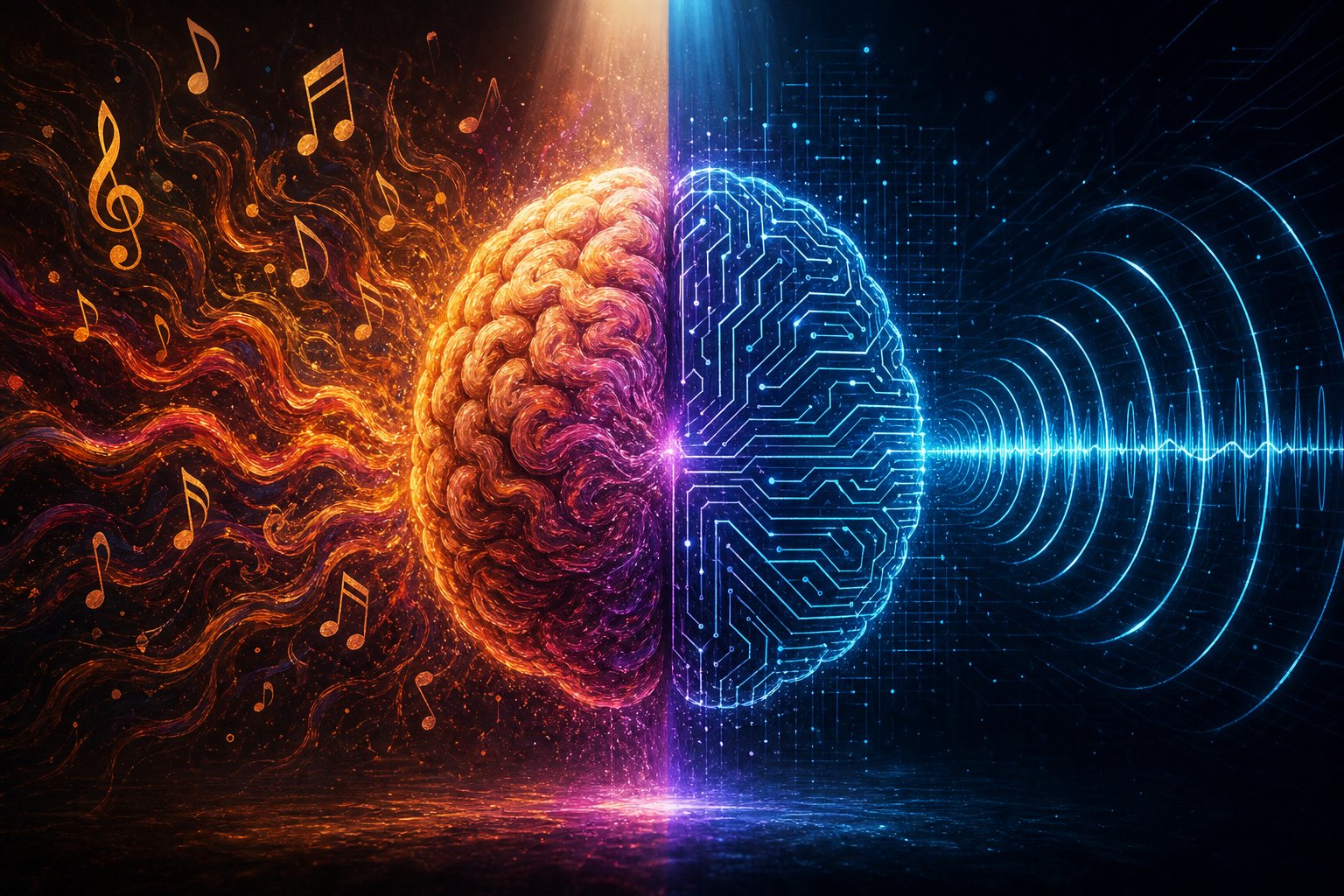
The clearest data we have on this question comes from an interdisciplinary study at Carnegie Mellon University. Researchers had participants compose melodies both with and without AI assistance, then had a separate group judge the results on creativity, enjoyment, and musicality. The findings were revealing: AI-assisted compositions were slower to produce, used fewer notes, and listeners rated them as less creative than purely human-composed pieces.
AI demonstrates technical competence in music generation, but humans still lead in creativity metrics, producing compositions that listeners perceive as more original and musically engaging.
As CMU doctoral researcher Jose Oros noted, most studies on AI focus on productivity, but creativity and novelty are central outcomes in music and the arts. These tools are being developed with the promise of improving creativity. If they are not helping, that has important implications for how we develop and deploy them.
Rich Randall, who leads CMU's Music Experience Lab, framed it more bluntly: "The ways humans shape pitches, not just how they combine them, but how they shape the sounds of them, how they organize them in time, the rhythmic pullbacks, delays and pushes that someone adds, it's not formulaic." AI-generated music, in his assessment, is always going to be derivative in some way, always going to be playing it safe. Humans are not constrained by that.
So can ai make better music than humans? By creativity research news standards, the answer is currently no. By production speed and accessibility standards, the answer shifts dramatically. It depends entirely on what you mean by "better."
Is Pattern Matching the Same as Composing
This is where the debate gets philosophical. Skeptics argue that generative AI does not compose at all. It recombines statistical patterns extracted from training data without any understanding of why music creativity matters, why a minor key shift conveys sadness, or why a delayed resolution builds tension. The machine processes correlations in data. It does not experience the music or intend anything by its choices.
Research published in Transactions of the International Society for Music Information Retrieval goes further, arguing that general musical creativity is fundamentally an "AI-complete" problem. It requires a cognitive model of how listeners perceive music, references to the external world, embodied knowledge of instruments and performers, and creativity at the meta-level, the ability to invent new rules rather than just follow existing ones. By this standard, current AI systems are not composing. They are performing sophisticated style replication within learned boundaries.
Proponents push back with a fair counterpoint: human creativity also builds on learned patterns. Every songwriter absorbs chord progressions, melodic shapes, and rhythmic conventions from thousands of songs before writing their own. Jazz musicians spend years internalizing the vocabulary of their predecessors before they can improvise freely. If human creativity is, at some level, pattern recognition plus recombination plus selection, then why music creativity in AI should be judged by a fundamentally different standard is not obvious.
The honest answer sits between these poles. AI composition lacks intentionality, emotional grounding, and the ability to break its own rules with purpose. But the boundary between "mere" pattern matching and genuine creative thought may be fuzzier than either side admits. CMU's Chris Donahue, who leads the Generative Creativity Lab, offered a nuanced take: "I do believe at some point AI systems will be able to generate a waveform that evokes the same kinds of captivating interests that human-created music currently does. Ultimately, it's still human intentionality driving those systems that is going to continue to be the focus of the foreground of the human music experience."
Whether AI "truly" composes may ultimately be a less productive question than asking how humans and machines create together, each contributing what the other lacks. That collaborative reality is already reshaping how professionals work.
AI-Human Collaborative Composition in Practice
The philosophical debate has its place, but the reality on the ground looks less like a contest and more like a partnership. Across studios, home offices, and bedroom setups, musicians and creators are already weaving AI into their daily process. A 2025 survey of 1,200 music creators found that 87% of artists have incorporated AI into at least one stage of their workflow, from songwriting and production to promotion. The shift reshaping ai and the music industry is not replacement. It is integration.
How Professional Musicians Use AI as a Creative Partner
For working musicians and producers, AI fits most naturally as an ideation engine and arrangement accelerator. Imagine you are stuck three hours into a session, cycling through the same chord voicings. Instead of walking away, you feed your existing progression into an AI tool and ask it to suggest harmonic variations or a bridge section you had not considered. The output is not a finished product. It is a creative catalyst that breaks the loop and gives you something to react to.
Here is a collaborative workflow that reflects how professionals are actually using these tools:
- Define the creative brief — Set the mood, tempo, instrumentation, and genre direction before generating anything. Intentional input produces intentional output.
- Generate raw material — Use AI to produce chord progressions, melodic fragments, drum patterns, or full backing tracks as starting points.
- Curate and select — Listen critically to multiple variations. Pull the elements that spark ideas and discard what feels generic.
- Reshape and humanize — Bring selected elements into your DAW. Adjust timing, swap instruments, layer live recordings, and add the micro-imperfections that make music breathe.
- Produce the final version — Mix, arrange, and master with full artistic control. The AI contribution becomes raw material inside a human-directed composition.
Producers also use AI for rapid prototyping before committing studio time. You can test whether a song works as a stripped-back ballad or a full-band arrangement in minutes rather than hours. Suno's Studio product, for example, lets musicians upload samples, generate unlimited stem variations, control BPM and pitch, then export everything as audio and MIDI to continue working in their existing DAW. The AI handles the tedious iteration. The musician makes the decisions that matter.
As Sonarworks notes, AI tools also help producers explore genres outside their comfort zone by providing authentic-sounding elements from different musical traditions. This cross-pollination often leads to unique hybrid styles that distinguish their work. A hip-hop producer can sketch a string arrangement without years of orchestration training. A folk guitarist can test how their melody sounds with electronic production before hiring a collaborator.
Content Creator Workflows with AI Composition
Content creators face a fundamentally different problem than professional musicians. They need music that supports their visuals, matches a specific mood, and clears licensing requirements, often on a weekly or daily publishing schedule. The ai music industry has responded directly to this demand.
For YouTubers, podcasters, and social media creators, AI composition solves a time equation. Instead of spending hours browsing stock libraries for a track that almost fits, you describe what you need, generate it, and move on to editing. The workflow looks different from a musician's approach:
- Describe the scene — Type a prompt that matches the emotional tone of your video segment: "warm acoustic guitar, hopeful, building energy, 90 seconds."
- Generate and test against picture — Drop the output onto your timeline immediately. Does it support the pacing? Does it hit the right emotional beat when the visually key moment lands?
- Iterate on specifics — Adjust tempo, energy, or instrumentation through follow-up prompts until the music feels invisible, doing its job without competing with the content.
- Create variations — Need a shorter edit for a social clip? A lower-intensity version for dialogue sections? Generate those from the same base rather than starting from scratch.
This approach works particularly well for creators producing at scale. Agencies running campaigns across multiple platforms can build a consistent sonic identity and adapt it to different lengths and intensities. Indie game developers use AI to prototype mood-driven themes and environmental layers before investing in final composition. Even music marketing ai illustration projects benefit, where creators need background audio that complements visual content without overshadowing it.
Getting Started as a Beginner
Complete beginners occupy a unique position in this landscape. They lack the technical vocabulary to program a DAW, the ear training to evaluate harmonic choices, and often the confidence to call themselves musicians at all. AI lowers every one of those barriers simultaneously.
The most celebrated benefit of ai in the music industry, according to creator surveys, is the ability to fill skill gaps. You do not need to understand voice leading to produce a compelling chord progression. You do not need mixing experience to get a polished-sounding track. The technology lets you start with what you have, a melody hummed into your phone, a lyric written in a notebook, a vague sense of mood, and hear it realized as actual music.
For beginners, the key is treating AI output as a learning tool rather than a finished product. Generate a track, then ask yourself why certain parts work and others do not. Use stem separation to isolate elements and study how the arrangement is constructed. Over time, you develop the critical ear and musical vocabulary that let you guide the AI more precisely, moving from passive consumer to active collaborator.
The gap between these three user profiles, professional, content creator, and beginner, is narrowing. AI in music industry workflows is creating a continuum where the same underlying technology serves different creative depths depending on who is driving it. What matters is not your starting skill level but your willingness to stay in the creative seat, making the choices that shape raw generation into something with purpose.
With workflows established across skill levels, a practical question follows: which tools actually deliver on these promises, and how do their approaches differ?
Generative AI Music Tools and How They Compare
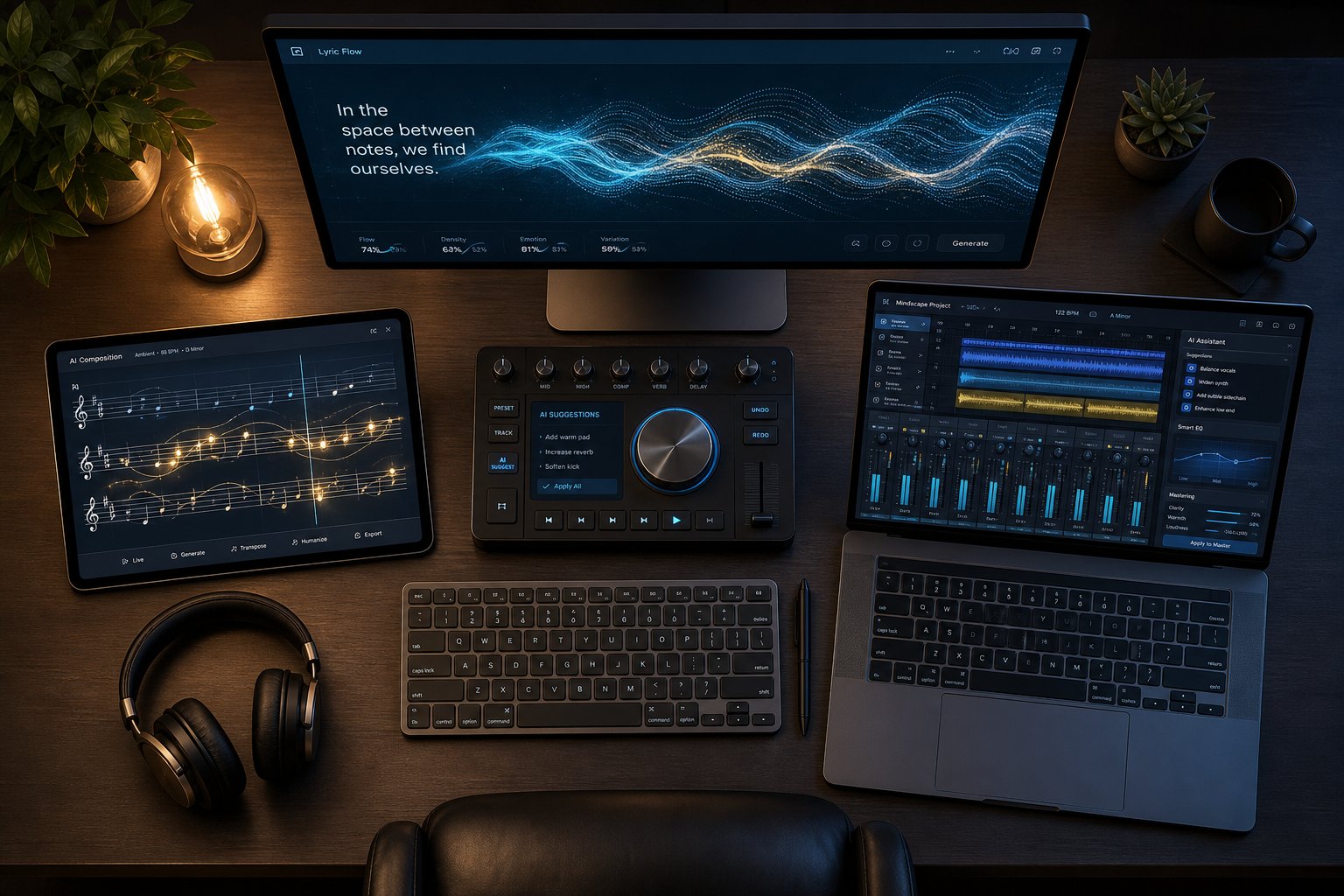
The tool landscape for AI music composition has fragmented into distinct categories, each built around different creative assumptions. Some tools want to replace the blank page entirely. Others want to sit quietly inside your existing session and offer suggestions when asked. Choosing the right one depends less on which platform has the flashiest demo and more on how you actually make music, what format you need the output in, and whether you plan to use it commercially.
Categories of AI Music Composition Tools
Think of the current market as four broad families. Each serves a different point on the composition spectrum we explored earlier, and each suits a different type of creator.
Text-to-music generators accept written prompts, lyrics, or mood descriptions and produce complete audio tracks. These tools handle the full pipeline from idea to finished sound, making them ideal for songwriters, content creators, and beginners who want polished output without touching a DAW. MakeBestMusic's Text to Music Generator is a strong example here, built specifically for turning written prompts or lyrics into polished songs without requiring musical training. Suno and Udio also operate in this space, generating full vocal tracks from short descriptions.
Fully autonomous composers go beyond single-track generation to produce scored arrangements across multiple instruments. AIVA leads this category as a dedicated ai classical music composer and cinematic scoring engine that outputs orchestral arrangements with customizable mood, genre, and instrumentation. These tools export MIDI for further editing, making them popular with film and game composers who need a starting point they can refine.
AI-assisted DAW plugins integrate directly into production environments like Ableton Live, Logic Pro, and FL Studio. Rather than generating finished tracks, they suggest chord progressions, extend melodies, generate drum patterns, or provide real-time accompaniment within your session. Staccato AI and BandLab SongStarter fall here. Logic Pro 12's AI musicians play along with your songs in real time, while FL Studio added an AI assistant that answers production questions on the spot. These plugins suit producers who want AI as a collaborator within an existing workflow, not a replacement for it.
Score-generation and notation tools produce symbolic output, MIDI files and sheet music, rather than audio. They target trained musicians and arrangers who think in notation and want to render the result through their own instruments or sample libraries. This category functions more like a composer ai assistant than a production tool, providing the notes and leaving the sound entirely to you.
Choosing the Right Tool for Your Needs
What separates these categories in practice comes down to five factors: input method, output format, genre range, depth of control, and licensing terms. A content creator needing weekly background tracks has radically different requirements than a film composer building a two-hour score or an ai classical music generator user sketching symphonic ideas.
| Category | Input Method | Best For | Output Quality |
|---|---|---|---|
| Text-to-Music Generators (e.g., MakeBestMusic, Suno, Udio) | Text prompts, lyrics, mood descriptions | Songwriters, content creators, beginners who need finished tracks from written ideas | High — full mixes with vocals, production-ready audio |
| Fully Autonomous Composers (e.g., AIVA, Beatoven.ai) | Genre selection, mood parameters, duration settings | Film/game composers, media producers needing scored arrangements | High for orchestral and cinematic; MIDI export enables refinement |
| AI-Assisted DAW Plugins (e.g., Staccato AI, Logic Pro AI Musicians) | MIDI input, audio clips, session context | Producers and musicians working inside existing DAW sessions | Variable — depends on how output is integrated into the mix |
| Score-Generation Tools (e.g., notation-focused AI assistants) | Key, meter, style parameters, or melodic seeds | Trained musicians, arrangers, and composers who work in notation | Symbolic only — quality depends on rendering engine used |
A few practical considerations that the table does not capture:
- Commercial licensing — Most ai music companies tie commercial usage rights to paid subscription tiers. Free plans typically restrict monetization or require attribution. Always verify before publishing. Tools like Soundraw and Loudly build royalty-free licensing directly into their subscription model, while others require checking plan-specific terms.
- Stem and MIDI export — If you plan to edit the output in a DAW, check whether the tool exports separated stems or MIDI alongside the full mix. Platforms offering stem export give you far more post-generation control than those delivering only a stereo bounce.
- Genre coverage — Text-to-music generators tend to cover the broadest range of styles because they condition on open-ended prompts. Autonomous composers often specialize, with AIVA excelling at orchestral work and Beatoven.ai optimized for adaptive underscore. Match the tool's strengths to the genres you actually produce.
- Customization depth — Some platforms offer granular controls over BPM, key, structure, and instrumentation. Others prioritize simplicity, giving you a prompt box and a generate button. Neither is inherently better. The right choice depends on how much control you want versus how quickly you need results.
The market is moving fast. Several of these categories are converging as tools add features that cross boundaries. Text-to-music generators are adding stem export. DAW plugins are gaining autonomous generation capabilities. The distinctions will blur further over the coming year. What will not change is the underlying question each creator must answer: do you want AI to hand you a finished product, or do you want it working alongside you as you build one?
Whichever category you choose, one question follows every generated track out the door: who owns it, and what can you legally do with it?
Copyright and Legal Status of AI-Composed Music
Ownership is not as straightforward as clicking "generate" and calling the track yours. The legal landscape surrounding AI-composed music is evolving rapidly, and the rules differ depending on where you live, how much human involvement shaped the output, and which platform you used. Getting this wrong can mean losing rights to your work entirely or, worse, facing infringement claims you never saw coming.
Who Owns Music That AI Composes
The foundational principle across most jurisdictions is simple: copyright requires human creativity. In January 2025, the U.S. Copyright Office released Part 2 of its AI report, stating that "the outputs of generative AI can be protected by copyright only where a human author has determined sufficient expressive elements." Writing a prompt, no matter how detailed, does not constitute authorship. Fully AI-generated music with no meaningful human creative input falls into the public domain under U.S. law.
That creates a critical split. AI-assisted works, where a human writes the melody, selects arrangements, edits outputs, and makes expressive decisions, can retain copyright protection. The AI functions like any other tool in the studio. But fully autonomous outputs, where the machine handles every creative choice from a minimal prompt, face uncertain or nonexistent legal protection.
The UK presents a different picture. Section 9(3) of the Copyright, Designs and Patents Act 1988 offers some protection for "computer-generated works," assigning copyright to whoever arranged for the work's creation. However, the UK government scrapped plans in early 2026 that would have allowed AI companies to train on copyrighted material without permission, signaling a regulatory environment that is actively tightening rather than relaxing. The ai copyright music news cycle keeps shifting, and creators need to stay current.
Platform terms add another layer. Most AI music services offer "ownership" to paid subscribers, but their own documentation often admits this may not include actual copyright protection. As one legal analysis noted, Suno's terms of service explicitly state: "Due to the nature of machine learning, Suno makes no representation or warranty to you that any copyright will vest in any Output." Ownership of the file and ownership of the intellectual property are not the same thing.
Commercial Use and Licensing Realities
Can you use AI-generated music commercially? Technically yes, on most paid plans. But "commercially usable" and "legally defensible" are different standards. The major copyright music ai news story of the past year has been the coordinated lawsuits from Universal, Sony, and Warner against AI music platforms, with the RIAA accusing these companies of "mass infringement of copyrighted sound recordings on an almost unimaginable scale."
Why does this matter to you? If the platforms generating your music trained on copyrighted material without proper licensing, the legal provenance of their output is questionable. Someone could claim the AI's output resembles their copyrighted work, and you would be the one fielding the dispute. Platforms shift liability to users in their terms and conditions.
Training data sourcing directly affects the legality of what comes out the other end. The settlement pattern tells the story: Udio settled with Warner Music and Universal by late 2025, pivoting to a licensed partnership model. The industry is moving toward "walled garden" approaches where AI companies license catalogs under strict conditions. Until that transition is complete, music generated by tools that trained on unlicensed data carries residual legal risk.
Meanwhile, ai music production companies stock audio human-made certification discussions are gaining traction. Platforms like Deezer and Spotify are implementing measures to distinguish human-created music from AI-generated output, with Spotify removing tens of millions of AI-generated spam tracks and Deezer receiving over 30,000 fully AI-generated submissions daily. Industry groups are actively developing certification frameworks and provenance tracking systems that would give listeners and licensors confidence in a track's origin.
Protecting Yourself as a Creator
Regardless of which tools you use, practical steps can strengthen your legal position and reduce exposure to disputes.
- Document your creative process — Save your prompts, selection decisions, edits, and any original material you contributed. This paper trail demonstrates the human authorship that copyright law requires.
- Add substantial human modification — The more you genuinely transform AI output, rearranging sections, rewriting melodies, re-recording with live instruments, layering original vocals, the stronger your claim to authorship becomes.
- Verify your platform's licensing tier — Free plans on most platforms do not grant commercial rights. Paid tiers vary significantly in what they actually transfer to you. Read the terms before publishing.
- Avoid prompts referencing specific artists or songs — Requesting output "in the style of" a named artist dramatically increases infringement risk. Keep prompts genre-based and descriptive rather than derivative.
- Consider registering important works — If your composition includes significant human creative input, registering with the copyright office (approximately $45-65 in the U.S.) provides legal presumption of ownership and the ability to pursue statutory damages.
- Disclose AI involvement when registering — The U.S. Copyright Office requires disclosure of AI-generated content in registration applications. Failing to disclose can invalidate your registration entirely.
- Plan for platform changes — Terms of service evolve. If a platform changes its policies or shuts down, can you prove the provenance of your music? Keep local copies and documentation independent of any single service.
The legal ground is still settling. Courts are actively deciding cases that will define the boundaries for years to come. The safest position is clear: the more human creativity you invest in the process, the more legal protection you retain. AI works best as a tool in the creative chain, not as the sole author, both artistically and legally.
With legal realities framing the boundaries of what is possible today, the natural question becomes where all of this is heading, and what creators at every skill level should do right now to stay ahead of the curve.

Where AI Composition Is Heading and How to Start Now
The trajectory is clear even if the destination is not. Three years ago, AI music tools produced novelty demos that impressed for about thirty seconds. Today, platforms like Suno have crossed 100 million users, AI-assisted tracks are charting on Billboard, and 87% of producers use AI in at least one stage of their workflow. The ai impact on music industry operations is no longer speculative. It is measurable and accelerating.
The Trajectory of AI Music Composition
Will ai get better at helping with making music? Every signal points to yes, and quickly. The generative ai music news today centers on tools evolving from prompt boxes into full production environments with timeline editing, stem separation, and MIDI export. The gap between typing a sentence and crafting a deliberate composition is widening in favor of creator control.
Industry analysis from OC&C Strategy Consultants projects AI music could account for 60% of music library revenues by 2028, primarily in functional contexts like background scoring, ads, and games. That is where speed, cost, and customization outweigh brand recognition. Meanwhile, the impact of ai on music industry economics is pushing platforms toward tiered royalty structures, licensed training data, and human-made certification systems that will reshape how all music is valued and distributed.
The pattern mirrors what happened with synthesizers, drum machines, and DAWs. Initial resistance gives way to absorption. AI becomes invisible infrastructure, a standard part of how music gets made rather than a controversial alternative to it. The latest ai music updates confirm this: major DAWs are embedding AI musicians directly into their sessions, and rights holders are shifting from litigation to licensing partnerships.
Practical Next Steps for Musicians and Creators
Wherever you sit on the skill spectrum, the best time to develop fluency with these tools is now. Here is how to start based on your situation:
- Professional musicians — Integrate AI at Levels 1 and 2. Use it for ideation, rapid prototyping, and arrangement experimentation within your DAW. Export stems and MIDI from generated output, then reshape everything with your own ear and intention. Your creative judgment remains the differentiator.
- Content creators — Adopt text-to-music generation for your production pipeline. Describe the mood and energy you need, generate variations, and test them against your visuals immediately. This eliminates stock library browsing and gives you custom audio that matches your brand.
- Beginners — Start by turning ideas into sound. If you have lyrics, a melody in your head, or even just a description of how you want music to feel, tools like MakeBestMusic's Text to Music Generator let you hear those ideas realized as finished songs without requiring any musical training. Use the output as a learning tool: study the arrangements, isolate stems, and gradually develop the vocabulary to guide generation more precisely.
- Everyone — Document your creative contributions. As legal frameworks solidify, the creators who can demonstrate genuine human authorship in their process will hold the strongest position, both artistically and legally.
The generative music news cycle will keep delivering breakthroughs, new tools, and shifting legal ground. What will not change is the fundamental dynamic: AI handles the mechanics of sound while humans supply the meaning behind it. The creators who thrive will be those who learn to direct these systems with intention rather than passively accepting whatever comes out. The technology is ready. The question is what you choose to build with it.
