

The Real Answer to Distributing AI Generated Music
Can you upload AI music to Spotify, Apple Music, or any other major streaming platform? The short answer is yes — but only under the right conditions. The real answer depends on three factors: how much AI was involved in creating the track, which distributor you use to get it onto stores, and whether your output qualifies for copyright protection.
This is not a simple yes-or-no situation. A producer who uses AI to generate a drum pattern and then builds an original song around it faces a completely different landscape than someone who types a prompt into Suno and uploads the raw output. Both are using AI. Only one is likely to stay on streaming platforms without issues.
This guide breaks down the full picture — the legal framework governing AI music ownership, the specific policies each major distributor enforces, and the practical steps you need to take to get your tracks live without risking takedowns or bans.
Why This Question Matters for Modern Creators
AI music tools have gone from niche experiments to mainstream production resources in a remarkably short time. A 2025 study from Water & Music and Moises found that 78% of professional musicians used AI for music-related work in the past 12 months. Platforms like Suno, Udio, and LANDR Composer have made it possible for anyone to generate tracks, stems, and even full songs with minimal musical training.
That explosion of creative possibility has created a knowledge gap. Thousands of creators now have tracks sitting on their hard drives and one burning question: can I publish a song written by AI and actually earn from it? The tools move fast. The rules around ai music distribution have struggled to keep pace.
Legal vs Practical — Two Separate Questions
Here is where most creators get tripped up. They conflate two distinct hurdles into one. Copyright law determines whether you can legally own and protect your AI-assisted work. Platform and distributor policies determine whether your track will actually be accepted, stay live, and earn royalties.
Being legally allowed to distribute a track and having a distributor actually accept it are two different hurdles — and you need to clear both to earn from AI-created music on streaming platforms.
A track might be perfectly legal to release yet still get rejected by your distributor's content review. Conversely, a distributor might accept a track that occupies a legal gray area regarding ownership. Understanding where your specific workflow falls on this spectrum is the key to making informed decisions — and that starts with knowing what copyright law actually says about AI-generated outputs.
Copyright Law and AI Music Ownership
Copyright is the foundation everything else rests on — your ability to claim ownership, collect royalties, and enforce exclusivity over a track. So what does copyright law actually say about music made with AI? The answer hinges on one critical factor: human authorship.
The U.S. Copyright Office has made its position clear through registration guidance, review board decisions, and its multi-part AI report. Purely AI-generated works — those created without meaningful human creative input — cannot receive copyright registration. This is not a new rule invented for AI. It is a longstanding legal principle that copyright protects human expression, applied to a new technology.
The distinction that matters most is between AI-generated and AI-assisted works. A track that AI produces autonomously from a text prompt falls into the first category. A track where a human writes melodies, arranges sections, edits outputs, or layers original performance over AI elements falls into the second. That second category can qualify for copyright protection — but only for the human-authored portions.
The Human Authorship Requirement Explained
What counts as sufficient human creative input? The USCO's Part 2 Copyrightability Report (January 2025) addresses this directly. Typing a prompt — even an extremely detailed one — does not constitute authorship. The reasoning is straightforward: prompts are instructions, not expressions of creativity. The AI system interprets those instructions through its own algorithms and training data, making creative decisions the user does not control.
The U.S. Copyright Office concluded that even if a prompt is extremely detailed or complex, it does not confer copyright ownership over an AI-generated output, because prompts function as instructions rather than expressions of creativity.
So can ChatGPT create a song you can copyright? Not if the AI is doing all the creative heavy lifting. But the USCO takes a case-by-case approach. Copyright protection may apply when a human:
- Edits or modifies AI-generated content in ways that add original creative expression
- Arranges or selects AI-generated elements into a larger human-authored work
- Writes original lyrics or melodies that AI then accompanies or produces around
- Performs, records, or layers original instrumentation over AI-generated backing tracks
Imagine you use an AI tool to generate a chord progression, then write your own vocal melody, craft original lyrics, arrange the song structure, and mix the final track. That workflow likely produces a copyrightable work — with protection covering your human contributions. The AI-generated chord progression itself may not be protectable, but your song as a whole could be. This is where song splits become relevant: you would need to clearly document which elements are human-authored versus AI-generated.
How Different Jurisdictions Handle AI Music Rights
Copyright law is territorial, and not every country approaches AI the same way. Since streaming platforms and distributors operate globally, creators need at least a basic awareness of how the major jurisdictions differ.
The United States applies existing human authorship requirements without new AI-specific legislation. The USCO has stated that "existing legal doctrines are adequate and appropriate to resolve questions of copyrightability" and that copyright law can handle case-by-case determinations as AI evolves.
The European Union has not created a unified position on AI output copyrightability, but the AI Act (effective 2024) introduces transparency obligations for AI systems. Member states still apply their own copyright frameworks, most of which require human intellectual creation as a threshold for protection — broadly consistent with the US approach.
The United Kingdom presents an interesting outlier. Section 9(3) of the Copyright, Designs and Patents Act 1988 provides protection for "computer-generated works" where no human author exists — a provision no other major jurisdiction offers. However, this provision was never designed with generative AI in mind, and its application remains debated. The UK Intellectual Property Office ran a major public consultation on copyright and AI in early 2025, receiving over 11,000 responses, and expert working groups are actively exploring policy options heading into 2026.
For creators distributing globally, the practical takeaway is this: the most restrictive jurisdiction often sets the effective standard. If your track cannot qualify for copyright in the US — the largest streaming market — that limitation follows you regardless of more permissive rules elsewhere.
What No Copyright Actually Means for Distribution
Here is where many creators get confused. Does DistroKid copyright your music when you upload it? No — no distributor grants you copyright. They distribute what you provide. And critically, lacking copyright does not automatically prevent you from distributing a track. It means something different.
Without copyright protection, you cannot:
- Claim exclusive ownership over the composition or recording
- Prevent someone else from using, copying, or distributing the same output
- File takedown notices against others who reproduce similar AI-generated content
- Register the work with performing rights organizations for publishing royalties
You can still upload and distribute the track through platforms that accept it. You can still earn streaming royalties on plays your release generates. What you lose is the legal monopoly that copyright normally provides — the ability to say "this is mine and no one else can use it."
For some creators, that trade-off is perfectly acceptable. For others building a catalog they intend to license, protect, or monetize long-term, it is a serious limitation. The key is understanding where your workflow falls on the spectrum of AI involvement — and that spectrum is more nuanced than most people realize.
Levels of AI Involvement and What They Mean
Not all AI use is created equal. A producer who runs a finished mix through an AI mastering engine is in a completely different category than someone generating entire songs from a two-line prompt. Yet both could technically answer "yes" to the question "Did you use AI?" That vagueness is exactly why distributors and platforms have started classifying AI involvement into distinct tiers — and why you should too.
Think of it as a spectrum. On one end, AI handles a single technical task within a human-driven creative process. On the other end, AI does all the composing, performing, and producing while a human simply clicks "generate." Where your workflow lands on this spectrum determines whether your tracks qualify for full distribution, limited distribution, or none at all.
From AI-Assisted Mixing to Fully Generated Tracks
Inspired by classification systems like Identity Music's five-category AI policy and adapted for universal application, here are the five levels of AI involvement in music creation:
- AI for mixing, mastering, or technical processing only. You compose, perform, and arrange everything yourself. AI handles post-production tasks like EQ balancing, loudness optimization, or audio cleanup. This is comparable to using any other automated tool in your signal chain.
- AI generates individual elements that humans arrange. You might use an AI sample chopper to create drum loops, or an AI tool to produce a bass line or synth texture. You then arrange, layer, and build the full track yourself. The creative decisions about structure, progression, and overall composition remain yours.
- Human writes core musical content with AI accompaniment. You write the lyrics, compose the melody, or create the chord progression. AI assists by generating backing instrumentation, harmonies, or production around your original material. If you want to know how to separate instruments in a song for remixing purposes, AI stem splitters fall here too — they are tools supporting your creative vision.
- AI generates most elements with human selection and editing. You prompt an AI to generate multiple outputs, then select the best sections, edit them together, adjust arrangements, and refine the final product. The raw material is AI-created, but the curation, editing, and assembly involve meaningful human decision-making.
- Entirely AI-generated with minimal human input. You type a prompt or set basic parameters, and the AI delivers a finished track. Your involvement is limited to choosing which output to keep. What are split tracks in this context? There are none — because no separable human contribution exists to split ownership over.
The key factor platforms evaluate is the degree of meaningful human creative contribution — not simply whether AI was involved at any stage of production.
How Your AI Involvement Level Affects Distributability
Each tier maps to a different distribution reality:
Tiers 1 through 3 are generally accepted by all major distributors and streaming platforms. Human creativity clearly drives the final product, with AI in a supporting role. Identity Music classifies these as eligible for full distribution, and most other distributors follow the same logic. No special restrictions apply beyond standard content guidelines.
Tier 4 is where things get platform-dependent. Some distributors allow this with disclosure and limitations — for example, Identity Music permits "partially AI-generated" tracks on streaming platforms but blocks them from rights management systems like YouTube Content ID. The reasoning is practical: AI-generated elements often lack the originality required for content fingerprinting, and similar outputs from the same model can trigger false ownership claims against other creators.
Tier 5 faces the most restrictions. Many distributors reject fully AI-generated content outright. Even those that do not explicitly ban it impose quality filters and spam detection that flag bulk-generated, low-effort releases. Streaming platforms themselves are also tightening enforcement — Spotify's anti-fraud systems now actively detect and de-prioritize content that appears to lack human creative involvement.
Identifying your tier is not just an academic exercise. It directly shapes which distributors will work with you, which platforms your music can reach, and what monetization options remain available. The next critical piece is understanding exactly how each distributor translates these tiers into specific acceptance policies — because the rules vary more than you might expect.
Distributor Policies Compared Side by Side
Knowing your tier of AI involvement is only half the equation. The other half is finding a distributor whose policies actually align with your workflow. Does DistroKid allow AI music? What about TuneCore's stance on fully generated tracks? Each platform draws the line in a different place — and those lines have shifted significantly in recent months.
The problem for creators is that no two distributors apply the same rules. One might welcome your AI-generated track with open arms while another rejects it outright. Rather than forcing you to read seven different terms-of-service documents, here is the consolidated comparison.
Which Distributors Accept AI Music Right Now
This table reflects distributor policies as of mid-2026. Because these policies evolve quickly, always verify current terms directly with your chosen platform before uploading.
| Distributor | AI Policy Stance | Disclosure Required | Specific Conditions | Human Authorship Certification |
|---|---|---|---|---|
| DistroKid | Accepts (fully and partially AI-generated) | Yes — checkbox during upload | Must own 100% of rights; no impersonation; no mass-generated spam | No |
| TuneCore | Restricts (no 100% AI-generated) | Yes — detailed attribution form | Human creation must be "clear, provable, and dominant"; resubmission allowed if flagged | Yes |
| CD Baby | Rejects (fully AI-generated banned) | Yes — must prove human authorship | AI permitted only for mixing/mastering; generative AI use in composition rejected | Yes |
| Ditto Music | Accepts (passes through DSP rules) | Yes — disclosure during upload | Warns that DSPs may reject or demonetize; artist assumes liability | No |
| Amuse | Accepts with platform restrictions | Yes | AI releases distributed only to select platforms (Qobuz, Meta, YouTube Content ID) | No |
| United Masters | Accepts with platform restrictions | Yes | AI tracks limited to Meta and TikTok distribution only | No |
| Identity Music | Restricts (bans fully AI-generated) | Yes | Partially generated tracks allowed on streaming but blocked from Content ID and rights management | Yes (for full distribution) |
The pattern is clear. DistroKid's AI music policy is the most permissive among major distributors — it accepts fully AI-generated tracks as long as you disclose, own the rights, and avoid spammy behavior. On the opposite end, CD Baby enforces a near-total ban on generative AI in composition. Everyone else falls somewhere in between, with varying degrees of restriction on which platforms your AI tracks can actually reach.
Notice that distributors like Amuse and United Masters technically "accept" AI music but limit where it goes. Your track might clear their upload process yet never reach Spotify or Apple Music — only smaller platforms willing to host AI content without editorial suppression. That is a meaningful distinction if streaming revenue is your goal.
Reading the Fine Print on AI Disclosure Requirements
Here is what catches many creators off guard: disclosure is no longer optional on any major platform. Every distributor in the table above requires you to indicate AI involvement during upload. The consequences of skipping that step can be severe — even when the content itself would have been accepted with proper disclosure.
The DistroKid disclosure process is a single checkbox. Check it, and your track enters the standard distribution pipeline with an AI metadata flag passed through to streaming platforms. Skip it, and automated detection systems may flag your upload anyway. Confirmed undisclosed AI content gets removed, and repeat offenders risk account suspension.
The TuneCore AI generated music policy demands more granular transparency. Their upload form asks you to specify which aspects used AI — composition, lyrics, vocals, production, or mastering — and which tools you used. Think of it less as a checkbox and more as a breakdown. "Melody composed by AI, lyrics written by human, production mixed by human" is the level of detail they expect. If their system detects AI characteristics that do not match your disclosure, the release gets paused for resubmission rather than permanently rejected. You get a second chance, but it delays your release timeline.
CD Baby takes a different approach entirely. Rather than asking you to disclose AI use, they ask you to prove human authorship. The burden flips. You are not flagging what the AI did — you are demonstrating what you did. For tracks where AI handled anything beyond mixing and mastering, this is a barrier most AI-heavy workflows cannot clear.
Failing to disclose AI involvement is now the single fastest way to get a release taken down — even when the content itself would have been accepted with proper transparency.
One more critical detail: these distributor policies sit on top of the streaming platforms' own rules. Spotify, Apple Music, and Deezer each apply their own AI content handling independently. A track that passes your distributor's review can still be demonetized, suppressed from playlists, or publicly tagged as AI-generated once it reaches the DSP level. Your distributor gets the music to the store. What happens inside the store is a separate layer of policy — and that affects how much you can actually earn from AI-created tracks once they are live.
How to Actually Get AI Music on Streaming Platforms
Policies and tiers are useful to understand, but they do not get your track onto Spotify. The gap between having a finished AI-assisted song on your hard drive and hearing it stream on a platform is filled with practical steps — file formats, metadata fields, disclosure checkboxes, and review processes that trip up even experienced creators. Here is what the process actually looks like from export to live.
Preparing Your AI Music Files for Upload
Before you touch a distributor's upload form, your files need to meet technical specifications. Whether you used Udio, Suno, LANDR Composer, or any other AI music generator, the supported audio formats for direct use on most distributors follow the same standard: uncompressed WAV files at 16-bit or 24-bit depth, with a sample rate of 44.1 kHz or 48 kHz. MP3 files are almost universally rejected for distribution — even if your AI tool exports in MP3, you will need to work from the highest-quality source available.
A few technical requirements that catch creators off guard:
- Bit depth and sample rate: Most distributors prefer 24-bit/44.1 kHz WAV as the industry standard for final masters. Some accept 48 kHz, but 44.1 kHz is the safest bet for universal compatibility across DSPs.
- No excessive silence: Platforms reject tracks with more than five seconds of silence at the beginning or end. If your AI tool appends dead air to outputs, trim it before uploading.
- Album artwork: 3000 x 3000 pixels minimum, RGB color mode, JPEG or PNG format. No logos you do not own, no single-color generic images, and no text that contradicts your metadata.
- Keep your stems: Even if you are uploading a final master, retain individual stems (vocals, instruments, drums). They prove human involvement if a distributor requests evidence, and they enable future remixes or radio edits.
Metadata is where many AI music uploads fall apart. You need accurate information for: track title, artist name, featured artists, genre, release date, and — critically — songwriter and composer credits.
The songwriter field creates a unique challenge for AI-created music. If you wrote the lyrics and melody yourself with AI handling production, list yourself as the songwriter and composer. If AI generated the composition entirely, the honest answer depends on your distributor's policy. DistroKid allows you to credit yourself as the artist regardless of AI involvement, while platforms like TuneCore expect the credited songwriter to have actually authored the composition. Never list the AI tool itself as a songwriter — distributors reject this, and performing rights organizations cannot register non-human entities.
One practical approach: if your workflow falls in Tiers 2 through 4 from the spectrum covered earlier, credit yourself for the elements you genuinely created and use the AI disclosure process to flag the rest. This keeps your metadata honest and avoids rejection triggers down the line.
The Upload and Disclosure Process Step by Step
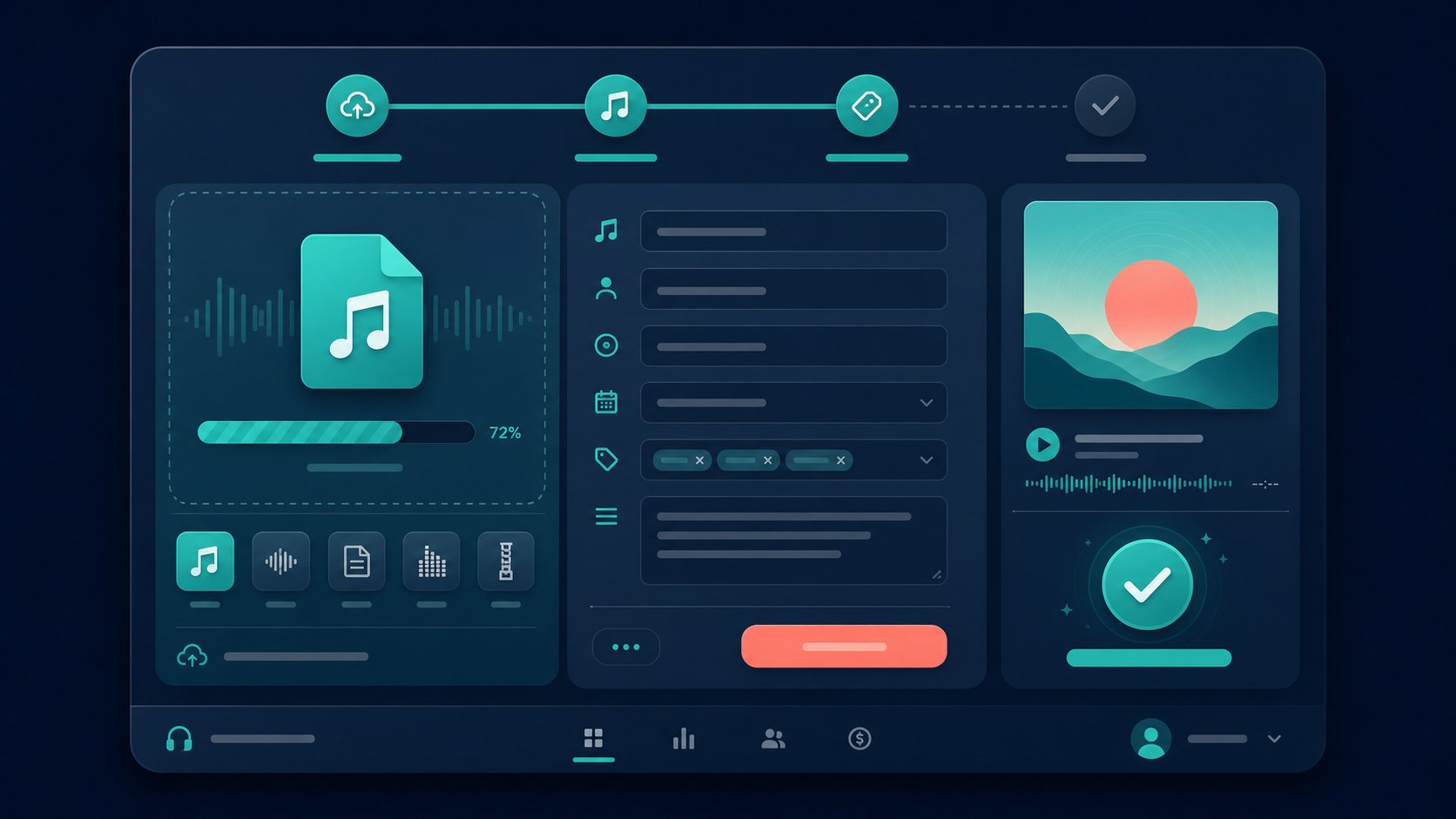
Once your files and metadata are ready, the actual upload follows a predictable sequence across most distributors. Here is the typical flow:
- Create a new release. Select single, EP, or album. Enter your release title, artist name, and label (use your own name if you are independent).
- Upload audio files. Drag in your WAV masters. The platform verifies format, duration, and audio quality. Some distributors run an automated loudness check at this stage.
- Enter track metadata. Fill in track titles, songwriter credits, composer names, ISRC codes (or let the distributor auto-assign them), and language. Mark explicit content if applicable.
- Complete AI disclosure. This is the step that did not exist two years ago. Select the checkbox or form indicating AI involvement. On DistroKid, you specify whether AI generated the lyrics, the music, all of the audio, or part of the audio. If you select "All of the audio," they also ask whether your artist name represents a human or an AI persona — streaming services use this to display credits correctly.
- Upload artwork. Attach your cover image meeting the pixel and format requirements. Ensure any text on the artwork matches your metadata exactly — mismatches trigger rejection.
- Select distribution platforms. Choose which DSPs receive your release. Some distributors limit AI content to specific platforms, so not every store may be available depending on your disclosure answers.
- Set release date and submit. Aim for at least three to four weeks before your intended release date. Some platforms need that lead time for editorial playlist consideration, and AI-flagged releases may take longer to clear review.
After submission, your release enters a review queue. Automated systems check for audio quality issues, metadata formatting, artwork compliance, and — increasingly — AI content markers. If anything fails, you receive a rejection notice with the specific reason. Most rejections are fixable: update metadata, swap artwork, or provide additional documentation.
Does DistroKid upload to SoundCloud? Yes, though SoundCloud's distribution arm operates its own separate AI content policy. SoundCloud's terms explicitly prohibit generative AI content unless it was created using their approved AI integration partners. If your AI music passes DistroKid's review but reaches SoundCloud, it may still be rejected at the platform level. This is an example of licensing documents for SoundCloud distribution playing a critical role — you may need to provide DAW project files, proof of creation, or documentation showing the production tools you used.
Getting Past Platform Review Without Rejection
Rejection is not a dead end, but it wastes time and delays your release. Knowing what reviewers look for — both human and automated — helps you avoid common pitfalls before they happen.
The biggest rejection triggers for AI music specifically:
- Misleading metadata. Avoid SEO-style titles like "Lofi Beats for Study" or "Chill Ambient Sleep Music." Platforms classify these as misleading and flag them regardless of how the music was made. Use a genuine track title that describes your release.
- Bulk uploads of low-effort content. Uploading 50 AI-generated tracks in a single week signals automated spam to every distributor's review system. Space your releases, and ensure each one demonstrates distinct creative identity.
- Incomplete or inconsistent artist profiles. A brand-new artist account with zero listening history that suddenly uploads multiple albums looks suspicious. Build a realistic profile presence — a bio, social links, and a release cadence that mirrors an actual creative practice.
- Artwork that fails automated checks. Content matching systems flag AI-generated cover art that resembles copyrighted images. If your artwork was made with an image generator, ensure it does not closely mimic recognizable copyrighted material. Keep original design files as proof of creation.
- Mismatch between disclosure and content. If you mark a track as having no AI involvement but the audio exhibits telltale AI characteristics — certain vocal artifacts, uniform production patterns, or elements matching known AI model outputs — automated detection can override your self-reported disclosure.
One practical tip that experienced AI music creators share: treat each release as if a human reviewer will listen to thirty seconds of it. Because in many cases, they will. Reviewers are not evaluating musical quality or genre preference — they are checking whether the release looks and sounds like a legitimate creative effort versus bulk-generated filler. Proper metadata, unique artwork, and a reasonable release pace signal legitimacy far more than the technical quality of the audio itself.
Getting your track live is the distribution challenge. Keeping it live — and actually earning from it — introduces an entirely different set of questions around monetization, royalty collection, and which revenue paths remain available when copyright ownership is uncertain.

Monetization and Royalties for AI Created Music
Your AI-assisted track is live on Spotify. Streams are trickling in. But a nagging question remains: are you actually earning the same per-stream rate as a human-produced release? And beyond streaming, which revenue paths are even available when your music involves AI?
The monetization picture for AI music is more nuanced than most creators expect. Some income streams work identically to traditional releases. Others are partially blocked. A few are actually better suited to AI-generated catalogs than human-made music. Understanding which is which helps you focus your energy where the money actually flows.
Do AI Tracks Earn the Same Per-Stream Royalties
Short answer: yes. Streaming royalties are paid based on listener share of a platform's total revenue pool — not based on how the music was created. Once your AI track passes distribution and goes live on a DSP, every stream earns at the same rate as any other track on that platform. Spotify does not pay less per stream because AI was involved. Neither does Apple Music, Deezer, or Tidal.
The payment chain works the same way regardless of creation method: a listener streams your track, the platform calculates your proportional share of that period's revenue pool, they pay your distributor, and the distributor passes it through to you minus any applicable fees. No checkpoint in that process verifies copyright status before issuing payment.
Publishing royalties are a different story. Performance royalties — collected by PROs like ASCAP, BMI, and SESAC when music is publicly performed or streamed — require you to register your compositions. Registration implies you hold compositional copyright. For fully AI-generated works, this creates a barrier.
A significant policy shift arrived in October 2025, when ASCAP, BMI, and SOCAN jointly announced they would accept registrations for musical compositions partially generated using AI tools. The key word is "partially." These works must combine AI-generated elements with elements of human authorship. Fully AI-generated compositions — those with no human creative contribution — remain ineligible for PRO registration with any of the three societies.
The practical breakdown looks like this:
- Fully AI-generated music: Earns streaming royalties normally, but cannot be registered with PROs for performance or mechanical royalties
- Human lyrics plus AI-generated music: The lyrical portion may qualify for registration, enabling partial publishing royalty collection
- AI-assisted with significant human input: Likely registrable for full performance royalties through ai music publishing administration services
Mechanical royalties — paid for reproduction of compositions through entities like the Mechanical Licensing Collective — face the same copyright dependency. If your composition is not copyrightable because it was entirely AI-generated, collecting mechanical royalties remains uncertain. For most AI music creators, streaming master royalties represent the reliable primary income stream.
Alternative Revenue Streams Beyond Streaming
Streaming is the most accessible revenue path, but it is rarely the most lucrative — especially for AI-generated catalogs. A track might earn $3 to $5 per thousand streams on Spotify. That same track, licensed for a TV commercial or packaged into an enterprise licensing deal for bulk ai-generated custom music, could generate hundreds or thousands of dollars from a single placement.
Several alternative monetization channels work well for AI music, and some actually favor it. Sync licensing — placing music in films, ads, games, and YouTube videos — operates through negotiated contracts rather than royalty collections. The buyer cares about having permission to use the music, not whether it holds a copyright registration. If your AI tool grants you commercial distribution rights and you can deliver the files, you can license the track. Enterprise clients seeking custom background music at scale find AI-generated catalogs particularly attractive, as they offer rapid turnaround and consistent quality at volume pricing.
Stock music libraries represent another strong fit. Platforms that sell production music to video creators, podcasters, and advertisers often welcome AI-generated submissions — the demand for affordable, royalty-free background music far outstrips human production capacity. Some libraries now offer ai-generated stock music bulk order discounts for enterprise clients who need hundreds of tracks for app environments, retail spaces, or content networks.
YouTube monetization also works reliably. AdSense revenue from your own channel and Content ID payments from others using your music are both based on channel ownership and distributor registration, not copyright claims.
| Revenue Path | Works for AI Music? | Copyright Required? | Revenue Potential | Best For |
|---|---|---|---|---|
| Streaming royalties (master) | Yes — identical to human music | No | $3–$5 per 1,000 streams | All AI creators with distributed tracks |
| Performance royalties (PRO) | Partially — only AI-assisted works | Yes | Varies by usage and venue | Creators with significant human authorship |
| Sync licensing | Yes — contract-based | No (but strengthens negotiating position) | $100–$50,000+ per placement | Creators targeting film, TV, ads, games |
| Stock music sales | Yes — high demand for volume | No | $1–$50 per license sold | Producers building large AI catalogs |
| Enterprise bulk licensing | Yes — AI excels here | No | $500–$10,000+ per contract | AI studios serving brands and apps |
| YouTube AdSense / Content ID | Yes — ownership-based | No | $1–$8 per 1,000 views | Creators with active YouTube channels |
The revenue paths that require copyright — primarily PRO registration and exclusive licensing deals — remain partially closed to fully AI-generated works. But the paths that do not require copyright represent the majority of where AI music creators actually earn. Streaming, sync, stock, and direct enterprise deals all function on the basis of distribution rights and contractual permission rather than registered ownership.
This distinction matters for how you structure your creative workflow. If maximizing revenue is the goal, the question shifts from "can I earn from AI music" to "am I leaving money on the table by not adding enough human involvement to unlock every available revenue stream?" And on the flip side, if you are earning from a channel that works — be careful not to jeopardize it by making common mistakes that trigger takedowns.
Common Mistakes That Lead to Takedowns
Earning royalties from AI music is possible — but only as long as your tracks stay live. And staying live is not guaranteed. Platforms are removing AI content at unprecedented scale, and the enforcement is accelerating. Spotify confirmed it removed over 75 million "spammy tracks" in a single 12-month period, a crackdown driven heavily by the explosion of generative AI tools. Deezer reports receiving over 50,000 fully AI-generated tracks every day, with up to 70% of plays on those tracks detected as fraudulent.
These are not random enforcement sweeps. Platforms are targeting specific patterns — recognizable behaviors that signal low-effort spam, impersonation, or policy violations. If your AI music gets taken down, chances are it tripped one of these triggers. Knowing them in advance lets you avoid the mistakes that cost creators their releases, their revenue, and sometimes their entire distributor accounts.
Mistakes That Get AI Music Taken Down
Patterns drawn from distributor enforcement actions, platform policy updates, and creator community reports reveal the same errors appearing again and again. Here is what gets AI music flagged, suppressed, or permanently removed:
- Failing to disclose AI involvement. This is the single most common mistake. Every major distributor now requires disclosure. Skipping the checkbox or underreporting AI's role does not protect you — it exposes you. Automated detection systems are increasingly capable of identifying AI-generated audio characteristics independently, and when their findings contradict your self-reported disclosure, the track gets removed and your account gets flagged. DistroKid, TuneCore, and others explicitly state that undisclosed AI use is grounds for takedown regardless of whether the content itself meets their acceptance criteria.
- Uploading content that mimics a specific artist's voice. Spotify's new impersonation policy prohibits unauthorized AI voice clones, deepfakes, and vocal replicas outright. "Unauthorized use of AI to clone an artist's voice exploits their identity, undermines their artistry, and threatens the fundamental integrity of their work," the platform stated. Sony Music has requested removal of over 135,000 AI songs impersonating its artists. Does DistroKid allow samples that replicate a known artist's vocal signature? Absolutely not — and neither does any other distributor or DSP.
- Bulk-uploading low-effort generated tracks. Mass uploads signal automated content farming to every platform's review system. Spotify's spam filter specifically targets accounts engaging in mass uploads, creating excessive duplicates with altered metadata, and uploading tracks just over 30 seconds to accumulate royalty-bearing streams. A North Carolina man pleaded guilty to fraud after generating hundreds of thousands of AI songs and using bots to stream them billions of times, pocketing over $8 million. Platforms learned from cases like this.
- Using AI tools without verifying their commercial licensing terms. Not every AI music generator grants you distribution rights to its outputs. Some tools license outputs for personal use only, others restrict commercial streaming distribution, and a few incorporate copyrighted training data that creates downstream liability. If the tool you used trained on copyrighted recordings without proper licensing — and that training is later challenged in court — your distributed tracks may become collateral damage. Sony Music recently moved to add over 30,000 copyrighted recordings to its ongoing lawsuit against Udio, signaling that training data disputes are far from resolved.
- Claiming sole authorship on fully AI-generated works. Marking yourself as the sole songwriter and composer on a track where AI handled all composition, lyrics, and performance is misrepresentation. Some distributors treat this as a terms-of-service violation. Others flag it during metadata review. Either way, it creates a mismatch between your credits and reality — and that mismatch is exactly what review systems are built to catch.
- Uploading the same AI song to multiple artist profiles. Scammers have been caught uploading identical AI tracks to the pages of dormant or mid-level artists, exploiting weak authentication to piggyback on existing fanbases. Spotify introduced Artist Profile Protection in response, letting artists review releases before they go live. If you are uploading the same track under multiple names or attempting to reach another artist's audience through profile manipulation, expect swift enforcement.
Platform enforcement is becoming more sophisticated at detecting undisclosed AI content — automated systems now identify vocal artifacts, uniform production patterns, and outputs matching known AI model signatures, often overriding what creators self-report.
The theme connecting all six mistakes is deception. Platforms are not punishing creators for using AI. They are punishing creators for hiding it, faking it, or exploiting it in ways that degrade the ecosystem. Spotify's VP of Music Product put it directly: "We're not here to punish artists for using AI authentically and responsibly." The crackdown targets bad actors — not legitimate creators who disclose properly and add genuine creative value.
Ethical Lines You Should Not Cross
Some actions fall into a gray zone — technically distributable under current policies, but ethically problematic. Just because a track clears your distributor's upload form does not mean releasing it is the right call.
Generating music that deliberately mimics a living artist's signature style — their phrasing, their production choices, their lyrical themes — to siphon their audience is one clear ethical boundary. Even if you avoid direct voice cloning (which is already banned), creating tracks designed to confuse listeners into thinking they discovered a new release from an artist they follow crosses a line. It exploits another creator's identity and years of creative work for your commercial gain.
Flooding platforms with volume is another. AI music production companies pursuing stock audio at scale can generate hundreds of tracks daily. When that volume displaces independent human artists from algorithmic recommendations, editorial playlists, and discovery features, the ecosystem suffers. Deezer found that fully AI-generated music already accounts for 34% of all new uploads to its platform. That ratio matters. Every slot occupied by low-effort AI filler is a slot an emerging human artist does not get.
The ai music distrokid relationship illustrates this tension. DistroKid's permissive policy makes it technically easy to upload large AI catalogs — but doing so irresponsibly draws enforcement attention to all AI creators, making life harder for those using AI thoughtfully within a genuine creative practice. Platforms respond to abuse patterns by tightening rules for everyone.
A useful ethical test: would you be comfortable telling your audience exactly how this track was made? If full transparency about your process would embarrass you or alienate listeners, that discomfort is informative. The creators thriving long-term in AI music are those who treat AI as a creative collaborator worth acknowledging — not a shortcut worth hiding.
Avoiding these mistakes and ethical pitfalls keeps your catalog intact. But prevention is only part of the picture. Choosing the right tools from the start — ones that grant clear commercial rights and minimize legal ambiguity — eliminates many of these risks before they arise.
Tools and Resources for AI Music Creators
The tool you use to generate music is not a neutral choice. It directly determines whether you can legally distribute and monetize the output. Each AI music platform operates under its own licensing terms, and those terms vary wildly — from full commercial rights on paid tiers to personal-use-only restrictions that make distribution a terms-of-service violation. Choosing the wrong tool at the start creates problems no amount of distributor compliance can fix later.
Think of it this way: your distributor checks whether your track meets their upload policies. But they cannot verify whether the AI tool you used actually grants you the right to distribute that audio commercially. That responsibility falls entirely on you. If your tool's license does not cover streaming distribution, you are uploading content you do not have permission to release — regardless of what your distributor's checkbox says.
AI Music Generation Tools and Their Licensing Terms
Not every AI music company treats commercial rights the same way. Some grant full ownership on paid plans. Others offer a license to use the output commercially while retaining underlying rights themselves. A few restrict distribution entirely unless you upgrade to enterprise pricing. Here is how the major players break down:
Suno is currently the most widely used option for full songs with vocals. Their Pro plan ($10/month) and Premier plan ($30/month) both grant commercial distribution rights, including streaming platform uploads. Those rights persist even after you cancel — but only for tracks generated while your paid subscription was active. The free Basic tier does not grant commercial rights at all, meaning any track created on a free account cannot be legally distributed.
Stable Audio from Stability AI focuses on instrumental content and offers commercial licensing on its Creator tier. It works well for producers adding AI-generated textures, loops, or stems into human-arranged compositions. Enterprise pricing exists for businesses earning over $1 million annually.
AIVA takes an interesting approach for orchestral and classical composition. Their Pro tier grants full copyright ownership to the creator — a rarity among ai music companies. Lower tiers impose revenue caps or restrict commercial use entirely, making the tier distinction critical.
Boomy offers the lowest barrier to entry with built-in distribution to Spotify, Apple Music, and TikTok directly from its platform. Royalty collection is handled automatically. However, audio quality and creative control are more limited than competitors, and their terms retain certain rights over outputs.
Soundraw operates on a parameter-based model rather than text prompts, generating royalty-free commercial music on its paid plan ($19.99/month). It is well-suited for video creators and podcasters who need background tracks rather than standalone releases.
Udio — once a leading competitor — currently cannot be used for distribution. Following its October 2025 settlement with Universal Music Group, downloads are suspended and the platform is transitioning to a "walled garden" model. A new licensed platform is expected in 2026, but for now, Udio-generated content cannot be exported or distributed.
Google's MusicFX remains experimental with unclear commercial terms. Short clips only, SynthID watermarking applied, and no explicit distribution rights. Not suitable for any commercial project.
- Licensing terms: Verify that your specific subscription tier explicitly allows commercial streaming distribution — not just "commercial use," which may cover YouTube but not Spotify.
- Rights persistence: Confirm whether distribution rights survive after you cancel your subscription. Some tools revoke rights; others let you keep using tracks created while subscribed.
- Output ownership: Understand whether you own the output, receive a license to use it, or share rights with the platform. This affects sync deals, exclusive licensing, and long-term catalog value.
- Format support: Ensure your tool exports in WAV at 44.1 kHz or higher. Tools that only export MP3 or short clips add friction to your distribution workflow — you may need a stems app or audio converter to get distribution-ready files.
- Training data provenance: Platforms facing copyright lawsuits over training data (like Udio's settlement) introduce risk. If the tool's legal standing shifts, your distributed content could face downstream challenges.
Free Options for Creators Who Need Distributable Music
Not every creator needs to navigate the complex landscape of AI music licensing tiers and distributor policies. If your goal is background music for videos, podcast intros, game soundtracks, or social content — rather than building a streaming catalog under your artist name — the simpler path is using a tool specifically designed for royalty-free commercial output.
MakeBestMusic's Free Music Generator is built for exactly this use case. It produces royalty-free music you can use in videos, social content, games, podcasts, and other commercial projects without navigating the ownership ambiguity that plagues fully AI-generated tracks on traditional distributors. There is no subscription tier to verify, no question about whether your plan covers commercial use, and no risk of rights being revoked. The output is yours to use commercially from the moment you download it.
This matters because the copyright uncertainty discussed throughout this article — the question of whether you truly own an AI-generated composition — becomes irrelevant when a tool explicitly grants royalty-free commercial rights regardless of authorship status. You skip the entire legal gray area. For creators who need distributable music without spending hours verifying licensing fine print, that clarity has real value.
The broader principle applies regardless of which tool you choose: match the tool to your actual goal. If you are building a streaming artist career and want tracks on Spotify under your name, you need a paid tier on Suno or similar platforms plus an AI-friendly distributor like DistroKid. If you need production music for content, a royalty-free generator eliminates most of the friction points this article has covered. The wrong tool for your goal creates unnecessary legal exposure — the right one makes the entire distribution question straightforward.
With the right tools selected, the final piece is mapping your specific situation to a clear action plan. Different creator types face different priorities, and what works for a hobbyist sharing music differs fundamentally from what a professional content creator or independent artist needs.
Final Recommendations for Every Creator Type
Every creator reading this article arrived with the same core question — can I distribute AI generated music — but the right answer depends entirely on what you are trying to accomplish. A bedroom producer experimenting with Suno for fun has different needs than a YouTuber looking for background tracks, and both differ from an independent artist building a streaming career with AI in their toolkit.
Rather than one-size-fits-all advice, here is a decision framework matched to the four most common creator scenarios. Find yours, and you will know exactly which path involves the least friction and the highest chance of success.
Choosing Your Path Based on Your Goals
Your goals determine your complexity. Some paths require distributor accounts, disclosure forms, and careful documentation. Others skip that entire infrastructure. The key is being honest about what outcome you actually want — then choosing the simplest route to get there.
- Hobbyist sharing music for fun (lowest friction). You generate tracks with AI and want people to hear them — but streaming revenue is not the priority. Upload directly to SoundCloud's free tier or Bandcamp, where AI disclosure requirements are minimal and no distributor middleman is needed. If you do want Spotify presence without monetization pressure, RouteNote's free plan accepts AI content with a 15% revenue share and no upfront cost. Keep expectations realistic: discovery without promotion is slow regardless of how music was made.
- Independent artist monetizing AI-assisted music (needs human authorship). You write lyrics, compose melodies, or arrange compositions — AI handles production, backing tracks, or mixing. This workflow falls in Tiers 2 through 3 and qualifies for full distribution on virtually every platform. Your best distributor for ai music in this scenario is DistroKid for unlimited uploads at low cost, or TuneCore if you want more robust publishing administration. Document your human contributions meticulously — keep DAW project files, lyric drafts, and demo recordings. Register compositions with your PRO for performance royalties, since your human authorship makes them eligible.
- Content creator needing background tracks for videos, podcasts, or games (simplest path). You do not need your music on Spotify. You need tracks you can legally use in commercial content without copyright claims landing on your YouTube videos or podcast episodes. Skip the distributor landscape entirely. A royalty-free generator like MakeBestMusic's Free Music Generator delivers commercially licensed music you can use immediately — no subscription tiers to verify, no ownership ambiguity, no disclosure forms. This is the fastest path from "I need music" to "I have music I can legally use."
- Producer using AI as part of a professional workflow (document everything). AI handles specific tasks — generating drum patterns, suggesting chord progressions, creating textures — while you make all arrangement, mixing, and structural decisions. Does TuneCore allow AI music in this context? Yes, because your work is AI-assisted rather than AI-generated. The critical action item: maintain a production log. Note which elements came from AI tools, which you created manually, and keep stems separated. If a distributor or platform ever questions your release, that documentation is your defense. Consider registering particularly strong tracks with the Copyright Office, explicitly noting AI-generated elements in your application.
Notice the pattern across all four scenarios: clarity about your goal eliminates most of the confusion. The creators who struggle are those trying to force a workflow into a path it does not fit — uploading fully AI-generated tracks through distributors that require human authorship, or navigating complex disclosure processes when all they needed was a royalty-free track for a YouTube intro.
Moving Forward with Confidence
The AI music distribution landscape will continue evolving. Spotify is standardizing AI disclosure through DDEX metadata. Distributors are refining their policies quarterly. New court rulings on training data and copyright eligibility could shift the legal ground under everyone's feet. Staying current is not optional — it is maintenance work that protects your catalog.
Three principles hold steady regardless of how policies change:
- Disclose honestly. Transparency protects you from the enforcement patterns that take down other creators. Every platform rewards honesty and punishes deception.
- Match your tool to your goal. If streaming distribution under your artist name is the objective, invest in a paid AI tool tier that grants commercial rights and pair it with an AI-friendly distributor like DistroKid. If you need music for content projects, a royalty-free option like MakeBestMusic removes the legal uncertainty entirely.
- Add human value where it counts. The more meaningful human creativity you contribute, the more doors open — full distributor acceptance, PRO registration, sync licensing leverage, and long-term copyright protection for your catalog.
The question was never really "can I distribute AI generated music." The answer to that has been yes for over a year. The real question is whether you are building something sustainable — a creative practice where AI amplifies your work rather than replacing it, where your releases stay live because they deserve to, and where every track you put into the world reflects a deliberate choice about how you want to create. That question only you can answer.
