


The Real Question Behind AI and the Music Industry
Will AI take over music? That depends entirely on what you mean by "take over." Are we talking about machines replacing human artists altogether? AI tools augmenting how producers and songwriters work? Streaming platforms drowning in algorithmically generated tracks? Or a fundamental shift in how listeners discover and connect with songs? Each of these scenarios is unfolding at a different pace, with different stakes, and the answer changes dramatically depending on which one you're asking about.
What Does AI Taking Over Music Actually Mean
The phrase "artificial intelligence in music" covers an enormous range of activity. On one end, you have tools like AIVA and Suno generating entire compositions from a text prompt. On the other, you have mixing software that uses machine learning to suggest EQ adjustments on a demo track. Both fall under the AI umbrella, yet their implications for working musicians could not be more different. A study by Ditto Music found that nearly 60 percent of surveyed artists already use AI in their music projects. That statistic sounds alarming until you realize most of them are using it the way a songwriter might use a rhyming dictionary, not handing over the creative reins.
Meanwhile, the flood of AI-generated tracks on streaming platforms represents a separate concern entirely. Songs about AI taking over may have once felt like speculative science fiction, but the reality playing out on Spotify and TikTok is less dramatic and more economic: a quiet dilution of attention and royalty pools that threatens independent creators from the margins inward.
AI is reshaping music in multiple dimensions simultaneously. It is a creative tool, a legal battleground, an economic disruptor, and a consumer experience shift. A nuanced answer to whether it will take over requires examining each dimension on its own terms.
Why This Question Has No Single Answer
The conversation around music and artificial intelligence tends to collapse into binary camps: utopian optimists who see limitless creative potential, and doomsayers predicting the death of human artistry. Neither framing holds up to scrutiny. The real picture involves copyright lawsuits working their way through courts, Grammy eligibility rules demanding human authorship, listeners forming complex opinions about authenticity, and entire sectors of the industry already feeling displacement while others thrive.
Will AI take over the music industry? That question deserves more than a headline-friendly yes or no. It deserves a look at the legal fights defining ownership, the creative workflows already transformed, the economic winners and losers emerging in real time, and the consumer psychology that will ultimately determine how far this shift goes. The story of AI in music is not a single narrative. It is several, running in parallel, occasionally contradicting each other, and collectively rewriting the rules of an industry that has been disrupted by new technology before, but never quite like this.
How AI Music Went From Experiment to Industry Force
Three years. That is all it took for generative AI music to move from a viral novelty to a multi-billion-dollar sector reshaping how songs are made, distributed, and monetized. If you have been following ai music news, you already know the pace feels relentless. But stepping back and mapping the key inflection points reveals just how compressed this transformation has been, and why the industry's response has swung so wildly between panic and partnership.
From Novelty Experiments to Viral Hits
The moment most people realized AI-generated music had arrived was May 2023, when an anonymous TikTok creator using the name Ghostwriter released "Heart On My Sleeve." The track used AI to deepfake the voices of Drake and The Weeknd, and it spread across every major platform before being pulled for copyright concerns. It was not the first AI vocal experiment, but it was the cultural flashpoint that forced the music industry to take generative AI seriously.
Within a year, the landscape escalated rapidly. Suno launched publicly after testing on Discord. Udio emerged from stealth with backing from a16z. And in May 2024, "BBL Drizzy" — an AI-generated beat created on Udio by comedian King Willonius — was sampled in a Drake and Sexyy Red collaboration, becoming the first known AI-generated sample cleared for a major release. Imagine that: AI output being treated as source material in the same way producers have sampled vinyl records for decades.
By late 2025, AI-created tracks were topping Spotify's viral chart, appearing on Billboard country charts, and even getting airtime on BBC Introducing. The Guardian reported that a wholly AI act called Velvet Sundown had generated millions of streams, while AI artist Xania Monet signed a multi-million-dollar record deal. These were no longer experiments happening at the fringes. They were chart-eligible events.
The Commercialization Tipping Point
Money tells you where an industry is heading faster than any press release. Suno raised $250 million in November 2025 at a $2.45 billion valuation. Just seven months later, it closed a Series D round exceeding $400 million, pushing its valuation to $5.4 billion. The company surpassed 2 million paid subscribers and was pacing $300 million in annual revenue. For context, that valuation rivals established music companies that took decades to build.
Simultaneously, the major labels pivoted from litigation to licensing. Universal Music Group settled with Udio and struck a partnership deal. Warner Music Group settled with both Udio and Suno. Google acquired ProducerAI and debuted its Lyria 3 model. The message from the biggest players in ai music news today 2025 was clear: if you cannot stop it, you had better own a piece of it.
Here is how the key milestones stack up chronologically:
| Date | Milestone | Significance |
|---|---|---|
| May 2023 | Ghostwriter's "Heart On My Sleeve" goes viral | First mainstream awareness moment for AI vocals in popular music |
| July 2023 | Suno launches on Discord | AI music generation becomes accessible to everyday users |
| April 2024 | Udio launches publicly with a16z backing | Serious venture capital validates the AI music market |
| May 2024 | "BBL Drizzy" sampled in a major release | First AI-generated content cleared and credited in traditional music pipeline |
| June 2024 | Major labels file $500M lawsuits against Suno and Udio | Industry signals legal boundaries around training data |
| September 2025 | Xania Monet signs multi-million-dollar deal | AI-assisted artists treated as commercially viable acts |
| Late 2025 | AI tracks top Spotify viral charts and Billboard country charts | AI music competes directly with human artists for listener attention |
| November 2025 | Warner Music settles and partners with Suno and Udio | Shift from adversarial litigation to commercial collaboration |
| January 2026 | Deezer reports 10% of daily uploads are fully AI-generated | Quantified proof of AI content flooding platforms |
| February 2026 | Google debuts Lyria 3 and acquires ProducerAI | Big Tech re-enters the generative music race |
| June 2026 | Suno raises $400M+ at $5.4B valuation | AI music companies reach valuations rivaling legacy music firms |
What this timeline makes undeniable is the acceleration. Each ai music updates cycle compresses further. The gap between "interesting curiosity" and "legitimate industry force" collapsed in roughly 18 months. Deezer's detection tools initially flagged 10 percent of daily uploads as fully AI-generated in early 2026; within months, that figure climbed toward 40 percent.
This velocity matters because it means artists, labels, regulators, and listeners are all reacting to a target that moves faster than any policy or cultural norm can keep up with. The technology did not politely wait for the industry to decide how it felt. It forced an answer — and the answer increasingly involves both collaboration and conflict happening simultaneously, often between the same parties.
Famous Musicians Already Working With AI
Collaboration and conflict between the same parties — that dynamic becomes much easier to understand once you look at the artists themselves. The question of whether AI is going to take over music assumes a clean dividing line between human creators and machines. In practice, that line has already blurred beyond recognition. Established hitmakers, bedroom producers, and entirely AI-native acts are all weaving generative tools into their workflows, each in radically different ways. Understanding who these ai music artists are, and how they work, reveals a creative landscape far more complex than any headline suggests.
Established Artists Embracing AI Tools
You might picture AI music as something happening in Silicon Valley garages, far from any major recording studio. The reality is different. Recording Academy CEO Harvey Mason Jr. told Billboard that "every" songwriter and producer he knows has now used generative AI platforms like Suno. That is not a fringe statistic — it reflects a wholesale shift in how professional musicians approach the blank page.
The way famous musicians using AI actually work with these tools varies enormously. Some text their lyrics or raw emotional ideas into a platform and generate an entire demo track as a starting point. Others rely on AI only for one stubborn piece of a song — a bridge melody that will not come together, a single line that resists every draft. As Mason described it, the spectrum runs from generating complete tracks to using AI output purely as a "launch point" that gets discarded once a human musician riffs on it and records something better.
Producer Timbaland has publicly embraced AI as a creative catalyst rather than a threat. Former Atlantic Records general manager Paul Sinclair joined Suno as chief music officer, signaling that industry veterans see AI not as an opponent but as a new instrument worth mastering. These are not fringe experimenters. They are people who shaped the sound of mainstream pop, hip-hop, and R&B for decades, and they are choosing to lean in.
AI-Native Musicians Building Careers
Then there are artists who would not exist without generative AI — and they are building real careers. The most striking example is Xania Monet, a gospel-singing AI persona created by Mississippi-based poet Talisha Jones. Monet uses AI to generate both her visual image and her sound recordings, all built on Jones's original creative direction. The result was a reported multi-million-dollar record deal with Hallwood Media, followed by chart debuts on both the Adult R&B Airplay Chart and the Hot Gospel Songs chart.
Hallwood Media has become the first known ai record label to actively sign what it calls "AI music designers." Beyond Monet, its roster includes acts like Breaking Rust, China Styles, Bleeding Verse, Drew Meadows, Lone Star Lyric House, and David Sven. Breaking Rust debuted at No. 9 on the Billboard Emerging Artists chart and hit No. 1 on the Country Digital Song Sales chart. Meanwhile, "A Million Colors" by Vinih Pray, created with Suno, reached the TikTok Viral 50. These are not underground curiosities — they are charting ai musicians competing for the same listener attention as traditionally recorded acts.
Dr. Maya Ackerman, a computer scientist and AI music researcher, has argued that the relationship between human creators and AI tools should be understood as collaboration rather than replacement. In her view, AI lowers the barriers that have historically kept creative people from expressing musical ideas — a poet like Talisha Jones, for example, who may not play an instrument or sing but carries a powerful artistic vision. The technology becomes a bridge between imagination and execution, not a substitute for either.
The Collaboration Spectrum
So how many ai musicians are there? The honest answer is that the number is both enormous and nearly impossible to pin down. If you count every creator who has opened Suno or Udio to generate a demo, the figure runs into the tens of millions — Suno alone produces 7 million songs daily. If you narrow it to artists distributing AI-assisted tracks on streaming platforms, the count still reaches hundreds of thousands. Deezer flagged up to 50,000 fully AI-generated songs arriving on its platform every single day by late 2025. Yet fewer than a handful of ai generated singers have secured significant commercial deals or mainstream chart positions.
The ways musicians currently integrate AI into their process fall across a wide range:
- Composition assistance: Generating melodic ideas, chord progressions, or full demo arrangements to break through creative blocks
- Vocal processing: Using AI for pitch correction, vocal layering, harmonization, or stylistic transformation of recorded vocals
- Production enhancement: AI-powered mixing, mastering, stem separation, and sound design that accelerates post-production workflows
- Marketing and visual identity: Creating promotional imagery, music videos, social media content, and even entire artist personas through generative tools
- Remixing and fan engagement: Platforms like Hook and MashApp let fans remix licensed tracks, opening new interaction models between artists and audiences
What emerges from this spectrum is a critical distinction. The rise of ai music labels like Hallwood represents one end — a fully AI-native model where generative tools are central to an act's identity and output. The other end is a Grammy-winning songwriter quietly typing a half-formed idea into Suno at 2 a.m. to hear what comes back, then deleting it and writing something better by hand. Both count as AI in music. Both are real. And both complicate any attempt to draw a clean line between human-made and machine-made art.
That blurring raises an unavoidable question: if AI is already woven into so many creative workflows, who actually owns what gets produced? The legal system is scrambling to answer — and the battles playing out in courtrooms may end up mattering more than any technology breakthrough.
Copyright Battles and Legal Fights Over AI Music
Ownership is the fault line running beneath every AI music story. Artists, labels, and platforms can debate creativity and authenticity all day, but the courtroom battles unfolding right now will determine who profits, who pays, and who gets left behind. The ai copyright music news cycle has been relentless, and the legal questions at stake go far beyond any single lawsuit. They are defining what music copyright means in an era where machines can generate millions of songs per day.
Here are the central legal questions the industry is grappling with:
- Who owns AI-generated music? If you type a prompt and a platform produces a finished track, do you hold the copyright — or does nobody?
- Can AI trained on copyrighted works produce non-infringing output? Does feeding millions of licensed recordings into a model constitute fair use, or is every generated track tainted by the training data?
- What consent is needed for voice cloning? When an AI replicates a recognizable artist's vocal timbre, whose rights are being violated — and under what legal framework?
- Are Suno artists going to have to pay royalties or face liability if the platform's training data is ultimately ruled infringing?
The Lawsuits Shaping AI Music Law
The highest-profile cases involve Universal Music Group and Sony Music Entertainment suing Suno in US District Court in Massachusetts. Originally filed in June 2024 with 560 copyrighted works, the complaint has expanded dramatically. UMG and Sony used Audible Magic fingerprinting technology during discovery and sought to add 61,026 additional copyrighted recordings to the lawsuit after revealing that Suno trained on "millions" of their sound recordings. Suno has even moved to seal the exact number of audio files in its training corpus, arguing that disclosure would cause "competitive harm" by letting rivals reverse-engineer its model architecture.
Warner Music Group took a different path, settling with both Suno and Udio in November 2025 and striking licensing partnerships. UMG settled separately with Udio. But UMG and Sony remain locked in active litigation against Suno, with licensing negotiations reportedly stalled and a fair use ruling expected that could reshape the entire music copyright ai news landscape for years to come.
Internationally, Germany's performing rights organization GEMA has pursued its own case against Suno. European courts have historically been more protective of creators' rights, and a strong ruling there could force global policy changes regardless of what happens in Massachusetts. Independent artist class actions add another layer — addressing whether individual creators whose work trained these models without permission can recover damages.
Training Data Consent and Voice Cloning Ethics
The consent question sits at the heart of every ai music licensing news story. The US Copyright Office stated clearly in its January 2025 report that prompts alone do not create copyright — meaning purely AI-generated output is essentially unownable. But that ruling cuts both ways. If the output is not copyrightable, does that make the training process itself fair use? Courts have not yet answered definitively.
Voice cloning occupies an even thornier legal space. Tennessee's ELVIS Act, passed in 2024, became the first state law specifically targeting AI voice replication under an expanded right of publicity framework. California followed with AB 2602 and AB 1836, restricting AI-generated digital replicas of performers without informed consent. At the federal level, the NO FAKES Act would establish nationwide protections for vocal likenesses, though it remains unpassed. The ai music rights news here is clear in its direction: legislatures are moving to protect artists, even as the technology races ahead of enforcement.
Grammy Rules and Industry Governance Standards
Industry bodies have not waited for courts to act. The Recording Academy established its AI protocols following a board of trustees meeting, declaring that "a work that contains no human authorship is not eligible in any category" for Grammy Awards. Works featuring AI elements can still qualify, but only when a human creator contributes "meaningful" authorship to the music or lyrics. This governance standard draws a practical line: AI is permitted as a tool, not as a replacement for human creative expression.
Streaming platforms are setting their own boundaries. Deezer uses detection technology to identify AI-generated tracks and excludes them from algorithmic recommendations, reporting roughly 60,000 AI-generated uploads daily. YouTube blocks monetization for "factory-made" AI content lacking meaningful human input. Spotify adopted the DDEX metadata standard for voluntary AI disclosure. Each platform's approach reflects a different bet on where ai music regulation news is heading — and collectively, they are creating a patchwork governance system that may eventually force standardization.
What makes copyright ai music news today so consequential is that these legal outcomes will not just settle individual disputes. They will define the economic architecture of an industry in transition — determining whether AI-generated music becomes a licensed, revenue-sharing ecosystem or an ungovernable flood of unownable content. The answers will shape who benefits from this technology, and who bears the cost of disruption in ways that reach far beyond the courtroom.
Where AI Is Already Replacing Human Musicians
Legal outcomes will eventually set the rules — but displacement is not waiting for a court ruling. While headlines focus on whether AI will replace musicians making chart-topping hits, the real impact of ai on music industry economics is already measurable in quieter corners of the business. Stock music libraries, advertising soundtracks, video game background scores, and content creator audio have become the canary in the coal mine. These sectors are where AI has moved past theoretical threat and into daily commercial reality.
Stock Music and Background Tracks Under Pressure
Imagine you run a YouTube channel and need 30 seconds of upbeat background music. A year ago, you might have licensed a track from a stock library for $15 to $50. Today, you can generate something comparable in seconds using a text prompt. Multiply that shift across millions of creators, and you start to see the economic damage accumulating for composers who built livelihoods supplying production music catalogs.
The numbers confirm what working composers already feel. A global economic study commissioned by CISAC projects that generative AI will account for roughly 60% of music libraries' revenues by 2028. That is not a gradual erosion — it is a majority takeover of an entire segment within four years. The same study estimates a cumulative €10 billion loss for music creators over the 2024-2028 period, with library and functional music bearing the steepest proportional hit.
Content creators — podcasters, YouTubers, social media marketers — represent the fastest-growing buyer category for background audio, and they are overwhelmingly choosing AI-generated alternatives. The appeal is obvious: zero licensing friction, infinite customization, and near-zero cost. For the composers who once earned steady royalty checks from library placements, this represents one of the most visible negative effects of ai in the music industry right now.
Film Scoring and Advertising Jingles at Risk
Advertising agencies operate on tight deadlines and tighter budgets. When a 15-second jingle for a regional car dealership can be generated in under a minute at negligible cost, the freelance composers who handled that work face a straightforward displacement problem. The quality threshold for a radio spot or a pre-roll ad is not high — it needs to be pleasant, inoffensive, and tonally appropriate. AI clears that bar comfortably.
Video game studios face a similar calculus for ambient and procedural audio. Open-world games need hundreds of hours of non-repetitive background music. Hiring a human composer for every biome transition or loading screen was already expensive; generative tools now offer adaptive scoring that responds to gameplay in real time. Session musicians who recorded loop libraries and game soundtracks are seeing fewer bookings, particularly for mid-tier and indie titles operating without major studio budgets.
The CISAC study projects that traditional music streaming platforms will see about 20% of their revenues attributed to AI-generated music by 2028. But in functional music categories — workout playlists, lo-fi study streams, spa ambiance — that figure likely understates the shift already underway. These are the use cases where listeners care least about artistic identity and most about mood, making them the first to tip toward AI-generated alternatives.
Where Human Musicians Still Hold the Advantage
The ai impact on music industry sectors is not uniform, and that unevenness matters. Flagship film scoring, top-line pop songwriting, live performance, and artist-driven album projects remain overwhelmingly human-led. Why? Because these contexts demand something AI consistently struggles to provide: emotional specificity born from lived experience, cultural context, and the irreplaceable energy of a performer interpreting a moment in real time.
Will ai replace musicians working at the highest creative levels? Current evidence says no — at least not in the near term. Research from OCC Strategy confirms that AI tracks currently account for less than 1% of total streams, because listening remains overwhelmingly concentrated around human stars with real fanbases and promotional infrastructure. The top 0.2% of tracks capture 60 to 80% of all streams, and those tracks are human-made.
Here is how the disruption maps across different sectors:
| Sector | Current AI Penetration | Displacement Risk (by 2028) | Human Advantage Remaining |
|---|---|---|---|
| Stock music libraries | High | Very high (60% revenue shift) | Niche emotional curation, branded exclusivity |
| Content creator background audio | High | Very high | Custom sync relationships, brand partnerships |
| Advertising jingles | Medium-high | High | Major campaigns still prefer human composers for brand identity |
| Video game ambient scores | Medium | High for indie, moderate for AAA | Adaptive emotional storytelling, franchise identity |
| Film and TV scoring | Low-medium | Moderate | Director collaboration, emotional nuance, prestige value |
| Pop and mainstream songwriting | Low (tool-assisted) | Low-moderate | Cultural relevance, personal narrative, star power |
| Live performance | Minimal | Low | Physical presence, improvisation, audience connection |
The pattern is clear. The more anonymous and functional the music, the higher AI's displacement potential. The more a piece depends on human identity, narrative, and performance energy, the safer it remains. Composers adapting to this reality are pivoting toward work that demands what machines cannot yet offer — deep collaboration with directors, bespoke emotional storytelling, and live experiences that no algorithm can replicate.
But here is the uncomfortable follow-up: does the average listener even notice the difference? That question — whether audiences actually care about the origin of the music they consume — may ultimately determine how far AI penetration extends beyond these functional niches and into territory the industry considers sacred.
Do Listeners Care If a Song Was Made by AI
Whether audiences notice the difference is one thing. Whether they care once they find out is something else entirely — and the gap between those two reactions may be the single most important variable in determining how far AI penetrates the music industry. Technology and legal frameworks set the boundaries, but consumer psychology draws the actual line. If listeners embrace AI-generated music the same way they embrace human-made songs, then the displacement story accelerates everywhere. If they push back, even subtly, the ceiling stays lower than the hype suggests.
Do Audiences Accept AI-Generated Songs
The short answer? They accept it just fine — until you tell them it is AI. A large-scale study by CESifo involving over 3,600 German-speaking participants across three experiments tested exactly this. Researchers played listeners a mix of AI-generated and human-composed tracks, then measured enjoyment and willingness to pay under different conditions. The findings were striking: participants generally could not distinguish between AI and human-made songs. When they did not know the origin of the music, they actually showed a slight preference for AI-composed tracks and valued them equally to human ones.
That sounds like a green light for AI music dominance — until you read the next part. When researchers disclosed that a song was AI-generated, appreciation dropped. Willingness to pay dropped. The music itself had not changed. The only thing that shifted was the label attached to it. This pattern held across pop and electronic dance music listeners, though reactions varied somewhat by genre and by how positively participants felt about AI technology in general.
The ai music debate often gets framed as a quality question: can AI make songs that sound good enough? This research suggests quality is not the bottleneck. Perception is. The moment a listener learns a machine made the song, something changes in how they experience it — even if they were enjoying it seconds earlier.
The Emotional Connection Question
Why does a simple label alter the experience so dramatically? Psychological research points to a mechanism that runs deeper than taste or preference. A series of five experiments published in the Journal of Experimental Social Psychology found that when people believe a creative work was made by AI, they feel less awe. That reduced awe, in turn, suppresses empathy — the emotional bridge that connects a viewer or listener to the human experience being expressed in the work.
Researchers Michael W. White and Rebecca Ponce de Leon tested this across real-world museum settings, office building lobbies, and controlled online experiments involving over 1,500 participants. The results were consistent. People who believed they were engaging with AI-created art rated it as less vast, less cognitively challenging, and less emotionally stirring. They even donated less money to charity afterward compared to participants who thought a human had created the same piece. The bias was not about aesthetic quality — in one experiment, human-made paintings labeled as AI-generated still triggered lower empathy. The creator's identity, not the creation's quality, was doing the heavy lifting.
Think about what that means for music. A song about heartbreak hits differently when you believe someone actually had their heart broken writing it. A track about resilience carries more weight when you imagine the artist clawing through real adversity to produce it. AI can mimic the sonic texture of those emotions with increasing fidelity, but it cannot supply the backstory that makes listeners lean in and feel something alongside the creator. A separate study in Computers in Human Behavior identified "anthropocentric creativity beliefs" as a driving factor — the deeply held conviction that creativity is a uniquely human trait. People who hold this belief strongly are more likely to downgrade their appreciation of AI art, regardless of its technical merit.
What Online Communities Are Saying
Academic research captures controlled reactions. Online communities capture the messy, unfiltered version. Discussions on ai music reddit threads and music production forums reveal a listener base that is genuinely split — but not along the simple lines you might expect.
Browse any active ai generated music reddit thread and you will find a recurring pattern. Users who discover a track is AI-generated after already enjoying it often report feeling "tricked" or "deflated." Others argue the origin should not matter if the song sounds good. A third camp — often producers and musicians themselves — worries less about individual songs and more about the economic flooding effect: millions of mediocre AI tracks diluting the attention pool for everyone.
If I can't tell the difference and it makes me feel something, does it matter who or what made it? But the second I know it's AI, I can't unhear that. It's like finding out a heartfelt letter was written by ChatGPT — the words don't change, but everything around them does.
That sentiment captures the tension the research confirms. Enjoyment and emotional resonance are not purely sonic experiences. They are relational ones. Listeners bring expectations about intent, struggle, and authenticity to every song, and those expectations shape the emotional payoff in ways that have nothing to do with melody or production quality.
The practical implication is enormous. AI can only truly take over music if consumers embrace it with the same emotional investment they bring to human-made art. Current evidence — from controlled experiments, behavioral studies, and the raw discourse of online communities — suggests they do not. Not because AI music sounds worse, but because knowing it is AI-made quietly drains the experience of something listeners value even when they cannot articulate what that something is.
This does not mean AI music has no audience. Functional contexts like workout playlists, background study tracks, and ambient audio face almost no consumer resistance — because nobody cares who made the lo-fi beats helping them focus. The resistance concentrates where music is consumed as art rather than utility, where the listener's relationship with the creator is part of the product itself. That distinction between music-as-utility and music-as-expression may be the clearest boundary separating where AI thrives from where it stalls.
And yet, even within that boundary, AI has real creative limitations that go beyond consumer perception — technical shortcomings that constrain what it can produce regardless of how listeners feel about it.
What AI Still Cannot Do in Music
Consumer perception aside, artificial intelligence in music production hits hard technical and creative walls that no amount of model scaling has solved. Can ai make better music than humans? If "better" means faster, cheaper, and more consistent — sure. If it means emotionally devastating, culturally resonant, or genuinely surprising, the answer remains no. These are not temporary limitations waiting for the next model update. They reflect fundamental gaps between pattern recognition and lived human experience.
Emotional Depth and Lived Experience
Music that moves people draws from somewhere real. A songwriter channeling grief into a ballad is not just arranging notes in a minor key — they are compressing months of sleepless nights, fragmented memories, and physical ache into three minutes of sound. AI has no body. No history. No relationships to lose. It can mimic the sonic signatures of sadness — slower tempo, descending melodies, breathy vocals — but it cannot generate the specificity that separates a generic sad song from one that makes a stranger cry on a train.
A biometric study published in PLOS One found that human-composed music was perceived as significantly more familiar to listeners than AI-generated alternatives, even when emotional valence ratings remained statistically similar across conditions. The researchers suggested this familiarity stems from established conventions in Western musical composition — subtle choices around tonality, instrumentation, and phrasing that reflect decades of cultural learning. AI output, by contrast, often produces what the study describes as an "uncanny" aesthetic: something close enough to feel familiar, yet strange enough to feel unsettling.
That uncanny quality matters more than most technical discussions acknowledge. It shows up in AI vocals that land slightly wrong rhythmically, in chord progressions that feel structurally correct but emotionally empty, and in lyrics that string together coherent words without ever saying something true. Listeners may not be able to articulate why ai is bad for artists on a technical level, but they sense the absence of lived experience — and that sensing erodes engagement in ways no metric captures cleanly.
Live Performance and Improvisation Gaps
Imagine a jazz trio reading the room at midnight, stretching a solo because the crowd leans forward, or a punk singer changing a lyric mid-set because the political moment demands it. Live performance is a feedback loop between musician and audience — a real-time negotiation that depends on physical presence, emotional intuition, and the willingness to fail in public.
AI cannot enter that loop. It cannot read a room's energy. It cannot decide to abandon the setlist because something electric is happening between the stage and the crowd. Even in controlled environments, the improvisation gap is stark. Research cataloging 337 AI music artworks found that live AI performances overwhelmingly depend on a human performer feeding input to a model in real time — a question-and-answer format where the human provides the creative impulse and the AI responds. The machine never initiates. It never feels the moment and decides to push somewhere unexpected on its own.
Why AI Excels at Patterns but Struggles With Innovation
Generative models work by learning statistical distributions from training data. They are, by design, interpolation machines — extraordinarily good at recombining elements that already exist in ways that feel plausible. What they cannot do is extrapolate beyond the known distribution in a way that creates a genuinely new genre, breaks a structural convention for emotional effect, or synthesizes cultural influences that have never been combined before.
Think about every genre-defining moment in music history: punk's deliberate rejection of technical proficiency, hip-hop's radical recontextualization of existing recordings, or Radiohead's mid-career dissolution of rock structure into electronic abstraction. Each required not just novelty but intent — a cultural stance, a critique, a refusal. AI has no stance. It has no reason to refuse.
Here are the creative tasks where AI consistently falls short:
- Writing lyrics that reference specific, unrepeatable personal experiences rather than generalized emotional templates
- Building cultural context — understanding why a specific sound carries political meaning within a community
- Developing an authentic artist-fan relationship that gives music social weight beyond its sonic qualities
- Improvising in response to live audience energy and unpredictable performance conditions
- Breaking established musical rules for deliberate artistic effect rather than random deviation
- Sustaining a coherent creative vision across a career arc that reflects genuine personal growth
None of these limitations make AI useless in music and ai collaboration. They make it a powerful tool with clear boundaries. The question for working musicians is not whether AI will eliminate these boundaries — it will not, because they are rooted in what it means to be human rather than what it means to be computationally powerful. The more productive question is how to build a creative practice that leans into exactly these strengths while using AI for the parts where speed and pattern fluency genuinely help.
How Musicians Can Thrive Alongside AI
Building a creative practice around human strengths sounds right in theory. In practice, most musicians want specifics: what do I actually do differently tomorrow? The benefits of ai in music are real, but only if you treat AI as infrastructure supporting your artistry rather than a competitor eating your market share. The artists thriving right now are not the ones ignoring AI or surrendering to it. They are the ones who figured out where the tool ends and the artist begins — and they built their workflow around that boundary.
Using AI as a Creative Collaboration Partner
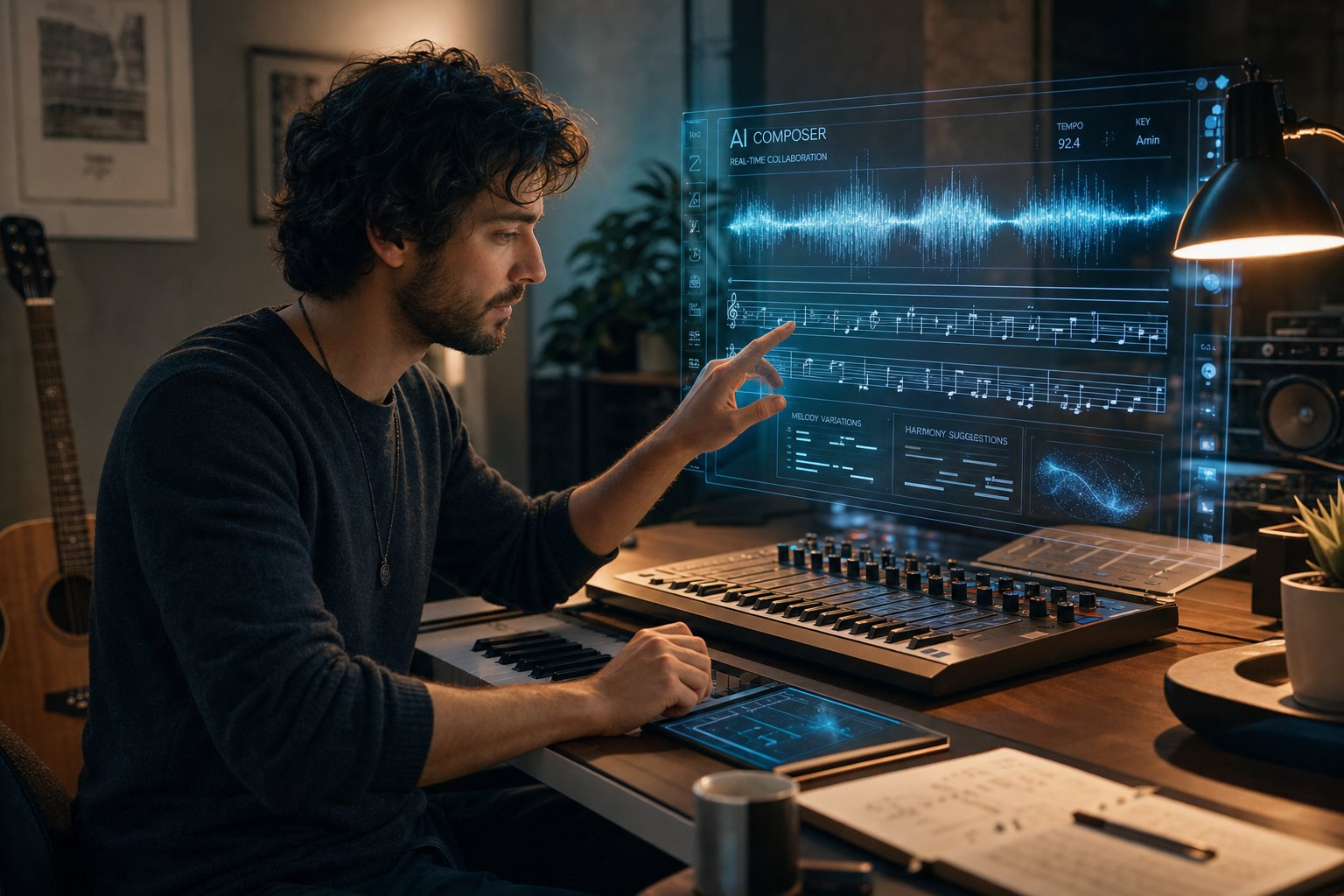
The most effective approach is treating AI the way a filmmaker treats a storyboard artist — as someone who helps you see rough ideas quickly so you can make better decisions faster. A recent survey of 1,200 music creators found that 87% of artists have incorporated AI into at least one part of their process, from songwriting and production to promotion. The ability to fill skill gaps was cited as the most celebrated benefit, enabling self-sufficient creators who handle every stage of their release cycle.
That does not mean handing over creative authority. As workflow research from Sonarworks emphasizes, maintaining creative control means establishing clear boundaries: you remain the curator, director, and final decision-maker. AI provides options. You choose which ones serve your vision and discard the rest. Think of it less like delegation and more like a brainstorming partner who never gets tired and never gets offended when you reject ninety percent of their ideas.
Rapid Prototyping and Idea Generation With AI Tools
Will ai get better at helping with making music? It already has — dramatically. The shift from clunky MIDI generators to platforms that produce full arrangements from a text prompt happened in under two years. Musicians using ai in music production today are not waiting for finished masterpieces from a prompt. They are using generation tools to hear rough concepts instantly, test whether a melody works in a different genre, or explore what a chorus sounds like with completely different instrumentation before committing hours to manual production.
Platforms like MakeBestMusic's AI Music Generator let you turn prompts, lyrics, and style ideas into complete songs in minutes — not as a replacement for your artistry, but as a sketchpad for rapid creative exploration. You might feed in a half-written lyric and a genre direction to hear what the vibe could become, then take that spark back into your DAW and build something entirely your own. The value is in speed and possibility, not in letting the tool do the final work.
This rapid prototyping approach is especially powerful for exploring ai music genre change. Curious what your folk ballad sounds like reimagined as synthwave? Generate a version in seconds. The point is not to release that output — it is to hear whether the idea has legs before investing a full production session.
Building What AI Cannot Replace
Ai and music production will keep converging. The tools will keep improving. That makes it even more critical to invest in the things no model can replicate — because those become your competitive moat as a working artist.
- Double down on storytelling and personal narrative. Write from specific, lived experiences that no model can invent. The more irreplaceably yours your lyrics are, the more they resist AI competition.
- Use AI for production grunt work, save your energy for performance. Let AI handle demo arrangements, rough mixing, and reference tracks. Pour your limited creative bandwidth into vocal delivery, live energy, and the emotional interpretation that listeners actually bond with.
- Build authentic audience relationships. Share your process, your failures, your behind-the-scenes reality. Research from Playlist Push confirms that fans in 2026 are actively seeking connection over consumption. BTS content, personal reflections, and direct engagement build loyalty that no AI persona can replicate.
- Develop live performance as a core revenue stream. AI cannot walk on stage, feed off a crowd, or improvise a set. Invest in becoming an unforgettable live act — that market is structurally immune to AI displacement.
- Experiment with AI tools early and often. Familiarize yourself with what is possible so you can integrate useful capabilities before your peers do. Use generators for ideation, stem separators for sampling, and vocal processors for creative texture — all while keeping your artistic voice at the center.
- Leverage AI for marketing and distribution. Generate promotional visuals, analyze audience data, and automate release logistics. These are time sinks that pull you away from creating — let AI handle the operational overhead while you focus on the art itself.
- Protect your creative identity. Use Spotify's verification tools, metadata standards, and platform features that signal your humanity. In an era of AI flooding, verified human artistry carries increasing premium value.
The musicians who will thrive are not the ones who out-produce AI — nobody wins a volume war against a machine generating seven million songs per day. They are the ones who become irreplaceable in the dimensions AI cannot reach: presence, authenticity, relationship, and the courage to say something only they could say. AI handles the scalable parts. You handle the human parts. That division of labor is not a compromise — it is the strongest creative position available.
The Verdict on AI and the Future of Music
Irreplaceable in the dimensions AI cannot reach — that is the survival strategy for individual artists. But zoom out, and the broader question remains: is AI going to take over music? After examining the legal battles, the creative limitations, the consumer psychology, and the economic displacement already underway, a clear verdict emerges. It is not the binary answer most headlines want. It is more honest than that.
AI is not taking over music. It is permanently restructuring who makes it, how it gets made, who profits from it, and which roles survive intact. The future of music is neither human-only nor machine-dominated — it is a layered ecosystem where both coexist, but not everyone benefits equally.
Winners and Losers in the AI Music Shift
The ai music industry is not experiencing a single story. It is experiencing several, and your position in the value chain determines whether this moment feels like opportunity or threat.
- Major labels: Winners, broadly. They control the catalogs AI needs for training, giving them licensing leverage. Universal and Warner have already monetized that position through settlement deals and partnerships. They set terms rather than accept them.
- Independent artists with strong personal brands: Winners, conditionally. Those who build authentic audience relationships and invest in live performance hold advantages AI cannot replicate. AI tools also lower their production costs, letting them compete with studio-quality output on a fraction of the budget.
- Session musicians and stock composers: Losers, near-term. Functional music work is disappearing into AI generation. Adaptation means pivoting toward collaborative scoring, live performance, or creative direction roles that demand human judgment.
- Producers and engineers: Mixed. AI accelerates their workflows dramatically, but also makes their technical skills more accessible to non-specialists. The ones who thrive will combine taste and creative vision with tool fluency.
- Consumers: Winners in access and personalization, potentially losers in discovery. More music than ever, but platform flooding makes finding meaningful work harder without better curation systems.
The Most Likely Future for Music and AI
Regulatory direction will shape how far this transformation goes. The American Federation of Musicians' lawsuit against Warner and Universal — filed for licensing members' work to AI companies without consent or compensation — signals that governance battles are far from settled. The EU AI Act's transparency requirements take enforcement effect later in 2026. US state-level protections for vocal likenesses continue expanding. And no final court decision has yet resolved the core questions around training data and copyright.
The music in the future will not be made exclusively by humans or exclusively by machines. It will be made by humans using machines — with legal guardrails that determine how much of the economic value flows back to creators versus platform operators. AI in the music industry is a permanent fixture now, not a passing experiment. The question is no longer whether it stays, but who shapes the terms under which it operates.
If you have read this far and still feel uncertain about where AI music actually stands, the most useful next step is not reading another opinion piece — it is hearing for yourself. Tools like MakeBestMusic's AI Music Generator let you turn a prompt or lyric idea into a complete song in minutes, giving you direct experience with what AI can and cannot do creatively. Form your own opinion. The future of music is not something that happens to you. It is something you participate in shaping.
