

Yes You Can Get Monetized Posting AI Music But Here Is What Determines Success
Can I get monetized posting AI music? The short answer is yes. Platforms like YouTube, Spotify, and TikTok do not outright ban AI-generated music from monetization. What they care about is rights, ownership, and whether your content meets their quality and policy standards. So the real question is not whether AI music is allowed — it is whether you have clear rights to use the track and whether you are following each platform's evolving disclosure rules.
The Short Answer for AI Music Creators
You can make money from AI generated music, but your success depends on three factors working together. First, the platform you choose: YouTube, Spotify, TikTok, and streaming distributors each have different thresholds and policies around AI content. Second, how much human creative input you contribute to the final track — this affects everything from copyright eligibility to whether a distributor accepts your upload. Third, whether you comply with transparency and disclosure requirements that platforms are actively rolling out.
Monetization is possible, but it requires understanding both legal ownership and platform-specific policies. The creators who treat AI music like a real asset — with clear usage rights, proper documentation, and genuine creative involvement — are the ones earning consistently.
Who This Guide Is For
Not every creator approaches AI music the same way, and the path to making money with AI music looks different depending on your starting point. This guide addresses three distinct creator types:
- Musicians using AI as a production tool — You already compose, arrange, or produce music, and you are integrating AI to speed up specific tasks like generating drum patterns, exploring chord progressions, or mastering audio. Your monetization path is the most straightforward because you retain significant creative control.
- Content creators needing background music — You make videos, podcasts, or social content and need original tracks that will not trigger copyright claims. You want to earn money with music as a supporting element, not the main product. Your risk level is low when you use tools with clear commercial licenses.
- Non-musicians generating tracks purely with AI prompts — You type a text prompt and receive a finished song. This path carries the most uncertainty because platforms and copyright offices draw sharp lines around works created without meaningful human authorship.
Each archetype faces different risks and opportunities. The rules are not uniform across platforms, and they are still shifting. What follows is a practical breakdown of where you stand on each major platform, what copyright law actually says about your ownership rights, and how to structure your approach so that policy changes do not wipe out your income overnight.
AI-Assisted vs Fully AI-Generated Music and Why Platforms Care
The single most important factor in whether you can earn money making music with AI tools comes down to one question: how much of the creative work did a human actually do? Platforms, distributors, and copyright offices all draw a line between music where AI assists a human creator and music where AI does essentially everything. Understanding where your work falls on that spectrum determines your monetization eligibility, your legal protections, and whether a distributor will even accept your upload.
AI-Assisted Music Where Humans Lead
AI-assisted music means a human remains the primary creative force. You might use an AI-powered plugin to master your mix, generate a reference drum pattern to build around, or explore chord progressions before performing and arranging the final piece yourself. The key distinction is that you are making the compositional decisions — selecting what stays, what gets reworked, and how the elements fit together.
Think of it like using a spell checker when writing an essay. The tool helps, but you wrote the essay. In the same way, beats by AI tools can spark ideas or handle technical tasks, but the human shapes the song into its final form. This category includes producers using LANDR for mastering, artists layering AI-generated backing elements under live vocals, or composers using AI suggestions as a starting point before extensively rearranging and performing.
From a policy standpoint, AI-assisted music is accepted by every major distributor and streaming platform. TuneCore, DistroKid, CD Baby — all of them treat this approach as standard modern production. No special disclosure is typically required beyond what individual platforms are beginning to ask for in metadata.
Fully AI-Generated Music From Prompt to Track
Fully AI-generated music sits at the other end of the spectrum. You type a text prompt into a tool like Suno or Udio, and the system produces a complete track — vocals, instrumentation, arrangement, and all. Your contribution is limited to describing what you want and maybe trimming the output. If you are wondering whether you can sell music you make in tools like Riffusion or similar prompt-based generators, this is the category that applies to you.
This approach faces real friction. Bandcamp has explicitly banned music produced entirely or mainly by AI. TuneCore blocks content that is 100% created by AI. YouTube treats raw AI audio involving minimal human input as low-value, often making it ineligible for monetization. Deezer uses detection tools to identify and tag fully AI-generated songs, then excludes them from algorithmic recommendations and filters their streams out of royalty calculations.
Why This Distinction Determines Your Monetization Eligibility
Three forces converge to make this distinction critical for anyone trying to monetize AI music:
| Dimension | AI-Assisted (Human-Led) | Fully AI-Generated (Prompt-Only) |
|---|---|---|
| Copyright Eligibility | Likely protected — human determines expressive elements | Uncertain or unprotectable — the US Copyright Office states mere prompting does not constitute authorship |
| Platform Acceptance | Accepted across all major platforms and distributors | Blocked or restricted by TuneCore, Bandcamp, YouTube Music, and others |
| Monetization Risk Level | Low — treated the same as traditionally produced music | High — subject to removal, demonetization, or royalty filtering |
| Recommended Approach | Distribute normally, document your process | Add human elements (vocals, arrangement, lyrics) to shift toward hybrid status |
The US Copyright Office's January 2025 report confirmed that outputs of generative AI can only receive copyright protection where a human author has determined sufficient expressive elements. Prompting alone does not meet that threshold. This means if someone copies your fully AI-generated track, you may have no legal basis to enforce ownership.
Practically, even modest human additions shift your work from "fully AI-generated" toward "hybrid" territory. Writing your own lyrics, performing vocals, or making deliberate arrangement decisions all strengthen both your copyright position and your standing with distributors. The platforms are not trying to eliminate AI from music — they are drawing a line between creators who use AI as a tool and content that is essentially manufactured without meaningful human involvement.
Platform-by-Platform Monetization Rules for AI Music
Knowing the difference between AI-assisted and fully AI-generated music only gets you halfway. Each platform applies its own rules to determine what earns revenue and what gets flagged. A track that passes on YouTube might get filtered on Spotify. A video with AI background music that monetizes fine on TikTok might need a disclosure label on YouTube. Here is where each major platform stands.
YouTube Partner Program and AI Disclosure Rules
YouTube remains the most straightforward path for creators asking how to add music to their video on YouTube and still earn ad revenue. The platform does not ban AI music outright. Instead, it requires you to meet the standard YouTube Partner Program thresholds and follow its disclosure policy.
To monetize any content on YouTube, you need:
- 1,000 subscribers (to check how to see your subs on YouTube, visit the Channel Dashboard in YouTube Studio)
- 4,000 public watch hours in the past 12 months, or 10 million Shorts views in the past 90 days
- A linked AdSense account
- Compliance with all community guidelines and monetization policies
Once you are in the program, AI-generated background music in original video content is generally permitted without disclosure. YouTube's disclosure policy targets realistic synthetic media that could mislead viewers — deepfake faces, cloned voices of real people, fabricated events. Using an AI tool to generate a background instrumental does not meet that threshold. You only need to check the "Altered content" toggle in YouTube Studio when your video contains photorealistic AI elements a viewer could mistake for real footage.
Where things get tricky is Content ID. YouTube's fingerprinting system scans uploaded audio against a database of registered tracks. If the AI tool you used trained on copyrighted material, or if the generated output happens to resemble an existing registered song, Content ID may flag your video. When that happens, ad revenue gets diverted to the claimant until you dispute the match. This does not mean your channel is penalized — it means you need to be prepared to file a dispute and demonstrate the track is original.
One practical tip: setting up a Google Brand Account for your channel separates your creative identity from your personal Google profile. This is advisable for any monetization-focused creator because it lets you manage channel access, add collaborators, and keep business analytics separate from personal activity. If you are figuring out how to do collab YouTube posts with other creators, a Brand Account also makes it easier to grant upload permissions without sharing personal login credentials.
Spotify Anti-Spam Policies and What Gets Removed
Spotify takes a different approach. The platform does not reject AI-assisted music, but it aggressively filters content that looks like spam — and fully AI-generated bulk uploads are the primary target.
In September 2025, Spotify announced strengthened AI protections including a new music spam filter designed to identify and stop recommending tracks that engage in mass uploads, duplicates, and artificially short track abuse. Over the prior 12 months, Spotify removed more than 75 million spammy tracks. The platform also introduced stronger impersonation rules to combat AI voice clones of real artists.
What gets you removed or filtered on Spotify:
- Mass-uploading hundreds of short, repetitive AI-generated tracks designed to game per-stream payouts
- Uploading music that impersonates another artist's voice without authorization
- Distributing duplicate or near-duplicate content across multiple artist profiles
- Artificial streaming manipulation — using bots or click farms to inflate play counts
What stays on Spotify without issues:
- AI-assisted tracks where the artist contributes genuine creative direction, arrangement, or performance
- Music produced with AI tools as part of a legitimate artistic workflow (synthesis, mastering, generation of individual elements)
- Tracks distributed through reputable aggregators that meet quality thresholds
Spotify is also rolling out AI disclosure credits through the DDEX industry standard, letting artists indicate where AI played a role in production. As of April 2026, a beta feature displays these credits in Song Credits on mobile. The platform has stated clearly that disclosing AI usage will not result in down-ranking or reduced payouts. It is a transparency signal, not a penalty.
The bottom line: if your AI music has genuine artistic merit and you are not flooding the platform with low-effort content, Spotify treats your tracks the same as any other upload. The problem is not AI — it is spam behavior disguised as music.
TikTok and Short-Form Platform Policies
Short-form platforms like TikTok are the most permissive environment for AI music right now. AI-generated audio in short videos is largely unrestricted because the platform evaluates video content holistically — engagement, originality, and watch time matter more than the origin of the background track.
That said, TikTok's monetization programs have their own eligibility gates. To earn through the Creator Rewards Program, you typically need:
- At least 10,000 followers
- A minimum of 100,000 video views in the past 30 days
- An account in good standing with no active community guideline violations
- Content that demonstrates originality and meaningful human input
TikTok does not currently require mandatory AI disclosure for background music, though the platform encourages transparency and may move toward stricter labeling. What matters for monetization is that your videos show creative direction — AI music supporting an original video concept is fine, but uploading dozens of static-image clips over AI tracks with no added value will get flagged as low-effort content.
For creators focused on accumulating youtube likes and building cross-platform audiences, repurposing TikTok content to YouTube Shorts is a common growth strategy. The key difference is that YouTube may require disclosure on the same content that TikTok does not, so you need to evaluate each platform's rules independently when cross-posting.
Across all three platforms, the pattern is consistent: AI music is welcome when it supports genuine creative content. What triggers problems is volume without value — bulk uploads, spam behavior, and attempts to game recommendation algorithms. Understand each platform's specific thresholds, and you will know exactly where you stand before uploading a single track.

Copyright Ownership and the Legal Reality of AI Music
Platform policies tell you whether you can upload and earn. Copyright law tells you whether you actually own what you created. These are two separate questions, and confusing them is where many creators get burned. You might monetize my music on YouTube or Spotify without any issues — until someone copies your track and you realize you have no legal standing to stop them. That is the gap copyright status creates.
What the US Copyright Office Says About AI Works
The US Copyright Office has been examining AI and copyright since early 2023, issuing guidance, hosting public listening sessions, and publishing a multi-part report. The key takeaway from Part 2 of their report, released January 29, 2025, is straightforward: copyright protection requires human authorship. Works generated entirely by AI — where no human exercised meaningful creative control over the expressive elements — cannot be registered.
This is not speculation. The Office has reinforced this position through multiple registration decisions. In Thaler v. Perlmutter, the D.C. Circuit Court of Appeals affirmed the refusal to register an AI-generated image, and the Supreme Court declined to hear the case. The principle applies equally to music: if you type a prompt and an AI produces a complete song without further human arrangement, that output does not qualify for copyright protection.
However — and this is the part many creators miss — the Office has registered more than a thousand works where applicants disclosed and disclaimed AI-generated material while demonstrating sufficient human contribution. Using AI to assist in the creation of a song does not bar copyrightability. The distinction is between using AI as a tool and using AI to stand in for human creativity.
What counts as sufficient human involvement? Writing original lyrics, performing vocals, making deliberate arrangement and selection choices, composing melodies that the AI then renders — these all demonstrate the kind of authorship that earns protection. The question is not whether AI touched your track. It is whether a human determined the expressive elements that make the work original.
If an artist uploads a fully AI-generated song to a streaming platform, they cannot prevent anyone from copying, remixing, or distributing that song. Without meaningful human involvement, that creation enters the public domain and anyone can use it without legal restriction.
EU AI Act Transparency Requirements
While the US focuses on copyrightability, the European Union is approaching AI content from a transparency angle. The EU AI Act's Article 50 establishes transparency obligations for both providers and deployers of generative AI systems. These rules require that AI-generated outputs — including audio — are marked in a machine-readable format and detectable as artificially generated.
What does this mean for you as a creator? If you distribute AI music in EU markets, you may be required to disclose AI involvement. The obligations address two levels:
- Provider obligations — Companies building AI music generators must ensure their outputs are marked and detectable as AI-generated. This means the tools you use may embed metadata flags in exported audio files.
- Deployer obligations — Creators who publish AI-generated content that could be mistaken for human-created work may need to label it appropriately, especially for deepfake audio or content informing the public on matters of public interest.
The compliance code of practice is being drafted through working groups running from November 2025 through May 2026, with the transparency obligations taking full effect in August 2026. For creators distributing globally, this means keeping track of how your AI tools handle metadata and being prepared to add disclosure labels when publishing to EU-facing platforms.
The practical impact is not a monetization blocker — it is a labeling requirement. You can still earn revenue from AI music in the EU. You just cannot hide its origins.
How Copyright Status Affects Your Revenue Protection
Here is the question that ties it all together: if you cannot copyright a fully AI-generated song, can you still monetize it? Yes. And this confuses a lot of people.
Monetization eligibility on platforms like YouTube and Spotify does not require copyright registration. You do not need to file with the Copyright Office to earn ad revenue or collect streaming royalties. Platforms pay you based on their own terms of service and partner agreements, not based on federal copyright status. So a fully AI-generated track can sit on Spotify and collect streams without any legal issue — the platform does not verify your copyright registration before issuing payments.
The problem surfaces when someone else enters the picture. Imagine another creator downloads your AI track, re-uploads it, or remixes it. Without copyright protection, you cannot file a DMCA takedown with legal backing. You cannot sue for infringement. You cannot claim ownership in a Content ID dispute with any enforceable authority. Your revenue depends entirely on being the first uploader — and that is a fragile position.
Contrast this with a copyrighted AI-assisted track. If you wrote the lyrics, performed the vocals, and arranged the composition with AI handling specific production tasks, you hold a registrable copyright. That gives you the ability to issue takedowns, pursue infringement claims, and register the work in Content ID databases so you earn revenue even when others use your track. You can also control how long a song can be before copyright on YouTube becomes relevant in licensing discussions — because you own the underlying work.
The takeaway is not that fully AI-generated music is worthless. It is that your revenue protection is weaker without copyright, and your income depends on platform goodwill rather than legal rights. For creators building a long-term catalog, documenting your creative process and adding genuine human elements is not just a copyright strategy — it is an income protection strategy.
Legal ownership sets the foundation. But it does not tell you how to actually structure your distribution for maximum revenue — and that is where the choice between releasing standalone audio tracks versus using AI music as background in video content becomes a critical fork in the road.
Standalone Audio Tracks vs Background Music in Videos
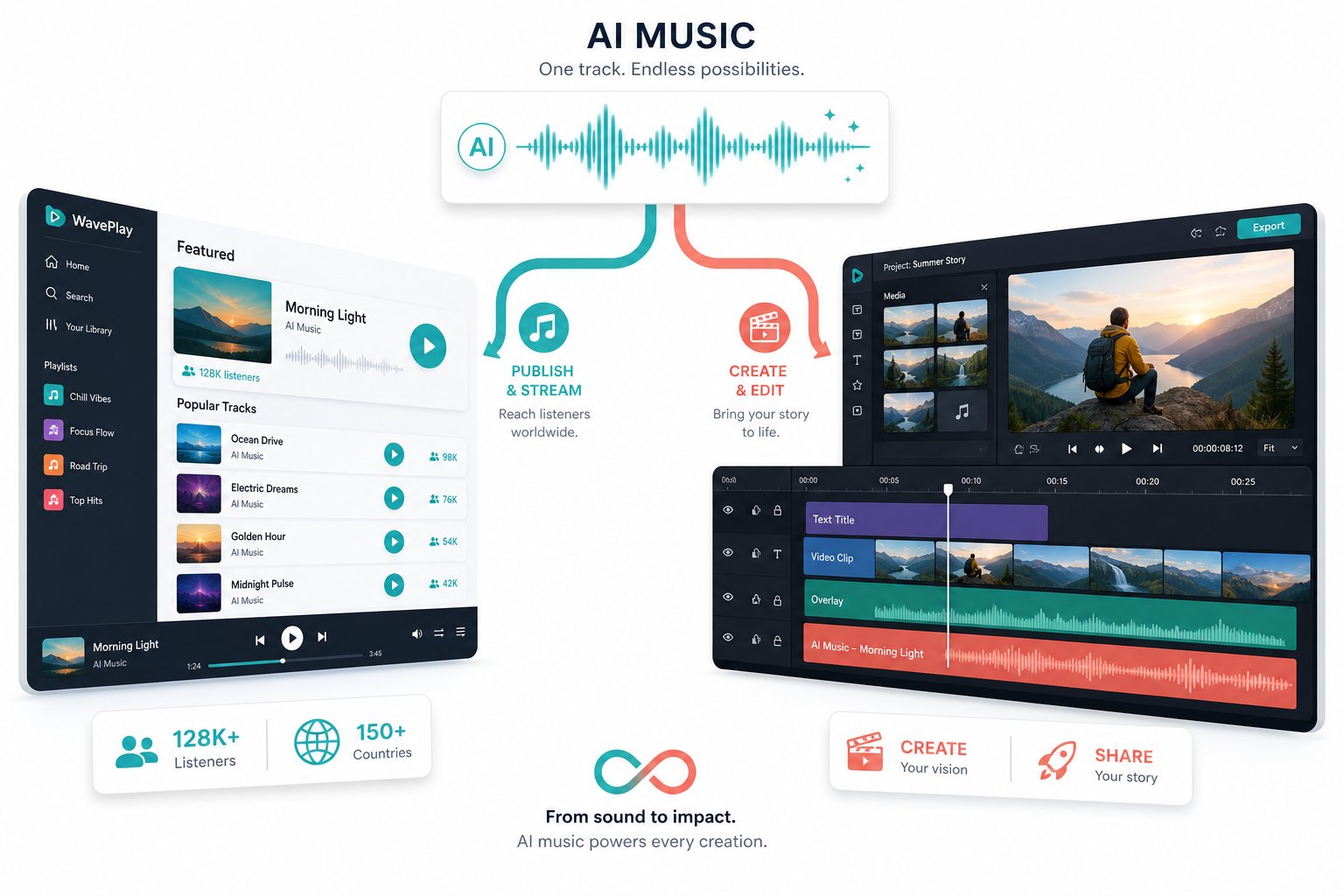
Two creators can use the exact same AI music tool and end up with completely different income profiles. The difference is not the music itself — it is how they package and distribute it. One uploads tracks to Spotify hoping to accumulate streams. The other drops the same music beneath original video content and earns through ads, sponsorships, and audience growth. Both paths work, but they carry different risk levels, revenue ceilings, and policy exposure.
Monetizing AI Tracks on Streaming Platforms
Releasing AI-generated tracks directly to streaming services is the most intuitive way to make money with music online. You create a track, push it through a distributor, and collect per-stream royalties from Spotify, Apple Music, Amazon Music, and others. The economics are simple: Spotify pays roughly $0.003 to $0.005 per stream, Apple Music around $0.007 to $0.010. At scale, a catalog of 100 tracks generating consistent plays can produce $300 to $1,000 monthly in passive income.
The challenge is that this path puts your AI music in direct competition with millions of other uploads — including a growing flood of AI-generated content. Platforms are actively filtering what they consider low-quality or spam-like AI uploads. Spotify removed over 75 million spammy tracks in the past year, and their algorithms increasingly down-rank repetitive, short-form content that looks automated.
You also face the duplicate content problem. If you and another creator both use the same AI tool with similar prompts, you might generate tracks that sound nearly identical. Both of you upload. Both try to monetize. Platforms have no reliable system for determining who created what first, and the resulting disputes are messy and time-consuming. This makes it harder to how to make money off your music when your work is not uniquely identifiable.
Using AI Music as Background in Video Content
The second path flips the model entirely. Instead of selling music as the product, you use AI-generated tracks as supporting audio beneath original video content. Revenue comes from ad placements, brand sponsorships, affiliate deals, and audience growth — not per-stream payments. The music serves your content rather than being the content itself.
This approach carries fewer policy restrictions because platforms evaluate the overall video quality, not the origin of background audio. A well-produced tutorial, vlog, or educational video with AI background music gets treated the same as one using stock music from a licensing library. YouTube does not penalize videos for using AI-generated instrumentals as long as the video itself provides genuine value.
The biggest practical advantage? You avoid Content ID claims entirely. When you use copyrighted music in a video, you risk revenue being diverted to the rights holder. When you generate your own royalty-free track, no one else has registered it in any fingerprinting database. Your ad revenue stays yours. For creators uploading mp4 on YouTube or exporting content across platforms, owning your background music eliminates one of the most common monetization headaches.
Tools designed for this use case make the process straightforward. MakeBestMusic's Free Music Generator lets you produce royalty-free tracks specifically built for commercial use in videos, podcasts, games, and social content — at no cost. Other options include Miraflow, MusicMake.ai, and Soundraw, each with varying pricing tiers and licensing terms. The key is choosing a generator that explicitly grants commercial usage rights so you have documentation if questions arise.
When producing video content with AI background music, keep technical specs in mind. The standard youtube video aspect ratio is 16:9 for landscape content and 9:16 for Shorts. If you are wondering how many fps should a youtube video be, 24 fps works for cinematic content, 30 fps for standard uploads, and 60 fps for gaming or fast-motion footage. These details affect how your audio syncs with visual pacing — a mismatch between frame rate and musical tempo can make content feel off even if viewers cannot pinpoint why.
Creators running youtube videos looping as ambient content — study music, relaxation playlists, background noise — sit at the intersection of both paths. The video earns ad revenue while the looped audio functions like a streaming track. This hybrid model works well because YouTube rewards watch time, and long-form ambient videos naturally accumulate hours of playback.
Which Path Fits Your Creator Type
Your choice depends on where your strengths lie and how much risk you are comfortable with. Here is how the two paths compare across the dimensions that matter most:
| Factor | Standalone Streaming Tracks | Background Music in Videos |
|---|---|---|
| Revenue Source | Per-stream royalties ($0.003-$0.01/play) | Ad revenue, sponsorships, audience growth |
| Revenue Potential | Moderate — requires high volume and playlist placement | High — compounds with channel growth and diversified income |
| Risk Level | High — subject to spam filters, duplicate disputes, policy changes | Low — platforms focus on video quality, not audio origin |
| Policy Restrictions | Distributors may reject fully AI content; platforms filter low-quality uploads | Minimal restrictions when music supports original video content |
| Scalability | Limited by platform tolerance for AI volume | Scales with content quality, niche authority, and audience size |
| Copyright Protection | Weak without human creative input; vulnerable to copying | Less critical — revenue tied to video, not the audio track alone |
If you are a musician using AI to accelerate production, standalone streaming makes sense — your human involvement protects both copyright and platform standing. If you are a content creator who needs reliable background audio, the video-first path offers better economics with far less friction. And if you are a non-musician experimenting with AI prompts, building video content around your generated tracks gives you a monetization path that does not depend on fragile streaming income.
Whichever path you choose, one variable remains constant: how you distribute your music determines whether platforms accept, reject, or retroactively restrict your content. That distribution decision deserves its own consideration.
How Your Distribution Path Affects Monetization Eligibility
You have a finished track and a clear monetization path in mind. The next decision — how you actually get your music onto platforms — can quietly determine whether you upload music and get money or hit a wall before listeners ever press play. Distribution is not a neutral pipeline. Each method carries its own policies, costs, and risks around AI-generated content.
Direct Upload vs Aggregator Distribution
Direct upload means publishing your music yourself on platforms that allow it. YouTube lets anyone upload audio or video content to their channel. SoundCloud offers free and paid tiers for hosting tracks. Bandcamp lets you sell directly to fans. In each case, you control the upload, keep whatever revenue share the platform offers, and deal with their policies independently.
The limitation? Direct uploads only reach one platform at a time. Your track lives on YouTube or SoundCloud — not both simultaneously unless you manually repeat the process everywhere.
Aggregator services like DistroKid, TuneCore, and CD Baby solve this by distributing your music to Spotify, Apple Music, Amazon Music, Deezer, and dozens of other streaming services through a single upload. This is what simulcast means in this context: distributing the same content across multiple platforms simultaneously through one service. The simulcast meaning matters for AI music creators because it lets you maximize revenue reach without managing separate uploads and policies on each individual platform.
The tradeoff is that aggregators add their own layer of content review between you and the streaming platforms — and their AI policies vary dramatically.
Aggregator Policies on AI-Generated Content
Not all distributors treat AI music the same way. Their policies range from permissive to outright hostile, and choosing the wrong one can mean immediate rejection or — worse — catalog removal after you have already built an audience.
DistroKid is currently the most AI-friendly major distributor. Their policy allows AI-generated music with mandatory disclosure — you check a box during upload indicating AI involvement. They charge $22.99 per year for unlimited uploads with zero commission on streaming revenue. No per-track limits, no volume caps on AI content. If you disclose properly, your track enters the same distribution pipeline as any human-produced song.
TuneCore takes a middle-ground approach. AI music is accepted, but their transparency requirements are more granular. During upload, you must specify which aspects used AI — composition, lyrics, vocals, production, mastering — and identify which tools were involved. Pricing runs $9.99 per single per year or $14.99 per year for a subscription covering unlimited singles. If their system detects undisclosed AI content, your track gets paused for resubmission rather than permanently rejected. You get a second chance, but it adds days to your release timeline.
CD Baby is the strictest among major aggregators. They reject fully AI-generated tracks outright and only accept content that qualifies as "AI-assisted" — meaning a human demonstrably led the creative process. Their one-time fee of $9.95 per single sounds economical, but the 9% commission on streaming revenue adds up for high-performing tracks. For creators whose workflow is primarily prompt-based generation, CD Baby is not a viable option.
Other distributors like Ditto Music ($19/year, unlimited uploads) and Symphonic (revenue-sharing model, typically 85/15) accept AI music with disclosure. Each sits somewhere on the spectrum between DistroKid's permissiveness and CD Baby's restrictions.
Diversifying Your Distribution Strategy
Here is the risk most creators overlook: aggregators can change their policies after you have already uploaded. Imagine building a 200-track catalog on a single distributor, earning steady monthly income, and then receiving an email that your content no longer meets updated AI guidelines. Your entire revenue stream disappears overnight. This is not hypothetical — distributors have retroactively updated terms of service as the AI music landscape evolved.
Protecting your income means spreading risk across multiple channels rather than betting everything on a single path. Here are the recommended strategies in priority order:
- Use at least two aggregators with different AI policies. Distribute your primary catalog through an AI-permissive service like DistroKid while maintaining a secondary presence through another distributor. If one changes terms, you are not starting from zero.
- Maintain direct-upload channels you control. Your YouTube channel, SoundCloud profile, and Bandcamp page cannot be de-platformed by a third-party distributor. Even if aggregator access disappears, your direct channels keep earning.
- Document your creative process for every track. Keep screenshots of your generation workflow, DAW edits, and any human contributions. This documentation lets you re-upload through stricter distributors if needed by demonstrating human involvement.
- Separate your catalog by AI involvement level. Distribute heavily AI-generated content through permissive platforms, and reserve AI-assisted work (with clear human authorship) for distributors with stricter policies. This reduces the chance of an entire catalog being flagged.
- Monitor policy changes quarterly. Set calendar reminders to review terms of service for every distributor you use. Catching a policy shift early gives you time to migrate content before enforcement begins.
The practical costs of multi-distributor strategies are modest. DistroKid at $22.99 per year plus Ditto at $19 per year gives you redundant access to all major streaming platforms for under $45 annually — a small price for income security. Compare that to the revenue loss of having a full catalog pulled without warning.
Distribution is the infrastructure beneath your monetization. Get it right, and platform policy changes become inconveniences rather than catastrophes. Get it wrong, and a single email from your aggregator can erase months of earned income — which raises the uncomfortable question of what else can go sideways when monetizing AI music at scale.
What Can Go Wrong and How to Handle Disputes
Everything covered so far assumes things go smoothly. But what happens when they do not? AI music monetization carries specific failure modes that traditional music does not — and understanding them before they hit is the difference between a temporary setback and a permanently lost income stream.
Content ID Conflicts With AI Music
Content ID is YouTube's automated fingerprinting system. It scans every upload against a database of registered audio. The problem for AI music creators is that generative models are trained on massive datasets of existing music. Sometimes the output contains melodic fragments, chord sequences, or tonal textures similar enough to a registered track that Content ID triggers a match — even when you created nothing intentionally derivative.
When this happens, you will see a youtube error licensing video notification in YouTube Studio. Your monetization gets paused or diverted to the claimant. The video is not removed, but your revenue is gone until you resolve the dispute. In some cases, the video may be blocked in certain countries or made entirely unavailable depending on the claimant's settings.
This is not a rare edge case. AI tools that produce full arrangements in popular genres — lo-fi, EDM, cinematic — are particularly prone to generating sequences that resemble registered works. The more generic your prompt, the higher the collision risk.
What Happens When Platforms Change the Rules
Platform policy changes are the existential risk that most creators underestimate. You build a catalog of 50 AI tracks across Spotify and YouTube. Revenue trickles in. Then a platform updates its terms and your content no longer qualifies — or worse, gets flagged retroactively.
This has already happened. Spotify removed over 75 million tracks flagged as spam in 2025. DistroKid applies policy changes retroactively, meaning tracks accepted under previous rules can be pulled during routine sweeps if they violate current guidelines. Your video could be privated without warning if YouTube determines it violates updated disclosure requirements. One day your content earns money; the next day it is invisible.
The worst version of this scenario is account-level action. Platforms that determine you engaged in what they classify as spam uploading — dozens of low-effort AI tracks per week under generic artist names — may suspend or terminate your account entirely. This does not just affect the flagged content. It removes your access to all accumulated subscribers, watch hours, and monetization eligibility.
Artificially inflating metrics compounds this risk. Using a views youtube bot or similar automation to fake engagement does not just violate terms of service — it trains the platform's detection systems to scrutinize your account more aggressively. The same applies to youtube bot comments used to simulate audience interaction. Platforms cross-reference engagement patterns, and synthetic activity makes your legitimate AI music uploads look even more suspicious.
Dispute Resolution When Two Creators Upload the Same Track
Here is a scenario unique to AI music: two creators use the same tool with similar prompts and generate nearly identical tracks. Both upload. Both try to monetize. Who wins?
Currently, there is no clean answer. Platforms generally favor the first uploader — the earliest timestamp gets presumption of originality. But enforcement is inconsistent. Neither creator holds copyright over a fully AI-generated track, so neither has legal standing to file a formal infringement claim against the other. The dispute becomes a platform-level moderation issue rather than a legal one.
If a competing creator files a Content ID claim against your track (or vice versa), the dispute gets resolved by the claimant reviewing your challenge — not by an independent arbiter. YouTube cannot make ownership determinations and leaves the decision to the parties involved. This means the outcome often depends on who registered their audio in a fingerprinting database first, not who actually created it first.
For AI music, this creates an uncomfortable reality: your revenue protection depends on upload speed and documentation rather than legal rights.
How to Appeal Claims and Reinstate Your Content
When things go wrong, you need a clear process for recovery. Here is the step-by-step approach for the most common scenarios:
- Disputing a Content ID claim on YouTube: Open YouTube Studio, navigate to Content, select the affected video, and tap the copyright claim. Choose "Dispute" and select the reason — typically "I have a license or written permission" or "This video uses the content in a way that qualifies as fair use." For AI-generated tracks, the strongest position is that your audio is original and was not derived from the claimant's work. The claimant has 30 days to respond. If they do not, the claim expires automatically.
- Appealing a rejected dispute: If the claimant reinstates their claim after your initial dispute, you can escalate to a formal appeal. At this stage, the claimant must either release the claim or file a legal copyright removal request. If they file a removal request, your video gets taken down and your channel receives a copyright strike — but you can then submit a counter-notification if you believe the claim is invalid.
- Reinstating a privated or removed video: If your video was made private or removed due to a policy violation rather than a copyright claim, go to Channel Settings and check for strikes or warnings. You can appeal through the "Appeal" link next to the violation. Include documentation showing your creative process — screen recordings of your DAW session, prompt history, and any human edits you applied to the AI output.
- Recovering from distributor removal on Spotify: If your aggregator pulls a track due to updated AI policies, contact their support with evidence of human creative input. Re-upload through a different distributor if the original will not reinstate your content. Keep original project files and generation logs as proof of process.
- Protecting against duplicate content disputes: Upload your finished track to a timestamped service (like Blockchain-based proof-of-creation tools or even emailing yourself the file) before distributing. This establishes a creation date independent of any platform. Keep your full prompt history and any intermediate versions showing creative evolution.
The common thread across all these scenarios is documentation. Creators who save their generation prompts, record their editing sessions, and timestamp their work before uploading have a recoverable position when disputes arise. Those who generate, upload, and move on without records are left arguing from a weak position with no evidence to support their claims.
None of these risks mean you should avoid AI music monetization. They mean you should approach it with the same operational discipline you would bring to any income-generating activity — documenting your work, diversifying your presence, and building the kind of sustainable strategy that does not collapse the first time a platform updates a policy page.
Building a Sustainable AI Music Income Strategy
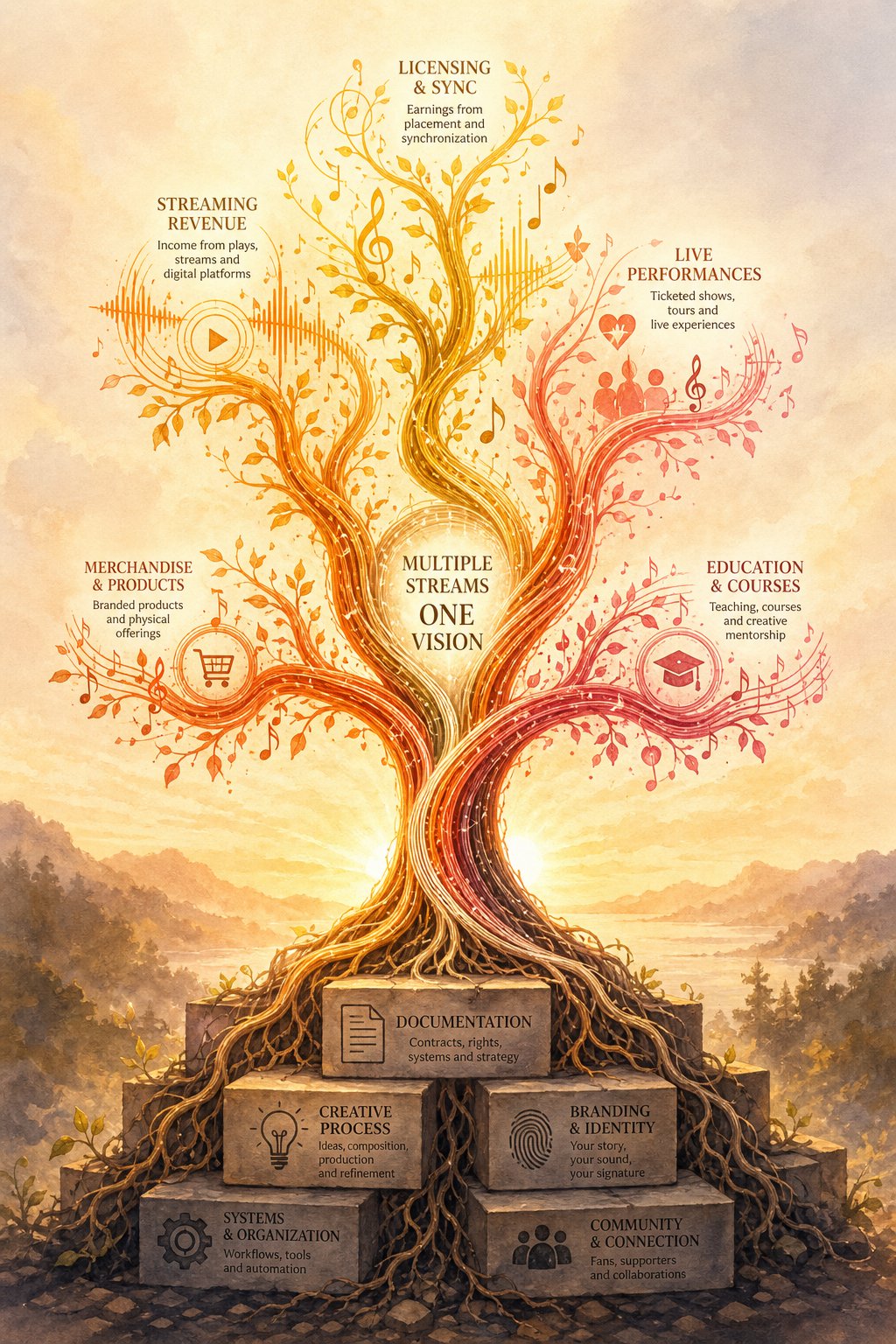
Disputes and policy changes are manageable problems when your income rests on a solid foundation. The creators who struggle most are those who built revenue on volume — hundreds of low-effort AI tracks pushed to every platform simultaneously, hoping the math works out. When platforms tighten filters or distributors update policies, that entire model collapses. Sustainable income looks different. It requires treating AI as a creative amplifier rather than a content factory, and it demands revenue sources that do not depend on a single algorithm's goodwill.
Building Income That Survives Policy Changes
Every platform rule discussed in this guide will change. YouTube will adjust its disclosure requirements. Spotify will refine its spam detection. Distributors will rewrite their terms. The question is not whether these shifts happen — it is whether your income survives them when they do.
Three principles make your earnings durable regardless of what platforms decide:
- Quality over quantity signals legitimacy. Platforms are increasingly using engagement metrics — save rates, repeat listens, completion rates — to distinguish genuine music from AI spam. A single well-produced track that earns organic saves and playlist adds is worth more than 50 tracks that accumulate passive background plays. When Spotify runs its next spam sweep, the tracks with real listener engagement survive.
- Human creative value is your insurance policy. Every hour you spend arranging, performing, or producing an AI-assisted track strengthens both your copyright position and your standing with platforms. If policies tighten tomorrow and only "AI-assisted" content qualifies for monetization, your documented human involvement keeps your catalog safe.
- Audience relationships outlast algorithms. Followers who know your name, subscribe to your channel, and engage with your content will find you even if an algorithm stops recommending your music. Building community through consistent publishing, behind-the-scenes content, and direct interaction creates income that no policy change can eliminate.
Choosing good youtube channel names that reflect your niche — whether ambient AI soundscapes, lo-fi study beats, or cinematic instrumentals — helps listeners associate your brand with a specific experience. This recognition compounds over time and makes your content discoverable through search even when recommendation algorithms shift. Think of good youtube names as long-term SEO assets, not throwaway decisions.
Non-Obvious Revenue Streams for AI Music Creators
Streaming royalties and ad revenue are the obvious income paths. But some of the most reliable non-obvious ways to make money with AI involve licensing and direct sales to buyers who need music but do not want to pay traditional production costs.
- License tracks for indie games and apps. Independent game developers need original soundtracks but rarely have budgets for custom composition. A well-curated catalog of AI-assisted tracks in genres like ambient, chiptune, or orchestral can generate recurring licensing fees. Platforms like itch.io have active communities of developers searching for affordable, rights-clear audio.
- Sell background music packs to podcasters and video creators. Podcasters need intro music, transition stings, and background beds. Video creators need non-repetitive audio that will not trigger Content ID. Packaging AI-generated tracks into themed bundles — "corporate presentation pack," "travel vlog essentials," "true crime underscore" — and selling them on Gumroad or your own site creates direct revenue with no platform middleman.
- Produce custom AI music for corporate clients. Businesses need music for internal presentations, training videos, social ads, and event content. Most do not know how to sell AI music directly, but if you position yourself as someone who produces original, rights-clear audio quickly and affordably, you become a go-to resource. Corporate clients pay flat fees that dwarf per-stream payouts.
- Create content around your process. Tutorials showing how you produce AI-assisted music, tool comparisons, and workflow breakdowns attract audiences interested in music production. That audience generates ad revenue, affiliate income from tool recommendations, and consulting opportunities. The music funds the content, and the content funds the music.
- License to social media creators directly. Short-form creators on TikTok, Instagram, and YouTube Shorts constantly need fresh audio. Offering a subscription or one-time license for a catalog of original AI tracks — especially trending sounds and viral-ready hooks — puts you in a market with high demand and low competition from traditional music libraries.
Cross-promotion amplifies all of these streams. A shoutout from a gaming creator who uses your music introduces your catalog to thousands of potential buyers. Collaborating with podcasters who credit your tracks in their show notes drives organic discovery. These relationship-driven growth strategies create more durable income than algorithm-dependent streams because they are built on trust and mutual benefit rather than platform mechanics.
Tools and Resources to Get Started
Translating strategy into action requires the right tools. Whether you are producing tracks for your own videos or building a licensing catalog, these resources cover the workflow from generation to monetization:
- MakeBestMusic's Free Music Generator — A free entry point for creators who want to produce original, royalty-free background music without licensing concerns. Tracks generated here are cleared for commercial use in videos, podcasts, games, and social content, making it practical for creators who need usable audio without upfront costs or complex rights negotiations.
- Suno (Pro/Premier tier) — Full commercial rights on generated tracks. Best for creators who want complete songs from prompts and plan to add human elements before distributing.
- Stable Audio (Creator tier) — Clear commercial licensing with a structured tier system. Strong for ambient, cinematic, and electronic genres.
- AIVA — AI composition tool geared toward film scoring and game soundtracks. Paid plans grant full ownership of generated compositions.
- Soundraw — Customizable AI music with stem editing capabilities. Lets you adjust arrangement elements after generation, which strengthens your human-involvement documentation.
Pair any of these generators with a DAW for post-production and a distributor for release. The combination of free generation tools plus minimal editing overhead means your startup cost is essentially zero — the investment is your time and creative direction, not expensive software or licensing fees.
The AI music landscape will keep shifting. Platforms will add rules. New tools will emerge. Competitors will flood every niche. But creators who document their process, add genuine creative value, and diversify across both platforms and revenue streams will not just survive those shifts — they will benefit as lower-quality content gets filtered out and audiences gravitate toward creators who treat AI as a craft, not a shortcut.
