


Yes, You Can Monetize AI Music - But Here Is What Determines Your Rights
Can you monetize AI music? The short answer is yes. Creators are already earning revenue from AI-generated and AI-assisted tracks through streaming platforms, sync licensing, and direct sales. But here's where most people trip up: the ability to earn money from these tracks isn't a blanket permission. It hinges entirely on the specific tool you used, how much creative work you actually contributed, and where you plan to distribute the finished product.
The Short Answer to AI Music Monetization
You can make money from AI generated music - plenty of creators already do. Some upload tracks to Spotify and Apple Music through distributors like DistroKid. Others monetize AI music videos on YouTube, sell beats on marketplaces, or license background tracks for podcasts and indie games. The revenue streams are real, and they're growing alongside the technology itself.
The catch? Not every AI-created track qualifies for every monetization path. A song generated entirely by an AI tool with zero human editing sits in a very different legal and commercial position than one where you used AI to draft a melody, then layered your own vocals, rearranged sections, and mixed the final output yourself. That distinction shapes everything - from whether you can register a copyright to whether a distributor will even accept your upload.
Why the Details Matter More Than Ever
Imagine spending weeks building a catalog of AI tracks, distributing them across every major platform, and watching the streams roll in - only to have your distributor account terminated because their policy shifted overnight. This isn't hypothetical. Platform rules around AI content are evolving rapidly, and what's permitted today may face new restrictions tomorrow.
Three factors ultimately decide whether making money with AI music is smooth or a legal headache:
Your monetization eligibility comes down to three things: the AI tool's license terms and what commercial rights it grants you, your level of meaningful creative input in shaping the final track, and the specific policies of every platform and distributor in your release chain.
Each of these factors carries its own set of rules, gray areas, and potential pitfalls. Copyright law in most jurisdictions still requires human authorship for full protection, meaning purely machine-generated output may lack the legal standing you'd expect. Streaming platforms like YouTube and Spotify have introduced disclosure requirements that directly affect whether your content stays monetized. And distributors themselves set their own standards - some welcome AI-assisted music while others draw hard lines against fully generated tracks.
This guide walks through every layer of that equation - from the legal foundations of ownership and copyright registration, to platform-specific policies, realistic revenue expectations, and the risks that most creators don't see coming until it's too late.
Copyright Law and AI Music Ownership Across Jurisdictions
Before a single dollar of AI music royalties can flow into your account, there's a more fundamental question to answer: do you actually own what you created? Ownership is the bedrock of monetization, and when it comes to AI generated music copyright, the legal landscape is anything but simple. Different countries treat AI-created works differently, and the rules are still being written in real time.
Copyright Office Guidance on AI Authorship
In the United States, the U.S. Copyright Office has staked out a clear position: copyright protects "only material that is the product of human creativity." A track generated entirely by an AI tool - where you typed a prompt and hit generate - doesn't meet that standard. The Office's Part 2 report on copyrightability, published in January 2025, reinforced this stance by explaining that "prompts alone do not provide sufficient human control to make users of an AI system the authors of the output."
So can you copyright AI generated music at all? Yes - but only when you've contributed enough creative input to qualify as the author of the final work. The Copyright Office has already granted registration to hundreds of works that incorporated AI outputs, provided the applicant properly disclaimed the AI-generated portions. The key distinction is between using AI as an instrument versus letting AI do the creative thinking for you.
What does "meaningful human authorship" look like in practice? Think of it as a spectrum. On one end, typing "make a chill lo-fi beat in C minor" into a generator and downloading the result probably won't cut it. On the other end, using AI to sketch a rough melody, then rearranging the structure, adding your own vocal performance, layering original instrumentation, adjusting harmonies, and mixing the final output yourself - that puts you firmly in the realm of copyrightable work. The human creative choices are what the law protects, not the AI-generated raw material underneath.
How Jurisdiction Affects Your Rights
Your AI music ownership rights don't exist in a vacuum. Where you live - and where you seek protection - shapes what's possible. Here's a practical breakdown of how the world's major legal frameworks handle this question:
| Jurisdiction | Authorship Requirement | Registration Eligibility | Practical Implication for Creators |
|---|---|---|---|
| United States | Human authorship required; prompts alone are insufficient | AI-assisted works eligible if human creative input is substantial; purely AI-generated works are not registrable | You must contribute meaningful creative choices beyond prompting. Disclaim AI-generated elements in your registration application. |
| European Union | Work must be "the expression of the intellectual creation of their author" (per CJEU in Infopaq) | No EU-wide prohibition on registering AI-assisted works; member states interpret individually | Significant human input is the general threshold across member states. The EU AI Act does not directly address copyrightability of AI outputs. |
| United Kingdom | Originality required for authorial works; Section 9(3) of CDPA assigns authorship of "computer-generated" works to the person who made the arrangements for creation | Computer-generated works explicitly covered by statute, though future case law will clarify the originality threshold | Potentially the most favorable framework for AI music creators, since the law already contemplates works without a traditional human author. |
The EU's approach, shaped by the Infopaq decision, leaves room for member states to interpret the standard on their own. A December 2024 policy questionnaire from the Council of the European Union revealed a general consensus: AI-generated content could be eligible for copyright protection "only if the human input in their creative process was significant." Meanwhile, the UK's Copyright, Designs and Patents Act stands out because Section 9(3) explicitly addresses computer-generated works, assigning authorship to the person who arranged for the work's creation. Whether that provision will be broadly applied to modern generative AI tools remains an open question for UK courts.
The practical takeaway? If you're distributing globally - and most digital music creators are - the US standard is effectively your baseline. It's the most restrictive among major Western jurisdictions, and meeting its requirements means you'll likely satisfy the others as well.
PRO Registration and AI-Generated Works
Even if you secure copyright protection, collecting performance royalties requires registration with a performing rights organization like ASCAP, BMI, or SOCAN. For a long time, these organizations had no formal policy on AI-generated compositions, leaving creators in a gray area.
That changed in October 2025. ASCAP, BMI, and SOCAN jointly announced they would accept registrations of partially AI-generated musical works - compositions that combine AI-generated elements with elements of human authorship. This was a significant milestone. As ASCAP CEO Elizabeth Matthews put it, "Songwriters and composers have always experimented with innovative tools as part of their creative process, and AI is no exception."
There's an important limitation, though. All three PROs drew the same line: musical compositions that are entirely created using AI tools are not eligible for registration. The word "partially" is doing heavy lifting here. You need demonstrable human creative contribution - writing lyrics, composing a melody, arranging sections, performing an instrument - layered alongside whatever the AI generated.
For creators focused on collecting AI music royalties, this means your workflow matters as much as your output. A track where you used AI to generate a chord progression but then wrote original lyrics, performed vocals, and structured the arrangement qualifies. A track where AI handled every creative decision from start to finish does not. Document your process, keep your project files, and be prepared to demonstrate the human elements of your work if challenged.
These legal and institutional frameworks set the boundaries for everything that follows - but knowing you can own and register your work is only half the equation. The platforms where you actually distribute and monetize that work enforce their own set of rules, and those policies can be even more restrictive than copyright law itself.
Platform Policies That Determine Whether Your AI Music Earns Revenue
Owning the rights to your AI-assisted track is one thing. Getting it past the gatekeepers - the streaming platforms and distributors that actually put music in front of listeners - is another challenge entirely. Each platform sets its own rules around AI-generated content, and those rules directly control whether your uploads earn a cent or get pulled without warning.
YouTube AI Labeling and Monetization Rules
Can AI generated music be monetized on YouTube? Yes - but transparency is non-negotiable. YouTube has required creators to disclose when content is generated or meaningfully altered by AI since 2024. As of May 2026, the platform moved its AI disclosure labels to a more prominent position for photorealistic and meaningfully AI-altered content, making them visible at a glance rather than buried in descriptions.
Here's what matters for monetization: YouTube explicitly states that "a disclosure label alone does not change how a video is recommended or whether it's eligible to earn money." In other words, labeling your AI music content won't tank your revenue. Failing to label it, however, is a different story. YouTube now uses automatic detection systems that can identify AI-generated content even when creators skip the disclosure step. If their systems flag your content and you haven't disclosed, the platform applies the label automatically - and repeated non-compliance could trigger broader channel-level consequences.
For YouTube music AI content specifically, the practical approach is straightforward: disclose during upload, use original compositions rather than prompts targeting copyrighted works, and keep documentation of your creation process. The platform isn't penalizing AI music creators who play by the rules. It's penalizing those who try to hide what they're doing.
Spotify Disclosure Requirements
Spotify accepts AI-generated music and pays the same per-stream royalties regardless of how a track was made. The catch is disclosure - and the consequences of skipping it are severe.
In September 2025, Spotify announced strengthened AI protections that included a new impersonation policy, a music spam filter that has already removed over 75 million spammy tracks, and a standardized AI disclosure framework developed through DDEX alongside major distributors. By April 2026, Spotify launched a beta feature displaying AI credits directly in Song Credits on mobile - showing listeners whether AI was used for vocals, lyrics, or production.
The disclosure process works through your distributor. When uploading, you indicate AI involvement, your distributor flags the metadata, and Spotify receives that flag with your release. Non-disclosure risks are real: track removal, full catalog review, distributor account issues, and potential platform bans. Spotify's spam filter specifically targets mass uploads, duplicates, and artificially short tracks - tactics that content farms often pair with AI generation tools.
One important nuance: Spotify treats AI disclosure as a spectrum, not a binary. You don't have to classify every song as purely "AI" or "not AI." The system accommodates tracks where AI handled some elements (say, instrumentation) while humans contributed others (vocals, lyrics, arrangement). This aligns with how most serious creators actually work.
Distributor Policies for AI Music Uploads
Your distributor is the bridge between your finished track and every streaming platform. If they reject your upload or terminate your account, nothing else matters. Here's where the major distributors currently stand on AI music:
| Platform | AI Music Policy | Disclosure Requirement | Monetization Status |
|---|---|---|---|
| DistroKid | Accepts AI-generated music; unlimited uploads under annual subscription ($22.99+) | Required during upload process; must confirm commercial rights | Full monetization across all distributed platforms |
| TuneCore | Accepts AI music; same pricing as human-created releases ($9.99+ per single) | Required during upload; same disclosure process as other content | Full monetization; includes sync licensing and publishing services |
| CD Baby | Accepts AI music with disclosure; one-time fee per release | Required; participates in DDEX AI disclosure standard | Full monetization; sync licensing opportunities may vary for AI content |
| Amuse | Generally accepts AI music; free tier available with revenue split | Expected; disclosure through upload process | Monetization available; paid tiers offer better revenue share |
A few things to note about this landscape. DistroKid's unlimited upload model makes it the most popular choice among AI musicians who release frequently - the flat annual fee means you're not paying per track, which suits the higher output volume that AI tools enable. TuneCore's per-release pricing makes more sense for creators who polish fewer tracks to a higher standard before distributing. CD Baby and Amuse both participate in the DDEX industry standard for AI disclosures that Spotify helped develop, which signals long-term commitment to supporting AI content within established frameworks.
The critical warning here: these policies have shifted multiple times already, and they'll shift again. What a distributor accepts today may face new restrictions next quarter. Always verify current terms before uploading a batch of content, and keep proof of your commercial rights (active subscriptions to AI tools, screenshots of license terms) readily accessible.
Content ID adds another layer of complexity. YouTube's automated rights management system scans uploaded audio against a database of registered works. AI-generated music can trigger false matches if the output resembles something in the training data too closely - even unintentionally. When this happens, revenue from your video may be claimed by another party, and disputes can take weeks to resolve. The best defense is generating truly original compositions, avoiding prompts that reference specific artists or songs, and keeping records of your generation process to support any disputes.
Platform compliance is ultimately manageable if you treat disclosure as a default rather than an afterthought. The creators who run into trouble aren't typically those making honest AI-assisted music - they're the ones trying to game the system through non-disclosure, artificial streaming, or mass-uploaded low-effort content. The line between those two approaches also determines how much creative input you're bringing to the table, which circles back to a more fundamental question: where does your track fall on the spectrum between fully AI-generated and genuinely AI-assisted?

Fully AI-Generated vs AI-Assisted Music and What It Means for Your Revenue
That spectrum isn't just an abstract concept. It's the single most important variable shaping your legal standing, your platform eligibility, and ultimately how much money you can realistically earn. Two tracks can both involve AI and land in completely different commercial positions depending on how much of the creative heavy lifting a human actually did. Understanding exactly where your workflow falls on that continuum - and how to move it in your favor - is the difference between building a sustainable income stream and watching your catalog collapse under policy changes.
The AI Music Spectrum From Fully Generated to AI-Assisted
Think of AI involvement in music creation as a sliding scale with three distinct zones, each carrying different implications for your rights and revenue.
Fully AI-generated music sits at one extreme. You type a text prompt - something like "upbeat electronic track with female vocals, 120 BPM" - and the tool delivers a finished song. Structure, melody, instrumentation, lyrics, vocal performance: all handled by the model. You pressed a button and received a product. As RouteNote's breakdown puts it, "the AI creates the entire piece: structure, melody, instruments - basically everything." This is the category that triggers the most restrictions. No copyright registration in the US, limited PRO eligibility, and heightened scrutiny from platforms and distributors.
AI-assisted music occupies the middle ground - and it's where most serious creators operate. Here, AI functions as a collaborator, not the creator. You might use a generator to sketch a chord progression, then rearrange it, record your own vocal take over the top, rewrite the lyrics, adjust the mix, and make structural decisions about verse-chorus flow. The artist remains in control. AI suggests; humans decide.
AI as a production tool is the third zone, and it's the least controversial. This is where AI-powered plugins handle mastering, noise reduction, stem separation, or beat quantization within a traditional DAW workflow. Think of it the way The Beatles used AI audio restoration to isolate John Lennon's vocals on Now and Then - the Grammy-winning track where AI served a specific technical function while human musicians shaped every creative element. Nobody questions the authorship of that song.
Where your work falls on this spectrum directly dictates your copyright strength, platform acceptance, and monetization ceiling. The closer you sit to the "fully generated" end, the thinner your legal protections become.
How Human Input Strengthens Your Monetization Position
The pattern across copyright law, PRO policies, and platform rules is consistent: the more human creative input you contribute, the stronger your position everywhere that matters. But what actually counts as "meaningful" contribution? And what doesn't?
Activities that likely qualify as meaningful human contribution:
- Writing original lyrics over an AI-generated instrumental
- Recording your own vocal or instrumental performance
- Substantially rearranging AI-generated sections - changing structure, reordering parts, modifying harmonic progressions
- Editing and layering multiple AI outputs into a new composition
- Mixing, sound design, and production decisions that shape the final character of the track
- Composing a melody or harmony manually, then using AI to flesh out arrangement or accompaniment
Activities that likely do not qualify:
- Typing a single text prompt and downloading the output without changes
- Selecting your favorite result from several AI-generated options without editing any of them
- Adjusting only volume levels or adding a simple fade-in/fade-out
- Using AI to clone a specific artist's voice or replicate a copyrighted song's style
- Batch-generating dozens of tracks with minor prompt variations and no post-production
Suno's own documentation reinforces this directly: "Music made 100% with AI would not qualify for copyright protection because a human did not write the lyrics or the music. Writing the prompt does not constitute the creation of the song." That statement aligns with the U.S. Copyright Office's case-by-case evaluation, which looks for evidence that a human shaped the expressive elements of the work - not just initiated the process.
From a practical standpoint, this means your creative workflow is your strongest asset. Document it. Save your project files, keep screenshots of your editing process, and maintain notes on what you changed from the raw AI output. If a distributor, platform, or PRO ever questions the human authorship of your track, that documentation is your proof.
Commercial Licensing Tiers Across AI Music Tools
Even when your creative input is substantial, you still need the AI tool itself to grant you commercial rights. Most generators tie those rights to paid subscription tiers - and the differences between free and paid plans are often the difference between earning revenue and violating terms of service.
Suno illustrates this clearly. Their tiered pricing structure draws a hard line between free and paid users:
| Suno Tier | Monthly Cost | Commercial Rights | Best For |
|---|---|---|---|
| Basic (Free) | $0 | No - non-commercial use only; Suno retains ownership | Experimentation and demos only |
| Pro | $10/mo ($8/mo annual) | Yes - full commercial use; 0% revenue share | Most independent creators and side hustlers |
| Premier | $30/mo ($24/mo annual) | Yes - identical commercial rights to Pro; 0% revenue share | High-volume catalog builders needing more credits and Studio access |
The critical detail: both Pro and Premier grant identical commercial rights. Premier's higher price buys you more generation credits (10,000 vs. 2,500 per month) and access to Suno Studio's advanced features - not broader legal permissions. For most creators exploring how to make money with Suno AI, the Pro tier is more than sufficient to start.
Two important caveats apply regardless of tier. First, music created on the free plan doesn't retroactively gain commercial rights if you upgrade later. If you generated tracks before subscribing, those tracks stay non-commercial unless Suno explicitly grants upgraded rights. Second, commercial rights persist after cancellation - songs created while you held a paid subscription keep their commercial status permanently, even if you later downgrade.
Other AI music tools follow similar tiered models, though the specifics of music AI pricing vary. Some offer royalty-free output on all tiers. Others restrict commercial use to premium plans. Before committing to any tool for monetization purposes, read the terms of service line by line. The licensing page is more important than the feature list when revenue is your goal.
Understanding these tiers and their boundaries keeps you legally clean. But legal permission to sell music and actually earning meaningful revenue from it are two very different things - and the gap between them is where most creators need the clearest guidance.
Realistic Monetization Paths Ranked by Effort and Revenue Potential
Having the legal right to sell AI music and the platform compliance to distribute it are necessary foundations - but they don't tell you where the money actually comes from. The revenue landscape for AI music creators is broader than most people realize, spanning everything from fractions-of-a-cent streaming payouts to four-figure sync licensing deals. Each path demands a different level of effort, carries different income ceilings, and suits different creator profiles.
Here's a practical breakdown of how to sell AI music across the channels that are actually generating income right now - ranked from the easiest entry point to the highest earning potential.
- Background music for YouTube channels and podcasts - Lowest barrier. Content creators constantly need royalty-free background tracks for videos, podcasts, and social content. You can supply this directly (offering tracks on your own site or through freelance platforms) or indirectly by building a catalog others can license. No audience of your own required.
- Streaming royalties through distributors - Low barrier, low per-track revenue, but scalable with volume. Upload through DistroKid, TuneCore, or similar services and earn per-stream payouts across Spotify, Apple Music, Amazon Music, and dozens of other platforms.
- Stock music library contributions - Moderate barrier. Libraries like Pond5, AudioJungle, and Epidemic Sound accept submissions (some now allow AI-assisted compositions) and handle licensing on your behalf. Revenue comes from one-time purchases or subscription pool payouts.
- Selling beats and loops on marketplaces - Moderate barrier. Platforms like BeatStars and Splice let you sell individual beats, loops, and sample packs. AI-assisted production can accelerate your output, though marketplace competition is fierce and buyers expect polished, unique material.
- Direct sales through platforms like Bandcamp - Moderate barrier, higher per-sale revenue. You set your own price, keep a larger cut, and build a direct relationship with buyers. Requires marketing effort and an audience willing to pay.
- Sync licensing for video, film, and media - Highest barrier, highest revenue potential. Placing tracks in commercials, TV shows, indie films, or video games can generate significant one-time fees plus backend royalties. Requires either direct relationships with music supervisors or placement through sync licensing agencies.
Streaming Revenue and the Volume Game
Streaming is the most accessible path, and it's where most creators start. The mechanics are simple: upload tracks through a distributor, get them on every major platform, and earn a fraction of a cent each time someone presses play. The math is straightforward but humbling - you'll need tens of thousands of streams before the revenue becomes meaningful.
This is where AI's speed advantage becomes relevant. Traditional artists might release an album every year or two. With AI-assisted workflows, you can realistically produce and distribute multiple quality tracks per week. That volume compounds over time. A catalog of 200 tracks each earning modest streams generates more total revenue than a handful of tracks hoping for viral moments.
Community discussions on Reddit and music production forums consistently echo the same reality: streaming income from AI music is a long game. Creators who report meaningful earnings typically describe months of consistent uploading before reaching even modest monthly payouts. The ones who flame out are usually those expecting quick returns from a batch of unedited AI outputs - tracks that lack the distinctiveness to attract organic listeners.
The key insight? Streaming works best as a passive foundation layer. You build the catalog, optimize metadata and playlist pitching, and let it accumulate while pursuing higher-value channels simultaneously.
Sync Licensing and Background Music Opportunities
Sync licensing sits at the opposite end of the effort-to-reward spectrum. A single placement in a commercial or TV show can pay more than years of streaming royalties. The trade-off is that breaking into sync requires either industry connections, representation by a sync agency, or a catalog specifically tailored to what music supervisors need.
For AI music creators, the more immediately accessible version of this is creating custom music for content creators and businesses. Think YouTube channel intros, podcast theme songs, corporate presentation backgrounds, indie game soundtracks, and mobile app audio. These clients need functional music that fits a specific mood and length - exactly the kind of output AI tools excel at producing quickly.
The revenue model here varies. Some creators charge flat fees per track (anywhere from modest to substantial depending on the client and usage scope). Others license tracks non-exclusively, earning smaller amounts from multiple buyers. Freelance platforms, direct outreach to content creators, and dedicated marketplaces all serve as distribution channels for this type of work.
Stock music libraries offer a more passive version of the same concept. You submit tracks, the library handles marketing and licensing, and you receive a cut when someone purchases or streams your music through their platform. Some libraries like Epidemic Sound and Artlist now accept AI-assisted compositions, though curation standards remain high. The tracks that perform well in these libraries tend to be versatile, well-produced, and designed for specific use cases - not generic outputs dumped in bulk.
Selling AI Beats and Loops on Marketplaces
Beat marketplaces and sample pack platforms represent a middle ground between passive streaming and active client work. You're creating products - beats, loops, stems, MIDI packs - and listing them for producers, artists, and content creators to purchase.
The economics work differently here than streaming. Instead of fractions of a cent per play, you're earning dollars per sale. A beat might sell for anywhere from a few dollars (non-exclusive license) to significantly more (exclusive rights). Sample packs and loop kits can generate recurring revenue as new producers discover them over time.
AI-assisted production lets you build inventory faster, but the marketplace dynamic rewards quality and uniqueness over raw volume. Buyers on BeatStars or Splice are comparing your output against thousands of other producers. If your AI-generated beats sound generic or indistinguishable from what everyone else's tools are producing, they'll scroll past. The creators who succeed here typically use AI as a starting point - generating raw ideas quickly, then applying their own production skills, sound design choices, and genre expertise to create something that stands apart.
One important caveat: some AI tools explicitly prohibit selling their output on third-party licensing platforms. SOUNDRAW, for example, does not allow selling music on services like AudioStock or BeatStars regardless of modifications. Always verify your tool's specific terms before listing on any marketplace.
Legitimate monetization requires genuine value creation. Artificial stream manipulation, bot-driven plays, and mass-uploaded low-effort content aren't gray areas - they're fraud. Criminal charges have been filed in streaming manipulation cases, and platforms actively detect and penalize these tactics. Build real audiences with real music.
The common thread across every viable monetization path is this: volume matters, but only when paired with consistency and genuine quality. How to make money with AI isn't really about the AI at all - it's about treating the output as raw material that still needs human judgment, curation, and strategic positioning to convert into revenue. The creators earning real income aren't the ones generating the most tracks. They're the ones generating the right tracks for specific audiences and use cases, then showing up consistently over months.
Of course, knowing where the revenue opportunities exist doesn't protect you from the risks that can wipe out that income overnight. Policy shifts, Content ID conflicts, and ethical landmines all lurk beneath the surface of AI music monetization - and most creators don't see them coming until the damage is already done.
What Can Go Wrong and How to Protect Your AI Music Income
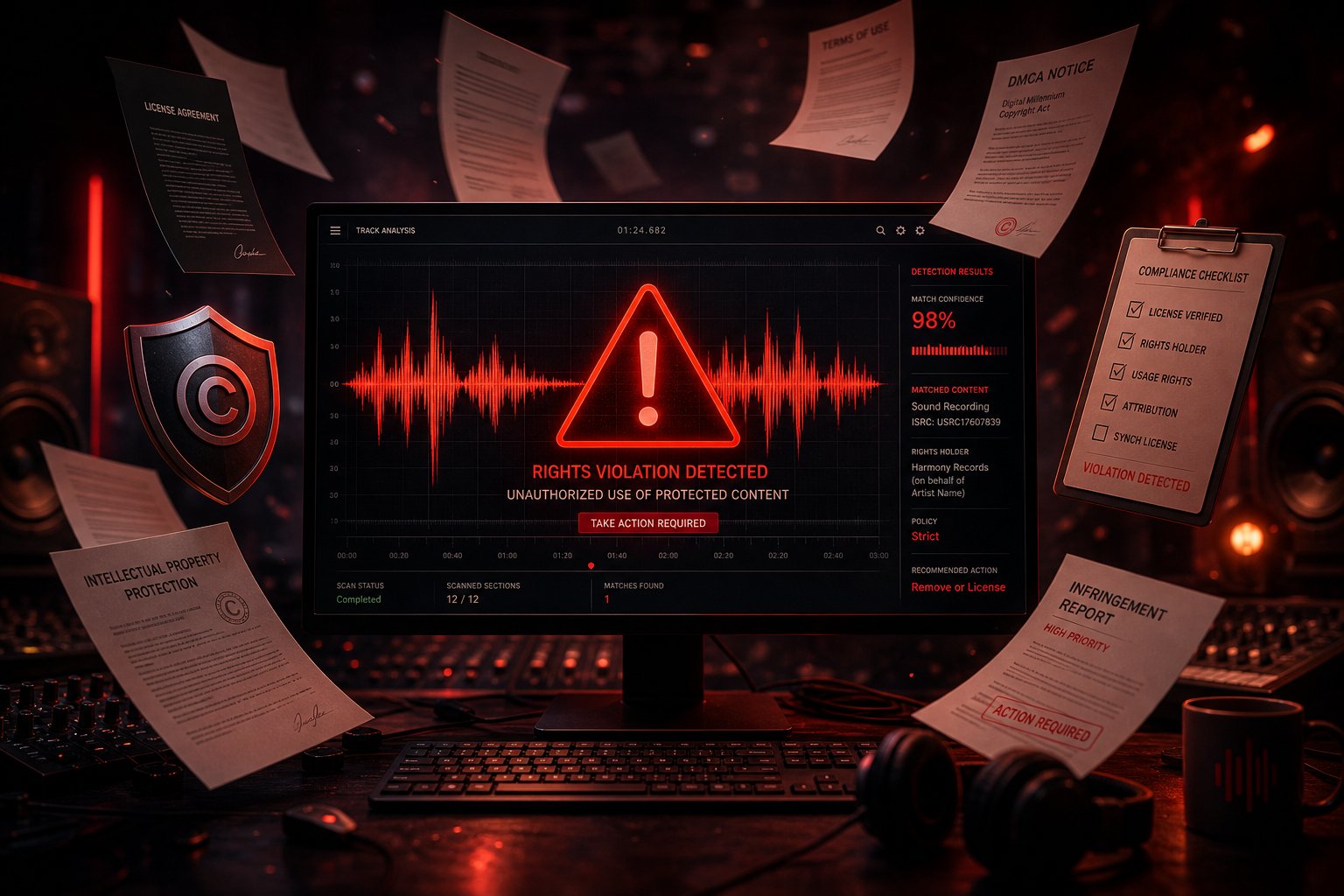
Revenue channels look promising on paper. The legal frameworks, while complex, are navigable. Platforms accept AI content when you follow their rules. So where do creators actually get burned? The risks of AI music monetization aren't hypothetical - they're playing out right now in courtrooms, in terminated distributor accounts, and in creator forums full of cautionary tales. Ignoring these pitfalls doesn't make them disappear. It just means you won't see them until they've already cost you money, time, or an entire catalog.
Fraud vs Legitimate Monetization and Where the Line Falls
The most dramatic example of AI music monetization risks involves a line that should be obvious but apparently isn't for everyone: the difference between earning real revenue from real listeners and faking it.
In a landmark case, a North Carolina man pleaded guilty to music streaming fraud aided by artificial intelligence. The scheme involved using AI to generate thousands of tracks, uploading them to streaming platforms, and then deploying bot networks to artificially inflate play counts - siphoning royalties from the pool that's supposed to pay legitimate artists. This wasn't a gray area or a policy disagreement. It was federal criminal fraud.
The case is a stark reminder that making money with AI music has a bright line. On one side: creating genuine tracks, distributing them honestly, building real audiences, and earning legitimate streams. On the other: manipulating play counts, gaming algorithmic recommendations with bot farms, or mass-uploading thousands of low-effort tracks designed to exploit per-stream payment structures rather than serve actual listeners.
Platforms are watching. Spotify has removed over 75 million tracks flagged as spam, and Deezer reports receiving more than 30,000 fully AI-generated tracks daily. When platforms crack down, they don't always distinguish carefully between creators who gamed the system and those who simply got caught in the sweep. Mass-uploaded catalogs of unedited AI outputs - even if uploaded in good faith - can trigger the same automated filters designed to catch fraud.
Content ID Conflicts and Account Termination Risks
Even creators doing everything right can find themselves blindsided by AI music Content ID issues. Here's the scenario: you generate a track, distribute it properly, and use it in your YouTube content. Weeks later, a copyright claim lands on your video. Someone else - or some automated system - has flagged your track as matching content in their database.
How does this happen with music you created? Because AI models are trained on vast libraries of existing music. If your output resembles something in that training data - even unintentionally - fingerprinting systems like YouTube's Content ID can register a match. As one composer explained bluntly: since you don't own the copyright to fully AI-generated music, "there's absolutely no way to stop someone from claiming it belongs to them, uploading, and distributing the track, and registering it with fingerprinting services such as ContentID." The result? Revenue from your video gets redirected to whoever filed the claim, and you're left fighting an automated dispute process that can drag on for weeks.
Worse still, AI-generated music reddit discussions are filled with creators describing rejected disputes. One YouTuber recounted: "I submitted a dispute but the company has rejected my dispute. My next option would be to appeal the decision but if my appeal is also rejected, I will receive a copyright strike." Three strikes on YouTube means permanent channel termination. That's a creator's entire body of work - potentially years of content - wiped out over background music.
Distributor account termination presents a parallel risk. Platform terms of service aren't static documents. They evolve, sometimes dramatically, as the industry figures out how to handle AI content. A distributor that welcomes AI uploads today could tighten restrictions next quarter. If your catalog suddenly violates updated terms, you could face anything from individual takedowns to full account suspension. Your existing revenue streams stop, your tracks disappear from platforms, and rebuilding on a new distributor means starting distribution history from scratch.
The compounding danger is that these risks feed on each other. A Content ID dispute triggers a platform review. The review flags your account for high AI content volume. The distributor, nervous about liability, terminates your agreement preemptively. Each domino falls because the legal and commercial foundations under AI music remain fundamentally unsettled.
Ethical Considerations for AI Music Creators
Beyond the legal and financial hazards, there's a layer of risk that doesn't show up in terms of service but shapes public perception and long-term viability: the ethics of making money with AI-generated music.
Audience disclosure is the most straightforward ethical obligation. Listeners and content consumers increasingly expect transparency about how creative work is produced. Concealing AI involvement isn't just a platform compliance issue - it's a trust issue. When audiences discover undisclosed AI use after the fact, the backlash tends to be disproportionate. The feeling of being deceived cuts deeper than any neutral opinion about AI music itself.
The impact on human musicians is harder to dismiss. Over 200 prominent artists - from Billie Eilish to Stevie Wonder to the estates of Bob Marley and Frank Sinatra - have signed an open letter warning against what they called "this assault on human creativity." The concern isn't abstract. Every AI-generated track competing for playlist spots and streaming royalties draws from the same finite pool of listener attention and platform revenue. As the SESAC Music Group's CIO put it: "whoever wants to use AI, we want to make sure that the intellectual property holders are compensated fairly for however AI ends up using them." That compensation question remains unresolved as major lawsuits between labels and AI companies continue to unfold.
There's also a practical authenticity concern. Audiences develop relationships with artists and brands partly because they trust the creative vision behind the work. If your monetization strategy depends on listeners believing they're hearing human-crafted music when they aren't, that strategy has an expiration date. Transparency, on the other hand, positions you as someone using innovative tools honestly - a much more sustainable brand identity.
Protecting yourself across all these risk categories doesn't require perfection. It requires intentional habits. Here are the specific measures that minimize your exposure:
- Document your creative process obsessively. Save prompts, project files, screenshots of edits, and notes on what you changed from the raw AI output. This documentation is your primary defense in copyright disputes and platform reviews.
- Disclose AI involvement proactively. Don't wait for platforms to detect it. Label your content during upload on every platform that offers the option, and be transparent with your audience about how you work.
- Diversify across distributors and revenue streams. Never rely on a single distributor or a single platform for all your income. If one account gets terminated, your entire music business shouldn't collapse with it.
- Monitor policy changes continuously. Subscribe to updates from your distributors, streaming platforms, and AI tools. Terms shift frequently, and ignorance isn't a defense when your account is under review.
- Avoid prompts referencing specific artists, songs, or copyrighted material. "Make something like Drake" is a legal landmine. Keep your prompts genre- and mood-based rather than artist-specific.
- Retain proof of your AI tool subscriptions and commercial licenses. Screenshots of active paid plans and license terms can resolve disputes before they escalate.
- Treat AI output as raw material, not finished product. The more human transformation you apply, the stronger your legal position and the lower your risk of Content ID conflicts, platform issues, and ethical criticism.
None of these steps eliminate risk entirely. The legal, regulatory, and platform landscape around AI music is still actively forming - shaped by ongoing litigation, shifting government policy, and platforms rewriting their rulebooks in real time. What these measures do is keep you on the right side of the line as it moves, so you're adapting rather than scrambling when the next change arrives.
Risk management, though, is only half the equation. The other half is choosing the right tools from the start - ones with licensing terms clear enough that you're not guessing about your commercial rights every time you hit export.
AI Music Generators With Commercial Rights Compared
Licensing clarity isn't just a nice-to-have - it's the single factor that separates tools you can safely build a revenue stream around from tools that leave you exposed. Every AI music generator handles commercial rights differently, and the gap between free tiers and paid plans often determines whether you're legally earning money or unknowingly violating terms of service. If you've spent any time browsing AI music generator Reddit threads, you've seen the confusion firsthand: creators asking which tools actually let them monetize, debating whether free plans cover commercial use, and sharing stories of takedowns they didn't see coming.
The solution is straightforward. Pick a tool whose licensing terms explicitly match your monetization goals - and verify those terms before you upload a single track anywhere.
Free Royalty-Free Generators for Commercial Projects
For creators who need commercially usable music without paying a subscription fee, the options are narrower than you'd expect. Most generators restrict commercial rights to paid tiers, which means the "free" music you generated might cost you everything if you monetize it without upgrading.
MakeBestMusic's Free Music Generator stands out here because it offers royalty-free output for commercial projects at no cost. If you're producing YouTube videos, podcast episodes, social media content, or indie games and need background tracks you can monetize without worrying about licensing fees or revenue share obligations, this eliminates the biggest legal uncertainty in AI music monetization. No subscription required, no retroactive licensing traps, no guessing about whether your free-tier output is actually cleared for commercial use.
That clarity matters more than most creators realize. When the tool's license terms are unambiguous from day one, you're not building your revenue on a foundation that could shift underneath you.
Comparing Commercial Licenses Across AI Music Tools
Discussions around the best free AI music generator on Reddit consistently circle back to the same question: what can I actually do with the output? The answer varies dramatically by tool and plan tier. Here's how the major options stack up:
| Tool | Free Tier Commercial Rights | Paid Plan Starting Price | Commercial Rights (Paid) | Best Use Case |
|---|---|---|---|---|
| MakeBestMusic Free Music Generator | Yes - royalty-free for commercial projects | Free | Included at no cost | YouTube background music, podcasts, social content, indie games |
| Suno | No - non-commercial only; Suno retains ownership | $10/mo (Pro) | Full commercial use on Pro and Premier; 0% revenue share | Full vocal songs, songwriting demos, high-volume catalog building |
| Udio | Limited - 10 credits/day, restricted commercial terms | $10/mo (Standard) | Commercial use on paid plans; post-UMG settlement licensing | Producers needing stems for DAW finishing, electronic and hip-hop |
| ElevenLabs Music | Yes - up to 7 songs/day; most commercial use permitted | $9.99/mo (Pro) | Self-Serve plans cover most commercial use; Enterprise for film/TV/AAA games | Content creators, multi-language vocals, voiceover integration |
| Stable Audio | No - personal and non-commercial only | Varies (Creator tier) | Creator tier and above; trained on licensed AudioSparx dataset | Sound design, ambient music, podcast intros, instrumental beds |
| AIVA | No - 3 downloads/month, non-commercial | ~$15/mo (Standard) | Standard allows social platform monetization; Pro grants full copyright ownership | Cinematic scoring, classical compositions, indie game soundtracks |
A few patterns jump out. Suno and Udio dominate Reddit conversations as the best AI music generators for full song creation, but neither offers commercial rights on free tiers. You need a paid subscription before generating anything you plan to monetize - and as SoundGuys notes, Suno's commercial rights don't apply retroactively, meaning tracks made on the free plan stay non-commercial even after upgrading. AIVA's Pro plan at roughly $49/month is the most expensive option listed here, but it's also the only one offering full copyright ownership to the user - a meaningful distinction for creators pursuing sync licensing in film or games.
ElevenLabs Music deserves attention for its generous free tier. With up to seven full songs per day and commercial rights included on Self-Serve plans, it's a strong option for content creators - though film, TV, and major studio game use requires an Enterprise license.
Matching the Right Tool to Your Monetization Strategy
The "best" generator depends entirely on what you're monetizing and how much you're willing to invest upfront. Here's how to think about the match:
- Zero-budget content creators who need royalty-free tracks for videos, podcasts, or social media should start with tools that grant commercial rights without a subscription. MakeBestMusic's Free Music Generator fits this profile directly - you're creating monetizable content without adding a recurring cost to your workflow.
- Aspiring music entrepreneurs building streaming catalogs or selling beats need the vocal generation and production depth of tools like Suno (Pro or Premier) or Udio (Standard or Pro). Budget $10-30/month and treat it as a business expense.
- Cinematic and game composers should look at AIVA's Pro tier for full ownership and MIDI export, or Stable Audio for ambient and sound design work.
- Multi-format creators who need both voiceover and music in one ecosystem will find ElevenLabs Music the most efficient choice, especially at the Pro tier.
Whichever tool you choose, the principle stays the same: verify commercial licensing before you create, not after. The cheapest mistake in AI music monetization is generating a catalog on the wrong plan tier and discovering months later that none of it was legally yours to sell.
Choosing the right tool, though, is only one variable in the equation. Your time, your skills, your budget, and your risk tolerance all shape which monetization path will actually work for your situation - and getting that alignment right matters just as much as the software you use.
A Decision Framework for Choosing Your AI Music Revenue Strategy
Software selection is one piece of the puzzle. The harder question - and the one that actually determines whether your AI music side hustle generates real income or fizzles out after a few weeks - is which monetization path fits your specific situation. Not every creator should chase streaming royalties. Not every side hustler should invest in sync licensing. The right strategy depends on variables that have nothing to do with the AI tool itself: how much time you can commit, what skills you already bring, how much you're willing to spend, and how much uncertainty you can stomach.
Rather than guessing, use the framework below to match your profile to the path most likely to produce results.
Choosing Your Path Based on Time and Skills
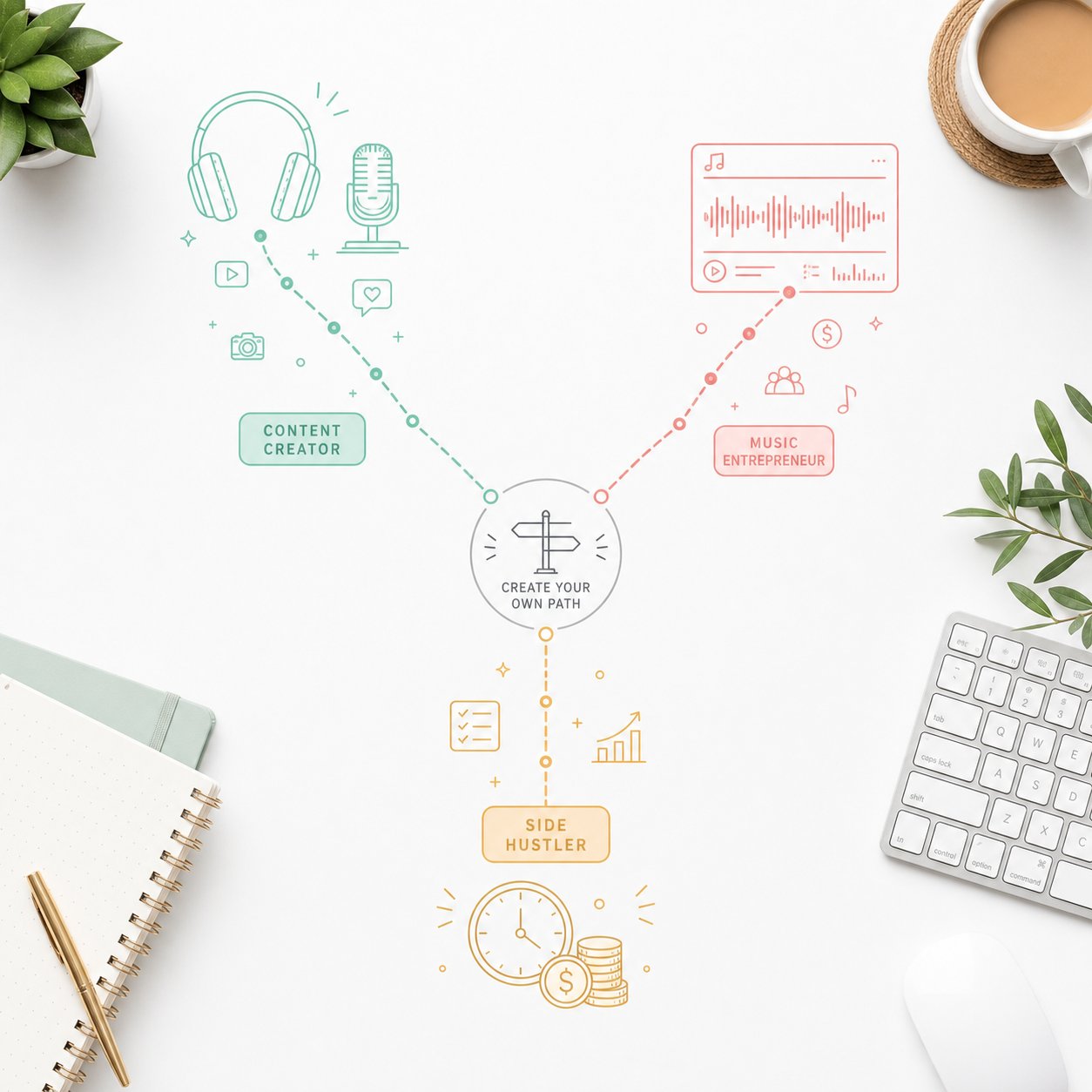
Imagine three different people asking the same question - "how to start selling AI music" - but coming from completely different starting points. A YouTuber with 50,000 subscribers needs background tracks for their own content. A bedroom producer with DAW experience wants to build a streaming catalog. A full-time employee with no music background wants passive income on the side. Same question, three entirely different answers.
The decision matrix below maps common creator profiles against the monetization paths most likely to work for each:
| Creator Profile | Recommended Monetization Path | Weekly Time Investment | Expected Ramp-Up Period | Key Advantage |
|---|---|---|---|---|
| Content Creator (YouTuber, podcaster, social media) | Self-supply background music; license extras to other creators | 2-4 hours | Immediate (own content); 1-3 months (licensing to others) | Built-in distribution through existing audience |
| Music Entrepreneur (production experience, willing to invest) | Streaming catalog + sync licensing + marketplace sales | 10-20 hours | 3-6 months for meaningful streaming revenue; 6-12 months for sync placements | Production skills elevate AI output above commodity level |
| Side Hustler (limited time, no music background) | Niche streaming catalogs (ambient, lo-fi, meditation); stock library submissions | 3-5 hours | 4-8 months for consistent passive income | AI handles the heavy lifting; success comes from volume and niche targeting |
A few things to notice. Content creators have the fastest path to monetization because they're their own first customer - every video or podcast episode that uses their AI-generated track is already earning ad revenue. Music entrepreneurs face a longer ramp-up but access higher-value channels like sync licensing. Side hustlers benefit most from the "music publisher" mindset described in Mubert's 2026 analysis: building large, niche-focused catalogs that attract daily listeners through search demand rather than viral moments.
Your ai music business model should reflect your honest assessment of these variables. If you have five hours a week and no production experience, don't aim for sync licensing placements that require polished, bespoke compositions. Start with the path that matches your current capacity, then expand as revenue justifies more time investment.
Business Structure and Tax Considerations for AI Music Income
Once revenue starts flowing - even modest amounts - you're running a business whether you've formalized it or not. The IRS doesn't care whether you think of yourself as a hobbyist. If you're earning money, you owe taxes on it. How you structure that business affects what you pay, what you're liable for, and how much paperwork you deal with.
For most creators just starting out, the decision is simpler than it seems. According to Orphiq's breakdown of music business structures, the general guidance is:
- Under $20,000/year in music income: Stay as a sole proprietor. Zero setup cost, simplest tax filing (Schedule C on your personal return), and no annual fees. The downside is no liability protection - you and your business are legally the same entity.
- $20,000-$50,000/year: Consider forming an LLC. State filing fees range from $50-500, and you gain liability protection that separates your personal assets from business debts. For tax purposes, a single-member LLC is treated like a sole proprietorship by default, so filing doesn't get much more complex.
- $50,000+ in annual profit: An S-Corp election may reduce self-employment taxes by splitting income into salary and distributions. But the added complexity - payroll processing, more expensive tax filing, quarterly filings - only makes sense when savings clearly exceed costs. Consult a CPA before making this move.
Royalty income from streaming, sync licensing, and marketplace sales is generally classified as self-employment income. That means you'll pay both income tax and self-employment tax (15.3% on the first $160,200+ of profit for Social Security and Medicare combined). Quarterly estimated tax payments are typically required once you owe more than $1,000 in a given year.
Two practical steps regardless of your structure: open a separate bank account for music income immediately, and track every business expense (subscriptions, distributor fees, equipment, marketing costs). These habits make tax time painless and protect your liability shield if you do form an LLC.
One common mistake worth flagging: don't form an LLC before you have consistent income. Annual state fees ($0-800 depending on where you live) add up quickly when revenue is still zero. California, for example, charges an $800 minimum franchise tax annually regardless of whether your LLC earned a dime. Wait until the income justifies the cost.
With your monetization path chosen and your business structure sorted, the remaining question is purely practical: what does the actual workflow look like from generating your first track to collecting your first payment?
Getting Started With Your First Monetizable AI Track
The full lifecycle from idea to income isn't complicated - it just requires doing things in the right order. Skip a step, and you risk building on a foundation that crumbles the moment a platform updates its terms or a Content ID claim lands on your channel. Follow the sequence below, and each step reinforces the next.
Your First Steps Toward Monetizing AI Music
Here's a practical ai music monetization guide that covers the entire workflow - from generation through revenue collection:
- Choose a tool with clear commercial licensing. Start with a generator that grants royalty-free commercial rights without ambiguity. MakeBestMusic's Free Music Generator works well here because it removes the upfront cost barrier entirely - you can create tracks for YouTube background music, podcast intros, or social content and monetize them without a subscription or revenue share obligation.
- Generate your first batch of tracks. Focus on a specific niche or use case rather than producing random genres. Meditation music, lo-fi study beats, corporate backgrounds, or workout playlists - pick one lane and create 5-10 tracks that serve a clear audience need.
- Apply human creative input. Edit, arrange, layer, or mix the output. Even modest adjustments - trimming sections, adjusting EQ, combining elements from multiple generations - strengthen your copyright position and make your tracks more distinctive.
- Verify your commercial rights. Screenshot your tool's license terms. Confirm your subscription tier (if applicable) grants the specific usage you're planning. Save this documentation alongside your project files.
- Select a distributor and upload with full disclosure. Choose a distributor that accepts AI-assisted music (DistroKid, TuneCore, or CD Baby all work). During upload, disclose AI involvement through whatever mechanism the platform provides. Complete your metadata thoroughly - title, genre, mood tags, ISRC codes.
- Enable monetization on every platform. Opt into YouTube Content ID if your distributor offers it. Ensure your Spotify for Artists profile is claimed. Set up your streaming analytics so you can track what's performing.
- Collect and reinvest. Revenue typically takes 4-8 weeks to appear after streams begin. Once it does, reinvest early earnings into expanding your catalog, upgrading tools, or testing additional monetization channels like sync licensing or marketplace sales.
Building a Sustainable AI Music Revenue Stream
The steps to sell AI music online aren't a one-time checklist - they're a repeating cycle. Each track you release teaches you something about what resonates with listeners, what platforms reward, and where your creative strengths lie. The creators who build sustainable income treat this as an iterative process, not a single launch event.
Three habits separate creators who earn consistently from those who flame out after a month:
- Document everything. Your creative process, your edits, your prompts, your license confirmations. This paper trail protects you in disputes and proves human authorship if challenged.
- Stay current on policy shifts. Subscribe to updates from your distributors and platforms. The rules governing how to monetize AI generated music are still evolving - what's permitted today may require adjustments next quarter.
- Diversify relentlessly. Never depend on a single platform, a single distributor, or a single revenue channel. Spread your catalog across streaming, licensing, direct sales, and content creation support so that no single policy change can wipe out your income.
The opportunity to earn real money from AI-assisted music is genuine and growing. The creators who capture it aren't necessarily the most technically skilled or the ones with the biggest budgets. They're the ones who started with clear commercial rights, added genuine creative value, followed platform rules from day one, and showed up consistently over months. That's the entire formula - and there's nothing stopping you from beginning today.
