


What Ownership Actually Means When AI Makes Your Music
You just generated a track using an AI music tool. It sounds great, fits your project perfectly, and you're ready to release it. But before you hit publish, a question stops you cold: do I own the rights to music using AI?
The answer splits into two separate dimensions that most creators confuse. The first is copyright, a legal right granted by governments that gives you exclusive control over a creative work. The second is contractual or license rights, meaning what a platform's terms of service actually grant you when you use their tool. These are not the same thing, and they don't always move together.
Here's the core tension. Copyright offices worldwide, including the U.S. Copyright Office, generally require human authorship as the threshold for protection. A fully AI-generated track with no meaningful human creative input may not qualify for copyright registration. Yet the platform you used to create that track may still grant you full commercial use rights through its terms of service, regardless of whether copyright applies.
What you actually own depends on two factors: how much human creative input shaped the final output, and which tool you used to make it.
Why This Question Matters for Every Creator
Imagine uploading an AI-assisted track to Spotify, licensing it for a short film, or monetizing it on YouTube. If someone disputes your ownership, can your track be claimed or taken down? The stakes are real. Creators across every medium need clarity on whether their AI music rights news translates into enforceable protection or just a hope that nobody challenges them.
Without clear ownership, you risk having revenue pulled, distribution blocked, or worse, facing an infringement claim if the AI model was trained on copyrighted material. The ai music copyright landscape is evolving fast, and staying informed is no longer optional for anyone building a creative business.
Copyright vs License Rights - The Critical Distinction
These two questions have different answers, and understanding the gap between them is what separates informed creators from those operating on assumptions. Copyright determines whether you can legally prevent others from copying your work. License rights determine whether you can commercially use and distribute the music you generated. One comes from the law. The other comes from a contract.
You may not own the copyright to AI-generated music, but you can still own enforceable commercial rights through platform agreements.
This distinction matters because copyright ai music news today consistently shows that legal frameworks are still catching up to the technology. Courts and regulators are actively working through questions without settled answers. Meanwhile, platform agreements offer creators a practical path to monetization right now, even while the ai music copyright news continues to develop.
The rest of this guide breaks down exactly where you stand, from the spectrum of AI involvement and its effect on ownership, to jurisdiction-specific rules, platform terms, and the concrete steps you can take to protect your work today.
The Spectrum of AI Involvement and Your Ownership Rights
Not all AI-generated music is created equal, and the way you use AI in your workflow directly determines what you can claim as your own. Think of it as a sliding scale. On one end, you're using AI the same way a guitarist uses a distortion pedal. On the other end, you're typing a sentence and receiving a finished song. Your position on that scale shapes your ownership outcome more than any other single factor.
The U.S. Copyright Office has made clear that distinguishing between using AI as a tool to assist in creation and using AI to stand in for human creativity is what matters most. So where does your workflow fall? Here's a framework that maps three distinct levels of AI involvement to their likely ownership outcomes:
- AI as a Production Tool - You direct every creative decision; AI handles technical execution. Ownership likelihood: Strong. This mirrors traditional tool use and carries the most defensible copyright claim.
- AI as Creative Collaborator - You provide core creative elements (lyrics, melody, structure) while AI generates supporting material (harmonies, instrumentation, arrangement). Ownership likelihood: Moderate. Copyright eligibility depends on whether your contribution constitutes meaningful human authorship.
- Fully AI-Generated Output - You supply only a text prompt and receive a complete track with no further creative intervention. Ownership likelihood: Weak to none. Most jurisdictions currently offer little or no copyright protection at this level.
AI as a Production Tool
Imagine you've written a song from scratch, recorded your vocals, and composed the chord progression. Then you use AI mixing and mastering tools to polish the final product, or you pull an AI-generated drum pattern into your DAW and rearrange it within a larger composition you've built yourself. In this scenario, AI functions like any other piece of studio equipment.
This is basic song production from a scratch track where AI handles the technical heavy lifting, not the creative decision-making. You're choosing tempos, selecting tonal qualities, adjusting audio ai dynamics, and shaping the arrangement. The AI might process your audio or generate raw material, but you're the architect of the final work.
The Copyright Office's January 2025 report affirmed that using AI to assist in the process of creating a song does not bar copyrightability. Artists have used technology for decades to enhance, modify, and add to their music. An AI sampler that generates a texture you then chop, layer, and integrate into a human-directed composition is functionally no different from sampling a vinyl record and transforming it into something new. Your creative control over the expressive elements is what secures the claim.
AI as Creative Collaborator
Here's where things get interesting. You write the lyrics and hum the melody, then feed those elements into a generative audio workstation that produces full instrumentation, harmonies, and arrangement around your core ideas. Or maybe you compose a verse and chorus, then ask AI to generate a bridge section that you tweak and approve.
Can AI make better music than humans in this collaborative mode? That's debatable. But the ownership question is clearer: it hinges on whether your human contribution is substantial enough to qualify as meaningful authorship. The Copyright Office evaluates this on a case-by-case basis, and they caution against equating minimal human input with authorship.
What strengthens your position at this level? Writing original lyrics. Composing the primary melody. Making deliberate selection and arrangement choices about which AI outputs to keep, modify, or discard. Each of these decisions adds a layer of human creative expression that moves you closer to a registrable work. What weakens it? Accepting AI output wholesale without modification, or contributing only a general direction like "make it sound jazzy."
Fully AI-Generated Output
You type "upbeat country song about summer" into a prompt box and receive a complete track: vocals, instrumentation, lyrics, arrangement, all generated without further input from you. This is the scenario with the weakest ownership position.
The Copyright Office's stance is direct: if an AI tool alone generates content based solely on a prompt, without further human creative intervention, the work will not acquire copyright protection. In practical terms, this means a fully AI-generated song uploaded to a streaming platform cannot be legally protected from copying, remixing, or redistribution by others. It effectively enters the public domain.
This doesn't mean you can't use or monetize such tracks. Platform terms of service may still grant you commercial rights. But you cannot prevent others from using that same output, and you have no legal mechanism to stop someone from distributing an identical or derivative version. The argument that AI cant write songs misses the point. AI absolutely can generate complete musical works. The real issue is that nobody owns what comes out when the machine does all the creative work.
Understanding where your workflow sits on this spectrum is the first step. The next question becomes: what do the authorities in your specific country actually say about these distinctions, and how do their rules affect your ability to register and enforce your rights?
The US Copyright Office Position on AI Music
The U.S. Copyright Office has been actively examining AI and copyright since launching a dedicated initiative in early 2023. Through public listening sessions, a notice of inquiry that received over 10,000 comments, and a multi-part report released across 2024 and 2025, the Office has laid out a clear framework. The central principle? Human authorship remains the non-negotiable threshold for copyright protection. So can you copyright AI music? Yes, but only when a human being contributed enough creative expression to qualify as the author.
This isn't a blanket rejection of AI in the creative process. The Office draws a deliberate line between works made with AI and works made by AI. That distinction is everything.
The term 'author,' which is used in both the Constitution and the Copyright Act, excludes non-humans. Copyright can only protect material that is the product of human creativity.
The Recording Academy reinforced this position after meeting directly with the Copyright Office in 2023, stating plainly that "copyright is for people, for creatives. Not for artificial intelligence." In practical terms, this means the entire system is designed to reward and protect human creative expression. Purely machine-generated output, no matter how impressive it sounds, falls outside that protection. Is AI music copyrighted by default? No. It earns protection only when a human's creative fingerprint is demonstrably present.
The Human Authorship Requirement Explained
What does the Copyright Office actually consider "enough" human input? Their Registration Guidance, published in March 2023, identifies several categories of human contribution that can support a copyright claim in AI-assisted works:
- Selection and arrangement of AI outputs - Choosing specific AI-generated elements and organizing them into a cohesive work demonstrates creative judgment. If you generate twenty variations and carefully select, sequence, and combine portions into a final composition, those selection decisions carry authorial weight.
- Substantial modification of AI-generated material - Taking raw AI output and reworking it through editing, recomposing sections, altering melodies, or restructuring arrangements adds human-authored expression on top of the machine-generated base.
- Creative decisions that shape the final work - Directing the overall artistic vision, writing original lyrics, composing melodies that the AI then harmonizes, or making production choices that define the character of the track all count as meaningful authorship.
What doesn't qualify? Simply typing a prompt. The Office has been explicit that instructing an AI system, even with detailed or iterative prompts, is not the same as authoring the resulting output. A prompt is more like a commission than a creation. You're telling the machine what to make, but the machine is making the expressive choices about how to realize it. This is why ai music copyright training matters for creators who want to understand where the line falls in their specific workflow.
How to Disclose AI Use in Copyright Registration
If you're wondering how to copyright AI music that includes some machine-generated elements, the process requires transparency. The Copyright Office's guidance mandates that applicants:
- Identify which portions of the work are human-authored
- Disclose which elements were generated by AI
- Disclaim the AI-generated portions in the application
Only the human-authored portions receive copyright protection. Imagine you write all the lyrics and vocal melody for a song, then use AI to generate the instrumental backing. You'd register the lyrics and melody as your authored work and disclaim the AI-generated instrumentation. The result is a partial registration, but it's still enforceable protection for the elements you created.
This disclosure requirement also means that failing to identify AI involvement can jeopardize your entire registration. If the Office later discovers undisclosed AI-generated content, they can cancel the registration. Honesty isn't just ethical here; it's strategically necessary.
There's another layer of risk that creators often overlook. Can AI music be copyrighted cleanly if the underlying model was trained on copyrighted songs? Not necessarily. Multiple lawsuits against AI music generators are currently working through the courts, with rights holders arguing that AI models trained on their copyrighted catalogs produce outputs that constitute derivative works. Even if your AI-generated track sounds completely original to your ears, you could face downstream infringement claims if the model's training data included protected material.
This is an active area of copyright ai music lawsuit news, and the outcomes will shape the landscape for years. The Copyright Office's Part 3 report, released in pre-publication form in May 2025, directly addresses generative AI training and the legal questions surrounding it. As ai music copyright lawsuit news today continues to develop, creators should understand that using a platform doesn't automatically shield them from claims related to how that platform's AI was built.
The U.S. position is clear but not universal. Other countries have taken notably different approaches to the same questions, and if you distribute music globally, the most restrictive jurisdiction's rules may be the ones that matter most.
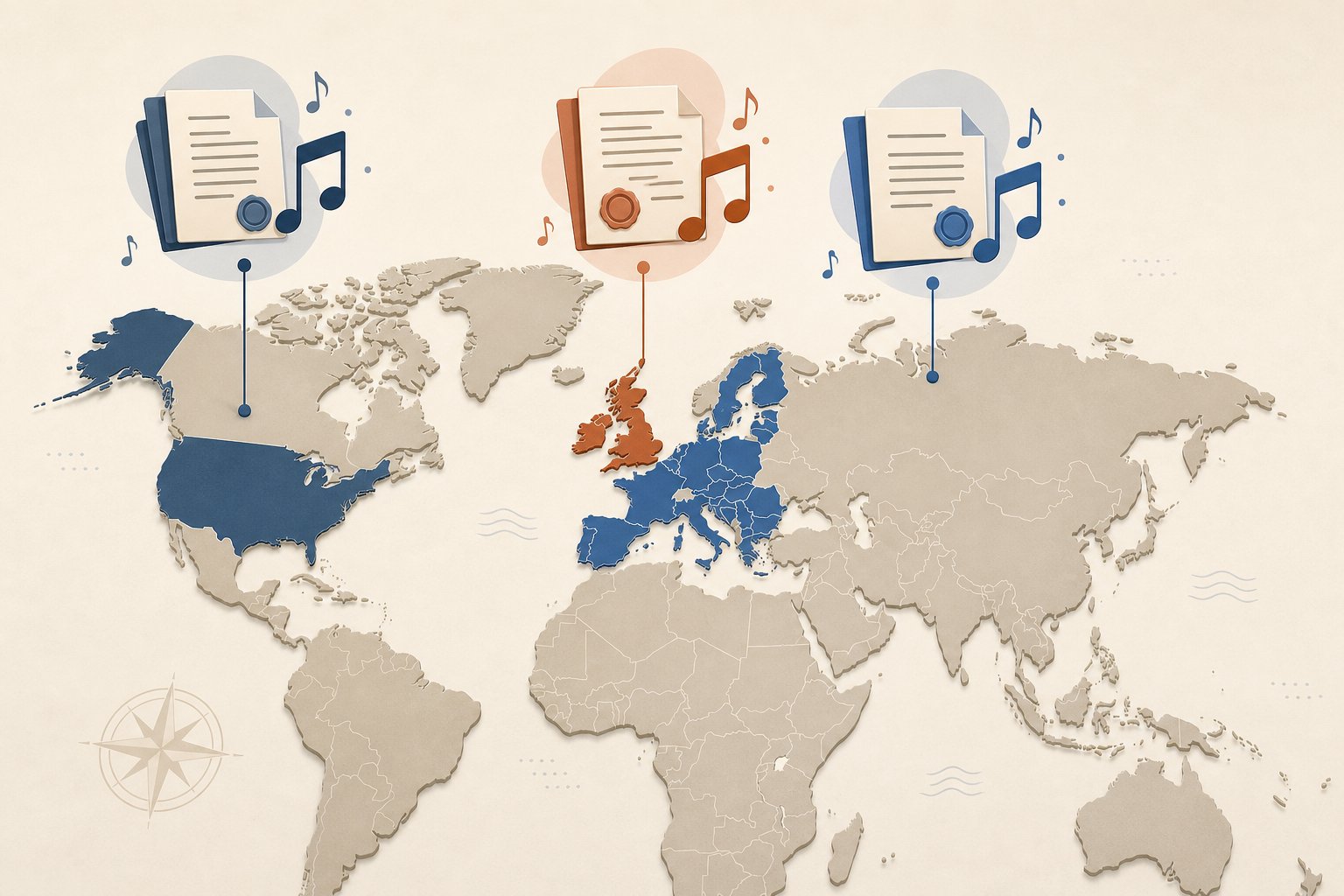
How Different Countries Handle AI Music Ownership
Music doesn't respect borders, but copyright law absolutely does. A track you generate in London, distribute from New York, and stream in Berlin passes through three distinct legal regimes, each with its own answer to whether AI-created music deserves protection. If you're following ai copyright music news, you'll notice that these jurisdictions aren't converging. They're actively diverging, and that divergence creates real complications for creators distributing globally.
The U.S. requires human authorship as a hard prerequisite. The UK has a statutory mechanism that explicitly protects computer-generated works. The EU is layering transparency obligations on top of existing member-state copyright frameworks. Each approach reflects different policy priorities, and understanding where your music will be consumed matters as much as understanding where it was made.
UK Law and Computer-Generated Works
The UK stands apart from nearly every other jurisdiction thanks to Section 9(3) of the Copyright, Designs and Patents Act 1988 (CDPA). This provision was designed specifically for works "generated by computer in circumstances such that there is no human author." Rather than denying protection entirely, the law assigns authorship to "the person by whom the arrangements necessary for the creation of the work are undertaken."
What does that mean in practice? If you use an AI music generator and no human can be identified as the creative author of the output, the person who set up and initiated the creation process is treated as the author. This could be the user who ran the prompt, the developer who built the system, or potentially the company that deployed it. The case law on this point remains limited, with Nova Productions Ltd v Mazooma Games Ltd being the only decision that expressly applied Section 9(3), and that case involved a video game rather than music.
There are important trade-offs. Works protected under Section 9(3) receive a shorter copyright term of 50 years from creation, compared to 70 years after the author's death for human-authored works. And critically, the designated author receives no moral rights. That means no right to attribution and no right to object to derogatory treatment of the work. For musicians who care about being credited and maintaining artistic integrity, this is a significant limitation even within a favorable ownership framework.
The UK government reviewed this provision in 2022 and acknowledged stakeholder concerns about how it applies to modern AI systems, but declined to make immediate changes. A proposed AI training data exemption was later abandoned in April 2026 after sustained opposition from publishers and creative industries, leaving the existing framework intact but unresolved questions about its application to today's generative AI tools.
EU Approach and Moral Rights Considerations
The European Union has taken a regulatory rather than purely copyright-based approach. The EU AI Act, adopted in March 2024 with phased enforcement beginning in August 2025, classifies generative AI music tools as "general-purpose AI" systems. Providers must publish detailed summaries of their training data, implement technical measures to comply with the Copyright Directive's text and data mining provisions, and clearly label AI-generated outputs.
The ai music regulation news from the EU adds another layer: the Digital Single Market Directive's Article 4 opt-out mechanism. Rights holders can place machine-readable reservations on their catalogs, and AI companies are legally obligated to respect those reservations. Major labels have already begun implementing these opt-outs aggressively. Non-compliance with the AI Act carries penalties of up to 35 million euros or 7% of global annual turnover.
Beyond these regulatory obligations, moral rights create additional complexity for AI music creators operating in EU jurisdictions. Most EU member states recognize strong moral rights, including the right of attribution (being named as the creator) and the right of integrity (objecting to modifications that harm your reputation). These rights are typically inalienable, meaning they can't be waived or transferred by contract.
Here's where it gets tricky for AI music. If a work has no identifiable human author, who holds the moral rights? In most EU member states, the answer is nobody, because moral rights attach to natural persons. But if a creator contributes enough human authorship to claim copyright in an AI-assisted work, they also acquire moral rights in those human-authored elements. The practical result: a creator who writes lyrics over AI-generated instrumentation holds moral rights in the lyrics but has no moral rights claim over the instrumental portions. This fragmented protection is something music copyright news today rarely addresses in depth, but it matters for anyone licensing AI-assisted works across European markets.
The European Parliament passed a resolution in April 2026 calling for mandatory AI copyright rules, with the Commission expected to respond by summer 2026. Whether this leads to mandatory licensing obligations or maintains the current opt-out model remains the most consequential near-term decision point for ai music legal news in Europe.
What This Means for Global Distribution
When you distribute music through platforms like Spotify or Apple Music, your tracks become available worldwide. That means your ownership position is only as strong as the weakest link in the jurisdictional chain. A track that qualifies for copyright protection in the UK under Section 9(3) may have no copyright protection in the U.S. if it lacks sufficient human authorship. Conversely, a work with strong human creative input that's fully protected in the U.S. might face additional transparency and labeling requirements when distributed in the EU.
The table below maps how each jurisdiction handles the key dimensions of copyright protection music industry usa creators and international artists need to understand:
| Dimension | United States | United Kingdom | European Union |
|---|---|---|---|
| Copyright Eligibility for AI Music | Only human-authored elements qualify; purely AI-generated works cannot be registered | Computer-generated works protected under CDPA Section 9(3); authorship assigned to person who made arrangements | Varies by member state; generally requires human intellectual creation; no unified AI-specific provision |
| Moral Rights | Limited moral rights (VARA applies only to visual art); not a major factor for music | No moral rights for computer-generated works under Section 9(3); full moral rights for human-authored works | Strong moral rights (attribution and integrity) in most member states; attach only to human-authored portions |
| Disclosure Requirements | Must disclose AI involvement in copyright registration; failure risks cancellation | No formal disclosure requirement for copyright; labeling may evolve with future legislation | AI Act requires labeling of AI-generated outputs; training data summaries mandatory for providers |
| Commercial Use Permissions | Platform ToS grants commercial rights independent of copyright status | Platform ToS grants commercial rights; Section 9(3) provides additional legal backing | Platform ToS grants commercial rights; must comply with AI Act transparency obligations |
| Copyright Duration | Life of author + 70 years (human-authored portions only) | 50 years from creation (computer-generated); life + 70 years (human-authored) | Life of author + 70 years (human-authored); no protection for purely AI-generated works in most states |
| Training Data Liability | Active litigation (RIAA v. Suno/Udio); fair use defense pending court resolution | No safe harbor; 40+ publishers have issued legal notices to AI companies | Article 4 opt-out mechanism enforceable; mandatory rules under consideration |
The practical takeaway? If you're releasing AI-assisted music globally, build your ownership strategy around the most restrictive standard you'll encounter. For most creators, that means ensuring meaningful human authorship in the core expressive elements of your work, because that's the one approach that provides protection across all three major jurisdictions simultaneously.
Copyright law tells you what the government will protect. But there's another source of rights that operates independently of any government's position: the terms of service you agreed to when you signed up for your AI music tool. Those contractual rights can grant you commercial use, distribution, and even exclusivity, regardless of whether your track qualifies for copyright registration.
AI Music Platform Terms of Service Compared
Copyright law determines what the government will protect. Platform terms of service determine what you can actually do with the music you generate. These are separate legal instruments, and for most creators, the platform agreement is the more immediately useful one. Why? Because contractual rights are enforceable between the parties regardless of whether the underlying work qualifies for copyright registration. Your ability to monetize, distribute, and sublicense AI-generated music flows from the contract you accepted when you signed up.
Yet not all platforms grant the same rights, and the differences between free and paid tiers can be dramatic. Choosing the wrong tool, or the wrong pricing tier, can leave you without the commercial permissions you assumed you had.
What Platform Terms Actually Grant You
When a platform like Suno, Soundraw, or AIVA states that paid subscribers receive "full commercial rights," they're granting a license. That license is a contractual promise: you may use the generated output for commercial purposes, distribute it, and in some cases sublicense it to third parties. This holds up in court as a binding agreement between you and the platform, even if no government copyright office would register the track.
Think of it this way. You can't copyright a sunset photograph taken by an automated camera trap with no human involvement. But if a stock photo platform licenses that image to you for commercial use, you still have enforceable rights to use it in your marketing materials. The same logic applies to AI music. The platform's license is your legal foundation for commercial exploitation, separate from any copyright claim.
This distinction matters enormously for creators asking whether they own the rights to music made with AI. In many cases, "ownership" in the traditional copyright sense isn't what you need. What you need is a clear, documented right to use the music commercially without risk of takedown or dispute. Platform agreements provide exactly that.
However, there's a critical limitation. Contractual rights only bind the parties to the agreement. If someone else copies your AI-generated track and uses it themselves, your platform license doesn't give you the power to stop them. Only copyright protection provides that exclusionary right. So while platform terms solve the monetization question, they don't solve the enforcement question against third parties.
Free Tier vs Paid Tier Ownership Differences
A consistent pattern emerges across the AI music landscape: free tiers restrict commercial use, while paid tiers unlock it. The specifics vary, but the general structure looks like this:
- Free tiers typically limit you to personal or non-commercial use. Some platforms retain rights to redistribute your outputs, require attribution, or restrict monetization entirely. Suno's free Basic tier, for example, explicitly does not grant commercial rights. Music generated on the free plan cannot legally be used in monetized content.
- Paid tiers generally grant full commercial rights, remove attribution requirements, and sometimes offer exclusive ownership of the generated output. The rights typically persist even after you cancel your subscription, though you should verify this in each platform's specific terms.
Some platforms like AIVA take a tiered approach where even the mid-level paid plan has revenue caps or partial restrictions, reserving full copyright ownership exclusively for Pro subscribers. Others, like Boomy, bundle distribution directly into the platform and handle royalty collection automatically, creating a different ownership dynamic where the platform remains involved in the commercial chain.
What about lyrics generated by AI chatbots versus music from dedicated generators? The ownership terms often differ. General-purpose AI tools like ChatGPT or Claude typically grant broad usage rights to outputs in their terms of service, but they weren't designed with music distribution in mind. Their terms may not explicitly address sync licensing, streaming distribution, or PRO registration. Dedicated AI music platforms like Soundraw or Stable Audio have terms specifically crafted for these use cases, making them more reliable for creators who need clarity on commercial music rights.
Platforms like melobytes and producerai occupy a different segment of the market, often targeting hobbyists or experimental creators with simpler licensing structures. Similarly, tools like brev ai that focus on specific production workflows may have narrower but clearer terms around what you can do with the output. The key in every case is reading the actual terms rather than assuming based on the platform's marketing language.
The table below maps the general rights structure across major platforms. Because terms of service change frequently, verify current policies directly before making commercial decisions:
| Platform | Free Tier Rights | Paid Tier Rights | Commercial Use | Exclusivity | Attribution Required |
|---|---|---|---|---|---|
| Suno | Non-commercial only | Full commercial rights (Pro $10/mo, Premier $30/mo) | Paid tiers only | Non-exclusive | No (paid tiers) |
| Stable Audio | Limited personal use | Full commercial license (Creator tier) | Paid tiers only | Non-exclusive | No (paid tiers) |
| AIVA | Non-commercial; platform owns output | Standard: limited commercial; Pro: full copyright ownership | Pro tier for full rights | Exclusive (Pro only) | Required on free/Standard |
| Boomy | Limited saves; restricted features | Commercial rights with built-in distribution ($9.99/mo) | Yes (with revenue share) | Non-exclusive | No |
| Soundraw | Not available | Royalty-free commercial music (Creator $19.99/mo) | Yes | Non-exclusive | No |
| Mubert | Personal use with watermark | Commercial license (paid plans) | Paid tiers only | Non-exclusive | No (paid tiers) |
| Udio | Downloads suspended | Downloads suspended (post-settlement transition) | Currently unavailable | N/A | N/A |
A few patterns worth noting. The soundraw ai music generator and similar parameter-based tools tend to offer the cleanest commercial terms for content creators because their business model is built around royalty-free licensing. Platforms like rightsify that focus on music licensing infrastructure approach ownership from the distribution side, offering pre-cleared catalogs rather than generation tools. And platforms currently in legal transition, like Udio, demonstrate how quickly commercial rights can evaporate when training-data disputes reach settlement.
The musichero ai music generator and tad ai ai music generator represent newer entrants in the space. As with any emerging platform, their terms may be less battle-tested than established players. When evaluating newer tools, look for explicit language about commercial use, whether rights survive subscription cancellation, and whether the platform retains any claim to your generated outputs.
One red flag to watch for: platforms that include revenue-sharing clauses or retain redistribution rights over your generated content. These arrangements mean the platform remains a stakeholder in your commercial use, which can create complications if you later want to license the track exclusively to a client or register it with a distributor.
Contractual rights give you a clear path to monetization. But which specific revenue streams are actually open to AI-generated music, and what documentation does each one require? The answer varies significantly depending on whether you're streaming, sync licensing, or collecting performance royalties.
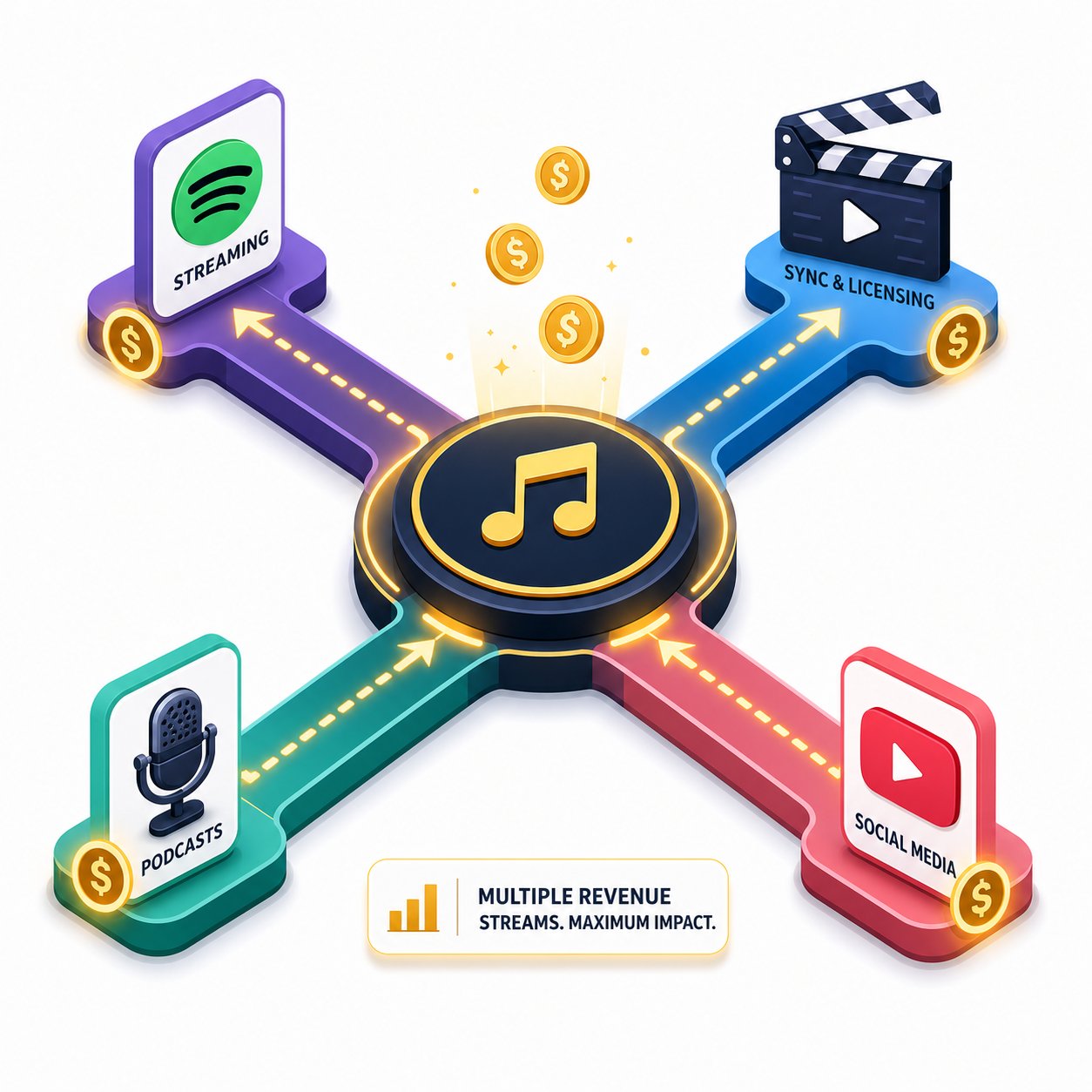
Monetizing AI Music Through Streaming and Licensing
You have commercial rights from your platform's terms of service. You may even have a partial copyright registration for the human-authored elements of your track. The next question is practical: where can you actually earn money with AI-generated music, and what does each revenue stream require you to prove?
The answer depends on which monetization path you pursue. Each one has different gatekeepers, different documentation requirements, and different tolerance levels for AI involvement. Some doors are wide open. Others remain partially closed. And a few are actively evolving their policies as the role of AI in the music industry continues to expand.
Streaming Platform Distribution
Getting AI music onto Spotify, Apple Music, or Amazon Music requires a distributor, and distributors have their own policies about what they'll accept. The two largest independent distributors illustrate the split perfectly.
DistroKid explicitly allows AI-generated music with conditions: you must own 100% of the rights, check the AI disclosure box during upload, and avoid impersonation or algorithmic spam. Their model is permissive, adapting to AI music rather than blocking it outright. For creators producing ai records at volume, DistroKid's unlimited upload structure at $24.99/year makes it the default choice.
TuneCore takes the opposite stance, blocking content that is "100% created by AI" and deploying detection technology that claims 99.9% accuracy in identifying fully AI-generated tracks. AI-assisted production with significant human involvement may pass, but tracks generated entirely through tools like Suno or Udio will likely be rejected.
The critical insight here: the distributor's requirement isn't copyright registration. It's that you have the legal right to distribute the content. That right comes from your platform's terms of service. If your AI music tool grants you commercial distribution rights on a paid tier, and you check the appropriate disclosure boxes, most distributors will deliver your track to streaming platforms. The per-stream royalty rates are identical regardless of which distributor you use, so the real variable is whether your release gets accepted in the first place.
Streaming platforms themselves are also developing policies. Spotify has removed tracks suspected of being AI-generated streaming fraud, and Apple Music requires distributors to flag AI content. These rules target spam and impersonation rather than legitimate AI-assisted creation, but they signal that platforms are paying attention to how AI reshapes the landscape.
Sync Licensing and Content Monetization
Sync licensing, the process of placing music in film, TV, commercials, and video games, represents a $500M+ global industry. Traditionally, sync deals require proof of clear ownership because the licensee needs assurance that no third party will surface with a competing claim. This creates a challenge for fully AI-generated works where copyright status is uncertain.
For professional sync placements, music supervisors and brands typically want to see clean rights documentation: confirmed authorship, no uncleared samples, and no legal issues in music industry masters that could trigger disputes down the line. AI-generated tracks without demonstrable human authorship introduce risk that most supervisors aren't willing to accept for high-value placements. The copyright music industry news around training-data lawsuits only amplifies that caution.
Content creators using AI music for their own ai music videos, podcasts, YouTube channels, or social media face a much simpler situation. You're not licensing to a third party. You're using music in your own content under the commercial rights your platform granted you. No sync deal is required. No proof of copyright ownership is needed. You just need a valid commercial license from the tool you used, which paid tiers of most AI music generators provide.
This is why the content creator use case is the most straightforward monetization path for AI-generated music today. You generate a track, confirm your plan includes commercial rights, and use it in your monetized content. YouTube's Content ID system won't flag music you generated through a licensed tool because no one else holds a competing claim to that specific output.
Performance Rights Organizations represent the most nuanced revenue stream. Until recently, ASCAP, BMI, and SESAC required human composers for registration, creating a complete gap for AI-generated works. That changed in October 2025 when ASCAP, BMI, and SOCAN jointly announced they would accept registrations of partially AI-generated musical compositions. The key word is "partially." Works must combine AI-generated elements with elements of human authorship. Compositions entirely created by AI tools remain ineligible.
This policy shift means creators who write lyrics, compose melodies, or make substantial arrangement decisions over AI-generated backing can now register those works and collect performance royalties when they're played publicly. It's a significant development for anyone pursuing an ai record deal or building a catalog of AI-assisted compositions for long-term royalty income. Services like recordlabel.ai that help independent artists manage their releases should be evaluated against these evolving PRO requirements.
Here's a summary of each monetization path and what it requires:
- Streaming distribution (Spotify, Apple Music, Amazon) - Requires: commercial rights from platform ToS, AI disclosure to distributor, no impersonation. Does not require copyright registration.
- Sync licensing (film, TV, ads) - Requires: proof of clear ownership, typically copyright registration or exclusive rights documentation. Challenging for fully AI-generated works; viable for AI-assisted works with strong human authorship.
- PRO registration (ASCAP, BMI, SOCAN) - Requires: partially AI-generated work with demonstrable human-authored elements. Fully AI-generated compositions are not eligible.
- Content monetization (YouTube, TikTok, podcasts) - Requires: valid commercial license from AI music platform. Simplest path; no third-party licensing or copyright registration needed.
- YouTube Content ID revenue - Requires: distributor that offers Content ID registration (often an add-on fee). Works for AI music distributed through accepted channels.
- Stock music libraries and licensing platforms - Requires: varies by platform; some accept AI-generated music with disclosure, others require human composition. Check individual submission guidelines.
The monetization landscape for AI music is more open than many creators assume. The barriers aren't universal. They're specific to each revenue stream, and the most accessible paths, streaming and content monetization, require only the commercial rights that a paid platform subscription already provides.
Knowing which revenue streams are available is one thing. Positioning yourself to take full advantage of them, while protecting against the legal uncertainties that remain, requires a deliberate strategy tailored to your specific creative goals.
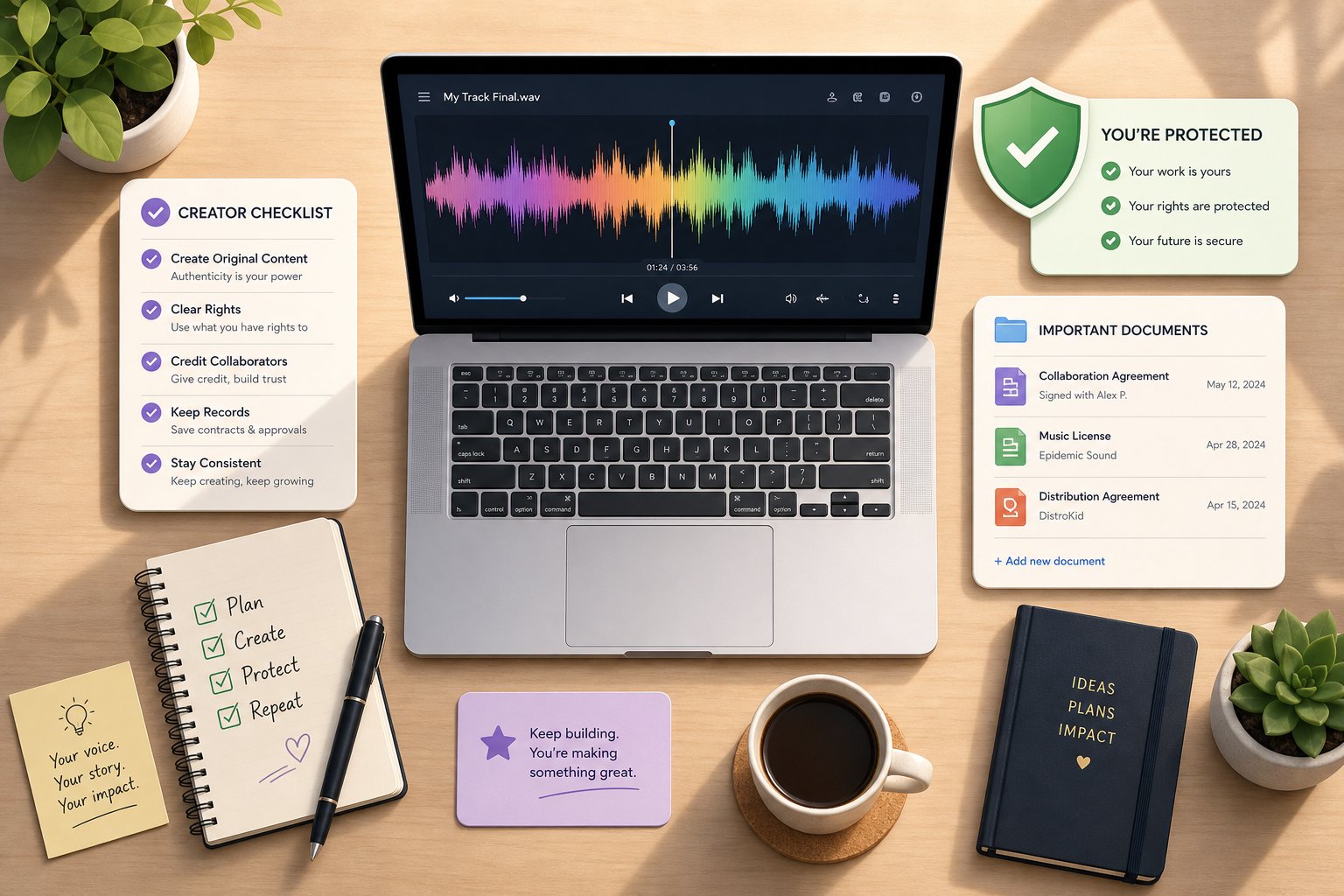
Practical Steps to Protect Your AI Music Rights Today
Legal uncertainty doesn't mean you're powerless. While courts and copyright offices work through the gray areas, you can take concrete steps right now to strengthen your ownership position, protect your commercial rights, and build a defensible record of your creative process. The creators who document, choose wisely, and contribute meaningfully will be in the strongest position regardless of how the law eventually settles.
Can you publish a song written by AI? Yes, in most cases. But publishing without a strategy leaves you exposed. Here's what to do instead.
Document Your Creative Process
Think of documentation as your insurance policy. If your ownership is ever challenged, whether by a platform, a distributor, or a third party claiming infringement, your records become your evidence. The best practice guidance from IP professionals consistently emphasizes that creators should be transparent about AI use and provide evidence of their creative involvement.
What should you record? Every human creative decision you make. Save your original lyrics drafts, melody recordings, prompt iterations, and screenshots of your DAW sessions showing arrangement choices. Keep notes on which elements you modified after generation and how you shaped the final output. If you write lyrics using a chatbot, the question of whether you own lyrics from Claude or ChatGPT depends partly on how much you edited and directed the output, and your documentation proves that contribution.
This matters for copyright registration too. When you efile song copyrights with the U.S. Copyright Office, you'll need to identify which portions are human-authored and disclaim AI-generated elements. Having a clear creative trail makes that process straightforward rather than a guessing game. It also protects against time stamp fraud in music copyright disputes, where bad actors attempt to claim prior creation of similar works.
Choose Platforms With Clear Commercial Rights
Your platform choice is the single most controllable factor in your ownership equation. Selecting AI music tools with transparent, creator-friendly terms of service gives you enforceable commercial rights today, regardless of how copyright law evolves tomorrow.
What should you look for? Platforms that explicitly grant royalty-free commercial licenses on their paid tiers, don't retain redistribution rights over your outputs, and clearly state that rights survive subscription cancellation. Tools like the shoom ai music generator or musicfyai each have their own licensing structures, so reading the actual terms rather than relying on marketing claims is essential.
For creators who need free, royalty-free music for videos, podcasts, games, and social content without navigating complex ownership questions, MakeBestMusic's Free Music Generator offers a straightforward solution. It's designed for creators who prioritize clear commercial use rights without royalty concerns, making it a practical choice when you need music you can confidently monetize across platforms without worrying about downstream disputes.
The cost for music copyrights album ai projects can add up quickly when you factor in registration fees, legal consultation, and platform subscriptions. Choosing a tool that grants clear commercial rights from the start reduces both legal complexity and out-of-pocket expenses.
Maximize Human Creative Input
Every human creative choice you make strengthens your ownership position. The more you treat AI as a starting point rather than a finished product, the closer you move toward registrable copyright protection. This isn't just legal strategy. It's also what separates forgettable AI output from music that actually connects with listeners.
Use AI-generated material as raw material, then transform it. Layer human-performed vocals or instruments over AI backing tracks. Write original lyrics rather than accepting generated text. Make substantive arrangement decisions: restructure sections, change keys, alter dynamics, add transitions that reflect your artistic vision. Each intervention adds human authorship that copyright law recognizes and protects.
Here's your immediate action checklist:
- Start a creation log - For every AI-assisted track, record the date, tool used, prompts entered, and human modifications made. A simple text file or spreadsheet works.
- Save all drafts and iterations - Keep before-and-after versions showing how you transformed AI output into your final work.
- Verify your platform's commercial terms - Confirm your subscription tier grants the specific rights you need (commercial use, no attribution, distribution rights).
- Write at least one core element yourself - Original lyrics, a composed melody, or a distinctive arrangement choice gives you the strongest authorship claim.
- Screenshot your subscription status - If your rights depend on a paid tier, document that you held an active subscription when you generated the music.
- Disclose AI involvement proactively - When registering with the Copyright Office or submitting to distributors, be upfront about which elements are AI-generated. Honesty protects your registration from future cancellation.
- Monitor platform terms for changes - Terms of service evolve. Set a quarterly reminder to review the licensing terms of every AI tool in your workflow.
These steps take minimal time but create maximum protection. The creators who implement them consistently will have documented, defensible ownership positions while others operate on assumptions that may not hold up under scrutiny.
Of course, not every creator needs the same level of protection. A YouTuber using background music has different ownership needs than an independent artist releasing singles on Spotify. The right strategy depends entirely on what you're building and where your music will live.
Which Ownership Strategy Fits Your Creative Goals
Your ownership needs aren't the same as every other creator using AI music tools. A podcaster searching for background tracks operates in a completely different risk environment than an independent artist building a streaming catalog. The right strategy depends on what you're making, where it will live, and how much legal protection you actually need to sleep well at night.
Whether you're experimenting with a chatgpt song maker for fun or evaluating top ai platforms for lyrics and writing for a professional release, your persona determines your path. Here's how each creator type maps to a specific ownership approach.
Content Creators and Background Music
If you make YouTube videos, run a podcast, produce social content, or develop indie games, you have the simplest ownership question to answer. You don't need copyright registration. You don't need to prove authorship to a government office. You need one thing: a valid commercial license that lets you use the music without getting a takedown notice or a royalty claim.
Royalty-free AI music generators solve this completely. The commercial rights granted by a platform's terms of service are all the legal foundation you need. Nobody is going to challenge your copyright ownership of a background track in your tutorial video. They might challenge whether you had permission to use it, and that's what a clear license answers.
MakeBestMusic's Free Music Generator is built for exactly this use case. It provides free, royalty-free music you can use across videos, games, podcasts, and commercial projects without navigating ownership complexity. For content creators who need reliable background music without legal headaches, it removes the guesswork entirely. You generate, you use, you monetize. No attribution required, no royalty concerns, no ambiguity about whether your content will get flagged.
This persona also includes creators wondering whether they can use an ai generated country song as intro music, or someone asking ai to make a hit country song for a comedic sketch. The answer is the same: if your platform grants commercial rights, you're covered for content use regardless of copyright status.
Independent Artists Releasing Original Music
You want your name on the track. You want it on Spotify, Apple Music, and maybe pitched for playlist placement. You might even want to register it with a PRO for performance royalties. This persona has higher ownership stakes because you're building a catalog that represents your artistic identity.
Your goal is copyright eligibility, which means demonstrating meaningful human authorship. The strategy here is clear: use AI as a collaborator, not a replacement. Write your own lyrics. Compose the core melody. Use AI to generate instrumental ideas or arrangement options, then select, modify, and shape those outputs into something that carries your creative fingerprint.
Can Gemini make songs? Can any AI tool produce a complete track from a prompt? Absolutely. But accepting that output as your finished release puts you in the weakest ownership position possible. Independent artists should treat AI outputs as raw material, the same way a producer treats a sample pack. The best ai tool for song lyrics is one that sparks ideas you then rewrite, not one that hands you a finished verse you publish unchanged.
Document everything. Keep your lyric drafts, melody recordings, and DAW screenshots showing arrangement decisions. When you submit to distributors, disclose AI involvement honestly. When you register with ASCAP or BMI, you'll need to identify which elements are human-authored. Your documentation makes that process seamless rather than stressful.
Professional Producers Using AI in Their Workflow
Producers who incorporate AI mixing, mastering, stem generation, or MIDI composition into a larger human-directed workflow have the strongest ownership position of any persona. Why? Because AI is clearly functioning as an instrument in a creative process you control from start to finish.
You're not asking an AI to make your song. You're using an ai music remixer to process a drum loop, running AI mastering on a mix you spent weeks building, or pulling MIDI patterns from an AI composer that you then rearrange, reharmonize, and integrate into a production only you could have made. This mirrors how producers have always adopted new technology, from drum machines to auto-tune to algorithmic reverb. The tool changes; the human direction doesn't.
Professional producers exploring ai song apps for specific workflow tasks should evaluate tools based on output quality and integration with their existing DAW setup rather than obsessing over ownership terms. When AI handles technical execution within a human-directed creative vision, the copyright question is largely settled in your favor. Your concern shifts to ensuring the AI tool's training data doesn't introduce downstream infringement risk, which is a platform-selection question rather than an authorship question.
Here's how each persona maps to a recommended strategy:
- Content creators (YouTube, podcasts, social media, games) - Platform type: royalty-free AI music generators with clear commercial licenses. Strategy: prioritize ease of use and license clarity over copyright registration. Recommended: MakeBestMusic's Free Music Generator for free, royalty-free tracks with no attribution requirements.
- Hobbyists and social media creators - Platform type: free-tier AI generators for personal and non-commercial use. Strategy: enjoy the creative process without worrying about ownership unless you decide to monetize later. Upgrade to paid tiers only when commercial use becomes relevant.
- Independent artists releasing on streaming platforms - Platform type: AI collaboration tools that allow export and modification in a DAW. Strategy: maximize human creative input, document your process thoroughly, and register human-authored elements with the Copyright Office and PROs.
- Professional producers - Platform type: AI-powered production tools (mixing, mastering, MIDI generation, stem splitting) that integrate into existing workflows. Strategy: use AI for technical tasks within a human-directed creative process. Focus on training-data provenance when selecting tools to minimize infringement exposure.
The common thread across every persona? Clarity beats ambiguity. Whether you need a simple commercial license or full copyright registration, choosing your tools deliberately and understanding what each one grants you is what separates confident creators from those operating on hope. The legal landscape will keep evolving, but creators who match their strategy to their actual needs, rather than chasing protections they don't require, will navigate the gray zone with the least friction and the most creative freedom.
