

Step 1 - Understand the Real Opportunity Behind AI Music Income
Can you make money from AI music? Yes. Creators are doing it right now through licensing, streaming royalties, sample pack sales, and sync placements. Some report earning thousands per month from growing catalogs of AI-assisted tracks. Others have had their accounts banned, their revenue clawed back, and in extreme cases, faced criminal charges for streaming fraud.
The difference between those two outcomes comes down to method, quality, and compliance. Making money with AI music is not a loophole or a get-rich-quick hack. It is a legitimate creative and business pursuit, but only when you understand the rules of the game.
Legitimate AI music income comes from creating genuine value for listeners and buyers. The schemes that get people banned or prosecuted involve faking that value through bot streams, stolen likenesses, or policy violations.
Global recorded music revenues hit US$31.7 billion in 2025, with streaming alone surpassing $22 billion. That is a massive market, and AI tools have lowered the barrier to entry for anyone willing to put in the work. The opportunity is real. But so are the risks if you approach it carelessly.
Why AI Music Is a Viable Income Stream
Think about what has changed. A few years ago, producing music required expensive studio time, years of technical training, or both. AI music generators now let you create broadcast-quality tracks from text prompts in minutes. The monetization paths mirror those available to any independent musician: streaming platforms, licensing marketplaces, direct sales to content creators, and sync placements in video, games, and advertising.
What makes this viable is not the speed alone. It is the combination of low production cost, scalable output, and growing demand for background and functional music. Podcasters, YouTubers, game developers, and brands all need affordable music. Can you monetize AI music to serve that demand? Absolutely, if your output clears the quality bar and your distribution methods stay within platform guidelines.
What This Guide Covers and Who It's For
This guide walks through every step, from legal foundations and tool selection to distribution, licensing, scaling, and avoiding the mistakes that destroy accounts. Each section tackles a specific dimension of making money from AI generated music so you can build a sustainable income stream rather than a house of cards.
You will find value here whether you are a complete beginner curious about AI music as a side income, a working musician exploring how AI tools can accelerate your production workflow, or a content creator who needs affordable background music and wants to understand the commercial landscape before investing time.
The legal and platform landscape shapes everything that follows. Understanding where the boundaries are, and why they exist, is the foundation every monetization strategy rests on.
Step 2 - Learn the Legal Rules and Platform Policies First
Every dollar you earn from AI music depends on whether you actually have the right to monetize what you created. Sounds straightforward, but the legal framework around AI-generated music is still evolving, and platform policies differ widely. Getting this wrong does not just mean lost revenue. It can mean account bans, copyright strikes, or worse.
Copyright Ownership and AI Music Tools
Here is the core question: is AI generated music copyrighted? In the United States, the U.S. Copyright Office has made its position clear through multiple rulings and a multi-part report on Copyright and Artificial Intelligence. The key principle: works generated entirely by AI, with no meaningful human creative input, are not eligible for copyright protection. The Office's Part 2 report on copyrightability, published in January 2025, reinforces that copyright requires human authorship.
What does this mean in practice? If you type a single prompt and publish the raw output without modification, you likely cannot claim copyright on that track. But if you select, arrange, edit, layer, and master AI-generated elements with genuine creative decisions, your contribution may qualify for protection. The more human creative involvement you add, the stronger your ownership position becomes.
Jurisdiction matters too. The EU, UK, and other regions are developing their own frameworks, some more permissive than others. But for most creators looking to sell AI generated music legally, the safest approach is to treat your AI tool as an instrument and ensure meaningful human creativity sits on top of the output.
Beyond copyright law, your rights also depend on the specific tool you use. Each AI music generator has its own terms of service governing commercial use. Some grant you full ownership of outputs on paid plans. Others retain partial rights or restrict monetization to certain channels. Always read the licensing terms before distributing anything. If the tool does not explicitly grant commercial rights, you do not have them.
Platform Policies You Must Know Before Publishing
Even if you have clear commercial rights from your tool, streaming platforms and distributors set their own rules about AI content. These policies have tightened significantly, and violating them can get your catalog removed overnight. Here is where each major platform stands:
| Platform | AI Content Allowed? | Disclosure Required? | Key Restrictions |
|---|---|---|---|
| Spotify | Yes, with conditions | Yes (DDEX metadata standard) | Bans unauthorized AI voice clones; spam filter targets mass-produced fraudulent content |
| Apple Music | Yes | Yes (new metadata tags required) | Labels and distributors must disclose AI use in music and cover art |
| YouTube Music | Conditionally | Yes | Raw AI audio with minimal human input ineligible for monetization; requires "transformative human input" |
| Amazon Music | Yes, informally | Not explicitly required | Focus on catalog integrity; quiet takedowns for IP-flagged releases |
| Bandcamp | No | N/A | Explicitly bans music produced entirely or mainly by AI |
| Deezer | Yes, but flagged | Auto-detected and labeled | AI tracks excluded from algorithmic and editorial recommendations; fraudulent streams filtered from royalty calculations |
| SoundCloud | Yes | Not required | AI-assisted uploads allowed; platform commits to not using uploads for AI training without consent |
| Qobuz | Restricted | Auto-detected | AI Charter in place; "industrially generated AI content" excluded from playlists and features |
The pattern is clear. Most platforms allow AI-assisted music but increasingly require transparency. Bandcamp stands alone with an outright ban, while YouTube demands the highest bar of human creative contribution for monetization eligibility. If you are wondering how to upload AI music to Spotify or Apple Music, the short answer is: use a distributor that accepts AI content, tag it properly with the required metadata, and never clone someone's voice without authorization.
AI music royalties flow through the same mechanisms as traditional music royalties. Per-stream payments, mechanical royalties, and performance royalties all apply. But platforms like Deezer now actively filter out fraudulent AI streams from royalty pools, meaning the ecosystem is self-correcting against manipulation.
The line between legitimate promotion and streaming fraud is not blurry. It is a wall. On one side: releasing quality tracks, building playlists organically, promoting through social media, and letting real listeners find your music. On the other side: bots, fake accounts, and artificial inflation.
How serious are the consequences? Consider the case of Michael Smith, a North Carolina musician charged by the U.S. Department of Justice in 2024 with music streaming fraud aided by artificial intelligence. Smith allegedly used AI to generate hundreds of thousands of songs, then deployed bot accounts to stream them billions of times, fraudulently collecting over $10 million in royalties. The charges include wire fraud and money laundering conspiracy, each carrying a maximum sentence of 20 years in prison.
Smith's case is the first criminal prosecution involving artificially inflated music streaming. It demonstrates that streaming fraud is not a terms-of-service violation you can appeal. It is a federal crime.
The takeaway for anyone exploring AI music income on Reddit or anywhere else: legitimate monetization is completely achievable. But the moment you introduce bots, fake accounts, or artificial stream counts, you cross from entrepreneurship into fraud. Platforms are building detection systems specifically for this. Deezer uses AI detection tools to identify and filter fraudulent streams. Spotify's spam filters target mass-produced content with anomalous streaming patterns.
Knowing these rules is not optional. It is the foundation that determines whether your AI music business survives its first year or disappears in a policy enforcement sweep. With the legal and platform landscape mapped out, the next decision is which tools give you the commercial rights and output quality to actually compete.
Step 3 - Pick the Right AI Music Tools for Commercial Use
Your tool choice determines your commercial rights before you generate a single note. Some AI music generators grant full ownership on every plan. Others restrict monetization to premium tiers or limit where you can distribute outputs. Picking the wrong tool means you could create a hundred tracks and legally own none of them.
What to Look For in an AI Music Generator
When you browse an ai music generator reddit thread, you will find dozens of recommendations. The problem is that most discussions focus on sound quality alone without addressing whether you can actually sell what the tool produces. For monetization, you need to evaluate tools through a commercial lens.
Here are the criteria that matter most when your goal is revenue:
- Commercial licensing clarity - Does the tool explicitly grant you the right to sell, stream, and license outputs? Check whether this applies to all plans or only paid tiers.
- Output quality for your target platform - Streaming platforms and licensing buyers expect polished, professional-sounding audio. Tools that export only compressed MP3 files limit your options.
- Genre coverage - Functional music niches like lo-fi, ambient, and cinematic score differently than pop or hip-hop. Match the tool's strengths to your monetization strategy.
- Export format options - WAV files, stem separation, and MIDI export give you flexibility for post-production and licensing packages.
- Cost vs. revenue potential - A free tool with commercial rights lets you test the market at zero risk. Paid tools need to justify their subscription against realistic earnings.
Music ai pricing varies dramatically across the market. Free tiers often strip away commercial rights entirely, while premium plans range from $10 to $49 per month. The best free ai music generator reddit communities frequently recommend is whichever tool offers the highest quality output with clear commercial licensing at no cost, because that eliminates financial risk while you learn what works.
Free Tools That Allow Commercial Use
Starting with zero upfront investment makes sense when you are still testing whether AI music fits your workflow and audience. Several tools now offer royalty-free outputs on free plans, though the specifics vary.
MakeBestMusic's Free Music Generator stands out as a zero-risk starting point for creators who need royalty-free music for videos, social content, games, and podcasts. You get commercial-use tracks without a subscription barrier, which means you can experiment with monetization strategies before committing any budget. For beginners exploring whether they can make money from AI music, removing the cost variable lets you focus entirely on quality and distribution.
Here is how the current landscape compares across tools that support commercial use:
| Tool | Commercial Rights | Pricing | Best Use Cases |
|---|---|---|---|
| MakeBestMusic Free Music Generator | Yes, royalty-free on all outputs | Free | Video backgrounds, social content, podcasts, games |
| Suno | Paid plans only (Pro $10/mo, Premier $30/mo) | Free tier available, no commercial rights | Full vocal songs, wide genre range |
| Udio | Paid plans only (Standard $10/mo, Pro $30/mo) | Free tier available, limited credits | Stem exports, DAW integration, electronic production |
| AIVA | Standard plan for social platforms; Pro (EUR 49/mo) for full ownership | Free tier non-commercial | Cinematic scoring, classical, game audio |
| ElevenLabs Music | Self-Serve plans permit most commercial use | Free tier (7 songs/day), Pro $9.99/mo | Multi-language vocals, content creators |
| Stable Audio | Creator license and above | Free tier non-commercial | Sound design, instrumental beds, podcast intros |
Notice the pattern. Most major generators lock commercial rights behind a paywall. Tools like Suno and Udio deliver excellent audio quality, but their free tiers are strictly non-commercial. AIVA requires its Pro plan at EUR 49 per month for full copyright ownership. If you are weighing how much these tools cost against potential earnings, starting free and scaling into paid plans as revenue justifies the expense is the lowest-risk path.
The tool you choose also shapes your workflow. Generators focused on full vocal songs (Suno, Udio) suit creators targeting streaming platforms. Instrumental-focused tools (AIVA, Stable Audio) fit licensing and sync markets better. And royalty-free generators like MakeBestMusic serve creators who need quick, commercially clear tracks for content production without navigating complex tier structures.
Choosing a tool is only half the equation. The real differentiator between creators who earn and those who do not is what happens after generation: how you prompt, curate, edit, and polish raw AI output into something worth paying for.
Step 4 - Create Tracks From Prompt to Polished Output
A great tool with clear commercial rights still produces generic audio if you feed it vague instructions. The gap between creators who earn and those who quit frustrated almost always comes down to workflow: how you prompt, how many outputs you generate, how ruthlessly you curate, and how much finishing work you put into the survivors.
Raw AI outputs rarely meet distribution standards. If you upload an unedited generation straight to Spotify, it will sound quieter, thinner, and less polished than neighboring tracks in any playlist. The listeners who give your song three seconds before skipping will not know why it sounds off. They will just leave. Making AI generated music sound professional requires a deliberate process from concept through final export.
Writing Prompts That Produce Monetizable Tracks
Imagine describing a song to a session musician who has never heard your references. You would not say "make something cool." You would specify the genre, the energy, the instruments, and the structure. AI generators work the same way. The best prompts for ai music generation follow a formula: lead with genre, layer in sonic descriptors, define the vocal style or instrumental focus, and close with mood.
A practical example: "indie folk, fingerpicked acoustic guitar, warm room reverb, soft male vocals with raspy texture, melancholic, 80 BPM, verse-chorus-verse-bridge-chorus structure." That is specific enough to guide the model without overloading it. According to widely referenced prompt guides, most AI music models weight the early words of your prompt most heavily, so put the genre or subgenre first.
Keep your descriptor count between four and seven. Stacking too many adjectives pulls outputs toward something muddy and average. If something is not working, swap one descriptor at a time rather than rewriting everything. Sometimes regenerating with the same prompt produces a completely different interpretation, so volume is your friend here.
Editing and Mastering Your AI Tracks for Release Quality
Successful creators on aimusic reddit communities share a consistent pattern: they generate dozens of variations and keep only the top 10-20% for further development. Think of generation as your raw material phase. Curation is where taste becomes your competitive edge.
Here is the full workflow from concept to release-ready file:
- Define your concept - Write down the emotion, genre, and use case before opening any tool. "A hopeful ambient track for study playlists" beats "something chill."
- Write targeted prompts - Specify genre first, then tempo, instrumentation, vocal style, mood, and structure. Include section labels (verse, chorus, bridge) if your tool supports them.
- Generate in volume - Produce 10-20 variations per concept. Every ai song generator reddit thread that discusses earnings emphasizes this: quantity at the generation stage feeds quality at the selection stage.
- Curate ruthlessly - Listen with headphones. Does the track capture your original concept? Discard anything that feels generic, has timing artifacts, or wanders structurally.
- Edit and arrange - Trim dead space, adjust transitions, and tighten song structure in a DAW. Layer multiple AI outputs or add human-played elements to strengthen your copyright position.
- Master for distribution - AI outputs typically lack competitive loudness and tonal balance. Use an AI mastering service like LANDR, eMastered, or Automix to bring your track to streaming-platform loudness standards with balanced EQ and proper stereo imaging.
- Export in the correct format - Distributors require WAV files at 16-bit/44.1kHz minimum. Never upload a compressed MP3 as your distribution master.
The mastering step deserves emphasis. Services like Automix handle true multi-track mixing from stems if you have layered elements, while LANDR and eMastered process your stereo bounce into a release-ready master for under $15 per month. Skipping this step is the single most common reason AI tracks sound amateur next to traditionally produced music.
Volume and curation compound over time. A creator who generates 100 tracks per month, keeps 15, and masters those 15 for distribution will build a catalog far faster than someone who agonizes over a single generation. The tracks that survive your quality filter are the ones worth distributing, and distribution strategy determines whether those polished tracks actually reach paying listeners.
Step 5 - Distribute to Streaming Platforms the Right Way
Polished tracks sitting on your hard drive earn nothing. Distribution is the bridge between finished audio and actual revenue, but for AI music creators, that bridge has gatekeepers. Not every distributor accepts AI-generated content, and those that do impose specific disclosure requirements, volume limits, and platform exclusions that directly affect your earning potential.
Getting this step wrong can mean rejected uploads, pulled catalogs, or frozen earnings. Getting it right means your tracks reach listeners across dozens of platforms while you stay compliant with every policy in the chain.
Choosing a Distributor That Accepts AI Content
If you have been searching for the best music distributors for AI generated songs, here is the reality: most independent distributors now accept AI content, but with meaningful differences in what they require and where they deliver your music. Two major distributors, TuneCore and CD Baby, reject fully AI-generated tracks outright. The rest accept them under varying conditions.
Here is how the distributor landscape breaks down:
- DistroKid - Accepts AI music with an AI disclosure step during upload. You indicate whether AI contributed to vocals, lyrics, melody, or instrumentation. No volume caps or platform exclusions are documented.
- RouteNote - Accepts AI releases on both free (15% revenue share) and premium tiers. You must provide links to the AI tools used so their moderation team can verify legitimacy. Content ID services may not be available for AI tracks.
- UnitedMasters - States they "do not explicitly limit" AI-generated music distribution. No specific disclosure requirements documented, making it one of the more permissive options.
- LANDR - Accepts AI content with the most detailed policy: disclosure required, maximum 12 AI songs per calendar month, and significant platform exclusions including YouTube Content ID, Meta, TikTok, Deezer, and Pandora.
- Amuse - Accepts AI music with a cap of 10 releases per rolling 7-day period. Meta and YouTube Content ID excluded. Amuse detects AI content at their discretion and may exclude stores automatically.
- Symphonic - Accepts both fully AI-generated and AI-assisted music with disclosure through their upload process.
For creators who want how to upload AI music to Spotify with the fewest restrictions, DistroKid or UnitedMasters offer the simplest path. If you want to test distribution without upfront cost, RouteNote's free tier works, though you sacrifice 15% of revenue. If transparent, well-documented policies matter most to you, LANDR provides the clearest terms at the expense of stricter limits.
One critical detail that catches beginners: platform exclusions from your distributor reduce your earning potential. LANDR excluding AI tracks from TikTok, Deezer, and YouTube Content ID means you lose access to revenue streams that can represent 15-25% of a lo-fi artist's income. Factor these gaps into your distributor choice before uploading your first track.
Streaming Strategies That Actually Generate Revenue
Here is the math that sobers most newcomers: Spotify pays roughly $0.00318 per stream. That means you need approximately 230 streams to earn a single dollar. YouTube Music pays even less at around $0.002 per stream. The only platform paying meaningfully per play is TIDAL at $0.01284, but it has a fraction of the user base.
| Platform | Avg. Per-Stream Rate | Streams for $100 | AI Content Status |
|---|---|---|---|
| TIDAL | $0.01284 | ~7,800 | Accepted |
| Apple Music | $0.01000 | ~10,000 | Accepted with disclosure |
| Spotify | $0.00318 | ~31,450 | Accepted with metadata tags |
| Amazon Music | $0.00395 | ~25,300 | Accepted informally |
| Deezer | $0.00110 | ~90,900 | Flagged; excluded from recommendations |
| YouTube Music | $0.00200 | ~50,000 | Requires transformative human input |
| Pandora | $0.00133 | ~75,200 | Accepted (excluded by some distributors) |
These numbers make one thing obvious: volume is the only path to meaningful streaming income. A single track earning $40 per month will not change your life. But 200 tracks each averaging 10,000 monthly streams? That is roughly $8,000 per month from Spotify alone, before accounting for other platforms.
This is exactly why functional music genres dominate the AI music reddit conversations about revenue. Lo-fi beats, ambient soundscapes, study music, sleep sounds, and focus playlists accumulate passive streams in ways that pop or hip-hop tracks rarely do. A listener studying for four hours does not skip through an ambient playlist the way they skip songs looking for a hit. Those extended listening sessions compound stream counts without any active promotion.
The catalog business model works because each track becomes a small recurring asset. A lo-fi catalog of 200 tracks averaging 10,000 streams each produces 2 million monthly streams. Add YouTube Content ID revenue from creators using your music in study livestreams, and the income stack grows further. Successful AI music creators on reddit ai music communities consistently point to catalog depth, not individual viral tracks, as their primary revenue driver.
Practical strategies that work for AI-generated functional music:
- Target activity-based playlists - "Deep Focus," "Sleep Sounds," "Lo-fi Beats" playlists refresh regularly and favor instrumental, non-distracting music. Pitch your tracks through Spotify for Artists with specific use-case descriptions.
- Release consistently - Weekly or bi-weekly singles keep your profile active in algorithmic recommendations. Consistency signals quality to platform algorithms.
- Optimize track length - Longer tracks (4-7 minutes) generate more streams per listening session in ambient and focus contexts. Some creators release 10-minute extended versions specifically for playlist inclusion.
- Use accurate metadata and genre tags - Platforms rely on metadata to place your music in Discovery Weekly and Radio features. Precise tagging connects your tracks with the right listeners.
A word about what not to do. Every discussion about making money with AI music eventually surfaces creators who got banned for artificial inflation. Bots, fake playlist networks, stream farms, and pay-for-plays are not gray areas. They are fraud. Spotify removed over 75 million spam tracks in the 12 months before September 2025. Deezer reported that up to 85% of streams on AI-generated music were fraudulent in 2025. Platforms are investing heavily in detection, and the consequences range from catalog removal to criminal prosecution.
As for when you will actually see money: most distributors pay monthly or quarterly, with payment thresholds typically between $10 and $50. DistroKid offers withdrawals once your balance reaches their minimum, while RouteNote's free tier pays monthly after crossing the threshold. Expect your first payout roughly 2-3 months after your initial release, accounting for the reporting delay between streams occurring and revenue appearing in your dashboard.
Streaming revenue rewards patience and consistency. But it is only one monetization channel, and for many creators, not even the most profitable one. Licensing a single track to an advertiser or selling a royalty-free pack can outpace months of streaming income from that same track, which opens an entirely different approach to earning from the same catalog.
Step 6 - Monetize Through Licensing and Direct Sales
Streaming pays fractions of a cent per play. Licensing can pay hundreds or thousands of dollars per placement. That math alone explains why experienced producers increasingly treat streaming as a visibility tool and licensing as their actual revenue engine. If you are wondering how to sell AI music in ways that generate meaningful income without needing millions of streams, licensing and direct sales deserve most of your attention.
The economics are stark. To match a single $3,000 sync placement at Spotify's average rate of $0.00318 per stream, you would need roughly 750,000 streams. One track, one placement. And licensing pays in layers: the upfront sync fee, writer performance royalties, publisher performance royalties, possible mechanicals, and potential renewals if the content gets redistributed internationally. Streaming income stops the moment listening stops. Licensing income can compound for years.
Selling Royalty-Free Packs and Loop Libraries
Packaging your AI-generated tracks into royalty-free music packs is one of the most accessible entry points for direct sales. Content creators, YouTubers, podcasters, and indie game developers constantly need affordable music they can use without worrying about recurring licensing fees. You create the pack once, and it sells repeatedly as a digital product.
What goes into a sellable pack? Think themed bundles: "Cinematic Ambient - 20 Tracks for Documentary and Travel Videos" or "Lo-fi Study Beats - 15 Instrumental Loops." Buyers want clarity on what they are getting and confidence that the license covers their use case. Include WAV files, clear licensing documentation, and organized folder structures with descriptive filenames.
Pricing follows market norms. Smaller packs (5-10 tracks) typically sell for $10-$20, while larger, professionally curated collections can command $30-$60 or more. Bundle pricing, limited-time discounts, and tiered options (standard license vs. extended commercial license) let you experiment with what your audience responds to.
Where to sell royalty free music online? Several marketplaces and platforms cater specifically to audio creators:
- AudioJungle (Envato) - Over 2 million users browsing for audio. You earn up to 50% commission on standard licenses, with higher splits for exclusive authors. Strong global exposure but limited branding control.
- Sellfy - Build your own storefront with zero transaction fees. You keep 100% of earnings and control pricing, branding, and customer relationships. Requires driving your own traffic.
- Airbit - Designed for producers selling beats, loops, and sample packs together. Platinum plan at $7.99/month. Supports YouTube Content ID integration.
- Bandcamp - Direct-to-fan sales with flexible pricing. Takes 10-15% per sale. Best for creators with an existing audience. Note: Bandcamp bans fully AI-generated music, so your packs need substantial human creative contribution.
- Splice - Subscription-based exposure to millions of active producers. Strong for loops and samples rather than full tracks. Long verification process for new creators.
- Kitsi - Community marketplace where sellers keep up to 92% of revenue on paid plans. Easy setup with no approval process required.
- Pond5 and Artlist - Stock music marketplaces where creators can list tracks for sync and royalty-free licensing to video producers.
Here is an important competitive reality: buyers have access to free alternatives. Tools like MakeBestMusic's Free Music Generator give content creators royalty-free music for videos, podcasts, and social content at no cost. That means anyone selling AI music packs needs to offer something the free options do not: premium production quality, niche genre specialization, consistent sonic branding, or curated thematic collections that save buyers time. Understanding what free tools provide helps you position your paid offerings where they actually deliver unique value.
Sync Licensing and Direct Sales to Creators
Sync licensing places your music in visual media: films, TV shows, advertisements, video games, and online content. The fees vary enormously based on placement context, but even lower-tier opportunities dwarf streaming income per track.
Here is what sync licensing ai generated tracks can realistically earn, based on industry benchmarks:
| Placement Type | Typical All-In Fee | Streams Needed to Match (at $0.003/stream) |
|---|---|---|
| YouTube/TikTok micro-sync | $5 - $500 | 1,700 - 167,000 |
| Indie video game | $1,000 - $5,000 | 333,000 - 1.67M |
| Cable TV episode | $2,000 - $10,000 | 667,000 - 3.3M |
| National US advertisement | $10,000 - $50,000 | 3.3M - 16.7M |
| AAA video game | $10,000 - $50,000+ | 3.3M - 16.7M+ |
| Trailer placement | $10,000 - $80,000 | 3.3M - 26.7M |
| Global ad campaign | $100,000 - $250,000+ | 33M - 83M+ |
The top-tier placements require established relationships with music supervisors, professionally mastered catalogs, and clean rights documentation. But the lower tiers, particularly ai music licensing for videos, indie games, and podcasts, are accessible to independent creators with quality catalogs and proper metadata.
How do you get started? Sync libraries and licensing platforms accept submissions from independent producers. Services like Musicbed, Artlist, Epidemic Sound, and Marmoset connect music creators with buyers in film, advertising, and digital media. Some operate on revenue-share models, while others purchase non-exclusive licenses upfront. Direct licensing, where you negotiate placements yourself without a middleman, lets you retain 100% of the sync fee but requires building relationships with supervisors and production companies.
For AI music specifically, the key requirement is clean rights. You need to own or control both the master recording and the composition. If your AI tool's terms grant full commercial rights (which you verified back in Step 3), you can license freely. Sync buyers care about clearance speed and legal certainty more than how the music was made.
Here is how different monetization channels compare in terms of realistic revenue potential:
| Channel | Revenue Per Track | Volume Needed | Effort Level | Best For |
|---|---|---|---|---|
| Streaming royalties | $0.003 - $0.01 per stream | Very high (100K+ streams) | Low per track, high catalog maintenance | Passive income from large catalogs |
| Royalty-free pack sales | $10 - $60 per sale | Moderate (recurring sales) | Medium (creation + marketing) | Creators with niche expertise |
| Sync licensing | $500 - $50,000+ per placement | Low (few placements needed) | High (relationships + catalog quality) | Highest per-track revenue |
| Direct commissions | $50 - $500+ per project | Moderate (client pipeline) | High (client management) | Custom work for specific needs |
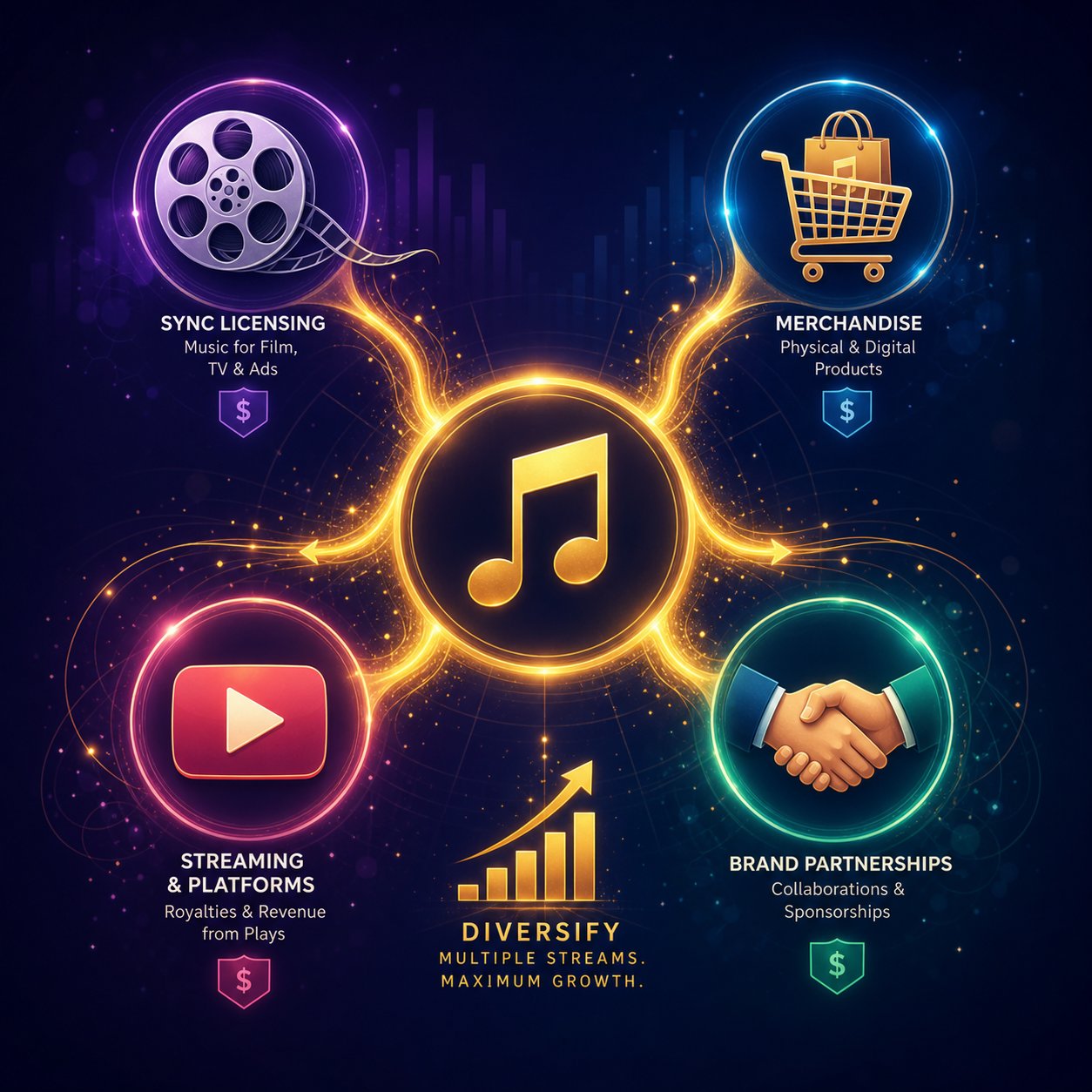
The most resilient AI music businesses do not rely on a single channel. They stream functional music for passive baseline income, sell curated packs for recurring digital product revenue, and pursue sync placements for high-value windfalls. Each channel feeds the others: streaming builds discovery, discovery attracts licensing inquiries, and licensing validates quality that drives pack sales.
Building these revenue streams requires patience, professional presentation, and clean rights documentation at every step. It also requires avoiding the mistakes that can unravel everything overnight, from policy violations that trigger account bans to tax oversights that create legal headaches down the road.
Step 7 - Avoid the Mistakes That Get Creators Banned
Revenue channels mean nothing if your accounts get terminated. Every discussion about making money with AI reddit communities eventually surfaces horror stories: entire catalogs wiped, earnings frozen, profiles shadow-banned from search. These are not random events. They follow predictable patterns of mistakes that you can sidestep entirely if you know what to watch for.
The AI music landscape is shifting fast. Spotify ai music policy changes, Bandcamp's outright ban, and Deezer's detection tools all emerged within a short window. What worked six months ago may violate today's terms. Creators who treat compliance as a one-time checkbox rather than an ongoing practice are the ones who wake up to empty dashboards.
Red Flags That Lead to Bans and Lost Revenue
If you search ai music copyright issues reddit, you will find the same handful of mistakes repeated endlessly. Some are obvious. Others catch people who thought they were doing everything right.
- Using tools without commercial licenses - Free tiers on platforms like Suno, Udio, and AIVA explicitly prohibit monetization. Uploading those outputs to Spotify or selling them in packs violates both the tool's terms and your distributor's agreement. If the tool discovers the violation, they can revoke your license retroactively.
- Failing to disclose AI generation where required - Spotify now supports DDEX-standard AI disclosures and is rolling out credits showing AI contributions to vocals, lyrics, or production. Distributors like DistroKid and LANDR require disclosure during upload. Skipping this step does not make your tracks invisible to detection systems. It makes you non-compliant.
- Artificial stream inflation - Bots, fake playlists, stream farms, and pay-for-plays. Spotify removed over 75 million spam tracks in a single 12-month period. Deezer found that up to 85% of streams on AI-generated music were fraudulent in 2025. The consequences range from royalty clawbacks to federal criminal charges.
- Unauthorized vocal cloning - Using AI to replicate a recognizable artist's voice without permission triggers Spotify's impersonation policy and potentially violates right-of-publicity laws. Spotify's updated rules state that vocal impersonation is only allowed when the impersonated artist has authorized it.
- Ignoring platform policy updates - Bandcamp's January 2026 policy led to accounts being deleted, catalogs wiped, and pages shadow-banned from search, sometimes based purely on suspicion. Artists who had published AI-assisted work before the policy took effect lost everything retroactively. If you are not actively monitoring policy changes on every platform where you distribute, you are operating blind.
- Mass-uploading without quality control - Spotify's new spam filter specifically targets uploaders who engage in mass uploads and duplicates. Flooding platforms with hundreds of low-quality generations signals exactly the behavior their detection systems are designed to catch.
The Bandcamp situation illustrates how quickly enforcement can escalate. Artists like Moonvampire were removed from the platform after community reports, with Bandcamp's policy stating that "suspicion" alone is enough to justify removal. Whether or not those specific artists actually used AI, the enforcement mechanism operates on a guilty-until-proven-innocent basis. Creators who cannot demonstrate their workflow are vulnerable.
Sustainability in AI music requires treating policy monitoring as part of your job. The rules are rewritten quarterly. The creators who survive long-term are the ones who read every platform update the week it drops and adjust before enforcement catches up.
Tax and Business Basics for AI Music Income
Discussions about how to get AI to make you money reddit rarely mention the tax implications, but the IRS does not care whether your income came from a guitar or a text prompt. AI music income is taxable income, period. How you report it depends on your structure and scale.
If you are earning from multiple platforms, you are essentially running a small business with complex income streams, royalty tracking, and tax obligations to manage. Here is what that means practically:
- Self-employment tax applies - Music royalties, licensing fees, and pack sales are self-employment income in the U.S. if music is your trade or business. That means you owe both the employer and employee portions of Social Security and Medicare taxes (15.3% combined) on top of income tax.
- Track every platform separately - DistroKid, RouteNote, AudioJungle, sync libraries, and direct sales each report differently. Some issue 1099 forms, others do not. You are responsible for reporting all income regardless of whether you receive a tax form.
- Deduct your expenses - AI tool subscriptions, mastering services, distributor fees, hardware, and even a portion of your internet bill qualify as business deductions. Keep receipts from day one.
- Consider forming an LLC - Once you are earning consistently (many accountants suggest $3,000-$5,000 annually as a threshold), an LLC separates your personal assets from business liability. If a licensing dispute or copyright claim arises, the LLC shields your personal finances.
- State and local taxes can surprise you - Income from digital sales may trigger obligations in multiple states. International royalties add another layer of complexity with foreign withholding taxes and treaty considerations.
Payment thresholds across platforms add a timing dimension. Most distributors hold earnings until you hit $10-$50 minimums, then pay monthly or quarterly with a 30-60 day reporting delay. Budget for the gap between earning and receiving, especially in your first year when balances are still accumulating.
When should you formalize your business structure? The practical answer: before you need to. Setting up an LLC, opening a business bank account, and establishing a bookkeeping system costs very little upfront but becomes painful to retroactively organize once you have 12 months of scattered payments across eight platforms. Treat the business infrastructure as part of your launch, not something you will get to later.
Avoiding these mistakes keeps your accounts active and your income flowing. But staying compliant is a defensive strategy. The creators who build real, lasting income from AI music combine compliance with a growth system that compounds over time, turning scattered earnings into a predictable revenue engine.

Step 8 - Scale From First Earnings to Consistent Income
A compliant setup and a handful of distributed tracks are not a business yet. They are a starting position. The difference between creators who earn sporadically and those who build passive income from AI music comes down to one principle: catalog compounding. Every track you publish becomes a small recurring asset. Ten tracks earn almost nothing. Two hundred tracks working across streaming, licensing, and direct sales start to resemble a real income stream.
Scaling AI music production for profit is not about working harder on individual songs. It is about building systems that let your output accumulate into something greater than the sum of its parts.
Building a Catalog That Earns Passively
Think of your catalog like a digital storefront. Each track occupies shelf space across streaming platforms and licensing libraries. Ten items on the shelf give you ten chances to be discovered. Two hundred items give you two hundred chances. The math is simple probability, and it works in your favor over time.
Here is what makes catalog growth powerful for AI music specifically: older tracks do not expire. A lo-fi ambient piece you published eight months ago can get picked up by a playlist curator tomorrow or licensed for a documentary next year. Unlike a social media post that peaks within 48 hours, a distributed track earns indefinitely as long as it stays live. That is the compounding effect at work. Your first 50 tracks might generate $200 per month. But with 200 tracks across multiple platforms and licensing libraries, those same per-track averages produce $800 or more, and the number keeps climbing without extra effort on past releases.
The key insight from creators who have built substantial AI music catalogs: variety drives discovery. A catalog of 200 identical-sounding ambient pads attracts a narrow slice of listeners. A catalog spanning study beats, cinematic underscore, acoustic folk instrumentals, and meditation soundscapes captures search traffic across dozens of use cases. Each genre or mood you cover is another entry point for listeners, playlist curators, and licensing buyers to find your work.
Diversifying Revenue Streams for Long-Term Stability
Relying on a single platform or monetization channel is fragile. Spotify could change its AI policy tomorrow. A licensing marketplace could fold. A distributor could tighten volume limits. Creators who survive long-term spread their catalog across multiple income sources so that no single policy change can wipe out their earnings overnight.
A practical diversification strategy looks like this: stream functional music on Spotify and Apple Music for baseline passive income. List curated packs on Sellfy or AudioJungle for recurring digital product sales. Submit your strongest tracks to sync libraries for high-value placement opportunities. Offer custom production services to content creators who need branded audio. Each channel reinforces the others. Streaming builds discoverability. Discoverability attracts licensing inquiries. Licensing validates quality that drives pack sales. The flywheel accelerates as your catalog grows.
How to make money with AI reddit threads frequently ask about realistic timelines. Here is a 90-day action plan that takes you from zero to first earnings with a disciplined, proof-based approach:
- Days 1-15: Choose your path and niche - Pick one primary audience (content creators needing background music, meditation app developers, indie game studios) and one monetization channel to test first. Define what proof of traction looks like: downloads, streams, purchases, or licensing inquiries.
- Days 16-30: Build your starter catalog - Generate, curate, and master 15-20 tracks in your chosen niche. Set up your distributor account with proper AI disclosure. Create your first royalty-free pack if pursuing direct sales. Submit to one sync library.
- Days 31-60: Publish and promote consistently - Release 2-3 tracks per week to streaming platforms. Post behind-the-scenes content showing your process. Pitch tracks to playlist curators. List your pack on a marketplace. Track which tracks get traction and which get skipped.
- Days 61-90: Measure, adjust, and expand - Review your proof metrics. Which genres perform? Which platforms drive the most revenue per track? Double down on what works. Add a second monetization channel based on what your data shows. Reinvest early earnings into better tools or mastering services.
By day 90, you will not be rich. But you will have data, a growing catalog, at least one active revenue channel, and a clear picture of whether to continue, adjust your niche, or pivot your strategy entirely. That evidence-based foundation is worth more than months of guessing.
The sustainability question looms over everything. As more creators discover how to build an AI music catalog, competition intensifies. Playlist spots get crowded. Licensing libraries overflow with ambient pads and lo-fi loops. The barrier to entry is low, which means the barrier to standing out is high.
How do you stay competitive as the market fills up? Four levers matter most:
- Quality over quantity - Mass-produced, unedited AI outputs flood every platform. Creators who master, arrange, and curate their tracks to professional standards automatically differentiate themselves from 90% of the field.
- Niche specialization - "Lo-fi beats" is saturated. "Lo-fi beats with Japanese city pop influences for travel vlogs" is not. The more specific your sonic identity, the less competition you face and the more discoverable you become for the exact audience that wants what you make.
- Speed and consistency - AI tools let you publish faster than traditional producers. Use that advantage to build catalog depth while others are still debating which tool to try. Consistent weekly releases signal quality to algorithms and keep your profile visible.
- Audience building - A YouTube channel, newsletter, or social following around your niche creates a distribution advantage that pure catalog size cannot replicate. When you own the relationship with listeners, you are not entirely dependent on platform algorithms to surface your work.
Here is the honest assessment. Can you make money from AI music? Yes. People are doing it right now, earning anywhere from supplemental side income to full-time revenue from catalogs they built in months rather than years. But this is not passive in the way some marketers suggest. It requires consistent effort: generating, curating, mastering, distributing, promoting, monitoring policies, and reinvesting. The creators who treat it like a real business, with systems, tracking, and strategic decisions, are the ones building something durable. Everyone else generates a few tracks, uploads them, and wonders why the money never arrives.
The opportunity is real. The competition is growing. And the window for building a meaningful catalog before the market fully saturates is still open, but it will not stay that way indefinitely. Start with one path, prove it works, then scale from evidence rather than hope.
