

DistroKid's Official Stance on AI-Generated Music
Does DistroKid accept AI-generated music? Yes, it does. But that yes comes with conditions that can make or break your account if you ignore them. DistroKid allows music created with AI tools as long as you follow specific rules around ownership, disclosure, and content guidelines set by streaming platforms.
The Short Answer to DistroKid's AI Policy
DistroKid's official support documentation states the policy plainly:
Yes — DistroKid accepts music created with AI tools, but there are some rules. All music uploaded to DistroKid must follow streaming services' content guidelines, whether created with an AI tool or not.
Those rules boil down to four non-negotiable requirements:
- You must own 100% of the rights — including the legal right to distribute anything created with AI tools, samples, or lyrics.
- No impersonation — your music cannot mimic or copy someone else's voice, likeness, or identity without permission.
- No mass-generated spam — content created solely to game streaming algorithms or flood platforms with generic filler violates platform policies.
- No infringement — your release cannot infringe on anyone else's rights.
So you can upload AI music to DistroKid. The platform won't reject a track simply because AI was involved. What triggers rejection or account penalties is failing to meet the conditions above or skipping proper disclosure during the upload process.
Why This Policy Matters for Independent Creators
Imagine you've spent hours crafting a track using an AI composition tool, only to see it pulled from Spotify two weeks after release with a vague policy violation notice. That scenario is more common than you'd think, and it almost always traces back to incomplete disclosure or unclear rights ownership rather than the use of AI itself.
The DistroKid AI music policy exists because streaming services like Spotify and Apple Music now require transparency about how tracks are made. DistroKid introduced AI Credits specifically so creators can disclose when AI generated part of a track, whether that's the vocals, lyrics, or instrumental performance. These credits feed directly into what listeners see on streaming platforms.
The confusion many independent artists face is understandable. AI music tools have exploded in capability and accessibility, yet the rules around distributing that output remain fragmented and fast-moving. Knowing the policy is only the first layer. How you classify your AI involvement, disclose it during upload, and respond if something gets flagged determines whether your catalog stays live or disappears overnight.
Understanding the Different Tiers of AI Involvement
Not all AI usage is treated the same way. A producer running vocals through an AI mastering plugin sits in a completely different category than someone typing a prompt into a generator and uploading the raw output. DistroKid and streaming platforms distinguish between these scenarios, and how you classify your own work determines what disclosure you need and how much risk you carry.
Think of AI involvement as a spectrum. On one end, you have traditional production tools with a thin AI layer. On the other, fully autonomous generation where a human's only contribution is pressing "enter." Where your track falls on that spectrum shapes everything from upload requirements to copyright eligibility.
- AI-Assisted Production — AI handles mixing, mastering, noise reduction, or minor enhancements to human-composed music. Generally accepted without special disclosure.
- Human-Created, Partially AI-Generated — AI generates specific elements (an instrumental loop, a verse, harmonies) that you then arrange, edit, and integrate into a broader creative vision. Accepted with disclosure.
- Fully AI-Generated — Music composed predominantly through AI prompts with minimal human input beyond typing a command and exporting the result. Accepted with disclosure, but carries higher scrutiny from platforms.
- AI Voice Cloning — Using AI to replicate a specific person's vocal characteristics. Explicitly prohibited unless you have documented permission from that person.
AI-Assisted Production and Enhancement
Is AI mastering considered AI-generated music? In most cases, no. When you run a finished mix through an AI-powered mastering service, use AI-driven noise reduction, or let an algorithm suggest EQ adjustments that you approve, you're using AI as a production tool rather than a creative author. This mirrors how producers have used auto-tune, quantization, and sample libraries for decades without anyone questioning whether the music is "human-made."
DistroKid's policy doesn't require special disclosure for this tier. The platform's AI classification system, which aligns with the broader industry-wide framework adopted by distributors, treats AI-assisted production the same as traditional tools. You composed the melody, wrote the lyrics, performed the vocals. AI just polished the final product.
The key distinction here is creative authorship. If you made all the meaningful artistic decisions and AI simply executed technical tasks under your direction, you're firmly in the "assisted" category. No additional flags, no elevated risk.
Fully AI-Generated Compositions
This is where things get more nuanced. A fully AI-generated track is one where the main content — music, lyrics, vocals — is produced through prompts without significant artistic input from you. You type a description, the tool produces a complete song, and you export it with little or no modification.
DistroKid does accept these tracks, but they carry additional requirements and higher scrutiny. You'll need to disclose the AI involvement during upload, and the content must still meet all standard requirements: you own the rights (confirmed through your AI tool's license terms), there's no impersonation, and the track isn't mass-generated spam. Streaming platforms like Spotify run automated detection that screens for AI generation patterns, and DistroKid itself uses automated detection to identify AI characteristics before distribution.
The practical difference between "partially AI-generated" and "fully AI-generated" often comes down to documentation. Did you edit the output, rearrange sections, layer in your own performance, or make meaningful creative choices beyond the initial prompt? If yes, you're likely in the partial category. If your interaction was limited to typing a command and hitting export, that's fully generated.
AI Voice Cloning and Deepfake Vocals
Voice cloning sits apart from every other tier because it introduces identity and likeness concerns that go beyond copyright. DistroKid's policy is unambiguous: your music cannot mimic or copy someone else's voice, likeness, or identity without permission. This applies whether the cloned voice belongs to a major artist or a lesser-known creator.
Every distributor that accepts AI music shares this prohibition. It aligns with Spotify's explicit policy on AI voice clones and reflects a growing legal consensus that a person's voice is part of their protected identity.
There is an exception. If you use an AI voice model that you created from your own voice, or if you have documented permission from the person whose voice was cloned, the track can be distributed with proper disclosure. Licensed voice models — where the original artist has explicitly authorized AI replication — also pass review when you can demonstrate that authorization.
Where creators get into trouble is the gray area between "inspired by" and "imitating." A track that sounds stylistically similar to a well-known artist isn't the same as one that uses their cloned vocal signature. But if DistroKid's automated detection or a manual review flags your upload as potential impersonation, the burden falls on you to prove otherwise.
The safest approach across all these tiers is straightforward: when in doubt, disclose. A track incorrectly labeled as AI-assisted won't trigger penalties, but a track that should have been disclosed and wasn't can result in removal or worse. The line between AI-assisted and AI-generated remains subjective in edge cases, and DistroKid has stated that declarations may be compared with automated audio analysis tools. Honesty protects your catalog far more effectively than hoping something slips through unnoticed.
How to Properly Disclose AI Content During Upload
Knowing the tiers of AI involvement is one thing. Translating that knowledge into the correct selections during upload is where most creators stumble. DistroKid's AI disclosure process is built directly into the upload flow, and the choices you make there determine what metadata gets passed to streaming platforms. Get it right and your track goes live without issues. Get it wrong — or skip it entirely — and you're inviting the kind of retroactive takedown that can snowball into account-level consequences.
Required Disclosure Fields During Upload
When you upload a track to DistroKid, the platform now presents a direct question: was any part of your music generated by AI? This isn't buried in fine print or hidden behind an optional settings panel. It's a required checkpoint in the upload process that you'll encounter before your release can move forward.
Here's the DistroKid AI upload process step by step:
- Upload your audio file — drag in your WAV or FLAC and fill in standard release details (title, artist name, genre, release date).
- Answer the AI generation question — DistroKid asks whether any part of the track was generated by AI. If your answer is no, you move on. If yes, you proceed to the next selection.
- Specify what AI generated — you'll select at least one category from the following options: The lyrics (AI wrote the words), The music (AI composed the melody), All of the audio (everything the listener hears is AI-generated), or Part of the audio (some elements are AI, some are human).
- Declare your artist identity — if you select "All of the audio," DistroKid asks an additional question: is your artist name a human or an AI persona? Streaming services need this to display your artist credit correctly on the track.
- Submit for distribution — once disclosure is complete, your release enters the standard review queue with AI metadata attached.
You'll notice the options are granular enough to capture most real-world scenarios. A creator who uses AI to compose a backing track but writes and performs their own vocals would select "The music." Someone using an AI voice model with human-written lyrics would select "Part of the audio." The system is designed to accommodate hybrid workflows, not just binary yes-or-no situations.
One detail worth highlighting: you can add or update AI credits after uploading. If you missed a disclosure or made an incorrect selection, visit your album page and click "Credits" next to each song, or go directly to DistroKid's credits page to make corrections. This safety net exists because the platform recognizes that honest mistakes happen, and it's better to let creators fix disclosures than to punish them for an initial oversight.
Metadata Tags and How Platforms Use Them
Your disclosure selections don't just sit in DistroKid's internal system. They translate into metadata tags that travel with your release to every streaming platform it reaches. This is where the AI music metadata requirements for streaming platforms come into play.
Spotify launched a beta test of AI credit labels in partnership with DistroKid, exposing AI assistance directly within track credits that listeners can see. Apple Music has rolled out its own Transparency Tags system, now required as part of music delivery for labels. These platforms are building listener-facing AI labeling systems, and DistroKid's disclosure fields are the pipeline feeding that information downstream.
What does this mean practically? When you check "The lyrics" or "The music" during upload, that tag becomes visible infrastructure. It may appear in track credits, inform algorithmic recommendations, or factor into editorial playlist decisions. The metadata isn't punitive — it's informational. But its existence means your disclosure choices have consequences beyond just satisfying DistroKid's upload requirements.
The self-disclosure model relies entirely on creators being honest. The absence of an AI credit does not confirm that AI tools were not used — but failure to disclose when AI was used can result in copyright strikes and legal complications.
This is worth sitting with. The system currently operates on trust. DistroKid asks, and you answer. But both DistroKid and streaming platforms use automated detection tools that can flag discrepancies between what you declared and what the audio analysis suggests. Deezer, for comparison, has already deployed automatic AI identification that doesn't rely on self-reporting at all. The broader industry is moving toward verification, not just declaration.
The takeaway for creators is simple: incomplete or dishonest disclosure is the primary reason for rejection, not AI use itself. A properly disclosed fully AI-generated track passes review. An undisclosed one — even if the music is perfectly fine by every other standard — becomes a liability the moment automated detection or manual review catches the gap. Filling out those DistroKid AI content disclosure fields accurately isn't bureaucratic busywork. It's the single most important step protecting your release and your account from downstream problems.
Still, proper disclosure doesn't guarantee smooth sailing forever. Platforms update their policies, detection systems improve, and what passes today might face additional scrutiny tomorrow. Understanding what happens when a track does get flagged — and how to respond — is where preparation separates resilient creators from those caught off guard.
Rejection Consequences and How to Appeal
So your track got flagged. Maybe you forgot to check the AI disclosure box. Maybe DistroKid's automated detection picked up something in your audio that didn't match your declaration. Either way, a rejection email just landed in your inbox, and you're wondering how bad this actually is. The answer depends entirely on what triggered the flag and what you do next.
What Happens When Your AI Track Gets Rejected
A single rejection is not the end of the world. When DistroKid rejects your song, you'll receive an email referencing a content policy violation. According to DistroKid's support documentation, the standard process requires you to delete the rejected release and re-upload it after fixing whatever was flagged. The rejection email includes details on what went wrong, though many creators report the explanation can be frustratingly vague — often a generic reference to policy rather than a specific technical breakdown.
Here's what the escalation path looks like in practice:
- Initial rejection — your track is flagged during review, you receive an email with the reason, and the release does not go live on any platform. Your account remains in good standing.
- Correction opportunity — you delete the rejected upload, fix the issue (update disclosure, correct metadata, or address rights concerns), and resubmit as a new release.
- Repeated violations — multiple flagged uploads within a short window trigger an account-level review. DistroKid begins scrutinizing your submissions more closely.
- Catalog-wide review — if a pattern of non-disclosure or misrepresentation emerges, DistroKid may audit your entire catalog, potentially pulling tracks that are already live on streaming platforms.
- Account suspension or ban — egregious violations like unauthorized voice cloning, mass-generated spam uploads, or deliberate repeated misrepresentation can result in permanent account removal under DistroKid's terms of service.
The key distinction? A single honest mistake — forgetting to select the right AI credit option, for example — almost never results in account suspension. DistroKid gives you the chance to correct and resubmit. The creators who face serious consequences are those showing a pattern: submitting dozens of undisclosed AI tracks, resubmitting the same flagged content repeatedly without changes, or uploading voice clones of recognizable artists.
Account-Level Consequences of Repeated Violations
Imagine uploading a track, getting rejected, and immediately resubmitting the exact same file hoping it slips through on a second pass. Each rejection gets logged against your account. As community reports from affected producers indicate, DistroKid's system tracks rejection history, and repeated submissions of flagged content signal either ignorance of the rules or intentional circumvention. Neither works in your favor.
Producers running bulk upload operations face the highest risk. Hundreds of AI-generated tracks submitted in rapid succession — the kind of pattern associated with streaming fraud — can trigger immediate account termination without the usual escalation steps. DistroKid's automated systems are specifically tuned to identify this behavior because platforms like Spotify have removed over 75 million AI-generated tracks tied to fraudulent streaming activity.
For individual creators using AI as a genuine creative tool, the threshold for serious consequences is much higher. You'd need a consistent pattern of violations, not a one-off mistake. But here's the thing worth remembering: retroactive enforcement is real. DistroKid can pull tracks that are already live if they're later identified as non-compliant. Royalties earned before removal may still be paid out, but your account gets flagged for additional scrutiny going forward.
The Appeal Process and How to Use It
What if DistroKid incorrectly flagged your track? Maybe your music was genuinely human-created but the automated detection system identified a false positive. Or perhaps you used AI for minor assistance that doesn't require disclosure, but the system flagged it anyway. You have options.
DistroKid's appeal process works through their support system. While the platform doesn't offer a dedicated one-click appeal button for AI-related rejections, you can contact their team to dispute a flag. The strength of your appeal comes down to documentation.
Here's how to write an effective appeal if your track was incorrectly flagged:
- Document your creative process — session files from your DAW, project screenshots showing arrangement decisions, stems that demonstrate human performances. Anything proving meaningful human involvement strengthens your case.
- Be specific about what you did — don't just say "I made this." Explain which elements you composed, performed, or arranged. Describe the creative decisions you made beyond pressing a generate button.
- Clarify your AI usage honestly — if you used AI for mastering or minor enhancement, state that clearly. Demonstrating that you understand the tiers of AI involvement shows you're operating in good faith.
- Provide evidence of rights ownership — license confirmations from your AI tool, proof of commercial rights, or documentation of vocal permissions if applicable.
- Keep it professional and concise — support teams process high volumes of requests. A clear, factual message with attached evidence gets resolved faster than a lengthy emotional appeal.
One practical tip: build your documentation habit before you need it. Keep dated project files, screenshot your AI tool sessions, save your DAW arrangements. If a rejection ever comes, you'll have everything ready instead of scrambling to reconstruct proof after the fact.
The appeal process isn't guaranteed to reverse a decision, but creators who can demonstrate genuine human authorship and proper rights ownership have strong grounds for reinstatement. The burden of proof falls on you — DistroKid won't investigate on your behalf — but a well-documented appeal shows you're a legitimate creator caught by an imperfect system rather than someone trying to game it.
All of this enforcement machinery exists for a reason that extends beyond any single platform's policies. DistroKid's rules don't operate in a vacuum — they reflect a rapidly evolving legal framework around AI-generated content, copyright ownership, and what it means to be the "author" of a piece of music in the first place.
The Legal Landscape Behind DistroKid's AI Policy
DistroKid's disclosure rules and enforcement mechanisms aren't arbitrary platform decisions. They're downstream reflections of a fundamental legal reality: under US law, you can only distribute music you have rights to, and AI-generated content faces a serious rights gap that every creator needs to understand.
Can you copyright AI-generated music? The short answer is: not if it's purely machine-made. And that single legal fact reshapes everything about how distributors handle AI content.
Copyright Office Rulings on AI Authorship
The US Copyright Office has been examining AI and copyright since early 2023, and its position has only solidified over time. The Office's Part 2 Report on Copyright and AI, published January 29, 2025, affirmed that works entirely generated by AI are not copyrightable. The human authorship requirement for AI music isn't a suggestion — it's a legal threshold that determines whether your work receives any protection at all.
This principle was tested in court through Thaler v. Perlmutter, where a federal judge ruled that an AI system cannot be named as the author of a copyrightable work. The D.C. Circuit Court of Appeals affirmed that decision, and the Supreme Court declined to hear the case, leaving the human authorship requirement firmly intact.
Copyright protects original works of authorship, and under US law, an "author" must be a human being. Works entirely generated by AI are not copyrightable, but works combining human authorship with AI-generated material can be registered when the human-authored elements are sufficiently original.
What does "sufficiently original" look like in practice? The Copyright Office's registration guidance draws a clear line: writing a text prompt does not constitute authorship. Typing "create an upbeat pop song about summer" into Suno or Udio, no matter how detailed your prompt, doesn't give you copyright over the output. The Office has consistently held that users of generative AI systems "do not exercise ultimate creative control over" how the system interprets prompts.
However, if you write original lyrics, compose a melody yourself, perform vocals, or make meaningful creative choices in selecting, coordinating, and arranging AI-generated elements into a final work, those human contributions can be registered. You just have to formally exclude the AI-generated portions using what the Copyright Office calls a "Limitation of Claim" — a declaration identifying which parts you authored and which parts the machine produced.
How Copyright Gaps Affect Your Distribution Rights
Here's where the US Copyright Office AI music ruling connects directly to your DistroKid uploads. Without copyright protection, you have no legal recourse if someone copies your track. None. A fully AI-generated song that lacks human authorship essentially enters a gray zone where anyone can use it, remix it, or even claim it as their own — and you can't stop them.
Think about what that means for distribution. You upload a 100% AI-generated track to Spotify through DistroKid. Someone downloads it, re-uploads it under their name through a different distributor, and registers it with Content ID. Now their claim takes priority over yours. Without a valid copyright registration backing your ownership, you have no legal standing to dispute their claim in court.
This isn't hypothetical. AI music copyright and distribution rights are inseparable concepts. Distribution platforms like DistroKid need assurance that the content flowing through their system has a legitimate rights holder — someone who can legally authorize its placement on Spotify, Apple Music, and everywhere else it lands. When DistroKid asks you to confirm rights ownership during upload, that question carries legal weight precisely because copyright law ties ownership to human authorship.
The practical implication creates a clear incentive structure for creators:
- Fully AI-generated tracks (no human authorship) — distributable through DistroKid with proper disclosure, but not copyrightable. You carry the risk of having no legal protection against copying or unauthorized use.
- AI-assisted tracks (meaningful human creative decisions) — distributable and potentially copyrightable. Your original lyrics, melodies, arrangements, and performances qualify for registration. The AI-generated elements get excluded from the claim.
- Human-created tracks (AI used only for technical tasks) — fully copyrightable. AI mastering, noise reduction, or mixing assistance doesn't trigger any limitation on your copyright claim.
The Zarya of the Dawn decision from the Copyright Office illustrated this perfectly. A creator who used Midjourney to generate images received copyright protection only for her creative selection, coordination, and arrangement of those images — not for the AI-generated images themselves. The same logic applies to music: your creative choices around AI-generated material can be protected, but the raw AI output cannot.
So what does this mean for your distribution strategy? It means that maintaining genuine human involvement in your creative process isn't just good practice for passing DistroKid's review — it's the only path to owning enforceable rights over your released music. A distributor can put your track on streaming platforms, but only copyright law can protect it once it's there.
This legal reality also explains why the comparison between different distributors matters. Each platform interprets these rules slightly differently, applies different levels of scrutiny, and offers different safeguards for creators navigating the gap between "distributable" and "protectable."
Which Distributors Allow AI-Generated Music?
Copyright law tells you what's protectable. But distributor policy determines what actually reaches listeners. Each platform interprets the AI music question differently — some welcome it openly, others reject it outright, and a few land somewhere in between with conditions that shift from quarter to quarter. If you're choosing the best music distributor for AI-generated songs, the differences in policy, disclosure mechanics, and enforcement risk matter more than pricing alone.
How Each Major Distributor Handles AI Music
The gap between DistroKid vs TuneCore AI music policy is wider than most creators realize. DistroKid operates as the most permissive major distributor, accepting fully AI-generated tracks with a simple checkbox disclosure during upload. TuneCore, by contrast, rejects tracks that are 100% AI-generated with no human creative input — though AI-assisted music with meaningful human involvement passes their review.
CD Baby draws the hardest line. Owned by Universal Music Group, it bans fully AI-generated music entirely and only accepts tracks where AI served as an assistive tool within a human-led creative process. A CD Baby AI music policy comparison against DistroKid reveals two fundamentally different philosophies: one treats AI as a legitimate creative method requiring transparency, the other treats it as a threat to human artistry.
Then there are the mid-tier platforms carving out their own positions. UnitedMasters has no documented limitations on AI music — technically the most open stance of any distributor, though the lack of formal policy also means protections could vanish without warning. Ditto Music accepts AI tracks with disclosure at $19/year for unlimited uploads, positioning itself as a budget-friendly alternative to DistroKid. Amuse accepts AI music on both its free and paid tiers but excludes AI content from Meta and YouTube Content ID distribution — a meaningful revenue gap for creators relying on social platforms for discovery.
Here's how the six major distributors compare across the dimensions that matter most:
| Platform | AI Policy | Disclosure Required | Appeal Process | Account Risk Level |
|---|---|---|---|---|
| DistroKid | Accepts fully AI-generated music | Yes — checkbox during upload (AI Credits) | Support ticket; resubmission after correction | Low for disclosed content; high for undisclosed patterns |
| TuneCore | Rejects 100% AI-generated; accepts AI-assisted | Yes — detailed attribution form specifying AI tools used | Resubmission with full disclosure allowed | Medium; may distribute then pull later |
| CD Baby | Bans AI-generated; AI-assisted only with strict human authorship | Must demonstrate meaningful human creative input | No resubmission pathway for AI-generated content | High; aggressive detection with low flagging threshold |
| UnitedMasters | No documented restrictions on AI music | No specific disclosure mechanism documented | Standard support channels | Low currently; policy could tighten without notice |
| Ditto Music | Accepts with disclosure | Yes — during upload | Standard support channels | Low for disclosed content |
| Amuse | Accepts with disclosure; excludes Meta and YouTube Content ID | Yes — human review at upload stage | Standard support channels | Medium; human review creates stricter pre-screening |
A few patterns emerge from this comparison. Every distributor now uses automated AI detection during upload screening — the difference is what happens after detection. DistroKid uses it to verify that your disclosure matches the audio. TuneCore uses it to enforce transparency requirements. CD Baby uses it as grounds for outright rejection.
Choosing the Right Distributor for Your AI Workflow
Your choice depends on where your tracks fall on the AI involvement spectrum discussed earlier. If your workflow produces fully AI-generated compositions with proper disclosure, DistroKid's unlimited uploads at $22.99/year and simple checkbox process makes it the path of least friction. Its flat-rate pricing means whether you release 5 tracks or 500, the cost stays the same — a significant advantage for creators producing AI content at volume.
If your process is more collaborative — human songwriting enhanced by AI arrangement or production tools — nearly every platform accepts your work. TuneCore's more granular attribution form might actually serve you better here, since it lets you specify exactly which elements used AI and which didn't. That level of detail can protect you during downstream platform reviews.
For creators who want maximum platform reach, pay attention to exclusion lists. DistroKid and UnitedMasters are currently the only major distributors that don't document specific platform exclusions for AI content. Amuse cuts off Meta and YouTube Content ID. Other distributors like LANDR exclude TikTok, Deezer, and Pandora on top of that. If social discovery and UGC monetization matter to your strategy, these exclusions could cost you more than any subscription fee.
One critical caveat: this landscape evolves fast. The DDEX AI disclosure standard that Spotify is driving — with DistroKid, CD Baby, Amuse, and others signed on — will standardize how AI metadata travels through the distribution chain. Platforms that currently accept AI music without mandatory disclosure will likely tighten requirements as this standard rolls out. Verify current policies directly with your chosen distributor before uploading, because the rules that applied to your last release may not apply to your next one.
Knowing which platforms accept your music is half the equation. The other half is understanding what separates a compliant AI submission from one that gets flagged — and seeing real examples of both outcomes clarifies where theory meets practice.
Compliant vs Non-Compliant AI Music Submissions
Policy language and tier classifications only take you so far. What actually happens when you hit upload? Concrete scenarios reveal where the line sits between a smooth release and a rejection notice — or worse, account action. The following examples map directly to the most common situations AI music creators encounter on DistroKid, with clear outcomes for each.
Examples That Pass DistroKid Review
These AI music examples that pass DistroKid review share a common thread: proper disclosure, legitimate rights ownership, and no identity violations.
Scenario 1: Fully AI-generated instrumental with proper disclosure. You open Suno Pro, type a detailed prompt for a lo-fi ambient track, export the result, and upload it to DistroKid. During the upload process, you check the AI disclosure box, select "All of the audio," and confirm your artist name represents a human identity. The track goes live. Suno Pro's terms grant you full commercial rights to the output, you disclosed honestly, and nothing in the audio impersonates another artist. This is a textbook compliant submission.
Scenario 2: Human-written song with AI-assisted mixing and mastering. You wrote the lyrics, sang the vocals, and played guitar. Then you ran the mix through an AI mastering service like LANDR Mastering for polish. Do you need to disclose? No. AI-powered mastering, EQ, and noise reduction fall into the production tool category — not generative AI. DistroKid treats this the same as using any other mixing plugin. No special checkbox, no elevated scrutiny. Your song passes review as a standard human-created release.
Scenario 3: AI-generated vocals using a licensed voice model. You compose a track in your DAW, write original lyrics, and use an AI vocal synthesis tool to generate vocals from a voice model you trained on your own recordings — or one you licensed from a platform that provides explicit commercial authorization. You select "Part of the audio" during DistroKid's disclosure step. The track passes. The key factors: you can prove you own or have permission to use that voice, you disclosed the AI vocal generation, and the result doesn't impersonate anyone else.
Examples That Get Rejected or Flagged
Rejections rarely come from a single mistake. They usually combine a rights problem, a disclosure gap, or an identity violation that triggers DistroKid's automated detection or manual review.
Scenario 4: AI-generated vocals cloning a famous artist without permission. You use an AI voice cloning tool to generate vocals mimicking a well-known singer's voice. Even if you disclose the AI involvement, this violates DistroKid's explicit prohibition against impersonation. The viral "Heart on My Sleeve" incident — where AI-generated Drake and Weeknd vocals were removed from all major platforms — demonstrated exactly how seriously distributors and streaming services treat this. Expect immediate rejection and potential account-level consequences, especially if the impersonation is obvious or repeated.
Scenario 5: Track generated by an AI tool whose license prohibits commercial distribution. This is the trap that catches more creators than any other. You generate a track on Suno's free plan — which explicitly restricts output to personal, non-commercial use — and upload it to DistroKid. Even with perfect AI disclosure, the submission violates the AI tool's terms of service. You don't hold commercial rights to that output, which means you can't legally confirm ownership during DistroKid's upload process. If Suno or DistroKid's systems catch it, the track gets pulled. Worse, claiming rights you don't have constitutes misrepresentation under DistroKid's terms.
Here's how these scenarios break down side by side:
| Scenario | AI Tier | Disclosure Needed | Likely Outcome |
|---|---|---|---|
| AI instrumental (Suno Pro) with full disclosure | Fully AI-Generated | Yes — "All of the audio" | Accepted |
| Human song + AI mastering | AI-Assisted Production | No | Accepted (standard upload) |
| AI vocals from licensed/own voice model | Partially AI-Generated | Yes — "Part of the audio" | Accepted with disclosure |
| AI vocals cloning a famous artist | AI Voice Cloning | Disclosure irrelevant | Rejected + potential account action |
| Track from free-tier AI tool (no commercial license) | Any tier | Disclosure irrelevant | Rejected — no distribution rights |
Notice the pattern in the rejection column. DistroKid AI vocal cloning rejection isn't about whether you checked the right box — impersonation is a hard ban regardless of how transparent you are. And a licensing violation makes every other compliance step meaningless. You could fill out every disclosure field perfectly, but if your AI tool's terms don't grant commercial distribution rights, you're building on a foundation that doesn't exist.
Why AI Music Tool Commercial License Requirements Matter as Much as Platform Policy
This is the piece many creators overlook. DistroKid's policy sits on top of your AI tool's license terms, not in place of them. When you confirm during upload that you own 100% of the distribution rights, you're making a legal assertion — and that assertion depends entirely on what your generation tool actually grants you.
The differences between plans are dramatic. Suno's free plan restricts output to non-commercial use. Suno Pro and Pro+ grant full commercial rights including streaming distribution. Udio follows the same free-versus-paid structure. AIVA's Pro plan includes a clause where AIVA waives all claims to generated compositions — a stronger guarantee than most competitors offer. Boomy takes a percentage of streaming revenue as part of its arrangement.
Before uploading anything to DistroKid, verify these three things about your AI tool:
- Does your subscription tier include commercial distribution rights? Free plans almost universally restrict output to personal use only.
- Does the tool retain any ownership claim over outputs? Some platforms reserve broad rights over free-tier generations, including using your output for promotional purposes.
- Are there revenue-sharing obligations? Platforms like Boomy take a cut, which doesn't prevent distribution but changes your financial calculus.
A tool that retains ownership of outputs makes distribution ineligible regardless of how you disclose it on DistroKid. This is what gets AI music rejected on DistroKid even when creators think they've done everything right. They followed the platform's upload process to the letter, checked all the boxes, wrote honest descriptions — but the track never had valid commercial rights in the first place because they generated it on a free tier or a platform whose terms don't support distribution.
The safest workflow starts with rights verification before you even open your DAW. Confirm your AI tool's license, make sure you're on a plan that grants what you need, and keep documentation of your subscription status at the time of generation. That evidence becomes critical if a track is ever questioned months after release.
With compliant submissions handled, the remaining question shifts from "can I distribute this?" to "how do I build a workflow that produces distribution-ready AI music from the start?" — one where licensing, disclosure, and creative process align before you ever reach the upload screen.
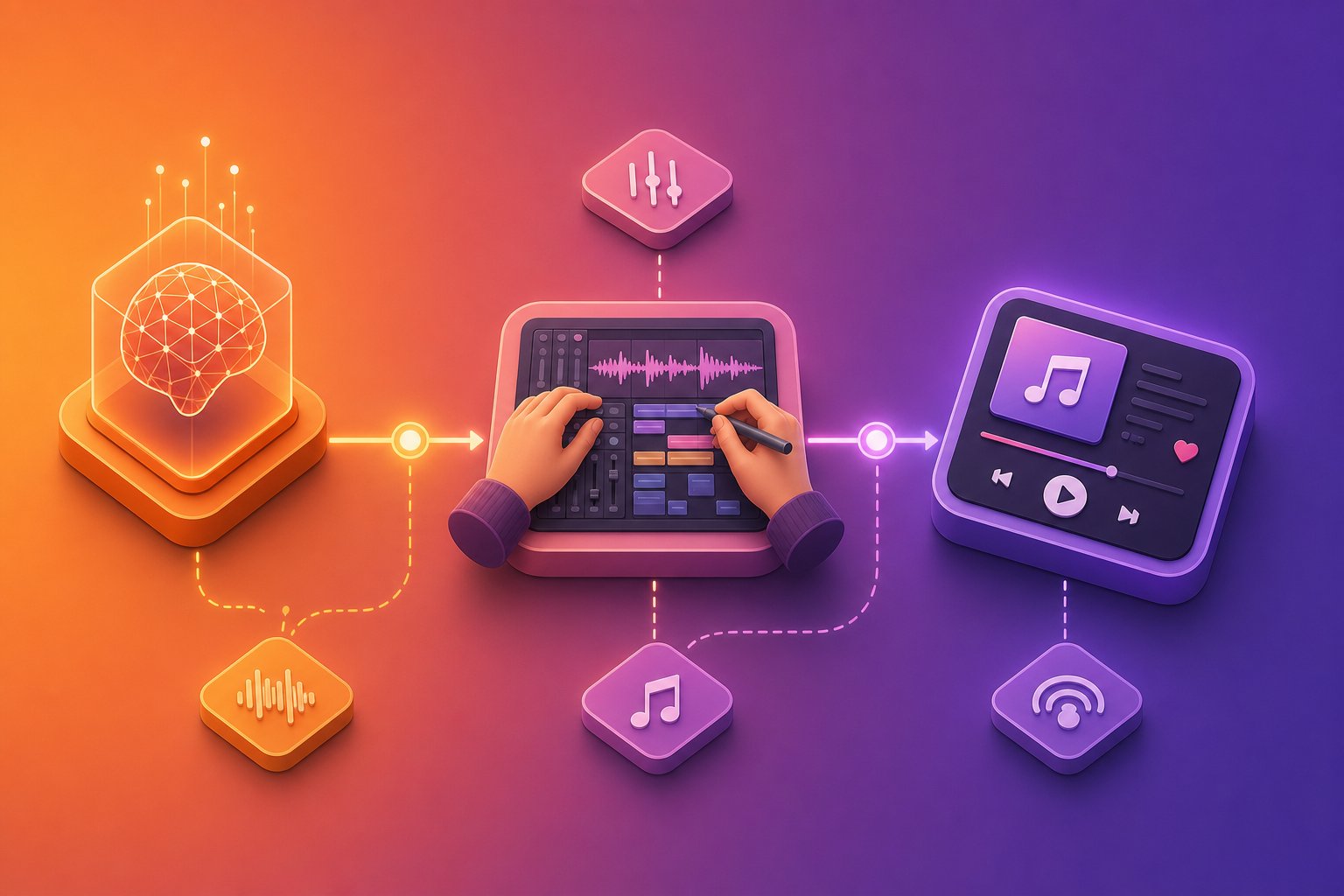
Creating Distribution-Ready AI Music From the Start
Fixing compliance issues after the fact is stressful. Building a workflow that produces distribution-ready tracks from the beginning eliminates most of that friction entirely. The creators who never deal with rejections or appeals aren't lucky — they've structured their process so that rights, disclosure, and creative involvement are baked in before they ever reach DistroKid's upload screen.
The formula is straightforward: start with a tool that grants you proper rights, add meaningful human creative direction throughout the process, and document everything as you go. Each of those three pillars addresses a different failure point — licensing violations, copyright gaps, and disclosure disputes — that we've seen trip up creators in the previous sections.
Building a Distribution-Ready AI Music Workflow
How do you make AI music ready for distribution? Think of it as a layered process where each step adds both creative value and legal protection.
Start with intentional creative direction. Even if AI generates the initial musical material, your workflow should involve decisions that go beyond typing a single prompt. Select specific elements from multiple generations. Rearrange sections. Change the key or tempo. Layer in your own performance — a vocal take, a guitar part, a drum pattern. Each of these choices represents the kind of human authorship that strengthens both your copyright claim and your position if a track is ever questioned.
Treat AI output as raw material, not a finished product. The most resilient AI music workflow for DistroKid upload mirrors how producers have always worked with samples and loops. You generate material, then sculpt it. Maybe you take the chord progression from one AI generation, the rhythmic feel from another, and combine them with original melodies you wrote yourself. The result is genuinely yours in a way that a single-prompt export never is.
Document your process in real time. Keep screenshots of your DAW sessions showing arrangement decisions. Save multiple AI generations alongside notes on why you chose one over another. Record the prompts you used and what edits you made to the output. This documentation serves two purposes: it proves human authorship if your copyright is ever challenged, and it provides evidence for appeals if DistroKid's automated detection flags your track incorrectly.
The Grammy Awards' standard offers a useful benchmark here — they require "meaningful and more than de minimis" human creative contribution for AI-assisted music to qualify. You don't need to hit that bar for DistroKid distribution, but aiming for it gives you the strongest possible position across copyright registration, platform compliance, and audience credibility.
Choosing AI Tools With Distribution-Friendly Licenses
Your workflow is only as solid as the tool powering it. A beautifully arranged, expertly produced track still fails distribution if the AI generator's license doesn't grant commercial rights. Choosing the best AI music generators with commercial licenses is the single most important upstream decision you'll make.
When evaluating royalty-free AI music tools for commercial use, look for these specific qualities:
- MakeBestMusic's Free Music Generator — provides royalty-free outputs suitable for commercial use across videos, podcasts, games, and social content. A practical starting point for creators who want distribution-ready material without subscription costs or revenue-sharing obligations.
- Explicit commercial distribution rights in the terms of service — not just "commercial use" broadly, but specific language permitting upload to streaming platforms through distributors. Some tools allow commercial use in videos but restrict standalone music distribution.
- No revenue-sharing requirements that complicate your DistroKid earnings — platforms like Boomy take a percentage of streaming income, which is workable but adds administrative complexity. Fully royalty-free tools keep your revenue structure clean.
- Clear ownership transfer on the plan you're using — verify whether the tool retains any rights over generated content. The ideal license explicitly states that you own the output and the platform waives claims. As Suno's documentation makes clear, ownership varies dramatically between free and paid tiers — free plan outputs belong to Suno, while Pro/Premier subscribers own their generations.
- No restrictions on derivative works or modifications — you want the freedom to edit, rearrange, combine with other elements, and transform AI output without hitting licensing walls.
- Documentation-friendly output — tools that provide generation history, timestamps, or export logs make it easier to prove your creative process if ever questioned.
The licensing trap that catches most creators is assuming "free to use" means "free to distribute commercially." Those are different rights. A tool might let you use generated music in a YouTube video under a Creative Commons-style license while explicitly prohibiting standalone distribution on Spotify or Apple Music. Always read the specific distribution clauses, not just the headline permissions.
Here's a practical checkpoint before you upload anything: can you honestly confirm to DistroKid that you own 100% of the distribution rights? If your AI tool's terms create any ambiguity around that answer, you're carrying risk that could surface weeks or months after release — potentially after you've already earned royalties that might need to be clawed back.
The combination of a rights-clear tool and a human-directed creative process gives you the strongest foundation possible. You satisfy DistroKid's ownership requirement, you generate copyrightable material through meaningful creative choices, and you have documentation ready if anything is ever questioned. That's not just compliance — it's a workflow designed to scale without accumulating hidden liability with every new release.
Putting It All Together as an AI Music Creator
You've seen the policy, the tiers, the upload process, the rejection scenarios, the legal framework, and the distributor landscape. The core message threading through all of it is simple: DistroKid accepts AI music when you play by three rules — disclose honestly, own legitimate rights, and contribute meaningful human creativity. Break any one of those, and the system works against you instead of for you.
Key Takeaways for AI Music Distribution
Every section of this guide points toward the same practical truths. Here's the AI music distribution checklist for creators who want to avoid rejection and build a catalog that stays live:
- Disclosure prevents problems; concealment creates them. Properly disclosed AI tracks pass review. Undisclosed ones become liabilities the moment automated detection catches a mismatch. The system runs on trust right now, but verification technology is tightening fast.
- Your AI tool's license matters as much as DistroKid's policy. If your generator doesn't grant commercial distribution rights on the plan you're using, no amount of correct disclosure fixes the ownership gap. Free-tier restrictions are the most common trap.
- Human creative direction strengthens every layer of protection. It satisfies disclosure requirements, builds copyright eligibility, provides appeal documentation, and produces better music. There's no downside to maintaining genuine artistic involvement.
- A single honest mistake won't destroy your account. DistroKid's escalation path gives you correction opportunities before consequences become serious. Patterns of misrepresentation are what trigger suspensions — not one-off errors.
- Copyright protection requires human authorship. You can distribute a fully AI-generated track, but you can't protect it. Anyone can copy an uncopyrightable work without legal consequence. That risk compounds with every release that lacks meaningful human contribution.
Recommended Next Steps for Creators
Ready to distribute AI music on DistroKid without the anxiety of wondering whether your next upload triggers a ban? Follow these steps to distribute AI music with confidence:
- Select a royalty-free AI tool with explicit commercial distribution rights. MakeBestMusic's Free Music Generator offers royalty-free outputs cleared for commercial use — a solid starting point that eliminates licensing ambiguity before your creative process even begins.
- Generate material, then shape it. Use AI output as your raw ingredient. Arrange sections, layer original performances, adjust tempo and key, rewrite lyrics, or combine elements from multiple generations. Each decision adds human authorship.
- Document your creative process as you work. Screenshot DAW sessions, save generation logs, keep notes on your editorial choices. This evidence protects you during appeals and supports copyright registration later.
- Verify rights ownership before uploading. Confirm your subscription tier grants commercial streaming distribution. Check for revenue-sharing clauses or retained platform rights. If there's any ambiguity, resolve it before you hit submit.
- Disclose accurately during DistroKid's upload flow. Select the correct AI Credit categories — lyrics, music, all audio, or part of audio. When in doubt, disclose more rather than less.
- Release at a natural cadence. Avoid bulk uploads of similar tracks in short windows. A measured release schedule signals legitimate artistry rather than algorithmic spam.
These steps aren't just about how to avoid AI music rejection on DistroKid. They're about building a sustainable creative practice where every release carries legitimate rights, honest metadata, and genuine artistic value.
The future of AI music distribution policies points toward standardized verification, not just self-disclosure. Creators who build transparent, well-documented workflows today are positioning themselves for a landscape where proving human involvement becomes mandatory rather than optional.
The rules will keep evolving. Platforms will tighten detection, new legal precedents will reshape copyright boundaries, and disclosure standards will become more granular. But the creators who thrive through those changes are the ones treating AI as a creative collaborator — not a replacement for artistry — and documenting that collaboration every step of the way.
