

Does SoundCloud Actually Allow AI-Generated Music
You made a track with AI tools and now you're wondering: can you actually upload it to SoundCloud without getting flagged or removed? The short answer is yes, SoundCloud does allow AI-generated music on its platform. But the longer, more important answer involves conditions that most creators never bother reading in the fine print.
The Short Answer on AI Music Uploads
SoundCloud permits AI music uploads, though the rules differ depending on what you want to do with that content. If you're simply sharing an AI-assisted track on your profile, the platform won't block you. The restrictions tighten significantly when you want to distribute or monetize that music through SoundCloud for Artists.
SoundCloud allows AI-generated music under specific conditions: you must own or have proper licensing for the content, use approved AI integration partners for distribution and monetization, and provide proof of your rights when submitting tracks for commercial use.
The platform's official help documentation states clearly that creators can only distribute or monetize content to which they own the rights or have proper licensing. For AI-created tracks, this means your chosen AI tool must grant you commercial distribution rights, and SoundCloud's team needs to verify that before approving anything.
There's another critical detail buried in the SoundCloud Monetization Terms of Service: recordings that are exclusively (100% GenAI) computer-generated through artificial intelligence are not eligible for distribution or monetization. That single sentence changes the game for creators relying entirely on AI to produce their music.
What This Guide Covers for AI Creators
The SoundCloud AI music policy sits across multiple documents, none of which make things easy to parse. So here's what you'll find in this guide:
- The difference between AI-assisted and fully AI-generated content, and why SoundCloud treats them differently
- What the Terms of Service actually say about rights ownership for AI music
- How to properly label and disclose AI usage to avoid takedowns
- The separate controversy around SoundCloud using your uploads to train AI models
- Monetization rules and realistic revenue expectations for AI tracks
- How SoundCloud's AI music policy compares to Spotify, YouTube Music, and other platforms
Whether you're using AI as a creative assistant or generating entire tracks from a text prompt, the upload rules on SoundCloud aren't the same for both scenarios. Understanding that distinction is where the real policy details live.
AI-Assisted vs Fully AI-Generated Music on SoundCloud
Imagine two creators. One uses an AI tool to clean up a vocal recording and suggest a chord progression, then writes, arranges, and produces the rest of the track themselves. The other types a prompt into a generator and downloads a finished song. Both tracks involve AI, but SoundCloud treats them very differently. The difference between AI-assisted and AI-generated music isn't just a philosophical debate; it determines what you can actually do with your upload.
AI as a Creative Tool in Your Workflow
AI-assisted music is music where you remain the creative driver. You're making decisions, shaping the sound, and using AI as one tool among many. This might look like:
- Running your mix through an AI-powered mastering service
- Using AI to generate beat patterns or loops that you build a track around
- Getting melodic or harmonic suggestions from an AI plugin, then reworking them
- Employing AI-based audio restoration to isolate or improve vocal recordings
Think of how The Beatles' "Now and Then" used AI-powered software to isolate John Lennon's vocals from old demos. AI handled a specific technical task, but humans directed the entire creative vision. That Grammy-winning track is a clear example of AI-assisted music where the artist remains in control.
On SoundCloud, this category of content faces the fewest restrictions. You can upload AI-assisted tracks freely, and if the AI tools you used grant you proper commercial rights, you can pursue distribution and monetization through SoundCloud for Artists. The platform even maintains a list of approved AI integration partners including services like Soundful, ACE Studio, FADR, and TwoShot that are pre-cleared for this purpose.
Fully AI-Generated Tracks and Their Limitations
Fully AI-generated music sits at the other end of the spectrum. Here, AI creates essentially everything: structure, melody, instrumentation, arrangement. You might feed in a text prompt or select a style, but the machine does the heavy lifting. Your creative input is minimal.
This is where SoundCloud draws a hard line. Can AI made songs be uploaded to SoundCloud? Yes, you can upload them to your profile for sharing. But recordings that are 100% generated through artificial intelligence are not eligible for distribution or monetization. That's a direct policy restriction, not a gray area.
The reasoning connects to a broader legal reality: most copyright frameworks don't protect works created entirely by machines with no meaningful human input. If you can't claim copyright ownership, you can't truthfully assert to SoundCloud that you hold the rights required for commercial distribution.
| Factor | AI-Assisted Music | Fully AI-Generated Music |
|---|---|---|
| Upload to SoundCloud profile | Allowed | Allowed |
| Distribution via SoundCloud for Artists | Eligible (with approved tools and proof of rights) | Not eligible |
| Monetization | Eligible (requires rights verification) | Not eligible |
| Copyright ownership | Generally belongs to the human creator | Legally uncertain in most jurisdictions |
| Disclosure requirement | Recommended | Recommended |
| Approved AI tools required | Yes, for distribution/monetization | N/A (not eligible regardless) |
The spectrum between these two categories isn't always clean. What about a track where you wrote the lyrics and performed the vocals, but AI generated the entire instrumental? What if you prompted an AI to create a melody, then spent hours rearranging and producing it with traditional tools? SoundCloud's policy doesn't spell out every scenario. The guiding principle is whether meaningful human creativity shaped the final product. The more human involvement you can demonstrate, the stronger your position when submitting for distribution approval.
This distinction also explains why SoundCloud requires creators to upload proof of subscription or terms of service from their AI tool when submitting content for monetization. The platform's review team needs to verify both that you used an approved partner and that your level of creative involvement qualifies the track as more than pure machine output.
SoundCloud Terms of Service and AI Content Explained
Knowing that SoundCloud treats AI-assisted and fully AI-generated music differently is one thing. Understanding why requires looking at the legal language that governs every upload on the platform. The SoundCloud terms of service AI music rules aren't spelled out in a single, clearly labeled section. Instead, they're woven across multiple clauses covering content ownership, license grants, and representations you make every time you hit "upload."
Key Terms of Service Clauses Explained
When you upload a track to SoundCloud, you're not just sharing a file. You're entering a legal agreement. The platform's Terms of Use (last amended January 2026) require you to grant SoundCloud a license to host, distribute, and make your content available across the platform and any linked services. Here's the core of the SoundCloud content license agreement explained in plain terms:
By uploading content, you grant SoundCloud a limited, worldwide, non-exclusive, royalty-free license to store, transcode, transmit, distribute, publicly perform, and make available your content, as necessary to provide platform services and enable user-directed features.
You'll notice this license is broad but functional. It covers what SoundCloud needs to do its job: stream your track, display it on profiles, embed it via widgets, and distribute it through partner services if you opt in. The license terminates automatically when you remove audio content from your account.
A second license extends to other users, allowing them to listen, repost, and share your content within the parameters you set. Neither license transfers ownership. SoundCloud explicitly states: "SoundCloud does not claim any ownership rights in your Content, and your Content remains your sole responsibility."
The critical clause for AI creators sits in the Representations and Warranties section. Every uploader guarantees that:
- Their content is an original work, or they have obtained all rights, licenses, and permissions necessary for its use
- The content does not infringe any third party's intellectual property rights, performer's rights, or rights of privacy
- They have obtained necessary consents from any persons appearing in the content, including name, voice, or likeness
These aren't suggestions. They're legally binding promises you make to the platform. Violating them can result in content removal, account suspension, or even civil liability.
Rights Ownership Requirements for AI Content
Here's where things get complicated for AI music. Do you own rights to AI generated music? The honest answer: it depends, and the legal landscape remains unsettled.
In the United States, the Copyright Office has repeatedly stated that works generated entirely by AI without meaningful human authorship are not eligible for copyright protection. A human must contribute creative expression beyond simply entering a prompt. The European Union follows similar principles under its copyright frameworks. If a track can't receive copyright protection, you can't truthfully represent to SoundCloud that you "own the rights" to it.
SoundCloud's help documentation on AI content adds a practical layer to this legal question. It states that you can only distribute or monetize content to which you own the rights or have proper licensing. For AI-created tracks, this means your AI tool must explicitly grant you commercial distribution rights, and SoundCloud's team verifies this before approving submissions.
It is your responsibility to ensure you have proper rights or licensing before submitting anything for monetization or distribution. SoundCloud's team would need to verify this before approving any AI content.
The platform currently only approves content created with its listed AI integration partners for distribution or monetization. If you used a tool outside that approved list, you'll need to demonstrate your rights through supporting documentation. Without clear ownership or a qualifying license from an approved partner, your AI tracks can exist on the platform for sharing but won't qualify for commercial features.
This ownership gap is the real policy barrier for AI music creators. The technical ability to upload isn't the issue. The legal ability to guarantee your rights is what determines whether a track can move beyond a simple profile share into distribution and revenue territory.
How to Properly Label AI Music on SoundCloud
Rights ownership determines whether your AI track qualifies for distribution, but disclosure determines whether it stays there. Even when you've cleared the legal hurdles, poor labeling can trigger content reviews, algorithm flags, or user reports that put your uploads at risk. Knowing how to label AI music on SoundCloud isn't just about following rules. It's a protective measure that keeps your account in good standing and your tracks live.
Best Practices for Disclosing AI in Your Uploads
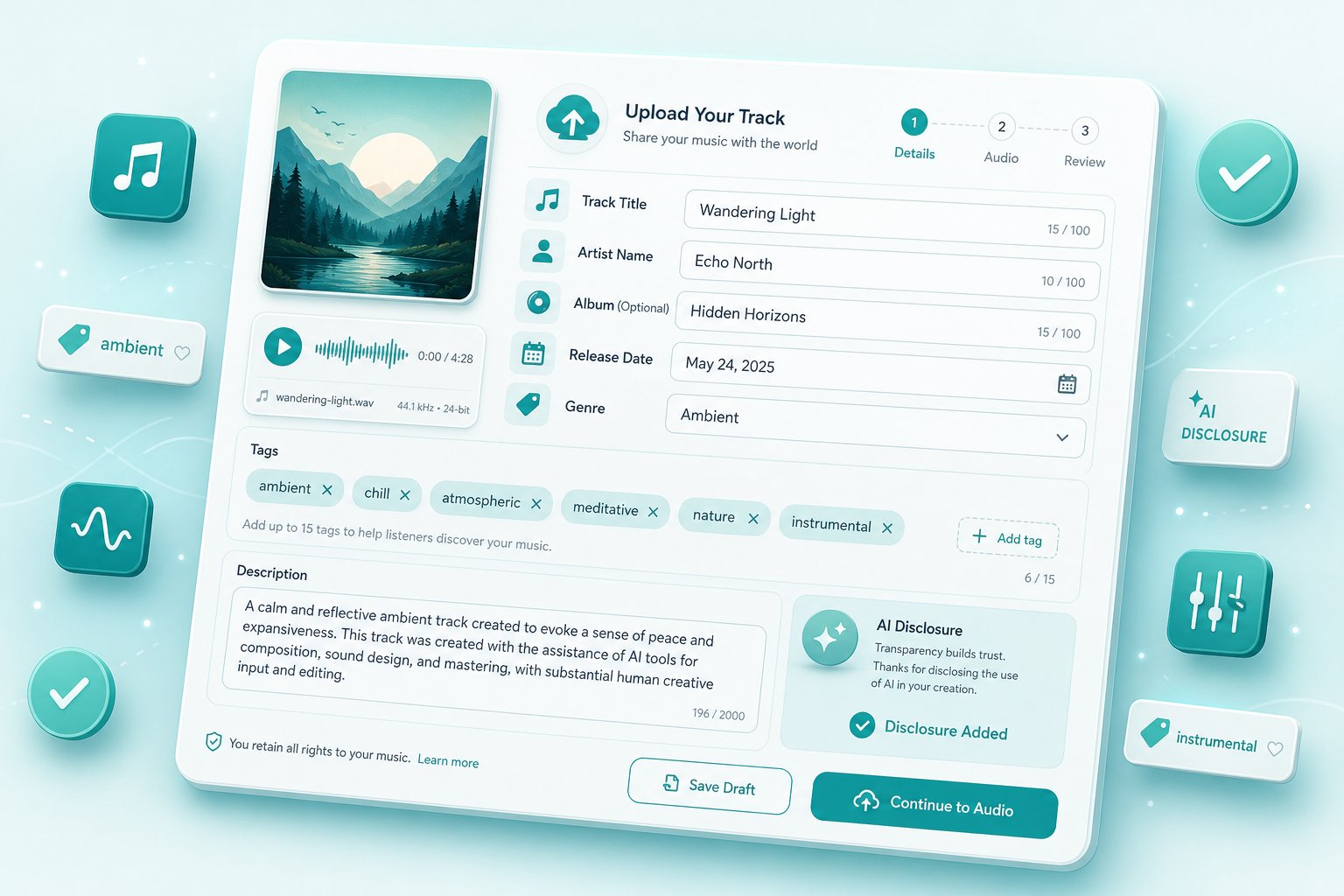
SoundCloud doesn't currently offer a dedicated "AI-generated" toggle or checkbox in its upload interface. That means disclosure falls on you, and it happens through the same metadata fields available for any track. The platform's track editing tools give you several places to communicate AI involvement clearly.
Your track description supports up to 4,000 characters and displays full URLs as clickable links. This is the most visible place to explain what role AI played in your creative process. Tags act as a map for the SoundCloud algorithm to surface your content to the right listeners, and using AI-related tags helps categorize your work honestly. The metadata section lets you add collaborator credits, ISRC codes, and publisher details that further document your track's origins.
Here's a step-by-step disclosure checklist to follow every time you upload AI-involved content:
- In the track description, state clearly which elements were created or assisted by AI (vocals, instrumentals, mastering, arrangement) and which elements involved direct human performance or composition.
- Name the specific AI tool or service used. If it's an approved SoundCloud AI integration partner, mention that explicitly.
- Add relevant tags such as "AI assisted," "AI generated," or "AI vocals" alongside your genre and mood tags. Your first tag should still be your primary genre for discoverability.
- In the metadata section, credit any AI tools in the collaborator or artist field where appropriate, keeping your artist name as the primary credit.
- If submitting for distribution or monetization, prepare documentation showing your subscription to or license from the AI tool, confirming you hold commercial rights.
- For tracks using AI-cloned or synthetic voices, note in the description whether you have explicit permission from the voice's owner, or whether the voice is an original AI synthesis not modeled on a specific person.
This might feel like overkill for a casual upload. But SoundCloud AI content tagging best practices aren't about perfection. They're about creating a paper trail that protects you if questions arise later.
Protecting Your Tracks from Policy Violations
Why does transparent labeling matter so much? Because ambiguity is what triggers problems. When SoundCloud's review team or community members can't tell whether a track involves AI, the default response leans toward caution: flag first, ask questions later. A well-labeled track with clear AI disclosure signals that you understand the rules and have nothing to hide.
Consider the gray areas where disclosure becomes essential rather than optional:
- AI-generated instrumentals with human vocals: Your voice is real, but the beat and arrangement came from a prompt. Without disclosure, a listener or reviewer might assume the entire track is human-made, creating a mismatch if questions arise during monetization review.
- AI-enhanced vocals on a human performance: You sang the part, but used AI to pitch-correct, harmonize, or alter the timbre beyond traditional processing. The line between a plugin effect and AI generation blurs here, so transparency helps.
- Collaborative tracks with mixed inputs: One artist contributed live guitar, another used an AI tool for the synth arrangement. Each collaborator's contribution method should be documented.
- AI mastering or mixing on otherwise human-created music: This is the lowest-risk scenario and unlikely to cause issues, but a brief mention in your description still demonstrates good faith.
The goal is to avoid SoundCloud takedowns on AI music by removing any ambiguity about what you uploaded and how it was made. Creators who disclose proactively rarely face enforcement actions. Those who get caught without disclosure, especially after monetizing content, face harsher consequences: revenue clawbacks, distribution removal, or account restrictions.
Think of it this way: disclosure costs you nothing but a few extra lines in your track description. Failing to disclose can cost you your entire catalog's standing on the platform. The AI music disclosure requirements on SoundCloud may not be spelled out in a rigid form, but the expectation of honesty runs through every relevant policy document. Make transparency a habit, and the platform's rules work in your favor rather than against you.

Does SoundCloud Use Your Music for AI Training
Uploading AI music to SoundCloud is one side of the coin. The other side hits closer to home for every creator on the platform, regardless of how they make their tracks: is SoundCloud uploading music to train AI models behind the scenes? This question exploded into public debate in 2025, and the answer involves a policy reversal, a CEO apology, and some lingering concerns that haven't fully disappeared.
The AI Training Controversy Explained
In February 2024, SoundCloud quietly updated its Terms of Use. Buried in the legal text was a clause that caught almost nobody's attention at the time. It read, in part: "You explicitly agree that your Content may be used to inform, train, develop or serve as input to artificial intelligence or machine intelligence technologies or services as part of and for providing the services."
That language sat undisturbed for over a year. Then in May 2025, tech outlet Futurism flagged it publicly. The reaction was swift and furious. Independent artists, music advocates, and industry commentators interpreted the clause as giving SoundCloud blanket permission to feed user uploads into AI training pipelines. TechCrunch reported on the widespread backlash, and Pitchfork pressed SoundCloud for a direct response.
SoundCloud moved quickly into damage control. Representatives told Pitchfork that "SoundCloud has never used artist content to train AI models, nor do we develop AI tools or allow third parties to scrape or use SoundCloud content from our platform for AI training purposes." The company explained that the February 2024 language was intended to cover internal AI use cases like personalized recommendations, content organization, fraud detection, and content identification improvements.
That explanation didn't satisfy everyone. The problem wasn't necessarily what SoundCloud was doing at the time. It was what the terms legally permitted them to do in the future. A clause that broad could justify almost any AI application of user content without requiring additional consent.
Days later, SoundCloud CEO Eliah Seton published an open letter acknowledging that the wording "was too broad and wasn't clear enough." He stated definitively: "SoundCloud has never used artist content to train AI models. Not for music creation. Not for large language models. Not for anything that tries to mimic or replace your work. Period."
The company then revised its terms to explicitly prohibit using user content to train generative AI models that replicate or synthesize a creator's voice, music, or likeness. The updated terms took effect May 14, 2025.
Your Rights and Opt-Out Options
So what rights does SoundCloud's terms actually grant regarding your uploaded content? Even after the revision, the platform retains certain permissions that are worth understanding clearly:
- Platform service delivery: SoundCloud can store, transcode, transmit, distribute, and publicly perform your content as necessary to operate the streaming service.
- Internal AI for platform features: Your content may interact with AI technologies that power recommendations, search, playlisting, content tagging, and fraud prevention tools.
- No generative AI training: SoundCloud will not use your content to train generative AI models designed to replicate or synthesize your voice, music, or likeness.
- No third-party scraping permitted: The platform prohibits external parties from scraping user content for AI training purposes and has implemented technical safeguards against unauthorized data collection.
- "No AI" tag available: Creators can apply a "no AI" tag to their content, explicitly signaling that it cannot be used for any AI training purposes.
- Future generative AI use requires opt-in: Seton committed that any future opportunity involving generative AI for the benefit of artists would only proceed with explicit creator consent through an opt-in mechanism.
The "no AI" tag deserves special attention. If you want to stop SoundCloud from using your music for AI in any capacity beyond basic platform operations, applying this tag is currently your strongest protective action. It creates an explicit, documented signal of your intent that goes beyond the default terms.
Not everyone considers the revised terms sufficient. AI ethics advocate Ed Newton-Rex, who runs the Fairly Trained initiative, pointed out that the new language only prohibits training models that "replicate" a creator's voice or style. It doesn't address models trained on your work that might not directly copy your style but still compete with you in the market. His suggested fix was simple: "We will not use Your Content to train generative AI models without your explicit consent." SoundCloud hasn't adopted that broader language.
The distinction matters because platform improvement and generative AI training serve fundamentally different purposes. When SoundCloud's algorithms analyze your track to recommend it to the right listeners, that benefits you directly. When a generative model learns from thousands of tracks to produce new music, the value flows away from the original creators. SoundCloud's current terms draw a line between those two scenarios, but critics argue the line should be drawn more conservatively, covering all generative training rather than only the subset that directly replicates an artist's output.
For creators weighing whether to keep their catalog on the platform, the practical takeaway is this: SoundCloud has made a public, legally binding commitment not to train generative AI on your uploads. The "no AI" tag adds an extra layer of protection. Whether those safeguards feel strong enough depends on how much you trust the distinction between replicating your work and learning from it.
Monetizing AI Music on SoundCloud
Protecting your uploads from AI training is a defensive concern. The offensive question, the one that drives most creators to the platform in the first place, is whether their AI tracks can actually earn money. Can you monetize AI music on SoundCloud? The answer depends entirely on how much human creativity went into the work and whether you can prove your rights to the platform's review team.
Monetization Eligibility for AI Tracks
SoundCloud's monetization program operates through the SoundCloud for Artists dashboard, available to Artist and Artist Pro subscribers. The system uses fan-powered royalties, meaning you get paid based on your dedicated listeners' actual streaming habits rather than a pro-rata pool. When you monetize directly through SoundCloud, you keep 100% of your royalties.
The baseline eligibility rules apply to all content, AI or otherwise:
- You must own all rights to the content being monetized
- Tracks must be between 30 seconds and 10 minutes in length
- Unofficial covers, remixes, mashups, DJ sets, and podcasts are not monetizable
- Your account must be on an Artist or Artist Pro subscription plan
For AI-involved tracks, additional SoundCloud monetization requirements for AI tracks kick in. You need to have created your content using one of the platform's approved AI integration partners. When submitting for monetization, SoundCloud's team reviews your track and may request documentation: licensing agreements, proof of subscription to the AI tool, or the tool's terms of service confirming your commercial distribution rights.
Here's the critical filter: if your track matches existing audio during the review process, you'll receive an "Edits Requested" status. At that point, you need to upload documentation proving ownership of any samples, loops, or sounds that triggered the match. The more information you provide upfront, the smoother the approval process goes. SoundCloud explicitly recommends uploading licensing documentation even before it's requested.
Monetization review typically takes up to five business days. Once approved, a blue dollar sign appears next to your track, confirming it's actively generating revenue.
Revenue Potential and Realistic Expectations
So how much can you realistically make with AI generated music on SoundCloud? The honest answer: revenue depends on listener engagement, not on how the track was made. Fan-powered royalties reward creators whose audiences actually listen, so a track that captures dedicated fans will outperform one with passive streams regardless of its origin.
That said, AI-assisted creators face a few practical constraints that limit earning potential compared to fully human-produced content:
- No monetization for 100% AI tracks: If your content is entirely machine-generated with no meaningful human creative input, it's excluded from SoundCloud AI music revenue sharing entirely.
- Approval friction: Every AI track goes through a rights verification step that traditional uploads may bypass if no audio match is detected. This adds time and documentation overhead.
- Tool restrictions: Only tracks made with approved AI partners qualify. If your preferred tool isn't on the list, you're locked out of monetization until you switch tools or the list expands.
- Audience perception: Some listeners and playlist curators actively avoid AI-tagged content, which can limit discoverability and reduce stream counts.
The revenue model itself doesn't discriminate. Once an AI-assisted track is approved for monetization, it earns at the same rate per engaged listener as any other track on the platform. The limitation isn't in the payout structure; it's in qualifying for that structure in the first place.
| Criteria | Human-Created Music | AI-Assisted Music | Fully AI-Generated Music |
|---|---|---|---|
| Eligible for monetization | Yes | Yes (with documentation) | No |
| Rights verification required | Only if audio match detected | Always required | N/A |
| Approved tools required | No | Yes (approved AI partners only) | N/A |
| Fan-powered royalty rate | Standard (100% retained) | Standard (100% retained) | Not applicable |
| Track length requirement | 30 sec - 10 min | 30 sec - 10 min | Not applicable |
| Subscription tier needed | Artist or Artist Pro | Artist or Artist Pro | Not applicable |
| Review timeline | Up to 5 business days | Up to 5 business days | Not applicable |
The takeaway for creators looking to make money with AI generated music on SoundCloud: treat AI as one instrument in a larger creative process. Tracks where you perform vocals, write lyrics, arrange sections, or produce the mix with human judgment qualify for monetization. Tracks where you typed a prompt and downloaded the result do not. The platform rewards creative involvement, and the revenue path reflects that priority.
What remains unclear is how SoundCloud's monetization rules stack up against other platforms. A track that's ineligible here might find a home elsewhere, or face even stricter barriers.

How SoundCloud Compares to Other Platforms on AI Music
SoundCloud's rules make sense in isolation, but you're probably not distributing to just one platform. If a track gets approved for monetization on SoundCloud, does that mean Spotify will accept it too? What about Apple Music or YouTube? And if you're considering alternatives, which platforms allow AI generated music with the fewest restrictions? The policy landscape varies dramatically from one service to the next, and a track that earns revenue on one platform might get rejected or banned on another.
Platform-by-Platform AI Music Policy Breakdown
Each major platform has staked out its own position on AI music. Some lean permissive. Others have drawn hard lines. Here's how the biggest players compare.
Spotify takes what might be called a transparency-first approach. The platform doesn't ban AI music outright but has invested heavily in fighting spam, impersonation, and deception. In late 2025, Spotify announced strengthened AI protections including a new impersonation policy, a music spam filter targeting mass uploads and artificially short tracks, and support for industry-standard AI disclosures through DDEX credits. Spotify removed over 75 million spammy tracks in a 12-month period. The platform requires disclosure of AI involvement at the track level, specifying whether AI was used for vocals, instrumentation, or post-production. As of April 2026, artists can share how they've used AI through Song Credits on mobile. Vocal impersonation is only permitted when the impersonated artist has authorized the usage. Spotify treats all music equally in its royalty system regardless of creation tools, but its spam filter actively targets uploaders using mass-generation tactics to game the royalty pool.
Apple Music emphasizes curation integrity and ethical data sourcing. The platform allows AI music uploads only from verified creators who adhere to data consent standards. Apple's documentation requires proof of consent for training datasets used in production and prohibits any use of scraped or unlicensed data in the AI tools that generated the music. This creates a higher barrier to entry compared to SoundCloud. You're not just proving you own the rights to the output. You need to demonstrate the AI tool itself was trained ethically.
YouTube Music operates under a hybrid model. Its guidelines separate AI audio from human-created content through tagging, and strict copyright scans run before publication. The most significant requirement: tracks using AI-generated vocals modeled after real voices need explicit opt-in consent forms signed by the original artists. YouTube applies its broader Content ID system to AI music, which means automated matching can flag tracks that resemble existing copyrighted works even when generated synthetically. For creators, this means a higher risk of false-positive matches on AI-generated content.
Bandcamp stands at the opposite extreme. In January 2026, Bandcamp published its generative AI policy with a clear message: "Music and audio that is generated wholly or in substantial part by AI is not permitted on Bandcamp." The platform reserves the right to remove any music on suspicion of being AI-generated and encourages users to report content they believe violates this rule. Any use of AI tools to impersonate other artists or styles is strictly prohibited. There's no monetization path, no disclosure option, no gray area. If AI played a substantial role in creating the track, Bandcamp doesn't want it on the platform. Period.
DistroKid functions differently because it's a distributor rather than a streaming destination. DistroKid delivers your music to platforms like Spotify, Apple Music, and Amazon Music. The service allows AI-assisted music uploads but requires creators to confirm they own all necessary rights. DistroKid is also a partner in Spotify's DDEX-based AI disclosure standard, meaning it supports the metadata pipeline that lets artists communicate AI involvement to downstream platforms. The key constraint: DistroKid distributes your music, but each receiving platform applies its own AI policy. Getting through DistroKid's door doesn't guarantee acceptance everywhere.
Where SoundCloud Stands in the Landscape
When you compare the SoundCloud vs Spotify AI music policy, the most notable difference is in structure rather than strictness. Spotify focuses on transparency and anti-spam enforcement while treating approved AI music equally in royalties. SoundCloud gates AI content behind an approved tools list and manual rights verification before monetization is possible. Both platforms block unauthorized vocal deepfakes, but Spotify's system is more automated through metadata scanning and watermark detection.
Against Bandcamp, SoundCloud is dramatically more permissive. Bandcamp's outright ban means creators using AI tools have zero options there, even for non-commercial sharing. SoundCloud at minimum allows uploads for sharing and offers a monetization path for AI-assisted content with proper documentation.
Apple Music's ethical sourcing requirements create a unique hurdle that neither SoundCloud nor Spotify explicitly enforce. Proving your AI tool used licensed training data adds a layer of due diligence most indie creators aren't prepared for.
| Platform | AI Music Upload Allowed | Disclosure Required | Monetization Eligible | AI Training Opt-Out Available | Key Restrictions |
|---|---|---|---|---|---|
| SoundCloud | Yes (upload); AI-assisted only for distribution | Recommended (manual via tags/description) | AI-assisted only; 100% AI excluded | Yes ("no AI" tag + revised terms) | Must use approved AI partners for monetization; manual rights verification required |
| Spotify | Yes | Yes (DDEX standard credits, April 2026 beta) | Yes (equal royalty treatment) | Not explicitly offered to uploaders | Spam filter targets mass AI uploads; vocal impersonation requires artist consent |
| Apple Music | Yes (verified creators only) | Yes | Yes (with ethical data sourcing proof) | Not publicly documented | Proof of consent for AI training datasets required; no scraped data permitted |
| YouTube Music | Yes | Yes (tagging separation) | Yes | Not explicitly offered | AI vocal clones need signed consent from original artist; Content ID scans apply |
| Bandcamp | No (wholly or substantially AI-generated content banned) | N/A | No | N/A (no AI content permitted) | Can remove content on suspicion; community reporting encouraged |
| DistroKid | Yes (AI-assisted) | Yes (supports DDEX metadata) | Depends on receiving platform | Not applicable (distributor, not host) | Rights confirmation required; downstream platforms apply their own rules |
So which is the best platform to upload AI music? It depends on your goals. For maximum flexibility in sharing and community engagement, SoundCloud remains strong. Its direct upload model means you can get AI tracks in front of listeners immediately, even if monetization requires jumping through hoops. For revenue and equal treatment once approved, Spotify's system is the most straightforward: pass the disclosure requirements and your AI track earns on the same terms as any other song. For selling directly to fans with no middleman, Bandcamp is off the table entirely if AI played a meaningful role.
The broader trend across this AI music distribution platform comparison is convergence toward disclosure and transparency standards. Platforms aren't asking whether AI should exist in music. They're building infrastructure to label it, verify rights, and prevent abuse. The DDEX standard that Spotify, DistroKid, and others are adopting will likely become universal within the next year or two, giving creators a single metadata framework for communicating AI involvement across all platforms simultaneously.
What none of these platforms solve, however, is the underlying rights question. You can comply with every disclosure rule and still hit a wall if your AI tool's license doesn't grant clear commercial distribution rights. That's a problem rooted in which tools you choose and what terms they offer, not in which platform you upload to.
Creating AI Music You Can Freely Upload and Distribute
Platform policies, disclosure rules, and monetization hoops all collapse into a single upstream decision: which tool did you use, and what rights does it actually give you? Every complication covered in this guide traces back to that question. If your AI music generator grants you clear, royalty-free commercial rights from the moment of creation, the entire distribution process becomes straightforward. You label honestly, submit documentation, and move on. If it doesn't, you're stuck in a gray zone where even a perfectly labeled track can't pass rights verification.
So how do you create AI music with distribution rights baked in from the start? The answer is a deliberate workflow that treats licensing as the first creative decision, not an afterthought.
Building a Rights-Clear AI Music Workflow
Think of this as reverse-engineering the upload process. You know what SoundCloud, Spotify, and other platforms require: proof of ownership, commercial licensing from your AI tool, and documentation you can submit during review. Your workflow should produce all of that automatically.
Here's the practical sequence:
- Choose a tool with explicit commercial rights. Before you generate a single note, read the tool's terms of service. Look for language that grants you full ownership or a perpetual, royalty-free license to use, distribute, and monetize your output. If the terms are vague, move on.
- Confirm your subscription tier qualifies. Many AI music generators only grant commercial rights on paid tiers. Free plans often restrict you to personal use only. Research from Dynamoi confirms that most free tiers from tools like Suno and AIVA do not grant distribution rights. Verify your plan before creating content you intend to release.
- Add meaningful human creative input. Platforms including SoundCloud exclude 100% AI-generated content from monetization. Write your own lyrics. Perform vocals. Arrange the structure. Layer in live instrumentation. The more human creativity you contribute, the stronger your copyright claim and the smoother your approval process.
- Download and archive immediately. Platform access can change. Udio's download suspension after its settlement with Universal Music Group proved that content sitting on a server you don't control isn't content you own. Export your files the moment they're ready.
- Document everything. Screenshot your subscription status, save the tool's terms of service as a PDF, and keep a brief creation log noting which elements are AI-generated and which are human-performed. This becomes your evidence package during platform review.
- Master and prepare metadata before uploading. Treat AI-generated stems the same way you'd treat any raw material: finalize production, add proper ISRC codes, prepare artwork, and write your disclosure language for track descriptions.
- Submit to an AI-friendly distributor. Services like DistroKid, RouteNote, and Amuse accept AI-assisted music and support disclosure metadata standards. Upload through them for multi-platform reach, or go direct through SoundCloud for Artists if that's your primary destination.
This workflow eliminates the most common failure point: discovering after the fact that your tool's license doesn't cover commercial distribution. By front-loading the rights question, you avoid takedowns, rejected submissions, and wasted creative effort.
Free Tools That Grant Full Distribution Rights
Budget matters, especially for independent creators testing whether AI music can work as part of their release strategy. Not every royalty-free AI music generator for SoundCloud requires a monthly subscription. Several options give you AI music you can upload without copyright issues, even on free or low-cost plans.
- MakeBestMusic's Free Music Generator — A strong starting point for creators who need royalty-free music for videos, social content, games, podcasts, or streaming platforms. The tool generates music you can use commercially without licensing fees or attribution requirements, directly solving the rights-ownership problem that makes AI music uploads complicated on SoundCloud. If you want to create and distribute without worrying about whether your tool's terms will pass platform verification, this removes that friction entirely.
- Suno (Pro plan, $10/month) — Generates full songs with AI vocals and grants commercial distribution rights on paid tiers. Rights persist even after cancellation for tracks created during your subscription. One of the few tools that handles both vocals and instrumentals at a quality level suitable for streaming.
- Stable Audio (Creator tier) — Focused on instrumental content and sound design. Commercial use is granted on the paid tier, with streaming distribution explicitly permitted. A solid choice for producers adding AI-generated elements to human-created arrangements.
- Boomy ($9.99/month) — Offers the simplest path from generation to distribution with built-in delivery to Spotify, Apple Music, and TikTok. Less creative control than other options, but the lowest barrier to entry for beginners exploring AI music for commercial use.
- Soundraw ($19.99/month) — Uses parameter-based customization rather than text prompts. Generates royalty-free music safe for YouTube, ads, and podcasts. Best suited for content creators needing background music rather than standalone releases.
The common thread across these free AI music tools for commercial use: they all provide explicit licensing language you can point to during platform review. That documentation is your shield against takedowns and your ticket into monetization programs.
The safest AI music workflow starts with the license, not the prompt. Choose your tool based on what rights it grants, then create freely knowing every track is distribution-ready from the moment it's exported.
One final consideration: the AI music landscape shifts fast. Tools that offer commercial rights today might revise their terms tomorrow, as Udio's sudden download suspension demonstrated. Protect yourself by downloading content promptly, archiving license terms at the time of creation, and diversifying across multiple tools rather than depending on a single platform. The creators who navigate this space successfully aren't necessarily the most technically skilled. They're the ones who treat rights clearance as seriously as the music itself.
