


What Electronic Instruments Actually Are
Imagine playing a musical instrument that has no strings to pluck, no reed to blow, and no drumhead to strike. Instead, the sound itself is born inside a circuit. That is the core idea behind electronic instruments, and it is reshaping how music in instruments gets created, performed, and recorded across every genre you can name.
Defining Electronic Instruments and Electrophones
An electronic instrument is any device that generates, modifies, or amplifies sound primarily through electronic circuitry rather than purely acoustic vibration.
This definition covers a wide family of devices, from towering modular synthesizers to pocket-sized grooveboxes and software plug-ins running inside a laptop. What unites them is the signal's origin: an electrically driven oscillator, a digital processor, or some combination of both produces the audio before it ever reaches a speaker.
Musicologists formalize this family under the term electrophone, the fifth top-level category in the Hornbostel-Sachs classification system. Sitting alongside idiophones, membranophones, chordophones, and aerophones, the electrophone class is subdivided into three groups: electrically actuated acoustic instruments (51), electrically amplified acoustic instruments (52), and instruments that primarily produce sound with electrically driven oscillators (53). Only that last subcategory, group 53, is considered truly electronic. Musical instruments that start with e, like the electronic keyboard, the EWI (electronic wind instrument), and the Emulator sampler, all fall squarely into this group.
Electronic vs. Electrified Acoustic — A Key Distinction
Here is where many newcomers get tripped up. An electric guitar uses a magnetic pickup to convert string vibrations into an electrical signal, but the sound still begins as a physical, acoustic event. Swap that guitar for a synthesizer, and the picture changes completely. The oscillator inside a synth generates a waveform from scratch using voltage or code. No vibrating string, no resonating body, just pure electronic signal.
This distinction matters because it shapes how you design sound. An electrified acoustic instrument lets you amplify and color a tone that already exists. A true electronic instrument lets you build a tone from nothing, giving producers and performers near-limitless control over timbre, pitch, and texture. That level of control is exactly why the synthesizer became the defining edm instrument and a staple across pop, hip-hop, film scoring, and experimental music alike.
Understanding what is Musical Instrument Digital Interface, or MIDI, adds another layer. MIDI does not carry audio. It carries performance data, note numbers, velocities, and control messages, allowing one electronic device to talk to another. This protocol ties the entire ecosystem together, from hardware synths to software plug-ins, and it will surface repeatedly as we move deeper into how these instruments actually produce sound.
With the definition and classification in place, the real question becomes: what happens inside the circuit? The answer starts with a single oscillator and a concept called the signal chain.
How Electronic Sound Generation Works
Every sound you hear from a synthesizer, drum machine, or software plug-in follows a journey. That journey is called the signal chain, and once you understand it, even the most complex electronic music instruments start to make sense. Think of it like a kitchen: one station prepares the raw ingredients, another seasons them, and a third plates the dish. The signal chain works the same way, except the ingredients are waveforms and the seasoning is frequency manipulation.
Oscillators, Filters, and the Signal Chain
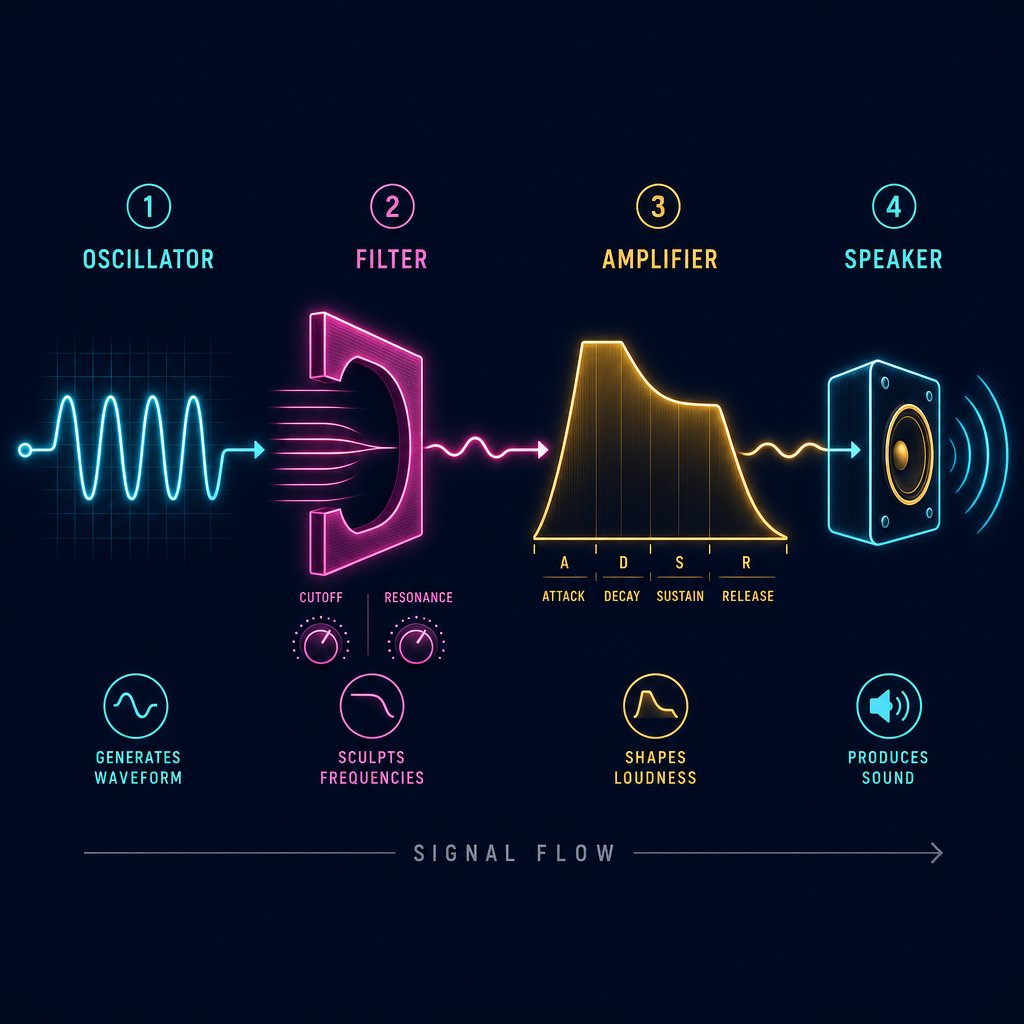
The basic signal chain inside most electronic instruments follows four stages:
Oscillator → Filter → Amplifier → Output
Each stage has a specific job, and sound passes through them in order. Here is what each one does.
The oscillator is the starting point. It generates a raw waveform, the basic shape of the sound. Common waveform types include sine (smooth and pure), sawtooth (bright and buzzy), square (hollow and reedy), and triangle (soft, somewhere between sine and square). Imagine the oscillator as a faucet: it produces a constant stream of sound that, on its own, just keeps going. Without anything else in the chain, you would hear a flat, unchanging tone.
The filter shapes that raw tone by removing or emphasizing certain frequencies. The most common type is a low-pass filter, which cuts high frequencies and lets low ones through. Sweep the filter's cutoff point down on a bright sawtooth wave and you will hear the sound go from sizzling to muffled, almost like someone slowly closing a door between you and a speaker. Filters also have a resonance control that boosts frequencies right at the cutoff point, creating that signature squelchy, almost vocal quality you hear in countless edm instruments and acid house basslines.
The amplifier controls volume, but not in the way a stereo volume knob does. Inside a synth, the amplifier determines how much of the oscillator's signal actually passes through at any given moment. By default, many synths keep the amplifier fully closed until something tells it to open. That "something" is usually an envelope.
The envelope, often labeled ADSR, governs how a sound behaves over time. Those four letters stand for Attack (how quickly the sound reaches full volume), Decay (how fast it drops from the peak), Sustain (the level it holds while you keep a key pressed), and Release (how long it lingers after you let go). A short attack and zero sustain gives you a percussive pluck. A slow attack and long release creates a swelling pad. The envelope can also be routed to the filter, making the brightness of a sound rise and fall with each note. As Sweetwater's synthesis guide puts it, the envelope generator alters incoming voltage over time, and that simple concept is what gives electronic sounds their dynamic, living character.
Beyond these core stages, modulation sources like LFOs (low-frequency oscillators) add movement. An LFO does not produce audible sound itself. Instead, it sends a slow, repeating control signal to other parameters. Route an LFO to pitch and you get vibrato. Route it to the filter cutoff and you get a rhythmic wobble. Route it to the amplifier and you get tremolo. These modulation paths are what make a static waveform feel alive, and they are a big reason why sound designers find this kind of instrument cool enough to spend hours tweaking a single patch.
Five Synthesis Methods Every Producer Should Know
The signal chain explains how sound moves through an instrument. Synthesis methods explain how that sound is created in the first place. Each method takes a different approach to building timbre, and knowing the differences helps you pick the right tool for the texture you are chasing. If you have ever searched for a big name in electronic instruments crossword clue, names like Moog, Yamaha, and Korg probably came up. Each of those manufacturers built their reputation on specific synthesis methods, which is why understanding these five approaches unlocks a deeper appreciation of the gear itself.
Subtractive synthesis is the most common starting point. You begin with a harmonically rich waveform, typically a sawtooth or square wave, and then carve away frequencies with a filter. It is the method behind classic analog synths and the one responsible for the warm basses, lush pads, and screaming leads that defined decades of popular music. If you have heard a Moog or a Korg Minilogue, you have heard subtractive synthesis at work.
Additive synthesis works in the opposite direction. Instead of starting rich and removing frequencies, you stack individual sine waves together to build a complex tone from scratch. The principle comes from Fourier analysis: any sound, no matter how intricate, can be expressed as a sum of simple sine waves at different frequencies and amplitudes. Early instruments like the Hammond organ used this concept with spinning tonewheels. Modern additive synths are digital because you need serious processing power to control hundreds of individual sine oscillators in real time.
FM (frequency modulation) synthesis uses one waveform, called a modulator, to rapidly change the frequency of another waveform, called a carrier. The result is complex, often metallic or bell-like timbres that are difficult to achieve any other way. The Yamaha DX7, released in 1983, brought FM synthesis to the mainstream and essentially defined the sound of 1980s pop. FM excels at electric pianos, glassy bells, and sharp percussive tones, though its parameters can feel unpredictable until you develop an intuition for how operators interact.
Wavetable synthesis stores short, single-cycle waveforms in a table and lets you scan through them over time. Instead of being locked to a static sawtooth or square wave, you can morph smoothly between dozens or even hundreds of different wave shapes. This creates evolving, animated textures that sit somewhere between traditional synthesis and sample-based sound design. Xfer Serum, one of the most widely used software synths in modern production, is a wavetable instrument, and its popularity among electronic musicians shows how versatile this method can be.
Granular synthesis takes a completely different path. It slices an audio sample into tiny fragments, sometimes just a few milliseconds long, called grains. These grains can be rearranged, stretched, layered, and scattered to create textures that range from shimmering ambient clouds to glitchy, fractured rhythms. Granular tools are famous instruments for fae music and other ethereal, otherworldly soundscapes because they can transform even a simple voice recording into something that sounds like it belongs in another dimension.
| Method | Core Principle | Typical Sound Character |
|---|---|---|
| Subtractive | Start with a harmonically rich wave, remove frequencies with a filter | Warm basses, classic leads, lush pads |
| Additive | Stack individual sine waves to build a complex tone | Organ-like tones, precise harmonic control, crystalline timbres |
| FM (Frequency Modulation) | One oscillator modulates the frequency of another | Metallic bells, electric pianos, glassy percussive hits |
| Wavetable | Scan through a table of stored single-cycle waveforms | Evolving textures, animated pads, morphing leads |
| Granular | Slice audio into micro-fragments (grains) and rearrange them | Ambient clouds, stretched textures, glitchy atmospheres |
Each method has strengths, and many modern instruments blend two or more approaches in a single engine. A wavetable oscillator might feed into a subtractive filter chain, or a granular engine might use FM-style modulation between grains. The boundaries between methods keep blurring, which is part of what makes electronic sound design so endlessly creative.
These building blocks, oscillators, filters, envelopes, and synthesis methods, did not appear overnight. They evolved across more than a century of experimentation, from room-sized tone generators to the software running on your laptop right now. That story of invention is where the signal chain meets history.
The Evolution from Theremin to Software Synth
Oscillators, filters, and envelopes are powerful tools, but none of them sprang into existence fully formed. Every knob on a modern synthesizer traces back to a specific problem a musician or engineer needed to solve. The history of electronic instruments is really a chain of creative frustrations and the inventions that answered them, stretching from a 200-ton machine in a New York basement to the software plug-in open on your screen right now.
Early Pioneers and Electromagnetic Experiments
Picture the late 1800s. Electricity is still a novelty, and the idea of generating music from a circuit sounds like science fiction. Yet as early as 1897, an inventor named Thaddeus Cahill began building the Telharmonium, a massive tonewheel instrument that weighed roughly 200 tons and filled an entire room. It worked by spinning large electromagnetic generators at precise speeds to produce different pitches, essentially turning raw electrical current into musical tones. The Telharmonium was meant to pipe live music through telephone lines to hotels and restaurants, a kind of proto-streaming service. It ultimately failed commercially because the technology was too bulky and too expensive, but it proved a radical point: sound could originate from electricity itself, not from a vibrating string or column of air.
A quarter century later, a young Russian physicist named Lev Termen stumbled onto something far more portable. While researching proximity sensors for the Soviet government, he noticed that moving his hand near an antenna changed the pitch of an audible tone. By 1922, he had refined this accident into the Theremin, one of the most recognizable instruments that start with e in the broader family of electrophones. You play it without touching it, waving your hands between two antennas to control pitch and volume. The Theremin captivated audiences worldwide and became a fixture in experimental music and Hollywood sci-fi soundtracks. It also introduced a concept that would echo through every generation of electronic design: the performer's gesture could shape a sound in real time, even without physical contact.
Other weird electronic instruments followed in rapid succession. The Ondes Martenot (1928) used a similar heterodyne principle but added a keyboard and a sliding ribbon for expressive pitch bending, earning a permanent seat in orchestral works by composers like Olivier Messiaen. The Hammond Tonewheel Organ (1935) brought additive-style synthesis into churches and jazz clubs by spinning multiple tonewheels at different speeds. And the Hammond Novachord (1939) became what many consider the first commercial synthesizer, using vacuum tubes for oscillators, tone shaping, and envelope control. Each of these instruments solved a limitation of the one before it: more portability, more tonal variety, more expressive control.
From Moog to MIDI and the Digital Revolution
By the early 1960s, the creative limitation was clear. Existing electronic instruments could produce interesting sounds, but they were either too specialized (like the Theremin) or too rigid (like the tonewheel organ). Musicians wanted a single device that could generate almost any timbre and be shaped on the fly. In 1963, Robert Moog and, independently, Don Buchla answered that call by building the first transistor-based modular synthesizers. Moog's system used voltage-controlled oscillators, filters, and amplifiers, the exact signal chain covered earlier, connected by patch cables. For the first time, a musician could wire together sound-generating and sound-shaping modules in any order, creating timbres no acoustic instrument could replicate.
The Moog Modular was a studio beast, though. It was expensive, room-sized, and required engineering knowledge to operate. The real breakthrough for popular music came in 1970 with the Minimoog Model D, a compact, hard-wired version with three oscillators and a built-in filter. Suddenly, a single performer could carry a synthesizer onto a stage. Progressive rock, funk, and early electronic acts adopted it almost overnight, and the Minimoog's fat, warm tone became one of the most imitated sounds in music history.
Still, a major frustration remained. Through the late 1970s, every synthesizer manufacturer used its own proprietary interface. A Roland could not talk to a Yamaha. A Sequential Circuits Prophet could not sync with a Korg. Engineer Dave Smith recognized this was holding the entire industry back. Working alongside Roland's Ikutaro Kakehashi and representatives from Yamaha, Korg, and Kawai, Smith helped design the Musical Instrument Digital Interface, better known as MIDI. The standard was agreed upon in 1981 and first demonstrated publicly at the NAMM show in 1983. As Smith later recalled, the goal was not perfection but universal adoption: "We wanted something everyone could agree on and then we wanted to give it away."
So what is Musical Instrument Digital Interface in practical terms? MIDI does not transmit audio. It transmits performance data, note numbers, velocities, timing, and control changes, as a stream of simple numbers. That means a keyboard in one studio can trigger a synth module in another, a computer can record a performance and play it back through any compatible instrument, and a single controller can manage an entire rack of gear. MIDI turned isolated instruments into a connected ecosystem and laid the foundation for the computer-based production workflows that dominate music today.
The digital revolution accelerated from there. The Yamaha DX7 (1983) brought FM synthesis to a mass audience at a fraction of the cost of analog polysynths. The Korg M1 (1988) merged sample-based sounds with onboard sequencing, creating the workstation concept. By the mid-1990s, software synthesizers began running entirely inside personal computers, and the Doepfer A100 (1995) introduced the Eurorack modular format that would explode in popularity over the following decades. Each leap solved a specific bottleneck: cost, portability, connectivity, or creative flexibility.
Here is that progression distilled into the milestones that mattered most musically:
- 1897 — Telharmonium: Proved that electricity alone could generate musical tones, even though the instrument itself was impractically massive.
- 1922 — Theremin: Introduced gesture-based, touchless performance and brought electronic sound to concert stages worldwide.
- 1963 — Moog and Buchla Modular Synthesizers: Gave musicians a voltage-controlled signal chain they could patch and reconfigure, unlocking limitless timbral possibilities.
- 1970 — Minimoog Model D: Made the synthesizer portable and performance-ready, fueling its adoption across rock, funk, and pop.
- 1981 — MIDI Standard Agreed: Created a universal language for musical instruments that start with an e (and beyond), connecting hardware, software, and computers into a single workflow.
- 1983 — Yamaha DX7: Democratized digital synthesis with affordable FM technology, defining the sound of an entire decade.
- 1995 — Doepfer A100 / Software Synths Emerge: Split the future into two parallel paths: modular hardware for hands-on experimenters and software instruments for computer-based producers.
Each milestone on this timeline did not just add a new gadget to the catalog. It removed a barrier, whether that was size, cost, connectivity, or creative range, and opened a door that the next generation of musicians rushed through. The result is the sprawling, diverse landscape of electronic instruments available today, from analog reissues to browser-based synths.
Knowing how these devices evolved raises a practical question: with so many types available, how do you make sense of them all? The answer is to stop sorting by brand or era and start sorting by what each instrument actually does inside a production.
Electronic Instrument Categories by Production Role
Walk into any music store or scroll through any gear forum and you will find electronic instruments sorted by brand, price, or release date. That is fine for shopping, but it does not help you understand how a piece of gear fits into an actual song. A more useful lens is function: what job does this device perform inside a production? When you group electronic instruments by their role rather than their label, the entire ecosystem snaps into focus, and you can spot exactly which piece of the puzzle your setup is missing.
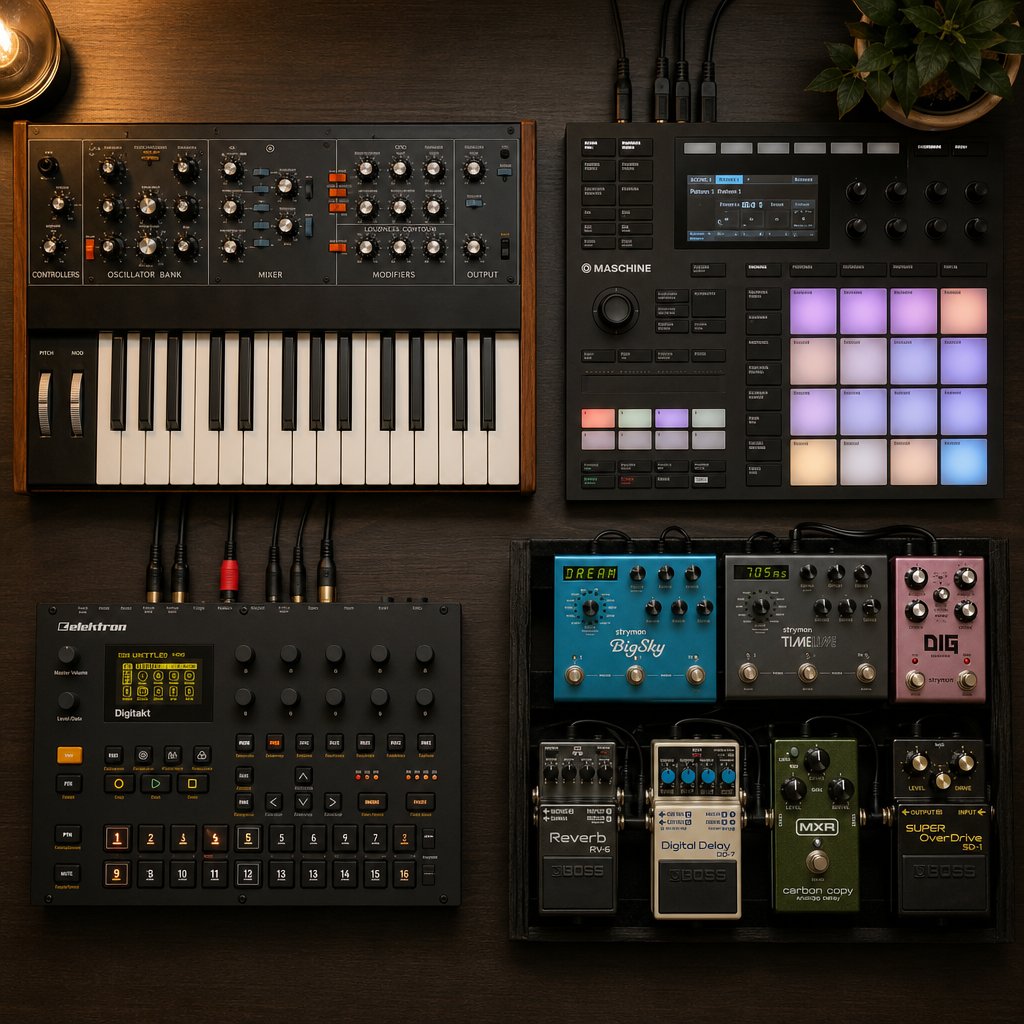
Every finished track, whether it is a four-bar loop or a five-minute arrangement, relies on four functional roles working together. Some devices cover a single role. Others, like grooveboxes, blur the lines and handle two or three at once. The categories below break down what each role contributes and which cool musical instruments fill it.
Sound Sources — Synthesizers, Samplers, and Drum Machines
Sound sources are the starting point of any production. These are the devices that actually generate the audio you hear, the raw tonal material that everything else shapes and arranges. Without a sound source, there is nothing to filter, sequence, or mix.
Synthesizers create sound from scratch using the oscillator-filter-amplifier chain covered earlier. They range from compact analog monosynths to sprawling digital workstations and software plug-ins. If you need a bass line, a lead melody, a pad, or an atmospheric texture, a synth is usually the first place to look.
Samplers take a different approach. Instead of generating waveforms electronically, a sampler captures and plays back digital audio clips, whether those clips are recorded vocals, chopped vinyl breaks, field recordings, or single instrument hits. Once a sample is loaded into memory, you can trigger it, pitch-shift it, loop it, and process it with onboard filters and effects. Hardware samplers were once essential studio centerpieces, and while software samplers have taken over much of that role, many producers still favor tactile hardware units for the hands-on workflow they provide.
Drum machines sit at the intersection of synthesis and sampling. A classic drum machine comes loaded with preset percussion sounds, kicks, snares, hi-hats, claps, and more, produced through synthesis or stored samples. What sets a drum machine apart from a general-purpose sampler is focus: it is purpose-built for rhythm. Most include a built-in step sequencer for programming patterns, along with controls for tempo, swing, and per-sound tuning. Iconic models earned their reputations not by sounding realistic but by having a distinctive sonic character that producers actively sought out.
Controllers, Sequencers, and Sound Shapers
Sound sources grab the spotlight, but the other three roles are what turn raw tones into a finished piece of music.
Controllers are the human interface layer. They do not generate sound on their own. Instead, they send performance data, typically via the musical instrument digital interface definition we know as MIDI, to trigger and manipulate sound sources. The most familiar controller is the MIDI keyboard, but the category extends far beyond keys. Pad controllers let you finger-drum samples and launch clips. Wind controllers like the Akai EWI translate breath and fingering into expressive synth performances. Even smartphone apps and motion-sensing gloves can serve as controllers. The key idea is separation: the thing you touch does not have to be the thing that makes the sound, and that flexibility lets you choose the physical interface that best matches your playing style.
Sequencers and arrangers handle the organizational side of music-making. A sequencer stores patterns of notes, rhythms, and automation data and plays them back automatically, freeing you to focus on sound design or live performance instead of manually triggering every hit. Hardware step sequencers use a grid of buttons, usually 16 steps per bar, to let you program patterns visually. Grooveboxes bundle a sequencer with onboard sound sources and effects into a single self-contained unit, making them popular for sketching ideas on the go or performing entire sets without a laptop. Loop stations take yet another angle, capturing live audio in real time and stacking layers on top of each other. If you have ever seen a solo performer build a full arrangement on stage one layer at a time, a loop station is likely doing the heavy lifting.
Sound shapers sit at the end of the chain, refining and transforming audio after it leaves a sound source. Effects processors add reverb, delay, distortion, chorus, and other treatments that place a sound in a space or give it movement. Standalone filter units let you sculpt frequencies in ways that go beyond what a synth's built-in filter offers. And vocoders blend a carrier signal, usually a synth, with a modulator signal, usually a voice, to create that robotic, talking-synth texture heard everywhere from 1970s funk to modern electro-pop. Sound shapers are easy to overlook, but they are often the difference between a demo that sounds flat and a mix that sounds polished and alive.
If you have ever stumbled across an "electronic instrument briefly crossword" clue, the answer is usually "synth," and for good reason: synthesizers dominate the conversation. But as the table below shows, a synth is only one piece of a larger production ecosystem. Each role depends on the others.
| Role | Example Instruments | Primary Function in a Mix |
|---|---|---|
| Sound Sources | Synthesizers, samplers, drum machines | Generate the raw audio material — melodies, basses, pads, rhythms |
| Controllers | MIDI keyboards, pad controllers, wind controllers | Translate human gestures into performance data that triggers sound sources |
| Sequencers / Arrangers | Hardware step sequencers, grooveboxes, loop stations | Store, arrange, and automate patterns so compositions play back without manual input |
| Sound Shapers | Effects processors, standalone filters, vocoders | Refine, color, and spatialize audio after it leaves the sound source |
Thinking in terms of roles rather than product names makes it easier to diagnose gaps in your setup. If your tracks feel rhythmically stiff, you might need a better sequencer, not a new synth. If your sounds feel thin, a dedicated effects processor or a quality reverb plug-in could matter more than another oscillator. And if your workflow feels clunky, a controller that matches your playing style can unlock creativity you did not know was there.
Among all four roles, one category towers above the rest in sheer variety and creative range: the synthesizer. It comes in analog, digital, hybrid, and software forms, each with its own strengths and trade-offs, and understanding that spectrum is the key to choosing the right tool for your sound.
Synthesizers Across the Hardware-Software Spectrum
If you ask what are the most popular instruments in modern music production, synthesizers will top the list almost every time. No other family of electronic musical instruments spans as wide a range of formats, price points, and sonic possibilities. From a hand-wired analog circuit to a plug-in running inside your browser, synthesizers exist along a continuum, and where you land on that continuum shapes your workflow, your sound, and your budget in very different ways.
Analog, Digital, and Hybrid Hardware Synths
Analog synthesizers generate sound using continuous electrical voltages. Oscillators produce raw waveforms, filters sculpt them, and amplifiers shape their volume, all through physical circuitry. The result is a sound often described as warm, fat, and slightly unpredictable. That unpredictability is actually a feature: tiny voltage fluctuations give analog oscillators a natural drift that many producers find musically pleasing. Instruments like the Minimoog, the Sequential Prophet-5, and the Korg MS-20 built their legendary status on this character. The trade-off is cost and limited polyphony. Many analog synths play only one note at a time, and fully analog polysynths climb quickly in price.
Digital hardware synths replace analog circuits with processors and algorithms. Because math is cheaper than copper, digital instruments can offer more voices, more synthesis methods, and more preset storage at a lower price. The Yamaha DX7 proved this in 1983 by delivering 16-voice FM synthesis for a fraction of what an analog polysynth cost. Modern digital workstations like the Korg Kronos pack subtractive, FM, wavetable, and sample-based engines into a single keyboard. The sound is precise and repeatable, though some players feel it lacks the organic movement of analog circuitry.
Hybrid synthesizers split the difference. A typical hybrid routes an analog oscillator and filter through a digitally controlled interface, giving you the tonal warmth of real circuits alongside the convenience of patch memory, digital modulation, and stable tuning. Instruments in this category, like the Dave Smith Prophet Rev2 or the Novation Peak, appeal to producers who want hands-on analog character without sacrificing modern workflow features. These hybrid electronic instruments have become increasingly popular as manufacturers find smarter ways to blend both worlds.
Software Synthesizers and Virtual Instruments
Software synths, commonly called VSTs or plug-ins, run entirely inside a digital audio workstation. They use your computer's processor to model analog circuits, execute complex algorithms, or do things no hardware box could manage at any price. The range is staggering. u-he Diva models five decades of analog hardware technology down to the component level, delivering sounds that rival physical synths at a fraction of the cost. Vital offers powerful wavetable synthesis for free. Spectrasonics Omnisphere 2 ships with over 14,000 built-in sounds and 500 unique DSP waveforms, making it one of the most expansive virtual instruments ever released. And Xfer Serum, widely considered the go-to wavetable synth for modern production, pairs a clean sound engine with drag-and-drop modulation that keeps the workflow fast and intuitive.
Software is where most beginners start, and for good reason. A free plug-in like Vital or Helm gives you a fully functional synthesizer without spending a cent. That accessibility is a big part of why synths remain central to pop music instruments, EDM production, film scoring, and experimental sound design alike. You do not need a studio full of hardware to start sculpting sound.
So how do you decide between hardware and software? The honest answer is that each format involves trade-offs. Here is a practical breakdown:
Hardware Synth Pros
- Dedicated knobs and faders offer immediate, tactile control over every parameter
- Analog circuits deliver natural sonic character and subtle harmonic variation
- No CPU load, no driver conflicts, no software updates interrupting a session
- A physical instrument on your desk can inspire ideas in ways a screen cannot
Hardware Synth Cons
- Higher upfront cost, especially for analog polysynths
- Limited preset storage on many analog models
- Takes up physical space and may require additional audio routing
- Harder to recall exact settings across sessions without patch memory
Software Synth Pros
- Dramatically lower cost, with many high-quality options available for free
- Total recall: every parameter saves with your DAW project automatically
- Run multiple instances simultaneously without buying duplicate hardware
- Access to synthesis methods and sound libraries that would cost thousands in hardware
Software Synth Cons
- CPU-intensive plug-ins can strain older computers, especially during large sessions
- Mouse-and-screen interaction feels less immediate than turning a physical knob
- Dependent on operating system compatibility and ongoing developer support
- The sheer number of options can lead to decision paralysis rather than creativity
Many producers eventually land on a hybrid workflow: a hardware synth or two for hands-on sound design paired with software for versatility and recall. There is no single correct answer. The best setup is the one that keeps you making music instead of shopping for gear.
Among all popular musical instruments in the electronic world, synthesizers get the most attention, and deservedly so. But a synth does not exist in a vacuum. The genres it helped build, from ambient to hip-hop to electro-pop, were shaped just as much by the instrument's constraints as by its capabilities. That relationship between tool and genre is where the story gets really interesting.
How Electronic Instruments Shaped Popular Genres
A synthesizer does not just make sounds. It makes decisions for you. Every instrument imposes limits, a fixed number of voices, a particular filter character, a specific sequencer grid, and those limits push musicians toward patterns and textures they might never have discovered otherwise. The result is that entire genres owe their sonic DNA to the quirks of a single machine. Understanding which instrument shaped which genre turns abstract gear specs into something you can actually hear.
Drum Machines, Samplers, and the Birth of Hip-Hop
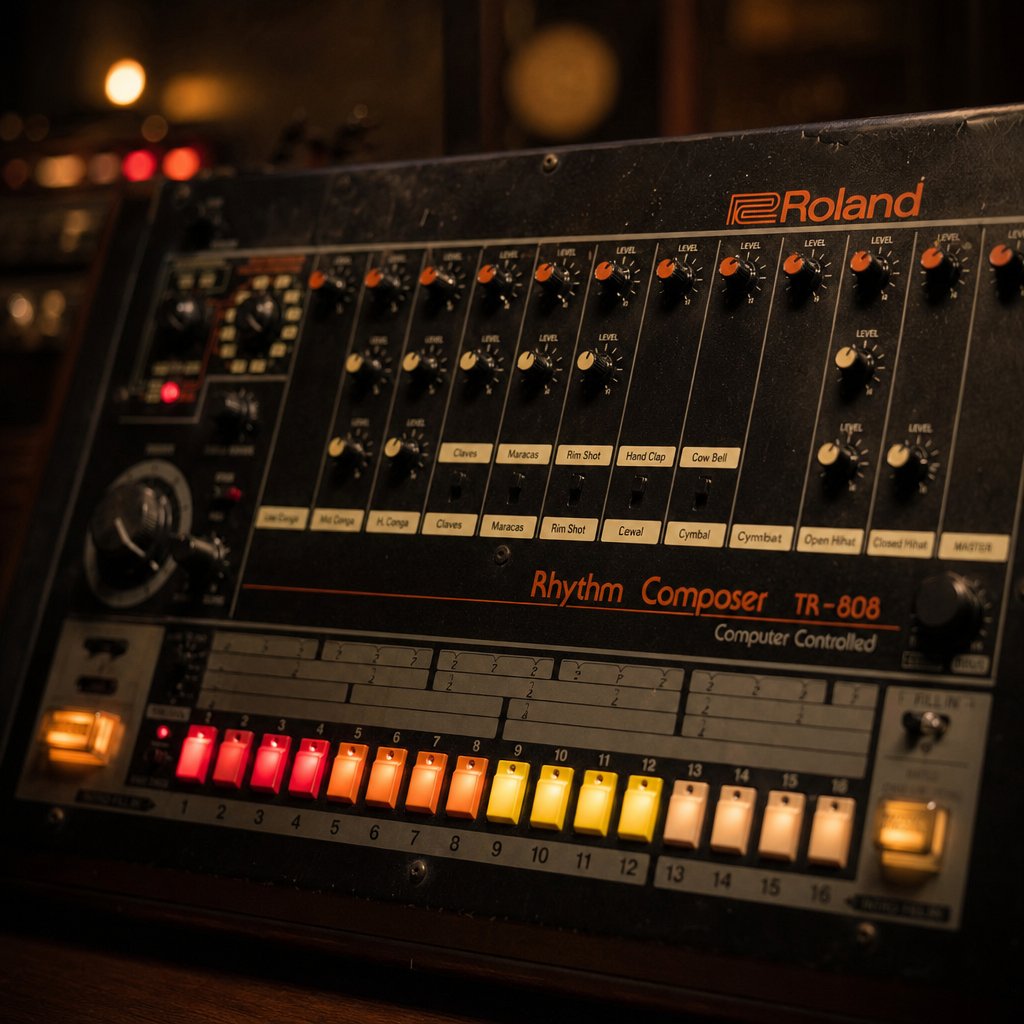
No instrument that starts with an e, or any other letter, reshaped popular music quite like the Roland TR-808. Released in 1980 as an affordable alternative to sample-based drum machines, the 808 used analog subtractive synthesis to generate its kicks, snares, claps, and cowbells. The sounds were never meant to be realistic. They were punchy, synthetic, and unmistakably electronic, and that is exactly what made them revolutionary.
Hip-hop producers latched on almost immediately. Afrika Bambaataa and Soulsonic Force's "Planet Rock" (1982) paired an 808 beat with icy Prophet-5 synth strings and a Moog Micromoog bassline, essentially building the blueprint for electro. That same year, Marvin Gaye's "Sexual Healing" placed the 808's signature claps and bass drum in an R&B setting that still sounds fresh decades later. By the mid-1980s, producers discovered the 808's best-hidden trick: cranking the bass drum's decay time until it functioned as a pitched bass instrument. That trunk-rattling sub-bass became the backbone of Miami bass, and by the time Dr. Dre released The Chronic in 1992, the 808 was practically standard issue for hip-hop production.
Samplers took the genre further. The Akai MPC let producers chop vinyl breaks, layer vocal snippets, and build entire arrangements from found sound. In the UK, that same sampling workflow fueled jungle and trip-hop. Artists sliced breakbeats into frantic, time-stretched patterns for jungle's hyperactive rhythms, or looped dusty soul records into the slow, hazy grooves that defined trip-hop acts like Massive Attack and Portishead. The sampler did not just play back audio. It recontextualized it, turning old records into raw material for something entirely new.
Synths in EDM, Ambient, and Electro-Pop
While drum machines and samplers drove rhythm-focused genres, synthesizers carved out the melodic and textural identities of others. The Moog Modular, with its voltage-controlled oscillators and step sequencer, became the foundation of early space music and ambient. Tangerine Dream's Phaedra (1974) used a Moog sequencer to create pulsing, arpeggiated bass lines that established the German electronic music movement. Popol Vuh's Florian Fricke, possibly the first German musician to own a Moog, described the instrument as "a fantastic way into my inside consciousness." These long, slowly evolving textures, anchored by repeating sequences and drenched in reverb, became the template that ambient and new age artists would follow for decades.
Vocoders and talk boxes gave electro-pop its robotic vocal signature. The Roland SVC-350 was the vocoder of choice for most electro artists in the early 1980s, blending a synth carrier signal with a human voice to produce that cold, mechanical singing heard on tracks by the Egyptian Lover and Kraftwerk. Any electronic musician working in synth-pop or electro-funk during that era leaned heavily on this effect to blur the line between human and machine.
Modern EDM owes its existence to the convergence of all these tools. Software synths like Serum and Massive brought complex wavetable and FM synthesis to laptop producers. Grooveboxes and DAWs replaced racks of hardware with streamlined, all-in-one workflows. The genre's signature supersaws, sidechained basses, and intricate automation would be impossible without decades of instrument evolution feeding into a single production environment. Today, an electronic musician can access the sonic palette of every era, from analog warmth to digital precision, without leaving a single screen.
| Instrument Type | Genre(s) Shaped | Sonic Signature |
|---|---|---|
| Drum Machines (TR-808, TR-909) | Hip-hop, electro, house, Miami bass | Punchy analog kicks, crisp claps, booming sub-bass |
| Samplers (Akai MPC, E-Mu SP-1200) | Hip-hop, jungle, trip-hop | Chopped breaks, layered textures, gritty lo-fi character |
| Modular Synthesizers (Moog, Buchla) | Ambient, space music, experimental | Slowly evolving pads, pulsing arpeggios, vast reverb-drenched soundscapes |
| Software Synths and Grooveboxes | EDM, future bass, dubstep | Complex wavetables, aggressive modulation, precise automation |
| Vocoders and Talk Boxes | Electro-pop, synth-funk, electro | Robotic vocals, metallic harmonies, human-machine hybrid tones |
These famous instruments did not just accompany their genres. They defined the creative boundaries within which musicians worked, and those boundaries became the genres themselves. The 808's limited voice count forced producers to be economical. The Moog sequencer's repetitive loops encouraged hypnotic, meditative structures. The sampler's ability to repurpose existing recordings turned crate-digging into a compositional method.
Knowing which tools shaped which sounds is more than music history trivia. It is a practical guide for anyone assembling their first setup. If you know the genre you want to make, you already know which musical instruments with e at the core of their design will get you closest to that sound. The real question is where to start, and how to connect the pieces into a workflow that actually produces finished music.
Building Your First Electronic Music Setup
Genres, synthesis methods, and signal chains are useful knowledge, but at some point you have to stop reading and start making noise. The good news? You do not need a room full of gear to get there. The barrier to entry for electronic music production has never been lower, and the path from curious beginner to someone finishing actual tracks can start with nothing more than a laptop and a pair of headphones. The trick is matching your setup to your current commitment level so you invest in learning, not just in equipment.
Below are three practical tiers, each one building on the last. Pick the one that fits your budget and curiosity, and know that you can always move up when you are ready.
Three Setup Tiers from Software-Only to Hardware-Hybrid
- Software-Only Start (Budget: $0 - $100)
This is the leanest path, and it is surprisingly capable. All you need is a computer, a digital audio workstation, and a few free virtual instruments. On the DAW side, several fully free options can handle complete productions. Mac users already have GarageBand installed. Windows users can grab Cakewalk Sonar or Waveform Free, both of which offer unlimited tracks and full plug-in support at no cost. BandLab runs entirely in a browser, so even a Chromebook works. For instruments, free VST synths like Vital (wavetable), Dexed (FM), and Surge XT (multi-engine) cover an enormous range of sounds without costing a cent. Add a decent pair of headphones, and you have everything you need to learn arrangement, sound design, and mixing fundamentals. Many popular instruments in electronic music today are software-based, so starting here is not a compromise. It is how a large portion of working producers still operate. - Controller-Enhanced Setup (Budget: $150 - $400)
Once you are comfortable inside a DAW, adding a physical controller transforms the experience. A 25- or 49-key MIDI keyboard gives you a tactile way to play melodies, trigger drums, and audition sounds that feels far more musical than clicking notes on a piano roll. Pad controllers like the Novation Launchpad or Akai MPD series add finger-drumming and clip-launching capabilities. These controllers send MIDI data to your software instruments, so they do not generate sound on their own, but the hands-on interaction makes a real difference in how quickly ideas flow. At this tier, you will also want an audio interface, a small box that sits between your computer and your headphones or speakers. An interface converts digital audio to analog with much better quality than a built-in sound card, and it provides low-latency monitoring so you hear your playing in real time. Entry-level models from Focusrite, PreSonus, or Universal Audio connect via USB and set up in minutes. Many even come bundled with a lite version of Ableton Live or Cubase, giving you another DAW to explore. - Hardware-Hybrid Rig (Budget: $500 - $1,200)
This is where things get really fun. Adding one piece of dedicated hardware, a groovebox, a desktop synth module, or a compact analog synthesizer, alongside your software setup gives you the best of both worlds. Hybrid electronic instruments like the Novation Circuit Tracks or the Roland MC-101 pack sound engines, sequencers, and effects into a single portable unit that works standalone or syncs with your DAW. A desktop synth like the Korg Minilogue XD or the Arturia MicroFreak offers hands-on knob-per-function control that makes sound design feel immediate and physical. The key connection point is MIDI and audio routing. Your hardware synth sends audio into your interface (typically via a quarter-inch cable) and receives MIDI from your DAW or controller. This lets you sequence hardware sounds from your computer, record the audio output, and process it with software effects, blending analog character with digital flexibility in a single project. Studio monitors replace headphones as your primary listening source at this stage, giving you a more accurate picture of how your mixes translate to other playback systems.
Regardless of which tier you choose, the underlying connections follow the same logic. MIDI carries performance data between controllers, instruments, and your DAW. Audio flows from sound sources through an interface into your monitoring chain. And the DAW sits at the center, recording, arranging, and mixing everything. Once you understand that signal flow, scaling up is just a matter of adding new sources and controllers to the same framework.
Turning Instrument Ideas into Finished Songs
Here is the part most beginner guides skip. You have a DAW, maybe a controller, maybe a synth. You can make sounds. But how do you turn a cool music instruments patch or a four-bar loop into an actual finished song? This is where many newcomers stall, not because they lack gear, but because the gap between "I found a sound I like" and "I have a complete track" feels enormous.
Start by working with constraints. Pick one synth, one drum source, and one effect. Sketch a short loop, maybe eight bars, that captures a mood or groove. Then focus on arrangement: how does the track build, where does it peak, and how does it resolve? Learning basic song structure, intro, verse, chorus, breakdown, is more valuable at this stage than learning advanced synthesis. Many producers find it helpful to reference tracks they admire, analyzing how those songs use instrument layers, transitions, and dynamics to hold a listener's attention.
If the full DAW workflow still feels overwhelming, AI-powered tools can bridge the gap. MakeBestMusic's AI Song Generator, for example, lets you feed in tonal references, instrument ideas, and production textures and receive original songs in return. It is a practical way to hear how your ideas might sound as finished music before you have mastered every aspect of mixing and arrangement. Think of it as a sketchpad that turns rough concepts into playable drafts. You can study the output, learn from its structure, and then recreate or refine those ideas inside your DAW as your skills grow.
Alongside AI tools, free resources accelerate the learning curve. YouTube tutorials cover everything from basic EQ to advanced sound design. Sample packs give you professionally recorded drums and textures to build with. And online communities on Reddit, Discord, and dedicated forums provide feedback loops that no tutorial can replace. The people wondering how to spell electronics correctly in a search bar today are the same people releasing tracks six months from now, because the tools and knowledge are genuinely that accessible.
The most important instrument in electronic music is not a synth, a drum machine, or a plug-in. It is momentum. Finish a track, even a rough one. Then finish another. Each completed project teaches you more than a week of tweaking presets ever will. Your setup will evolve as your ears and ambitions grow, but the habit of finishing is what separates hobbyists from producers.
With a working setup in place and songs taking shape, the natural next question shifts from "what do I need?" to "what is coming next?" The tools shaping electronic music are evolving fast, and the trends emerging right now will define how the next generation of instruments looks, feels, and sounds.
Where Electronic Instruments Are Headed Next
Every generation of electronics instruments has been defined by a single shift: something that was once expensive, complex, or exclusive suddenly becomes accessible. Vacuum tubes gave way to transistors. Room-sized modulars shrank into portable keyboards. Software replaced racks of hardware. The pattern keeps repeating, and the trends taking shape right now suggest the next wave will be just as transformative. What are the instruments used by tomorrow's producers going to look like? The answer is already emerging across four converging fronts.
AI, MPE, and the Next Wave of Instrument Design
Artificial intelligence is no longer a futuristic concept hovering at the edges of music production. It is already embedded in the tools musicians use daily, and its role is expanding fast. The most compelling applications are not about replacing human creativity. They are about removing friction between an idea and a finished result.
Consider what is happening in sound design. Synplant 2 by Sonic Charge uses a neural network trained on its own synthesis engine to reverse-engineer sounds. Feed it any audio recording, a field recording, a vocal snippet, a texture you captured on your phone, and its Genopatch system guesses which synthesizer parameters would produce something similar. The output is not a static audio clip but a fully playable, editable synth patch. You get a creative starting point in seconds that might have taken hours of manual knob-turning to discover. Roland's Project LYDIA, a collaboration with AI studio Neutone, pushes this further by using an autoencoder neural network to learn the tonal fingerprint of any sound source and apply it to live input in real time. Imagine singing into a microphone and hearing your voice reshaped through the timbral character of a cello, a rainstorm, or a busy street market, all while preserving your original pitch and dynamics.
AI is also closing the gap between instrument exploration and finished music. Tools like MakeBestMusic's AI Song Generator let you feed in instrument ideas, tonal references, and production textures and receive original songs back, illustrating how AI lowers creative barriers for musicians at every skill level. Meanwhile, open-source models like ACE-Step offer diffusion-based song generation that supports inpainting, remixing, and LoRA fine-tuning, giving independent developers and artists a foundation to build custom workflows on top of.
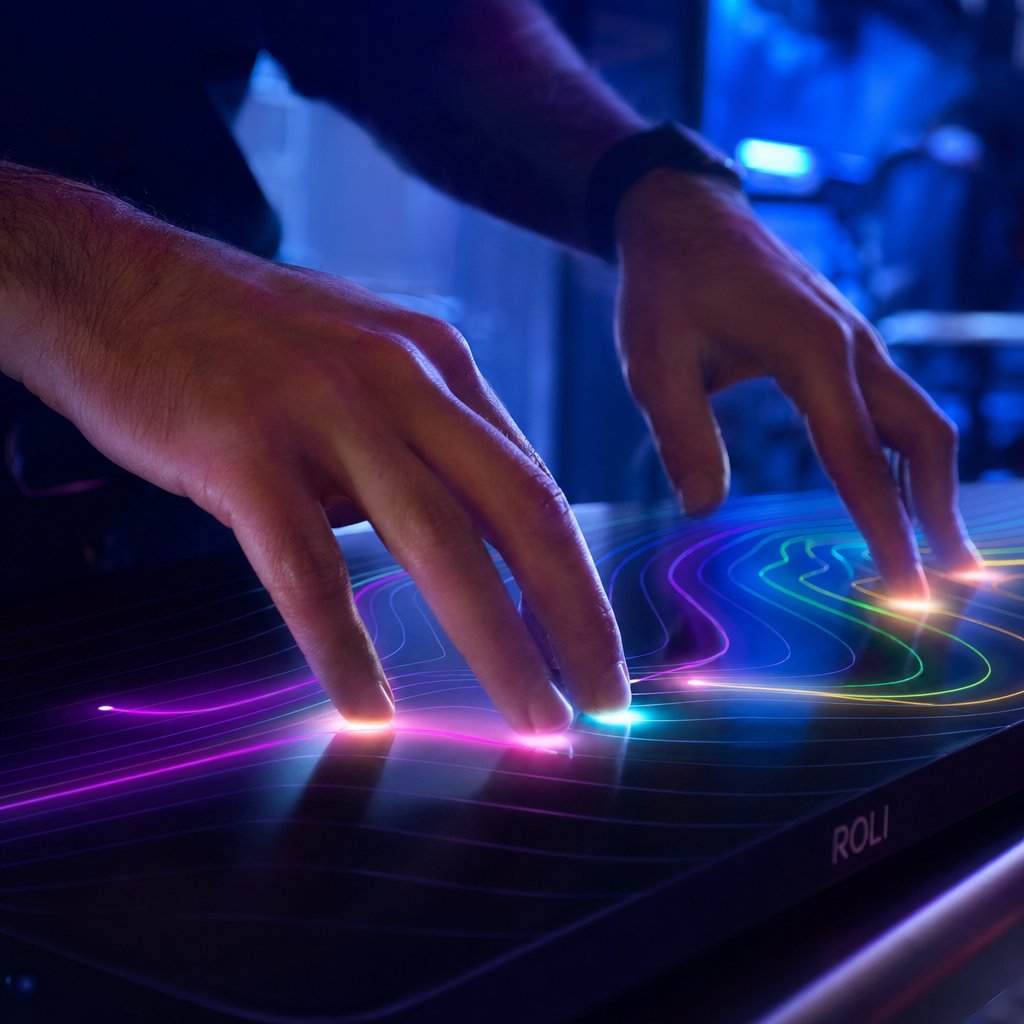
Parallel to AI, a quieter revolution is making electronic instruments feel more like acoustic ones. MPE, or MIDI Polyphonic Expression, upgrades the decades-old MIDI protocol by assigning each note its own channel of expression data. In standard MIDI, pitch bend or vibrato applies to every note at once. With MPE, you can bend a single note in a chord while the others stay put, add pressure to one key to brighten its timbre, or slide your finger across a surface for per-note glide, much like what a violinist or guitarist does naturally.
The hardware built around MPE reflects this expressive ambition. The ROLI Seaboard 2 replaces rigid piano keys with a continuous silicone surface that senses five dimensions of touch: strike, glide, slide, press, and lift. The LinnStrument arranges notes on a grid layout inspired by stringed instruments, sensing finger movement across all five expression axes. The Expressive E Osmose keeps a traditional keyboard feel but adds per-key pressure and lateral movement, making it approachable for pianists who want expressive depth without learning an entirely new interface. Even Ableton's Push 3 now includes MPE-sensitive pads, signaling that polyphonic expression is moving from niche territory into mainstream production tools. On the software side, DAWs like Bitwig Studio, Ableton Live, Logic Pro, and Boris FX Samplitude all support MPE editing, and synth plug-ins such as Arturia Pigments, Serum 2, and the free Surge XT respond to per-note expression data out of the box.
If you have ever searched for what is the coolest instrument in electronic music, MPE controllers are strong contenders. They bring the nuance and intimacy of acoustic performance into a digital signal chain, solving a limitation that MIDI has carried since 1983.
From Niche Gear to Accessible Creative Tools
AI and MPE grab headlines, but accessibility might be the most consequential trend of all. The tools shaping the next generation of musical instruments starting with e, and every other letter, are getting cheaper, more portable, and more open than ever before.
- Browser-based and mobile instruments are eliminating the install barrier entirely. Roland's Zenology GX for iPad brings the same synthesis engine found in the company's flagship FANTOM and JUPITER-X hardware to a tablet, complete with deep editing tools and a touch-friendly interface. Browser-based DAWs like BandLab and Soundtrap let anyone with a web connection compose, record, and collaborate without downloading a single file. These platforms are turning smartphones and tablets into legitimate production environments, not just toys.
- Open-source hardware is democratizing instrument building itself. At the 2026 NAMM Show, Bastl Instruments open-sourced the firmware for three of its designs, the Alchemist, Wave Bard, and FX Wizard, and released them as affordable DIY kits in both standalone and Eurorack formats. The Randomwaves Drumboy Pro Edition, previewed at the same show, is an open-source drum machine with full source code on GitHub, priced around $240. These projects let musicians not just play instruments but modify and rebuild them, turning users into co-designers.
- Instruments blurring into production environments continue to collapse the boundary between a single device and a full studio. The Akai MPC XL, also unveiled at NAMM 2026, promises standalone processing power, expressive control, and professional I/O connectivity that can serve as the centerpiece of a studio without requiring a computer. Grooveboxes, standalone synths with built-in sequencers, and all-in-one workstations keep absorbing features that once required separate devices, making it possible to produce, perform, and finish music on a single piece of hardware.
- AI-assisted composition and effects are reaching into unexpected corners. Polyend's Endless effects pedal lets users "vibe code" custom effects using natural language, no programming knowledge required. Positive Grid's BIAS X analyzes a reference guitar track and reconstructs a matching amp-and-effects preset in seconds, trained on over one million tones and 200 amplifier models. These tools translate creative intent directly into technical results, skipping the manual parameter hunt that used to be the price of admission.
- Revived and reimagined classics are connecting past and future. Eventide Audio is working with composer Laurie Spiegel to bring back Music Mouse, her algorithmic composition tool, after 40 years, carefully preserved for modern systems. Korg's Kaoss Pad V revives the beloved touch-controlled effects box with updated capabilities. Even the concept of acoustic synthesis is getting a polished new entry with the Korg phase8, which uses electronics to control the vibration of physical strings. These reintroductions show that innovation does not always mean inventing something new. Sometimes it means making something great available again.
If you have ever seen the clue "electronic instruments for short crossword" and answered "synths," you already understand how deeply these devices have embedded themselves in culture. What is changing is not the importance of electronic instruments but who gets to use them and how quickly a spark of inspiration can become a finished piece of music.
The trajectory is clear. Hardware is getting smarter, software is getting more tactile, and AI is filling the gaps between imagination and execution. Whether you start with a free browser synth, a $50 Stylophone sampler, or a flagship workstation, the tools available right now are more powerful, more expressive, and more open than anything that came before. The best time to pick one up and start experimenting, with hardware, software, or both, is exactly now.
