

What Happens When AI Creates a Song From Scratch
You type a few words — something like "upbeat jazz with piano and a rainy-day mood" — click a button, and thirty seconds later you're listening to a fully produced track. Millions of people do this every day. But what actually happens between the moment you hit generate and the moment sound reaches your ears?
Most people already have a rough sense of how tools like ChatGPT predict text or how Midjourney conjures images from descriptions. Music generation, though, remains a black box for many. It sits at the intersection of language processing, audio engineering, and deep learning — a unique challenge that no single familiar AI concept fully explains. This article bridges that gap, walking you through how AI creates music from scratch, layer by layer.
What AI Music Generation Actually Means
AI music generation is the process of using trained neural networks to produce original musical audio or compositions from input conditions — such as text prompts, melodies, or style tags — without direct human performance or manual programming of each note.
Here's the simplest version: a deep learning model studies vast amounts of existing music, learns the statistical patterns that make melodies, harmonies, and rhythms work together, and then uses those patterns to generate something new. The output can range from a short loop to a full song with vocals, instrumentation, and mastering applied. What you hear is not a collage of copied clips — it's a newly synthesized audio signal shaped by learned musical relationships.
If you're familiar with how ChatGPT predicts the next word in a sentence, AI music generation follows a parallel logic: predicting what musical element comes next, given everything that came before it. The difference is that music unfolds across multiple dimensions simultaneously — pitch, rhythm, timbre, dynamics, and structure — all of which must stay coherent over minutes rather than seconds.
Why Music Is Uniquely Challenging for AI
Text is one-dimensional. Images are two-dimensional. Music adds a third axis: time. A generated song must sound good at any given instant and still make structural sense across its entire duration. That's a fundamentally harder problem.
There are two major paradigms for tackling it, and understanding them gives you a mental map for everything that follows:
- Symbolic generation (MIDI/note-level) — the model produces a sequence of musical events like note-on, note-off, velocity, and instrument choice. Think of it as writing sheet music. It's computationally lighter but loses nuances like vocal texture and recording ambiance.
- Audio-based generation (waveform-level) — the model works directly with sound data, producing actual audio signals. This preserves every sonic detail but requires far more computational power, as research from deep learning labs has shown, with tens of thousands of audio samples needed per second of music.
Modern systems that let you AI generate a song from a text prompt almost always operate at the audio level, often combining language-model-style architectures with specialized audio decoders. The question of how these models perceive, compress, and reconstruct sound — rather than just notes on a page — is where the real technical story begins.
The Evolution of AI Music Technology
The ability to generate full songs from a text prompt didn't appear overnight. It's the result of decades of experimentation, where each generation of technology solved a specific problem that its predecessor couldn't. Understanding this history of AI music generation technology helps explain why modern systems work the way they do — and why earlier attempts fell short.
Rule-Based Systems and Early Experiments
The earliest AI music systems weren't neural networks at all. They were rule-based programs — essentially, sets of instructions a human composer would code into a machine. The Illiac Suite in 1956, composed by programmers Lejaren Hiller and Leonard Isaacson, is widely recognized as the first computer-generated musical score. Hiller defined rules like restricting notes to a certain octave and avoiding dissonance, then let the ILLIAC computer generate a score that human musicians performed.
By the 1980s, composer David Cope developed algorithms that could deconstruct existing music, identify stylistic signatures, and recombine elements into new works. In 2002, Francois Pachet's Continuator took this further — a machine learning model that listened to a musician play and then continued in the same style, marking one of the first real-time ML music systems.
These early approaches were impressive for their era, but they shared a critical limitation: they could only produce what a human explicitly programmed them to produce. The rules defined the ceiling. There was no learning from raw musical data, no generalization, and no capacity for surprise.
From Recurrent Networks to Transformers
When neural networks entered the picture in the 2010s, the game changed. Recurrent Neural Networks (RNNs) were the first architecture applied seriously to music generation. Their cyclic structure — where each output feeds back as input for the next step — made them a natural fit for sequential data like melodies.
The problem? Standard RNNs struggle with long-term memory. As a generated sequence grows longer, earlier notes fade from the model's effective context. The result is music that sounds coherent note-to-note but drifts aimlessly over 30 or 60 seconds, losing any sense of theme or structure.
Long Short-Term Memory networks (LSTMs) improved on this by introducing gating mechanisms that help the model decide what information to keep and what to discard. Research on RNN-based melody generation confirms that LSTMs achieve better continuity in short-term sequences, but they still face the long-term dependency problem — the model struggles to maintain thematic consistency over longer compositions. A verse might sound fine internally, yet bear no relationship to the chorus that follows it.
Transformers changed everything. If you've used ChatGPT, you've used a transformer. The key innovation is the attention mechanism, which allows the model to look back at any earlier point in the sequence — not just the most recent few steps. For music, this means a transformer can reference a melody introduced in bar 4 while generating bar 64. It can maintain key signatures, recall rhythmic motifs, and build the kind of large-scale structure (verse, chorus, bridge) that listeners expect.
This is how transformers changed AI music: they gave models something closer to a composer's global awareness of an entire piece, rather than a performer sight-reading one note at a time.
The Diffusion Model Crossover
While transformers were reshaping sequential generation, a parallel revolution was happening in the image domain. Diffusion models — the technology behind tools like Midjourney and Stable Diffusion — work on a completely different principle. Instead of predicting the next token in a sequence, they start with pure noise and iteratively refine it into coherent output through a learned denoising process.
Technical research from Weights & Biases traces how diffusion models jumped from image generation to audio around 2021, with teams like Harmonai pioneering early audio diffusion experiments. The insight was straightforward: if you can represent audio as a visual spectrogram, you can apply the same denoising framework that generates images. This approach excels at producing high-fidelity, natural-sounding audio without the artifacts that autoregressive models sometimes introduce.
The table below summarizes how each era of technology addressed — and was ultimately limited by — different aspects of the evolution of neural network music composition:
| Era | Technology | Key Limitation |
|---|---|---|
| 1950s-2000s | Rule-based systems and algorithmic composition | No learning from data; output constrained by hand-coded rules |
| 2010-2017 | RNNs and LSTMs | Lost coherence over long sequences; poor structural memory |
| 2017-present | Transformers (attention-based) | Computationally expensive for raw audio; requires tokenized representations |
| 2021-present | Diffusion models | Slower generation (many denoising steps); harder to control structure precisely |
Each row in this timeline didn't replace what came before — it built on top of it. Modern AI music generators often combine transformers and diffusion models in hybrid architectures, using the strengths of each where they matter most. The RNN vs transformer music generation debate is essentially settled for long-form composition: attention-based models win on structural coherence. But knowing how the model perceives sound in the first place — what format the audio takes before any of these architectures can process it — is an equally important piece of the puzzle.
How AI Converts Sound Into Data It Can Actually Process
A transformer can attend to earlier tokens. A diffusion model can denoise a noisy canvas. But neither architecture can do anything useful until the raw musical signal — a continuous pressure wave fluctuating thousands of times per second — gets translated into a format the model can digest. How AI converts sound into data is the foundational step that determines everything downstream: the architecture you can use, the quality you can achieve, and the length of music you can generate.
There are three primary ways modern systems represent audio for neural networks, each with different tradeoffs:
- Raw waveforms — the uncompressed sequence of amplitude values sampled thousands of times per second. Complete information, but overwhelmingly long sequences for any model to process.
- Mel-spectrograms — visual frequency maps that show how energy is distributed across perceptually weighted frequency bands over time. A compressed, human-hearing-aligned snapshot of the audio.
- Discrete audio tokens — compact integer sequences produced by neural audio codecs, analogous to how text tokenizers break sentences into subword tokens for language models.
The choice of representation is not a minor implementation detail. It defines the ceiling on output quality and dictates which generation paradigm is even possible.
Spectrograms and Mel-Spectrograms Explained
Imagine pausing a song every 10 milliseconds and asking: which frequencies are active right now, and how loud is each one? Stack those snapshots side by side and you get a spectrogram — a 2D heatmap with time on the horizontal axis, frequency on the vertical axis, and color intensity representing energy.
A standard spectrogram uses a linear frequency scale, spacing Hertz values evenly from bottom to top. The problem is that human hearing doesn't work linearly. The perceptual distance between 100 Hz and 200 Hz feels enormous — roughly an octave. The distance between 5,000 Hz and 5,100 Hz is barely noticeable. A mel spectrogram fixes this by warping the frequency axis to match how we actually perceive pitch, compressing high frequencies and expanding low ones so that equal distances on the chart correspond to equal perceptual steps.
To create a mel spectrogram, the system applies the Short-Time Fourier Transform (STFT) to overlapping windows of the audio — typically 25ms each — extracting frequency content from those tiny quasi-stationary slices. The resulting power spectrum then passes through a bank of overlapping triangular filters spaced equally in mel scale. Finally, a logarithmic compression is applied to the energy values, matching the nonlinear way humans perceive loudness. The output is a compact matrix — say, 100 frames by 80 frequency bins per second of audio — that preserves the perceptually important structure while discarding redundant detail.
For AI music generation, mel spectrograms serve as an efficient intermediate representation. Diffusion-based models like Stable Audio treat these spectrograms almost like images, applying denoising across the time-frequency plane. The advantage is clear: you've reduced tens of thousands of raw samples per second down to a manageable 2D map. The limitation? Spectrograms discard phase information, making it harder to reconstruct perfectly natural-sounding audio from them without additional processing.
Audio Neural Codecs as the Missing Link
Here's the core insight that makes modern text-to-music generation possible: if you can compress audio into a sequence of discrete integer tokens, you can train a language model to predict those tokens — the same way GPT predicts the next word in a sentence.
This is exactly what neural audio codecs do. Systems like Meta's EnCodec and Google's SoundStream use a trained encoder-decoder architecture to squeeze continuous audio into a compact latent space, then quantize that space into discrete codes. The process works like this: an encoder network takes raw audio and downsamples it dramatically — often by a factor of 128x or more — producing a sequence of compact embedding vectors. These embeddings are then mapped to the nearest entries in a learned codebook through a technique called Residual Vector Quantization (RVQ).
RVQ is what gives these codecs their power. Instead of trying to capture all audio detail in a single quantization step, the system works in layers. The first quantizer captures the coarse structure — think broad melodic shape and rhythm. The residual error (what the first quantizer missed) gets fed to a second quantizer, which captures finer detail. This continues through multiple levels — 8, 16, or even 32 — each one refining what the previous levels couldn't represent. The audio is then encoded as a sequence of integer tuples, one per time step, with each integer pointing to a specific entry in a codebook.
The parallel to text tokenization is direct. Just as a text tokenizer converts "the cat sat" into token IDs like [1820, 4937, 3258], a neural audio codec converts a second of music into something like a grid of integers — perhaps 50 time steps, each with 8 codebook indices. A decoder network can then reconstruct high-fidelity audio from these tokens alone. Research from Kyutai demonstrates that with enough RVQ levels, codec-reconstructed audio becomes nearly indistinguishable from the original, even at aggressive compression ratios.
This is the bridge that connects language modeling to music generation. Once audio exists as discrete tokens, a transformer can be trained to predict the next audio token given a text conditioning signal — turning the music generation problem into something structurally similar to text generation, just with a different vocabulary.
Symbolic vs Waveform-Level Representations
It's worth stepping back to see how these audio-level representations compare to the symbolic approach mentioned earlier. Symbolic representations — MIDI files, piano rolls, sheet music notation — encode music as a sequence of events: note on, note off, pitch, velocity, instrument. They're lightweight, editable, and easy for models to handle. But they throw away everything that makes a recording sound like a recording: the grain of a vocalist's timbre, the room reverb, the subtle dynamics of a live performance.
Waveform-level representations preserve all of that. The tradeoff is sheer scale. A single second of CD-quality audio contains 44,100 amplitude samples. Even at a reduced 16 kHz sample rate common in speech and music AI systems, that's 16,000 values per second — far too many for a language model to handle efficiently with its quadratic attention cost.
Neural audio codecs solve this problem by collapsing those thousands of raw samples into a handful of discrete tokens per second while retaining enough information to reconstruct convincing audio. The codec effectively acts as both a compression layer and a translation layer — converting the continuous, high-dimensional world of sound into a discrete, lower-dimensional space where transformer-based generation becomes computationally feasible.
Understanding audio tokenization for music generation clarifies why this technology emerged so recently. The codecs themselves — EnCodec, SoundStream, and newer variants like Kyutai's Mimi — only reached sufficient quality in the early 2020s. Before they existed, there was no practical way to feed audio into a language model and get musically coherent output back. With them in place, the full generation pipeline — from text prompt to finished track — becomes architecturally possible. The question then shifts to how that pipeline actually orchestrates its components step by step.
From Text Prompt to Finished Audio
Audio tokens give models a vocabulary for sound. But vocabulary alone doesn't produce a song — just like knowing English words doesn't make you a novelist. The real magic lives in the pipeline that transforms your typed description into a complete musical composition. When you enter a prompt like "melancholic cello solo in a cathedral" and click generate, a carefully orchestrated chain of specialized models activates, each handling a distinct phase of creation.
Here's how AI turns text into audio, broken into the core stages that run under the hood:
Prompt Encoding and Conditioning
The journey starts with your words. A text encoder — typically a frozen language model like T5 or Flan-T5 — reads your prompt and converts it into a dense numerical representation called a conditioning vector. This vector doesn't store your words literally. Instead, it captures the semantic relationships between every concept in your description: instrument type, mood, tempo, genre, and spatial characteristics like reverb.
Think of it this way: the text encoder maps your plain-language request into the same mathematical space where the model has learned to associate descriptions with musical features. Systems trained with contrastive learning frameworks like CLAP (Contrastive Language-Audio Pretraining) build shared embedding spaces where text descriptions and matching audio sit near each other as points in high-dimensional space. A prompt like "lo-fi hip-hop beat with vinyl crackle and mellow Rhodes piano" activates a region of that space associated with specific frequency characteristics, rhythmic patterns, and timbral qualities the model encountered during training.
The specificity of your prompt directly shapes how prompt conditioning works in music AI. Vague inputs like "happy music" produce generic results because the conditioning vector doesn't sufficiently narrow down the generation space. Detailed prompts with specific instruments, tempo markers, and production descriptors give the model a tighter probability distribution to sample from — producing more targeted, distinctive output.
This conditioning vector then feeds into the generation model through cross-attention layers. At every step of generation, the model "looks back" at your encoded prompt to stay aligned with what you asked for. A technique called classifier-free guidance (CFG) controls how strongly the output adheres to your description. Higher CFG values push the model to match the prompt more faithfully, sometimes at the cost of audio naturalness. Lower values give the model more creative freedom but risk drifting from your intent. Most systems default to a guidance scale around 3, balancing fidelity and quality.
Iterative Generation and Token Decoding
With the conditioning signal locked in, the generation model produces music in its compressed representation — not as raw audio yet, but as sequences of discrete tokens or latent embeddings. How this happens depends on the architecture:
- Transformer-based systems (like MusicGen) predict audio tokens autoregressively — one token at a time, left to right, each prediction conditioned on the text embedding and all previously generated tokens. MusicGen uses an efficient token interleaving pattern to generate all codebook levels in a single forward pass, rather than cascading multiple models.
- Diffusion-based systems (like Stable Audio) start with a canvas of pure random noise in latent space, then iteratively denoise it over dozens or hundreds of steps until a coherent musical representation emerges — conditioned at every step by your text embedding.
In both cases, randomness plays a deliberate role. The model doesn't produce a single deterministic output for each prompt. It samples from probability distributions, and parameters like temperature control how much creative risk the model takes at each step. A higher temperature increases randomness — producing more surprising, varied results but occasionally less coherent ones. A lower temperature makes the model more conservative, choosing higher-probability tokens that sound safe and predictable. This is the creativity-coherence tradeoff that every AI music system must navigate.
For transformer-based pipelines, the output of this stage is a sequence of integer codes — indices into learned codebooks. These codes are compact: where raw CD-quality audio requires 44,100 samples per second, MusicGen's compressed representation might use roughly 50 token frames per second across its codebooks. The entire multi-minute composition exists, at this point, as a relatively small grid of numbers.
A separate decoder network — the neural codec decoder, such as EnCodec's decoder — then reconstructs a full audio waveform from these token sequences. This component works in the opposite direction of the encoder discussed in the previous section: it takes discrete codes, maps them back to continuous embeddings, and upsamples through a series of transposed convolutions until a high-fidelity waveform emerges at the target sample rate.
Post-Processing Before You Hear the Result
The raw output from the decoder rarely sounds production-ready. A post-processing stage cleans up the signal before it reaches your ears:
- Loudness normalization — adjusting the output to consistent levels (commonly -14 LUFS for streaming compatibility) so quiet passages aren't inaudible and loud ones don't clip.
- High-frequency correction — many models produce audio with slightly attenuated high frequencies due to codec compression. Filtering partially compensates for this rolloff.
- Stereo processing — some models generate mono audio internally and apply spatial widening as a final step to create a stereo field.
- Artifact suppression — filtering or neural post-nets smooth out occasional glitches, clicks, or unnatural transitions that the generation model introduced.
The entire text to music generation pipeline — from typing your prompt to hearing the result — typically completes in seconds to a few minutes depending on track length and computational resources. Platforms like MakeBestMusic's AI Music Generator let you experience this pipeline firsthand: you supply a prompt, lyrics, and style preferences, and the system orchestrates these technical stages behind a simple interface to deliver a complete song. It's a practical illustration of how all these abstract layers — text encoding, token generation, codec decoding, post-processing — collapse into a single button press from the user's perspective.
What varies between different AI music tools is which architecture powers the generation stage, how each architecture handles the conditioning signal, and what tradeoffs it makes between speed, quality, and creative control. Those architectural differences are where the real distinctions emerge.
Key Architectures Powering AI Music Generators
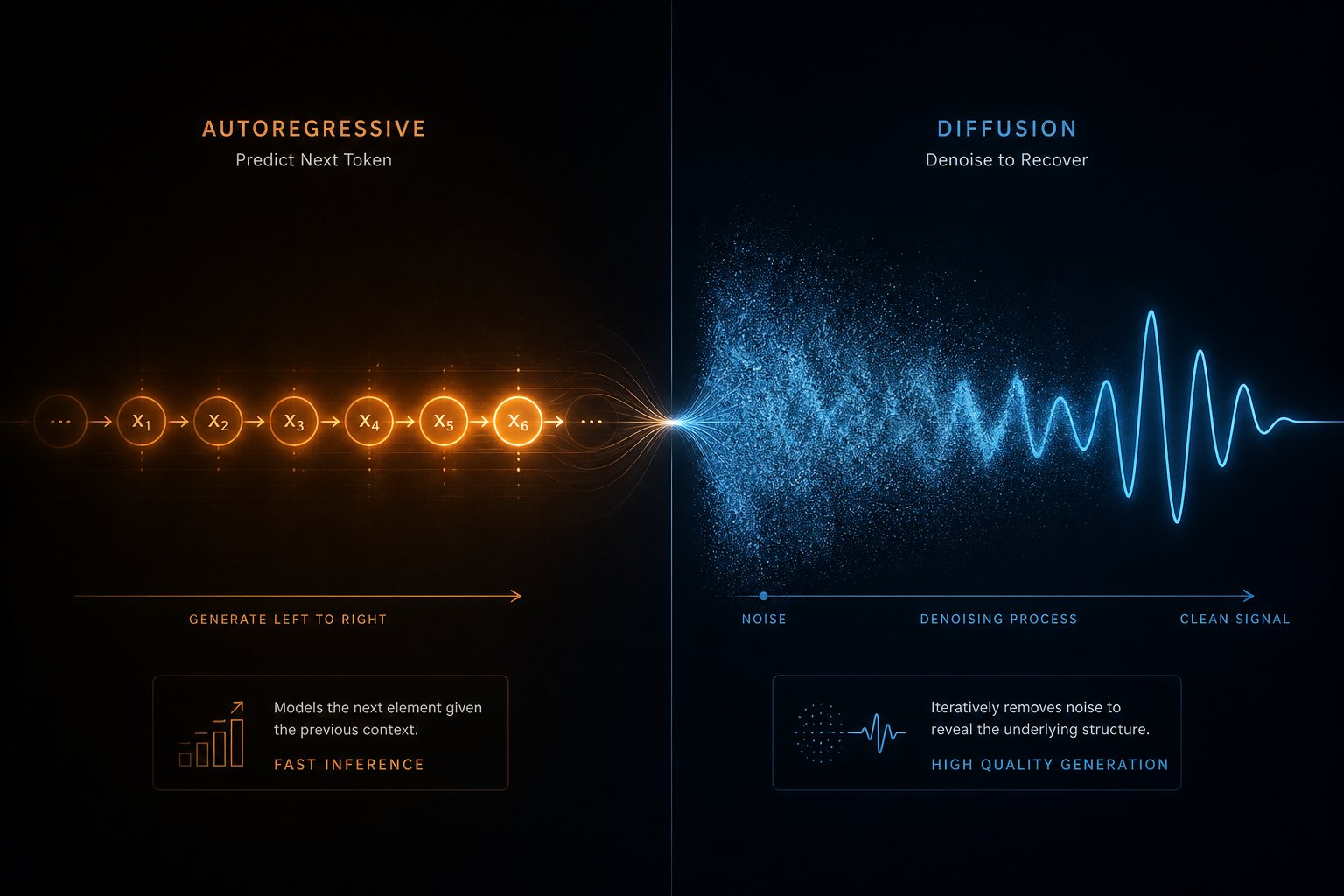
Two fundamentally different philosophies drive how modern systems generate music. One predicts the future one token at a time. The other starts with noise and sculpts it into coherent sound. Each comes with real strengths and real tradeoffs — and understanding the distinction between transformer vs diffusion model music generation clarifies why different tools produce noticeably different results.
Before either approach dominated, earlier generative architectures laid the groundwork. Generative Adversarial Networks (GANs) pitted a generator against a discriminator — one creating fake audio, the other trying to detect it — pushing quality upward through competition. Variational Autoencoders (VAEs) learned to compress audio into smooth latent spaces from which new samples could be drawn. Both proved that neural networks could synthesize convincing audio, but they struggled with the temporal complexity of full songs. GANs were prone to mode collapse (generating limited variety), and standard VAEs produced outputs that sounded blurry or washed out. They opened the door, but transformers and diffusion models walked through it.
Transformer-Based Music Generation
Autoregressive AI music models work by predicting the next audio token given everything that came before — the same sequential logic that powers large language models. The generation is left-to-right: each new token is conditioned on the text prompt and the full history of previously generated tokens.
Meta's MusicGen exemplifies this approach as a single-stage autoregressive transformer decoder. Its key innovation is an efficient token interleaving pattern that introduces calculated delays between codebook predictions, allowing the model to effectively handle multiple codebook streams in parallel within a single pass. This reduces the autoregressive steps needed to roughly 50 per second of audio, making generation fast without cascading multiple models. For conditioning, MusicGen uses a frozen T5 text encoder to produce semantic embeddings and supports optional melody guidance via chromagram extraction from reference audio.
Google's MusicLM takes a different autoregressive path — a hierarchical, multi-stage approach. It generates music through three distinct token levels: MuLan audio-text tokens (12 per second) for textual fidelity, w2v-BERT semantic tokens (25 per second) for long-term coherence, and SoundStream acoustic tokens (600 per second) for fine-grained detail. Each stage feeds the next. The richness of this multi-level representation enables strong semantic control but introduces complexity and potential error propagation between stages.
Both systems share a core principle: the transformer's attention mechanism allows them to reference musical ideas established earlier in the sequence, maintaining thematic consistency over extended passages. The difference lies in whether that generation happens in one pass (MusicGen) or cascades through specialized stages (MusicLM).
Diffusion Models Applied to Audio
Diffusion models for audio generation approach the problem from the opposite direction. Instead of building a song token by token, they begin with a latent representation filled with random Gaussian noise and progressively remove that noise through dozens or hundreds of learned denoising steps, guided at every step by the text conditioning signal.
Stable Audio from Stability AI is the clearest example. Its architecture has three components working together: a fully convolutional VAE that compresses stereo audio at 44.1 kHz into compact latent vectors, a pre-trained CLAP text encoder that produces semantic embeddings from prompts, and a 907M-parameter diffusion model that performs the actual generation in latent space. Because the diffusion process operates on compressed representations rather than raw audio, inference becomes tractable — the system can render 95 seconds of stereo audio in under a second on high-end hardware.
What makes Stable Audio particularly notable is its timing conditioning. During training, the model learns not just what music sounds like, but where in a track a given segment belongs. By encoding a "seconds_start" and "seconds_total" value alongside the text prompt, the system gains control over output duration and avoids generating arbitrary mid-phrase fragments — a common issue with fixed-length audio diffusion models.
The conditioning stack in diffusion models feeds into the denoising network through cross-attention layers, similar to how text-to-image diffusion works. At each denoising step, the model consults the text embedding, timing signals, and its current estimate of the clean latent to decide how to refine the output further.
How Named Models Differ in Approach
The table below maps the landscape of current architectures, showing how each system generates music and where its strengths and limitations lie:
| Architecture Type | How It Generates | Strengths | Limitations |
|---|---|---|---|
| Single-stage autoregressive (MusicGen) | Predicts next audio token sequentially using efficient codebook interleaving | Fast generation; single-model simplicity; strong melody conditioning | Errors can compound over long sequences; quality tied to codec fidelity |
| Hierarchical autoregressive (MusicLM) | Cascades through semantic, acoustic, and waveform stages | Rich semantic understanding; detailed multi-level representation | Complex pipeline; error propagation between stages; higher latency |
| Latent diffusion (Stable Audio) | Iteratively denoises random latent vectors conditioned on text and timing | High-fidelity stereo output; variable-length generation; consistent quality | Computationally intensive; less precise structural control than autoregressive |
| Hybrid (inferred for systems like Suno) | Combines transformer planning with diffusion-based audio synthesis | Can handle lyrics, structure, and vocals in a unified system | Proprietary; architectural details unconfirmed; legal concerns around training data |
Conditioning mechanisms differ across these architectures, but they converge on a shared goal: translating human-understandable inputs into mathematical signals the model can use. Text prompts pass through frozen language models (T5 for MusicGen and MusicLM, CLAP for Stable Audio) to produce dense embeddings. Melody inputs get converted to chromagrams or quantized pitch contours. Genre tags and tempo values may be encoded as additional embedding tokens concatenated with the prompt representation. In every case, these conditioning signals inject into the generation process through cross-attention — the model attends to the encoded prompt at each generation step, ensuring the output stays aligned with what was requested.
The architectural simplification trend is worth noting. The open-source community has gravitated toward simpler, single-stage designs over complex cascaded systems. MusicGen's single-pass approach and Stable Audio's direct latent diffusion are both more accessible and extensible than MusicLM's three-level hierarchy. This matters because accessibility drives iteration speed — and iteration speed drives progress.
Still, architecture alone doesn't explain everything about how a model performs. Even the most elegant architecture must contend with the hardest challenge in music generation: maintaining coherence and musical logic not just within a single phrase, but across the full length of a song.
How AI Maintains Song Structure and Coherence Over Time
An image exists in a single frozen instant. A song unfolds over three minutes, and every second must connect logically to the one before it and the one after. This is why temporal coherence in AI generated music is arguably the hardest remaining challenge — and the reason many AI-produced tracks still feel like they wander rather than arrive somewhere.
Why Temporal Coherence Is Hard for AI
When you listen to a human-composed song, you expect certain things without thinking about them: the chorus returns in the same key, the drum pattern stays consistent, a melodic hook introduced early reappears later to provide satisfaction. These aren't random — they're structural commitments that span the entire duration of a track.
For a model generating audio token by token, maintaining those commitments is expensive. Transformer attention lets the model look back at earlier tokens, but attention cost grows quadratically with sequence length. A 3-minute song at 50 tokens per second produces 9,000 tokens — and asking the model to meaningfully attend to token 200 while generating token 8,500 is a real computational stretch. The result? Models tend to maintain local coherence (the current 10-second passage sounds fine) while losing global coherence (the piece as a whole lacks direction).
This is fundamentally why AI music loses coherence over time. The model has no built-in concept of "I'm in a verse" or "the chorus should return here." It only knows probability distributions over the next token. Any structural awareness must emerge implicitly from training data — or be explicitly engineered into the architecture.
How Models Build Verses, Choruses, and Bridges
The most promising solution is hierarchical generation: plan the big picture first, then fill in the details. Research presented at ICLR 2024 demonstrates this approach using a cascaded diffusion model that operates across multiple levels of musical hierarchy. The high-level language captures whole-song form — where verse and chorus sections begin and end, phrase boundaries, and cadence patterns. Lower levels handle the actual notes, chords, and local rhythmic patterns. Each level conditions on the levels above it, ensuring detail stays aligned with structure.
This mirrors how human composers work. You sketch the form (intro-verse-chorus-verse-chorus-bridge-chorus-outro), decide on harmonic movement at the phrase level, then write the specific melodies and rhythms that live inside that skeleton. The hierarchical model makes this process explicit — and the results show recognizable verse-chorus structure with appropriate cadences, something flat single-level models struggle to achieve.
Attention mechanisms offer a complementary strategy. In single-stage transformers, extended context windows and relative positional encodings help the model understand distance relationships between tokens. Some systems use a technique called summary tokens or memory tokens — compressed representations of earlier passages that remain accessible without full token-by-token attention. This lets the model "remember" a hook from 90 seconds ago without paying the full computational cost of attending to every intervening token.
Repetition, often undervalued, is actually critical for listener satisfaction. Human music relies heavily on it — the return of a chorus, the recurrence of a riff. Models that generate purely novel content at every moment sound restless and unfamiliar. Successful AI music systems learn when to repeat and when to vary, a balance that requires structural awareness beyond what simple next-token prediction provides.
Despite these advances, coherence challenges persist. Here are the most common issues and how current systems attempt to address them:
- Key drift — the tonal center shifts unintentionally mid-song. Hierarchical models mitigate this by locking harmonic plans at a high level before generating notes.
- Rhythmic inconsistency — tempo or groove subtly changes between sections. Explicit tempo conditioning and beat-aligned token grids help maintain steady pulse.
- Excessive repetition or none at all — some models loop endlessly while others never revisit ideas. Section-level planning with explicit repeat markers addresses both extremes.
- Unnatural transitions — abrupt jumps between verse and chorus without proper fills or builds. Training on segment-labeled data helps models learn transitional patterns, though this remains an area of active research.
- Spectral artifacts at section boundaries — research on deconvolution in neural codecs shows that architecture-dependent frequency peaks can introduce subtle hissing or tonal anomalies, particularly audible during quiet transitions between sections.
The gap between local quality and global structure is narrowing, but it hasn't closed. Short clips — 15 to 30 seconds — often sound polished and convincing. Full-length tracks still sometimes reveal their machine origins through aimless passages or transitions that feel arbitrary. This is the frontier where AI music verse chorus bridge generation continues to improve, driven by better structural conditioning and larger context windows.
Architecture and coherence define what a model can generate. But equally important is what it learned from — the training data that shaped its understanding of music in the first place, along with the ethical questions that dataset choices inevitably raise.

What Data Is AI Music Trained On and Why It Matters
A model's architecture determines how it generates music. Its training data determines what music it can generate. No amount of clever engineering compensates for a dataset that's too narrow, too noisy, or too ethically compromised. The data pipeline behind AI music generation is less glamorous than the neural networks it feeds — but it's equally important, and far less discussed.
The Training Data Pipeline
Imagine you're teaching someone to compose by exposing them to every genre, era, and instrumentation style you can find. That's essentially what happens during training — except the "student" is a neural network, and the "listening" is a multi-stage preprocessing pipeline that converts raw recordings into structured, machine-readable representations.
Here's how training data flows from raw audio to model-ready format:
- Collection — Audio is gathered from licensed music catalogs, public domain archives, or contributed datasets. The scale varies enormously: some research models use tens of thousands of clips, while commercial systems may train on hundreds of thousands of hours.
- Preprocessing — Raw audio files get standardized: resampled to a consistent rate (commonly 16–48 kHz), converted to mono or stereo as needed, and normalized in loudness. Corrupted files, silence, and non-musical noise are filtered out.
- Segmentation — Full-length songs are cut into shorter clips, typically 10–30 seconds. This makes training tractable and exposes the model to thousands of varied musical passages rather than fewer long-form examples.
- Tokenization — Segments pass through a neural audio codec (like EnCodec or SoundStream) to produce discrete token sequences, or they're converted to mel-spectrograms for diffusion-based systems. This is where continuous audio becomes a format the model can learn from.
- Metadata pairing — Each audio segment gets paired with descriptive text: genre tags, mood labels, instrumentation lists, tempo markers, and natural language captions. This text-audio pairing is what teaches the model to respond to prompts later.
The metadata pairing step is particularly critical. A model can only follow a prompt like "upbeat funk guitar with slap bass" if its training data contained funk guitar clips labeled with descriptions that mention those exact characteristics. Weak or inconsistent labeling produces a model that ignores or misinterprets user prompts.
Two publicly documented datasets illustrate the range of what research models use. Google's MusicCaps contains roughly 5,500 music clips, each with expert-written natural language captions — small in scale but high in annotation quality, making it a common evaluation benchmark and a training source for models like Mustango. The Free Music Archive (FMA) takes the opposite approach: over 106,000 tracks spanning 161 genres with rich metadata, used as documented training data for systems like AudioLDM2 and Stable Audio Open. Research confirms that both datasets serve as verified components of these models' training corpora, with FMA contributing to both autoencoder and diffusion transformer training stages.
Copyright and Licensing Considerations
Where does all this audio come from — and did anyone ask permission? This is the question that dominates AI music copyright and licensing discussions, and there's no single clean answer.
Early models, particularly those developed between 2022 and 2024, often trained on massive audio scraped from the internet without explicit licensing. The legal landscape has shifted significantly since then. A UCL roundtable on music, generative AI, and copyright brought together stakeholders from across the music industry, technology, academia, and government. Participants noted a culture shift: while the music industry once shut down services like Napster outright, the response to AI training has been more measured — resistance on one hand, and licensing deal negotiations on the other.
The legal situation varies by jurisdiction. In the United States, AI companies often argue that training on copyrighted material constitutes fair use. But this defense faces growing skepticism: generative tools increasingly substitute for musicians (weighing against fair use under the fourth factor), and every licensing deal a company signs makes it harder to argue that an exception should apply. In the EU, the AI Act's Recital 106 states that EU copyright law should be respected regardless of where training occurs — though as a recital rather than binding law, its enforceability remains untested.
Different companies approach this differently. Some open-source research models publish their training data composition transparently — Stable Audio Open documents its use of FMA and other licensed sources. Proprietary systems like Suno and Udio remain opaque about their training corpora, with some claiming trade-secret protection. The roundtable noted that courts have historically made presumptions against parties that refuse to disclose relevant information, a precedent that could matter in future litigation.
Musicians themselves, according to the same roundtable, tend to be less concerned about whether their work is used for training and more focused on whether remuneration and attribution flow back to them. Session musicians face particular vulnerability — they're often excluded from licensing negotiations entirely, even when their performances form part of training datasets.
How Training Data Shapes Output Quality
A model can only generate what its training data taught it to understand. If the dataset contains no jazz saxophone, the model cannot produce convincing jazz saxophone — no matter how sophisticated its architecture.
This relationship between training data and output quality plays out across several dimensions. Dataset diversity determines stylistic range: a model trained primarily on Western pop music will struggle with microtonal Arabic maqam or the complex polyrhythms of West African percussion. Dataset size affects fidelity — larger datasets expose the model to more variation in recording quality, instrumentation, and production techniques, generally producing more natural-sounding output. And annotation quality directly impacts controllability: vague or inconsistent labels mean the model can't reliably distinguish between user requests for "ambient" versus "drone" versus "atmospheric."
Consider what happens when training data is unbalanced. If 60% of a dataset is pop and rock, the model develops strong priors for 4/4 time signatures, verse-chorus structures, and guitar-bass-drums instrumentation. Ask it for a Baroque harpsichord fugue and it may produce something that vaguely gestures at classical music while retaining pop-like phrasing and dynamics. The training distribution becomes the model's musical worldview — its biases, its strengths, and its blind spots all trace back to what data it consumed.
This is why how training data affects AI music quality isn't just a technical footnote. It's the single biggest determinant of whether a model can serve diverse creative needs or only reproduces a narrow slice of musical culture. And it raises a deeper question: when a model produces something that sounds strikingly like an existing artist's style, is that because it memorized specific tracks, or because it genuinely learned generalizable patterns? The answer — which separates copying from creation — is more nuanced than most people assume.
AI Music Generation Misconceptions Debunked
A model that learned from millions of songs. Outputs that sound eerily like real recordings. It's no surprise that forums and Reddit threads overflow with suspicion and confusion about what these systems actually do. Some claims overstate AI's capabilities, others understate them, and a few are just flatly wrong. Here's what the technical reality looks like behind the most persistent myths.
| Common Myth | Technical Reality |
|---|---|
| AI copies or remixes existing songs from its training data | Models generate new audio by sampling from learned probability distributions in latent space — no stored recordings are retrieved or spliced together |
| AI understands music theory and composes intentionally | Models learn statistical correlations between audio patterns without any conceptual grasp of harmony, counterpoint, or form |
| Every AI output is guaranteed to be fully original | Incidental similarity to existing works is possible, especially with common chord progressions or narrow training distributions |
| AI will fully replace human musicians | Research shows AI-assisted music is judged less creative; human intentionality, emotional direction, and cultural context remain irreplaceable |
Does AI Just Copy Existing Songs
This is the most common accusation — and it reflects a misunderstanding of how generation differs from retrieval. When a model produces audio, it isn't searching a hidden database and stitching clips together. It's predicting the next token in a sequence based on statistical patterns it absorbed during training. As Zinstrel's technical explainer puts it: the system learns "musical probability" — which chord movements feel resolved, which rhythms suggest energy or calm — stored as statistical tendencies, not as stored songs.
A helpful analogy: you've read thousands of English sentences in your life, but when you write a new one, you aren't copying any specific sentence you've seen. You're drawing on internalized grammatical and stylistic patterns. AI music generation works the same way at a mathematical level. The model operates in a compressed latent space where individual training examples don't exist as retrievable entities. Generation samples from that space to produce something new.
That said, accidental similarity can occur. When training data is too narrow or prompts are extremely specific, outputs may land close to recognizable melodies — particularly with ubiquitous patterns like the I-V-vi-IV chord progression that underpins countless pop songs. Modern systems introduce randomness, similarity checks, and constraints to push outputs away from recognizable content, but the probability of incidental resemblance is never zero.
Does AI Understand Music Theory
No. Not in any meaningful sense of the word "understand." This distinction matters more than it might seem.
AI models learn that certain note sequences tend to follow others. They learn that a dominant chord is statistically likely to resolve to a tonic. They learn that choruses often repeat. But they have no concept of why these patterns exist — no awareness of tension and resolution as emotional experiences, no grasp of counterpoint as an intellectual discipline. As music AI researcher Jinhee Han notes, AI "statistically predicts patterns based on data, rather than composing from an emotional or conceptual standpoint."
You'll notice this distinction when you push a model outside common patterns. Ask for a Baroque fugue with proper voice leading and you'll likely get something that vaguely resembles counterpoint — the surface statistics are there — but violates specific rules that any trained composer would catch. The model doesn't know it's breaking rules because it never learned rules. It learned frequencies of occurrence.
Can AI Fully Replace Human Musicians
Research from Carnegie Mellon University directly tested this question. Their interdisciplinary study found that AI-assisted music was slower to produce, used fewer notes, and was judged by listeners as less creative than human compositions. The finding aligns with what CMU's Rich Randall observed: "It's always going to be derivative in some way, it's always going to be playing it safe. Humans are not constrained by that."
The deeper issue isn't capability — it's intentionality. A human songwriter chooses to place a silence before a final chorus for dramatic effect. A human producer decides to leave a vocal slightly off-grid to preserve emotional rawness. These are deliberate artistic decisions rooted in lived experience, cultural context, and communicative intent. AI has none of that. As CMU's Chris Donahue put it: "It's still human intentionality driving those systems that is going to continue to be the focus of the foreground of the human music experience."
AI music tools are powerful instruments — genuinely useful for ideation, rapid prototyping, and lowering barriers to musical creation. But framing them as replacements for human musicians confuses the tool with the craftsperson. The more interesting question isn't whether AI can replace musicians, but how musicians can use AI as a creative partner — which starts with understanding what kinds of input these systems actually accept and how to work with them effectively.
Getting Started With AI Music Creation
Knowing how AI generates music is one thing. Actually making something with it is where the real learning happens. The good news: you don't need a background in machine learning, audio engineering, or even music theory. You need an idea, a text box, and a willingness to iterate. The technology discussed throughout this article — transformers, diffusion models, neural codecs — all collapses into a simple interaction from your side: you describe what you want, and the system delivers audio.
But not every tool accepts the same kind of input, and how you frame your creative intent directly shapes what comes back. Understanding the different input modalities — and which one fits your workflow — is the first practical step toward AI music creation for beginners.
Types of AI Music Generation by Input
AI music tools differ most visibly in what they ask you to provide. Each input type activates different parts of the generation pipeline and produces different kinds of output:
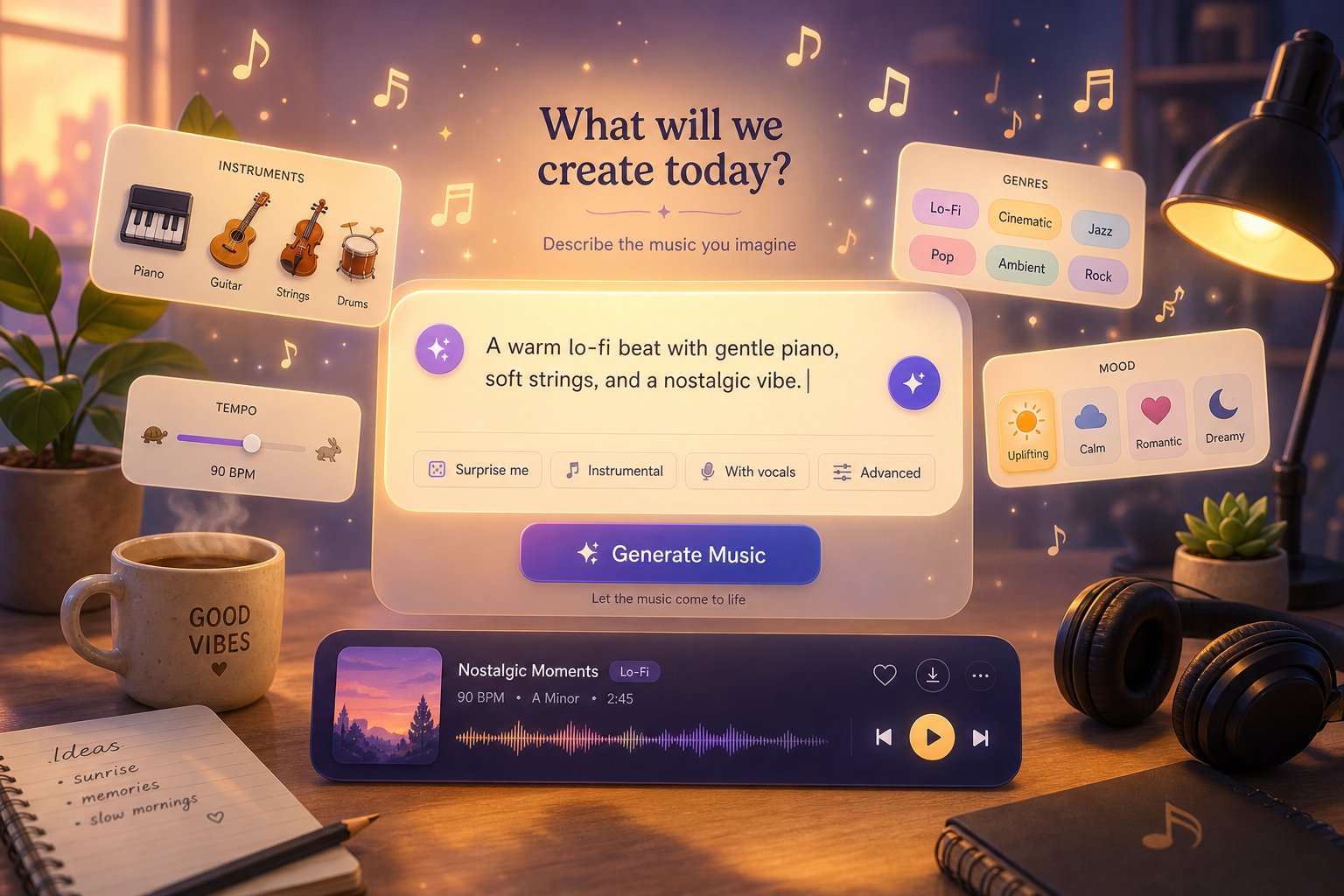
- Text-to-music — You write a descriptive prompt (genre, mood, instrumentation, tempo) and the model generates a complete instrumental or vocal track. The text encoder converts your words into conditioning vectors that guide every step of generation. This is the most accessible entry point and the one most platforms default to.
- Lyrics-to-song — You supply written lyrics alongside style cues, and the system produces a full vocal track with melody, phrasing, and arrangement built around your words. The model must handle not only musical generation but also text-to-speech alignment, vocal melody creation, and syllable-rhythm matching — a significantly more complex task than pure instrumental generation.
- Melody-to-arrangement — You hum, whistle, or upload a melodic reference, and the system builds instrumentation, harmony, and production around it. Technically, the input audio gets converted to a chromagram or pitch contour that conditions the generation model, preserving your melodic idea while letting the AI handle everything else.
- Style transfer — You provide a reference track and ask the model to generate new music in a similar style, often with specific modifications ("make it faster," "add strings," "change to minor key"). The reference gets encoded into the same latent space as training data, and the model generates new content that occupies a nearby region of that space.
The distinction between text to music vs lyrics to song AI is worth emphasizing. Text-to-music prompts describe the sound you want — the vibe, production quality, and instrumentation. Lyrics-to-song inputs additionally require the system to create singable melodies that fit your specific words, handle breath patterns, and align syllable stress with rhythmic emphasis. The latter demands more from the model and gives you more ownership over the final product since the words are yours.
How to Write Effective Prompts for AI Music
Your prompt is your creative direction. The more specific and structured it is, the more control you have over the output. Vague prompts like "make a cool song" force the model to guess — and it will default to the most generic patterns in its training data.
Here's what the best prompts for AI music generators tend to include:
- Genre and era — "90s trip-hop," "modern cinematic orchestral," "2010s bedroom pop." This anchors the tonal and rhythmic foundation.
- Instrumentation — Name specific instruments: "warm Rhodes piano, fingerpicked acoustic guitar, muted trumpet." This gives the model concrete targets rather than abstract concepts.
- Mood and emotion — "Melancholic but hopeful," "tense and building," "playful and light." Emotional descriptors shape dynamics and harmonic choices.
- Tempo and energy — "Slow burn at 72 BPM," "driving four-on-the-floor energy," "mid-tempo groove." This controls pacing.
- Production qualities — "Lo-fi cassette warmth," "clean studio production," "spacious reverb like a cathedral recording." These cues influence the timbral and spatial characteristics of the output.
- Structure cues — "Start quiet, build to a powerful chorus, end with a stripped-back outro." Giving the model a structural roadmap helps avoid flat, unchanging energy.
A concrete example that uses most of these elements: "Cinematic ambient electronic, 90 BPM, pulsing synth bass, ethereal female vocal textures, shimmering pads, melancholic and vast, slow build from minimal intro to layered climax, spacious production with long reverb tails." Compare that to "ambient electronic music" — the first prompt gives the model a tight probability space to work within, producing targeted results.
One critical mindset shift: your first generation is a draft, not a final product. Generate three to five versions from the same prompt, listen to each, identify what works — maybe the melody in version two is strong but the production in version four is better — then refine your prompt and generate another batch. Two or three rounds of this produces genuinely strong results. Writing your own lyrics, even rough ones, immediately makes the output feel more intentional and personal compared to relying on auto-generated words.
Turning Your Ideas Into Complete Songs
Ready to move from theory to practice? Here are recommended approaches for how to make AI generated songs from lyrics and prompts, organized by workflow:
- MakeBestMusic's AI Music Generator — A strong starting point for prompt-and-lyrics-based generation. You supply text prompts, your own lyrics, and style ideas, and the platform delivers complete songs. It directly maps to the input-type taxonomy above: text descriptions handle the musical direction, lyrics shape the vocal content, and style cues refine the production. This makes it a practical way to experience the full pipeline — from conditioning to finished audio — in a single interface.
- Iterative prompt refinement — Start with a broad prompt, generate multiple versions, then progressively add specificity based on what you hear. This approach works on any platform and teaches you how the model interprets different descriptors.
- Reference-driven workflows — If you have existing music you love, use platforms that accept reference tracks to guide generation while producing something new. This leverages style transfer conditioning rather than pure text prompts.
- Stem separation and editing — Many generators let you separate outputs into individual layers (vocals, drums, bass, other). This gives post-generation control, letting you adjust the balance, swap sections, or layer AI output with your own recordings.
- DAW integration — For producers comfortable with tools like Ableton or Logic, AI-generated stems serve as starting material you can arrange, process, and build upon — treating the AI as one instrument in a larger creative workflow.
The single biggest lever for quality is iteration. Even experienced users generate multiple versions per prompt. The AI is fast enough to make this painless — use that speed to explore variations rather than judging the first output as final. After 10 or 15 generations, you'll develop a working intuition for how specific words in your prompt translate to specific qualities in the audio.
How to get started with AI music generation comes down to this: pick a platform, write a structured prompt using the elements above, generate a handful of versions, and listen critically. Adjust your language based on what you hear, and iterate. The entire process — from first prompt to a track you're genuinely proud of — can happen in under 20 minutes. The bottleneck is no longer the technology. It's how clearly you communicate what you hear in your head.
