

AI Music Is Nearly Seven Decades Old
How long has AI music been around? The answer surprises most people. AI-composed music dates back to 1957, which means the technology is nearly seven decades old. That year, researchers at the University of Illinois used a five-ton supercomputer called ILLIAC I to generate a full string quartet composition. Long before streaming platforms and generative ai music news today filled our feeds, computers were already writing melodies in university labs.
The Definitive Answer to How Long AI Music Has Existed
The first AI-composed music dates to 1957, when the Illiac Suite was created at the University of Illinois.
That piece, formally titled String Quartet No. 4, was programmed by Lejaren Hiller and Leonard Isaacson. The computer organized algorithmic choices fed to it by Hiller, producing a four-movement composition that was performed by a student quartet on campus. This wasn't a novelty experiment tucked away in a filing cabinet. It was a deliberate, published work that laid the groundwork for everything from David Cope's style-imitating software in the 1980s to the consumer AI music platforms millions of people use right now.
Why Most People Think AI Music Is New
If the technology is this old, why does it feel like it arrived yesterday? The short answer: accessibility. For decades, AI music lived exclusively inside academic institutions and research labs. You needed a room-sized computer, programming expertise, and institutional funding to experiment with it. The average musician or listener had zero contact with these tools.
Then generative AI exploded into the mainstream. ChatGPT launched in late 2022, and suddenly the broader public became aware of what machine learning could do. AI music platforms followed the same wave, putting song generation into anyone's browser. A study by Ditto Music found that nearly 60 percent of surveyed artists now use AI in their music projects. With millions of users creating tracks through these tools, the question of how many ai musicians are there keeps growing harder to pin down.
The result is a perception gap. People see the ai music updates flooding their timelines and assume the whole concept is brand new. In reality, they're witnessing the consumer-facing tip of a research iceberg that stretches back to the Eisenhower administration. The journey from a five-ton mainframe generating simple melodies to a browser tab producing full songs with vocals spans nearly 70 years of quiet, incremental progress, and that story begins with a chemist who saw music as a problem a computer could solve.
The 1950s and 1960s When Computers First Composed Music
A chemist, a five-ton computer, and a string quartet. That's the unlikely combination that launched the breaking history of music and AI. The foundational era of computer-composed music wasn't driven by Silicon Valley startups or tech billionaires. It was born in university basements and telephone company research labs, pushed forward by scientists who believed music could be treated as a set of solvable problems.
The Illiac Suite and the Birth of Algorithmic Composition
Lejaren Hiller wasn't a musician by training. He was a chemist at the University of Illinois who noticed something interesting: the mathematical methods he used to model molecular behavior looked remarkably similar to the rules governing musical composition. Both involved setting constraints, testing combinations, and filtering results. So in the mid-1950s, Hiller and his colleague Leonard Isaacson fed a set of compositional parameters into the ILLIAC I supercomputer to see what would come out the other side.
The result was the Illiac Suite, a four-movement work for string quartet completed by the end of 1956. Each movement corresponded to a different programming experiment, growing in complexity as the piece progressed. The first movement followed relatively simple Renaissance-style counterpoint rules. The second explored four-voice textures. The third pushed into dissonant, chromatic territory. And the fourth used probability methods like the Markov Chain to generate music without relying on historically accepted compositional processes at all.
On August 9, 1956, a student quartet performed the first three movements in the Wedgewood Lounge of the Illini Union. All of the computer's output had been transcribed into traditional sheet music, so the performance itself sounded like any other chamber piece. The difference was authorship. No human had chosen those specific notes.
This was rule-based composition in its purest form. The ILLIAC I didn't learn from existing music or recognize patterns. It followed explicit instructions, generating possibilities and filtering them against coded rules until something musically valid emerged. Think of it less like a student studying thousands of songs, and more like a student following a textbook of strict counterpoint exercises at inhuman speed.
Max Mathews and Bell Labs Digital Synthesis
While Hiller was teaching a computer to compose, another researcher was solving a different problem: teaching a computer to produce sound itself. Max Mathews, an engineer at Bell Telephone Laboratories, began working on digital sound synthesis as early as 1957. His MUSIC I program was the first software that allowed a general-purpose computer to generate audio directly, rather than just printing notes on paper for humans to play.
Mathews iterated rapidly. MUSIC II, MUSIC III, and MUSIC IV followed throughout the late 1950s and 1960s, each version giving composers more control over the building blocks of sound: vibrato, attack, decay, glissando, tremolo, and waveform shapes. His 1960 piece "Numerology" demonstrated these parameters in action, showing that a computer could design entirely new virtual instruments rather than simply imitating acoustic ones.
The implications were enormous. Hiller had proven a computer could decide which notes to play. Mathews proved it could also decide what those notes sounded like. Together, these two breakthroughs defined the full scope of music and artificial intelligence research for decades to come.
Why These Pioneers Turned to Computers for Music
Imagine the music world's reaction. In the late 1950s, rock and roll was reshaping popular culture, jazz was entering its avant-garde era, and here were scientists claiming a machine could participate in the creative act. The reception was mixed, to put it gently.
But the motivation wasn't to replace musicians. Both Hiller and Mathews were driven by curiosity about music theory itself. If you could codify the rules of counterpoint precisely enough for a computer to follow them, what did that reveal about how composition actually works? The computer became a tool for testing ideas about music theory with AI-like precision, not a replacement for human artistry.
Institutional support mattered too. The University of Illinois gave Hiller the freedom to cross disciplinary boundaries, and in 1958 he founded the Experimental Music Studio on campus. Bell Labs, famous for giving researchers room to explore, let Mathews pursue digital synthesis alongside his telecommunications work. Without that institutional patience, these experiments might never have happened.
By the end of the 1960s, Hiller had collaborated with John Cage on HPSCHD, a piece combining harpsichords with computer-generated sound tapes. Mathews had built the foundation that later composers would use for decades of digital audio research. The seeds were planted. What came next was three decades of quiet, methodical progress that almost nobody outside academia noticed.
Three Decades of Quiet Progress From the 1970s to the 1990s
Seeds planted in university basements don't grow overnight. Between the 1960s breakthroughs and the modern explosion of artificial intelligence for music production, three crucial decades passed. During this period, researchers pushed the technology from rigid rule-following machines toward systems that could actually learn from music itself. Most histories skip this era entirely, jumping straight from the Illiac Suite to today's generative platforms. That gap hides some of the most fascinating work in the field.
Rule-Based Systems of the 1970s
Iannis Xenakis, the Greek-French composer and architect, had been applying mathematics to music since the 1950s. But in the mid-1970s, he took a step that connected his stochastic composition philosophy directly to computing. Xenakis began developing the UPIC system (Unite Polyagogique Informatique du CEMAMu), a computer music system that used a drawing surface as an input device. Lines drawn on a CAD-like tablet were transformed into sound through a software interface and digital-to-analog converter.
The first complete UPIC prototype arrived in 1977, running on a Solar 16-40 mini-computer. Xenakis composed Mycenes Alpha (1978) with it, his first work made entirely of computer-generated sounds. What made UPIC distinctive was its flexibility: a single drawn line could function as a wavetable shaping timbre, a control signal driving amplitude or frequency, or even a modulating signal. The same graphic gesture could map to micro-time sound design or macro-time compositional structure.
This was still a rule-based approach, but a more intuitive and interactive one than anything before it. The computer wasn't learning patterns from existing music. Instead, it was translating human gestures into sound through mathematically defined processes. Xenakis even used the system for educational purposes, inviting young people and non-experts to explore acoustics and composition through drawing. The concept of making music creation accessible to non-musicians, something we now associate with modern AI tools, was already taking shape decades earlier.
Meanwhile, David Cope at the University of California, Santa Cruz, was drawn to computers in the 1970s. "Part of me has always been that algorithmic side," Cope later recalled. He studied programming, learned artificial intelligence techniques, and even used an IBM computer with punched cards to compose a short piece of music in 1975. The results, by his own admission, were "an awful piece, just truly dreadful." But the ambition was clear: use computation to understand and replicate the logic behind musical style.
David Cope and Experiments in Musical Intelligence
The real breakthrough came from an unlikely source: writer's block. In the early 1980s, Cope had a commission for an opera but couldn't compose. As a form of productive procrastination, he began building a program that could produce music in his own style, something to "provoke me into composing," as he described it. That program eventually became Experiments in Musical Intelligence, known as EMI or Emmy.
EMI worked by analyzing music entered into its database, identifying patterns and signatures within a composer's body of work, then using those patterns to generate new compositions in the same style. This was fundamentally different from the Illiac Suite's approach. Hiller's program followed hand-coded rules of counterpoint. Cope's system extracted its own rules from data. It was, in essence, a data-driven approach to ai producing music that anticipated how modern systems would work decades later.
Cope started by entering his own compositions to break through his creative block. As EMI generated new pieces, he noticed patterns in his own music he'd never consciously recognized. "I looked for signatures of Cope style. I was hearing suddenly Ligeti and not David Cope," he noted. He then changed his own compositional approach based on what the program revealed.
The opera took eight years from commission to premiere, but the real payoff came when Cope turned EMI loose on the masters. He fed significant portions of Bach, Mozart, Chopin, and other composers into the system, then generated new works in their styles. The results were startling. In a musical Turing test organized by Professor Douglas Hofstadter, pianist Winifred Kerner performed three pieces in the style of Bach: one by EMI, one by a human composer, and one by Bach himself. The audience identified EMI's piece as the real Bach.
"EMI forces us to look at great works of art and wonder where they came from and how deep they really are," Hofstadter reflected. EMI eventually composed thousands of works, including 5,000 Bach chorales and a complete symphony in the style of Mozart, performed at the Santa Cruz Baroque Festival in 1997. This was ai assisted music production at a level nobody had imagined possible from a rule-extraction system.
The 1990s Neural Network Experiments
While Cope refined EMI's data-driven rule extraction, a parallel track was emerging from the artificial neural networks community. The late 1980s and early 1990s saw researchers apply a fundamentally different paradigm: rather than extracting explicit rules from music, they trained networks of artificial neurons to learn implicit patterns directly.
Peter Todd's 1989 experiments were among the earliest attempts. His "Sequential" architecture used a recurrent network with a memory context to generate monophonic melodies iteratively, one note at a time. The system learned pairwise correlations between melody segments and could interpolate between different learned melodies to create new ones. Todd's work introduced concepts, including conditioning inputs and hierarchical generation, that wouldn't fully mature until the deep learning era decades later.
In 1988, J.P. Lewis proposed "creation by refinement," a technique that adjusted random input values through gradient descent until the network classified the result as a well-formed melody. This seemingly simple idea, generating content by optimizing toward a target quality, would later reappear as the foundation for style transfer and generative adversarial approaches in modern AI music systems.
By the mid-1990s, LSTM (Long Short-Term Memory) networks offered a solution to one of the biggest problems in neural music generation: remembering long-term musical structure. Standard recurrent networks forgot earlier notes as sequences grew longer. LSTM architectures, introduced in 1997 by Hochreiter and Schmidhuber, provided a mechanism for selective memory that would eventually become critical for generating musically coherent passages.
Here's the key milestone timeline from these three decades:
- 1975 - David Cope composes his first computer-generated piece using IBM punch cards at UC Santa Cruz
- 1977 - Xenakis completes the first UPIC prototype, enabling graphic-to-sound composition
- 1978 - Mycenes Alpha becomes Xenakis's first fully computer-generated sound work
- 1981-82 - Cope begins building EMI (Experiments in Musical Intelligence)
- 1988 - Lewis introduces creation by refinement for neural network music generation
- 1989 - Todd publishes pioneering recurrent neural network experiments for melody generation
- 1993 - EMI's Bach by Design album becomes one of the first recordings with no human composer or performer
- 1997 - EMI's Mozart-style symphony performed at Santa Cruz Baroque Festival; LSTM architecture published
The technical evolution across these three decades traces a clear arc. The 1970s refined what rule-based systems could do, making them more interactive and intuitive. The 1980s introduced data-driven pattern extraction, where programs could learn what made Bach sound like Bach without being explicitly told. And the 1990s planted the seeds of true machine learning for music, training neural networks to recognize and reproduce musical patterns from raw data rather than human-specified rules.
Each step represented a shift in who did the intellectual heavy lifting. With rule-based systems, the human programmer encoded all musical knowledge by hand. With EMI, the system extracted patterns from examples but still relied on a human-designed extraction framework. With neural networks, the system learned its own internal representations directly from training data. That progression, from hand-coded rules to learned representations, is the exact trajectory that would eventually produce the AI tools capable of generating complete songs from a text prompt.
How AI Music Technology Actually Works
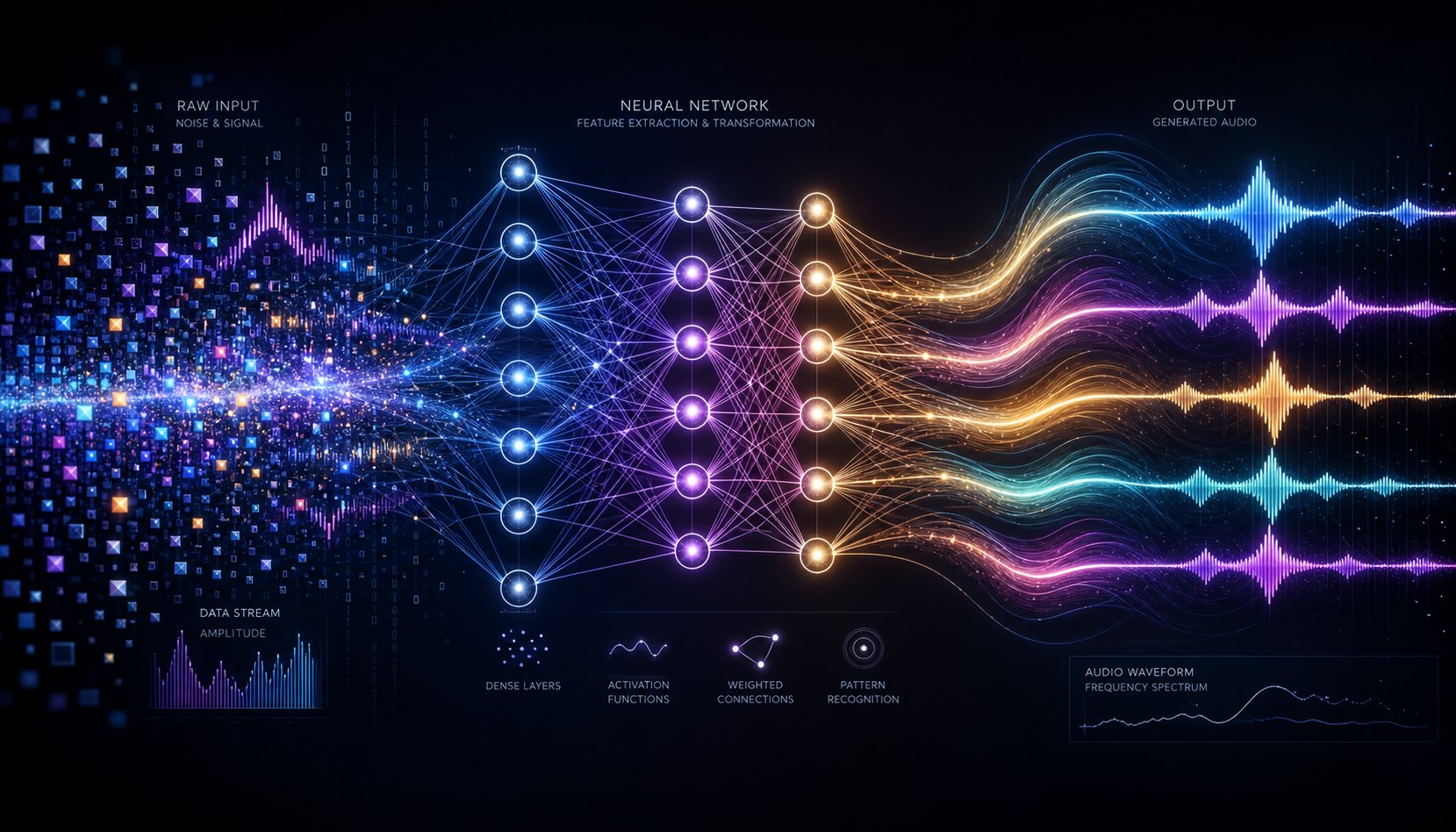
That progression from hand-coded counterpoint rules to neural networks learning their own representations isn't just a historical curiosity. It maps directly onto three distinct technical approaches that power every AI tool used in music production today. Understanding these approaches explains why a system from 1957 could only generate simple melodies on paper, while a system from 2024 can produce a fully mastered pop song with vocals in under a minute.
Rule-Based Systems vs Machine Learning vs Deep Learning
Imagine you want to teach someone to compose music. You have three options. First, you could hand them a textbook of strict rules: "never move in parallel fifths," "resolve the leading tone upward," "end phrases on the tonic." They follow instructions precisely but can't adapt when something falls outside those rules. That's a rule-based system.
Second, you could sit them down with 500 Bach chorales and say, "figure out the patterns." They study the data, notice recurring chord progressions and voice-leading tendencies, then apply those discovered patterns to write new pieces. That's machine learning.
Third, you could give them access to millions of complete recordings across every genre, let them absorb not just notes but timbre, production style, vocal inflection, and song structure all at once, then ask them to generate something entirely new from a verbal description. That's deep learning, and it's what powers the music AI models behind today's consumer platforms.
| Era | Method | Capability | Limitations |
|---|---|---|---|
| 1950s-1980s | Rule-Based Systems | Generate compositions following explicit musical rules coded by hand (counterpoint, harmony, rhythm constraints) | No adaptability; output limited to what programmers anticipate; cannot learn or improve from examples |
| 1980s-2000s | Machine Learning (pattern extraction, Markov chains, early neural nets) | Extract patterns from datasets of existing music; compose in the style of specific composers; recognize statistical regularities | Struggles with long-term structure; limited to symbolic MIDI output; requires careful feature engineering |
| 2010s-present | Deep Learning (transformers, diffusion models) | Generate complete audio including vocals, instrumentation, and mastering from text prompts; learn genre, mood, and production style simultaneously | Requires massive training data and compute; raises copyright questions; can lack emotional nuance and long-form coherence |
Each generation didn't replace the previous one overnight. Rule-based logic still operates inside modern systems as guardrails. Machine learning pattern recognition still informs how training data gets organized. Deep learning simply added the capacity to work with raw audio at scale, rather than symbolic note representations alone.
How Modern AI Generates Complete Songs
Modern AI music generators primarily rely on two architectures: transformer models (similar to GPT for text) and diffusion models (similar to Stable Diffusion for images). Transformer-based systems like Suno and Udio predict audio tokens sequentially, building a song step by step the way a language model builds a sentence word by word. Diffusion-based systems like Stable Audio start with noise and progressively refine it into coherent audio, guided by the text prompt you provide.
The generation process typically works in three stages. You enter a text prompt describing genre, mood, tempo, and instruments, sometimes adding custom lyrics or a reference track. The neural network then creates the song in real time, handling melody, harmony, rhythm, and vocals in a single pass. Finally, you export the finished track as MP3 or WAV, with many tools offering stem separation for post-production in a DAW. The entire process usually takes 30 to 120 seconds.
What makes this feel so different from earlier approaches is completeness. The Illiac Suite produced notes on paper that humans then performed. EMI generated MIDI data that needed a pianist. Today's deep learning systems output finished audio, powered by music training data vast enough to encode production techniques alongside compositional ones.
Training Data and What AI Actually Learns
When you hear that a music AI model was "trained on millions of songs," what does that actually mean? The system doesn't memorize tracks and replay them. Instead, it processes audio converted into numerical representations, spectrograms, mel-frequency features, or tokenized audio codes, and learns statistical relationships between those numbers.
Over millions of examples, the model learns which chord progressions typically follow each other in pop music, how a verse transitions to a chorus, what frequency patterns define a distorted guitar versus a clean piano, and how vocals sit in a mix relative to drums and bass. It builds an internal map of musical possibility without storing any single song verbatim.
An important distinction exists between training sources. Some platforms like SOUNDRAW and Mubert train exclusively on proprietary, in-house recordings, eliminating copyright conflicts entirely. Others like Suno trained on publicly available music, which has sparked ongoing legal debates about fair use and artist compensation. The choice of training data shapes not just the legal standing of a tool but also its sonic range and genre capabilities.
This technical foundation, the gap between following rules and learning from data at scale, is precisely what enabled AI in music production to leap from academic curiosity to mainstream creative tool. The capability jump wasn't gradual. It arrived in a concentrated burst when deep learning matured enough to handle audio generation, and that burst reshaped the entire landscape of who can make music and how.
The Deep Learning Era and Rise of Consumer AI Music
That concentrated burst arrived in stages. First came the research breakthroughs at well-funded labs. Then came the startups translating those breakthroughs into products. And finally, within just a few years, came the platforms that put full song generation into the hands of anyone with a browser tab and an idea.
Deep Learning Breakthroughs That Changed Everything
Google launched its Magenta project in 2016, an open-source research effort specifically focused on using machine learning to create art and music. Magenta gave researchers freely available tools for experimenting with melody generation, accompaniment, and audio synthesis, seeding an ecosystem of academic and independent projects built on top of Google's infrastructure.
OpenAI followed with MuseNet in 2019, a deep neural network capable of generating four-minute compositions with up to ten different instruments. MuseNet worked in the symbolic domain, predicting MIDI-like tokens, but it could blend styles that had never been combined before: Chopin mixed with pop, or Mozart fused with jazz. Then in April 2020, OpenAI released Jukebox, which represented a far more ambitious leap. Jukebox generated raw audio directly, including rudimentary singing, conditioned on genre, artist style, and lyrics. It trained on 1.2 million songs and used hierarchical VQ-VAE compression paired with Sparse Transformers to handle the extreme sequence lengths raw audio demands. A single minute of audio took roughly nine hours to render, making it impractical for real-time use, but the proof of concept was undeniable: AI could produce something that sounded like a complete song, vocals included.
These weren't consumer products. They were research demonstrations. But they showed the entire tech industry what was now technically possible, and venture capital took notice.
The Consumer Platform Explosion
Between 2016 and 2024, a wave of ai music companies translated those research breakthroughs into accessible tools. Each platform carved out a different niche, from background music licensing to full song creation:
- 2016 - AIVA launches, initially focused on composing classical and cinematic scores using deep learning trained on thousands of classical compositions
- 2017 - Amper Music debuts (later acquired by Shutterstock in 2020), offering customizable royalty-free tracks for video creators
- 2019 - Mubert goes live with real-time generative music streams, blending human-produced loops through AI arrangement
- 2020 - Boomy launches, letting users create and distribute songs to streaming platforms with minimal input
- 2020 - SOUNDRAW launches, training exclusively on proprietary recordings to avoid copyright concerns
- July 2023 - Suno launches on Discord, quickly becoming the fastest-growing platform in the space
- April 2024 - Udio launches publicly, founded by former Google DeepMind researchers with backing from a16z
If you've wondered when did Suno AI come out, the answer is mid-2023 on Discord, with its web platform following shortly after. The Suno brand grew explosively from there. Semrush data shows Suno attracting 46.9 million monthly visits within roughly 18 months of launch, making it one of the most-visited creative AI platforms globally. The combined ecosystem of Suno, Udio, and their competitors now serves millions of active users generating songs every day.
From Research Labs to Everyone's Browser
So how many AI musicians are there? The number is difficult to pin down precisely, but the scale is staggering. Boomy alone claimed over 20 million songs created on its platform by 2023. Suno's traffic numbers suggest millions of active monthly creators. Deezer reported that nearly 40 percent of daily uploads to its platform are now fully AI-generated. When you add casual experimenters, professional producers using AI for stems or arrangement ideas, and content creators generating background tracks, the total community easily reaches tens of millions worldwide.
Why does this era feel like a revolution when the foundations stretch back nearly seven decades? The gap between generating a MIDI melody and producing a polished three-minute song with genre-appropriate vocals, instrumentation, mixing, and mastering is enormous. Earlier systems created sketches that needed human performers and engineers to become listenable. Today's platforms deliver finished audio. That shift from "interesting academic output" to "something you'd actually add to a playlist" is what separates Suno and Udio from the Illiac Suite, even though both rely on the same core principle: letting machines make compositional decisions.
The AI music market reached USD 5.2 billion in 2024 and is projected to hit USD 60.4 billion by 2034. Music-tech startups raised over USD 700 million in just the first half of 2025. Suno secured a $250 million Series C round in November 2025. These aren't research grants funding academic curiosity. This is venture-scale capital betting that AI music generation is a permanent, mainstream creative category.
With that much money, that many users, and that much creative output flowing through these platforms, the impact on the existing music industry was inevitable. Established artists, labels, and legal systems all had to respond, and their responses reveal just how deeply AI has already reshaped who makes music and on what terms.
How AI Is Reshaping the Music Industry
Millions of new creators flooding into the market is one thing. But what happens when the artists who already define popular culture start using the same tools? The ai music industry isn't just being reshaped from below by bedroom producers. It's being reshaped from the top, as some of the world's most recognized musicians adopt AI for purposes no one predicted a decade ago.
Famous Musicians Embracing AI Tools
Do artists use AI to write songs? Some do. But the more interesting pattern is how differently each artist applies the technology. Rather than a single use case, famous musicians using AI have scattered across the entire creative spectrum, from restoration to live performance to identity experimentation.
- Paul McCartney used AI-powered source separation technology to isolate John Lennon's vocals from a degraded demo tape buried under piano. The result was "Now And Then," the final Beatles track, completed with Lennon's crystal-clear original performance decades after his death.
- Randy Travis, who lost his singing voice after a 2013 stroke, released "Where That Came From" in 2024 using an AI model trained on his old vocal stems, allowing him to "sing" again with his full consent and creative involvement.
- Grimes launched her own open-source platform, Elf Tech, inviting fans to use AI voice-clones of her vocals for their own songs in exchange for a royalty split. She turned her own identity into a shared creative resource.
- Holly Herndon trained a neural network called "Spawn" on a live vocal choir, then treated it as a full ensemble member on her album PROTO, blending human voices with machine-generated harmonies that respond like a digital bandmate.
- Timbaland moved beyond his controversial 2023 experiments mimicking Notorious B.I.G.'s voice to launch Stage Zero, an AI-focused entertainment company pioneering what he calls "A-Pop" (Artificial Pop), headlined by a fully autonomous AI artist named TaTa.
- YACHT fed their entire back catalog into machine learning algorithms for the album Chain Tripping, then learned and performed the "alien" melodies the system suggested, using AI to push their human creativity into unfamiliar territory.
- Fred again.. uses AI-powered stem separation to extract usable audio from low-quality Instagram and TikTok clips, turning what would otherwise be unusable recordings into the foundation for stadium anthems.
Notice the range. Voice restoration, style exploration, identity sharing, collaborative composition, audio rescue. None of these artists use AI the same way, and none treat it as a replacement for their creative judgment. The technology slots into their existing workflows at whatever point serves their artistic vision.
AI Record Labels and New Business Models
The emergence of the ai record label concept represents something genuinely new in the industry's structure. In 2025, an AI artist named Xania Monet signed a multimillion-dollar record deal, raising immediate questions about what a "record deal" even means when no human performer exists. Meanwhile, Timbaland's Stage Zero operates less like a traditional label and more like an AI production system that generates artists from scratch.
Major labels are responding strategically. Deloitte's analysis of the ai and the music industry landscape identifies a widening gap between what AI can do and what most music companies are actually implementing at scale. Labels are running fragmented AI pilots across creative, marketing, and rights management functions, but few have connected those experiments into a cohesive strategy. The companies that integrate data across departments, using AI to identify under-monetized catalog tracks, match songs to sync opportunities in real time, and predict emerging audience preferences, will likely pull ahead of those stuck in perpetual pilot mode.
New revenue streams are already emerging. Labels are licensing their catalogs as AI training data, negotiating consent frameworks with artists, and using AI to surface decades-old recordings for new audiences who discover them through algorithmic recommendations. A track recorded forty years ago can suddenly find relevance in a social media trend the label's team wouldn't have spotted manually.
The Democratization of Music Creation
Perhaps the most profound shift isn't about famous artists or major labels at all. It's about the collapse of barriers that once kept most people out of music creation entirely. Professional studio sessions cost hundreds per day. High-end equipment demanded thousands in upfront investment. Mixing and mastering required years of technical training to execute properly. AI tools have compressed all of that into a browser window and a monthly subscription.
Independent artists can now generate backing tracks, create vocal harmonies from a single take, master their recordings to commercial standards, and distribute finished songs to streaming platforms without ever booking studio time. The technical expertise barrier that separated amateur and professional creators for decades has thinned dramatically. Talented musicians who couldn't afford studio access can focus on creativity rather than budget constraints.
Does AI replace musicians, then? The historical record says no. From Hiller's Illiac Suite to Cope's EMI to Grimes's Elf Tech, AI has consistently functioned as a tool alongside human creativity rather than a substitute for it. What changes is who gets to participate. The playing field that once required institutional backing, expensive equipment, and years of technical training now accepts anyone with a musical idea and an internet connection.
That democratization, combined with AI-generated content flooding streaming platforms at unprecedented scale, inevitably raises a question the early academic researchers never had to face: who owns what an AI creates, and what happens when that creation sounds suspiciously like someone else's work?
The Legal and Ethical Questions AI Music Raises
When Hiller generated the Illiac Suite in 1957, nobody asked who owned the copyright. It was an academic experiment at a state university, performed once by students, and published as research. David Cope's EMI compositions in the 1990s raised philosophical eyebrows but few legal challenges. The music stayed within academic and experimental circles. Scale was small, stakes were low, and lawyers had bigger problems to worry about.
Commercial AI music generation at the level of millions of songs per day? That changes everything. The ai music legal news cycle has exploded precisely because the technology crossed the threshold from curiosity to industry disruption.
Copyright Questions Around AI-Generated Music
Can you copyright AI music? The short answer in the United States is: not if a human didn't make the key creative decisions. The U.S. Copyright Office released Part 2 of its AI report in January 2025, confirming that outputs of generative AI can only receive copyright protection where a human author has determined "sufficient expressive elements." Writing a text prompt, no matter how detailed or clever, does not qualify as authorship under current guidance.
The practical implication hits hard. If you generate a track entirely through an AI platform, that music may sit in the public domain. Anyone can use it, copy it, or claim it, and you have limited legal recourse to stop them. Suno's own terms of service acknowledge this reality directly, stating the company makes "no representation or warranty" that copyright will vest in any output.
The Copyright Office is issuing its guidance in multiple parts. Part 1 (July 2024) addressed digital replicas of voices and likenesses. Part 2 (January 2025) tackled copyrightability of AI-generated content. Part 3, released in pre-publication form in May 2025, examines whether using copyrighted works to train generative AI models constitutes infringement. Together, these documents are building the legal framework that will govern AI music for years to come.
Major Lawsuits and Their Implications
The theoretical arguments became very real in June 2024, when Universal Music Group, Sony Music, and Warner Music Group filed coordinated lawsuits against both Suno and Udio through the RIAA. The labels alleged that these AI companies copied hundreds of songs from popular musicians to train their systems, creating tools that would "directly compete with, cheapen, and ultimately drown out" human artists. Potential statutory damages reach up to $150,000 per infringed track.
Both companies argued that training on copyrighted recordings qualifies as fair use under U.S. copyright law. Suno openly admitted to using copyrighted music in its training data while defending the practice as legally permissible and necessary for the technology to work.
The ai music lawsuit news has shifted significantly since those initial filings. A settlement pattern is emerging:
- Universal Music Group settled its copyright case with Udio in October 2025
- Warner Music Group settled with Udio in November 2025 and announced plans to jointly launch a new AI song-creation platform in 2026, powered by models trained on licensed and authorized songs
- Suno, which raised $250 million at a $2.45 billion valuation, remains in an active copyright dispute with all three major labels
- In January 2026, Universal Music Group, Concord, and ABKCO filed what has been described as potentially the single largest non-class action copyright case in U.S. history, suing an AI company for over $3 billion over alleged infringement of more than 20,000 songs
The udio ai news around its Warner settlement is particularly revealing. Rather than simply paying damages, the two parties are building a licensed platform together. This signals where the industry may be heading: not blanket opposition to AI music, but insistence that AI companies pay for and properly license the material their models learn from.
Where the Legal Landscape Is Heading
Several forces are converging to shape what comes next. On the regulatory side, the UK government scrapped plans in March 2026 that would have allowed AI companies to train on copyrighted music without explicit permission. Over 10,000 submissions flooded the government consultation, with 95 percent opposing the AI-friendly opt-out approach. Artists including Elton John, Dua Lipa, and members of ABBA campaigned publicly against it. The UK Culture Secretary confirmed that "copyright material cannot be used for AI development and training without permission."
Meanwhile, streaming platforms are responding to the flood. A Deezer and Ipsos survey found that 97 percent of listeners cannot distinguish between AI-generated and human-composed songs. Platforms like Deezer have begun clearly marking AI-generated music, while Spotify removed 75 million tracks flagged as AI-generated spam within a single 12-month period. YouTube updated its policies in mid-2025 to limit the reach and monetization of music without clear human input.
The direction is becoming clearer, even if the destination isn't fully settled. Rights holders want compensation and consent. Governments are siding with creators over unlicensed training. Platforms are distinguishing between human and AI content. And the AI companies themselves are increasingly choosing to negotiate licensed access rather than fight fair-use battles in court.
For anyone creating or using AI-generated music commercially, the key takeaway is this: the legal ground is actively shifting. What's permissible today may not be tomorrow. The suno settlement saga and broader industry negotiations are writing the rulebook in real time. Whether you're a content creator adding background music to videos, an independent artist experimenting with AI tools, or a label executive planning strategy, the choices made in courtrooms and boardrooms over the next year or two will define the boundaries for everyone.
Those boundaries, though, don't have to be barriers. They can also be an invitation. Nearly seven decades of research have brought AI music to a point where anyone can experience the technology firsthand, and understanding the legal landscape actually makes you a smarter, more informed creator when you do.
Experiencing AI Music Creation for Yourself
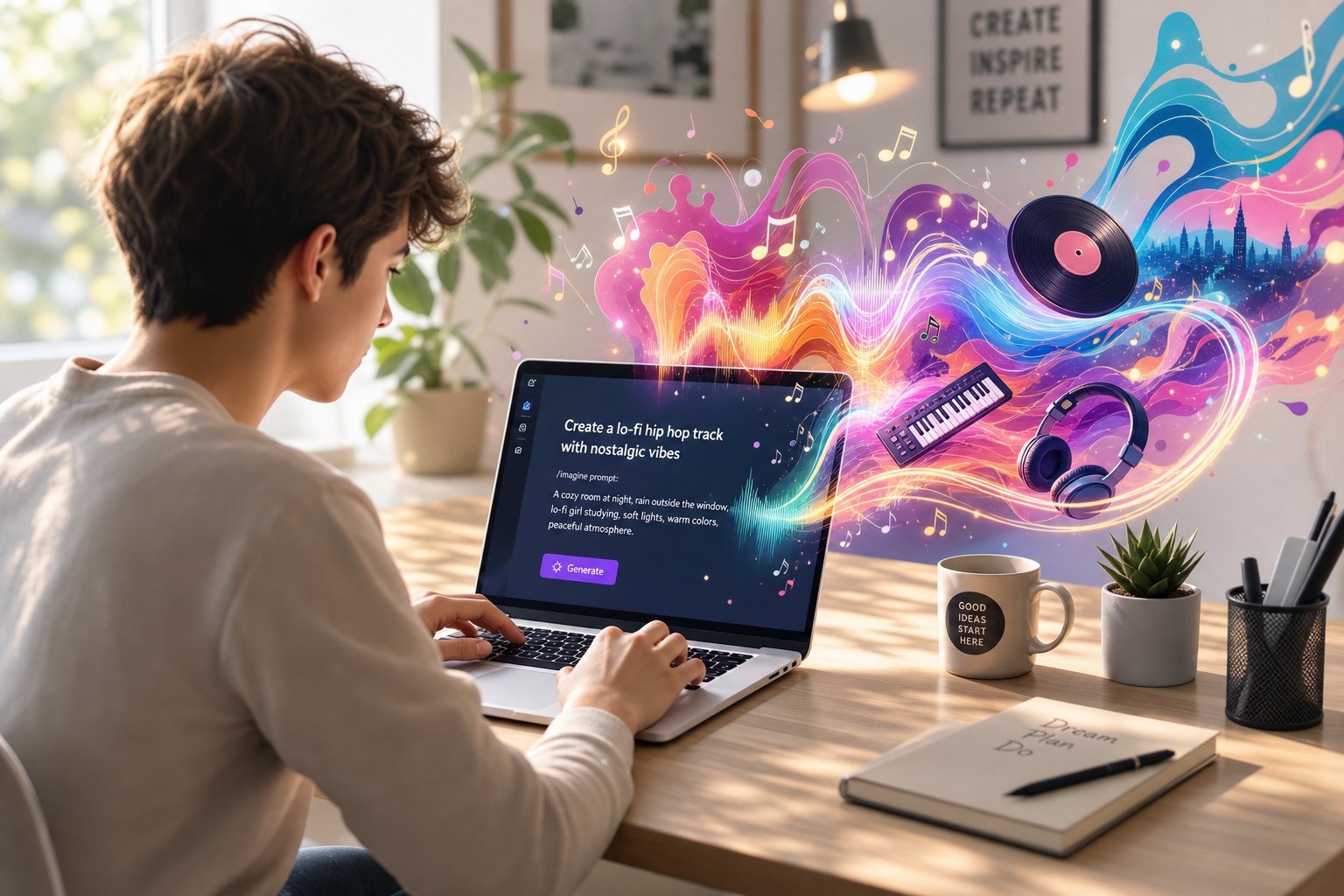
Nearly seven decades separate Hiller's Illiac Suite from the browser tab where you can generate a complete song in under a minute. That arc, from a five-ton mainframe printing sheet music to a text prompt producing mastered audio with vocals, represents one of the longest gestation periods in consumer technology. And yet all of that research converges into a single, remarkably simple action: you describe what you want to hear, and AI handles the rest.
From Seven Decades of Research to Your First AI Song
Every layer of the technology stack covered in this article feeds into what happens when you click "generate." Rule-based music theory ensures chord progressions resolve properly. Pattern extraction techniques inherited from Cope's EMI help the system understand what makes a genre sound like itself. Deep learning transformers and diffusion models handle the actual audio synthesis, turning numerical representations into waveforms your speakers can play. You don't need to understand any of that to use these tools. But knowing the history gives you a clearer sense of what you're working with: not a gimmick, but a technology refined across decades of serious research.
The barrier to entry has essentially vanished. You don't need a room-sized computer, a university affiliation, or programming expertise. You don't need to read sheet music, own instruments, or book studio time. If you can type a sentence describing the mood, genre, and feel you're after, you can produce a track. That's the payoff of 68 years of incremental progress compressed into a single interface.
Choosing the Right AI Music Tool for Your Goals
With dozens of platforms available, the best ai tools for music depend entirely on what you're trying to accomplish. A podcaster who needs a 30-second intro has different requirements than a songwriter sketching melodies or a content creator building a full track for a video. Here are the strongest current options for getting started:
- MakeBestMusic AI Music Generator - A prompt-based tool that lets you turn text descriptions, lyrics, and style ideas into complete AI-generated songs quickly. No technical expertise required. You describe what you want, add optional lyrics, pick a style direction, and receive a finished track. For readers who've followed this article's full journey and want to experience the end result of decades of research firsthand, it's one of the fastest paths from idea to finished song.
- Suno - The highest-traffic AI song generator, strong for complete tracks with vocals across virtually any genre. Free tier available with daily credits.
- Udio - Outputs at 48kHz for the highest audio fidelity among consumer tools. Best for creators who want post-generation editing control and clean mixes.
- Mubert - Focused on royalty-free instrumental backgrounds. Ideal for video producers and podcasters who need commercially cleared tracks without per-song licensing fees.
- Soundraw - Generates instrumental tracks with slider-based customization for tempo, energy, and mood. Trained on proprietary recordings, eliminating copyright concerns entirely.
- Boomy - The simplest entry point for absolute beginners who want to create and distribute songs to streaming platforms with minimal input.
- LALAL.AI - Not a generator but a stem separation tool. Useful for remixing, isolating vocals, or extracting instrumentals from existing recordings to feed into your creative process.
Each platform reflects a different slice of the technology's evolution. Some prioritize compositional depth. Others focus on audio quality or licensing simplicity. The right choice depends on whether you need vocals, how much creative control you want, and whether your output is commercial or personal.
For most first-time users, the fastest way to grasp what AI music can do is to start with a prompt-driven tool like MakeBestMusic or Suno, generate a few tracks across different styles, and listen critically to what comes back. You'll hear the transformer architecture predicting musical tokens, the training data shaping genre conventions, and the production model applying mixing and mastering, all compressed into a single seamless output. Making music video with AI, adding a background to a music performance on AI, producing a full ai artist music project: all of these are now within reach of anyone willing to experiment.
The question that opened this article, how long has AI music been around, has a definitive answer: since 1957. But the more relevant question for most readers is simpler. What can you create with it right now? After 68 years of quiet progress, the answer is: almost anything you can imagine describing.
