

AI-Generated Music Has Reached a Tipping Point
Imagine scrolling through a streaming platform and discovering that nearly half of the new songs added today were never touched by human hands. No vocalist, no guitarist, no producer in a studio at 2 a.m. tweaking the mix. That scenario is not hypothetical. It is the current reality on at least one major platform willing to measure it.
44% of all daily uploads to Deezer are now flagged as fully AI-generated music, amounting to nearly 75,000 synthetic tracks every single day.
That figure, published by Deezer in April 2026, represents the most concrete answer available to a question the entire music industry is asking: how much music is AI generated? The number has exploded from roughly 10% in January 2025 to 28% by September 2025, and now past the 44% mark. Over 2 million AI-generated tracks land on the platform every month.
Meanwhile, a CISAC and PMP Strategy study warns that nearly 25% of creators' revenues could be at risk by 2028, a potential loss reaching 4 billion euros. The generative ai music news cycle keeps accelerating, but reliable data remains scarce because Deezer is the only streamer transparently tracking and reporting these numbers.
The Scale of AI Music on Streaming Platforms
The sheer volume is staggering. Roughly 75,000 AI tracks uploaded daily means that for every human-made song submitted, there is almost one fully synthetic counterpart. This ai music news today affects listeners who unknowingly encounter machine-made tracks, artists whose royalties face dilution, and platforms grappling with catalog management at an unprecedented scale. Deezer's ai tagging system, which identifies and labels synthetic content, remains the only publicly documented detection pipeline of its kind in the streaming world. Other services, including those where ai music on spotify debates continue, have not disclosed comparable figures.
Why This Question Is Harder to Answer Than You Think
Here is where most headlines get it wrong. The question of how much music is AI generated does not have a single answer. It depends on which metric you look at:
- Daily upload rate — 44% of new tracks submitted to Deezer are AI-generated.
- Total catalog percentage — Over 13.4 million AI tracks were detected on Deezer in 2025 alone, but this remains a fraction of any platform's full library of tens of millions of songs.
- Stream share — AI music accounts for only 1-3% of total listening on Deezer, thanks partly to ai tagging and exclusion from recommendations.
These are three very different numbers telling three very different stories. A 44% upload rate does not mean 44% of all music you hear is synthetic. It means the pipeline is flooded, but listener behavior and platform intervention keep consumption low. Understanding this distinction is critical for anyone trying to make sense of the data. This article consolidates every publicly available figure, adds proper context to each, and explains what remains unknown across the broader streaming landscape.
How AI Music Went From Experiment to Explosion
That flood of synthetic tracks did not appear overnight. The path from early curiosity to tens of thousands of daily AI uploads follows a clear arc, driven by a handful of technological breakthroughs and the platforms that made them accessible to anyone with a keyboard.
From Niche Experiments to Mass Production
For years, the intersection of music and artificial intelligence lived in academic labs and experimental art circles. Tools like OpenAI's Jukebox (2020) and Google's MusicLM could generate rough audio clips, but the output was noisy, short, and required technical expertise to operate. The average person had no way in.
That changed rapidly. The shift from niche to mass production hinged on one key innovation: prompt-based creation. Instead of programming parameters or feeding MIDI data into a model, users could simply type "upbeat country song about a road trip" and receive a full track with vocals, instruments, and arrangement in under a minute. Platforms like Boomy pioneered this idea early, but it was the arrival of Suno and Udio in 2023-2024 that truly opened the floodgates. Suno initially launched on Discord in July 2023, then expanded to web and mobile interfaces. The suno desktop app and its mobile counterparts made song creation as simple as sending a text message. Udio, founded by former Google DeepMind researchers, launched publicly in April 2024 with similarly powerful capabilities.
The result was a fundamental change in how technology shapes music creation. Suddenly, non-musicians could produce complete, polished-sounding tracks. Output volumes scaled from hundreds to thousands to tens of thousands of new songs daily. By November 2025, Suno had raised $250 million in Series C funding, signaling just how large the generative audio news cycle had become.
The Moment AI Music Hit the Charts
The tipping point for public awareness came when AI-generated tracks started charting alongside human artists. In November 2025, an AI-driven country act called Breaking Rust placed its song "Walk My Walk" at the top of Billboard's country digital sales chart. Billboard confirmed that at least six AI or AI-assisted artists debuted on various rankings around the same period, making them some of the top ai songs to reach mainstream listeners without anyone initially realizing they were synthetic.
The incident forced a reckoning. As NPR reported, even country music fans who pride themselves on valuing authenticity found the song catchy before learning its origin. The creator behind Breaking Rust remained anonymous, and tracing ownership led only to another AI-generated artist profile. This opacity highlighted a growing tension: the tools had matured enough to produce chart-worthy material, but the industry lacked frameworks for disclosure.
Here is how the trajectory unfolded, milestone by milestone:
- May 2023 — Ghostwriter's "Heart On My Sleeve" goes viral using deepfaked Drake and Weeknd vocals, marking the moment the music industry first takes generative AI seriously.
- July 2023 — Suno launches its first model on Discord, bringing prompt-based song generation to early adopters. The suno desktop app follows as the platform expands access.
- April 2024 — Udio launches publicly with backing from a16z, enabling full song creation at the click of a button.
- June 2024 — Major labels file $500 million copyright infringement lawsuits against Suno and Udio, acknowledging AI music as a serious competitive force.
- September 2024 — First U.S. criminal streaming fraud case filed against a creator who used AI to generate hundreds of thousands of songs for royalty manipulation.
- January 2025 — Deezer publishes the first-ever data on AI upload volumes, initially reporting 10% of daily submissions are fully AI-generated.
- November 2025 — Breaking Rust's "Walk My Walk" tops Billboard's country digital sales chart, proving AI music can compete commercially with human artists.
Each step compressed the gap between what professionals could produce and what anyone with a prompt could generate. The volume problem visible in upload statistics is a direct consequence of this democratization, but the raw numbers alone do not reveal where all that AI music actually ends up or who is listening to it.
The Real Numbers Behind AI Music Generation
Numbers without context mislead. You have probably seen a headline screaming that 44% of music is now AI-generated. Sounds alarming, right? But that statistic describes one very specific measurement. When you look at how listeners actually experience music on streaming platforms, the picture shifts dramatically. To genuinely understand how much music is AI generated, you need to separate three distinct music measures: daily upload rate, total catalog share, and stream share. Each tells a different part of the story.
Daily Upload Rate vs Total Catalog Percentage
Deezer's detection system flags approximately 75,000 tracks per day as fully AI-generated, representing roughly 44% of all new daily uploads. Think of 44 as a fraction: nearly one out of every two songs submitted to the platform each day is synthetic. That is an astonishing inflow rate.
But here is the critical math most articles skip. A platform like Deezer hosts tens of millions of songs accumulated over years of operation. Those 75,000 daily AI tracks add to a catalog where the vast majority of existing content was uploaded before generative tools became mainstream. Even with over 13.4 million AI tracks detected and tagged on Deezer throughout 2025, that total still represents a single-digit percentage of the full catalog. The daily upload rate is not the same as the total library composition.
An analogy helps: imagine a river flowing into a lake. Even if 44% of the water entering today is a new color, the lake itself remains overwhelmingly the original color because it took decades to fill. The same logic applies to streaming catalogs. The flood is real, the proportional impact on the total library is growing, but it has not yet transformed the overall makeup of what is available to listeners.
Spotify processes a similar volume of daily submissions, with various industry sources citing roughly 100,000 new tracks per day across the platform. Deezer's 44% detection rate likely reflects broader patterns across the streaming ecosystem, though no other major service has published comparable data. If the ratio holds, tens of thousands of AI-generated songs are landing on every major platform daily.
Stream Share Tells a Different Story
Here is where the gap between uploads and actual listening becomes stark. Despite AI-generated tracks making up 44% of daily inflows, they account for only 1-3% of total streams on Deezer. That is a massive drop-off. Why?
Two forces keep that number low. First, Deezer removes AI-flagged tracks from algorithmic recommendations and editorial playlists. If a song never surfaces in Discover Weekly or a curated mood playlist, the vast majority of listeners will never encounter it. Second, most AI-uploaded music is not designed to attract organic listeners in the first place. It exists to be streamed by bots, not discovered by humans.
This distinction matters for anyone trying to assess the real impact of ai in the music industry. A casual listener scrolling through recommendations on a platform with active detection will encounter AI music rarely. The problem is not primarily about listener experience on well-managed platforms. It is about what happens to the royalty pool and artist revenues when millions of synthetic tracks compete for payouts.
The Revenue and Fraud Dimension
Streaming platforms operate on a pro-rata model: total subscription revenue is divided among all streams. Every fraudulent stream diverts money from legitimate artists. Deezer found that 85% of the streams generated by AI tracks were fraudulent in 2025, meaning bots rather than real listeners produced the plays. Those streams get demonetized on Deezer, but platforms without similar detection systems may be paying out on them.
The financial exposure is enormous. A CISAC and PMP Strategy study projects that nearly 25% of creators' revenues could be at risk by 2028, potentially amounting to 4 billion euros. As Morgan Hayduk of Beatdapp told WIPO Magazine, every single point of market share in streaming is worth hundreds of millions of dollars. When fraudsters extract even a small slice, the cumulative loss across the ecosystem runs into the billions.
The table below consolidates these different measurement dimensions so you can see at a glance what each number actually represents:
| Measurement | Data Point | What It Actually Means |
|---|---|---|
| Daily upload rate | ~75,000 AI tracks/day (44% of uploads) | Nearly half of new submissions are synthetic, but this reflects inflow, not the total library |
| Monthly volume | 2+ million AI tracks/month | The rate at which AI content accumulates in platform catalogs |
| Total catalog tagged (Deezer, 2025) | 13.4 million AI tracks | A growing but still single-digit percentage of the full multi-million-song catalog |
| Stream share | 1-3% of total plays | What listeners actually hear; kept low by detection and playlist exclusion |
| Fraud rate among AI streams | 85% fraudulent | Most AI music streams come from bots, not real listeners |
| Revenue at risk (industry-wide, by 2028) | Up to €4 billion | Projected cumulative losses to creators from AI-enabled streaming fraud |
So when someone asks how much music is AI generated, the honest answer depends on which layer you examine. The upload pipeline is nearly half synthetic. The catalog is growing with AI content but remains predominantly human-made. And the listening experience, at least on platforms actively fighting fraud, stays in the low single digits. These are not contradictions. They are different measurements of the same phenomenon at different stages of the content lifecycle.
What this data cannot tell you is equally important: where exactly all that AI music concentrates, which genres absorb the most synthetic content, and how platform policies create vastly different exposure levels for listeners depending on which service they use.
Where AI Music Shows Up Most and Why
Not all genres absorb AI-generated content equally. The flood of synthetic tracks clusters heavily in categories where originality matters less to listeners and where functional, mood-driven audio fills a clear demand gap. If you mostly listen to mainstream pop or hip-hop, your exposure to AI music is minimal. If your listening habits lean toward ambient study playlists or lo-fi background beats, the odds shift considerably.
Genres Where AI Music Dominates
AI-generated tracks gravitate toward genres that prioritize atmosphere over distinct artistic identity. These categories share common traits: repetitive structures, minimal vocals, and listeners who treat them as background rather than foreground. Here are the genres and categories most saturated with AI-generated content, ordered by estimated prevalence:
- Lo-fi beats and study music — Simple loops, minimal variation, and high demand for fresh content make this the single largest concentration of AI output on streaming platforms.
- Ambient and meditation soundscapes — Long-form, low-complexity audio that is easy for generative models to produce convincingly.
- Background music for content creators — Royalty-free style tracks designed for YouTube videos, podcasts, and presentations.
- Mood-based playlists — "Chill vibes," "focus flow," and "sleep sounds" categories where track identity is secondary to atmosphere.
- Instrumental jazz and classical variations — Pattern-driven genres where AI can mimic conventions without revealing obvious artifacts.
- Generic pop and EDM filler — Short, formulaic tracks uploaded in bulk by royalty farming operations.
Listeners in these categories may never notice. A Luminate study covered by NPR found that attitudes toward AI music are net negative across all demographics, with the decline especially sharp among Gen Z and Gen Alpha listeners. Yet when people encounter AI tracks passively through mood playlists, many cannot distinguish them from human-made alternatives. The discomfort emerges only when listeners know a song is synthetic, which is precisely why disclosure and detection policies matter so much.
Beyond Streaming Services to Social Media
The ai stream of synthetic audio extends far beyond Spotify and Deezer. Short-form video platforms represent a massive and largely unmeasured channel for AI-generated music. TikTok, Instagram Reels, and YouTube Shorts all rely heavily on backing audio, and creators constantly need fresh, copyright-safe tracks. AI generation solves that problem instantly.
Consider the scale. Creators figuring out how to put your music on instagram or TikTok now compete with AI tools that produce unlimited, royalty-free alternatives in seconds. The tiktok music licensing news 2025 october cycle highlighted growing tensions between platforms, labels, and AI-generated content that sidesteps licensing entirely. YouTube has responded with its own framework. The youtube ai generated content monetization policy 2025 requires creators to disclose AI-generated material in uploads, though enforcement across millions of daily Shorts remains inconsistent.
On these platforms, AI music is not trying to chart or attract fans. It serves a purely utilitarian function: providing a soundtrack for someone else's visual content. That makes it harder to track but no less significant in volume.
Platform-by-Platform Differences
Your exposure to AI-generated music depends heavily on which service you use. Among the largest music streaming services, policies and detection capabilities vary widely:
Deezer actively detects, labels, and demotes AI content from recommendations. Listeners on Deezer encounter the least AI music despite receiving among the highest volumes of it.
Spotify, the most popular music streaming platform by subscriber count, removed tens of thousands of AI-generated tracks from Boomy in 2023 and has implemented anti-fraud measures, but does not publish detection statistics or systematically label AI content for listeners.
Apple Music and Amazon Music remain largely silent on their AI content volumes and detection approaches.
YouTube Music benefits from YouTube's broader disclosure requirements but still lacks a dedicated AI audio detection pipeline comparable to Deezer's system.
This uneven landscape means the same question produces different answers depending on where you listen. A Deezer user browsing curated playlists encounters a carefully filtered experience. A listener on a platform without active detection may be hearing more AI-generated tracks than they realize, particularly in those ambient and lo-fi categories where synthetic content concentrates most heavily.
The gap between platform approaches raises a deeper question: if most AI uploads are not reaching real listeners organically, and most of the streams they do generate are fraudulent, what separates the genuine creative use of AI from the schemes designed purely to extract royalties?
Legitimate Creativity vs Fraudulent Flooding
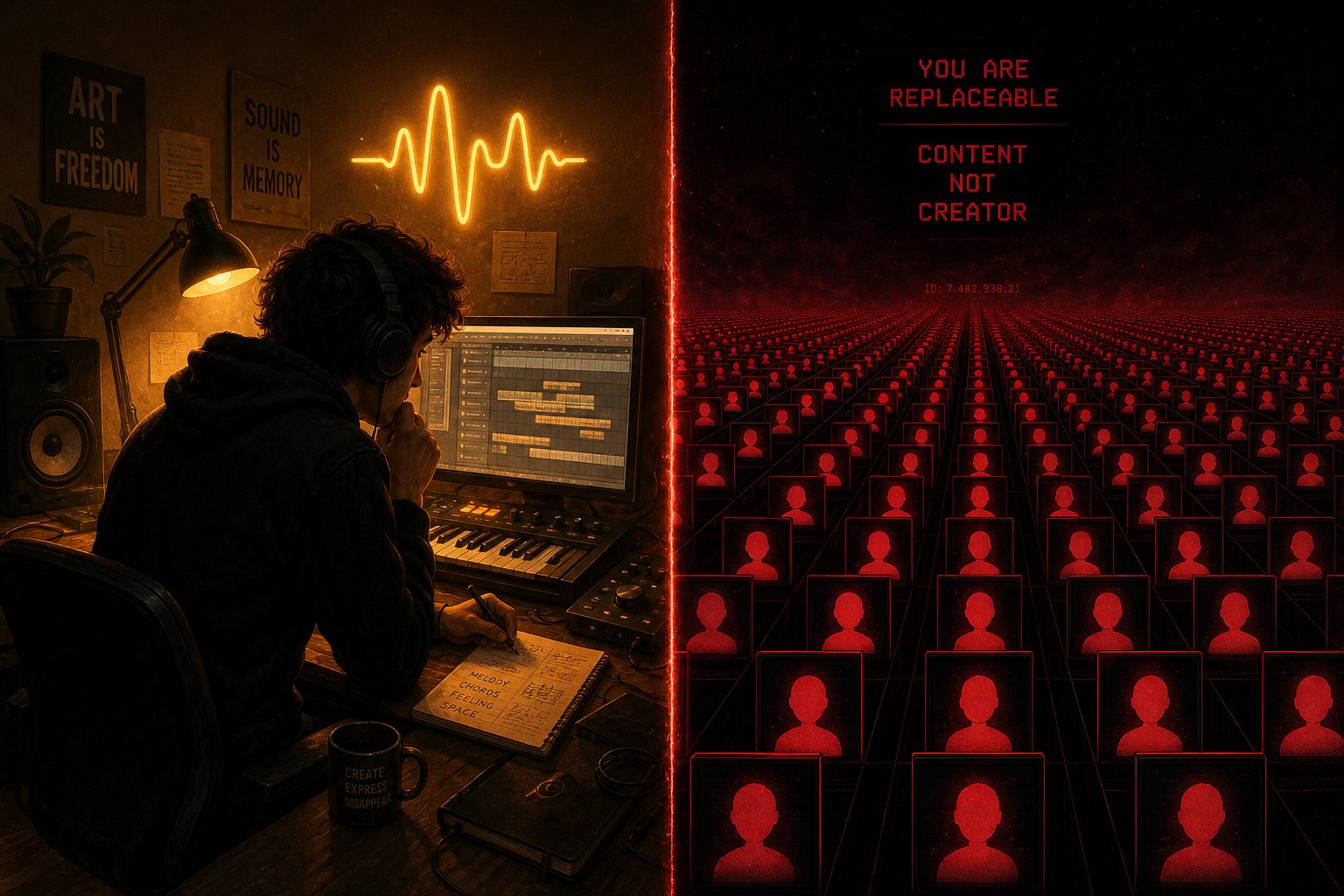
The distinction is simple but overlooked in nearly every ai music rights news headline: not all AI-generated music is the same problem. Some of it is creative experimentation by real people exploring a new tool. The rest is an industrial-scale extraction scheme. When you hear alarming percentages about ai in the music industry, the concern is overwhelmingly about the second category. Conflating them distorts the conversation for everyone involved.
Legitimate AI Music Creation
Picture an independent songwriter who uses generative tools to sketch demo arrangements, test vocal harmonies, or produce backing tracks for a live performance. Or a hobbyist who has always wanted to compose but never learned an instrument. These creators are transparent about their process, often disclosing AI involvement in their credits or artist bios. They upload modestly, engage real listeners, and contribute genuine creative value to the ecosystem.
Legitimate AI music creation shares several characteristics. The creator has artistic intent. There is human direction behind the output, whether through prompt crafting, editing, layering, or curation. The work is disclosed rather than disguised. And the volume is proportional to what a real creative practice looks like: a few tracks per week, not thousands per day. Some industry musicians are embracing these tools openly, treating them as another instrument in their workflow rather than a shortcut to flood catalogs.
The Royalty Farming Problem
The fraudulent side operates on entirely different logic. As Deezer's Thibault Roucou stated directly, "Generating fake streams continues to be the main purpose for uploading AI-generated music." The data backs that claim: 85% of the streams generated by AI tracks on Deezer in 2025 were detected as fraudulent, driven by bots rather than real listeners.
The mechanics are now well documented. Fraudsters use AI generators to produce thousands of tracks, upload them through distributors without any clearing tracks process that would verify human authorship, then deploy bot networks to stream each song a modest number of times. The low per-track volume avoids detection systems tuned for suspicious spikes. At scale, even a few thousand streams per track across tens of thousands of songs generates substantial royalty payouts. Michael Smith's case proved exactly how lucrative this can be: he allegedly extracted over $10 million before becoming the first person convicted in a federal criminal streaming fraud case in March 2026.
The technology music industry relies on was never designed to ask whether a human made the music. Upload pipelines check for copyright infringement, content quality thresholds, and metadata formatting. The question of origin was simply never part of the gate. That gap is what fraud operators exploit, and it is why clearing tracks of suspicious AI content remains a platform-level challenge rather than a distributor-level one.
Why This Distinction Matters for the Industry
When policymakers and platforms respond to AI music, their approach depends entirely on which category they are targeting. Blanket bans punish legitimate creators alongside fraudsters. Doing nothing bleeds the royalty pool dry. The table below maps the critical differences:
| Dimension | Legitimate AI Music | Fraudulent AI Music |
|---|---|---|
| Intent | Creative expression, experimentation, personal projects | Royalty extraction through inflated play counts |
| Disclosure | Transparent about AI involvement in credits or bios | Deliberately disguised as human-made content |
| Volume | Modest output (single tracks or small catalogs) | Industrial scale (thousands of tracks per operator) |
| Streaming behavior | Organic listeners, low but real engagement | Bot-driven streams (85% fraudulent on Deezer) |
| Revenue impact | Minimal; competes fairly within the ecosystem | Diverts billions from legitimate artists' royalty pools |
| Industry response | Generally tolerated or encouraged with disclosure | Detection, demonetization, legal prosecution |
The CISAC and PMP Strategy study projecting 4 billion euros in potential losses by 2028 is focused squarely on the fraudulent dimension. That figure does not describe the impact of a bedroom producer using Suno to explore new sounds. It describes organized operations siphoning money from every legitimate industry musician, songwriter, and label in the streaming ecosystem.
This distinction shapes everything downstream: how detection systems are designed, what gets flagged versus what gets left alone, and how accurately platforms can separate creative signal from industrial noise. The technology behind that separation is more complex than most people realize, and only one platform has shown its work publicly.
How Platforms Actually Detect AI-Generated Tracks
Separating creative signal from industrial noise sounds straightforward until you try to do it at scale. Every day, platforms receive tens of thousands of new uploads, and the synthetic ones sound increasingly indistinguishable from human recordings. A Deezer-commissioned Ipsos survey found that 97% of listeners failed to identify AI-generated songs in a blind test. If human ears cannot reliably tell the difference, algorithmic detection becomes the only viable path. But how does an ai music detector actually work, and how reliable is it?
How Detection Algorithms Identify AI Music
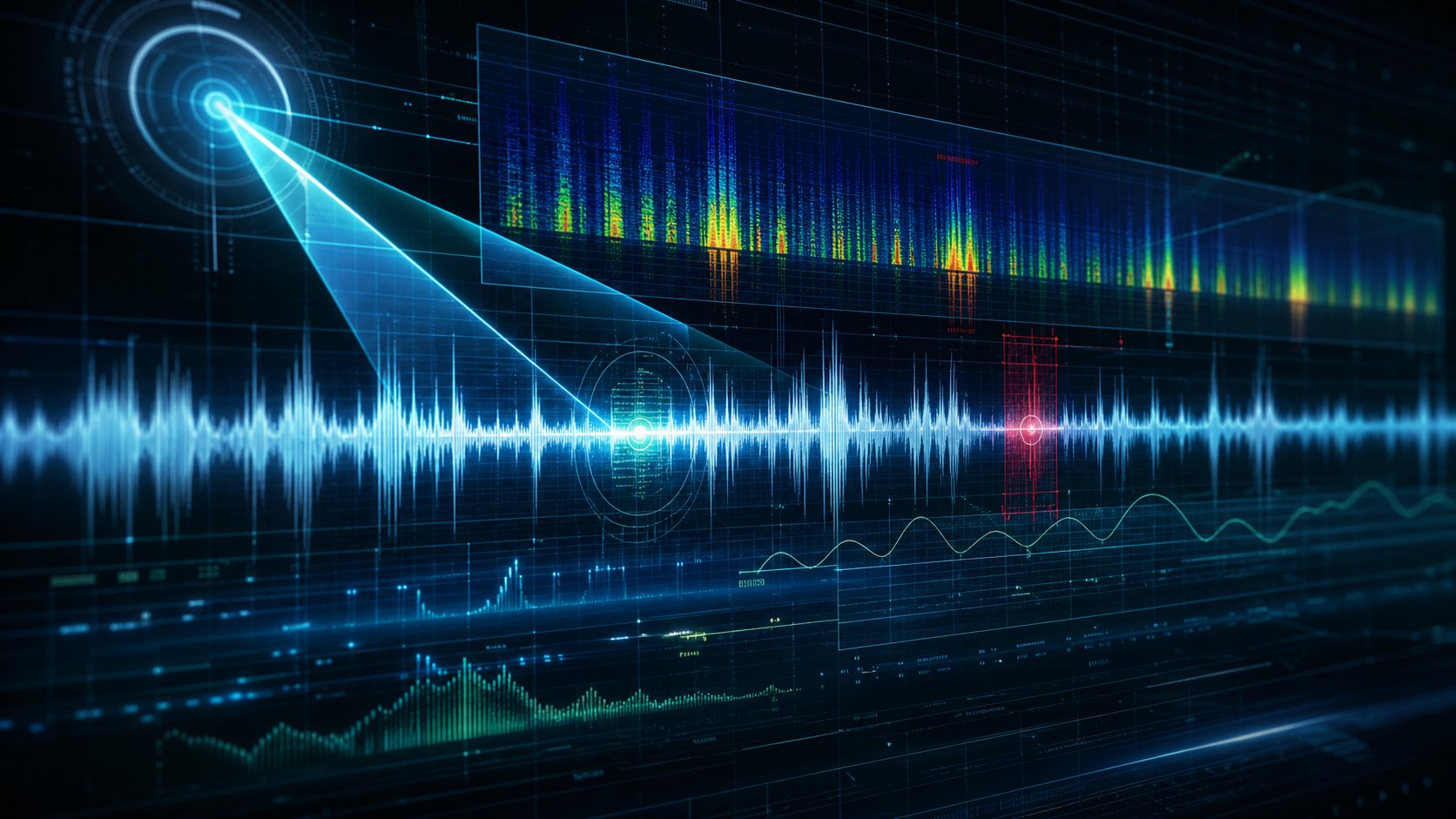
Think of it like forensic audio analysis. Every production pipeline leaves fingerprints. A song recorded in a studio carries traces of specific microphones, room acoustics, compression algorithms, and mastering chains. AI-generated music, similarly, carries artifacts from its generation process, subtle signatures embedded by the neural networks that produced it.
Detection systems function as classifiers trained to recognize these signatures. The core approach involves feeding large volumes of confirmed AI-generated audio (from platforms like Suno and Udio) alongside confirmed human-made music into machine learning models. The system learns to distinguish patterns that differ between the two classes, even when those differences are imperceptible to human ears.
Here are the key technical signals that an ai audio detector typically analyzes:
- Spectral artifacts — AI generators often produce telltale patterns in high-frequency content. Research from KTH Royal Institute of Technology found that Suno tracks exhibit a lower spectral centroid than human-made recordings, indicating reduced high-frequency energy and weaker harmonic content.
- Sampling rate and bit rate fingerprints — Suno outputs audio at 48 kHz with 128 kbps, while Udio uses 48 kHz at 320 kbps. These fixed parameters contrast with the wide variation found in human-produced music and can serve as initial detection cues.
- Mel-band distribution patterns — The skewness and kurtosis of energy across mel-frequency bands differ measurably between AI and human sources. Suno tracks show higher kurtosis variability, suggesting sharper and more erratic spectral peaks.
- Upsampling artifacts — Some models generate audio internally at lower sample rates (around 24 kHz) then upscale to 48 kHz, leaving identifiable low-fidelity traces in higher frequencies.
- Temporal structure and dynamic range — AI-generated tracks tend to have more constrained duration distributions and less dynamic complexity compared to the natural variation in human recordings.
- Audio embedding analysis — Systems like CLAP (Contrastive Language-Audio Pretraining) convert audio into high-dimensional vector representations, where AI-generated and human-made clusters separate visibly in embedding space.
Deezer's system represents the most publicly documented implementation. The company applied for two patents in December 2024 covering distinct methods for detecting unique signatures that distinguish synthetic content from authentic recordings. Their tool can identify fully AI-generated music from the most prolific generative models, with the ability to add detection capabilities for new tools as long as relevant training data is available. Deezer has also made progress on generalized detection, systems that can flag AI content without needing a specific dataset from each generator to train on.
This ai content tagging approach goes beyond simple binary classification. Once detected, tracks receive visible labels so listeners know what they are hearing. Deezer became the first streaming platform to explicitly tag AI-generated content in June 2025, and Billboard now uses their tool to determine which charting tracks are AI-generated.
Accuracy Rates and Limitations
How good are these systems? The answer depends on what you are trying to detect. Academic research published in TISMIR (Transactions of the International Society for Music Information Retrieval) tested multiple detection approaches and found that even basic machine learning methods using CLAP embeddings achieved precision above 95% when trained and tested on the same platforms (Suno and Udio). The commercial IRCAM Amplify detector achieved near-perfect F1 scores of 0.976 for non-AI and 0.988 for AI in controlled settings.
Sounds reliable. But several critical limitations undermine that confidence:
Cross-platform generalization fails. When researchers tested detectors trained on Suno and Udio against music from Boomy (a different AI platform), detection rates collapsed. IRCAM Amplify identified only 8% of Boomy tracks as AI-generated. Simple SVM classifiers caught even fewer. A detector that works perfectly against known generators may miss entirely new ones.
Simple audio transformations fool detectors. The same research found that merely resampling audio to 22.05 kHz caused the IRCAM commercial system to misclassify AI tracks as human-made. Low-pass filtering at certain frequencies eliminated detection entirely. If a fraudster knows what key detector music systems look for, basic post-processing can evade them.
False positives carry real consequences. A 4.7% false-positive rate for human-made music sounds small until you scale it to catalogs of 100 million songs. That translates to millions of human tracks potentially mislabeled as AI-generated. For an independent artist whose livelihood depends on streaming revenue, a false flag could mean demonetization of legitimate work.
The binary question is reductive. Defining music as purely "AI-generated" or "human-made" ignores the spectrum in between. A producer who uses AI to generate a drum loop, then records live vocals and guitar over it, creates something that defies clean categorization. Detection systems currently target fully synthetic content, but the boundary grows blurrier as hybrid workflows become standard.
The Generator vs Detector Arms Race
Every improvement in detection creates pressure on generators to evolve, and vice versa. This dynamic mirrors the broader pattern seen in deepfake detection for images and voice synthesis. Researchers at KTH have explicitly framed this as an "AI music arms race" where systems are built to evade detection, and detection systems are adapted to the particulars of new generators in an ongoing cycle.
The practical implications are significant. Detectors trained on Suno v3 output may not recognize Suno v4 audio if the newer model eliminates the specific artifacts the detector relied upon. Udio tracks already prove harder to distinguish from human-made recordings than Suno tracks, with embedding visualizations showing Udio clusters overlapping more closely with human music in feature space. As models improve audio fidelity, the spectral shortcuts that current detectors exploit will disappear.
When you ask something like "ai identify this song, is it real or synthetic?" the honest answer is: it depends on when the song was made, which tool made it, and whether the detector has been updated to handle that particular generator. There is no universal ai song checker that catches everything. Detection is a moving target.
Platform transparency varies for exactly this reason. Publishing detection methodologies in detail helps fraudsters evade them. Deezer shares its results and approach broadly because it wants to set an industry standard and now licenses the technology commercially. Other platforms may have internal detection but keep it quiet to avoid giving generators a roadmap for evasion. The trade-off between transparency and security explains much of the silence across the industry.
That silence, though, creates its own problem. If only one platform publishes data, the entire industry's understanding of how much music is AI generated rests on a single source. The detection tools exist in various forms, but the willingness to track ai content systematically and report the findings publicly remains the exception rather than the rule.
What the Industry Still Does Not Know
A single platform publishing detection data does not give us industry-wide truth. Deezer's 44% figure is the most concrete number available, but it describes one service with roughly 16 million monthly active users. Spotify serves over 600 million. Apple Music, YouTube Music, and Amazon Music collectively reach hundreds of millions more. The full picture of music and ai remains obscured by the silence of every other major player.
The Transparency Gap Across Platforms
Why does only one platform share this data? The reasons are a mix of competitive strategy, legal caution, and economic incentive.
Spotify has acknowledged the challenge publicly but avoids disclosing detection metrics. Its official position focuses on addressing "harmful uses" like spam and impersonation rather than filtering music based on how it was made. A voluntary credit system launched in early 2025 lets artists disclose AI usage, but critics point out that creators motivated to disguise AI involvement simply will not opt in. Without active detection and reporting, listeners and the industry have no visibility into how many synthetic tracks populate Spotify's catalog.
Apple Music introduced transparency tags in early 2026, requiring labels and distributors to self-disclose AI involvement in new releases. The move signals intent, but self-reporting suffers from the same fundamental flaw: artists risk stigma by admitting AI use, so many choose not to. How prominently Apple displays those tags to listeners also remains unclear.
YouTube Music benefits from its parent platform's broader AI disclosure policies, but those rules target video content rather than audio specifically. Amazon Music has said almost nothing publicly about AI music volumes or detection capabilities. The result is a fragmented landscape where distributors and labels are left guessing about the rules on each platform.
Robert Prey, who studies streaming platforms at Oxford University's Internet Institute, described the situation as a "borderline existential balancing act" for services like Spotify. Platforms must weigh listener trust against platform growth, transparency against operational cost, and labeling against the philosophical difficulty of defining where AI involvement begins.
Current public data represents only a partial picture of AI music's true scale. Deezer accounts for a fraction of global streaming, and the platforms serving the vast majority of listeners have disclosed nothing about their AI content volumes.
Metrics We Still Cannot Measure
Even with Deezer's data, critical gaps remain in the music dataset the industry needs to understand this phenomenon fully. Here is what no one can reliably quantify right now:
- True catalog percentages across all platforms — We know Deezer's inflow rate but not how much of Spotify's 100-million-plus track library, or Apple Music's comparable catalog, consists of AI-generated content.
- Accurate genre breakdowns — While we can estimate that lo-fi and ambient categories carry the highest concentration, no platform publishes granular genre-by-genre detection data.
- Quarter-over-quarter growth rates — Deezer has shared snapshots (10% in January 2025, 28% by September, 44% by early 2026), but other platforms offer no comparable timeline. Whether growth is accelerating, plateauing, or shifting across services remains unknown.
- How much AI music goes undetected — Detection systems struggle with new generators and hybrid content. The actual volume of synthetic music on any platform is necessarily higher than what detection catches.
- Listener exposure rates — We know stream share is 1-3% on Deezer, but that number reflects active detection and demotion. On platforms without those systems, listener exposure could be meaningfully higher.
- Revenue actually diverted — The CISAC study projects future risk, but current real-world losses across all platforms remain unquantified at an industry level.
There are political and business reasons this data stays hidden. Publishing AI content volumes could invite regulatory scrutiny, alarm investors, or embarrass platforms that have been slow to act. Detection itself costs money. As David Hoffman of Duke University has pointed out, identifying AI-generated content adds operational cost, and it may also be cheaper for platforms to serve AI music than to police it. Keeping recommendation systems unencumbered maximizes engagement, which maximizes revenue. Transparency, in this case, works against the business model.
For readers following news music streaming developments around AI, skepticism is warranted when any single statistic appears without context. A headline claiming "half of all music is AI" distorts what the data actually shows. A headline claiming "AI music is negligible" ignores the pipeline flooding happening in real time. The truth sits in between, and it shifts depending on which platform, genre, and metric you examine.
The landscape is evolving quickly. The EU AI Act requires labeling of certain AI-generated content starting August 2026, though how streaming services will implement those rules is still uncertain. Industry standards body DDEX continues developing frameworks for AI disclosure in music metadata. Deezer now licenses its detection technology commercially, potentially enabling other platforms to adopt similar capabilities without building from scratch. And Spotify recently introduced features like SongDNA and "About the Song" aimed at elevating human artistry, a step that could lay groundwork for clearer AI labeling down the road.
None of these developments have yet produced the comprehensive, cross-platform music dataset the industry needs. But they suggest that the current opacity will not last indefinitely. The competitive advantage of being the only platform that tracks AI content may eventually force others to follow, if only to avoid looking like they have something to hide. In the meantime, the question of how much music is AI generated across the full streaming ecosystem remains partially answered at best, a puzzle where one piece is visible and dozens more sit face down on the table.
What is clear, even within these data gaps, is that the same AI tools creating problems for platforms also offer genuine creative value to people who use them responsibly. The technology itself is neutral. What matters is how it is applied and whether the people using it are transparent about the process.

The Creative Side of AI Music Generation
Fraud dominates the headlines, but it does not define the technology. The same generative models that enable royalty farming also power something far more interesting: giving everyday people the ability to compose, arrange, and produce original music without years of formal training. For ai music artists working transparently, these tools represent the most significant expansion of creative access since home recording went digital.
AI Music Tools Reshaping How People Create
The spectrum of available tools is broad, and each approaches creation differently. Some generate full songs from a text prompt. Others function more like intelligent collaborators, offering melodic suggestions, arranging stems, or helping producers overcome creative blocks. A 2025 LANDR survey found that 87% of musicians and producers already use AI somewhere in their workflow, whether for ideation, mixing assistance, or generating reference tracks they later rebuild by hand.
What separates legitimate creative use from the fraud problem discussed earlier comes down to intent and transparency. A content creator producing songs about technology for a YouTube series is not competing with streaming farmers. A hobbyist exploring an ai music remix of their own vocal recording is not diluting anyone's royalty pool. These use cases represent the technology functioning as designed: lowering barriers so more people can participate in music-making.
The ecosystem of music technology companies building these tools has matured rapidly. Platforms like Suno now offer full DAW-like workspaces with stem editing and MIDI export. Others focus on specific niches: instrumental background music, vocal synthesis, or beat generation. The variety means creators can match a tool to their actual need rather than forcing a one-size-fits-all solution. Some tools even leverage nota ai approaches to help users understand and annotate musical elements within their generated compositions, bridging the gap between AI output and musical literacy.
What all legitimate tools share is a philosophy of human direction. You provide the creative vision, whether that is a lyric, a mood description, a melody hummed into your phone, or a genre mashup you have always wanted to hear. The AI handles execution. The result is something closer to songs about artificial intelligence collaboration than pure machine output.
Trying AI Music Generation for Yourself
Reading about AI music statistics is one thing. Hearing what these tools actually produce is another. If the data throughout this article has made you curious about what generative music sounds like or how the creation process works, the most direct way to understand it is to try it yourself.
Here is what you can explore with current AI music creation tools:
- MakeBestMusic — Turn prompts, lyrics, and style ideas into complete AI-generated songs. An accessible entry point for anyone who wants to experience prompt-based music creation without a steep learning curve.
- Suno — A full generative audio workstation with studio features, stem editing, and advanced customization for users who want deeper creative control.
- Udio — Quick, playful generation focused on experimentation and community sharing within its platform.
- Beatoven.AI — Purpose-built for background music and podcast scoring, prioritizing functional audio over artistic expression.
- AIVA — Composer-oriented with MIDI export, suited for people comfortable working in traditional DAWs who want AI-assisted starting points.
The key difference between using these tools responsibly and contributing to the flooding problem is straightforward: disclose what you make, create because you have something to express, and treat AI as a collaborator rather than a content factory. The 87% of musicians already integrating AI into their process are not the problem the industry is fighting. They are the future the technology was built to serve.
Whether you are a content creator needing original backing tracks, a songwriter testing arrangements before committing to studio time, or simply curious about what prompt-based composition feels like, these tools offer a way to engage with the same technology reshaping the music industry, on your own terms and at your own pace.
