

The Real Question Behind the AI Music Panic
Is AI going to ruin music? That question sounds simple, but it fractures the moment you push on it. Ruin it for whom? Ruin it how? Ruin it on what timeline? A bedroom producer gaining access to studio-quality tools overnight sees a different reality than a session guitarist watching sync licensing gigs vanish. A listener streaming lo-fi playlists while working doesn't share the same stakes as a label executive calculating catalog licensing fees. The answer depends entirely on where you stand in the music ecosystem, and that's exactly what makes this debate so charged.
Why This Question Hits Different Now
People have worried about technology killing music for decades. What's changed is a threshold. Generative AI models are now creating songs that casual listeners genuinely cannot distinguish from human compositions. Research from Jana Friedrichsen, Julia Schwarz, and Michel Clement found that listeners actually perceived AI-generated songs as superior to human-made tracks when they didn't know the origin. A separate study focusing on pop music found no negative bias toward AI-generated songs even when participants were told the music came from an algorithm. That's not a hypothetical threat sitting on the horizon. It's a present-tense reality reshaping how music gets made, distributed, and valued.
The ai music debate is no longer academic. In August 2024, an AI-generated song entered the German charts for the first time. Platforms like Spotify are quietly integrating AI-generated content into playlists. The question of whether AI will take over music has moved from speculative forum posts to boardroom strategy sessions and courtroom filings.
Ruin It for Whom Exactly
Here's the framework that matters: every stakeholder in music faces a different version of this question.
- Listeners may get more music, cheaper and faster, but potentially lose the human stories behind the songs they love.
- Independent artists gain powerful creative tools while facing a flood of competing content that dilutes their visibility and income.
- Session musicians watch the functional music market, their bread and butter, get automated first.
- Producers can accelerate workflows but risk commodifying their own expertise.
- Major labels sit on the training data AI models need, positioning them to profit regardless of outcome.
- Streaming platforms stand to cut costs by replacing licensed catalogs with generated alternatives.
Each group confronts a different calculus of risk and reward. Lumping them together under one panic-driven headline obscures more than it reveals.
The same technology that democratizes music creation for millions may simultaneously devalue the craft for those who've spent lifetimes mastering it.
This article won't pretend the answer is simple or predetermined. Can AI make better music than humans? By some listener metrics, it already does in narrow contexts. Does that mean music is ruined? That depends on what you believe music is for. The evidence points in multiple directions at once, and the honest approach is to follow each thread to see where it leads, stakeholder by stakeholder, consequence by consequence.
The place to start is history. Every generation of musicians has faced a technology that threatened to make them obsolete. What actually happened to them tells us more than any prediction about what comes next.
What Past Technology Disruptions Actually Did to Musicians
Musicians have been told their livelihoods are about to disappear roughly once per decade since the 1960s. The threats change shape, but the emotional texture stays the same: panic, outrage, attempts at prohibition, and eventually adaptation. Understanding what actually happened during each of these disruptions, not just that they occurred but who lost income, who gained it, and what new roles emerged, gives us the clearest lens for evaluating the ai impact on music industry today.
Because here's the thing: every time a new technology arrives in music, the people it threatens most are the ones who describe it as the end. And they're never entirely wrong. Real losses happen. Real careers end. But the full picture always turns out to be more complicated than the initial alarm suggests.
What Synthesizers and Samplers Actually Did to Musicians
In 1982, the UK Musicians' Union did something that sounds absurd in hindsight. After Barry Manilow replaced several orchestral players with synthesizers for a UK tour, the union passed a motion to ban synthesizers, drum machines, and any electronic devices "capable of recreating the sounds of conventional musical instruments." The NME called them "Loonies." Synth players who were union members set up a rival body called the Union of Sound Synthesists.
This wasn't the union's first fight with technology either. They had previously tried to stop the use of the Mellotron in the 1960s because of its string-playing capabilities. They even once insisted that bands appearing on Top of the Pops record their backing tracks the afternoon before, just to prove they could actually play.
The fear was straightforward: if one synthesizer player can simulate the sound of a string section, you no longer need to hire a string section. And in certain narrow contexts, that fear proved justified. Session work for functional recordings, jingles, low-budget TV scores, and backing tracks did contract for traditional instrumentalists throughout the 1980s.
But the economic outcome was far more layered than a simple replacement story. Synthesizers didn't shrink the music industry. They expanded it. New genres emerged. New production roles appeared. The people who learned to program and perform on synthesizers created entirely new career paths that hadn't existed before. The overall market for recorded music grew throughout the 1980s and into the 1990s. Technology leveled the playing field so that many more people could participate in music creation, as even the MU eventually acknowledged when they lifted the ban in 1997 and allowed DJs to join.
The same pattern repeated with sampling in hip-hop during the late 1980s and 1990s. Traditional musicians and composers argued that chopping up existing recordings wasn't "real" musicianship. Legal battles over clearances reshaped copyright law. Yet sampling produced some of the most culturally significant music of the era and launched production careers that simply didn't exist before the technology arrived.
Auto-Tune followed the same script. When Cher's "Believe" made pitch correction audible in 1998, critics declared it the death of authentic vocal performance. Two decades later, Auto-Tune is a standard studio tool used on the majority of commercial releases, and listeners still pack arenas to hear artists sing live, imperfections and all.
Lessons from the Napster Era and Streaming Transition
The disruption that most closely mirrors today's artificial intelligence in music debate arrived in June 1999. Napster peaked at an estimated 80 million users sharing music files for free. The global recorded music industry's value dropped every single year from 2000 to a low of $15 billion in 2014, roughly half of its 1999 peak of $30.6 billion.
That wasn't hypothetical damage. Real musicians lost real income. Mid-tier artists who had lived on album sales found the economic floor yanked out from under them. Independent labels closed. Recording budgets shrank. The issues in the music industry during this period were existential, not cosmetic.
Yet the industry eventually stabilized. Streaming replaced piracy with a legal model. New revenue streams emerged around live performance, brand partnerships, and social media monetization. By 2023, global recorded music revenue had recovered to roughly $28 billion. The business looks fundamentally different than it did in 1999, but it exists, and it's growing.
The pattern across all these disruptions follows a recognizable arc:
- Synthesizers (1980s): Session musicians in functional music lost work. New electronic music genres created new careers. The overall industry grew.
- Sampling (late 1980s-1990s): Copyright holders fought legal battles. Producers and beat-makers emerged as a new creative class. Hip-hop became commercially dominant.
- Digital recording (1990s): Studio engineers who only knew analog struggled. Home recording democratized production. More music got made by more people.
- Napster and piracy (1999-2014): Industry revenue halved. Mid-tier artists were hardest hit. Streaming eventually rebuilt the market on different terms.
- Streaming transition (2010s): Per-unit revenue dropped dramatically. Artists adapted to playlist culture and direct-to-fan models. Total consumption skyrocketed.
Each disruption produced genuine casualties and genuine winners. Each required adaptation rather than resistance. And each ultimately expanded who could participate in music, even as it narrowed certain legacy pathways.
But there's a critical point where the AI parallel breaks down, and it matters. Every previous technology, from synthesizers to samplers to DAWs to streaming, still required human skill to operate. You needed musical knowledge to program a Moog. You needed taste and timing to chop a sample. You needed engineering ears to mix in a DAW. The human remained the bottleneck of creative decision-making.
Generative AI removes that bottleneck. A person with no musical training, no instrument skills, and no production experience can now generate a complete, listenable song from a text prompt. That's not an incremental shift in who controls the tools. It's a categorical change in whether learned musicianship is required at all. The historical pattern of disruption-then-adaptation still offers useful guidance, but anyone who claims "this is just like the synth scare" is ignoring what makes this moment structurally different.
Understanding that difference is essential for evaluating the real threat. And the place that difference shows up most clearly is in how these AI systems actually produce music, a process that looks nothing like how any previous music technology worked.
How AI Music Generation Actually Works Under the Hood
A synthesizer still needs someone to play it. A sampler still needs someone to choose what gets chopped and rearranged. Generative AI music tools operate on a fundamentally different principle: they learn statistical relationships from existing music, then use those relationships to produce new audio without direct human performance. Understanding this mechanism clarifies why the technology provokes such strong reactions and where its outputs genuinely fall short.
How AI Learns Musical Patterns from Training Data
Imagine showing a composer thousands of songs across every genre, decade, and mood, then asking them to write something new based on everything they absorbed. That's a rough analogy for how artificial intelligence songwriting works, with one critical difference: the AI doesn't "understand" music the way a human does. It identifies mathematical patterns.
The process follows a general pipeline that most generative AI music systems share:
- Data collection: The model ingests large datasets of existing music. These datasets can include raw audio waveforms, isolated instrument stems, metadata like genre and tempo tags, and in some cases lyrics paired with melodies.
- Preprocessing: Raw audio gets converted into formats suitable for machine learning, typically spectral and temporal representations that translate sound waves into numerical data a neural network can process.
- Feature extraction: The system identifies key musical elements: pitch sequences, rhythmic patterns, harmonic progressions, timbral qualities, and structural markers like verses and choruses.
- Model training: Deep neural networks learn the statistical relationships between these elements. Which notes tend to follow which? How do chord progressions typically resolve? What drum patterns accompany specific tempos and genres? The model builds a mathematical representation of what music "is" based on millions of these observed correlations.
- Generation: When prompted, the model constructs new sequences that follow the learned patterns without directly copying any single source track.
Here's where it gets interesting for the question of originality. The AI doesn't memorize whole songs and spit them back out. It learns tendencies: that minor keys correlate with sadness, that four-on-the-floor kick patterns signal dance music, that vocal melodies in pop tend to stay within a certain intervallic range. Then it generates new combinations that satisfy those learned constraints.
This is statistically novel output. But is it creatively original? That depends on your definition. A human songwriter who grew up listening to thousands of songs also internalizes patterns and recombines them. The difference is that human learning involves embodied experience, emotional memory, and intentional artistic choices. The AI has no experience of heartbreak when it writes a ballad. It has a probability distribution that says minor seventh chords and slow tempos correlate with tracks labeled "melancholic" in its training data.
The nature of that training data raises its own set of questions. Early models scraped audio from the internet without artist permission or compensation. By 2026, the industry is pushing toward consent-based training frameworks where artists license their catalogs specifically for AI model development, though enforcement remains uneven and millions of tracks were already absorbed during the earlier, less regulated period.
What Current AI Music Tools Can and Cannot Do
Not all generative AI music tools work the same way or target the same use case. The landscape splits into distinct categories, each with different technical approaches and creative implications.
Text-to-song generators like Suno and Udio represent the most visible category. You type a description, something like "upbeat indie rock with female vocals and jangly guitars," and the system returns a complete song with vocals, instrumentation, and structure within minutes. Suno uses a transformer-based model and has become a benchmark for creating songs with realistic vocal performances across genres. Udio, developed by former Google DeepMind researchers, emphasizes audio fidelity and instrumental separation, offering more granular control over tags, structure, and remixing.
Composition-focused tools like AIVA take a different approach. Built on a long short-term memory (LSTM) model and trained on over 20,000 classical scores, AIVA functions more like a digital audio workstation, letting users edit generated chord progressions, add layers, and adjust arrangements. It's the first AI officially recognized as a composer by France's SACEM, and its strength lies in orchestral and cinematic scoring rather than pop songwriting.
Then there are production assistants and stem separators, tools that don't generate full songs but handle specific tasks within a human-led workflow. Stem separation isolates vocals, drums, bass, and other instruments from a mixed track. Mixing assistants suggest EQ settings or compression parameters. These sit at the less controversial end of the spectrum because they augment human creativity rather than replacing it.
A biometric study published in PLOS One compared emotional responses to AI-generated versus human-composed soundtracks and found that emotional valence remained consistent across conditions. Participants perceived the same core emotions regardless of whether the music was human-made or AI-generated. However, human-created music was rated as significantly more familiar, and AI-generated tracks produced wider pupil dilation, suggesting they required more cognitive effort to process. The takeaway: AI can hit the right emotional notes in functional contexts, but something still feels subtly different to listeners at a physiological level.
Where these tools consistently struggle tells you a lot about what's actually hard in music. The technical challenges and ethical issues in ai music generation cluster around several persistent weak points:
- Long-form structural coherence: AI can produce convincing 30-second clips or even full three-minute songs, but maintaining a compelling narrative arc, building tension and releasing it across a longer piece, remains inconsistent.
- Genuine emotional narrative: A song that tells a specific human story, with lyrical subtlety and melodic choices that serve that story's emotional trajectory, still largely eludes fully automated generation.
- Truly novel musical ideas: Because the model generates from learned patterns, it excels at producing music that sounds like existing genres. Inventing something that sounds like nothing before it, the way punk or early electronic music did, sits outside its operational logic.
- Uncanny familiarity: Research suggests AI-generated audio can produce an "uncanny" aesthetic, an eerie quality where something sounds almost right but triggers subtle discomfort in attentive listeners.
| Tool Category | Examples | Primary Capability | User Skill Required | Key Limitation |
|---|---|---|---|---|
| Text-to-Song Generators | Suno, Udio, Boomy | Full song creation from text prompts, including vocals and instrumentation | None (describe what you want in plain language) | Limited structural control; outputs can sound generic across multiple generations |
| Composition and Scoring Tools | AIVA, Soundful | Orchestral composition, customizable arrangements, score editing | Basic to intermediate music knowledge helpful | Narrower genre range; less convincing with contemporary vocal styles |
| Production Assistants | AI mixing plugins, mastering tools | Mixing suggestions, EQ/compression automation, arrangement assistance | Intermediate production experience | Works within human-directed workflow; cannot generate original compositions |
| Stem Separators | Isolation tools in DAWs | Splitting mixed audio into individual instrument tracks | Basic audio editing | Separation quality varies; artifacts common on complex mixes |
| Real-Time Generative Tools | Mubert | Continuous adaptive music generation for streaming, events, and background use | None to minimal | Functional rather than artistic; limited compositional depth |
The generative ai music news cycle often treats these categories as interchangeable, but they represent very different levels of creative involvement. A stem separator helping a remixer isolate a vocal track raises few philosophical questions. A text-to-song generator producing a complete track that competes with human artists on streaming platforms raises many.
And those questions become most urgent when you follow the music from creation to distribution. Because even if AI-generated songs are merely "good enough" rather than genuinely great, the speed and volume at which they can flood platforms creates an economic problem that has nothing to do with artistic quality and everything to do with math.
The Streaming Economics Problem Nobody Fully Explains
You can debate the artistic merits of AI-generated music endlessly. But the most immediate, measurable harm isn't aesthetic. It's mathematical. When AI-generated tracks flood streaming platforms by the tens of thousands daily, they don't just compete with human artists for listener attention. They siphon money from a finite pool that every artist shares. This is where the conversation about ai and the music industry shifts from philosophical to financial, and where the negative effects of ai in the music industry become hardest to dismiss.
How Royalty Pool Dilution Works
Most major streaming platforms, including Spotify, Apple Music, and YouTube Music, distribute ai music royalties using what's called a pro-rata model. Here's how it works in plain terms: each month, the platform takes its total revenue from subscriptions and advertising, sets aside a percentage for royalties, and then divides that pool among all tracks based on their share of total streams.
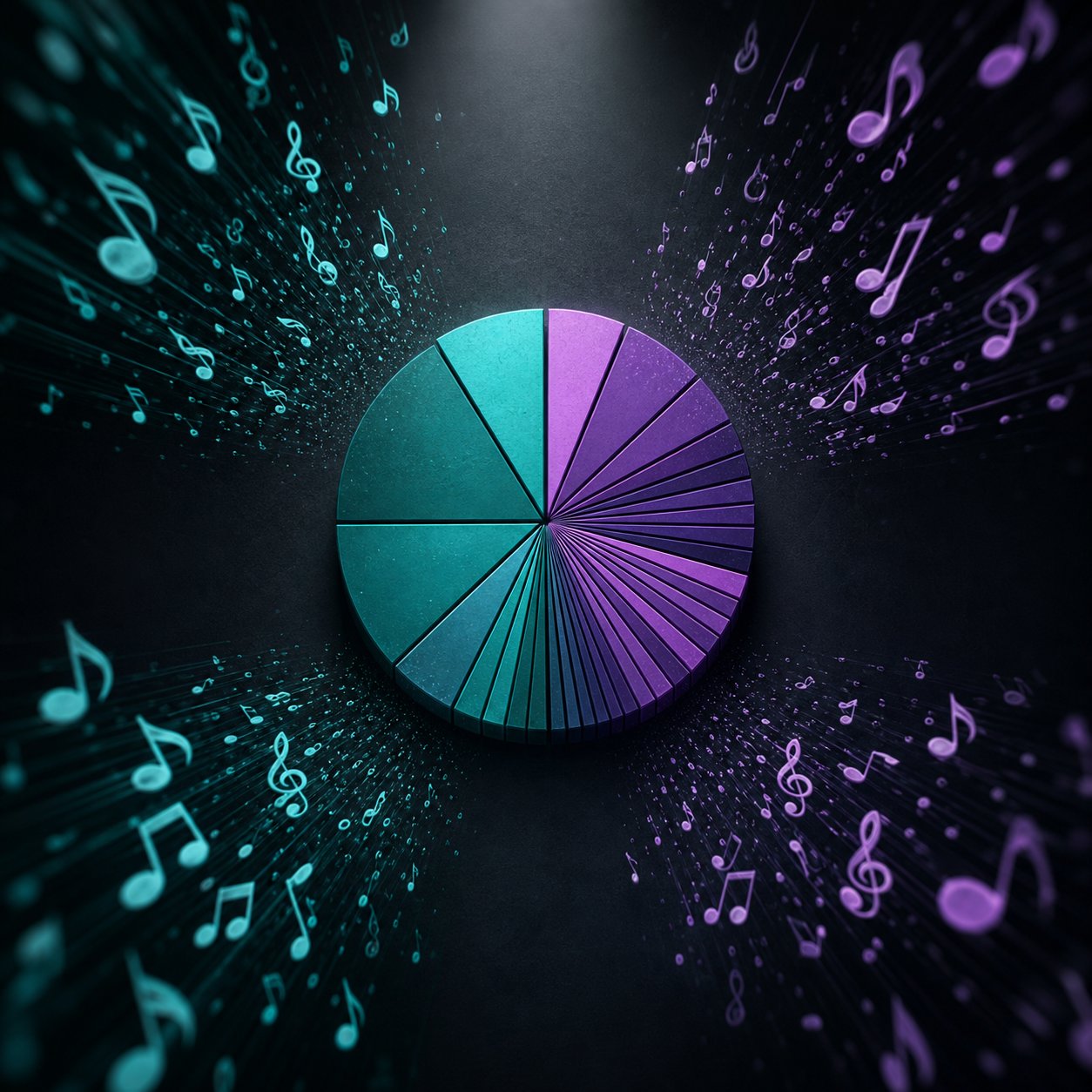
Picture a pie. Every stream on the platform represents a slice. If your song gets 1,000 streams out of 100 billion total streams that month, you receive one ten-millionth of the royalty pool. The critical detail: the pie doesn't grow just because more tracks get uploaded. Revenue is determined by subscriber count and ad sales, not by the volume of content available.
When AI-generated tracks accumulate streams, even modest ones spread across thousands of tracks, they expand the denominator. More total streams across the platform means each individual stream is worth less. Your song still got those 1,000 plays, but each play now pays a fraction less because the total pool got divided into more pieces.
This isn't a hypothetical scenario. Deezer reported in April 2026 that AI-generated tracks represent 44% of all new music uploaded to its platform, with approximately 50,000 AI tracks arriving daily. While those tracks account for only 1% to 3% of total streams, 85% of the streams they do receive were identified as fraudulent, generated by bots rather than real listeners.
This reveals the business model behind what the industry now calls "music farms." The playbook is straightforward: generate hundreds or thousands of ambient, lo-fi, or functional tracks using AI tools. Upload them to streaming platforms under generic artist names. Deploy bots to inflate stream counts. Pocket the royalty payments. A North Carolina man pleaded guilty in March 2026 to exactly this scheme, having generated hundreds of thousands of AI songs and used bots to stream them billions of times, collecting more than $8 million in fraudulent royalty payments.
That $8 million didn't materialize from nowhere. It came directly from the royalty pool that legitimate artists depend on for income. Every fraudulent stream on an AI-generated track reduces the per-stream payout for every real artist on the platform. Multiply that across thousands of bad actors running similar operations at smaller scales, and the cumulative dilution becomes significant.
The targets aren't random either. Scammers have uploaded AI-generated songs to the profiles of real artists, exploiting their fanbases to generate quick streams. Artists like the British singer-songwriter Ormella have discovered unauthorized AI tracks appearing on their Spotify pages, notifying their fans of a release they never made. The AI song on Ormella's profile racked up a thousand plays on its first day, with the same track appearing on other artists' pages under different titles, a strategy of nickel-and-diming across hundreds of profiles simultaneously.
How Platforms Are Responding to the Flood
Streaming platforms aren't ignoring the problem. But their responses vary widely in scope and effectiveness, and enforcement gets harder as AI outputs become more indistinguishable from human-made music.
Here's where the major platforms stand:
- Spotify removed over 75 million spammy tracks in a 12-month period and rolled out a music spam filter that identifies suspicious uploaders, tags them, and stops recommending their content. In 2026, they introduced Artist Profile Protection, letting artists review releases before they go live to prevent unauthorized uploads to their profiles.
- Deezer built a proprietary AI detection system that identifies and tags fully AI-generated tracks, then excludes them from algorithmic recommendations and playlists, directly limiting their ability to accumulate streams and earn royalties.
- Qobuz similarly deployed detection technology and excludes AI-generated music from recommendations.
- Apple Music requires content providers to disclose AI use in a track's metadata, though disclosure remains voluntary.
- Sony Music requested the removal of more than 135,000 AI songs impersonating its artists.
On the distribution side, the gatekeepers who deliver music to platforms are also tightening their policies. UMG-owned CD Baby refuses both fully and partially AI-generated tracks. Believe's TuneCore rejects AI tracks from models trained on unlicensed content. DistroKid still accepts AI-generated music but requires uploaders to own 100% of the rights.
The fundamental enforcement challenge is detection accuracy. Two approaches exist: AI detection systems that analyze audio characteristics, and metadata disclosure where uploaders self-report AI use. Neither is perfect. Detection systems aren't 100% accurate and risk false positives against human artists who happen to produce very clean, polished recordings. Self-disclosure depends entirely on the honesty of uploaders, and bad actors have no incentive to flag their content as AI-generated.
Some industry voices have proposed structural solutions that go beyond detection:
- Separate royalty pools for AI-generated content, so machine-made tracks don't dilute payments to human artists
- Tiered streaming royalties with lower per-stream rates for AI tracks
- A shift from pro-rata to "user-centric" payment models, where your subscription money goes only to the artists you personally stream rather than the platform-wide pool
- Minimum stream thresholds before tracks become eligible for royalty payments
Each proposal carries trade-offs. Separate pools require a reliable way to classify content. Tiered rates need industry-wide agreement on what counts as AI-generated versus AI-assisted. User-centric models would require platforms to rebuild their entire payment infrastructure.
Here's the disproportion that makes this an equity issue rather than just an industry logistics problem. Major label artists operate under guaranteed advances. Whether the per-stream rate drops from $0.004 to $0.003, their income is largely insulated by contractual minimums and the sheer scale of their catalog streams. Independent artists have no such cushion. They earn based directly on what their streams pay. A 10% decline in per-stream value might be invisible on a Taylor Swift royalty statement but devastating for an indie artist earning $2,000 a month from streaming.
The economics of AI flooding also hit specific market segments hardest. Ambient music, lo-fi beats, study playlists, meditation soundscapes, and background music for content creators are the first categories where AI-generated alternatives become cost-competitive. These are exactly the segments where many independent artists have built sustainable micro-careers. The listeners in these spaces often aren't seeking a specific artist's voice or story. They want functional audio, and they're indifferent to whether a human or an algorithm produced it.
This creates a sobering arithmetic. The financial damage from AI-generated music on streaming platforms isn't evenly distributed. It concentrates on the most vulnerable artists in the most commoditized genres. And it's happening right now, not in some speculative future, but in the royalty statements arriving in artists' inboxes this month.
The economic picture raises an unavoidable next question: beyond the aggregate numbers, who specifically gets hurt, who benefits, and is the damage the same across every role in the music ecosystem?
Who Actually Gets Hurt and Who Benefits
Aggregate statistics about royalty dilution and upload volumes tell part of the story. But the impact of ai on music industry stakeholders isn't uniform. A session cellist and a major label CEO occupy the same industry, yet they face completely different versions of this disruption. The threat level, the opportunity upside, and the timeline of impact all shift depending on your role. Mapping those differences reveals who's actually vulnerable, who's insulated, and who might come out ahead.
Independent Artists and Bedroom Producers
For indie musicians, AI in the music industry presents a genuine paradox. On one hand, generative tools hand you capabilities that once required a $50,000 studio budget and a team of collaborators. Need orchestral strings for your track? AI can generate them. Can't afford a mixing engineer? AI mastering tools get you 80% of the way there. The barriers to making professional-sounding music have never been lower.
On the other hand, those same lowered barriers mean exponentially more competition for listener attention. When anyone can produce a polished track in minutes, the sheer volume of content flooding platforms makes discoverability harder for everyone. Indie artists already struggled to stand out in a landscape of 100,000 new tracks uploaded daily. Add AI-generated content to that pile, and the visibility problem intensifies.
The calculus splits further by career stage. An emerging artist with no audience might welcome AI tools that let them produce at a quality level they couldn't otherwise afford. An established indie artist who spent years building a sound and fanbase watches their niche get flooded with cheaper alternatives. The benefits of ai in music creation are real, but they accrue most to people still climbing and least to those who already carved out a sustainable position through skill and persistence.
Session Musicians and Sync Licensing Professionals
If any group faces existential displacement from generative AI, it's session musicians working in functional music. Background tracks for advertisements, stock music libraries, podcast intros, video game ambient layers, and sync licensing placements for corporate videos represent the first markets where AI-generated alternatives are genuinely cost-competitive right now.
Gregor Pryor, a managing partner at legal firm Reed Smith, put it plainly in a Guardian investigation: background music for advertising, films, and video games "is where the real damage will be done" first. "People will ask: why would I pay anyone to compose anything?"
The economics are stark. A brand that previously paid $2,000 to $10,000 for a custom sync composition can now generate comparable background audio for essentially nothing. The quality gap for functional contexts, where music needs to set a mood rather than stand alone as art, has shrunk to the point where many buyers genuinely cannot hear the difference. And they don't need to. A 30-second backing track for a YouTube ad doesn't require emotional depth or structural brilliance. It needs to feel right for the brand, and AI handles that adequately.
Producers face a different but related pressure. AI can accelerate workflow tasks that once commanded premium rates: generating rough arrangements, suggesting chord progressions, automating mixing decisions. These tools make producers faster, but they also erode the perceived value of skills that clients once paid top dollar for. If your client knows an AI can generate a serviceable arrangement in seconds, the premium they'll pay you to do it better shrinks.
The American Federation of Musicians' lawsuit against Universal Music Group and Warner Music Group underscores just how immediate this threat is. The union alleges that both labels licensed recordings featuring AFM member performances to Suno and Udio "without compensation or credit." The very musicians who played on those tracks are watching their performances get fed into systems designed to replace future session work. Their past labor is being used to train their own replacements.
Major Labels and Their Strategic Position
Major labels occupy a structurally different position from every other stakeholder. They don't just respond to AI disruption. They control key inputs the technology needs to function: massive catalogs of training data.
The three majors, Universal Music Group, Warner Music Group, and Sony Music, collectively control roughly 60% to 70% of commercially released recorded music. Any AI music platform that wants to produce outputs trained on professional-quality, diverse recordings needs access to those catalogs. That gives the majors leverage no indie artist or session musician has.
Their strategic playbook became clear throughout 2025. After initially suing Suno and Udio for copyright infringement, UMG and WMG pivoted to settlement and licensing deals. Klay became the first AI music service to secure deals with all three majors, licensing thousands of tracks to train its model. UMG partnered with Udio, and WMG struck deals with both Udio and Suno. Warner Music Group CEO Robert Kyncl framed these partnerships as "the democratisation of music creation."
The labels earn from AI regardless of which direction the technology goes. If AI-generated music succeeds commercially, they collect licensing fees from the platforms using their catalogs as training data. If human-made music retains premium value, they still own the world's largest catalogs of it. They win either way, or at minimum, they're hedged.
Artist manager Irving Azoff offered a less charitable interpretation of these deals. "We've seen this before, everyone talks about 'partnership,' but artists end up on the sidelines with scraps," he said in response to the UMG-Udio announcement. The Council of Music Makers in the UK accused the majors of "spin" and called for more robust artist-label agreements around AI licensing.
Reed Smith's Pryor offered a counterintuitive possibility: AI music could actually increase the value of verified human-made recordings. "By its nature, AI is derivative and cannot create new music," he argued. "Some investors in music catalogues that I speak to say it's good for artists, because music 'verified' as created by humans will have greater value."
Whether that prediction holds depends on whether listeners care about the distinction. The table below maps each stakeholder group against both their threat exposure and their opportunity upside:
| Stakeholder Group | Primary Threat | Threat Level | Primary Opportunity | Opportunity Level |
|---|---|---|---|---|
| Independent Artists | Content flood reducing visibility and per-stream income | High | Access to professional production tools without expensive studios | Medium-High |
| Session Musicians | Direct displacement in functional, sync, and stock music markets | Very High | Limited; niche demand for live performance and premium sessions | Low |
| Producers and Engineers | Devaluation of production skills as AI handles routine tasks | Medium-High | Workflow acceleration; ability to take on more projects faster | Medium |
| Major Labels | Potential long-term devaluation of recorded music if AI floods the market | Low | Licensing fees from training data; reduced production costs; new revenue streams | Very High |
| Streaming Platforms | Quality degradation of catalog; user trust erosion from AI spam | Medium | Reduced licensing costs; new AI-powered listener features | High |
| Listeners | Homogenization of available music; loss of cultural authenticity signals | Low-Medium | More music, more personalization, lower cost access | High |
| Songwriters | Reduced demand for compositions in commercial and functional contexts | High | AI co-writing tools to overcome blocks and accelerate output | Medium |
The pattern is unmistakable. The closer your role sits to commoditized, functional music production, the higher your threat exposure. The more structural power you hold, whether through catalog ownership, platform control, or consumer-facing brand identity, the more insulated you are. AI in the music industry doesn't threaten everyone equally. It concentrates harm on the people with the least leverage and distributes opportunity toward those who already hold the most.
Catherine Anne Davies, who records as the Anchoress and sits on the board of the Featured Artists Coalition, captured the frustration of artists caught in this asymmetry. "We cannot think of ourselves selfishly as entities that will be unaffected, because the entire ecosystem will experience a knock-on effect financially," she told The Guardian. "What about your fellow composers and creators? But also what about the generations to come after? Are we fucking this completely, just to make sure that we can pay our mortgages now?"
That question cuts through the economics and into something deeper. All the stakeholder analysis, all the threat matrices and royalty math, ultimately leads back to the people on the receiving end of the music: listeners. And their perspective on AI-generated songs might be the most surprising and underexplored part of this entire debate.
The Listener Perspective Everyone Ignores
Most of the AI music debate centers on creators, platforms, and executives. The person actually pressing play gets surprisingly little attention. Yet listeners are the ultimate judges. Their behavior, preferences, and willingness to pay determine whether AI-generated music thrives or fizzles. So here's the question nobody seems to ask them directly: is ai music bad from the perspective of the person consuming it? The research suggests the answer is far more nuanced than either side of the debate admits.
Can Listeners Tell the Difference
The short answer: almost never, at least not reliably. A landmark Deezer-commissioned survey conducted by Ipsos across 9,000 respondents in eight countries found that 97% of participants could not distinguish fully AI-generated tracks from human-made music in a blind listening test. That's not a marginal failure rate. It's near-total inability to detect the difference when no label is provided.
More than half of those respondents, 52%, said they felt uncomfortable learning they couldn't tell. The gap between what people assume they'd notice and what they actually notice is enormous. You might believe you'd spot something artificial, some uncanny stiffness or soulless quality. The data says otherwise for casual listening contexts.
A biometric study published in PLOS One added physiological depth to this finding. When participants watched videos paired with either human-composed or AI-generated soundtracks, their reported emotional valence showed no significant difference across conditions. The core emotion they felt watching the same video didn't change based on whether a human or an algorithm scored it. However, human-created music was perceived as significantly more familiar, and AI soundtracks triggered wider pupil dilation, a marker of increased cognitive effort. Something registers below conscious awareness even when listeners can't articulate what it is.
Think about your own listening habits for a moment. How much of your daily music consumption involves deep, attentive listening versus functional background audio? Playlists while working, ambient soundscapes during a commute, lo-fi beats while studying. For that kind of listening, the emotional depth that distinguishes great human artistry may genuinely not matter. The music and ai question lands differently depending on whether you're sitting in the dark with headphones absorbing every note of an album or letting a study playlist wash over you at half attention.
This is where the opinion on ai music splits along use-case lines rather than ideological ones. A listener seeking functional audio may be perfectly well-served by generated content. A listener seeking connection to another human's lived experience may find AI output hollow regardless of its sonic quality.
Does Knowing Music Is AI-Made Change How It Feels
Here's where it gets philosophically interesting. Imagine a song moves you to tears. You feel something genuine, undeniable. Then someone tells you it was generated by an algorithm in twelve seconds from a text prompt. Does that knowledge retroactively diminish what you felt?
Research from MIT's Media Lab and Myndstream explored this exact scenario across 152 participants. They found a striking disconnect: participants were significantly more likely to prefer AI-generated music, but they attributed greater emotional efficacy to human-composed tracks. People liked the AI songs more yet believed the human songs were better at actually making them feel something. When asked to explain, participants associated humanness with qualities like "imperfection," "flow," "soul," and "realness." One participant noted that tiny flaws made music "feel alive."
Even more revealing, when labels were deliberately swapped, telling listeners that AI music was human-made and vice versa, most participants maintained their initial judgments even after being informed of the deception. Personal taste proved more stubborn than origin labels. The majority said knowing the true source didn't change how they felt about the music.
If a song resonates emotionally, does it matter whether the resonance was crafted by a human heart or calculated by a statistical model? Or does music's deepest value lie not in the sound waves themselves but in the knowledge that another conscious being chose those exact notes to express something only they could feel?
This tension sits at the center of why is ai music bad as a question rather than a statement. The "bad" doesn't live in the audio signal. It lives in what you believe music is for. If music is primarily a sonic experience, generated tracks that hit the right frequencies and progressions are functionally equivalent to human compositions. If music is primarily a form of human communication, a way of saying "I felt this, and maybe you feel it too," then AI output is missing the entire point regardless of how good it sounds.
The Deezer-Ipsos survey found that 80% of respondents believe AI-generated music should be clearly labeled for listeners. That number signals something important: people want the choice. They want to know what they're hearing so they can decide for themselves whether it matters. Transparency doesn't necessarily kill enjoyment, but its absence feels like a violation of trust. Forty percent of streaming users said they would skip AI-generated music without listening if they knew what it was, while 66% said they'd listen at least once out of curiosity.
Labeling requirements could reshape listener behavior in ways that are hard to predict. If every AI track carries a visible tag, does that create a stigma that pushes listeners toward human music? Or does it normalize AI content by making it visible and accepted? The answer likely depends on context. A "made with AI" label on a meditation playlist might matter to nobody. The same label on a breakup song might matter to everyone.
What listeners want, ultimately, is honesty about what they're consuming and the freedom to decide what that information means to them. That demand for transparency connects directly to a broader set of ethical questions that extend well beyond whether a tag appears on a streaming page.
Ethical Dimensions Beyond the Copyright Debate
Copyright gets all the headlines. Lawsuits between major labels and AI companies dominate the ai music regulation news cycle, and for good reason: billions of dollars hang in the balance. But copyright is only one ethical dimension of music and artificial intelligence, and arguably not the most urgent one for working musicians. Questions of consent, attribution, transparency, and labeling cut deeper into what it means to build a fair creative ecosystem, and they remain largely unresolved.
Training Data Consent and Attribution Rights
Here's the core ethical problem in plain terms: AI music models were trained on tens of millions of songs, many copyrighted, without asking the artists who made them. Suno and Udio, the two leading generative platforms, allegedly trained on tens of millions of copyrighted tracks to build their models. The companies argue this constitutes fair use. Major labels argue it's theft. Courts are still deciding.
But zoom out from the legal question and a more fundamental ethical tension emerges. When a human songwriter listens to thousands of songs over a lifetime, they internalize influences through embodied experience, emotional memory, and conscious choice. They can point to their influences. They can credit them. The process is slow, personal, and selective. When an AI model ingests those same songs, it performs statistical extraction: converting audio into numerical patterns, stripping away context, and learning probability distributions across millions of data points simultaneously. The output may be legally distinct from any single source, but the ethical question remains: should the artists whose work made that learning possible have a say in whether it happens?
Most artists say yes. The American Federation of Musicians' lawsuit against UMG and Warner alleges that member recordings were licensed to AI companies without the performers' knowledge, let alone their consent. The musicians who played on those tracks received no compensation and no credit for their contributions to training data. Their past creative labor is feeding systems designed to make future versions of that labor unnecessary.
Regulatory responses are emerging, though unevenly. The EU AI Act includes transparency requirements around training data, compelling platforms to disclose what copyrighted material their models consumed. Some countries, including Japan and the UK, have moved in the opposite direction, broadly permitting the use of copyrighted works for AI training in the interest of innovation. In the US, the question remains tied up in litigation, with courts weighing whether model training constitutes "non-expressive" fair use or whether it crosses into appropriation.
Proposed frameworks for consent and compensation range from opt-in licensing agreements, where artists explicitly permit their catalogs for training in exchange for royalties, to collective licensing bodies that negotiate on behalf of entire artist communities. Some platforms have begun building ethical pipelines where training datasets are fully licensed and contributors receive recurring compensation based on how their sonic contributions influence generated outputs. These models exist but remain the exception rather than the norm.
Should AI Music Be Labeled as Such
If you buy food at a grocery store, the label tells you what's inside. If a social media post is a paid advertisement, disclosure rules require that information to be visible. Should the same principle apply to ai for the culture music? Should listeners know when the song in their playlist was generated by an algorithm rather than written by a person?
The argument for labeling is straightforward: listeners deserve informed choice. The Deezer-Ipsos survey found that 80% of respondents want AI-generated music clearly labeled. People aren't necessarily against hearing it. They're against being deceived about what they're hearing. Transparency doesn't require prohibition. It requires honesty.
The AI Labeling Act of 2023 proposed exactly this: requiring AI-generated content to carry metadata identifying its origin and mandating "clear and conspicuous" disclosure to users. The EU AI Act takes a similar approach, requiring developers to ensure their outputs are automatically labeled in metadata that platforms can then surface to listeners. French streaming platform Deezer has built an internal detection tool to identify and tag AI-generated tracks independently of uploader disclosure.
Two practical challenges complicate implementation. First, detection reliability. AI-generated music detectors aren't perfectly accurate, and given the known unreliability of AI content detectors in other domains, false positives remain a real risk for human artists whose productions happen to sound unusually polished or formulaic. Second, enforcement scope. A labeling requirement works only if it captures the full pipeline from generation to distribution. A developer-side mandate, where AI tools embed origin data in the metadata automatically, offers more reliable coverage than relying on uploaders to self-report honestly.
Beyond copyright and labeling, several other ethical dimensions need resolution before anyone can claim this technology is being deployed responsibly:
- Attribution tracking: When AI-generated music draws on patterns learned from specific artists, should those artists receive attribution even if no direct copying occurred?
- Consent withdrawal: If an artist's work was used in training without permission, can they demand removal from the model, and is that technically feasible after training is complete?
- Voice and likeness rights: AI vocal synthesis can replicate a specific artist's voice without their involvement. Where does style end and identity theft begin?
- Algorithmic identity protection: Should artists be able to own and license the unique characteristics of their sonic fingerprint, preventing AI from replicating their distinctive sound?
- Recurring compensation models: If consent is granted, should payment be one-time or continuous, tied to how often the model generates outputs influenced by a given artist's contributions?
- Transparency of influence: Should AI-generated tracks come with traceable attribution reports showing which training data most influenced the output?
None of these questions have settled answers. The legal and regulatory landscape is evolving rapidly, with different jurisdictions taking contradictory approaches. What's clear is that framing the ethics of AI music as purely a copyright issue misses most of the picture. Copyright addresses whether copying occurred. These broader questions address whether the entire system is built on a foundation of consent, whether the people whose creativity made the technology possible are treated as participants rather than raw materials.
Resolving these ethical dimensions requires clarity about something else first: what role AI actually plays in the creative process. Because the ethics look very different depending on whether we're talking about a tool that assists human musicians or a system that replaces them entirely.
The Spectrum from AI Tool to AI Creator
The ethical questions above hinge on a distinction that most of the debate glosses over: what exactly is the AI doing in the creative process? Saying "AI made this song" can mean anything from "an algorithm suggested a chord voicing that I then modified" to "I typed six words and received a finished track." Those are not the same activity. They carry different creative implications, different ethical weight, and different economic consequences. Yet the public conversation treats them as identical.
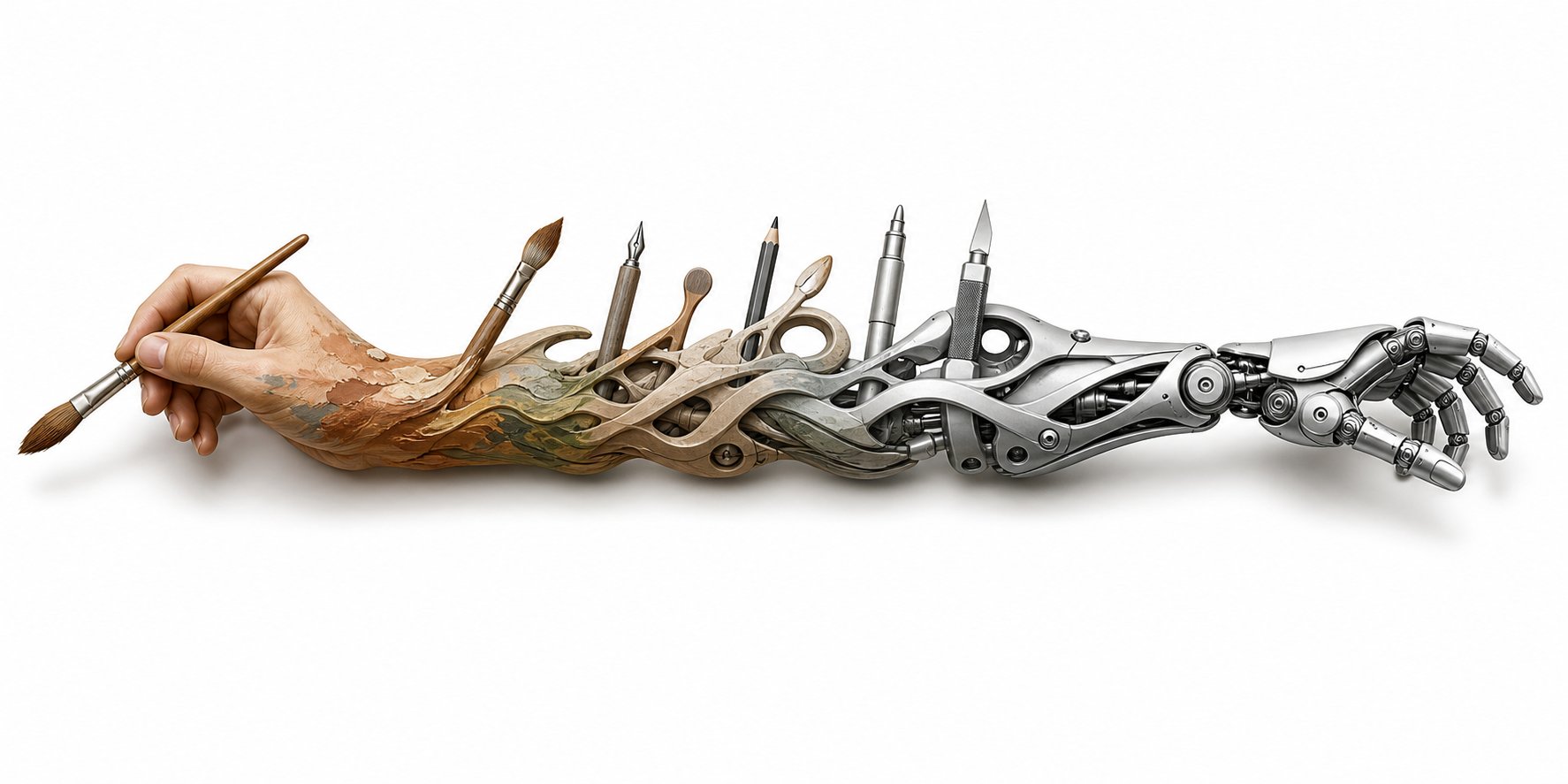
In reality, ai in music production exists on a spectrum. Not a binary switch between "human-made" and "AI-made" but a gradient with many positions between those poles. Understanding where a given use case falls on that gradient clarifies which applications genuinely threaten musical culture and which ones simply make the creative process faster.
The Spectrum from Enhancement to Replacement
Think of it as a ladder. Each rung represents a deeper level of AI involvement in the creative process, from minimal assistance to full autonomy. The further up you climb, the less human decision-making remains in the loop.
- AI as technical assistant: The AI handles non-creative mechanical tasks. Mixing suggestions, mastering EQ adjustments, audio restoration, stem separation. The human makes every musical decision; the AI just executes technical operations faster. Think of AI-powered mastering plugins or noise reduction tools. No creative choices are delegated.
- AI as idea generator: The AI produces raw material that a human evaluates, edits, and reshapes. A songwriter asks for chord progression suggestions or melodic fragments, listens to the output, keeps what sparks something, discards the rest, and builds their own composition around it. The AI contributes possibilities; the human provides curation and intent.
- AI as co-writer and arrangement tool: The AI contributes substantive musical elements that make it into the final product with moderate editing. A producer uses AI to generate a drum pattern, a bass line, or a vocal harmony that they then refine and integrate into a larger arrangement they're directing. Creative control is shared but human-led.
- AI generating from prompts: The human provides a text description, and the AI produces a complete or near-complete song. The creator's role shifts from performer or composer to director and curator, selecting from outputs and potentially refining results through iterative prompting. Musical skill isn't required; taste and intention still matter.
- AI as autonomous composer: The AI generates music continuously with minimal or no human input. Algorithmic playlists, generative ambient streams, and music farms that produce thousands of tracks without creative direction from any individual. No human creative involvement beyond initiating the system.
Here's the critical insight: almost all the fear around whether AI will ruin music focuses on levels four and five. Autonomous generation. Music without musicians. The scenario where the technology renders human creativity irrelevant. That fear isn't irrational, but it misrepresents where most actual AI use in music sits right now.
A LANDR study of 1,200 producers found that 87% already use AI in their workflows, but the usage concentrates heavily on levels one through three. Seventy-nine percent use AI for technical tasks like mixing, mastering, or audio restoration. Sixty-six percent use it as a creative aid for songwriting, melodies, or instrumentation. Only 13% have used a tool to generate an entire song. The vast majority of working musicians are using AI to work faster, not to stop working.
Even among those who experiment with full-song generation, the motivation is often closer to level two than level five. Twenty-nine percent of respondents use AI to generate vocals, drums, or instrumentals, but they're generating parts to complement existing arrangements, filling skill gaps or exploring ideas they wouldn't have reached otherwise. They're reacting to AI output, not deferring to it.
AI as a Creative Collaborator Rather Than a Replacement
Will ai get better at helping with making music? Almost certainly. But "better at helping" and "better at replacing" are different trajectories. The distinction between AI music generators and AI music assistants matters enormously here. Generators produce finished audio from prompts. Assistants operate inside your existing workflow, controlling your DAW, loading your instruments, writing editable MIDI, and handling mechanical tasks while you retain creative authority over every decision.
When an AI assistant opens a synthesizer in your session, creates MIDI notes for a chord progression, and places them in your arrangement, everything remains editable. You can change the voicing, swap the instrument, shift the rhythm, or delete it entirely. The AI accelerated the mechanical steps. You still made the music. That's a fundamentally different relationship than typing a prompt and receiving a flat audio file you can't surgically edit.
Many producers describe their AI use in terms that sound more like bouncing ideas off a collaborator than outsourcing their creativity. They generate options to react against. They use AI to overcome the blank-page paralysis that stalls sessions. They delegate the tedious setup work, loading plugins, routing signals, building basic arrangements, so they can focus on the decisions that actually define their artistic identity.
This middle ground is where ai and music production intersect most productively. Not replacement. Not pure autonomy. But acceleration of human intent. The producer who uses AI to generate twenty chord progressions, picks the one that resonates, modifies it, and builds a song around it has a different relationship with the technology than someone who types "sad indie song" and publishes whatever comes back.
Platforms like MakeBestMusic sit in the prompt-to-song space, letting you turn lyrics, style ideas, and creative direction into complete AI-generated tracks. For someone trying to form their own opinion on whether artificial intelligence for music production enhances or diminishes the creative process, tools like this offer a direct way to experience the spectrum firsthand rather than only reading arguments about it. You can test your own reaction: does generating music from a prompt feel like creating, like directing, or like something else entirely? That firsthand experience tends to be more informative than any think piece.
The spectrum framework also clarifies the ethical boundaries. An AI mastering tool that polishes your mix raises zero questions about authorship. An AI assistant that writes MIDI in your DAW session exists in a gray zone but keeps you as the architect. A prompt-to-song generator that produces complete tracks for streaming distribution occupies contested territory where questions of credit, compensation, and creative ownership become urgent.
Where the industry ultimately lands on these distinctions will determine whether AI tools become the new synthesizer, another creative instrument that expands what musicians can do, or the new Napster, a force that redistributes value away from creators before anyone figures out how to make the system fair. The difference between those outcomes isn't technical. It's a matter of choices: regulatory choices, platform choices, and individual choices about how deeply each of us lets the technology into our creative process.
The Balanced Verdict on AI and Music's Future
So will ai take over the music industry? After examining the economic data, the stakeholder impacts, the listener psychology, the ethical gaps, and the spectrum of creative involvement, a single yes-or-no answer would be dishonest. The reality is messier and more interesting than either techno-optimists or doomsayers acknowledge. AI will not ruin music in any absolute sense. But it will cause genuine harm to specific people in specific roles unless deliberate choices are made to prevent that. And it will simultaneously unlock creative possibilities that didn't exist five years ago.
The verdict depends on what you mean by "ruin," who you're asking about, and what decisions get made in the next few years. Here's where the evidence actually points.
Where AI Genuinely Threatens Music
The threats are real, measurable, and already materializing. Dismissing them as fear-mongering ignores what's happening in artists' royalty statements right now.
- Economic dilution for working musicians: The pro-rata streaming model means every AI-generated track that accumulates streams pulls money from the same finite pool human artists depend on. With AI content representing 44% of new uploads on platforms like Deezer, the dilution effect is not hypothetical. Independent artists operating without label advances absorb this damage disproportionately. A CISAC-backed study estimates 27% of music creators' revenues could be at risk by 2028 due to unregulated generative AI, amounting to cumulative losses of approximately 22 billion euros over five years.
- Homogenization of popular music: Large AI models trained predominantly on Western pop, rock, and classical music push outputs toward a mainstream average. As these tools become embedded in production workflows, they risk flattening the musical diversity that makes culture rich. Nick Bryan-Kinns of the University of the Arts London warns that "different rhythms, scales and structures that reflect the richness of our musical heritage" cannot be generated by models biased toward dominant Western styles.
- Erosion of cultural value placed on musical skill: If anyone can generate a polished song in seconds, the perceived value of spending years mastering an instrument, developing a voice, or learning the craft of composition diminishes. Not because the skill becomes less real, but because the market assigns less economic premium to it. Session musicians in functional music are experiencing this erosion first.
- Displacement of the most vulnerable creators first: Background music composers, stock library contributors, sync licensing professionals, and early-career artists building income from streaming micro-royalties face the most immediate displacement. The markets where AI alternatives are cost-competitive happen to be the markets where independent musicians earn their rent.
None of these threats mean music disappears or stops being meaningful. They mean specific people lose livelihoods, specific creative ecosystems shrink, and specific cultural values get tested. The damage is concentrated, not universal, but that makes it no less real for those affected.
Where AI Genuinely Helps Music Thrive
The benefits are equally real, and pretending they don't exist serves nobody. For many creators, AI tools represent the most significant expansion of creative access since affordable home recording.
- Democratized access to music creation: A teenager in a rural town with no access to studios, session musicians, or production mentors can now create professional-sounding music. The barrier to entry has dropped from thousands of dollars in equipment and years of training to a laptop and an idea. That expansion of who gets to make music is genuinely meaningful, especially for underrepresented voices who were previously locked out by economic gatekeeping.
- New creative possibilities: AI doesn't just replicate what already exists. It enables experimentation at speeds that weren't previously possible. Generating twenty arrangements of the same song to hear which direction resonates, prototyping genre fusions, exploring musical traditions you haven't studied, these capabilities expand the creative palette for musicians willing to engage with the tools as collaborators rather than replacements.
- Acceleration of production workflows: For working producers, AI handles the mechanical tedium that eats studio hours: loading instruments, generating reference arrangements, automating mixing decisions, restoring audio, separating stems. That time savings lets creators focus on the decisions that actually define their artistic identity. Eighty-seven percent of producers already use AI in their workflows, and the majority report that it makes them more productive without diminishing their creative ownership.
- Reduced barriers for underrepresented voices: Musical traditions outside the Western mainstream have historically struggled for visibility in commercial markets. Smaller AI models trained on specific cultural traditions, like the ones developed in the Responsible AI for Music project at the University of the Arts London, could preserve and reimagine musical heritage in ways that large commercial platforms cannot.
The tension between these threats and benefits is not something that resolves cleanly. Both exist simultaneously. The same platform that lets an underrepresented artist produce their first album also lets a music farm generate ten thousand ambient tracks overnight. That duality is the defining characteristic of this moment.
What Happens Next Depends on Choices Made Now
Here's the part that matters most: AI will not ruin music automatically. There's no predetermined trajectory where the technology inevitably destroys creative culture. The outcomes depend entirely on decisions being made right now by regulators, platforms, labels, and individual creators.
The regulatory landscape is forming in real time. The proposed AI Music Transparency Act in the US would require labeling, training data disclosure, and artist opt-out mechanisms. The EU AI Act already classifies certain AI music uses as high-risk and mandates consent for voice cloning. South Korea requires opt-in consent for training. These frameworks are imperfect and unevenly enforced, but they demonstrate that policy choices can shape how the technology impacts creators.
Platform decisions matter equally. Whether streaming services create separate royalty pools for AI content, implement user-centric payment models, or enforce minimum stream thresholds will directly determine how much economic damage AI flooding causes to human artists. Deezer's decision to exclude AI-generated tracks from recommendations represents one approach. Spotify's spam removal efforts represent another. Neither is sufficient alone, but both show that platform architecture is a choice, not an inevitability.
Cultural attitudes carry weight too. If listeners consistently signal that they value human artistry, if they seek out verified human-made music, support artists directly, and attend live performances, the market will reward human creativity regardless of how much AI content floods the ecosystem. The 40% of streaming users who say they'd skip AI-generated tracks if labeled represent a significant market force, one that could sustain human musicians even in a landscape saturated with generated alternatives.
And individual creators face their own choices about how deeply to integrate AI into their process. As Carnegie Mellon's research demonstrates, AI-assisted music tends to be less creative than purely human compositions. But used as an ideation tool rather than a replacement for creative judgment, AI can complement human musicianship without displacing it. The musician who uses AI to overcome creative blocks while retaining authorship over every final decision occupies a fundamentally different position than a music farm pumping out content with no human involvement.
AI cannot write songs the way humans do, drawing from lived experience, emotional truth, and the deliberate imperfections that make art feel alive. What it can do is generate sound that mimics those qualities convincingly enough to compete for attention and revenue. Whether that competition enriches or impoverishes musical culture depends on the rules we build around it.
Rich Randall of Carnegie Mellon's Music Experience Lab put it simply: "I don't think there's a limit to human creativity. The ways humans shape pitches, not just how they combine them, but how they shape the sounds of them, how they organize them in time, the rhythmic pullbacks, delays and pushes that someone adds, it's not formulaic." AI-generated music, by contrast, "is always going to be derivative in some way, it's always going to be playing it safe."
That's the fundamental asymmetry. AI can produce competent music indefinitely. It cannot produce the unexpected, the vulnerable, the genuinely new. Human creativity remains the source of everything that moves music forward. The question is whether we build systems that protect and compensate that creativity or let it get buried under an avalanche of adequate content.
The ai in music industry story isn't over. It's barely begun. The technology will improve. The legal precedents will solidify. The market will adapt. But the shape of that adaptation isn't written yet. It's being negotiated in courtrooms, boardrooms, legislative chambers, and studio sessions right now.
Rather than forming opinions about AI music in the abstract, based on headlines and hypotheticals, you might find it more useful to experience the technology directly. Tools like MakeBestMusic's AI generator let you turn prompts, lyrics, and style ideas into complete songs, giving you firsthand insight into what AI can actually do, where it falls short, and whether the result feels like creation, curation, or something else entirely. That personal experience tends to cut through the noise faster than any article can. Try it, react to what you hear, and decide for yourself where you stand on the spectrum between fear and possibility.
