

Defining Real Music in the Age of Algorithms
Is AI music real music? The short answer: it depends on how you define music. If music is organized sound with melody, rhythm, and harmony, then yes, AI output qualifies. If music requires human intention and emotional expression behind it, the answer gets complicated. And if music is simply whatever moves a listener emotionally, then the source becomes irrelevant. The question isn't really about sound waves. It's about what we believe music fundamentally is.
Why This Question Matters Now
This isn't a hypothetical debate anymore. AI music on Spotify and other streaming platforms has become impossible to ignore. According to a Luminate report covered by NPR, approximately 44% of daily uploads to the streaming service Deezer are now AI-generated tracks. Spotify recently announced a deal with Universal Music Group to let premium subscribers create AI remixes of existing songs. Artists like SZA have said they feel "at war" with AI-generated content. The latest ai music news today points in one direction: music and artificial intelligence are no longer separate conversations. They're the same conversation, and it's splitting listeners and musicians into opposing camps.
Three Ways to Define Real Music
Philosophers have debated what counts as music for centuries. The Stanford Encyclopedia of Philosophy notes that definitions of music typically start with "organized sound" and then add further conditions. For this article, we'll use three distinct frameworks as our guide:
- Structural - Does it have melody, rhythm, harmony, and form? If the sonic architecture meets these criteria, it qualifies as music regardless of who or what built it.
- Intentional - Was it created with human purpose and emotional expression? This framework requires a sentient being communicating something through the sound.
- Experiential - Does it move the listener? If a track produces chills, joy, or tears, that neurological response is real no matter what generated the audio.
Each framework yields a different verdict. And most people hold some blend of all three without realizing it.
Whether AI music counts as "real" depends entirely on which definition of music you adopt. This article examines all three seriously, because the question deserves more than a hot take.
The cultural anxiety around this debate feels urgent and new. But the pattern itself is remarkably familiar. Nearly every major technological shift in music history triggered the exact same question, and the answer expanded every single time.
Every Music Revolution Was Called Fake First
Imagine telling someone in 1906 that a machine playing music in their living room would one day be completely normal. They'd have called you delusional. Or worse, a threat to civilization. That's essentially what happened. The debate around AI in the music industry feels new, but the script is over a century old. Every major leap in music technology was met with the same accusation: that's not real music.
The Player Piano and the Death of Performance
In the early 1900s, player pianos let families fill their homes with ragtime or Bach without anyone learning to find middle C. Advertisements sold the machines as a way to produce quality music instantly, "without the least preparatory study," as one 1909 ad promised. Sound familiar? That's the same pitch AI music tools make today: access, ease, and professional-sounding results for amateurs.
Composer John Philip Sousa saw it differently. In his 1906 essay "The Menace of Mechanical Music," he warned that devices like the player piano and phonograph would reduce music to "a mathematical system of megaphones, wheels, cogs, disks, cylinders, and all manner of revolving things" devoid of soul. He predicted children would become "indifferent to practice" and that amateur musicianship would erode entirely. He even imagined a future where "no one will be ready to submit himself to the ennobling discipline of learning music."
By the 1930s, the panic escalated. The American Federation of Musicians launched a campaign against "canned music," running newspaper ads featuring menacing robots performing music and symbolizing machines displacing humans. One ad put the word "music" in quotes when describing recorded sound, implying it didn't deserve the name. AFM president Joseph N. Weber declared that the public would eventually "want the real thing" because scientific development "must not come at the expense of art." The worst predictions never materialized. Player pianos didn't eliminate concert pianists. Some composers even embraced piano rolls and wrote music specifically for them.
Synthesizers, Sampling, and Auto-Tune
The pattern repeated with each new decade. When rock 'n' roll exploded in the 1950s, powered by electric guitars and amplifiers, Frank Sinatra called it "the most brutal, ugly, degenerate, vicious form of expression" he'd ever heard. When Bob Dylan plugged in an electric guitar at the 1965 Newport Folk Festival, an audience member shouted "Judas!" Going electric was heresy.
Then came synthesizers. The British rock band Queen proudly stamped "No Synthesizers!" on four album sleeves during the 1970s, signaling that their music was made with "real" instruments only. The UK Musicians' Union grew so alarmed that in 1982 it passed a resolution to ban synthesizers and drum machines. Session players rallied behind the slogan "Drum machines have no soul," which appeared on bumper stickers as a protest against programmed beats. Every industry musician who relied on live performance saw electronic tools as an existential threat.
Hip-hop's golden age in the late 1980s and early 1990s brought sampling into the crosshairs. Critics argued that rearranging someone else's recordings wasn't composition. It was theft, laziness, or at best a gimmick. Lawsuits followed. Definitions shifted. Turntables became instruments. Laptops took the stage in EDM. And by the early 2000s, Auto-Tune drew the next line in the sand. Death Cab for Cutie launched a campaign to "bring back the blue note," preserving the slight vocal imperfections that convey human feel. Dave Grohl of Foo Fighters, accepting a Grammy in 2012, declared: "It's not about being perfect, it's not about sounding absolutely correct, it's not about what goes on in a computer."
What History Tells Us About AI
The language barely changes across a century. "Soulless." "Mechanical." "Fake." "Canned." When generative ai music news breaks today and musicians push back against AI tools, they reach for the same vocabulary Sousa used in 1906 and the Musicians' Union used in 1930. Garage-rock artist Olivia Jean called AI music "heartless, soulless, ridiculous." Nick Cave labeled AI-written lyrics "a grotesque mockery of what it is to be human." Even Meta CEO Mark Zuckerberg said AI music will "feel a little soulless."
The recurring anxiety isn't really about musical quality. It's about human displacement. Who gets to call themselves a creator? Who earns a living? Who holds cultural power? As one Aeon essay on drum machines observes, debates over authenticity in music tend to "hide other concerns about who has power, who defines cultural taste, and who can access music-making."
- Player Piano (1900s) — Criticism: removes the need for human skill; produces "canned" imitation music. Resolution: didn't replace pianists; some composers wrote specifically for piano rolls; contributed to new forms of musical labor.
- Electric Guitar (1950s-60s) — Criticism: ugly noise, not real musicianship, betrayal of acoustic tradition. Resolution: became the defining instrument of multiple genres; redefined what popular music sounds like.
- Synthesizer (1970s-80s) — Criticism: soulless machine sounds replacing real instruments; unions attempted outright bans. Resolution: became foundational to pop, new wave, hip-hop, and electronic music worldwide.
- Sampling and Drum Machines (1980s-90s) — Criticism: not original composition; theft; "drum machines have no soul." Resolution: turntables and samplers recognized as legitimate instruments; hip-hop became the world's dominant genre.
- Auto-Tune (2000s) — Criticism: erases human imperfection; makes untalented singers sound capable. Resolution: became a deliberate artistic effect; used creatively by artists from T-Pain to Bon Iver.
- AI Generation (2020s) — Criticism: soulless, no human experience behind it, threatens livelihoods. Resolution: still unfolding.
Every single time, the definition of "real music" expanded to absorb what it once rejected. The technology that terrified one generation became the creative bedrock of the next. That doesn't automatically mean AI will follow the same trajectory. But it does mean the burden of proof has shifted. The question worth asking isn't whether AI output sounds like music. It's whether AI output meets the structural, intentional, and experiential criteria that define music on a deeper level.
What Music Theory Says About Machine Compositions
History shows us the pattern of rejection and acceptance. But patterns alone don't settle the question. If we want a rigorous answer about whether AI output qualifies as music, music theory offers the most objective measuring stick available. Forget opinions for a moment. What do the structural criteria actually say?
Melody, Harmony, and Rhythm in AI Output
Pull up any of the top ai songs generated by platforms like Suno or Udio, and you'll find something striking: the outputs contain identifiable key signatures, functional chord progressions, rhythmic patterns with consistent meter, and melodic contour that rises, falls, and resolves. These aren't random sound collages. They follow the same organizational principles that underpin a Bach chorale or a Beatles single.
AI music generators trained on vast datasets learn the statistical relationships between notes, intervals, and rhythms. The result? Outputs that demonstrate tonal center, harmonic tension and resolution, syncopation, phrase structure, and dynamic variation. From a purely formal standpoint, this is music. It meets every checkbox a first-year music theory student learns to identify.
A 2025 biometric study found that emotional valence did not differ significantly between AI-generated and human-composed soundtracks, suggesting the structural properties of AI music produce comparable affective patterns in listeners. The building blocks are all there.
Composition vs. Intentional Expression
Here's where it gets complicated. Music theory can tell you whether a piece has a I-IV-V-I progression in C major. It cannot tell you whether that progression means anything. Structure defines the skeleton. But is a skeleton a living thing?
This tension isn't new. Mozart's Musikalisches Wurfelspiel (Musical Dice Game) from 1787 let players assemble minuets by rolling dice to select pre-composed phrases. The output was structurally perfect music. But was Mozart the composer of each unique arrangement, or was randomness? In the mid-20th century, Iannis Xenakis applied probability theory and mathematical models to generate entire musical structures through what he called stochastic music. His work was performed in concert halls, reviewed by critics, and studied by musicologists. It met every structural criterion for music while deliberately removing conventional human decision-making from large portions of the compositional process.
The generative audio news cycle constantly surfaces new AI tools that operate in this same conceptual space. An ai music remix tool might restructure a song's harmonic framework algorithmically, producing something structurally coherent yet untouched by human intention at the note level. The question becomes: does structural correctness alone make something music, or is intentional expression a separate, non-negotiable requirement?
Formalists say structure is sufficient. Expressivists say it's necessary but not enough. The table below lays out where AI output genuinely excels and where honest gaps remain.
| Musical Element | Definition | Does AI Output Meet This Criterion? | Notes |
|---|---|---|---|
| Melody | A sequence of pitched notes forming a recognizable line | Yes | AI generates coherent melodic contour with phrasing and repetition |
| Harmony | Simultaneous combination of pitches creating chords and progressions | Yes | Functional harmony with tension and resolution is reliably produced |
| Rhythm | Organized patterns of duration and accent in time | Yes | Consistent meter, syncopation, and groove patterns appear in output |
| Form | Large-scale structure (verse-chorus, sonata, ABA, etc.) | Mostly | Short-form structures are strong; extended compositions can lack purposeful development |
| Dynamics | Variation in volume and intensity over time | Partially | Some dynamic range exists, but nuanced expressive shaping (rubato, crescendo tied to emotional arc) remains limited |
| Intentional Expression | Communication of meaning, emotion, or lived experience | No (inherently) | AI has no subjective experience to express; any perceived meaning originates in the listener or the human who prompted it |
The honest assessment: AI passes the structural test convincingly on melody, harmony, and rhythm. It performs reasonably well on form in short pieces. It falls short on expressive dynamics and entirely lacks inherent intentional expression. Whether those gaps disqualify it from being "real music" depends on whether you believe structure alone is sufficient or whether something more is required.
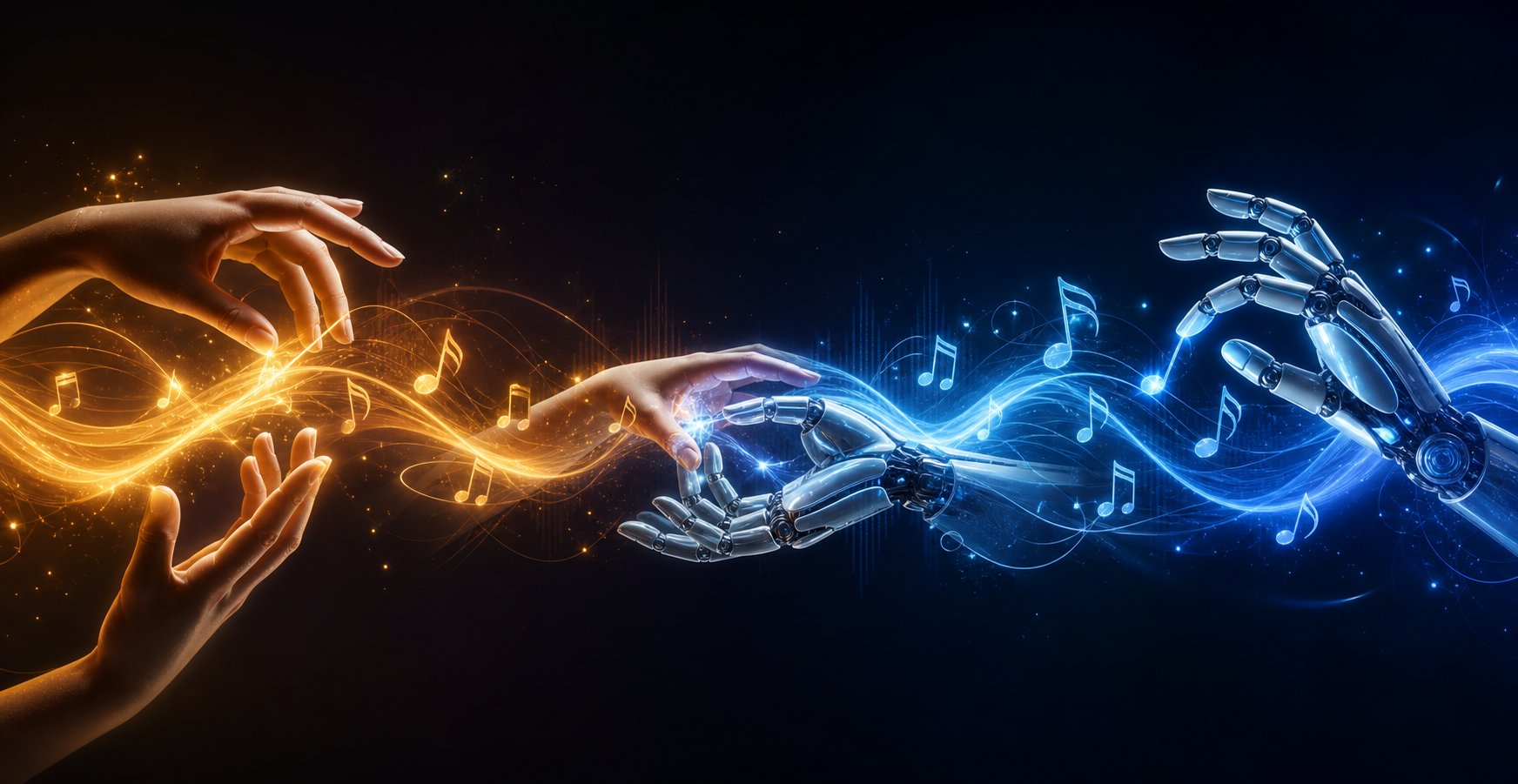
That something more introduces a deeper question. If a human directs AI with specific creative goals, does the human's intention transfer to the output? The answer may depend on how much creative control the human actually exercises, a spectrum that ranges from passive button-pressing to active artistic collaboration.
The Spectrum from AI Tool to AI Composer
Not all AI music is created equally. A producer using an AI plugin to suggest chord voicings is doing something fundamentally different from someone typing "make me a country hit" into a text box and walking away. Yet both scenarios get lumped under the same umbrella in public debate. That flattening distorts the conversation. The reality is a spectrum, and where any given track falls on it determines how convincingly it qualifies as real music.
Research in Human-AI Co-creation identifies two axes that define this spectrum: the balance of creative agency between human and machine, and the depth of collaboration between them. When you map actual tools and workflows along these axes, clear categories emerge.
AI as Instrument
Imagine a guitarist using a smart harmonizer pedal that generates complementary notes based on what they play. The human chooses the key, the tempo, the emotional arc. The tool executes a specific mechanical task. This is AI functioning as an instrument, a "compositional prosthesis" in research terminology. The human directs every meaningful creative decision.
Tools like Izotope's Ozone mastering assistant or Google Magenta's DAW plugins fit here. They might suggest EQ settings or generate a four-bar melodic phrase, but the musician selects, edits, arranges, and discards at will. The creative agency stays with the human. By any definition, structural, intentional, or experiential, the resulting music is real. Nobody questions whether a song is legitimate because the producer used a compressor plugin. AI at this level functions identically.
AI as Collaborator
The middle ground is where things get interesting. Here, a human provides creative direction: lyrics, genre preferences, mood descriptors, maybe a reference track. The AI generates a full composition based on those inputs. The human evaluates, iterates, and curates from multiple outputs.
Is the human's creative intent sufficient to confer legitimacy? Consider the parallel: a film director doesn't personally operate the camera, compose the score, or edit each frame. Yet nobody questions whether the resulting film is "their" creative work. Direction, selection, and curation are recognized forms of creative labor. Many ai music artists working today operate in exactly this collaborative space, providing substantial creative vision while AI handles execution.
Discussions on ai generated music reddit threads frequently land here. Users describe spending hours refining prompts, adjusting outputs, combining elements from different generations, and tweaking lyrics until the result matches their internal vision. That process resembles composition more than passive consumption. The creative agency is shared, but the human retains the role of decision-maker, choosing what succeeds and what gets discarded.
AI as Autonomous Creator
Then there's the far end. Fully autonomous generation where no human provides meaningful creative direction beyond perhaps clicking "generate." Ohio University music industry expert Josh Antonuccio describes this as an "entirely different ecosystem" in the recorded music space, one where AI-generated artists like Breaking Rust and The Velvet Sundown accumulate millions of streams without any human musician behind them. These are cases of what researchers call "Heroic AI" rather than "Collaborative AI," where the machine assumes all creative agency.
This is where the debate intensifies. The structural criteria are still met: melody, harmony, rhythm, and form are all present. But without a human directing the creative vision, the intentional framework collapses. There's no one expressing anything. The music exists because statistical patterns converged, not because someone had something to say.
The following scale maps these categories into a clear framework. Think of it as a legitimacy gradient rather than a binary switch:
- AI as basic tool — AI performs a narrow technical task (noise removal, pitch correction, EQ balancing). The human controls all creative decisions. Clearly real music by every definition.
- AI as enhanced instrument — AI generates small musical elements (a suggested chord, a four-bar phrase, a drum pattern) that the human integrates into a larger composition. Still firmly real music; analogous to using a loop library or arpeggiator.
- AI as creative partner — Human provides substantial direction (lyrics, genre, mood, structure) and AI generates full compositions. The human curates, edits, and iterates. Real music under structural and experiential definitions; debatable under strict intentional definitions, though human creative intent is clearly present.
- AI as primary creator with human selection — AI generates music autonomously; a human's only role is choosing which output to publish. Structurally qualifies as music. Intentionally questionable, since curation alone may not constitute creative expression. This is where many ping ai-style one-click generators operate.
- AI as fully autonomous composer — No meaningful human involvement at any stage. AI generates, selects, and distributes. Structurally music, experientially music if it moves a listener, but intentionally empty. The "real music" question is hardest to answer here.
Most real-world use cases cluster between levels 2 and 4. As Antonuccio puts it, the future will include "fully-generated AI artists, as well as established and emerging artists that use AI as a part of their workflow." The spectrum isn't a neat dividing line. It's a gradient where legitimacy fades gradually rather than vanishing at a single threshold.
The structural and intentional frameworks both point toward the human's role as the key variable. But there's a third framework we haven't fully tested yet: the experiential one. What happens in the listener's brain when AI music plays? Does the nervous system even care who made it?
How Your Brain Hears Music Regardless of Its Origin
Your auditory cortex doesn't ask for credentials. When sound waves reach your inner ear, the cochlea transforms vibrations into neural signals regardless of whether a human or an algorithm arranged those frequencies. The brain processes pitch, rhythm, and harmonic relationships the same way every time. So what does cognitive science actually tell us about how listeners experience AI music versus human-made music? The findings are more surprising than the debate suggests.
Can You Tell the Difference
You might think you'd spot the difference immediately. Most people do. But the research tells a different story. A 2025 study on listener responses to AI-generated pop music found no significant differences between AI-labelled and human-labelled music on perceived liking or quality when participants evaluated the same AI-generated songs under different authorship labels. Ratings for liking averaged 5.41 for music labelled as AI and 5.37 for music labelled as human-composed, a gap so small it fell well within statistical noise.
This pattern holds across multiple experiments. When listeners evaluate music without knowing its origin, their ability to distinguish AI from human composition hovers near chance. The sonic architecture that AI produces, its chord progressions, melodic contours, rhythmic patterns, activates the same perceptual pathways as human-composed music. If you've ever tried to find a song using partial lyrics and discovered it was AI-generated, you've already experienced this firsthand. The track sounded real enough to stick in your memory.
The implication is straightforward: at the level of pure sonic perception, AI music and human music are functionally indistinguishable for most listeners in most contexts. Whatever separates them, it isn't something the ear alone can detect.
Emotional Response Does Not Check Credentials
When you hear a piece of music that gives you chills, a cascade of neurological events fires without consulting the liner notes. Research on the neural circuitry of musical pleasure shows that intensely pleasurable music activates the ventral striatum, the same brain region that responds to food, sex, and drugs of abuse. Dopamine release in both ventral and dorsal portions of the striatum occurs during chill-inducing music, with dorsal activity linked to anticipation and ventral activity linked to the peak pleasure moment itself.
Think about what this means. The mesolimbic reward system, your brain's core pleasure architecture, responds to musical patterns based on their structural properties: expectation, tension, resolution, and surprise. It responds to whether the music confirms or violates your predictions about what comes next. This process doesn't include a checkpoint that asks, "But who composed this?"
The amygdala, typically associated with threat and negative emotion, actually deactivates during highly pleasurable music listening. The orbitofrontal cortex lights up during consonant, pleasant passages. The parahippocampal cortex engages during dissonant or tense moments. These responses operate on the acoustic signal itself. Whether you're studying and wondering if it's okay to listen to music while studying, or fully immersed in a concert experience, your neural reward circuitry responds to the sound, not the biography behind it.
Psychophysiological measures reinforce this. Heart rate changes, skin conductance spikes, and respiratory shifts all track musical structure rather than authorship. Listeners show consistent physiological arousal at moments of harmonic surprise, new instrument entries, and melodic climaxes, the same moments that trigger these responses in human-composed works trigger them in AI-generated ones. If a song produces joy, nostalgia, or that spine-tingling chill, those neurological responses are measurably real. Your body doesn't fake them, and it doesn't verify authorship before producing them.
The Authenticity Paradox
Here's the catch. While your brain processes the sound identically regardless of source, knowing the source changes everything. A large-scale lab study at Amsterdam's NEMO Science Museum (N = 372) played the exact same orchestral piece to two groups. One group was told it was composed by AI. The other was told it was performed by a human orchestra. Same music. Different label. The results were striking.
Participants in the human condition rated appreciation significantly higher (M = 5.33) than those in the AI condition (M = 4.57). They also reported stronger emotional responses: 4.62 versus 3.96 on the aesthetic emotion scale. The same sonic information, hitting the same ears, produced measurably different subjective experiences based purely on a label. People didn't just think they liked the human-attributed version more. Their bodies responded differently too.
The researchers measured respiratory sinus arrhythmia (RSA), an involuntary marker of cardiovascular stress that people cannot consciously control. Participants who believed the music was AI-generated showed progressive vagal withdrawal over the course of listening, a physiological stress response. Those who believed it was human-made showed no such decline. The music didn't change. The label activated a deeper, embodied threat response, particularly in people who held strong beliefs that creativity is uniquely human.
This is more than a song more human than human debate. It's a paradox baked into our psychology. The emotional experience of music is simultaneously real and manipulable by context. Your pleasure pathways fire on the acoustic signal, but your cognitive appraisal system can dampen or amplify that response based on what you believe about the music's origin. The same study found that this effect was moderated by what researchers call anthropocentric creativity beliefs: the stronger someone believes creativity is exclusively human, the more threatened they feel by AI-attributed music, and the less they enjoy it.
Interestingly, the pop music study found the opposite pattern among younger university students. When the same AI-generated songs were labelled as AI, participants actually rated them higher on happiness, interest, awe, and energizing emotions compared to the human-labelled versions. This suggests the bias isn't fixed. It's generational, cultural, and tied to how comfortable someone is with AI entering creative spaces.
Emotional authenticity in the listener exists independently of creative authenticity in the composer. Your brain's pleasure response to music is real whether or not the music was made by a human, but knowing it wasn't can override that response through a separate psychological mechanism entirely.
The experiential framework, then, gives a qualified yes: AI music is real music because the emotions it produces are real. But that yes comes with a psychological asterisk. Our beliefs about authorship act as a filter between the sound and the feeling. The music doesn't change. We do. And that raises a different kind of question, one that philosophy and cultural tradition have been wrestling with far longer than cognitive science has existed.
Four Philosophical Frameworks for Judging AI Music
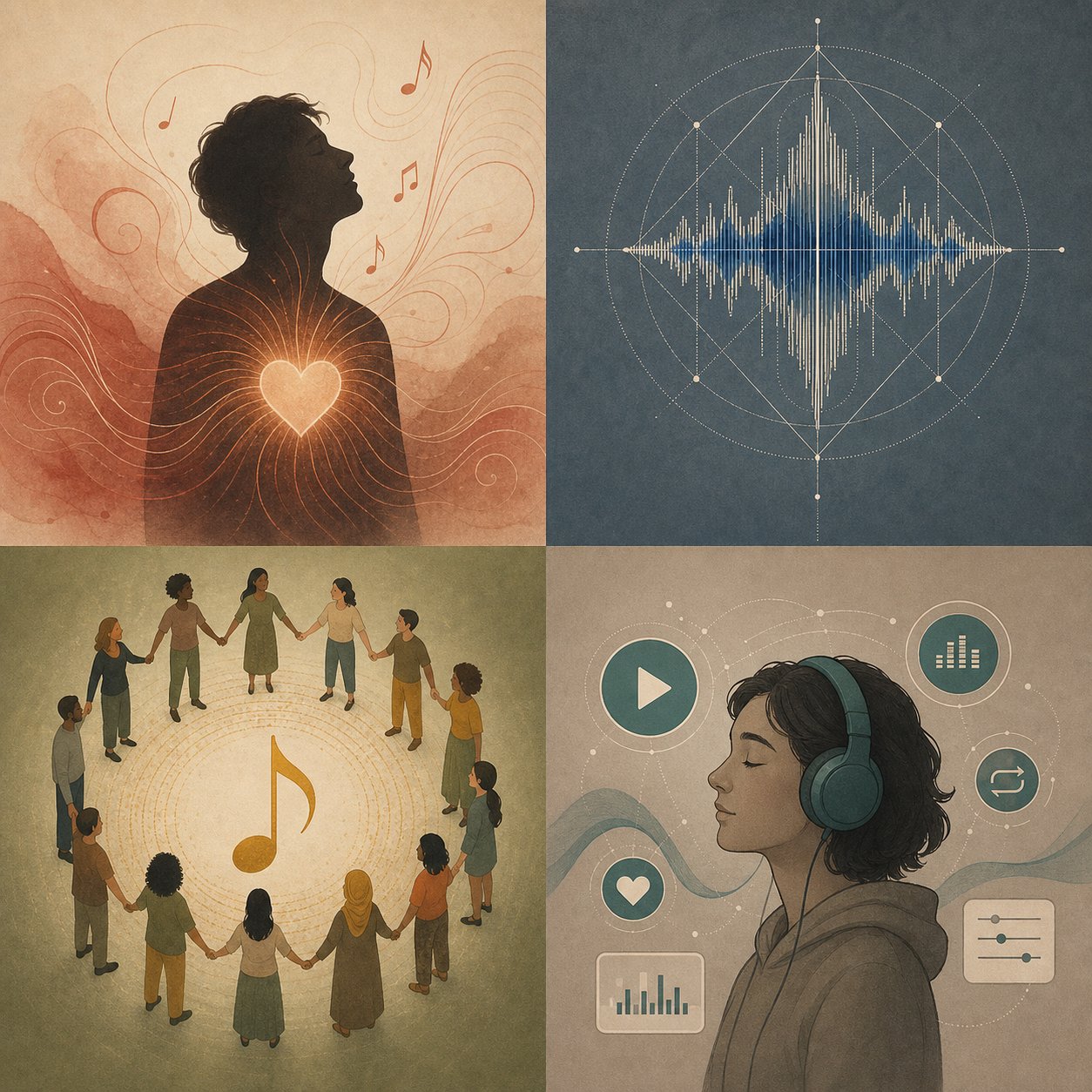
Neuroscience tells us the brain responds to musical patterns without checking who made them. But the brain isn't the only authority here. Humans don't just process music. They interpret it through cultural values, spiritual traditions, and philosophical commitments that run far deeper than neural reward circuits. What does music mean within these frameworks, and does AI output survive their scrutiny?
Music as Human Expression
The Romantic tradition, stretching from Beethoven through the singer-songwriters of the 1970s, holds that music is fundamentally the voice of lived experience. A composer pours grief, longing, or joy into sound, and the listener receives it as communication from one consciousness to another. Songs about singers often celebrate exactly this: the artist who channels raw human truth into melody.
Under this framework, music without a sentient being behind it simply isn't music in the fullest sense. As one critical analysis of AI composition puts it, AI "can process and reproduce musical structures with artisanal precision, but without any intention of its own." The distinction is subtle but essential: if art is defined by human experience, then AI-generated music cannot be considered art in the strict sense because it lacks real experience. It is technical elaboration, not authentic expression. The composer's suffering, wonder, or defiance is the ingredient that transforms organized sound into something sacred. Without it, you have a beautiful shell with nothing living inside.
Music as Organized Sound
Not everyone agrees that meaning must precede music. The formalist tradition takes a radically different position: music is organized sound, full stop. Who organized it, and why, is irrelevant to whether it qualifies.
Composer Edgard Varese famously championed this definition, using the phrase "organised sound" to connote a broad definition of what music was, and might be, within a scientific and technological world. John Cage pushed the idea further. His 1952 composition 4'33" consisted entirely of silence, reframing ambient noise as music by placing it within an intentional frame. If silence can be music, then the source of sound becomes categorically irrelevant. What matters is the perceptual frame, not the origin story.
Under formalism, AI music qualifies without hesitation. It exhibits pitch relationships, rhythmic organization, harmonic structure, and temporal form. It is sound that has been organized. The question of who or what did the organizing is, to a formalist, as irrelevant as asking whether a river "intended" to carve a beautiful canyon.
Music as Cultural Practice
A third perspective moves beyond both the individual creator and the sonic object to focus on music as something people do together. In many traditions, the act of making music is inseparable from community, ritual, and shared meaning. Think of flamenco songs emerging from centuries of Romani cultural experience in Spain, or christian songs about creation sung in congregational worship. These forms don't just exist as audio. They exist as practices embedded in specific social contexts.
Musician and writer John Garner captures this beautifully when describing traditions ranging from "Gnawa religious songs" and "Gospel" to "Sacred Harp" singing and "Ewe drumming." In each case, the music's meaning is bound up in bodies sharing space, in the transmission of knowledge from elder to student, in the communal act of making sound together. AI complicates this framework profoundly. An algorithm cannot participate in ceremony. It cannot grieve with a congregation. It cannot dance alongside other bodies or carry forward the memory of a community's pain and resilience.
Consider the story Garner shares of a Japanese community devastated by the 2011 tsunami: residents retrieved their ceremonial taiko drums from the mud, and a twelve-year-old boy persuaded scattered friends to learn the Deer Dance together. When they performed, "local residents watched it with tears in their eyes." The music's power was inseparable from the act of communal recovery. No AI output could replicate that function, because the function isn't sonic. It's social, spiritual, and embodied.
A fourth perspective rounds out the picture. Pragmatism asks a simpler question: does it work? If a track serves its purpose, whether that's helping someone focus, providing catharsis, or filling a dance floor, then its origin is beside the point. Pragmatists don't need to resolve metaphysical debates. They evaluate music by its effects in the world.
| Philosophical Framework | Definition of Music | Key Criterion | Does AI Music Qualify? |
|---|---|---|---|
| Romantic / Expressionist | Music is the expression of human emotion and lived experience communicated through sound | Sentient creator with something to say | No — AI lacks consciousness, subjective experience, and expressive intention |
| Formalist | Music is organized sound, regardless of source or intent | Structural coherence (pitch, rhythm, form) | Yes — AI output demonstrates clear sonic organization meeting all formal criteria |
| Cultural / Communal | Music is a shared human practice embedded in community, ritual, and tradition | Participatory social context and embodied transmission | No — AI cannot participate in community, ceremony, or intergenerational transmission |
| Pragmatist | Music is whatever functions as music in a given context | Effective function (moves listeners, serves a purpose) | Yes — AI music demonstrably functions as music for millions of listeners across contexts |
Where do you land? Most people hold an intuitive blend of these positions without making the framework explicit. You might feel that AI-generated lo-fi beats serving as background for studying are "real enough" (pragmatist), while simultaneously feeling that an AI-generated ballad claiming to express heartbreak is somehow hollow (expressionist). Both reactions are philosophically coherent. They just draw from different traditions.
The frameworks split evenly: two say yes, two say no. That stalemate might feel unsatisfying, but it reveals something important. The question of whether AI music is real isn't a factual dispute waiting for a correct answer. It's a values question, and your answer reveals which dimension of music you consider most essential: its structure, its origin, its social function, or its practical effect.
Philosophy can map the terrain, but it can't force a verdict. Institutions, however, can. And one institution in particular has already staked a clear position: the legal system. Copyright law has drawn a line in the sand about what counts as creative work, and the reasoning behind that line carries its own philosophical weight.
What Copyright Law Says About AI Creativity
Philosophy offers competing frameworks. But the legal system doesn't have the luxury of ambiguity. Courts and regulatory bodies must draw concrete lines about what counts as creative work, because real money, real ownership, and real enforcement depend on the answer. And in the case of AI music, that line has already been drawn with unusual clarity.
Why AI Music Cannot Be Copyrighted
The U.S. Copyright Office released Part 2 of its report on AI and copyrightability in January 2025, making the position explicit: purely AI-generated works cannot receive copyright protection. The reasoning is grounded in a requirement as old as American copyright itself. Human authorship is, as one federal judge put it in Thaler v. Perlmutter, "the sine qua non at the core of copyrightability." When the U.S. Supreme Court denied certiorari in that case in early 2026, it effectively cemented the principle: AI cannot be an author under the law.
The Copyright Office's analysis is straightforward. Prompts alone do not give a user enough expressive control over the output to constitute authorship. Because AI systems fill in the gaps between a user's instructions and the final work, the resulting expression belongs to the algorithm's internal processes rather than to a human mind. Just as a monkey's selfie cannot be copyrighted and alleged spirit-channeled messages lack human authorship, music generated autonomously by AI falls outside the scope of legal protection. This matters for ai music rights news because it means fully AI-generated tracks sitting on the largest music streaming services exist in a kind of legal no-man's-land: present, playable, profitable, but unownable.
What Copyright Law Reveals About Realness
Think about what this institutional boundary implies. Copyright doesn't merely regulate commerce. It reflects a societal judgment about what constitutes creative expression. By denying protection to AI-generated works, the legal system says something philosophical: that creativity is not just pattern assembly, but a fundamentally human act of expression. The Copyright Office considered over 10,000 stakeholder comments before reaching this conclusion. It isn't an arbitrary policy quirk. It's a deliberate statement about the nature of authorship.
That said, legal definitions are policy choices, not metaphysical truths. Much like how a getty library catalogue classifies and organizes creative works according to institutional standards that evolve over time, copyright law categorizes authorship according to principles that could shift as technology and culture change. Several commonwealth jurisdictions, including the United Kingdom and Hong Kong, enacted laws before modern generative AI that allow copyright in computer-generated works. The consensus isn't universal. But in the U.S., for now, the law treats human agency as a non-negotiable ingredient of creative work.
The Human-Directed Exception
Here's where the spectrum from the previous section resurfaces. The Copyright Office makes clear that using AI in your creative process does not automatically disqualify a work from protection. If a human provides substantial creative direction, makes expressive choices, arranges AI outputs, or modifies generated material in meaningful ways, the resulting work can qualify for copyright. The Office's report uses the analogy of a photographer: the camera assists, but the human's choices in lighting, composition, timing, and editing constitute authorship. AI tools can function the same way.
A Chinese court found that over 150 prompts combined with retouches and modifications produced sufficient human expression for protection. The Copyright Office itself granted partial protection to a comic book "illustrated" with AI but arranged and texted by a human author. Even on an even music platform distributing AI-assisted tracks, the key question isn't whether AI was involved. It's whether a human's creative expression is identifiable in the final work.
The legal distinction is not between music made with AI and music made without it. It's between music where a human directed the creative expression and music where no human did. That distinction mirrors the spectrum of involvement, and it determines whether the law recognizes the result as authored creative work.
Copyright law can't tell us whether AI music is "real" in any absolute sense. But it reveals which version of the question society has chosen to act on: not whether the output sounds like music, but whether a human mind shaped it into being. The legal framework reinforces what the intentional and cultural philosophical frameworks suggested, that origin matters, not just outcome. Still, laws describe what institutions protect. They don't describe what listeners feel, or what creators experience when they sit down with these tools and begin making something new.
Experience AI Music Creation and Judge for Yourself
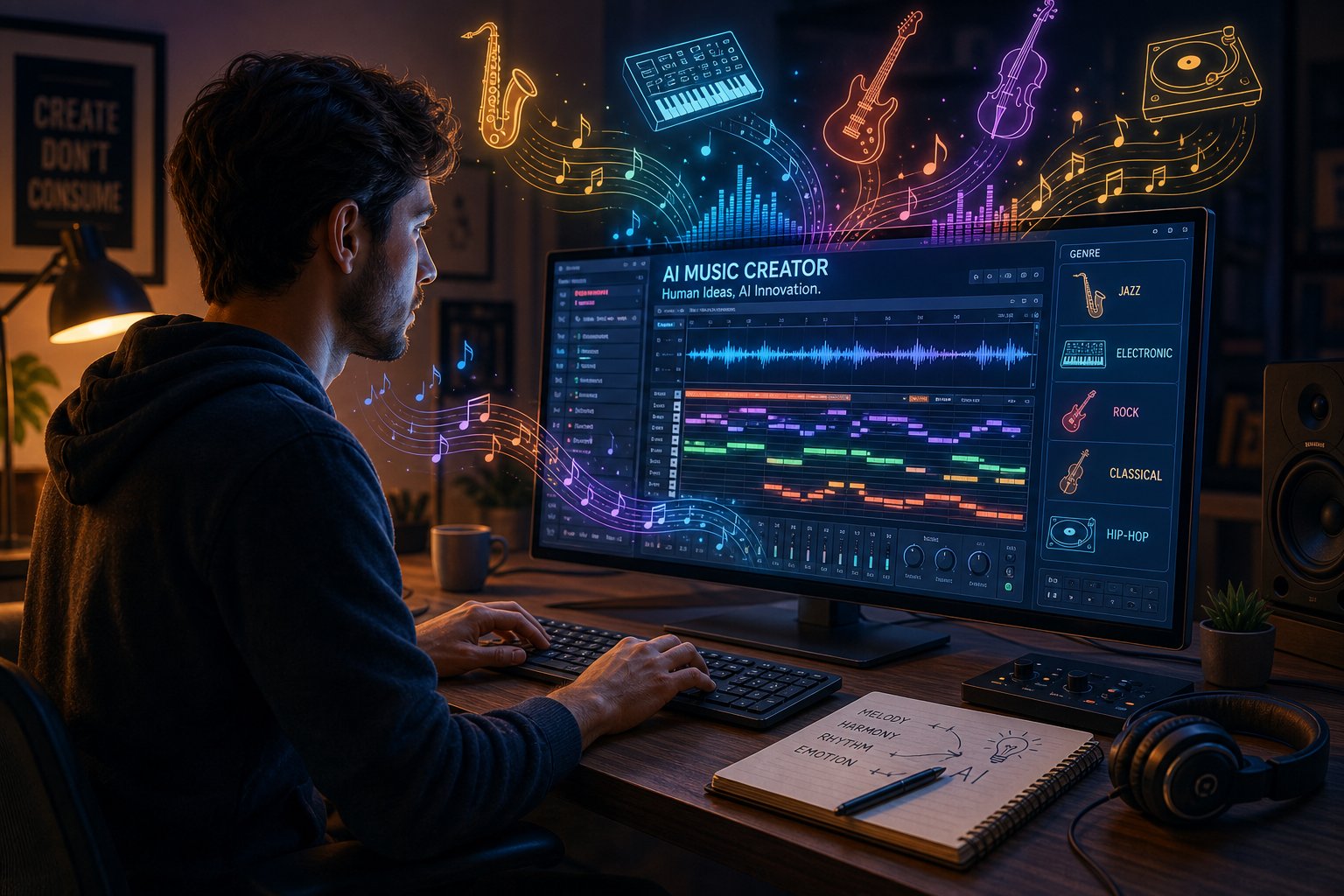
Legal frameworks, philosophical traditions, and neuroscience all offer verdicts on whether AI music qualifies as real. But there's something those frameworks can't replicate: the experience of actually making it. Sitting in front of a blank prompt and shaping raw intention into a finished track reveals something about the creative process that no amount of abstract reasoning can settle for you.
What It Feels Like to Create with AI
People often imagine AI music creation as pressing a single button and walking away. The reality looks nothing like that. Communities on aimusic reddit forums describe workflows that mirror traditional songwriting in surprising ways: you start with an idea, a feeling, a phrase that won't leave your head. Then you translate that internal vision into specific creative decisions.
As Berklee professor Ben Camp describes, using AI for music involves iterating through dozens of variations, refining and reshaping outputs based on instinct: "The reason I'm able to navigate these things so quickly is because I know what I want." Camp uses AI to prototype lyric ideas, hear them back in musical form, then decide what's working and what isn't. The AI generates. The human curates, directs, and decides.
This creative loop, prompt, evaluate, refine, repeat, parallels how many music artists like Ed Sheeran describe their own writing process. They generate dozens of rough ideas, discard most of them, and polish the ones that resonate. The medium changes. The creative judgment stays human. Whether you're hunting for the perfect chord progression or testing whether a lyric hits harder in a minor key, responsible AI integration means the tool responds to your artistic direction rather than operating independently of your input.
The difference between a generic output and something that genuinely moves you often comes down to specificity. Vague prompts produce vague music. Detailed creative direction produces something with personality. That's the same principle behind any form of composition: clarity of vision translates into quality of output.
Try It and Decide for Yourself
Abstract debate only goes so far. The fastest way to form your own opinion on whether AI-assisted music feels "real" is to make some. When you provide the creative inputs, choose the direction, and shape the result, you'll know immediately whether the process feels like genuine creation or hollow automation.
MakeBestMusic's AI Music Generator offers a practical way to test this for yourself. You bring the creative vision, turning prompts, lyrics, and style ideas into complete songs, and evaluate whether the result carries your intention. It's the shortest path from philosophical curiosity to hands-on understanding.
Here's what you actually control in the process:
- Lyrics — Write original words, paste existing poetry, or describe a narrative you want the song to tell
- Genre — Choose from pop, rock, hip-hop, folk, electronic, or blend multiple styles together
- Mood — Specify the emotional tone: melancholic, upbeat, nostalgic, defiant, intimate
- Instrumentation — Select acoustic guitar, piano, synth pads, strings, drum machines, or full band arrangements
- Tempo — Set the pace from slow ballad to driving dance track, shaping the energy of the entire piece
Each of these inputs represents a genuine creative choice. You're not asking a machine to be creative for you. You're directing it the way a producer directs a session, the way a songwriter hears a finished track in their head before a single note is recorded. Whether you're looking for a suno student discount alternative or simply curious about what the creative process feels like, the act of making something is worth more than a thousand think pieces about whether it counts.
The verdict you reach after creating something yourself will be more honest than any framework can provide. And that personal experience points toward the larger conclusion this entire exploration has been building toward: what music "is" has never been a fixed category. It's always been shaped by the tools people use and the intentions they bring to them.
The Verdict Depends on What You Believe Music Is
So is AI music real music? After examining this question through structural music theory, cognitive science, four philosophical traditions, copyright law, and direct creative experience, the honest answer is: it depends entirely on what you believe music fundamentally is.
The Answer Depends on Your Definition
Each framework delivers its own verdict. Structurally, AI music passes. It has melody, harmony, rhythm, and form. Experientially, your brain responds to it with real pleasure, real chills, real emotion, regardless of origin. Legally, it's conditional: AI-assisted works with substantial human direction qualify for protection, while fully autonomous output does not. Expressively, it remains debatable. If you hold that music requires a sentient being communicating lived experience, AI falls short. If you hold that organized sound is sufficient, it qualifies without hesitation.
The most productive answer isn't binary. It's contextual. Where a track sits on the spectrum of human involvement matters more than a blanket yes or no. A song you shaped through specific lyric choices, mood direction, and iterative refinement carries your creative intent. A track generated with zero human input carries none. Same technology, different legitimacy.
Where the Conversation Goes From Here
As AI tools become more collaborative and human-directed, the line between "AI music" and "human music made with AI" will keep blurring. It already is. The latest pop songs appearing on musical streaming platforms increasingly involve AI somewhere in the production chain, whether listeners know it or not. Apps similar to spotify are integrating AI-generated content alongside human-composed tracks, and audiences are engaging with both. This is the same trajectory every previous technology followed: from threat to tool to invisible infrastructure.
Discussions on ai music reddit communities reflect this shift in real time. Fewer people are asking "is this legitimate?" and more are asking "how do I make it better?" The question is migrating from philosophy to practice. And the best way to form your own position is through direct engagement. Tools like MakeBestMusic's AI Music Generator place creative control in your hands, making the resulting music as real as the intention you bring to it.
Music has never been defined by its tools. It's defined by what those tools are used to express. The realness of AI music isn't a property of the technology. It's a property of the human choices surrounding it.
