

Is Making AI Music Illegal or Perfectly Legal
You typed a prompt, hit generate, and a fully produced track appeared in seconds. Now the question gnawing at you: did you just break the law? The short answer is no. Making AI music is not illegal in the United States, the EU, the UK, or most other jurisdictions. No law criminalizes the act of generating a song with an AI tool.
The Short Answer to Whether AI Music Creation Is Illegal
There is currently no statute in any major jurisdiction that makes the creation of AI-generated music a criminal or civil offense. You can open Suno, Udio, or any other generator, type a prompt, and produce a track without violating the law. The confusion arises because people conflate creation with ownership and commercialization, two entirely separate legal questions.
Creating AI music is legal. What you can do with it afterward, whether you can copyright it, sell it, or stop others from copying it, depends on how you made it and where you plan to use it.
Three Questions People Confuse About AI Music Legality
When someone asks "is making AI music illegal," they are usually tangling three distinct issues into one:
- Is creation legal? Yes. Generating music with AI tools is permitted everywhere.
- Is AI music copyrighted? Not automatically. The U.S. Copyright Office ruled that 100% AI-generated content cannot receive copyright protection unless it embodies meaningful human authorship. So can AI music be copyrighted? Only when a human has determined sufficient expressive elements in the work.
- Can you sell or distribute it commercially? This is where real risk lives. Commercial exploitation introduces questions about training data liability, platform terms, and potential infringement claims from rights holders.
Most copyright music AI news focuses exclusively on that second and third tier, skipping the foundational point that creation itself carries no legal penalty. That gap leaves creators unnecessarily anxious about simply experimenting with AI tools.
The rest of this article unpacks each tier in detail. You will learn exactly where the legal lines sit, how risk escalates from private hobby to commercial release, and what practical steps keep you on solid ground as the regulatory landscape continues to shift.
How Legal Risk Changes Based on What You Do With AI Music
Creating AI music sits at zero legal risk. The moment you decide what to do with that track, the risk meter starts moving. Think of it like recording yourself singing in the shower versus uploading that recording to Spotify and charging listeners. Same voice, same song, completely different legal exposure.
Your legal risk does not hinge on whether you used AI. It hinges on how you use the output. Here are the three tiers, ranked from safest to most exposed:
- Private use and personal projects - generating tracks for your own enjoyment, learning, or internal creative workflow.
- Non-commercial sharing on social platforms - posting AI music to YouTube, TikTok, or SoundCloud without monetization.
- Commercial release and monetization - distributing AI tracks on streaming services, licensing them for film or ads, or selling them directly.
Each tier carries a different set of concerns. Enforcement actions, copyright claims, and platform takedowns cluster almost entirely at the third level. Understanding where you sit on this spectrum is the single most important factor in determining your actual exposure.
Private Use and Personal Projects
If you generate AI music and keep it on your hard drive, you face essentially no legal risk. No rights holder is monitoring your laptop. No platform policy governs what you create in private. You could generate a thousand tracks tonight purely for fun, as a songwriting sketch pad, or as background ambiance in your home, and no law or enforcement mechanism touches you.
This applies even when the AI tool trained on copyrighted material. The ongoing lawsuits between major labels and AI platforms like Suno and Udio target the companies that built those tools, not individual users generating tracks for personal use. The legal disputes focus on whether the platforms infringed copyrights during training, a question about platform liability that does not flow downstream to hobbyists.
Imagine you want to experiment with beat production or test how AI handles different genre prompts. That kind of private exploration is as legally safe as doodling in a sketchbook.
Non-Commercial Sharing on Social Platforms
Posting an AI-generated track to social media without monetization sits in a gray area, though still a relatively low-risk one. You are not profiting, but you are publicly distributing content with uncertain copyright status. The practical risk depends on what you created and how you share it.
If your AI track sounds generic and does not replicate a recognizable artist's voice or style, enforcement is extremely unlikely. Nobody is filing takedown notices over ambient lo-fi beats that a bedroom producer shared on SoundCloud for free. Platforms like YouTube and TikTok have updated their policies to address AI content, but their enforcement focuses on impersonation, spam, and monetized content rather than casual non-commercial posts.
Where risk creeps in: if you share a track that mimics a specific artist's voice or closely resembles a copyrighted song, rights holders may issue a claim regardless of whether you are making money. The viral AI-generated "Heart on My Sleeve" track featuring fake Drake and Weeknd vocals was removed from all major platforms even though its creator was not directly selling it. The lesson is that impersonation triggers enforcement faster than monetization does.
For creators sharing on social platforms without revenue goals, the practical advice is simple: avoid referencing specific artists in your prompts, do not clone anyone's voice, and you will likely stay under the enforcement radar.
Commercial Release and Monetization
This is where the legal landscape shifts dramatically. The moment you distribute AI music commercially, whether through Spotify, Apple Music, YouTube Content ID, or a sync licensing deal, you enter a space where every unresolved legal question becomes your problem.
Can you publish a song written by AI on streaming platforms? Technically yes. Distributors like LANDR and DistroKid accept AI-assisted music under certain conditions. But acceptance by a distributor does not equal legal protection. You face three overlapping risks at the commercial tier:
- Copyright claims from training data. If the AI output resembles something in its training set, rights holders can file infringement claims against your release. Creators have already reported receiving copyright strikes on tracks they believed were fully original AI records.
- No copyright protection for your work. Under current U.S. Copyright Office guidance, purely AI-generated music cannot be copyrighted. That means anyone can copy your commercial release and you have no legal recourse to stop them.
- Platform policy shifts. Spotify removed tens of thousands of AI-generated tracks in 2024-2025. YouTube now limits reach and blocks monetization for music without clear human input. Deezer receives over 30,000 fully AI-generated tracks daily and actively filters them.
If you plan to efile song copyrights for an AI-assisted track, you must disclose AI involvement and demonstrate substantial human creative contribution. Registration only covers the human-authored elements, not anything the AI generated independently.
The enforcement pattern is clear: labels, platforms, and regulators are focused on commercial exploitation. Nobody has been sued for generating a track at home. People have been sued, claimed against, and de-platformed for trying to monetize AI output without proper rights. Your decision to monetize, not your decision to create, is the trigger that activates real legal consequences.
The AI Music Legal Risk Spectrum From Safe to Dangerous
Knowing that commercial use is the trigger for legal exposure is helpful, but it does not tell you which specific activities are safe and which ones are reckless. Not all AI music use cases carry equal weight. Using AI for beat production in your home studio is a world apart from releasing a voice-cloned track of a living artist on Spotify.
The following breakdown maps common AI music activities onto a risk spectrum, so you can see exactly where your workflow falls.
Low-Risk Activities That Are Generally Safe
Some uses of AI in music production are so far removed from legal gray areas that they barely register as concerns. These activities either involve AI as a background utility or produce output that is unlikely to trigger any enforcement action.
- AI mixing and mastering. Tools like LANDR Mastering or AI-powered features in Logic Pro AI apply audio processing to your original recordings. The creative decisions, composition, melody, and lyrics, remain yours. The AI handles technical polish. This is legally comparable to using an equalizer or compressor.
- AI-generated background loops. Producing ambient textures, drum patterns, or sonic beds for personal projects or internal use carries minimal risk. These audio ai dynamics elements are functional rather than expressive, and nobody is filing claims over a generic four-bar loop.
- MIDI generation for songwriting sketches. Using AI to suggest chord progressions or melodic fragments that you then modify and arrange yourself keeps human authorship intact. The AI acts as a brainstorming partner, not a composer.
- AI-powered sample creation. Generating original sounds with an ai sampler tool to load into your DAW avoids any training data infringement issues because the output is a raw building block, not a finished work.
These activities share one trait: human creativity remains the driving force. The AI assists rather than replaces you, which keeps both copyright eligibility and legal safety intact.
Medium-Risk Gray Areas Where Caution Is Needed
The middle of the spectrum contains activities that are not inherently illegal but can attract enforcement depending on context, platform, and how closely the output resembles copyrighted material.
- Releasing AI-generated instrumentals on streaming platforms. You can distribute these tracks, and many distributors accept them. But you cannot copyright the output, and platforms like Spotify have removed tens of thousands of AI tracks for quality and spam concerns. Your release may stay up indefinitely or vanish overnight.
- Using an ai music remixer to create derivative works. Running existing tracks through AI remix tools to create new versions walks a fine line. If the source material is yours, the risk is low. If you are remixing copyrighted music, even through AI transformation, you may face an infringement claim.
- Generating full songs for YouTube video backgrounds. YouTube has updated its policies so that music without clear human input may face limited reach or blocked monetization. Your video itself might be fine, but the AI soundtrack could quietly suppress your discoverability.
- Creating mashups with AI tools. Using an audiocleaner ai mashup maker or similar platform to blend elements from multiple sources can produce entertaining content. The legal risk depends entirely on whether those source elements include copyrighted material, and AI stem splitters make it easy to inadvertently cross that line.
High-Risk Actions That Invite Legal Trouble
At the dangerous end of the spectrum sit activities that have already triggered lawsuits, platform bans, and industry enforcement. These are not theoretical risks. They have real consequences happening right now.
- Voice cloning of living artists for commercial release. This is the single riskiest thing you can do with AI music. Think of the eminem ai songs or the viral AI Drake tracks that labels aggressively pursued. Universal Music Group filed takedowns across every major platform for the AI-generated "Heart on My Sleeve" track. Voice cloning violates both copyright and emerging right-of-publicity laws like Tennessee's ELVIS Act.
- Bulk uploading AI-generated tracks for streaming royalties. Platforms actively detect and remove spam releases. Spotify removed 75 million tracks flagged as low-quality or AI spam. Deezer receives over 30,000 fully AI-generated submissions daily and filters aggressively.
- Prompting AI with specific copyrighted song references. Telling an AI to "recreate" a specific hit track or generate something "identical to" a famous song puts you squarely in infringement territory. The output may be close enough to the original that ContentID systems flag it automatically.
- Distributing AI music while claiming sole human authorship. Misrepresenting AI-generated work to collect royalties or register copyrights you are not entitled to can lead to both platform bans and potential fraud liability.
Here is a quick-reference table to help you assess where your activity sits:
| Activity | Risk Level | Current Legal Status | Enforcement Likelihood |
|---|---|---|---|
| AI mixing and mastering of original recordings | Very Low | Legal, copyright protected | None |
| AI-generated loops and samples for personal use | Very Low | Legal, no copyright issues | None |
| Releasing original AI instrumentals on streaming | Medium | Legal but uncopyrightable | Low to moderate (platform removal possible) |
| AI remixes of copyrighted material | Medium-High | Likely infringement | Moderate (ContentID flags) |
| AI music as YouTube video background | Medium | Legal, may limit monetization | Low (unless resembles known work) |
| Voice cloning of known artists | Very High | Violates copyright and publicity rights | High (active label enforcement) |
| Bulk AI uploads for streaming royalties | High | Violates platform terms | High (automated detection) |
| Claiming AI output as human-authored for copyright registration | Very High | Potential fraud | Moderate (disclosure requirements tightening) |
The pattern is consistent across every scenario: the more your activity resembles commercial exploitation of someone else's creative work or identity, the higher your exposure. And the further you move from genuine human creative contribution, the less legal protection you carry if anything goes wrong.
What remains unclear is how much responsibility falls on you versus the AI platform that trained on copyrighted material in the first place. That distinction between platform liability and user liability is where the biggest active lawsuits are being fought.
Does the AI Training on Copyrighted Songs Make Your Output Illegal
Here is the question that keeps AI music creators up at night: if the tool you used was trained on millions of copyrighted songs without permission, does that taint everything it produces? Are you holding stolen goods every time you hit "generate"?
The answer is more nuanced than music ai copyright news headlines suggest. Whether an AI platform ingested copyrighted recordings during training is a separate legal question from whether your individual output infringes on anyone's rights. These are two distinct liability chains, and understanding the difference protects you from unnecessary panic while keeping you alert to genuine risks.
Why Training Data Matters to You as a User
Every major AI music generator, from Suno to the Udio music maker, learned to produce music by analyzing vast datasets of existing recordings. Suno openly admitted in court filings that it trained on copyrighted music, arguing this constitutes fair use. The key question for you: does a platform's training decision create legal liability for the person using the platform?
Think of it this way. Imagine you buy paint from a store, and it later turns out the store sourced pigments illegally. You painted a landscape with those supplies in good faith. Are you liable for the store's supply chain violations? Generally, no. Your painting is still your painting. But if your painting is an exact replica of someone else's artwork, that is a different problem entirely.
The same logic applies to ai music copyright training disputes. The platform's choice to use copyrighted material for training is the platform's legal problem. Your output becomes your legal problem only if it substantially reproduces or is derived from a specific copyrighted work.
A platform's liability for training on copyrighted music does not automatically transfer to users. Your legal exposure depends on what your specific output contains, not on what the AI consumed during development.
Platform Liability vs User Liability
Legal scholars are actively mapping out who bears responsibility when AI systems generate infringing output. A detailed analysis published on the Kluwer Copyright Blog lays out the framework courts are developing. The liability splits into three distinct scenarios:
- Infringement caused by user input. If you specifically prompt the AI to replicate a copyrighted song or clone a specific artist's voice, you are the active cause of any infringement. The act of reproduction is directly attributable to you as the user.
- Infringement caused by system defects. If the AI spits out something that closely resembles a copyrighted work despite a generic prompt, the liability shifts toward the platform provider. They failed to prevent their system from regurgitating training data. You typed something innocent; the system produced something infringing due to internal flaws.
- Infringement inherent in the platform's design. If the AI tool is specifically built to enable copying, the provider bears secondary liability for facilitating infringement, even though the user performs the direct act.
For everyday creators using AI music tools with generic prompts like "upbeat indie rock track" or "calm piano ambient," the current legal consensus leans strongly toward platform responsibility. You did not direct the AI to copy anything specific. If its output happens to resemble a copyrighted song because of training data overlap, that is a system-based cause the provider should have prevented.
What Major Label Lawsuits Mean for Creators
The lawsuits against AI music generators are massive, coordinated, and still reshaping the landscape. In June 2024, Universal Music Group, Sony Music, and Warner Music Group filed landmark cases through the RIAA against both Suno and Udio, accusing the platforms of "mass infringement of copyrighted sound recordings on an almost unimaginable scale." Potential statutory damages reach up to $150,000 per infringed track.
Notice who the defendants are: Suno and Udio, the platforms. Not their users. No individual creator has been sued for generating a track on these tools.
The settlement pattern reinforces this distinction. Warner Music settled its lawsuit with Udio and signed a licensing deal allowing the platform to use Warner's catalog going forward. Universal also settled with Udio, while its case against Suno remains active. These settlements created licensing agreements between labels and platforms, not enforcement actions against users.
A more recent development reveals how deep these tensions run. In June 2026, the American Federation of Musicians sued Warner and Universal in Manhattan federal court, arguing the labels' settlements with Suno and Udio wrongly allowed those platforms to continue using musicians' recordings without compensating the performers. The labels protected their own revenue interests but allegedly left the musicians whose work fed the AI models without payment.
This latest copyright ai music lawsuit news highlights a critical point: the legal battles are happening between corporations, labels versus platforms versus unions. Individual creators sitting at home generating tracks are not targets in any of these disputes.
Every major lawsuit in the AI music space targets platforms and corporations, not individual users. Courts are deciding whether AI companies can train on copyrighted music, not whether you can use those tools.
That said, this legal shelter has limits. If your output closely mimics a specific copyrighted recording and you release it commercially, you could face an infringement claim regardless of whether the platform had proper licenses. The platform's liability for training does not immunize you against distributing infringing content. Courts are still deciding exactly where these boundaries fall, and the copyright ai music lawsuit news today could look very different from the rulings that emerge next year.
Your safest position: use generic creative prompts, avoid requesting replicas of specific songs or artists, and check whether your chosen platform has settled its licensing disputes with major rights holders. The training data question is the platform's fight to win or lose. Your fight only begins if your specific output crosses the line from original creation into reproduction of someone else's protected work.
Geography matters too. The legal frameworks governing AI music differ dramatically depending on which country you create and distribute from, a factor that most coverage of this topic ignores entirely.
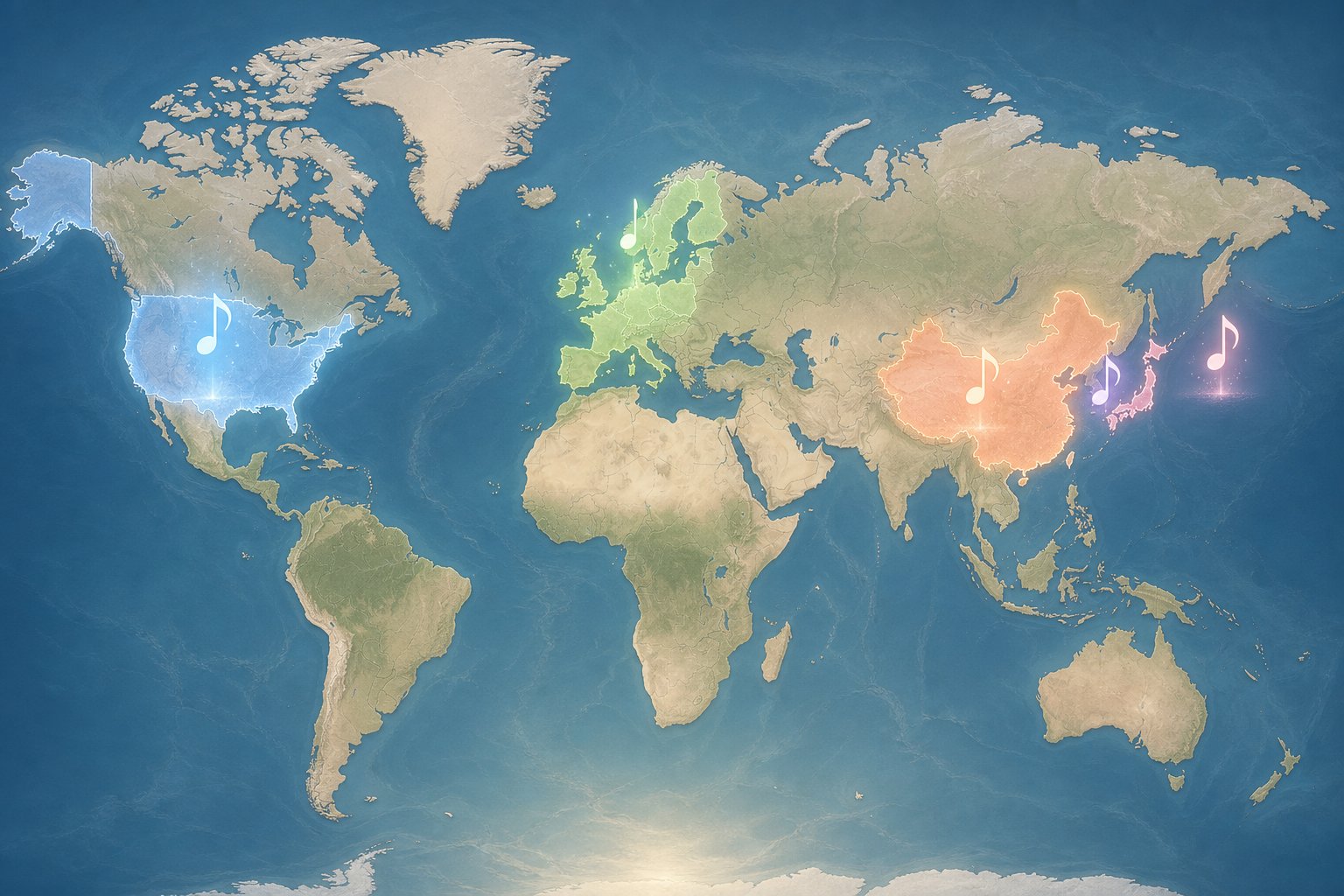
Where AI Music Is Legal Around the World
Your legal exposure does not just depend on what you create or how you monetize it. It also depends on where you are. A track that qualifies for copyright protection in one country may be completely unprotectable in another. A training practice that is legal in Tokyo could trigger enforcement in Brussels. The global ai music regulation news landscape is fractured, and creators who distribute internationally need to understand how each major jurisdiction approaches this technology.
Here is the current state of play across the regions that matter most to music creators.
United States Copyright Office Position
The U.S. remains the most influential jurisdiction for AI music rights. In January 2025, the U.S. Copyright Office released Part 2 of its AI report, directly addressing whether AI-generated outputs can receive copyright protection. The conclusion is clear: copyright only attaches where a human author has determined sufficient expressive elements.
What does that mean in practice? A few scenarios:
- Purely AI-generated music (type a prompt, get a finished track) receives no copyright protection. Anyone can copy it freely.
- AI-assisted music (using AI tools during production while making substantial creative decisions yourself) can be copyrighted. The human-authored elements qualify for protection.
- AI material within a larger human work (incorporating an AI-generated loop into a track you composed and arranged) does not bar copyrightability for the overall work.
Register of Copyrights Shira Perlmutter stated that "extending protection to material whose expressive elements are determined by a machine would undermine rather than further the constitutional goals of copyright." The Office also confirmed that merely providing prompts does not constitute human authorship. You need demonstrable creative control over the expressive output.
For creators in the U.S., the practical takeaway is straightforward: AI is a legal tool, but you must contribute genuine creative decisions to own what comes out of it. The act of creation is legal. Ownership depends on your level of involvement.
European Union AI Act and Music
The EU takes a different angle. Rather than focusing primarily on copyright eligibility, the EU AI Act's Article 50 centers on transparency obligations that apply from August 2026. These rules affect anyone providing or deploying generative AI systems within EU borders, including AI music platforms.
Key requirements for AI music under the EU framework:
- Machine-readable marking. Providers of generative AI systems must mark outputs in a machine-readable format so they are detectable as artificially generated. A standardized EU label is being developed through a Code of Practice expected to finalize by June 2026.
- Disclosure for deepfakes. AI-generated audio that resembles existing persons and could "falsely appear authentic" must be labeled. This directly targets voice cloning scenarios in music.
- Artist voice cloning classified as high-risk. AI tools that clone identifiable artist voices face stricter requirements including explicit consent.
The EU has not banned AI music creation. It has imposed disclosure and labeling rules that reshape how ai in music industry tools operate within its borders. If you release AI-generated tracks in EU markets, you will need to ensure proper labeling and transparency compliance as these provisions take full effect.
The UK, meanwhile, is still in consultation phase. The government launched a formal copyright review exploring new licensing frameworks for AI training, potential royalty pools for AI-generated streams, and an artist compensation fund. No binding legislation has emerged yet, leaving UK-based creators in a holding pattern where creation is legal but the long-term commercial framework remains undefined.
Asia-Pacific Approaches to AI Music
The Asia-Pacific region offers the widest range of approaches, from permissive to strictly controlled.
Japan stands out as the most AI-friendly major market. Japanese copyright law allows AI systems to train on copyrighted music for "information analysis" purposes, a broad exception that most other countries do not offer. However, this permissiveness applies to training, not to commercial output. If your AI-generated track is substantially similar to a specific copyrighted Japanese song, you still face infringement claims. Japan's framework essentially says: train freely, but produce responsibly.
South Korea focuses heavily on artist consent. Voice cloning requires notarized permission. "Style copying" is restricted when the original artist is identifiable. And unlike Japan, South Korea defaults to opt-out for training, meaning artists' works cannot be used to train AI models unless they actively opt in. This consent-first approach reflects how seriously Korean law treats performer rights.
China takes the most regulatory approach. All AI music services must register with the Cyberspace Administration, disclose training data sources, implement content review systems, and report generation statistics monthly. Non-compliance results in service shutdowns and fines. The framework is strict but clear: follow the registration and disclosure rules, and you can operate legally within Chinese markets.
The latest music ai legal news from these regions confirms a global trend: no country has banned AI music creation outright, but each imposes different conditions on how AI tools are built, labeled, and commercialized. The differences are significant enough that a creator distributing internationally needs jurisdiction-specific awareness.
Here is a comparative overview of where things stand:
| Jurisdiction | Legal Status of AI Music Creation | Copyright Eligibility | Notable Restrictions |
|---|---|---|---|
| United States | Legal, no restrictions on creation | Only human-authored elements qualify | Prompts alone do not establish authorship |
| European Union | Legal, transparency rules apply from Aug 2026 | Requires "human creative input" | Mandatory machine-readable marking of AI outputs |
| United Kingdom | Legal, framework under consultation | Under review, limited guidance | New licensing framework proposed but not enacted |
| Japan | Legal, permissive training exceptions | Similar to US (human authorship needed) | Commercial output may still require licenses |
| South Korea | Legal, consent-focused framework | Human contribution required | Voice cloning needs notarized consent; opt-in for training data |
| China | Legal with mandatory registration | Evolving standards | Service registration, training disclosure, monthly reporting required |
The global picture confirms one consistent theme: creating AI music is legal everywhere. The differences emerge in what protections you receive, what disclosures you owe, and what consent frameworks govern the tools you use. As ai music rights news continues to develop, creators distributing across borders should track the jurisdictions where their audience lives, not just the country where they press "generate."
The regulatory landscape is not static, either. New legislation is actively moving through government bodies in multiple countries, and major industry players are pushing for rules that protect their existing revenue streams. That legislative momentum is already producing laws you need to know about.
New Laws and Industry Actions Reshaping AI Music Rules
Legislation moves slower than technology, but it is catching up fast. While courts work through the landmark lawsuits covered in the previous section, lawmakers and major labels are building a parallel enforcement framework that will define what AI music creators can and cannot do in the coming years. Some of these rules are already in effect. Others are weeks or months from becoming law.
If you follow copyright ai music news today, you will notice a clear pattern: the legal system is closing the gap between what AI tools can technically produce and what creators are legally permitted to distribute. Here is what is actively moving through legislatures and boardrooms right now.
Proposed Federal Legislation Targeting AI Music
The most significant piece of pending U.S. legislation for AI music creators is the NO FAKES Act (Nurture Originals, Foster Art, and Keep Entertainment Safe). This bipartisan bill focuses on protecting "the voice and visual likenesses of individuals and creators from the proliferation of digital replicas created without their consent."
The bill has been through multiple iterations since it was first drafted in 2023. Formally introduced in the Senate in 2024, it ran out of time before the elections and was reintroduced in April 2025. A revised version returned in May 2026 with updated provisions that specifically address music streaming platforms. The latest revision includes technical fixes to ensure the bill works as designed for streaming services, plus exemptions for libraries, archives, and research institutions studying deepfakes.
What makes this version significant for music creators: the revised NO FAKES Act now has backing from Spotify, YouTube, TikTok, all three major labels, and multiple music industry organizations. Bipartisan sponsorship from Republican senators Marsha Blackburn and Thom Tillis alongside Democrat senators Chris Coons and Amy Klobuchar gives it a stronger path to passage than previous versions.
Other federal proposals worth tracking:
- NO FAKES Act (revised May 2026) - Protects voice and visual likeness from unauthorized AI replication. Now includes music streaming provisions. Status: introduced in Senate, bipartisan support, awaiting committee action.
- COPIED Act - Would require AI platforms to disclose copyrighted works used in training data. Status: introduced but not yet advanced.
- AI Disclosure Act - Would mandate labeling of AI-generated content across all media. Status: under committee review.
- AI Foundation Model Transparency Act - Would require public documentation of training datasets for large AI models. Status: early legislative stage.
None of these proposals criminalize making AI music. They target specific harmful applications, particularly unauthorized voice cloning and lack of transparency, rather than the act of generation itself. But if the NO FAKES Act passes, releasing music that uses someone's cloned voice without permission would carry clear federal civil liability.
State-Level Protection Laws Already in Effect
While federal legislation moves slowly, Tennessee did not wait. The Ensuring Likeness Voice and Image Security Act (ELVIS Act) was signed into law by Governor Bill Lee on March 21, 2024 and took effect on July 1, 2024. It is the first state-level legislation specifically designed to protect musicians from unauthorized AI usage.
The ELVIS Act updates Tennessee's existing Protection of Personal Rights law to explicitly cover sound and voice. It prohibits using AI to mimic a person's voice without their permission and covers "new, personalized generative AI cloning models and services that enable human impersonation and allow users to make unauthorized fake works in the image and voice of others."
Violations are enforceable as Class A misdemeanors under criminal law, and the act also authorizes civil action. This means someone who clones a Nashville artist's voice for a commercial release without consent could face both criminal charges and a civil lawsuit in Tennessee.
Why does this matter beyond Tennessee? Because Nashville is the capital of country music and a major hub for music publishing. Any AI music platform that serves users creating country, gospel, or Americana content is operating in direct proximity to this law's reach. And other states are watching. The ELVIS Act has become a template for similar proposals in California, New York, and several other states.
The silent album protest ai copyright movement also drew attention to how artists are pushing back beyond legislation. Some musicians have released albums of silence or minimal audio to streaming platforms specifically to claim copyright over the data space that AI models might scrape, a creative form of resistance that highlights how seriously performers take the threat of unauthorized voice replication.
How Major Labels Are Enforcing Their Rights
Legislation is one pressure point. The three major labels, Universal Music Group, Sony Music, and Warner Music Group, are applying the other through direct enforcement, licensing deals, and platform partnerships.
Their strategy has evolved from pure litigation into a multi-track approach:
- Warner Music settled with Suno in November 2025, signing a licensing deal that allows Suno to use Warner's catalog in new licensed AI models. Warner also reached a separate licensing arrangement with Udio in late 2025.
- Universal Music Group settled with Udio in October 2025 and is co-launching a licensed "walled garden" AI music platform in 2026 where AI creations cannot be downloaded or posted externally. UMG artists can opt in to training and receive compensation.
- Sony Music has settled with neither Suno nor Udio. Sony is the last major label actively litigating both cases, betting on a court ruling expected in summer 2026 that could set the legal precedent for the entire industry.
- UMG, Concord, and ABKCO filed a supersized $3 billion lawsuit against Anthropic in January 2026, covering over 20,000 songs. This is now the largest non-class-action copyright case in U.S. history.
Streaming platforms are also tightening the gate. Deezer AI detection systems now process over 30,000 fully AI-generated track submissions daily, filtering out content that violates platform standards. Spotify removed tens of thousands of AI tracks through 2024-2025 and continues enforcing policies against impersonation and undisclosed AI content.
The pattern across all of these actions is consistent: labels and platforms target commercial exploitation and impersonation, not private creation. Nobody is sending cease-and-desist letters to hobbyists. But anyone releasing AI-generated music commercially, especially content that touches a recognizable artist's voice or style, is operating in an enforcement-heavy environment that grows more aggressive each quarter.
The legal landscape is actively shifting under your feet. Following ai music copyright news regularly is no longer optional for creators who rely on AI tools professionally. Laws like the ELVIS Act are already enforceable, the NO FAKES Act could pass within the year, and label enforcement grows more sophisticated with every settlement deal that funds new detection infrastructure.
What you can control in this environment is your choice of platform and tools. Not all AI music services expose you to the same level of risk, and the terms of service you agree to when generating music directly shape what rights you actually hold over the output.

What AI Music Platforms Actually Let You Own and Sell
Your legal exposure is not shaped only by what you create or which country you live in. It is shaped by which platform you used to create it. Every AI music tool comes with a terms-of-service agreement that defines who owns the output, what you can do with it, and what the platform keeps for itself. These agreements vary wildly, and most creators never read them.
That is a problem, because the difference between a platform that grants you full commercial rights and one that retains shared ownership could determine whether you earn revenue or face a takedown notice.
Platforms That Grant Full Commercial Rights
A handful of AI music generators explicitly transfer commercial rights to paying subscribers. These platforms let you distribute output on streaming services, monetize it on YouTube, and use it in client projects without additional licensing fees.
Suno leads this category. Its Pro plan ($10/month) and Premier plan ($30/month) grant full commercial rights, including streaming distribution. Those rights persist even after you cancel your subscription, as long as the track was generated while you were subscribed. Stable Audio from Stability AI follows a similar model: its Creator tier grants commercial use for instrumental content with rights that survive cancellation.
The Soundraw AI music generator takes a slightly different approach, offering royalty-free commercial music through parameter-based customization rather than text prompts. At $19.99/month, its Creator Plan allows unlimited generation for YouTube, ads, podcasts, and similar content projects. Soundraw also claims to train its AI exclusively on music it created internally, which reduces your exposure to training-data infringement claims.
AIVA's Pro tier grants full copyright ownership for orchestral and classical compositions, giving you complete commercial freedom including the right to register the work. Tools like Flexclip AI music generator and Songer AI offer more limited generation features but typically include commercial licensing for content created within their ecosystems.
Platforms With Restricted or Shared Ownership
Not every platform hands you the keys. Some retain partial ownership, cap your revenue, or restrict how you can distribute the output.
Boomy offers built-in distribution to Spotify and Apple Music starting at $9.99/month, but operates under a shared-attribution model where the platform maintains involvement in the commercial chain. Lower-tier plans on platforms like AIVA and Musicful restrict commercial use entirely or impose revenue thresholds you cannot exceed without upgrading.
Google's MusicFX sits in an even murkier space. It is free to use, but its commercial terms are unclear, it only generates short clips, and it applies SynthID watermarking to all output. Using it for anything beyond personal experimentation is not advisable.
Then there are platforms in legal limbo. Udio suspended all downloads following its October 2025 settlement with Universal Music Group and is transitioning to a "walled garden" model. Content generated on Udio currently cannot be exported, making commercial use impossible regardless of what the original terms promised. Tools like ProducerAI and Musichero AI music generator occupy niche segments where terms of service may be less rigorously defined, so verifying rights before publishing is essential.
Here is a comparison of how major platform types handle ownership:
| Platform Type | Ownership Model | Commercial Use Rights | Distribution Restrictions |
|---|---|---|---|
| Full commercial (Suno Pro, Stable Audio Creator) | User owns output | Unrestricted streaming, sync, and monetization | None for paid tier; free tier excluded |
| Royalty-free commercial (Soundraw, AIVA Pro) | User owns output | Commercial use included | Some platforms restrict sublicensing or resale |
| Shared attribution (Boomy, lower-tier plans) | Shared between user and platform | Limited commercial use, revenue caps possible | Distribution through platform channels only |
| Unclear or experimental (MusicFX, suspended platforms) | Undefined or platform-retained | Not recommended for commercial projects | Watermarking, short clips, or no downloads |
Reading the Fine Print Before You Publish
Two details buried in terms of service deserve your attention before you release anything commercially:
- Indemnification clauses. Many AI music platforms include language that releases them from liability if you are sued for content you generated using their tools. MusicFlow, for instance, explicitly requires users to notify them of any copyright infringement but does not indemnify you against claims. If a rights holder comes after your release, you are on your own.
- Tier-specific rights. Commercial rights almost universally require a paid subscription at the time of creation. Suno's free Basic tier does not grant commercial rights. Generating a track on a free plan and later upgrading does not retroactively license that earlier output. The subscription you held when you pressed "generate" is the one that counts.
Platform choice is not a minor detail. It is the single most controllable variable in your legal risk equation. Choosing a tool with clear commercial licensing, transparent training data practices, and explicit user ownership eliminates entire categories of legal uncertainty before you produce a single note.
The next question is practical: given all these risks and options, what specific steps should you take to use AI music safely and protect yourself going forward?
How to Use AI Music Legally and Protect Yourself
You understand the risks. You know which activities are safe and which ones invite trouble. You have seen how platform choice shapes your rights. The remaining question is practical: what should you actually do? The strategies below work together to keep you on solid legal ground whether you are producing background tracks for a podcast or building basic song production from a scratch track ai workflow.
Adding Human Authorship to Secure Copyright
The single most effective thing you can do is treat AI as an assistant, not a replacement. The U.S. Copyright Office's framework protects human-authored expression. That means your lyrics, your melodic choices, your arrangement decisions, and your performance all count. Raw AI output on its own does not.
In practice, this looks like:
- Writing your own lyrics and using AI only for instrumental backing or chord suggestions.
- Generating multiple AI outputs, then selecting, rearranging, and editing them into a cohesive track that reflects your creative vision.
- Recording a live vocal or instrumental performance over AI-generated elements.
- Modifying AI-generated melodies enough that the final version reflects your expressive choices rather than the machine's defaults.
People often ask "do you own lyrics from Claude" or whether a chatgpt song maker gives you copyright over the words it produces. The answer follows the same principle: if the AI wrote the lyrics autonomously, those words are not copyrightable by you. If you used AI suggestions as a starting point and then rewrote, restructured, and shaped the language yourself, your contribution qualifies as human authorship. The best ai tool for song lyrics is whichever one you treat as a brainstorming partner rather than a ghostwriter.
Can Gemini make songs? Technically, yes. Google's model can generate lyrical and musical content. But the copyright question is not about whether the tool is capable. It is about whether you contributed enough creative expression to own the result.
Choosing Royalty-Free AI Music for Content Projects
Not every creator needs copyright ownership. If you produce YouTube videos, podcasts, social content, or indie games, what you actually need is a clear license to use music commercially without worrying about takedowns or royalty claims. Royalty-free AI generators solve this problem entirely by granting explicit commercial rights upfront.
Here are practical steps to minimize legal risk when choosing a platform:
- Use MakeBestMusic's Free Music Generator for projects where you need royalty-free tracks you can use in videos, podcasts, games, and social content without licensing fees or attribution headaches. It is designed specifically for creators who want commercial-ready music without navigating complex ownership questions.
- Verify your plan includes commercial rights before publishing. Free tiers on most platforms restrict you to personal use only. Generating a track on a free plan and then monetizing it violates the terms you agreed to.
- Check whether the platform indemnifies you against training data claims. Platforms that train on internally created music or licensed datasets reduce your downstream risk.
- Keep your subscription active or confirm rights survive cancellation. Some platforms revoke commercial rights the moment you downgrade. Others let you keep rights on tracks generated during your paid period.
For content creators who are not trying to build a music career but simply need safe, usable tracks for their projects, a royalty-free generator like MakeBestMusic removes the legal ambiguity entirely. You get a clear license, no ongoing royalties, and no risk of copyright claims from training data disputes.
Documenting Your Creative Process as Legal Protection
If you plan to register copyright or defend your work against copying, documentation is your insurance policy. The Copyright Office requires applicants to describe their human contribution when filing AI-assisted works. Without records, you are relying on memory to reconstruct your creative decisions months or years after the fact.
What to document:
- Save your prompts and generation parameters. These show what you asked the AI to produce and demonstrate that you made deliberate creative choices.
- Keep before-and-after versions. Export the raw AI output, then save your edited final version. The difference between these two files is your human authorship evidence.
- Record your arrangement and editing sessions. Screen recordings or DAW project files with timestamps prove that a human made the compositional decisions.
- Note which platform and subscription tier you used. This confirms you had commercial rights at the time of creation.
- Maintain contributor splits and AI disclosure records. If collaborators are involved, document who contributed what, including which elements came from AI tools.
This documentation habit takes minutes per session but can save you months of legal headaches. Tools like RightsDocket exist specifically to help creators organize contributor data, AI usage disclosures, and timestamps into structured records aligned with Copyright Office requirements. Whether you use a dedicated tool or a simple folder of screenshots and project files, the key is capturing the evidence while it is fresh.
The creators who will thrive in this legal environment are not the ones avoiding AI entirely. They are the ones using it deliberately, choosing the right platforms, contributing genuine creative expression, and keeping records that prove it. That combination of smart tool selection and documented human input is the most reliable shield against every legal risk this article has covered.
Making Smart Decisions About AI Music Going Forward
Every section of this article pointed back to the same core truth: the legality of AI music does not hinge on whether you press "generate." It hinges on what happens next. Your choices about platform, creative contribution, and commercial intent determine whether you operate safely or stumble into legal exposure nobody warned you about.
Your Personal Legal Risk Assessment
Before you publish, release, or monetize any AI-generated track, run it through this three-question framework:
- Is creation legal? Yes. Always. No jurisdiction criminalizes the act of generating music with AI tools. Whether you are an ai songwriter exploring new genres or a podcaster looking for intro music, generating tracks is permitted everywhere.
- Can you own it? Only if you contributed meaningful human authorship. Purely AI-generated output sits in the public domain under U.S. law. Anyone can copy it, and you have no legal recourse. The more creative decisions you make, the stronger your ownership claim.
- Can you sell it safely? That depends on your platform's terms, your level of human involvement, and whether your output resembles existing copyrighted works. Commercial release without clear licensing and documented creative input is where every real legal problem in this space originates.
Some people argue that ai cant write songs with genuine emotional depth. Others point to Billboard-charting AI tracks as proof the technology produces commercially viable work. The debate over whether can ai make better music than humans is interesting, but it is irrelevant to the legal question. Quality does not determine legality. Your process does.
The Bottom Line for AI Music Creators
The legal issues in music industry masters programs have always centered on ownership, licensing, and rights management. AI does not change those fundamentals. It just adds a new variable: the machine's contribution versus yours. Courts, legislatures, and platforms are all converging on the same principle. Human creative input is the dividing line between protected work and public domain output.
Making AI music is legal. Owning it requires human authorship. Selling it safely requires the right platform, documented creative contribution, and awareness of a legal landscape that shifts quarterly.
Smart creators are not avoiding AI. They are using it as one tool in a larger creative process, choosing platforms with clear commercial licensing, keeping records of their decisions, and staying informed as new laws take effect. If you want a risk-free starting point for experimenting with AI music generation while staying on solid legal ground, MakeBestMusic's Free Music Generator offers royalty-free tracks designed for commercial use in videos, podcasts, games, and social content without the ownership ambiguity that plagues other tools.
The question was never "is making AI music illegal." The real question is whether you are making decisions that protect what you create. Choose your tools carefully, contribute your own creative voice, and document the process. That combination keeps you safe regardless of how the legal landscape evolves from here.
