


What Texas Country Music Actually Is
Imagine two people who both love country music moving in together and discovering they barely recognize each other's favorite artists. That's exactly what happened when a Dallas native and a Nashville native became roommates — one swearing by Josh Abbott Band and Turnpike Troubadours, the other having never heard of them. The gap between their playlists reveals something bigger than personal taste. It points to an entire parallel universe of country music most people outside the Lone Star State don't even know exists.
Defining Texas Country for the Uninitiated
Texas country music is a roots-driven, independently operated genre rooted in honky-tonk, Western swing, and outlaw traditions, defined by raw instrumentation, narrative songwriting, and a fiercely self-sustaining ecosystem of artists, dance halls, radio stations, and regional charts that thrive largely outside Nashville's mainstream infrastructure.
That definition matters because this isn't just a regional accent on the same old sound. It's a fully functioning music economy. The scene has its own charting systems, dedicated radio stations across Austin, San Antonio, and the Hill Country, and a touring circuit built around legendary dance halls rather than corporate arenas. Artists release records on independent labels — or no label at all — and build loyal audiences one two-step crowd at a time.
Why Texas Country Is a Movement, Not Just a Sound
So what holds it all together? A few core pillars. First, there's the songwriting — personal, story-driven, and often penned by the artists themselves rather than teams of professional co-writers chasing radio hooks. Then there's the production philosophy: raw, unpolished, and built around fiddle, steel guitar, and acoustic instruments instead of drum machines and studio gloss. The live music culture ties it all together, with honky-tonks and dance halls shaping the sound as much as any recording studio does. And underneath everything runs a spirit of independence — a refusal to let boardrooms dictate what country music should be.
That spirit didn't appear out of nowhere. It was forged over decades by artists who chose creative freedom over commercial compromise, and it stretches back further than most people realize.
The Roots and Origins of the Texas Country Sound
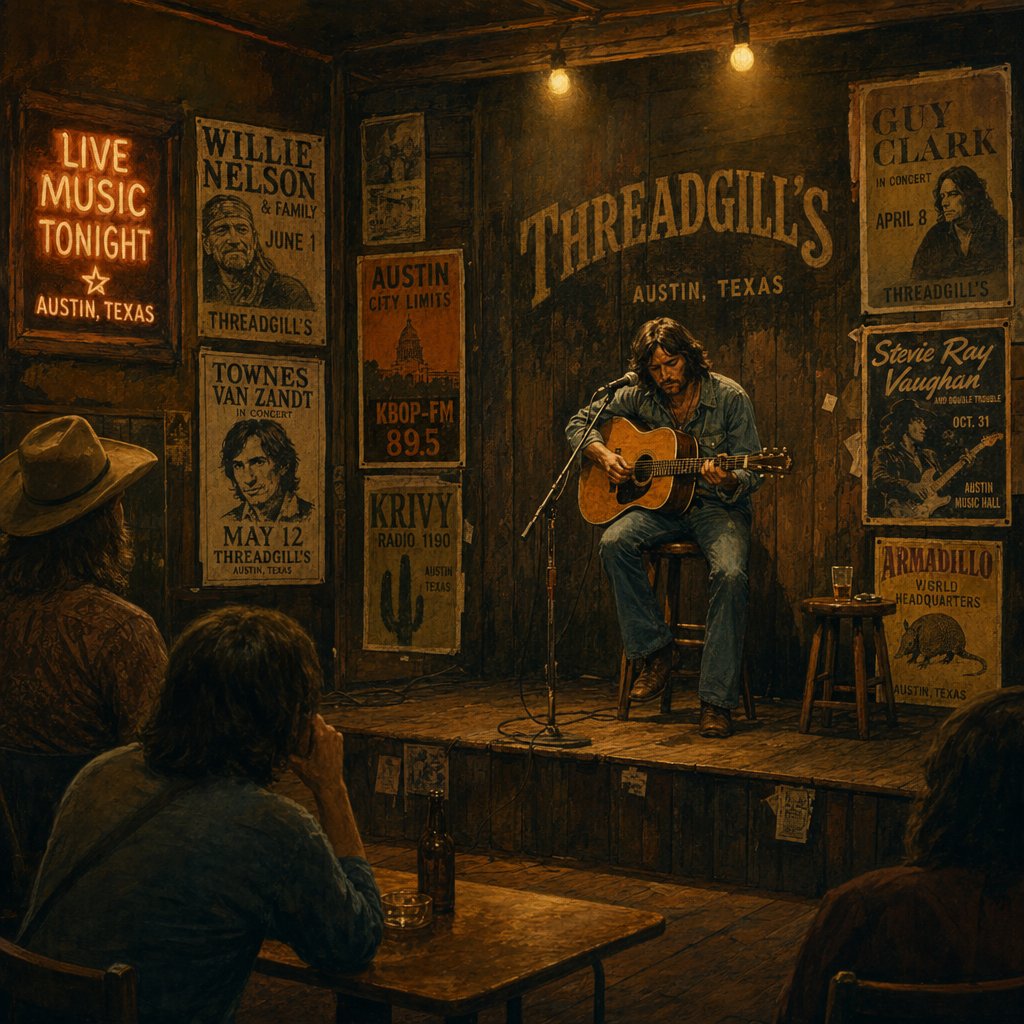
The DNA of this movement stretches back to the 1930s and 1940s, when Texas was already producing sounds that didn't quite fit the mold. Bob Wills and His Texas Playboys fused country fiddle with jazz and big band swing, creating Western swing — a genre built for dance floors, not radio programmers. Around the same time, Ernest Tubb brought a grittier, electric honky-tonk sound out of Texas dance halls and onto the national stage. Both artists shared something that would become a defining trait of the state's music: they played what felt right, not what anyone told them to play.
From Western Swing to Outlaw Country
By the early 1970s, Nashville had drifted toward a heavily produced, string-laden style known as the "countrypolitan" sound. It was polished, safe, and commercially calculated. A handful of Texans wanted no part of it. Willie Nelson, frustrated by Nashville's creative constraints, moved back to Austin and started performing alongside artists like Jerry Jeff Walker and Billy Joe Shaver. Waylon Jennings fought for — and won — the right to produce his own records, a nearly unheard-of demand at the time. Together, they became the faces of outlaw country, a movement that was essentially a Texas-led rebellion against Music Row's corporate grip.
The rebellion went mainstream in 1976 when Wanted! The Outlaws became country music's first platinum-certified album, featuring Jennings, Nelson, Jessi Colter, and Tompall Glaser. Alongside them, songwriters like Townes Van Zandt, Guy Clark, and Kris Kristofferson proved that raw, literary storytelling could thrive outside Nashville's formula. That spirit of defiance didn't fade when the decade ended — it became the blueprint for every generation of independent Texas artists that followed.
The Rise of the Texas and Red Dirt Scenes in the 1990s
Fast forward to the mid-1990s. A new wave of artists picked up the outlaw torch and built something even more self-sufficient. Robert Earl Keen, who'd famously jammed on his college porch with Lyle Lovett, became the face of Americana and proved that a career could thrive on relentless touring and word-of-mouth loyalty. Pat Green sold over 250,000 albums before ever signing with a major label — a staggering number that showed just how hungry Texas audiences were for their own sound. Artists like Cory Morrow, Jack Ingram, and Reckless Kelly filled dance halls across the state while Cross Canadian Ragweed brought a parallel energy out of Stillwater, Oklahoma, blurring the line between the Texas and Red Dirt scenes.
What made this era transformative wasn't just the music. It was the proof of concept. These artists demonstrated that you could pack venues, move records, and build a lasting career without a Nashville label, a mainstream radio single, or anyone's permission.
- 1930s-1940s: Bob Wills pioneers Western swing; Ernest Tubb brings electric honky-tonk out of Texas dance halls
- 1970s: Willie Nelson and Waylon Jennings launch the outlaw country movement from Austin, rejecting Nashville's countrypolitan sound
- 1976: Wanted! The Outlaws becomes country music's first platinum album, bringing the movement to a national audience
- 1970s-1980s: Townes Van Zandt, Guy Clark, and Billy Joe Shaver establish Texas as a home for literary, uncompromising songwriting
- Early 1990s: Robert Earl Keen and Lyle Lovett emerge from the Texas singer-songwriter tradition, bridging folk, country, and Americana
- Mid-1990s to early 2000s: Pat Green, Cory Morrow, Cross Canadian Ragweed, and Reckless Kelly build a thriving independent touring circuit across Texas and Oklahoma
- 2003: The Red Dirt Music Hall of Fame inducts its first members, formalizing the movement's cultural identity
This infrastructure — the venues, the loyal fan bases, the independent business model — didn't just support a generation of artists. It created the foundation for a scene that would only grow louder, more distinct, and harder for the mainstream to ignore.
Texas Country vs Nashville Mainstream Country
History and attitude are one thing. But when you actually press play on a Texas country track and a Nashville pop-country single back to back, the differences hit you fast — you don't need to set a 5 minute timer to hear the gap. It's obvious within the first few bars. The two scenes share common roots, but they've evolved into fundamentally different approaches to making, distributing, and experiencing country music.
Songwriting Philosophy and Storytelling vs. Pop Hooks
In Nashville's mainstream lane, songwriting is often a collaborative, commercial process. Teams of professional writers gather in writing rooms to craft hook-driven singles designed for maximum radio rotation. The goal is a catchy chorus that sticks on first listen — think anthems built around a clever phrase or a party-ready vibe. There's real skill in that formula, but it prioritizes accessibility over depth.
The Texas scene flips that priority. Here, storytelling and personal authenticity come first. Artists tend to write their own material — or at least co-write from genuine lived experience rather than chasing trends. As Josh Abbott of the Josh Abbott Band put it, "the process is what separates us, as artists, from karaoke singers." You'll hear songs about working-class grit, small-town pride, heartbreak that actually stings, and the kind of road-worn detail that only comes from living it. The literary influence of writers like Townes Van Zandt and Guy Clark still runs deep — narrative weight matters more than a singalong hook.
Instrumentation and Production Differences
Sonically, the contrast is just as sharp. Texas country foregrounds fiddle, steel guitar, acoustic guitar, and sometimes Tejano or blues-inflected textures that reflect the state's cultural crossroads. The production tends to feel raw and unfiltered — like the band is playing in the room with you. Compared to the dandys world of Nashville's layered studio polish, where drum machines, pop-rock guitars, and pitch-perfect vocal processing dominate, the Texas approach sounds deliberately rougher around the edges. That's not a limitation. It's the point.
| Category | Texas Country | Nashville Mainstream |
|---|---|---|
| Songwriting Approach | Artist-written, narrative-driven, literary influences, lived experience | Professional co-writes, hook-driven, radio-optimized for mass appeal |
| Typical Instruments | Fiddle, steel guitar, acoustic guitar, Tejano and blues elements | Electric guitar, drum machines, synths, pop-rock layering |
| Production Style | Raw, unpolished, live-room feel | Slick, heavily produced, studio-perfected |
| Touring Model | Relentless regional circuit — dance halls, honky-tonks, festivals | National arena tours, amphitheaters, corporate-sponsored events |
| Label Structure | Independent or small labels, artist-controlled releases | Major label deals with significant label input on creative direction |
| Fan Engagement | Intimate, community-driven — fans and artists share the same dance floor | Large-scale, media-driven — awards shows, national radio, streaming playlists |
The Independent Touring and Business Model
The business side might be where the two worlds diverge most dramatically. Nashville's mainstream model runs on major label infrastructure — A&R teams selecting singles, national radio promotion campaigns, and carefully managed rollouts designed to climb the Billboard charts. It's a top-down system where the label often steers creative and commercial decisions.
Texas artists largely bypass that entire apparatus. Many self-release albums or work with independent distributors like Thirty Tigers, keeping creative control firmly in their own hands. The DIY approach extends to touring — artists build audiences through relentless gigging across a regional circuit of dance halls, county fairs, and festivals rather than waiting for a radio single to open doors. Pat Green sold a quarter-million records independently before Nashville even came calling. The Josh Abbott Band built crowds from 500 to over 1,000 on the strength of Texas radio airplay alone, without a major label push.
This model demands more hustle, but it offers something Nashville's system often doesn't: freedom. Freedom to make the record you want, play the shows you want, and build a career on your own terms. It's that independence — not just the fiddle and steel guitar — that truly separates the two worlds.
Of course, knowing the structural differences only tells part of the story. The artists themselves — across three generations and counting — are the ones who've given this movement its voice, its credibility, and its staying power.
Legendary Texas Country Artists and Singers You Need to Know
Three generations of artists have carried this movement from smoky dance halls to sold-out amphitheaters — each one building on the last while keeping the core identity intact. Think of it as a living family tree. You don't need to understand statistics fundamentals to see the pattern: every era produced artists who chose independence over industry approval, and every era proved that bet right.
Foundational and Legacy Artists
The roots start with Willie Nelson, whose move from Nashville back to Austin in the early 1970s essentially gave the entire scene permission to exist. Waylon Jennings fought for producer credit on his own records and won, rewriting the rules of artist autonomy. George Strait brought a no-frills, Western-hat authenticity that dominated mainstream country while never abandoning his Texas identity. Townes Van Zandt wrote songs so devastatingly good — "Pancho and Lefty," "To Live Is to Fly" — that they became the literary standard every Texas songwriter since has measured themselves against. And Robert Earl Keen turned relentless touring and razor-sharp storytelling into a career blueprint that dozens of artists would follow.
The Mid-Generation Torchbearers
By the late 1990s, a new class of artists took that blueprint and scaled it. Pat Green packed dance halls across the state and sold over 250,000 albums independently before Nashville even noticed. Cory Morrow did the same, moving 200,000-plus records without a major label. The Randy Rogers Band, formed in San Marcos, became a Red Dirt staple with a live energy that translated into seven studio albums and counting. Aaron Watson quietly became one of the most successful independent artists in all of country music, landing a number-one album on the Billboard country charts entirely on his own terms. And Wade Bowen, out of Waco, built a devoted following through records like Try Not to Listen and a collaborative spirit that led to his celebrated duets project with Rogers. Together, these artists proved the commercial viability of the Texas scene — no boardroom required.
The New Wave Driving the Genre Forward
The current generation is where things get really interesting. Cody Jinks spent years grinding through the independent circuit before albums like Lifers turned him into an arena-filling force. Flatland Cavalry blends folk-tinged storytelling with a youthful energy that's expanded the genre's audience. Charley Crockett has released a staggering 16 albums in roughly a decade, earning a 2026 GRAMMY nomination for Best Traditional Country Album with Dollar a Day. Vincent Neil Emerson channels the raw troubadour spirit of Townes Van Zandt so convincingly that critics have drawn direct comparisons. Zach Bryan exploded from posting raw recordings online to becoming one of the biggest names in all of country music. And Kolby Cooper represents the younger edge of the scene — gritty, emotionally direct, and building a fanbase one rowdy show at a time.
You don't need to know how to use Photoshop to design a career in this genre. You need songs, a van, and the willingness to play 200 nights a year. That ethos connects every name on this list.
| Era | Artist | Signature Album | Key Contribution |
|---|---|---|---|
| Foundational | Willie Nelson | Red Headed Stranger (1975) | Moved to Austin and launched the outlaw movement, proving artists could thrive outside Nashville |
| Foundational | Waylon Jennings | Honky Tonk Heroes (1973) | Won creative control over his own production, setting the template for artist independence |
| Foundational | Townes Van Zandt | Live at the Old Quarter (1977) | Established the literary songwriting standard that defines the genre's lyrical identity |
| Foundational | George Strait | Strait Country (1981) | Brought traditional Texas honky-tonk to mainstream dominance without compromising authenticity |
| Foundational | Robert Earl Keen | No Kinda Dancer (1984) | Built the independent touring and storytelling blueprint the entire scene follows |
| Mid-Generation | Pat Green | George's Bar (1997) | Proved massive independent sales were possible without major label support |
| Mid-Generation | Randy Rogers Band | Rollercoaster (2004) | Anchored the Red Dirt and Texas crossover circuit with high-energy live performances |
| Mid-Generation | Aaron Watson | The Underdog (2015) | First independent male artist to debut at number one on the Billboard Top Country Albums chart |
| Mid-Generation | Wade Bowen | Try Not to Listen (2002) | Expanded the regional fanbase and championed collaborative artist culture |
| New Wave | Cody Jinks | Lifers (2018) | Turned years of independent grinding into arena-level success without a major label |
| New Wave | Charley Crockett | Dollar a Day (2024) | Prolific output and 2026 GRAMMY nomination cemented his status as a modern torchbearer |
| New Wave | Flatland Cavalry | Homeland Insecurity (2019) | Blended folk-driven storytelling with accessible energy, drawing younger audiences to the scene |
| New Wave | Zach Bryan | American Heartbreak (2022) | Broke from raw online recordings to mainstream stardom while keeping an independent spirit |
| New Wave | Vincent Neil Emerson | The Golden Crystal Kingdom (2023) | Carried the raw troubadour tradition of Van Zandt and Clark into a new generation |
Names and albums only tell you so much, though. Several of these artists also straddle the line between the Texas scene and another closely related movement — one that shares the same spirit but traces its roots to a different patch of red Oklahoma dirt.
Red Dirt Country and Its Deep Texas Connection
That patch of Oklahoma dirt has a name — and a whole mythology behind it. If you've spent any time exploring the Texas scene, you've probably bumped into the term "red dirt" and wondered whether it's the same thing, a rival, or something else entirely. The short answer: it's a sibling, not a twin. The two share DNA, venues, and fans, but they grew up in different houses.
What Red Dirt Country Actually Means
Red dirt music gets its name from the rust-colored soil of Oklahoma, and its story begins in Stillwater — specifically at a ramshackle property known as "The Farm." Starting in 1979, this two-story yellow house on 149 acres became a communal living space, party destination, and makeshift concert venue for aspiring musicians drawn to Oklahoma State University's orbit. Songwriters like Bob Childers, Jimmy LaFave, Tom Skinner, and the Red Dirt Rangers lived, wrote, and jammed there for over two decades, forging a creative community far from any industry spotlight.
What emerged wasn't defined by a single sound. As Cody Canada of Cross Canadian Ragweed recalled, Bob Childers told him the music was "as soulful and honest as the dirt was red." Red dirt blends country, rock, folk, blues, and Southern storytelling into something that resists easy categorization. The Great Divide brought a rock-leaning edge. Jason Boland and the Stragglers channeled hardcore honky-tonk. Stoney LaRue delivered soulful, almost gospel-tinged performances. Cross Canadian Ragweed played with a raucous energy that could shake the walls off a bar. The common thread was never a specific sonic formula — it was independence, collaboration, and writing songs for the sake of the song.
Where Red Dirt and Texas Country Overlap and Diverge
The two scenes merged in practice long before anyone tried to draw a line between them. When Oklahoma venues dried up and The Farm burned down in 2003, red dirt artists migrated south. The Great Divide blazed the trail into the Texas touring circuit, and Cross Canadian Ragweed followed close behind, with Boland moving to Texas in 2002 and Brandon Jenkins arriving in 2003. Before long, Oklahoma acts were sharing the same dance halls, radio stations, and festival stages as their Texas counterparts. As Jenkins put it, "to them Red Dirt and Texas music are the same thing because we pretty much went down there and took over their scene."
Still, subtle differences persist. Texas country tends to lean harder into honky-tonk traditions, two-step rhythms, and Tejano-inflected textures shaped by the state's cultural crossroads. Red dirt often carries more rock and folk influence — a rougher, more freewheeling energy rooted in that Stillwater commune spirit. Think of it less like separate countries flying different world flags and more like neighboring states with an open border. The fans, the venues, and the values overlap so heavily that most listeners experience them as a single ecosystem.
Artists like Turnpike Troubadours — formed in Tahlequah, Oklahoma, but beloved across Texas — embody that overlap perfectly. Their blend of literary songwriting and country-rock energy appeals to both camps without compromise. The broader Americana movement connects to both scenes as well, sharing the same emphasis on roots authenticity and songwriter credibility, though Americana casts a wider stylistic net that includes folk, bluegrass, and roots-rock acts with no regional allegiance at all.
| Category | Red Dirt Country | Texas Country |
|---|---|---|
| Origin | Stillwater, Oklahoma — The Farm commune, late 1970s | Texas dance halls and honky-tonks — Western swing and outlaw traditions |
| Key Artists | Cross Canadian Ragweed, Jason Boland & the Stragglers, Turnpike Troubadours, Stoney LaRue | Pat Green, Robert Earl Keen, Cody Jinks, Flatland Cavalry |
| Sonic Traits | Country-rock-folk blend, freewheeling energy, genre-crossing experimentation | Honky-tonk, fiddle and steel-forward, Tejano and blues textures, two-step rhythms |
| Primary Venues | Originated in Stillwater bars (Willie's Saloon, The Wormy Dog); now shares the Texas circuit | Gruene Hall, Luckenbach, Billy Bob's, Broken Spoke, and the broader Texas dance hall network |
| Defining Ethos | Communal collaboration — "one big damn band" | Fierce individual independence — build your own career on your own terms |
Whether you call it red dirt, Texas country, or just good music, the real magic lives in the songs themselves — and knowing where to start listening can feel overwhelming when the catalog runs this deep.
Essential Texas Country Songs and Albums Worth Hearing
Knowing the history and the names is a solid start, but this genre really clicks when you hear it. The catalog runs deep enough to feel intimidating, so here's a curated entry point organized by sub-style — whether you're brand new or just looking to fill gaps in your playlist.
Essential Texas Country Songs by Sub-Style
Classic outlaw tracks carry the rebellious DNA that started it all. These are the songs that told Nashville to keep its polish:
- Willie Nelson — "Whiskey River"
- Waylon Jennings — "Honky Tonk Heroes"
- Billy Joe Shaver — "Georgia on a Fast Train"
- Ray Wylie Hubbard — "Snake Farm"
Honky-tonk staples are built for jukeboxes and two-stepping. Drop any of these at a dance hall and watch the floor fill up:
- George Strait — "Amarillo by Morning"
- Kevin Fowler — "Lord Loves a Drinking Man"
- Roger Creager — "The Everclear Song"
- Sunny Sweeney — "Ten Years Pass"
Red dirt crossovers blur the Texas-Oklahoma line with a rock-folk edge that hits different:
- Cross Canadian Ragweed — "17"
- Turnpike Troubadours — "Gin, Smoke, Lies"
- Jason Boland & the Stragglers — "Pearl Snaps"
- Stoney LaRue — "Down in Flames"
Modern anthems represent the current generation carrying the torch forward:
- Cody Jinks — "Cast No Stones"
- Cody Johnson — "The Painter"
- Parker McCollum — "Hell of a Year"
- Flatland Cavalry — "A Life Where We Work Out"
And then there are the songs about Texas itself — the ones that turn the state into a character. If you want to know how to start a conversation with a Texan, just mention one of these:
- Robert Earl Keen — "Corpus Christi Bay"
- Jason Boland — "Somewhere Down in Texas"
- Pat Green — "Wave on Wave"
- Casey Donahew Band — "Stockyards"
Starter Albums for Getting Into the Genre
Songs are great for sampling, but albums are where these artists really stretch out. The records below represent the full breadth of the scene — from raw songwriting masterpieces to barn-burning live sets. If you're wondering how to start a conversation about this genre with any longtime fan, knowing even a few of these will earn you instant credibility.
| Album | Artist | Sub-Style | Why It's Essential |
|---|---|---|---|
| Live at the Old Quarter (1977) | Townes Van Zandt | Folk / Songwriter | The raw, intimate recording that set the literary standard for every Texas songwriter who followed |
| Gringo Honeymoon (1994) | Robert Earl Keen | Americana / Outlaw | Features sprawling, Dylan-esque storytelling and the sardonic wit that made Keen a genre godfather |
| Dancehall Dreamer (1995) | Pat Green | Texas Dance Hall | The modest, dusty debut that launched the modern Texas country boom of the 1990s |
| Life of the Party (1998) | Charlie Robison | Texas Country | Gave the scene its wittiest anthem in "My Hometown" and proved range could coexist with twang |
| Pearl Snaps (1999) | Jason Boland & the Stragglers | Red Dirt / Outlaw | Blurred the Texas-Oklahoma line with a baritone twang and honky-tonk conviction that felt timeless |
| Rollercoaster (2004) | Randy Rogers Band | Texas / Red Dirt | The watershed album that signaled a generational shift and inspired the next wave of Texas artists |
| Adobe Sessions (2015) | Cody Jinks | Outlaw / Honky-Tonk | The independent release that turned a former metalhead into one of the genre's biggest draws |
| Homeland Insecurity (2019) | Flatland Cavalry | Folk-Country | Brought youthful, folk-tinged storytelling to the scene and expanded its audience significantly |
| Lil G.L. Presents: Jukebox Charley (2022) | Charley Crockett | Honky-Tonk / Western Soul | A jukebox-ready collection that channels classic country through a Gulf Coast soul filter |
| American Heartbreak (2022) | Zach Bryan | Raw Americana | A sprawling 34-track debut that proved raw, unfiltered songwriting could dominate the mainstream |
These records and tracks are more than a playlist — they're a map of the venues, communities, and traditions that keep this music alive. And those physical spaces deserve their own spotlight, because the dance halls and honky-tonks where this music gets played aren't just backdrops. They're part of the instrument.
Dance Halls, Venues, and the Live Music Ecosystem
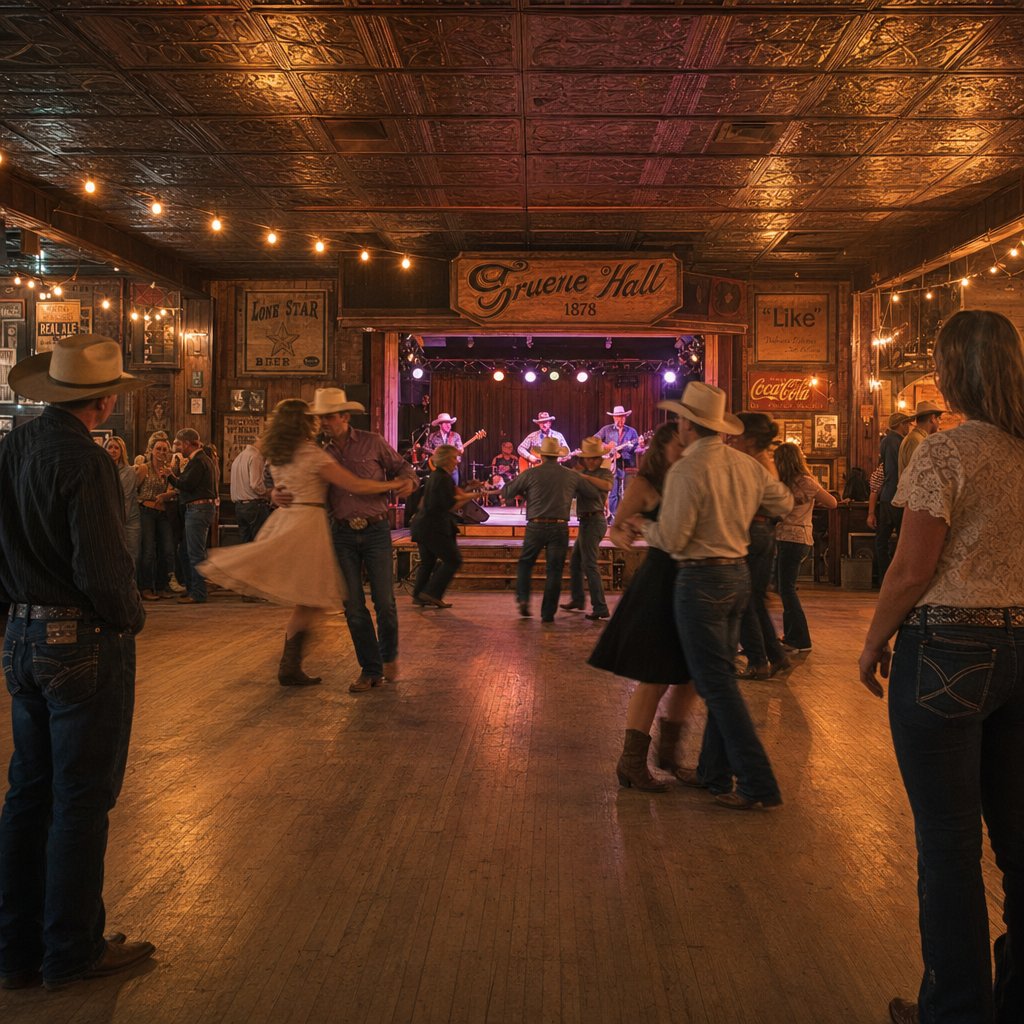
Albums capture the songs, but the rooms where those songs get played shape how they sound in the first place. When an artist writes a track knowing it'll land in a 150-year-old wooden hall full of two-stepping couples — not a stadium with a pyrotechnics budget — the music comes out different. Tempos lock into danceable grooves. Arrangements stay lean enough to cut through bar noise. Lyrics aim for the gut, not the nosebleed seats. The physical infrastructure of the Texas scene isn't just where the music happens. It's why the music sounds the way it does.
Iconic Dance Halls and Honky-Tonks
There's an important distinction worth knowing here. As Texas Monthly has noted, dance halls and honky-tonks aren't the same thing. Many of the state's most beloved dance halls were built by German and Czech settlers in the second half of the nineteenth century — beautiful structures originally designed for social clubs and family gatherings. Honky-tonks, by contrast, tend to have shallower roots. They spring to life when an empty filling station or abandoned storefront gets repurposed into a bar with a stage. As Patrick Sparks of Texas Dance Hall Preservation Inc. once joked, "a dance hall is where you go to dance with your wife, a honky-tonk is where you go to dance with somebody else's wife."
Both types of venue share something essential: they bring together everything that matters about Texas culture. Barbecue, cold beer, two-steps, waltzes, and what Sparks called "our state's abiding frontier personality — that odd combination of friendliness and stubborn independence." These aren't concert halls with assigned seating. They're communal spaces where the artist and the audience share the same worn hardwood floor.
- Gruene Hall (New Braunfels) — Built in 1878, it's the oldest continually operating dance hall in Texas. No air conditioning, no pretense — just raw music in a space that's barely changed in over a century.
- Luckenbach Texas (Luckenbach) — More myth than town, this tiny Hill Country outpost became a symbol of the outlaw movement after Willie, Waylon, and Jerry Jeff Walker made it famous. The Sunday afternoon jams are still legendary.
- Billy Bob's Texas (Fort Worth) — Billed as the world's largest honky-tonk, this 127,000-square-foot venue in the Stockyards has hosted everyone from George Strait to Cody Jinks. It's the rare room that feels massive and intimate at the same time.
- The Broken Spoke (Austin) — A stubborn holdout on South Lamar since 1964, the Spoke has survived Austin's explosive growth by refusing to change. The dance floor is small, the chicken-fried steak is real, and the music stays traditional.
- Floore's Country Store (Helotes) — Just outside San Antonio, this open-air venue has been a proving ground for Texas artists since 1942. Willie Nelson played here so often they named a road after him.
- Cheatham Street Warehouse (San Marcos) — The songwriter's room where George Strait, Todd Snider, and Randy Rogers all cut their teeth. Kent Finlay ran it as a nurturing ground for raw talent for decades.
- Cain's Ballroom (Tulsa) — Technically Oklahoma, but deeply woven into the Texas and red dirt touring circuit. Bob Wills called it home, and it remains a bucket-list stage for artists in both scenes.
Texas Country Radio and Regional Media
Venues put artists in front of crowds, but radio puts them in front of everyone else. The Texas scene sustains its own network of regional stations that give airplay to artists mainstream country radio won't touch. Stations across Austin, San Antonio, the Hill Country, and smaller markets throughout the state form a parallel broadcast ecosystem — one where a fiddle-driven independent release can climb a chart without ever being heard on a Clear Channel playlist.
The Texas Regional Radio Report operates as the recognized and official Texas and red dirt music chart, tracking airplay across its reporting panel and hosting annual awards that celebrate the scene's best. Meanwhile, the Texas Country Music Association provides educational resources and supports charting through digital audio fingerprinting technology — a system that monitors radio station streams and detects every spin without requiring stations to manually report plays. These aren't vanity metrics. They're the infrastructure that lets independent artists prove their reach, book bigger rooms, and build careers on documented momentum rather than Nashville connections.
Regional media outlets and Texas-focused music publications fill the remaining gaps, covering new releases, profiling emerging artists, and keeping fans connected to a scene that mainstream entertainment media largely overlooks. Together, the venues, the radio stations, and the regional press form a self-sustaining ecosystem — one that's been quietly growing for decades and is now impossible for the broader industry to ignore.
The Modern Texas Country Scene and Its Crossover Moment
That self-sustaining ecosystem didn't just survive — it started leaking into the mainstream. Artists who built their careers on the independent Texas circuit are now charting nationally, filling arenas, and racking up billions of streams, all without following the traditional Nashville playbook. The genre is experiencing its biggest crossover moment ever, and it's raising a question the scene has never had to answer at this scale: how big can you get before you stop being independent?
The Mainstream Crossover Moment
Zach Bryan is the most dramatic example. He went from posting raw recordings online to becoming one of the most-streamed artists in all of country music. His album American Heartbreak competed directly with releases from Morgan Wallen and Luke Combs on the Billboard charts — and his hit "Something in the Orange" began charting on Billboard's Country Airplay without an active radio promotion campaign. Stations simply couldn't ignore the demand anymore. As one independent music director noted, the song wasn't even available through standard promotional channels — he had to copy the mp3 from his personal library just to play it.
Cody Jinks took a different approach. After years of selling out venues on the independent circuit, his signature track "Loud and Heavy" from the 2015 album Adobe Sessions earned RIAA Platinum certification and surpassed 142 million Spotify streams — all before anyone seriously tried to push it to mainstream radio. Charley Crockett, meanwhile, has released a prolific run of albums that earned him a 2026 GRAMMY nomination, proving that sheer creative output and authenticity can generate industry recognition without industry compromise.
This crossover isn't happening because these artists changed to fit the mainstream. It's happening because streaming platforms and social media dismantled the old gatekeeping model. Fans no longer need country radio to discover new music — algorithms, playlists, and viral moments do the work instead. As Berklee's Luis Espaillat put it, "If you start to blow up, then the labels will be like, 'Okay, well, let's help you push on a little more.'" The power dynamic has flipped. The scene doesn't need Nashville's permission anymore; Nashville needs the scene's credibility.
That shift creates real tension, though. Growth means bigger venues, wider audiences, and more money — but it also means more industry pressure, more algorithmic dependence, and the risk of diluting the very independence that made the music resonate in the first place. The artists navigating this moment are essentially writing the rules in real time.
Tracking the Scene Through Texas Country Charts
One thing that keeps the scene grounded is its own infrastructure for measuring success. The genre doesn't rely on Billboard alone. The Texas Country Music Chart provides real airplay data from a digital monitoring system — the only Texas-based chart offering verified radio tracking. It publishes weekly rankings, annual Top 200 lists, and a running archive of number-one hits dating back to 2019. For fans and artists alike, it functions as a discovery engine that surfaces music the mainstream charts would never reflect.
The Texas Regional Radio Report serves a similar role, tracking spins across its reporting panel and hosting annual awards. Together, these charting systems give independent artists documented proof of their reach — data they can use to book bigger rooms, negotiate better deals, and build careers on measurable momentum rather than label connections.
Streaming has amplified all of this. Country audio streams exceeded 20 billion in 2023, representing a nearly 24 percent year-over-year increase — almost double the growth rate of the overall music industry. A significant share of that growth comes from listeners discovering roots-driven, independent artists through algorithmic recommendations and curated playlists. What used to be a regional touring circuit now has a global digital footprint.
If you want to stay plugged into what's happening, here are the best ways to track the scene:
- Follow the Texas Country Music Chart for weekly radio airplay rankings and annual Top 200 lists
- Check the Texas Regional Radio Report for official charting data and award nominees across the Texas and red dirt scenes
- Subscribe to Texas-focused Spotify playlists like "Texas Country" and "Red Dirt Nation" for algorithm-friendly discovery
- Tune into Austin and Hill Country radio stations that prioritize independent artists over mainstream rotation
- Follow outlets like Saving Country Music, Lone Star Music Magazine, and Wide Open Country for reviews, profiles, and new release coverage
- Watch for festival lineups — events like Larry Joe Taylor's Texas Music Festival, Lone Star Jam, and MusicFest reveal which artists are rising fastest
- Browse YouTube and TikTok for raw live performances — many artists in this scene still break through the old-fashioned way, one viral clip at a time
The tools for following this music have never been more accessible. The harder question — and the more interesting one — is what happens when you stop just listening and start wondering how to make something that sounds like this yourself.
How to Discover and Create Your Own Texas Country Sound
Wondering where to start is half the fun. Whether you want to go deeper as a listener or try your hand at making something that carries that same raw, independent spirit, the path forward is more accessible than you might think.
Building Your Texas Country Playlist and Knowledge
Start with the essential albums and songs from the earlier sections of this guide — they're organized by era and sub-style for a reason. Queue up a few records, set a 15 minute timer, and just listen without skipping. This music rewards patience. A song like Townes Van Zandt's "To Live Is to Fly" doesn't hit the same way on shuffle as it does when you sit with it.
From there, branch out:
- Follow Texas-specific playlists on Spotify and Apple Music — search "Texas Country" or "Red Dirt Nation" for curated starting points
- Tune into Austin and Hill Country radio stations online for a steady stream of artists the mainstream algorithms won't surface
- Check the Texas Country Music Chart weekly to catch rising tracks before they cross over
- Attend a live show at a dance hall or festival if you get the chance — hearing this music in the room it was written for changes everything
The genre rewards active exploration because so much of its best work lives outside mainstream recommendation engines. The deeper you dig, the more you find.
Creating Your Own Texas Country-Inspired Music
For those inspired to create rather than just consume, the sonic blueprint is surprisingly approachable. At its core, the sound relies on a few key elements: prominent fiddle and steel guitar, storytelling-first lyrics grounded in real experience, a raw and unpolished production feel that favors room tone over studio gloss, and danceable rhythms that lock into two-step and waltz grooves. You don't need a Nashville studio budget. Some of the genre's most beloved recordings were made in living rooms and bare-bones sessions.
Learning fiddle or steel guitar takes time, obviously. But if you want to experiment with the feel of the genre before committing to years of practice, tools like MakeBestMusic's AI Song Generator offer a low-barrier entry point. You can feed it a genre, mood, or song concept and get an original royalty-free track back in seconds — useful for content creators, songwriting demos, or just scratching the creative itch while you're still learning your way around an instrument. It won't replace the experience of playing a real honky-tonk, but it's a practical way to explore ideas quickly and hear how different moods and tempos shape a track.
The real secret, though, is the same one every artist on this list figured out: start with a story worth telling. The fiddle and steel guitar are just the delivery system. What made this movement matter — from Willie's Austin rebellion to Zach Bryan's phone recordings — was never the production. It was the honesty. Pick up a guitar, open a blank page, or fire up whatever tool gets you creating, and write something true. That's how every great Texas country song has ever started.
