

The Real Question Behind AI and Music's Future
Imagine logging into your favorite streaming platform and discovering that nearly half of the new music uploaded today was generated by artificial intelligence. That scenario is no longer hypothetical. Deezer reported that approximately 44% of its daily uploads are now AI-generated tracks. The question of whether AI will ruin the music industry has moved from speculative debate to urgent, real-world concern.
Yet here is the twist: those AI tracks account for less than 3% of actual listening on the platform, and a majority of those streams appear to be driven by bots rather than human ears. The gap between supply and consumption tells a more complicated story than either doomsday headlines or techno-optimist cheerleading would suggest.
Why This Question Matters Now
AI music capabilities have accelerated dramatically. Platforms like Suno and Udio scaled rapidly in users and revenue, enabling anyone to generate full songs from a text prompt. Consumer-facing AI tools have moved from producing generic background sounds to generating high-fidelity compositions that can be difficult to distinguish from human-created work. Meanwhile, a Luminate study found that listener comfort with AI music actually declined over 2025, dropping from -13% to -20% net sentiment. Artists like SZA have publicly declared themselves "at war" with AI-generated content. The tension between technological capability and cultural resistance is intensifying on every front.
What This Analysis Covers
This is not an opinion piece. It is a multi-stakeholder, evidence-based investigation into how AI is reshaping music across five dimensions: historical context, economics, ethics, regulation, and practical impact on specific roles from session musicians to independent artists. The goal is to move past fear and hype toward clarity.
Disruption and destruction are not the same thing. The future of music with artificial intelligence depends on which forces, creative, economic, and regulatory, ultimately shape how the technology is deployed.
Whether AI is a threat to musicians or an unprecedented creative partner depends on choices being made right now, by platforms, lawmakers, labels, and artists themselves. The evidence points in multiple directions simultaneously, and understanding those competing signals is the only way to answer the question honestly.
Every Time Technology Was Supposed to Kill Music
Fears about technology destroying the music industry are not new. They are, in fact, a recurring pattern stretching back more than a century. Each time a new invention changed how music was created, distributed, or consumed, established players predicted catastrophe. And each time, the industry adapted, often emerging larger and more diverse than before. Understanding this history is essential context for evaluating whether AI represents just another chapter in that story or something fundamentally different.
From Player Pianos to Napster
The panic cycle starts earlier than most people realize. In the late 1800s, the player piano reached mass market and immediately threatened the livelihoods of working pianists. Why hire a musician when a mechanical device could reproduce a performance from a paper roll? Sheet music publishers were equally alarmed because their songs were being mechanically reproduced without compensation. Courts initially ruled that piano rolls did not constitute copies because they could not be read by the human eye. It took Congressional action to establish mechanical royalties, creating an entirely new revenue stream that persists today.
Then came radio. By the early 1930s, record labels watched in horror as audiences shifted to free broadcast entertainment. Why buy a recording when you could hear live performances in your living room at no cost? Record sales dropped. The industry response was not collapse but innovation: ASCAP extended performance licensing to radio stations, creating broadcast performance royalties. When ASCAP pushed rates too high, the radio industry formed BMI in 1939, which signed jazz, blues, and country artists previously underserved by ASCAP. The unintended consequence? Mainstream exposure of the genres that would feed directly into rock and roll.
The pattern repeated with home taping in the 1980s. The British Phonographic Industry's "Home Taping Is Killing Music" campaign warned that cassette recorders would destroy the record business. What actually happened? The industry grew. Tapes made music portable and personal, expanding consumption rather than cannibalizing it.
Napster and peer-to-peer file sharing in the early 2000s came closest to genuine destruction. Revenue plummeted from its 2001 peak as millions of users shared recordings freely. As Judge Sidney R. Thomas of the Ninth Circuit noted in a landmark file-sharing case, "The introduction of new technology is always disruptive to old markets, and particularly to those copyright owners whose works are sold through well-established distribution mechanisms. Yet, history has shown that time and market forces often provide equilibrium." The equilibrium eventually arrived through licensed streaming, which transformed the industry's economics entirely.
Did streaming ruin the music industry? The numbers tell a clear story. IFPI data shows global recorded music revenue has more than doubled since 2014, growing from US$14 billion to US$29.6 billion, with streaming now accounting for 69 percent of that total. Over 750 million users hold paid streaming subscriptions globally. The industry did not die. It restructured.
- Player Piano (1890s-1900s) — Predicted outcome: live pianists and sheet music sales destroyed. Actual outcome: mechanical royalties created, new revenue stream established for songwriters.
- Radio (1930s) — Predicted outcome: record sales collapse permanently. Actual outcome: broadcast performance royalties created, new genres gained mainstream exposure, radio became a promotional engine for record sales.
- Home Taping (1980s) — Predicted outcome: recorded music industry killed by free copying. Actual outcome: music consumption expanded through portability, industry revenue continued growing.
- Napster and P2P (2000s) — Predicted outcome: recorded music ceases to be commercially viable. Actual outcome: severe revenue decline followed by recovery through licensed streaming, industry now worth more than double its 2014 value.
- Streaming (2010s) — Predicted outcome: artists cannot survive on fractions-of-a-cent payments. Actual outcome: global revenue growth, artist payments increasing 107% between 2016 and 2023, though distribution of that revenue remains uneven.
Why AI Might Be Different This Time
Here is the counterargument that makes the history of technology disrupting music less reassuring than it first appears. Every previous disruption targeted how music was distributed, reproduced, or consumed. Player pianos reproduced existing performances. Radio broadcast existing songs. Napster copied existing recordings. Streaming changed the delivery format. None of these technologies threatened the creative act itself.
AI does something qualitatively different. It targets creation. A text-to-music generator does not copy or redistribute a human composition. It produces new compositions, melodies, arrangements, and lyrics that never existed before, without a human musician making creative decisions. As the Columbia Journal of Law & The Arts frames it, AI trained on copyrighted works "can create music that has the potential to oversaturate the market, thereby undermining the artistic integrity of music created by human beings and threatening the economic welfare of creators."
Previous technologies displaced musicians from specific economic roles while leaving the fundamental need for human creativity intact. Radio displaced live performers from living rooms but still needed someone to write and perform the songs. Streaming displaced physical retailers but still required human artists to fill the catalog. AI, at least in theory, can generate the catalog itself.
That distinction matters enormously. The reassuring historical pattern, where technology disrupts distribution and new business models emerge to compensate creators, depends on creators remaining necessary. If the technology can perform the creative work, the historical analogy breaks down. The question is no longer just about how music reaches listeners but about who, or what, makes the music in the first place.
This does not mean the historical lessons are irrelevant. The pattern of regulatory adaptation, from mechanical royalties to broadcast licensing to the DMCA, shows that legal frameworks can evolve to protect creators when new technologies threaten their livelihoods. But the speed and scale of adaptation required may be unprecedented, precisely because the disruption sits closer to the core of what the industry exists to support: human musical expression.
The real impact, though, depends on where AI lands across the full music value chain, not just in the headline-grabbing act of composition.
How AI Touches Every Stage of Music
Most of the debate around AI and music fixates on one thing: composition. Can a machine write a hit song? But that narrow focus misses the bigger picture. AI is already deeply embedded across the entire music value chain, from the first spark of an idea to the moment a listener presses play. Understanding this full AI music value chain breakdown reveals that the disruption is broader, quieter, and in many cases further along than headlines suggest.
AI in Music Creation and Composition
This is the stage grabbing all the attention, and for good reason. Text-to-music generators can now draft melodies, lyrics, and chord progressions that meet mainstream quality standards, compressing weeks of top-line writing into minutes. Venture-backed platforms push out full-length demos with multi-voice arrangements and evolving song sections. For songwriters, the creative bottleneck shifts from blank-page paralysis to taste-driven curation and prompt craft.
Voice modeling adds another layer. Major labels have struck agreements allowing roster artists to audition alternate languages, timbres, or vocal textures without booking additional sessions. The spend once reserved for session vocalists and topliners can be redirected elsewhere. Whether you view that as liberation or displacement depends on which side of the studio glass you sit on.
AI in Production, Distribution, and Marketing
How AI is used in music production goes well beyond generating notes on a page. Cloud-based stem splitters can isolate drums, vocals, or guitars from vintage masters in seconds, letting producers flip catalog deep cuts into remix-ready material without expensive re-recording. Automated mix-and-master engines thread stems through genre-matched processing chains that mimic professional loudness and tonal curves. Human engineers increasingly step in for brand-critical records or boutique sonic signatures rather than baseline fidelity.
On the distribution and marketing side, AI is remaking how tracks reach ears. Spotify's personalization stack, including DJ, Daylist, and predictive playlisting, relies on transformer models parsing micro-signals like skip rates to deliver tailored surfacing. Labels pair that data with predictive A&R dashboards flagging unsigned acts whose sentiment, structure, and social velocity mirror previous breakouts.
AI in music distribution and marketing extends even further. AI playlist generators now assemble listening experiences from natural-language prompts like "late-night atmospheric indie with female vocals." Discovery is becoming semantic rather than categorical. Metadata, once an administrative afterthought, is now strategic infrastructure. Tracks with incomplete mood tags, instrumentation details, or contextual descriptors risk being invisible to algorithms entirely.
The table below maps how AI tools for music creation and mastering, along with distribution and consumption technologies, interact with each stage:
| Value Chain Stage | AI's Current Role | Level of Disruption | Replaces or Augments? |
|---|---|---|---|
| Creation (melody, lyrics, arrangement) | Text-to-music generators, AI co-writing tools, voice modeling | High | Both — augments skilled writers, can replace formulaic work |
| Production (mixing, mastering, sound design) | Automated mastering engines, stem separation, AI sound design | Medium-High | Augments primarily — replaces baseline tasks, not boutique work |
| Distribution (playlist placement, metadata) | Algorithmic playlist generation, semantic search, metadata optimization | High | Augments — shifts strategy from pitching to data precision |
| Marketing (audience targeting, content) | Predictive A&R dashboards, social content generation, ad targeting | Medium | Augments — automates analysis, humans still set creative direction |
| Consumption (listening experience) | Personalized recommendations, adaptive playlists, prompt-based curation | High | Augments listener experience — reshapes which music gets heard |
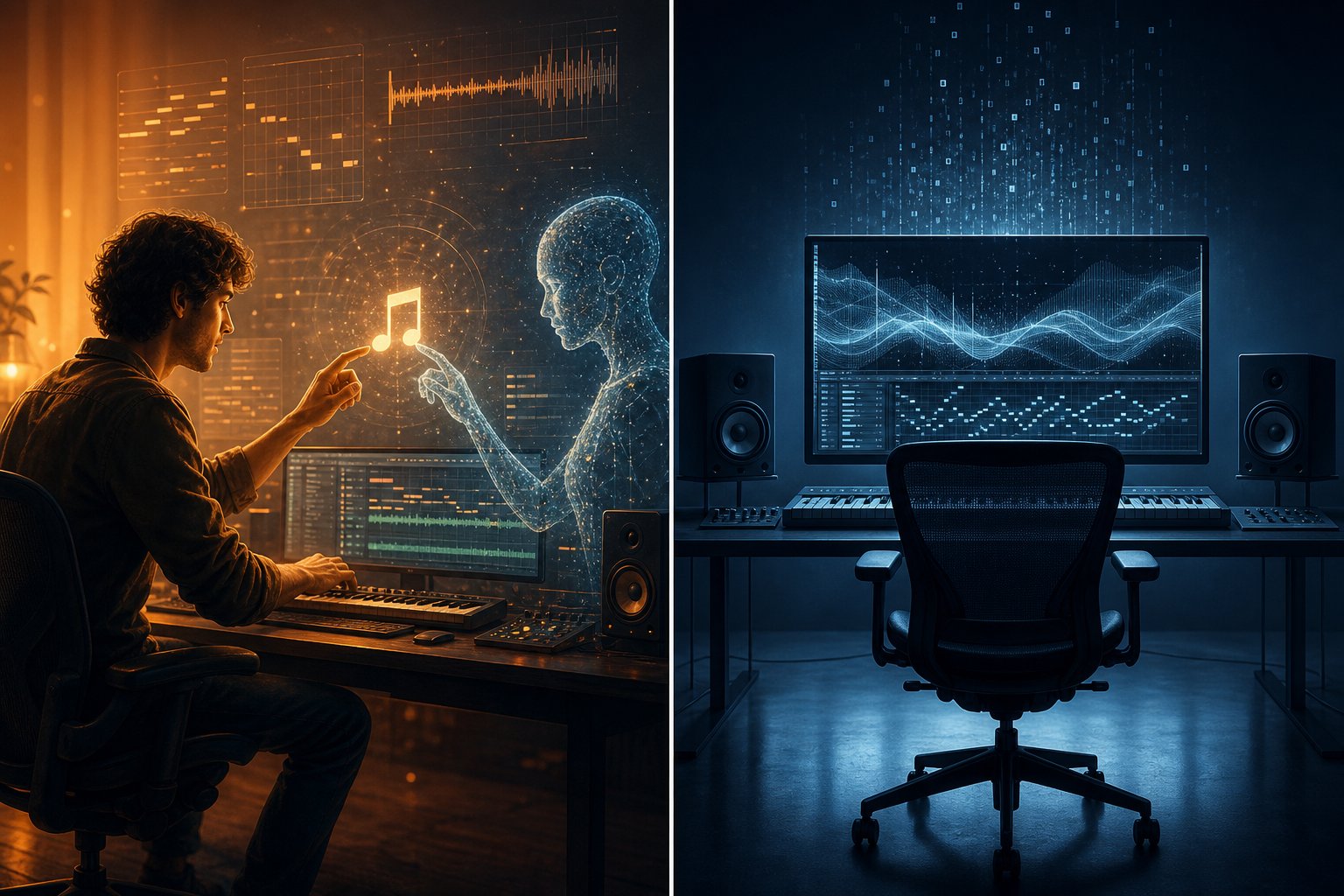
Notice the pattern. At every stage except pure consumption, AI operates on a spectrum between augmentation and replacement. Where it lands on that spectrum for any given role is not predetermined by the technology itself. It depends on economics, regulation, and the choices made by the people deploying it. That distinction between tool and substitute turns out to be the single most important factor in determining whether AI reshapes the industry or hollows it out.
The Difference Between Replacement and Augmentation
That spectrum between tool and substitute is not just an academic distinction. It is the single most useful lens for evaluating whether AI will hollow out the music industry or expand what human musicians can accomplish. Two artists can use the same AI platform and arrive at radically different outcomes: one treats it as a collaborator that accelerates their vision, the other is replaced by it entirely. The technology is identical. The framing determines the result.
Think of it this way. A calculator did not replace mathematicians. It eliminated arithmetic drudgery so they could focus on higher-order problem solving. AI augmentation vs replacement in music follows a similar logic, but the stakes feel more personal because music is not arithmetic. It is expression, identity, culture. That emotional weight is exactly why the distinction matters so much.
AI as Creative Partner
How musicians use AI as a creative tool looks nothing like the dystopian headlines suggest. A 2025 LANDR study of 1,200 producers found that 87% already use AI in their workflows, but the breakdown reveals something important: 79% use it for technical tasks like mixing, mastering, or audio restoration. Only 13% have used a tool to generate an entire song. The overwhelming majority treat AI as a skill-gap filler and workflow accelerator, not a replacement for their creative judgment.
Consider what AI assisted songwriting and production actually looks like in practice. A songwriter stuck on a bridge section feeds their verse into a chord generator and gets fifteen harmonic options they would not have explored on their own. A bedroom producer who cannot afford a session drummer uses AI to generate a rhythmic foundation, then chops, rearranges, and humanizes it until it fits their vision. An independent artist handles their own mastering through an AI engine because hiring a professional for every single costs more than their monthly revenue.
- Exploring chord progressions and harmonic alternatives — AI suggests options a songwriter might not reach intuitively, expanding creative range without dictating choices.
- Generating instrumental stems for arrangements — 16-18% of producers already use AI to create vocals, beats, or instrumentals that complement existing work rather than stand alone.
- Rapid prototyping and reference tracks — Musicians generate rough demos in minutes to communicate ideas to collaborators or test concepts before committing studio time.
- Technical production tasks — Mastering, stem separation, audio restoration, and mix referencing handled at a fraction of traditional cost and turnaround.
- Visual and promotional content — Over 80% of producers in the LANDR study said AI could help with social media content and fan analytics, freeing time for actual music-making.
In each of these cases, the human remains the decision-maker. AI proposes. The artist disposes. The creative identity of the work stays anchored in a person with taste, intention, and lived experience. As Musicians Institute frames it, AI is not a replacement for human creativity but a tool to enhance it, with the best results emerging from the combination of human skill and technology.
AI as Creative Replacement
The replacement model looks entirely different. Here, no human musician makes meaningful creative decisions. A content creator types "upbeat lo-fi hip hop, 3 minutes, no vocals" into a generator and receives a finished track ready for their YouTube video. A retail chain generates an endless ambient playlist for its stores without licensing a single human composition. A mobile game developer populates dozens of levels with AI-generated soundtracks at near-zero marginal cost.
This is where the AI replacing human musicians debate gets real. Background and functional music is experiencing the most dramatic shift because it was always utility-focused: music designed to accompany rather than captivate. Content creators who previously faced expensive licensing, limited free libraries, or copyright strikes now have unlimited royalty-free options tailored to exact specifications. Stock music libraries feel the pressure directly. When an AI generates tracks customized to precise duration, tempo, and mood in seconds, the value of searching through thousands of pre-made options diminishes sharply.
These are not hypothetical scenarios. They represent real market segments where AI output already substitutes for human-created music at scale. The musicians who built careers providing functional music for commercial applications face genuine displacement, and there is no honest way to minimize that reality.
The critical insight is this: the outcome for the broader industry depends on which model dominates. If AI primarily serves as a creative partner, lowering barriers and expanding what artists can achieve, the industry grows more accessible and diverse. If it primarily serves as a replacement engine flooding platforms with zero-cost content, it erodes the economic foundation that supports human musicians. Both models coexist right now. The balance between them will determine whether the answer to this question is "reshaped" or "ruined."
That balance is not just a matter of technology or individual choice. It is fundamentally an economic question, shaped by who benefits when the cost of producing music approaches zero.
The Economics of Infinite Music Supply
When production costs collapse toward zero, the economics of an entire industry shift beneath everyone's feet. A professional-quality track that once required thousands of dollars in studio time, session fees, and engineering can now be generated in seconds at negligible cost. That sounds democratizing in theory. In practice, it creates a supply-side explosion that fundamentally alters how AI affects music streaming revenue, discoverability, and the financial viability of human artistry.
The math is straightforward and unforgiving. Listener attention is finite. There are still only 24 hours in a day, and the average streaming subscriber listens to roughly 30 hours of music per month. Meanwhile, the supply of available music is becoming functionally infinite. Deezer's data showing 44% of daily uploads as AI-generated tracks illustrates the scale of this imbalance. When supply grows exponentially while demand stays flat, the per-unit value of each track drops accordingly.
Market Flooding and the Discoverability Crisis
Imagine you are an independent artist releasing a single you spent months writing, recording, and mixing. On the day you upload it, thousands of AI-generated tracks hit the same platform. Your song is not competing against other artists who invested similar time and effort. It is competing against an ocean of content produced at near-zero marginal cost, optimized for algorithmic metadata, and uploaded at industrial scale.
This is AI music flooding streaming platforms in real time. The discoverability problem is not new, but AI accelerates it from difficult to nearly impossible for artists without existing audiences or marketing budgets. Streaming platforms use algorithmic recommendation systems that surface content based on engagement signals. When the catalog expands by millions of tracks monthly, the percentage of total streams any single human artist can capture shrinks mechanically, even if their music is objectively better.
The royalty pool math makes this concrete. Most major streaming services operate on a pro-rata model: total subscription revenue is divided among all streams on the platform proportionally. As artists' rights groups noted in their open letter "Say No To Suno," AI content "dilutes the royalty pools of legitimate artists from whose music this slop is derived." Every fraudulent or bot-driven stream on an AI track siphons fractions of a cent away from human musicians. Deezer found that a majority of streams on AI-generated content were driven by bots rather than real listeners, yet those streams still dilute the pool before being identified and demonetized.
There is a silver lining buried in the data. Listeners themselves appear resistant to AI content. That same Deezer analysis showed AI tracks accounting for less than 3% of actual human listening despite representing 44% of uploads. Luminate's research confirmed that consumer sentiment toward AI music dropped to -20% net negative by late 2025. The market is flooding, but ears are not following. The question is whether platform economics and algorithmic systems can reflect that human preference quickly enough to protect creator revenue.
Who Wins and Loses in the New Economics
AI reducing music production costs does not affect all industry players equally. The impact depends on your position in the value chain, your existing resources, and how much of your revenue comes from creative labor versus catalog ownership.
| Industry Player | Economic Impact of AI | Net Position |
|---|---|---|
| Major Labels | Cut production costs on new signings, monetize catalogs through AI licensing deals, leverage legal resources to negotiate favorable terms with AI companies | Net positive — positioned to profit from both cost reduction and new licensing revenue |
| Independent Artists | Gain access to production quality previously unaffordable, but face intensified competition for discovery and shrinking per-stream payouts | Mixed — tools improve, but economic environment worsens |
| Producers and Engineers | Baseline production work (mastering, basic mixing) commoditized; premium and boutique work retains value but total addressable market shrinks | Net negative for mid-tier; top-tier and niche specialists retain demand |
| Sync/Stock Music Creators | Direct replacement by AI generators offering customized, royalty-free alternatives at near-zero cost; clients shifting budgets away from licensing | Net negative — highest immediate displacement of any segment |
Major labels sit in the strongest position because they control vast catalogs that AI companies need for training data. Universal Music and Warner Music have already settled legal disputes with AI platforms and converted them into licensing partnerships. These deals generate new revenue streams from existing assets without requiring additional creative investment. The labels profit whether AI augments or replaces human musicians, because they own the raw material either way.
Independent artists face a paradox. AI tools genuinely lower the barrier to professional-sounding releases. A solo artist can now produce, mix, and master a track that rivals major-label sonic quality without a studio budget. But that same democratization applies to everyone, including people generating content purely for algorithmic exploitation. The economic impact of AI on independent musicians is a story of improved tools inside a deteriorating marketplace.
Stock music and sync licensing represent the canary in the coal mine. Content creators, advertisers, and media companies that once licensed functional music from libraries now generate custom tracks on demand. As Forbes noted, platforms increasingly integrate AI-generated music to cut costs, asking a simple question: why license a costly catalog when AI can generate something "good enough" for free? For composers who built sustainable careers providing background music for commercials, podcasts, and corporate videos, the answer is existential.
The economic restructuring is already underway. It does not require AI to achieve human-level artistry to reshape who profits. It only requires AI to be good enough for the use cases where music serves a functional rather than expressive purpose. And for those use cases, it already is. The deeper question is what happens to the people caught in this transition, and whether their specific roles face temporary disruption or permanent displacement.

Who Is Most at Risk and Who Stands to Gain
Economic averages hide individual stories. Saying the music industry is "restructuring" means very different things depending on whether you are a touring vocalist, a stock music composer, or a bedroom producer trying to break through. The only useful way to answer which music jobs are most at risk from AI is to go role by role, weighing each position against the specific capabilities AI has today and the trajectory it is on.
Not every role faces the same threat level. Some are already experiencing measurable displacement. Others are becoming more valuable precisely because AI cannot replicate what they do. The key factors determining resilience are the same ones that have protected certain jobs through every previous technological shift: human creativity, relationship-driven work, strategic decision-making, and physical or real-world presence. The more a role depends on those qualities, the more resistant it is to automation.
Roles Facing the Highest Disruption
Picture a sync composer who has spent a decade building a catalog of corporate background tracks, podcast intros, and commercial beds. Their clients are content creators, ad agencies, and media companies who need functional music quickly and affordably. When an AI generator can produce a custom 90-second upbeat corporate track in seconds at near-zero cost, the economic logic of licensing from a human catalog collapses. This is not a hypothetical future. It is already happening. Sync and stock music creators sit at the top of the risk hierarchy because their work was always utility-driven, and utility is exactly where AI excels.
Will AI replace session musicians? The answer depends heavily on genre and context. For pop, electronic, and hip-hop production, AI-generated drums, bass lines, and synth parts are already good enough to fill arrangements that would have previously required booking a session player. LANDR's 2025 study found that 16-18% of producers already use AI to generate instrumentals and beats for existing arrangements, and 65% said they were open to using generators at some stage in their workflow. The reasoning is practical: working with a session musician can be costly, challenging, and time-consuming. For genres demanding nuanced human expression, think jazz improvisation, complex fingerstyle guitar, or orchestral performance with emotional phrasing, session musicians retain clear value. But the volume of work available to mid-tier session players in commercially driven genres is shrinking.
Producers face a different kind of shift. The role is not disappearing so much as evolving from execution to curation. When AI handles baseline mixing, mastering, and sound design, the producer who simply delivers competent technical output loses their competitive edge. The producer who brings a distinctive sonic identity, creative vision, and artist-development instinct becomes more essential. Top-tier and niche-specialist producers will likely see sustained demand. The crowded middle tier, professionals who deliver solid but undifferentiated work, faces the steepest pressure.
Songwriters occupy an interesting middle ground. AI-assisted songwriting tools can generate chord progressions, melodic ideas, and even lyrical drafts that serve as creative springboards. For writers who craft deeply personal, narrative-driven, or culturally specific material, AI is a brainstorming partner at best. For writers whose output skews formulaic, think jingle writing, topline hooks built on predictable patterns, or lyrics that follow well-worn emotional templates, the replacement threat is real. The music industry roles most affected by AI tend to be those where the creative work follows patterns that algorithms can learn and reproduce at scale.
- Sync/Stock Music Composers — Highest immediate risk. Clients are shifting to AI generators for custom, royalty-free functional music. Revenue erosion is already measurable.
- Session Musicians (Pop, Electronic, Hip-Hop) — High risk for genres where AI-generated parts meet production standards. Lower risk for acoustic, jazz, and performance-intensive genres.
- Mid-Tier Producers and Engineers — High risk for baseline production work. AI commoditizes mixing, mastering, and standard sound design. Specialists and top-tier talent retain demand.
- Formulaic Songwriters — Moderate-to-high risk. Pattern-based writing is replicable by AI. Distinctive storytelling and cultural specificity remain human advantages.
- Performing Artists — Lowest risk. Audiences connect with human identity and authenticity. Live performance, stage presence, and personal brand cannot be automated, making performers the most resilient category.
- Music Educators and Coaches — Low risk, evolving role. Teaching involves adapting to individual students, providing motivation, and building mentorship relationships. AI can support learning tools but cannot replace the human element of instruction.
- A&R, Managers, and Music Lawyers — Low risk. These roles depend on taste, instinct, trust, and negotiation, qualities that remain firmly in the human domain even as AI assists with data analysis and administrative tasks.
How Independent Artists Face Different Challenges Than Major Label Acts
The AI threat to independent artists vs major labels is not just a matter of degree. It is a structural difference in resources, protection, and adaptive capacity.
Major label artists operate inside ecosystems designed to absorb disruption. Their labels control massive back catalogs that AI companies need for training data, converting that leverage into licensing deals and revenue-sharing agreements. They have legal teams that can pursue infringement claims, marketing budgets that ensure algorithmic visibility, and brand recognition that audiences seek out regardless of platform dynamics. When Universal Music negotiates an AI training license, every artist on its roster benefits indirectly from that institutional power.
Independent artists have none of those buffers. As Duke's Tech Policy analysis notes, independent musicians are forced to "take whatever terms dominant online platforms offer for their work," leaving them exposed as AI content floods those same platforms. They lack the legal resources to monitor or challenge unauthorized use of their music in AI training sets. The protections available under existing copyright frameworks have been described as a "game of whack-a-mole" where the burden falls on individual creators to report infringements against an endless tide of AI-generated content.
The discoverability gap widens further. On streaming platforms, recommendation algorithms already favor major-label content. Research on bias in music recommendation found that major labels are over-represented in the recommendation process, partly because labels like Universal and Warner hold substantial equity in platforms like Spotify. Independent artists competing for algorithmic visibility were already fighting an uphill battle. Adding millions of AI-generated tracks to that environment makes the climb steeper.
Yet there is a counterpoint worth noting. The same AI tools that threaten the broader marketplace also give independent artists capabilities that were once locked behind expensive studio doors. A solo artist can now produce, mix, master, and promote a release using AI-powered tools at a fraction of what those services cost even five years ago. The paradox for independents is stark: better tools inside a harder market.
Whether any of these role-specific pressures translate into lasting damage or temporary disruption depends partly on something less tangible than economics: what listeners actually value when they choose to press play. The question of authenticity, what makes music feel real and worth caring about, may ultimately matter more than any algorithm or cost curve.
What AI Means for Musical Authenticity
Authenticity is harder to quantify than royalty rates or stream counts, but it may be the factor that ultimately determines how this story ends. Copyright law can address who owns what. Economics can explain who profits and who loses. Neither framework answers the deeper question lurking beneath every debate about AI in music: does it matter who, or what, created the song you are listening to?
For most of recorded history, that question did not need asking. Every piece of music implied a human behind it, someone who lived through something, felt something, and translated that experience into sound. AI-generated music breaks that assumption for the first time. The ethical concerns about AI music generation extend well beyond intellectual property into territory that touches identity, meaning, and the cultural role music plays in human life.
Authenticity and Emotional Truth in AI Music
Here is a fascinating paradox. A biometric study published in PLOS ONE found that AI-generated soundtracks actually produced wider pupil dilation and higher self-reported arousal than human-composed music in audiovisual contexts. Participants found AI music more stimulating on measurable physiological levels. Emotional valence, the conscious sense of whether the experience felt positive or negative, showed no significant difference across conditions. In other words, listeners' bodies responded to AI music at least as strongly as to human-made music, and their conscious emotional experience was statistically indistinguishable.
Does AI generated music have emotional value, then? The biometric evidence says yes, at least in terms of physiological and perceptual impact. But that answer only scratches the surface. The same study revealed that human-created music was perceived as significantly more familiar, and familiarity correlates with preference in music listening. The researchers suggested that human composers draw on established conventions in Western cinematic composition that feel natural and recognizable, while AI-generated content can produce what scholars describe as an "uncanny" aesthetic, something that sounds almost right but carries an eerie, unsettling quality.
If a machine generates a heartbreak ballad without ever having experienced loss, does the song carry less emotional truth, or does the listener's interpretation create the meaning regardless of origin?
This is not just a philosophical thought experiment. Research from CESifo found that listeners actually perceived AI-generated songs as superior to human-made ones in blind comparisons. They rated them higher and expressed a greater desire to listen again. But when the AI origin was disclosed, willingness to pay dropped and the desire to relisten decreased, particularly among pop listeners. The music did not change. Only the story behind it changed. And that shift was enough to alter perceived value.
Authenticity in AI created music, it turns out, is less about the sonic qualities of the output and more about the narrative listeners attach to it. We do not just hear music. We hear the person behind the music. When that person disappears, something shifts in how we assign meaning, even if our ears cannot detect the difference. As AI ethics researcher Virginia Dignum has put it, "Signals of authenticity will soon matter more than content."
The Case for Human-Made Certification
If authenticity matters to listeners but they cannot reliably detect AI-generated music by ear alone, a gap opens between what people value and what they can identify. That gap has sparked a growing human-made music certification movement, drawing direct parallels to organic food labeling and fair-trade designations.
The data supporting this approach is striking. Experiments at Columbia Business School found that when people were shown similar creative works and told which were human-made versus AI-generated, they valued the human-made pieces up to 60% more highly, rating them as more creative, more labor-intensive, and more worthy of financial support. The label itself created the value difference, not the content.
Early prototypes of certification are already emerging. Actor and director Justine Bateman launched the Credo23 film festival in Los Angeles, requiring filmmakers to pledge that no generative AI was used in any capacity, with qualifying works receiving a visible human-made stamp. Industry voices have proposed a three-tier system: "human-created" for works made entirely by people, "human-AI hybrid" for works using generative tools with full disclosure, and "AI-generated" for outputs with no meaningful human authorship.
The idea is not to police taste or ban tools. It is to make the creative process visible again. As one Columbia researcher noted, "I'm waiting for the day when I'm scrolling through my algorithm and see a 'Verified Human Content' label." Streaming platforms, arts councils, and festival committees could all integrate such labeling, giving listeners who care about origin a practical way to act on that preference.
Challenges remain, of course. Any certification system risks gatekeeping if controlled by narrow institutions. It could stigmatize artists who use AI transparently and ethically as part of their process. And the identity question grows murkier in the middle ground: at what point does a musician who uses AI to generate chord progressions, draft lyrics, and build arrangements cross the line from AI-assisted artist to AI artist? There is no clean threshold. The line between "tool user" and "curator of machine output" blurs more with each advancement in generative capability.
Still, the underlying principle holds. In a market flooding with synthetic content, the ability to verify human involvement becomes an economic asset, not just a philosophical stance. The cultural value we assign to music has always been tied to the belief that someone real made it. Protecting that signal may prove just as important as protecting the legal rights around it, and it is exactly the kind of issue that regulators around the world are beginning to grapple with.
The Global Regulatory Race to Protect Creators
Certification labels and cultural norms can signal authenticity, but they cannot enforce it. That enforcement falls to law, and right now the legal landscape for AI music copyright law by country is fragmented, fast-moving, and nowhere close to settled. How governments and courts answer the core questions, whether AI training on copyrighted music requires a license, whether AI-generated outputs qualify for copyright protection, and who bears liability when infringement occurs, will largely determine whether AI functions as a creative partner or an unchecked replacement engine.
The challenge is speed. Generative AI capabilities advance in months. Legislation moves in years. Court cases take even longer. That gap between regulatory pace and technological acceleration means the rules governing AI music are being written after the disruption is already underway, not before.
How Different Regions Are Responding
There is no unified global approach. The US, EU, and UK are each pursuing distinct strategies shaped by their legal traditions, economic priorities, and political pressures.
In the United States, the Copyright Office has taken a clear position: works generated entirely by AI lack copyright protection and fall into the public domain. Human collaboration with AI can create protectable works, but authors must identify and disclaim AI-generated portions. The bigger unresolved question is whether using copyrighted music to train AI models constitutes fair use. Multiple lawsuits are testing this, including cases brought by major labels against Suno and Udio, and a class action by independent musicians against Skywork AI's Mureka platform for allegedly misappropriating copyrighted music and voices for training data. Federal legislation remains stalled, with earlier attempts to impose a moratorium on state AI regulation removed from the "One Big Beautiful Bill Act" after significant opposition.
The European Union has moved furthest on structural regulation. Article 50 of the EU AI Act, which entered into force in August 2024, requires providers of generative AI systems to mark outputs in machine-readable formats and ensure AI-generated content is detectable. The first draft Code of Practice published in December 2025 mandates a multi-layered approach combining metadata embedding, imperceptible watermarks, and fingerprinting. A final version is expected by mid-2026. Meanwhile, the EU's DSM Directive includes a text and data mining exception that allows AI training on copyrighted works unless rights holders explicitly reserve their rights in a machine-readable format. Courts are actively testing these boundaries. In Germany, GEMA won a ruling against OpenAI when the Munich Regional Court found that memorization of copyrighted song lyrics in AI models constituted infringement, with the TDM exception deemed inapplicable.
The United Kingdom sits at a crossroads. A major government consultation attracted over 11,500 responses, with 88% of respondents favoring mandatory licensing for all AI training on copyrighted works. The government's own preferred option, a TDM exception with rights reservation, received only 3% support. Under the Data (Use and Access) Act, the government must publish an economic impact assessment and a report on copyright use in AI development by March 2026. Expert working groups covering control standards, transparency, licensing, and creator support are informing those recommendations. The Getty Images v Stability AI case, where the High Court found trade mark infringement but ruled that AI models do not store copies of training data in model weights, is heading to appeal on key questions about what constitutes an "infringing copy" in the context of AI.
| Region | Regulatory Approach | Status | Key Provisions | Impact on AI Music |
|---|---|---|---|---|
| United States | Case law driven, no comprehensive federal AI legislation | Active litigation, no settled precedent on training fair use | AI-only works uncopyrightable; human-AI hybrids protectable with disclosure; fair use of training data unresolved | Uncertainty favors well-resourced players who can afford litigation; independents lack enforcement tools |
| European Union | Regulatory framework (AI Act) plus directive-based copyright exceptions | AI Act in force; Code of Practice final version expected mid-2026; CJEU referral pending | Mandatory AI output marking; TDM exception with opt-out rights for creators; transparency obligations on providers | Strongest creator protections if opt-out mechanisms work in practice; labeling requirements support authenticity signals |
| United Kingdom | Consultation-based, balancing innovation and creator rights | Government report due March 2026; Getty appeal proceeding; no new legislation yet | 88% consultation support for mandatory licensing; expert working groups on transparency and licensing standards | Outcome uncertain but political pressure strongly favors creator protection over broad TDM exceptions |
Industry Self-Regulation and Licensing Frameworks
While governments deliberate, the industry is not waiting. Major labels have shifted from pure litigation to negotiated licensing, recognizing that resistance alone may be less effective than structured collaboration. Universal Music Group, Warner Music Group, and Sony Music Group initially sued AI platforms Suno and Udio for copyright infringement, then pivoted toward licensing agreements that include compensation for past use, ongoing royalties, and even minority equity stakes. Current negotiations reportedly include veto power over future AI music tools like voice-cloning features and remix suites.
These deals represent what governance experts call "human-in-the-loop" systems: AI companies continue using major-label catalogs for training, but under new parameters and oversight structures. The labels gain revenue from a technology they cannot stop while maintaining some control over how their catalogs are used. It is a pragmatic compromise, though one that primarily benefits rights holders with enough leverage to negotiate.
For independent artists and smaller rights holders, industry-led music industry AI licensing frameworks offer less protection. Opt-out registries and rights reservation systems only work if creators know they exist, understand how to use them, and have the technical capacity to implement machine-readable rights signals across every platform where their work appears. The UK consultation's expert working groups are specifically addressing this gap, exploring how transparency standards and licensing infrastructure can serve creators who lack institutional backing.
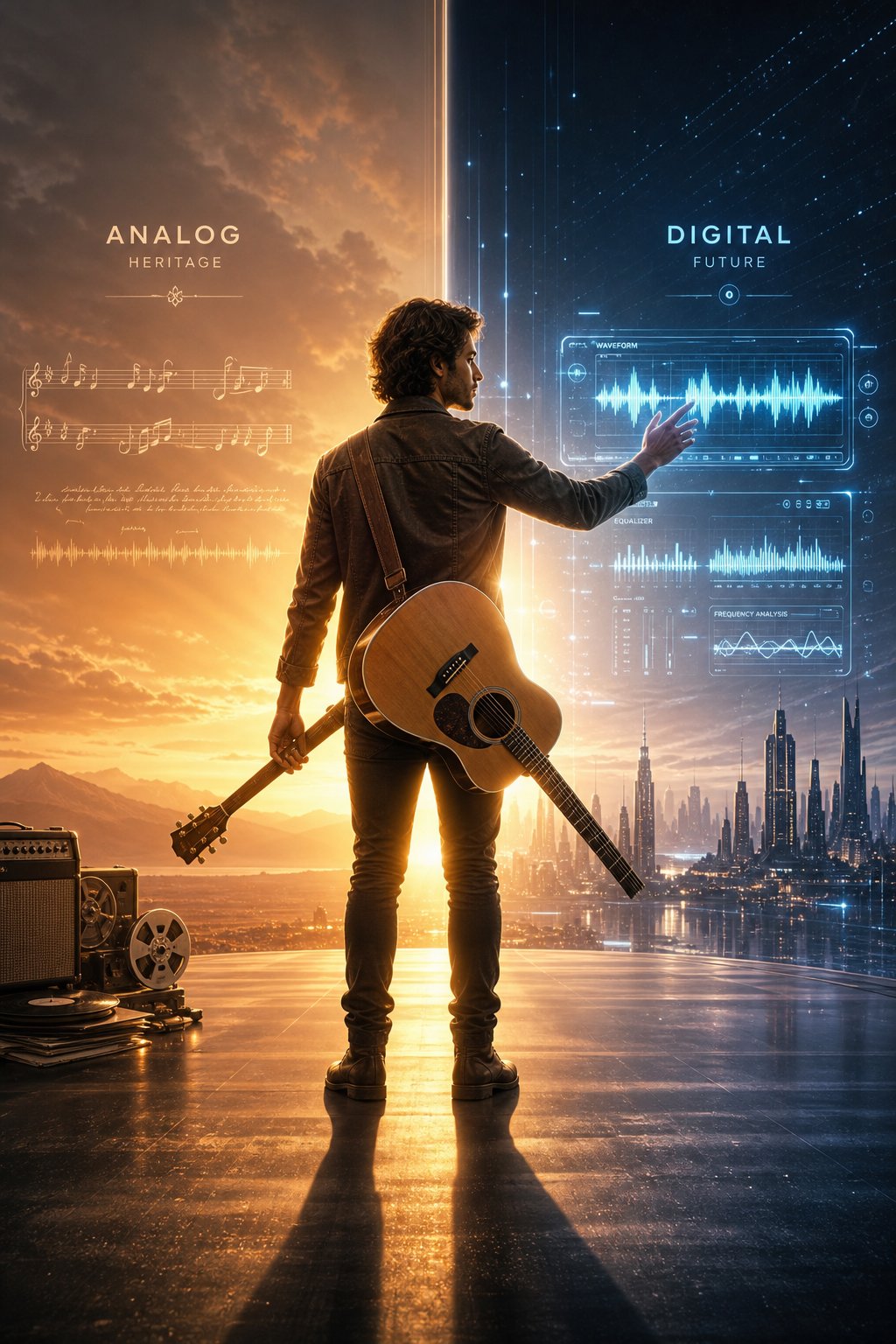
The regulatory picture reveals a fundamental truth about whether AI reshapes or ruins the music industry. Technology alone does not determine the outcome. Policy does. If regulations enforce transparency, require licensing for training data, and ensure creators can opt out meaningfully, AI is more likely to function as an augmentation tool operating within boundaries that protect human livelihoods. If enforcement lags, exceptions swallow the rule, and only major rights holders can negotiate protections, the replacement model wins by default. The rules being written now, in courtrooms, parliaments, and negotiating rooms, are not just legal technicalities. They are the architecture that will determine who profits from music's AI-driven future, and whether individual creators have any say in the matter.
What Creators Should Actually Do About AI
Regulations will shape the playing field, but they will not tell you what to do on Monday morning. The evidence throughout this analysis points in a clear direction: AI will not ruin the music industry for creators who engage with it intentionally. It will, however, leave behind those who ignore it entirely or fail to develop the qualities that no algorithm can replicate. The practical strategies for artists dealing with AI come down to two parallel tracks: strengthening what makes you irreplaceable, and learning to use AI where it genuinely serves your creative vision.
Skills That AI Cannot Replace
Every piece of research examined in this article converges on the same insight. AI can generate sound, but it cannot generate meaning. It cannot walk on stage and hold a crowd. It cannot build a community around shared lived experience. It cannot tell your story. As Berklee's Lori Landay put it, "An AI simulation is never going to have what everyone in this room has, which is experiences over time in a body." That embodied experience is not a sentimental nicety. It is an economic moat.
How musicians can adapt to AI in music starts with doubling down on the skills AI cannot replace in music:
- Live performance and stage presence — Audiences connect with human energy, spontaneity, and physical presence. Touring and live events remain the most AI-resistant revenue stream in music.
- Authentic storytelling and personal narrative — Songs rooted in specific, lived experience carry emotional weight that listeners value more highly once they know a human is behind them. The Columbia research showing 60% higher perceived value for human-made work confirms this.
- Community building and fan relationships — Direct connection with an audience, through social platforms, live interactions, and genuine engagement, creates loyalty no algorithm can manufacture.
- Taste and creative curation — As Berklee's Ben Camp noted, "If you don't have the taste to discern what's working and what's not working, you're gonna lose out to the people that do have the taste." Developing sharp creative judgment is more valuable than ever when anyone can generate content.
- Cross-disciplinary collaboration — Working with other humans across genres, visual art, film, and performance creates outputs that emerge from relationship and friction, things machines do not experience.
- Brand identity and visual world-building — Your personality becomes even more valuable as AI becomes more capable. A recognizable artistic identity, distinct imagery, consistent aesthetics, and the face behind the music are things technology cannot replicate.
These are not fallback positions. They are the core of what makes a music career sustainable in any technological environment. AI makes the technical side easier. The emotional, relational, and performative sides become proportionally more valuable.
How to Experiment with AI as a Creative Tool
Strengthening irreplaceable skills is half the equation. The other half is understanding AI well enough to use it on your terms rather than being blindsided by it. Experimenting with AI music tools as an artist is not about surrendering your creative process. It is about knowing what the technology can and cannot do so you can make informed decisions about where it fits in your workflow.
Berklee's panelists described using AI to prototype lyric ideas quickly, hear back melodic sketches, and test whether concepts land before committing studio time. The key principle: use AI to draft, then refine manually. Think of it as a silent creative teammate, never the full band.
Here is how to use AI music generation as a creator without losing your artistic center:
- Start with a specific creative question — Do not generate aimlessly. Use AI to explore a particular harmonic direction, test a lyric concept, or hear how a melody sounds in a style you have not tried before.
- Generate, then curate ruthlessly — Let AI produce options, then apply your taste. The value you bring is knowing which output works and why. Discard everything that does not serve your vision.
- Try turning your ideas into complete songs — Platforms like MakeBestMusic's AI Music Generator let you feed in prompts, lyrics, and style ideas to hear back full arrangements quickly. This is useful not as a finished product but as a way to audition concepts, test whether a lyric hits differently over a different groove, or prototype ideas for collaborators.
- Use AI for technical tasks, keep creative decisions human — Mastering demos, separating stems, generating reference mixes, cleaning audio. These are workflow accelerators that free your time for the work only you can do.
- Stay informed about your rights — Monitor regulatory developments in your region. Understand opt-out mechanisms for AI training. Register your works and know what protections apply to your catalog.
- Document your creative process — As certification and labeling systems emerge, being able to demonstrate human authorship may become an economic asset. Keep records of your creative decisions and contributions.
The musicians who will thrive are not the ones who resist AI entirely or adopt it uncritically. They are the ones who, as Musicians Institute emphasizes, combine human skill with technological capability, using each where it is strongest. AI handles scale, speed, and technical execution. You bring taste, identity, emotional truth, and the irreplaceable fact of being a person with something to say.
Will AI ruin the music industry? The evidence says no, not if creators, platforms, and policymakers make deliberate choices about how it is deployed. The industry will reshape. Revenue will redistribute. Some roles will contract while others expand. But music's core value, human expression that connects people to each other and to themselves, remains something no model can generate from a prompt. Protect that. Build on it. And use every tool available, including AI, to amplify what only you can create.
