

How 80s Rap Songs Launched a Cultural Revolution
Imagine a summer night in the South Bronx, somewhere around 1980. A DJ hooks a guitar amp to two turntables in a park or a building rec room. Kids crowd in from every direction. The breakbeat drops, a loop of raw funk spinning back and forth between the needles, and an MC grabs the mic to ride the rhythm with words. No record deal. No studio. Just a sound system, a crowd, and a new language being invented in real time. That scene, repeated on sidewalks and rooftops across New York City, is where 80s rap songs were born, and where an entire culture took its first breath.
From Block Parties to a Global Movement
Rap grew directly out of DJing culture in the South Bronx. Pioneers like DJ Kool Herc brought the Jamaican sound system concept to New York in 1973, looping breakbeats on two turntables to keep dancers moving. Afrika Bambaataa folded in global sounds, from salsa to Kraftwerk's electronic textures. Grandmaster Flash invented cutting and backspinning. Grand Wizzard Theodore stumbled onto scratching in his bedroom. Each innovation was like learning how to paint a room you've never seen before, layering technique on top of technique until something completely original covered the walls.
Then, on September 16, 1979, the Sugarhill Gang released "Rapper's Delight." Built around Chic's iconic "Good Times" bassline, the track became the first rap song to crack the Billboard Top 40, peaking at No. 36 on the Hot 100 and hitting number one in Canada and the Netherlands. Hip hop was no longer a local curiosity. It was a commercial force, and the 1980s would prove just how far that force could reach.
What Makes 80s Rap Songs Still Resonate
What keeps these tracks alive decades later? It starts with raw energy. Early rap didn't hide behind polished production. It thrived on urgency, on the feeling that someone was speaking directly to you from a street corner. Layer in social commentary, tracks like "The Message" documenting poverty and systemic neglect, and you get music that functions as both art and testimony. The musical experimentation mattered just as much: producers were sampling funk, rock, and electronic records with no rulebook, building a dandys world of sonic collage that no other genre had attempted.
"Don't push me 'cause I'm close to the edge. I'm trying not to lose my head." — Grandmaster Flash and the Furious Five, "The Message"
That lyric captured something universal about pressure, survival
How 80s Rap Evolved Year by Year
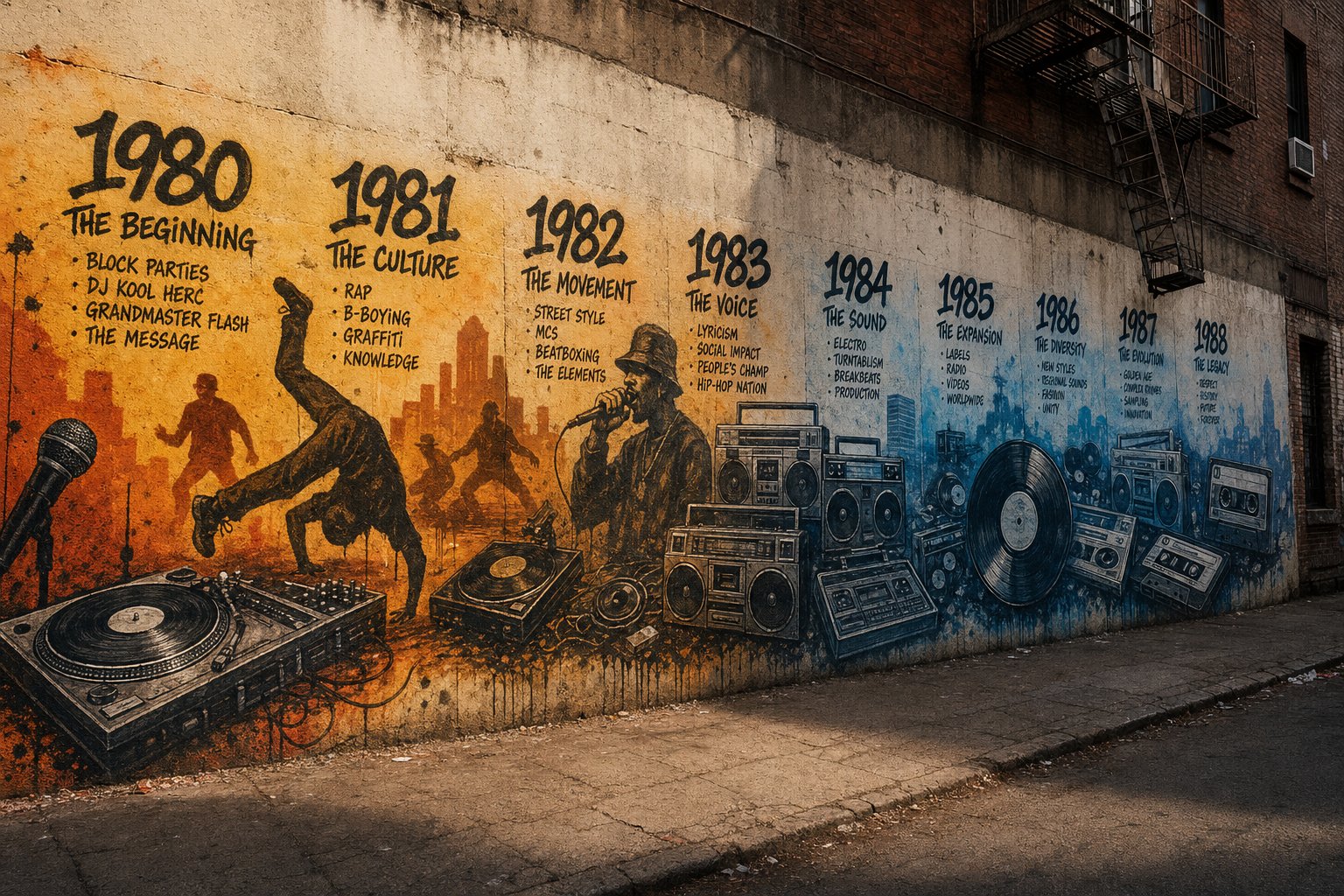
That sense of urgency didn't stay frozen in one style. Over the course of a single decade, rap reinvented itself at least three times, each phase building on the last like someone learning how to build a pc, snapping together components until the whole machine roared to life. Tracking these shifts year by year reveals just how fast the genre moved and how dramatically the sound, subject matter, and ambition of 80s rap songs transformed between 1979 and 1989.
The Early Wave: From Party Rap to Street Poetry
The first phase, roughly 1979 to 1983, was defined by landmark firsts. In 1979, Kurtis Blow became the first rapper signed to a major label under manager Russell Simmons. That same year, the Sugarhill Gang's "Rapper's Delight" gave mainstream America its first real taste of rap. By 1980, Blow's "The Breaks" became hip hop's first certified gold single, proving the genre had genuine commercial legs.
Party raps dominated these early years, but the mood shifted hard in 1982 when Grandmaster Flash and the Furious Five released "The Message." Instead of celebrating the good times, Melle Mel painted a vivid, unflinching portrait of inner-city poverty. It was a turning point: rap could be journalism, protest, and poetry all at once. Meanwhile, Afrika Bambaataa's "Planet Rock" fused electro-funk with Kraftwerk-inspired synthesizers, proving that hip hop's sonic palette had no boundaries. These artists were generating craft ideas that would echo through every era that followed.
The Golden Age Breakout
Between 1984 and 1986, rap went from underground phenomenon to cultural juggernaut. Run-DMC led the charge. Their 1983 debut single "Sucker M.C.s" had already stripped rap production down to its bones, hard drum machines and aggressive rhymes with no disco polish. But it was their 1986 collaboration with Aerosmith on "Walk This Way" that shattered the wall between rap and rock, literally and figuratively. The track climbed to No. 4 on the Billboard Hot 100, and their album "Raising Hell" became the first multi-platinum rap record.
Def Jam Recordings, founded by Russell Simmons and Rick Rubin out of Rubin's NYU dorm room in 1984, became the engine behind this breakout. A 16-year-old LL Cool J released "Radio" as the label's first album in 1985. The Beastie Boys, a former punk band turned rap group, dropped "Licensed to Ill" in 1986, and it became the best-selling rap album of the decade. Salt-N-Pepa arrived with "Hot, Cool & Vicious," and their remix of "Push It" earned a Grammy nomination the following year. Rap was no longer knocking on the mainstream's door. It had kicked it open.
The Late-Decade Explosion
The final stretch, 1987 to 1989, is where everything detonated. Eric B. & Rakim released "Paid in Full," and Rakim's lyrical complexity rewrote the rules of MCing. His internal rhyme schemes and layered wordplay operated with the precision of geometry formulas, each bar calculated to land with maximum impact. As Hank Shocklee of the Bomb Squad recalled, hearing "I Know You Got Soul" in the summer of 1987 "stopped time" and pushed Public Enemy to create something even bigger.
That something was "It Takes a Nation of Millions to Hold Us Back" in 1988, a dense, politically incendiary masterpiece that many critics still consider the greatest hip hop album ever recorded. On the West Coast, N.W.A's "Straight Outta Compton" arrived the same year, channeling the realities of Compton street life into a gangsta rap manifesto that drew an actual letter from the FBI. Boogie Down Productions' KRS-One emerged as "The Teacha," blending hardcore beats with social consciousness. And De La Soul's 1989 debut "3 Feet High and Rising" proved rap could be playful, psychedelic, and deeply alternative, like flipping through coloring books filled with sounds nobody expected.
By decade's end, hip hop had fractured into multiple creative lanes, each one thriving. The night routine of block parties and park jams had evolved into a global industry. Here's a timeline of the milestones that made it happen:
- 1979 — "Rapper's Delight" becomes the first rap single to reach the Billboard Top 40.
- 1980 — Kurtis Blow's "The Breaks" becomes hip hop's first gold-certified single.
- 1984 — Russell Simmons and Rick Rubin found Def Jam Recordings.
- 1986 — Run-DMC's "Raising Hell" becomes the first multi-platinum rap album; the group earns rap's first Grammy nomination.
- 1986 — Eric B. & Rakim's "Eric B. Is President" ushers in a new era of lyrical complexity.
- 1988 — Public Enemy's "It Takes a Nation of Millions to Hold Us Back" redefines political rap; N.W.A's "Straight Outta Compton" launches West Coast gangsta rap nationally.
- 1989 — DJ Jazzy Jeff & The Fresh Prince win the first-ever Grammy Award for Best Rap Performance, though many top artists boycott the ceremony because the category isn't televised.
Each of these moments didn't just mark a date on a calendar. They redrew the boundaries of what rap could say, who could say it, and how many people would listen. The real question, though, is which specific tracks carried that weight, and what made each one matter beyond the charts.
Essential 80s Rap Songs Everyone Should Know
Some tracks don't just chart. They redraw the entire map of what's possible. The 80s rap songs that mattered most weren't simply popular. They introduced new ways of thinking about rhythm, language, and storytelling, each one functioning like a set of statistics fundamentals for every MC and producer who came after. Understanding why these records hit so hard requires more than a title and a release date. It demands context.
Tracks That Rewrote the Rules
"The Message" by Grandmaster Flash and the Furious Five (1982) is where rap learned how to start a conversation about real life. Before this track, most hip hop records were party anthems. Melle Mel changed that by narrating the daily grind of inner-city poverty with cinematic detail, from broken glass in the playground to the desperation of watching a neighborhood collapse. The single reached No. 4 on the Billboard R&B chart and is widely regarded as the most important song in hip hop history for opening the door to social realism in rap.
"Sucker M.C.s" by Run-DMC (1983) stripped everything back. No live band, no disco strings, no sweetening. Just a drum machine, two aggressive voices, and attitude. Released as the B-side to "It's Like That," this track signaled the direction hip hop was headed: harder, sparser, and unapologetically raw. Run-DMC essentially drew a line between old school and the golden age with a single record.
"Paid in Full" by Eric B. & Rakim (1987) raised the lyrical bar so high that MCs are still reaching for it. Rakim's internal rhyme schemes and relaxed, jazz-inflected delivery made every rapper before him sound like they were reading from cue cards. As NPR's Kiana Fitzgerald noted, Rakim took complex concepts and placed them in unconventional positions within the bar, flipping the traditional customs of hip hop rhythm. He drew inspiration from John Coltrane's saxophone phrasing, treating his voice like an instrument rather than a megaphone.
"I came in the door, I said it before, I never let the mic magnetize me no more." — Rakim, "Eric B. Is President"
"Straight Outta Compton" by N.W.A (1988) detonated on the West Coast like nothing before it. Dr. Dre's production was revolutionary, and Ice Cube's writing gave the group a voice that was raw, original, and authentic. The album went multi-platinum without any radio play, proving that audiences didn't need a gatekeeper's permission to find music that spoke to them. It was a cultural earthquake that redefined what rap could sound like outside of New York.
"Fight the Power" by Public Enemy (1989) arrived as the soundtrack to Spike Lee's "Do the Right Thing" and immediately became a political anthem that transcended hip hop. Chuck D's booming delivery over the Bomb Squad's layered production created something that felt less like a song and more like a movement. It remains universally regarded as one of the best songs of all time.
Deep Cuts and Overlooked Gems
The headline-grabbing singles get the retrospectives, but the genre's DNA runs just as deep through tracks that shaped hip hop without always getting mainstream credit. "La Di Da Di" by Slick Rick and Doug E. Fresh (1985) is one of the most sampled songs in music history, a storytelling masterclass delivered over nothing but Doug E. Fresh's human beatbox. Its companion track, "The Show," was equally infectious, a party anthem that showcased beatboxing as a legitimate art form and gave Slick Rick his first major spotlight.
"Eric B. Is President" (1986), produced by the legendary Marley Marl, introduced Rakim to the world with opening bars so iconic they became instant quotables. "South Bronx" by Boogie Down Productions (1986) was KRS-One's fierce response to MC Shan's "The Bridge," a track that doubled as a history lesson on hip hop's birthplace and ignited one of the genre's first major beefs. And "Me Myself and I" by De La Soul (1989) proved that rap didn't have to be aggressive to be groundbreaking. Its playful, sample-heavy production and self-aware humor planted gardening tips for an entire alternative hip hop movement that would bloom through the 90s and beyond.
Think of these deep cuts as the dinner ideas you didn't know you needed. They might not be the first thing on the menu, but once you hear them, they become essentials. Here's a quick-reference guide to the tracks covered above, plus a few more that deserve a spot in any serious playlist:
| Song Title | Artist | Approximate Year | Why It Matters |
|---|---|---|---|
| The Message | Grandmaster Flash & The Furious Five | 1982 | Introduced social realism to rap; shifted the genre beyond party music |
| Sucker M.C.s | Run-DMC | 1983 | Stripped-down production that bridged old school and golden age hip hop |
| La Di Da Di | Slick Rick & Doug E. Fresh | 1985 | One of the most sampled tracks ever; pioneered narrative storytelling over beatbox |
| The Show | Doug E. Fresh & The Get Fresh Crew | 1985 | Elevated beatboxing as a performance art; massive party anthem |
| Eric B. Is President | Eric B. & Rakim | 1986 | Introduced Rakim's revolutionary internal rhyme schemes to the world |
| South Bronx | Boogie Down Productions | 1986 | Ignited the Bridge Wars; served as a hip hop origin-story anthem |
| Paid in Full | Eric B. & Rakim | 1987 | Set the benchmark for lyrical complexity and flow in MCing |
| Straight Outta Compton | N.W.A | 1988 | Launched West Coast gangsta rap; went multi-platinum with zero radio play |
| Me Myself and I | De La Soul | 1989 | Proved rap could be playful and alternative; inspired a new creative lane |
| Fight the Power | Public Enemy | 1989 | Became a universal political anthem through Spike Lee's "Do the Right Thing" |
Every track on this list changed something fundamental about how rap was made, heard, or understood. Yet for all the names listed here, one group remains conspicuously underrepresented in most retrospectives: the women who were shaping the genre just as forcefully, often with even less recognition.
The Women Who Shaped 80s Hip Hop
That underrepresentation isn't accidental. It's a gap in the story that distorts the full picture of what 80s rap songs actually sounded like and who was making them. Women weren't standing on the sidelines waiting for permission. They were on the mic, moving records, and in at least one case, igniting the biggest lyrical feud the genre had ever seen.
Roxanne Shanté and the Birth of Battle Rap
In 1984, the Brooklyn group UTFO released "Roxanne, Roxanne," a playful track about a woman who wouldn't give them the time of day. When the group failed to show up for an appearance on Mr. Magic's legendary WBLS radio show, producer Marley Marl decided to strike back. He found his weapon in a 14-year-old from the Queensbridge Projects named Lolita Gooden. She adopted the persona of the very Roxanne UTFO had been rapping about, flipped the script, and recorded "Roxanne's Revenge" in a single raw take over a loop of "Seven Minutes of Funk."
The result was electric. Shanté sold 250,000 copies in the New York area alone, forcing her mother to pull her out of school just to handle the contracts. UTFO's label fired back by casting Adelaida Martinez as "The Real Roxanne," and the floodgates opened. Over 100 answer records followed between 1984 and 1985, making the "Roxanne Wars" hip hop's first viral phenomenon. More importantly, a teenage girl from the projects had proven that a female MC could be the aggressor, the headliner, and the one everyone else was chasing. Her fearless approach paved the way for every female rapper who followed.
MC Lyte and Salt-N-Pepa Break Barriers
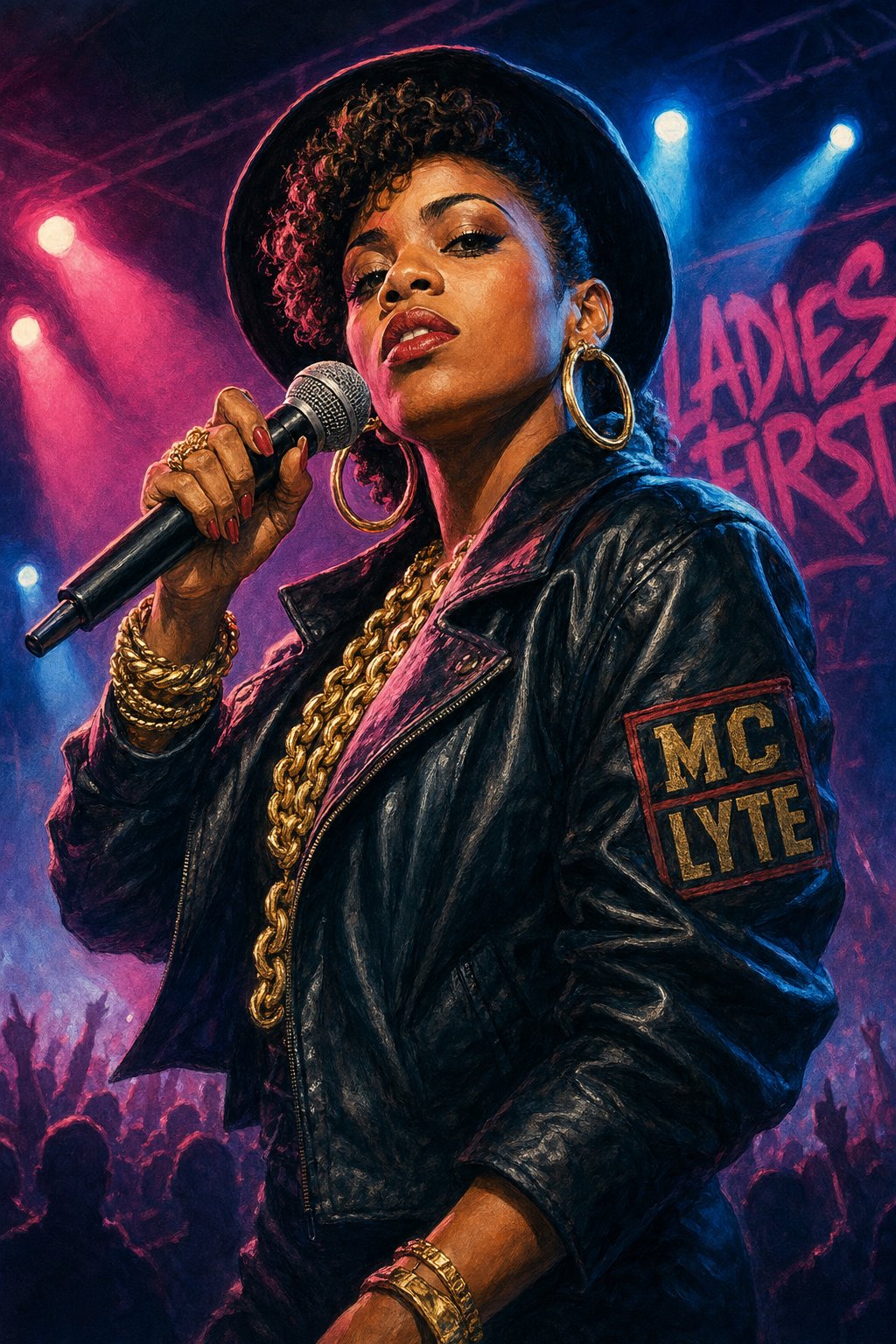
Shanté kicked the door open. MC Lyte walked through it and built a house. In 1988, Lana Michelle Moore released Lyte as a Rock, becoming the first solo female rapper to put out a full-length album. Growing up alongside the duo Audio Two, Lyte developed a cool, precise flow that let you know wrecking the mic was light work. She talked braggadocio with the best of them, but she also wove in social commentary, joining KRS-One's Stop the Violence Movement for the landmark "Self Destruction" track. As she once told Billboard, "I was the baddest MC. If you don't think you're the baddest MC, then you might as well sit down."
Salt-N-Pepa took a different route to the same destination. Cheryl James and Sandra Denton formed the group in 1985, and when a London DJ remixed the B-side "Push It" into a club anthem, it became the first platinum single for a female hip hop group. Their energy was fun and unapologetically sexy, but the substance ran deep. They rapped about independence, agency, and ignoring clowns from the jump. Their crossover appeal brought rap to audiences who might never have listened otherwise, proving the genre's reach extended far beyond any single demographic.
By the decade's close, Queen Latifah arrived with All Hail the Queen in 1989. A member of the Native Tongues collective alongside De La Soul and A Tribe Called Quest, Latifah blended hip hop, reggae, and house while centering her lyrics on empowerment and community. Her collaboration with Monie Love on "Ladies First" was a defining statement: two female MCs trading fire bars with not a man to be found on the track, dismantling every assumption about what women in rap could accomplish.
Why Their Legacy Gets Overlooked
Despite these achievements, most retrospectives of the era barely mention female MCs. The reasons are structural. Hip hop has always operated as a boys' club, and the industry's tendency to frame women as supporting characters rather than architects means their contributions get compressed into footnotes. Correcting that erasure isn't just about fairness. It's about accuracy. You can't understand the full scope of 80s rap without accounting for the artists who shaped battle culture, broke commercial barriers, and expanded the genre's audience.
Here are the key women who defined the era and what they brought to the table:
- Roxanne Shanté — "Roxanne's Revenge" (1984). Ignited hip hop's first answer-record phenomenon and proved female MCs could dominate battle rap.
- MC Lyte — Lyte as a Rock (1988). First solo female rapper to release a full-length album; blended braggadocio with social consciousness.
- Salt-N-Pepa — "Push It" (1987). First female rap act to earn a platinum single; made hip hop accessible to mainstream audiences worldwide.
- Queen Latifah — All Hail the Queen (1989). Bridged hip hop, reggae, and house; championed women's empowerment and Afrocentric identity.
- Sha-Rock — Funky 4 + 1 (early 1980s). Widely recognized as the first female MC recorded on vinyl; influenced artists like MC Lyte and DMC of Run-DMC.
- The Real Roxanne — "The Real Roxanne" (1984). Backed by Full Force production; represented the polished, label-driven side of the Roxanne Wars.
- Sparky D — "Sparky's Turn" (1985). Entered the Roxanne Wars as a direct challenger to Shanté, adding another fierce female voice to the battle.
These women weren't exceptions to the rule. They were building the rule alongside their male peers, shaping the sound and culture of a genre that would go global. And that global reach didn't happen uniformly. Geography played a massive role in determining what 80s rap sounded like, who made it, and what stories it told.
80s Rap by Region
A block in the South Bronx sounded nothing like a street corner in Compton. The weather was different, the slang was different, and the problems people rapped about carried a distinctly local charge. Geography didn't just influence 80s rap songs. It defined them. Each city and borough functioned like its own ecosystem, producing sounds as varied as the neighborhoods they came from.
New York as the Birthplace and Epicenter
Every borough contributed something essential. The South Bronx was ground zero, the place where DJ Kool Herc hosted the party on August 11, 1973, that most historians consider hip hop's birthday. Grandmaster Flash and the Furious Five grew out of those same streets, turning breakbeat DJing into a vehicle for social commentary that resonated far beyond the neighborhood.
Queens gave the world Run-DMC and LL Cool J, two acts that dragged rap into the mainstream with sheer force of personality and stripped-down production. Brooklyn's rise came through lyricists like Big Daddy Kane, whose rapid-fire delivery set a new standard for technical skill, and MC Lyte, who proved Brooklyn could produce MCs of any gender with equal ferocity. Then there was Long Island, a suburban landscape that somehow produced two of the decade's most boundary-pushing acts: De La Soul, with their playful, sample-dense alternative approach, and Public Enemy, whose dense sonic collages and political fury were anything but suburban.
New York's density fueled all of it. You had rival crews living a few subway stops apart, each one pushing the other to be sharper, louder, more inventive. The Bridge Wars between the Juice Crew and Boogie Down Productions turned territorial pride into art, generating classic records like "South Bronx" and "The Bridge Is Over" that doubled as neighborhood anthems. Think of it as competitive landscaping ideas applied to music: every crew wanted their block to look and sound better than the one across town.
The West Coast Finds Its Voice
While New York was refining its sound, something rawer was brewing 3,000 miles away. Ice-T, a Los Angeles street hustler turned rapper, released "6 'N the Morning" in 1986, a track influenced by Philadelphia's Schoolly D that narrated a day in the life of a neighborhood drug dealer with unflinching detail. It was a distinctly West Coast perspective, slower in tempo, heavier in atmosphere, and rooted in a California reality that had nothing to do with New York subway culture.
Up in Oakland, Too Short was building a hustle-rap empire independently, selling tapes out of his car with sexually explicit, pimp-influenced storytelling that reflected the Bay Area's own street economy. But the real seismic shift came from Compton. N.W.A, formed by Ice Cube, Dr. Dre, Eazy-E, DJ Yella, and MC Ren, unleashed rebellious rap music that was praised for its innovation and criticized for its content in equal measure. Eazy-E funded the operation through his own label, Ruthless Records, built with profits from his pre-rap life. Their 1988 debut "Straight Outta Compton" didn't just put the West Coast on the map. It drew an entirely new map.
Philadelphia, Miami, and Houston
The story didn't stop at two coasts. Philadelphia's Schoolly D had arguably created the first gangsta rap song with "P.S.K. What Does It Mean?" in 1985, predating both Ice-T and N.W.A. DJ Jazzy Jeff and The Fresh Prince followed with a lighter, more accessible Philly sound, eventually winning the first-ever Grammy for Best Rap Performance in 1989.
Down in Miami, Luther "Uncle Luke" Campbell and 2 Live Crew built a bass-heavy, party-driven style that was impossible to ignore. Their explicit lyrics and booming 808 kicks created a regional sound so provocative it landed them in a federal obscenity trial, a story that would reshape free speech law in America. Meanwhile, Houston's Geto Boys were quietly laying the groundwork for Texas rap. Their dark, psychologically complex storytelling, anchored by Scarface, Bushwick Bill, and Willie D, planted seeds that would eventually grow into one of hip hop's most influential regional scenes through Rap-A-Lot Records.
Here's a geographic snapshot of how each region shaped the decade's sound:
| Region | Key Artists | Signature Sound | Notable Tracks |
|---|---|---|---|
| South Bronx, NY | Grandmaster Flash & The Furious Five, Afrika Bambaataa | Breakbeat-driven, socially conscious, electro-funk | "The Message," "Planet Rock" |
| Queens, NY | Run-DMC, LL Cool J | Stripped-down drum machines, aggressive delivery | "Sucker M.C.s," "Rock the Bells" |
| Brooklyn, NY | Big Daddy Kane, MC Lyte | Technical lyricism, rapid-fire flows | "Ain't No Half-Steppin'," "Lyte as a Rock" |
| Long Island, NY | Public Enemy, De La Soul | Dense sample collages, alternative/political | "Fight the Power," "Me Myself and I" |
| Los Angeles, CA | Ice-T, N.W.A | Gangsta rap, slower tempos, street narratives | "6 'N the Morning," "Straight Outta Compton" |
| Oakland, CA | Too Short | Hustle rap, explicit storytelling, independent distribution | "Freaky Tales" |
| Philadelphia, PA | Schoolly D, DJ Jazzy Jeff & The Fresh Prince | Proto-gangsta rap to pop-friendly crossover | "P.S.K.," "Parents Just Don't Understand" |
| Miami, FL | 2 Live Crew | Miami bass, 808-heavy, explicit party rap | "Throw the D," "Me So Horny" |
| Houston, TX | Geto Boys | Dark, psychological storytelling over heavy production | "Mind Playing Tricks on Me" |
Each region was essentially drawing up its own landscaping ideas for what hip hop could look and feel like, cultivating a local identity that made the genre richer and more unpredictable. But geography only tells part of the story. Behind every regional sound was a set of tools, machines, and production techniques that gave each city its sonic fingerprint.
The Production Techniques Behind 80s Rap Music
Those sonic fingerprints didn't appear out of thin air. They were pressed into wax by specific machines, specific techniques, and a handful of producers who treated cheap gear like fine instruments. The production behind 80s rap songs underwent a transformation so dramatic that a track from 1980 and a track from 1989 barely sound like they belong to the same genre. Understanding that shift means getting inside the studios, bedrooms, and park jams where the sound was actually built.
Drum Machines and the Roland TR-808
Early 80s rap relied almost entirely on live DJing. A DJ would loop a breakbeat between two turntables, and the MC would ride the rhythm. No programming, no sequencing, just hands on vinyl. That changed when drum machines entered the picture, and one machine in particular rewired the genre's DNA.
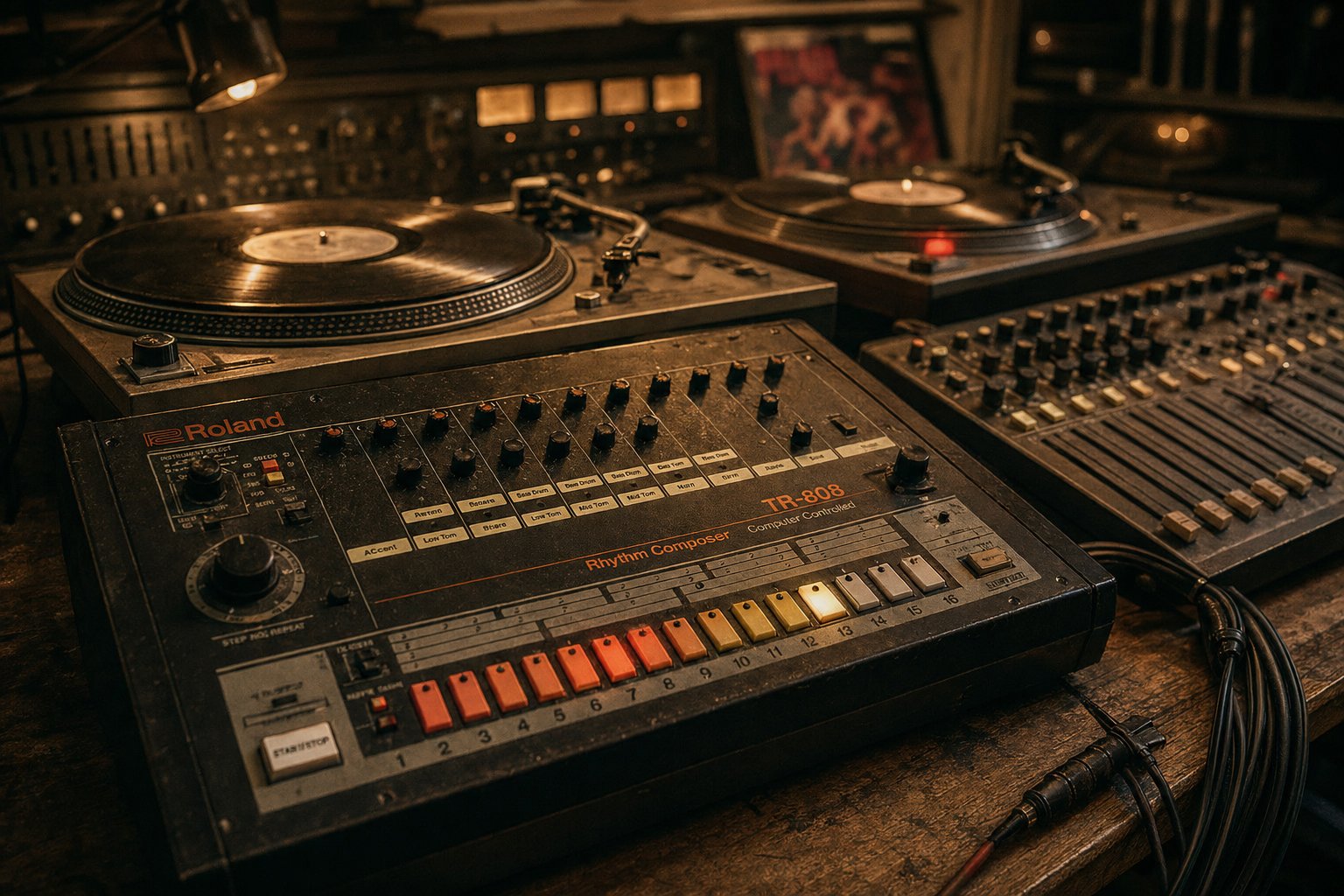
The Roland TR-808, released in 1980, was originally designed as a tool for songwriters to sketch out demos. Its sounds were synthetic rather than realistic, which made it a commercial disappointment at first. Roland discontinued it by 1983. But hip hop producers heard something in those artificial kicks and snares that nobody else did: a booming, elastic low end that hit harder than any live drum recording. Afrika Bambaataa and producer Arthur Baker proved the point with "Planet Rock" in 1982, a track that birthed the electro genre and became a sample source for close to 400 other producers over the years.
Def Jam co-founder Rick Rubin leaned into the 808's minimalism on T La Rock and Jazzy Jay's 1984 single "It's Yours," a record whose unique blend of drum sounds and powerful delivery made it an oft-sampled favorite across eras and styles. Kurtis Mantronik pushed the machine further by decreasing the tempo of his 808 patterns to increase the intensity and resonance of the sound on Mantronix's 1985 electro classic "Fresh Is The Word." Meanwhile, down south, a distracted mixing session for Double Duce's 1985 single "Commin' In Fresh" accidentally cranked the 808's bass so hard it destroyed a record shop's speakers, catching the attention of passersby and sparking the entire Miami bass movement. The 808 wasn't just a drum machine. It was a cultural accelerant.
By the mid-80s, the E-mu SP-1200 sampler gave producers like Marley Marl a different kind of power. Instead of programming synthetic drum hits, they could now chop and rearrange pieces of existing records, layering funk breaks, soul vocal stabs, and jazz horn lines into entirely new compositions. The SP-1200's gritty 12-bit sound quality became a sonic signature in itself, giving golden age hip hop that warm, crunchy texture that producers still chase. If the 808 gave rap its heartbeat, the SP-1200 gave it a vocabulary.
The Sampling Revolution and Its Legal Fallout
Nobody pushed sampling further than the Bomb Squad, Public Enemy's production team led by Hank Shocklee. Their approach was less like building a song and more like assembling a controlled explosion. On albums like It Takes a Nation of Millions to Hold Us Back (1988), they layered dozens of fragments from funk, soul, rock, and spoken-word records into dense sonic collages that felt like standing inside a wall of sound. As Chuck D explained, "We thought sampling was just another way of arranging sounds. Just like a musician would take the sounds off of an instrument and arrange them their own particular way."
Shocklee described the process as architectural. "The sound has a look to me," he told interviewer Kembrew McLeod, "and Public Enemy was all about having a sound that had its own distinct vision." They deliberately avoided traditional R&B elements like bass lines and chord structures, instead building rhythm and texture from bits and pieces of samples that were unrecognizable on their own but devastating when combined.
This creative explosion had a legal expiration date. By 1990, record companies began aggressively policing sample use. Chuck D recalled that "corporations found that hip-hop music was viable" and their lawyers started hunting for infringements across labels. The impact on Public Enemy was immediate and devastating. "We were taking thousands of sounds," Chuck D said. "If you separated the sounds, they wouldn't have been anything. The sounds were all collaged together to make a sonic wall. Public Enemy was affected because it is too expensive to defend against a claim." By 1991, the group had to change their whole style.
The ripple effects reshaped the entire genre. Shocklee noted that the shift to organic instruments couldn't replicate the same compression and impact: "Something that's organic is almost going to have a powder effect. It hits more like a pillow than a piece of wood." Producers like Dr. Dre adapted by replaying samples with live musicians to avoid master recording clearances, a workaround that became standard practice. The era of freely layering hundreds of fragments into a single track was over, like trying to fix a running toilet by replacing the whole plumbing system rather than just the flapper valve. The solution worked, but the original character was gone.
How Turntablism Became an Art Form
Before drum machines and samplers took over studios, the turntable itself was the instrument. Grandmaster Flash pioneered the technique of cueing records through headphones, a concept borrowed from radio DJs but applied to breakbeat mixing in a way nobody had attempted. His "clock theory" involved backspinning records to repeat breaks seamlessly, so the audience never heard the transition. As Grand Wizard Theodore recalled, Flash "wanted to change the way people played music" and developed a system where "you wouldn't know how the break got back to the beginning."
Theodore himself took things in a completely different direction. Around 1975, while practicing at home with the volume too loud, his mother burst in to yell at him. With his headphones still on and his hand resting on the record, he instinctively moved the vinyl back and forth while she lectured him from the doorway. "When she left I was like, 'What is this?'" he told DJ History. He spent months studying and refining the technique until it became what the world now knows as scratching. The crowd reaction was immediate: "Everybody would stop dancing and walk up to the front of the stage to try to see what the hell I was doing."
Theodore's innovation turned the turntable from a playback device into a yummly expressive instrument, something you could manipulate in real time to create entirely new sounds. Combined with Flash's precision mixing and Bambaataa's genre-defying record selection, turntablism gave 80s rap a performance dimension that no 15 minute timer in a studio could replicate. These weren't producers hiding behind equipment. They were musicians performing live, reading the crowd, and improvising on the fly.
Here's a quick reference to the key production tools and techniques that defined the decade's sound:
- Roland TR-808 Drum Machine — Provided the booming synthetic bass and crisp snares that became hip hop's rhythmic foundation, from electro-funk to Miami bass.
- E-mu SP-1200 Sampler — Enabled producers like Marley Marl to chop and rearrange existing records into new compositions, with a gritty 12-bit sound that defined golden age production.
- Turntable Scratching — Invented by Grand Wizard Theodore around 1975, scratching transformed the turntable into a live performance instrument and became a defining element of hip hop's sonic identity.
- Breakbeat Looping — Pioneered by DJ Kool Herc and refined by Grandmaster Flash, the technique of extending a song's drum break by switching between two copies of the same record created the rhythmic backbone of early rap.
- Multi-Sample Collage — Perfected by the Bomb Squad, this technique layered dozens of short samples from different records into dense, chaotic soundscapes that defined Public Enemy's revolutionary production style.
- Roland TB-303 Bass Synthesizer — Originally designed for bass accompaniment, producers like Afrika Islam sampled its acid-tinged tones into tracks for Ice-T's 1988 album Power.
- Cueing and Backspinning — Flash's headphone-based cueing system allowed DJs to preview and precisely time their transitions, turning breakbeat mixing from a rough art into a precise science.
Every one of these tools and techniques shaped what listeners heard on the radio, at the club, and blasting from boomboxes on the street. But the machines alone didn't build the industry. Behind the production boards and turntables stood a handful of record labels that turned raw creativity into a commercial infrastructure, each one leaving its own mark on how 80s rap reached the world.
The Record Labels That Built 80s Rap
Machines and techniques gave 80s rap its sound, but labels gave it a business. Without a handful of scrappy, risk-taking imprints willing to press vinyl on music the mainstream considered a fad, the greatest tracks of the decade would have stayed trapped in park jams and cassette dubs. Each label that emerged brought its own philosophy, its own roster, and its own set of problems. Together, they built the commercial infrastructure that turned rap from a local expression into a global industry.
Sugar Hill Records and the First Rap Empire
Before anyone else saw a dollar in hip hop, Sylvia Robinson saw a movement. The R&B singer-songwriter-turned-executive had already scored a million-selling hit in 1957 as one half of Mickey & Sylvia, and she'd built a string of soul labels with her husband Joe throughout the 1960s and 70s. But by 1978, the Robinsons had declared bankruptcy. Everything changed that summer when Sylvia attended a niece's birthday party at the iconic Harlem World club and watched a DJ rapping over Chic's "Good Times" while the crowd lost its mind.
"All of a sudden, something said to me, 'Put something like that on a record, and it will be the biggest thing,'" Robinson recalled to the New Jersey Star-Ledger. She assembled three unknown MCs, Wonder Mike, Big Bank Hank, and Master Gee, into her newly christened Sugar Hill Studios in Englewood, New Jersey. The result was "Rapper's Delight," released September 16, 1979. At its peak, the record moved a reported 50,000 copies per day and became the first hip hop single to enter the Billboard Top 40, eventually selling over 14 million copies worldwide.
Sugar Hill quickly became rap's first commercial powerhouse. By 1982, the roster included Grandmaster Flash and the Furious Five, the Treacherous Three, the Funky 4 + 1, Spoonie Gee, and the Sequence, the first female and Southern rap act to sign a label deal. The Sugar Hill Revue toured arenas as the first rap package tour, opening for acts like Parliament-Funkadelic and Rick James. Grandmaster Flash's "The Adventures of Grandmaster Flash on the Wheels of Steel" (1981) became the first record to feature scratching and mixing routines on wax, and "The Message" (1982) redefined what rap could say.
But Robinson's practices were as controversial as they were pioneering. House band members reportedly went unpaid for studio and songwriting contributions. Artists who complained about missing royalties found themselves frozen out. Grandmaster Flash and others filed lawsuits. As Angie Stone of the Sequence recalled, "You had an OG like Mrs. Robinson who knew that if you accept a check as a work for hire, you could never come back to claim ownership on anything. We all got duped from time to time because we were eager, young and excited." A doomed distribution deal with a struggling MCA Records accelerated the decline, and Sugar Hill folded in 1986 after 26 gold records. Robinson died in 2011 and was posthumously inducted into the Rock & Roll Hall of Fame a decade later. As Stone put it simply: "There would be no hip-hop industry without Sugar Hill Records."
Def Jam and the Mainstream Breakthrough
If Sugar Hill proved rap could sell, Def Jam proved it could scale. The label that professionalized hip hop started in 1984 in the most unlikely of offices: a dorm room at NYU. Rick Rubin, a 21-year-old art student from Long Island, had been making beats on a drum machine and producing records like T La Rock's "It's Yours." Russell Simmons, a 27-year-old from Queens who was already managing Run-DMC, Kurtis Blow, and Whodini, heard something in Rubin's stripped-down sound that matched his own instincts. "The more I got to know Rick, the more I felt that my efforts should go into the partnership," Simmons told NPR.
Their first release, LL Cool J's "I Need a Beat," sold so well that the partnership solidified almost immediately. Simmons brought industry connections and street credibility. Rubin brought a producer's ear that rejected everything polished. "Up until the time of Def Jam, pretty much most of the rap records at the time were R&B records with people rapping on them," Rubin explained. "One of the things that separated our records from the ones that came prior was that they had more to do with what the actual hip hop culture was like." The goal was to capture the raw energy of a live hip hop night, not smooth it out for radio.
LL Cool J's debut album Radio dropped in 1985 when the rapper was just 17. The Beastie Boys' Licensed to Ill followed in 1986 and became the best-selling rap album of the decade. Public Enemy joined the roster and delivered It Takes a Nation of Millions to Hold Us Back in 1988, a record that redefined political music. Def Jam's artist development strategy was the opposite of the old-school label playbook. Instead of molding artists to fit the market, Simmons and Rubin pushed them to be more themselves. "'Keep it real' was always the artist development strategy for Def Jam," Simmons said. That authenticity became the label's brand, and it essentially made Sugar Hill's approach obsolete overnight.
Tommy Boy, Profile, and Ruthless Records
Def Jam wasn't operating alone. Several independent labels carved out distinct lanes that kept the genre diverse and competitive. Tommy Boy Records, founded by Tom Silverman in 1981, became the home of Afrika Bambaataa's electro-funk experiments and later signed De La Soul, whose 1989 debut 3 Feet High and Rising proved that rap could be whimsical, sample-heavy, and deeply alternative. Tommy Boy had an ear for artists who didn't fit neatly into any box, and that willingness to take creative risks gave the label a catalog that aged remarkably well.
Profile Records took a different approach. Founded in 1981 by Cory Robbins and Steve Plotnicki, Profile signed Run-DMC and rode the group's meteoric rise from "Sucker M.C.s" through the multi-platinum Raising Hell. Profile's strength was distribution and promotion. They knew how to hang a picture in the mainstream's living room without stripping the frame of its original character, getting rap records into stores and onto radio playlists that had never touched the genre before.
Then there was Ruthless Records, the Compton-based label founded by Eazy-E in 1987 with manager Jerry Heller. Ruthless was built differently from the start. Eazy-E funded the operation with his own money, giving the label an independence that East Coast imprints rarely had. N.W.A's Straight Outta Compton went multi-platinum without mainstream radio support, proving that a self-financed West Coast operation could compete with, and outsell, the established New York infrastructure. Ruthless didn't just release records. It announced that the geography of rap's power structure was shifting.
Here's a quick-reference overview of the labels that shaped the decade:
| Label Name | Key Artists | Signature Contribution |
|---|---|---|
| Sugar Hill Records | Sugarhill Gang, Grandmaster Flash & The Furious Five, The Sequence, Treacherous Three | Created the commercial rap industry; released the first rap hit and the first socially conscious rap single |
| Def Jam Recordings | LL Cool J, Beastie Boys, Public Enemy, Slick Rick | Professionalized hip hop as big business; prioritized authenticity and raw production over polished R&B formulas |
| Tommy Boy Records | Afrika Bambaataa, De La Soul, Stetsasonic | Championed experimental and alternative rap; released foundational electro-funk and Native Tongues records |
| Profile Records | Run-DMC, Dana Dane, DJ Quik | Powered rap's mainstream crossover through strong distribution; home to the first multi-platinum rap album |
| Ruthless Records | N.W.A, Eazy-E, The D.O.C., Michel'le | Proved a self-funded West Coast label could rival East Coast infrastructure; launched gangsta rap nationally |
Each of these labels operated with a different philosophy, a different roster, and a different vision of what rap could become. But they all shared one thing: a willingness to bet on a genre that the mainstream music industry either ignored or actively dismissed. That dismissal didn't stay passive for long. As rap's audience grew and its lyrics grew bolder, the pushback from institutions, politicians, and law enforcement escalated into full-blown cultural warfare.
Censorship and Controversy in 80s Rap
That cultural warfare wasn't subtle. As labels pushed rap into wider markets and artists grew bolder in what they were willing to say, the backlash came from the highest levels of American institutional power. Politicians, law enforcement agencies, and parent advocacy groups all took aim at hip hop during the late 1980s, turning 80s rap songs into the frontline of a national debate over free speech, obscenity, and who gets to control the narrative about life in America.
The PMRC and the Parental Advisory Label
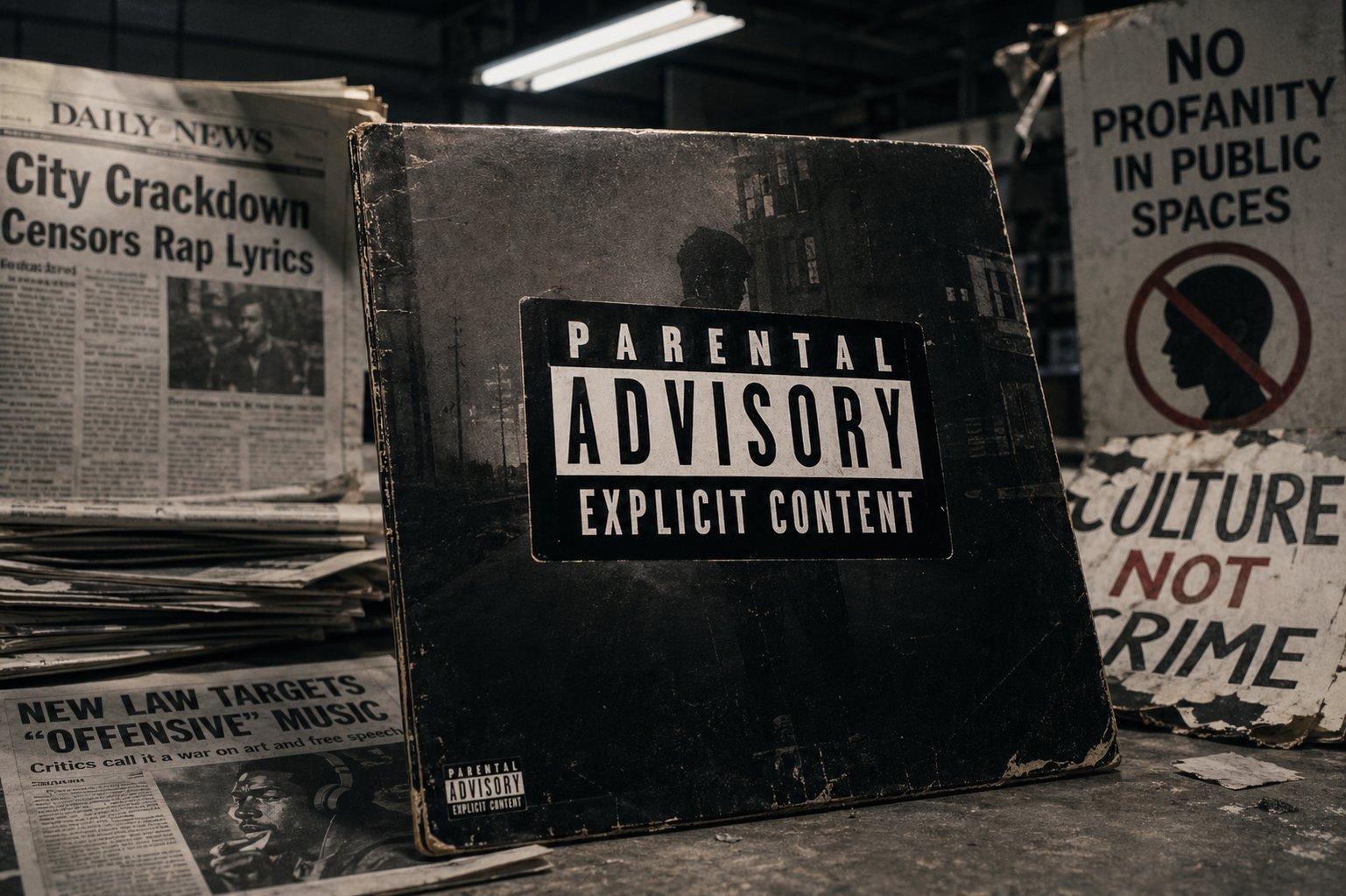
In 1985, Tipper Gore co-founded the Parents Music Resource Center (PMRC), a Washington-based advocacy group that pressured the recording industry to label albums containing explicit content. The PMRC's initial targets included rock and metal acts, but hip hop drew especially intense scrutiny. The organization claimed rap music promoted violence, drug use, anti-authority messages, and sexual content. Their lobbying led to the now-iconic black-and-white Parental Advisory sticker, a warning system designed to help parents screen what their children listened to.
The sticker's actual effect was the opposite of its intent. Albums carrying the label frequently outsold their "clean" counterparts. Young listeners treated the warning as a seal of authenticity, proof that the artist wasn't softening their message for mainstream approval. Record stores created dedicated sections for labeled albums, and the sticker became a marketing asset that labels quietly welcomed. For rap acts in particular, the Parental Advisory label functioned less like a caution sign and more like a badge of credibility. It told fans: this record has something real on it, and somebody powerful doesn't want you to hear it.
N.W.A. vs. the FBI and the Fight for Free Speech
The institutional pushback went far beyond stickers. In 1989, the FBI sent a letter to Priority Records regarding N.W.A's track "F*** tha Police," expressing the bureau's concern that the song encouraged violence against law enforcement. The letter didn't carry legal force, but its message was clear: the federal government was watching. Police organizations across the country pressured venues to cancel N.W.A's concerts, and officers in some cities stood outside shows in a visible display of intimidation. The group's response was to keep performing the song, often opening sets with it as a direct act of defiance.
A year later, the battle escalated in Florida. Broward County Sheriff Nick Navarro prosecuted record store owners who sold 2 Live Crew's 1989 album As Nasty As They Wanna Be, arguing the record constituted obscenity. A federal district court initially agreed, declaring the album obscene under the Supreme Court's Miller v. California standard. But the 11th U.S. Circuit Court of Appeals reversed the ruling, finding that expert testimony established the album possessed serious artistic value. The appeals court's decision was unambiguous: "A work cannot be held obscene unless each element of the Miller test has been met. We reject the argument that simply by listening to this musical work, the judge could determine that it had no serious artistic value."
These weren't isolated incidents. They were part of a broader pattern in which rap artists faced legal and political pressure that musicians in other genres rarely encountered at the same scale. The Reagan-era war on drugs had already intensified policing in urban communities, and hip hop's willingness to document that reality on record made it a target. Every attempt to silence these voices, from FBI letters to obscenity trials, only amplified them. Much like learning how to do a pullup, the resistance itself made the genre stronger, building cultural muscle with every confrontation.
Rap as Social Commentary and Resistance
The censorship battles make more sense when you listen to what was actually being said. The tracks that drew the most institutional heat weren't gratuitously provocative. They were reporting. "The Message" described the grinding poverty of the South Bronx with the specificity of a documentary. "Fight the Power" challenged the exclusion of Black voices from American cultural institutions. "Straight Outta Compton" narrated the daily reality of police harassment in a community that mainstream media either ignored or demonized. These weren't smiling friends offering comfortable truths. They were witnesses testifying under oath to an audience of millions.
"Hip hop is Black America's CNN." — Chuck D, Public Enemy
That statement from Chuck D captured the core tension perfectly. Hip hop artists saw themselves as journalists and commentators, using rhythm and rhyme to broadcast stories from communities that had no other megaphone. The establishment saw something dangerous: a cultural force that couldn't be edited, couldn't be managed, and was reaching an audience that grew larger with every attempt to shut it down. The advisory sticker became a symbol of authenticity, proof that artists weren't watering down their truth to please mainstream tastes.
What made the censorship era so revealing wasn't just the conflict itself. It was the way it exposed how deeply uncomfortable powerful institutions became when marginalized voices found a platform they couldn't control. Rap didn't create the conditions it described. It simply refused to look away. Much like the work of journalists such as ash trevino and others who've documented how to drive a manual car through the intersection of culture and politics, these artists understood that telling the truth clearly and loudly was itself an act of resistance. The Parental Advisory sticker, the FBI letters, the obscenity trials — none of it silenced a single MC. If anything, it proved that the music was doing exactly what it was supposed to do.
The battles over censorship and free speech defined how the world perceived 80s rap, but they also set the stage for something bigger. The artists who survived those fights didn't just preserve their right to speak. They built a foundation so solid that every generation of hip hop that followed has drawn from it, borrowing production techniques, lyrical frameworks, and a defiant posture that traces directly back to the late 1980s.
The Lasting Legacy of 80s Rap and What It Inspires
That foundation didn't crack under pressure. It hardened. The artists who fought censorship battles, pioneered production techniques, and turned block party culture into a global industry left behind more than classic records. They left a blueprint that every generation of hip hop since has studied, borrowed from, and built upon. The DNA of 80s rap songs is woven so deeply into modern music that you can hear it in nearly every corner of contemporary hip hop, whether the artist knows it or not.
How 80s Rap DNA Lives in Modern Hip Hop
The lines of influence are direct and traceable. Rakim's internal rhyme schemes and jazz-inflected delivery didn't just impress his peers. They fundamentally changed how MCs approached the microphone. As Georgetown professor Michael Eric Dyson argued, Jay-Z's entire career can be read as a political and literary evolution rooted in the same traditions Rakim pioneered, from the Marcy Projects to billionaire status, narrating with conviction and delivering literature at its most accessible. Nas built his debut Illmatic on the multisyllabic complexity Rakim introduced. Kendrick Lamar's layered storytelling traces back through that same lineage. On hits like "Paid In Full" and "Eric B for President," Rakim deftly transitions from metaphors and allegories to rhymes and made-on-the-spot proverbs, a technique that became the gold standard for lyrical ambition.
N.W.A's Compton-born aggression paved the road for Death Row Records, Snoop Dogg, and the entire West Coast dominance of the early 90s. Public Enemy's dense, sample-heavy production influenced everyone from Kanye West's maximalist arrangements to the Bomb Squad-inspired chaos of Run the Jewels. De La Soul's alternative, genre-bending approach planted seeds that grew into A Tribe Called Quest, The Roots, and later Odd Future and Tyler, the Creator's entire creative universe. Even the cultural crossover that Salt-N-Pepa and the Beastie Boys achieved in the 80s set the template for how hip hop would eventually become the most consumed genre in America, a shift confirmed by Nielsen data showing R&B/hip hop overtaking rock as the nation's most listened-to music.
The influence extends beyond sound. 80s rap established hip hop as a legitimate form of American literature and social commentary. Books like Rakim's Sweat the Technique and Dyson's Jay-Z: Made In America treat these artists with the same critical engagement once reserved for novelists and poets. That shift in perception started in the 80s, when tracks like "The Message" and "Fight the Power" proved that rap could carry the weight of social truth with the same force as any Toni Morrison novel or, for that matter, the most powerful denzel washington movies depicting American struggle and resilience.
Rediscovering and Recreating the 80s Rap Sound
There's a growing wave of producers and listeners circling back to the era's raw aesthetics. The boom-bap feel, the crunch of 12-bit SP-1200 samples, the elastic thump of the TR-808 — these textures keep resurfacing because they carry an emotional weight that polished modern production sometimes lacks. As Abbey Road Institute's Jason O'Bryan observed, "the flaws and limitations of early sampling technology are exactly the reason why the music of that period continues to inspire and resonate today." Producers are actively studying vintage hardware, recreating the lo-fi warmth of golden age records using modern emulations, and digging through crates — physical and digital — for the same kind of obscure breaks that Marley Marl and the Bomb Squad once hunted across boroughs.
That DIY spirit hasn't faded. It's just found new tools. Listeners inspired by the era's energy can now explore creating original tracks through platforms like MakeBestMusic's AI Song Generator, which lets users generate music based on specific styles, eras, and moods. Want to channel the stripped-down aggression of early Run-DMC or the layered density of Public Enemy? You can set those parameters and hear what the AI produces as a starting point. It's not a replacement for the craft that Rakim or Rick Rubin brought to the studio, but it's a genuinely useful way to sketch ideas and experiment with the sounds that defined 80s hip hop, much like how the SP-1200 itself once liberated producers from needing a full band. The process is about as straightforward as learning how to make coffee: pick your flavor, adjust the strength, and see what comes out.
Here are the specific ways 80s rap continues to shape contemporary music and culture:
- Production techniques — Boom-bap drum patterns, sample chopping, and TR-808 programming remain foundational across hip hop, trap, and electronic music. Modern DAWs include emulations of the exact hardware that defined the era.
- Lyrical approaches — Rakim's multisyllabic internal rhymes, KRS-One's conscious storytelling, and Slick Rick's narrative style are still the benchmarks MCs measure themselves against.
- Sampling culture — The practice of digging for obscure records and repurposing them into new compositions, pioneered in the 80s, drives entire subgenres and platforms like WhoSampled that map the connections between eras.
- Fashion and visual identity — Adidas Superstars, gold chains, Kangol hats, and the overall aesthetic of 80s hip hop cycle back through streetwear and high fashion with the regularity of a great pyrenees returning to its favorite spot on the porch.
- Independent hustle — Eazy-E self-funding Ruthless Records and Too Short selling tapes from his trunk established the independent distribution model that artists from Chance the Rapper to Russ have followed into the streaming age.
- Social commentary as art — The tradition of using rap to document systemic inequality, police violence, and community resilience runs in a straight line from "The Message" through Kendrick Lamar's To Pimp a Butterfly and beyond.
Understanding 80s rap isn't nostalgia. It's literacy. Every subgenre that followed, from gangsta rap to conscious hip hop, from trap to alternative, traces its roots back to the innovations, risks, and raw creativity of that single decade. The block parties are long over, but the boomboxes never really went silent. They just got louder, found new frequencies, and reached every corner of the planet. If you care about where hip hop is going, the surest way to navigate the future is to know exactly where it started.
