

What It Means to AI Generate EDM Music
Imagine typing a single sentence - something like "dark techno, 130 BPM, rolling bassline, hypnotic synth stabs" - and hearing a full electronic dance track materialize in seconds. No DAW experience. No years of sound design training. No expensive studio gear. That scenario isn't hypothetical anymore. Artificial intelligence has moved from research labs to the creative toolkit of producers, DJs, and content creators worldwide, and electronic dance music sits right at the center of this shift.
To AI generate EDM music means using machine learning models to compose, arrange, and produce electronic dance tracks from text prompts, parameter selections, or a combination of both. These AI systems - trained on vast libraries of electronic music - analyze rhythmic patterns, harmonic progressions, and timbral characteristics, then synthesize entirely new compositions that reflect those learned structures. The result can range from a rough creative seed you refine in your own production software to a polished, export-ready track.
This guide walks you through every dimension of the process: the underlying technology, subgenre nuances, prompt engineering strategies, platform comparisons, legal considerations, and hybrid workflows that blend AI output with human artistry.
What Does AI-Generated EDM Actually Mean
At its core, AI-generated EDM refers to electronic dance music created - partially or entirely - by artificial intelligence systems trained on electronic music data. These systems output original compositions in EDM styles, producing everything from pulsing basslines to intricate synth progressions.
A critical distinction exists between two modes of creation. Fully autonomous generation is where the AI handles the entire piece with minimal human input beyond an initial prompt or style selection. You feed it a description, and it delivers a complete track: structure, melody, rhythm, and mix. AI-assisted production, on the other hand, keeps the human firmly in control. Here, AI functions as a creative partner - suggesting chord progressions, generating drum loops, or handling mastering - while the artist directs every meaningful decision. As RouteNote's analysis puts it clearly, AI-assisted music still has a clear human creator, whereas AI-generated content blurs that line entirely.
Both approaches have legitimate creative applications, and most real-world workflows fall somewhere between these two poles. Whether you're a hobbyist exploring your first EDM creation or a seasoned producer hunting for fresh inspiration, understanding where your process lands on this spectrum matters - especially when questions of copyright and originality come into play later.
Why EDM and AI Are a Natural Fit
You might wonder: why does AI seem to handle electronic dance music more convincingly than, say, jazz improvisation or a classical symphony? The answer lies in EDM's DNA.
Electronic dance music is built on grid-based timing. Every kick, snare, and hi-hat snaps to a rigid rhythmic grid - typically quantized to sixteenth notes or finer divisions. Sections are modular and loopable: an eight-bar phrase repeats, layers evolve gradually, and transitions follow predictable energy arcs. The entire sound palette is synthesized rather than performed acoustically, which means there's no need for AI to replicate the subtle imperfections of a bowed violin or a breathy vocal. Even the genre's signature tension-release cycle - buildup into drop - follows a statistical pattern that neural networks can learn and reproduce effectively.
EDM's modular, pattern-based architecture aligns remarkably well with how neural networks process and generate sequential audio data. Repetitive structures, quantized rhythms, and synthesizer-driven timbres give AI models clearer patterns to learn from - making electronic dance music one of the most convincing genres for algorithmic composition.
Industry leaders echo this perspective. According to insights shared by Soundverse, many professionals expect EDM and mainstream pop to be the genres most adaptable to AI-assisted creativity, reflecting electronic music's inherent openness to technological innovation. Compare that to jazz, where value often lives in spontaneous deviation from structure, or folk music, where tonal imperfections carry emotional weight. EDM doesn't just tolerate precision - it demands it.
That structural compatibility, however, doesn't mean every AI-generated EDM track sounds club-ready. The quality of your output depends heavily on your understanding of the genre's building blocks, the specificity of your prompts, and the platform you choose - all topics this guide covers in depth.
EDM Fundamentals Every AI Music Creator Should Know
Knowing that AI and electronic dance music are a natural fit is one thing. Knowing why a four-on-the-floor kick pattern drives a dancefloor - and how to describe it in a prompt - is something else entirely. Before you type a single word into an AI generator, a solid grasp of EDM's building blocks will dramatically sharpen both your input and your ability to judge what comes out.
Electronic dance music traces its roots to the early 1980s, emerging from Chicago house clubs, Detroit techno warehouses, and European rave culture. DJs and producers like Frankie Knuckles, Juan Atkins, and Kraftwerk fused drum machines, synthesizers, and sequencers into a new sonic language designed for one purpose: keeping bodies moving. That DNA - repetitive, hypnotic, and relentlessly rhythmic - still defines every EDM subgenre you'll encounter today, and it's exactly what makes the genre so accessible for AI-driven creation.
The Core Elements of Electronic Dance Music
Picture an EDM beat stripped to its skeleton. At the foundation sits the four-on-the-floor kick pattern - a bass drum hitting on every beat of a 4/4 bar. It's the heartbeat of house, techno, trance, and most mainstream electronic styles. Layer on hi-hats pulsing in eighth or sixteenth notes, a clap or snare cracking on beats two and four, and you already have the rhythmic engine that powers millions of tracks.
Above the drums, a synthesized bassline provides harmonic and rhythmic drive. This can range from deep sub-bass rumbles to aggressive mid-range growls, depending on the subgenre. Leads, pads, and plucks fill the melodic and harmonic space - leads carry the main melody, pads supply atmospheric texture, and plucks add rhythmic sparkle. Risers, sweeps, and impact effects create the tension that glues sections together, pulling listeners toward the moment everyone waits for: the drop.
The drop is where all that accumulated energy explodes. Every element hits at full force - the bassline locks in, the kick pounds, and the lead synth takes center stage. It's the climactic payoff that defines EDM making at its most visceral.
One technique you'll hear in virtually every modern EDM track is sidechain compression. This process ducks the volume of the bassline (and sometimes other elements) every time the kick drum hits, creating that signature "pumping" effect. As Ben Rainey explains, sidechaining makes room for the kick drum and enhances the punchiness of the low end - a small technical detail with a massive sonic impact.
The standard EDM song structure follows a predictable arc that Hyperbits describes as a roadmap of tension and release:
Intro → Buildup → Drop → Breakdown → Second Buildup → Second Drop → Outro
Each section serves a specific function. The intro gives DJs mixing space. The buildup creates anticipation. The drop delivers the peak energy. The breakdown resets the emotional palette. And the outro mirrors the intro, allowing a smooth transition into the next track. This architecture isn't just tradition - it's functional design for the dancefloor, and it gives AI models a reliable structural template to follow.
Why EDM Production Knowledge Improves AI Results
Here's the practical payoff: understanding these fundamentals empowers you to write dramatically better prompts, evaluate AI output with a trained ear, and make smarter editing decisions when refining a generated track. Telling an AI to create "some EDM" is like telling a chef to "make food." Specifying a rolling bassline with heavy sidechain, a 16-bar buildup using filtered risers, and a drop anchored by a supersaw lead? That's a recipe.
Every AI EDM user benefits from understanding these key production concepts:
- BPM and tempo - the speed of the track, which varies widely across subgenres and directly shapes energy and mood
- Song structure sections - intro, buildup, drop, breakdown, and outro, each with distinct roles in the track's narrative
- Sound design elements - leads, pads, plucks, and basses, along with how they interact to fill the frequency spectrum
- Effects processing - reverb for space, delay for rhythm, and sidechain compression for that essential EDM beat pumping effect
- Energy arc - the overall dynamic journey from low-energy openings through peak-intensity drops and back down again
You don't need to master a DAW to leverage this knowledge. Even a conceptual understanding of how an edm beat drop maker effect works - the way tension accumulates through filtered noise sweeps, snare rolls, and rising pitch before slamming into a full-force drop - gives you the vocabulary to guide AI tools toward convincing results. The more precisely you can articulate what you want, the closer the output lands to your vision.
These fundamentals also reveal something important: not all subgenres play by the same rules. A dubstep track at 140 BPM with a half-time groove demands an entirely different prompt strategy than a four-on-the-floor house groove at 124 BPM. Those distinctions matter enormously when you're choosing what to generate - and understanding them is the subject worth exploring next.
EDM Subgenres Explained and How AI Handles Each
A dubstep prompt and a trance prompt walk into the same AI generator - and they shouldn't come out sounding anything alike. Yet one of the most common mistakes new users make is treating EDM as a single, monolithic genre. In reality, electronic dance music is a family of dozens of distinct styles, each with its own tempo conventions, rhythmic DNA, sound design philosophy, and emotional fingerprint. Choosing the right subgenre before you generate is arguably the single most impactful decision you'll make in the entire workflow.
Why? Because subgenre selection doesn't just influence the vibe of your track - it dictates the BPM, the drum patterns, the bass character, the harmonic language, and the energy arc. A 174 BPM drum and bass roller and a 124 BPM deep house groove exist in completely different sonic universes. If you want to make electronic dance music that actually sounds authentic, you need to speak the language of the specific style you're targeting.
Major EDM Subgenres at a Glance
The table below breaks down eight core EDM subgenres across the dimensions that matter most when you're working with an AI edm maker. Use it as a quick-reference guide whenever you're setting up a new generation session.
| Subgenre | Typical BPM Range | Defining Sonic Characteristics | Common Instruments / Sounds | Mood / Energy | AI Generation Notes |
|---|---|---|---|---|---|
| House | 120-130 | Four-on-the-floor kick, syncopated hi-hats, warm grooves, vocal chops | Analog-style kicks, organ stabs, funky basslines, soulful vocal samples | Feel-good, groovy, uplifting | Excellent AI coverage; most platforms handle house confidently due to abundant training data |
| Techno | 125-150 | Hypnotic repetition, dark or industrial textures, minimal melody, atmospheric layering | Distorted kicks, metallic percussion, droning pads, acid synth lines | Dark, hypnotic, driving | Good results for straightforward techno; niche substyles like industrial techno may lack nuance |
| Dubstep | 138-142 (half-time feel) | Heavy drops, wobble bass, sparse arrangements punctuated by massive bass hits | Wobble bass, distorted mid-range synths, snare-heavy drums, risers | Aggressive, intense, high-contrast | AI often captures the drop energy but may struggle with the intricate bass sound design that defines top-tier dubstep |
| Drum and Bass | 160-180 | Breakbeat-derived rhythms, rapid tempo, complex drum programming, heavy sub-bass | Chopped breakbeats, reese bass, fast hi-hats, layered percussion | Energetic, intense, relentless | Challenging for AI; the intricate syncopated breaks and extreme tempo require strong training data |
| Trance | 128-145 | Long buildups, euphoric breakdowns, arpeggiated synths, emotional melodies | Supersaw leads, gated pads, pluck arpeggios, uplifting vocal hooks | Euphoric, emotional, epic | Solid results on mainstream platforms; AI handles the tension-release arc well due to predictable structure |
| Future Bass | 130-170 | Lush chords, pitch-bent synths, bright and melodic, pop-influenced hooks | Wobbly chord stabs, pitched vocal chops, snappy snares, shimmering pads | Bright, emotional, colorful | Generally well-supported; the melodic, chord-driven style translates cleanly to AI generation |
| Hardstyle | 150-160 | Distorted kick drums, reverse bass, raw or euphoric variants, relentless energy | Hard-hitting distorted kicks, screeching leads, orchestral stabs, reverse bass | Aggressive, euphoric, festival-scale | Limited coverage on most platforms; the signature distorted kick is difficult for many AI models to reproduce accurately |
| Progressive House | 125-132 | Longer arrangements, cinematic builds, layered synths, gradual evolution rather than sudden drops | Sweeping pads, pluck melodies, filtered basslines, atmospheric FX | Uplifting, expansive, journey-like | Strong AI suitability; the gradual, layered approach aligns well with how models handle sequential composition |
A few patterns stand out immediately. Subgenres with simpler rhythmic structures - house, progressive house, trance - tend to produce more convincing AI output. That four-on-the-floor kick pattern is highly predictable, giving models a stable foundation to build on. Subgenres with complex, syncopated rhythms - drum and bass, breakbeat-influenced dubstep - push current AI capabilities harder because the drum programming relies on subtle timing variations and layered polyrhythms that are difficult to learn from statistical patterns alone.
Sound design complexity plays an equally important role. As Orphiq's subgenre guide highlights, dubstep's wobble bass and neurofunk's machinery-like bass patches represent some of the most intricate sound design in all of electronic music. Replicating these textures requires more than pattern recognition - it demands granular control over synthesis parameters that most AI generators don't yet expose to users.
How Subgenre Choice Shapes Your AI Output
Think of subgenre selection as the single decision that cascades into every other aspect of your generated track. When you tell an AI tool to create electro music in the style of trance, you're implicitly requesting a specific BPM window, a particular kick drum character, a certain melodic sensibility, and a defined structural arc. Change that selection to hardstyle, and every one of those variables shifts dramatically - the kick becomes distorted and punishing, the BPM jumps by 20-30 beats per minute, and the energy profile swings from euphoric builds to relentless intensity.
This is precisely why vague prompts underperform. Telling an edm maker to produce "something electronic" forces the model to average across styles, often resulting in a generic track that doesn't commit to any subgenre's identity. Specificity unlocks authenticity.
There's also a practical dimension worth considering: not all AI platforms handle every subgenre equally well. The EDM landscape in 2026 features increasingly blurred genre lines, with single tracks sometimes blending house, techno, and trap elements simultaneously. AI tools trained primarily on mainstream festival EDM will naturally excel at house and progressive house but may produce unconvincing results for niche styles like psytrance, neurofunk, or industrial techno. Platforms with broader training datasets and more granular style controls tend to handle a wider subgenre range.
Here's a practical approach to matching your subgenre selection with your creative goal:
- Content creators needing background music - lean toward house or progressive house for their broad appeal and reliable AI output quality
- DJs seeking fresh loops for live sets - experiment with tech house or techno, where repetitive grooves translate well and imperfections are less noticeable in a mix
- Game streamers wanting high-energy accompaniment - try dubstep or drum and bass for intensity, but be prepared to iterate more and potentially refine the output
- Producers prototyping ideas - use any subgenre as a starting point, knowing you'll reshape the AI output in your DAW later
The takeaway is straightforward: the more precisely you understand what separates a deep house groove from a hardstyle banger, the more effectively you can direct any AI generator toward the sound in your head. Genre literacy isn't just music nerd trivia - it's the foundation of effective prompt engineering.
And prompt engineering, as it turns out, is where the real craft of AI-driven EDM production begins. The difference between a forgettable output and a track that actually captures your vision often comes down to how well you translate subgenre knowledge into the specific language an AI model can act on - a skill built on understanding not just what to ask for, but how the technology interprets your request.
How AI Music Generation Technology Actually Works
You've picked your subgenre, you understand what makes a drop land, and you're ready to type a prompt. But what actually happens between the moment you hit "generate" and the moment audio starts playing back? Most platforms treat this as a black box - words go in, music comes out. Pulling that curtain back reveals a fascinating interplay of mathematical models, training data, and audio engineering that shapes every note you hear.
Understanding the technology won't just satisfy curiosity. It gives you a practical edge. When you know how an AI system interprets your request, you can anticipate its strengths, work around its blind spots, and choose the right edm music software for your specific needs.
The AI Architectures Behind EDM Generation
Three primary approaches power today's AI music generators. Each works differently under the hood, and those differences show up in the audio you hear.
Transformer-based models treat music the same way large language models treat text: as a sequence prediction problem. Imagine reading a sentence and guessing the next word - transformers do the same thing with audio, predicting what sound should come next based on everything that came before it. Music is first broken into tokens - either as musical events like notes and durations, or as compressed audio codes generated by neural audio codecs such as EnCodec. The model then learns which tokens typically follow which across enormous training sets.
The payoff? Structural coherence. Because a transformer attends across its entire context window, it can maintain a key signature, return to a melodic motif, and sustain a verse-drop-breakdown form over a full track. That's exactly why transformer-based systems tend to handle EDM's tension-release arcs convincingly. The trade-off is that errors compound - each token depends on previous ones, so a single off-key note can derail everything that follows.
Diffusion models work in the opposite direction. Instead of building audio left to right, they start with pure noise and gradually refine it into coherent sound. Picture a sculptor chipping away at a marble block - except here, the sculptor removes randomness rather than stone, step by step, until a structured piece of music emerges. As Veena Studio's architecture comparison explains, this process happens across the whole piece at once rather than sequentially.
The result is exceptional audio quality. Diffusion models produce detailed, clean textures and handle timbre beautifully - that lush supersaw pad or crisp hi-hat shimmer sounds polished straight out of the generator. The weakness? Long-range musical structure. A model refining an entire spectrogram simultaneously has no built-in mechanism for deciding "the chorus should return here." Longer generations often sound texturally gorgeous but structurally aimless.
Sample-based synthesis systems take a fundamentally different approach. Rather than generating audio from scratch, these platforms use AI-driven arrangement logic to recombine and transform existing audio building blocks - drum loops, bass one-shots, melodic phrases, and effects. Think of it as an incredibly intelligent remix engine. The AI selects, layers, transforms, and sequences pre-produced elements based on your parameters, creating something that feels original while drawing on a curated library of sounds.
This approach often delivers the most immediately usable results for EDM because the source material is already professionally produced. The limitation is creative ceiling - you're working within the boundaries of the available sound library, which can make outputs feel constrained compared to fully generative edm music programs.
Here's the reality most users encounter in practice: the strongest systems in 2026 don't rely on a single architecture. They combine them. A common hybrid pattern uses a transformer to plan musical structure and a diffusion decoder to render high-fidelity audio - playing to both strengths simultaneously. Structure from the sequence model, texture from the diffusion model.
How AI Learns to Make a Drop
Architecture is only half the story. The other half is training data - the massive libraries of music that teach these models what electronic dance music actually sounds like.
Every AI music model is shaped by the data it trains on. State-of-the-art systems learn from datasets containing tens of thousands to hundreds of thousands of hours of audio, spanning genres, tempos, instrumentation, and production styles. During training, raw audio is converted into compressed representations - mel spectrograms that visualize frequency content over time, neural codec tokens that reduce audio to efficient discrete sequences, or latent embeddings that capture high-level musical features. The model then learns statistical relationships within this data: which chord progressions follow which, how a buildup's energy curve typically escalates, what frequency range a dubstep wobble bass occupies versus a house sub-bass.
For EDM specifically, the training process captures genre-defining patterns with remarkable precision:
- The tension-release cycle - how filtered noise sweeps, snare rolls, and rising pitch create anticipation before a drop slams in
- Rhythmic grids - the placement of kick drums, claps, and hi-hats across quantized time divisions
- Frequency spectrum management - how bass, mids, and highs are balanced differently in techno versus trance versus dubstep
- Sidechain dynamics - the pumping amplitude envelope that gives EDM its characteristic breathing feel
Training data quality directly affects what comes out the other end. A model trained primarily on mainstream festival EDM will reproduce house and progressive house convincingly but may flounder when asked for industrial techno or neurofunk. A model trained on a narrow or low-quality dataset might produce tracks that sound muddy, harmonically confused, or structurally incoherent. This is precisely why different software EDM platforms produce noticeably different results from the same prompt - their training data compositions differ.
Text-audio alignment adds another layer. For text-to-music generation, the model must learn the relationship between language and sound through contrastive learning - training on millions of text-audio pairs so that a prompt like "euphoric trance, 138 BPM, soaring supersaw lead" maps to the right combination of tempo, timbre, and mood. The specificity of your prompt directly constrains the model's output space. Vague requests leave too much room for the model to wander; detailed descriptions narrow the probability distribution toward what you actually want.
AI doesn't "understand" music emotionally - it recognizes and reproduces statistical patterns in audio data. This is why structured genres like EDM, with their predictable rhythmic grids and repeatable energy arcs, yield more convincing AI-generated results than free-form genres where human intuition and spontaneous expression carry the creative weight.
That distinction matters more than it might seem at first. When a generated track's drop feels underwhelming, it's not because the AI lacked inspiration - it's because the statistical patterns it learned didn't sufficiently capture the specific energy contrast you were hoping for. When the breakdown drifts harmonically from the rest of the track, it's a context window limitation, not a creative choice. Recognizing these technical realities transforms how you evaluate AI output and, more importantly, how you craft the prompts and workflows that produce better results.
Step-by-Step Guide to Generating EDM with AI
Statistical patterns, transformer architectures, diffusion decoders - all of that technical knowledge becomes genuinely useful only when you sit down to actually create something. The difference between a producer who gets disappointing results and one who consistently pulls compelling tracks from AI tools almost always comes down to process. Not luck. Not a better platform. Process.
Most tutorials reduce AI music creation to three vague steps: pick a genre, type a prompt, download your track. That's like reducing cooking to "buy ingredients, turn on stove, eat dinner." The reality of learning how to make EDM music with AI involves deliberate decisions at every stage - from clarifying your intent before you touch a single tool to evaluating output with a critical ear before you export anything.
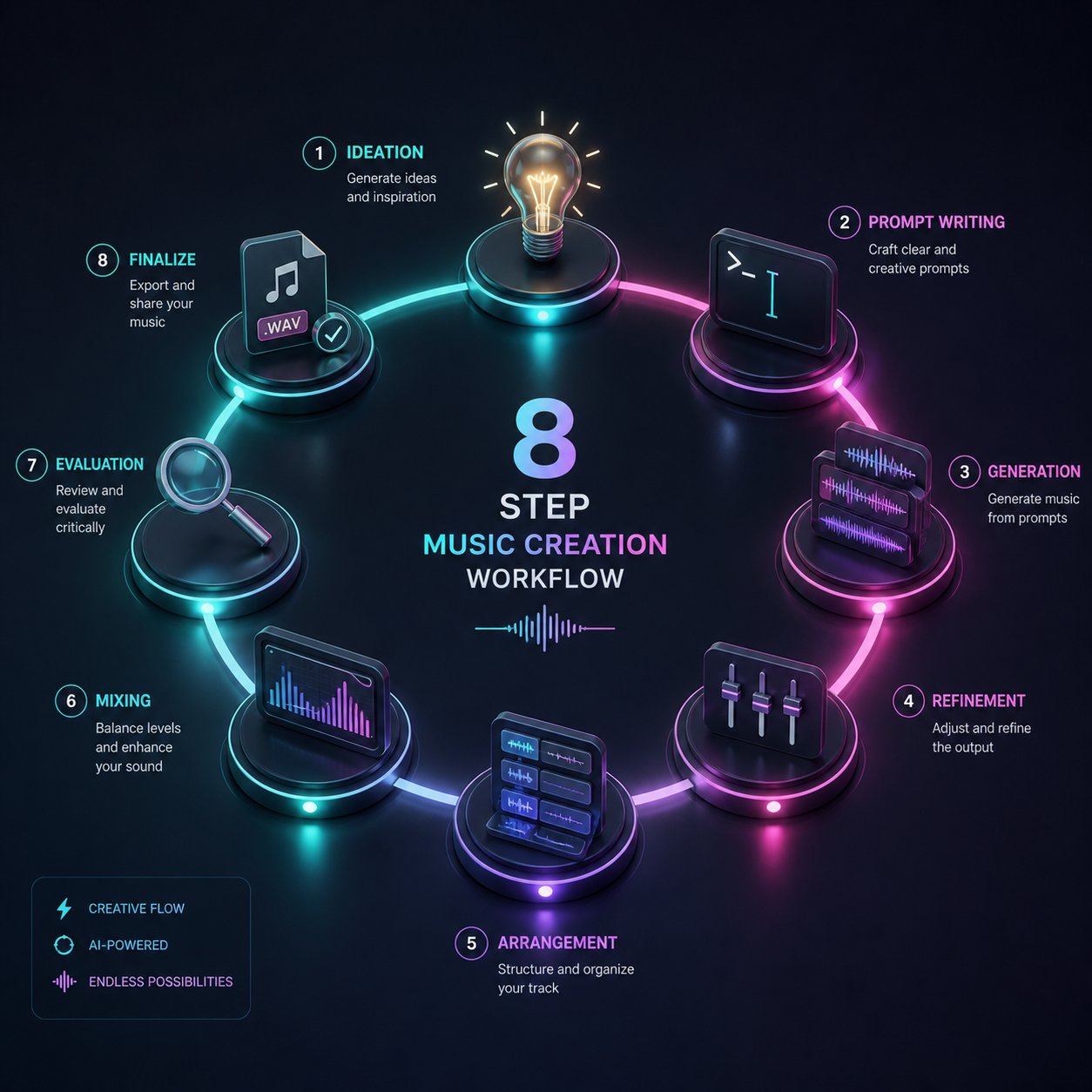
Here's the complete eight-step workflow that separates generic outputs from tracks worth using.
Define Your Goal and Choose a Subgenre
Every strong creative process starts with intent. Jumping straight into generation without a clear purpose is the fastest route to wasted time and mediocre results. These first two steps establish the creative guardrails that make everything downstream more focused.
Step 1 asks a deceptively simple question: what is this track actually for? A background loop for a YouTube gaming stream has completely different requirements than a DJ intro tool or a soundtrack for a product launch video. The intended use case determines acceptable track length, energy profile, structural complexity, and even whether you need stems or a full mixdown. A content creator might need 60 seconds of mid-energy house that sits beneath voiceover. A DJ might want a 3-minute progressive house track with a clean 16-bar intro for beatmatching. A game developer might need an adaptive loop that sustains energy without a traditional buildup-drop arc. Defining that goal upfront prevents the aimless "generate and hope" cycle that burns through credits and patience.
Step 2 locks in your subgenre and target BPM. If the previous chapters accomplished their job, you already understand why this matters. Selecting "techno at 130 BPM" versus "drum and bass at 174 BPM" doesn't just change the tempo - it reshapes the entire rhythmic structure, bass character, melodic language, and emotional trajectory of your track. Match your subgenre to both your creative goal and the strengths of your chosen platform. If you know your generator handles four-on-the-floor patterns more convincingly than breakbeat-driven styles, lean into house or techno rather than fighting for a clean jungle output.
Craft Your Prompt and Generate
With your creative target locked in, the generation phase is where your understanding of EDM fundamentals translates into actionable instructions. This is how to produce EDM music through AI - not by typing two generic words, but by communicating a specific sonic vision.
Step 3 is where most users either succeed or stumble. Write a detailed prompt - or configure parameters if your platform uses sliders and menus - that specifies genre, tempo, mood, instrumentation, energy level, and duration. Instead of "make me some EDM," try something like "dark melodic techno, 128 BPM, hypnotic atmosphere, rolling bassline with filtered acid synth, layered hi-hats, gradual buildup into a driving drop, 2 minutes." Every concrete descriptor narrows the AI's output space and increases the likelihood of getting something close to your vision. The prompt engineering section later in this article dives much deeper into this craft, but the principle here is simple: specificity beats vagueness every time.
Step 4 is a habit that separates experienced AI users from beginners: generate multiple variations rather than settling on the first output. Even the best prompt produces different results each time because of the stochastic nature of these models. As MusicMake.ai's quality analysis framework emphasizes, you should generate a few versions but avoid repeating the same unchanged prompt endlessly - each attempt is a chance to learn what the model responds to. Three to five variations from the same prompt give you a meaningful pool to evaluate.
Step 5 requires the most discipline: evaluate each output critically. Don't just ask "does this sound cool?" Ask targeted questions. Does the track maintain a coherent key throughout? Do the transitions between sections feel natural or abrupt? Does the energy arc match what you specified - a gradual build into a convincing drop, or whatever dynamic you requested? Does it actually sound like the subgenre you targeted? A useful evaluation checklist borrowed from professional production workflows covers eight dimensions: audio fidelity, musical coherence, arrangement quality, mix balance, prompt alignment, and editability, among others. Always listen to the full track - many AI outputs sound impressive for the first 15 seconds and then drift structurally.
Iterate, Refine, and Export
Generation is rarely a one-shot process. The refinement stage is where good tracks become great ones, and where understanding how to start producing EDM music with AI becomes an iterative craft rather than a slot machine pull.
Step 6 closes the feedback loop. Based on your evaluation, iterate on the prompt by adjusting what didn't work. If the mood was right but the tempo felt sluggish, bump the BPM up. If the instrumentation landed but the energy stayed flat, add descriptors like "building intensity" or "increasing layering throughout." If the bass overwhelmed the mix, specify "balanced mix" or "clear high-frequency detail." Think of each iteration as a conversation with the model - you're refining your shared language one generation at a time. The key insight from professional AI-assisted workflows is to change one variable per attempt rather than rewriting the entire prompt. Isolating changes helps you understand what the model responds to.
Step 7 takes advantage of platform-specific customization features when they're available. Some tools let you fine-tune individual sections, swap out instruments in specific parts of the arrangement, adjust energy curves visually, or regenerate just the portion of the track that isn't working without redoing the entire piece. Platforms like Soundverse offer iterative refinement through conversational interfaces with contextual memory, while others provide timeline-based editing environments where you can rearrange, extend, or replace sections surgically. If your chosen tool supports these capabilities, use them - they're far more efficient than regenerating entire tracks from scratch every time one section falls short.
Step 8 is the final decision: export in the format that matches your use case. If you need a ready-to-use track for content creation or streaming, export the full mix as a high-quality audio file (WAV for maximum fidelity, MP3 for lighter file sizes). If you plan to continue production in a DAW like Ableton Live, FL Studio, or Logic Pro, export stems - separated tracks for drums, bass, melody, and effects that give you granular control over every element. Stem export is arguably the most valuable feature for anyone serious about how to make an EDM song that sounds professional, because it bridges the gap between AI generation and human production polish.
Here's the complete workflow condensed into a scannable reference:
- Clarify your goal - Determine the track's purpose (content background, DJ tool, game audio, personal project) to set requirements for length, energy, and format.
- Select your subgenre and BPM - Choose a specific EDM style and tempo range that match your intended use case, mood, and the platform's strengths.
- Write a detailed prompt - Specify genre, tempo, mood, instrumentation, energy dynamics, and duration with concrete descriptors rather than vague terms.
- Generate multiple variations - Create three to five outputs from the same prompt to build a pool of options worth evaluating.
- Evaluate critically - Listen to each full track, checking for structural coherence, clean transitions, genre authenticity, and energy arc alignment.
- Iterate with targeted adjustments - Refine your prompt by changing one variable at a time based on what worked and what fell short.
- Use platform customization tools - Fine-tune sections, swap instruments, adjust energy curves, or regenerate specific parts using available editing features.
- Export in the right format - Choose full mix for ready-to-use tracks or stems for further production in your DAW.
Notice that the actual generation - hitting the "create" button - is only one step in an eight-step process. The real skill lives in the preparation before generation and the critical evaluation after it. Every round through this workflow teaches you something about how your chosen platform interprets language, which descriptors produce the most reliable results, and where the model's blind spots live.
That raises an obvious question: what exactly should you put in that prompt? Knowing you need to be specific is one thing. Knowing which specific details matter most - and how to structure them so the AI actually responds - is a craft in itself, one that separates passable outputs from tracks that genuinely capture the sound in your head.
Prompt Engineering Secrets for Better AI EDM Tracks
The prompt is the instrument. That's not a metaphor - it's the operational reality of how to create EDM music with AI. Your text input is the only communication channel between the sound in your head and the model generating audio on the other end. A vague prompt produces a vague track. A precise, genre-literate prompt produces something you might actually want to use. The gap between those two outcomes isn't talent or luck - it's prompt engineering, and for EDM specifically, the technique has nuances that generic "how to prompt AI" guides completely miss.
Think of it this way: you've already learned what separates a house groove from a dubstep banger, and you understand the eight-step generation workflow. Prompt crafting is where all that knowledge converts into concrete instructions the AI can act on. It's the skill that transforms "make edm music" from a wish into a blueprint.
Anatomy of a High-Quality EDM Prompt
Every effective EDM prompt shares the same underlying architecture, regardless of which platform you're using. The framework below breaks that architecture into six essential components. Include as many as possible in every generation attempt, and you'll notice an immediate jump in output quality.
- Genre / Subgenre - Always lead with this. AI models weight early tokens more heavily, meaning the first few words disproportionately shape the entire output. "Melodic techno" and "aggressive dubstep" send the model down completely different rhythmic, harmonic, and timbral paths from the very first millisecond of generation. Avoid burying genre information mid-sentence.
- Tempo / BPM - A specific number beats a vague adjective every time. "128 BPM" anchors the rhythmic grid precisely; "medium tempo" leaves the model guessing between 110 and 135. As prompt engineering research consistently shows, specifying BPM numerically stabilizes the rhythmic foundation and prevents pacing drift across the track.
- Mood / Energy - This is your emotional compass. Descriptors like "dark and menacing," "euphoric and uplifting," or "melancholic but driving" guide harmonic choices, reverb depth, and timbral brightness. Don't default to single-word moods - pair an emotional state with an intensity level for better results.
- Instrumentation - Name actual sounds, not categories. "Supersaw lead" is vastly more useful than "synth." "Rolling acid bassline" outperforms "bass." "Brushed hi-hats with tight decay" communicates infinitely more than "drums." The more specific your instrument descriptions, the narrower the AI's interpretation space and the closer the output lands to your vision.
- Structure - Tell the model what should happen and when. "16-bar intro, 8-bar buildup with rising filter sweep, heavy drop at bar 25, breakdown with stripped-back pads, second drop with added percussion" gives the AI an architectural plan. Without structural guidance, most generators default to repetitive loops rather than dynamic arrangements.
- Duration - Specify the total length you need. A 30-second social media clip, a 90-second content background, or a 3-minute full track each demand different pacing and structural density. Duration also affects how much room the AI has to develop ideas - too short and the track feels truncated; too long and it risks losing coherence.
Put these six components together and you get prompts like this: "Aggressive dubstep, 140 BPM, dark and heavy, wobble bass and distorted synths, slow buildup into massive drop, 90 seconds." Compare that to "make EDM music" and the difference becomes self-evident. One gives the model a detailed specification. The other gives it permission to guess.
Common Prompt Mistakes and How to Fix Them
Even with the framework in hand, certain patterns consistently undermine output quality. The table below shows five common weak prompts alongside improved versions that demonstrate how specificity transforms results. Study the differences - each improved prompt adds concrete information about tempo, energy dynamics, sound palette, and structural expectations that the weak version completely omits.
| Weak Prompt | Improved Prompt |
|---|---|
| "Make a cool EDM track" | "Energetic progressive house, 128 BPM, euphoric mood, supersaw leads with pluck arpeggios, filtered buildup into a layered drop, 2 minutes" |
| "Fast electronic music with bass" | "Drum and bass, 174 BPM, dark and intense, chopped breakbeat drums with heavy reese bass, atmospheric pads in the breakdown, relentless energy throughout, 90 seconds" |
| "Chill EDM song" | "Deep house, 122 BPM, warm and groovy, muted organ stabs with a smooth sub-bass groove, syncopated hi-hats, subtle vocal chops, relaxed energy with gentle sidechain pumping, 2 minutes" |
| "Something like a club banger" | "Tech house, 126 BPM, driving and hypnotic, punchy four-on-the-floor kick with tight percussion layers, acid synth riff, minimal melodic variation, builds intensity through layering rather than drops, 3 minutes" |
| "Dark dubstep with a drop" | "Heavy dubstep, 140 BPM, D minor, menacing atmosphere, sparse intro with eerie pads, snare roll buildup into aggressive wobble bass drop, syncopated drum pattern after drop, high contrast between sections, 90 seconds" |
Notice a pattern? The weak prompts describe categories. The improved prompts describe sounds. That distinction matters because AI models don't interpret genre labels the way a human producer would. They map your words probabilistically to learned audio patterns, and descriptive phrases with emotional cues and sonic specifics give the model far more actionable information than abstract labels. Telling a system to create EDM music is like handing someone a map of the entire world and asking them to drive you home. Telling it to produce "melodic techno in F minor at 130 BPM with a rolling bassline and airy pad textures" is giving turn-by-turn directions.
One more trap to avoid: conflicting descriptors. Asking for "dark, happy, energetic, slow" in the same prompt forces the model to reconcile contradictions, which degrades coherence and increases randomness in the output. If your mood descriptors pull in opposite directions, the generated track will sound like it can't decide what it wants to be. Keep your emotional and tonal language aligned.
Advanced Prompt Strategies for EDM
Once you've internalized the basic framework, several advanced techniques push your results from competent to genuinely impressive. These strategies work because they give the AI richer contextual information - not just what the track should sound like, but how it should feel and move across its runtime.
Layer your mood descriptors. Single-word moods are a starting point, not a destination. "Dark" is fine. "Dark and industrial with a relentless mechanical edge" is better. "Melancholic but forward-moving, like driving through a rain-soaked city at 2 AM" gives the model an emotional texture it can translate into harmonic choices, reverb characteristics, and rhythmic feel. Experienced prompt writers often use visual imagery and analogies rather than purely musical terms - the AI interprets these abstract cues as tonal and structural signals, sometimes producing more expressive results than technical language alone.
Reference specific sonic qualities instead of generic instrument names. This is where your EDM production knowledge pays dividends. Instead of asking for "bass," specify "heavy sidechain-pumped sub-bass" or "mid-range growl bass with filter modulation." Instead of "synth," try "detuned supersaw with wide stereo spread" or "monophonic acid lead with resonance sweep." Instead of "drums," describe "tight, punchy kick with clicky attack" or "shuffled hi-hats with ghost notes." These production-specific descriptors map much more precisely to the sonic features the AI learned during training, dramatically narrowing the gap between what you imagine and what comes out.
Specify energy dynamics across the track. Static energy is the default mode for most AI generators - without explicit guidance, the model tends to produce tracks that maintain a consistent intensity from start to finish. That's fine for background loops but fatal for anything that needs a compelling arc. Direct the dynamics explicitly: "start sparse and minimal, build tension with layered percussion and rising filter sweeps, peak intensity at the drop, pull back to atmospheric pads in the breakdown, rebuild to a second drop with added harmonic layers." Mapping these energy shifts within your prompt gives the AI a dynamic blueprint that produces far more engaging results than a flat intensity curve.
Use reference-style framing without naming artists. Rather than asking for "something that sounds like a specific producer" - which raises ethical concerns and may not even register with some models - describe the qualities you're drawn to. "Festival-scale euphoric trance with soaring melodies and stadium-sized reverb" captures a vibe without relying on a proper name. "Underground Berlin techno with raw, stripped-back production and hypnotic repetition" paints a sonic picture through scene and aesthetic rather than attribution.
Treat prompt engineering as an iterative skill. Your first attempt at a detailed prompt will produce better results than a vague one, but your fiftieth attempt will produce better results than your first. Each generation teaches you something about how your chosen platform interprets specific words. You'll discover that "aggressive" triggers different responses than "intense," that "atmospheric" and "ambient" lead to distinctly different textures, and that mentioning bar counts or section lengths works on some platforms but gets ignored on others. Keep a running log of prompts that produced strong results. Over time, you'll build a personal library of tested descriptors and structures - your own prompt vocabulary tailored to how to create edm music effectively with the specific tools you use.
The gap between a mediocre AI-generated EDM track and a compelling one almost always traces back to the prompt. Not the platform. Not the model architecture. The prompt. Master this skill, and you'll extract dramatically better results from any tool you choose - which raises the natural question of which tools are actually worth choosing, and how their capabilities compare when put side by side.
Best AI EDM Tools and Platforms Compared
A perfectly crafted prompt is only as effective as the platform interpreting it. You could write the most detailed, genre-literate EDM prompt imaginable - specifying subgenre, BPM, instrumentation, energy dynamics, and structural arc - and still get disappointing results if the tool you're feeding it into wasn't designed for electronic dance music or lacks the training data to handle your chosen subgenre. The platform decision shapes everything: audio fidelity, stylistic range, how much post-generation control you have, and whether you can legally use the output in a commercial project.
The challenge? Nearly every AI music platform markets itself as the best option, and most comparisons you'll find online only discuss one product - the one writing the article. That makes objective evaluation almost impossible for someone in the research phase. What follows is a genuinely cross-platform comparison, evaluated against the same criteria so you can match tools to your specific EDM production goals rather than relying on marketing copy.
What to Look for in an AI EDM Generator
Before diving into specific platforms, you need a framework for evaluation. Not all features matter equally depending on your use case, but these seven criteria consistently separate capable edm software from tools that overpromise and underdeliver:
- Subgenre coverage - Can the platform convincingly generate house, techno, dubstep, trance, drum and bass, and niche styles? Or does it default to generic "electronic" regardless of what you ask for? Broad subgenre coverage matters most for producers and DJs who work across styles.
- Output audio quality - Listen for clean frequency separation, punchy low end, crisp highs, and minimal artifacts. EDM demands polished production - a muddy or distorted output defeats the purpose. The best platforms render at 44.1 kHz or higher with professional-grade clarity.
- Customization depth - Can you control tempo, mood, instrumentation, structure, and energy dynamics? The difference between a slider-based interface with five options and a detailed prompt system that responds to production-specific language is enormous. Deeper customization means closer alignment with your creative vision.
- Stem export capability - This is the single most important feature for anyone planning to refine AI output in a DAW. Separated stems for drums, bass, melody, and effects let you remix, re-mix, and redesign elements individually. Without stems, you're stuck with a flat mixdown that's nearly impossible to edit professionally.
- Licensing terms - Can you use the output commercially? Do you retain full ownership? Are there exclusivity clauses, revenue-sharing requirements, or attribution obligations? Unclear licensing creates legal risk, especially for content monetized on YouTube, Twitch, or streaming platforms.
- Pricing model - Free tiers, credit-based systems, monthly subscriptions, and per-download pricing all create different value propositions. A platform that charges per generation encourages conservative prompting; unlimited generation plans encourage experimentation. Match the model to how you actually work.
- Ease of use - A steep learning curve isn't inherently bad if the payoff is granular control. But for content creators and hobbyists who want usable results quickly, an intuitive interface with guided workflows saves hours of frustration. Consider how much time you're willing to invest in learning a new tool versus how quickly you need output.
Keep these seven dimensions in mind as you explore the comparison below. No single platform dominates every category - the best choice depends entirely on which criteria matter most for your specific workflow.
Top AI EDM Platforms Compared
The landscape of programs to make edm music with AI has expanded significantly, ranging from purpose-built EDM generators to general-purpose AI music platforms that happen to cover electronic styles. The table below compares notable options across the features that matter most for EDM-focused creators.
| Platform | Best For | Key Strengths | Subgenre Range | Stem Export | Licensing Model |
|---|---|---|---|---|---|
| MakeBestMusic AI EDM Generator | DJs, electronic producers, gamers, and social creators seeking high-energy EDM | Purpose-built for electronic dance music; focused on high-energy output across EDM styles; streamlined workflow tailored to the genre's specific needs rather than trying to cover every musical style | Strong across core EDM styles including house, techno, dubstep, and trance | Available | Commercial use supported |
| Suno | Producers wanting the most complete AI music workflow with DAW-style editing | Suno Studio provides multitrack editing, BPM control, and stem generation in-browser; excellent overall audio quality with natural-sounding vocals; metatag system for precise structural control | Broad coverage across genres including EDM; responds well to subgenre-specific prompts | Yes - up to 12 WAV stems plus MIDI export | Commercial rights on paid plans (Pro ~$10/month, Premier ~$30/month) |
| Udio | Producers who prioritize vocal realism and surgical editing control | Inpainting feature for re-generating specific sections; style reference from uploaded audio; builds tracks in 30-second increments for section-by-section control; audio quality up to 48 kHz | Good EDM coverage; handles vocal-driven electronic tracks particularly well | Limited compared to Suno | Commercial rights on paid plans (Standard $10/month, Pro $30/month) |
| SOUNDRAW | Content creators needing royalty-free background music quickly | Parameter-based generation using mood, genre, and tempo selectors rather than text prompts; powerful song structure editor for adjusting sections like building blocks; supports genre mixing (e.g., Jazz + EDM) | Covers major EDM styles; instrumental only - no vocals | Yes - separate WAV files for each instrument | Royalty-free with commercial rights on paid plans; unlimited preview on free tier |
| AIVA | Composers and scoring professionals who need MIDI output for DAW refinement | Structured composition engine with recognizable sections; 250+ musical styles; MIDI and multi-track stem export; built-in browser MIDI editor for note-level tweaking | Primarily orchestral and cinematic; limited EDM-specific coverage | Yes - MIDI files and multi-track stems | Free for non-commercial use; Pro plan (~$49/month) for full commercial rights |
| Mubert | Streamers, app developers, and creators needing continuous generative audio | Generates continuous music streams rather than discrete tracks; blends human-made samples with AI generation; API available for app and brand integration | Strongest in ambient, lo-fi, and atmospheric electronic; limited for high-energy EDM subgenres | No | Royalty-free; monetization opportunities for contributing musicians |
Several patterns emerge from this comparison. First, the distinction between EDM-specific tools and general-purpose generators matters more than most users realize. MakeBestMusic's AI EDM Generator is built specifically around electronic dance music production - its entire workflow is optimized for the genre's unique demands, from high-energy drops to sidechain-pumped grooves. That focus means it doesn't try to be everything to everyone, but what it does, it does with genre-appropriate precision. For DJs building sets, gamers needing intense backing tracks, or social creators wanting punchy electronic content, that specialization translates directly into more usable output with less iteration.
General-purpose platforms like Suno and Udio, on the other hand, offer broader creative flexibility. Their strength lies in versatility - you can generate EDM one minute and a folk ballad the next, all within the same interface. Suno's Studio environment is particularly impressive for EDM producers, offering multitrack editing and stem separation that bridges the gap between generation and traditional production. Udio's inpainting feature - the ability to regenerate specific sections without touching the rest of the track - is invaluable for fixing a weak breakdown or reshaping a drop that didn't land.
SOUNDRAW occupies a different niche entirely. Its parameter-based approach - selecting mood, genre, instruments, and tempo through menus rather than writing prompts - makes it the fastest path from zero to usable background music. The song structure editor lets you adjust sections visually, adding or removing intros, choruses, and endings like building blocks. For content creators who need royalty-free EDM loops for videos and don't want to learn prompt engineering, it's arguably the most practical choice. The trade-off is creative ceiling - you're working within predefined parameter spaces rather than describing a freeform sonic vision.
AIVA deserves mention for a specific use case: producers who want AI-generated MIDI compositions they can pull into a DAW and completely redesign with their own synths, samples, and effects. Its strength isn't in EDM audio output - it's in compositional structure. You can generate a chord progression and melodic framework, export it as MIDI, and build your own electronic production around that skeleton. It's the most software to make edm starting from a compositional foundation rather than a finished audio file.
Mubert rounds out the landscape as the best option for continuous, generative audio rather than structured tracks. If you need an ever-evolving ambient electronic soundtrack for a Twitch stream or a meditation app, Mubert's streaming approach makes more sense than generating discrete two-minute tracks. It's not where you'd go for a festival-ready banger with a massive drop, but for atmospheric electronic textures, it fills a gap no other platform addresses as cleanly.
Matching the Right Platform to Your Workflow
Choosing the best music production software for edm generation isn't about finding the objectively "best" tool - it's about finding the right fit for how you actually work. A DJ building a live set has completely different requirements than a YouTuber scoring a travel vlog or a game developer prototyping adaptive soundtracks.
If you're a DJ or electronic producer looking for high-energy tracks and loops tailored to the dancefloor, start with a purpose-built solution like MakeBestMusic's AI EDM Generator for genre-focused output, and supplement with Suno's Studio environment when you need deeper multitrack editing control. If you're a content creator prioritizing speed and licensing simplicity, SOUNDRAW's parameter-driven workflow gets you to a usable track in minutes. If you're a producer who treats AI as a compositional starting point, AIVA's MIDI export pipeline feeds directly into your existing DAW workflow.
The smartest approach? Don't commit exclusively to one platform. Most offer free tiers or trial credits, and the landscape is evolving fast enough that today's limitations may disappear in the next model update. Test two or three options with the same prompt, compare the results against the seven evaluation criteria above, and let the output quality - not the marketing - guide your decision.
Whichever platform you choose, one question inevitably follows: what can you actually do with the music it generates? The answer depends not just on audio quality or creative satisfaction, but on a tangle of legal, ethical, and licensing considerations that most AI music discussions conveniently skip over.
Copyright, Licensing, and Ethics of AI-Generated EDM
You've chosen your platform, refined your prompts, and exported a track that genuinely sounds like it belongs in a DJ set. The creative part feels done. But a question lingers that no amount of prompt engineering can answer: do you actually own what the AI just made? Can you release it commercially, monetize it on YouTube, or drop it into a paid sync placement without legal risk? And if the model learned to make that drop by training on thousands of tracks from human producers, what do you owe them?
These aren't hypothetical concerns. They're the practical reality facing anyone who wants to move beyond personal experimentation and actually use AI-generated EDM in the real world. The legal and ethical landscape is evolving rapidly, and understanding where things stand - and where the uncertainty lives - is essential before you publish, distribute, or profit from a single generated track.
Can You Copyright AI-Generated EDM Tracks
Here's the short answer: it depends on how much you actually contributed. In the United States, copyright protection requires human authorship. That principle isn't new, but AI generation has forced it into sharp focus. The U.S. Copyright Office launched a dedicated AI initiative in 2023 and has been publishing a multi-part report analyzing how existing copyright law applies to generative AI outputs. Part 2 of that report, released in January 2025, addresses copyrightability directly - and the core finding is nuanced rather than binary.
The Copyright Office's position draws a clear line: AI assistance does not automatically disqualify a work from protection, but purely AI-generated material is not protectable. A track you created by typing a single prompt and downloading the result - with no further creative input - likely lacks the human authorship required for copyright registration. A track where you wrote original lyrics, composed a melody, performed additional instrumentation, made deliberate arrangement decisions, or substantially edited and rearranged the AI output stands on much stronger ground. The protection covers your creative contribution, not the machine-generated portions.
Prompts alone generally don't qualify as sufficient creative control. Typing "aggressive dubstep, 140 BPM, dark atmosphere" is more like giving instructions to a machine than making expressive choices that courts recognize as authorship. The analogy isn't perfect, but imagine telling a photographer "take a moody shot of that building at sunset." The instruction has creative intent, but the photographer - not the person giving directions - is the author of the resulting image. With AI, there's no photographer to claim authorship, which leaves a gap that current law hasn't fully resolved.
The practical takeaway? The more human creative work you layer onto an AI-generated foundation - editing, rearranging, adding original elements, making deliberate selection and curation decisions - the stronger your potential copyright claim becomes. For commercial use cases like sync licensing, label releases, or monetized content, consult a qualified entertainment or intellectual property attorney who understands the specific jurisdiction where you plan to release. General guides (including this one) can outline the landscape, but they can't replace legal advice tailored to your actual project.
Training Data and Originality Concerns
Copyright questions don't stop at the output. They reach backward into how the AI model was built in the first place. Every generator you use learned its understanding of EDM by training on existing music - real tracks made by real producers. The legitimacy of that training process is one of the most contested legal questions in the AI industry right now.
The Copyright Office's pre-publication Part 3 report, released in May 2025, examines generative AI training specifically. It stops short of declaring all training either fair use or infringement, instead emphasizing that the analysis depends on the specific circumstances - particularly whether the training involved lawful access to the works and whether the resulting system produces content that competes with the originals. Commercial systems built from massive libraries of expressive work to generate competing content face steeper legal scrutiny.
The industry response has been a patchwork of litigation and licensing deals. Warner Music Group settled with Suno and announced a partnership in late 2025, while Udio has signed agreements with Universal Music Group, Warner, and the NMPA. Yet these deals don't cover every rights holder - Sony filed a new copyright action against Udio as recently as mid-2026. A training license with one major label doesn't mean every songwriter, independent artist, and publisher in the training dataset has been compensated or even consulted.
Some platforms take a different approach entirely. SOUNDRAW, for instance, claims to use in-house produced music for its training data, sidestepping the third-party copyright question altogether. Others remain less transparent about their data sources.
Before you commercially release any AI-generated EDM track, verify these specifics with your chosen platform:
- Training data policy - Does the platform disclose what music its model was trained on? Is it licensed, in-house, or sourced from broader datasets?
- Commercial licensing terms - Does your subscription tier grant commercial use rights? Are there limitations on distribution channels or revenue thresholds?
- Exclusivity clauses - Can the same generated track be produced for another user? Some platforms make no guarantees of uniqueness.
- Revenue-sharing requirements - Does the platform claim any percentage of revenue from tracks generated using its tool?
- Terms stability - Can the platform retroactively change licensing terms for tracks you've already generated? Capture the applicable terms at the time of creation.
As the Pract.is licensing guide puts it clearly: a platform can license training data without making every output copyrightable, exportable, or safe to release. Contractual permission from a software provider and legal copyright protection are two separate things. Having one doesn't guarantee the other.
The Ethics of AI in EDM Production
Legal frameworks tell you what you can do. Ethics asks what you should do. And in the EDM community - a scene built by DJs, producers, and sound designers who spent years mastering their craft - the rise of AI generation has triggered legitimate concerns that deserve honest engagement rather than dismissal.
The displacement argument is real. When a content creator can generate a passable tech house loop in 30 seconds instead of licensing a track from an independent producer, that producer loses income. When a brand can score an entire campaign with AI-generated music instead of hiring a composer, a working musician loses a gig. Data from Deezer illustrates the scale: fully AI-generated tracks reached roughly 44 percent of daily uploads on the platform by early 2026, though they accounted for only 1 to 3 percent of streams - with most of those streams classified as fraudulent. The flood of low-effort AI content doesn't just compete with human creators; it threatens to overwhelm discovery systems, making it harder for original music to find its audience.
The counterargument carries weight too. AI dramatically lowers the barrier to entry for people who have musical ideas but lack production skills, expensive software to make EDM music, or years of training. A bedroom creator in a developing country who can't afford the best software for making edm music or professional studio time can now bring a musical vision to life. Educators see AI as a tool for demystifying production concepts and helping students experiment with structure, instrumentation, and arrangement before they've mastered a DAW. The democratization potential is genuine - not everyone who benefits from AI music generation is displacing a professional.
There's also a homogenization risk worth acknowledging. AI models trained on existing hit music tend to reinforce established patterns, producing output that sounds competent but formulaic. Over time, this feedback loop could narrow the sonic diversity of electronic music rather than expanding it. As music educator Dr. Jose Valentino Ruiz argues, producers and educators must remain vigilant, ensuring AI serves as a complement to human creativity rather than a substitute that gradually erodes originality and experimentation.
The most sustainable path forward likely sits between the extremes. AI isn't going away, and pretending it will doesn't protect anyone. Blanket adoption without ethical reflection doesn't serve the creative community either. Transparency matters - acknowledging when and how AI contributed to a track, rather than presenting fully generated output as original human work. Streaming platforms are already moving in this direction, with Spotify implementing AI-use credit systems and Deezer tagging fully generated content.
AI tools are most ethically sound when used as creative assistants rather than wholesale replacements for human artistry - augmenting what producers can imagine and execute while preserving the intentional, emotionally grounded decision-making that gives music its meaning.
Whether you're using AI as the best software to make edm starting points, generating stems for a hybrid production, or creating quick background loops for content, the ethical foundation remains the same: be transparent about your process, respect the creative labor that trained these models, and invest your own artistry into the result. The most defensible AI-assisted track isn't the one that hides the machine - it's the one where your creative fingerprint is unmistakable.
That principle points toward a practical reality that the most compelling AI-generated EDM almost never comes straight from a generator. The producers getting the best results treat AI output as raw material - a starting point for human refinement, remixing, and creative transformation that turns a statistical prediction into something genuinely worth hearing.
Hybrid Workflows and Real-World Applications for AI EDM
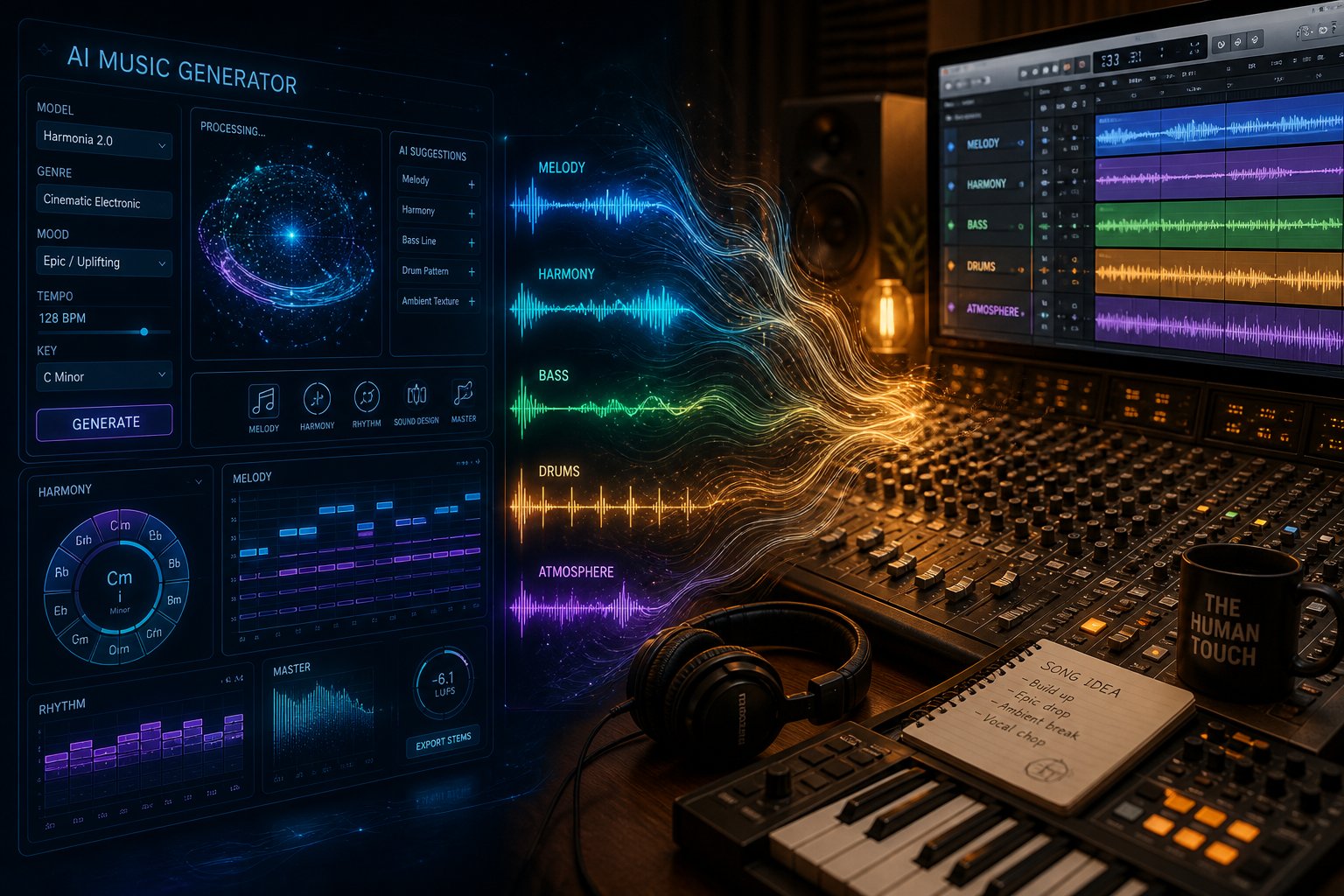
Raw material. That phrase keeps surfacing for a reason. The most impressive AI-assisted EDM tracks you'll hear in the wild - the ones that genuinely sound club-ready, emotionally compelling, and sonically polished - rarely came straight out of a generator untouched. They went through human hands. A producer heard something promising in the AI output, pulled it apart, reshaped it, layered in their own creative decisions, and transformed a statistical prediction into a piece of music with genuine intention behind it.
This isn't a limitation of AI - it's an opportunity. The hybrid workflow, where AI handles the heavy lifting of initial composition and human skill handles everything else, is quickly becoming the dominant production model. A Deloitte Digital Media Trends Report found that more than 52 percent of independent creators already use some form of hybrid AI-assisted workflow. That number is climbing fast, and for good reason: the combination is faster than traditional production, higher quality than AI alone, and uniquely personal because your taste and skill shape the final result.
Why Hybrid Workflows Produce the Best Results
Imagine you generate a 2-minute progressive house track using AI. The chord progression is gorgeous - lush, emotional, perfectly voiced. The drum pattern grooves. But the drop feels underwhelming, the bass tone is too generic, and the mix is muddy in the low-mids. If you treat that output as a finished product, you're stuck with those flaws. If you treat it as a starting point, you've just saved yourself hours of compositional work and can focus your energy where it matters most: refinement.
Professional and semi-professional producers use AI as a creative launchpad, then refine in a traditional DAW like Ableton Live, FL Studio, or Logic Pro. The AI-to-DAW pipeline follows a clear path: generate in AI, extract stems, import into your DAW, arrange and edit, mix professionally, then master and export. Each stage adds human creative control and professional polish that the AI alone can't deliver.
The specific hybrid techniques that yield the strongest results include:
- Using AI-generated drum patterns as a rhythmic foundation - Import the drum stem, keep the groove you like, then replace individual hits with your own samples for a punchier, more personalized kit. The AI provides the pattern; you provide the sonic identity.
- Taking AI melody stems and redesigning the synth sounds - The melodic idea might be compelling, but the preset synth tone rarely matches professional standards. Export the melody, analyze or recreate it as MIDI in your DAW, and run it through your own synthesizers and effects chains. Same notes, completely different character.
- Generating multiple variations to find inspiring harmonic progressions - This is one of the most underrated uses of AI in production. Generate ten variations of the same prompt, listen to the chord movements in each, and cherry-pick the most interesting harmonic idea. You're using AI as a brainstorming partner, not a ghostwriter.
- Using AI outputs as reference tracks for original compositions - Sometimes the most valuable thing an AI generation gives you isn't audio you'll use directly - it's a structural blueprint. The way it paced the buildup, the rhythmic density of the drop, the textural shift in the breakdown - these can inspire your own arrangement decisions without a single AI-generated sample appearing in the final mix.
The critical step that separates amateur hybrid workflows from professional ones is stem quality management. Always download stems as WAV files rather than MP3 - compression artifacts become painfully obvious once you start applying EQ, compression, and effects processing. AI stems commonly suffer from excess energy in the 200-500 Hz range, unusual stereo imaging, and timing that doesn't sit perfectly on the grid. Treating these stems exactly like you'd treat any raw recording - with corrective EQ, careful panning, and time-stretching where needed - is what turns "impressively generated" into "genuinely release-ready."
Real-World Use Cases for AI-Generated EDM
Hybrid production isn't the only way people are putting AI-generated electronic music to work. The practical applications span a wide range of creative and professional contexts, each with its own requirements and workflow priorities:
- Content creators needing royalty-free background music - YouTubers, Twitch streamers, podcasters, and social media creators burn through music constantly. AI generation eliminates the tedious search through royalty-free libraries and the ever-present risk of copyright claims. A gaming streamer can generate a high-energy dubstep loop that perfectly matches their content's intensity without licensing headaches.
- DJs seeking fresh loops and stems for live sets - Rather than relying exclusively on released tracks and sample packs, DJs can generate custom loops, transition elements, and layering material tailored to their specific style and set flow. As one DJ noted after experimenting with AI tools, the ability to introduce unexpected elements between real tracks and overlay AI-generated vocals over monotonous sections opens creative possibilities that sample packs simply can't match.
- Game developers building adaptive soundtracks - Interactive media demands music that responds to player actions - ramping intensity during combat, pulling back during exploration, shifting mood during story beats. AI generation lets developers prototype these adaptive layers rapidly, testing how different energy levels and subgenres feel in-game before committing to full production.
- Hobbyists exploring music creation without years of training - Not everyone who wants to make music EDM-style has the time or resources to master a DAW, learn synthesis, and study mixing. A 2024 IFPI Music Creator Survey found that 68 percent of new AI music tool users had no prior production experience. AI generation lets these creators participate in music-making immediately, building intuition about structure, energy, and arrangement through hands-on experimentation rather than theoretical study.
- Producers using AI for rapid prototyping - Even experienced producers with fully equipped studios benefit from AI as an ideation accelerator. Instead of spending two hours building a rough arrangement to test whether a concept works, you can generate a prototype in minutes, evaluate the vibe, and decide whether the idea warrants full production commitment. It's the musical equivalent of sketching before painting.
For DJs, gamers, and social creators who want high-energy electronic dance music as a creative launchpad, a purpose-built solution like MakeBestMusic's AI EDM Generator offers a streamlined entry point specifically designed around these use cases. Its focus on EDM means less time fighting a general-purpose tool to produce genre-appropriate output and more time actually using the results - whether that's dropping a generated loop into a live set, layering it under gameplay footage, or pulling stems into a DAW for the kind of hybrid refinement that produces truly professional results.
Getting Started on Your AI EDM Journey
If you've read this far, you already have a significant advantage over the vast majority of people experimenting with AI music generation. You understand the structural DNA of electronic dance music - the four-on-the-floor foundation, the tension-release arc of buildups and drops, the sonic fingerprints that distinguish house from techno from dubstep. You know how transformer and diffusion models interpret your requests, which means you can anticipate their strengths and work around their limitations. You've seen what separates a vague, underperforming prompt from a detailed blueprint that consistently produces usable output. And you understand the legal and ethical terrain well enough to make informed decisions about how you use what you generate.
That combination - EDM literacy, technical awareness, prompt engineering skill, and ethical grounding - is the foundation for creating compelling AI-generated electronic dance music. The best program to make edm music isn't necessarily the most expensive or the most hyped. It's the one that fits your specific workflow, responds well to your prompts, and outputs audio quality that meets your standards.
Start small. Pick a subgenre you're passionate about. Write your first detailed prompt using the six-component framework. Generate five variations. Listen critically. Iterate. If you have DAW skills, pull the most promising stems into a project and reshape them. If you don't, use the output as-is and focus on sharpening your prompt craft with each generation cycle. Either way, you're building a skill set that compounds over time - every session teaches you something about how to make music EDM audiences actually want to hear.
The producers who will define the next era of electronic music aren't choosing between human creativity and artificial intelligence. They're combining both - using AI's speed and generative range to explore ideas faster than ever, then applying human judgment, taste, and emotional intelligence to turn those ideas into something worth dancing to. That's not a compromise. It's an evolution. And the best program for making edm music in this new landscape is the one you learn to use as a creative partner rather than a replacement for your own artistic voice.
