

What AI Music Generators Actually Do and Why This Guide Is Different
Imagine typing a short description of the song in your head — the mood, the genre, the instruments — and receiving a fully produced track with vocals, harmonies, and polished mastering within seconds. That is exactly what the best ai music generators 2026 deliver. These platforms translate text prompts, raw lyrics, and style descriptors into complete songs that sound increasingly close to human-produced music.
The leap from what was considered the best ai music generator 2025 to today's tools is staggering. Earlier models struggled with coherent song structure and natural-sounding vocals. Current generators handle multi-minute compositions with verse-chorus dynamics, genre-accurate instrumentation, and vocal performances that can genuinely fool a casual listener.
How AI Music Generators Work Today
The core workflow follows four stages. First, you provide a prompt — anything from a single sentence like "upbeat indie pop about summer road trips" to detailed instructions specifying tempo, key, instrumentation, and vocal tone. The model then interprets your input, mapping language to musical patterns it learned during training on vast audio datasets. Next comes audio synthesis, where the system generates waveforms for each musical element: vocals, drums, bass, melody lines, and ambient textures. Finally, the output goes through refinement — automatic mixing, EQ balancing, and mastering.
How each platform handles these stages varies dramatically. Some generators, like those built on modular pipeline architectures, separate generation from mixing and licensing so you can swap engines without rebuilding your workflow. Others bundle everything into a single black-box experience. Research into hybrid Transformer-GNN frameworks has shown improvements in pitch accuracy reaching 85.3% and harmonic coherence scores of 0.78, as documented in recent academic evaluations — a sign that the underlying models are maturing rapidly.
Why Editorial Independence Matters in This Space
Here is the uncomfortable truth about most ai music generation tools 2026 roundups: many are published by the very companies selling the tools. Platforms like Tad AI and freebeat.ai rank their own products first without disclosing the conflict of interest. You'll find glowing self-reviews dressed up as objective comparisons, and readers rarely notice the bias until they waste money on an overhyped product.
Every tool in this guide was evaluated through hands-on testing using identical controlled prompts — not aggregated from press releases, affiliate rankings, or self-published reviews by the platforms themselves.
Our approach is straightforward. We fed the same detailed prompts across every platform, evaluated the outputs for vocal naturalness, production quality, structural coherence, and genre accuracy, then scored each tool against a weighted rubric. No tool received preferential treatment, and no company sponsored this evaluation. The ai music tools updates 2026 cycle moves fast — models that led six months ago may already trail newer entrants — so transparency about how and when testing happened matters just as much as the results themselves.
With that foundation in place, the real question becomes: how exactly did we measure quality, and what does a rigorous scoring framework look like when every platform claims to be the best?
Our Testing Methodology and Weighted Scoring Rubric
Most roundups of the best ai music generation tools 2026 hand you a ranked list and expect you to trust it. They rarely explain how they arrived at the rankings. Did they test every tool with the same prompt? Did they weigh licensing clarity as heavily as audio quality? Or did they simply rewrite each platform's marketing copy and call it a review? That gap between "we tested these" and "here is exactly how" is where readers get burned.
We built a weighted scoring rubric before generating a single note — not after. The framework was designed to reflect what actually matters across different user profiles, from a YouTuber who needs royalty-free background tracks to a game developer evaluating API reliability. Every criterion carries an explicit weight, and every weight has a reason behind it.
Six Evaluation Criteria and How We Weighted Them
Effective evaluation of AI music tools requires blending what USC Libraries' research framework calls subjective human listening tests with objective technical analysis. Pure listening impressions miss measurable differences in output fidelity. Pure metrics miss whether a track actually feels right. Our rubric combines both approaches across six dimensions:
- Audio Output Quality — 25%. Does the generated track sound like a finished demo or a rough sketch? We assessed vocal realism, instrumental clarity, mix balance, and mastering polish. This criterion carries the heaviest single weight because nothing else matters if the output sounds artificial or poorly mixed.
- Ease of Use and Prompt Responsiveness — 20%. How accurately does the platform interpret what you ask for? A tool that produces beautiful music but ignores your genre request or mood descriptor creates extra work, not less. We measured how closely outputs matched detailed prompt instructions on the first generation attempt.
- Pricing Value and Commercial Rights — 20%. Price alone means little without understanding what you actually get. We evaluated credit systems, download limits, commercial licensing terms, and whether free-tier outputs carry watermarks or usage restrictions. This criterion shares the second-highest weight because unclear licensing has become the single biggest risk factor in this space — as evidenced by the ongoing litigation involving Suno and major labels.
- Genre Versatility — 15%. Can the tool handle cinematic orchestral, lo-fi hip hop, acoustic folk, and EDM with equal competence? Or does it excel in pop and stumble everywhere else? Versatility matters most for agencies and content teams managing diverse projects, less so for creators locked into a single genre.
- Feature Depth — 10%. This covers stem separation, vocal cloning options, MIDI export, API access, and batch generation. Power users and developers need these capabilities. Casual creators rarely touch them. The lower weight reflects that reality without ignoring the features entirely.
- Platform Innovation Trajectory — 10%. Is the platform shipping meaningful updates, or has development stalled? We examined release histories, model version progression, and announced roadmaps. A tool that leads today but shows no momentum may not lead six months from now — and this space moves in months, not years.
You'll notice these weights do not treat every factor equally. That is intentional. A gorgeous-sounding track you cannot legally use in a client project scores lower overall than a slightly less polished track with airtight commercial licensing. The rubric reflects real-world decision-making, not theoretical ideals.
How We Tested with Controlled Prompts
Feature-list comparisons tell you what a platform claims to do. Controlled prompt testing reveals what it actually does. Here is how we structured the process.
We crafted a set of identical, detailed prompts — each specifying genre, mood, instrumentation, tempo range, vocal style, and song structure. For example, one prompt requested "a melancholic acoustic folk ballad at 78 BPM in D minor, female vocals with a breathy tone, fingerpicked guitar and subtle cello, verse-chorus-bridge structure, with a stripped-back outro." That same prompt was fed into every platform under evaluation, and the outputs were scored blind across four dimensions:
- Style accuracy: Did the output match the requested genre, tempo, and instrumentation?
- Vocal naturalness: Did the vocals sound human, or were there telltale artifacts — metallic resonance, unnatural vibrato, or garbled consonants?
- Production polish: Was the mix balanced? Did the mastering hold up on studio monitors and consumer earbuds alike?
- Structural coherence: Did the song follow a logical arc with clear sections, or did it meander without resolution?
This same-prompt approach is what separates a genuine ai music generation tools comparison 2026 from a reshuffled press kit. When you feed every tool the exact same creative brief, the differences become impossible to hide. Some platforms nailed the genre but mangled the vocal tone. Others delivered stunning vocals but ignored the tempo instruction entirely. A few produced outputs that were genuinely indistinguishable from human demos — and several that were not even close, despite impressive marketing claims.
We want to be direct about something: hype outpaces reality across much of this category. When we began assembling what would become our top ai music generation tools january 2026 shortlist, several platforms that dominate social media buzz delivered middling results under controlled conditions. Popularity and quality are not the same thing, and a tool with millions of users can still produce mediocre output in genres outside its comfort zone. Our rubric is designed to surface those gaps honestly rather than smooth them over.
With the scoring framework established and testing complete, the next logical step is applying it — tool by tool, score by score — to reveal which platforms actually earned their rankings.
Top AI Music Generators Ranked After Hands-On Testing
Scores mean nothing without context, and context means nothing without side-by-side results. Below is how every major platform performed when we applied our weighted rubric to identical controlled prompts — revealing which tools deliver on their promises and which coast on brand recognition alone. This table captures the best ai music generator 2026 landscape at a glance before we dig into the specifics.
| Tool Name | Best For | Audio Quality Score | Ease of Use | Free Tier | Commercial Rights | Standout Feature |
|---|---|---|---|---|---|---|
| MakeBestMusic | Prompt-to-finished-song workflow | 8.5/10 | 9/10 | Yes | Paid plans | Streamlined lyrics-to-complete-song pipeline |
| Suno | Overall song quality and genre breadth | 9/10 | 8.5/10 | Yes (50 credits/day) | Paid plans | Suno Studio multitrack DAW |
| Udio | Vocal realism and editing control | 8.5/10 | 7.5/10 | Yes (limited) | Paid plans (downloads disabled) | Inpainting and section-level re-generation |
| ElevenLabs Music | Voice-first creators, multilingual vocals | 8.5/10 | 8/10 | Yes (~11 min/mo) | Starter plan and above | Modular section regeneration |
| Stable Audio | Instrumental beds and sound design | 8/10 | 8/10 | Yes (non-commercial) | Paid tiers | Licensed training dataset |
| AIVA | Cinematic, classical, and game scoring | 8/10 | 7.5/10 | Yes (3 downloads/mo) | Pro plan (full copyright ownership) | MIDI export with full copyright assignment |
Top-Tier Generators for Complete Song Creation
MakeBestMusic earned its position at the top of this list for one reason: nobody else makes the journey from idea to finished song feel this effortless. You feed it prompts, raw lyrics, or style ideas, and it returns a complete AI-generated song — vocals, instrumentals, arrangement — without requiring you to stitch sections together manually. For musicians sketching demos, marketers producing branded audio, and content teams that need tracks on deadline, that streamlined workflow eliminates the friction that makes other platforms feel like half-finished tools. The audio quality holds up across pop, hip-hop, and electronic genres, though highly technical styles like jazz fusion expose the same limitations you will find in every generator at this stage.
Suno remains the category's most mature ecosystem. With a $2.45B valuation, roughly two million paid subscribers, and $300M in annualized recurring revenue as of early 2026, it is the default choice many creators reach for first. Is Suno the best ai music generator overall? In terms of raw output quality across the widest genre range, the answer is still yes — vocal generation leads the field, and Suno Studio on the Premier plan adds multitrack editing, stem extraction, and MIDI export that bridge the gap between AI generation and traditional DAW production. The limitations are real, though: fine structural control beyond text prompts remains clunky, and the active litigation with Sony Music and Universal Music Group means commercial licensing carries unresolved legal exposure until those cases conclude.
Udio built its reputation on exceptional vocal realism and granular editing — features like inpainting let you regenerate specific sections without affecting the rest of a track. In a direct suno vs udio vs other ai music generators 2026 comparison, Udio's vocal phrasing and emotional delivery often edge ahead of Suno's, particularly in electronic and hip-hop production. The critical caveat? All downloads have been disabled since October 29, 2025, as part of Udio's UMG settlement. You cannot export audio, stems, or video from the platform. Until the jointly licensed platform launches and defines new export rules, Udio is effectively a walled garden — impressive to listen to inside the platform, unusable for anyone who needs files in a DAW or on a distribution service.
Strong Contenders and Specialized Alternatives
ElevenLabs Music deserves serious attention from creators who already use ElevenLabs for voiceover work. Launched in August 2025 with licensing partnerships including Merlin and Kobalt, it delivers studio-grade 44.1kHz audio with commercial use from the $6/mo Starter plan — the lowest entry price for commercially licensed AI music in this roundup. Its modular design lets you regenerate individual song sections rather than re-rolling the entire track, which saves both time and credits. The tradeoff: a smaller community and fewer tutorials than Suno, plus content restrictions that prohibit prompting with specific artist names or song titles.
Stable Audio occupies a different lane entirely. It does not generate vocals. What it does produce — instrumental beds, sound design elements, ambient textures, and podcast-ready audio up to three minutes at 44.1kHz stereo — comes backed by a licensed training dataset from AudioSparx and partners. For sound designers and podcasters who need clean instrumentals without legal ambiguity, it is the safest choice in this list.
AIVA has been operating longer than any other tool here and remains the leader for cinematic, classical, and game scoring workflows. Its Pro plan at €33/mo billed annually is the only option across all top ai music generation products 2026 that grants full copyright ownership of generated outputs — not just a commercial license, but actual copyright assignment. The MIDI export capability makes AIVA uniquely suited for composers who want AI-generated starting points they can orchestrate and refine inside a professional DAW. It is not competing with Suno or MakeBestMusic for pop songwriting; it is solving a fundamentally different problem.
When we compiled our top ai music generators march 2026 shortlist, one pattern became clear: no single platform dominates every use case. MakeBestMusic leads on workflow speed and accessibility, Suno leads on raw output breadth, Udio leads on vocal editing control but cannot export, and the specialized tools each own a well-defined niche. The real differentiator for most users will not be audio quality alone — it will be the specific features, integration capabilities, and licensing terms that match their actual workflow.
Feature-by-Feature Comparison Matrix Every Buyer Needs
Rankings reveal which platforms lead overall, but they do not tell you whether a tool exports stems at 44.1kHz, supports vocal cloning, or integrates with your DAW. Those granular details determine whether a generator actually fits your production pipeline — or becomes an expensive dead end. The tables below break down the best ai music generators 2026 comparison features that no competing roundup bothers to compile in one place.
Audio Capabilities and Output Specifications
When evaluating ai music composition tools 2026, output specs matter as much as output quality. A generator that produces beautiful audio but caps exports at 128kbps MP3 is useless for professional delivery. Here is how each platform stacks up on the technical fundamentals:
| Feature | MakeBestMusic | Suno | Udio | ElevenLabs Music | Stable Audio | AIVA |
|---|---|---|---|---|---|---|
| Max Track Length | Up to 4 min | Up to 4 min (extendable) | Up to 15 min (via extensions) | ~5 min per generation | Up to 3 min | Up to 5 min (varies by plan) |
| Export Formats | MP3, WAV | MP3, WAV, MIDI (Premier) | Downloads currently disabled | MP3, WAV (44.1kHz) | MP3, WAV (44.1kHz stereo) | MP3, WAV, MIDI |
| Vocal Quality | Strong across pop and hip-hop | Leading vocal realism | Exceptional phrasing and emotion | Studio-grade multilingual vocals | No vocal generation | Limited vocal support |
| Vocal Cloning | Not available | Not available natively | Not available natively | Supported via ElevenLabs voice ecosystem | Not available | Not available |
| Stem Separation | Limited | Available on Premier plan | Previously available; paused with downloads | Not natively supported | Not natively supported | Not natively supported (MIDI export enables stem-like workflows) |
| Genre Range | Broad (pop, hip-hop, electronic, rock, folk) | Widest genre coverage tested | Strong in electronic, hip-hop, indie | Broad with multilingual strength | Instrumental-focused; ambient, cinematic, electronic | Classical, cinematic, game scoring |
| Multilingual Vocals | Limited language support | Multiple languages supported | Multiple languages supported | Extensive multilingual support | N/A (instrumental only) | Minimal |
A few standout details deserve attention. ElevenLabs Music is the only platform that connects directly to a mature voice cloning ecosystem — meaning you can potentially pair custom voice models with generated music, a capability that positions it among the best ai voice enhancement tools for music production 2026. AIVA's MIDI export is a quiet superpower: even though it does not generate vocal stems, exporting MIDI lets you rebuild every note in a DAW with your own instruments. And Udio's disabled downloads remain the elephant in the room — no export path means no practical production use, regardless of how good the audio sounds inside the platform.
Platform and Integration Features
Generating a great track is only half the battle. Getting that track into Ableton, synced to a video timeline in Premiere Pro, or triggered dynamically through an API — that is where most platforms fall silent. Professional workflows depend on integration, and this is the gap that separates top ai music creation tools 2026 from glorified demo generators.
| Feature | MakeBestMusic | Suno | Udio | ElevenLabs Music | Stable Audio | AIVA |
|---|---|---|---|---|---|---|
| API Access | Not publicly documented | Available (Suno API) | Paused alongside downloads | Yes (robust developer docs) | Yes (Stability AI API) | Yes (AIVA API) |
| DAW Integration | Export and import manually | Suno Studio offers multitrack editing; export stems/MIDI to DAW | No current export path | Export and import manually | Export and import manually | MIDI export to any DAW (Ableton, FL Studio, Logic Pro) |
| Video Editor Integration | Download and import to timeline | Download and import to timeline | Not available | Download and import to timeline | Download and import to timeline | Download and import to timeline |
| Mobile App | Web-based (mobile responsive) | iOS and Android apps | Web-based | Web-based and mobile app | Web-based | Web-based |
| Collaboration Features | Basic sharing | Community sharing and remixing | Community features | Workspace sharing | Limited | Project sharing on team plans |
| Batch Generation | Multiple variations per prompt | Multiple outputs per generation | Multiple outputs per generation | Multiple variations supported | Multiple outputs per prompt | Bulk composition tools on higher plans |
The honest takeaway? No AI music generator offers true native DAW plugin integration the way tools like MIDI Agent or Staccato do for MIDI generation inside Ableton, FL Studio, Logic Pro, and Studio One. The current workflow for every platform on this list involves generating audio in the browser, downloading the file, and importing it into your DAW or video editor manually. AIVA's MIDI export gets closest to a native production workflow because you can drag the MIDI directly into any DAW session and assign your own virtual instruments — but that is a composition-first approach, not a full-song output.
For video editors working in Premiere Pro or DaVinci Resolve, the process is similarly manual: generate, download, drag to timeline. No platform offers a direct plugin, panel extension, or integration that embeds AI music generation inside a video editing environment. If your workflow involves scoring to picture, you will generate tracks externally and sync them manually — planning for this step upfront saves frustration later.
Developers evaluating the best ai music generation apis 2026 should look closely at ElevenLabs and Stability AI. Both provide well-documented REST APIs with programmatic generation, making them viable for automated content pipelines, in-app music features, and game audio systems. Suno's API is available but less extensively documented for third-party integration. AIVA's API serves niche scoring workflows. MakeBestMusic and Udio currently lack public API access, which limits their utility for developers building automated music into products.
These integration realities shape which platform fits which user — and the right match depends entirely on how you actually plan to use the generated music in your day-to-day workflow.
Best AI Music Generators Matched to Your Specific Use Case
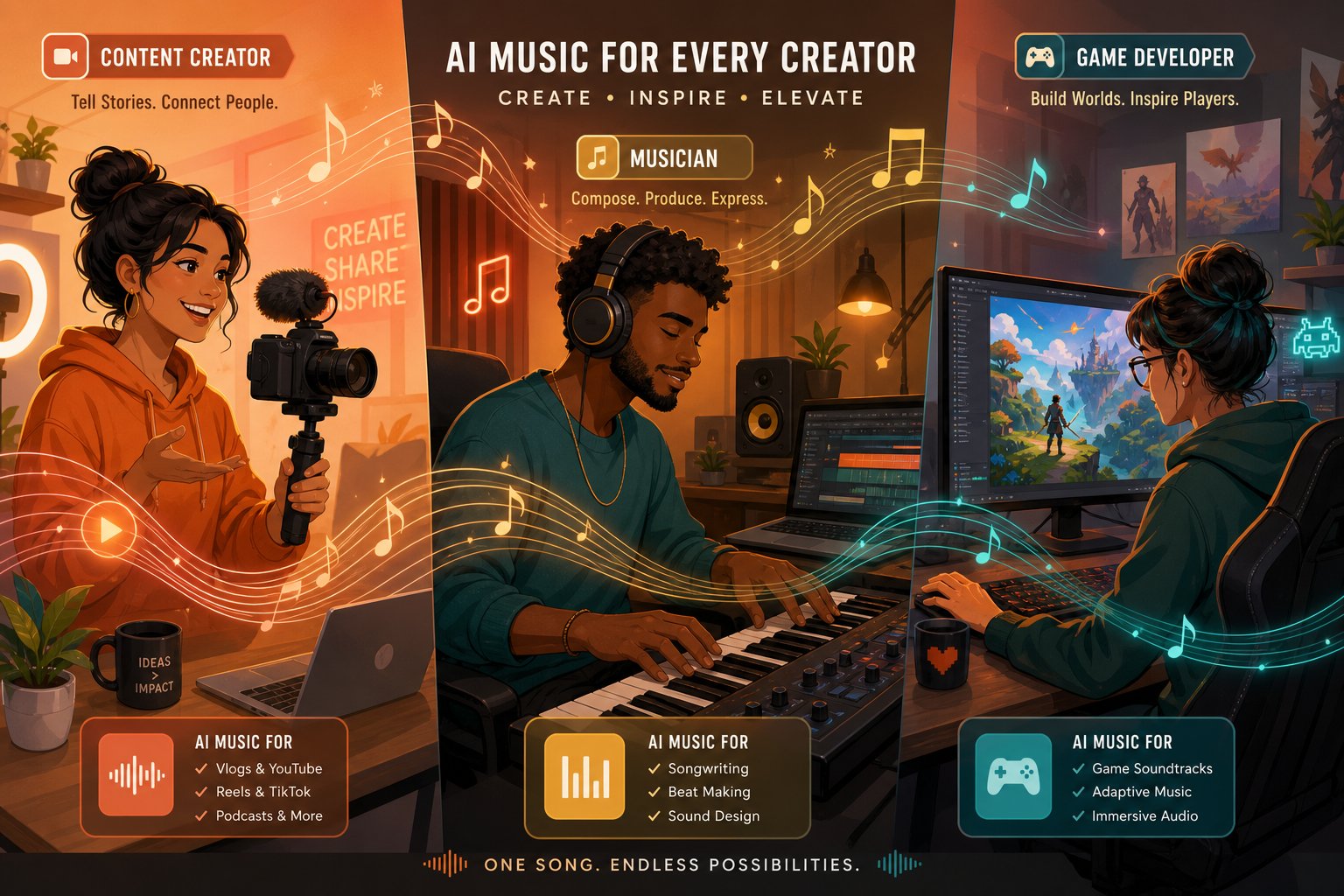
Feature tables and integration specs answer the question "what can this tool do?" The harder question — "which tool should I use?" — depends entirely on who you are and what you are trying to accomplish. A podcast host shopping for a 30-second intro has radically different needs than a game developer building an adaptive soundtrack system. Treating them as the same audience is exactly where most roundups fall apart.
Below, we match the best ai music creation tools 2026 to three distinct professional profiles, each with specific tool recommendations grounded in our hands-on testing rather than marketing claims.
For Content Creators and Social Media Teams
When you need royalty-free background music for a YouTube video, a punchy TikTok soundtrack, or a podcast intro that sounds custom without a custom budget, speed and licensing clarity outrank every other factor. The best ai music generators for creators 2026 are platforms that deliver commercially licensed audio in minutes — not hours of prompt tweaking.
Short-form content adds another constraint: tracks need to hook within the first two seconds and loop cleanly at 15, 30, or 60-second marks. Not every generator handles truncated formats gracefully. Here are the strongest picks:
- MakeBestMusic — Ideal for creators who want a complete song from a single prompt without assembling stems or stitching sections. Describe your mood, genre, and energy level, and the platform delivers a finished track ready for a YouTube upload or Instagram Reel. Commercial licensing on paid plans removes the guesswork around monetized channels.
- Suno — The widest genre range of any platform tested, which matters when your content calendar spans cooking tutorials, fitness montages, and travel vlogs in the same week. The free tier's 50 daily credits let you experiment before committing, and the $10/mo Pro plan unlocks commercial rights. Born to Produce's comparison echoes this: Suno's combination of generation quality and workflow tools makes it the default for most creators.
- Soundraw — Purpose-built for royalty-free background music. You select mood, genre, and length, then customize energy levels per section. It will not win any awards for vocal realism — it does not generate vocals at all — but for YouTubers and podcasters who need unobtrusive background audio fast, it solves the right problem without overcomplicating the workflow.
A practical tip: if you produce content across multiple social platforms, verify that the commercial license covers all distribution channels — not just YouTube. Some plans restrict usage to specific platforms or cap the number of published videos per month, a detail buried in fine print that can create headaches after the fact.
For Professional Musicians and Producers
Professional workflows demand capabilities that go far beyond "generate a track and download it." Songwriters need melodic starting points they can reshape. Producers need stems they can process through their own signal chains. Vocalists need reference tracks that demonstrate arrangement ideas before committing studio time. The best ai music generators for professionals 2026 are the ones that treat AI output as raw material for further production — not as a finished product.
Among the top professional ai music generation tools 2026, the platforms that integrate most naturally into a DAW-centric workflow stand out:
- AIVA — The strongest choice for composers who want AI-generated MIDI they can orchestrate with their own instruments and samples. Export a MIDI composition into Ableton, Logic Pro, or FL Studio, reassign every note to your preferred virtual instruments, and build from there. Its classical, cinematic, and game scoring output is unmatched, and the Pro plan grants full copyright ownership — not just a license.
- Suno (Premier plan) — Suno Studio's multitrack editing, stem extraction, and MIDI export bridge the gap between generation and traditional production. If you want to isolate a vocal take, swap out a drum pattern, or adjust BPM before bringing stems into your DAW, the Premier tier at $30/mo is the most complete AI-to-DAW workflow available.
- Udio — Its inpainting feature — regenerating specific sections without touching the rest — is genuinely useful for iterative songwriting where you want to experiment with different verse melodies over the same chorus. The critical limitation remains: downloads are disabled until the new jointly licensed platform launches, so you cannot bring outputs into a DAW until that changes.
For producers specifically searching for the best ai tools to generate melody over existing beat 2026, the honest answer is that no platform handles this use case seamlessly yet. Udio's style reference feature — generating based on uploaded reference audio — comes closest, but the export restriction kills the workflow. A more reliable approach today involves using AIVA or Suno to generate melodic ideas independently, exporting the stems or MIDI, and layering them over your existing beat inside a DAW. It is an extra step, but it preserves the creative control that professional production demands.
For Game Developers and Advertising Teams
Game audio and advertising have a shared requirement that content creators and musicians typically do not: programmatic generation. An indie game studio needs music that adapts to in-game events. An ad agency needs to produce dozens of jingle variations for A/B testing across campaigns. Both scenarios benefit from API access, batch generation, and flexible licensing that covers commercial distribution across multiple channels.
The best ai music generation apps 2026 for these teams are the ones that offer developer-friendly infrastructure alongside quality output:
- ElevenLabs Music — The most robust and well-documented API among the platforms tested. Developers can programmatically generate tracks, retrieve outputs, and integrate music generation into apps, games, or automated content pipelines. Multilingual vocal support adds value for global ad campaigns. Commercial licensing starts at the $6/mo Starter plan — the lowest barrier in this roundup.
- Stable Audio (via Stability AI API) — Best suited for instrumental beds, ambient textures, and sound design elements. The licensed training dataset minimizes legal risk, which matters enormously for ad agencies whose clients have zero tolerance for copyright ambiguity. No vocal generation limits its use for jingle work, but for game soundscapes and background scoring, it is a reliable choice.
- AIVA — Its API supports automated composition workflows for game scoring, and MIDI export lets audio teams orchestrate AI-generated themes using their own sample libraries. For indie studios building adaptive music systems, feeding AIVA-generated MIDI into middleware like FMOD or Wwise creates a pipeline that is both cost-effective and creatively flexible.
As Skycrumbs' 2026 analysis notes, the next phase of AI music generation is moving toward real-time adaptive music — soundtracks that adjust dynamically to in-game events. Several game engine integrations are already in beta, which means the best ai music creation tools 2026 for game developers may look very different twelve months from now as native integrations mature.
Matching the right tool to your workflow is the decision that saves you the most time and money. But even the perfect platform produces mediocre results if you feed it vague, generic prompts — and that is a skill gap almost nobody in this space talks about.
Prompt Engineering Templates That Unlock Better AI Music
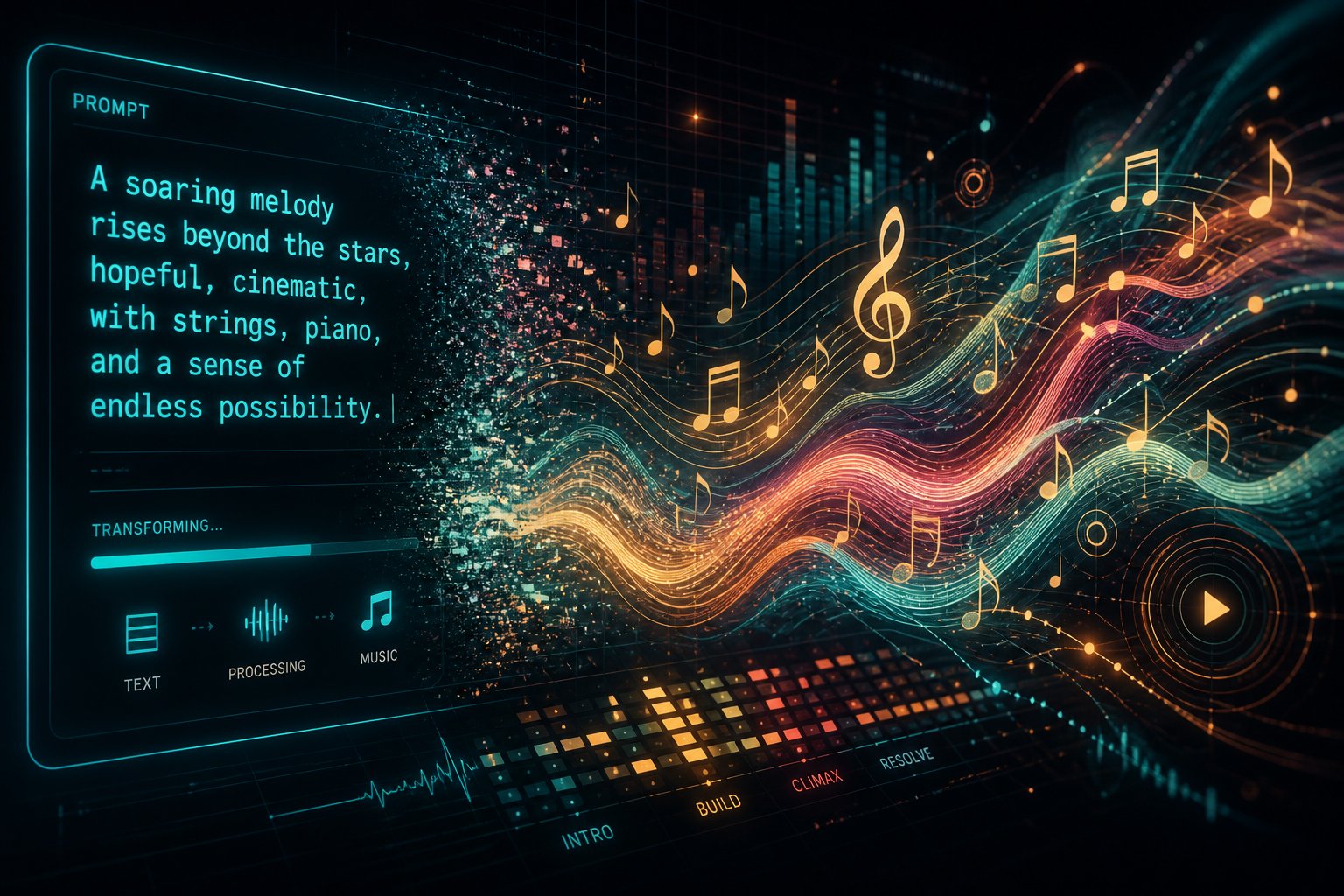
A vague prompt is the fastest way to waste credits on any AI music platform. You might have picked the perfect tool from the list above, but typing "make a cool song" produces the sonic equivalent of asking a chef to "cook something nice" — technically possible, almost certainly disappointing. The difference between unusable output and a track you would actually publish comes down to how precisely you communicate your vision.
If you are wondering how to start ai music production for beginners 2026, this is the single most important skill to develop. Forget complex DAW techniques for now. Learn to write prompts that make AI do the heavy lifting accurately.
Anatomy of a High-Quality Music Prompt
Effective prompts share a consistent anatomy. Based on our testing across every platform and insights from MusicMakerApp's prompt engineering framework, seven components consistently improve output quality:
- Genre and style: "Lo-fi hip hop" is better than "chill." "Dark synthwave with retro drums" is better still. Narrow the lane so the model stops guessing.
- Mood and energy descriptors: Combine feeling with purpose — "tense and urgent for a game boss fight" tells the AI more than "intense" alone.
- Instrumentation: Name two to four instruments. "Warm Rhodes piano, brushed drums, subtle sub bass" gives the model a palette. Saying "no saxophone, no cheesy brass" is equally useful when you know what you want to avoid.
- Tempo and key suggestions: You do not need surgical precision. "Around 85 BPM, D minor" is enough. As Sonygram's prompt engineering guide explains, specifying BPM anchors the rhythmic grid and prevents the model from estimating speed based on genre probability alone.
- Vocal style and tone: "Female vocal, breathy, no full verses — just a hook phrase" prevents the surprise choir that derails your product demo. Specify "instrumental only" when vocals are not wanted.
- Structural cues: "Verse-chorus-bridge" or "short intro, stable groove, no big drops" — plain language structure descriptions work across all major platforms.
- Production style references: "Warm analog saturation" or "clean digital mastering" shapes the final texture. This is the layer most beginners skip, but it dramatically affects whether output sounds polished or flat.
Specificity is the multiplier. Every element you define reduces what AI researchers call generative entropy — the randomness that fills the gaps when your instructions leave room for interpretation. The best ai songwriting tools 2026 still cannot read your mind, but they respond remarkably well to structured briefing.
Genre-Specific Prompt Templates Ready to Use
These templates are optimized from our controlled testing sessions. Drop them into your preferred platform, then adjust one or two variables to match your project. Each covers all seven prompt components in natural language — think of them as creative briefs, not commands.
Cinematic Orchestral — best results on AIVA and Suno:
Epic cinematic orchestral score in D minor at 90 BPM, slow string ostinato intro, layered brass swells entering at the second section, deep timpani build, gradual crescendo to dramatic climax at 60 seconds, resolved ending with choir swell and controlled decrescendo, wide stereo mix with concert hall reverb.
Lo-Fi Hip Hop — best results on Suno and MakeBestMusic:
Nostalgic lo-fi hip hop at 78 BPM in A minor, dusty swing drum loop with subtle vinyl crackle, warm Rhodes piano chords, muted sub bassline, instrumental only, 16-bar seamless loop feel, soft analog tape saturation, designed to sit quietly under a study or coding session without distracting.
Acoustic Folk Ballad — best results on Suno and ElevenLabs Music:
Melancholic acoustic folk ballad at 76 BPM in D minor, female vocals with a breathy intimate tone, fingerpicked acoustic guitar and subtle cello, verse-chorus-bridge structure, stripped-back outro, warm natural room sound, emotionally vulnerable and honest.
EDM with Builds and Drops — best results on Suno and Udio (when exports resume):
High-energy house track at 126 BPM in G minor, four-on-the-floor kick with groovy bassline, 16-bar intro building tension with rising synth filter, supersaw drop with sidechain compression pumping, breakdown at the midpoint, second drop variation with added percussion, clean digital mastering for club playback.
Ambient Background — best results on Stable Audio:
Atmospheric ambient soundscape at 65 BPM, no defined key center, evolving synthesizer pads with slow filter movement, soft granular textures, sparse percussive clicks, no vocals, seamless and non-intrusive, designed as background audio for a meditation app or wellness brand video.
Jazz Fusion — challenging for all platforms; closest results on Suno:
Smooth jazz fusion in F major at 120 BPM with swing feel, walking upright bass line, brushed drum kit, Rhodes piano comping with seventh and ninth chord extensions over a ii-V-I progression, expressive tenor saxophone lead, intimate small club reverb, no vocals.
Pop with Catchy Hooks — best results on MakeBestMusic and Suno:
Upbeat modern pop at 118 BPM in G major, bright synth hooks and muted electric guitar, tight programmed drums with claps on the snare hits, male vocal with a warm confident tone, verse-chorus-verse-chorus-bridge-final chorus structure, catchy melodic hook that repeats in the chorus, polished radio-ready mix.
A quick note on lyrics: if you are searching for the best ai for song lyrics, some of these platforms accept full lyric input alongside style prompts. Tools like Suno and MakeBestMusic let you paste lyrics directly and the model sets them to music — essentially functioning as a best ai song maker that handles both composition and vocal performance. You can even draft lyrics using a chatgpt song writer workflow, then feed those lyrics into a dedicated music generator for production. Separating lyric writing from music generation often produces better results than asking one tool to handle everything simultaneously.
Iterating and Refining Your Outputs
Your first generation will rarely be the final version — and that is completely fine. The creators who get professional-quality results from the best ai music composition tools 2026 treat initial outputs as drafts, not deliverables.
A practical refinement workflow looks like this: generate two or three variations from your initial prompt, then listen critically. Is the mood right but the tempo too fast? Is the verse strong but the chorus flat? Identify one specific element that needs adjustment and change only that variable in the next prompt. As MusicMakerApp's iteration guide emphasizes, rewriting the entire prompt every time makes it impossible to isolate what actually improved the output.
Most platforms offer variation and extend features. Suno lets you extend a track or create variations from a specific section. Udio's inpainting regenerates a single passage without touching the surrounding audio. MakeBestMusic generates multiple complete variations per prompt so you can cherry-pick the strongest version. Use these tools strategically: once you have a strong foundation, refine surgically rather than starting from scratch.
When a track is 80% right — solid structure, good groove, but one awkward section — stop tweaking the prompt and fix it in editing. Trim the weak passage, loop the strongest 30 seconds for short-form content, or export stems and process them in a DAW. The chatgpt song writer approach to lyric drafting applies here too: use AI to get close, then apply human judgment for the final polish. That combination of machine generation and human curation is where consistently usable results live.
Prompt precision gets you to the right neighborhood. Knowing what each platform charges — and what hidden costs lurk beneath the surface — determines whether you can afford to stay there.
Pricing Breakdown and Hidden Costs Nobody Talks About
A platform can produce stunning audio, nail every genre, and offer the cleanest workflow imaginable — but if its pricing structure quietly drains your budget through expiring credits, hidden watermarks, or licensing fine print, the value proposition collapses. Pricing pages are designed to make you click "Subscribe." This section is designed to help you understand what you are actually paying for.
Most roundups of the best free ai music generators 2026 stop at listing monthly rates. They rarely explain credit mechanics, rollover policies, or the real gap between free-tier and paid-tier output quality. The table below consolidates verified pricing across every major platform into a single view — the kind of unified comparison that should exist everywhere but somehow does not.
Complete Pricing Comparison Across All Major Platforms
| Platform | Free Tier (Monthly Limits) | Basic Paid Plan | Pro / Top Plan | Credit System Details | Commercial License Included |
|---|---|---|---|---|---|
| MakeBestMusic | Yes (limited generations) | Paid plans available | Higher-tier plans available | Credit-based; verify current allotments on site | Yes, on paid plans |
| Suno | 50 credits/day, no commercial use | Pro: $10/mo ($8/mo annual) | Premier: $30/mo ($24/mo annual) | 2,500 credits/mo (Pro), 10,000/mo (Premier); credits do not roll over | Yes, paid plans only |
| Udio | 10/day + 100/mo, max 3 songs/day | Standard: $10/mo | Pro: $30/mo | 2,400/mo (Standard), 6,000/mo (Pro); credits do not roll over | Yes, but all downloads disabled since Oct 2025 |
| ElevenLabs Music | ~11 min of music/mo (10,000 credits), no commercial use | Starter: $6/mo | Pro: $99/mo | Shared credit pool with voice products (900 credits per minute of music); 30K (Starter) to 500K (Pro) | Yes, Starter plan and above |
| Stable Audio | Yes, non-commercial use only | Paid tiers available (rates unconfirmed) | Enterprise tier available | Check stableaudio.com for current credit allotments | Yes, paid tiers |
| AIVA | 3 downloads/mo, MP3 and MIDI only, non-commercial | Standard: €11/mo (annual billing) | Pro: €33/mo (annual billing) | 15 downloads/mo (Standard), 300/mo (Pro); no credit-based system — download count per plan | Standard: limited to YouTube, Twitch, TikTok, Instagram. Pro: full copyright ownership |
Pricing data above was verified against each platform's official pricing page. Suno, Udio, ElevenLabs, and AIVA rates were confirmed as of July 2026. Stable Audio pricing could not be independently rendered during the same verification window, so treat those rates as approximate and check the source directly. Plans, credits, and prices change frequently — always confirm before purchasing.
At first glance, the best free ai music generation tools 2026 appear generous. Suno hands you 50 credits daily. ElevenLabs gives roughly 11 minutes of generated music each month. AIVA lets you download three compositions. Sounds reasonable — until you read the fine print.
Hidden Costs and Fine Print You Need to Know
Every top ai music production tools 2026 pricing page is engineered to highlight what you get. The costs below are the ones you discover after you have committed to a workflow — and by then, switching platforms means abandoning your catalog of prompts, saved generations, and learned quirks.
- Credit expiration: Neither Suno nor Udio roll over unused credits. If your Pro plan renews with 800 credits still unspent, those vanish. You are paying for a monthly ceiling, not accumulating a balance. AIVA uses a download count instead of credits, and those reset monthly too.
- Quality degradation on free tiers: Free-tier outputs on several platforms are not sonically identical to paid-tier outputs. Some generators apply subtle quality capping — lower bitrate renders, reduced vocal fidelity, or less polished mastering — to incentivize upgrades. This is rarely documented explicitly.
- Watermarks and audio fingerprinting: Free plans may embed inaudible watermarks or metadata tags that identify the track as AI-generated and non-licensed. Uploading a watermarked track to a monetized YouTube channel or distributor can trigger content flags or takedowns.
- Rate limiting and queue priority: Paid subscribers jump the generation queue. During peak hours, free-tier users on popular platforms can wait 30 to 90 seconds per generation while Pro users get near-instant results. This is a hidden productivity tax that adds up over long sessions.
- Auto-renewal and cancellation friction: Most platforms auto-renew monthly or annually. Some require cancellation five or more days before renewal to avoid being charged. Annual billing locks in a lower rate but commits you to 12 months — an eternity in a space where a tool that leads today may be surpassed in three months.
- Commercial rights scope: "Commercial license included" does not always mean unrestricted use. ElevenLabs Music's terms carve out political advocacy, firearms, adult entertainment, and several other sectors entirely. AIVA's Standard plan restricts monetization to specific social platforms. Suno grants commercial rights on paid plans, but the underlying training-data litigation with Sony and UMG remains unresolved — meaning your legal exposure depends on court outcomes you cannot control.
- Shared credit pools: ElevenLabs Music shares one credit pool with its voiceover, dubbing, and sound effects products. If your team burns through credits on voice cloning projects, you may have nothing left for music generation that month — an easy trap for teams using multiple ElevenLabs products.
The pattern is clear: the sticker price is the starting point, not the full cost. Before committing to any of the best ai tools for music production 2026, map your actual monthly usage — how many tracks you need, at what quality level, with what commercial rights — and calculate whether the credit or download allotment covers it. A $10/mo plan that runs out halfway through the month is effectively a $20/mo plan.
Cost Analysis for Self-Hosting Open-Source Models
For technically capable teams, self-hosting an open-source music generation model sidesteps subscription fees entirely. You download the model weights, run inference on your own GPU infrastructure, and pay only for compute. No credits, no watermarks, no licensing ambiguity baked into a platform's terms.
The reality check? GPU compute is not cheap. Based on current AWS on-demand pricing, the infrastructure costs for self-hosting AI models scale quickly:
| Setup | AWS Instance Type | Approx. Monthly Cost (Business Hours) | Approx. Monthly Cost (24/7) |
|---|---|---|---|
| Budget (smaller model, ~7B parameters) | g5.2xlarge (1x A10G GPU) | ~$440 | ~$1,460 |
| Mid-range (larger model, multi-GPU) | g5.12xlarge (4x A10G GPU) | ~$1,250 | ~$4,100 |
| Frontier-class (massive model) | p6-b300.48xlarge (8x B300 GPU) | ~$25,000–30,000 | ~$71,000+ |
These figures apply to general AI model hosting — language models, specifically — but the GPU memory and compute requirements for music generation models follow similar patterns. A mid-range audio model that fits on a single high-VRAM GPU might cost $440 to $1,460 per month depending on usage hours, which is competitive with a handful of commercial SaaS subscriptions. A larger, higher-quality model demanding four GPUs pushes costs to $1,250 or more per month during business hours alone.
The business-hours scheduling trick is essential: if your team only generates music during a 10-hour workday, you pay for roughly 220 hours per month instead of 730. That single optimization cuts compute costs by approximately 70%.
Beyond raw compute, factor in the hidden operational costs. Someone needs to maintain the infrastructure — handling model updates, monitoring GPU utilization, troubleshooting failures, and managing security. For a team of two or three, that overhead may exceed the SaaS subscription it replaces. For a larger organization running dozens of ai music production tools 2026 workloads, the economics tilt in favor of self-hosting, especially when data sovereignty and unlimited generation volume matter.
There is also an honest quality gap to acknowledge. As of mid-2026, leading open-source music models have not matched the output quality of top commercial platforms like Suno or ElevenLabs Music. Self-hosting gives you full control and eliminates per-track costs, but you trade that for audio quality that currently sits a tier below the best commercial options. For internal demos and prototyping, that tradeoff is often acceptable. For client-facing deliverables, it usually is not — yet.
Pricing shapes what is possible, but it does not answer the deeper questions about ownership, ethics, and whether the commercial SaaS model or the open-source path better protects your interests long-term.
Commercial SaaS vs Open-Source and the Ethics Question
Choosing the best ai music generation software 2026 is not purely a question of audio quality or monthly pricing. It is a structural decision about control, dependency, and legal exposure. Commercial SaaS platforms and open-source models represent fundamentally different philosophies — and the right path depends on whether you prioritize convenience or autonomy, speed to production or long-term ownership.
Commercial Platforms vs Open-Source Models
Commercial tools like Suno, ElevenLabs Music, and MakeBestMusic offer a compelling bargain: polished interfaces, managed GPU infrastructure, regular model updates, and customer support. You sign up, type a prompt, and receive a finished track. No hardware provisioning, no dependency management, no debugging CUDA errors at midnight. For creators and content teams who need results today, that frictionless experience is genuinely valuable.
The tradeoff? You are renting access, not owning a capability. Your workflow depends on the platform's continued existence, its pricing decisions, and its terms of service — which can change unilaterally. Udio's download suspension is a stark example: users who built entire workflows around the platform lost export access overnight due to a licensing settlement they had no part in negotiating. Subscription lock-in also means your creative history, saved prompts, and generation catalog live on someone else's servers.
Open-source models — including options like Stable Audio's open-weight variants and community-developed alternatives — flip that equation. You download the model weights, run inference on your own GPUs, and answer to no one's terms of service. Full customization becomes possible: fine-tune the model on your own audio datasets, adjust generation parameters, and integrate the system into proprietary pipelines without API rate limits or credit caps.
The honest reality, though, is that leading open-source music models have not yet closed the quality gap with the best ai music production tools 2026 on the commercial side. As ModelHunter's 2026 analysis notes, platforms like Suno v5.5 and ElevenLabs Music invest heavily in proprietary training data, vocal modeling, and production refinement that open-source alternatives cannot easily replicate. Self-hosted models produce serviceable output for prototyping, internal demos, and experimental workflows — but for client-facing deliverables or commercial releases, the polish difference remains audible. That gap is narrowing with each ai music production tools 2026 updates cycle, but it has not disappeared.
Ethical Considerations and Copyright Clarity
The elephant in every AI music conversation is training data. Where did the audio come from? Were artists compensated? And who actually owns what comes out the other side?
These are not abstract questions. The regulatory landscape has shifted dramatically. In the EU, Article 53 of the AI Act now requires general-purpose AI providers to comply with copyright law and publish detailed summaries of their training data — regardless of where training occurred. In Germany, the Munich Regional Court ruled in the GEMA v. OpenAI case that training on unlicensed song lyrics was unlawful. In the US, the Copyright Office's May 2025 report preserved the fair use status quo but offered no categorical protection for AI training, leaving providers exposed to case-by-case litigation risk. The February 2025 Thomson Reuters v. Ross Intelligence decision rejected fair use for AI training when the output competed with the original work's market — a precedent that casts a long shadow over music generators trained on copyrighted songs.
Different platforms handle this exposure differently. ElevenLabs Music and Stable Audio have positioned themselves around licensed training data, explicitly marketing commercial safety as a core feature. Beatoven maestro and Loudly similarly emphasize licensed datasets and royalty-free workflows. Suno and Udio, meanwhile, face active litigation with major labels — Sony Music and Universal Music Group — over alleged use of copyrighted recordings in training data. Until those cases resolve, commercial users of those platforms carry inherited legal exposure they cannot fully assess.
Copyright ownership of AI-generated music varies drastically by platform. AIVA's Pro plan grants full copyright assignment to the user. Suno and ElevenLabs grant commercial licenses on paid plans but retain underlying rights. Free-tier outputs on most platforms carry no commercial rights whatsoever. Always verify ownership terms before distributing AI-generated music commercially.
The artist compensation debate adds another layer. Many musicians argue that ai tools for music production 2026 profit from creative labor without consent or payment. The European Parliament's March 2026 resolution proposed a flat-rate licensing fee of 5 to 7 percent of global turnover for creative industry compensation — a non-binding signal, but a clear indicator of where regulation is heading. The June 2026 EU Copyright Directive review could formalize mandatory licensing, fundamentally altering the economics of every commercial music generator. Providers building on licensed datasets are better positioned to absorb that shift. Those relying on contested fair use arguments face a reckoning that could arrive faster than their legal teams expect.
API Access for Developers and Automated Pipelines
For developers building music generation into products — games, apps, advertising platforms, content automation systems — API quality matters more than any consumer-facing feature. Yet most roundups barely mention API availability, let alone compare documentation depth, endpoint reliability, or pricing structures for programmatic access.
The current landscape breaks down into clear tiers based on our testing and data from Apiframe's 2026 API comparison and ModelHunter's API buyer analysis:
- Google DeepMind Lyria 3 Pro — The most infrastructure-grade option. Available through Vertex AI and AI Studio at approximately $0.009 per generation (up to 3 minutes), Lyria is built for teams embedding music generation at platform scale. Its emphasis on structured song components — intros, verses, choruses, bridges — makes it the strongest pick for developers who need predictable, compositionally aware output inside larger software stacks.
- ElevenLabs Music API — Well-documented, usage-based pricing, and commercially licensed from the Starter plan. Developers already using ElevenLabs for voice synthesis can add music generation through the same integration, reducing vendor complexity. The shared credit pool between voice and music products is both a strength and a trap — monitor consumption across both to avoid mid-month shortfalls.
- Suno API — Available at approximately $0.08 per song, Suno's API gives programmatic access to its market-leading full-song generation. Third-party services like Apiframe offer unified access to Suno, Udio, and ElevenLabs Music through a single integration — useful for teams that want to A/B test output across multiple models without maintaining separate implementations.
- Stability AI API (Stable Audio) — Best suited for instrumental generation and sound design. Enterprise-oriented pricing and platform access make it a fit for branded audio pipelines and game audio systems rather than consumer-facing song creation.
- AIVA API — Niche but valuable for automated composition workflows, particularly in game scoring where MIDI output can feed into audio middleware like FMOD or Wwise for real-time adaptive soundtracks.
Notably absent from robust API access: MakeBestMusic and Udio. MakeBestMusic does not offer a publicly documented API, which limits its utility for developer-driven workflows despite its strong consumer experience. Udio's API access remains paused alongside its download suspension. For teams building automated music pipelines, these gaps are disqualifying — no matter how good the audio quality is through the browser interface.
The split between commercial convenience and open-source control, between licensed safety and litigation risk, between consumer polish and developer flexibility — these are the real decisions that shape whether AI music generation becomes a sustainable part of your workflow or a liability waiting to surface. Knowing where each platform stands on these axes is what turns a tool choice into a strategy.
How to Choose Your Ideal Generator and Start Creating Today
You have seen the scores, studied the feature matrices, compared the pricing, and weighed the ethical tradeoffs. The risk now is analysis paralysis — cycling through tabs, re-reading comparison tables, and never actually generating a track. The best ai music generators march 2026 landscape is dense enough to keep you researching indefinitely. So instead of another comparison, here is a decision framework that cuts straight to the answer based on who you are and what you need right now.
Decision Framework Based on Your Starting Point
Every creator falls into one of a handful of profiles. Match yours below, and you will skip weeks of trial-and-error testing:
- Beginner wanting fast results with zero production experience: Start with MakeBestMusic. Its streamlined prompt-to-finished-song workflow means you describe your idea — genre, mood, lyrics, style — and receive a complete track with vocals, instrumentation, and mastering. No DAW knowledge required, no stems to stitch together, no learning curve that delays your first usable output. For content teams and marketers who need to go from concept to published audio within a single session, this is the fastest path available.
- Professional musician or producer needing DAW integration: Prioritize Suno Premier or AIVA Pro. Suno Studio's multitrack editing, stem extraction, and MIDI export create the most complete AI-to-DAW bridge in the current best ai music generators march 2026 lineup. AIVA is the stronger pick if your workflow centers on MIDI composition — export note data directly into Ableton, Logic Pro, or FL Studio and orchestrate with your own instruments and sample libraries.
- Developer building music generation into an app or game: Evaluate ElevenLabs Music API or Google DeepMind Lyria 3 Pro through Vertex AI. Both offer well-documented REST endpoints, programmatic generation, and commercial licensing from entry-level plans. For adaptive game audio, pair AIVA's MIDI API output with middleware like FMOD or Wwise for real-time soundtrack systems.
- Budget-conscious creator exploring AI music for the first time: Use Suno's free tier (50 credits daily) to test prompt behavior and genre fit without financial commitment. If you want maximum draft volume before committing, Treblo (formerly Sonauto) positions itself around unlimited free song generation — useful when you need dozens of rough sketches to find a direction.
- Agency or brand team needing airtight commercial licensing: Choose platforms trained on licensed datasets. Stable Audio and ElevenLabs Music both market licensed training data as core features, minimizing inherited copyright exposure. If full copyright ownership — not just a license — matters for your deliverables, AIVA Pro at €33/mo remains the only platform that assigns actual copyright to the user.
The fastest timeline to release and monetize your first song as an ai music artist in 2026 is shorter than most people realize. A creator with clear lyrics and a defined style can go from prompt to distributable track in under an hour using any of the top-tier platforms. The bottleneck is almost never the technology — it is the clarity of your creative brief.
Where AI Music Generation Is Heading Next
Picking the best ai for music today is only half the equation. The other half is choosing a platform that will still be competitive six months from now. This space evolves in months, not years, and betting on a stagnant tool means rebuilding your workflow sooner than you would like.
Several trajectories are already visible. Jam.com's analysis tracks Suno's evolution from a simple prompt box to a Studio environment with timeline editing, stem separation, and MIDI export — a progression that mirrors what happened with digital photography and video editing tools over a decade, compressed into roughly 18 months. That pace of platform maturation signals where the entire category is heading: AI music tools 2026 are transitioning from novelty generators into genuine production environments where AI handles the heavy lifting and human creators handle the creative judgment.
The legal landscape will reshape the competitive map as dramatically as any model update. The UMG v. Suno fair use ruling, expected in summer 2026, could either validate or undermine the training methodology behind the most popular platforms. Platforms built on licensed datasets — ElevenLabs, Stable Audio, Beatoven — are better insulated regardless of the outcome. Those relying on fair use arguments face binary risk: vindication or forced restructuring. As the Jam.com team frames it, AI will likely become a standard production tool within three years — like synthesizers, drum machines, and Auto-Tune before it — but the path between here and there runs through courtrooms as much as code repositories.
Real-time adaptive music is the next frontier for game developers and interactive media teams. Several engine integrations are already in beta, and AI music tools 2026 that offer robust API access today — ElevenLabs, Lyria, AIVA — are best positioned to power those dynamic soundtracks tomorrow. If programmatic music generation is central to your product roadmap, investing in API-first platforms now avoids a painful migration later.
Start Creating Your First AI-Generated Track
You have the framework. You know which platforms match your profile. You understand the pricing traps, the licensing nuances, and the ethical considerations that most guides never mention. The only remaining step is the one that actually matters: making something.
If you are ready to turn an idea into a finished song without wrestling with a DAW, MakeBestMusic is the ideal starting point. Type your prompt, paste your lyrics, define your style — and hear a complete AI-generated track in minutes. It is built for creators and content teams who value speed and simplicity without sacrificing quality, and the current best ai music generation tools march 2026 landscape does not offer a more direct path from concept to completed song.
The creators who will define this space are not waiting for the perfect tool to arrive. They are shipping music with the tools that exist today, iterating on every output, and building audiences while everyone else debates whether AI music counts as "real." The technology is ready. The question is whether you are.
