


What AI Rap Lyric Generation Really Means for Creators
To AI generate rap lyrics means using machine learning models trained on vast collections of existing hip-hop to produce original verses, hooks, and full song structures based on your prompts. Instead of staring at a blank page, you feed the system a theme, mood, or style reference, and it returns ai rap lyrics shaped by patterns it learned from thousands of songs. Think of it less as a magic button and more as a creative engine that understands rhyme, rhythm, and wordplay at a structural level.
What Does It Mean to AI Generate Rap Lyrics
An ai rap lyrics generator works by analyzing how bars are built, how rhyme schemes connect, and how vocabulary shifts across subgenres. You type a prompt, the model predicts word sequences that match rap conventions, and you get raw output you can shape into something personal. The technology behind every ai rap song you hear follows this same fundamental loop: input, pattern matching, and generation. It is not copying existing tracks. It is learning the rules of the craft and applying them to new ideas, much like a student studying classic verses before writing their own.
Who Uses AI Rap Generation and Why
The people turning to rap ai tools are far more diverse than you might expect. An ai rapper generator is not just for tech enthusiasts. It serves real creative needs across a wide spectrum:
- Aspiring rappers looking for inspiration, fresh angles, or a starting point when ideas run dry
- Professional songwriters breaking through writer's block by generating multiple drafts quickly
- Content creators who need catchy ai rap lyrics fast for TikTok, YouTube Shorts, or Instagram Reels
- Hobbyists and experimenters exploring the intersection of technology and hip-hop culture purely for fun
Each of these creators shares one thing in common: they want better output, not just faster output. That distinction matters. Most guides online simply point you toward a tool and say "click generate." This article takes a different path. You will learn the craft fundamentals, prompt strategies, and editing techniques that separate forgettable ai rap from bars that actually hit. Because knowing how the technology works, and what good rap actually sounds like, is the real key to getting results worth performing.
How AI Actually Generates Rap Lyrics Behind the Scenes
Most people treat a rap lyrics generator ai tool like a vending machine: insert a topic, receive bars. But understanding what happens between your prompt and the output is exactly what separates users who get mediocre results from those who get something worth recording. The technology is not random, and it is not magic. It follows learnable patterns, and once you see those patterns, you can exploit them.
How Large Language Models Learn From Rap Corpora
Every ai rap lyric generator is powered by a large language model, or LLM, trained on massive datasets that include song lyrics, written text, and in some cases, curated collections of hip-hop verses. During training, the model does not memorize individual songs. Instead, it identifies statistical relationships between words, phrases, and structures. It learns that certain vocabulary clusters around specific themes, that punchlines tend to land at the end of a bar, and that verse patterns follow recognizable templates.
Imagine reading thousands of rap verses until you instinctively know what word "feels right" after "cold nights in the city." That is essentially what the model does, but at a scale no human could match. Research from Microsoft Research on DeepRapper, a Transformer-based rap generation system, demonstrated that training on large-scale rap datasets with aligned lyrics and rhythmic beats allows models to internalize both lyrical and structural conventions. The key takeaway is that training data quality directly shapes output quality. A rap generator ai trained on a narrow or low-quality corpus will produce flat, repetitive bars, while one trained on diverse, well-curated material captures the richness of the genre.
The Role of Rhyme Detection and Meter Modeling
Rhyming is the backbone of rap, but not all rhymes are created equal. A rapping ai needs to do more than match ending sounds. It needs to handle end rhymes, internal rhymes, slant rhymes, and multisyllabic rhymes, each of which carries a different impact in a verse.
Natural language processing enables this distinction. The model learns phonetic representations of words, allowing it to recognize that "capacity" and "audacity" share a multisyllabic rhyme, while "love" and "shove" are simple end rhymes. More advanced systems go further. DeepRapper, for example, generates lyrics in reverse order with explicit rhyme representation and constraints, a technique specifically designed to enhance rhyme density and consistency at the end of each bar. Some systems also insert beat-aligned symbols into lyrics to model rhythm and cadence, bridging the gap between words on a page and how they sound over a beat.
Meter modeling works similarly. The ai rap song generator analyzes syllable counts and stress patterns across training data, learning that a typical bar carries a certain rhythmic weight. When it generates new lines, it tries to match that weight, producing output that at least approximates natural cadence. Research into automated meter and rhyme evaluation has shown that computational tools can assess how well generated text adheres to rhythmic rules, assigning "technicality" scores that correlate with human judgments of quality. This means the same principles used to evaluate poetry are actively shaping how AI learns to write bars.
How User Prompts Shape AI Output
Here is where most users lose the game. The prompt you write is not just a topic suggestion. It is the steering wheel for the entire generation pipeline. When you type "write a rap about struggle," the model has millions of possible directions and defaults to the most statistically average one. The result? Generic lines about grinding and rising up that sound like every other AI-generated verse.
Specificity changes everything. When you reference a subgenre, name a rhyme scheme, set an emotional tone, or describe a narrative arc, you dramatically narrow the model's prediction space. Instead of guessing what you want, it generates within the boundaries you defined. As Dimitri Glazkov documented in his experiments teaching AI to write lyrics, breaking the generation process into structured steps, such as theme development, storyline creation, and hook writing, produced significantly more creative and coherent results than a single generic request. His work also revealed that few-shot prompting, where you provide the model with examples of the style you want, dramatically improved output quality and reduced the "AI smell" of predictable word choices.
The better you understand how a rap lyrics generator ai processes your input, the more precisely you can shape its output. Prompting is not about asking nicely. It is about giving the model a creative framework tight enough to produce focused bars and loose enough to surprise you.
This prompt-to-output relationship is the single most underappreciated skill in AI-assisted rap writing. The technology is only as good as the instructions it receives, which means the real craft has shifted from pure writing ability to a hybrid of lyrical knowledge and strategic prompting. And that hybrid skill starts with understanding what makes rap lyrics actually work at a structural level.
Rap Songwriting Fundamentals Every AI User Should Know
Knowing how the technology works is one thing. Knowing whether the output is actually good is something else entirely. If you cannot tell a tight bar from a filler line, you will accept mediocre rap lyrics without realizing what is missing. That is why understanding how to write rap lyrics at a structural level is non-negotiable, even when a machine is doing the first draft.
Bar Structure and Verse Architecture
A bar in rap is one measure of music, typically counted as four beats in standard 4/4 time. Every time you can count "1, 2, 3, 4" along with a beat, you have heard one bar. A standard verse rap section runs 16 bars, giving the rapper enough room to develop a thought, tell a story, or build momentum toward a punchline. The chorus or hook usually spans 8 bars and serves as the memorable, repeatable anchor of the song.
Typical rap song lyrics follow a structure that looks something like this: a 4-bar intro, a 16-bar verse, an 8-bar hook, another 16-bar verse, an optional 8-bar bridge, a final hook, and a short outro. Not every song follows this template rigidly, but most commercial tracks land somewhere close. When you ask an AI to generate a verse, knowing this architecture helps you judge whether the output fits a real song or just produces a shapeless block of text.
Essential Rhyme Schemes in Rap
Rhyme schemes are the skeleton holding rap lyrics together. They determine where the listener's ear expects a payoff and how much tension builds between lines. You will encounter four foundational patterns repeatedly, and each one creates a different feel when delivered over a beat:
- AABB (Couplet Rhyming) — Every two consecutive lines share an end rhyme. This is the most common pattern in hip-hop because the payoff comes fast. It works best on high-energy tracks where you want punchlines to land immediately, one after another.
- ABAB (Alternating Rhyme) — Line 1 rhymes with Line 3, and Line 2 rhymes with Line 4. This delays the resolution, keeping the listener leaning forward. It suits storytelling verses where you need more room to develop a thought before closing the rhyme.
- ABCB (Loose Rhyme) — Only the second and fourth lines rhyme, leaving the first and third lines free. This creates a conversational, laid-back feel and gives you breathing room to set up context before delivering the payoff.
- Free-form — No fixed end-rhyme pattern. Rhymes appear wherever they feel natural, often as internal rhymes or scattered multisyllabic matches. This is the hardest scheme to pull off because without a predictable structure, only raw skill keeps the listener engaged.
When you rhyme rap lyrics using AI, the tool typically defaults to AABB couplets because they are the statistically most common pattern in training data. Recognizing that gives you an immediate editing advantage: you can restructure AI output into ABAB or free-form patterns to make it sound less predictable and more dynamic.
Advanced Techniques That Separate Great Lyrics From Generic Ones
Here is where most AI-generated freestyle lyrics fall apart. A machine can match end sounds all day, but the techniques that make rap feel alive go far beyond basic rhyming. These are the elements worth watching for when you evaluate any output:
- Multisyllabic rhyming — Matching two or more syllables across words or phrases, like "top notch" and "stop watch." This is the clearest marker of lyrical sophistication and something AI often attempts but rarely nails consistently.
- Internal rhymes — Rhymes placed in the middle of a line rather than only at the end. They double the density of a bar and lock your flow tighter to the beat. As Cole Mize Studios explains, juggling end rhymes and internal rhyme schemes simultaneously gives you more words to choose from and prevents you from using rhymes that sound forced.
- Slant rhymes — Words that share a vowel sound but have different ending consonants, like "park" and "card." Slant rhymes triple your usable vocabulary and keep a scheme running for an entire 16-bar freestyle rap lyrics section without sounding repetitive.
- Wordplay and double entendres — Lines that carry two meanings simultaneously. These reward the listener on re-listen and create the kind of depth that separates memorable bars from forgettable ones.
- Metaphor and simile — Comparing ideas in unexpected ways. Strong metaphors make abstract concepts feel concrete and give rap rhymes lyrics their emotional weight.
The critical point is this: AI can technically rhyme, but rhyming is not the same as rapping. A line that forces "fire" and "desire" together for the hundredth time is technically correct and creatively dead. When you understand these advanced techniques, you stop accepting nice freestyle rap lyrics at face value and start identifying exactly where the output needs surgery. That skill, the ability to diagnose weakness in generated bars, is what turns AI from a crutch into a genuine creative partner.
Of course, knowing what great lyrics look like is only half the equation. The real leverage comes from learning how to ask the AI for these specific elements, which is an entirely different craft in itself.
Prompt Engineering Secrets for Better AI Rap Output
You just learned how to spot the difference between a lazy bar and a lethal one. But here is the uncomfortable truth: your AI tool already knows how to write those stronger bars. It simply will not produce them unless you tell it exactly what you want. The gap between forgettable output and something genuinely sharp almost always traces back to the same place: your prompt.
Why Generic Prompts Produce Generic Rap Lyrics
Imagine walking into a studio, handing the engineer a note that says "make me a rap," and expecting a hit record. That is essentially what happens when you type a vague request into an AI tool. The model has millions of possible directions and no reason to pick a specific one, so it defaults to the statistical average of everything it learned. The result is a verse stuffed with predictable rhymes about "hustle" and "grind," generic flexing that could belong to anyone, and zero personality.
Why does this happen? Large language models generate text by predicting the most probable next word based on your input. When your input is broad, the prediction space is enormous. The model gravitates toward the safest, most frequently occurring patterns in its training data, which are, by definition, the most cliché. Typing "give me rap lyrics about life" is like telling a GPS to "go somewhere interesting." You will end up in the most tourist-heavy spot in town.
Specificity is the antidote. When you narrow the model's prediction space with concrete details, style references, and structural constraints, you force it off the beaten path and into territory where the output starts to feel original. The difference between a forgettable verse and a usable draft often comes down to thirty extra seconds spent crafting a better prompt.
The Anatomy of an Effective Rap Lyric Prompt
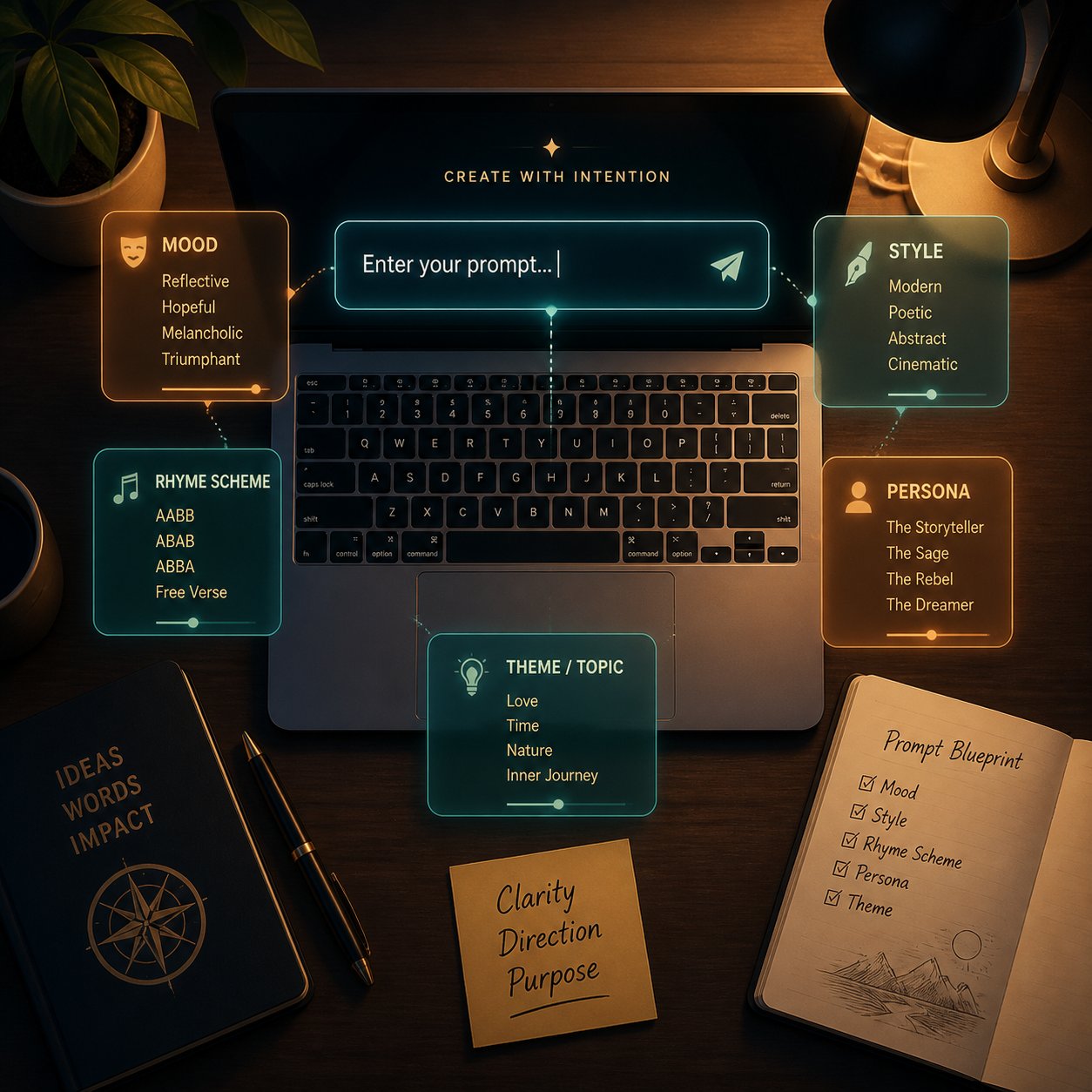
A strong prompt is not a wish. It is a creative brief. Think of yourself as the executive producer handing an artist a direction sheet before a session. The more specific that sheet, the less time everyone wastes. Here are the core components every effective prompt should include:
- Subgenre or style reference — Specifying "boom-bap with dense wordplay" versus "melodic trap with sung hooks" sends the model down completely different vocabulary and structural paths. You can even reference a decade or regional style, like "90s East Coast storytelling" or "UK drill tone."
- Emotional tone — Words like "melancholic," "aggressive," "triumphant," or "introspective" steer the model's word choices and imagery. A prompt requesting "dark and paranoid" will pull very different language than one requesting "celebratory and confident."
- Narrative perspective — First person? Third person telling a story? A letter to a younger self? Defining the point of view gives the output a coherent voice instead of a detached, generic narrator.
- Rhyme scheme preference — Requesting AABB couplets, ABAB alternating patterns, or heavy internal rhymes tells the model exactly how to structure its line endings and mid-bar connections.
- Vocabulary level — Should the language be street-level and raw, poetic and metaphor-heavy, or conversational and accessible? This single detail can transform the entire register of the output.
- Subject matter — Go beyond broad themes. Instead of "write about struggle," try "write about working a night shift at a warehouse while recording demos on your phone during breaks." Concrete scenarios produce concrete bars.
As Jack Righteous documents in his advanced prompting guide, defining both the structure and the emotional tone in a single prompt ensures the AI understands the form and the feeling you are aiming for. His approach of using layered prompts, starting with a broad metaphorical framework and then narrowing into specific verses, consistently produces output with more depth than a one-shot request.
Advanced Prompt Strategies for Experienced Users
Once you have the fundamentals down, you can push the technology significantly harder. These techniques move you from writing adequate prompts to engineering output that genuinely surprises you.
Request specific structural elements. Instead of asking for "a verse," ask for "a 16-bar verse with an AABB rhyme scheme where every couplet uses at least one multisyllabic rhyme." This level of precision forces the model to meet structural criteria that generic prompts completely ignore. You can also request distinct sections within a single generation: a 4-bar setup, an 8-bar escalation, and a 4-bar punchline closer, for example.
Specify a persona or point of view. Telling the AI to write as "a retired boxer reflecting on the cost of fame" or "a first-generation college student returning to their old neighborhood" gives the output a grounded identity. Without a persona, you get a verse that sounds like it was written by nobody in particular, and listeners can always tell.
Iterate rather than regenerate. One of the most overlooked strategies is treating generation as a conversation. Generate a first draft, identify the two or three strongest bars, and then prompt the AI to expand on those specific lines while replacing the weaker ones. Advanced prompting research confirms that refinement through iteration, where you ask the model to revise a chorus for stronger emotional impact or tighten a verse for rhythmic consistency, produces dramatically better results than simply hitting "generate" again and hoping for luck.
Use few-shot examples. Paste two or three bars in the style you want, then ask the AI to continue in that voice. This technique, known as few-shot prompting, anchors the model's output to a specific tonal and structural register. It is one of the fastest ways to reduce the "AI smell" of predictable, generic word choices.
Set profanity and content boundaries. Whether you want raw, explicit content or clean bars suitable for a broader audience, stating this upfront prevents wasted generations. Many users forget this parameter and end up manually scrubbing output or, worse, getting sanitized verses when they wanted edge.
Advanced tools go even further by exposing customization parameters directly in their interfaces. Depending on the platform, you might find controls for:
| Parameter | What It Controls | Impact on Output |
|---|---|---|
| Rap Style | Subgenre direction (trap, boom-bap, drill, etc.) | Shapes vocabulary, cadence, and structural patterns |
| Emotion | Mood keywords (dark, uplifting, aggressive) | Steers imagery, word connotation, and tonal register |
| Rhyme Targets | End rhyme density and multisyllabic preference | Determines rhyme complexity and scheme consistency |
| Structure Bias | Verse length, hook placement, bar count | Aligns output to standard or custom song architecture |
| Tempo | BPM range or rhythmic feel | Adjusts syllable density and pacing of generated lines |
| Persona | Character voice or narrative identity | Gives the output a consistent, recognizable perspective |
Not every tool exposes all of these, but knowing they exist helps you make a rap that feels intentional rather than random. Even with platforms that only accept a text prompt, you can manually include these parameters as instructions. Think of a freestyle word generator or a rap word generator as a starting point for raw material, but treat your prompt as the blueprint that determines whether that material is worth building on.
The bottom line is straightforward: prompt engineering is not a technical nicety. It is the single highest-leverage skill you can develop when you generate a rap with AI. A mediocre tool with a brilliant prompt will outperform a brilliant tool with a mediocre prompt almost every time. And the proof is in the output, which is exactly where the conversation needs to go next: what does strong AI-generated rap actually look like compared to weak output, and how do you tell the difference at a glance?
Good vs. Mediocre AI Rap Lyrics and How to Tell the Difference
You have the prompt engineering skills. You understand bar structure, rhyme schemes, and advanced techniques. But when the AI spits out sixteen bars, can you actually tell whether they are worth keeping? Most users cannot, and that is exactly why so much AI-generated rap sounds the same: people accept the first output without diagnosing what is wrong with it. Developing an ear for quality, even on the page, is the difference between using AI as a crutch and using it as a legitimate creative tool.
What Mediocre AI Rap Lyrics Look Like and Why
Mediocre output has a signature. Once you learn to recognize it, you will spot it instantly. Here are the hallmarks of weak AI-generated bars, the kind of random rap lyrics that flood every default generation:
- Forced rhymes that sacrifice meaning — The AI prioritizes landing a rhyme over saying something coherent. Words get shoehorned into lines purely because they match the ending sound, not because they advance a thought.
- Repetitive vocabulary — The same cluster of "safe" words recycled across bars: grind, shine, hustle, time, mind, fire, desire. These are the statistical darlings of training data, and they show up constantly when the model has no reason to reach further.
- Lack of narrative coherence — Each bar feels disconnected from the one before it. There is no story, no argument, no emotional arc. The verse reads like a list of unrelated statements loosely tied to a theme.
- Generic punchlines — Lines that try to sound clever but land flat because the wordplay is surface-level or the metaphor is a cliché everyone has heard a thousand times.
- Absence of authentic voice — The lyrics could belong to anyone. There is no personality, no perspective, no lived detail that anchors the verse to a real human experience.
Consider these illustrative bars that represent typical weak output:
I'm on the grind every day, getting money and fame / Nobody can stop me now, they don't know my name / I'm living my life, yeah I'm playing the game / Haters gonna hate but I rise through the flame
Read those lines again. Every end rhyme lands on a predictable sound: fame, name, game, flame. The rhyme scheme is technically intact, but the content says absolutely nothing specific. Who is the speaker? What is the story? "Getting money and fame" is a placeholder, not a detail. "Haters gonna hate" is a phrase so overused it reads like a generic emotional placeholder rather than genuine expression. And "rise through the flame" is a dead metaphor that no listener would remember five seconds after hearing it. These are the easy rap lyrics freestyle output that AI produces when your prompt gives it nothing specific to work with.
What Strong AI Rap Lyrics Look Like and Why
Strong output feels different immediately. You can sense a voice behind the words, even when a machine assembled the first draft. The hallmarks of quality AI-generated rap lyrics freestyle include rhyme density without sacrificing meaning, coherent storytelling that builds across bars, effective metaphor usage that surprises the listener, natural-sounding flow you can almost hear in your head, and a distinct tonal voice that does not sound like it belongs to everybody and nobody at once.
Compare the weak example above to bars that demonstrate these qualities:
Clock in at eleven, warehouse cold as a confession / Forklift stacking pallets while I'm stacking up my lessons / Phone in my back pocket, voice memos hold the sessions / Every break's a booth, loading dock my only blessing
Notice the difference. The rhyme scheme is still AABB, but the end rhymes, confession, lessons, sessions, blessing, are multisyllabic and share a richer phonetic connection. More importantly, every single bar advances a specific narrative. You know exactly where this person is, what they are doing, and what they care about. The warehouse is not a vague metaphor for struggle. It is a concrete setting. "Every break's a booth" is a double entendre: the work break becomes a recording booth, and the loading dock becomes a sanctuary. That kind of layered meaning is what separates good freestyle lyrics to use as a foundation from output you should immediately discard.
The key insight from research into what makes a good rap reinforces this: strong lyricism showcases creativity and command of language where every word serves a purpose, while authentic emotion transforms a simple verse into something timeless. AI can approximate these qualities, but only when the prompt provides enough creative direction and the user edits with enough skill to close the remaining gaps.
A Framework for Evaluating AI Rap Lyric Quality
Gut reactions are useful, but a structured framework gives you language for what is actually happening in a verse. Use the following scoring criteria to evaluate any AI-generated output before you decide whether to keep it, edit it, or scrap it entirely. This works whether you are reviewing nice freestyle rap lyrics for a quick social post or polishing bars for a serious recording session.
| Criterion | Low Quality | Medium Quality | High Quality |
|---|---|---|---|
| Rhyme Complexity | Single-syllable end rhymes only. Predictable pairings like "night/right" repeated throughout the verse. | Mix of single and multisyllabic end rhymes. Some internal rhymes present but inconsistent across bars. | Dense multisyllabic rhymes, layered internal rhymes, and slant rhymes woven throughout. Rhyme choices feel intentional, not forced. |
| Flow Consistency | Syllable counts vary wildly between lines. Bars feel choppy or overstuffed when read aloud. No rhythmic pattern emerges. | Most lines share a similar rhythmic weight. Occasional bars break the pattern but not disruptively. | Every bar rides a consistent cadence. Syllable distribution feels deliberate, with intentional variation used for emphasis rather than accident. |
| Thematic Coherence | Each bar introduces an unrelated idea. No narrative thread or emotional arc connects the verse. | A general theme holds the verse together, but individual bars sometimes drift into tangential territory. | Every line advances a single narrative or argument. The verse builds logically from opening setup to closing payoff. |
| Punchline Effectiveness | No memorable lines. Attempted punchlines rely on cliches or obvious wordplay that lands flat. | One or two solid punches land, but filler bars dilute their impact. Wordplay is competent but not surprising. | Multiple bars carry quotable impact. Punchlines use double entendres, unexpected metaphors, or sharp irony that rewards re-listening. |
| Originality | Output reads like a composite of every generic rap verse ever written. Random rap lyrics with no distinct identity. | Some fresh imagery or phrasing appears alongside familiar tropes. Voice is emerging but not fully formed. | The verse has a recognizable perspective and vocabulary that feels specific to a persona. Lines surprise rather than confirm expectations. |
Here is how to use this framework in practice. After generating output, score each criterion on a simple low, medium, or high scale. If three or more categories land at "low," the draft is not worth editing. Regenerate with a more specific prompt. If most categories hit "medium," you have a workable foundation: keep the strongest bars, identify the weakest ones, and rewrite or re-prompt for replacements. If you are seeing "high" across the board, you have good freestyle rap lyrics that just need human polish, personal details, flow adjustments, and delivery mapping.
The framework also reveals patterns in your AI tool's weaknesses. You might notice that your generator consistently scores high on rhyme complexity but low on thematic coherence. That tells you exactly where to focus your editing energy and how to adjust your prompts to compensate. Over time, this diagnostic habit turns you from someone who passively accepts AI output into someone who actively directs it, knowing precisely which bars to keep and which to cut before a single word hits the mic.
Still, even the best-evaluated draft is only raw material. The real transformation happens in the editing process, where you inject personal experience, tighten the flow to match a specific beat, and replace every last trace of generic phrasing with something only you could say.
Top AI Rap Lyric Generators Compared Side by Side
Knowing how to evaluate bars and engineer prompts gives you a massive edge, but that edge only matters if you are feeding your skills into the right tool. The rap lyrics generator landscape is crowded, and most options look identical from a landing page. Some produce lyrics only. Others bundle beats, vocal generation, and cover art into a single workflow. A few are just general-purpose AI chatbots repackaged with a hip-hop skin. So how do you choose without wasting hours testing every option yourself?
Key Features to Compare Across AI Rap Generators
Before jumping into specific platforms, you need a clear set of criteria. Not every rap generator serves the same purpose, and picking the wrong type wastes both time and creative momentum. Here are the dimensions that actually matter when comparing an ai rap generator to its competitors:
- Customization depth — Can you specify rhyme scheme, subgenre, emotional tone, persona, and structure? Or does the tool offer a single text box and a "generate" button with no fine-tuning?
- Subgenre support — Does it handle trap, boom-bap, drill, melodic rap, and conscious hip-hop as distinct styles, or does everything come out sounding like the same generic blend?
- Free vs. paid access — Can you test the tool meaningfully without a subscription, or does the free tier limit you to a handful of unusable previews?
- Output type — This is the biggest differentiator. A lyrics-only rap lyric generator gives you text to work with in your own production workflow. An all-in-one platform generates lyrics, beats, vocal delivery, and sometimes even cover art in a single pipeline. Each approach has trade-offs worth understanding.
- Output quality indicators — Does the tool produce bars with rhyme density, coherent narrative, and natural flow? Or does it lean on the cliché patterns you learned to spot in the previous chapter?
With these criteria in hand, you can cut through marketing language and compare what each platform actually delivers.
AI Rap Generator Comparison Table
The following table maps the major tools available for creators who want to ai generate rap lyrics. Each platform is evaluated on the criteria outlined above, so you can identify which rap song lyrics generator fits your specific workflow and creative goals.
| Tool Name | Key Strengths | Subgenre Support | Free Access | Output Type |
|---|---|---|---|---|
| MakeBestMusic AI Rap Generator | All-in-one platform for rap lyrics, flows, hooks, and beats. Strong customization for style, emotion, and structure. Built specifically for hip-hop creators. | Multiple rap subgenres including trap, drill, boom-bap, and melodic | Yes | Full production (lyrics + beats + flows) |
| Freshbots | Dedicated rap lyric generator with theme and mood inputs. Simple interface for quick verse generation. | General rap styles with some mood variation | Yes | Lyrics only |
| Canva Magic Write | Integrated into Canva's design ecosystem. Useful for social content creators who need lyrics alongside visuals. | Limited — general-purpose AI, not rap-specific | Yes (limited generations) | Lyrics only (text generation) |
| freebeat.ai | Beat generation with lyric integration. Focused on producers who want instrumentals paired with vocal ideas. | Beat-driven subgenre selection | Yes (limited) | Beats + lyrics |
| OpenMusic.ai | Broad AI music generation covering multiple genres. Lyrics are part of a larger song creation pipeline. | Cross-genre with hip-hop options | Yes (limited) | Full production |
| MusicWave.ai | Song generation platform with lyric input support. Handles melody and vocal rendering alongside text. | Multiple genres including hip-hop | Yes (limited) | Full production |
| Manus | AI assistant approach to lyric writing. Offers conversational iteration similar to prompting a general LLM. | Prompt-dependent — adapts to user direction | Varies | Lyrics only |
A few things stand out immediately. General-purpose tools like Canva Magic Write can technically produce rap text, but they lack the genre-specific training and customization parameters that dedicated platforms offer. Meanwhile, as Violet Recording notes, conversational AI assistants remain the most flexible option for writers who want line-by-line control, but they require more prompting skill and produce no audio output. The sweet spot for most creators falls somewhere between a pure online rap lyrics maker that only outputs text and a full-production platform that handles the entire creative chain.
Which Type of AI Rap Tool Fits Your Needs
The choice between a lyrics-only tool and an all-in-one rap song generator comes down to where you are in your creative process and what you plan to do with the output.
Lyrics-only generators work best if you already have beats, a home studio setup, or a production partner. You get raw text, you edit it using the evaluation framework and prompt strategies covered earlier, and you record it on your own terms. The advantage is total control over every element. The downside is that you handle production separately, which adds steps and requires additional skills or tools.
All-in-one platforms collapse the entire workflow into a single environment. You describe what you want, and the tool delivers lyrics, an instrumental, and sometimes a vocal performance in one pass. MakeBestMusic's AI Rap Generator is a strong example of this approach, especially for creators who want to generate rap lyrics, flows, hooks, and beats without juggling multiple platforms. The trade-off is that bundled workflows sometimes offer less granular control over individual elements compared to using specialized tools for each stage.
There is also a hybrid path worth considering. You can use an online rap lyrics generator to draft and refine your text, then feed those polished lyrics into a beat-generation tool or record them over your own production. Plenty of creators mix and match: drafting concepts in one platform, running a dedicated rhyme tool over tricky bars, and then dropping the finished words into a production environment. As one guide puts it, there is no rule that says you have to pick just one tool.
The right choice depends on your goals. If you are an aspiring rapper building a portfolio, an all-in-one platform gets you from idea to finished demo fastest. If you are a seasoned lyricist who already has beats and studio access, a focused rap lyric generator that gives you maximum text control is the sharper tool. Either way, the quality of your output still depends far more on your prompting skill and editing ability than on which platform you choose.
That editing ability is exactly where the next critical skill gap lives. Even the best tool, paired with the best prompt, produces a first draft, not a finished verse. The real transformation happens when you take that raw output and reshape it into something that sounds like you.
How to Refine AI-Generated Rap Lyrics Into Authentic Bars
A strong prompt and the right tool got you a solid first draft. That is all it is, though: a draft. Raw AI output is the musical equivalent of a rough sketch on a napkin. The bones might be there, the rhyme scheme might hold up, and a couple of bars might genuinely surprise you. But if you record it as-is, listeners will hear the difference. The lyrics to rap convincingly over a beat need a human fingerprint, something no model can fabricate on its own.
Why Raw AI Output Is a Starting Point Not a Finished Product
Think about how any experienced rap writer works. They draft, they cross out, they rewrite, they mumble lines over a beat until the syllables lock in. They swap a word because it "feels" wrong even though it rhymes perfectly. They inject a memory from last Tuesday that no algorithm could have predicted. That messy, personal revision process is where authenticity lives.
AI skips all of that. It produces text that is statistically plausible but experientially hollow. The rhymes land, the structure looks correct, and the vocabulary fits the subgenre you requested. What is missing is you: your stories, your cadence, your word choices that come from the way you actually talk. As the Humanizing AI Lyrics guide from Jack Righteous puts it, your creativity is the missing piece that transforms AI-generated lyrics from robotic patterns into authentic, compelling songs. The technology handles the scaffolding. You supply the soul.
Adopting an "AI as collaborator" mindset changes everything about how you interact with generated output. You stop treating the result as a finished product and start treating it as raw material, a brainstorming partner that gave you twenty ideas so you can pick the three that actually hit. That shift in perspective is the single biggest unlock for anyone learning how to write a rap song with AI assistance.
Step-by-Step Process for Refining AI Rap Lyrics
Editing AI-generated bars does not have to be chaotic. A structured process keeps you from either accepting everything passively or scrapping everything reflexively. Follow these steps in order, and you will consistently turn workable drafts into verses worth recording:
- Read every line aloud for flow and cadence. This is non-negotiable. Words that look fine on screen often stumble when spoken at tempo. If you trip over a phrase, the audience will too. Read it as if you are performing, not reading a document. You will immediately hear which bars feel natural and which ones fight your mouth.
- Replace generic words with your personal vocabulary. AI defaults to the most statistically common words in its training data. Swap "streets" for the actual name of the block you grew up on. Replace "hustle" with a specific detail about what you actually do. These micro-substitutions are what transform words to rap authentically into words that sound like they came from a real person with a real life.
- Strengthen weak rhymes with multisyllabic alternatives. If you spot a lazy single-syllable end rhyme, push it harder. Trade "night/fight" for "sleepless nights/reckless heights." The rhyme still lands, but it carries twice the phonetic weight and sounds far more intentional.
- Inject personal stories and authentic experiences. This is where the biggest quality leap happens. Find bars that make generic claims, like "I came from nothing," and replace them with a specific moment. "Momma worked doubles so the lights stayed on" says the same thing with ten times the emotional impact. As Soundverse's lyric creation guide emphasizes, replacing generic references with specific details that reflect authentic experiences is what grounds lyrics in real hip-hop culture.
- Adjust syllable counts to match your intended beat tempo. A 140 BPM drill beat demands shorter, punchier bars than a 90 BPM boom-bap groove. Count the syllables in each line, then add or trim words until the density matches the rhythmic space your beat provides. If you are not sure how many syllables fit, record yourself counting "1, 2, 3, 4" over the beat and use that as your baseline bar length.
- Cut filler bars that add nothing. Every verse has dead weight. Lines that repeat what a previous bar already said, bars that exist only to bridge two better lines, or throwaway phrases like "you already know" that eat space without delivering meaning. Cut ruthlessly. A tight 12-bar verse hits harder than a padded 16 where four bars are coasting.
This process is how you turn a rap lyrics maker output into something a listener would actually believe came from a human pen. The key is treating each step as a separate editing pass rather than trying to fix everything at once. First pass: flow check. Second pass: vocabulary swap. Third pass: rhyme upgrade. Each pass sharpens the verse without overwhelming you.
Making AI Lyrics Performance-Ready
Editing the text is only half the equation. Rap is a performance art. The same words delivered with different flow, cadence, and emphasis can sound like two completely different songs. This is the territory where AI genuinely cannot help you, and where your artistry takes over entirely.
Map your lyrics to the beat. Knowing how to make a rap song that actually sounds polished means understanding where each syllable sits relative to the kick, snare, and hi-hat. Print or display your lyrics, then play the beat and physically mark where each bar starts. Some words need to land directly on the downbeat for impact. Others work better slightly ahead of or behind the beat, creating the push-and-pull tension that makes a verse feel alive.
Adjust emphasis patterns. Not every word in a bar carries equal weight. Decide which words you want the listener to catch, and lean into them. A punchline word should hit harder than the setup around it. A key rhyme deserves a slight pause before it lands so the ear has time to anticipate the payoff. As QuickRapReview's flow analysis research explains, flow patterns like straight flow, triplet cadence, legato delivery, and staccato phrasing each create distinct rhythmic feels, and choosing the right one for a given bar is a decision only the performer can make.
Rehearse delivery until it feels unconscious. The first few read-throughs will sound stiff because you are still processing the words cognitively rather than feeling them rhythmically. Record yourself, play it back, and compare your delivery to how you hear the verse in your head. The gap between those two versions is where your practice needs to focus. Every rap lyric maker on the planet can hand you words, but only repetition and performance instinct can make those words hit the way they are supposed to.
The reality is that refining and performing AI-generated lyrics is itself a creative act. You are not just polishing someone else's work. You are translating raw material into something shaped by your voice, your timing, and your lived experience. That translation process is what keeps the human at the center of the craft, regardless of where the first draft originated.
Of course, the refinement strategies that work for one style of rap may fall completely flat for another. A boom-bap verse built on dense internal rhymes demands a different editing lens than a melodic trap hook designed around emotional vulnerability, which is precisely why understanding subgenre conventions matters as much as understanding editing technique.
How AI Handles Different Rap Subgenres From Trap to Boom-Bap
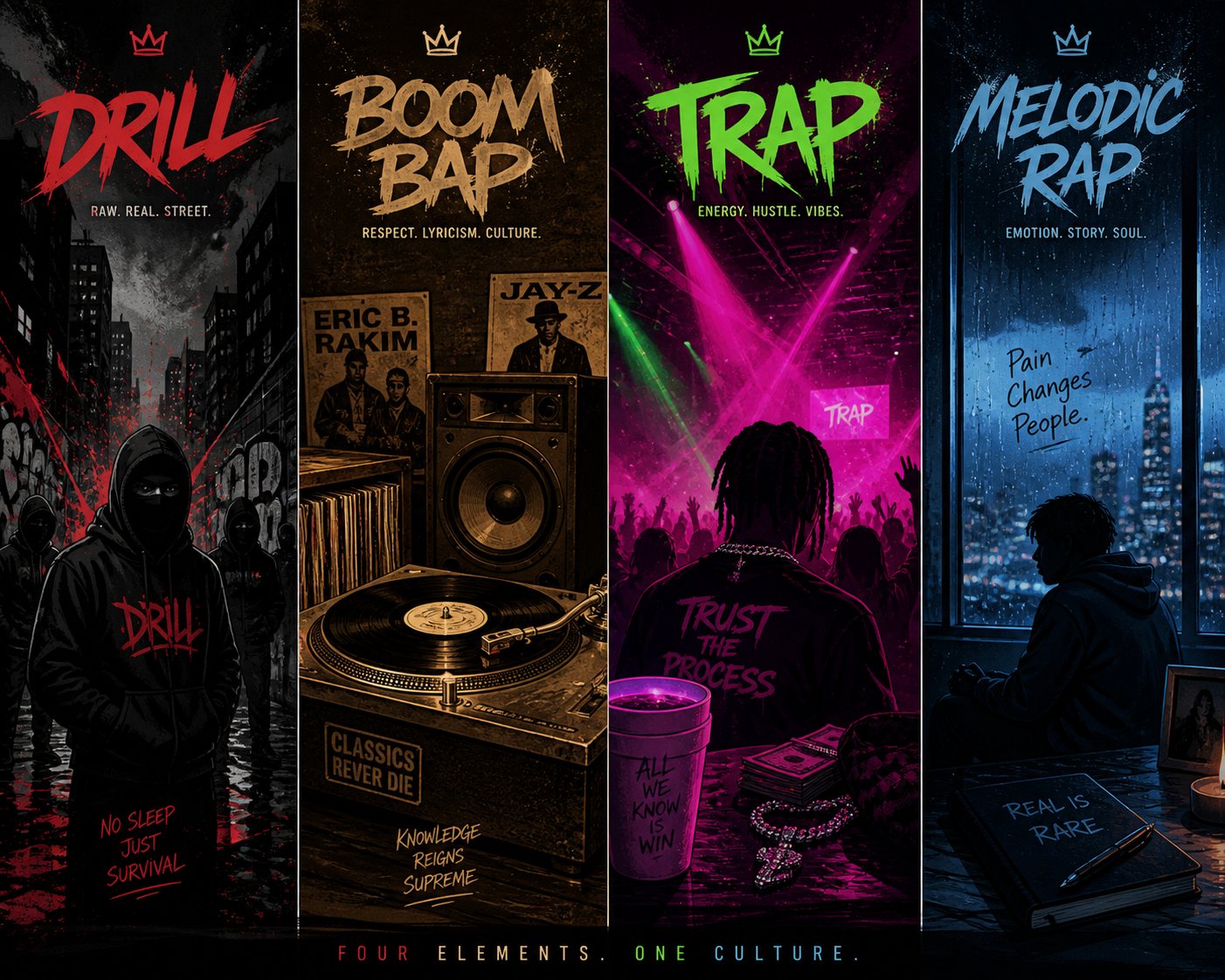
A boom-bap verse packed with dense internal rhymes and storytelling precision lives in a completely different universe than a drill verse built on aggressive delivery and regional slang. Yet most AI tools treat "rap" as a single category. They blend conventions from every subgenre into one mushy middle ground, producing output that sounds vaguely like hip-hop but nails nothing in particular. If you want your generated lyrics to actually fit the lane you are working in, you need to understand what makes each subgenre distinct at the lyrical level, and where AI consistently falls short.
Subgenre Lyrical Conventions From Boom-Bap to Drill
Every rap subgenre carries its own DNA: a specific vocabulary palette, a preferred rhyme architecture, a tonal register, and a set of thematic expectations the audience brings before a single bar drops. When you ask an AI to generate gangster rap lyrics, the tool needs to understand not just the theme but the entire sonic and lyrical ecosystem around it. According to Orphiq's subgenre breakdown, the differences between subgenres are as significant as the differences between rock and jazz, touching everything from BPM range to vocal delivery style.
Here is how the major subgenres stack up on the lyrical dimensions that matter most:
| Subgenre | Key Lyrical Traits | Typical Rhyme Patterns | Vocabulary Style |
|---|---|---|---|
| Trap | Ad-libs between bars, repetitive hooks designed for replay, braggadocio and flexing, short punchy phrases, triplet cadence | AABB couplets, heavy repetition in hooks, minimal internal rhyme | Street slang, brand names, drug references, Atlanta-rooted terminology |
| Boom-Bap | Dense wordplay, multi-bar storytelling, lyrical complexity prioritized over melody, breath control showcases | ABAB and free-form with layered internal rhymes and multisyllabic chains | Literary, metaphor-heavy, East Coast vernacular, elevated vocabulary |
| Drill | Aggressive tone, street narratives, direct threats and confrontational energy, region-specific slang | AABB with sliding cadence, staccato delivery, syncopated phrasing | Chicago, UK, or Brooklyn slang depending on regional variant, raw and unfiltered |
| Melodic Rap | Sung hooks as focal points, emotional vulnerability, melody over bar density, auto-tuned vocal textures | Loose rhyme schemes (ABCB), chorus-driven structure, flowing legato lines | Emotional, introspective, relationship-focused, accessible language |
| Conscious Rap | Social commentary, complex extended metaphors, political critique, personal reflection, narrative arcs | Free-form and ABAB with dense internal rhymes, scheme shifts within a single verse | Intellectual, culturally aware, historical references, poetic register |
| Battle Rap | Punchlines engineered for crowd reaction, personal disses, comedic timing, rapid-fire delivery, audience engagement | AABB couplets with punchline payoffs every two bars, setup-punch structure | Confrontational, humor-driven, opponent-specific, improvisational tone |
Notice how different the expectations are across these lanes. Lyrics for rap battles demand a completely different skill set than a melodic rap hook. A gangsta rap song built on street narratives needs authentic regional vocabulary and a gritty tonal register that would feel completely wrong in a conscious rap verse exploring systemic inequality. When you generate rap lyrics without specifying these distinctions, the AI has no way to know which set of conventions to follow, so it follows all of them at once, and the result sounds like none of them.
Where AI Excels and Struggles With Subgenre Nuance
Here is where honesty matters more than hype. AI tools handle some subgenre elements reasonably well and others poorly. Understanding the pattern helps you set realistic expectations and focus your editing energy where it counts.
Where AI tends to perform adequately:
- Trap hooks and repetitive structures — Because trap relies heavily on catchy, repeated phrases and simpler rhyme schemes, AI's tendency toward statistical averages actually works in its favor. Repetition is a feature, not a flaw, in this subgenre.
- Melodic rap's emotional register — Emotional vocabulary clusters, like heartbreak, loneliness, and longing, are well-represented in training data. AI can produce serviceable melodic bars when prompted with the right mood keywords.
- Basic boom-bap structure — The model understands 16-bar verse architecture and can produce lines with reasonable internal rhyme density, especially when explicitly instructed.
Where AI consistently struggles:
- Regional slang and cultural specificity — A dark trap lyrics maker might deliver the mood, but it rarely nails the precise slang of Chicago drill versus Brooklyn drill versus UK drill. These regional voices are deeply tied to lived geography, and AI flattens them into a generic approximation. As Orphiq notes, each drill variant carries its own stamp: Chicago is dark and sparse, UK runs faster with a distinctive bounce, and Brooklyn fuses UK production style with New York vocal swagger. AI rarely captures these distinctions without heavy prompting.
- Battle rap and punchline writing — A diss track lyrics generator faces a fundamental problem: great punchlines require cultural awareness, real-time audience reading, and personal specificity that AI simply cannot manufacture. The setup-punch structure demands surprise, and statistical prediction is the opposite of surprise. You can get a competent structure, but the actual punches almost always land soft.
- Conscious rap's intellectual depth — Extended metaphors that sustain across an entire verse, the kind Kendrick Lamar builds where a single conceit carries sixteen bars, require a level of thematic planning that most generation models do not perform well. The AI will shift metaphors mid-verse, breaking the coherence that defines this subgenre's best work.
- Authentic voice and persona — Every subgenre relies on the listener believing the speaker. Gangsta rap song lyrics feel hollow without the weight of real experience behind them, and AI output reads as observational rather than lived. This is the single hardest gap for any tool to close, regardless of subgenre.
The core issue is that most AI rap generators are trained on broad, cross-genre datasets. They learn the average of hip-hop rather than the specifics of any one lane. The result is output that blends trap ad-libs with boom-bap vocabulary and melodic rap phrasing into something that technically qualifies as rap but fails to convince anyone familiar with a specific subgenre. As NPR's reporting on generative AI in music highlights, AI models taxonomize existing material and replicate its patterns, but the cultural context, regional identity, and authentic voice behind the music remain beyond the technology's current reach.
Tips for Getting Subgenre-Specific Results From AI
The limitations are real, but they are not roadblocks. They are editing assignments. If you know where the AI will fall short for your chosen subgenre, you can compensate with smarter prompts and targeted manual revision. Here is how:
- Name the subgenre explicitly and add era or region markers. Do not just type "drill." Specify "UK drill, 2023 Central Cee style, aggressive but melodic undertone, 142 BPM feel." The more reference points you stack, the narrower the model's prediction space becomes. As Meloty's prompt library demonstrates, specifying the region and the era rather than just saying "hip-hop" is what separates a usable draft from a generic mess.
- Reference specific lyrical techniques tied to the subgenre. For boom-bap, ask for "dense internal rhymes, storytelling across all sixteen bars, and at least two extended metaphors." For trap, request "short punchy bars, ad-lib placement markers, and a repetitive four-bar hook." For rap lyrics battle contexts, specify "setup-punch couplet structure with a crowd-reaction punchline every two bars."
- Supply vocabulary anchors. Paste five to ten words or phrases that belong to your target subgenre and instruct the AI to prioritize them. If you are going for a gangsta rap song lyrics feel, feeding in specific slang and regional references gives the model concrete vocabulary to build around rather than defaulting to its generic word pool.
- Edit for subgenre alignment, not just general quality. After generating, evaluate the output against the subgenre table above. Does a drill verse actually carry aggressive tone and staccato delivery patterns? Does a conscious rap verse sustain its central metaphor? Score the output on subgenre fidelity as a separate criterion from rhyme complexity or flow consistency. If the bars are technically clean but sound like they belong to the wrong lane, the problem is not quality. It is alignment.
- Layer human slang and cultural references manually. This is the step most people skip, and it is the most important one. AI will never know that your city pronounces a word differently, that a particular phrase carries weight in your neighborhood, or that a certain reference lands harder with your audience. Those details are your job. The AI builds the frame. You paint the culture onto it.
The bottom line is that subgenre specificity is not a luxury. It is a requirement. A verse that sounds generically "rap" will not resonate with listeners who have strong subgenre preferences, and in hip-hop, almost every listener does. The tools are getting better at handling these distinctions, but the gap between AI approximation and authentic subgenre execution is still wide enough that your editing and cultural knowledge remain the decisive factors.
That gap raises a bigger question, one the hip-hop community has been debating since AI-generated music first surfaced: if the technology cannot fully replicate the lived experience and cultural specificity that defines great rap, what role should it actually play in the creative process, and where do the ethical boundaries fall?
Ethics and Authenticity in AI Rap Plus Your Creative Next Steps
Hip-hop was born from lived experience. Block parties in the Bronx, four-track recordings in basement studios, cyphers on street corners where the sharpest bars earned respect that no algorithm could calculate. So when an ai rapper enters the conversation, the reaction from the culture is not just curiosity. It is suspicion, and often for good reason. The question is not whether AI can generate rap lyrics. You have seen throughout this article that it clearly can. The real question is whether it should, and if so, under what terms.
The Ethics and Authenticity Question in AI Rap
The most common criticism is straightforward: rap is personal, and AI is not a person. When an artist like Kendrick Lamar spends sixteen bars unpacking generational trauma, those words carry weight because they come from somewhere real. When an AI produces a verse about struggle, it is drawing on statistical patterns from training data, not on memories of watching a parent work three jobs. The output might be structurally competent, but it lacks the experiential gravity that gives great rap its emotional force.
That distinction matters more in hip-hop than in almost any other genre. As Dr. Enongo Lumumba-Kasongo (Sammus), a rapper and scholar at Brown University, explained in her research on AI and hip-hop, the richness and complexity of how ideas are expressed through each individual artist is completely cut from the picture when AI generates verses. The technology can identify that an artist cares about "not fitting the mold," but it cannot approach the sonic, emotional, and cultural depth of how that idea manifests in a real human's voice.
Then there is the question of credit and consent. Most large language models were trained on enormous datasets that include song lyrics, and the artists who wrote those lyrics were rarely asked for permission or offered compensation. When you use a rap maker powered by these models, the output you receive is built on the unacknowledged creative labor of thousands of songwriters. Dr. James Frankel highlighted this tension when an AI-generated country song reached the top of a Billboard chart: the "success" was built on voices, lyrics, and musical styles of real artists fed into the algorithm without credit or payment. The same dynamic applies to hip-hop, arguably with even higher cultural stakes given the genre's deep roots in Black creative expression and its long history of appropriation by outside forces.
Cultural appropriation adds another layer. Sammus's research draws a direct line between AI voice cloning in hip-hop and the legacy of digital blackface, where non-Black creators use AI tools to adopt Black vocal styles and vernacular without any connection to the communities that created them. When algorithms decide what "sounds like rap," they risk flattening an entire culture into predictable sonic templates stripped of the regional identity, lived struggle, and communal history that gave the art form its meaning in the first place.
AI does not replace the rapper. It amplifies whatever creative vision the human brings to the table. The tool has no stories, no scars, no neighborhood. You do. That is what makes the difference between generated text and genuine art.
None of this means AI has no place in hip-hop. It means that place needs to be defined honestly, with transparency about what the technology is, what it draws from, and who ultimately shapes the final product.
The AI Collaborator Mindset for Rappers and Creators
The most productive way to think about AI in rap is not as a replacement for human creativity but as a brainstorming partner that never runs out of ideas. Writer's block hits everyone, from first-time lyricists to veterans with decades of material. An ai rap maker can break that block in seconds, throwing out twenty verse concepts so you can identify the one angle you would never have found staring at a blank page.
Think about how producers use drum machines. Nobody argues that a drum machine "replaced" live drummers. It became a different tool with different strengths, and entire subgenres were built on its capabilities. AI lyric generation occupies a similar space. It is a rapid prototyping engine for ideas. You feed it a direction, it returns raw material, and you sculpt that material with the lived experience, cultural knowledge, and performance instinct that only a human rap creator possesses.
The collaborator mindset also resolves the authenticity tension. If you treat AI output as a finished product, you are presenting machine-generated text as your own voice, which is where the ethical ground gets shaky. If you treat it as a starting point that you rewrite, personalize, and perform with your own delivery and story, the final product is genuinely yours. The AI contributed a scaffold. You built the house. Even ChatGPT itself, when asked to write in the style of a specific rapper, has responded with advice to study the artist's music, practice freestyling, and develop your own skills, essentially acknowledging, as Sammus documented, that the complexity of the form demands human investment that no generator can shortcut.
This is not a hypothetical philosophy. It is the practical approach that every chapter of this article has been building toward. Learn the fundamentals so you can evaluate output. Engineer prompts so the AI gives you better raw material. Edit ruthlessly so the final product carries your fingerprint. Perform with intention so the words come alive. At every stage, the human is the artist. The AI is the instrument.
Your Next Steps to Start Creating AI-Powered Rap Lyrics
You have the knowledge. You understand bar structure, rhyme schemes, prompt engineering, quality evaluation, subgenre conventions, and the editing process that turns a draft into a finished verse. The only thing left is to start. Here is a concrete action plan to create a rap song using everything you have learned:
- Internalize the fundamentals. Before you generate a single bar, make sure you can identify rhyme schemes, count bars, and distinguish multisyllabic rhymes from lazy single-syllable matches. These skills are your quality filter. Without them, you cannot tell good output from bad.
- Choose a tool that fits your workflow. If you want lyrics, beats, flows, and hooks in one place, MakeBestMusic's AI Rap Generator is a strong starting point that handles the full creative chain for hip-hop creators. If you prefer maximum control over each element separately, pair a dedicated lyric generator with your own production setup. Either path works. Pick the one that matches how you already create.
- Craft specific, layered prompts. Specify your subgenre, emotional tone, rhyme scheme, narrative perspective, and vocabulary level. The more precise your creative brief, the less editing you will need on the back end. Use the prompt anatomy and advanced strategies covered earlier as your template.
- Generate multiple drafts before committing. Never settle for the first output. Run three to five generations with slightly different prompts, then cherry-pick the strongest bars from each. Treat it like a writing session where the AI is a co-writer pitching ideas, and you are the creative director deciding what makes the cut.
- Refine and personalize ruthlessly. Read every line aloud. Replace generic vocabulary with your own words. Inject real stories. Strengthen weak rhymes. Cut filler. Use the evaluation framework to score your draft and identify exactly where it needs work. This step is where you make a rap song ai helped draft into something only you could have written.
- Map lyrics to a beat and perform. Print your final bars, play your beat, and physically mark where each syllable lands. Rehearse until the delivery feels unconscious. Record, play it back, and refine your flow. This is where the words become music, and no rap song maker on the planet can do this part for you.
The creators who get the most out of AI are not the ones who click "generate" and post the result. They are the ones who understand the craft deeply enough to use AI as a force multiplier for skills they already possess or are actively building. The technology handles speed, volume, and structural consistency. You handle authenticity, cultural awareness, and the irreplaceable specificity of your own voice.
Hip-hop has always absorbed new tools without losing its soul. Samplers, drum machines, auto-tune, digital audio workstations, each one sparked the same debate about whether technology would dilute the art form, and each time the culture adapted, incorporating the tool while preserving the human core that makes rap matter. AI is the next chapter in that evolution. Whether it elevates or diminishes the craft depends entirely on how you choose to use it. So use it wisely, use it honestly, and never forget that the best bar you will ever write is the one that comes from something you actually lived.
