


What Is an AI Song Title Generator and Who Needs One
Imagine you have a finished beat, a melody humming in your head, maybe even a full set of lyrics — but no name. You stare at the screen, cycling through vague ideas that never quite click. This is exactly the creative bottleneck an AI song title generator is designed to break.
At its core, this type of tool takes your input — keywords, a mood, a genre, a thematic direction — and feeds it through a large language model trained on enormous datasets of text, including song titles, poetry, literature, and creative writing. The model identifies patterns in how words combine to evoke specific emotions and genres, then generates multiple original title candidates that match your constraints. Unlike a basic song name generator that simply shuffles pre-written word lists, a genuinely AI-powered tool understands context. It grasps why "Velvet Collapse" feels like an indie ballad while "Neon Stampede" leans toward electronic energy.
Defining the AI Song Title Generator
The distinction between a sophisticated song title generator and a simple randomizer matters more than most people realize. A quality AI-driven tool lets you layer inputs — specifying, for example, that you want something melancholic, rooted in folk, centered on the theme of distance. The result is a focused batch of usable candidates rather than nonsensical word pairings. Think of it this way: the more specific and vivid your input, the sharper the output. Vague prompts produce vague titles. Detailed prompts produce titles you can actually picture on a streaming platform.
This mirrors what Berklee Online instructor Ben Camp teaches about crafting effective AI prompts for songwriting — the quality of what you ask directly shapes the quality of what you get back. A song titles generator powered by real AI responds to nuance; a random name picker does not.
Who Uses These Tools and Why
The audience for these tools is broader than you might expect. Bedroom producers wrestling with creative block use them to jumpstart a session. Professional songwriters rely on them to brainstorm dozens of directions in minutes rather than hours — a real advantage when, as Camp notes, a typical co-writing session in LA runs about four hours, and a song that does not get nailed in that window often gets shelved permanently. Bands use them when naming album tracks, testing how different titles sit alongside one another in a tracklist. Content creators lean on a reliable song name maker to find catchy, attention-grabbing names for music destined for social media platforms where scroll speed is ruthless.
A great song title is the first marketing decision you make — it shapes listener expectations before a single note plays.
Whether you are a solo artist producing tracks in your apartment or a seasoned writer in a professional studio, the underlying challenge is identical: a song without a compelling name is a song that struggles to get noticed. Throughout this article, you will learn not only how to use these tools effectively, but also the craft principles behind memorable titles, genre-specific naming conventions, and a complete workflow for turning raw AI suggestions into polished, professional names that serve your music and your brand.
The real question is not whether AI can generate a title — it is whether the title it generates actually deserves to represent your song. And that depends on understanding what makes any song title work in the first place.
Why Your Song Title Matters More Than You Think
A song title might look like a small detail — a few words sitting above a waveform in your DAW. But those few words carry outsized weight. They influence whether a listener clicks play, how streaming algorithms categorize your track, and what emotional expectations a potential fan brings to your music before a single chord rings out. When you start exploring song title ideas seriously, you quickly realize that naming a track is not an afterthought. It is a strategic decision that touches discoverability, branding, and emotional connection all at once.
Song Titles as a Discoverability Tool on Streaming Platforms
Think about how you find new music. You might type a mood into Spotify's search bar — something like "sad rain songs" or "upbeat summer drive." Spotify's algorithm uses content-based filtering, collaborative filters, and natural language processing to categorize and serve content, and your track title is one of the first metadata signals it reads. A well-chosen title containing evocative, searchable language can surface your song for queries it would otherwise never reach.
This matters especially for independent artists competing against a catalog of over 100 million tracks. Vague or overly abstract names — a single untranslated word, a string of numbers — might feel artistically bold, but they create a discoverability wall. Listeners searching by theme, mood, or phrase simply will not find you. Titles with clear emotional or thematic language outperform obscure ones in search-driven discovery. That does not mean you need to sacrifice creativity for SEO, but it does mean your song name ideas should account for how real people actually search for music.
The discovery equation extends beyond Spotify's internal search, too. Google indexes Spotify content, and ChatGPT now integrates directly with the platform. A title optimized for one discovery channel often performs across all three — in-platform search, traditional web results, and AI-powered recommendations.
Titles as Branding and First Impressions
Your title is micro-marketing. It appears in playlist thumbnails, search results, social media shares, radio callouts, and Shazam identifications. Every one of those touchpoints is a moment where a potential listener decides whether your track is worth their time.
Consider the difference between a title like "Midnight Rodeo" and "Algorithm of Love." Without hearing a note, you already have genre expectations, tonal assumptions, and emotional associations for each. The first suggests country swagger or Americana grit. The second hints at synth-pop or experimental electronic. Good song names do this kind of heavy lifting effortlessly — they signal genre, set mood, and spark curiosity in two or three words.
Consistency in titling style can even become part of an artist's brand identity over time. When your song title suggestions share a recognizable aesthetic — whether that is poetic naturalism, blunt emotional honesty, or playful absurdity — listeners begin to associate that naming voice with you. Cool song names are not just about individual cleverness; they are about building a cohesive artistic signature across your catalog.
Copyright and Originality Considerations
Here is a question that comes up constantly when brainstorming song name suggestions: can someone else already own the title you want? The short answer is no — a song title is not a copyrightable work under U.S. law. There is simply not enough unique and original content in a title to grant it an independent copyright, which means you are legally free to reuse a title that already exists.
However, legal freedom and strategic wisdom are different things. Some titles have become so closely associated with specific songs or artists that reusing them can trigger claims of unfair competition. The Red Hot Chili Peppers, for example, sued a television producer over the use of "Californication" as a TV series title — a case that was settled out of court under unfair competition law, not copyright. Artists can also trademark iconic titles; David Bowie registered a trademark for "Ziggy Stardust."
Beyond legal risk, there is a practical problem: naming your indie folk track the same thing as a global hit means you are competing directly with that song in every search result, every playlist algorithm, and every AI recommendation. Your track gets buried under a mountain of existing engagement data.
Your title competes for attention in a library of over 100 million tracks — distinctiveness is not optional.
The takeaway is straightforward. You do not need to worry about copyright when picking a title, but you absolutely need to worry about standing out. A distinctive title is not just a creative preference — it is a discoverability requirement. And understanding how different genres approach that distinctiveness reveals patterns that can sharpen your own naming instincts dramatically.
How AI Song Title Generators Actually Work
Knowing why a title matters is one thing. Understanding how a machine produces one is another — and it is simpler than you might expect. You do not need a computer science degree to grasp what happens between typing a few keywords and receiving a list of polished title candidates. The technology powering a modern song name generator AI relies on the same breakthrough architecture behind tools like ChatGPT and Google Gemini: the transformer model.
The transformer architecture, introduced by Google researchers in 2017, fundamentally changed how machines process language. Instead of reading words one at a time in sequence, transformers analyze an entire block of text simultaneously — every word in relation to every other word. This parallel processing allows the model to grasp context, tone, and thematic connections at a level that previous AI approaches could not match. When applied to creative tasks like generating song titles, this contextual awareness is what separates a genuinely useful tool from a digital coin flip.
From Prompt to Title — The Generation Process
Imagine you sit down with a random song title generator and enter three pieces of information: a mood like "melancholic," a genre like "indie folk," and a theme like "lost love." Here is what happens behind the curtain in a matter of milliseconds:
- Your input is broken into tokens. The model splits your words into smaller computational units — fragments it can process mathematically. "Melancholic" might become two tokens; "indie folk" might become three.
- Tokens become numerical vectors. Each token is converted into a high-dimensional list of numbers called an embedding vector. These vectors encode meaning based on patterns the model learned during training. Words used in similar contexts — "melancholic" and "wistful," for instance — end up with numerically similar vectors.
- The transformer layers compute relationships. This is where the real magic lives. Through a mechanism called self-attention, the model asks: which parts of your input matter most to each other? It recognizes that "melancholic" combined with "lost love" should pull the output toward a very different emotional register than "energetic" combined with "road trip." Multiple transformer layers — sometimes dozens stacked together — progressively refine this understanding.
- The model predicts the next word, then the next, then the next. Using the contextual picture it has built, the model assigns a probability score to every word in its vocabulary and selects the most fitting continuation. It repeats this process token by token until a complete title emerges.
- Multiple candidates are generated. The tool runs this process several times — often with slight variations in probability sampling — to produce a batch of distinct options rather than a single answer.
The result? You might receive titles like "Paper Lantern Goodbye," "Rivers We Never Crossed," or "Frost on the Doorframe" — each one shaped by the specific intersection of mood, genre, and theme you provided. Input specificity directly correlates with output quality. Telling the tool "sad song" gives it almost nothing to work with. Telling it "bittersweet indie folk about watching someone leave a small town in winter" gives it a rich creative space to explore.
This is also why the same tool can function as a word generator for song titles across wildly different genres. The underlying model has learned patterns from poetry, literature, journalism, and millions of existing song titles. It draws on all of that training data simultaneously, filtering through the lens of whatever constraints you supply.
AI Generation vs Random Word Shuffling
Not every tool that claims to generate titles actually uses this technology. Many simpler generators — the kind you find as free browser widgets — work by shuffling pre-written word lists. They pull a random adjective from column A, a random noun from column B, and glue them together. The outputs might occasionally land on something usable, but the process has no understanding of context, genre, or emotional coherence. You are essentially rolling dice with words.
The difference becomes obvious when you compare results. A list-based tool asked for a melancholic folk title might spit out random song names like "Purple Horizon" or "Dancing Thunder" — combinations that sound vaguely creative but have no meaningful connection to your input. A transformer-powered random song name generator, by contrast, produces titles that feel intentionally crafted because the model genuinely understands how words relate to each other within a specific emotional and stylistic context.
Here is a side-by-side comparison to help you evaluate the tools you encounter:
| Dimension | AI-Powered Generator (Transformer-Based) | Random Word Shuffler (List-Based) |
|---|---|---|
| Input Flexibility | Accepts genre, mood, theme, imagery, and multi-word prompts | Limited to selecting from preset dropdowns or single keywords |
| Output Coherence | Titles read as intentional, natural phrases with internal logic | Combinations often feel arbitrary or nonsensical |
| Genre Awareness | Adjusts vocabulary, tone, and structure to match genre conventions | No genre sensitivity — outputs are stylistically random |
| Creative Range | Produces diverse results across poetic, colloquial, abstract, and direct styles | Narrow range limited by the size and variety of the pre-built word list |
| Sensitivity to Prompt Changes | Small input changes produce meaningfully different outputs | Outputs are largely unaffected by input nuance |
| Repetition Risk | Low — probabilistic sampling ensures variety across generations | High — finite word lists recycle combinations quickly |
The practical takeaway? When choosing a tool, test it with a specific, layered prompt. If the output shifts meaningfully when you change "upbeat summer pop" to "wistful autumn folk," you are working with genuine AI. If the results feel interchangeable regardless of what you type, you are dealing with a randomizer wearing a clever interface.
Understanding this distinction matters because the quality of your tool directly shapes the quality of your starting material. And the real creative work — the part where raw AI suggestions become titles worthy of your music — depends on knowing what conventions and patterns define great titles in your specific genre.
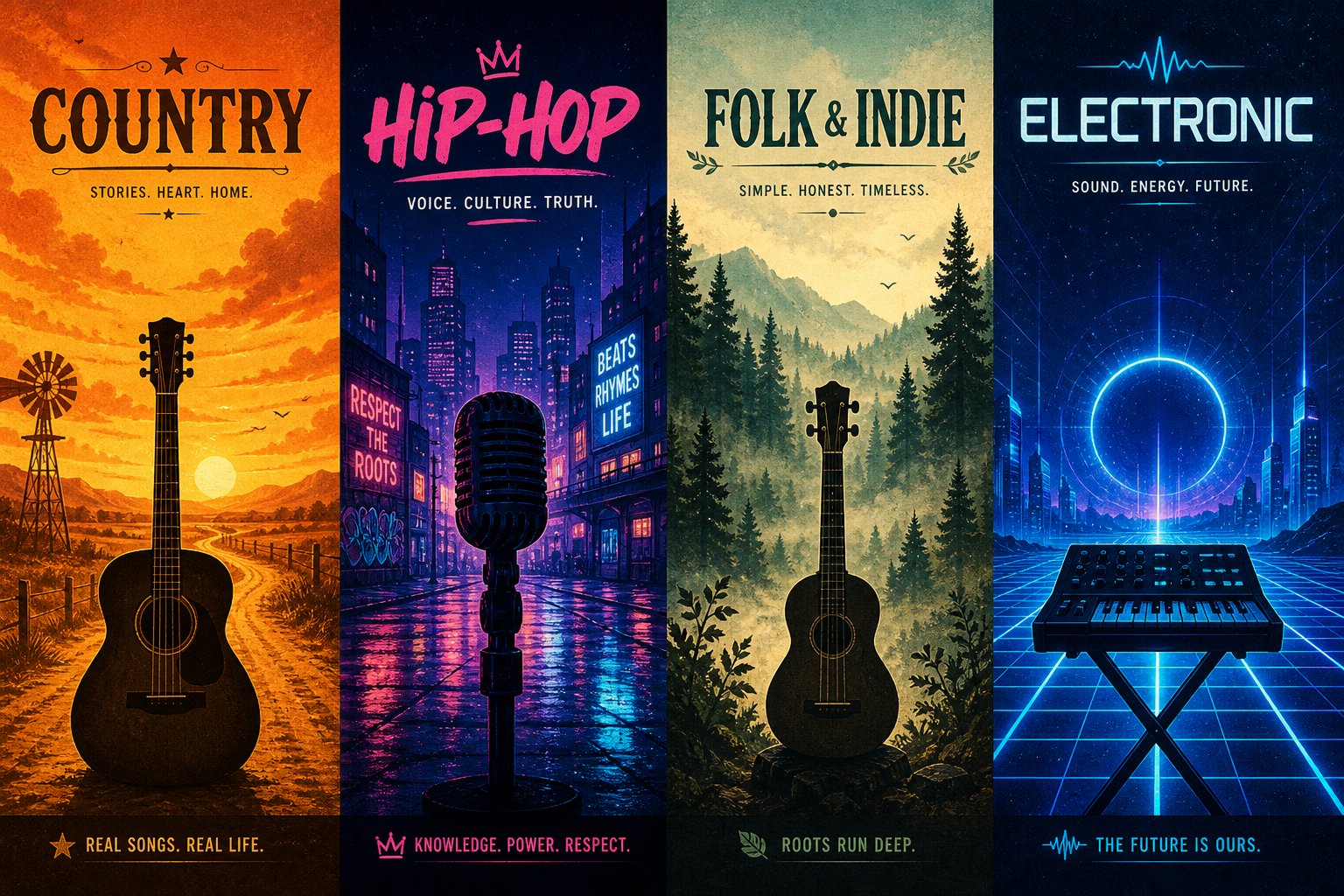
Genre-Specific Song Title Conventions Every Songwriter Should Know
Every genre carries its own unwritten rules about what a title should look like, how long it should be, and what emotional register it should hit. A title that feels perfectly at home on a country album would sound bizarre on an EDM release — and vice versa. Whether you are feeding prompts into an AI tool or brainstorming on your own, understanding these conventions gives you a massive creative advantage. It helps you generate titles that feel authentic to the style you are working in rather than generically "musical."
Think of genre-specific titling conventions as a shared vocabulary between you and your audience. Listeners develop subconscious expectations about what a hip-hop track name should sound like versus an indie folk title, and meeting — or deliberately subverting — those expectations is a skill worth mastering. Below is a genre-by-genre breakdown you can use as a reference guide every time you sit down to name a track.
Pop and R&B Title Conventions
Pop thrives on immediacy. The titles that dominate pop charts tend to be short — one to three words — and built from everyday language that mirrors the hook or chorus phrase. Think about how often a massive pop hit is named after the exact words the singer repeats in the catchiest part of the song. This is not accidental. Pop titles function as verbal earworms, designed to be recalled, searched, and requested at a glance.
Common patterns include single-word emotion titles ("Jealousy," "Closer"), direct address phrases ("Call Me," "Stay"), and imperative commands ("Dance," "Shut Up"). The language is conversational, accessible, and rarely abstract. If a casual listener cannot remember and type the title into a search bar after hearing the song once, it has probably failed as a pop title.
R&B leans into slightly different territory. Titles here frequently reference intimacy, sensory experience, and emotional vulnerability. You will notice more possessive and relational language — titles that feel like whispered confessions or late-night text messages. The length stays compact, but the emotional texture runs deeper than most pop naming conventions.
Hip-Hop and Rap Naming Strategies
Rap titling operates by its own playbook entirely. If you are searching for rap song title ideas, you will notice that the genre embraces slang, wordplay, cultural references, and unapologetic bravado in ways that would feel out of place in most other styles. Titles frequently reference location, lifestyle, attitude, or clever double meanings that reward listeners who catch the layers.
Rap titles also tend to run longer and more conversational than pop names. Where a pop title might be a single punchy word, a hip-hop track might carry a full phrase, a slang expression, or even a sentence fragment that sounds like something pulled mid-conversation from a studio session. This conversational quality is part of the genre's DNA — the title feels like it belongs to the artist's real speaking voice.
If you are using a rap song name generator or brainstorming rap song name ideas manually, lean into specificity. Generic motivational phrases fall flat. Titles rooted in concrete imagery, cultural shorthand, or distinctive wordplay — the kind of name that could only belong to one artist — tend to resonate most. A useful strategy from Sonicbids applies here especially well: try using a cut lyric, a line that did not quite make the final verses but captures the track's attitude perfectly.
Country, Folk, and Indie Approaches
Country titles tell stories in miniature. You will find references to specific places, people's names, nostalgic imagery, and small-town settings packed into just a few words. A great country title often reads like the opening line of a short story — it sets a scene and implies a narrative arc before the listener presses play. Think of patterns like "[Name] + [Place]" or "[Object] + [Emotional State]" — these formulas feel timeless because they tap into country music's storytelling roots.
Folk titles share some of that narrative quality but lean more toward naturalistic and traditional language. References to rivers, mountains, seasons, and journeys are common, and the tone tends toward earnestness rather than irony. Sitting and listening to the finished song, then trying to find a single-word summation that captures its essence, works particularly well for instrumental folk pieces where there are no lyrics to pull from.
Indie titles, by contrast, often swerve toward the poetic, ironic, or deliberately obscure. An indie band might name a heartbreak song something that sounds completely unrelated to love — and that is the point. The title becomes a puzzle, an inside joke, or a tonal counterweight to the music itself. This approach can be artistically rewarding but creates real discoverability challenges, so it works best for artists with an established audience who will seek out the track regardless of its name.
Electronic, EDM, and Instrumental Track Names
Instrumental genres face a unique titling challenge: there are no lyrics to reference, no vocal hook to borrow, and no narrative to summarize. This is where a beat name generator or a track title generator earns its keep, because producers in these spaces often need to name dozens of tracks without any verbal content to guide them.
EDM and electronic track names tend to gravitate toward abstract concepts, single evocative words, or technical and futuristic language. Titles like "Eclipse," "Cascade," "Synapse" — words that suggest energy, movement, or atmosphere without anchoring the listener to a specific story. The tone is often sleek and minimal, matching the aesthetic of the genre itself.
Beat producers naming instrumentals for licensing or sale face a slightly different calculus. Their track names need to communicate mood and vibe quickly to potential buyers scrolling through catalogs. A beat titled "Late Night Lavender" tells a buyer more about what to expect than "Beat 47." Descriptive, mood-forward language works best here because the title is essentially doing the job that lyrics would normally handle.
Genre Titling Conventions at a Glance
Use this reference table whenever you need a quick reminder of how each genre typically approaches naming:
| Genre | Typical Title Length | Common Themes | Tone | Example Patterns |
|---|---|---|---|---|
| Pop | 1-3 words | Emotions, relationships, commands | Direct, catchy, conversational | "Stay," "Call Me," "Bad Guy" |
| R&B | 1-4 words | Intimacy, sensory experience, desire | Smooth, vulnerable, evocative | "Adorn," "No Guidance," "Earned It" |
| Hip-Hop / Rap | 2-6 words | Lifestyle, location, wordplay, bravado | Confident, slang-heavy, conversational | "Started From the Bottom," "Sicko Mode" |
| Country | 3-6 words | Places, people, nostalgia, small-town life | Storytelling, warm, grounded | "Dirt Road Anthem," "Jolene" |
| Folk | 2-5 words | Nature, journeys, seasons, tradition | Earnest, poetic, naturalistic | "Big Yellow Taxi," "The River" |
| Indie | 2-7 words | Abstract imagery, irony, literary references | Poetic, ironic, sometimes obscure | "Motion Sickness," "Dog Days Are Over" |
| Electronic / EDM | 1-3 words | Abstract concepts, energy, technology | Sleek, futuristic, atmospheric | "Strobe," "Clarity," "Levels" |
| Instrumental / Beats | 2-4 words | Mood, atmosphere, color, texture | Descriptive, evocative, mood-forward | "Late Night Lavender," "Golden Hour" |
Bookmark this table. Whether you are using an ai song title generator with genre-specific prompts or scribbling possibilities in a notebook, these patterns give you a reliable starting framework — and a clearer sense of when breaking the conventions might actually work in your favor.
Conventions, though, are only half the equation. The other half is studying what happens when a title transcends its genre entirely and becomes iconic — and that reveals a different set of principles about memorability, curiosity, and emotional impact that apply regardless of the style you are working in.
What Makes Iconic Song Titles Work
Genre conventions give you a framework. But the titles that transcend their genre entirely — the ones people remember decades later, the ones that enter everyday language — operate on a deeper level. They tap into principles of memorability, curiosity, and emotional resonance that no formula can fully capture, yet every songwriter can study and apply. Whether you are sifting through AI-generated candidates or brainstorming alone at midnight, these principles are the filter that separates a forgettable placeholder from a title that earns its place on the track.
The Power of Simplicity and Repetition
Look at the biggest songs in modern history and you will notice something striking: most of them have titles you could say in under two seconds. "Stay." "Hello." "Yesterday." "Respect." "Closer." These are not complex or clever — they are brutally simple. And that simplicity is precisely what makes them stick.
Short, common-word titles function as earworms before the music even plays. They are easy to remember after a single listen, effortless to type into a search bar, and natural to request on the radio or shout across a crowded room. They also reproduce well across every medium — playlist thumbnails, social media shares, voice-activated searches, radio callouts — without being truncated or misheard.
Repetition amplifies this effect. When a title doubles as the hook — the phrase the singer repeats in the chorus — it becomes almost impossible to separate the name from the melody. You hear the word "Umbrella" and Rihanna's voice is already in your head. The title and the song fuse into a single memory unit. For anyone generating good song title ideas, this is the most reliable pattern in chart history: if your title is the hook, your hook markets itself.
Does this mean every title needs to be one word? Not at all. But it does mean that the most commercially successful titles share a bias toward clarity and recall. When in doubt, shorter almost always wins.
Titles That Create Curiosity or Tension
Simplicity gets attention. Curiosity holds it. Some of the most compelling titles in music work because they make a listener think, "I need to hear what this is about" — before a single note plays.
This effect usually comes from one of three techniques: implied questions, paradoxes, or unexpected juxtapositions. A title like "Somebody That I Used to Know" carries an entire emotional narrative in seven words — who is this person, and what happened? "Killing Me Softly" pairs violence with tenderness, creating a tension that demands resolution. "Don't It Make My Brown Eyes Blue" twists a cliche into something emotionally surprising, using a clever turn on words that makes you pause and lean in.
The craft here lies in creating a gap — a small space between what the title says and what it means. Listeners instinctively want to close that gap, and the only way to do it is to press play. If you are searching for ideas for song titles that stand out in a crowded playlist, building in a hint of unresolved tension is one of the most effective strategies available. The title becomes a tiny promise: "There is a story here, and it is worth your time."
Berklee songwriting instructor Pat Pattison describes this instinct well: effective titles often contain metaphor, simile, or a sense response — something specific rather than general that provokes the imagination. Titles like "Wind Beneath My Wings" and "Your Body Is a Wonderland" work not because they are literal, but because they create vivid images that pull the listener into a felt experience.
When Abstract or Poetic Titles Work
Every principle above argues for clarity, brevity, and emotional directness. And then you encounter "Bohemian Rhapsody." Or "Several Species of Small Furry Animals Gathered Together in a Cave and Grooving with a Pict." Or "A Simple Desultory Philippic." Titles that break every conventional rule — and are unforgettable precisely because they do.
Abstract and poetic titles succeed when at least one of these conditions is met: the artist already has a dedicated audience who will seek out the track regardless, the title itself is so unusual that it generates word-of-mouth curiosity, or the music is strong enough to create its own momentum and retroactively make the title iconic. As BBC Music has documented, some of the weirdest song titles in history owe their existence to in-studio games, personal inside jokes, or deliberate provocations — and they work because the music behind them earned the listener's trust first.
The risk, especially for emerging artists, is real. A deliberately obscure title can feel like a locked door to a new listener — intriguing if they already know your work, alienating if they do not. Good song titles balance artistic expression with audience accessibility, and the further you lean toward abstraction, the more your music needs to compensate with its own discoverability through playlists, social virality, or press coverage.
Legendary songwriter Gary Burr captures the sweet spot perfectly: he always goes "four or five angles down the road, to the one most people wouldn't get to." That is the key — not randomness, but deliberate depth. The best unique song titles are not weird for the sake of weird. They are the result of exploring past the obvious, past the cliche, to an angle that feels both surprising and inevitable once you hear the song.
The best song titles work on two levels — they hook casual listeners and reward fans with deeper meaning.
This is the standard worth aiming for, whether you are evaluating cool song titles from an AI tool or testing your own handwritten candidates. Simplicity catches the ear. Curiosity opens the door. And depth keeps people coming back. The real creative challenge is not generating nice song titles — any decent tool can produce a list. It is knowing which title on that list deserves to represent your song. And that judgment call requires a clear framework, not just instinct.
AI vs Human Brainstorming for Song Names
Judgment requires options — and the way you generate those options shapes everything that follows. Some songwriters swear by sitting alone with a notebook, free-associating until something clicks. Others fire up an ai song title generator and let the machine produce forty candidates in thirty seconds. Both methods produce usable results. Neither is universally superior. The real question is when each approach earns its place in your creative process — and what happens when you stop treating them as competitors and start using them together.
Where AI Title Generation Excels
Speed is the most obvious advantage, but it is not the most important one. Yes, an AI-powered song idea generator can produce dozens of candidates in the time it takes you to uncap a pen. That raw volume matters when you are deep in a session and momentum is everything — you do not want to lose a great melodic idea because you spent forty-five minutes agonizing over what to call the track.
The deeper advantage is range. When you brainstorm alone, you draw from your own vocabulary, your own reading history, your own emotional associations. That is a finite pool, and it carries unconscious biases. You gravitate toward the same types of phrases, the same structural patterns, the same emotional registers. An AI tool, by contrast, draws from patterns across an enormous training corpus — poetry, literature, journalism, millions of existing titles — and can produce combinations you genuinely would not have reached on your own. It does not have a comfort zone to fall back on.
This makes AI particularly powerful for overcoming creative block. That paralysis you feel staring at a blank title field is not a lack of talent — it is decision fatigue colliding with the infinite possibility space. A songwriting ideas generator collapses that space into a manageable set of concrete options, giving your brain something to react to instead of something to invent from nothing. Sonarworks describes this well: AI tools break creative cycles by introducing unexpected elements and fresh perspectives, generating starting points from minimal input that help maintain creative momentum.
There is also a valuable neutrality to AI output. It does not second-guess itself, worry about sounding pretentious, or self-censor based on what it thinks the audience wants. It simply generates. That lack of personal bias means you sometimes receive a title that feels surprising or even uncomfortable — and those are often the ones worth paying attention to.
Where Human Creativity Remains Essential
For all its strengths, AI has blind spots that no amount of processing power can fix. The most fundamental one: it does not know what your song actually means to you.
An AI model can detect that "melancholic" and "lost love" and "indie folk" tend to co-occur with certain word patterns. What it cannot do is understand that this particular song was written about a specific person, in a specific kitchen, on a Tuesday night when something irreversible happened. That personal emotional context — the lived experience behind the music — is invisible to the machine. It generates candidates that are statistically plausible but emotionally generic unless you steer it with exceptionally detailed prompts.
AI also struggles with cultural timing. It does not know that a phrase suddenly carries new connotations because of a viral meme, a political event, or a competing release that dropped last week. It cannot evaluate whether a title will land as clever or tone-deaf in the current cultural moment. That kind of real-time judgment requires a human mind embedded in the world the music will enter.
Research from Harvard Business School reinforces this distinction. In a study comparing AI-generated ideas with human-generated ones, evaluators consistently rated human contributions as more novel — featuring more unique, "out of the box" thinking — while AI ideas scored higher on feasibility and practicality. The pattern translates directly to song titling: AI excels at producing workable, coherent options, but the truly original, emotionally resonant title — the one that feels like it could only belong to your song — typically requires a human sensibility.
There is a subtler limitation, too. AI generates candidates. It does not evaluate them. It cannot tell you whether "Glass Carousel" actually represents the emotional arc of your track or just sounds nice. It cannot weigh whether a title fits your existing catalog, aligns with your brand, or will confuse your audience. That evaluative judgment — the ability to say "this is the one, and here is why" — remains entirely yours.
The Hybrid Approach — Combining AI and Human Brainstorming
The most productive creative process is rarely pure AI or pure human. It is a deliberate combination of both. Harvard's research team found that "the best ideas may come from those in which humans and AI collaborate, with people engineering prompts and continually working with AI to develop more original ideas." The same principle applies to song titling: use the machine for breadth, then apply your judgment for depth.
In practice, this hybrid workflow looks straightforward. You start by feeding a song topic generator your core theme, mood, and genre to produce a wide pool of raw candidates — twenty, thirty, even fifty options. You scan those options not looking for a finished title, but for sparks: a word you had not considered, a phrase structure that reframes your concept, a juxtaposition that opens a new angle. Then you take those fragments and run them through your own creative filter — combining pieces from different outputs, swapping in personal language, or using an AI suggestion as a springboard for an entirely original idea the machine never produced.
This mirrors what professional creatives already do across disciplines. Designers use AI to generate layout variations, then hand-select and refine. Writers use language models to brainstorm angles, then craft the final prose themselves. Music producers use AI to suggest chord progressions or drum patterns, then apply their musical judgment to refine and personalize the results. The tool accelerates the ideation phase. The human shapes the final product.
To help you decide which approach fits a given moment, here is a breakdown of when each method works best:
- Use AI when you are staring at a blank page with no starting point and need raw material to react to.
- Use AI when you want to explore naming styles outside your usual creative habits — genres, tones, or vocabulary you would not naturally reach for.
- Use AI when you need to name multiple tracks quickly, such as when titling an entire album or a batch of beats for licensing.
- Use AI when you want a second opinion that is not influenced by personal relationships or social pressure.
- Use human brainstorming when the song carries deeply personal meaning and the title needs to reflect a specific lived experience.
- Use human brainstorming when cultural context, wordplay, or slang requires real-time awareness of how language is being used right now.
- Use human brainstorming when you are evaluating final candidates and need to weigh factors like brand consistency, catalog cohesion, and audience expectations.
- Use human brainstorming when the title needs to work across marketing contexts — merchandise, social media, press releases — where tone and connotation carry extra weight.
The artists who get the most from an AI song ideas generator are not the ones who accept its first suggestion uncritically. They are the ones who treat it as a brainstorming partner — prolific, tireless, and occasionally brilliant, but always in need of a human editor with skin in the game. The machine proposes. You decide.
That decision, though, depends heavily on what you ask the machine in the first place. A vague prompt produces vague options. A sharp, layered prompt produces candidates that are genuinely worth evaluating — and learning how to craft those prompts is one of the fastest ways to upgrade your results.

Prompt-Crafting Tips That Produce Better AI Song Titles
The difference between a list of forgettable suggestions and a batch of genuinely usable title candidates usually comes down to one thing: what you typed into the input field. Most people treat an AI song title generator like a vending machine — press a button, receive a title. But the tool is more like a session musician. Give it a vague direction and you get a generic performance. Hand it a detailed creative brief and something remarkable can happen.
Prompt quality is the single biggest lever you control, and improving it costs nothing but a few extra seconds of thought. The principles behind effective prompting apply whether you are using a dedicated songwriting topic generator or a general-purpose AI assistant — specificity, context, and clear constraints consistently produce stronger outputs across every type of creative task.
Specify Genre, Mood, and Theme Together
Vague inputs produce vague outputs. This is the most common mistake, and the easiest to fix. Typing a single word like "love" or "sad" gives the model almost nothing to work with — it has to guess your genre, your emotional register, your audience, and your aesthetic preferences all at once. The result is a scattershot list of titles that could belong to any song in any style.
Combine three layers of information instead: a genre, a mood, and a theme. Watch how the output quality shifts with each layer you add:
- "Love" — produces generic, unfocused results across every possible style.
- "Indie rock + love" — slightly better, but still too broad to generate distinctive titles.
- "Indie rock + bittersweet nostalgia + leaving your hometown" — now the model has a specific emotional landscape to explore, and the titles it generates will reflect that specificity.
That third prompt might return ideas for a song name like "Rearview Skyline" or "Last Gas Station on Route 9" — titles rooted in a concrete emotional situation rather than floating in abstraction. The genre tells the model what vocabulary and structure to use. The mood tells it what emotional register to hit. The theme gives it a subject to anchor everything around. All three together create a focused creative space that produces results you can actually picture on your track.
This layering principle mirrors what prompt engineering research consistently confirms: the more descriptive and detailed your prompt, the better the results. There are no magic keywords — just relevant context that narrows the model's output toward what you actually need.
Use Sensory and Emotional Language in Your Prompts
Here is where most people stop: they specify genre, mood, and theme, and call it done. But there is another level of prompt detail that dramatically improves title quality — sensory language.
Instead of telling the tool you want something "sad," try describing what that sadness looks like, sounds like, and feels like. Colors, textures, temperatures, times of day, physical sensations — these concrete details give the AI rich material to draw from. A prompt like "cold, gray morning, the sound of rain on a tin roof, the ache of knowing you waited too long" produces far more evocative titles than "sad breakup song."
Why does this work? AI language models respond strongly to vivid, specific language because it narrows the creative space productively. When you write "cold" and "gray" and "tin roof," the model activates word associations connected to those sensory clusters — and the titles it generates will carry that atmospheric texture. You are essentially painting a scene and asking the machine to name it, which is a much richer creative task than asking it to label an emotion.
Emotional language works the same way. "Frustrated" is fine. "The frustration of explaining yourself to someone who already decided not to listen" is better. The more specific the emotional state, the more specific — and usable — the output. Think of your prompt not as a search query but as a tiny creative brief: the kind of one-paragraph description you might give a collaborator before a writing session.
Iterate and Vary Your Inputs Systematically
One prompt, one generation, done — that is how most people use these tools, and it is leaving enormous creative potential on the table. Professional results come from iteration: running the same core concept through multiple prompt variations and collecting the strongest outputs from each pass.
Think of it like working with a song themes generator. Your underlying theme stays constant, but you approach it from different angles each time. Change the mood from "melancholic" to "quietly defiant." Swap a nature metaphor for an urban one. Shift the formality from poetic to conversational. Each variation pulls different word patterns from the model, and the best title might emerge from your fourth or fifth run — not your first.
Here is a structured process you can follow every time you sit down to generate titles:
- Start with a broad theme. Define the song's core subject in plain language — "a relationship ending slowly" or "finding confidence after self-doubt." Use this as your baseline prompt and review what comes back.
- Add mood modifiers. Layer in emotional texture — "wistful," "restless," "quietly angry" — and regenerate. Notice how the titles shift in tone and vocabulary.
- Specify genre conventions. Tell the tool whether you want titles that fit country storytelling, rap wordplay, indie poetry, or pop immediacy. The same theme generates very different names depending on the genre lens you apply.
- Include key imagery or metaphors. Feed in the sensory details you developed — a specific color palette, a setting, a physical sensation. This is where the outputs start feeling genuinely tailored to your song rather than generically appropriate.
- Regenerate with synonyms and alternative angles. Replace key words in your prompt with synonyms or reframe the concept entirely. If "leaving" produced interesting results, try "vanishing," "slipping away," or "choosing to stay but feeling gone." Each variation opens a different creative corridor.
By the end of this process, you should have twenty to thirty raw candidates drawn from five or more distinct prompt angles. That pool gives you genuine variety to evaluate — not just minor variations on the same phrasing, but fundamentally different creative directions rooted in the same core idea. You will also start developing an intuition for which types of prompts consistently produce your strongest results, a skill that compounds every time you use it.
The topic generator for songs approach works the same way: do not settle for the first angle the tool offers. Push it — and push yourself — through multiple passes until you find the output that makes you stop scrolling and think, "That is the one." Great prompts are not written in a flash of inspiration. They are built through an iterative process of experimentation and refinement, just like great songs.
Of course, generating a strong pool of candidates is only half the challenge. The other half — arguably the harder half — is knowing which title in that pool actually deserves to represent your track. And that requires more than gut instinct. It requires a structured evaluation framework.
A Framework for Evaluating AI-Generated Song Titles
You have a list of thirty candidates. Some sound clever. A few feel poetic. One or two seem catchy enough to stick. But which one actually deserves to represent your song? Without a clear framework, you are left relying on gut instinct — and gut instinct is notoriously unreliable when you have been staring at a song title ideas list for twenty minutes and everything starts blending together.
The difference between amateurs and professionals is not who generates better raw material — it is who evaluates it more rigorously. What follows is a structured checklist you can use every time you need to decide what is a good song name versus what merely sounds pleasant in the moment.
The Five-Point Title Evaluation Checklist
Run every candidate through these five criteria before committing. A strong title should pass all five. A title that fails even one deserves a second look.
| Criterion | What to Ask | Red Flags |
|---|---|---|
| Memorability | Can you recall it after hearing it once? Would a listener remember it well enough to search for it later? | Too generic to stick — sounds like a hundred other tracks. Forgettable after a few seconds. |
| Searchability | Will it surface in streaming platform searches? Does it contain language listeners might actually type? | Identical to a famous existing song. Uses symbols, obscure spelling, or characters that search engines handle poorly. |
| Emotional Impact | Does it evoke a feeling that matches the song's mood and content? Does it create curiosity or resonance? | Emotionally flat — technically fine but stirs nothing. Tone mismatch between title and track. |
| Originality | Does it stand out from existing titles in your genre? Would a listener notice it in a playlist? | Cliche or overused phrasing. Feels like a placeholder rather than a deliberate creative choice. |
| Genre Fit | Does it match the conventions and audience expectations of the target genre? Would it feel at home on a playlist alongside similar artists? | Misleads listeners about the song's style. Uses vocabulary or structure that belongs to a completely different genre. |
This checklist answers the question songwriters ask constantly: what are good song names, really? They are names that pass all five filters simultaneously — memorable enough to recall, searchable enough to find, emotionally aligned with the music, original enough to stand apart, and appropriate for the genre they live in. Meeting four out of five is not enough. A title that scores high on originality but fails searchability still has a structural weakness that will cost you listeners.
Testing Your Title Before Committing
Passing the checklist on paper is a start. But good names for songs also need to survive contact with the real world. Before you lock in a final choice, put your top candidates through these practical tests:
- Say it aloud. How does it sound in conversation? Could a DJ announce it naturally during a radio callout? Titles that look great on screen sometimes feel clumsy when spoken — and spoken contexts still drive significant music discovery.
- Search for it on streaming platforms. Open Spotify, Apple Music, or YouTube and type the exact title. If a major-label hit with the same name dominates every result, your track will be buried. You want a title that gives you a realistic chance of appearing on the first page of results.
- Share it with trusted listeners. Show the title — without playing the music — to two or three people whose taste you respect. Ask them what genre, mood, and subject they expect from a song with that name. If their assumptions align with your actual track, the title is doing its job. If they are confused or misled, it is not.
- Test it as a social media caption. Post the title as text on your story or feed and observe the visual impression. Does it look compelling? Is it easy to read at a glance? Titles with strong visual appeal tend to perform better in the social-first discovery environments where most new listeners encounter music.
These tests take five minutes combined. They catch problems that checklist analysis alone misses — the title that reads beautifully but sounds awkward, the one that seemed original until you discovered three existing tracks with the same name, the one your audience interprets completely differently than you intended.
When to Go Back to the Generator
Here is the hard truth: sometimes the right move is to throw out your entire list and start over. If your strongest candidate fails two or more checklist criteria, or if the real-world tests reveal a fundamental problem, forcing that title onto your track will not serve you. It is better to refine your prompt, adjust your inputs, and regenerate a fresh batch than to settle for a title you already know is weak.
This willingness to regenerate is what separates professional titling from scrolling through random song titles and picking whichever one feels least bad. The evaluation step is not a formality — it is the core of the process. Generating song names ideas is easy. Any tool can produce a long list. The craft lies in applying rigorous, repeatable criteria to that list and having the discipline to reject candidates that do not clear the bar, no matter how much time you have already invested.
Think of it this way: your title will outlive every other decision you make about the track. Mixes get updated. Artwork gets refreshed. But once a title is attached to a release and indexed across platforms, changing it creates confusion and fractures your streaming history. Getting it right before you commit is not perfectionism — it is pragmatism.
With a reliable evaluation process in place, the remaining question becomes practical: which tools give you the strongest raw material to evaluate in the first place? The landscape of available options varies widely in capability, and choosing the right tool for your workflow can save you significant time and creative energy.
Best AI Tools for Generating Song Titles and Writing Lyrics
Not all AI tools are built the same — and in a market flooded with browser widgets, mobile apps, and full-scale creative platforms, picking the right one can feel like its own creative challenge. Some tools specialize narrowly in title generation. Others function as broader songwriting assistants that handle lyrics, hooks, themes, and even full compositions. A few are general-purpose AI models that happen to be useful for music when prompted correctly. Your ideal choice depends on where you are in the creative process and how far beyond a title you need the tool to take you.
What to Look for in an AI Song Title Tool
Before you commit to any platform, evaluate it against four practical criteria. These apply whether you are shopping for a dedicated ai song name generator, an album title generator for naming an entire project, or a playlist title generator for curating themed collections.
- Input flexibility. Can you specify genre, mood, theme, and imagery — or are you limited to selecting from a handful of preset dropdowns? Tools that accept free-text prompts with layered detail consistently produce more usable results than those that restrict you to rigid menus.
- Output volume. How many titles does the tool generate per run? You want at least ten to fifteen candidates per generation to give yourself a meaningful pool for evaluation. A tool that returns only three or four options forces you to regenerate constantly, breaking your creative rhythm.
- Creative range. Does the tool produce genuinely diverse styles across generations, or do the results feel repetitive after a few rounds? Test this by running the same prompt twice and comparing outputs. If the second batch looks nearly identical to the first, the tool's creative ceiling is low.
- Extended creative workflow. This is the criterion most people overlook — and arguably the most important one. A great title is a starting point, not a finish line. Does the tool extend into related tasks like lyric writing, hook development, or thematic exploration? The ability to move seamlessly from a title concept into full songwriting support saves time and keeps creative momentum alive.
That last point deserves emphasis. Finding a strong title and then switching to a completely different tool for lyrics creates friction — you lose context, re-explain your vision, and often end up starting from scratch. Platforms that support the full arc from title brainstorming through lyric development offer a significantly smoother experience.
Top Tools for Song Title and Songwriting Support
The landscape breaks into three broad categories: end-to-end songwriting assistants, dedicated title and name generators, and general-purpose AI models. Each serves a different need. Here is an honest comparison to help you find the right fit.
| Tool | Type | Key Strength | Best For | Supports Broader Songwriting? |
|---|---|---|---|---|
| MakeBestMusic AI Lyrics Generator | End-to-end songwriting assistant | Develops titles, lyrics, hooks, themes, and complete song ideas in a single workflow | Songwriters and creators who want to move from a title concept directly into full lyric development | Yes — lyrics, hooks, themes, and song ideas |
| Dedicated title generators (various free browser tools) | Single-purpose title tool | Fast, zero-setup title output; some offer genre filtering | Quick brainstorming when you only need a name and nothing more | No — title output only |
| LyricStudio | AI co-writing assistant | Line-by-line lyric suggestions with rhyme and tone awareness | Experienced writers who want interactive, collaborative lyric support | Partial — lyrics only, no audio or full song generation |
| General-purpose AI models (ChatGPT, Claude, etc.) | Multipurpose language model | Highly flexible prompting; handles any creative text task | Users comfortable with prompt engineering who want maximum control | Indirect — capable but not music-optimized |
| Full song generators (Suno, Udio) | Audio-first music creation | Generates complete tracks with vocals, melody, and arrangement | Producers who want playable demos quickly; less focused on title or lyric craft | Yes, but with limited text-level editing control |
A few things stand out from this comparison. Dedicated title generators are fine for a fast spark of inspiration, but they hit a dead end the moment you need to develop the idea further. You get a name — and then you are on your own. General-purpose models like ChatGPT offer tremendous flexibility, but they require you to do the heavy lifting of prompt design, and they lack built-in awareness of songwriting structure.
MakeBestMusic's AI Lyrics Generator fills the gap that matters most for working songwriters: the transition from title to lyrics. Once you have landed on a compelling name, the platform lets you develop hooks, verses, and thematic ideas that align with that title — all within the same creative environment. You are not copying a title from one tool, opening a second tool, and re-explaining your concept from scratch. The workflow stays continuous. For anyone who has felt the momentum drain out of a session during that awkward tool-switching phase, this continuity is a genuine advantage.
If your needs are more specialized — say, you are a beat producer who primarily needs an album name generator or a music album name generator to name instrumental projects — a simpler dedicated tool might be sufficient. Producers building sample packs or beat catalogs often need to generate dozens of names quickly without deep lyric development, and a lightweight ai album name generator handles that efficiently. Similarly, playlist curators looking for a playlist name generator to title themed collections may not need full songwriting support at all.
The honest answer is that no single tool is perfect for every situation. Different creative needs call for different solutions. But if your typical workflow involves generating a title and then immediately needing lyrics, hooks, or thematic direction — which describes the majority of songwriters — an end-to-end platform eliminates the most common friction point in the process. The strongest tool is the one that matches how you actually work, not the one with the longest feature list.
Choosing the right tool, though, is just one piece of the puzzle. The real payoff comes from integrating that tool into a structured creative workflow — a repeatable process that takes you from initial inspiration all the way through to a final, validated title ready for release.
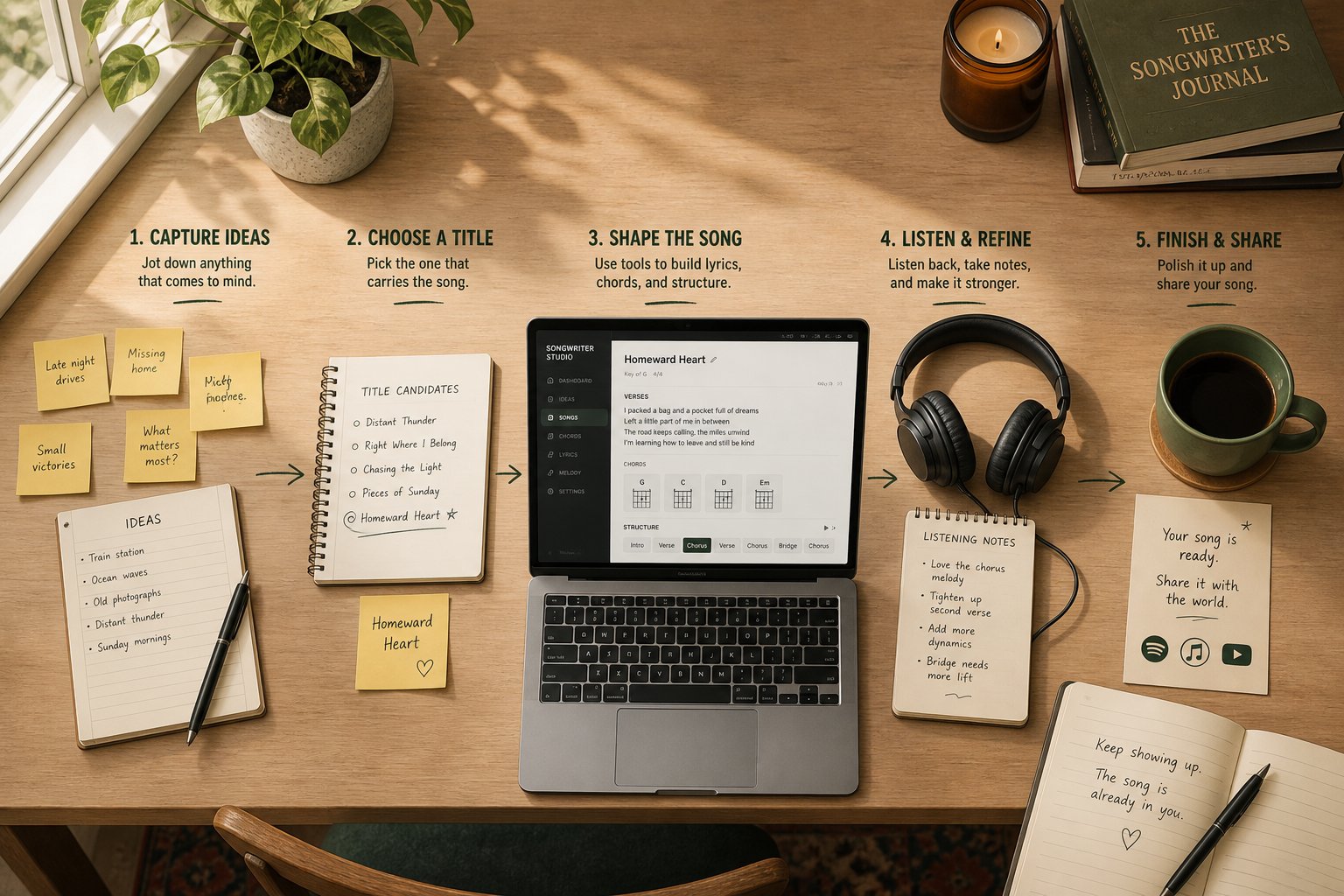
Your Complete Song Title Brainstorming Workflow
You have the principles. You understand genre conventions, evaluation criteria, prompt-crafting techniques, and the strengths of both AI and human brainstorming. Scattered across the previous sections, those insights are valuable — but scattered knowledge does not finish songs. What finishes songs is a repeatable process you can follow every time you sit down to name a track, whether it is your first single or the twelfth cut on an album.
What follows is that process — a five-stage workflow that consolidates everything covered in this article into a structured, step-by-step method. If you have ever wondered how do I write a song title that actually holds up under professional scrutiny, this is the framework that answers it. No guesswork, no staring at the ceiling, no settling for a name that feels "good enough." Just a clear path from raw inspiration to a polished, validated title ready for release.
The Five-Stage Title Brainstorming Workflow
Treat these stages as distinct phases — much like the Generate, Shape, and Refine framework that productive songwriters use to finish tracks. Mixing stages is where most people stall. Keeping them separate is where momentum lives.
- Pre-Generation Prep — Define before you generate. Before opening any tool, spend five minutes clarifying your song's creative identity. Write down the core theme in a single sentence. Identify the mood — not just "sad" or "happy," but something layered like "defiantly hopeful" or "nostalgic with an edge of regret." Name the genre. Then list three to five key images, sensory details, or emotions that define the track's atmosphere. A song about leaving home might include "empty driveway," "cold morning air," "the weight of a packed suitcase," and "relief mixed with guilt." This prep work takes minutes but transforms every output that follows. As songwriter Jason Blume emphasizes, the title sits at the heart of the lyric — defining it clearly before you brainstorm gives every candidate a target to hit.
- AI Generation Round — Produce volume across multiple angles. Use an ai song title generator to produce twenty to thirty raw title candidates. Do not settle for a single prompt. Run at least four or five variations using the iteration method from the prompt-crafting section: start broad, add mood modifiers, specify genre conventions, layer in sensory imagery, then regenerate with synonyms and alternative angles. Each variation pulls different patterns from the model, and your best candidate often emerges from the third or fourth pass — not the first. The goal here is quantity and diversity, not perfection.
- First-Pass Filter — Cut ruthlessly using your checklist. Scan your full list and eliminate any title that immediately fails the memorability or genre-fit criteria from the evaluation framework. You are not looking for winners yet — you are removing obvious losers. Titles that sound generic, feel tonally wrong for the genre, or would vanish in a streaming search get cut without hesitation. This pass typically reduces thirty candidates to eight or ten survivors. That is exactly the ratio you want.
- Refinement and Hybridization — Make the AI's best ideas yours. This is the stage most people skip, and it is the stage that produces the strongest results. Take your surviving candidates and start working with them creatively. Combine a compelling word from one title with the structure of another. Swap in personal language that connects the name to your lived experience. Use an AI suggestion as a springboard for an entirely original idea the machine never generated. A title like "Glass Morning" from the AI might become "Glass Morning, Paper Walls" once you add a fragment that references your actual lyrics. The hybrid approach — AI for breadth, human judgment for depth — is where good ideas for a song title become great ones.
- Final Validation — Test before you commit. Narrow your list to two or three finalists and run them through real-world testing. Say each one aloud to check how it sounds in conversation. Search for it on Spotify and YouTube to gauge direct competition. Share it with a trusted listener and ask what genre, mood, and subject they expect — without playing the song. If their assumptions align with your track, the title is doing its job. If a finalist fails two or more of these tests, go back to stage four and refine further. Do not rush this step. Your title will outlive every other decision you make about the release.
This workflow turns how to name a song from a paralyzing open-ended question into a structured creative exercise with clear milestones. You always know what stage you are in, what the goal of that stage is, and when to move forward. That clarity is what separates songwriters who agonize over titles for days from those who lock one in confidently within a single session.
A practical note on timing: the entire workflow — from prep through final validation — typically takes thirty to forty-five minutes for a single track. If you are naming an album's worth of songs, batch the AI generation rounds together and then filter and refine in a separate sitting. Spreading the evaluative work across two sessions gives your brain time to reset, which research on songwriting workflows consistently identifies as a key factor in making better creative decisions.
From Title to Full Song — Keeping the Momentum
A strong title is a launchpad, not a finish line. Once the name is locked, it becomes a creative anchor that can guide every subsequent decision — lyric writing, melodic direction, arrangement choices, even artwork and marketing. The title's mood and imagery give you a north star. When you are stuck on a verse, ask yourself: does this line earn the title? When you are choosing between two melodic directions, ask: which one sounds like a song called this?
Jason Blume, whose songs have sold over fifty million copies, describes this principle directly: the title is chosen before the rest of the lyric is written because the lyric is crafted to lead to the title. Every verse becomes a pathway toward that destination. Every chorus is a payoff that rewards the listener for following along. When your title is clear, the rest of the writing process gains direction and focus it would not otherwise have.
This is also the natural moment to bridge the gap from title to full lyrics. Tools like MakeBestMusic's AI Lyrics Generator are built for exactly this transition — you feed in your chosen title along with its mood, genre, and thematic context, and the platform generates hooks, verses, and thematic ideas that align with the name you have already validated. Instead of losing momentum by staring at another blank page, you carry the creative energy from your titling session directly into lyric development. The title shapes the lyrics. The lyrics deepen the title. And the song starts to feel inevitable rather than assembled.
This continuity matters more than most songwriters realize. The most productive writers maintain momentum across creative stages rather than treating each task — titling, lyric writing, melody, arrangement — as an isolated event. Responsible AI integration means using these tools to amplify your creative vision, not replace it. The title is yours. The creative direction is yours. The AI accelerates the journey between what you envision and what you produce.
So how do you write song titles that actually serve your music? You define before you generate. You generate with specificity and volume. You filter with rigor. You refine with personal creative judgment. And you validate against real-world conditions before committing. That process — not luck, not random inspiration, not a single clever prompt — is what consistently produces titles worthy of the songs they represent.
The best song titles are not found — they are crafted through a process of generation, evaluation, and refinement.
Every tool, technique, and principle in this article points toward the same conclusion: a great title is not a gift from the muse. It is an outcome of deliberate creative work. The ai song title generator gives you raw material. Genre conventions give you guardrails. Evaluation frameworks give you quality control. And your own artistic judgment — the part no machine can replicate — gives the final result its meaning. Start the workflow. Trust the process. Name the song.
