


Why Developers Need a Dedicated AI Music API Guide
Search for "AI music generation API" and you'll hit a wall of listicles reviewing consumer-facing song generators — tools designed for someone clicking buttons in a browser, not a developer wiring up a POST request. The problem is real: most content ranking for the best ai music generation apis 2026 conflates browser-based music makers with genuine developer-grade endpoints. If you've landed here looking for REST documentation, authentication flows, and async generation pipelines, you already know the difference. This guide is built entirely around it.
Why Most AI Music API Articles Miss the Mark
Picture this. You need to add AI-generated background music to a video editing platform your team is building. You search for an ai music generator api, click the top results, and find article after article reviewing tools where you type a prompt into a web form and download an MP3. No endpoint URLs. No SDK references. No rate-limit tiers. That's the gap. Consumer generators like Suno and Udio — two of the most-searched names in this space — don't even offer a public API as of mid-2026. Yet they appear in nearly every "API comparison" article on the first page of search results. The reality is that a browser-based song generator and a true ai music api solve fundamentally different problems. One serves a creator sitting at a laptop; the other serves a codebase that needs to generate, retrieve, and process audio programmatically at scale. Lumping them together wastes your evaluation time and leads to architectural dead ends.
Who This Guide Is Written For
If you're a developer building music features into an application, a startup integrating generative audio into your product, a content platform that needs programmatic music creation, or a technical evaluator comparing ai music generation api options for your stack — you're the reader we had in mind. Every section ahead evaluates providers on the dimensions that actually matter for integration: endpoint architecture, SDK support, generation latency, webhook patterns, pricing per API call, and commercial licensing terms.
This guide evaluates APIs as integration targets — not as consumer products you click through in a browser.
That editorial promise shapes everything that follows. You won't find vague "ease of use" ratings or screenshots of web UIs here. Instead, you'll get structured evaluation frameworks, normalized pricing comparisons, and integration patterns drawn from the real landscape of ai music tools 2026. The goal is simple: help you pick the right API for your technical requirements, budget, and production timeline — then actually ship with it.
The first decision every developer faces, though, is understanding exactly what separates a true developer API from a consumer tool that merely looks like one — and why that architectural distinction has real consequences for your tech stack.
Consumer Music Generators vs Developer-Grade APIs
Imagine you're evaluating two products that both call themselves "AI music APIs." One gives you a slick web interface where you type a prompt, click generate, and download a file. The other hands you a base URL, an API key, and a documented schema for constructing JSON payloads. Both produce music. Only one belongs in your codebase. The confusion between these two categories is the single biggest source of wasted evaluation time for developers exploring the best ai music generation tools 2026 — and it starts with a fundamental architectural difference that most comparison articles never bother to define.
What Makes an API Different from a Consumer Generator
A true developer API offers programmatic access through REST or WebSocket endpoints. You authenticate with an API key passed in a request header, construct a generation request using a documented JSON schema, and receive a job ID for asynchronous processing. The platform then notifies you when your track is ready — either through a polling endpoint or a webhook callback to your server. SDKs in languages like Python or Node.js wrap these calls into idiomatic functions. Rate limits, error codes, and retry strategies are all documented.
A consumer generator, by contrast, lives entirely behind a graphical interface. You interact through form fields, sliders, and buttons. There's no endpoint to call, no authentication token to manage, and no way to trigger generation from your own application's backend. The output is a downloadable file you grab manually — not a programmatic response your pipeline can ingest.
The distinction sounds obvious when stated plainly. Yet the two categories get mixed together constantly in rankings and reviews. Here's how they actually compare across the dimensions that matter for integration:
| Dimension | Developer-Grade API | Consumer Generator |
|---|---|---|
| Access Method | REST/WebSocket endpoints | Web UI or mobile app |
| Authentication | API key or OAuth token | User login (email/password) |
| Output Format Control | Specify format via parameters (MP3, WAV, stems) | Fixed download format |
| Batch Processing | Supported via concurrent API calls | Manual, one-at-a-time |
| Webhook Support | Configurable callback URLs for async results | None |
| Custom Integration | Embeddable in any application or pipeline | Standalone product only |
| Rate Limits | Documented tiers with overage policies | Implicit usage caps tied to subscription |
When you're searching for an api music integration that can handle hundreds of generations per day inside your product, this table tells you immediately which category to focus on. Platforms like MusicGPT and Apiframe fall squarely into the developer-grade column — offering REST endpoints, async workflows with webhooks, and documented request schemas designed for production use.
The Hybrid Category and API Wrappers
The landscape isn't purely binary, though. A growing number of platforms started life as consumer-facing generators and have since released API access for developers. This hybrid category creates a unique evaluation challenge. You need to ask: was the API an afterthought bolted onto a consumer product, or is it a first-class integration surface with its own documentation, versioning, and support channel?
Then there's the aggregator model. Services like Apiframe wrap multiple underlying generation models — Suno, Udio, Mureka, and others — behind a single unified endpoint. Instead of integrating with each provider's API separately, you change a model field in your request to switch between backends. This is a distinct architectural decision developers should consider early, because it trades direct provider access for integration simplicity and the ability to swap models without rewriting client code.
The trade-off is real. Aggregators add a layer of abstraction that can introduce latency overhead, and you're relying on the aggregator's uptime in addition to the underlying model provider's. For teams evaluating top ai music generation products 2026, understanding whether you're looking at a direct-to-model API, a hybrid consumer-plus-API platform, or an aggregator wrapper shapes every downstream decision — from error handling to vendor lock-in risk.
Why the Distinction Matters for Your Tech Stack
Here's where the architectural difference translates into real production consequences. Consumer tools can redesign their interface, change generation parameters, or restructure their pricing without warning — because their contract with you is a subscription to use a website, not a versioned API agreement. Your workflow breaks the moment they rearrange a button or swap a model behind the scenes.
API-first products operate differently. They publish versioned endpoints with changelogs. They announce deprecation timelines before removing features. They provide sandbox environments so you can test against new versions before they go live. These aren't nice-to-haves — they're the foundation that production applications depend on for stability.
For anyone evaluating the best ai music creation tools 2026 with integration in mind, the question isn't "which one sounds best?" It's "which one gives me a stable, documented surface I can build on without worrying that a UI redesign will break my pipeline next month?" And among the top ai music creation tools 2026, the ones that treat their API as a product — with its own documentation, SDKs, and versioning discipline — are the ones worth serious evaluation.
Knowing the category, though, is only the first filter. The harder question is what to actually evaluate once you've narrowed your list to genuine developer APIs — and that requires a structured framework most comparison articles never provide.
Essential API Capabilities Every Developer Should Evaluate
A shortlist of genuine developer APIs is a good start — but how do you actually rank them against each other? Most comparison articles hand you a feature table and call it a day. That's not enough. You need a structured evaluation framework you can apply to any provider, whether it's one of today's leaders or a new entrant that launches next quarter. Think of this as your API Maturity Assessment: a repeatable checklist that separates production-ready platforms from polished demos.
Audio Generation Parameters and Creative Control
The first dimension to evaluate is how much creative control the API exposes through its request schema. Granular parameter support is what lets you build a differentiated product rather than a thin wrapper around someone else's defaults. Here are the capability dimensions worth testing:
- Genre and style conditioning — Can you specify "lo-fi hip hop" or "orchestral cinematic" as structured parameters, or are you limited to free-text prompts the model may interpret loosely?
- Tempo and key specification — Does the API accept BPM values and musical keys directly? Google's Lyria 3, for example, lets developers control tempo through natural language prompts with granular precision.
- Mood parameters — Some providers offer mood tags (energetic, melancholic, uplifting) as first-class request fields; others require you to encode mood entirely in the text prompt.
- Vocal vs. instrumental toggle — Only a handful of APIs support sung vocals at all. As of mid-2026, publicly documented vocal-capable APIs include AI Music API, ElevenLabs Eleven Music, and Google Lyria 3 Pro. Everything else is instrumental-focused or undocumented on this front.
- Lyric input support — Can you pass custom lyrics the model will sing, or is lyric generation handled entirely by the AI?
- Duration control — Maximum track length varies dramatically. ElevenLabs supports up to 5-minute single-call generations, while Stable Audio caps at 3 minutes. Duration limits directly affect what you can build.
- Seed and variation controls — Reproducibility matters for A/B testing. Can you pass a seed value to get deterministic outputs, then request variations from that seed?
- Post-generation editing — Extend, remix, section replace, stem separation, and audio-to-MIDI conversion are rare but powerful differentiators. AI Music API currently documents the broadest post-generation toolchain, including 4-track and 12-track stem separation plus MIDI extraction.
Why does this granularity matter? Because two APIs that both "generate music from a text prompt" can produce wildly different integration experiences. One might give you a single black-box endpoint. The other might let you specify BPM, key, mood, vocal language, and duration — then hand back separated stems for downstream processing. The gap between those two products determines whether your app feels like a creative tool or a novelty feature. As ai music generation tools 2026 continue to mature, the providers that expose richer parameter surfaces are the ones enabling genuinely new product categories.
Infrastructure and Reliability Signals
Creative control is meaningless if the API goes down during your product launch. Infrastructure reliability is the dimension that separates a weekend prototype from a production deployment — and it's the dimension most ai music generation tools updates 2026 roundups completely ignore.
Music generation is computationally expensive. Most providers handle it asynchronously: you submit a request, receive a job ID, and either poll a status endpoint or register a webhook callback to get notified when the track is ready. Typical generation latency ranges from around 30 seconds for faster models to several minutes for complex full-song requests. That async architecture introduces a set of reliability questions you should ask before committing to any provider:
- Does the provider publish an uptime SLA, and does it include credits or refunds for downtime — or is it just an aspirational target?
- How does the platform handle queue congestion during peak load? Is there a priority queue tier?
- What's the cold-start latency versus warm generation time? First requests after idle periods often take significantly longer.
- Does the API support webhook callbacks for async completion, or are you limited to polling? Polling at scale wastes compute and adds latency.
- Are error codes documented with specific retry guidance? A generic 500 error with no context is a debugging nightmare at 2 AM.
- What are the rate limit tiers, and what happens when you exceed them — queuing, throttling, or hard rejection?
- Does the provider bill on job completion or on submission? Completion-based billing aligns cost with successful output and protects you from paying for failed generations.
These aren't hypothetical concerns. Teams scaling to hundreds or thousands of daily generations will hit every one of these edge cases. A provider that documents clear error codes, offers webhook support, and publishes transparent rate-limit policies signals production readiness. One that glosses over these details — or hides them behind a "contact sales" wall — signals a platform that hasn't yet felt the pressure of real-world integration at scale.
Developer Experience and Documentation Quality
You've confirmed the API has the creative parameters you need and the infrastructure to stay reliable. The final evaluation layer is developer experience — the day-to-day reality of building against this platform. Consider this your ai music production tools updates 2026 maturity check: a set of signals that reveal whether a provider treats developers as first-class users or as an afterthought.
Start with the SDK ecosystem. Does the provider offer official libraries for Python, Node.js, or other languages your team uses? Official SDKs reduce boilerplate, handle authentication consistently, and manage async polling patterns so you don't have to write that logic from scratch. Both ElevenLabs and Google's Gemini API ship official SDKs in Python and TypeScript; smaller providers may offer only raw REST documentation.
Documentation completeness is equally telling. Look for full request and response schema references, not just a getting-started tutorial. Check whether edge cases are documented: what happens when you pass conflicting parameters, like a 5-minute duration on a model that maxes out at 3 minutes? Are error responses structured and consistent?
Then evaluate the sandbox and testing environment. Can you test generation with free credits before committing budget? Several providers offer free tiers — AI Music API provides 30 credits with no credit card required, Stable Audio gives 25 free credits, and Google AI Studio offers limited free testing for Lyria 3. A sandbox that mirrors production behavior lets you validate your integration before launch rather than debugging live.
Versioning stability and changelog transparency round out the assessment. Does the provider publish a changelog? Do they version their endpoints so you can pin to a stable release while testing the next one? Do they announce breaking changes with enough lead time to adapt? These signals indicate whether the platform is built for long-term integration or just riding a hype cycle.
Taken together, these three layers — creative control, infrastructure reliability, and developer experience — form a complete evaluation framework for any ai music generation tools 2026 provider. Apply it consistently, and you'll cut through marketing noise to identify the APIs that actually belong in your architecture. The real test, of course, comes when you compare specific providers head-to-head using this framework — which is exactly where the landscape gets interesting.
Top AI Music Generation APIs Compared in Detail
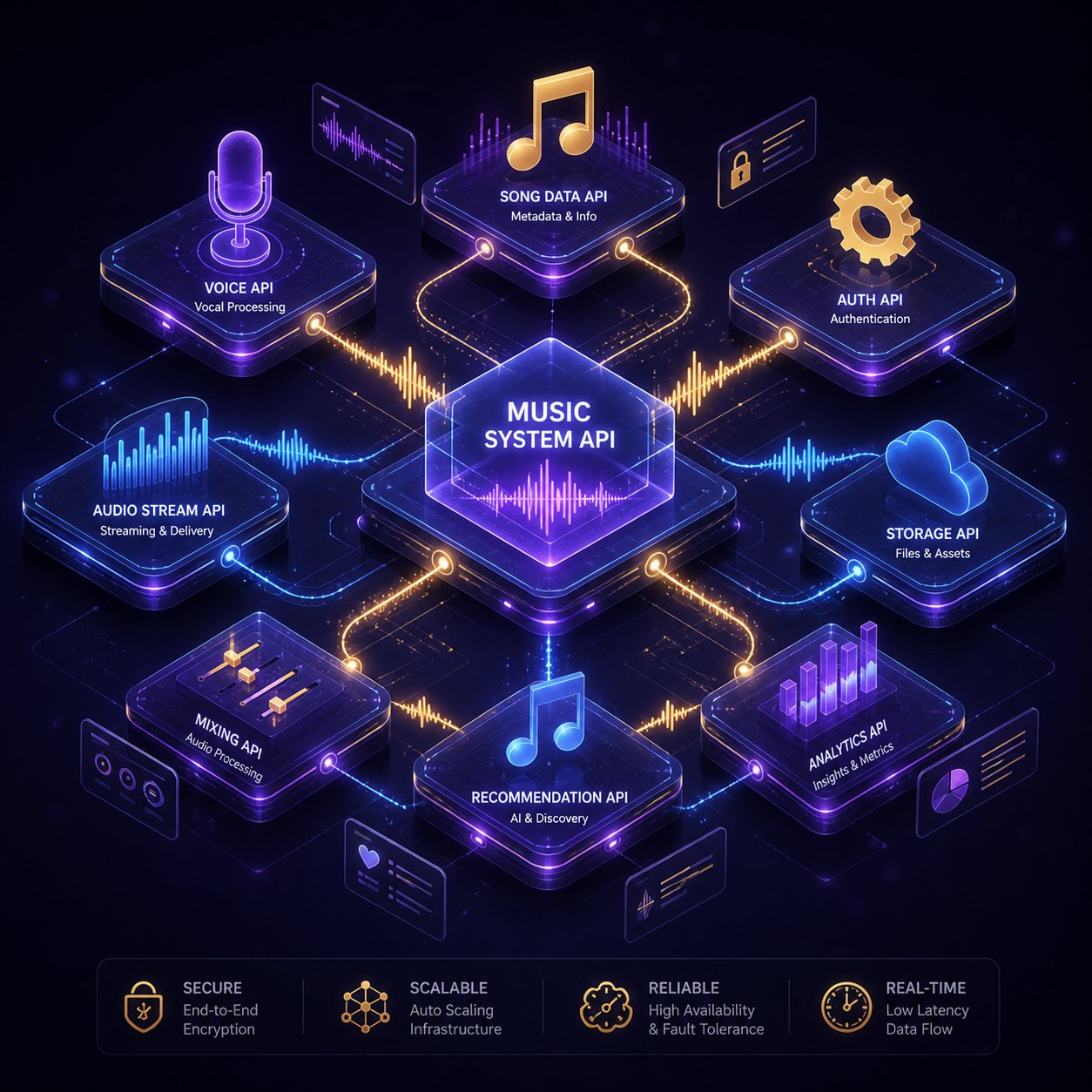
Frameworks are useful — but at some point, you need to stack real providers side by side and see how they hold up. This is the section most competitor articles rush through with shallow 150-word summaries and star ratings that tell you nothing about endpoint architecture or generation latency. Here, every provider is evaluated against the dimensions outlined in the previous section: creative control, infrastructure signals, and developer experience. The comparison table below captures the best ai music generators 2026 comparison features across the dimensions that actually decide integration choices.
| Provider | API Architecture | Authentication | Generation Latency | Max Track Duration | Style Control | Vocal Support | SDK Languages | Free Tier | Doc Quality |
|---|---|---|---|---|---|---|---|---|---|
| MakeBestMusic | Web app (prompt-to-song) | User account | Moderate | Full songs | Prompt, lyrics, style tags | Yes | N/A (browser-based) | Available | User guides |
| AI Music API | REST (async) | Bearer token | ~30 sec (Producer) | ~4 min (Sonic V5 w/ extend) | Genre, mood, tempo, lyrics, personas | Yes, multilingual | Python, JS (REST) | 30 credits, no card | Comprehensive |
| ElevenLabs Eleven Music | REST | API key (paid plan) | Moderate | 5 min | Prompt-based, multilingual lyrics | Yes, multilingual | Python, TypeScript | App free tier; API requires paid | Strong |
| Sonilo | REST (NDJSON streaming) | Bearer token | Moderate (async polling for SFX) | 6 min video input | Video-conditioned, prompt-based | Instrumental focus | Python, JS (REST) | Paid usage balance | Strong |
| Google Lyria 3 Pro | REST (Gemini API / Vertex AI) | Google Cloud API key | Moderate | 3 min | Prompt with tempo/style control | Yes, multilingual | Python, TypeScript (Gemini SDK) | Limited AI Studio testing | Google Cloud standard |
| Stable Audio 2.5 | REST | API key | Moderate | 3 min | Text-to-audio, audio-to-audio | Instrumental focus | Python (REST) | 25 free credits | Transparent |
| Loudly | REST | Developer portal key | Moderate | Configurable | Prompt, stems, catalog | Not publicly documented | REST docs | Free track allowance | Adequate |
| Mubert | REST | API token | Moderate | ~5 min (30-300 sec typical) | Tags, mood, genre | No (instrumental) | REST docs | Trial path | Basic |
A few things jump out of this table immediately. Only three providers — AI Music API, ElevenLabs, and Google Lyria — offer sung vocals through a documented public API. The two most-searched names in the space, Suno and Udio, have no public API at all. And post-generation capabilities like stem separation and MIDI extraction remain rare, with AI Music API documenting the broadest toolchain in this category. These gaps shape every integration decision you'll make when evaluating the top ai music generation tools 2026.
Leading API Providers and Their Strengths
Each provider in the table occupies a distinct niche, and choosing between them depends on what your product actually needs to do with generated audio.
AI Music API stands out for developer flexibility. It exposes three model families — Sonic (up to V5) for full songs with vocals, Riffusion for audio manipulation like vocal swap and section replace, and Producer (FUZZ-2.0, Lyria-class) for fast high-fidelity generation — all behind a single API key. The post-generation toolchain is the deepest in this comparison: 4-track and 12-track stem separation, audio-to-MIDI conversion, extend, cover, mashup, and aligned lyrics with word-level timestamps for karaoke workflows. Pricing starts at $0.08 per generation on a pay-as-you-go basis, and concurrency scales up to 200 parallel requests on the Scale plan. The ideal use case is any product that needs to generate full songs with vocals and then decompose or edit the output programmatically.
ElevenLabs Eleven Music brings a mature developer experience to the table. Already well known for voice synthesis, ElevenLabs extends that reliability to music generation with the longest single-call ceiling in this comparison — up to 5 minutes of generated audio per request. It supports multilingual vocals across English, Spanish, German, Japanese, and more, with official SDKs in Python and TypeScript. API pricing runs $0.15 per minute of generated audio, which means a 4-minute track costs roughly $0.60 — competitive for longer formats but more expensive than flat per-generation models for short clips. If you're already using ElevenLabs for voice synthesis, adding music generation through the same SDK and billing relationship is the path of least resistance.
Sonilo carves out a unique position as the only provider with native video input. Its POST /v1/video-to-music endpoint accepts a video file and generates a soundtrack aligned to runtime, pacing, scene changes, and final-frame timing — a capability no other API in this comparison documents. It also offers video-to-SFX and audio-ducking endpoints, making it the obvious choice for AI video tools, ad creative platforms, and any product where the video edit already exists and needs a fitted soundtrack. Pricing starts at $0.54/min for video-to-music and $0.135/min for text-to-music, with per-second billing and commercial use rights on generated output. The limitation is clear: Sonilo is instrumental-focused and doesn't generate vocal tracks.
Google Lyria 3 Pro offers the lowest per-track cost in the comparison — roughly $0.04 per 30-second clip and $0.08 per full song via Lyria 3 Pro. It supports multilingual vocals and integrates through the familiar Gemini API and Vertex AI infrastructure. Every output carries Google's SynthID watermark, which provides provenance tracking but may matter if your product needs unmarked audio. The natural fit is teams already deep in the Google Cloud ecosystem who want to add music generation without onboarding a new vendor. However, stems, MIDI export, and post-generation editing are not exposed through the public API.
Stable Audio 2.5 from Stability AI earns points for pricing transparency: credits cost $0.01 each, and each generation consumes 20 credits, landing at a flat $0.20 per track with 25 free credits on signup. It supports text-to-audio and audio-to-audio transformation for up to 3 minutes of stereo output. The model excels at instrumental textures, sound design elements, and production layers rather than full songs with vocals. For developers building ambient soundscape features or generative background audio, it's a cost-predictable choice.
Loudly differentiates on the enterprise side with something rare in this space: licensing indemnification. Its developer portal documents instrument stem retrieval and positions the API for copyright-safe soundtrack delivery at scale. The trade-off is pricing opacity — costs are volume-based and quote-driven, which makes budget planning harder for startups. If your legal team requires contractual indemnification for generated audio, Loudly belongs on your shortlist.
Mubert has served the functional audio niche for years, generating royalty-free instrumental music for streams, ambient apps, and fitness platforms. API access sits on the Business plan, with third-party reports placing it around $199/month. It's not built for full songs with vocals or complex post-processing — but for continuous background music at predictable volume, it remains a solid pick among top rated ai music generation tools 2026.
API Aggregators and Unified Access Layers
Not every team wants to pick a single provider and commit. API aggregators offer an alternative architecture: a single endpoint that routes requests to multiple underlying generation backends. You send the same REST call regardless of which model produces the output, switching between providers by changing a parameter in your request body.
The appeal is real. Aggregators simplify integration, reduce the number of API keys you manage, and let you A/B test outputs from different models without maintaining separate client libraries. Gateway platforms like Crazyrouter extend this concept across modalities — offering a single API key for chat, image, video, audio, and music generation from 627+ models, with unified billing and OpenAI-compatible request formats.
The trade-offs deserve honest evaluation, though. Every aggregation layer adds latency — your request travels to the aggregator, then to the underlying provider, then back through both hops on the return. You're also stacking uptime dependencies: if the aggregator goes down, you lose access to every provider it wraps. And provider-specific parameters — things like Sonilo's video-conditioned generation or AI Music API's stem separation endpoints — may not be fully exposed through a unified interface. The aggregator abstracts away provider differences, which is exactly the point, but it can also abstract away the differentiating features that made you choose a particular model.
For teams at an early evaluation stage — especially those surveying the current best ai music generation tools march 2026 landscape before committing to a single vendor — aggregators offer a low-friction way to benchmark multiple models. For production deployments where you need deep parameter control and the lowest possible latency, direct API integration with your chosen provider is typically the stronger architecture.
Where MakeBestMusic Fits in the Landscape
Here's a reality check that every honest comparison should include: not every reader of this guide actually needs to build a custom API pipeline. A significant number of people researching the best ai music generators march 2026 are technical evaluators, content team leads, or startup founders who want to experience AI music generation firsthand before investing engineering resources into a full integration.
That's exactly where MakeBestMusic's AI Music Generator App bridges the consumer-developer gap. It lets creators, musicians, marketers, and content teams turn prompts, lyrics, and style ideas into complete AI-generated songs — no API key, no code, no async webhook configuration. You describe what you want, and you get a finished track. For teams evaluating AI music generation capabilities before committing to deeper API integration, it serves as the fastest path from curiosity to concrete output.
Imagine you're a product manager building a business case for adding generative music to your platform. Before your engineering team spends weeks evaluating REST endpoints and writing integration code, you can generate sample tracks through MakeBestMusic to demonstrate the quality and creative range of AI-generated music to stakeholders. It's a practical starting point — the place where you validate the concept before choosing which API to build on.
For creators and small teams whose actual need is producing music rather than integrating an API into a codebase, MakeBestMusic is the right tool for the job. And for technical teams running evaluations, it provides an accessible benchmark: generate tracks here first, then compare the output quality against what you get from the developer-grade APIs above.
Knowing which provider fits your use case is half the decision. The other half — the one that often surprises teams after they've already started building — is understanding the true cost at your expected usage volume, where pricing models that look similar on the surface can diverge dramatically at scale.
API Pricing Breakdown and Total Cost Modeling
Provider feature lists can look nearly identical until you run the numbers at your expected usage volume. A pricing model that seems cheap for 20 generations a month can quietly become the most expensive option at 2,000 — and the reverse is equally true. This is the transparency gap that trips up most teams evaluating ai music production tools 2026: every provider structures costs differently, and no one normalizes them into an apples-to-apples comparison. Let's fix that.
Understanding API Pricing Models
Across the current landscape of best ai tools for music production 2026, you'll encounter four dominant pricing structures — and each one changes how you should think about budgeting:
- Per-generation flat fee — You pay a fixed amount every time you trigger a generation, regardless of how long the output track is. AI Music API uses this model at $0.08 per generation, and Stable Audio 2.5 charges $0.20 per generation. This structure is predictable and favors short-form content like jingles or sound design clips, where you get the same cost whether the output is 15 seconds or 3 minutes.
- Per-minute-of-audio pricing — You pay based on the duration of the generated output. ElevenLabs Eleven Music charges $0.15 per minute of generated audio. This model penalizes longer tracks: a 4-minute song costs roughly $0.60, while a 30-second clip costs under $0.08. If your product generates mostly short clips, per-minute pricing can actually undercut flat-fee models — but it scales unfavorably for full-length tracks.
- Credit-based systems — You purchase credits in bundles, and each generation consumes a set number. Stability AI sells credits at $0.01 each, with each generation costing 20 credits. The math works out to a flat per-generation fee in practice, but credit expiration policies and minimum purchase amounts add complexity.
- Subscription tiers with included generations — You pay a monthly fee that includes a fixed generation allotment, with overage charges beyond that cap. Mubert's API access reportedly sits on a ~$199/month Business plan. Loudly uses volume-based tiers that require a sales conversation to price out. Subscriptions favor consistent, predictable usage — but they're wasteful if your generation volume fluctuates month to month.
Duration is the hidden variable that makes direct comparison tricky. Generating a 30-second clip versus a 3-minute track can mean a 6x cost difference on per-minute models while costing exactly the same on a flat-fee model. Always calculate cost at your actual average track length, not at the provider's example duration.
Cost Modeling for Different Usage Volumes
To cut through the noise, the table below normalizes costs across providers at three usage tiers. Where specific pricing data is publicly documented, those numbers are used directly. Where providers require custom quotes, the table reflects that limitation — because hiding behind a "contact sales" wall is itself a data point worth noting when comparing the best ai music production tools 2026.
| Provider | Free Tier | Cost Per Generation | Cost Per Minute of Audio (est.) | Rate Limit | Overage Policy |
|---|---|---|---|---|---|
| AI Music API | 30 credits, no card | From $0.08 (pay-as-you-go) | ~$0.02-0.08 (flat fee, duration-independent) | Up to 200 concurrent (Scale plan) | Pay-as-you-go, no overage surcharge |
| ElevenLabs Eleven Music | App free tier; API requires paid plan | Duration-based ($0.15/min) | $0.15/min | Tied to subscription tier | Overages billed; minutes shared across all ElevenLabs features |
| Google Lyria 3 Pro | Limited AI Studio testing | ~$0.04 (30 sec) / ~$0.08 (full song) | ~$0.04-0.08 (estimated) | Google Cloud rate limits | Google Cloud billing |
| Stable Audio 2.5 | 25 free credits | $0.20 (20 credits) | ~$0.07-0.20 (flat fee, up to 3 min) | Standard platform limits | Credit purchase required |
| Loudly | Free track allowance | Quote required | Quote required | Tier-dependent | Volume-based, negotiated |
| Mubert | 25 tracks/mo (consumer app) | ~$199/mo subscription (API) | Varies by plan usage | Plan-dependent | Subscription overage terms |
Here's where the math gets interesting. At the Hobby tier — say, 50 generations per month of 2-minute tracks — AI Music API costs roughly $4/month, Google Lyria runs about $4 as well, Stable Audio lands at $10, and ElevenLabs comes in around $15. At the Startup tier of 500 monthly generations, those numbers shift to roughly $40, $40, $100, and $150 respectively. And at Enterprise scale with 2,000+ generations, the gap widens further. Per-generation flat fees maintain linear scaling, while per-minute models and subscription caps start triggering overage charges or tier upgrades that reshape the total cost curve.
For teams evaluating the best free ai music generation tools 2026, the free tiers themselves deserve scrutiny. AI Music API's 30 free credits let you test roughly 3 full generations with no card on file — enough to validate output quality. Stable Audio's 25 credits cover one generation. Google AI Studio allows limited free testing. These free tiers are valuable for benchmarking, but none of them sustain ongoing production use, so treat them as evaluation tools rather than long-term solutions.
Hidden Costs and Budget Traps
The sticker price per generation is only the starting point. Production deployments regularly encounter costs that never appear on a provider's pricing page — and these hidden expenses can quietly double your effective cost per track if you're not planning for them. Among the top ai music production tools 2026, these budget traps are consistent enough to warrant a checklist:
- Overage charges beyond rate limits — Some providers throttle requests once you exceed your plan's allotment; others charge punitive per-generation overage fees. Know which model your provider uses before you hit a usage spike.
- Storage fees for generated assets — Does the provider host your generated tracks indefinitely, or do they expire after a retention window? If tracks expire, you need your own storage infrastructure — and that's an additional line item.
- Re-generation and variation costs — Generating three variations of a track to pick the best one means paying three times. If your product workflow involves iterative refinement, your effective cost per final track is a multiple of the per-generation price.
- Premium charges for commercial licensing — Several providers offer lower prices on tiers that restrict output to personal or non-commercial use. Full commercial rights — the kind you need to ship a product — often require a higher-priced plan. AIVA, for example, only grants full copyright ownership on its Pro plan at €49/month through the web app, with API access requiring a separately negotiated agreement.
- Shared minute pools — ElevenLabs draws music generation minutes from the same pool as voice synthesis and dubbing. If your team also uses their TTS or voice cloning features, music generation competes for the same allotment, effectively raising per-track cost.
- Watermarking on lower tiers — Google Lyria outputs carry a SynthID watermark regardless of tier. Other providers watermark free-tier output but not paid output. Confirm whether your chosen tier delivers clean, unmarked audio.
Before you commit to any provider, answer these budget planning questions honestly: What's your realistic monthly generation volume, including re-generations and variations? What's your average target track duration? Do you need commercial licensing on every output or only a subset? Will you store generated assets on the provider's infrastructure or your own? And are you using other features from the same provider that share your usage allotment?
Getting pricing right is a financial exercise — but the next challenge is an architectural one. When your production pipeline needs more than a single provider can deliver, the question shifts from "how much does each API cost?" to "how do I orchestrate multiple APIs into a reliable, fault-tolerant system?"
Building a Production Pipeline with Multiple APIs
Relying on a single API to handle every stage of music generation sounds clean on a whiteboard — but it rarely survives contact with production requirements. One provider might excel at melody composition, another at vocal synthesis, and a third at mastering or stem enhancement. The teams building the most capable products in 2026 aren't choosing one provider. They're orchestrating several into a pipeline where each API handles the stage it does best. This multi-API approach is standard practice in other generative media domains — enterprise production deployments now use a median of 14 different models across text, image, video, and audio, according to the State of Generative Media 2026 report from a16z and fal. Music pipelines are following the same trajectory.
The Multi-API Architecture Pattern
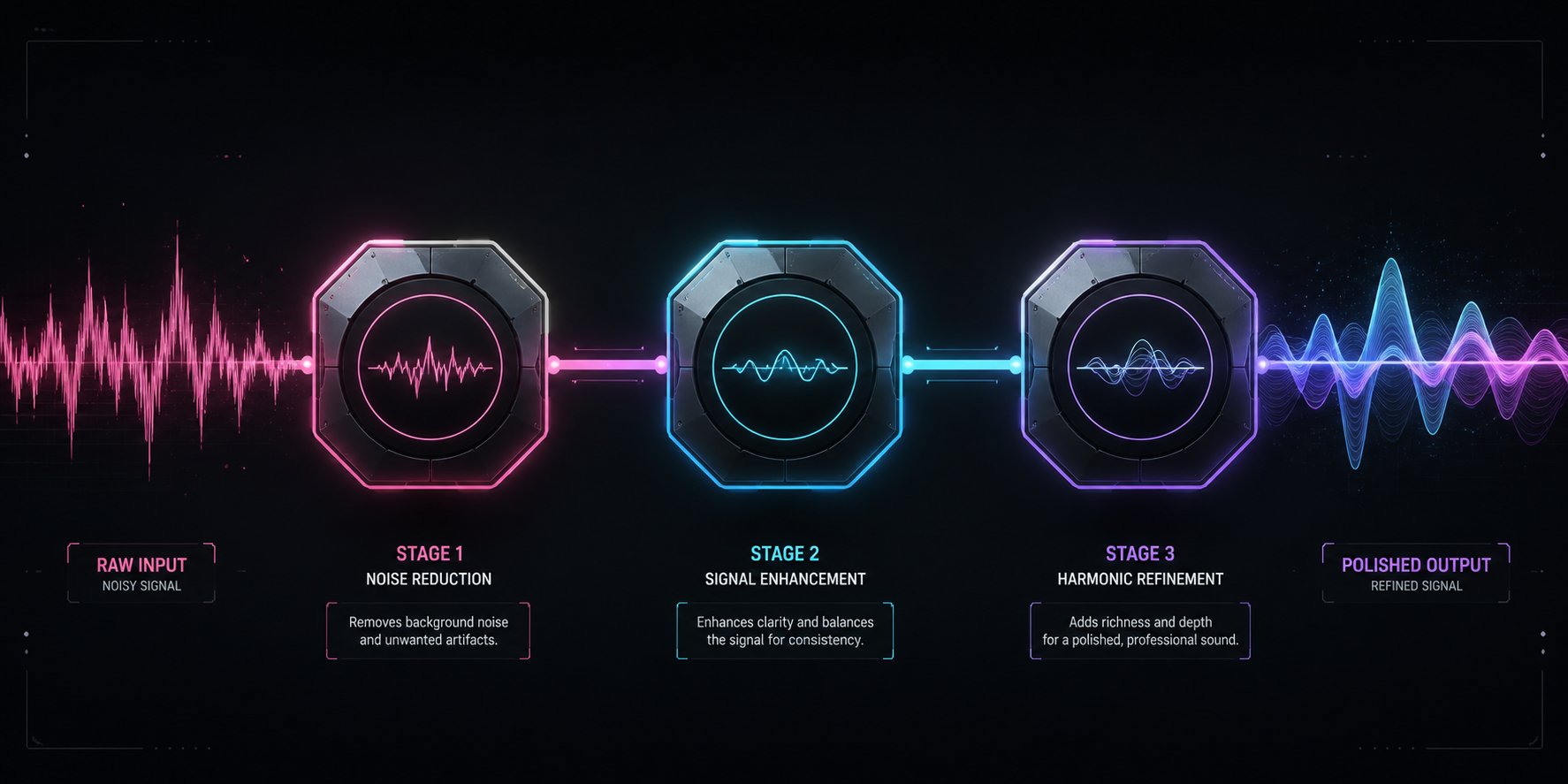
Why would you chain multiple APIs instead of picking the best all-in-one option? Because specialization wins at every stage. Consider a realistic pipeline: you use one of the best ai music composition tools 2026 to generate a base instrumental track from a text prompt, route the output to a vocal synthesis API that layers sung lyrics over the melody, then pass the combined audio through one of the best ai voice enhancement tools for music production 2026 for mastering, loudness normalization, and final polish. Each provider handles the task it was purpose-built for, and the result is higher quality than any single endpoint could deliver alone.
Three orchestration patterns dominate how teams wire these stages together:
- Sequential pipeline — Each stage feeds its output directly into the next. Simple to reason about, but total latency is the sum of every individual stage. A composition step taking 45 seconds, followed by a vocal synthesis step at 30 seconds, followed by mastering at 15 seconds, gives you a 90-second minimum end-to-end wait. This pattern fits workflows where each step strictly depends on the previous output.
- Parallel generation with selection — You fire requests to multiple ai music composition tools 2026 simultaneously, then select the best result before passing it downstream. This is ideal when you want to A/B test providers or generate creative variations, though it multiplies your API costs proportionally. Teams searching for the best ai tools to generate melody over existing beat 2026 often use this pattern to compare outputs from different melodic models before committing to a single track.
- Hybrid approach — Independent stages run in parallel while dependent stages run sequentially. Melody generation and lyric alignment might happen simultaneously since neither depends on the other, but vocal synthesis waits for both to finish. This pattern, which mirrors how production orchestration layers handle dependency graphs in video pipelines, offers the best balance of speed and reliability.
The pattern you choose directly shapes your latency budget, error handling complexity, and monthly API spend. Sequential is easiest to debug. Parallel is fastest. Hybrid demands the most architectural discipline — but delivers both speed and quality when implemented correctly.
Handling Async Generation and Queue Management
Every music generation API covered in this guide operates asynchronously. You submit a request, receive a job ID, and wait for completion. When your pipeline chains two or three async APIs in sequence, managing that waiting becomes the core engineering challenge. A single-provider integration can tolerate naive polling. A multi-step pipeline cannot.
The first decision is polling versus webhook callbacks. Polling means your server repeatedly hits a status endpoint — simple to implement, but wasteful at scale and introduces latency between completion and detection. Webhooks flip the model: the provider calls your endpoint the moment generation finishes, eliminating wasted cycles. For multi-API pipelines, webhooks are almost always the right choice because each stage's completion event can immediately trigger the next stage's submission.
Real-world pipelines need more than just "submit and wait," though. Peak-hour queue congestion, provider-side timeouts, and partial failures across stages all require explicit handling strategies. Here's a recommended sequence for building a resilient async generation workflow:
- Submit the generation request and store the returned job ID alongside your internal pipeline state (stage number, input parameters, timestamp).
- Register a webhook callback URL with the provider — or, if webhooks aren't supported, initiate polling with an initial delay matching the provider's typical generation time.
- Set a hard timeout per stage. If a composition API typically returns in 45 seconds, set your timeout at 120 seconds. Beyond that threshold, treat the job as failed rather than waiting indefinitely.
- Implement retry logic with exponential backoff. A first retry at 5 seconds, a second at 15, a third at 45. Cap retries at three attempts per stage to avoid runaway costs from stuck jobs.
- Handle partial failures at the stage level, not the pipeline level. If vocal synthesis fails but composition succeeded, don't discard the composition output — cache it and retry only the failed stage.
- Log every state transition with timestamps. When debugging a pipeline that processes hundreds of tracks daily, the difference between "it failed" and "vocal synthesis timed out after 120 seconds on the third retry at 02:14 UTC" is the difference between guessing and fixing.
- Implement a dead-letter queue for jobs that exhaust all retries. Review these failures periodically to identify systemic issues — a spike in dead-letter entries for one provider often signals an upstream capacity problem before the provider's own status page acknowledges it.
This workflow applies whether you're building a pipeline for the best ai songwriting tools 2026 or orchestrating sound design assets for a game engine. The async patterns are universal; only the payloads change.
Reducing Vendor Lock-In and Migration Planning
A multi-API architecture introduces a risk that single-provider setups avoid: you're now dependent on multiple vendors simultaneously, and any one of them can change pricing, deprecate endpoints, or alter model behavior on their own schedule. Documented cases from other AI domains show this isn't hypothetical — DeepSeek scheduled model deprecation for July 2026, and Anthropic's Claude Sonnet 5 pricing stepped up 50% on September 1, 2026. Music API providers operate under the same dynamics.
The mitigation strategy starts with an abstraction layer. Design your pipeline so that each stage calls a normalized internal interface — not the provider's endpoint directly. When you want to swap your composition backend from one provider to another, you change the adapter behind that interface. Your pipeline logic, error handling, and downstream stages never need to know the switch happened.
Generative AI introduces lock-in risks that go beyond standard API dependencies:
- Proprietary style parameters — A genre taxonomy or mood tag system that works on one API may not map to another provider's parameter schema. Document your parameter mappings explicitly so migration means updating a mapping file, not rewriting prompt engineering logic.
- Non-portable seed values — Seed-based reproducibility is provider-specific. A seed that produces a particular melody on one model produces something completely different on another. If your product depends on reproducible outputs, plan for re-validation during any migration.
- Provider-specific audio fingerprinting — Some providers embed metadata or watermarks (like Google's SynthID) in generated audio. Switching providers changes the fingerprint characteristics of your output, which may affect downstream content identification systems.
The strongest hedge against lock-in is practical: keep a secondary provider wired in and periodically warm. Running even 5% of your generation volume through an alternate backend means you've already validated the integration path before you ever need it under pressure. Teams that only discover migration friction during a forced deadline — when a provider deprecates the model they depend on — face all five friction points simultaneously, under a timeline they didn't choose.
Standardize your input and output formats around common audio specifications (WAV at 44.1kHz/16-bit, for example) rather than accepting whatever default each provider returns. This ensures downstream stages in your pipeline are format-agnostic, and swapping an upstream provider never breaks a downstream consumer.
Architecture and vendor strategy protect the engineering side of your pipeline. But there's an equally consequential dimension that most technical teams defer until it's too late — and that's the legal question of who actually owns the music your pipeline generates, and what you're allowed to do with it commercially.
Licensing, IP Rights, and Compliance for Generated Music
Your pipeline is architected, your providers are chosen, and your async workflows are humming. But here's a question that can unravel everything: do you actually own the tracks your system produces? And can you legally monetize them? Most developer-focused guides treat licensing as a footnote — a paragraph at the bottom of a comparison table. For anyone building commercial products with the best ai music generation apis 2026, though, IP ownership and compliance aren't footnotes. They're foundational decisions that determine whether your product can ship, scale, and generate revenue without legal exposure.
Who Owns the Output and Can You Monetize It
IP ownership terms vary dramatically across providers — and the differences often hide inside terms of service that few developers read before committing to an integration. Some providers grant full commercial rights on paid tiers but restrict free-tier output to personal, non-commercial use. Others retain partial rights or require attribution. A few grant ownership outright the moment you pay for generation.
The legal landscape itself adds complexity. Under current copyright doctrine in most jurisdictions, an AI cannot be an author. As heyData's 2026 compliance analysis notes, the concept of "personal intellectual creation" means that where no human engaged in creative activity, there may be no copyright at all. This creates an uncomfortable gray area: your API-generated track might not be copyrightable by you — but it might still infringe someone else's copyright if the underlying model was trained on protected works.
Content ID risks add a practical layer to this legal uncertainty. Platforms like YouTube and Spotify use audio fingerprinting systems to detect matches against registered works. If your AI-generated track shares enough sonic similarity with a track in the Content ID database — even coincidentally — it can trigger a claim, demonetize your content, or redirect revenue to a third party. Different providers handle this differently: some, like Loudly, offer licensing indemnification that protects you from such claims. Others explicitly disclaim any liability, placing the full risk on the user who generated the content.
For anyone pursuing the fastest timeline to release and monetize a first song as an ai music artist in 2026, understanding this ownership chain isn't optional — it's the difference between building on solid ground and building on sand. A legal-technical analysis of AI music generation systems published in mid-2026 highlights that unauthorized lyric copying poses a high risk of composition infringement, while AI-generated vocal imitations typically fall outside federal sound recording protection and instead trigger state-level publicity rights claims. The practical implication: even if you own the generated output under your provider's terms, you're still exposed if the model's training data or your prompt inputs touch protected material.
Data Privacy and Content Moderation Policies
Ownership is one dimension. Data handling is another — and for developers serving EU users, it's a compliance obligation with real enforcement teeth. The EU AI Act, now fully in force, requires transparency about AI usage and imposes obligations on how AI systems process user data. When your application sends a user's custom lyrics or style preferences to a third-party music generation API, you're transmitting personal data through an external processor. That raises GDPR questions your legal team will want answered before you ship.
Most API providers are vague on these specifics, which is exactly why you need to ask explicitly. Before integrating any provider into a product that handles user-generated input, work through this compliance checklist:
- Does the API provider store user prompts, and if so, for how long? Some providers retain prompts for model improvement; others delete them after generation completes.
- Where are generation servers physically located? Data residency matters for GDPR compliance — if your EU users' prompts are processed on servers outside the EEA without adequate safeguards, you have a transfer risk.
- Are user prompts or generated outputs used to train or fine-tune the provider's models? If so, does the user have the ability to opt out?
- What content moderation filters exist? Can the API reject prompts that reference real artists, copyrighted lyrics, or explicit content — and how are rejections communicated in the API response?
- Does the provider offer a Data Processing Agreement (DPA) that meets GDPR requirements for controller-processor relationships?
- How does the provider handle data subject access requests (DSARs)? If a user asks you to delete their data, can you ensure the API provider also purges their prompts and generated audio?
These aren't theoretical concerns. The Soundverse legal checklist for commercial AI music use emphasizes that transparency and traceability are now pivotal for any commercial music production workflow — and that companies using AI-generated music without proper compliance measures risk reputational damage and financial penalties. For top professional ai music generation tools 2026, the providers that publish clear data handling policies, offer DPAs, and document their content moderation logic are signaling production readiness. The ones that don't are asking you to take on compliance risk they won't share.
Commercial Licensing Tier Differences
Even within a single provider, licensing terms can shift dramatically between pricing tiers — and these shifts directly affect what you're allowed to do with the generated audio. The distinction isn't just about cost; it's about legal permission.
Here's how the tiers typically break down:
- Free tier — Most providers restrict free-tier output to personal, non-commercial use. Some add audio watermarks or metadata tags that identify the track as AI-generated. Distributing free-tier output commercially, even if technically possible, often violates the terms of service and exposes you to takedown claims.
- Pro or paid tier — Commercial use rights typically unlock here, but the scope varies. Some providers grant full ownership and commercial distribution rights. Others permit commercial use but retain a non-exclusive license to the output — meaning they could theoretically feature your generated track in their own marketing or sample library.
- Enterprise tier — This is where synchronization rights, broadcast distribution rights, and indemnification clauses usually appear. Enterprise agreements may also grant the right to register generated music with performance rights organizations (PROs) like ASCAP or BMI — a capability that lower tiers almost universally exclude.
The distinction between synchronization rights (using music in video, ads, or film) and distribution rights (releasing music on streaming platforms) matters here. A Pro tier might grant distribution rights but explicitly exclude sync licensing, which means you can release a track on Spotify but can't legally use it in a commercial video. These nuances are easy to miss and expensive to discover after the fact. Developers evaluating the best ai music generators for professionals 2025 2026 need to read licensing terms at the tier they'll actually use — not at the tier they're testing on.
One final warning: terms of service can change. Providers update their licensing language, sometimes retroactively altering what you're allowed to do with tracks you've already generated. For enterprise deployments, contractual protections matter more than terms-of-service pages. Negotiate a master services agreement that locks in licensing terms for a defined period, includes an indemnification clause covering IP claims against your generated output, and specifies what happens to your rights if the provider changes ownership, pivots its business model, or shuts down. Among the best free ai music generators 2026 and paid providers alike, the ones willing to sign custom agreements for enterprise customers are the ones treating commercial deployment seriously.
Legal clarity protects your business — but it doesn't help your engineering team ship faster. The next challenge is the one developers actually spend their days on: writing the integration code, handling the errors that real-world API calls inevitably throw, and building quality assurance into a pipeline that produces something as subjective as music.
Integration Patterns, Error Handling, and Developer Experience
Legal terms are signed. Provider selection is done. Your engineering team opens a code editor — and hits the same question every developer faces on day one: what does a real integration actually look like from request to response? Competing articles stop at feature tables. This section picks up where they leave off, walking through the practical integration flow, documenting the failure modes your team will encounter in production, and covering the quality assurance strategies that separate a demo from a shippable product. If you're evaluating the best ai music generation software 2026, this is the part that tells you what building with it actually feels like.
What a Typical API Integration Looks Like
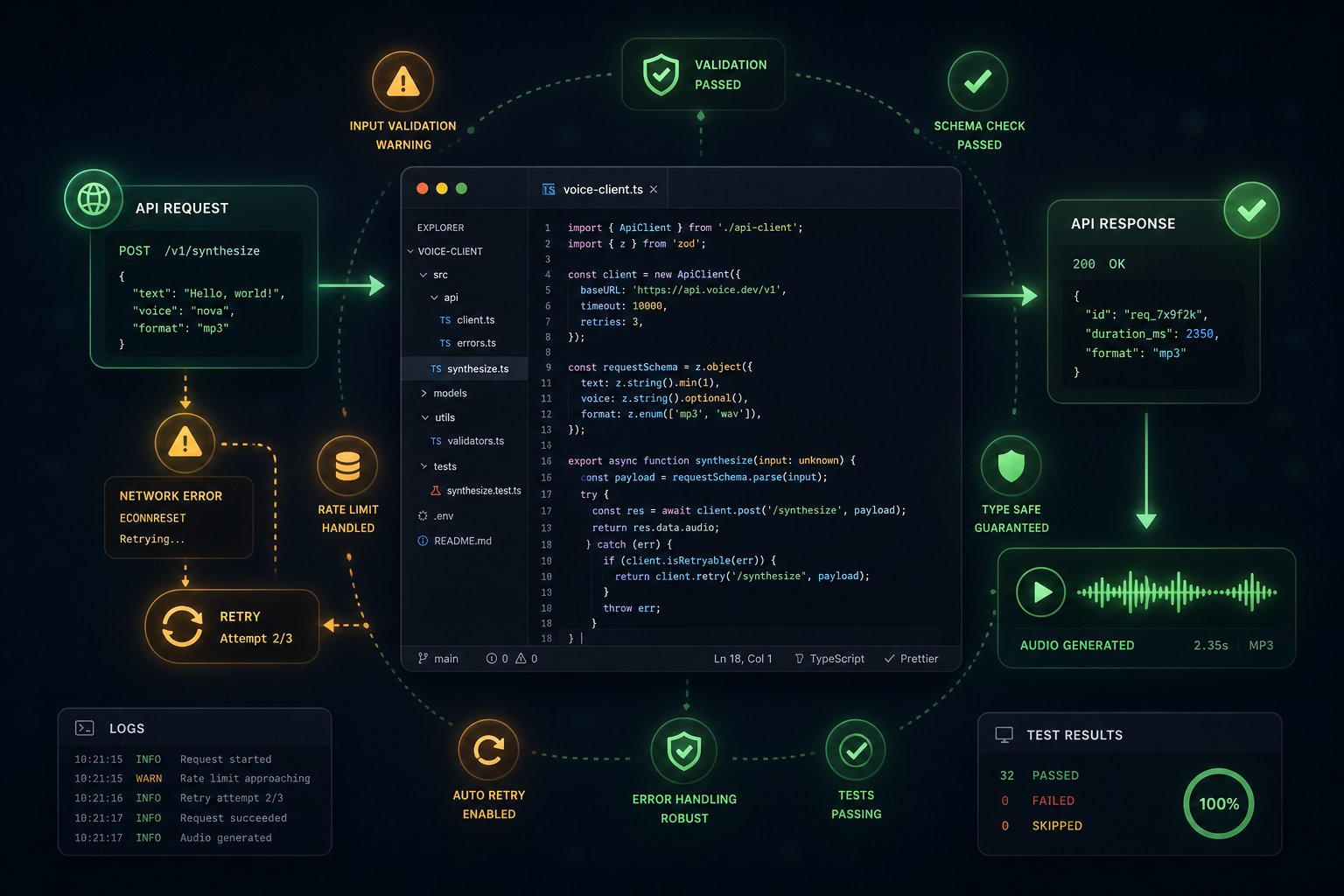
Despite surface-level differences between providers, nearly every AI music generation API follows the same core workflow. You'll recognize the pattern if you've integrated any async API — but a few music-specific details deserve attention.
The flow breaks down into five steps:
- Obtain an API key. Register with the provider, generate a key, and store it securely as an environment variable — never hardcoded. Most providers authenticate via a header like
X-API-KeyorAuthorization: Bearer. - Construct a generation request. Build a JSON payload specifying your parameters: genre or style tags, mood, tempo, duration, whether you want vocals or an instrumental, and optionally custom lyrics. A representative request to a REST endpoint looks like this:
POST /v2/music/generate
{"prompt": "upbeat electronic track with synth arpeggios", "model": "your-chosen-model", "style": "electronic, synthwave", "instrumental": false, "duration": 120}
- Submit and receive a job ID. The API responds immediately — not with audio, but with a job identifier and a status of
QUEUED. Generation is asynchronous because producing a full track takes anywhere from 30 seconds to several minutes depending on the model and duration. Apiframe's integration guide confirms this pattern: you get ajobIdback instantly, then track its progress through status transitions fromQUEUEDtoPROCESSINGtoCOMPLETED. - Handle async completion. You have two options. Polling means hitting a status endpoint on a timer until the job completes — simple but wasteful at scale. Webhooks mean registering a callback URL where the provider sends a POST request the moment your track is ready. For any ai music generation tools comparison 2026 evaluation, webhook support should be a hard requirement for production use. Polling a few thousand jobs a day adds unnecessary load on both sides.
- Retrieve and process the output. Once the job status flips to
COMPLETED, the response includes an array of audio file URLs (typically MP3), along with metadata like title, duration, and style tags. Some providers — Suno through Apiframe, for instance — generate two tracks per request, letting you pick the stronger take without submitting a second job.
This five-step pattern is consistent across the ai tools for music production 2026 landscape. The differences between providers show up in parameter schemas, latency ranges, and post-generation capabilities — not in the fundamental request-response architecture.
Common Errors and Failure Modes
Here's what no competitor article tells you: the real-world issues your team will debug at midnight when generation starts failing. AI systems fail differently than traditional APIs. As Grizzly Peak Software's production AI error handling guide puts it, "an AI model can return a perfectly valid HTTP 200 response containing output that is completely wrong." Music generation adds its own failure taxonomy on top of standard HTTP errors.
| Error Type | Typical Cause | Recommended Workaround |
|---|---|---|
| Rate limit exceeded (429) | Too many concurrent requests for your plan tier; burst traffic during peak hours | Implement exponential backoff with jitter. Respect the retry-after header. Queue requests internally before hitting the API. |
| Generation timeout | Complex prompts with multiple style parameters or long duration requests overwhelming the model | Set generous timeouts (60-120 seconds vs. typical API calls). Cap retries at 3 attempts per job. Cache successful outputs to avoid re-generating identical requests. |
| Audio quality degradation | Longer durations (3+ minutes) pushing past the model's optimal output window; provider under heavy load returning subtly lower-quality results | Break long tracks into segments using extend/continuation endpoints. Monitor output duration and spectral characteristics programmatically. Under load, quality drops may produce no error code — only shorter or more generic output. |
| Style parameter conflict | Contradictory parameters (e.g., "acoustic folk" genre with "heavy bass drop" mood) confusing the model's conditioning | Validate parameter combinations before submission. Build an internal compatibility matrix for your most-used style and mood pairings. |
| Queue rejection | Provider's generation queue is full during peak usage; no capacity to accept new jobs | Implement a circuit breaker pattern that stops sending requests after repeated rejections. Route overflow to a secondary provider if you've built a multi-API pipeline. |
| Content filter block | Prompt or lyrics triggered the provider's safety filter — references to real artists, explicit content, or copyrighted material | Non-retriable with the same input. Modify the prompt and resubmit. Pre-screen user-generated prompts before passing them to the API. |
| Partial or truncated output | Generation interrupted mid-process; network failure between provider CDN and your server | Validate returned audio file duration against requested duration. If truncated, retry the job. Don't serve partial audio to end users without explicit duration checks. |
Two patterns from the broader AI error handling discipline apply directly here. First, circuit breakers: if a provider returns five consecutive failures within a monitoring window, stop sending requests and let the provider recover rather than hammering a struggling service. Second, graceful degradation chains — when your primary generation path fails, fall back to a simpler model, then to cached output, then to a static placeholder track. The key insight from production AI systems is that not all errors deserve a retry. Content filter blocks are non-retriable. Timeouts are retriable with backoff. Quality degradation is retriable with modified parameters (like slightly raising the temperature or adjusting style tags). Classifying errors before deciding how to handle them is the difference between a robust pipeline and one that burns through credits retrying hopeless requests.
For teams tracking ai music production tools 2026 news, it's worth noting that several providers now refund credits automatically for failed generations — a practice that signals maturity. Confirm whether your chosen provider does this before building cost assumptions around 100% billable success rates.
Testing and Quality Assurance Strategies
Music is subjective. A track one listener calls "moody and atmospheric," another calls "boring." That subjectivity makes quality assurance harder than testing a JSON response schema — but it doesn't make it impossible. You need both automated checks for objective audio properties and structured human evaluation for the subjective dimensions.
Start with the automated layer. These checks can run in your CI/CD pipeline or as post-generation validation before serving output to users:
- Duration validation — Compare the audio file's actual duration against the requested duration. A 30-second track when you requested 2 minutes indicates a generation failure the API may not have flagged. This is the simplest and most valuable check.
- Silence detection — Scan the waveform for extended silent segments. More than 2-3 seconds of silence in the middle of a track usually signals a generation artifact, not an intentional musical pause. Tools like FFmpeg's
silencedetectfilter make this trivial to automate. - Clipping detection — Check for samples that hit the maximum amplitude ceiling. Clipping produces audible distortion and indicates the generation output wasn't properly normalized. Analyze peak levels and flag any track where amplitude consistently hits 0 dBFS.
- Format and encoding validation — Confirm the returned file matches the expected codec, sample rate, and channel count. A stereo request that returns mono audio breaks downstream mixing workflows silently.
The subjective layer requires human evaluation — but you can structure it rigorously. Borrowing from audio quality testing methodology used in voice AI, apply a Mean Opinion Score (MOS) framework: have evaluators rate generated tracks on a 1-5 scale across dimensions like genre accuracy, production quality, vocal clarity (if applicable), and overall musicality. A MOS above 4.0 generally indicates quality suitable for commercial deployment. Track these scores over time to catch model regressions — a provider update that silently degrades output quality won't show up in your error logs, but it will show up in declining MOS trends.
For teams running the best ai music creation software 2026 evaluations, A/B testing offers a practical framework for comparing providers. Generate the same prompt across two or three APIs, run both automated checks and MOS evaluations on the outputs, and track which provider wins on which prompt types. You'll quickly discover that no single provider dominates across all genres and styles — which loops back to the multi-API pipeline architecture covered earlier.
Combine automated validation with structured human scoring, and you have a quality assurance pipeline that catches both objective failures and subjective regressions. The automated checks gate bad output before users see it. The MOS scoring reveals trends your error logs never will. Together, they turn ai music generation into a testable, measurable feature rather than a black box you hope works correctly.
With integration patterns understood, errors classified, and quality checks in place, the remaining question is the most practical one: which API should your specific project actually use? That answer depends less on which provider is "best" in the abstract and more on which one fits your particular use case, team, and timeline.
Choosing the Right AI Music API for Your Project
You've seen the evaluation framework, compared providers head-to-head, modeled costs at scale, and mapped out production pipeline patterns. The question that remains isn't "which API is objectively best" — it's "which one fits what I'm actually building?" That answer varies dramatically depending on whether you're shipping a mobile app feature, automating podcast intros, or generating thousands of marketing tracks per month. Let's match the most common project profiles to the provider characteristics that serve them best.
Matching Your Use Case to the Right API
Every integration decision boils down to a handful of non-negotiable requirements shaped by your product category. The table below maps five common use cases to the API characteristics and provider types that fit them — giving you a shortcut through the evaluation process covered in earlier sections.
| Use Case | Critical API Requirements | Recommended Provider Types | Why This Fit Works |
|---|---|---|---|
| Content platform integration | Webhook callbacks, high concurrency, commercial licensing, batch generation | MakeBestMusic for rapid prototyping and stakeholder demos; AI Music API or ElevenLabs for production endpoints | Content platforms need both quick proof-of-concept tracks and scalable API pipelines — starting with MakeBestMusic lets you validate creative output before committing engineering resources |
| Mobile app music feature | Low latency, lightweight SDKs, per-generation pricing, instrumental + vocal options | AI Music API (broad model selection, pay-as-you-go), Google Lyria 3 Pro (lowest per-track cost) | Mobile budgets are tight per-user; flat per-generation fees keep unit economics predictable |
| Marketing audio generation | Short-form output (15-60 sec), fast turnaround, commercial rights on all tiers, style variety | MakeBestMusic for marketing teams generating directly; Stable Audio 2.5 or AI Music API for programmatic campaigns | Marketing teams often need tracks faster than an API integration can ship — MakeBestMusic bridges that gap immediately |
| Game soundtrack automation | Instrumental generation, loop-friendly output, real-time or near-real-time latency, mood conditioning | Mubert (dynamic background audio), AI Music API (stem separation for adaptive layering) | Games need seamless loops and mood shifts — providers with tag-based conditioning and stem output serve this best |
| Podcast intro/outro creation | Short duration, vocal optional, simple prompt interface, low volume pricing | MakeBestMusic for one-off creation; Stable Audio 2.5 for API-driven batch generation | Most podcasters need a handful of tracks, not an API — a prompt-to-song tool is the right level of complexity |
Notice a pattern in that table. For three out of five use cases, the fastest path to a usable track isn't an API integration at all — it's a prompt-to-song tool that produces finished output without writing code. That observation matters, because a significant share of people researching the best ai music generator 2026 aren't developers building pipelines. They're creators, team leads, and evaluators who need music right now.
For Creators and Teams Who Need Music Now, Not an API
Here's a question worth asking honestly: do you actually need an API, or do you need a song? If you're a musician exploring AI-assisted composition, a marketer producing ad soundtracks, a content creator building a YouTube channel, or a startup founder wondering how to start ai music production for beginners 2026 — the answer is probably the song. Building a custom API integration to generate a single track is like renting a crane to hang a picture frame.
For these readers, MakeBestMusic's AI Music Generator App is the most direct path from idea to finished track. You describe your vision through prompts, paste in lyrics, select a style direction, and receive a complete AI-generated song — vocals included. No API key. No webhook configuration. No async polling loop. Just a creative tool that turns your input into music.
This isn't a consolation prize for non-technical readers. It's genuinely the right tool for the job when your goal is producing music rather than integrating a generation endpoint into a codebase. Among the best ai music generators for creators 2026, the ones that eliminate friction between idea and output deliver the most value for people whose core skill is creativity, not systems architecture. MakeBestMusic fits that description precisely — and it doubles as a practical evaluation tool for technical teams. Generate sample tracks here first to demonstrate quality to stakeholders, then decide whether your product needs the deeper control that a developer API provides.
For the best ai music generators for professionals 2026, the decision tree is straightforward. If your workflow involves code, CI/CD pipelines, and programmatic generation at scale, choose from the developer-grade APIs compared in earlier sections. If your workflow involves a creative brief and a deadline, start with MakeBestMusic and ship the track today. Many teams discover that the best ai music generation apps 2026 for their situation is a combination of both: a prompt-to-song tool for ad hoc creative work and an API integration for automated, high-volume generation.
Future-Proofing Your Integration Decision
Whichever path you choose, one thing is certain: the landscape will look different in six months. New models will launch. Pricing will shift. Providers will add capabilities — or deprecate them. The question what is best ai music generator doesn't have a permanent answer; it has a contextual one that changes as the ecosystem evolves.
The model-agnostic architecture approach outlined by enterprise AI infrastructure teams applies directly here: treat model selection as a configuration decision, not an architectural constraint. If swapping your music generation provider requires rewriting your pipeline, you've built in a fragility that will cost you every time the market shifts. If it requires changing a config file, you've built resilience.
Three practical habits keep your integration current without demanding constant re-evaluation:
- Follow provider changelogs — Subscribe to release notes and deprecation announcements from every provider in your stack. A changelog entry today is a migration deadline six months from now.
- Maintain your abstraction layer — The normalized internal interface discussed in the pipeline architecture section isn't just a migration tool. It's an evaluation tool. When a new provider launches, you can wire it into your abstraction layer and benchmark it against your current provider without touching production code.
- Schedule quarterly re-evaluations — Block time every quarter to regenerate your benchmark prompts across current and emerging providers. Compare output quality, latency, and cost. The best ai music generator apps 2026 won't necessarily be the best options by year's end — and the teams that catch the shift early gain a competitive edge.
The AI music generation API space is maturing fast. Providers that barely had documentation six months ago now ship SDKs and webhook support. Pricing models are normalizing. Licensing terms are becoming clearer — though they still demand careful reading. The developers and teams that build with flexibility, evaluate with rigor, and choose with clarity will be the ones whose products actually ship and scale.
The three most important factors in choosing an AI music API: generation quality that meets your product's creative standard, reliability at the scale your architecture demands, and licensing clarity that lets you monetize without legal exposure.
Apply the evaluation framework from this guide, run the cost models at your actual usage volume, and test real outputs before you commit. Whether you start by generating tracks through MakeBestMusic or by wiring up your first API call, the goal is the same — turning AI music generation from a buzzword on your roadmap into a working feature in your product.
