

Step 1: Define What Better Actually Means in Music
Can AI create better music than humans? Ask ten people and you will get ten different answers. That is not because the question is poorly worded. It is because "better" in music is not a fixed target. A lullaby that soothes an infant, a protest anthem that ignites a crowd, a film score that makes you cry in a dark theater — each serves a different purpose, speaks to a different audience, and succeeds by entirely different criteria. Before you can judge whether AI or a human musician produces superior work, you need to decide what superior actually means to you.
This guide does not hand you a verdict. Instead, it walks you through a structured, step-by-step method so you can answer the question for yourself, grounded in evidence and personal priorities rather than hype or fear.
Why This Question Has No Single Answer
Philosophers have debated the nature of musical value for centuries. As explored in the Stanford Encyclopedia of Philosophy's entry on music, most theorists agree that the value of a musical work is tied to the experience it affords — formal beauty, emotional expressiveness, cultural meaning, and the listener's own history all feed into the judgment. Stephen Davies, among others, argues that an adequate definition of music must account for its intentional, structural, historical, and cultural dimensions simultaneously. Strip away any one of those layers and the assessment changes.
This is precisely why music creativity resists a single scoreboard. A track can be technically flawless yet emotionally hollow. A rough demo can carry more meaning than a polished studio production. Understanding why music creativity matters so deeply requires looking beyond waveforms and into the human systems that process them.
Music quality is not one-dimensional. It spans technical precision, emotional resonance, cultural relevance, originality, and personal meaning — and each listener weighs these dimensions differently.
What You Will Learn in This Guide
Your brain offers a clue about why this debate runs so deep. Neuroscience research published in the Proceedings of the National Academy of Sciences demonstrated that dopamine causally mediates the reward experience of music listening. When participants received a dopamine precursor (levodopa), their hedonic responses to music increased — more chills, higher pleasure ratings, greater willingness to spend money on songs. A dopamine antagonist produced the opposite effect. Music, in other words, activates the same reward circuitry as food and social bonding, yet through entirely abstract cognitive patterns rather than survival-related stimuli.
Meanwhile, empirical studies on perception consistently show that people rate creative works lower when they believe those works were produced by AI — even when viewing the exact same pieces. A 2025 eye-tracking study from the University of Notre Dame found that participants judged identical artworks as more likable, sincere, and aesthetically valuable when told a human created them. The bias was explicit and measurable, yet their unconscious viewing behavior remained unchanged. Can AI make better music than humans if our perception of quality shifts based on who we believe made it?
Over the next seven steps, you will learn how AI actually generates music, map the collaboration spectrum between human and machine, compare capabilities side by side, run your own blind listening test, experiment with AI tools firsthand, match results to your specific use case, and build a personal creative workflow. By the end, you will have a decision framework rooted in creativity research news and direct experience — not someone else's opinion.
The starting point is honest: there is no universal winner. But there is a structured way to figure out what works best for your ears, your goals, and your creative life.
Step 2: Understand How AI Actually Generates Music
Judging whether artificial intelligence in music can rival human creativity requires knowing what the technology actually does under the hood. The phrase "AI creates music" conjures images of a digital mind composing with intention. The reality is more mechanical — and understanding that gap is essential to a fair evaluation.
How Neural Networks Learn Musical Patterns
So how does AI create music? At the core, neural networks learn by ingesting massive datasets of existing recordings — sometimes hundreds of thousands of hours — and identifying statistical patterns within them. Think of it like a student who has listened to every jazz album ever recorded but has never felt heartbreak or danced in a crowded room. The model learns that certain chord progressions tend to follow others, that a kick drum usually lands on beats one and three in a rock song, that a minor key correlates with descriptors like "melancholic" in its training labels.
The word "generative" means the model produces new outputs rather than retrieving stored files. It samples from probability distributions shaped by training data. The result sounds like music because it mirrors the statistical structure of music — not because the system understands harmony, tension, or release in any experiential sense.
State-of-the-art models like YuE (presented at ICLR 2026) now scale to trillions of tokens and generate full songs up to five minutes long with vocals, accompaniment, and lyrical alignment. These systems use techniques like track-decoupled next-token prediction and structural progressive conditioning to maintain coherence across song sections. Generative ai music news in recent months has centered on exactly this leap — from short clips to full-length compositions.
What AI Can and Cannot Hear
How does AI music generation work at the architectural level? Several dominant approaches power today's tools:
- Text-to-audio: The user writes a natural-language prompt (e.g., "upbeat jazz piano with brushed drums, 120 BPM") and the model generates matching audio. Systems like MusicGen and Stable Audio operate this way, making music creation accessible to people with zero instrumental training.
- Style transfer (audio-to-audio): A reference clip is fed in, and the model produces a new piece that echoes its tonal characteristics, rhythm, and mood without directly copying the source.
- Continuation and symbolic models: The system extends a melody or generates MIDI sequences and sheet music notation, giving users more editorial control over the final arrangement.
Behind these methods sit two key architectures. Transformer models treat audio as sequences of tokens — similar to how large language models process text — and learn long-range dependencies, predicting how a chord in measure four should relate to the melody in measure thirty-two. Diffusion models take a different route: they start with pure noise and iteratively remove it until a clean audio signal emerges, producing exceptionally detailed textures but at higher computational cost.
Here is where honesty matters. Current AI can produce coherent melodies, convincing harmonies, and polished arrangements. It wins on speed and consistency. But it struggles with long-form narrative structure — maintaining purposeful tension and resolution across an entire song the way a human storyteller would. Genuine novelty remains elusive because the system can only recombine patterns it has already seen. As generative ai music news continues to track rapid improvements, these limitations are shrinking — but they have not disappeared.
The technology is impressive. It is also, fundamentally, a pattern-matching engine operating on statistics rather than lived experience. That distinction becomes the pivot point when you start mapping where AI and human musicians each excel — which is exactly what the collaboration spectrum reveals.
Step 3: Map the AI-Human Collaboration Spectrum
The debate usually gets framed as a cage match — AI versus humans, pick a side. But that framing misses how music actually gets made today. A Ditto Music study found that nearly 60 percent of surveyed artists already use AI in their music projects. Most of them are not handing the entire process to a machine. They are using it at specific points in their workflow while retaining creative control over the final product.
The relationship between music and artificial intelligence is not binary. It is a spectrum — and locating yourself on that spectrum is the key to answering whether AI produces "better" results for your particular situation.
The Four Levels of AI Music Involvement
Imagine a sliding scale with four distinct positions. Each represents a different balance of human and machine contribution:
- Fully AI-generated: A user types a prompt and the system delivers a complete track — vocals, arrangement, mix — with no human editing. Tools like Suno and AIVA operate at this level when used without post-production. The human's role is limited to describing what they want.
- AI-assisted creation: The AI generates raw material — a melody, a beat, a chord progression — and a human selects, edits, and reshapes it into something intentional. Think of a songwriter who generates twenty chorus ideas, picks the strongest phrase, and rewrites everything around it.
- Human-led with AI tools: The musician drives the composition and performance, but uses AI for specific support tasks: intelligent EQ suggestions, automated stem separation, arrangement recommendations, or AI-powered mastering. The creative decisions remain human; the technical heavy lifting gets shared.
- Fully human: Every note, every mix decision, every lyric emerges from human hands and ears alone — no algorithmic assistance at any stage. This is how most recorded music was made before 2020, and it remains the standard for many artists today.
Academic literature on music and AI supports this layered view. Researchers Fiebrink and Caramiaux argue that machine learning tools are most appropriately regarded as partners in the creative process — responsive to user input, adaptable to different musical contexts, and flexible enough to serve the musician's objectives rather than forcing production into predefined workflows.
Why the Binary Debate Misses the Point
Here is what most discussions of ai and music production overlook: the hybrid middle of this spectrum is where the most interesting work happens. A producer might use AI to generate drum patterns, then manually program the fills. A film composer might feed a rough piano sketch into a style-transfer model to hear how it sounds orchestrated, then rewrite the orchestration by hand using that output as a reference. A vocalist might use AI mixing tools to clean up a home recording that would otherwise need an expensive studio session.
These workflows are not theoretical. They represent how thousands of creators work right now — combining the speed and breadth of AI generation with the taste, intention, and emotional intelligence that only a human brings. The question shifts from "which is better" to "what combination serves this project best."
Knowing where you sit on this spectrum — and where you want to sit — shapes everything that follows. It determines which capabilities matter most in a side-by-side comparison, which is exactly what a structured evaluation rubric makes visible.

Step 4: Compare AI and Human Capabilities Side by Side
A spectrum is useful for understanding workflows, but it does not tell you who does what better. For that, you need a rubric — a set of defined dimensions you can score and compare. Think of it as the scorecard you will carry into every evaluation from here on out.
The dimensions below are not exhaustive, but they cover the ground that matters most when assessing the impact of ai on music industry output and individual creative projects alike.
| Dimension | AI Capabilities | Human Capabilities | Current Edge |
|---|---|---|---|
| Originality | Recombines learned patterns in novel configurations; constrained by training data | Draws on lived experience, cross-domain inspiration, and intentional rule-breaking | Human |
| Emotional Depth | Simulates dynamics and mood through statistical mimicry | Expresses genuine feeling shaped by personal narrative and cultural memory | Human |
| Technical Execution | Produces polished mixes with consistent quality; no performance errors | Varies with skill level; top-tier professionals match or exceed AI polish | Contextual |
| Speed | Generates a full track in seconds to minutes | Days to months for composition, recording, and production | AI |
| Cost | Subscription or per-track fees; no session musicians, no studio time | Hourly rates, instrument costs, studio bookings, mixing and mastering fees | AI |
| Consistency | Delivers predictable quality on every prompt without fatigue or off-days | Output varies with mood, health, inspiration, and external pressures | AI |
| Cultural Relevance | Can mimic genre conventions but lacks awareness of shifting social context | Responds to current events, community movements, and lived cultural identity | Human |
| Adaptability | Pivots instantly between genres, tempos, and instrumentation on command | Adapts through learning and collaboration; deeper but slower pivots | Contextual |
Where AI Outperforms Human Musicians
The benefits of ai in music cluster around efficiency. When you need volume, speed, and budget-friendliness, algorithms deliver. A Bensound industry analysis notes that AI-assisted workflows can reduce production time by up to 80 percent, especially for background-oriented projects. For a podcaster who needs a new intro every week or a marketer producing dozens of social clips per month, that speed-to-cost ratio is hard to beat. Consistency also matters here — AI does not have off days, creative blocks, or scheduling conflicts.
Where Humans Remain Unmatched
Creativity and emotional authenticity still belong to people. Carnegie Mellon University research found that AI-assisted music was judged by listeners as less creative than human-composed work. The study, led by doctoral researcher Jose Oros at CMU's Heinz College, also found that AI-assisted compositions used fewer notes and were produced more slowly — suggesting the tools may actually constrain rather than expand creative output in certain contexts.
Rich Randall, who leads CMU's Music Experience Lab, put it plainly: "The ways humans shape pitches, not just how they combine them, but how they shape the sounds of them, how they organize them in time, the rhythmic pullbacks, delays and pushes — it's not formulaic." AI, by contrast, "is always going to be derivative in some way, it's always going to be playing it safe."
A separate lab study published in Science Direct tested this from the listener's side. Participants who believed they were hearing AI-generated music reported lower appreciation (scoring 4.57 versus 5.33 on a 7-point scale) and weaker emotional responses — and their bodies agreed. Physiological stress markers increased when participants believed AI made the music, even though the actual audio was identical across groups.
The Dimensions That Depend on Context
Technical execution and adaptability do not have a clear winner — they depend on what you are making and who you are making it for. A solo bedroom producer with limited mixing experience may get better technical results from AI mastering tools than from their own ears. A seasoned engineer will almost certainly outperform the algorithm on a nuanced vocal mix. Similarly, will ai get better at helping with making music that requires rapid genre-switching for sync placements? It already excels there. But adapting a live performance to an audience's energy in real time? That remains a distinctly human skill.
Use this table as a living reference. Score each dimension based on your own priorities. If speed and cost dominate your needs, AI stacks up well. If cultural storytelling and emotional connection define your success criteria, humans remain irreplaceable. Most real-world projects involve a mix of both — which is exactly why the next step tests these claims with your own ears rather than taking anyone's word for it.
Step 5: Run Your Own AI vs Human Listening Test
Tables and rubrics are useful on paper. But your ears are the final judge. The most honest way to test whether AI-generated music holds up against human-made work is to remove labels entirely and listen blind. This step gives you a concrete methodology for doing exactly that — one modeled on the same Turing-style experiments researchers use in academic perception studies.
Setting Up Your Blind Listening Experiment
You will need three things: a playlist of unlabeled tracks, a small panel of listeners, and a scoring system. Here is how to build each one.
Curate your track list. Select 5 to 10 tracks total, mixing AI-generated and human-created pieces roughly evenly. Spread them across at least two or three genres — pop, electronic, hip-hop, rock — so your results are not skewed by one style where AI happens to excel or struggle. Keep track lengths between 90 seconds and four minutes. Label each track with a neutral identifier (Track A, Track B, Track C) and do not reveal origins until scoring is complete.
Source your AI tracks. Communities like r/SunoAI on Reddit are filled with ai generated music reddit users have created using commercial tools. These represent real-world outputs rather than cherry-picked demos from marketing pages. You can also generate your own tracks using text-to-audio platforms — just make sure you are not unconsciously biasing your selection toward the best or worst outputs.
Recruit listeners. Gather 3 to 5 people with varying musical backgrounds. Include at least one person with formal training and one casual listener. A perception study from the Federal University of Minas Gerais found that practical musical experience of over ten years significantly increased a listener's ability to identify AI music, while casual listeners performed no better than random guessing on dissimilar pairs. Diverse panels surface more nuanced results.
Building a Fair Scoring Rubric
Give each listener a simple sheet with four dimensions scored on a 1 to 5 scale for every track:
- Emotional impact: Does the track make you feel something? Does it hold your attention or fade into background noise?
- Memorability: Could you hum or recall any part of this track an hour later?
- Production quality: Does the mix sound polished? Are the levels balanced, the textures clean, the vocals (if present) natural?
- Originality: Does the track feel fresh, or does it sound like a generic template?
Add an optional fifth field: "Do you believe this track was made by AI or a human?" This lets you measure perception bias separately from quality ratings. The UFMG study used exactly this structure — pairing a confidence question with free-text justification — and found that listeners who focused on vocal quality, technical artifacts, and lyric coherence were most successful at identifying AI tracks. Those who relied on gut feeling alone performed at chance level.
After everyone scores blind, reveal the sources. Compare average scores for AI tracks versus human tracks. Then look at whether anyone correctly guessed which was which — and what cues they cited. You may be surprised. Among the most popular ai songs that have gone viral in recent years, many initially fooled both casual and trained listeners alike.
What the AI Drake Song Taught Us About Perception
In April 2023, a track called "Heart on My Sleeve" exploded across streaming platforms. It sounded like a collaboration between Drake and The Weeknd — the vocal timbres, the cadence, the production style all matched what fans expected from those artists. Millions of streams accumulated before Universal Music Group invoked copyright to remove it, revealing the track was entirely AI-generated using voice-cloning technology.
The incident revealed something important about how we evaluate music. Listeners on ai music reddit threads debated passionately whether the song was "good" — and many said yes before learning its origin. The production was clean, the melodies were catchy, and the vocal delivery felt emotionally convincing. By most surface-level criteria, it passed.
But here is where context matters. The song succeeded largely because it replicated an existing style rather than creating something new. It was impressive mimicry, not artistic innovation. Singer-songwriter Dan Navarro warned in that same NPR report that the danger is "the lowering of artistic standards to a point where fake becomes real and mediocrity rules." The track fooled ears, but it did not push any creative boundary forward.
This distinction — between sounding good and being creatively significant — is exactly what your blind test can surface. If your AI tracks score high on production quality but low on originality, you have learned something real about where the technology currently sits. If they score evenly across all dimensions, that tells you something different about your own evaluation criteria. Other high-profile AI music projects have drawn similar attention — when people ask to tell me about 50 cent's ai music project or similar celebrity-linked experiments, the conversation usually circles back to the same tension between technical polish and genuine artistic intent.
Your listening test gives you empirical evidence drawn from your own ears and your own panel — not headlines or hype. It anchors the comparison in lived experience. And that experience becomes the foundation for the next step: generating AI music yourself, so you understand the tool from the inside rather than just evaluating its output from the outside.
Step 6: Try AI Music Creation Tools Firsthand
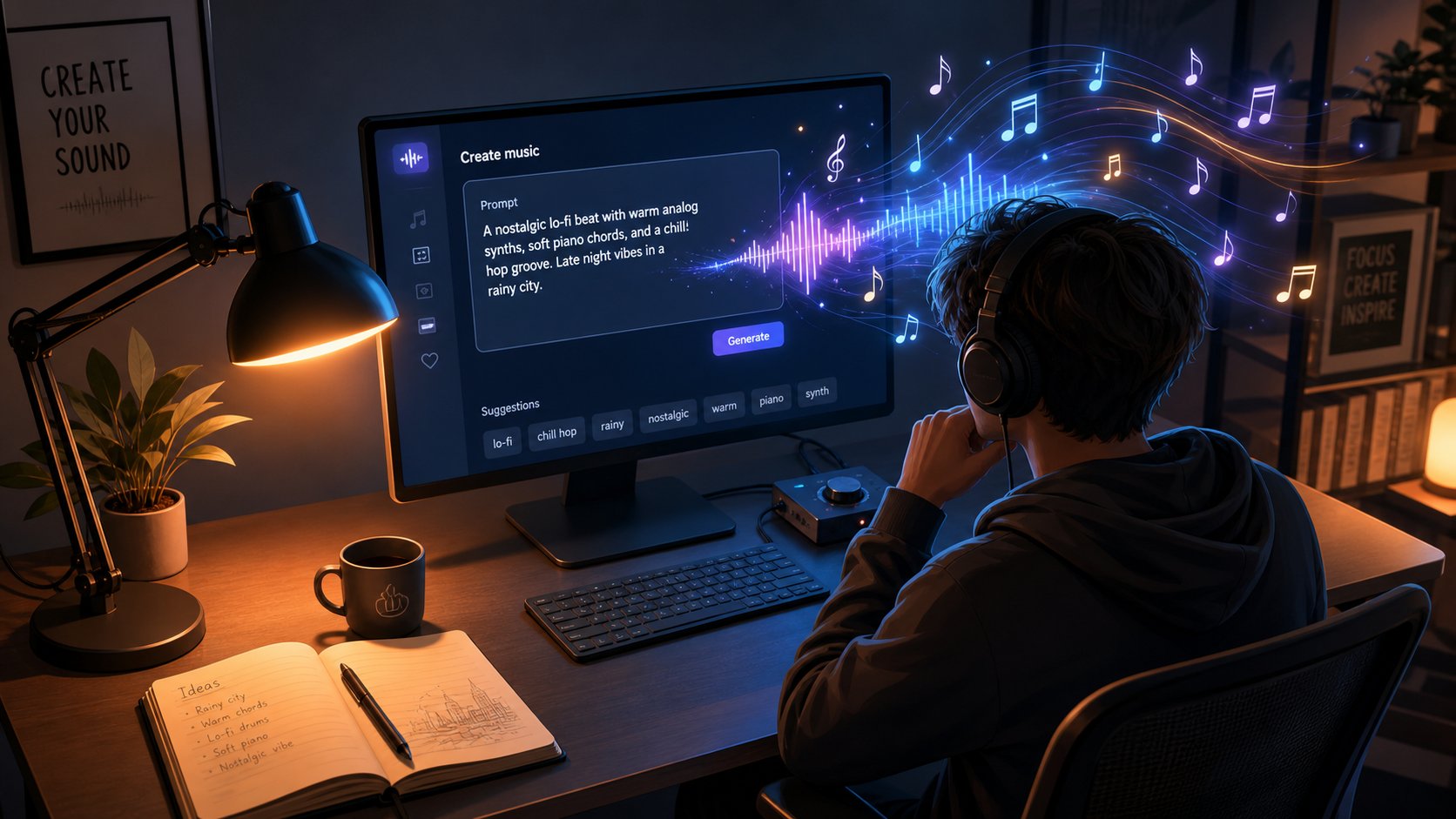
Listening to AI music as a judge is one thing. Creating it yourself is something else entirely. Hands-on experimentation reveals what no blind test can — how much creative control you actually have, where the tools surprise you, and where they fall flat. If you want a genuine answer to whether AI produces music that meets your standards, you need to sit in the driver's seat.
The current state of ai in music production is both more capable and more limited than headlines suggest. Generative ai music news today focuses heavily on breakthroughs — full songs in seconds, realistic vocals, genre-blending compositions. What gets less coverage is the gap between a polished demo track on a marketing page and the average output you get from a generic prompt. The difference? How you communicate with the tool.
How to Write Effective Music Generation Prompts
Prompt engineering is the single biggest lever you have over output quality. A vague instruction like "make a cool song" gives the AI almost nothing to work with. The result will sound generic because you gave it generic input. Specific prompts produce specific results.
Think of your prompt as a creative brief. You would not hand a session musician a one-word instruction and expect a masterpiece. The same logic applies here. According to prompt engineering research from Soundverse, effective prompts balance six components: genre context, mood and emotion, instrumentation, purpose or use case, structure and flow, and descriptive language. The difference between "electronic beat" and "deep house rhythm with muted bass and shimmering pads at 122 BPM" drastically changes what you receive.
Common mistakes that ai music generator reddit communities flag repeatedly: overloading a prompt with conflicting descriptors, being too vague about mood, and forgetting to specify duration or structure. Avoiding these pitfalls puts you ahead of most first-time users immediately.
Generate Your First AI Track Step by Step
Ready to create? Follow this workflow to produce your first track and build a meaningful comparison against your blind test results:
- Define the purpose: Decide what this track is for — a video background, a podcast intro, a standalone song. Purpose shapes every other choice.
- Choose genre and mood keywords: Pick one primary genre (lo-fi, cinematic, indie rock) and pair it with two or three emotional descriptors (melancholic, driving, warm).
- Specify instrumentation: Name the instruments or textures you want. "Acoustic guitar with soft brush drums and ambient synth pads" gives the model concrete anchors.
- Add structural instructions: Request an intro, verse, chorus progression. Mention tempo if it matters. Note whether you want the track to loop or build to a climax.
- Generate and iterate: Produce at least three to five variations. Adjust one element per regeneration — swap the mood descriptor, change the tempo, add or remove an instrument — so you can hear how each variable shifts the output.
- Compare against your blind test scores: Rate your generated tracks using the same rubric (emotional impact, memorability, production quality, originality) you applied in Step 5. How do your own creations stack up?
For a straightforward starting point, MakeBestMusic's AI Music Generator lets you input prompts, lyrics, and style preferences and receive complete songs quickly — making it a practical entry point for following this guide's methodology without a steep learning curve. Generate a few tracks there, then branch out to other platforms if you want to compare outputs across tools.
What you will likely notice after several rounds: the quality ceiling rises dramatically when you treat prompting as an iterative skill rather than a one-shot command. Generative ai music news today consistently highlights that professional creators who get impressive results are not using better tools — they are writing better prompts and running more iterations. The latest ai music updates from platforms like Suno, Udio, and ElevenLabs all point toward the same conclusion: the human's role shifts from performer to director, but creative intentionality still drives the outcome.
Generate at least five to ten tracks across different styles before drawing conclusions. Your direct experience with the creation process — its strengths, its frustrations, its surprising moments — becomes the evidence you need for the final step: matching these capabilities to the specific use cases that matter in your life.
Step 7: Match Results to Your Specific Use Case
You have tested, generated, and scored. You have a rubric full of data and a handful of AI tracks you made yourself. The next question is practical: given everything you now know, which creation method actually fits what you need to accomplish? The answer changes depending on who you are, what you are making, and who will hear it.
This is where the ai in the music industry conversation gets concrete. A YouTuber uploading three videos a week has fundamentally different needs than a singer-songwriter releasing a debut album. A brand manager licensing music for a product launch operates under different constraints than a film composer scoring an emotional climax. "Better" stops being abstract and becomes situational.
When AI Music Is the Smarter Choice
Some use cases reward speed, volume, and cost efficiency above all else. If you produce social media clips that cycle through feeds in 48 hours, investing weeks of composer time in a 15-second background loop makes little sense. The same applies to podcast intros, corporate training videos, and internal presentations where music serves an atmospheric function rather than an artistic one.
A 2024 Nielsen analysis found that advertisements using original human-composed soundtracks achieved 23 percent higher audience retention — but that premium only matters when retention is the goal. For content that needs to be functional, on-brand, and delivered yesterday, AI handles the job cleanly. The ai music industry has responded accordingly: platforms now serve millions of tracks monthly to creators who need background audio, not artistic statements.
Consider these scenarios where AI-only or AI-heavy workflows win:
- Background music for video content: Tutorials, vlogs, product demos — viewers barely register the music consciously. Speed and tonal fit matter more than emotional depth.
- Podcast intros and outros: Short, branded loops that repeat every episode. Once you generate one you like, it is done.
- Social media clips: High turnover, short shelf life, tight budgets. AI matches the pace of content calendars that demand daily output.
- Placeholder and demo tracks: Producers sketching ideas for clients before committing to full production budgets.
When Only Human Musicians Will Do
Other contexts demand what algorithms cannot deliver: genuine emotional narrative, cultural authenticity, and the kind of artistic risk that defines memorable work. Album releases live or die on whether listeners feel a personal connection to the artist behind the sound. Live performance depends on reading a room — adjusting energy, improvising, responding to crowd dynamics in real time. No prompt can replicate that feedback loop.
Cultural storytelling is where the gap is widest. Music that speaks to a community's lived experience — protest songs, regional folk traditions, diaspora narratives — requires understanding that no training dataset encodes. When people discuss ai for the culture music, the conversation often circles back to this point: culture is not a style to imitate. It is a relationship between artist and community, built on shared history and mutual recognition. AI can approximate the sonic palette of a genre, but it cannot carry the weight of meaning that comes from belonging to it.
A Berklee College of Music study found that 16.7 percent of surveyed respondents actively avoid AI-generated music for quality, ethical, or audience perception reasons — and that figure rises to 21.3 percent among professional musicians. For projects where artistic credibility matters to your audience, human authorship is not just preferable. It is a trust signal.
Human-only remains the right call for:
- Album releases and singles: Artistic identity, fan connection, and long-term career building all require a human voice (literal and figurative).
- Live performance: Improvisation, stage presence, and audience interaction are inherently human skills.
- Film scoring for emotional scenes: A composer who reads the director's intent and adjusts phrasing to match an actor's micro-expressions delivers nuance that prompts cannot specify.
- Cultural and political music: Songs tied to identity, community, and social movements carry weight precisely because a human chose to say something.
The Grey Zone Where Hybrid Wins
Most real-world music needs fall somewhere between these poles. Advertising jingles, for example, benefit from AI-generated drafts that a human producer then refines for brand voice and emotional precision. Game soundtracks can use AI to generate adaptive ambient layers while a composer writes the hero themes. Independent artists working without label budgets can use AI mixing and arrangement tools to elevate home recordings to professional quality without sacrificing creative ownership.
The ai and the music industry are increasingly settling into this hybrid middle ground. That same Berklee study reported that 30.9 percent of musicians surveyed use AI tools for lyric generation and 26.2 percent for full backing tracks in finished work — not as replacements but as accelerants within a human-directed process.
The table below maps common use cases to recommended approaches, drawn from the capability comparison in Step 4 and the real-world adoption data available today:
| Use Case | Recommended Approach | Reasoning |
|---|---|---|
| YouTube/TikTok background music | AI-only | High volume, short lifespan, functional role — speed and cost outweigh artistic depth |
| Podcast intro/outro | AI-only | One-time generation of a branded loop; minimal ongoing creative input needed |
| Advertising jingle | Hybrid | AI drafts provide speed; human refinement ensures brand alignment and emotional targeting |
| Corporate training video | AI-only | Ambient, non-distracting audio with no artistic expectation from the audience |
| Film/TV scoring | Hybrid to Human-only | Emotional scenes need human nuance; ambient or transitional cues can be AI-assisted |
| Video game adaptive soundtrack | Hybrid | AI handles reactive ambient layers; humans compose key narrative themes |
| Album release / singles | Human-only | Artistic identity, fan trust, and long-term career equity depend on authentic authorship |
| Live performance | Human-only | Improvisation, audience connection, and physical presence cannot be generated |
| Cultural/political storytelling | Human-only | Authenticity requires lived experience; ai for the culture music demands the culture's own voice |
| Sync licensing for brands | Hybrid | AI provides volume for pitch options; humans ensure emotional and legal clarity |
Notice the pattern: the more a project depends on personal connection, cultural meaning, or artistic reputation, the more it needs human involvement. The more it depends on volume, speed, and functional utility, the more AI makes sense. Your position on that axis is not fixed — it shifts project by project, track by track.
This use-case map gives you a decision filter. But a filter only works if you know your own priorities. The final step pulls everything together into a personal framework you can carry forward — one that accounts for your creative goals, your practical constraints, and the evolving legal landscape around AI-generated music ownership.

Step 8: Build Your Creative Workflow Going Forward
You have walked through seven structured steps. You defined what "better" means on your own terms. You learned how the technology works underneath the marketing. You mapped where you sit on the collaboration spectrum, compared capabilities across eight dimensions, ran a blind listening test with real ears, generated tracks yourself, and matched results to specific use cases. That is not casual browsing — it is a personal evaluation methodology.
The question now is: how do you turn all of that into a workflow you can actually use week after week as the technology evolves?
Your Personal AI Music Decision Framework
Think of everything you have gathered as a decision tree. Each new project or track you need runs through a short set of filters before you choose your approach. Here is the checklist distilled from the previous seven steps:
- Purpose clarity: Is this track serving a functional role (background, atmosphere, filler) or an artistic one (emotional storytelling, identity, audience connection)?
- Quality priority: Which dimensions matter most for this specific project — speed, cost, originality, emotional depth, cultural resonance, or technical polish?
- Collaboration level: Does this project call for fully AI-generated output, a hybrid workflow with human refinement, or entirely human creation?
- Audience expectation: Will your listeners care whether AI was involved? Does authenticity of authorship affect their trust or engagement with your content?
- Legal exposure: Are you distributing commercially? Registering copyright? Licensing to third parties? The answers change your risk profile dramatically.
- Iteration budget: Do you have time to prompt, generate, evaluate, and refine multiple outputs — or do you need a single reliable result on the first pass?
- Long-term ownership: Will you need to defend, license, or resell this music in the future? Can you document your creative contribution clearly?
Run any incoming project through these seven questions and the right approach surfaces quickly. A branded podcast intro? AI-only, low legal risk, fast turnaround. A debut single you plan to distribute on streaming platforms? Human-led, with careful documentation of any AI assistance. A pitch deck for a client meeting tomorrow? Generate five options tonight using MakeBestMusic's AI Music Generator, pick the best fit, and move on. The framework adapts because your priorities shift project to project — and that flexibility is the whole point.
Navigating Copyright and Ownership Questions
No creative workflow exists in a vacuum. The legal landscape around AI-generated music is shifting fast, and ignoring it creates real risk — especially for anyone producing music commercially.
The core issue is straightforward: under current U.S. law, fully AI-generated music cannot receive copyright protection. The U.S. Copyright Office released Part 2 of its AI report in January 2025, confirming that "the outputs of generative AI can be protected by copyright only where a human author has determined sufficient expressive elements." Writing a prompt alone does not qualify as authorship. If an AI produced the melody, the arrangement, and the lyrics without meaningful human creative input, that output sits in the public domain — anyone can copy it, and you have no legal recourse.
The litigation environment is equally turbulent. Major labels sued AI music platforms Suno and Udio in 2024 for training on copyrighted recordings without licenses, with the RIAA describing it as infringement "on an almost unimaginable scale." Warner Music settled with Udio by late 2025. Universal Music Group, Concord, and ABKCO then filed a $3 billion lawsuit — potentially the largest non-class-action copyright case in U.S. history. The UK government scrapped plans to allow unlicensed AI training on copyrighted works after over 10,000 consultation submissions opposed the approach. Some ai music production companies stock audio human-made certification 2025 initiatives have emerged precisely because the market demands clear provenance.
What does this mean practically? The copyright music ai news cycle will keep producing new rulings, settlements, and policy shifts. Rather than waiting for certainty, build your workflow around defensible principles:
- Document your creative process — save prompts, record edits, note which elements you added or modified by hand.
- The more human creative input you contribute, the stronger your copyright claim. Use AI as a tool, not a replacement for your creative decisions.
- Avoid prompts that reference specific artists or songs by name. Outputs that mimic identifiable styles carry infringement risk.
- For commercially distributed work, understand your platform's AI disclosure policies. YouTube, Spotify, and Deezer are all tightening rules around AI-generated content.
- Stay current with ai copyright music news — rulings from ongoing cases will reshape the rules over the coming months.
The legal uncertainty is not a reason to avoid AI music tools entirely. It is a reason to use them intentionally, with awareness of where the boundaries sit today and how they are moving.
Capabilities will keep advancing. The models producing generic loops today will produce more nuanced compositions tomorrow. Your framework does not need to be static — revisit your blind test quarterly, regenerate tracks with updated tools, and reassess whether the capability gap has narrowed or widened in the dimensions you care about most. Treat your workflow as a living system that evolves alongside the technology.
So — can AI create better music than humans? You now have everything you need to answer that for yourself. Not with a borrowed opinion, but with a methodology grounded in defined criteria, direct experience, and honest comparison. The answer is yours, it is contextual, and it will probably change over time. That is not a cop-out. That is how quality works when the subject is as personal as music.
If you are ready to keep experimenting, start generating tracks and run them through your rubric. Each round sharpens your ear, clarifies your preferences, and moves you closer to the workflow that fits your creative life — not someone else's.
