

Can AI Actually Hear Music or Just Process It
The Direct Answer to Whether AI Can Hear
When you ask Siri to identify a song or let Spotify build you a playlist, it feels like something is listening. But is it?
AI can detect, analyze, and classify music with remarkable precision, but it does not hear in the way humans do. It processes sound waves as mathematical data — identifying patterns in frequency, rhythm, and timbre — without any subjective experience of the music itself.
That is the short answer. AI systems convert audio signals into numerical representations and run pattern-matching algorithms across those numbers. They can tell you the tempo of a track, identify the genre, separate a vocal from a guitar, and even generate new compositions. What they cannot do is feel the weight of a minor chord or get chills from a singer's voice cracking at the perfect moment.
Research in auditory intelligence frames machine listening as a layered cognitive process: perceptual recognition (identifying acoustic patterns), contextual reasoning (inferring meaning), and generative interaction (producing appropriate responses). Current AI operates strongly at that first layer — recognizing what is heard — while still struggling to understand why it matters or what it implies in a human context.
Why the Question Is More Complex Than Yes or No
The complexity here comes from the word "hear" itself. Hearing sits on a spectrum. At one end, you have basic signal detection — a microphone picking up vibrations, much like your eardrum does. At the other end, you have deep musical understanding — the kind that makes a song remind you of a summer ten years ago or move an entire stadium to sing in unison.
AI occupies a fascinating middle ground on that spectrum. It goes well beyond simple signal detection. Modern systems trained on music and artificial intelligence research can recognize instruments, track chord progressions, and even write opinions about what they analyze — functioning almost like an AI that listens to music and writes its opinion. Yet they fall short of genuine perception because they lack embodiment, memory, and emotion.
So is ChatGPT or any chat music AI actually hearing your favorite song? Not exactly. But dismissing its capabilities as "just math" undersells how sophisticated that math has become. The real story lives in the gap between processing and perceiving — and understanding that gap changes how you think about every music tool powered by artificial intelligence.
The sections ahead explore both sides of this question: the technical machinery that lets AI analyze audio at superhuman speed, and the irreplaceable human elements that no algorithm has replicated yet.
Human Hearing vs AI Audio Processing
That spectrum between signal detection and deep musical understanding becomes clearer when you map the two systems side by side — your ear and an AI audio pipeline. Both start with the same raw material: vibrations traveling through air. What happens next reveals why one system produces goosebumps and the other produces data points.
How Human Ears Turn Vibrations Into Meaning
Imagine a cello note filling a concert hall. Sound waves enter your outer ear and travel down the ear canal to the eardrum, which vibrates in response. Three tiny bones in the middle ear — the malleus, incus, and stapes — amplify those vibrations and pass them into the cochlea, a fluid-filled structure in the inner ear. According to the National Institute on Deafness and Other Communication Disorders, the vibrations cause fluid inside the cochlea to ripple, forming a traveling wave along the basilar membrane. Thousands of hair cells riding that wave bend microscopic projections called stereocilia, opening channels that create electrical signals.
The auditory nerve carries those signals to the brain, which turns them into a sound you recognize and understand. But the brain does far more than identification. It cross-references the sound with memory, culture, language, and emotion. That cello note might remind you of your grandmother's living room or trigger a physical sensation in your chest. Human hearing is not a pipeline — it is an experience.
How AI Converts Sound Waves Into Data
An AI system starts with a microphone instead of an ear canal. The microphone converts air pressure changes into an analog electrical signal, which an analog-to-digital converter (ADC) samples — typically at 16 kHz or higher — turning continuous sound into discrete numerical values. From there, spectral analysis algorithms like the Fast Fourier Transform break the signal into frequency components, producing a mathematical snapshot of what is happening at each moment in time.
Feature extraction layers then pull out characteristics like pitch, rhythm, timbre, and harmonic structure. Modern music AI models feed these features into deep neural networks trained on massive datasets, where pattern recognition identifies genres, instruments, chord progressions, and more. Tools like Sonoteller AI and similar platforms use this pipeline to generate detailed tags and descriptions of tracks — essentially automating what a music theory AI would do if it could parse every sonic detail simultaneously.
The entire process is deterministic and reproducible. Give the same audio file to the same model twice, and you get identical results. There is no mood, no fatigue, no personal history coloring the output.
Where the Two Systems Diverge
The stages map onto each other remarkably well — until you reach the final step. Here is a direct comparison:
| Stage | Human Hearing | AI Audio Processing |
|---|---|---|
| Sound collection | Outer ear and ear canal | Microphone |
| Signal conversion | Eardrum and middle ear bones | Analog-to-digital converter (ADC) |
| Frequency separation | Cochlea and basilar membrane | Spectral analysis (FFT) |
| Signal encoding | Hair cells and auditory nerve | Feature extraction (MFCCs, embeddings) |
| Pattern recognition | Auditory cortex | Neural network layers |
| Meaning and response | Emotional processing, memory, physical sensation | Classification output or numerical label |
Notice that the first five stages are functionally parallel. Both systems detect sound, convert it, separate frequencies, encode features, and recognize patterns. The divergence happens at the final row. Your brain produces meaning — a felt sense that a piece of music is sad, triumphant, or unsettling. An AI produces a label or a confidence score. It can tell you a track is in a minor key at 72 BPM with prominent strings. It cannot tell you why that combination makes humans cry.
This structural similarity is precisely what makes AI audio tools so powerful for practical tasks like identification, tagging, and separation. But it also explains why no algorithm replaces the listener. The machinery is analogous; the outcome is fundamentally different.
Understanding this parallel raises a natural follow-up: what exactly happens inside that AI pipeline between raw waveform and final output? The technical steps bridging microphone input to neural network classification involve a specific sequence of transformations — each one converting messy real-world sound into progressively cleaner mathematical representations.
The Technical Pipeline Behind AI Audio Analysis
Between a microphone picking up vibrations and a neural network labeling a track as "jazz" or "120 BPM," a precise sequence of mathematical transformations takes place. Each step strips away noise and irrelevance, distilling raw sound into compact numerical features a machine can reason about. If you have ever wondered how artificial intelligence for music production actually works under the hood, this is the pipeline that powers it.
From Raw Sound Wave to Digital Spectrogram
When a microphone captures audio, it produces a waveform — a simple graph of air pressure over time. Think of it like a seismograph tracing vibrations on paper. This raw signal contains everything: every instrument, every voice, every background hum, all tangled together in a single wiggly line.
The first real transformation is the Fast Fourier Transform (FFT). It answers a deceptively simple question: which frequencies are present at any given moment? The FFT takes a small slice of the waveform — typically 20 to 40 milliseconds — and decomposes it into individual frequency components, much like a prism splitting white light into its constituent colors. Instead of seeing one blended beam, you see every wavelength separately.
Apply the FFT repeatedly across the entire audio file, sliding your window forward frame by frame, and you get a spectrogram: a two-dimensional image with time on the horizontal axis, frequency on the vertical axis, and color intensity representing how loud each frequency is at each moment. Sounds complex? Imagine photographing a song. That photograph is the spectrogram — a visual fingerprint of everything happening in the audio.
This single conversion is foundational. It transforms a one-dimensional time-series signal into a two-dimensional image, opening the door for image-recognition techniques to be applied directly to sound.
Feature Extraction and Neural Audio Embeddings
A raw spectrogram contains far more information than a model needs. Not all frequencies matter equally to human perception — and by extension, not all matter equally for music analysis. This is where Mel-Frequency Cepstral Coefficients (MFCCs) come in.
MFCCs mimic the way the human ear perceives pitch. Our hearing is more sensitive to differences in lower frequencies than higher ones — the gap between 200 Hz and 400 Hz sounds huge, while 8,000 Hz and 8,200 Hz sounds trivial. The Mel scale accounts for this by applying linear spacing below 1,000 Hz and logarithmic spacing above it, aligning machine analysis with human auditory perception.
The full MFCC extraction pipeline works like this:
- Pre-emphasis — Boost high frequencies that tend to lose energy during recording, ensuring the full spectrum gets equal attention.
- Framing — Slice the audio into short overlapping segments (typically 25 ms each) so that analysis captures stable snapshots of the signal.
- Windowing — Smooth the edges of each frame to prevent mathematical artifacts at the boundaries.
- FFT — Convert each frame from the time domain to the frequency domain, revealing its spectral content.
- Mel filterbank — Apply a set of triangular filters spaced along the Mel scale, grouping frequencies the way a human ear naturally does.
- Logarithm — Compress the energy values because human loudness perception is logarithmic, not linear.
- Discrete Cosine Transform (DCT) — Decorrelate the filter outputs, producing a compact set of coefficients that represent the most important spectral characteristics.
The result? Typically 12 to 13 coefficients per frame — a tiny numerical fingerprint that captures the essential tonal character of that moment in the audio. These coefficients are the backbone of ai assisted music production tools, speech recognition systems, and genre classifiers alike.
Modern systems go further. Deep neural networks learn their own audio embeddings — dense numerical vectors that encode not just spectral shape but higher-level patterns like instrument identity, rhythmic structure, and harmonic relationships. Unlike hand-crafted MFCCs, these learned embeddings adapt to whatever task the model is trained for, whether that is ai producing a new beat or identifying a copyright-infringing sample in a podcast.
How Deep Learning Reads a Spectrogram Like an Image
Here is the insight that revolutionized audio AI: a spectrogram looks like an image — and convolutional neural networks (CNNs) are exceptionally good at reading images.
A CNN processes a spectrogram by sliding small filters across it, detecting local patterns — a harmonic stack here, a percussive burst there. The first layers pick up simple edges and textures (frequency bands lighting up), while deeper layers combine those into complex features (a piano chord, a snare hit, a vocal vowel shape). Feature maps at each layer highlight different aspects of the sound, simplifying the data until a final classification layer can confidently label what it hears.
Models like YAMNet, developed by Google, use this architecture to classify audio into over 500 categories — from musical instruments to environmental sounds — achieving high accuracy across varying signal durations. VGGish, another Google model originally adapted from image classification, processes spectrograms to produce fixed-length embedding vectors useful for downstream tasks like audio tagging and scene classification.
But music is not a static image. It unfolds over time, and context matters — a note's meaning depends on what came before it. Recurrent neural networks (RNNs) and their more capable variants like LSTMs address this by maintaining a memory of previous frames as they process new ones. Where a CNN sees spatial patterns in the spectrogram, an RNN tracks temporal sequences — how a melody develops, when a chorus returns, where a rhythm shifts. Combining both approaches gives AI systems the ability to understand music as something that moves and changes, not just a frozen snapshot.
Together, these architectures form the core of modern audio intelligence. CNNs handle the "what is this sound" question. RNNs handle "how does this sound evolve over time." And increasingly, transformer models — the same architecture behind large language models — handle both simultaneously, processing entire audio sequences with attention mechanisms that weigh the importance of every frame relative to every other.
The pipeline, summarized end to end, moves through a clear progression: raw waveform to spectrogram, spectrogram to features, features to embeddings, embeddings to output. Whether that output is a genre label, a confidence score, or an entirely new piece of generated audio depends on the task. The underlying machinery remains the same.
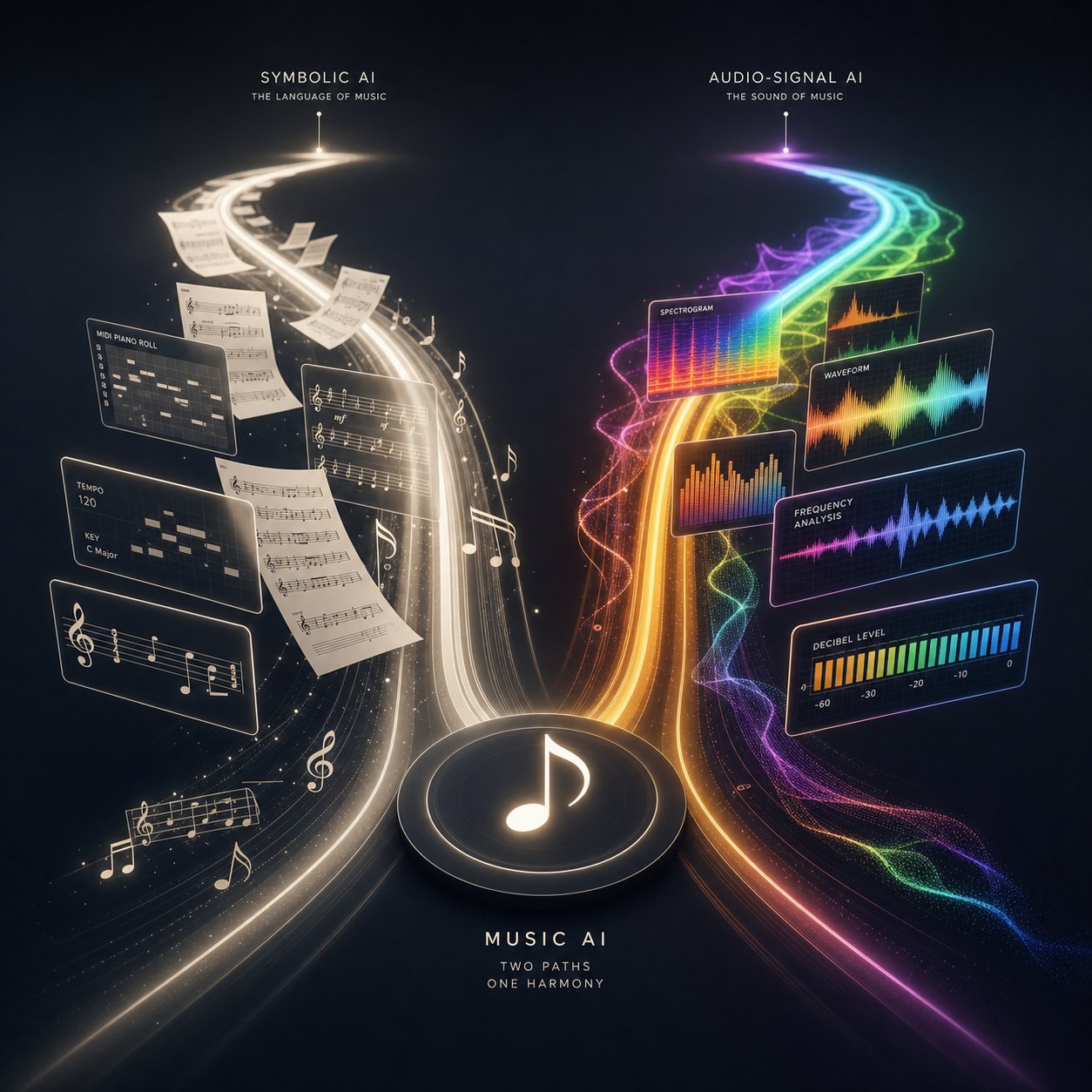
This distinction between what the pipeline produces — a classification, a score, a generated signal — connects directly to a deeper question about what AI is actually doing with music at each stage. Some systems never touch actual sound at all. They work entirely from notation and MIDI data, reading music the way a conductor reads a score. Others process raw audio waveforms, engaging with sound as vibration rather than symbol. The difference between these two approaches shapes what it means for an AI to "hear."
Reading Music vs Hearing Music in AI Systems
Think of it this way: a pianist sight-reading a score and a listener absorbing a live performance are both engaging with music — but through completely different channels. One works from written symbols on a page. The other works from vibrations in the air. AI systems face the same fork in the road, and which path they take determines whether they are reading music or something closer to hearing it.
Symbolic AI That Reads Sheet Music and MIDI
Early AI music systems operated almost exclusively in the symbolic domain. They worked with MIDI files, MusicXML scores, piano-roll representations, and tablature — formats that encode music as discrete instructions rather than continuous sound. A MIDI note, for example, tells the system "play C4 at velocity 80 for 500 milliseconds." It says nothing about the texture of the instrument, the room acoustics, or the performer's subtle timing variations.
This approach has deep roots, breaking history in music AI wide open. The Illiac Suite for String Quartet, composed algorithmically in 1956, worked entirely from symbolic rules. David Cope's Experiments in Musical Intelligence in the 1980s analyzed and recombined symbolic patterns from Bach to generate new pieces in the same style. More recently, OpenAI's MuseNet uses transformer architecture on MIDI data to produce multi-instrument compositions spanning genres from country to classical.
Symbolic systems excel at structural tasks. They can model chord progressions, enforce music theory rules, generate harmonically coherent compositions, and manipulate musical form with precision. For researchers asking whether artists use AI to write songs, symbolic tools offer the clearest creative partnership — the AI understands the grammar of music without ever hearing a single sound wave.
The tradeoff? These systems are essentially deaf. They cannot process a live recording, detect the warmth of an analog synth, or distinguish a Stradivarius from a student violin. They read music the way a computer reads code — symbol by symbol, instruction by instruction.
Audio-Signal AI That Processes Raw Sound
Audio-signal AI takes the opposite approach. Instead of starting with notation, it starts with the raw waveform — the same continuous stream of vibrations that enters a human ear. Models in this category ingest spectrograms, mel-frequency features, and learned audio embeddings to work directly with what music actually sounds like, not what it looks like on paper.
Meta's AudioCraft family exemplifies this shift. Its MusicGen model generates high-quality audio from text prompts by operating entirely in the audio domain — it never sees a MIDI file. Instead, it uses Meta's EnCodec neural audio codec to compress raw waveforms into discrete tokens, then models sequences of those tokens with a transformer. The output is actual sound, complete with timbre, dynamics, and production texture.
Google's MusicLM follows a similar philosophy, converting text descriptions into audio by learning directly from waveform representations. These systems can capture qualities that symbolic notation simply cannot express: the grain of a distorted guitar, the breath between vocal phrases, the spatial depth of a reverb tail. According to a Deepgram overview of audio representation in AI, this high-dimensional approach captures all aspects and nuances of sound — though it demands significantly more computational power than symbolic methods.
If symbolic AI reads the sheet music, audio-signal AI listens to the recording. That distinction matters enormously when you ask whether AI can hear music. Only the second category engages with sound itself.
Why Modern Models Blur the Line Between Reading and Hearing
The boundary between these two approaches is not as clean as it once was. Cutting-edge systems increasingly combine both. A model might use symbolic understanding to maintain long-range musical structure while generating output in the audio domain to preserve sonic fidelity. Imagine a composer who reads the score and plays by ear simultaneously — that is the direction modern architectures are heading.
Automatic music transcription tools like Klangio AI bridge the gap from the other direction: they take raw audio input and convert it into symbolic notation, essentially translating what they "hear" into what they can "read." This bidirectional flow — audio to symbols, symbols to audio — means the question of whether AI hears or reads is becoming less binary and more a matter of which layer you examine.
For anyone exploring how to add a background to a music performance using AI, or wondering how generative tools produce full arrangements from a text prompt, the answer involves both channels working in tandem. The symbolic layer provides structural intelligence. The audio layer provides sonic realism. Together, they represent the most complete form of machine music understanding available.
Here is how the two approaches compare across key dimensions:
| Dimension | Symbolic Processing | Audio-Signal Processing |
|---|---|---|
| Input type | MIDI, MusicXML, piano-roll, tablature | Raw waveforms, spectrograms, audio embeddings |
| What it captures | Pitch, rhythm, structure, harmony | Timbre, dynamics, texture, spatial qualities |
| Strengths | Long-range structure, music theory compliance, low compute cost | Sonic realism, nuance, works with any recorded audio |
| Limitations | Cannot process real recordings, misses performance nuance | High compute demands, struggles with long-form coherence |
| Example systems | MuseNet, AIVA, early Magenta models | MusicGen (Meta AudioCraft), MusicLM (Google), Stable Audio |
| Analogy | Reading a novel | Listening to an audiobook |
This distinction is not just academic — it shapes what practical tools can do. Symbolic systems help composers draft arrangements. Audio-signal systems power the apps that identify songs in noisy bars, recommend tracks based on sonic similarity, and detect copyrighted material in uploaded videos. Both count as forms of AI engaging with music, but only audio-signal processing involves something resembling the act of listening.
And those everyday listening applications? You already use several of them without thinking twice.
Everyday Examples of AI Listening to Music
Spectrograms, neural embeddings, and audio-signal pipelines can feel abstract until you realize you already interact with AI listeners dozens of times a week. Every time you hold your phone up to a speaker, skip a recommended song, or upload a video with background music, an AI system is doing something remarkably close to hearing. These tools rely on the exact same technical pipeline discussed earlier — FFT, feature extraction, pattern matching — packaged into products so seamless you forget the complexity underneath.
How Shazam Identifies Songs in Seconds
You are in a crowded coffee shop. A song plays over the speakers — you recognize the melody but cannot place the name. You tap the Shazam button, hold your phone in the air for a few seconds, and a title appears on screen. That moment feels like magic, but the underlying process is pure applied audio intelligence.
When you press that button, Shazam records a 5 to 10 second snippet of audio. It never stores the raw recording. Instead, it immediately converts the sound into a spectrogram using a Short-Time Fourier Transform, then filters out low-intensity frequencies to isolate only the loudest peaks — creating what engineers call a constellation map. Think of it as reducing a photograph to only its brightest points of light.
From that constellation map, the system pairs anchor points with nearby target peaks, encoding each pair as a compact hash: a 32-bit value capturing two frequencies and the time gap between them. These hashes form the song's audio fingerprint — small enough to transmit on a slow connection, robust enough to survive background noise, crowd chatter, and speaker distortion.
Matching happens almost instantly. Shazam stores fingerprints for its entire catalog in a hashmap data structure that allows lookups in constant time regardless of database size. The system compares your snippet's hashes against its library and identifies the song with the highest number of aligned matches. According to its published architecture details, the platform handles over 23,000 recognitions per minute at global scale — a system so fast and reliable that Apple acquired it for a reported $400 million in 2017.
The key insight: Shazam does not need to understand a song. It does not know the lyrics are sad or that the bridge is surprising. It simply matches spectral fingerprints against a database. Yet for the practical question of "can AI hear music," this is one of the most convincing demonstrations — a system that listens to noisy, distorted, partial audio and correctly identifies what is playing.
How Streaming Platforms Learn Your Musical Taste
Shazam listens to identify a single track. Spotify listens to understand you.
When you search, play, skip, or save a song, Spotify's algorithms interpret those actions as signals about your preferences — building what the platform calls your "taste profile." But the system goes far deeper than tracking which artists you click on. It analyzes the audio characteristics of the music itself: tempo, energy, danceability, valence (musical positivity), acousticness, and dozens of other features extracted directly from the waveform.
Spotify's recommendation engine combines multiple layers of input:
- Your listening behavior — What you play, skip, repeat, and save tells the algorithm which sonic qualities you gravitate toward and which ones push you away.
- Audio content analysis — Algorithms examine the characteristics of each track — genre, tempo, instrumentation, mood — to identify what different songs share beneath the surface.
- Collaborative filtering — When users with similar taste patterns interact with certain content, the system uses those collective behaviors to improve recommendations for everyone.
- Contextual signals — Your device, time of day, location, and language all influence what shows up on your Home feed and in personalized playlists like Discover Weekly and Release Radar.
This is AI hearing at scale — not identifying a single song, but building a continuous model of your sonic preferences by analyzing the acoustic DNA of every track you encounter. Reddit discussions about chat music experiences and AI-curated playlists often debate whether these systems truly understand taste or just correlate patterns. The honest answer: they correlate patterns extraordinarily well, which produces results that feel like understanding even when no genuine comprehension exists.
Content Detection and Copyright Monitoring
A less visible but equally impressive form of AI listening operates behind every video platform, podcast host, and social media app you use. Content identification systems continuously scan uploaded audio to detect copyrighted music — often within seconds of a file hitting the server.
YouTube's Content ID, for example, compares audio fingerprints of uploaded videos against a reference database supplied by rights holders. The same spectral fingerprinting concepts that power Shazam apply here, but at an even more demanding scale: billions of uploads checked against millions of reference tracks, running continuously without human intervention.
Sony AI's research into music recognition and protection pushes these capabilities further. Their CLEWS system — built on supervised contrastive learning — can detect when two audio segments are versions of the same musical piece even when they sound quite different. It learns from 20-second snippets rather than full tracks, identifying shared melodies, harmonic contours, or rhythmic patterns that connect a remix back to its original source. The researchers note this achieves "breakthrough performance in segment-level evaluation," meaning it can catch partial or modified uses that older fingerprinting systems would miss.
When you consider how many AI systems are now operating in the music space — identification apps, streaming recommenders, voice assistants filtering speech from music, content moderation tools, royalty tracking platforms, tools like Sonoteller.ai generating detailed track analysis — the number is staggering. AI listeners are woven into nearly every digital music interaction you have, processing audio at a scale and speed no human team could match.
All of these systems share a common trait: they excel at pattern detection and classification. They hear what is measurable — frequency relationships, temporal structures, spectral fingerprints. What remains outside their reach is everything that makes music matter to a human being: the memories a song triggers, the cultural weight it carries, the physical sensation of rhythm pulling your body into motion. That gap between what AI measures and what humans feel is where the most important part of the story lives.

What AI Still Cannot Perceive About Music
A system that fingerprints a song in five seconds or builds a playlist matching your mood is impressive. But strip away the convenience and ask a harder question: does any of that processing add up to understanding what the music means? The answer reveals limits that no architecture upgrade or larger training set will easily solve.
Emotional Resonance and Personal Memory
Imagine hearing a song that played at your wedding, or during a road trip when you were seventeen. The emotional weight of that moment floods back — not because the track is objectively better than millions of others, but because your brain wired it to a lived experience. That is what researchers in embodied music cognition call the dynamic interaction between minds, bodies, and environment, where bodily experience informs cognition in ways that transcend pure acoustic signal processing.
AI has no autobiography. It cannot associate a chord progression with a first kiss or a funeral. It can label a track as "melancholic" because it learned statistical correlations between minor keys, slow tempos, and that tag in its training data. But correlation is not feeling. A famous musician using AI as a creative tool still brings their own grief, joy, and memory to the final product — the part that makes listeners connect. The machine contributes craft. The human contributes meaning.
Carnegie Mellon researcher Rich Randall, who leads the Music Experience Lab, puts it simply: "Humans create music out of their own personal experiences and inspirations, and that resonates with some people, creating a relationship between the music, the artist, and the listener." That three-way relationship — artist, music, listener — has no equivalent in an algorithm's output layer.
Cultural Context AI Cannot Learn From Audio Alone
Music is never just sound. A protest song carries the weight of a political moment. A hymn holds centuries of communal faith. A national anthem stirs patriotism not because of its melody but because of everything that melody represents. These layers of cultural meaning exist outside the waveform — they live in shared history, social ritual, and collective memory.
Consider the example Deni Ellis Bechard describes in Scientific American: Buffalo Springfield's "For What It's Worth" was a response to the 1966 Sunset Strip curfew riots, and it resonates again decades later because its themes map onto new social concerns. An AI analyzing that track hears folk-rock instrumentation, a mid-tempo groove, and male vocals. It cannot hear the counterculture, the generational tension, or the reason the song keeps resurfacing in coffee shops and yoga classes during politically charged eras.
This is also where questions like "is the song 1 AM made by AI" or "is we are Charlie Kirk song AI" gain cultural significance. People ask not because they doubt the audio quality — AI-generated music can be sonically indistinguishable from human work — but because authorship changes how the song means something. Knowing a human wrote from experience versus knowing a model generated from statistical patterns alters the listener's emotional contract with the music. AI cannot perceive that contract because it exists entirely in the social space between creator and audience.
The Philosophical Gap Between Processing and Perceiving
Academic discourse draws a sharp line between computational analysis and genuine aesthetic experience. Research into embodied music cognition emphasizes that musical meaning is not reducible to the individual processing of acoustic signals — it is emergent from social interaction, physical presence, and shared performance. Music, as this body of research frames it, "is a verb. It's not a noun. It's not a thing sitting on a table. It's something we do."
Processing a signal is not the same as perceiving music. Perception requires a body that moves with rhythm, a memory that attaches narrative to sound, and a social context that gives the experience shared meaning. AI achieves the first step — processing — with superhuman precision, but it cannot cross into the embodied, relational territory where music becomes experience.
Your body responds to rhythm before your conscious mind does. You tap your foot, nod your head, feel chills run down your spine during a singer's climactic note. These physical responses are not decorative side effects — they are central to what hearing music actually is. The wanting-to-dance, the lump-in-throat, the communal high of an entire crowd singing the same chorus — these are embodied, social, and deeply human phenomena that no classification score can replicate.
Chris Donahue, who leads the Generative Creativity Lab at Carnegie Mellon, acknowledges the trajectory: "I do believe at some point AI systems will be able to generate a waveform that evokes the same kinds of captivating interests that human-created music currently does." But he adds a crucial qualifier — "it's still human intentionality driving those systems" that remains the foreground of the music experience. The machine may produce the sound. The human still provides the why.
None of this diminishes what AI listening can accomplish in practice. Pattern detection, source separation, real-time transcription, and audio analysis are genuinely useful capabilities — tools that extend human musicianship rather than replacing the listener. The gap between processing and perceiving is not a flaw to be fixed; it is a boundary that clarifies where AI tools add the most value: in the technical work of pulling audio apart, isolating components, and making the invisible layers of a track accessible for human ears to explore.
AI Tools That Separate and Analyze Audio Tracks
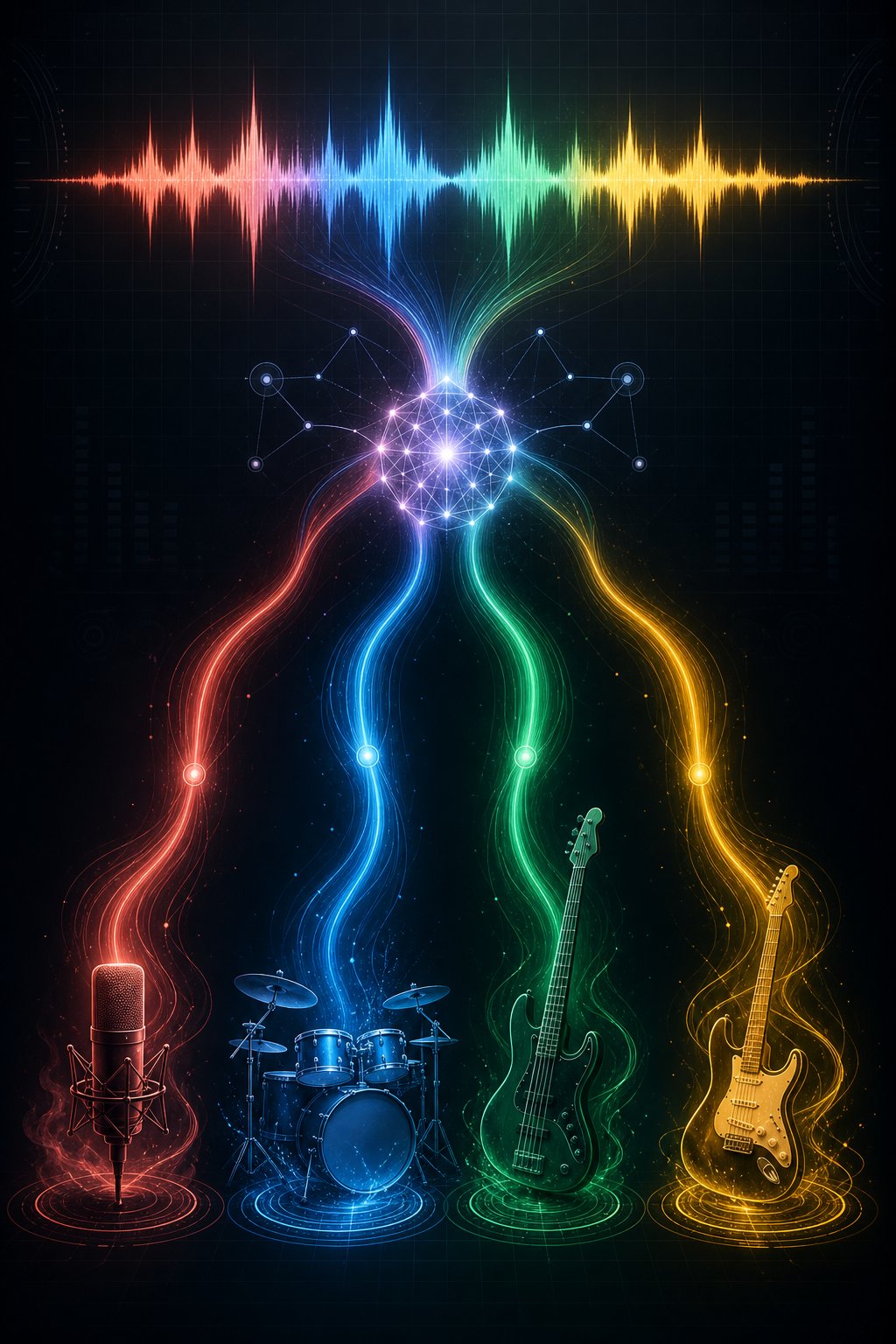
The technical work of pulling audio apart — that is where AI listening delivers its most tangible value. Source separation takes the entire pipeline discussed in earlier sections (spectrograms, neural embeddings, deep learning pattern recognition) and applies it to a single, practical question: can the system hear each instrument individually inside a finished mix?
How Source Separation Proves AI Can Hear Individual Instruments
When instruments and voices are blended into a final mix, separating them is mathematically equivalent to trying to un-stir paint. Traditional approaches relied on EQ sculpting and phase cancellation — techniques that always degraded quality because instruments share overlapping frequency ranges. AI changes the equation entirely.
Modern source separation models use deep neural networks trained on massive datasets of mixed songs paired with their original isolated stems. The AI learns the spectral and temporal fingerprints that characterize each source type: vocals with their unique harmonic structures and breath patterns, drums with sharp transient attacks, bass occupying distinct low-frequency envelopes, and other instruments filling the remaining spectral space. During separation, the model analyzes the mixed spectrogram and predicts masks for each source — essentially telling the system which pixels in that audio photograph belong to the guitar and which belong to the voice.
This is AI hearing in its most demonstrable form. A system that can isolate a violin buried beneath drums, bass, and synthesizers is proving — through its output — that it perceives those individual components within the blend. It does not feel the violin's sadness, but it hears the violin's frequency signature clearly enough to extract it with near-studio quality. According to recent analysis of stem separation technology, current algorithms produce isolation quality that rivals original multitrack sessions, particularly on clean modern productions.
The evolution has been rapid. Early systems could only split audio into two parts: vocals and everything else. Current models routinely separate into four to six stems — vocals, drums, bass, guitar, piano, and accompaniment — with fine-grained control that would have seemed impossible just a few years ago.
Practical Tools for Separating and Inspecting Audio Tracks
Source separation is not locked inside research labs. It powers accessible tools that musicians, students, remixers, and content creators use daily. If you have ever wanted to isolate a vocal for a remix, strip drums from a track to study the arrangement, or create a practice backing track with the lead instrument removed, these are among the best ai tools for music separation available:
- MakeBestMusic Audio Separator — Lets you upload a track and separate it into individual stems for inspection and creative use. Built on the same spectral analysis and neural network technology covered throughout this article, it gives hands-on access to vocals, drums, bass, and instrument layers without requiring technical expertise or DAW knowledge.
- Ultimate Vocal Remover (UVR) — A free, open-source option with multiple algorithm models. Independent testing across 13 songs and 12 tools ranked it highest for overall separation quality, scoring 8.05 out of 10 on sound fidelity. The trade-off is a steeper learning curve.
- Moises — Combines stem separation with key detection, chord recognition, and BPM analysis. Scored the highest usability rating (8.3) in the same comparative test, making it popular with musicians who want quick results on mobile.
- LALAL.AI — A cloud-based separator supporting up to 10 source types including electric guitar, acoustic guitar, piano, and wind instruments. Convenient but mid-pack in separation quality when tested head-to-head against dedicated tools.
The use cases for ai in music production and beyond span a wide range:
- Remixing and sampling — Isolate a vocal hook or drum pattern from any track for creative reinterpretation.
- Music study and education — Strip a song to its individual layers to analyze arrangement, mixing techniques, and instrument balance.
- Vocal isolation — Extract clean acapellas for mashups, covers, or karaoke tracks.
- Practice tracks — Remove your instrument from a song and play along with the remaining parts.
- Content creation — Pull instrumentals for video backgrounds, podcasts, or social media without licensing full tracks.
One important caveat worth noting: no stem splitter perfectly recreates original studio stems. Dense, distorted mixes — metal, shoegaze, heavily compressed lo-fi — still challenge every tool on the market. Sparse, well-produced modern tracks separate best. And bass remains the weakest category across all separators, with high-frequency harmonics consistently lost during extraction.
Still, the practical reality is striking. The same AI hearing pipeline that seemed purely theoretical a few sections ago — FFT, spectral masking, convolutional networks reading spectrograms like images — now powers tools that hand you individual track components in seconds. That is the bridge between AI processing sound and AI doing something genuinely useful with what it hears.
The Future of AI Music Perception and Understanding
Separating a vocal from a mix is impressive, but it represents only what AI can do with audio in isolation. The next generation of systems is not content to hear music through a single channel. They want to read the lyrics simultaneously, watch the performer's body language, and track how an audience reacts — all at once, in real time.
Multimodal AI and Deeper Musical Understanding
The most significant shift in the ai music industry is the move from unimodal to multimodal perception. Earlier systems operated in one lane: either analyzing audio waveforms, or processing MIDI data, or reading text metadata. Modern architectures fuse all of these streams into a single model that reasons across them simultaneously.
Research from KAIST demonstrates this trajectory clearly. Their TalkPlay system encodes five modalities — audio features, lyrics, metadata, semantic tags, and playlist co-occurrence signals — into a unified token representation that a large language model can process together. The result is a conversational recommendation engine that understands music not just as sound, but as a layered object with textual, sonic, cultural, and behavioral dimensions. In human evaluations, this multimodal approach achieved win rates above 70% against systems relying on text or listening history alone.
Imagine the practical implications. A multimodal AI does not just hear a melancholic piano ballad — it simultaneously reads the lyrics about loss, notices the album artwork is desaturated, recognizes the artist has been tagged as "heartbreak" across thousands of playlists, and factors in that listeners tend to stream it late at night. None of those signals alone captures what the song is. Together, they approximate a richer form of understanding.
Real-time music analysis for live performance pushes this further. Systems that process audio, visual gesture data, and audience energy simultaneously could adapt stage lighting, suggest setlist changes, or trigger effects in response to what is happening musically — not seconds later, but in the moment. The trajectory from basic pitch detection to full compositional understanding is becoming measurable rather than speculative.
What Comes Next for AI and Music Perception
The impact of AI on the music industry extends well beyond perception into questions of ownership and rights. As AI models grow more capable — trained on millions of tracks to hear, analyze, and generate music — the legal landscape struggles to keep pace. Universal Music and Warner Music have entered licensing deals with AI companies like Suno and Udio, signaling that the industry is shifting from confrontation to negotiation. But fundamental questions remain unresolved: can you copyright AI music if the system learned from millions of human compositions? Who owns the output when a model trained on your catalog generates something new?
Professor Jeremy Morris of the University of Wisconsin frames the tension well: AI excels at pattern recognition and replication, which allows it to mimic emotional qualities based on vast datasets. But the authentic human experience that drives original artistic expression still resides with human creators. The ai and the music industry will need to navigate this boundary carefully — leveraging AI's analytical power without erasing the human authorship that gives music its cultural weight.
For creators and listeners today, the most tangible value lives in practical tools that apply AI hearing to real workflows. Source separation platforms like MakeBestMusic's Audio Separator represent the current frontier — complex spectral analysis and neural network technology made accessible through a simple interface. They do not replace human ears. They extend what those ears can access, pulling apart layers of a mix that were previously locked behind studio doors.
AI hearing sits on a spectrum: already remarkable in technical capability, still far from human experience. The question is not whether machines will eventually hear like we do — it is how we use what they can already do to deepen our own relationship with music.
The gap between processing and perceiving is not closing. It is becoming better defined. And within that clarity, both the limitations and the genuine power of AI listening become easier to use wisely — whether you are a musician dissecting a mix, a researcher studying musical cognition, or a listener curious about the invisible systems shaping every playlist you hear.
