

Can AI Music Actually Be Copyrighted
Can AI music be copyrighted? The short answer: only if a human author has shaped enough of the expressive elements. Purely AI-generated music, created by a prompt alone with no further human creative input, does not qualify for copyright protection in the United States. Works that blend AI outputs with meaningful human authorship, however, can receive protection.
Why This Question Matters for Every Music Creator
Imagine you spend hours refining prompts, selecting the best outputs, arranging sections, and mixing a final track. You release it, it gains traction, and someone copies it wholesale. Can you stop them? That depends entirely on whether your work qualifies for ai music copyright protection, and the answer hinges on how much creative control you actually exercised.
Copyright law was built on one foundational idea: it protects original works of human authorship. For centuries, that requirement was so obvious it barely needed stating. A person wrote the melody, played the chords, penned the lyrics. AI-generated music challenges this framework because the machine, not a person, is determining many of the expressive choices in the final output.
The Short Answer and Why It Is Complicated
The U.S. Copyright Office addressed this directly in its 2025 report on AI and copyrightability:
Copyright protects the original expression in a work created by a human author, even if the work also includes AI-generated material.
So is ai music copyrighted by default? No. Can you copyright ai music that you actively shaped and arranged? Potentially yes, on a case-by-case basis. The dividing line is whether a human determined sufficient expressive elements in the final work, or whether the AI did that independently.
This creates two separate legal questions that most creators unknowingly conflate: whether you can own copyright in music you create using AI tools, and whether AI systems infringe existing copyrights through their training data. These are fundamentally different issues with different risks, different legal standards, and different practical implications for your workflow.
What follows is a breakdown of both questions, the legal precedents defining the current rules, the role of human authorship across a full spectrum of AI involvement, and concrete steps you can take to protect your work.
Two Distinct Legal Questions Most People Confuse
When creators search for copyright ai music news, the results blend two entirely different legal problems into one confusing pile. One question asks whether you can protect what you made. The other asks whether the AI tool itself broke the law by learning from someone else's work. Treating them as the same issue leads to bad decisions on both fronts.
Owning Copyright in Your AI-Created Music
The first question is about your rights as a creator. If you use an AI tool to generate a beat, a melody, or an entire arrangement, do you hold copyright in that output? Under current U.S. law, the answer depends on whether you contributed enough original creative expression to qualify as the human author. Simply typing a prompt and accepting what comes out is unlikely to meet that threshold. Editing, selecting, rearranging, and layering human-performed elements on top of AI outputs shifts the balance toward protectability.
This is a forward-looking concern. It determines whether you can license your tracks, issue takedowns against copycats, or build a catalog with real market value. If your work lacks copyrightable authorship, anyone can use it freely and you have no legal recourse.
Training Data Liability and Infringement Risk
The second question looks backward. It asks whether AI music generators violated copyright law when they ingested millions of existing songs to train their models. This is the issue driving the largest lawsuits against ai music generators right now. In June 2024, Universal, Sony, and Warner filed coordinated suits against Suno and Udio through the RIAA, alleging mass infringement of copyrighted sound recordings used in ai music copyright training. Potential damages reach $150,000 per work infringed.
This matters to you as a user because if the outputs you download are substantially similar to copyrighted recordings in the training data, you could face infringement claims even though you had no idea the copying occurred. Anyone following copyright ai music lawsuit news today can see the scale of exposure: settlements already reaching into the billions, and regulatory bodies in both the U.S. and UK moving to restrict unlicensed training.
| Dimension | Owning Copyright in AI Output | Training Data Infringement |
|---|---|---|
| Core Question | Can I protect music I made with AI? | Did the AI copy protected works to learn? |
| Who It Affects | Creators using AI tools | AI companies, and indirectly their users |
| Current Legal Status | Copyrightable only with meaningful human authorship | Active litigation; fair use defense unresolved |
| Key Risk for Creators | No protection means anyone can copy your work | Outputs resembling training data may trigger claims against you |
| Direction of Liability | You trying to enforce rights outward | Rights holders enforcing inward against AI platforms and users |
These two issues create a pincer effect. On one side, your AI-generated track may lack copyright protection entirely. On the other, that same track might expose you to infringement liability if it echoes something in the training set. Understanding which problem you are solving, and which legal standard applies, is the first step toward making informed creative and business decisions.
Both questions ultimately hinge on one concept: human authorship. The legal system uses it to decide what deserves protection going forward and what constituted lawful creation in the past. The precedents establishing that standard are still being written.
Legal Precedents and Official Guidance You Need to Know
Those precedents are not hypothetical. A handful of court rulings and Copyright Office decisions have already drawn hard lines around what AI-generated content can and cannot receive protection. If you create music with AI tools, these cases define the rules you are operating under right now.
Landmark Cases That Define the Current Rules
Three key decisions, issued between 2022 and 2025, form the backbone of current ai music copyright news and legal analysis. Each one clarified a different piece of the puzzle.
- A Recent Entrance to Paradise — Copyright Review Board (February 2022). Computer scientist Stephen Thaler submitted an artwork generated entirely by his AI system, the "Creativity Machine," listing the machine as sole author. The Copyright Office's Review Board refused registration, affirming that only human beings can be authors under the Copyright Act.
- Thaler v. Perlmutter — District Court and D.C. Circuit (2023–2025). Thaler challenged that refusal in federal court. Both the District Court and the D.C. Circuit Court of Appeals affirmed the denial, holding that the Copyright Act requires all eligible works to be authored by a human being. Because Thaler listed only the AI as author, the application was properly rejected. The appellate court did not reach the broader constitutional question, but the practical rule is clear: listing an AI system as the sole author guarantees rejection.
- Zarya of the Dawn — Copyright Office Registration Decision (February 2023). Artist Kristina Kashtanova registered a graphic novel containing both human-written text and AI-generated images from Midjourney. After review, the Copyright Office canceled the original registration and reissued it covering only the text and the "selection, coordination, and arrangement" of written and visual elements. The AI-generated images themselves received no protection because Kashtanova lacked "sufficient control over" the outputs.
The pattern across these decisions is consistent: autonomous AI output is not copyrightable, but human creative choices applied to or around that output can be. For music creators, this means a raw AI-generated track has no protection, while your deliberate arrangement, editing, and layering of those outputs may qualify.
What the Copyright Office Has Actually Said
Beyond individual cases, the U.S. Copyright Office published formal registration guidance in March 2023 and released Part 2 of its multi-part AI report in January 2025, specifically addressing copyrightability. The Office held a dedicated listening session on music and sound recordings in May 2023 to gather industry input on how these rules apply to audio works.
The registration guidance establishes this core standard:
The Office will consider whether the AI contributions are the result of "mechanical reproduction" or instead of an author's "own original mental conception, to which [the author] gave visible form."
In practical terms, the Office requires applicants to disclose AI-generated content and to describe in the application what a human author actually created. When AI produced material without meaningful human direction, that material must be excluded from the claim. The guidance applies equally to musical works, sound recordings, and literary works.
For music specifically, the Office's listening session and subsequent report language confirm that human-authored elements like original lyrics, melody composition, arrangement decisions, mixing choices, and performance all remain fully protectable. The question is never whether AI was used in the process. It is whether the human made enough expressive decisions to qualify as the author of the final work.
Keeping up with ai music legal news matters here because the landscape is still developing. The Copyright Office's Part 3 report, released in pre-publication form in May 2025, addresses generative AI training, and additional ai music regulation news is expected as pending legislation moves through Congress. But the core principle of meaningful human authorship has remained stable across every decision so far.
What remains undefined is exactly where the line falls. The Copyright Office evaluates claims case by case, and it has not published a bright-line test for how much human involvement is enough. That ambiguity makes your creative workflow, and how well you can document it, the deciding factor in whether your AI-assisted music receives protection.
The Human Involvement Spectrum and Where Copyright Begins
That ambiguity around "enough" human involvement is not random. It maps onto a spectrum, and your position on that spectrum determines whether your AI-assisted track enters the public domain or earns legal protection. The Copyright Office evaluates each work individually, but its guidance and decisions reveal a clear pattern tied to how much creative control the human exercised over expressive elements.
Think of it as three distinct zones. Each represents a different workflow, a different relationship between human and machine, and a different likely copyright outcome.
| Level of AI Use | Example Workflow | Likely Copyright Status | What Makes the Difference |
|---|---|---|---|
| Fully Autonomous Generation | Type a prompt like "upbeat pop track, 120 BPM" and download the result unchanged | Not copyrightable | AI determined all expressive elements; human provided only an idea |
| AI-Assisted Composition | Generate multiple outputs, select sections, arrange them, edit transitions, add original lyrics or melodies | Potentially copyrightable | Human selection, arrangement, and creative modification add original expression |
| AI as a Creative Tool | Compose with AI suggestions for chord progressions or harmonies, perform and record human vocals, mix and produce the final track | Likely copyrightable | Human leads the composition; AI functions like a synthesizer or sampler assisting human decisions |
Text Prompt Only and No Human Editing
Imagine asking ai to make a hit country song by typing that exact phrase into a generator and hitting download. No editing. No arrangement. No layering of your own performance. The Copyright Office's 2025 report is direct on this point: prompts alone do not provide sufficient human control to make the user an author. A prompt reflects your idea, but the AI system independently determines the expression of that idea, filling in melody, rhythm, instrumentation, timbre, and structure without further human direction.
This is why some argue that ai cant write songs in the legal sense. The AI generates audio, but a "song" with enforceable rights requires a human author. If you accept the output as-is, no human shaped the expressive content. The result belongs to everyone and no one.
Human Selection and Arrangement of AI Outputs
Move one step along the spectrum and the picture shifts. Say you generate twenty variations using a chorus generator or a full-track tool, then pick the best verse from one output, a bridge from another, and a hook from a third. You arrange these into a structure, adjust tempo transitions, rewrite certain melodic phrases, and layer in original lyrics. This workflow mirrors how the Copyright Office treated Zarya of the Dawn: the individual AI-generated pieces may lack protection, but your creative selection, coordination, and arrangement of them can constitute original authorship.
The key distinction is that you are making expressive decisions the AI did not make. Which sections fit together, in what order, with what modifications. Anyone learning how to use ai to write music should understand that this middle zone is where documentation becomes critical. The more choices you can demonstrate, the stronger your claim.
AI as a Tool in Human-Led Composition
At the far end of the spectrum, AI functions like any other instrument in your studio. A producer who uses an ai synthesizer for pad textures while composing original melodies, performing live vocals, and making all arrangement decisions is operating in essentially the same legal territory as someone using a drum machine or an ai sampler for textural elements. The human is the author. The technology is the tool.
Consider a songwriter who drafts chord progressions, uses an ai songwriter feature to suggest harmonic alternatives, rejects most suggestions, modifies one, and then performs and records the finished piece. The Copyright Office has stated that "tangential use of AI technology will not disqualify any subsequent work of authorship from protection." Here, the human's creative contribution overwhelms the AI's role. The final work captures the author's expression, not the machine's.
This three-tier framework is not codified in statute. It is inferred from the Copyright Office's decisions and reports. But the practical takeaway is clear: the more expressive choices you make, document, and retain in the final work, the more likely your music qualifies for protection. Your workflow is your evidence, and the next question is how to translate that evidence into an actual copyright registration.
How to Register AI Music with the Copyright Office
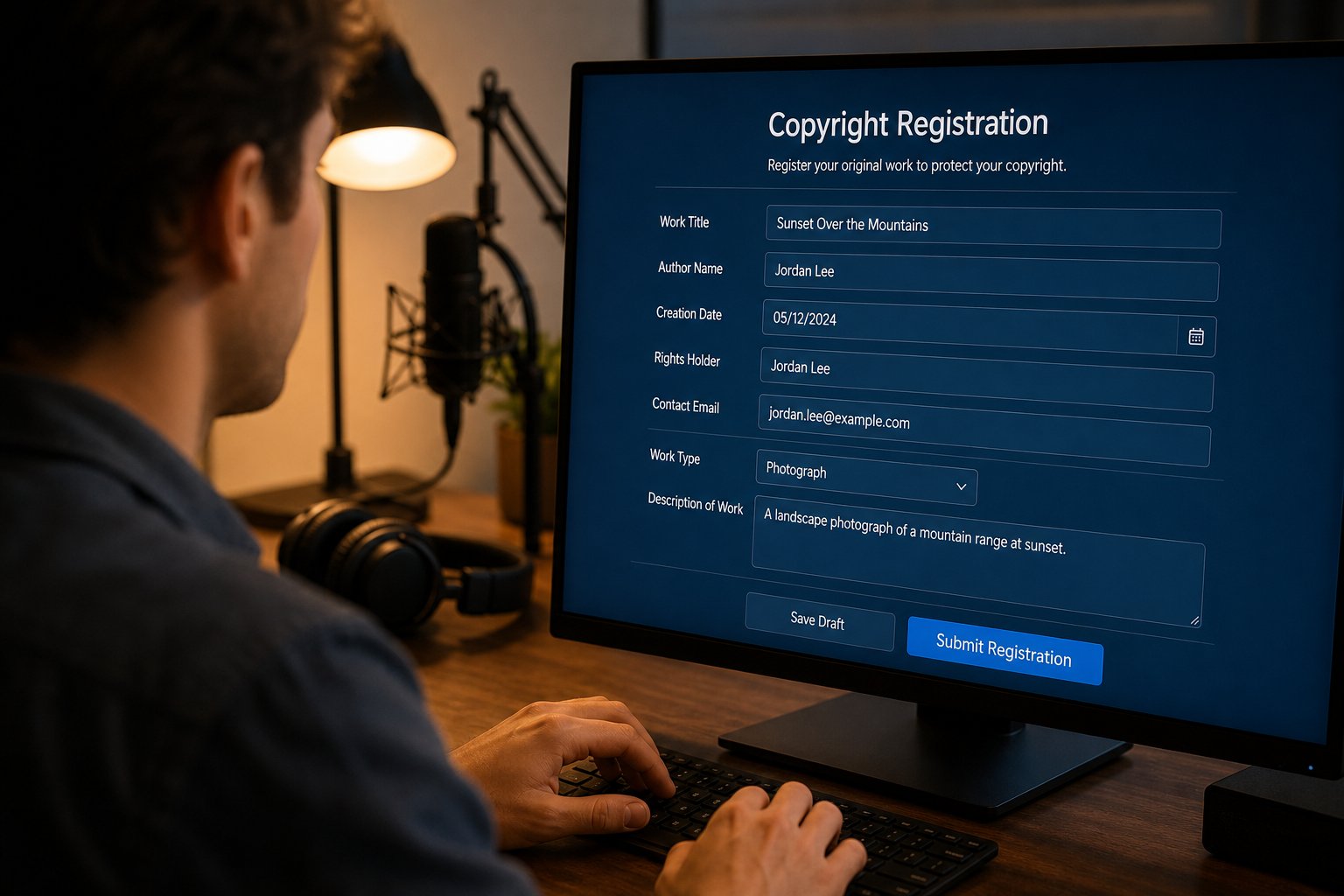
Translating your creative workflow into a legal claim requires more than good intentions. The U.S. Copyright Office has specific procedural requirements for anyone seeking to register works that incorporate AI-generated material. Get them wrong, and you risk having your registration canceled outright. Get them right, and you secure the legal foundation to enforce your rights, license your music, and recover statutory damages in court.
So how do you actually copyright ai music that blends human creativity with AI-generated elements? The process is straightforward once you understand what the Office expects.
How to Fill Out the Copyright Application
The Copyright Office requires that all works containing AI-generated content be registered using the Standard Application form. This is a critical detail. You cannot use the Single Application (which is limited to works where all content was created by the same individual) or group registration options for AI-assisted works. The reason is simple: only the Standard Application contains the fields necessary to disclaim unprotectable material like AI-generated elements.
Here is the step-by-step process to efile song copyrights for AI-assisted music through the Copyright Office's electronic system:
- Access the eCO system. Go to the Copyright Office's Electronic Copyright Office portal and log in or create an account.
- Select the Standard Application. Do not choose the Single Application even if you are the sole claimant. Only the Standard Application accommodates AI-related disclaimers.
- Identify the work type. For musical compositions, select "Work of the Performing Arts." For sound recordings, select the appropriate category that covers both the recording and the underlying composition if you own both.
- Complete the "Author Created" field. This is the most important step. Describe specifically what the human author contributed. For music, this might include: "original lyrics," "melody composition," "arrangement of AI-generated instrumental sections," "vocal performance," "selection and coordination of musical elements," or "mixing and production choices." Be specific. Vague descriptions invite examiner follow-up questions that delay registration.
- Exclude AI-generated material. In the "Limitation of Claim" section, use the "Other" field to identify what the AI produced. For example: "AI-generated instrumental backing track" or "AI-generated chord progression in verses." You are drawing a boundary around what you are not claiming.
- Pay the filing fee. The cost for music copyrights album ai registrations varies. A single Standard Application costs $65 online. If you are registering multiple works, costs scale accordingly. Group registration options for unpublished works ($65 for up to 10 works) may be available if none contain AI elements, but AI-assisted works must go through Standard Applications individually.
- Upload your deposit copy. Submit the completed audio file or sheet music that represents the work being registered.
Disclosing AI Use Without Losing Protection
Many creators worry that disclosing AI involvement will torpedo their application. The opposite is true. The Copyright Office does not penalize you for using AI tools. It penalizes you for failing to be transparent about it. Your registration covers the human-authored elements you claim, and those elements receive full protection regardless of how much AI material surrounds them.
Think of it this way: if you wrote original lyrics and composed a melody, then used AI to generate a backing arrangement, your lyrics and melody are fully protectable. You simply need to tell the Office that the backing arrangement was AI-generated so the registration accurately reflects what you own. The human-authored portions receive the same protection they would have received in any other context.
Can i publish a song written by ai? You can release it commercially, but the portions generated entirely by AI will not receive copyright protection. What you add on top of the AI output, your creative contributions and modifications, those are what the registration protects. The more substantial your human contributions, the broader your copyright claim.
If you are unsure exactly how to describe the split between human and AI contributions, the Copyright Office allows applicants to provide a general statement that the work contains AI-generated material. An examiner will then follow up with specific questions. This is acceptable, but it extends processing time significantly. Taking the time to clearly delineate human versus AI contributions upfront streamlines the process.
What Happens If You Fail to Disclose
This is where the stakes get real. The Copyright Office has explicitly warned that applicants who omit AI-generated content from their disclosures "risk losing the benefits of the registration." If the Office discovers undisclosed AI involvement, whether through its own review, public information, or social media, it may cancel the registration outright.
This is not hypothetical. The Zarya of the Dawn case demonstrated exactly this process. After the Copyright Office learned through social media that the applicant used Midjourney to generate images without disclosing it, the original registration was canceled. A new, narrower registration was issued covering only the human-authored text and arrangement. The AI-generated images lost all protection.
In litigation, the consequences compound. An opposing party can challenge your registration's validity under 17 U.S.C. Section 411(b), requesting that the court refer the matter to the Register of Copyrights. If the Register determines that accurate information would have caused refusal, your registration may be deemed invalid for purposes of that lawsuit. You lose access to statutory damages and attorney's fees, effectively gutting your enforcement power.
Beyond cancellation, knowingly making false representations of material fact on a copyright application carries a fine of up to $2,500 under 17 U.S.C. Section 506(e). The disclosure requirement also applies retroactively. If you already registered an AI-assisted work without proper disclosure, the Copyright Office directs you to file a supplementary registration to correct the record before problems arise.
The documentation you maintain throughout your creative process is what makes accurate disclosure possible. Keep records that allow you to confidently identify what you created versus what the AI generated:
- Save all raw AI outputs before any human editing or arrangement
- Maintain version history showing your iterative modifications
- Document which sections of the final track were AI-generated and which were human-composed
- Record your prompt history and the selection process (which outputs you rejected and why)
- Keep session files from your DAW showing layering, mixing, and arrangement decisions
- Note timestamps of your creative decisions to establish the chronology of human involvement
This documentation serves a dual purpose. It makes your copyright application accurate and defensible, and it provides evidence of meaningful human authorship if your claim is ever challenged. Registration is the legal mechanism, but your creative records are the foundation it rests on.
What the registration process cannot resolve, however, is whether the platform you used to generate that music even allows you to claim ownership in the first place. Your legal rights under copyright law are one layer. The contractual terms you agreed to when you clicked "Accept" are another entirely.
Platform Terms of Service and Who Really Owns Your Music
Copyright law might give you a claim over your AI-assisted composition, but there is a second gatekeeper most creators never think about: the platform's Terms of Service. You agreed to those terms the moment you created an account. And in many cases, what you agreed to overrides whatever rights copyright law would otherwise grant you.
This disconnect catches people off guard. Threads across Reddit ask whether any music ai creator without copyright restrictions exists, and the honest answer is that every platform attaches conditions. Some are generous. Others quietly retain rights that make commercial release risky or outright prohibited. Before you build a workflow around any tool, you need to understand what its terms actually say about ownership, licensing, and monetization.
What Platform Terms Actually Say About Ownership
AI music generators fall into three general models when it comes to ownership allocation. The differences are dramatic, and they directly determine whether you can distribute, license, or sell the music you create.
Model 1: Full ownership assignment on paid plans. Some platforms assign all of their right, title, and interest in generated outputs to paid subscribers. Suno's Terms of Service follow this approach for Pro and Premier tier users: the platform assigns ownership of outputs generated during your paid subscription. However, even Suno includes a critical caveat. Its terms state explicitly that "due to the nature of machine learning, Suno makes no representation or warranty to you that any copyright will vest in any Output." You get ownership of whatever rights exist, but the platform does not guarantee those rights amount to a registrable copyright.
Model 2: Limited commercial license. Other platforms retain ownership but grant users a license to use outputs commercially. This is common among tools like the Soundraw AI music generator, which typically allows commercial use of generated tracks within specific parameters. You can use the music in videos, podcasts, or other projects, but the platform maintains underlying rights. This model works well for content creators who need background music but creates problems if you want to build a catalog of original releases.
Model 3: Personal use only on free tiers. Nearly every platform restricts free-tier users to personal, non-commercial use. Suno's free and Basic tier terms require that outputs be used "solely for your lawful, internal, personal and non-commercial purposes" with attribution credit. Releasing a free-tier track on Spotify or licensing it for a commercial video violates these terms regardless of any copyright argument you might construct. This is often the detail people miss when they ask do you own lyrics from Claude or can ChatGPT make songs they can sell. The answer depends less on copyright doctrine and more on what the service's terms permit.
For creators researching top ai platforms for lyrics and writing, the ownership model is the first thing to check. A platform that grants full ownership on a paid plan gives you maximum flexibility. One that retains a license may limit what you can do downstream.
| Ownership Model | Commercial Rights | Exclusivity | Revenue Implications |
|---|---|---|---|
| Full assignment (paid tier) | Unrestricted commercial use and distribution | Non-exclusive — platform may generate identical output for other users | You keep all revenue but cannot guarantee exclusivity of the composition |
| Commercial license (paid tier) | Permitted within license scope (videos, streams, podcasts) | Non-exclusive — others may license similar outputs | No royalty sharing required, but resale or sublicensing may be restricted |
| Personal use only (free tier) | No commercial rights | Not applicable | Commercial distribution violates terms and risks account termination or takedowns |
Red Flags to Watch For in AI Music Platform Agreements
Beyond the headline ownership model, platform ToS contain clauses that can quietly undermine your rights. Here is what to look for before committing your creative workflow to any tool, whether it is the Musichero AI music generator, the Tad AI music generator, or any other service.
Broad content licenses back to the platform. Even platforms that assign ownership to you often retain a perpetual, royalty-free license to use your content. Suno's terms grant the company a "worldwide, non-exclusive, fully paid-up, sublicensable, assignable, royalty-free, perpetual, irrevocable right and license" to use all content you create through the service. This means even after you own the output, Suno can use it to promote its services, improve its models, or display it publicly. That is a significant retention of rights that exists alongside your ownership.
Non-uniqueness disclaimers. Most platforms warn that outputs "may not be unique across users" and that the service "may generate the same or similar output for a third party." This is a practical reality of how generative models work, but it has commercial implications. If someone else receives a substantially similar track, neither of you has exclusive use, regardless of who generated it first.
Anti-competition clauses. Some terms prohibit using outputs to "compete with" the platform or to "create a competing product or service." If you are building a music library, a production house, or any business that could be construed as competitive, these clauses may create legal exposure.
Content ID and fingerprinting risks. When a platform retains a license and makes outputs available in its public library or shares them with content identification databases, your release may trigger copyright claims on streaming platforms even though you generated it. This is not a hypothetical scenario. Creators have reported Content ID matches on tracks they generated themselves because the platform's library registered overlapping audio fingerprints.
Remix and derivative work terms. Some platforms allow other users to remix your outputs by default. Suno's terms state that if you enable remix features, the resulting work becomes "a joint work owned jointly and equally by you and the Remixer." Worse, joint owners of remixes are restricted to personal, non-commercial use regardless of paid tier status. A single toggled setting can strip commercial rights from derivative works.
The practical question people really want answered, whether on Reddit or elsewhere, is straightforward: can you publish and monetize AI-generated songs? Yes, if your plan's terms explicitly grant commercial rights, you comply with disclosure requirements from streaming platforms, and you understand that ownership does not guarantee copyright protection. The platform gives you a contractual right to distribute. Copyright law determines whether you can stop others from copying what you distributed.
These contractual realities apply differently depending on where you operate. A U.S.-based creator and a UK-based creator working on the same platform face identical ToS, but the copyright frameworks behind those terms diverge significantly, especially when it comes to who qualifies as an author of AI-generated music in the first place.
How Copyright Rules Differ Across the US, EU, and UK
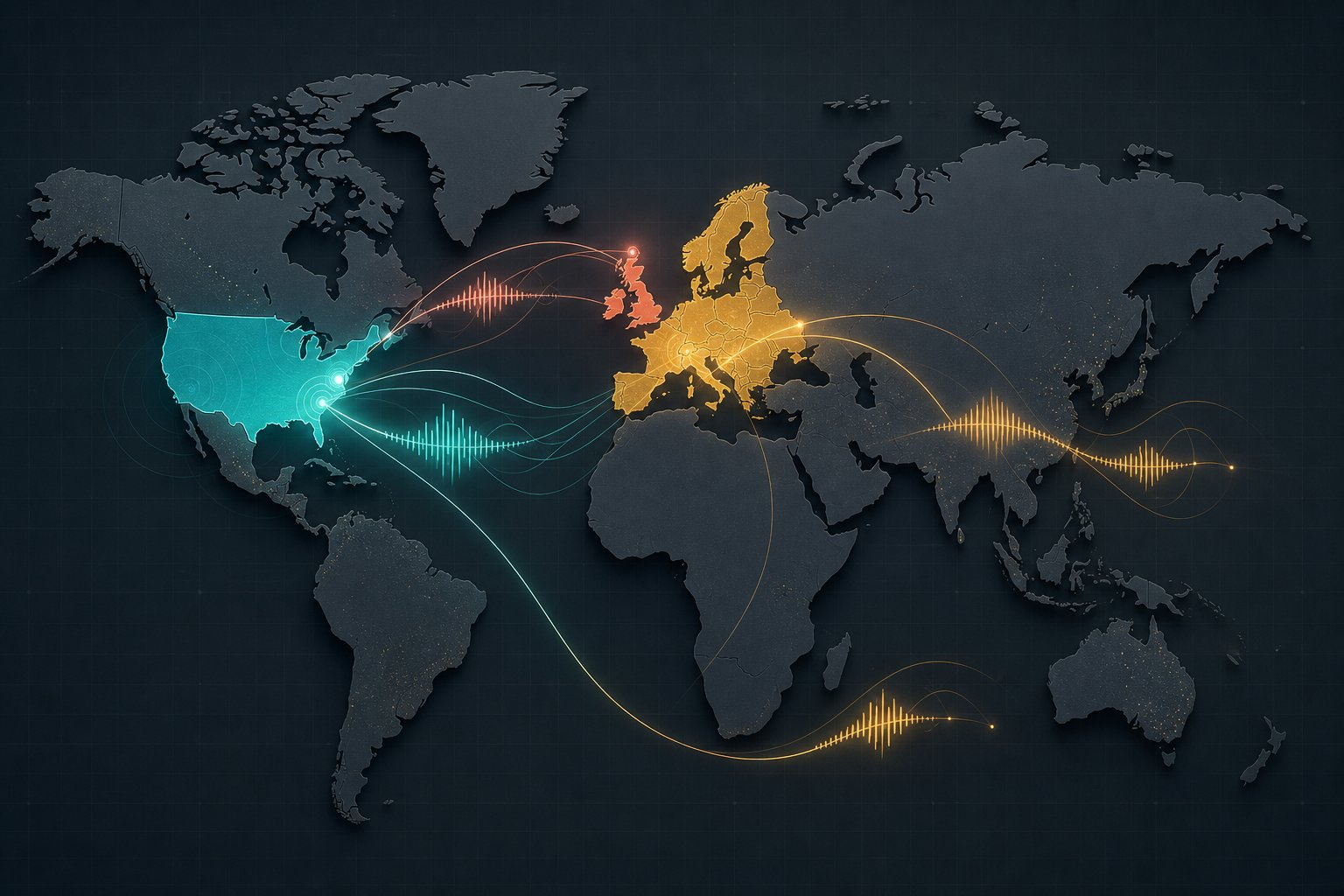
Platform terms are global, but copyright law is not. A creator in London, Berlin, and Los Angeles can use the same AI music tool under the same ToS, yet face entirely different legal outcomes when asking whether their output qualifies for protection. If you distribute music internationally, or collaborate across borders, you need to understand how each major jurisdiction handles AI-generated works. The divergence is striking, and for anyone tracking ai music rights news, the gap between these frameworks is widening rather than narrowing.
The US Approach and Human Authorship Requirement
The United States takes the strictest position. The Copyright Office has consistently held that only works created by a human author qualify for registration. This standard, rooted in the Copyright Clause of the Constitution and reinforced by every major AI-related decision since 2022, means purely AI-generated music receives zero protection. No human authorship, no copyright. Period.
The flip side is that AI-assisted music, where a human demonstrably shaped the final expressive content, remains fully eligible. The Office evaluates claims case by case, looking for evidence that the applicant made creative choices going beyond mere prompting. For U.S.-based creators, the framework is clear even if the threshold is fuzzy: your copyright claim lives or dies on provable human creative contribution.
EU Originality Standards and AI Works
The European Union takes a slightly different path. Under the InfoSoc Directive and the Court of Justice of the European Union's landmark Infopaq ruling, a work qualifies for copyright if it constitutes the author's "own intellectual creation" reflecting free and creative choices. The EU currently lacks specific legislation addressing AI-generated works directly, but the European Parliament has advocated a human-centric approach while calling for further analysis of how intellectual property rights apply to AI-assisted content.
What does this mean practically? The "own intellectual creation" standard likely excludes fully autonomous AI outputs, since no human expressed free creative choices. But it may leave more room for AI-assisted works than the U.S. approach, particularly where a creator can demonstrate that their intellectual input guided the final result. Member states show mixed approaches. German courts, for instance, recently found in the GEMA v. OpenAI case that AI memorization and reproduction of copyrighted lyrics constitutes infringement, signaling strong protection for existing rightsholders even as the copyrightability of new AI outputs remains uncertain.
For creators following copyright music ai news from Europe, the biggest development to watch is whether the CJEU establishes a unified standard through pending referrals. A case referred in April 2025 could produce the first authoritative EU ruling on AI and copyright, though a decision is not expected before 2027.
The UK Exception for Computer-Generated Works
The UK stands apart from both the U.S. and EU with a unique statutory provision. Section 9(3) of the Copyright, Designs and Patents Act 1988 (CDPA) grants copyright in "computer-generated works" that have no human author. Ownership is assigned to "the person by whom the arrangements necessary for the creation of the work are made." In theory, this means someone who uses an AI tool to generate a track could claim copyright simply by being the person who set up and initiated the process.
Sounds like an easy win for AI music creators? Not quite. The provision creates a contradiction. UK courts follow EU case law requiring originality to reflect an author's "personal touch" and "free and creative choices." A purely AI-generated work satisfying Section 9(3) may simultaneously fail the originality test that applies to all authorial works. The UK Intellectual Property Office acknowledged this tension in its 2024 consultation, noting that Section 9(3)'s repeal could "remove this apparent contradiction" and that there is little evidence the provision stimulates AI innovation.
A decision on Section 9(3)'s future is expected soon. The UK Government's 2024 consultation attracted over 11,500 responses, with 88% favoring mandatory licensing for AI training. The resulting report, due by March 2026, will likely address whether this decades-old provision survives in its current form. Music ai copyright news today increasingly suggests repeal is probable, which would align the UK more closely with the U.S. human-authorship standard.
| Region | Legal Framework | AI Music Copyright Status | Key Implication for Creators |
|---|---|---|---|
| United States | Copyright Act + USCO guidance requiring human authorship | Purely AI outputs not protectable; AI-assisted works with human creative input eligible case by case | Document every human creative decision; disclose AI use on applications |
| European Union | InfoSoc Directive + CJEU "own intellectual creation" standard | No specific AI legislation yet; human-centric approach advocated; fully autonomous outputs likely excluded | Demonstrate that free creative choices guided the result; watch for CJEU referrals |
| United Kingdom | CDPA Section 9(3) for computer-generated works + originality requirement | Statutory provision exists for works with no human author, but faces likely repeal; originality test may still block protection | Do not rely on Section 9(3) long-term; build human authorship into your workflow regardless |
The practical takeaway across all three jurisdictions points in the same direction: build your workflow around demonstrable human creativity. Even where the law technically accommodates purely AI-generated works, as in the UK, those provisions are unstable and likely to narrow. Creators who invest in documenting their creative process, regardless of jurisdiction, position themselves for protection under any framework. The question then becomes what specific documentation practices and workflow choices give you the strongest possible claim.
How to Strengthen Your Copyright Claim as a Creator
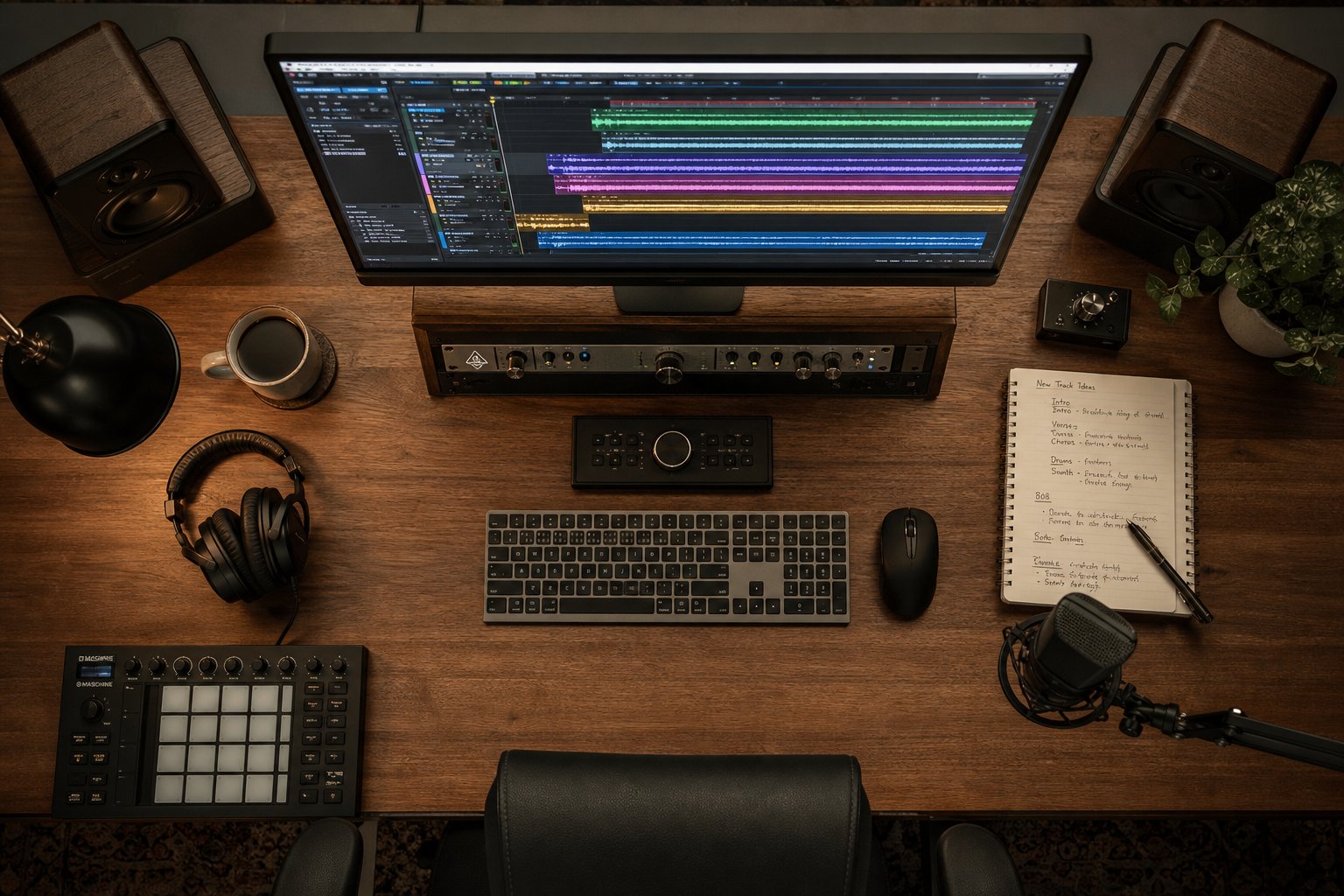
Knowing the rules is one thing. Building a workflow that actually satisfies those rules is another. The strongest copyright claims do not emerge after the fact. They are built into the process from the first prompt to the final export. Whether you are doing basic song production from a scratch track ai or layering human performance over generated elements, your documentation is what transforms a creative hunch into a defensible legal position.
What follows is a practical framework for different types of creators, each with different goals and different tolerance for legal complexity.
Documentation Best Practices for Your AI Music Workflow
The Copyright Office evaluates human authorship based on evidence. Assertions alone are not enough. You need a paper trail that shows what you created versus what the AI generated, when you made each decision, and how the work evolved through your creative direction. Think of it as version control for your copyright claim.
Here is what to capture at each stage of production:
- Prompt history and creative intent. Save every prompt you write, including rejected variations. Document why you chose specific directions. A prompt log demonstrates that you exercised creative judgment in guiding the AI, even if prompts alone do not constitute authorship.
- Raw AI outputs before editing. Export and timestamp every generated file before you touch it. This creates a baseline that proves what the AI produced independently versus what you shaped afterward.
- Iterative drafts showing human modifications. Save each version as you edit, rearrange, or rewrite sections. If you use a generative audio workstation or a DAW like Logic Pro AI features for composition assistance, keep session files that show your arrangement decisions layered on top of generated material.
- Mixing and production choices. Your ai mixing and mastering decisions, EQ adjustments, audio ai dynamics processing, spatial placement, and tonal shaping all represent human creative expression. Screenshot or export session states that capture these choices. A bounced stem showing your processing chain is evidence of authorship that a raw generated file cannot provide.
- Human-performed elements. Record and retain isolated tracks of anything you performed: vocals, instrument recordings, melody lines, even beat-boxed rhythms you later replicated with software. These are unambiguous proof of human authorship over those specific elements.
- Selection and rejection records. If you generated fifty variations and chose three sections to combine, document the full set and your reasoning. Creative selection is one of the strongest indicators of human authorship the Copyright Office recognizes.
- Final composition notes. Write a brief summary describing what you created, what the AI contributed, and how the two relate in the finished work. This becomes the basis of your Author Created field on the copyright application.
You do not need to capture every mouse click. The goal is a clear narrative: here is what the machine produced autonomously, and here is what I shaped, selected, arranged, and performed. If someone challenged your registration, could you walk a Copyright Office examiner through the creative journey from prompt to final mix? If yes, your documentation is sufficient.
Different Strategies for Different Creator Types
Not every creator needs the same level of copyright protection, and not every workflow justifies the same documentation overhead. Your strategy should match your goals.
Independent musicians using AI in their workflow. If you are building a catalog of original releases, you need the strongest possible copyright claims. Use AI as one tool among many. Write your own lyrics. Perform vocals or live instruments. Use an ai music remixer to create variations, but apply your own arrangement and editing on top. Treat the chatgpt song maker or any generative tool the same way you would treat a session musician who hands you raw ideas: take what works, reshape it, and make the final expression yours. Your DAW session files, lyric drafts, vocal takes, and arrangement decisions become your copyright evidence. Build the habit of exporting a timestamped project archive after each major creative session.
Producers incorporating AI elements. Producers who integrate AI-generated loops, textures, or harmonic suggestions into larger human-directed productions occupy strong legal ground. The key is ensuring that AI contributions remain components rather than the dominant creative force. If you generate a pad texture using an AI tool, then process it through your own effects chain, chop it, pitch-shift it, and layer it beneath human-composed melodies, you have transformed a raw output into a production element shaped by your creative vision. Document the transformation. Keep the original generated file alongside your processed version so the difference is audible and provable.
Content creators needing background music. Here is where the calculus changes entirely. If you are a YouTuber, podcaster, or social media producer who needs music behind your content rather than building a music catalog, the copyright registration question may not be relevant to your goals at all. You do not need to own a registrable copyright in your background track. You need the legal right to use it commercially without claims or takedowns.
For this use case, the simplest path avoids the documentation and registration process altogether. Platforms offering royalty-free AI music with clear commercial licenses eliminate copyright uncertainty from your workflow. MakeBestMusic's Free Music Generator provides royalty-free tracks with explicit commercial usage rights, so you can focus on your video, podcast, or game project without worrying about whether your background music qualifies for copyright protection or whether a platform's ToS will trigger a future takedown. When your goal is reliable, rights-clear music rather than building an original catalog, this approach saves you from navigating registration mechanics that were never designed for your use case.
The distinction matters: musicians and producers benefit from investing in documentation because their AI-assisted compositions are the product. Content creators benefit from sidestepping the question entirely because their music is a supporting element, not the core deliverable.
Whichever category you fall into, one principle holds: decisions made today about your creative process determine your legal options tomorrow. The creators who will be best positioned as copyright law continues evolving are those who built documentation habits early, chose tools with clear ownership terms, and matched their workflow to their actual business goals rather than hoping the legal landscape would sort itself out after the fact.
What This Means for Your Music Going Forward
The legal framework around AI-generated music is not waiting for creators to catch up. Legislation, litigation, and regulatory guidance are moving simultaneously, and the choices you make about your creative workflow right now will determine whether you are protected or exposed when the dust settles. So where does everything stand, and what should you actually do about it?
Where the Law Is Heading
The core principle has held steady across every ruling, registration decision, and official report published so far: purely AI-generated music cannot be copyrighted, but human-directed AI-assisted music can be, provided the creator demonstrates meaningful creative control over the expressive elements. That principle is unlikely to change. What will change is how precisely it gets applied, and several active processes are shaping those details right now.
The U.S. Copyright Office's Part 3 report, addressing the legality of training AI models on copyrighted works, has already been released in pre-publication form. Its conclusions on licensing frameworks and liability allocation will directly affect how AI music platforms operate and what legal exposure their users carry. Congressional activity is accelerating as well. Multiple bills addressing AI and copyright have been introduced, and the growing influence of ai in the music industry has made this a bipartisan priority. Whether new legislation codifies the human authorship requirement, creates compulsory licensing for AI training data, or establishes a new category of protection for AI-assisted works, the regulatory landscape will look different within the next few years.
Internationally, the trajectory is equally clear. The UK appears poised to scrap its unique Section 9(3) provision for computer-generated works, moving closer to the U.S. human-authorship standard. The UK government already confirmed that copyrighted material cannot be used for AI training without permission, a policy reversal driven by overwhelming industry opposition. The EU is watching pending CJEU referrals that could produce the first authoritative European ruling on AI and copyright. Across all three major jurisdictions, the direction favors human creators, not autonomous machine outputs.
Pending lawsuits add another layer of uncertainty. The coordinated RIAA suits against Suno and Udio remain active, and settlements like Udio's deals with Universal and Warner signal that the industry is establishing licensing frameworks through litigation. A $3 billion lawsuit filed by UMG, Concord, and ABKCO over unauthorized use of song lyrics in AI training underscores the scale of enforcement the industry is willing to pursue. Can ai make better music than humans? That question matters less than whether the legal system will protect whatever music AI does make, and right now, the answer leans heavily toward no, unless a human shaped it.
Choosing the Right Approach for Your Needs
Knowing where the law is heading matters only if you translate that knowledge into action. The right strategy depends on what you are trying to build. A songwriter pursuing original releases needs a fundamentally different approach than a podcaster who needs thirty seconds of intro music. Trying to apply one strategy to both use cases creates unnecessary risk or unnecessary work.
Here are the concrete steps you can take today based on your goals:
- If you are building a copyrightable music catalog: Use AI as one tool among many, not as the primary author. Write your own lyrics, compose melodies, perform vocals or instruments, and document every creative decision. Register works through the Standard Application with full AI disclosure. Your human contributions are the product. The AI is the assistant.
- If you are a producer integrating AI elements: Keep raw AI outputs separate from your processed, arranged, and mixed versions. Ensure that human-directed production choices dominate the final work. Maintain session files as evidence of transformation. Treat AI-generated material the same way you would treat any uncleared sample: useful raw material that needs your creative stamp before it becomes part of a finished, protectable work.
- If you need rights-clear music for content projects: Skip the registration complexity entirely. Use platforms that provide royalty-free music with explicit commercial licenses. MakeBestMusic's Free Music Generator offers free, royalty-free tracks designed for videos, podcasts, social content, and games, giving you clear commercial usage rights without the legal uncertainty of generating your own AI music and hoping it qualifies for protection. When background music is a supporting element rather than the core product, simplicity and legal clarity matter more than ownership.
- If you have already released AI-generated music without documentation: Start building your records now. Go back through existing projects and identify what you created versus what the AI generated. If you filed copyright registrations without disclosing AI use, consider filing supplementary registrations to correct the record before issues arise. The cost of proactive correction is far lower than the cost of a canceled registration during litigation.
- Regardless of your category: Read platform Terms of Service before committing your workflow. Check ownership clauses, content licenses retained by the platform, and commercial use restrictions on your specific plan tier. Choose tools whose terms align with your business goals, not just tools that produce the best-sounding output.
The role of ai in the music industry will only grow. Generative tools will become more capable, more integrated into professional workflows, and more normalized. That is not the question. The question is whether you are positioned to benefit from that growth or exposed by it. Creators who document their process, disclose AI involvement honestly, choose platforms with clear ownership terms, and match their workflow to their actual needs will thrive under whatever legal framework emerges. Those who treat AI outputs as a shortcut, skip the documentation, ignore the ToS, and hope for the best are building on a foundation that copyright law, platform policies, and an aggressive rights-holding industry are all working to undermine.
The tools have changed. The underlying principle has not. Copyright protects human creative expression. Make sure yours is visible, documented, and undeniable in every piece of music you release.
