

Can AI Actually Predict Music Trends
The short answer is yes, AI can predict certain music trends, but not all of them equally well and not without significant blind spots. Predicting a viral TikTok sound two weeks out is a fundamentally different task than forecasting whether jazz-funk fusion will dominate playlists three years from now. Most discussions lump these together, which leads to confusion and overhyped claims. The reality is more nuanced and more interesting.
What We Mean by Music Trend Prediction
When you hear the phrase "music trend prediction," what exactly does that cover? It helps to break the concept into distinct categories, because each one involves different data, different AI methods, and different levels of difficulty:
- Hit song prediction - Forecasting whether a specific track will chart or go viral based on its audio features, release context, and early engagement signals.
- Genre shifts - Detecting when listener behavior starts migrating toward new sounds or hybrid styles. With Spotify listing approximately 6,000 genres and genre fluidity becoming the norm, this task is increasingly complex.
- Emerging artist trajectories - Identifying which creators are gaining momentum before they break into the mainstream.
- Viral sound patterns - Spotting audio clips, samples, or production techniques that are accelerating across social platforms.
- Production style evolution - Tracking how sonic aesthetics shift over time, from tempo changes in dance music to the rise of lo-fi or "dirty" textures in pop.
Each of these represents a separate prediction challenge. A hit predictor analyzing audio waveforms operates nothing like a system tracking genre-level cultural shifts across millions of playlists. Conflating the two leads to misleading accuracy claims and unrealistic expectations about what AI can actually do.
Hit Songs vs Broader Cultural Shifts
Here is the distinction that matters most:
Predicting whether a song will perform well given current listener behavior is a pattern-matching problem. Predicting where culture and music are heading next is a far messier challenge that involves politics, identity, social movements, and human unpredictability that no algorithm fully captures.
Consider how music trends actually emerge in practice. The rise of phonk from a niche Memphis rap offshoot to a global TikTok phenomenon did not follow a neat data trajectory. It required cultural context, regional identity, platform dynamics, and a generation of listeners who connected the sound to weightlifting videos and car drifting clips. No model trained purely on audio features could have predicted that chain of events.
Meanwhile, predictive analytics in the music industry can forecast short-term trends with up to 95% accuracy within a week when working with streaming velocity and engagement data. That is impressive, but it is a very different kind of prediction than asking whether AI can predict culture at a macro level.
The gap between these two tasks is where most of the interesting questions live. AI excels at detecting momentum that already exists in data. It struggles with the genuinely novel, the countercultural, and the things artists create precisely because they break existing patterns. In a world where breakout stars no longer need to conform to established formulas and music is increasingly defined by moment rather than genre, that limitation is significant.
What follows is a systems-level look at how AI processes music data, where these prediction models succeed, where they fail, and a question that rarely gets asked: whether the algorithms doing the "predicting" are actually manufacturing the very trends they claim to forecast.
The Data That Feeds AI Trend Prediction
Every prediction starts with data, and AI music trend forecasting is no exception. The quality of what goes in determines the quality of what comes out. So what exactly are these systems ingesting to detect the next wave before it crests? Think of it as a pipeline: raw signals flow in from dozens of sources, get normalized, layered on top of each other, and processed through models that look for patterns a human analyst scanning spreadsheets would never catch in time.
Streaming and Engagement Data
Streaming platforms generate the densest layer of behavioral data available. Every time you press play, skip a track at the 15-second mark, or save a song to your library, that action feeds a signal. Multiply that by hundreds of millions of users across Spotify, Apple Music, YouTube Music, and Deezer, and you get an enormous real-time picture of what listeners actually want versus what they passively tolerate.
Here is what each core data source reveals about listener behavior:
- Play counts and streaming velocity - Raw volume matters less than the rate of acceleration. A track jumping from 5,000 to 50,000 daily streams in a week tells a very different story than one sitting flat at 100,000. AI systems focus on the curve, not the number.
- Skip rates and completion rates - A song people finish signals genuine engagement. High skip rates at the 10-15 second mark suggest the hook is not landing. This behavioral data is invisible to the public but critical for platforms internally.
- Save-to-stream ratio - One of the cleanest intent signals available. A track with a save-to-stream ratio above 4% is treated as algorithmically promising regardless of total stream count, because saving means the listener wants to return.
- Playlist additions and algorithmic placements - When a track gets picked up by editorial playlists or algorithmic lists like Discover Weekly, that placement itself becomes a data point. The rate at which cold listeners save a track after algorithmic delivery is a pre-virality signal that external tools cannot replicate.
- Shazam search spikes - Someone hearing a song in the wild and reaching for their phone to identify it represents a different kind of demand than passive streaming. Shazam spikes often precede streaming surges by days or weeks, making them a valuable early indicator.
- Radio airplay patterns - Traditional radio still feeds the pipeline, especially in markets outside the US. Airplay data reveals regional momentum and demographic reach that streaming alone does not capture.
- Search volume trends - Google Trends, YouTube search queries, and in-app search behavior show when audiences are actively seeking out an artist or sound. A spike in searches for a specific production style or subgenre name signals emerging curiosity before it translates to streams.
Social Signals and Platform Behavior
Streaming data tells you what people are listening to. Social signals tell you what people are doing with music, and that distinction matters enormously for trend detection. A song might have modest streams but explosive social adoption, which almost always precedes a streaming breakout.
The social signals AI systems track include TikTok video creations using a specific sound, Instagram Reels usage, hashtag velocity, duet and stitch chains, and cross-demographic adoption patterns. Research published in Humanities and Social Sciences Communications found that prior social media activity, particularly on TikTok and YouTube, correlates with chart entry within 1 to 3 days, reinforcing that these platforms function as leading indicators.
Imagine a track going from 200 to 5,000 TikTok sound uses in 10 days. That acceleration pattern, especially when the usage comes from mid-tier creators between 10K and 500K followers rather than a single paid push, tells AI systems something powerful is happening organically. TikTok velocity over a 7 to 14 day window now accounts for roughly 28% of the signal weight in major A&R prediction tools, making it the single most influential data source for trend detection in the current landscape.
The key insight about digital analytics trends in music prediction is that no single metric tells the full story. A track with massive TikTok usage but no corresponding Apple Music growth might be a short-lived meme rather than a genuine trend. A song with high save rates on Spotify but zero social signal might be an algorithm-fed anomaly that will not scale beyond its playlist bubble. The power of AI in this space comes from layering these dimensions together, cross-referencing streaming behavior with social engagement, geographic spread, and platform consistency to separate real momentum from noise.
Human analysts can read a chart and spot an outlier. What they cannot do is process 100,000 new tracks uploaded daily, cross-reference each one against dozens of behavioral signals in near-real-time, and flag the 50 that show genuine multi-platform acceleration. That volume and velocity of media and consumption data is precisely where AI earns its role, not as a replacement for human judgment, but as the filter that makes human judgment possible at scale.
These data inputs, though, only matter if the platforms processing them actually know how to act on the signals. The mechanisms each major platform uses to translate raw data into trend detection vary widely, and understanding those differences reveals why some platforms spot trends earlier than others.
How Major Platforms Use AI to Spot Trends
The platforms themselves are not passive repositories of listening data. They are active prediction engines, each running proprietary AI systems trained on behavioral signals no outside tool can fully replicate. Spotify, TikTok, YouTube, and Shazam all approach trend detection differently, and those differences shape which artists break, which sounds spread, and how quickly an emerging style reaches critical mass.
How Spotify Detects Emerging Artists
Spotify's recommendation engine is arguably the most sophisticated trend detection system in music. It combines content-based filtering (analyzing raw audio features, metadata, and even visual components of a release) with collaborative filtering built on roughly 700 million user-generated playlists. The system does not just match songs to listeners. It maps the entire musical landscape into vector spaces where proximity equals similarity, and movement within those spaces signals emerging momentum.
Here is what makes Spotify's internal AI so effective at spotting emerging artists before they break: over one third of all new artist discoveries happen through "Made for You" recommendation sessions, according to Spotify's own Made to be Found report. The platform tracks explicit signals like saves, playlist adds, shares, and click-throughs to artist profiles alongside implicit signals like listen-through rates and repeat plays. When a relatively unknown artist starts generating disproportionately strong session feedback, engagement rippling outward from a small core of early adopters into adjacent listener clusters, the system detects that pattern and amplifies it through algorithmic playlists like Discover Weekly and Release Radar.
The system also models user taste as multi-dimensional, context-aware profiles. Your Monday morning workout preferences and your Sunday evening wind-down preferences are treated as distinct interest clusters. This means an emerging artist does not need to appeal broadly to get surfaced. They need to fit a specific context with unusual precision. A lo-fi ambient producer who generates high completion rates during late-night study sessions will get recommended into that exact slot for similar listeners, even if the artist has only a few thousand monthly streams.
TikTok as Trend Engine and Predictor
TikTok operates on a fundamentally different model. Where Spotify relies on deep listening behavior accumulated over time, TikTok's algorithm makes predictions based on immediate, high-frequency engagement with short-form content. The platform can analyze video AI signals, watch-time ratios, replays, shares, and sound reuse velocity to determine whether a track is gaining cultural traction in near real-time.
What makes TikTok uniquely powerful for music trend prediction is that it measures something other platforms cannot: creative adoption. When users do not just listen to a sound but actively build content around it, duets, stitches, choreography, comedic reinterpretations, that signals a level of cultural resonance that passive streaming never captures. Research on algorithmic aesthetics and musical virality on TikTok has examined how platform-native musical aesthetics emerge through this participatory dynamic, where the algorithm both detects and rewards sounds that generate creative responses across demographics.
The key metrics TikTok's system tracks for trend prediction include:
- Sound usage velocity - The rate at which new videos adopt a specific audio clip over a 7 to 14 day window.
- Cross-demographic spread - A sound used only by one age group or geographic region has limited breakout potential. When adoption jumps across audience segments, virality becomes likely.
- Duet and stitch chains - These represent conversational engagement with a sound, indicating the audio has become a cultural object rather than background music.
- Creator tier distribution - Organic trends show adoption across micro, mid-tier, and macro creators. A sound pushed only by large accounts often lacks staying power.
The result is that TikTok functions simultaneously as a trend detector and a trend accelerator. Its recommendation algorithm surfaces sounds showing early momentum to exponentially larger audiences, compressing what might have been a months-long discovery arc into days. This dual role raises questions about whether the platform is predicting virality or manufacturing it, a tension explored in more depth later in this article.
Shazam and Early Signal Detection
Shazam occupies a unique position in the music discovery ecosystem because it captures demand that exists entirely outside digital platforms. When someone opens Shazam, they are hearing music in the physical world, in a store, on a TV show, at a party, in a passing car, and actively seeking to identify it. That intent signal is qualitatively different from anything streaming or social data provides.
In 2025, Shazam formalized this access intelligence capability by launching global Viral Charts: daily-updated, public-facing charts that use signals unique to Shazam to surface songs going viral in real time. The charts rank songs by their weekly growth in Shazam volume and track how songs emerge to popularity, including cultural moments from TV, film, streaming, and other global events. A Top 50 global chart and 42 national Top 25 charts provide both macro and regional visibility.
Shazam spikes have historically preceded mainstream streaming surges by days or even weeks, making the platform an early warning system for labels, playlist curators, and radio programmers. A song featured in a television series that generates a sudden Shazam spike in a specific market gives industry professionals a head start on a trend that has not yet shown up in streaming numbers.
YouTube rounds out the platform picture with its own trend detection layer, primarily through Content ID and the Trending algorithm. Content ID tracks how music gets used across millions of user-uploaded videos, surfacing patterns around which songs creators are choosing for their content, effectively a parallel signal to TikTok sound usage. YouTube's system can identify when a track's usage in copyright music on YouTube starts accelerating across creator categories, flagging it as a potential breakout before the official audio reaches chart-level streams.
What all four platforms share is proprietary access to behavioral data at a scale and granularity that no external analytics tool can match. Spotify knows how listeners respond to songs second by second. TikTok knows how audiences engage creatively with sounds. Shazam knows what people want to find. YouTube knows what creators choose to build around. Each data layer reveals a different dimension of musical momentum, and together they form the most powerful trend prediction infrastructure in existence.
The AI methods processing all of this platform data, however, vary widely in their approach, accuracy, and what they can realistically forecast. Understanding the technical models behind music trend prediction reveals both their genuine strengths and the gap between laboratory claims and real-world performance.
AI Methods Behind Music Trend Forecasting
The platforms covered above have the data. But data alone does not produce predictions. The intelligence analysis layer, the actual AI models processing all that behavioral information, determines whether raw signals become actionable trend forecasts. Several distinct technical approaches power music trend prediction, each suited to different aspects of the problem. Understanding how they work, and where their claims break down, is essential for separating real capability from hype.
Time Series and Deep Learning Methods
At its core, predicting music trends is a forecasting problem. You have historical data (streams over time, social engagement curves, playlist additions per day) and you want to project where those numbers are heading. The primary AI methods tackling this challenge fall into a few major categories:
- Time series forecasting - Models like ARIMA and Prophet analyze streaming trajectories to predict future play counts based on historical patterns. These work well for short-term projections where momentum is already visible in the data.
- Regression models - Linear and logistic regression approaches correlate audio features, release metadata, and early engagement signals with chart performance outcomes. They are simple, interpretable, and useful as baselines, but they struggle with non-linear cultural dynamics.
- LSTM networks (Long Short-Term Memory) - A type of recurrent neural network designed for sequential pattern recognition. LSTMs can process audio feature sequences over time and detect patterns in how listener behavior evolves, making them particularly suited to capturing the temporal dynamics of trend emergence.
- NLP and sentiment analysis - Natural language processing models scan social media posts, music reviews, comment sections, and forum discussions to gauge audience sentiment around genres, artists, and sounds. This quantitative descriptive analysis of text data adds a qualitative dimension that pure listening metrics miss.
- Hybrid deep learning architectures - Models like DHB-ILSTM (which combine different neural network components) attempt to fuse multiple data types, audio features, engagement metrics, and temporal patterns, into unified prediction systems. These have reported accuracy rates as high as 93% in research settings.
The time series and regression approaches handle the "what is already moving" question well. Deep learning methods attempt something harder: identifying latent patterns in audio or behavior that precede visible momentum. The distinction matters because trend prediction is most valuable when it detects something before it becomes obvious, not after a song is already climbing charts.
What Accuracy Claims Actually Mean
You will encounter bold numbers in this space. A widely covered 2023 study published in Frontiers in Artificial Intelligence claimed that a machine learning model could predict hit songs with 97% accuracy using neurophysiological data from listeners wearing cardiac sensors. News outlets including Scientific American initially covered the finding as a potential breakthrough.
The reality? Researchers at Princeton found the study's results were fundamentally flawed due to data leakage, one of the most common pitfalls in machine learning. The model was trained on just 24 songs from 33 listeners, then the dataset was synthetically oversampled to 10,000 samples before being split into training and test sets. This means the model was essentially evaluated on data nearly identical to what it trained on. When Princeton's team corrected the error and tested the model properly, its accuracy dropped to little better than random chance.
This is not an isolated case. The same oversampling-before-splitting error has been found across hundreds of papers in over a dozen fields. Other researchers have echoed skepticism. Hoda Khalil, a data scientist at Carleton University, has noted that analyzing data from more than 600,000 songs revealed no significant correlations between acoustic features and commercial popularity. Stefan Koelsch, a neuroscientist at the University of Bergen, has stated that finding reliable indicators even for crude differences between pleasant and unpleasant music is extremely difficult, let alone the subtle distinctions that separate a nice musical piece from a hit.
So what do these accuracy numbers actually mean in practice? Here is a comparison of the major methods, their inputs, and how their reported numbers hold up:
| AI Method | Primary Data Inputs | Prediction Target | Reported Accuracy | Real-World Reliability |
|---|---|---|---|---|
| Neurophysiology + ML | Cardiac sensor data from listeners | Hit vs. flop classification | 97% | Debunked; no better than random when tested properly |
| Audio feature regression | Tempo, key, danceability, energy | Chart performance | 50-60% | Slightly better than a coin flip; consistent across large-scale studies |
| LSTM / DHB-ILSTM | Sequential audio features + engagement data | Streaming trajectory | 85-93% | Strong in controlled settings; degrades on novel genres and cultural shifts |
| Time series forecasting | Historical streaming and engagement curves | Short-term stream count projection | 70-90% | Reliable for 1-2 week windows; accuracy drops sharply beyond 30 days |
| NLP sentiment analysis | Social posts, reviews, comments | Genre/artist momentum direction | 65-80% | Useful as a supplementary signal; prone to sarcasm and context misreads |
The pattern is clear. Models that rely on already-visible momentum data (streaming curves, engagement velocity) perform reasonably well over short horizons. Models that claim to predict hits from intrinsic audio properties or small listener samples tend to overstate their accuracy by orders of magnitude. Lab conditions allow researchers to control variables, clean datasets, and optimize for specific test splits. The real world is messier. New artists emerge from scenes the training data never saw. Cultural context shifts overnight. A geopolitical event reshapes what listeners want to hear in ways no historical pattern can anticipate.
The honest takeaway: AI can project short-term trends from existing momentum with meaningful reliability. It cannot reliably tell you which song will be a hit before anyone has heard it. The gap between those two capabilities is vast, and any accuracy claim that does not specify its prediction window, dataset size, and validation method should be treated with serious skepticism.
These technical limitations, though, are only part of the story. There is a deeper problem with treating AI as a neutral predictor of musical trends, one that emerges from the very architecture of the platforms running these models. When the system making the prediction also controls what millions of people hear next, the line between forecasting a trend and forcing one into existence gets dangerously blurry.
When AI Predictions Create the Trends They Forecast
Here is the uncomfortable question that rarely gets asked in conversations about whether AI can predict music trends: what happens when the system making the prediction is also the system deciding what hundreds of millions of people hear next? Spotify does not just detect that a track is gaining momentum. It acts on that detection by placing the track in front of exponentially more listeners. TikTok does not just observe that a sound is spreading. It feeds that sound into the For You pages of users who have never encountered it. The prediction and the outcome become inseparable.
This is not a minor technical detail. It is the central tension in how artificial intelligence and social media are reshaping musical culture. And it challenges the entire premise of trend prediction as a neutral, observational activity.
The Self-Fulfilling Prophecy Problem
Imagine a track gets uploaded to Spotify with zero promotion. Within its first 48 hours, it generates an unusually high save-to-stream ratio among the small audience that encounters it organically. The algorithm flags this as a signal of quality. The track gets placed into Discover Weekly playlists for listeners with adjacent taste profiles. Those listeners engage strongly, triggering further amplification into Release Radar and genre-based algorithmic playlists. Within two weeks, the song has 500,000 streams and gets picked up by editorial curators. A month later, it charts.
Was that trend predicted or manufactured? The algorithm detected early promise and then created the conditions for that promise to be fulfilled. Without the amplification, the track might have plateaued at 5,000 streams and disappeared. The "prediction" was not a passive observation about where culture was heading. It was an active intervention that shaped the outcome.
Researchers studying this dynamic have identified it as a core problem in how recommender systems influence cultural content. A major study from the Knight First Amendment Institute at Columbia University describes how recommender systems create feedback loops where personalized recommendations "are having cumulative effects, shaping the cultures and societies in which they are used," influencing "content consumption, creator incentives, and dominant formats." The system does not merely reflect existing taste. It actively conditions future taste by controlling what gets exposure and what gets buried.
When Prediction Becomes Amplification
The feedback loop operates in a clear sequence, and understanding each stage reveals why the boundary between forecasting and manufacturing has collapsed:
- Detection - AI identifies early engagement signals (high save rates, low skip rates, strong completion metrics) from a small initial audience.
- Amplification - The platform acts on that signal by surfacing the content to progressively larger audiences through algorithmic playlists, recommendation feeds, or trending placements.
- Validation - The larger audience engages with the content, generating more data that confirms the original prediction. The algorithm interprets this as proof that its forecast was correct.
- Entrenchment - Industry professionals, radio programmers, and editorial curators see the rising numbers and add their own amplification, reinforcing the trajectory.
At no point in this cycle does anyone ask whether the trend would have existed without the algorithmic push. The system validates itself by producing the outcome it predicted. This is not unique to music. It is a fundamental property of any digital marketing trend driven by platform algorithms. But in music, the consequences are particularly visible because cultural movements are supposed to emerge from collective human expression, not from optimization logic.
Consider the scale involved. Spotify's "algo-torial" system, as researchers describe it, combines editorial judgment with algorithmic infrastructure in a way where "human agency blends with the automated functioning of algorithmic infrastructures" to create a new form of cultural gatekeeping. When Discover Weekly reaches over 100 million users weekly, a single algorithmic placement carries more promotional force than any radio campaign or marketing budget could deliver. The platform is not observing the trend. It is the infrastructure through which the trend exists.
TikTok intensifies this dynamic further because its algorithm makes decisions in near-real-time with minimal human oversight. A sound can go from 200 uses to 2 million in under a week, not because two million people independently decided the sound was great, but because the algorithm detected early engagement and systematically distributed the sound to audiences most likely to create content with it. The trends in digital content management on TikTok are inseparable from the algorithmic decisions that govern what appears on every user's feed.
The implications for artist diversity are significant. If algorithms consistently amplify tracks that match patterns already validated by past data, they create a narrowing effect. Music that resembles what already worked gets boosted. Music that breaks new ground, that challenges existing listener expectations, gets less algorithmic support because it does not trigger the same early engagement signals the system is trained to reward. The Knight Columbia research warns that this produces a system where personalization "encourages fragmentation and atomization based on the recursive individuation to which users are subjected" while simultaneously homogenizing what reaches mass audiences into safe, algorithmically validated patterns.
You end up with a paradox: hyper-personalized listening at the individual level coexisting with increasing sonic sameness at the cultural level. Everyone's feed feels tailored, but the tracks that actually break through to mainstream status share an increasingly narrow set of characteristics because they are the ones the amplification loop selects for.
None of this means algorithmic trend detection is useless or dishonest. It means the question "can AI predict music trends" needs reframing. A more honest version might be: can AI identify early signals of listener resonance and then use its distribution power to turn those signals into full-scale cultural phenomena? The answer to that is unambiguously yes. Whether that constitutes prediction or creation depends on how comfortable you are with a system that both calls the race and runs it.
This blurring of prediction and production introduces a different set of problems, ones that have less to do with accuracy metrics and more to do with what gets systematically missed. Algorithmic amplification has blind spots, built-in biases, and entire categories of cultural activity it simply cannot see.
Where AI Trend Prediction Falls Short
Algorithmic blind spots are not edge cases. They are structural features of how AI trend prediction works. Every model is shaped by its training data, and when that data reflects narrow slices of musical culture, the predictions it produces carry those same biases forward. Understanding where AI falls short is not about dismissing its capabilities. It is about knowing when to trust the output and when to rely on something else entirely.
Genre Bias in Training Data
AI models learn from what they are fed, and what they are fed is overwhelmingly skewed toward commercially dominant genres. Pop, hip-hop, and electronic music generate the highest streaming volumes, the densest engagement data, and the most social media activity. That means prediction systems trained on platform data develop stronger pattern recognition for those genres while remaining comparatively blind to jazz, classical, folk, experimental, and regional music traditions that generate less digital signal.
This is not just a theoretical concern. A predictive modeling project from the University of Virginia School of Data Science demonstrated exactly how human bias in music evaluation flows directly into AI systems. The research team scraped album review data from Pitchfork and combined it with Spotify API data to build a genre classification model. What they found was revealing: Pitchfork reviewers showed a consistent bias toward indie and niche artists, giving higher scores to lesser-known acts and albums that subvert genre expectations. Albums reviewed further into the future scored higher, suggesting nostalgia bias. A noticeable scoring drop occurred from 2016 onward, reflecting shifting editorial priorities rather than actual changes in music quality.
The model could predict genre effectively, but its accuracy was partially dependent on those very biases. As one of the researchers noted, their analysis considers only nine official genre tags (Rock, Electronic, Pop/R&B, Folk/Country, Rap, Experimental, Jazz, Metal, and Global), yet albums frequently span multiple genres or fit none at all. This forced simplification means AI genre prediction systems inherit a reductive framework that flattens the complexity of how music actually exists in the world. Genre itself becomes a limitation baked into the model architecture.
The practical consequence for trend prediction is significant. If an AI system cannot accurately classify or understand music outside its dominant training categories, it cannot detect emerging momentum in those spaces. A new wave building in Afrobeats, amapiano, or regional Mexican music may go undetected until it has already crossed over into mainstream Western platforms, at which point calling it a "prediction" is generous. The biased listening patterns embedded in training data mean AI is consistently better at confirming trends within established genres than discovering them in underrepresented ones.
Cultural Context AI Cannot Capture
Beyond genre bias lies a deeper problem: music trends often emerge from cultural forces that leave no trace in streaming data or audio features. Political movements, regional identity, subcultural solidarity, economic conditions, and generational rebellion all drive musical shifts in ways that resist quantification.
Consider how punk emerged from economic frustration and class anger in 1970s Britain. Or how drill music mapped directly onto specific neighborhood realities in Chicago before spreading globally. Or how K-pop's international rise was inseparable from South Korea's deliberate soft-power cultural strategy spanning decades. None of these trajectories could have been predicted by analyzing audio waveforms or engagement metrics. They required understanding political context, social identity, and the cultural tenets that bind communities to specific sounds.
Research in the journal Psychology of Music and related fields has consistently shown that musical preferences are embedded within complex social and cultural ecosystems. Factors including cultural background, age demographics, social identity, and personal experiences create deep emotional associations with particular styles. These preferences evolve dynamically over time at both individual and collective levels, influenced by forces entirely outside the data pipelines that AI systems ingest. A model trained on Spotify behavior in 2023 has no mechanism for anticipating how a 2025 political movement might reshape what an entire generation wants to hear.
The UVA research reinforces this point from a different angle. Their team found that Spotify's algorithmic ecosystem is already reshaping how listeners form preferences in the first place. As one researcher observed, "It's almost like Spotify knows my music taste better than I do, but this also shows how much control these platforms have over what we hear." When the data source itself is shaped by algorithmic decisions, predictions built on that data are circular. The AI is not reading culture. It is reading its own output reflected back.
The Human Elements That Resist Prediction
Some of the most significant musical movements in history emerged precisely because artists made deliberate anti-algorithmic choices. They rejected what was popular, broke sonic conventions, and created sounds that existing frameworks could not categorize. AI prediction models, by definition, look for patterns that resemble past successes. They cannot anticipate the artist who succeeds by rejecting everything the data says should work.
Here are the specific categories where AI trend prediction consistently underperforms or fails outright:
- False positives and fizzled predictions - Songs or styles that show all the early engagement signals AI systems reward (high save rates, strong completion, social pickup) but never translate into sustained cultural relevance. The model flags them as trending, labels invest, and the momentum evaporates within weeks.
- Subcultural movements with low digital footprints - Scenes that grow through live events, physical media, word of mouth, and community spaces that generate minimal streaming data until they are already established.
- Deliberate aesthetic resistance - Artists who intentionally produce music that defies algorithmic optimization: tracks with long intros, unconventional structures, abrasive textures, or extreme length that trigger high skip rates but cultivate devoted followings.
- Cross-cultural emergence - Sounds that develop significance within specific diaspora communities or regional contexts before crossing linguistic and geographic boundaries in unpredictable ways.
- Retroactive recontextualization - Older music that suddenly gains new cultural meaning due to a film placement, meme, social moment, or generational rediscovery. No amount of audio feature analysis predicts when a 1985 Kate Bush track will become a global streaming phenomenon because of a television show.
- Genre invention - Entirely new sonic categories that have no historical precedent in training data. Hyperpop, vaporwave, and phonk all emerged from creative communities operating outside mainstream data visibility before AI systems could recognize them as coherent movements.
Human curation, A&R intuition, and deep cultural knowledge remain essential precisely because they operate where data cannot reach. An experienced A&R professional attending underground shows, monitoring niche forums, and maintaining relationships within creative communities accesses qualitative intelligence that no API can deliver. They can sense when an energy in a room signals something larger. They understand why a particular sound resonates with a specific community at a specific moment in ways that require lived experience, not pattern matching.
The most effective approach to music trend prediction is not choosing between AI and human judgment. It is understanding where each one works and where it does not. AI excels at processing scale, detecting momentum in data-rich environments, and surfacing patterns across millions of data points. Humans excel at context, meaning, cultural awareness, and recognizing the significance of things that have not yet generated enough data to be visible to any algorithm.
That complementary relationship is exactly what a growing ecosystem of industry tools is built around, combining algorithmic signal processing with human interpretation to create something more reliable than either approach alone.
AI Tools That Help Predict and Create Trending Music
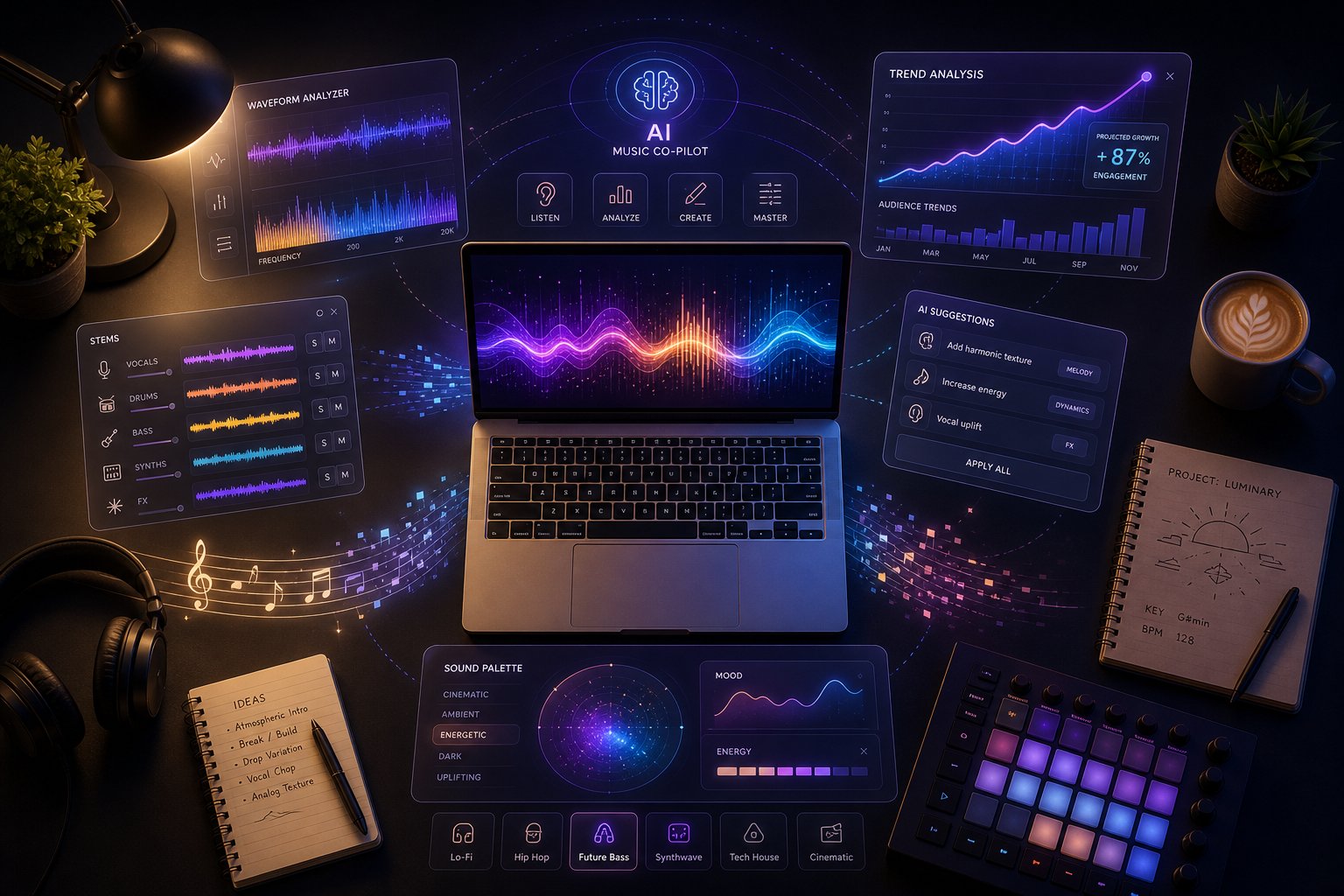
Knowing where AI excels and where it falls short is useful context. But if you are a label executive, an A&R analyst, or an independent creator trying to stay ahead of the curve, the practical question is different: which tools actually exist, and how do professionals use them day to day? The ecosystem of modern music solutions built around trend detection has matured significantly, and the best results come from combining multiple tools rather than relying on any single platform.
AI Tools for Industry Professionals
Major labels and large independents have built their A&R workflows around a core stack of analytics platforms, each serving a distinct role in the discovery pipeline. The job of these tools is straightforward: reduce 100,000 new tracks uploaded daily to a manageable list of artists showing genuine acceleration. The label with the best filter wins.
Here is how the leading platforms function and what each one brings to the table:
- MakeBestMusic AI Music Generator - For creators who want to act on trend insights immediately. Turn prompts, lyrics, and style references into complete AI-generated tracks aligned with emerging sounds. Useful for rapid prototyping of trend-aligned music without needing a full studio setup, letting you experiment with production approaches you are hearing in the data.
- Chartmetric - The industry-wide standard for cross-platform analytics. Aggregates data from Spotify, Apple Music, TikTok, YouTube, SoundCloud, Shazam, and radio into per-artist time series with years of history. Its Predict feature flags artists 30 to 60 days before viral inflection, defined as a 5x acceleration in cross-platform velocity over a 7-day window. Used across Universal, Warner, Sony, and most large independents.
- Soundcharts - Acquired by BMG in 2023, Soundcharts specializes in global tracking with deeper international radio and chart data than competitors, particularly in France, Germany, and Japan. Its AI Heat feature compresses multi-platform signals into a single 0-100 score that A&R analysts can scan at speed, functioning as a top-of-funnel filter for daily triage.
- Sodatone - Warner-owned and never released as a public product. Specializes in TikTok signal aggregation and predicting which TikTok sounds will translate to Spotify pickup. Inside Warner, Sodatone has driven a meaningful share of signings since 2020. Its competitive advantage is precisely that it remains proprietary.
- Viberate - The leading independent challenger to Chartmetric at a substantially lower price point. Offers broader Eastern European chart coverage and a public methodology page. Popular with independent labels and management companies that cannot justify enterprise-tier seat costs.
- Songstats - Distributor-grade analytics that integrates with DistroKid and other distribution APIs. Surfaces faster per-track data than the broader aggregators and serves as a verification layer: if Chartmetric flags an anomaly, Songstats is where analysts confirm it is not a data artifact.
The music prediction algorithms these platforms run share a common logic. They weight TikTok velocity, save-to-stream ratios, geographic spread, and cross-platform consistency to identify artists gaining real momentum versus those generating noise from paid promotion. What is conspicuously absent from the weighting? Raw stream counts and follower numbers. Those are vanity metrics that show where an artist is, not where they are going.
The human role in this workflow is critical. Every morning, an A&R analyst receives a tool-generated hot list of 30 to 100 artists who tripped a velocity threshold in the past 24 to 72 hours. Within an hour, the analyst rejects most of the list by cross-referencing genre fit, roster gaps, and a quick listen. The tools narrow the field. The human decides what to do with it.
How Creators Can Leverage AI Trend Insights
These analytics platforms were built for labels and industry professionals, but the underlying insights are increasingly accessible to independent creators. The shift matters because the information asymmetry between labels and artists is real. Labels see your data before you do through enterprise dashboards. Artists who build their own analytics awareness close that gap.
For producers and independent musicians, the actionable workflow looks like this: use analytics tools to identify what is gaining traction (rising tempos, specific production textures, genre hybrids showing cross-platform consistency), then use creative tools to experiment with those directions quickly. You do not need a six-figure studio budget to test whether a trending sound works in your style.
This is where AI generation tools become practical. If you spot that lo-fi jazz-hop textures are accelerating on TikTok, or that a particular rhythmic pattern is showing up in Discover Weekly placements, you can use MakeBestMusic's AI Music Generator to prototype tracks in that direction within minutes. Feed it a style description, lyrical concept, or production reference and get a complete track you can evaluate, iterate on, or use as a creative starting point. It bridges the gap between insight and action without requiring you to master every production technique from scratch.
The human-AI collaboration model works the same way at the creator level as it does inside labels. AI narrows the field, surfaces patterns, and quantifies signals that would take weeks to identify manually. You bring taste, cultural awareness, artistic identity, and the strategic thinking that decides which trends are worth following and which ones would compromise your voice. Musical note identification, tempo analysis, and sonic pattern matching are things algorithms handle efficiently. Deciding what to actually make with that information remains a human decision.
The most effective creators in this environment treat AI tools as accelerators, not replacements. They use analytics to stay informed, generation tools to prototype rapidly, and their own judgment to filter everything through a creative vision that no algorithm can replicate. The tools do not make the decisions. They make better-informed decisions possible at a pace that keeps up with how quickly the landscape shifts.
The Verdict on AI Music Trend Prediction
So where does all of this leave us? After examining the data pipelines, the platform mechanics, the technical models, the self-fulfilling prophecy problem, the blind spots, and the tools available, the answer to whether AI can predict music trends is neither a clean yes nor a dismissive no. It is a qualified yes that depends entirely on what kind of trend you are asking about, over what time horizon, and whether you are comfortable accepting that the predictor and the amplifier are often the same system.
What AI Predicts Well Right Now
AI performs strongest when the task involves detecting momentum that already exists in data-rich environments. Short-term virality, streaming acceleration, and cross-platform pickup are measurable phenomena with clear digital footprints, and algorithms process those signals faster and at greater scale than any human team. If a sound is gaining traction across TikTok, Spotify saves, and Shazam searches simultaneously, AI systems will flag it before most industry professionals notice.
The measures in music that algorithms handle with genuine reliability include streaming velocity projections over 7 to 14 day windows, save-to-stream ratio thresholds that predict playlist pickup, TikTok sound adoption curves that signal imminent crossover to streaming platforms, and geographic spread patterns that indicate whether momentum is local or global. These are pattern-matching tasks operating on dense behavioral data, and they represent AI's sweet spot.
Longer-term forecasting is a different story. Predicting what genre is the score of the cultural moment six months from now, or which underground scene will define the next era of popular music, remains beyond algorithmic reach. Those shifts are driven by social identity, political climate, generational values, and creative rebellion, forces that generate minimal digital signal until they have already reshaped listening behavior. AI trained on past patterns cannot anticipate the artist or community that succeeds by breaking those patterns entirely.
Here is how current AI capability maps against different prediction tasks:
| Prediction Task | Time Horizon | AI Capability Level | Human Advantage |
|---|---|---|---|
| Viral sound detection | 1-3 weeks | Strong. Cross-platform velocity signals are reliable early indicators. | Low. Speed and scale favor algorithms. |
| Chart performance projection | 2-6 weeks | Moderate to strong. Accurate when momentum is already visible in streaming data. | Moderate. Industry context helps interpret anomalies. |
| Emerging artist trajectory | 1-6 months | Moderate. Effective at flagging acceleration but prone to false positives. | High. A&R intuition catches what data misses. |
| Production style evolution | 3-12 months | Moderate. Can track feature shifts across large catalogs but struggles with novelty. | High. Producers and tastemakers sense shifts before data confirms them. |
| Genre evolution and hybridization | 1-3 years | Weak. Training data bias and pattern-matching logic limit visibility into new categories. | Very high. Cultural immersion and scene knowledge are essential. |
| Broad cultural movements | 3+ years | Very weak. Political, social, and identity-driven shifts leave no actionable data trail in advance. | Dominant. Understanding music for culture requires lived context no model possesses. |
The pattern is consistent across every dimension examined in this article. As the prediction horizon extends and the cultural complexity increases, AI reliability drops and human intelligence becomes indispensable. The inverse is equally true: for short-term, data-dense, momentum-based tasks, trying to compete with algorithmic processing using human analysts alone is a losing proposition.
The Future of Human-AI Music Forecasting
The most significant development ahead is not better prediction models. It is the convergence of prediction and creation into a single workflow. The industry is moving toward a reality where understanding what is trending and being able to produce music aligned with those directions happen in the same creative session rather than in separate departments.
This convergence is already visible. Platforms like Deezer receive over 50,000 fully AI-generated tracks per day, and automatic mixing and mastering tools continue improving, making professional-quality production accessible to creators without large budgets. The barrier between spotting a trend and acting on it is collapsing. A producer who identifies rising momentum in a particular sonic direction no longer needs weeks of studio time to test whether that direction works for their sound.
Creators who understand trend signals can use AI generation tools like MakeBestMusic to rapidly prototype music that aligns with emerging directions, closing the gap between insight and action. You see a production texture gaining cross-platform traction. You feed that stylistic direction into a generation tool. Within minutes you have a working draft to evaluate, iterate on, or use as a compositional starting point. The cycle from observation to experimentation shrinks from weeks to hours.
But the creators who will navigate this landscape most effectively are not the ones who blindly follow algorithmic signals. They are the ones who use AI as an information layer and a creative accelerator while maintaining the cultural awareness, artistic identity, and taste that algorithms cannot replicate. The data tells you what is moving. Your judgment tells you whether it matters, whether it fits your voice, and whether chasing it would compromise something more valuable than a short-term streaming spike.
The honest final assessment: AI can predict music trends within specific, bounded conditions, primarily short-term momentum in data-rich environments. It cannot predict culture. It cannot anticipate the genuinely novel. And it often manufactures the very trends it claims to forecast through amplification loops that blur the line between observation and intervention. The most powerful position is not choosing a side in the AI-versus-human debate. It is understanding exactly where each one works, combining them deliberately, and never mistaking algorithmic momentum for cultural significance.
