

Understanding AI in the Music Industry
Imagine hearing a new song from your favorite artist, loving it, sharing it with friends, and then discovering it was never actually performed or written by that artist at all. That scenario stopped being hypothetical in 2023, and it forced millions of listeners to confront a question that now shapes every corner of the business: what is AI in music industry practice today?
Defining Artificial Intelligence in Music
At its core, artificial intelligence in music refers to the use of machine learning algorithms, neural networks, and generative models to compose, produce, distribute, analyze, and personalize music. These systems learn from enormous datasets of existing recordings, scores, and metadata, then apply those learned patterns to create new audio, automate production tasks, or drive the recommendation engines that decide what you hear next.
AI in the music industry encompasses every stage of the value chain, from the initial spark of composition through production, distribution, marketing, and listener experience, powered by machine learning systems trained on vast catalogs of musical data.
This is not a single technology. It is a collection of approaches: deep learning models that generate melodies, natural language processors that interpret text prompts, computer vision systems that read sheet music, and recommendation algorithms that map listener behavior. Together, they represent a fundamental shift in how music gets made and consumed.
Why AI in Music Matters Now
The relationship between ai and the music industry did not emerge overnight. Researchers experimented with algorithmic composition as far back as the 1950s. So why does it feel like everything changed in the last few years?
Three forces converged at once. First, computing power became cheap and accessible enough to train complex neural networks on consumer-grade hardware. Second, the internet produced massive training datasets, millions of songs, stems, MIDI files, and lyrics freely available for models to learn from. Third, user-friendly interfaces brought these capabilities out of research labs and into the hands of everyday creators. A study by Ditto Music found that nearly 60 percent of surveyed artists already use AI in their music projects, signaling just how quickly adoption has spread.
The moment that crystallized public awareness came in April 2023. A TikTok creator using the name Ghostwriter released "Heart on My Sleeve," an AI-generated track that simulated the voices and styles of Drake and The Weeknd so convincingly that it went viral across streaming platforms. Universal Music Group invoked copyright violation to pull the song down, but versions kept circulating. The incident forced industry players, from label executives to entertainment lawyers, to grapple with music and artificial intelligence in a very public, very urgent way.
As Stanford professor Ge Wang put it, "The cat is not going back in the bag." AI in the music industry is no longer speculative. It is operational, commercial, and growing fast.
This article serves as both a foundational explainer and a practical reference. Whether you are a casual listener curious about how your playlists are built, a creator exploring new production workflows, or an industry professional navigating rights and revenue questions, the sections ahead break down exactly how ai and the music industry intersect, where the technology delivers real value, and where the hard problems remain unsolved.
How AI Music Generation Actually Works
You type a sentence like "mellow jazz piano with rain sounds" into a text box, click generate, and thirty seconds later you are listening to a full track that never existed before. It feels like magic. But how does AI create music from a handful of words? The answer involves layers of machine learning, massive datasets, and clever audio engineering working in sequence.
Training Data and Model Architecture
Every AI music system starts by learning from existing music, absorbing patterns from thousands or even hundreds of thousands of hours of audio. How does AI music generation work at the architectural level? It depends on which of two core approaches a system uses.
The first is symbolic generation. Here, models work with structured representations like MIDI data, piano rolls, or music notation rather than raw sound. Think of it as learning the recipe rather than the finished dish. A MIDI file encodes which notes play, when they start, how long they last, and how loud they are. Models like Music Transformer process these symbolic sequences to predict the next note in a composition, generating melodies and harmonies as structured data that a synthesizer then renders into audible sound. The advantage is efficiency: symbolic data is compact, which means models can learn from large amounts of music without extreme computational costs. The tradeoff is that the final audio quality depends entirely on the synthesis engine turning those notes into sound.
The second approach is audio-based generation, where models work directly with waveforms or spectrograms, the raw sonic material itself. This is how systems like MusicGen and Stable Audio operate. Instead of learning note sequences, they learn the full texture of sound: timbre, space, production quality, even the crackle of vinyl or the reverb of a room. Transformer models treat compressed audio as a sequence of tokens and predict what comes next, much like a language model predicts words. Diffusion models take a different path, starting from pure noise and gradually refining it into coherent audio through repeated denoising steps. Both architectures excel at producing realistic-sounding results, though they demand significantly more computing power than symbolic methods.
From Prompt to Finished Song
So how do ai music generators work in practice, from the moment you hit "create" to the moment you hear playback? The pipeline follows a consistent sequence regardless of which platform you use:
- Input encoding — Your text prompt, melody, or style reference gets converted into a numerical representation called a conditioning vector. A text encoder interprets the semantic meaning of phrases like "upbeat" or "acoustic guitar" and maps them to learned musical associations.
- Latent generation — Conditioned on that vector, the model generates a compressed musical representation. Transformer-based systems predict sequences of audio tokens one by one. Diffusion-based systems iteratively remove noise from a random signal until music emerges. At this stage, the output exists as abstract code, not yet listenable audio.
- Decoding — A decoder network, often a neural vocoder like HiFi-GAN, reconstructs a full audio waveform from the compressed representation. This is where the music becomes something your speakers can actually play.
- Post-processing — The raw output gets normalized for loudness, filtered for artifacts, and adjusted to meet standard audio specifications before delivery.
The specificity of your prompt directly shapes what comes out. Vague inputs like "happy song" produce generic results because the model has too much freedom. Detailed prompts naming instruments, tempo, genre, and mood narrow the possibilities and yield more targeted tracks.
One distinction worth making clearly: AI-assisted music is human-directed. A songwriter uses AI to generate chord suggestions, drum patterns, or arrangement ideas, then selects, edits, and shapes the output with creative intent. Fully AI-generated music is autonomous. You provide a prompt, the system handles composition, arrangement, and production, and the output arrives as a finished piece with no human editing in between. These are fundamentally different workflows, and understanding how does AI music work in each mode helps you evaluate what role the technology plays in any given track.
With the mechanics clear, the natural question becomes: where do these capabilities plug into the broader music business? The answer stretches far beyond composition alone.
AI Applications Across the Music Value Chain
A song's journey does not end when the last note is written. It gets produced, mixed, distributed, marketed, monetized, and tracked across dozens of platforms and territories. AI now touches every one of those stages, yet most discussions treat it as purely a composition trick. That misses the bigger picture. When you trace a track from first idea to final royalty payment, you'll find machine learning embedded at nearly every step.
AI in Composition and Production
The creative stage is where most people first encounter artificial intelligence in music production. Songwriters use AI-powered tools to break through writer's block, generating chord progressions, melodic ideas, or full arrangement sketches from a simple prompt or hummed melody. Platforms like AIVA and Soundraw handle complete composition for users who need background tracks quickly, while more production-oriented tools offer granular control over individual elements.
Move into the studio, and AI handles increasingly technical work. Stem separation tools like LALAL.AI and MOISES.AI isolate vocals, drums, bass, and other instruments from finished recordings, a task that once required access to original multitrack sessions. Noise reduction engines powered by neural networks, such as iZotope's RX suite, analyze audio in real time and surgically remove unwanted artifacts without damaging the underlying performance. Intelligent EQ and compression plugins learn from reference tracks, suggesting frequency adjustments that would take a seasoned mixing engineer hours of careful listening.
Mastering, the final production step, has also been reshaped. AI-driven mastering services like LANDR analyze a track's spectral balance, dynamics, and loudness relative to genre norms, then apply corrections automatically. Their engine avoids presets entirely, instead making decisions based on what it hears in each specific recording. For independent producers without access to expensive studio engineers, ai and music production tools like these close a quality gap that used to be prohibitively wide.
AI in Distribution and Marketing
Once a song is production-ready, getting it heard is a challenge all its own. This is where AI shifts from creative partner to strategic engine.
Playlist placement algorithms are the most visible example. Streaming platforms no longer rely solely on editorial curators. Generative playlist systems now assemble listening experiences from natural-language prompts like "mellow acoustic morning vibes" or "high-energy Latin workout." These systems match tracks using metadata, audio fingerprints, mood tags, and contextual signals rather than simple genre labels. For artists, that means discoverability increasingly depends on how well a song's metadata describes its qualities, not just whether a human curator noticed it.
Audience analytics platforms use machine learning to identify listener demographics, predict engagement patterns, and recommend optimal release windows. Imagine knowing that your fanbase in Berlin streams most actively on Thursday evenings, or that a particular TikTok sound is trending in a genre adjacent to yours. AI-driven marketing tools synthesize these signals into actionable strategies, even generating social media content, video captions, and ad copy tailored to specific audience segments.
AI in Rights Management and Monetization
Behind the creative and promotional layers sits the operational backbone that actually pays musicians. This is arguably where AI delivers its most underappreciated value.
Music distribution runs on data, and the volume of that data is staggering. Every stream generates information tied to territory, subscription tier, contributor splits, and platform-specific rates. AI-supported systems now detect missing or inconsistent metadata before delivery, flag ownership conflicts, and match recordings against existing catalog entries using audio fingerprinting. Music recognition AI powers content identification systems like YouTube's Content ID, scanning uploaded videos against databases of registered recordings to ensure rights holders get credited and compensated automatically.
Royalty reconciliation, once a slow manual process riddled with discrepancies, benefits from intelligent pattern detection. Machine learning surfaces inconsistencies between territory reports, highlights mismatched subscription tier categorizations, and identifies revenue sitting unallocated due to minor metadata errors. For independent artists especially, these improvements translate into fewer delayed payments and more transparent earnings statements.
Fraud detection adds another critical layer. AI systems monitor streaming activity for suspicious patterns, including sudden unexplained spikes, repetitive bot-like behavior, and traffic from low-quality sources. Catching artificial streams protects legitimate artists from having royalty pools diluted by fraudulent plays.
Even contract management is evolving. Music contract software with automated royalty calculation features can parse complex licensing agreements, track obligations across multiple deals, and flag discrepancies before they become disputes. While still maturing, these tools point toward a future where the administrative burden of managing a music catalog shrinks dramatically.
The table below maps each stage of the value chain to its corresponding AI applications and representative tools, giving you a single reference for where the technology fits:
| Value Chain Stage | AI Applications | Example Tools |
|---|---|---|
| Composition | Melody generation, chord suggestion, lyric assistance, arrangement drafting | AIVA, Soundraw, Orb Producer Suite |
| Production | Stem separation, noise reduction, intelligent EQ, mixing assistance | LALAL.AI, MOISES.AI, iZotope RX |
| Mastering | Automated loudness optimization, spectral balancing, dynamic processing | LANDR, iZotope Ozone |
| Distribution | Metadata validation, catalog matching, format compliance checks | Symphonic TransferTrack, DDEX-based systems |
| Marketing | Audience analytics, release timing prediction, social content generation | Chartmetric, Spotify for Artists analytics |
| Monetization | Royalty reconciliation, fraud detection, streaming pattern analysis | Platform-native AI fraud systems, distributor dashboards |
| Rights Management | Audio fingerprinting, content ID matching, ownership conflict detection | YouTube Content ID, Audible Magic |
What stands out across the entire chain is a consistent theme: artificial intelligence in music production and distribution does not replace human decision-making at any single stage. It accelerates it, catches errors humans would miss, and scales processes that would otherwise collapse under the weight of modern catalog sizes and global streaming volumes.
Yet the technology powering all these applications is only as meaningful as the people using it. The most revealing test of AI's real-world impact comes from the artists and creators who have put these tools into practice, sometimes with results that surprised even them.
Famous Musicians and Artists Using AI
Theory is one thing. Watching actual artists fold AI into their creative process tells you far more about where the technology sits in real music-making today. Some use it as a sketchpad, others as a full collaborator, and a few have built entire careers around it. The range of approaches reveals something important: there is no single "right" way to work with AI in music, only the way that serves each creator's vision.
Major Artists Embracing AI Tools
The most talked-about case remains the viral "Heart on My Sleeve" incident. In 2023, a creator operating under the alias Ghostwriter used AI voice-cloning to produce a track mimicking Drake and The Weeknd so convincingly that it accumulated millions of streams before Universal Music Group intervened. The song was never authorized, and it ignited fierce debate about consent, likeness rights, and what counts as original creation. But it also proved something undeniable: AI-generated music could pass the ear test for a mass audience.
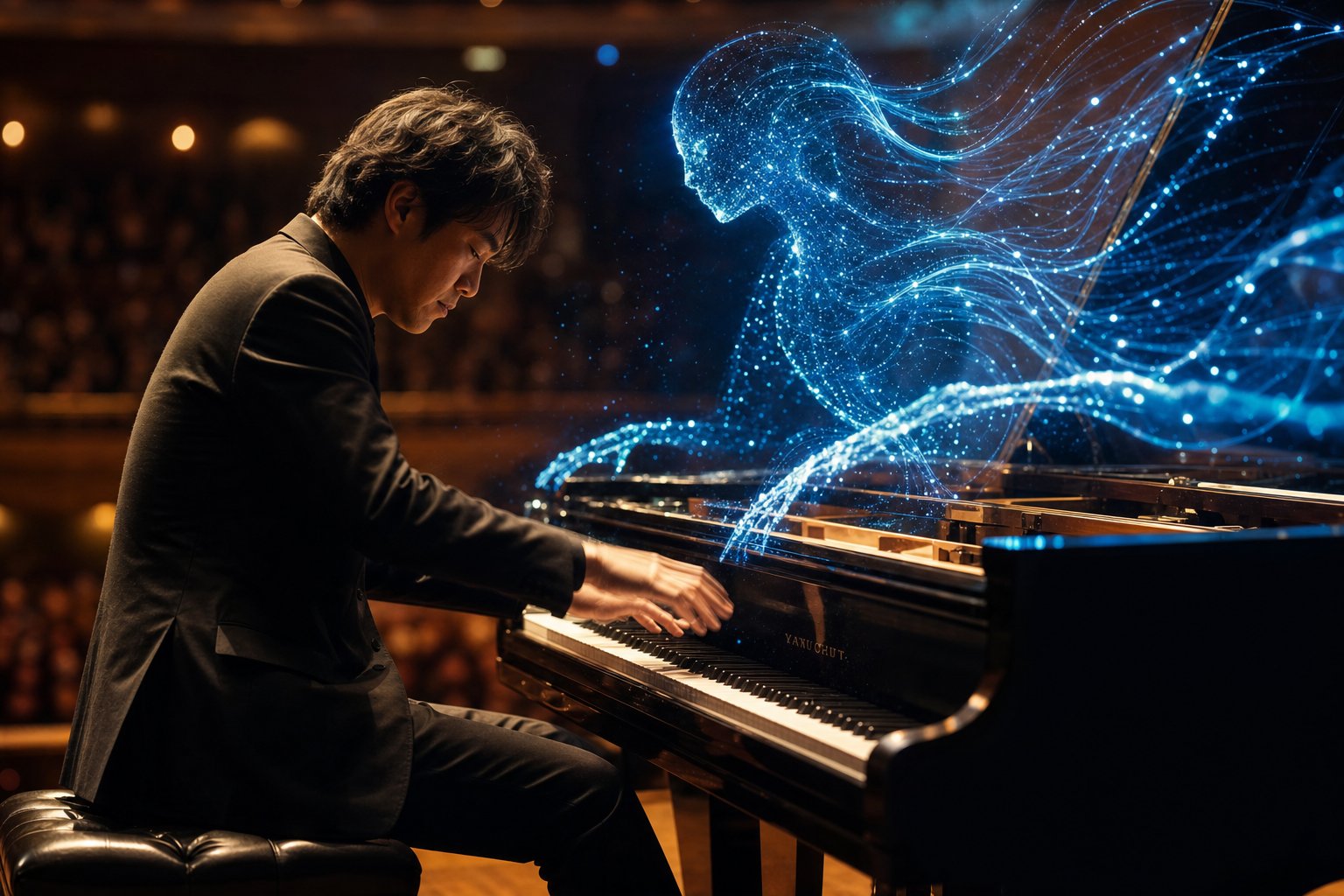
Away from the controversy, genuine collaboration between humans and AI has been unfolding in more deliberate ways. Pianist David Dolan and programmer-composer Dr. Oded Ben-Tal have performed live improvisations where a machine-listening system responds to Dolan's piano playing in real time, generating musical material that creates a genuine dialogue between human and machine. Ben-Tal's AI listens, infers musical structure from the audio signal, and produces responses that recombine Dolan's material in inventive ways. The result is not a replacement for human performance. It is a duet partner with a fundamentally different kind of intelligence.
"As a human, I have to limit my musical freedom and bursts of spontaneous expressive gestures and ideas so that the AI can keep being onboard, enabling the duo to keep making sense in real-time," Dolan explained. That constraint, interestingly, becomes its own creative force, pushing the performer into unfamiliar territory.
Other established artists treat AI less as a collaborator and more as a brainstorming tool. Producers use generative systems to rapidly prototype demo ideas, exploring dozens of melodic or rhythmic directions before committing to one. Songwriters feed half-finished lyrics into AI assistants to break through creative blocks, then reshape or discard the suggestions entirely. The key pattern across these cases: do artists use AI to write songs wholesale? Rarely. They use it to accelerate the messy, exploratory phase of creation, then apply their own taste and experience to shape the final work.
The Rise of AI-Native Musicians
Beyond established names experimenting with new tools, an entirely different category of creator has emerged: artists who build their workflow around AI from the ground up. What is an AI artist in this context? Someone who treats generative models as their primary instrument, the way a guitarist treats a guitar or a producer treats a DAW.
Quantifying how many AI musicians are there is tricky because the boundaries are blurry. A study by Landr surveying over 1,200 music creators found that 87% of musicians now use AI in some part of their creative process. Among beginners, 51% already use AI song generators, compared to 25% of professionals. Those numbers signal that AI-native creation is not a niche anymore. It is a growing default, especially for newer artists who never knew a workflow without these tools.
The spectrum of how these creators work varies widely:
- AI as a starting point — Creators generate raw material (melodies, beats, vocal demos) through AI, then heavily edit, layer, and rearrange the output using traditional production techniques. The AI provides inspiration; the human provides curation and finishing.
- AI as a session band — Solo artists who cannot play every instrument use AI to generate realistic instrumental parts, effectively treating the system like a group of session musicians available on demand. As one respondent in the Landr study noted: "I use AI as if it was a band of session musicians."
- AI as a finishing tool — Artists compose and perform everything themselves, then use AI for mixing assistance, mastering, or vocal tuning at the final stage of production, keeping the creative origin entirely human.
- AI as the complete engine — A smaller but growing group uses prompt-to-song generation for entire tracks, focusing their creative energy on prompting, curating, and sequencing output rather than performing or producing manually.
The gap between these approaches matters. Calling all of them "AI music" flattens important distinctions. A producer who uses AI stem separation to remix a track differently from someone who generates an entire song from a text prompt, even though both technically involve artificial intelligence. Famous musicians using AI tend to cluster at the "starting point" and "session band" end of the spectrum, retaining creative control while offloading tasks that used to require expensive studios or large teams.
What unites every approach is a shared belief that these tools extend creative capacity rather than diminish it. But extending capacity means different things depending on who you are: an independent bedroom producer, a major-label songwriter, a music educator, or a casual listener. Each stakeholder experiences the benefits and tradeoffs of AI in music differently.
Benefits of AI for Every Music Stakeholder
The ai impact on music industry workflows looks different depending on where you sit in the ecosystem. A bedroom producer in Lagos does not care about the same things as a playlist curator at a streaming platform. A songwriter dealing with creative block has different priorities than a music educator teaching harmony to beginners. The benefits of ai in music are real, but they distribute unevenly, and understanding who gains what helps you figure out where the technology fits in your own world.
Benefits for Independent Artists and Producers
For years, producing professional-quality music required either expensive studio time or deep technical knowledge of mixing consoles, synthesis, and signal processing. AI flattens that barrier dramatically. Modern AI production tools handle complex tasks like EQ adjustment, compression, and mastering automatically, allowing creators without formal training to achieve results that compete with major studio output.
Imagine you play guitar and sing, but you have never touched a drum machine or written a bass line. Music theory ai tools can suggest chord progressions that complement your melody, generate rhythm patterns that fit your tempo, and even transform a hummed idea into a realistic instrumental arrangement. You skip years of theory study and jump straight into creative exploration.
Speed matters too. Producers who once spent days building demos from scratch now prototype ideas in minutes, testing dozens of directions before committing studio time to the best one. That acceleration does not replace taste or vision. It just removes the bottleneck between having an idea and hearing it realized.
New monetization models have emerged alongside these creative tools. Independent artists can now build AI music revenue streams through custom soundtrack licensing, AI-assisted sync libraries, and personalized music services for brands. Creators license their catalogs for AI training in exchange for recurring royalties. Others sell custom compositions generated from text prompts to content creators who need affordable, original tracks. These pathways generate income without requiring a label deal or a viral hit.
Benefits for Listeners and Platforms
On the consumption side, the ai impact on music industry experiences shows up every time you open a streaming app. What is ai-powered music discovery? It is the system working behind every personalized playlist, every "Discover Weekly" recommendation, and every mood-based radio station. Modern recommendation engines go beyond simple genre matching. They analyze sonic fingerprints, emotional sentiment in lyrics, tempo patterns, and even contextual signals like time of day or listening environment to surface tracks you are statistically likely to enjoy but would never have found on your own.
AI music prediction models also help platforms anticipate what listeners want before they search for it, adapting playlists dynamically based on behavioral shifts and emerging micro-trends. The result is a listening experience that feels curated by someone who knows your taste intimately.
Accessibility improvements deserve mention too. AI-powered tools now generate audio descriptions of music for visually impaired listeners, auto-generate synchronized lyrics, and adapt playback characteristics for listeners with hearing differences. Music becomes more inclusive by default.
Here is how the benefits break down across stakeholder groups:
- Independent artists — Lower production costs, faster prototyping, access to studio-quality mixing and mastering without hiring engineers, new revenue streams through AI licensing and custom generation
- Producers and songwriters — Rapid idea exploration, intelligent arrangement suggestions, music theory assistance that accelerates composition without replacing creative judgment
- Music educators — Interactive teaching tools that demonstrate theory concepts in real time, adaptive exercises that respond to student skill levels, automated feedback on student compositions
- Listeners — Hyper-personalized discovery, mood-adaptive playlists, contextual recommendations, improved accessibility features
- Platforms and labels — Higher engagement and session duration, reduced editorial curation costs, better metadata quality, fraud detection that protects royalty pools
The through-line across every group is the same: AI handles complexity so humans can focus on what they actually care about. Producers care about the sound, not the EQ curve. Listeners care about finding music they love, not scrolling through millions of tracks. Labels care about paying the right people, not reconciling spreadsheets manually.
Still, benefits never arrive without tradeoffs. The same tools that lower barriers for independent creators also raise urgent questions about ownership, authenticity, and the economic future of working musicians. Those tensions deserve honest examination.
Technical Challenges and Ethical Issues in AI Music
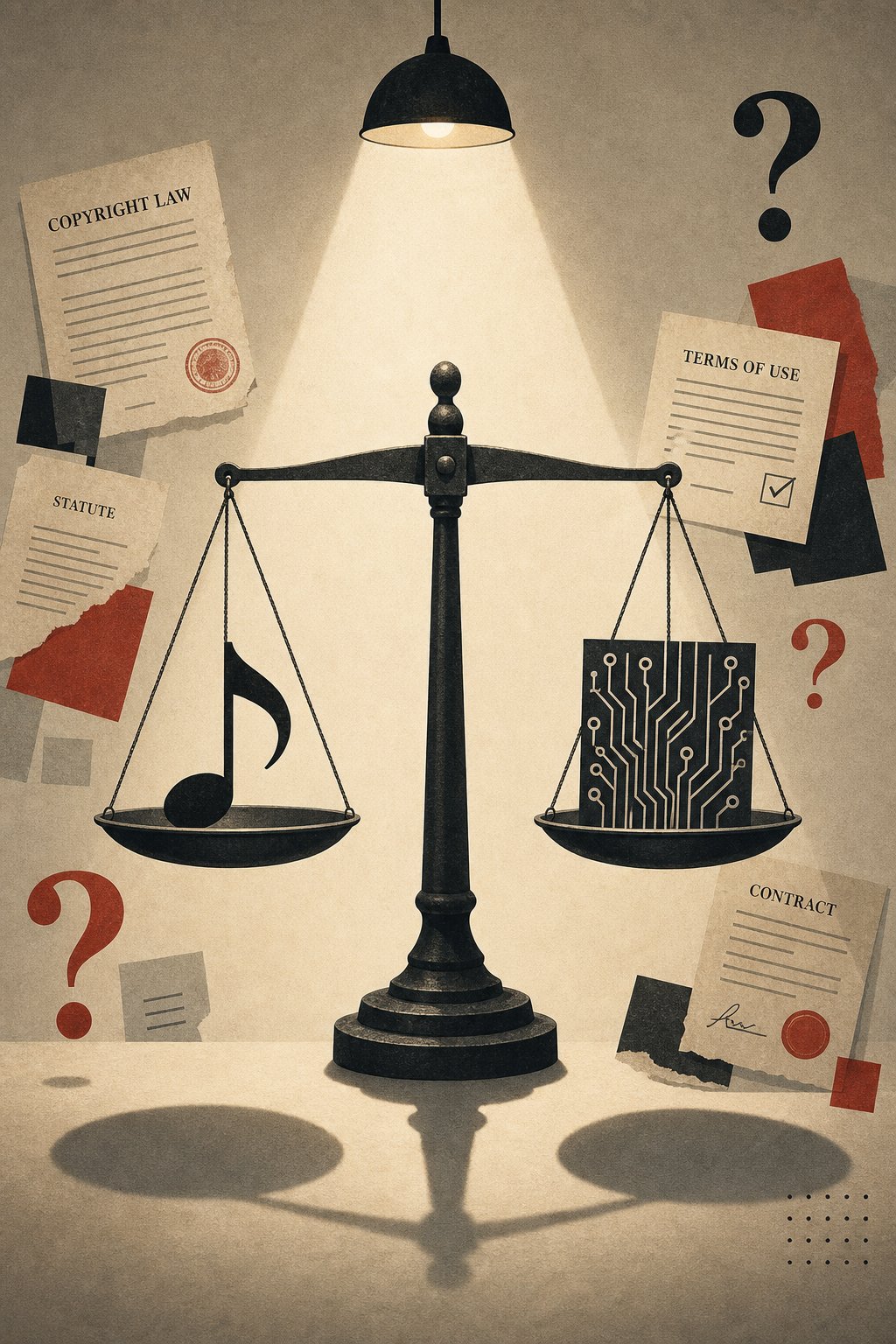
Every technology that reshapes a creative industry brings unresolved questions along with its benefits. AI in music is no exception. The legal frameworks governing ownership were built for a world where humans made music and machines played it back. That world no longer exists in the same form, and the gap between what the technology can do and what the law can handle is widening fast. The technical challenges and ethical issues in ai music generation are not theoretical edge cases. They affect anyone who creates, distributes, or listens to music today.
Copyright and Ownership Debates
Can you copyright AI music? The short answer, at least under current U.S. law, is no, not if the music was generated entirely by a machine. The U.S. Copyright Office released Part 2 of its AI report in January 2025, stating clearly that "the outputs of generative AI can be protected by copyright only where a human author has determined sufficient expressive elements." Writing a clever prompt does not qualify as authorship. The Thaler v. Perlmutter case reinforced this position, confirming that copyright protection remains reserved for works of human creation.
So who owns the output? The answer depends on who you ask, and none of the answers are fully satisfying. If you generate a track using an AI platform, the platform's terms of service may grant you "ownership" of the file. But ownership of a file and ownership of a copyright are two different things. Suno's own documentation acknowledges this distinction explicitly: "Music made 100% with AI would not qualify for copyright protection because a human did not write the lyrics or the music." You get the keys to the car, but you might not be legally allowed to drive it.
The training data question adds another volatile layer. Major AI music generators learned their craft by processing vast libraries of copyrighted recordings. In June 2024, Universal, Sony, and Warner launched coordinated lawsuits through the RIAA against both Suno and Udio, accusing them of "mass infringement of copyrighted sound recordings on an almost unimaginable scale." Suno admitted to using copyrighted music for training, arguing fair use. By late 2025, Udio had settled with both Universal and Warner under confidential terms, signaling that the legal pressure is producing results.
Artists have responded forcefully. Over 200 prominent musicians, including Billie Eilish, Stevie Wonder, and Nicki Minaj, signed an open letter warning against "this assault on human creativity." In March 2026, the UK government reversed its position on AI training opt-outs entirely, confirming that copyrighted material cannot be used for AI development without permission, a decision driven by over 10,000 consultation submissions with 95% opposing the AI-friendly approach.
The practical reality for creators is uncomfortable. If you generate music with AI and someone else claims it, you may have no legal recourse. If AI-generated music sits in the public domain, your competitors can freely copy anything you produce. Neither scenario gives creators the certainty they need to build a sustainable catalog.
Detection and Authenticity Concerns
When listeners cannot tell whether a track was made by a human or a machine, a trust problem emerges. How to spot AI music is becoming a practical skill, not just an academic curiosity. The viral Drake and Weeknd deepfake demonstrated that even trained ears can be fooled, and the volume of AI-generated submissions has exploded since then. Deezer reports receiving over 30,000 fully AI-generated tracks daily. Spotify removed 75 million tracks flagged as spam in a twelve-month period.
Detection tools are developing rapidly in response. Audio analysis systems examine spectral characteristics, timing micro-variations, and performance dynamics to check music to see if its ai generated or not. Human performances contain subtle imperfections, slight timing fluctuations, breath patterns, dynamic inconsistencies, that current AI models tend to smooth over. Detection algorithms look for these telltale signs of machine precision.
Industry certification initiatives are gaining traction as well. Several ai music production companies and stock audio libraries now pursue human-made certification programs, labeling tracks that were composed and performed entirely by people. YouTube updated its content policies in mid-2025 to address AI-generated music directly, with tracks lacking "clear human input" facing limited reach or blocked monetization. These steps point toward a future where provenance metadata, a verifiable chain showing who or what created a piece of music, becomes standard infrastructure rather than optional documentation.
Legislative momentum is building too. The UK's reversal on AI training permissions, combined with the U.S. Copyright Office's multi-part report and ongoing congressional engagement, suggests regulatory frameworks are catching up to the technology. The question is whether they will arrive quickly enough to prevent further damage to creators in the interim.
Impact on Working Musicians
Job displacement anxiety is real and deserves honest acknowledgment. When an AI can produce a serviceable background track in thirty seconds, certain categories of work, particularly low-cost stock music, jingle production, and generic sync library content, face genuine economic pressure. Musicians whose income depends on volume production of functional tracks have reason to worry.
But framing the situation as a simple replacement narrative misses important nuance. Research from Carnegie Mellon University examined this question directly, finding that AI-assisted music was slower, used fewer notes, and was judged by listeners as less creative than human compositions. As Rich Randall of CMU's Music Experience Lab put it: "It's always going to be derivative in some way, it's always going to be playing it safe. Humans are not constrained by that."
AI systems will likely generate waveforms that evoke captivating interest, but it is still human intentionality driving those systems that will remain the focus of the music experience. The technology augments creative capacity rather than replacing the human qualities that make music resonate.
New roles are emerging alongside the displacement concerns. AI prompt engineering for music, model fine-tuning, ethical AI consulting, detection and verification services, and AI-human collaboration design are all nascent specializations that did not exist five years ago. Musicians with deep domain knowledge are uniquely positioned to fill these roles because building effective AI music tools requires understanding what makes music work, not just how algorithms process data.
The most productive framing, supported by the CMU findings, treats AI as a force that shifts the value of musical labor rather than eliminating it. Routine, formulaic tasks lose economic value. Creative judgment, emotional authenticity, live performance, and the human story behind a piece of music gain value by contrast. The musicians most at risk are those whose work can be fully described by a text prompt. The ones least at risk are those whose artistry cannot.
These unresolved tensions, legal ambiguity, authenticity concerns, and economic disruption, do not exist in a vacuum. They shape the tools available to creators and the decisions those creators face when choosing how to integrate AI into their workflow. Navigating those choices requires knowing what is actually available.
AI Music Tools and Platforms for Creators
Knowing about legal risks and ethical debates is important, but at some point you need to actually pick a tool and make something. The landscape of AI music platforms has expanded rapidly, and the best ai tools for music vary dramatically depending on whether you want a complete song from a text prompt, production assistance inside your existing DAW, or specialized features like stem separation or automated mastering. Choosing without context leads to frustration, so let's map the options clearly.
AI Music Generation Platforms Compared
The platforms below span four major categories: full song generation, production assistance, mastering, and stem separation. Each draws on different music ai models under the hood, from transformer-based architectures that predict audio tokens to diffusion models that sculpt sound from noise. What matters to you as a creator is the output, not the math. Here's how the leading options stack up:
| Platform | Category | Use Case | Target User | Key Differentiator |
|---|---|---|---|---|
| MakeBestMusic | Full Song Generation | Turn text prompts, lyrics, and style preferences into complete tracks | Beginners, songwriters, content creators | Prompt-and-lyrics-to-song with fast output and no technical setup required |
| Suno | Full Song Generation | Complete songs with realistic AI vocals across 200+ genres | Content creators, hobbyists, songwriters | Most natural-sounding vocals; strong lyric interpretation |
| Udio | Full Song Generation | High-fidelity music with broadcast-quality audio | Professional producers, audiophiles | 48kHz/24-bit output; superior mixing and instrument separation |
| AIVA | Production Assistance | Orchestral composition with full notation export | Film composers, game audio designers | Sheet music and MIDI export; music notation ai capabilities for classically trained users |
| Soundraw | Production Assistance | Customizable royalty-free background music | Video editors, podcasters | Granular section-by-section editing after generation |
| LANDR | Mastering | Automated mastering with genre-aware processing | Independent artists, producers | Spectral analysis tuned to genre norms; no presets |
| iZotope Ozone | Mastering | AI-assisted mastering within a professional plugin environment | Mixing engineers, advanced producers | Reference track matching; integrates with existing DAW workflows |
| LALAL.AI | Stem Separation | Isolate vocals, drums, bass, and instruments from mixed audio | Remixers, DJs, producers | High-quality separation without original multitrack files |
| Mubert | Streaming/API | Infinite non-repeating background music via API | App developers, game studios | Real-time generative streams; enterprise-ready integration |
Notice the variety. Some platforms function like a chat gpt for music, where you describe what you want in natural language and receive a finished result. Others operate more like intelligent assistants embedded in traditional production environments. The underlying music ai models differ too: generation platforms typically use large transformer or diffusion architectures trained on audio data, while mastering and separation tools use specialized networks trained on narrower tasks.
Choosing the Right Tool for Your Workflow
With this many options, the real question is not "which platform is best" but "which platform fits how I actually work?" A hobbyist wanting quick results has entirely different needs from a professional ai producing team assembling a sync library. Here's how to narrow the field:
- Define your output goal — Do you need a complete song with vocals, an instrumental background track, a polished master, or separated stems from existing audio? Each goal points to a different category in the table above.
- Assess your technical comfort — If you have never opened a DAW, start with a prompt-to-song platform like MakeBestMusic or Suno that handles composition, arrangement, and production in one step. If you already produce in Ableton or Logic, look at tools that integrate into your existing setup.
- Check commercial licensing terms — Free tiers often restrict commercial use. If you plan to monetize, verify that your subscription level explicitly grants you rights to publish and earn revenue from generated tracks.
- Consider iteration speed — Platforms vary from 15-second generation to several minutes. If your workflow depends on rapid experimentation, speed matters more than maximum audio fidelity.
- Evaluate export flexibility — Can you download stems, MIDI, or just a stereo mix? Producers who want to process AI output in their own DAW need stem or multitrack export capabilities.
The practical advice? Start with one tool that matches your immediate need, learn its strengths and limits, then layer in additional platforms as your workflow demands. Most experienced creators end up using two or three tools in combination, maybe a generation platform for ideas, a production assistant for arrangement, and a mastering service for final polish.
For creators who want the shortest path from idea to finished track, prompt-based generators offer the lowest friction entry point. You write a description, add lyrics if you want vocals, pick a style, and hear back a complete arrangement within seconds. That workflow eliminates technical barriers entirely and lets you focus purely on the creative decision: does this sound like what I imagined?
Getting Started with AI Music Creation
Choosing the right tool is half the equation. The other half is actually sitting down and making something. If you have read this far without generating a single track, the best next step is not more research. It is experimentation. The creative barrier for ai assisted music production has dropped so low that your first attempt can happen in less time than it took to read this section.
Your First AI Music Creation Steps
You do not need a studio, a music degree, or even headphones to get started. Here is a practical sequence that takes you from zero to a finished piece of ai composed music in a single session:
- Pick a prompt-based generator and sign up — Start with a platform that requires no downloads or technical configuration. MakeBestMusic's AI Music Generator works well here because its prompt-and-lyrics-to-song approach lets you hear results immediately without any setup friction.
- Write a short, specific prompt — Describe the genre, mood, energy level, and any instruments you want. "Warm acoustic folk ballad with fingerpicked guitar and soft female vocals" will outperform "nice song" every time. Five details give the model enough direction to produce something coherent.
- Generate multiple variations — Create three to five versions from the same prompt. Listen for the one that sparks a reaction, not perfection. You are looking for a foundation, not a final master.
- Iterate on your favorite — Adjust the prompt, swap the style, change the lyrics. Each generation teaches you how the system responds to different inputs, building your intuition for how to use ai to write music effectively.
- Integrate into your existing workflow — Once you find something promising, export it. Use it as a demo reference, layer your own vocals over it, pull it into a DAW for further production, or publish it directly if the result stands on its own.
This process works whether you want a quick background track for a video, an artificial intelligence soundtrack for a podcast, or a fully realized song you plan to release. The point is momentum. Every generation sharpens your prompting skill, and that skill compounds fast.
Turning Ideas Into Complete Songs
What makes modern AI generators genuinely useful for beginners is their ability to handle the entire production chain from a single input. You provide a text description, maybe paste in some lyrics, select a style reference, and the system returns a complete arrangement: vocals, instrumentation, song structure, mixing, and basic mastering all handled in one pass. That means your half-formed idea, the melody stuck in your head at 2 AM or the lyric fragment scribbled on a napkin, can become a listenable track within minutes.
This is not about replacing the craft of production. It is about removing the blank-canvas problem. Many creators never start because the distance between "idea" and "finished song" feels insurmountable. AI collapses that distance. You hear your concept realized immediately, then decide whether to refine it further, take it into a DAW for professional polish, or use it as creative fuel for something entirely different.
If you want to learn how to use ai in music production at a deeper level, the path forward is the same as any instrument: practice, listen critically, and iterate. Generate an artificial intelligence soundtrack for a short film project. Write lyrics and hear them sung back in a style you never expected. Try genres outside your comfort zone just to see what happens. Each experiment builds fluency with tools that are only getting more capable.
The technology covered throughout this article, from neural network architectures to playlist algorithms to rights management systems, ultimately exists for one purpose: helping people make and experience music. The best way to understand what AI means for the music industry is not to read about it indefinitely. It is to open a generator, type something honest, and press create.
