

The Legal Reality of AI-Generated Music and Copyright
You just generated a full track using an AI music tool. It sounds polished, professional, ready to release. But can you actually own it? Can music created by AI be copyrighted in a way that gives you real legal protection?
The answer depends almost entirely on you, specifically how much creative decision-making you put into the work. Under the current legal framework in the United States, purely AI-generated outputs receive no copyright protection at all. However, music where a human has shaped the expressive elements through genuine creative choices may still qualify. The U.S. Copyright Office evaluates these situations on a case-by-case basis, looking at whether a human author determined sufficient expressive content in the final work.
This article breaks down the legal precedents driving these decisions, the practical thresholds that separate protectable work from unprotectable output, how different countries handle the question, and the concrete steps you can take to secure your rights.
Why This Question Matters for Every Creator
Without copyright, you cannot control who distributes your music. You cannot collect royalties when it streams. You cannot pursue infringement claims if someone copies it. For musicians, producers, and content creators building careers or businesses around their work, the ai music copyright question is not abstract. It determines whether your creative output has legal value or sits in the public domain the moment you publish it.
The Short Answer and Its Complications
Can you copyright ai music? Here is the short version: if AI alone created the work, no. If you directed the creative process with enough human authorship, potentially yes. The complication lies in that gray space between typing a prompt and composing every note yourself.
The outputs of generative AI can be protected by copyright only where a human author has determined sufficient expressive elements. This can include situations where a human-authored work is perceptible in an AI output, or a human makes creative arrangements or modifications of the output, but not the mere provision of prompts.
That position, stated by the Copyright Office in its January 2025 AI report, draws a clear line. Is ai music copyrighted by default? No. But the door remains open for creators who treat AI as a tool rather than a replacement for human expression. The real question becomes: where exactly does your involvement cross the threshold from instruction into authorship?
Why Human Involvement Determines Copyright Protection
The question of who owns artificial intelligence outputs starts with a foundational principle that U.S. copyright law has maintained since its inception: only humans can be authors. This is not a new rule invented to address AI. It is a bedrock requirement that courts have applied consistently, and the Supreme Court reinforced it in 2026 by denying certiorari in Thaler v. Perlmutter, leaving intact the D.C. Circuit's ruling that AI systems cannot be listed as authors under the Copyright Act.
What does this mean for ai artists working with generative tools? It means the software itself will never hold a copyright. The protection, if any exists, belongs to the human who exercised creative control over what the AI produced. The D.C. Circuit pointed to multiple provisions of the Copyright Act that assume authors are human: ownership rules presume the author can hold property, duration is measured by the author's lifespan, joint authorship requires intent, and registration requires a signature. These are all capacities only people possess.
For musicians, producers, and composers, this creates a practical framework. Your copyright claim lives or dies based on what you contributed creatively, not on the fact that you pressed a button or paid for a subscription.
What Counts as Sufficient Human Creative Input
Imagine you sit down to write a song. You compose a chord progression in D minor, sketch a vocal melody, write the lyrics, then hand the instrumental arrangement to an AI tool to flesh out the backing track. Do you own an auto copyright on things you make in that scenario? Almost certainly yes, because the core expressive elements, the melody, harmony, and lyrics, originated from your creative mind.
The U.S. Copyright Office's January 2025 report identifies several categories where human authorship likely exists in AI-assisted works:
- Selecting and arranging AI-generated materials alongside human-authored content, protectable as a compilation
- Modifying AI-generated content through iterative editing, selecting passages, adapting melodies note by note, and reshaping arrangements
- Inputting your own copyrightable work, such as an original melody or lyric, where that work remains perceptible in the final output
In music-specific terms, activities that likely establish sufficient authorship include: writing chord progressions that the AI then arranges, editing AI-generated melodies note by note until they reflect your creative vision, composing original lyrics and using AI only for instrumental backing, selecting key signatures and tempo as part of broader compositional decisions, and making substantive arrangement choices about song structure and dynamics.
Contrast these with what almost certainly falls short: typing "make me a sad lo-fi beat in C minor" and downloading the result without modification. In that scenario, your contribution is an idea, a set of instructions, not creative expression. The rules on work being framed as input rather than authorship are clear here. Instructions alone do not make you the author of what comes out.
The Prompt Engineering Debate
What about detailed, highly specific prompts? Some creators spend considerable time crafting elaborate text descriptions, specifying instrumentation, mood progressions, tempo changes, and stylistic references. Does that effort cross into authorship?
The Copyright Office says no. Its position is direct: prompts function as instructions that convey unprotectable ideas. They do not control how the AI system processes them into the final output.
Prompts do not appear to adequately determine the expressive elements produced, or control how the system translates them into an output. While prompts may reflect a user's mental conception or idea, they do not control the way that idea is expressed.
Think of it this way. Commissioning a painter and saying "paint me a melancholy landscape at dusk with a lone figure on a hill" does not make you the author of the resulting painting, no matter how specific your brief. The painter controls the brushstrokes, color mixing, and compositional choices that constitute the actual expression. Similarly, the AI system determines how your prompt translates into specific note sequences, timbres, and rhythmic patterns. You described what you wanted. You did not create the expression itself.
This distinction matters enormously for musicians relying on prompt-based generators. Even 600 iterative prompts, as in the pending Allen v. Perlmutter case involving visual art, may not be enough if the human never directly shaped the expressive content of the output.
Where the Threshold Likely Falls
The Copyright Office evaluates authorship on a case-by-case basis, which means no single bright-line rule exists. Still, you can map a useful spectrum based on the guidance available. The more direct control you exercise over expressive elements, the stronger your copyright claim.
Activities that likely meet the authorship threshold:
- Writing original melodies or lyrics that appear in the final work
- Composing chord progressions and harmonic structures the AI then orchestrates
- Editing AI-generated audio note by note, bar by bar, to reshape it into your vision
- Arranging and sequencing multiple AI-generated clips into a deliberate creative structure
- Recording original vocal or instrumental performances layered over AI-generated elements
- Making iterative creative modifications that transform the AI output substantially
Activities that likely do not meet the threshold:
- Typing a single prompt and accepting the output as-is
- Selecting one result from multiple AI generations without further modification
- Making only technical adjustments like volume normalization or format conversion
- Providing style references or genre tags without contributing original musical content
- Using regeneration buttons repeatedly until a satisfying result appears
The key insight from the Copyright Office's framework is that your involvement must reach the level of determining expressive elements, not just directing or curating them from a distance. You need to be in the work, shaping it at the level where creative choices become fixed expression. That distinction between directing and authoring is precisely what courts and registration examiners will scrutinize when specific legal disputes reach their desks.
Legal Cases Shaping AI Music Copyright Law
The thresholds discussed above did not emerge from thin air. They were defined through real disputes, real rulings, and real creators testing the boundaries of what the law will protect. A handful of landmark decisions now form the foundation for every copyright law news development in this space, and each one carries direct implications for musicians working with AI tools.
Thaler v. Perlmutter and Its Implications for Music
This is the case that settled the core question. Dr. Stephen Thaler sought copyright registration for a visual artwork generated entirely by his AI system, "The Creativity Machine," listing the AI as sole author. The U.S. Copyright Office refused. The district court agreed. The D.C. Circuit upheld that refusal, and the Supreme Court denied certiorari in March 2026, making the principle binding nationwide.
The court's reasoning went beyond a simple policy preference. It pointed to structural features of the Copyright Act itself: protection duration measured by a human lifespan, inheritance rights granted to heirs, ownership provisions requiring legal personhood, and transfer rules assuming an author capable of holding property. These provisions only make sense if the author is a person.
Copyright has always required a human creative mind. The Copyright Act's provisions presuppose a human author, with machines serving only as tools rather than independent creators.
For musicians, the Thaler v. Perlmutter ruling means that no AI music generator, regardless of how sophisticated, can ever hold a copyright on its own output. If you generate a full track using Suno, Udio, or any other platform and the AI did the creative work, that output belongs to no one. It sits in a copyright vacuum. The decision does not address what happens when human and AI contributions blend, but it draws an unmistakable line: purely autonomous machine output is categorically ineligible.
The Zarya of the Dawn Decision
Where Thaler addressed fully autonomous AI output, the Zarya of the Dawn decision tackled the messier reality of mixed works. Artist Kristina Kashtanova created a graphic novel combining their own written text with images generated by Midjourney. The Copyright Office's 2023 ruling split the registration: Kashtanova received copyright protection for the text and for the selection, coordination, and arrangement of elements, but not for the individual AI-generated images.
The Office concluded that Kashtanova lacked "sufficient control over" what Midjourney produced. Even though they used detailed prompts and refined outputs in Photoshop, the expressive choices within each image were made by the AI system, not the human.
Translate this framework to music and a clear pattern emerges. Imagine a song with human-written lyrics, a human-composed vocal melody, and AI-generated instrumentals. Under the Zarya logic, copyright would attach to the lyrics and melody but not to the backing track. The arrangement decisions, how you structured and sequenced those elements into a cohesive work, might also qualify as a protectable compilation. But each AI-generated instrumental loop or pattern, standing alone, likely receives no protection.
This component-by-component analysis is now the practical reality for anyone releasing AI-assisted music. Your copyright covers what you created. The rest is exposed.
Pending Litigation and Upcoming Rulings
A separate wave of lawsuits is attacking the problem from the opposite direction. Rather than asking whether AI outputs are copyrightable, these cases ask whether AI companies infringed existing copyrights by training their models on protected works without authorization.
Major music publishers, including Universal Music Group and Sony Music, have filed suits against AI companies alleging that their tools ingested vast catalogs of copyrighted recordings and compositions. Web scraping legal news december 2025 highlighted several of these cases advancing past early motions, with courts allowing discovery into training data practices. The question of whether meta ai publishers in-house third-party data licensing arrangements satisfy fair use remains contested and unresolved.
These training-data cases matter for everyday creators in a concrete way. If a court rules that an AI model produces outputs substantially similar to copyrighted training material, anyone who released that output could face secondary infringement claims. You might not have copied anyone intentionally, but if your AI tool did, the legal exposure could still reach you.
The ongoing litigation does not just determine liability for AI companies. It shapes whether creators using those tools can confidently distribute what they produce.
The ai copyright lawsuit news today 2025 and into 2026 reflects an accelerating legal landscape. Rulings in these training-data disputes will likely influence how the Copyright Office refines its guidance, how platforms update their terms, and how much legal risk accompanies using any particular AI music tool. For creators tracking copyright ai training lawsuit news today, the practical takeaway is straightforward: know what your tools were trained on, and understand that the legal ground beneath them is still shifting.
These rulings collectively establish the boundaries. But within those boundaries, different elements of a single song may receive very different treatment, a complexity that requires examining copyright at the component level.
How Copyright Applies to Different Parts of a Song
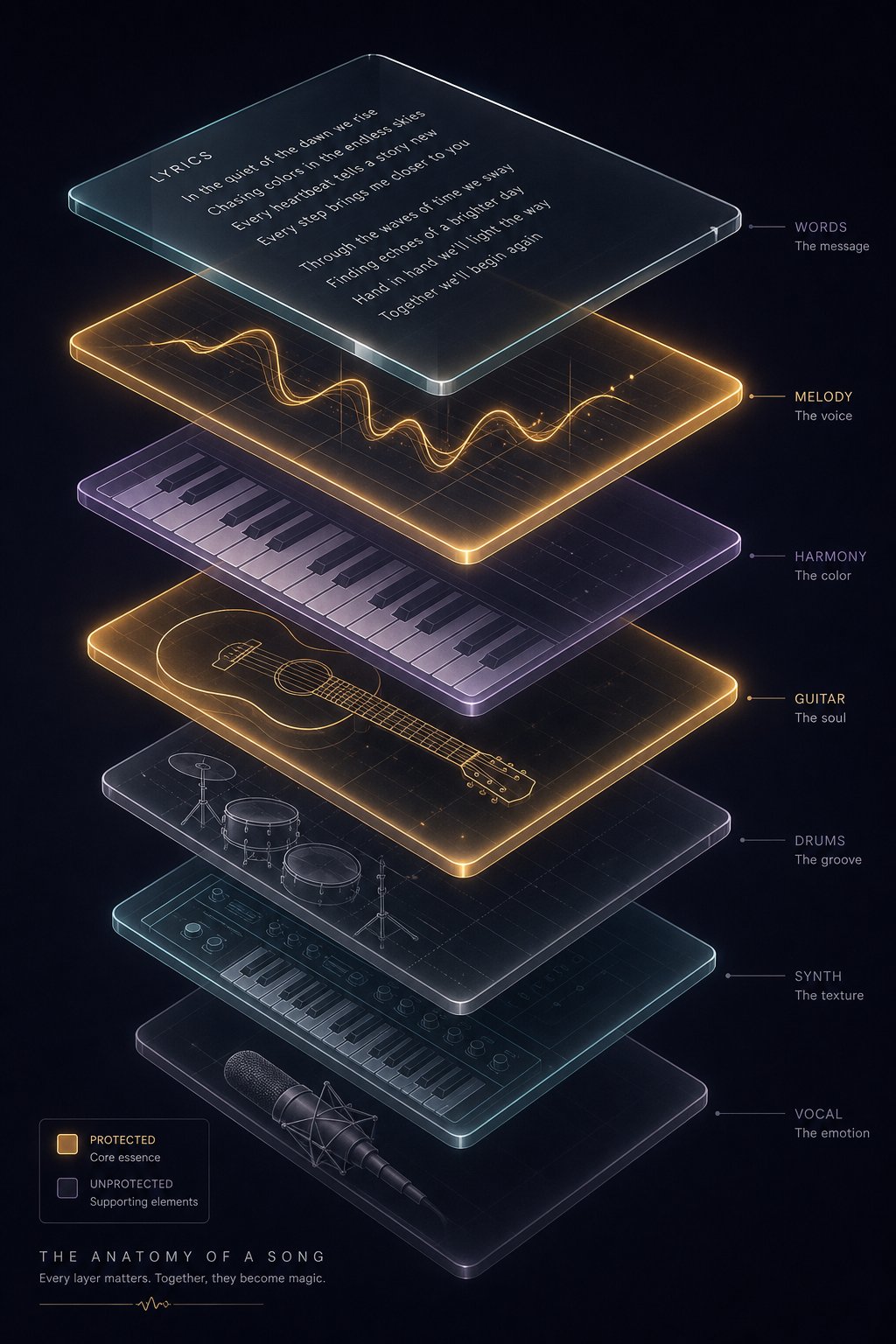
A song is not a single legal unit. It is a collection of separable elements, each with its own copyrightability status, and each potentially involving a different level of AI contribution. When you ask "can I publish a song written by AI," the more precise question is: which parts of music in that song were created by a human, and which were generated by a machine?
Traditional copyright law already treats songs as two distinct copyrights: the musical composition (melody, lyrics, harmony) and the sound recording (the actual audio performance and production). Within the composition itself, not every element receives equal legal weight. Melody and lyrics are considered unique creative works. Chord progressions and rhythms are generally treated as shared building blocks that no one can own. This existing hierarchy becomes critical when AI enters the workflow, because it determines exactly where your human authorship claims hold up and where they do not.
Lyrics and Melody as Separable Elements
Imagine you write a complete set of lyrics and a vocal melody, then feed them into an AI tool that generates a full instrumental arrangement. Under the component-by-component framework the Copyright Office applied in Zarya of the Dawn, your lyrics and melody remain copyrightable. They originated from your creative mind. The AI-generated instrumentation, however, likely receives no protection because the machine made the expressive choices for those elements.
This mirrors exactly how the Office handled mixed human-AI works in the graphic novel context: protect what the human created, exclude what the AI generated independently. For music, the logic translates cleanly. Melody and lyrics are the two elements traditionally recognized as the core copyrightable substance of a composition. If you wrote those yourself, your copyright claim for those elements stands regardless of how the rest of the track was produced.
The reverse scenario works too. If you use AI to generate lyrics and then compose the melody and harmonic structure yourself, the Copyright Office would likely grant partial registration covering the melody and harmony but not the AI-generated text. You would still own something, just not the whole composition.
Arrangement and Production Decisions
Here is where things get genuinely interesting. Song arrangement, the decisions about which instruments play where, how sections are structured, when dynamics shift, is not typically copyrightable on its own under traditional music copyright doctrine. Standard song structures like AABA or verse-chorus-bridge are shared conventions, just like common chord progressions.
But the Copyright Office's AI guidance introduces a nuance. When a human selects, coordinates, and arranges AI-generated elements into a deliberate creative structure, that arrangement itself may qualify for protection as a compilation. This is the same principle that protected Kashtanova's arrangement of text and images in Zarya of the Dawn, even though the individual images were not protectable.
For producers, this means your choices matter even when you did not create the raw sound elements. Selecting specific AI-generated drum patterns, layering them with AI-produced synth textures, structuring the song into a particular form, adjusting tempo and dynamics across sections, these compositional decisions could constitute copyrightable authorship if they reflect sufficient creative expression. The key question is whether your arrangement decisions go beyond mechanical assembly into genuine artistic choice.
Production and mixing decisions occupy similar territory. A mixing engineer who uses AI to EQ a bass track to emulate a specific amplifier is using AI as a tool without impacting copyrightability. The creative decision, choosing that particular sonic character, remains human. But if the AI is generating the bass line itself, the engineer's mixing choices do not retroactively grant copyright over the melodic content of that line.
Practical Implications for Split Copyright
When only portions of your song are copyrightable, several practical consequences follow. Registration becomes more complex: you must identify and exclude AI-generated elements from your copyright claim. Licensing splits may not align with traditional 50/50 songwriter-producer arrangements if the producer's contribution was entirely AI-generated. And if someone copies the unprotected AI-generated portion of your track, you have no infringement claim for those elements.
Revenue implications are significant. Performance royalties flow from the musical work copyright. If your AI-generated melody is not protectable, you cannot collect mechanical royalties on it or pursue sync licensing fees for that element alone. You would only collect on the human-authored components, which means understanding the cost for music copyrights album ai projects requires mapping which elements carry legal protection and which do not.
The table below maps common song elements against typical AI involvement scenarios and their likely copyright status:
| Song Element | Scenario: Human-Created | Scenario: AI-Generated, Human-Edited | Scenario: Fully AI-Generated |
|---|---|---|---|
| Lyrics | Fully copyrightable | Likely copyrightable if edits are substantial | Not copyrightable |
| Melody | Fully copyrightable | Likely copyrightable if significantly transformed | Not copyrightable |
| Chord Progression | Generally not copyrightable (shared building blocks) | Generally not copyrightable | Not copyrightable |
| Arrangement/Structure | Copyrightable if it creates a unique derivative or compilation | Potentially copyrightable as compilation/selection | Not copyrightable |
| Production/Mixing | Protected within the sound recording copyright | Human mixing decisions likely protected; AI-generated sonic content is not | Not copyrightable |
| Mastering | Technical process; rarely adds copyrightable expression | Same as human-created; minimal creative expression | Not copyrightable |
Notice the pattern. Elements where creative expression is highest, lyrics and melody, offer the clearest path to protection when human-authored. Elements that are functional or conventionalized, like chord progressions and mastering, carry little copyright weight regardless of who or what created them. And arrangement sits in a middle zone where your claim depends on whether your selection and coordination decisions rise to the level of original authorship.
This component-level analysis means that a single track can exist in multiple copyright states simultaneously. Some parts belong to you. Some parts belong to no one. Understanding this split is essential before you can address the next practical question: given a particular level of AI involvement in your workflow, what copyright outcome should you realistically expect?
A Taxonomy of AI Involvement and Copyright Outcomes
Knowing that different song elements carry different copyright weight is useful, but it still leaves a practical gap. How much AI involvement is too much? Where on the spectrum between "I typed a prompt" and "I composed every note" does your workflow actually fall, and what does that mean for your legal protection?
Discussions on forums about music ai creator without copyright restrictions reddit threads reveal widespread confusion on this point. Creators want a clear framework, not just general principles. The reality, reflected in generative ai updates from the Copyright Office through early 2026, is that a workable spectrum does exist. It runs from zero human involvement to full human authorship with AI handling only mechanical tasks. Your position on that spectrum largely determines whether you hold a copyright or not.
Prompt-Only Generation
This is the simplest scenario. You type a text prompt, something like "upbeat indie rock track, 128 BPM, female vocals, summer vibe," and the AI delivers a finished song. You download it. Maybe you pick your favorite from three generated options. That is the extent of your involvement.
Under current guidance, this level of participation almost certainly does not qualify for copyright protection. Your contribution is an idea or a set of instructions, not creative expression. The Copyright Office's 2023 registration guidance is explicit: when an AI receives solely a prompt and produces complex musical works in response, the traditional elements of authorship are determined and executed by the technology, not the human user. Selecting one output from several generations does not change this analysis. You are curating, not authoring.
People searching for nomorecopyright ai solutions or assuming that prompt-generated music is freely ownable are often surprised by this reality. Without meaningful human authorship, that track sits in what is effectively the public domain. Anyone can use it, remix it, or redistribute it without your permission.
AI-Assisted Composition with Human Editing
The middle ground is where things get interesting and where most serious creators actually operate. You generate AI output, then you reshape it. You rewrite the melody in the second verse. You swap out chord voicings. You restructure the arrangement, cut sections, add transitions, reharmonize the bridge. The AI gave you raw material; you turned it into something that reflects your creative decisions.
How much transformation is enough? The Copyright Office does not provide a fixed percentage. Instead, it looks at whether the modifications meet the standard for copyright protection, meaning whether the human edits result in an original work of authorship. Changing a single note probably does not get you there. Rewriting the melody across an entire song section, rearranging the structure, and layering your own vocal performance over AI-generated instrumentals likely does.
This is also where many creators use AI for work that would otherwise require hiring session musicians or spending hours on arrangement tasks. You might generate ten variations of a drum pattern, pick elements from three of them, edit the timing and velocity by hand, and integrate the result into a composition you wrote from scratch. That workflow puts you firmly in the role of author. The AI accelerated your process, but you controlled the expressive outcome.
Many of the top ai platforms for lyrics and writing operate in this space. They generate drafts or suggestions. The creator then revises, selects, and transforms. The copyright outcome depends on how substantial those human contributions end up being in the final product.
AI as a Tool Within a Human-Directed Workflow
At the far end of the spectrum, AI handles discrete technical tasks inside a composition that is fundamentally human-conceived and human-directed. Think of a songwriter who writes the melody, lyrics, and chord progression, then uses AI to generate a realistic drum track from a MIDI pattern they programmed. Or a producer who composes an entire arrangement in a DAW and uses AI only for auto-tuning vocals or suggesting a reverb setting.
This scenario is most analogous to how musicians have always used technology. A guitarist using a digital effects pedal does not forfeit copyright over their performance. A producer quantizing MIDI notes does not lose authorship of the composition. When AI functions as one tool among many in a human-led creative process, the Copyright Office has affirmed that existing copyright principles apply. The human remains the author because they conceived the work and controlled its expressive elements. AI simply executed specific technical steps within that vision.
For creators who already treat AI for work tasks like generating reference tracks, testing arrangement ideas, or producing placeholder stems that get replaced or heavily modified, this level of involvement likely results in full copyright protection over the final work.
Here is the full spectrum, ordered from least to most human involvement:
- Fully autonomous AI generation - No human input beyond initiating the system. Copyright likelihood: none.
- Prompt-only generation - Human provides text instructions; AI produces the finished work. Copyright likelihood: extremely low to none.
- Prompt with selection - Human generates multiple outputs and picks one without further editing. Copyright likelihood: very low.
- AI generation with light editing - Human makes minor adjustments (trimming length, adjusting volume, small note changes). Copyright likelihood: low, unlikely to meet the threshold.
- AI generation with substantial transformation - Human rewrites melodies, restructures arrangements, adds original elements, and reshapes the work significantly. Copyright likelihood: moderate to high, depending on the degree of transformation.
- Human composition with AI-assisted elements - Human writes core creative content (melody, lyrics, harmony); AI handles specific supporting tasks (drum patterns, vocal tuning, sound design). Copyright likelihood: high.
- Human composition with AI as a purely technical tool - Human creates all expressive content; AI performs only mechanical functions (format conversion, noise reduction, tempo detection). Copyright likelihood: full protection, equivalent to any non-AI workflow.
The practical lesson is clear. The more direct creative control you exercise over what listeners actually hear, the stronger your legal position becomes. Creators who want to protect their work should aim to operate at level five or above on this spectrum, where human authorship is demonstrable and documented.
Of course, knowing where you fall on this spectrum is only useful if you also understand how the jurisdiction you are releasing music in actually treats these questions. The same workflow that grants you full copyright in one country may produce a very different outcome in another.
How Different Countries Handle AI Music Copyright
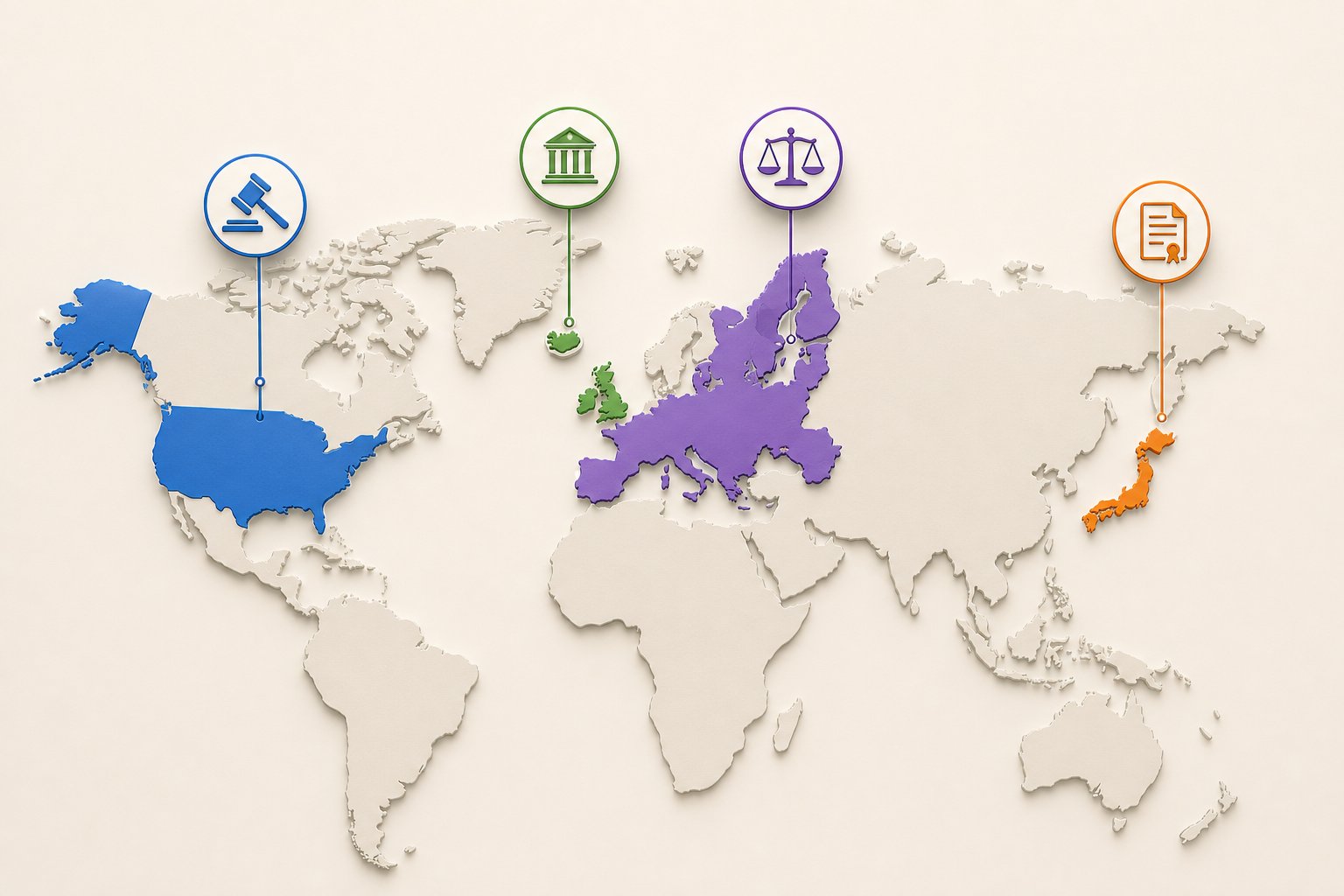
A track you release on Spotify reaches listeners in 184 markets simultaneously. If your copyright protections differ depending on where someone streams the song, you have a problem. And right now, that is exactly the situation facing creators who use AI in their workflow. The copyright 2025 landscape is not uniform. Each major jurisdiction has taken a distinct approach to whether AI-generated music can receive legal protection, who qualifies as the author, and what disclosure obligations apply.
For anyone distributing music internationally, the most restrictive applicable framework effectively sets the floor for your rights. Understanding these differences is not academic. It determines where your work is protected and where it is exposed.
The U.S. Copyright Office Position
The American approach is the most clearly articulated. The reg usa framework rests on four pillars:
- Human authorship required. Only works created by a human mind qualify for copyright. AI systems cannot be listed as authors under any circumstance, as confirmed by Thaler v. Perlmutter.
- AI cannot hold or receive copyright. No registration will be granted for purely AI-generated content, regardless of the tool used or the sophistication of the output.
- Disclosure mandated. Since March 2023, applicants must disclose AI-generated content in registration applications and identify which elements are human-authored versus machine-generated.
- Case-by-case evaluation. Mixed works containing both human and AI contributions are assessed individually, with protection granted only to the human-authored portions.
This position makes the United states of ai policy among the most conservative globally. It draws a hard line at human authorship while offering a practical path for creators who use AI as a tool rather than a replacement. The Copyright Office has signaled it will continue refining guidance as new cases arise, but the foundational principle is settled law.
The EU AI Act and European Approach
Europe's framework layers AI-specific regulation on top of existing copyright directives. The EU AI Act, with its transparency obligations taking effect in August 2026, does not directly address copyright ownership of AI outputs. Instead, it focuses on marking and detection requirements. Article 50 mandates that providers of generative AI systems ensure outputs are marked in machine-readable formats as artificially generated, and that deployers disclose AI-generated content to the public.
Ai regulation news today december 5 2025 covered the first working group meetings drafting the code of practice for these transparency obligations, with sessions continuing through early 2026. The practical effect for musicians is that AI-generated music distributed in EU markets will eventually need to carry machine-readable identifiers indicating its origin.
On the ownership question itself, the EU defers to member state copyright laws. Most EU nations follow the principle established in CJEU case law requiring works to be the "author's own intellectual creation," which inherently demands human creative involvement. No EU member state currently grants copyright to purely AI-generated works. However, the EU lacks a unified equivalent to the U.S. Copyright Office's explicit registration guidance, leaving practical enforcement to individual national offices.
Ai regulation news today december 14 2025 further detailed how member states are interpreting these obligations differently, creating a patchwork that creators must navigate carefully when releasing music across European markets.
The UK, Japan, and Other Jurisdictions
The UK stands apart from every other major jurisdiction thanks to Section 9(3) of the Copyright, Designs and Patents Act 1988 (CDPA), which explicitly provides copyright protection for "computer-generated works" with no human author. Under this provision, the author is deemed to be "the person who made the arrangements necessary" for the work's creation. In theory, this means someone who uses an AI music generator could claim authorship by virtue of setting up and initiating the process.
Sounds like a clear advantage for UK-based creators? Not quite. The provision was drafted in 1988 for a completely different technological era, and its application to modern generative AI is deeply uncertain. UK courts still require works to be "original" under EU-derived case law, meaning they must bear the author's "personal touch" and reflect "free and creative choices." How a work generated by algorithmic selection from massive datasets satisfies that originality test remains unresolved.
The UK Intellectual Property Office's 2024 consultation invited views on whether to repeal Section 9(3) entirely, noting little evidence that it stimulates AI innovation and highlighting the contradiction between its existence and the human-centric originality requirement. A decision is expected soon, and repeal would align the UK more closely with the U.S. position. Ai regulation updates october 2025 flagged this consultation as one of the most significant pending policy shifts in the creative industries.
Japan takes a notably different approach. Article 30-4 of the Japanese Copyright Act permits broad use of copyrighted works for AI training, distinguishing clearly between the development and training stage versus the generation and utilization stage. While training on publicly accessible data is permitted, copyright infringement standards still apply to AI-generated outputs. Japan does not grant copyright to purely AI-generated works, but its framework provides greater legal certainty for the training process itself. This is significant for AI music tools developed or trained in Japan: the training may be lawful, but the outputs still need human authorship to qualify for protection.
The following table compares how these four major jurisdictions address the key dimensions of AI music copyright:
| Dimension | United States | United Kingdom | European Union | Japan |
|---|---|---|---|---|
| Can purely AI-generated works be copyrighted? | No | Potentially yes, under Section 9(3) CDPA (but under review for repeal) | No, under member state laws requiring human intellectual creation | No, outputs must meet originality standards |
| Who is considered the author? | Only the human who exercised creative control over expressive elements | The person who made "arrangements necessary" for creation (for computer-generated works) | The natural person whose intellectual creation the work represents | The human creator; no specific AI authorship provision |
| AI disclosure requirements | Mandatory since March 2023 for copyright registration | Proposed in 2024 consultation; not yet enacted | AI Act Article 50 mandates machine-readable marking and labeling (effective August 2026) | No mandatory disclosure requirements currently |
| Duration of protection | Life of author + 70 years (human-authored portions only) | 50 years from creation for computer-generated works; life + 70 for human-authored works | Life of author + 70 years (varies slightly by member state) | Life of author + 70 years for human-authored works |
| AI training on copyrighted works | Unsettled; subject to fair use case-by-case analysis and active litigation | Proposed opt-out rights reservation model under consultation | Permitted for research; commercial TDM allowed with opt-out under DSM Directive | Broadly permitted under Article 30-4 for both commercial and non-commercial purposes |
A few patterns emerge from this comparison. Every jurisdiction except the UK (under its current but possibly temporary Section 9(3) provision) requires human creative involvement for copyright to attach. Transparency requirements are growing across all regions, though at different speeds. And the training-data question, whether AI tools can lawfully ingest copyrighted music, remains the most unsettled area globally.
For creators distributing music across borders, the practical implication is straightforward: build your workflow around the U.S. standard of demonstrable human authorship. It is the most clearly defined, and meeting it will almost certainly satisfy requirements in every other major jurisdiction. Relying on the UK's Section 9(3) exception as your sole basis for protection is risky given its uncertain future.
Knowing where you stand legally across jurisdictions is one thing. Actually securing that protection through a formal registration process is another, and the mechanics of filing an AI-assisted music copyright claim involve specific disclosure requirements and procedural steps that trip up many applicants.
Registering AI-Assisted Music Step by Step
So you have created a track with meaningful human authorship layered alongside AI-generated elements, and you understand which parts carry copyright weight. How do you actually file for protection? Learning how to copyright ai music that involves AI assistance requires navigating a specific disclosure process the U.S. Copyright Office introduced in March 2023. Get this wrong, and your registration could be narrowed, delayed, or canceled entirely.
The AI Disclosure Requirement
The Copyright Office's 2023 registration guidance established a clear obligation: applicants must disclose the inclusion of AI-generated content in any work submitted for registration and provide a brief explanation of what the human author actually contributed. This is not optional. The Office treats AI involvement as information "bearing upon the preparation or identification of the work or the existence, ownership, or duration of the copyright" under 17 U.S.C. 409(10).
What must you disclose? Any AI-generated content that is more than de minimis. You do not need to flag every minor AI-assisted function, like using auto-tune on a vocal or a noise-reduction plugin. But if an AI tool generated a melody, produced an instrumental section, wrote lyrics, or created substantial portions of your arrangement, that involvement must be identified in your application.
The consequences of failing to disclose are serious. If the Office later discovers undisclosed AI-generated material, it may cancel your registration under 37 CFR 201.7(c)(4). Separately, a court can disregard your registration entirely in an infringement lawsuit if it finds you knowingly provided inaccurate information that would have resulted in refusal. Ai copyright updates since 2023 have only reinforced this stance, with the Office's January 2025 Part 2 report reaffirming that accurate disclosure is a baseline requirement for valid registration.
Preparing Your Application
The filing process follows a logical sequence. Before you touch the eCO system, you need to sort out what you are claiming and what you are excluding. Here is the full workflow:
- Determine the type of work. Decide whether you are registering the musical composition (melody, lyrics, harmony), the sound recording (the actual audio), or both. The human authorship story may differ across these layers. You might have written the composition entirely but used AI for instrumental production in the recording.
- Separate human-authored elements from AI-generated material. List everything you personally created: original lyrics, melodies you composed, arrangement decisions you made, vocal or instrumental performances you recorded, and substantive edits you applied to AI output. Then identify what the AI generated independently.
- Select the Standard Application. Works containing AI-generated material must use the Standard Application in the eCO system. The Single Application form cannot be used because it requires that all content was created by the same individual, and AI-generated material does not qualify as individual human authorship.
- Complete the "Author Created" field. Describe specifically what the human author contributed. For a song with human-written lyrics and melody but AI-generated instrumentals, you might enter: "Lyrics, vocal melody, and arrangement of musical elements created by the author."
- Exclude AI-generated content in the "Limitation of the Claim" section. Under "Material Excluded," use the "Other" field to describe what the AI produced. For example: "Instrumental backing track generated by artificial intelligence."
- Do not list AI as an author or co-author. The AI tool and the company that made it are not authors. Listing them will trigger examiner correspondence and delay your registration.
- Add context in the "Note to CO" field if needed. If the relationship between human and AI contributions is complex, use this field to provide a brief explanation of your creative process.
Applicants should describe their human-authored contribution in the "Author Created" field and exclude AI-generated material in the "Limitation of the Claim" section under "Material Excluded/Other" by entering a description such as: "[description of content] generated by artificial intelligence."
The language you use matters. Frame your claim around Copyright Office taxonomy, not product-marketing language from the AI tool. Instead of writing "co-created with Suno" or "AI-native production," describe the human contribution in standard terms: original lyrics, vocal melody, musical arrangement, performance, or substantive modifications to generated material.
What Happens After Filing
Once you submit, an examiner reviews your claim. For straightforward applications where the human authorship is clear and properly described, registration proceeds normally. Processing times vary, but expect several months under current workloads.
In less clear-cut cases, the examiner may issue correspondence requesting additional information. Common questions include:
- What specific AI tool was used and how does it function?
- What exactly did the human author contribute versus what did the AI generate?
- Were the modifications to AI output substantial enough to constitute original authorship?
- Can you describe the creative decisions that shaped the final work?
When responding, be factual and specific. Describe your process in concrete terms: "I wrote the vocal melody in measures 1-32, composed the chord progression, and restructured the AI-generated arrangement by removing two sections, reordering the remaining material, and adding an original bridge." Vague claims like "I guided the AI creatively" will not satisfy the examiner.
If the Office determines that your application claims copyright over material that is actually AI-generated, it will narrow the registration to cover only the human-authored portions. This is not a rejection of your entire claim. It is the same partial registration approach applied in Zarya of the Dawn. You still receive protection for what you created.
For applicants who previously filed without disclosing AI involvement, the Office provides a correction path. You can submit a supplementary registration to update the public record, describing the human-authored material in the "Author Created" field and disclaiming AI-generated content in "Material Excluded/Other." Correcting proactively is far better than having the Office discover the omission and initiate cancellation proceedings.
Applicants who fail to update the public record after obtaining a registration for material generated by AI risk losing the benefits of the registration, including potential cancellation.
The copyright news today around AI registration reflects a system that is strict but navigable. The Office is not trying to block AI-assisted creators from protection. It is trying to ensure that what gets registered actually qualifies as human authorship. Creators who document their process, describe their contributions accurately, and exclude AI-generated material from their claims will find the registration path open and clear.
Registration gives you the legal foundation. But the practical reality of using AI music in commercial projects involves another layer entirely: the terms of service of the platform that generated the audio. Those contractual terms can grant or restrict rights independently of what copyright law provides, and ignoring them can undermine even a valid registration.
AI Music Platform Terms and Who Owns the Output
A valid copyright registration protects specific human-authored elements of your work. But in day-to-day practice, the terms of service you agreed to when you signed up for an AI music platform may matter just as much, sometimes more. These contractual agreements operate independently from copyright law, and they define what you can actually do with the audio files sitting on your hard drive.
How Platform ToS Shape Your Rights
Here is the key distinction most creators miss: platform terms of service create contractual rights between you and the AI provider. Copyright law creates rights you can enforce against the entire world. These are two separate systems, and they do not always align.
Consider a scenario. You generate a track using an AI tool whose ToS assigns you full ownership of all outputs. Under that contract, you have the right to use, sell, and distribute the track. But if the track lacks sufficient human authorship to qualify for copyright, you cannot sue a third party who independently copies it. Your contractual ownership gives you permission from the platform. It does not give you exclusive rights against everyone else.
The reverse situation also exists. Some platforms retain broad perpetual licenses over everything their users generate, even content that might qualify for copyright protection based on the user's creative contributions. Suno's ToS, revised in November 2025, grants the company a broad, perpetual license to use both user submissions and outputs for service improvement, including AI model training. Paid subscribers receive assignment of Suno's rights in their output and full commercial use privileges. Free users are restricted to non-commercial use with attribution.
This tiered model is common across the industry. AIVA follows a similar structure: its standard plan retains copyright ownership with the platform (granting users only a license), while the Pro plan at $33/month transfers full copyright to the user. Platforms like Rightsify and Loudme.ai each implement their own variations on ownership assignment, license scope, and commercial use permissions. Even tools like Sonoteller, which focus on music analysis rather than generation, include terms that affect how derived outputs can be used commercially.
The practical takeaway? Your rights are not determined by copyright law alone. They live in the intersection of federal intellectual property standards and whatever contract you clicked "agree" on. A platform can grant you more freedom than copyright law provides (by giving you contractual usage rights for uncopyrightable content) or less (by retaining licenses over material you arguably authored).
Royalty-Free AI Music for Commercial Use
For many creators, the copyright question is secondary to a simpler need: usable music without legal headaches. Content creators producing YouTube videos, podcasters building episode libraries, game developers scoring their projects, these people need tracks they can publish commercially without worrying about infringement claims, royalty obligations, or ownership disputes.
This is where royalty-free AI music generators fill a genuine gap. Platforms in this category are designed specifically to produce music you can use in commercial projects with clear, permissive terms that sidestep the copyright ambiguity entirely. The licensing model works through contract: the platform grants you explicit usage rights regardless of whether the underlying audio qualifies for copyright registration.
MakeBestMusic's Free Music Generator is a practical example of this approach. It offers free, royalty-free music for videos, social content, games, podcasts, and other commercial projects. The terms explicitly grant usage rights to generated tracks, meaning you can publish and monetize content using that music without navigating complex IP ownership debates or paying ongoing royalties. For creators who need background music, intros, or ambient scoring and want to avoid the legal uncertainty surrounding AI-generated content ownership, this type of platform provides a straightforward solution.
The Sound Republic AI company model and similar enterprise-focused services take a different approach, targeting brands and agencies that need custom AI-generated audio at scale with enterprise licensing agreements. The common thread across all these platforms is that contractual terms, not copyright registrations, serve as the primary mechanism granting creators permission to use the music commercially.
Reading the Fine Print
Not all ToS are created equal, and the differences between platforms can have significant financial and legal consequences. Before you commit to a tool for any serious project, look for these specific provisions:
- Ownership assignment clause. Does the platform assign you ownership of outputs, or merely license them to you? Assignment means the rights transfer to you. A license means the platform retains ownership and grants you permission to use the content under defined conditions.
- License scope. Is your license perpetual or time-limited? Does it survive if you cancel your subscription? Some platforms revoke commercial use rights the moment your paid plan lapses, which can create problems for content already published using those tracks.
- Exclusivity. Can other users generate identical or similar outputs? Nearly every AI platform disclaims exclusivity, meaning someone else could theoretically receive similar-sounding music from the same tool. This matters less for background music but significantly more if you are building a brand identity around a specific sound.
- Attribution requirements. Free tiers commonly require visible credit to the platform. Paid tiers typically waive attribution. Failing to attribute when required can constitute a breach of contract, even if no copyright infringement occurred.
- Platform license-back. Many platforms reserve the right to use your outputs (and your inputs) for training and service improvement. If confidentiality matters for your project, check whether you can opt out of this.
- Indemnification. Who bears liability if the AI output resembles a copyrighted song? Most platforms disclaim warranty that outputs are non-infringing. Some, like Anthropic for its commercial API customers, offer explicit indemnification against copyright claims. Most AI music generators do not.
The table below compares key ownership terms across three common platform categories:
| Term | Royalty-Free Generators (e.g., MakeBestMusic) | Subscription Services (e.g., AIVA, Soundraw) | Prompt-Based Generators (e.g., Suno, Udio) |
|---|---|---|---|
| Output ownership | Full usage rights granted; no ongoing platform claim | Varies by tier; Pro plans typically transfer copyright | Paid plans assign platform's rights to user; free plans restrict to non-commercial |
| Commercial use rights | Included at no cost for all generated tracks | Requires paid subscription (typically $11-$33/month) | Requires paid subscription ($8-$24/month) |
| Exclusivity | Non-exclusive; similar outputs possible for other users | Non-exclusive | Non-exclusive; platform explicitly disclaims output uniqueness |
| Attribution required | Not required | Not required on Pro tiers; often required on free/standard | Required on free tier; waived on paid |
| Platform license-back for training | Minimal or none | Varies; check specific terms | Broad perpetual license for AI training and service improvement |
| Infringement indemnification | Typically not included | Typically not included | Not included; platform disclaims liability for similarity to existing works |
Notice the tradeoff pattern. Platforms offering the broadest commercial freedoms (like royalty-free generators) tend to provide the simplest terms but no copyright transfer, because the underlying content may not be copyrightable. Subscription services offering full copyright transfer charge more and restrict ownership to higher-tier plans. Prompt-based generators sit in between, assigning whatever rights the platform holds while explicitly disclaiming any guarantee that those rights include enforceable copyright.
The bottom line: your ToS defines the floor of what you can do with AI-generated music. Copyright law defines the ceiling of what you can exclusively own. A smart workflow accounts for both. Use platforms with clear, permissive terms for content where you need usage certainty. Reserve your most human-intensive creative effort for work where you want full copyright protection and legal exclusivity.
Understanding your platform rights and copyright status positions you to make strategic decisions. The final piece is translating that knowledge into a sustainable creative practice, one that protects your most valuable work, generates reliable income, and adapts as the legal landscape continues to evolve.
Protecting and Monetizing Your AI-Assisted Music
You now understand the legal framework, the registration process, and the platform terms that shape your rights. The remaining question is practical: how do you turn all of this into a workflow that protects your most valuable creative work and generates reliable income even while the law continues to evolve?
The music copyright ai news cycle moves fast. Rulings shift, platforms update policies, and enforcement mechanisms tighten. Creators who build good habits now will be far better positioned than those scrambling to retroactively prove authorship after a dispute surfaces.
Maximize Your Copyright Protection
Strong copyright claims start with documentation, not registration. By the time you file with the Copyright Office, the evidence supporting your human authorship should already exist in your project files. Here is what that looks like in practice:
- Save every project file version. DAW sessions, MIDI exports, early drafts, and revision histories all demonstrate the progression of human creative decisions over time.
- Write original lyrics or melodies before involving AI. When your core copyrightable elements exist independently of the AI tool, your claim becomes nearly bulletproof.
- Make substantive arrangement and production decisions. Do not let the AI determine song structure, dynamics, or emotional arc. Choose those yourself and document why.
- Edit AI-generated material meaningfully. Rewrite melodies note by note. Restructure arrangements. Layer your own performances on top. The more transformation you apply, the stronger your position.
- Keep timestamped records. Screenshots of your editing process, dated file exports, and version-controlled stems all serve as evidence. In an era where time stamp fraud in music copyright disputes has become a concern in enforcement proceedings, authentic metadata and consistent version histories provide the credibility courts and examiners look for.
- Describe your process clearly in registration applications. Use specific, factual language about what you created versus what the AI generated. Vague claims invite examiner scrutiny.
These steps cost nothing except a small amount of organizational discipline. They are the difference between a defensible copyright claim and a registration that collapses under challenge.
Monetization When Copyright Is Uncertain
What happens to your income streams when parts of your music may not be copyrightable? The good news is that commercial platforms have not stopped accepting AI-assisted music, at least not yet. Spotify, Apple Music, and YouTube all currently allow AI-assisted tracks, though each imposes different disclosure and quality requirements.
Streaming royalties flow based on play counts, not copyright registration status. You can earn from AI-assisted music on most platforms today. The risk is not immediate revenue loss. It is long-term vulnerability: if someone copies your unprotected AI-generated elements, you cannot pursue an infringement claim for those portions. And if a platform changes its policy, as Bandcamp has already done by banning primarily AI-generated music, content relying heavily on AI may be removed without recourse.
Sync licensing presents a sharper challenge. Music supervisors placing tracks in films, ads, or games increasingly ask about AI involvement and expect clear ownership documentation. A track with uncertain copyright status is a legal liability for any production company, and many will simply pass on it. Right of publicity ai news has also raised concerns in sync contexts where AI-generated vocals mimic recognizable artists, adding another layer of risk for creators using voice-cloning features.
Contractual protections offer an alternative path. Even when copyright does not fully apply, you can still use licensing agreements, platform terms, and distribution contracts to control how your music is used commercially. These agreements bind the parties who sign them, providing enforceable rights within that relationship even if you cannot assert exclusivity against the world at large.
Building a Sustainable Creative Workflow
The smartest approach separates your creative output into two categories: work that needs full copyright protection, and work where usage rights are sufficient.
For your original songs, artist releases, and tracks tied to your brand identity, maximize human authorship. Write the melodies. Compose the lyrics. Make the arrangement decisions. Use AI only for mechanical or technical tasks that do not determine expressive content. Register these works properly, disclose AI involvement where it exists, and maintain your documentation trail.
For background music in content projects, podcast intros, social media clips, game ambience, and video scoring, the calculus shifts. Here, you need reliable, commercially usable audio without the overhead of establishing and defending copyright claims. Royalty-free AI generators like MakeBestMusic's Free Music Generator provide a pragmatic solution for these use cases. You get free music cleared for commercial projects while reserving your copyrightable human effort for the creative work that matters most to your career and income. As the legal landscape catches up to the technology, this division of labor keeps you productive and protected simultaneously.
The copyright music ai news landscape will continue shifting. Courts will issue new rulings. The Copyright Office will refine its guidance. Platforms will update their policies. But the fundamental principle is unlikely to change: human creative expression is what the law protects. Everything else is a tool, a shortcut, or a convenience.
Here is a checklist of best practices to follow today:
- Document your creative process with timestamped project files and version histories
- Write core copyrightable elements (melody, lyrics) before involving AI
- Make and record substantive creative decisions at every stage of production
- Disclose AI involvement accurately when registering with the Copyright Office
- Read and understand the ToS of every AI music platform you use
- Use royalty-free AI generators for functional music needs where copyright ownership is not critical
- Reserve your deepest human creative investment for work tied to your brand and primary income
- Monitor ai music copyright news today for policy changes at streaming platforms and distribution services
- Keep contractual records of all platform agreements, license grants, and commercial use authorizations
- Consult an IP attorney before making major commercial decisions about AI-assisted works
The question of whether AI-created music can be copyrighted ultimately hinges on you, on the creative choices you make, the authorship you exercise, and the evidence you maintain. The law does not punish creators for using AI. It rewards those who remain genuinely creative while using it.
