

Yes You Can Sell AI Generated Music But Here Is What You Need to Know
You typed a prompt, hit generate, and got a track that actually sounds good. The immediate question: can you sell AI generated music and pocket the earnings? The answer is more encouraging than most creators expect, but it comes with layers worth understanding before you upload anything to a distributor or marketplace.
The Short Answer to Selling AI Music
Yes, you can sell AI-generated music. There is currently no law banning the sale of AI-created tracks in the US or most other markets. Your ability to monetize depends on three factors: the commercial license granted by the AI tool you used, the level of human creativity you contributed, and the policies of the platform or distributor where you plan to sell.
That core answer holds whether you want to sell my songs on streaming platforms, license tracks for video content, or list beats on a stock music marketplace. The legal right to sell exists. The practical question is whether you can protect, scale, and sustain that income, and that depends on choices you make before and after generation.
Why This Question Matters for Creators
Global recorded music revenues hit US$31.7 billion in 2025, growing 6.4% year over year. Paid streaming alone accounts for 52.4% of that market, with 837 million subscribers worldwide. That is a massive pool of listeners, and AI tools now let independent creators produce release-ready music faster than ever before. The opportunity is real.
But so is the confusion. Can you make money from AI generated music without running into copyright issues? Can i publish a song written by ai on Spotify or Apple Music without getting flagged? How do you actually sell ai music when platforms keep changing their rules? These are not hypothetical worries. Distributors have updated policies, the US Copyright Office has issued new guidance, and streaming platforms are actively implementing AI detection systems.
Different creators need different answers. A hobbyist experimenting with passive income faces different rules than a producer using AI as a creative tool or a content creator who just needs affordable background tracks. This guide covers the full picture: copyright eligibility and what it means for your rights, platform-by-platform licensing terms, distributor policies on AI content, step-by-step workflows for each selling channel, and the ethical risks that can derail your revenue if ignored.
The legal distinction between fully AI-generated and AI-assisted music is where everything starts, and it shapes every commercial decision that follows.
AI-Generated vs. AI-Assisted Music and Why the Difference Matters
Imagine two producers releasing tracks on the same day. One typed "upbeat lo-fi beat with jazz piano" into an AI tool and uploaded the raw output. The other used AI to generate a chord progression, rewrote the melody by hand, layered in original vocals, and restructured the arrangement. Both tracks contain AI-generated elements, but only one is likely eligible for copyright protection. That distinction shapes everything from your legal rights to your long-term earning potential.
Fully AI-Generated vs. AI-Assisted Music
Think of AI involvement in music as a spectrum rather than a binary. On one end, a user enters a text prompt and receives a finished track without making any further creative decisions. No editing, no arrangement choices, no additional instrumentation. The AI determined every expressive element: melody, harmony, rhythm, structure, and production. This is fully AI-generated music.
On the other end, a producer uses AI tools for specific tasks, maybe generating drum patterns, suggesting harmonic options, or handling automated mastering, while contributing substantial creative direction at every stage. They select, reject, rearrange, compose over, and transform what the AI produces. This is AI-assisted music, and the human creative decisions are what matter legally.
The question of whether AI music is copyrighted depends almost entirely on where a given track falls on this spectrum. Copyright law in the United States protects original works of authorship, and that word "authorship" carries weight. It requires a human mind making expressive choices. The more creative decisions you make, the stronger your copyright claim becomes.
This spectrum is also why the question "do artists use AI to write songs" has a nuanced answer. Many professional producers already incorporate AI tools into their workflow for ideation, arrangement assistance, or production polish, but they contribute enough original creative expression to retain full ownership of the final work.
The Human Authorship Threshold
The U.S. Copyright Office has made its position clear through registration guidance and a multi-part report on AI and copyright. The core principle: outputs of generative AI can be protected by copyright only where a human author has determined sufficient expressive elements. Simply providing a prompt, no matter how detailed or iterative, does not meet the threshold for human authorship.
The Office's Part 2 report on copyrightability confirms that using AI to assist in the creative process does not bar copyright protection. It also clarifies that including AI-generated material within a larger human-generated work can still qualify for registration, provided the human-authored portions are identified. Applicants must disclose AI involvement and exclude purely AI-generated elements from their copyright claim.
So what kinds of human contributions can transform AI output into copyrightable work? Based on the Office's guidance, these activities may qualify:
- Selecting and arranging multiple AI-generated outputs into a cohesive composition
- Writing original lyrics over AI-generated instrumentals (using AI to write song lyrics for inspiration but crafting the final words yourself)
- Substantially modifying generated audio through editing, re-recording, or processing
- Composing original melodies, then using AI for production, mixing, or mastering
- Making creative arrangement decisions: choosing which sections to keep, reordering structure, layering human-performed elements
The key takeaway is that your creative expression must be perceptible in the final work. If a listener could strip away your contributions and the track would sound essentially the same, you likely have not crossed the authorship threshold.
What No Copyright Means for Sellers
Here is where many creators get confused: lacking copyright protection does not mean you cannot sell the music. It means you cannot prevent others from using it too.
When a track is fully AI-generated with no copyrightable human authorship, it exists in a legal gray zone. You can still sell it, license it, and collect revenue from it. No law prohibits that transaction. But you cannot enforce exclusive rights against someone who copies, redistributes, or builds upon that same output. You have no infringement claim because there is no copyright to infringe.
For practical commercial purposes, this creates a tiered reality. Fully AI-generated tracks work fine for use cases where exclusivity is not critical: background music for your own videos, bulk content for royalty-free libraries, or low-cost licensing where buyers understand the terms. They become problematic when a buyer expects exclusive rights, when you need to issue takedown notices against unauthorized use, or when you want to build long-term catalog value.
AI-assisted tracks where you have contributed genuine creative expression offer stronger commercial footing. You can register copyright on the human-authored elements, enforce your rights, and offer legitimate exclusive licenses. This is why producers serious about building a sustainable music business tend to treat AI as a tool rather than a replacement for creative decision-making.
The distinction also matters for platforms and distributors, many of which are now drawing their own lines around what qualifies for distribution. Those policies, and how they vary by jurisdiction, add another layer to the commercialization puzzle.
International Copyright Rules That Affect Where You Can Sell
Copyright law is not global. It is territorial. A track that qualifies for protection in one country may sit in the public domain in another. When you distribute AI-generated music to streaming platforms, your release typically reaches listeners across dozens of jurisdictions simultaneously, each with its own stance on ai music copyright. Understanding the major frameworks helps you make informed decisions about where and how to sell.
US Copyright Office Position on AI Works
The United States remains the largest single recorded music market, so its rules carry outsized weight for creators wondering how to copyright ai music that includes AI elements. The US Copyright Office has taken a clear position: purely AI-generated content without human authorship cannot receive copyright registration. Works where a human exercised sufficient creative control over the expressive elements may qualify for partial protection.
In practice, this means applicants must disclose AI involvement when registering works. The registration form requires you to identify which elements were generated by AI and exclude those from your copyright claim. You can still claim protection for the human-authored portions, such as original lyrics, melodies you composed, or creative arrangements you made using AI-generated material as a starting point.
The cost for music copyrights album ai-assisted works remains the same as any standard registration filing. There is no special fee or separate process for AI-involved works. The difference is purely in the disclosure requirement and the scope of what you can claim.
EU AI Act Implications for Music Creators
The European Union takes a different angle. Rather than focusing solely on copyright eligibility, the EU AI Act (Regulation 2024/1689) introduces transparency and disclosure obligations that directly affect how AI music gets distributed in European markets. The General Purpose AI provisions begin enforcement on August 2, 2026, and three requirements matter most for music sellers.
First, GPAI providers like Suno, Udio, and ElevenLabs must publish summaries of their training data. This connects directly to the ongoing debate around ai music copyright training, since rights holders have long demanded transparency about what content trained these models. Second, AI-generated audio distributed in the EU must be machine-detectable and disclosed to the listener through watermarking. Third, distributors operating in EU markets become accountable for collecting accurate AI disclosure declarations at upload.
The territorial scope catches many creators off guard. Under Article 2 of the Regulation, these rules apply whenever AI-generated output is used in the EU, regardless of where the creator lives. If your distributor ships tracks to Spotify, Apple Music, or Deezer in European territories, you fall within scope. Penalties under Article 99 run up to EUR 15 million or 3 percent of global annual turnover for non-compliance with transparency obligations.
Major distributors including DistroKid, TuneCore, CD Baby, and Believe are rolling out mandatory AI disclosure fields in their upload flows ahead of the deadline. Apple Music has already launched its Transparency Tag program globally, labeling tracks by declared AI involvement. The practical effect is that EU rules are becoming the global default because building separate upload workflows for different regions is more expensive than applying one disclosure standard everywhere.
UK and Other Jurisdictions
The United Kingdom stands apart from both the US and EU with a provision that may offer AI music creators something neither jurisdiction provides: direct copyright protection for computer-generated works even when no human author can be identified.
Section 9(3) of the Copyright, Designs and Patents Act 1988 (CDPA) states that the author of a computer-generated work "shall be taken to be the person by whom the arrangements necessary for the creation of the work are undertaken." Copyright in these works lasts 50 years from creation rather than the standard 70 years post-death, and no moral rights attach. Still, it provides a legal basis for ownership that does not exist in the US or EU for fully AI-generated output.
Who qualifies as the person making "the arrangements necessary" remains debated. It could be the AI developer, the user who prompts the system, or potentially both depending on the circumstances. UK courts have not yet tested this provision against modern generative AI music tools, so uncertainty remains. The practical takeaway for sellers: tracks distributed in the UK market may carry stronger legal standing than the same tracks in the US.
Germany is also shaping the landscape through active litigation. In November 2025, Munich Regional Court I ruled in GEMA v. OpenAI that storing copyrighted song lyrics in AI model parameters (memorisation) and reproducing them in output (regurgitation) constitutes copyright infringement. The court found that even simple prompts could trigger reproduction of protected content, and the text and data mining limitation did not justify these uses. This german court openai lyrics ruling news sent a clear signal: AI-generated output that reproduces training data exposes sellers to downstream liability.
| Region | Copyright Eligibility | Disclosure Requirements | Commercial Sale Status |
|---|---|---|---|
| United States | Only human-authored elements protectable; purely AI-generated works cannot be registered | Must disclose AI involvement in copyright registration; platform-level labeling emerging | Legal to sell; no copyright enforcement for fully AI-generated portions |
| European Union | Follows member-state copyright law; generally requires human intellectual creation | Mandatory machine-readable watermarking and listener disclosure under EU AI Act (enforcement August 2026) | Legal to sell with proper disclosure; penalties up to EUR 15M for non-compliance |
| United Kingdom | Section 9(3) CDPA may protect computer-generated works; 50-year term, no moral rights | No AI-specific disclosure law yet; platform policies apply | Legal to sell; potentially stronger ownership claims than US or EU |
| Germany | Human authorship required under German Copyright Act; GEMA v. OpenAI ruling (2025) reinforces protections for training data | EU AI Act applies; additional case law developing on memorisation and regurgitation liability | Legal to sell original AI output; high risk if output reproduces training data |
The jurisdictional patchwork creates a practical reality for sellers: your safest commercial position is to assume the strictest rules apply globally. Disclose AI involvement accurately, add genuine human creative expression where possible, and verify that your AI output does not reproduce recognizable copyrighted material. These rules determine your legal footing, but the platform where you actually list your music adds another layer of terms and restrictions on top.
AI Music Platform Licensing Terms Compared
Legal rights give you the foundation, but the AI tool you used to generate a track determines what you can actually do with it commercially. Every platform writes its own licensing rules, and the gap between free and paid tiers is where most creators get tripped up. A track made on the wrong plan can be unsellable regardless of how good it sounds.
What Each AI Music Platform Allows Commercially
The ai music platform licensing deals across major generators follow a consistent pattern: free tiers restrict you to personal use, while paid subscriptions unlock commercial rights. The specifics, however, vary enough that a side-by-side comparison is essential before you commit to any monetization strategy.
| Platform | Free Plan Commercial Rights | Paid Plan Commercial Rights | Ownership Terms | Revenue Sharing |
|---|---|---|---|---|
| Suno | No commercial use; personal only | Pro ($10/mo) and Premier ($30/mo) grant full commercial rights | Commercial rights retained after cancellation for tracks made during subscription | None; you keep 100% of revenue |
| Udio | No commercial use; personal only | Standard ($12/mo) and Pro ($36/mo) grant commercial use | Commercial license terms remain unsettled due to ongoing training-data litigation | None stated; verify current terms |
| AIVA | No commercial use; AIVA retains copyright | Professional ($49/mo) grants full copyright ownership to user | Standard plan ($15/mo) allows monetization but copyright stays with AIVA | None on Pro plan; Standard requires AIVA credit |
| Soundful | 1 download/month; personal use only | Commercial use on paid plans (starting ~$5/mo); up to $249.99/mo for full access | Royalty-free license; tracks are yours to use commercially | None; royalty-free model |
| SOUNDRAW | Limited access; no commercial rights | Paid plans (from ~$11/mo) grant commercial use but prohibit selling on mainstream audio platforms | Royalty-free for content use; you cannot resell the tracks as standalone music products | None; usage license only |
| Boomy | Limited generation; personal use | Creator ($14.99/mo) and Pro ($39.99/mo) unlock commercial distribution | Built-in distribution to streaming platforms; Boomy takes a revenue share | Yes; Boomy retains a percentage of streaming royalties |
A few things jump out from this comparison. Suno offers the lowest entry point for full commercial rights at $10 per month with roughly 500 songs worth of credits. AIVA requires the most expensive subscription ($49/mo) to gain actual copyright ownership rather than just a usage license. SOUNDRAW grants commercial rights for content creation but explicitly blocks you from selling tracks on streaming platforms as standalone releases. Boomy is the only major platform that takes a cut of your streaming revenue in exchange for handling distribution directly.
Notably absent from this table are newer or more niche tools. Platforms like notagen ai, songscription ai, and various produser ai tools each carry their own licensing structures that may differ from the major players listed above. Riffusion, which specializes in loops and variations, offers workable commercial terms but requires you to verify rights on a per-tier basis, meaning the riffusion free producer ai credits you receive for experimentation do not extend to commercial projects without upgrading.
Free vs. Paid Plan Licensing Differences
The pattern is almost universal: free means personal, paid means commercial. But the nuances between paid tiers matter just as much as the free-to-paid jump. Before selling any AI-generated track, check these specific terms in the platform's current license agreement:
- Exclusivity clauses — Does the platform retain any rights to your output? Can other users generate identical or similar tracks using the same prompts?
- Attribution requirements — Must you credit the AI tool in your release metadata, liner notes, or distribution description?
- Revenue caps — Some platforms impose income thresholds. Stable Audio Creator, for example, grants free commercial rights only to individuals earning under $1 million annually.
- Sublicensing restrictions — Can you grant exclusive licenses to buyers, or does the platform's retained interest prevent true exclusivity?
- Retroactivity rules — Tracks created on a free plan cannot be retroactively licensed by upgrading later. You must regenerate on a paid tier.
That last point catches many new creators off guard. If you generated 50 tracks on Suno's free tier and then subscribe to Pro, those original tracks remain non-commercial permanently. You would need to create new versions on the paid plan to distribute them legally.
The economics work in your favor once you understand the rules. At $10 per month for Suno Pro, your cost per distributed song drops to roughly $0.02. That is orders of magnitude cheaper than licensing stock music or hiring session musicians. The investment is minimal; the compliance requirement is where discipline matters.
Licensing terms also shift. Udio's commercial posture is evolving following its transition to a licensed platform, and training-data lawsuits against both Suno and Udio remain active. For client-facing or high-stakes commercial work, platforms with settled licensing like ElevenLabs Music or Stable Audio offer cleaner legal ground, even if their output quality sits slightly below the consumer leaders.
Knowing your platform rights is one piece of the puzzle. The next challenge is getting your tracks onto the services where listeners actually spend money, and not every distributor treats AI content the same way.
Which Music Distributors Accept AI Content
Your AI tool grants commercial rights. Your track sounds release-ready. But between you and the streaming platforms stands a gatekeeper most creators underestimate: the distributor. With over 60,000 AI tracks uploaded daily across platforms, every major distributor has been forced to take an explicit stance on ai music distribution. Those stances range from openly welcoming to outright rejection, and choosing wrong means wasted time, lost revenue, or account-level consequences.
Distributor Policies on AI-Generated Tracks
The landscape has shifted dramatically since early 2025. Back then, most distributors had vague or nonexistent AI policies. The flood of AI uploads, combined with pressure from Spotify, Apple Music, and Deezer, made formal positions unavoidable. Every distributor now uses automated AI detection as part of their upload screening. The difference is what they do with the results.
Here is how the major distributors compare across the dimensions that matter most for AI music creators:
| Distributor | AI Music Accepted | Disclosure Required | Restrictions | Best For |
|---|---|---|---|---|
| DistroKid | Yes, with mandatory disclosure | Checkbox during upload | No impersonation; no spam-like bulk uploads; must own rights | High-volume AI creators who want unlimited uploads at a flat rate ($22.99/year) |
| TuneCore | AI-assisted yes; fully AI-generated may be rejected | Detailed attribution form specifying which elements used AI | Will not distribute works that are 100% AI-generated; flagged tracks paused for resubmission | Producers using AI as a creative tool with substantial human input |
| CD Baby | AI-assisted only; fully AI-generated rejected | Must demonstrate human authorship | Aggressive detection; no resubmission pathway for fully AI-generated content | Human-first artists with minimal AI involvement |
| Ditto Music | Yes, with disclosure | Required during upload | Standard anti-spam and anti-impersonation rules | Budget-conscious creators wanting permissive AI policy (~$19/year unlimited) |
| Amuse | Yes, with disclosure | Required; policy evolving | May tighten restrictions based on platform feedback; free tier has revenue sharing | New creators testing the waters with a free tier (limited features) |
| RouteNote | Yes, with conditions | May request AI tool/source links | No Content ID delivery; excluded from some partner stores; 15% rev share on free tier | Creators wanting zero upfront cost to test AI releases |
| LANDR | Yes, but capped | Required during upload | Max 12 AI-generated songs per month; no AI cover songs; some platform exclusions | Low-volume creators who want integrated production tools |
The pattern is clear: DistroKid is the most permissive major distributor for AI content, TuneCore occupies the middle ground favoring AI-assisted work, and CD Baby is the strictest, explicitly positioning itself as a human-artist-first platform. Newer entrants like ONCE have emerged specifically to serve AI creators, offering flat per-release pricing ($2 per AI track) with automatic provenance scanning and DSP disclosure metadata.
Store coverage adds another complication. Even when a distributor accepts AI content, specific platforms may not. LANDR notes that several stores restrict AI-generated content, including limitations on YouTube Content ID delivery. This matters for creators concerned about auto generated by youtube copyright claims, since Content ID access is how you monetize when others use your music in their videos. If your distributor cannot deliver AI tracks to Content ID, that revenue stream disappears regardless of your rights.
Disclosure Requirements and Consequences
Disclosure is no longer optional on any major platform. Spotify is implementing a DDEX-based standard for AI disclosures in music credits, and Apple Music has launched its Transparency Tag program globally. Distributors are building these requirements into their upload flows, and the expectations are getting more granular.
DistroKid keeps it simple: a single checkbox confirming AI involvement. TuneCore demands a breakdown, asking you to specify whether AI was used in composition, lyrics, vocals, production, or mastering, and which tools you used. CD Baby requires you to actively prove human authorship if AI was involved at all.
What happens when you skip disclosure or misrepresent your process? The consequences escalate quickly:
- Track removal — The most common first consequence. Your release is pulled from stores, often without warning.
- Revenue forfeiture — Earnings accrued during the period of non-compliance may be clawed back or withheld.
- Account suspension — Repeat offenders face temporary or permanent account penalties, affecting their entire catalog.
- Catalog-wide review — One flagged track can trigger scrutiny of every release on your account.
Distributors are cross-referencing C2PA manifest data (embedded provenance metadata in audio files) with your disclosure status. AI music labels and detection systems are sophisticated enough that undisclosed AI content is increasingly likely to be caught. The risk-reward calculation is straightforward: always disclose, even when you think your level of AI involvement is minimal.
Document your creative process as you go. Keep records of generation prompts, the AI tools used, your subscription tier (proving commercial rights), and any human modifications you made. Screenshots of your DAW sessions showing edits, subscription receipts, and generation history logs all serve as your defense if a distributor challenges an upload.
Choosing the Right Distributor for AI Music
The best distributor for ai music depends on three variables: how many tracks you release, where you want them available, and how much human involvement your workflow includes.
If you produce a high volume of fully AI-generated tracks and want the simplest path to streaming platforms, DistroKid's flat-rate unlimited model ($22.99/year with 0% commission) makes it the default choice. Their disclosure process is minimal friction, and they do not limit AI upload volume. For creators releasing 20 or more tracks per year, the per-track cost becomes negligible.
If your workflow is AI-assisted rather than fully AI-generated, with substantial human composition, performance, or arrangement, TuneCore's more detailed disclosure system and resubmission pathway provide a safety net. Flagged tracks get paused rather than permanently rejected, giving you a chance to correct attribution before losing the release. Their per-release pricing ($9.99/single or subscription plans starting around $14.99/year) works better for creators with fewer, higher-quality releases.
For creators just testing the market with a handful of tracks, RouteNote's free tier or Amuse's no-cost option let you experiment without financial commitment. The tradeoff is a revenue share (15% on RouteNote Free) and potential delivery limitations for AI content.
One universal consideration: avoid treating any distributor as a fire-and-forget upload pipeline. Spotify removed over 75 million spammy tracks in a 12-month period, and ai music labels across the industry are tightening spam detection. Mass-uploading near-duplicate AI tracks with generic metadata and no branding is the fastest way to get flagged regardless of which distributor you choose. Quality, proper metadata, and genuine artistic intent matter more than volume alone.
Getting your music onto streaming platforms is one distribution path, but it is far from the only way to generate revenue from AI-created tracks. Royalty-free libraries, sync licensing, and direct sales each follow different workflows and offer different income profiles.
Step-by-Step Workflows for Selling AI Music
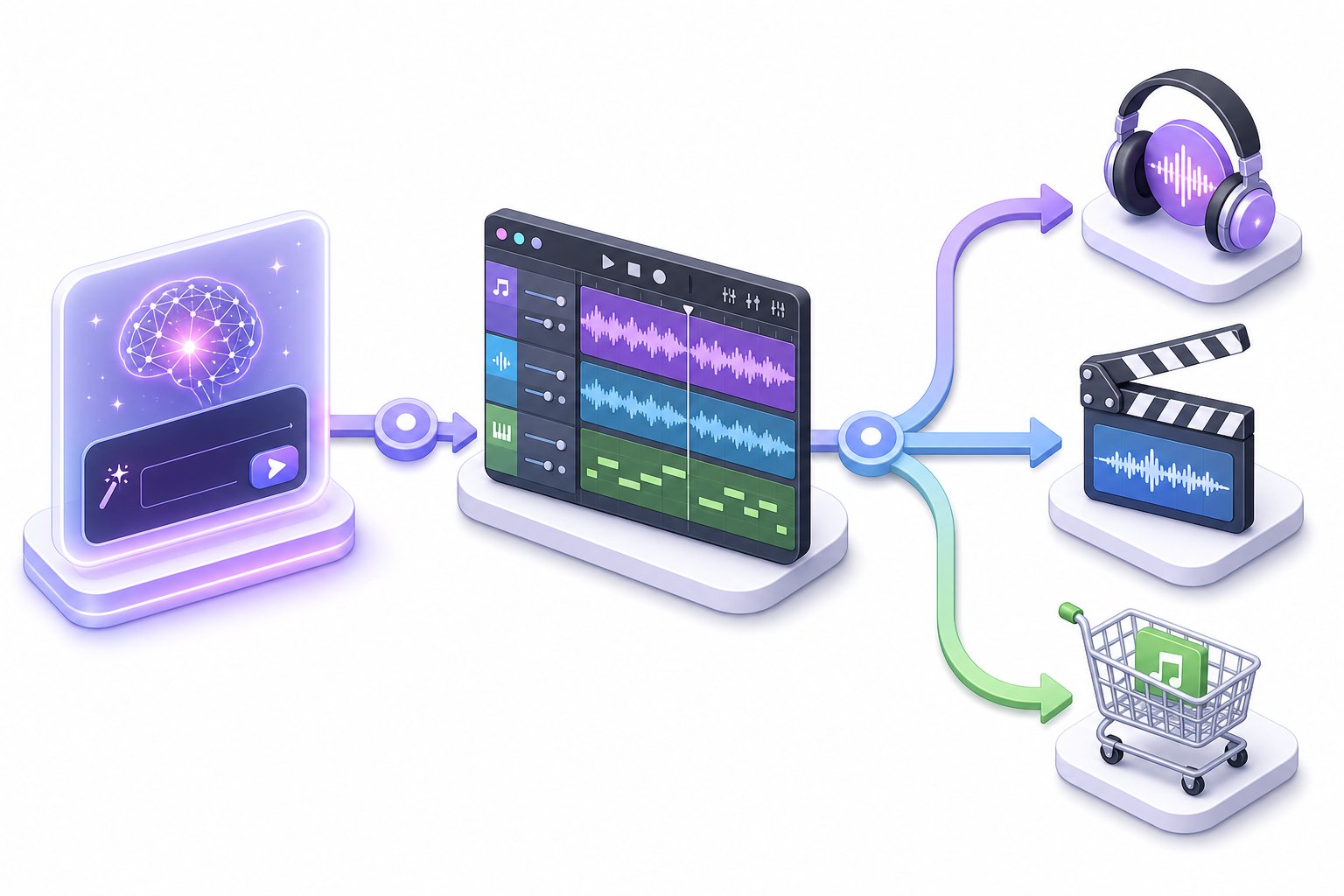
Knowing you can sell AI music is one thing. Knowing exactly how to move a finished track from your hard drive to a paying customer is another. Each selling channel follows a different workflow, attracts a different buyer, and produces a different income profile. The right path depends on your goals: passive royalties, recurring licensing income, or higher-margin direct deals.
Selling Through Streaming Platforms
Streaming is the most familiar path, but also the slowest to generate meaningful revenue. A single track earning 100,000 Spotify streams at roughly $3.02 per 1,000 plays returns about $302 before any distributor split. That is real money, but it takes consistent promotion and catalog depth to reach those numbers.
The workflow is straightforward:
- Generate or produce your track using an AI tool on a paid commercial plan
- Verify your commercial license is valid (save your subscription receipt and generation history)
- Master the audio to streaming-ready specs (LUFS targeting -14 for Spotify, 16-bit/44.1kHz WAV minimum)
- Select a distributor that accepts AI content (DistroKid, Ditto, or Amuse based on your volume)
- Upload with complete metadata: title, genre, mood tags, ISRC code, and accurate AI disclosure
- Design cover art and set a release date at least 2-3 weeks out to allow playlist pitching
- Promote through social channels, playlist submissions, and creator partnerships
Realistic expectations matter here. Months one through three typically produce $0 to $50 unless you already have an audience. Streaming rewards consistency and catalog size over individual releases. Creators wondering where can i sell songs i wrote often default to Spotify and Apple Music, but streaming works best as a long-term discovery engine rather than a quick income source.
Licensing to Royalty-Free Music Libraries
Stock audio libraries offer a different value proposition: upload once, earn passively as buyers license your tracks for their projects. This channel suits creators who can produce volume at consistent quality levels, especially for background music in videos, apps, and presentations.
Not every library accepts AI-generated submissions. Based on current platform policies, here is where you stand:
- AudioSparx — Open to AI content, 50% revenue split, notable clients include Disney and Google. Their AI partnership signals comfort with AI-generated material.
- Songtradr — No explicit ban; acceptance is case-by-case based on quality. Free tier earns 60% of licensing fees, paid tiers ($50/year) unlock up to 80-100%.
- Artlist — Selective; high-quality AI-assisted tracks with substantial human involvement may qualify.
- Pond5, Musicbed, Epidemic Sound — Do not accept AI-generated content. Submitting here risks account termination.
Quality standards for library acceptance go beyond "it sounds okay." Libraries want professional-grade mixes with no artifacts or clipping, clear emotional direction, and usable song structures with defined builds, drops, and clean endings. Generic background filler gets rejected even from platforms with lenient AI policies. Tracks submitted to libraries serving ai avatar services with royalty-free music libraries or video production companies need to meet the same production bar as human-created alternatives.
Some libraries offer ai-generated stock music bulk order discounts for buyers licensing multiple tracks, which means volume creators benefit from uploading cohesive collections rather than random one-offs. Build themed packs — corporate ambient, lo-fi study beats, cinematic tension — and tag them meticulously. Mood, tempo (exact BPM), instrumentation, and theme tags determine whether your track surfaces in buyer searches.
Sync Licensing and Direct B2B Sales
This is where per-transaction income outpaces streaming by a wide margin. A single direct license at $49 to $149 earns more than tens of thousands of streams, and the buyers are everywhere: YouTubers needing background music, podcasters looking for intro themes, indie game developers, and small businesses creating marketing videos.
If you have ever thought about how to sell my song directly to someone who needs it, direct licensing is the answer. You are not waiting for algorithmic discovery. You are matching a specific track to a specific buyer need.
Pricing depends on the use case. Current market rates for direct AI music licensing break down like this:
| Use Case | Price Range | License Type |
|---|---|---|
| Personal/non-commercial use | $25-50 | Non-commercial |
| YouTube video or podcast | $25-75 | Standard commercial |
| Short film or documentary | $50-150 | Film rights |
| Commercial advertisement | $100-300 | Advertising rights |
| Exclusive buyout | $500+ | Full rights transfer |
To sell songs to artists, content creators, or brands, you need a storefront and clear licensing terms. Gumroad works well for selling download packs and license tiers (10% + $0.50 per transaction). BeatStars is purpose-built for beat licensing with tiered lease structures. A simple personal website with embedded audio previews and a contact form handles custom commissions.
For creators who want to sell my song lyrics online alongside instrumentals, platforms like Gumroad let you bundle lyric sheets with audio files as a package deal, giving buyers everything they need for a complete release.
Direct outreach drives this channel. Find YouTubers in your genre using generic or no music. Check subreddits like r/MusicInTheMaking for active requests. Join creator Discord communities where people ask for affordable tracks. One custom commission at $399 can outperform months of streaming royalties.
Regardless of which channel you pursue, the underlying workflow follows the same lifecycle from creation to ongoing compliance:
- Generate the track using a commercially licensed AI tool
- Quality check: master to professional standards, eliminate artifacts, create alternate versions (instrumental, stems, cutdowns)
- Rights assessment: confirm commercial license validity, document human contributions, verify no training-data reproduction
- Platform selection: match the track to the channel that fits its quality level and target buyer
- Metadata and tagging: apply accurate mood, genre, tempo, instrumentation, and AI disclosure tags
- Distribution: upload to chosen platform(s) with proper licensing terms and pricing tiers
- Ongoing compliance and reporting: monitor for policy changes, respond to disclosure requests, track earnings across channels
Custom production services deserve a special mention as the fastest path to meaningful dollars. Offering a "custom track delivered in 48-72 hours, cleared for your intended use" positions you as a service provider rather than a catalog owner. Starter packages at $149-$299 for a single track with one revision can generate more in a week than months of passive streaming. The tradeoff is active time investment, but for creators building early revenue, it beats waiting for algorithmic traction.
Multiple channels running simultaneously is the long-term play. Stream for discovery, license through libraries for passive income, and sell directly for higher margins. Each channel reinforces the others: streaming builds credibility, library placements prove commercial viability, and direct sales fund your continued production. The risks and ethical considerations that can disrupt any of these channels are worth understanding before you scale.
Risks and Ethics of Selling AI-Generated Tracks
Revenue channels mean nothing if a single copyright claim wipes out your catalog overnight. Selling AI music carries risks that go beyond licensing compliance. The models generating your tracks were trained on something, the industry has strong opinions about that, and buyers increasingly care about where their music comes from. Understanding these dimensions protects your income and reputation.
Training Data Risks and Downstream Liability
Every AI music generator learned its craft by analyzing existing recordings. The problem: many of those recordings were copyrighted, and the artists who made them never consented to that use. Suno openly admitted to training on copyrighted music while arguing fair use. The RIAA responded with coordinated lawsuits from Universal, Sony, and Warner seeking up to $150,000 per infringed track. Udio settled with both Universal and Warner by late 2025, and the legal pressure keeps mounting.
Why does this matter to you as a seller? Because AI models can reproduce elements from their training data. The GEMA v. OpenAI ruling in Germany confirmed that even simple prompts can trigger reproduction of protected content. If your AI-generated track contains a melody, progression, or vocal cadence that matches a copyrighted song closely enough, you face the infringement claim, not the AI company. Their terms of service shift that liability squarely onto users.
Mitigation comes down to practical steps. Use platforms that have licensed their training data or settled with rights holders (Udio's post-settlement model, for example). Run similarity checks using tools like YouTube's Content ID preview or third-party melody-matching services before distributing. Keep detailed records of your generation process: prompts, timestamps, tool versions, and any modifications you made. If you ever wonder how do you buy the rights to a song that your AI output accidentally resembles, the answer is usually that you cannot retroactively clear a derivative work. Prevention beats remediation every time.
Industry Backlash and Market Acceptance
The music industry is not passively watching AI-generated content flood its platforms. Over 200 prominent artists, including Billie Eilish, Stevie Wonder, and Katy Perry, signed an open letter targeting AI music generators. The UK government scrapped plans that would have allowed unlicensed AI training after 95% of consultation respondents opposed it. Universal Music Group filed a $3 billion lawsuit against an AI company over more than 20,000 songs. These are not fringe actions. They represent an industry consensus against unlicensed AI use.
Streaming platforms are responding with detection systems. Deezer now receives over 75,000 AI-generated tracks daily and has demonetized 85% of AI streams it detects as fraudulent. Spotify removed over 75 million spammy tracks in 12 months. YouTube limits reach and may block monetization for music without clear human input. Discussions on ai music reddit communities reflect the same tension: listeners and fellow creators are skeptical of fully AI-generated releases, and that skepticism translates to real marketplace friction.
Consumer sentiment reinforces the backlash. Research shows 51% of listeners believe AI leads to more low-quality, generic music, and 52% would not want to listen to AI-assisted tracks even from their favorite artist. Ai music production companies are responding by offering stock audio human-made certification programs, giving buyers confidence that the tracks they license were composed by real people.
Sellers bear full responsibility for ensuring their AI-generated tracks do not infringe on existing works, regardless of how the AI tool was trained. Platform terms universally shift liability to the user, not the model provider.
Humanizing AI Music for Better Acceptance
The most effective strategy for navigating both legal risk and market resistance is to humanize ai song output through genuine creative contribution. This is not just about legal defensibility. It is about making music that listeners and buyers actually want.
Practical approaches that add real human value:
- Record live instruments over AI-generated beds: even a simple acoustic guitar layer or handclap rhythm transforms the track's provenance
- Write and perform original vocals or spoken-word elements over AI instrumentals
- Restructure AI output in a DAW: rearrange sections, create custom transitions, and build dynamic variation the AI did not produce
- Use AI-generated material as a starting point for composition rather than a finished product: extract a chord progression, then write original melodies over it
- Apply intentional sound design and mixing decisions that reflect a personal production style
Each of these steps strengthens your copyright position, improves your track's marketability, and reduces the chance of similarity with training data. Buyers paying for sync licenses or exclusive use want assurance that what they receive is defensible. A track with documented human creative input answers the question before it gets asked.
The ethical path and the commercially smart path converge here. AI as a creative tool that accelerates your workflow produces better outcomes than AI as a replacement for creative decision-making. The creators building sustainable income from AI music are the ones treating generation as step one of a production process, not the final step. With the right approach and the right tools, that process becomes both accessible and scalable.
Tools and Resources to Start Selling AI Music
Accessibility is what makes AI music commercially interesting in the first place. You do not need a studio, session musicians, or years of production experience to create sellable tracks. But you do need the right tools, and choosing them wisely determines both your upfront costs and your long-term earning ceiling. Whether you are exploring whether AI can help you write a song or building a full catalog business, the toolchain you start with shapes everything that follows.
Free Tools for Generating Sellable Music
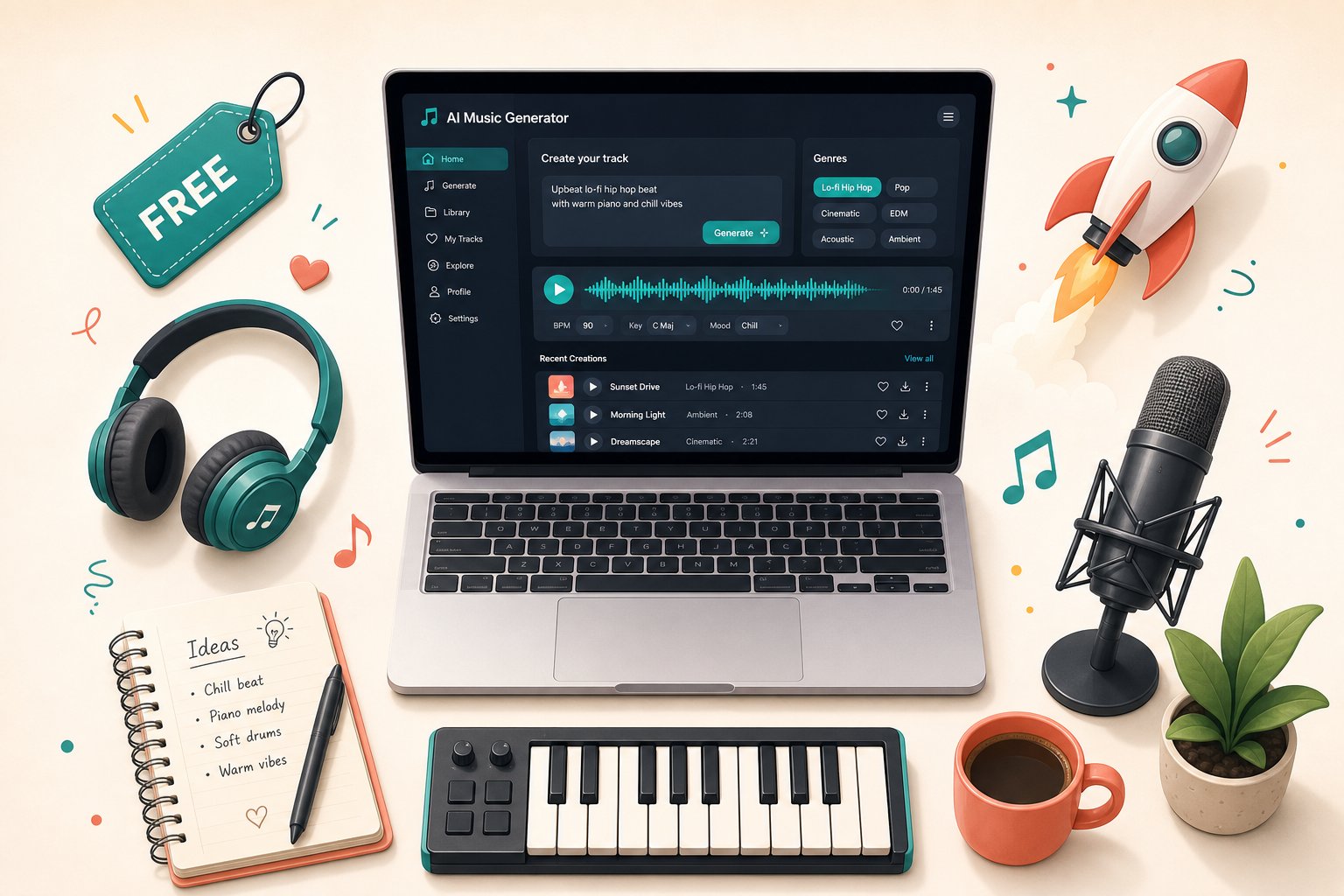
Paid platforms like Suno Pro and AIVA Professional deliver the strongest commercial terms, but free tools serve a critical role: they let you test the market, build skills, and generate usable tracks without financial risk. For creators still figuring out their workflow or evaluating whether AI music fits their content strategy, starting at zero cost makes sense.
Here are accessible options for getting started with AI music generation:
- MakeBestMusic's Free Music Generator — A strong starting point for creators who need royalty-free music for commercial projects. It generates tracks you can use in videos, social content, games, and podcasts without licensing complications. The royalty-free model means no per-use fees and no attribution headaches, making it particularly practical for content creators who need background music at volume without worrying about clearance.
- Suno (Free Tier) — Generates full songs with vocals and instrumentation. The free plan restricts commercial use, but it lets you experiment with prompts, test genres, and develop your melody craft before committing to a paid subscription where commercial rights unlock.
- Udio (Free Tier) — Similar to Suno in capability, offering style exploration and quick demo generation. Useful for testing ideas, though commercial distribution requires upgrading.
- ChatGPT for Lyrics — While not a music generator, ChatGPT works well as a chatgpt songwriter tool for drafting and refining lyrics. Can ChatGPT create a song? Not in the audio sense, but it can produce structured verses, choruses, and bridges that you pair with AI-generated instrumentals for a complete track. Many creators use it as the best ai for writing lyrics when they want full creative control over the words.
- These Lyrics Do Not Exist — A completely free, no-signup lyric generator for instant inspiration. Select a theme, style, and mood, and receive full lyrics in seconds. Useful for breaking creative blocks, though outputs need refinement before they are release-ready.
- Stable Audio (Free Tier) — Generates short instrumental clips and loops. The free tier grants commercial rights to individuals earning under $1 million annually, making it one of the few free options with built-in commercial clearance for small creators.
The strategic value of free tools goes beyond saving money. They let you validate demand before investing. Generate 10 tracks, upload them to a royalty-free library or use them in your own content, and measure response. If buyers engage or your content performs better with custom music, you have data justifying a paid subscription. If not, you lost nothing but time.
Free generators also lower the barrier for content creators who are not trying to sell music directly but need affordable tracks for their own commercial projects. A YouTuber producing three videos per week burns through stock music licenses fast. A tool like MakeBestMusic's generator solves that problem permanently: royalty-free tracks created on demand, matched to your content needs, with no recurring licensing fees eating into your channel revenue.
Building a Sustainable AI Music Business
There is a meaningful difference between uploading a few AI tracks and hoping for passive income versus building a legitimate catalog business that generates predictable revenue. The first approach yields pocket change. The second requires the same strategic thinking as any other creative business, just with faster production timelines.
Four pillars separate serious catalog builders from hobbyists:
Volume with intention. Streaming algorithms and stock libraries both reward consistent output. But volume without quality or coherence is spam. The target is themed releases: an EP of lo-fi study beats, a collection of cinematic tension cues, a pack of upbeat podcast intros. Each release serves a defined audience rather than scattering random tracks into the void.
Quality control as a non-negotiable. AI tools produce artifacts, awkward transitions, and muddy mixes that pass a casual listen but fail professional scrutiny. Every track needs a quality check before distribution: listen on multiple systems, verify clean endings, check for clipping, and confirm the structure resolves satisfyingly. The melody craft that distinguishes a sellable track from a forgettable one often comes down to post-generation editing rather than the initial prompt.
Metadata and tagging as discovery infrastructure. Your music is invisible without proper tags. Mood (energetic, melancholic, hopeful), tempo (exact BPM), instrumentation (piano, synth pads, acoustic guitar), and use case (corporate, travel, fitness) all determine whether a buyer finds your track. Treat tagging as seriously as production. Tracks with five accurate tags outperform tracks with one generic label every time.
Niche targeting over broad appeal. A track described as "happy background music" competes with millions of alternatives. A track described as "upbeat ukulele instrumental for cooking tutorial intros, 110 BPM, 30 seconds" matches a specific search query with far less competition. The narrower your niche, the higher your conversion rate per listener or buyer.
Creators who treat this as a business also diversify channels from the start. The same track can earn streaming royalties on Spotify, generate licensing income in a stock library, and serve as a portfolio piece for direct B2B sales. Each channel compounds the value of every track you produce, and the tools available today, from free generators for initial experimentation to professional platforms for scaled production, make the entire pipeline accessible without traditional industry gatekeepers.
Taking Action and Building Your AI Music Revenue
Every section of this guide points to the same conclusion: making money with ai music is real, accessible, and growing, but it rewards creators who approach it with intention rather than impulse. Your next move depends entirely on where you are right now and what you want to build.
Your Next Steps Based on Your Situation
Three distinct creator profiles emerge from the landscape covered above. Each has a different optimal starting point:
- Hobbyists seeking passive income — Start with free generators like MakeBestMusic's Free Music Generator to produce royalty-free tracks without upfront cost. Upload to permissive stock libraries like AudioSparx or Songtradr, tag meticulously, and build themed collections. Aim for 20-30 tracks in a single niche before expecting meaningful returns. Streaming via DistroKid at $22.99/year adds a second passive channel once your catalog has depth.
- Producers using AI as a creative tool — Focus on the AI-assisted workflow for stronger copyright claims and broader market acceptance. Use AI for ideation and arrangement, then layer in original performance, composition, or vocal work. Distribute through TuneCore or CD Baby where human authorship documentation strengthens your position. Register copyrights on the human-authored elements. This path supports ai music royalties collection through PROs like BMI or ASCAP, since your tracks qualify for performance royalty tracking.
- Content creators needing background music — You may not need to sell music at all. If you are asking how can i sell a song i wrote but your real goal is monetizing videos, podcasts, or social content, generating royalty-free tracks for your own projects eliminates licensing costs entirely. MakeBestMusic's free generator produces commercial-ready audio you can use across platforms without clearance headaches. Reserve selling for later, once you have surplus tracks that do not fit your own content calendar.
Regardless of your path, ai music promotion follows the same principles as any independent release strategy: consistency, niche focus, platform-native content, and community engagement. Playlist submissions, social media snippets, and direct outreach to potential buyers all compound over time. Creators who want to sell your lyrics online alongside instrumentals can bundle packages on Gumroad or BeatStars, serving artists who need ready-made song foundations.
The Bottom Line on Selling AI Music
You can sell AI-generated music. Your commercial success depends on choosing the right tools, understanding your rights, complying with platform policies, and adding genuine creative value. Start free, learn the rules, scale with intention.
The opportunity is not theoretical. Creators are already earning $500 to $3,000 monthly through catalog strategies that combine streaming, licensing, and direct sales. The barrier is not talent or budget. It is knowledge, and you now have it. Start with a free tool like MakeBestMusic's Free Music Generator to produce your first royalty-free tracks for commercial use, validate demand with real uploads, and expand into paid platforms and broader distribution as your revenue justifies the investment. The creators who act on this information while the market is still forming are the ones who will own the most defensible positions a year from now.
