


The Copyright Question Every AI Music Creator Faces
Imagine typing a short phrase into an AI tool and getting a polished, radio-ready track back in under a minute. The melody is catchy. The production sounds professional. But here's the question that trips up nearly everyone who tries it: can you copyright AI music that was generated this way?
Copyright law was designed for a world where humans pick up instruments, write lyrics in notebooks, and spend hours in studios making creative decisions. Artificial intelligence in music flips that model on its head. The legal framework hasn't caught up, and that leaves musicians, YouTubers, podcasters, and producers in a gray zone that can feel impossible to navigate.
The short answer is: it depends on what you touched. The degree of human involvement, the jurisdiction you're operating in, and which specific elements of the song you personally shaped all determine whether your AI-assisted track qualifies for protection. A track generated entirely from a text prompt with no further creative input sits in very different legal territory than one where a human rewrote the lyrics, rearranged the structure, and mixed the final master.
Why This Question Matters for Every Creator Using AI
The U.S. Copyright Office has been consistent on one foundational point since issuing its registration guidance in March 2023: works created entirely by AI without meaningful human creative input are not eligible for copyright protection. At the same time, AI-assisted works where a human exercised genuine creative control may qualify. The Office has already registered hundreds of works that incorporate AI-generated material, with protection covering the human author's contribution.
Copyright law requires human authorship. When AI determines the expressive elements of a work's output, the generated material is not the product of human authorship.
This distinction matters for your revenue, your licensing deals, and your ability to enforce exclusivity. If a work is uncopyrightable, anyone can use it freely. You can't file a DMCA takedown, and no sync license holds legal weight. Understanding where that line falls is no longer optional for creators working with AI music copyright issues.
What This Guide Covers
This guide walks through the full picture so you can make informed decisions about your own workflow:
- The legal threshold for human authorship and the court rulings that define it
- How different levels of AI involvement affect your copyright claim
- An element-by-element breakdown of how protection applies to melody, lyrics, arrangement, and production separately
- Practical registration strategies and documentation methods
- How platform terms of service shape your ownership rights regardless of what the law allows
- How rules differ across the U.S., UK, and EU
The goal isn't to scare you away from using AI in your creative process. It's to help you understand exactly how much human input is enough, and where to focus that input so your work stands on solid legal ground.
That legal ground starts with a single requirement courts have reinforced repeatedly: a human being must be the author. How that requirement plays out when AI handles part of the creative chain is where things get interesting.
Why Human Authorship Is the Legal Threshold
The entire copyright system in the United States rests on a single constitutional clause. Article I, Section 8 of the U.S. Constitution empowers Congress to "secure for limited Times to Authors... the exclusive Right to their... Writings." That word — Authors — is doing enormous legal work. Courts have consistently interpreted it to mean human beings, and that interpretation forms the bedrock of every decision about whether AI-generated music can receive protection.
The Copyright Act of 1976 extends protection to "original works of authorship," but it never explicitly defines who qualifies as an author. So can AI music be copyrighted under this framework? Courts have filled that gap by looking at the statute as a whole. Ownership provisions assume an author can hold property. Duration provisions tie copyright to an author's lifespan. Inheritance clauses reference widows, widowers, and grandchildren. Transfer provisions require a signature. None of these concepts apply to a machine.
For music creators, the practical implication is straightforward: a track generated solely from a text prompt — say, "create an upbeat indie folk song in A major" — with no further human creative input is not copyrightable under current law. The AI determined the melody, the chord progression, the arrangement, and the production choices. No human authored those expressive elements.
The Human Authorship Requirement in Copyright Law
Even before generative AI entered the picture, courts refused copyright protection for works lacking human creators. A monkey who took photographs of himself was denied standing under the Copyright Act. A book purportedly dictated by celestial beings couldn't be copyrighted. A living garden wasn't eligible either. The U.S. Copyright Office has maintained for decades that copyrightable works must be "created by a human being" and has refused to register works "produced by a machine or mere mechanical process that operates randomly or automatically without any creative input or intervention from a human author."
What does "creative input" actually look like? The Copyright Office's January 2025 report on Copyright and Artificial Intelligence draws the line at creative control. The report concludes that "given current generally available technology, prompts alone do not provide sufficient human control to make users of an AI system the authors of the output." Prompts, in the Office's view, function as instructions conveying unprotectable ideas — they don't control how the AI processes them into a finished piece of music.
Think of it this way: telling a session musician "play something jazzy and melancholic" doesn't make you the author of what they play. The Copyright Office sees AI prompts in a similar light — you're giving general direction, not exercising the kind of creative control that produces authorship.
Key Legal Precedents Shaping AI Music Rights
Two landmark decisions have shaped how is AI music copyrighted (or not) under U.S. law. Together, they draw the boundaries that every AI music creator needs to understand.
In March 2025, the U.S. Court of Appeals for the D.C. Circuit affirmed the ruling in Thaler v. Perlmutter, holding that the Copyright Act "requires all eligible work to be authored in the first instance by a human being." Computer scientist Stephen Thaler had listed his AI system — the Creativity Machine — as sole author of a visual artwork and sought registration. The court rejected every argument Thaler raised: that the natural meaning of "author" isn't limited to humans, that the work-for-hire doctrine allows nonhuman entities to be authors, and that denying AI authorship would disincentivize creativity. The court noted that machines don't respond to economic incentives, so the human authorship requirement doesn't reduce the creation of original works.
The second key decision involves the graphic novel Zarya of the Dawn. Creator Kris Kashtanova used Midjourney to generate images and combined them with human-written text and a human-arranged layout. The Copyright Office's February 2023 ruling granted protection for the text and the overall selection and arrangement of images and text, but denied copyright for the individual AI-generated images themselves. The Office found too much "distance" between the user's input and Midjourney's output to consider Kashtanova the author of those images.
The parallel to music is direct. If you use AI to generate a full instrumental track but then write original lyrics, arrange those lyrics against the AI audio in a creative sequence, and make deliberate choices about structure and pacing, your human contributions may receive protection while the AI-generated instrumental does not.
Here are the key rulings and what they established:
- Thaler v. Perlmutter (D.C. Cir., March 2025) — Works generated autonomously by AI cannot be copyrighted; the Copyright Act requires human authorship as a threshold condition.
- Zarya of the Dawn (Copyright Office, February 2023) — AI-generated elements within a larger work are not copyrightable, but human-authored text and sufficiently creative selection and arrangement of AI outputs may qualify.
- Theatre D'opera Spatial (Copyright Office, September 2023) — An AI-generated artwork modified by a human applicant was denied registration because the applicant failed to identify and disclaim the AI-generated portions.
- SURYAST (Copyright Office, December 2023) — An AI system that determined how to combine a human-provided base image and a style reference was deemed responsible for the expressive choices, denying copyright to the applicant.
These decisions share a common thread that applies directly to copyright AI music news and practice: the question is always who made the expressive choices. When AI determines the melody, the harmonic structure, and the sonic texture, those elements belong to no one. When a human selects, arranges, and meaningfully modifies AI outputs with creative judgment, those specific contributions can be protected.
The gap between "no protection" and "partial protection" is where most real-world AI music workflows actually live. Understanding exactly how different levels of involvement shift your legal position is what separates creators who build protectable catalogs from those who don't.
The Spectrum of AI Involvement in Music Creation
Legal precedent tells you what the rules are. But knowing that "human authorship is required" doesn't help much when you're sitting in front of a DAW at 2 AM wondering whether the chord progression your AI tool just suggested disqualifies your entire track. The real question is how these rules map onto the workflows creators actually use every day.
AI involvement in music isn't binary. It's a spectrum. On one end, you have fully autonomous generation where AI handles every creative decision. On the other, you have traditional human composition where AI merely executes technical tasks like mastering or noise reduction. Most creators fall somewhere in the middle, and your position on that spectrum determines whether your work qualifies for copyright protection.
Prompt-Only Generation and Its Copyright Status
Picture this: you open an AI music generator, type "create a lo-fi hip-hop track with vinyl crackle and mellow piano," hit enter, and download the result. You change nothing. The melody, rhythm, harmonic structure, arrangement, instrumentation, and mix were all determined by the AI. You provided a general idea. The machine made every expressive choice.
Under current U.S. Copyright Office guidance, this output almost certainly cannot be copyrighted. As the Office stated in its 2025 report, prompts function as instructions conveying ideas rather than exerting the kind of creative control that produces authorship. Even detailed, multi-sentence prompts describing tempo, key, mood, and instrumentation don't change the analysis. You're still telling the machine what you want rather than determining how it gets expressed.
Suno's own help documentation acknowledges this reality directly: "In the US, copyright laws protect material created by a human. Music made 100% with AI would not qualify for copyright protection because a human did not write the lyrics or the music." The platform generating your track is openly admitting it may not produce copyrightable output.
Even generating dozens of outputs, picking your favorite, and publishing it likely falls short. Selection alone — choosing one track from many — may not constitute the "meaningful human authorship" the Copyright Office requires, particularly when the expressive content of the selected work was entirely machine-determined.
AI-Assisted Composition and Production Workflows
The middle ground is where most professional and semi-professional creators operate, and it's where the copyright analysis gets genuinely interesting. These workflows involve humans and AI trading creative input back and forth, with the human retaining decision-making authority over the final result.
Consider these common scenarios:
- AI-generated chord progressions, human-rearranged structure: You ask an AI to suggest a four-chord loop in D minor. You take that suggestion, rearrange the voicings, change the rhythm, add a bridge with your own progression, and build a complete song structure around it. Your creative choices in arrangement and structure likely qualify as copyrightable authorship.
- Human composition with AI mastering: You write and record an original song — melody, lyrics, instrumentation, arrangement — and run the final mix through an AI mastering tool. PRS for Music considers this scenario "highly likely to satisfy the originality test," since the AI is performing a technical function rather than making creative decisions about the work's expressive content.
- Using AI to write song lyrics that a human substantially rewrites: You generate AI lyrics as a starting point, then rewrite 70% of the words, restructure the verses, and craft a new chorus entirely. The final lyrics reflect your creative judgment. The more you transform the AI's output, the stronger your claim to authorship.
- AI instrumental suggestions refined by a human producer: An AI generates a drum pattern and bassline. You adjust the rhythm, add ghost notes, layer your own synth parts over it, and build the production around your creative vision. The human-added elements and the creative decisions shaping the final arrangement are where your copyright lives.
PRS for Music's AI policy captures this middle ground clearly: "Where a composer has written an original melody and used AI to add instrumentation, or where a songwriter has used AI to refine original lyrics, the work may satisfy the originality test." The key qualifier is that the work must still be considered the human creator's "own intellectual creation, despite these amendments or additions by AI."
Where the Line Between Tool and Creator Falls
Here's a useful mental model: if AI is doing what a synthesizer, auto-tune, or drum machine does — executing your creative decisions with greater efficiency — it's functioning as a tool. Your copyrightability stays intact. If AI is doing what a co-writer, arranger, or producer does — making independent creative choices about how the music sounds — it's functioning as a creator. And non-human creators can't hold copyrights.
Think about how Riffusion debuts songs through its spectral diffusion process. The AI generates audio from text descriptions, making all the compositional decisions autonomously. A user typing "90s grunge guitar riff" isn't composing — they're commissioning. Contrast that with a producer who uses AI to isolate stems from a reference track, then manually chops, rearranges, and layers those stems with original material. The producer is composing; the AI is just a more sophisticated pair of scissors.
The top AI platforms for lyrics and writing operate on this same spectrum. A platform that generates complete, polished lyrics from a one-line prompt is making the creative choices. A platform that suggests rhymes, offers alternate phrasings, or helps you brainstorm ideas that you then shape into finished verses is assisting your creativity without replacing it.
The table below maps common AI music workflows against their likely copyright status:
| Workflow Type | What the AI Does | Human Input Required for Copyright | Likely Copyright Status |
|---|---|---|---|
| Prompt-only generation | Creates entire track from text description | None beyond the prompt | Not copyrightable |
| AI-assisted composition | Suggests melodies, chords, or structures | Human selects, rearranges, and modifies output substantially | Likely copyrightable (human elements) |
| AI mixing/mastering | Balances levels, applies EQ, compresses dynamics | Human composed and arranged all musical content | Copyrightable (AI performs technical role only) |
| AI vocal synthesis | Generates vocal performance from notation or text | Human wrote melody, lyrics, and vocal arrangement | Composition copyrightable; sound recording status uncertain |
| AI lyric drafting | Generates complete lyrics from a theme or prompt | Human rewrites substantially, restructures, adds original lines | Copyrightable if human transformation is meaningful |
Notice the pattern: copyright protection correlates directly with how many expressive decisions the human made versus how many the AI made. It's not about whether you used AI at all. It's about whether the final work reflects your creative choices or the machine's.
This workflow-level analysis gives you a practical framework, but there's another layer of complexity most creators overlook. A single song contains multiple distinct elements — melody, lyrics, harmony, arrangement, and the sound recording itself — and AI involvement in one element doesn't necessarily contaminate the others. Each component carries its own copyright analysis.
How Copyright Applies to Different Song Elements
A single recorded song isn't one unified legal entity. It's actually two separate copyrightable works stacked on top of each other, and each element within those works can have a different copyright status depending on who — or what — created it. This distinction is something most creators miss entirely, and it changes the calculus of AI music copyright in a meaningful way.
You might assume that using AI to generate your instrumental backing track means your entire song is uncopyrightable. That's not how it works. If you wrote original lyrics and a melody by hand, those elements can still qualify for copyright protection even when the underlying beat was machine-generated. The reverse is also true. Copyright law doesn't treat a song as all-or-nothing. It looks at each creative contribution individually.
Musical Composition vs. Sound Recording
Every recorded song carries two distinct copyrights under U.S. law. The first is the musical composition — the melody, harmony, lyrics, and song structure. Think of it as the underlying blueprint that could be performed by anyone. The second is the sound recording — the specific fixed performance captured in an audio file. These two rights often belong to different people (a songwriter and a label, for example), and they're registered separately with the Copyright Office.
Why does this matter for AI-generated music? Because AI might be involved in one layer but not the other. Consider these scenarios:
- Human-written melody and lyrics recorded with AI-generated instrumentation: The composition (melody and lyrics) is human-authored and copyrightable. The sound recording's status depends on how much of it was determined by AI versus human production choices.
- AI-generated composition performed and recorded by human musicians: The sound recording — the specific performance with its unique timbres, dynamics, and expressive nuances — may qualify for protection even if the underlying composition does not.
- Human-composed song with an AI-cloned vocal performance: The composition remains copyrightable. The sound recording may be protectable if a human production team made sufficient creative decisions about the recording process, as illustrated by Randy Travis's AI-assisted single "Where That Came From," where a production team used AI to transform a human singer's vocal track to match Travis's voice.
The U.S. Copyright Office's staff has emphasized that "even in a single song, with rights in both the musical composition and sound recording, these rights are often divided among multiple rightsholders." When AI enters the picture, this division becomes even more important because one right might be fully protectable while the other is not.
Element-by-Element Copyright Analysis
Zooming in further, each creative element within a composition or recording carries its own authorship analysis. You'll want to think about your AI usage at this granular level, because your copyright claim lives or dies based on which specific expressive choices you made versus which ones you delegated to the machine.
Melody. This is often the most individually recognizable element and one of the strongest candidates for copyright protection. If you wrote the melody yourself — even if you used AI to generate harmonic accompaniment beneath it — your melodic authorship stands independently. If AI generated the melody and you kept it unchanged, that element isn't protectable regardless of what else in the song is human-authored.
Lyrics. Words are words, and the question is who arranged them into expressive phrases. If you used AI to draft lyrics and then substantially rewrote them — restructuring verses, replacing imagery, crafting a new hook — your contribution is copyrightable. If you kept AI-generated lyrics intact or made only minor tweaks (fixing a rhyme, swapping a single word), the lyrics likely remain unprotectable. So can you publish a song written by AI? Yes, you can publish it. But owning the copyright to those lyrics is a separate question that hinges on how much rewriting you actually did.
Harmonic structure. Chord progressions on their own receive thin copyright protection at best, even in fully human-composed music, since so many songs share identical progressions. AI-generated chord sequences are even less likely to be independently copyrightable. However, if you take an AI-suggested progression and apply a creative voicing, reharmonize sections, or build a distinctive rhythmic treatment around it, your specific arrangement of that harmonic material may qualify.
Arrangement. How you organize musical elements — which instruments enter where, how sections transition, the overall arc of the track — reflects creative judgment. A human who takes AI-generated loops and arranges them into a structured song with intentional builds, drops, and dynamic shifts is making authorial decisions about selection and arrangement. This is analogous to the Zarya of the Dawn ruling, where the creative arrangement of AI-generated images received protection even though the individual images did not.
Production and mixing. Technical mixing decisions (EQ, compression, volume balancing) are generally not considered expressive authorship. But production choices that shape the artistic character of a recording — layering textures, designing sonic spaces, creating effects that define the track's identity — can be. If AI handles the technical mixing while you make the artistic production decisions, your contributions to the recording's expressive character remain protectable.
Hybrid Works and Partial Protection
Here's the practical takeaway: you don't have to choose between "fully copyrightable" and "no protection at all." The Copyright Office explicitly allows registration of hybrid works — pieces that contain both human-authored and AI-generated material — as long as you disclose and disclaim the AI-generated portions.
The Office has already registered more than a thousand works where applicants followed this approach. You identify what the AI contributed, exclude those elements from your copyright claim, and receive protection for everything you authored yourself. Your registration covers only the human-created material, but that partial protection is still enforceable.
PRS for Music takes a similar approach in the UK. Their policy allows members to register a work where the composition is human-created but the lyrics are AI-generated (or vice versa), as long as the AI-generated component is declared as "AI" in the registration. The human-authored element receives royalty distribution; the AI-generated element does not claim copyright.
The table below maps how copyright eligibility shifts based on who created each song element:
| Song Element | Human Only | AI-Assisted (Human-Led) | AI-Generated (No Meaningful Human Input) |
|---|---|---|---|
| Melody | Fully copyrightable | Copyrightable if human shaped final expression | Not copyrightable |
| Lyrics | Fully copyrightable | Copyrightable if substantially rewritten by human | Not copyrightable |
| Harmonic structure | Thin protection (common progressions unprotectable) | Protectable if human applied creative voicing/rhythm | Not copyrightable |
| Arrangement | Fully copyrightable | Copyrightable — selection and arrangement reflect human judgment | Not copyrightable |
| Sound recording | Fully copyrightable | Copyrightable if human made key expressive decisions | Not copyrightable |
| Production/mixing | Protectable if artistically expressive | Protectable if human controls artistic choices; AI handles technical tasks | Not copyrightable |
This element-by-element framework gives you a strategic advantage. Rather than worrying about whether your entire track is protectable, you can focus your human creative energy on the elements that matter most to you — the melody, the lyrics, the arrangement — and let AI handle components where copyright is either unavailable or less critical to your business interests.
Knowing which elements qualify for protection is one thing. Actually securing that protection through the registration process — with proper disclosure, documentation, and strategic framing — requires its own set of practical steps.
How to Copyright AI Music Through Proper Registration
You've identified which elements of your song are human-authored. You understand that the melody you wrote by hand and the lyrics you rewrote from an AI draft carry a different legal status than the AI-generated beat underneath them. The element-by-element analysis gives you clarity about what's protectable. But protection doesn't become real until you register it correctly with the U.S. Copyright Office — and that process has specific requirements when AI is part of your workflow.
The Office evaluates AI-assisted works on a case-by-case basis. There's no checkbox that automatically grants or denies your claim. Instead, examiners look at what you disclose, what you claim, and whether the human authorship you describe meets the threshold. Getting this right is the difference between a valid registration and one that could be challenged or invalidated later.
What the Copyright Office Requires You to Disclose
If any portion of your work was generated by AI, you're obligated to say so in your registration application. This isn't optional. The Copyright Office's March 2023 policy statement made clear that applicants must identify AI-generated content and exclude it from their copyright claim. You register what you authored. You disclaim what the machine authored.
In practice, this means your application needs to specify:
- Which elements of the work were generated by AI (for example, "instrumental backing track generated by [AI tool name]")
- Which elements you're claiming as human-authored (for example, "melody, lyrics, vocal arrangement, and overall selection and arrangement of musical elements")
- A description of how you contributed creatively to the final work
What triggers additional scrutiny? The Office may send correspondence requesting more information if your application raises questions — perhaps the work's metadata references an AI tool, or public statements about the project mention AI generation. Examiners may also flag applications where the claimed human contribution seems minimal relative to the complexity of the finished work.
The consequences of failing to disclose AI involvement are serious. A registration obtained without proper disclosure can be invalidated. Under 17 U.S.C. § 410(c), a timely registration serves as prima facie evidence of validity — but that presumption is rebuttable. In litigation, a defendant can challenge your registration through metadata, source files, version histories, prompt logs, or other workflow evidence obtained in discovery. If a court finds you claimed authorship over material that was actually AI-generated, your entire registration's credibility suffers.
Imagine spending years building a catalog, landing a sync placement, and then having your registration challenged because you never mentioned the AI tool that generated your track's harmonic foundation. Transparency now protects you later.
Documenting Your Creative Process Step by Step
The Copyright Office's 2025 copyrightability report makes one thing clear: your future legal position depends less on broad claims that AI was "merely a tool" and more on whether you can show, with contemporaneous evidence, what you actually contributed. Documentation isn't just good practice — it's the evidentiary foundation of your copyright claim.
Copyright protects the original expression in a work created by a human author, even if the work also includes AI-generated material.
So what does effective documentation look like for AI-assisted music? You'll want to build a paper trail that demonstrates progressive human creative input at every stage. Here's what to preserve:
Prompt logs and AI outputs. Save your original prompts and the raw outputs the AI produced. This establishes your starting point — what the machine gave you before you touched it. Screen recordings or timestamped exports work well here.
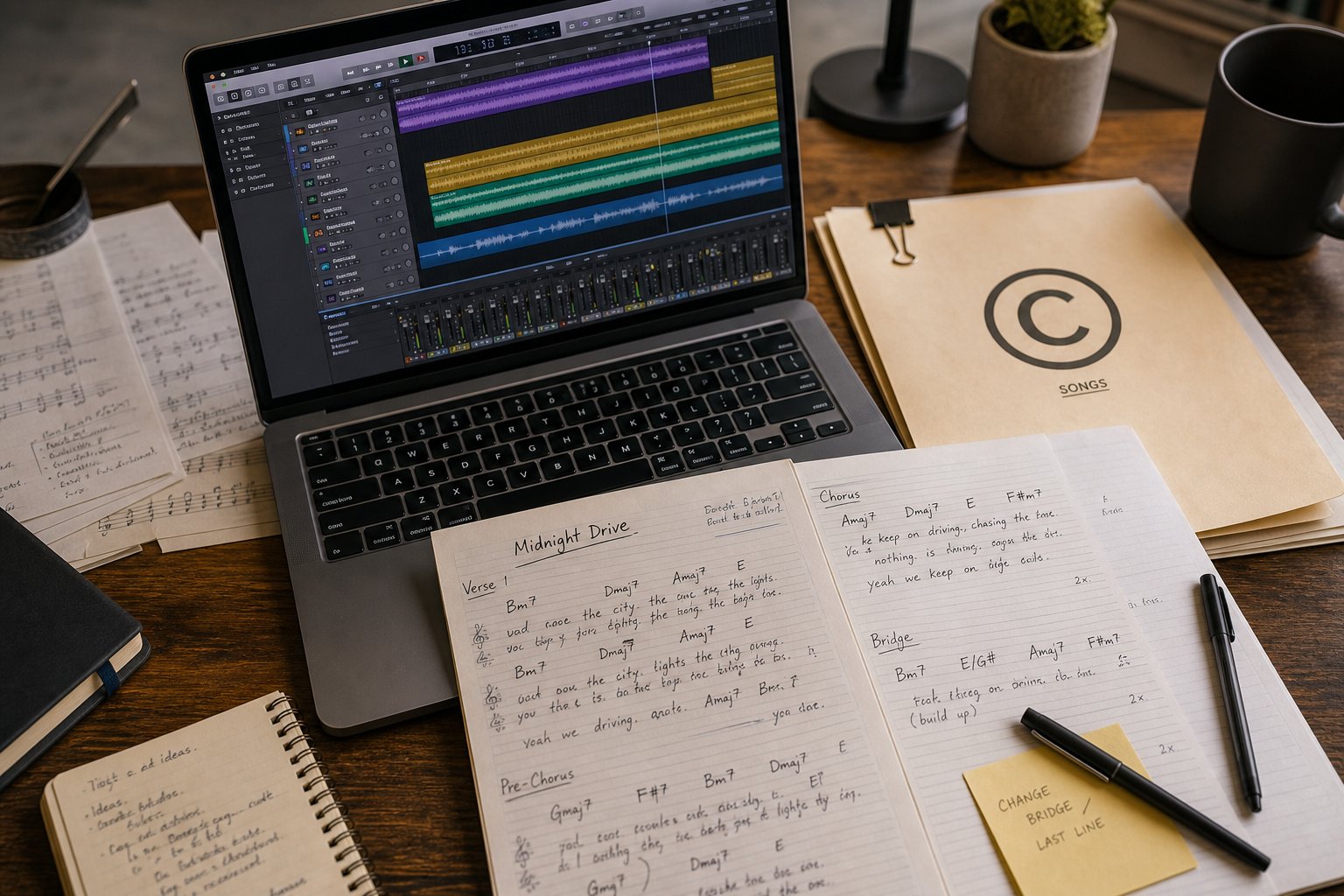
Draft versions showing progressive edits. Every time you modify the AI's output, save a new version. If you're reworking AI-generated lyrics, keep the original AI text alongside your first revision, second revision, and final draft. The progression from machine output to finished human expression tells the story examiners and courts need to see.
DAW session files. Your project files in Ableton, Logic, Pro Tools, or FL Studio contain a timeline of creative decisions. They show which tracks you added manually, where you edited MIDI notes, how you rearranged sections, and what effects or processing you applied. These files are some of the strongest evidence of human authorship available to music creators.
Notes on creative decisions. Keep a brief log of why you made specific choices. "Moved the AI-generated chorus melody up a third and rewrote the rhythm to match the lyric's stress pattern" is exactly the kind of evidence that demonstrates creative control over expressive elements. It doesn't need to be formal — a text file, a voice memo, or even comments in your session notes will do.
Before-and-after comparisons. If possible, export the AI's raw output as one file and your finished version as another. The difference between the two is your authorship, made audible.
This kind of documentation matters for more than just registration. In a copyright dispute, you may need to prove which portions of your work are actually human-authored. Courts don't treat a copyrighted work as entirely protected or entirely unprotected — they look at the specific elements. Having contemporaneous evidence of your creative process means you can point to exactly where human authorship lives in your track.
Registration Strategies That Strengthen Your Claim
How you frame your application matters. Two creators could use AI in nearly identical ways but end up with different outcomes based on how they describe their contributions. Strategic framing isn't about misrepresenting your process — it's about clearly articulating the creative choices you made so the examiner can evaluate them properly.
The standard you're aiming for is "meaningful human authorship." The Copyright Office has stated that copyright may protect human-authored elements in AI-assisted works, including creative selection, arrangement, and modification. Your application narrative should emphasize exactly those activities.
Here's a step-by-step process for registering AI-assisted music:
- Identify all AI-generated elements. Before you start the application, list every component where AI made expressive decisions — the beat, a synth patch, a chord progression, specific lyrics. Be thorough and honest.
- Define your human-authored contributions. For each element you're claiming, describe what you did: wrote the melody from scratch, substantially rewrote AI-drafted lyrics, arranged AI-generated loops into a structured composition, made production decisions shaping the recording's artistic character.
- Register the appropriate work type. If your human authorship is primarily in the composition (melody, lyrics, structure), register as a musical work. If it's in the recording itself (performance, production, artistic mixing decisions), register the sound recording. You can register both separately if you have human authorship in each.
- Complete the "Author Created" field accurately. List only the elements you authored. For a song where you wrote melody and lyrics but used AI for instrumentation, you might enter: "melody, lyrics, vocal arrangement, and selection and arrangement of musical elements."
- Use the "Limitation of Claim" field to disclaim AI material. State what the AI generated: "Instrumental backing track generated using [tool name]; applicant claims no copyright in the AI-generated instrumental."
- Prepare supporting documentation. While not always required at filing, having your draft history, session files, and process notes ready means you can respond quickly if the Office requests additional information.
- Submit your deposit copy. Upload the completed work. The cost for music copyright registration is $65 for a single work filed online through the Copyright Office's electronic system — the same fee whether or not AI was involved in creation.
One strategic consideration: if your work contains both a copyrightable composition and a copyrightable sound recording, you might register them separately rather than as a single unit. This gives you more precision in describing human authorship for each right individually, and it avoids situations where uncertainty about one element creates questions about the other.
Also keep in mind that the Copyright Office's examination is not adversarial. Examiners aren't trying to deny your claim — they're trying to determine whether what you're claiming meets the legal standard. Clear, specific descriptions of your creative contributions make their job easier and your registration stronger.
The registration process gives you a legal foundation, but it operates within a broader ecosystem. The platform you used to generate AI elements has its own terms of service, and those terms can shape — or limit — your ownership rights regardless of what copyright law allows.
How AI Music Platform Terms Affect Your Rights
Copyright law sets the ceiling for what protection is possible. But the platform you use to generate AI music often sets the floor — and sometimes the walls. Even if your workflow produces enough human authorship to qualify for copyright under the legal standards we've covered, your platform's terms of service may separately restrict what you actually own, how you can use the output, and whether you can distribute it commercially.
Terms of service are contracts. They override default legal rights in many situations. A platform could grant you full ownership of outputs, or it could retain a perpetual license to use everything you create. Understanding these differences before you commit to a tool isn't just smart business — it determines whether your finished track is truly yours.
How Platform Terms Shape Your Copyright Claims
Think of it this way: copyright law asks "did a human author this?" Platform terms ask "who agreed to own what?" These are separate questions, and both matter.
Some platforms assign all rights in the output to paid subscribers. Others retain ownership and grant you a limited license — meaning you can use the music, but the platform could theoretically license that same output to someone else. Free tiers almost universally come with restrictions: non-commercial use only, attribution requirements, or caps on how many tracks you can download or distribute.
Suno's terms illustrate this tiered approach clearly. According to their revised November 2025 Terms of Service, paid users receive assignment of Suno's rights in their output, while free users are limited to non-commercial use with attribution. Remixes are jointly owned. And all users — free or paid — grant Suno a broad, perpetual license to use their submissions and outputs for service improvement, including AI model training. So even when you "own" your Suno track, the company retains rights to use it internally.
This isn't unique to Suno. Most generative AI platforms include similar clauses that let them use your creations to improve their models. Whether that matters to you depends on your use case, but it's worth reading the fine print before you build a catalog on any single platform.
Comparing AI Music Tool Licensing Structures
The landscape splits roughly into three categories: subscription-based generators like Suno and Udio, free generators focused on royalty-free output, and AI-assisted plugins that integrate into existing DAWs.
Subscription generators typically gate commercial rights behind paid plans. Boomy, for instance, requires a $10/month subscription just to download up to 10 creations, with only five distributable per month. Their $30 pro tier promises "full commercial rights." Udio, after settling lawsuits with Universal and Warner, now operates a walled-garden model where distribution capabilities are more restricted. These platforms produce impressive outputs, but the ownership picture comes with layers of licensing conditions you need to track carefully.
Free and royalty-free generators take a different approach entirely. Rather than tangling creators in tiered ownership structures, they provide music that's cleared for commercial use from the start. MakeBestMusic's Free Music Generator fits squarely in this category — creators get royalty-free music they can use in videos, podcasts, games, and social content without navigating ownership disputes or worrying about whether their AI-generated track can be claimed by the platform later. For creators who need usable background music or production elements without the legal ambiguity, this kind of tool sidesteps the copyright question rather than trying to solve it.
Platforms like Soundraw and Loudly also position themselves in the royalty-free space. Soundraw offers downloadable and distributable creations trained on in-house material, while Loudly allows unlimited downloads and even facilitates distribution to streaming services like Spotify. Both emphasize "royalty-free" as a core selling point — and for good reason. When copyright ownership is uncertain, clear licensing terms become your actual protection.
DAW plugins and AI-assisted tools like Splice operate differently again. Splice provides a royalty-free sample library alongside AI-powered generation tools, and anything made on the platform can be downloaded and released commercially. Tools like Rightsify, Sonoteller, and MusicFlow tend to function as assistive layers within existing production workflows rather than standalone generators, meaning your ownership position depends more on what you do with their suggestions than on what the platform claims over the output.
The table below compares these platform types across the dimensions that matter most for your rights:
| Platform Type | Example | Licensing Model | Commercial Use Rights | Ownership Clarity |
|---|---|---|---|---|
| Free royalty-free generator | MakeBestMusic Free Music Generator | Royalty-free, no subscription required | Yes — videos, podcasts, games, social content | High — clear commercial license with no platform ownership claims |
| Subscription-based generator | Suno, Udio | Tiered — free (non-commercial) vs. paid (commercial rights assigned) | Paid tiers only; platform retains training license | Medium — ownership transfers on paid plans but broad platform licenses remain |
| Subscription-based generator (entry-level) | Boomy | Tiered — $10/mo for downloads, $30/mo for full commercial rights | Pro tier only; distribution caps on lower plans | Medium — commercial rights gated behind higher tiers |
| Royalty-free generator (subscription) | Soundraw, Loudly | Subscription with royalty-free output | Yes — download and distribute freely | High — royalty-free terms, trained on in-house or licensed material |
| AI-assisted DAW plugin / tool | Splice, Rightsify, MusicFlow | Royalty-free samples and AI suggestions within existing workflows | Yes — output is yours to release commercially | High — AI assists your composition rather than generating standalone works |
A few patterns stand out. Platforms that generate complete tracks from prompts tend to have the most complex ownership terms — precisely because the question of who "authored" the output is legally unsettled. Platforms that provide royalty-free material or function as creative assistants within your own workflow generally offer cleaner ownership, because they're either not claiming copyright at all or they're positioning the AI as a tool rather than a co-creator.
Your choice of platform isn't just a creative decision. It's a legal one. A track generated on a free Suno account can't be used commercially regardless of how much human authorship you layered on top. A royalty-free track from a tool like MakeBestMusic or Loudly can go straight into your YouTube video or podcast without a licensing question in sight — even if that track wouldn't qualify for copyright registration on its own.
Platform terms govern what you can do with AI music today, within the borders of a single country's legal framework. But music distribution is global, and copyright rules aren't universal. The same track that's clearly licensed for commercial use might face entirely different authorship questions depending on which country's law applies.
How Copyright Rules Differ Across Jurisdictions
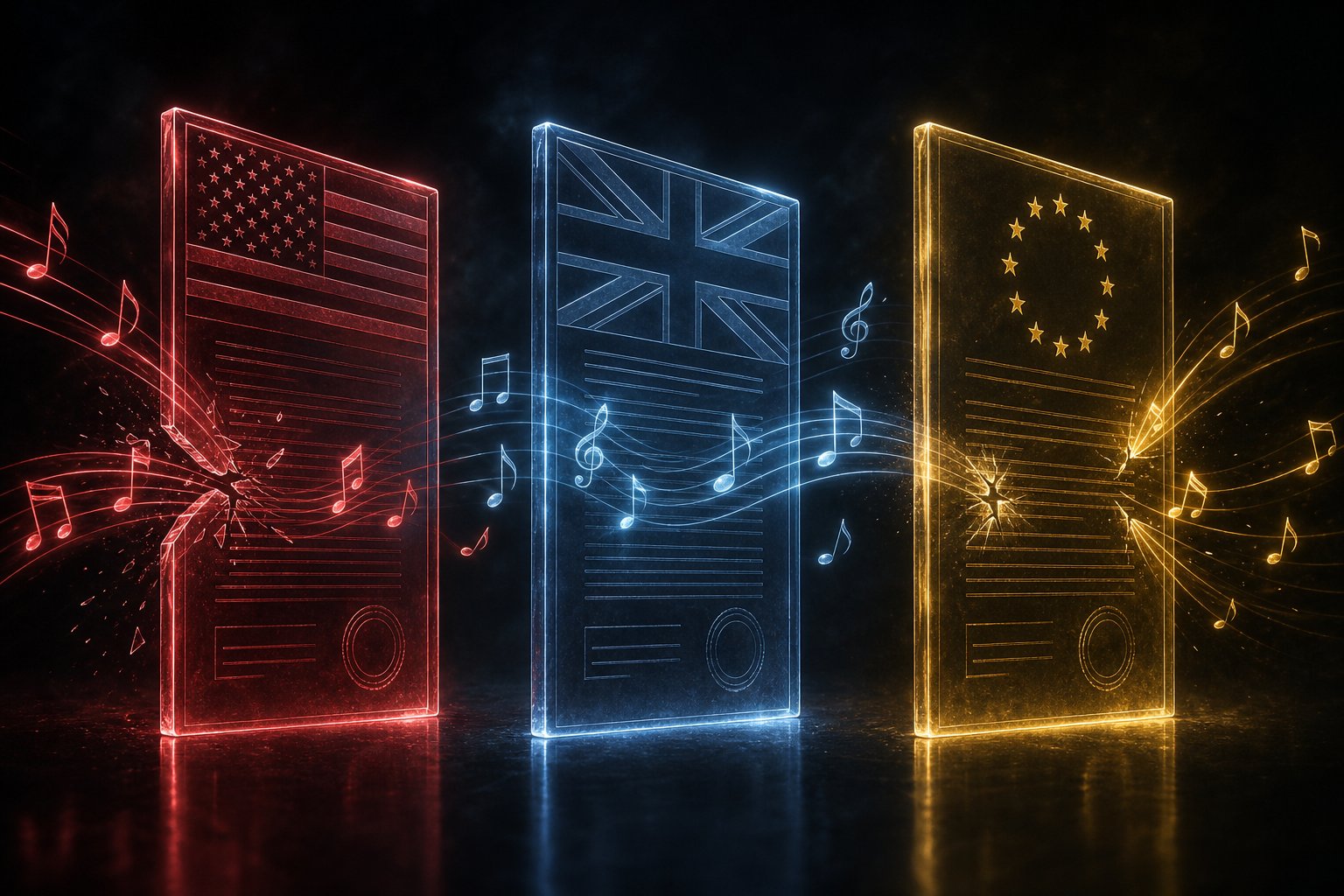
Copyright doesn't travel with a single passport. It's territorial — meaning the rules that apply to your AI-generated track depend entirely on which country's courts are evaluating it. A song that qualifies for protection in London might be considered public domain in Washington, D.C., and subject to entirely different transparency obligations in Berlin. For creators distributing music globally through streaming platforms, this patchwork creates real complications that no single jurisdiction's rules can resolve.
Music copyright AI news tends to focus heavily on U.S. developments, but the reality is that your listeners, licensees, and potential infringers are spread across dozens of legal systems. Understanding how the major frameworks diverge helps you make informed decisions about where your protection actually holds.
The U.S. Approach and Copyright Office Guidance
The U.S. position is the most widely reported and arguably the strictest among major economies. Here's the summary: human authorship is a non-negotiable threshold. The Copyright Office evaluates AI-assisted works case by case, looking for evidence that a human exercised meaningful creative control over the expressive elements. Applicants must disclose AI involvement and disclaim AI-generated portions. Prompts alone don't establish authorship. Selection of a favorite output from multiple AI generations likely doesn't either.
The practical effect is that purely AI-generated music — full tracks created from text prompts with no subsequent human creative intervention — cannot receive copyright protection in the United States. AI-assisted works where humans demonstrably shaped the final expression may qualify, but only for the human-authored elements.
There's no separate registration category for AI works. No reduced fee. No alternative pathway. You either meet the human authorship standard or you don't.
How the EU AI Act and UK Law Differ
The UK takes a fundamentally different approach — and it's one that may prove significantly more favorable for AI music creators. The Copyright, Designs and Patents Act 1988 (CDPA) includes a specific provision for "computer-generated works" under Section 9(3). When a literary, dramatic, musical, or artistic work is generated by computer "in circumstances such that there is no human author," the statute assigns authorship to "the person by whom the arrangements necessary for the creation of the work are undertaken."
Think about what that means for AI music. In the U.S., a track with no identifiable human author is simply uncopyrightable. In the UK, that same track could potentially receive protection — with authorship attributed to whoever made the arrangements for its creation. That might be the user who crafted the prompts, configured the parameters, and initiated generation. It might be the developer who built the AI system. UK courts haven't yet definitively resolved who qualifies in the context of modern generative AI, but the statutory pathway exists.
There are trade-offs, though. Computer-generated works under Section 9(3) receive a shorter copyright term — 50 years from creation rather than 70 years after the author's death. And the designated author receives no moral rights (the right to attribution and the right to object to derogatory treatment). As legal scholars at A&O Shearman have noted, the legislation also leaves unresolved how the originality requirement applies to these works, since originality traditionally demands the "author's own intellectual creation" — a concept that strains when no human is involved in the creative process.
Still, the UK's willingness to provide a legal mechanism for protecting computer-generated works reflects its explicit legislative goal of encouraging AI innovation and investment. The provision was described during its introduction as "the first copyright legislation anywhere in the world which attempts to deal specifically with the advent of artificial intelligence."
The EU takes yet another path. Rather than creating a specific ownership mechanism for AI-generated works, the EU AI Act focuses primarily on transparency and risk classification. AI systems that generate content must comply with transparency requirements — users must be informed when content is AI-generated. Individual EU member states retain their own copyright frameworks, and most continental European jurisdictions adhere to a strict human-authorship doctrine rooted in the "author's own intellectual creation" standard from the Infopaq line of CJEU cases.
France, Germany, and other civil law jurisdictions also impose strong moral rights obligations that are typically inalienable — meaning you can't waive them by contract. These moral rights include the right of attribution (droit de paternite) and the right of integrity (droit au respect de l'oeuvre). Since moral rights attach to human authors, they don't apply to AI-generated content. But in hybrid works where human and AI contributions are intertwined, the human author's moral rights still apply to their contributions, creating additional complexity for international licensing.
For creators involved in ai music copyright training — learning how these systems work across borders — the key insight is that no single country's rules govern a globally distributed track.
Practical Implications for Global Distribution
Imagine you create a track using an AI music generator with minimal human input beyond prompting. You distribute it worldwide through a streaming platform. Here's the jurisdictional puzzle you face:
- In the United States, the track likely has no copyright protection. Anyone can freely use it, and you can't enforce exclusivity or file DMCA takedowns.
- In the United Kingdom, Section 9(3) may provide protection to the person who made the arrangements for its creation — potentially you. But this hasn't been tested in court for modern generative AI music.
- In EU member states, the track is almost certainly unprotectable under the strict human-authorship standard, though transparency obligations around labeling may still apply.
This creates a scenario where your track might be "owned" in one territory and free to copy in another. Sync licensing agreements, exclusive distribution deals, and content ID enforcement all assume a consistent copyright status. When that status varies by territory, the contracts themselves become harder to structure and enforce.
Streaming platforms generally apply a single global set of terms to uploaded content. If your track lacks copyright protection in the U.S. — the largest music market — your practical ability to monetize and protect it globally is significantly diminished even if UK law might theoretically support your claim.
The table below summarizes how these three major jurisdictions approach AI music copyright across the dimensions that matter most:
| Dimension | United States | United Kingdom | European Union |
|---|---|---|---|
| Human authorship required? | Yes — absolute requirement for copyright | No — Section 9(3) CDPA provides pathway for computer-generated works with no human author | Yes — "author's own intellectual creation" standard requires human creative choices |
| AI-specific copyright provision? | None — evaluated under general authorship principles | Yes — CDPA Section 9(3) (enacted 1988) assigns authorship to person making "arrangements necessary" | No unified provision — AI Act addresses transparency, not ownership; member states set own copyright rules |
| Registration process | Voluntary but recommended; must disclose AI involvement and disclaim AI-generated elements | No registration system — copyright arises automatically upon creation | No registration system — copyright arises automatically; some member states have voluntary registries |
| Moral rights | Limited (Visual Artists Rights Act only); generally not relevant to music | No moral rights for computer-generated works under Section 9(3); full moral rights for human-authored works | Strong, often inalienable moral rights for human authors (attribution, integrity); not applicable to AI-generated content |
| Copyright term for AI works | N/A — purely AI works not copyrightable | 50 years from creation (shorter than 70 years post-death for human-authored works) | N/A in most member states — purely AI works generally not copyrightable |
| Transparency obligations | Disclosure required in copyright applications; no general labeling mandate | No specific AI labeling requirement for creative works | AI Act requires disclosure when content is AI-generated; details vary by risk classification |
A few things become clear from this comparison. The UK is uniquely positioned among major jurisdictions to protect AI-generated music, thanks to legislation written decades before generative AI existed in its current form. The U.S. draws the hardest line on human authorship. And the EU prioritizes transparency over ownership, leaving the copyright question largely to established doctrine that favors human creators.
For creators distributing globally — which is essentially anyone uploading to Spotify, Apple Music, or YouTube — the safest strategy remains ensuring enough human creative input to satisfy the strictest standard you'll encounter. That means meeting the U.S. threshold of "meaningful human authorship," which simultaneously satisfies the UK and EU requirements. Relying on Section 9(3) alone leaves your protection fragile in every market outside the UK and a handful of other common-law jurisdictions with similar provisions (Ireland, New Zealand, India, Hong Kong).
Jurisdictional complexity adds yet another layer of uncertainty to an already murky legal landscape. For creators who can't wait for courts and legislatures to sort this out — those who need to ship content, earn revenue, and protect their projects right now — the question shifts from "can I copyright this?" to "what practical steps protect my business regardless of copyright status?"
What Non-Copyrightability Means for Your Music Business
Legal theory matters, but revenue matters more when you're trying to build a sustainable creative career. If your AI-generated music falls outside copyright protection — whether because it lacks sufficient human authorship under U.S. law, sits in a jurisdictional gray zone, or simply wasn't documented well enough to defend — what actually happens to your income, your licensing deals, and your ability to control how your work gets used?
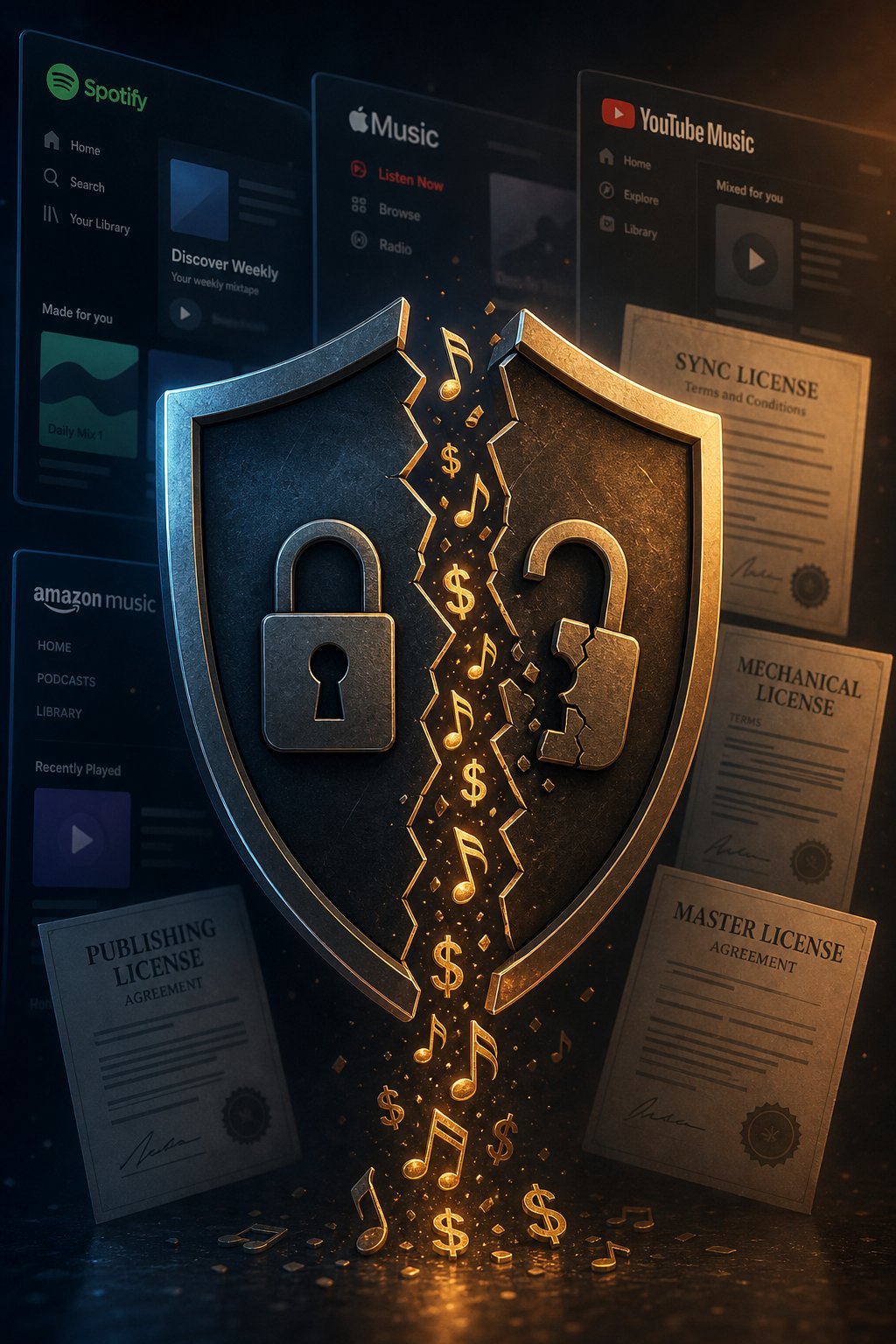
The consequences are more concrete than most creators realize. Copyright isn't just a legal formality. It's the mechanism that powers sync fees, streaming royalties, Content ID claims, and exclusive licensing agreements. Remove it, and the entire monetization infrastructure weakens or collapses entirely.
What Happens to Revenue When Copyright Is Uncertain
Picture this: you've placed an AI-generated track in a brand video through a sync licensing deal. The client paid for exclusivity — they don't want competitors using the same music. But if the track has no copyright protection, that exclusivity agreement has no legal teeth. Anyone can copy the track, use it freely, and you have no recourse to stop them. The client discovers this, disputes the contract, and your reputation as a music creator without copyright restrictions takes a hit you didn't see coming.
Here's how copyright uncertainty cascades through specific revenue streams:
Sync licensing. Music supervisors for film, TV, and advertising rely on clear copyright ownership to structure licensing deals. If you can't demonstrate ownership, most supervisors won't touch your track. The risk of a challenge — or the inability to guarantee exclusivity — makes uncopyrightable music a liability rather than an asset.
Streaming royalties. Platforms like Spotify and Apple Music distribute royalties to rights holders. Without a valid copyright claim, your ability to collect mechanical and performance royalties through PROs (performing rights organizations) becomes questionable. Deezer reports receiving over 30,000 fully AI-generated tracks daily, and platforms are actively developing policies to limit or demonetize content without clear human authorship.
Content ID and enforcement. YouTube's Content ID system allows rights holders to claim revenue on videos using their music. But Content ID claims depend on underlying copyright ownership. If your track is uncopyrightable, you can't legitimately register it in Content ID — and worse, someone else could register it against you. Since the track is in the public domain, a bad actor could claim it as theirs, direct all ad revenue to themselves, and leave you fighting automated systems with no legal standing to push back.
DMCA takedowns. The Digital Millennium Copyright Act gives copyright holders the power to request removal of infringing content. No copyright means no standing to file a takedown. If someone copies your AI-generated track note for note and uploads it as their own, you're legally powerless to stop them under copyright law.
Exclusivity agreements. Any deal built on exclusive rights — whether with a label, a sync agency, or a brand partner — depends on you actually holding those rights. An exclusivity promise without underlying copyright is essentially unenforceable against third parties. As Baker Donelson's legal analysis notes, "a third party who copies AI-generated output is not bound by the user's contractual ownership claim" because private agreements only bind the contracting parties.
Copyright uncertainty does not mean you have zero options. It means your primary legal protection has a gap, and you need to fill that gap with practical strategies that don't depend on copyright alone.
Strategies for Protecting Your AI Music Projects
Knowing the risks is only useful if you can act on them. The good news: creators have multiple paths forward, ranging from ensuring their work qualifies for copyright in the first place to alternative protection mechanisms that work regardless of copyright status. Some strategies are stronger than others. Here they are, ranked by effectiveness:
- Ensure sufficient human creative input to qualify for copyright. This is the strongest protection available. If you write original melodies, substantially rewrite AI-drafted lyrics, arrange AI-generated elements with deliberate creative judgment, and document your process, you're building a copyrightable work. The AI portions remain unprotected, but your contributions — the parts that make the song distinctively yours — receive full legal protection. This approach works in every jurisdiction and gives you access to the full enforcement toolkit: DMCA, Content ID, sync licensing, statutory damages.
- Choose platforms with clear commercial licensing regardless of copyright status. Not every project needs a copyright registration. If you need background music for a YouTube video, a podcast intro, or social content, the practical question isn't "do I own the copyright?" but "can I use this commercially without getting claimed?" Tools like MakeBestMusic's Free Music Generator offer a pragmatic path here — you get royalty-free music with clear commercial licensing for videos, podcasts, games, and social content, eliminating the legal ambiguity entirely. You won't own the copyright to the output, but you won't need to. The license itself is your protection.
- Use contract law and terms of service as your enforcement layer. When copyright isn't available, private agreements still bind the parties who sign them. Non-disclosure agreements, licensing contracts with penalty clauses, and platform terms that restrict unauthorized use all create enforceable obligations — just not against the entire world. If you're licensing AI music to specific clients, well-drafted contracts can provide meaningful protection within those relationships even without underlying copyright.
- Rely on trade secret protections for proprietary processes. If your competitive advantage lies in how you create AI music — specific prompt engineering techniques, custom training workflows, or proprietary post-processing chains — trade secret law may protect the process even when it can't protect the output. This requires keeping your methods genuinely confidential and documenting reasonable efforts to maintain secrecy. It won't stop someone from independently creating similar music, but it prevents misappropriation of your specific methodology.
- Leverage first-mover advantage and brand recognition. In a world where AI-generated music floods every platform, your reputation, audience, and distribution network become moats that copyright can't replicate anyway. Building a recognizable brand around your music — whether through consistent style, audience engagement, or strategic placement — creates practical protection through market position rather than legal exclusivity.
- Register human-authored elements and disclaim the rest. Even in heavily AI-assisted works, partial copyright is better than no copyright. Register the elements you authored — the lyrics, the melody, the arrangement structure — and disclaim AI-generated components. You won't have a claim over the full track, but you'll have enforceable rights over the pieces that carry the most creative and commercial value.
Each strategy has its place depending on your use case. A music AI creator without copyright restrictions who produces ambient backing tracks for content needs different protections than a songwriter using AI to assist with composition on a commercially released album. The songwriter should pursue full copyright registration with documented human authorship. The content creator might be better served by royalty-free tools that provide clear licensing without the overhead of registration and documentation.
For many creators, the most practical move is sidestepping the problem entirely. If you need music for commercial projects and the copyright question creates more friction than value, platforms built around royalty-free licensing — like MakeBestMusic's Free Music Generator — let you focus on your actual creative work rather than navigating legal uncertainty. You get usable music with commercial rights. No registration required. No ownership disputes. No Content ID claims appearing at 2 AM.
That doesn't mean copyright doesn't matter. It absolutely does for anyone building a catalog of original music, pursuing sync placements, or licensing tracks for revenue. But recognizing when copyright protection is worth pursuing versus when a clean license solves your actual problem is part of working strategically as a creator in an AI-altered landscape.
The legal framework will continue evolving. Courts are still hearing cases. The U.S. Copyright Office is refining its guidance. The UK government just scrapped plans that would have allowed unlicensed AI training on copyrighted music. Legislation at every level is in motion. The creators who thrive through this transition won't be the ones who ignored the question or panicked about it — they'll be the ones who understood where the line falls today, documented their creative contributions, and chose the right protection strategy for each project they shipped.
