


The Growing Challenge of Spotting AI-Generated Music
Imagine you hear a track on your Discover Weekly playlist. The vocals feel polished, the production sounds tight, and the melody sticks in your head. But something nags at you. The phrasing feels a little too perfect. The lyrics rhyme cleanly yet say nothing specific. You wonder: is this song AI?
A Deezer-Ipsos survey of 9,000 participants across eight countries found that 97% of listeners cannot distinguish between AI-generated and human-composed songs, and 71% expressed surprise at their own inability to tell the difference.
That statistic, reported by Reuters, makes one thing clear: your ears alone are not enough. But with the right framework, you can learn how to tell if music is AI generated and move from vague suspicion to confident assessment.
Why Detecting AI Music Has Become Urgent
This is not just an academic curiosity. AI-generated music submissions to streaming platforms have exploded. Deezer now receives over 50,000 AI tracks daily, roughly a third of its total uploads. Much of this content is tied to fraudulent streaming schemes that dilute royalty pools for human artists. When an AI song detector or human ear fails to catch these tracks, real musicians lose income.
The stakes extend beyond royalties. Copyright disputes arise when AI models trained on existing catalogs produce eerily similar outputs. Playlist curation loses integrity when synthetic tracks slip into editorial selections unchecked. Music competitions face fairness questions when entries may have been generated from a text prompt in seconds. And as a listener, you deserve to make informed choices about what you support with your streams and attention.
The case of The Velvet Sundown brought this into sharp focus: an AI band accumulated over 1.4 million monthly Spotify listeners before its synthetic origins were confirmed, proving how easily AI music passes undetected at scale.
What This Guide Will Help You Identify
This guide walks you through a complete detection workflow, whether you want to check music to see if its ai generated or not for professional reasons or personal curiosity. You will learn:
- Ear-based detection techniques that train you to hear what most listeners miss
- Platform-specific sonic fingerprints left by tools like Suno and Udio
- A structured listening method you can apply to any track in minutes
- AI music detector tools and audio analysis software that supplement your ears
- Contextual verification steps that go beyond the audio itself
No single method is foolproof. But combining critical listening with the right tools and contextual checks dramatically improves your accuracy. The journey from "this sounds a little off" to a well-supported conclusion starts with understanding what these generators actually produce and why their output carries specific, detectable patterns.
What AI Music Actually Sounds Like to Trained Ears
Those detectable patterns mentioned above are not random glitches. They are direct consequences of how generative models build audio from scratch. AI music systems train on millions of tracks, learning statistical relationships between sounds, then predict what comes next one tiny audio fragment at a time. That prediction process is powerful, but it leaves fingerprints. Once you understand why they appear, you will know how to spot ai music far more reliably than someone listening casually.
Common Audio Artifacts in AI-Generated Tracks
Think of these as the recurring tells that show up across AI-generated outputs regardless of genre or platform. A peer-reviewed analysis of over 12,400 tracks published in the Journal of the Audio Engineering Society identified several statistically significant anomalies tied to AI generation. Here are the sonic characteristics you should train your ears to notice:
- Plasticky or overly smooth vocals: AI vocals often lack natural breath dynamics. Human singers breathe between phrases in patterns shaped by physical lung capacity. AI either skips breaths entirely or inserts them at mechanical, evenly spaced intervals. The result sounds polished but lifeless, like a voice wrapped in cellophane.
- Subtle warble or pitch drift on sustained notes: When a human holds a long note, vibrato amplitude decays smoothly as the diaphragm tires. AI vocals frequently maintain constant vibrato depth or cut it off abruptly, creating an unnatural wobble that does not follow any physical logic.
- Perfectly quantized drums without push-pull timing: Real drummers play slightly ahead or behind the beat, creating groove. AI percussion locks rigidly to a grid. The timing deviations that do appear tend to be uniformly random rather than following the natural 1/f noise patterns found in human performance.
- Abrupt or illogically seamless transitions: Sections that jump without musical motivation, or flow together so smoothly that no tension or release exists, both suggest statistical prediction rather than intentional arrangement.
- Lyrics that rhyme well but lack coherent narrative: Lines like "lost in the echo of a fading light" could fit any song about anything. AI lyrics default to abstract emotional language, avoid proper nouns, and prioritize phonetic patterns over meaning.
- Blurry consonants: Hard sounds like "s," "t," and "p" often come out mushy or over-processed. Vowels sound clear while consonants smear together, a subtle but consistent giveaway.
How Generation Processes Create Audible Tells
Why do these artifacts exist at all? It comes down to how these systems work under the hood. AI music generators predict audio statistically, choosing the most probable next sound based on patterns in their training data. They do not understand breath control, finger fatigue, or the emotional arc of a song. They approximate those things.
Vocals sound plasticky because the model averages thousands of vocal performances into a smoothed-out composite. Drums land perfectly on the grid because the system has no concept of "leaning into" a downbeat. Transitions feel arbitrary because the model generates music sequentially without a long-range compositional plan. It knows what typically follows a chorus statistically, but it does not feel the need to build toward a climax or resolve harmonic tension.
Even the lyrical emptiness traces back to generation mechanics. Language models optimize for word sequences that are statistically plausible, not narratively meaningful. Rhymes emerge easily because phonetic patterns are mathematically predictable. Concrete storytelling is harder because it requires sustained context that generation models frequently lose across verses.
What Timbre Reveals About a Track's Origin
To define timbre in music simply: it is the tonal color or texture that distinguishes one sound source from another, even when pitch and volume are identical. A piano and a guitar playing the same note sound different because of timbre. This quality turns out to be one of the most revealing indicators when you are evaluating a track's origin.
AI-generated instruments often exhibit what researchers call "static timbral density." Real performances shift subtly in tonal color from note to note due to physical variables like pick angle, bow pressure, or lip tension. AI tends to produce a uniform timbral envelope, making instruments sound consistent to the point of sterility. The spatial characteristics also flatten out. Real recordings carry subtle room reflections that give sound depth, while AI output tends to exist in an acoustic vacuum where everything sits at the same distance from the listener.
Professional song analyzer tools quantify these differences using measurements called mel-frequency cepstral coefficients, which capture the spectral shape of audio in a way that mirrors human hearing. When researchers feed these coefficients into detection models, even simple classifiers can distinguish AI from human recordings with high accuracy because the timbral fingerprint of synthesized audio differs measurably from sound that passed through a physical space and a human body.
An ai voice detector leverages similar principles, measuring whether vocal timbre shifts naturally across a performance or remains suspiciously consistent. The absence of micro-variation in harmonic content, particularly the truncation of higher-order harmonics in bass instruments and the smoothing of transient attacks in percussion, creates a spectral profile that trained ears and mel-frequency cepstral coefficients alike can flag as synthetic.
These sonic fingerprints are not uniform across all AI platforms, though. Each generator processes audio differently, leaving its own characteristic trace in the output. Recognizing which platform produced a track can sharpen your detection considerably.
Platform-Specific Tells from Suno, Udio, and Beyond
Each AI music generator uses different architectures, training data, and audio synthesis pipelines. The practical consequence? They each leave a distinct sonic signature, almost like a watermark baked into the audio itself. If you can match what you hear to a specific platform's known tendencies, your suspicion moves from "this might be AI" to "this was likely made with X tool."
Suno's Signature Sound and Vocal Patterns
Suno is built for speed. It generates complete songs with vocals, lyrics, and full arrangements from a single text prompt in under a minute. That velocity comes with tradeoffs you can learn to hear. Suno tracks tend toward polished pop structures with tight verse-chorus-verse formats, and its vocal processing carries recognizable traits:
- Vocal smoothness that borders on synthetic: Suno's voices sound expressive at first listen, but under scrutiny they lack the micro-imperfections of a real singer. Breath placement feels formulaic, and transitions between syllables are unnaturally fluid.
- Aggressive vocal styles expose the model: According to audio engineers on the reddit suno community, rock and hip-hop vocals reveal a "robotic edge" where attack consonants sound slightly sharp and harmonies introduce uncanny vowel distortions.
- Genre bleed: Suno occasionally mashes stylistic elements together. You might hear EDM production choices leak into a folk song, or pop chord progressions underpinning a track that was prompted as jazz. This genre bleed is a reliable tell because human producers rarely make those specific cross-genre mistakes.
- Lyric repetition and abstraction: Suno's AI-written lyrics default to emotional generalities. Lines recycle thematic language across verses without building a narrative arc.
The reddit suno ai community has documented these patterns extensively, with users posting side-by-side comparisons of prompted outputs that show how Suno defaults to specific vocal cadences regardless of the genre requested.
Udio's Instrumentation and Mixing Tendencies
Where Suno prioritizes fast full-song delivery, Udio leans into audio fidelity and deeper customization. Comparing udio vs suno reveals genuinely different sonic fingerprints. Udio tracks tend to sound cleaner and more spatially detailed, with better instrument separation in the mix. But they carry their own tells:
- Overly polished mixes: Udio's outputs often sound like a finished master rather than a raw recording. Every frequency band sits perfectly in place, which paradoxically becomes suspicious because even professional human mixes retain small imbalances that give them character.
- Vocal clarity without room tone: Udio voices tend to sound "dry" and close-miked in a way that lacks the subtle room reflections present in real studio recordings. The vocal sits on top of the mix rather than inside it.
- Structural predictability: While Udio handles section editing and remixing better than Suno, its default generations still follow predictable structural templates. Bridges tend to arrive at the same relative timestamp, and outros fade rather than resolve musically.
One nuance worth noting: the udio ai music generator supported audio formats for direct use include high-quality WAV exports and multitrack stems, which means Udio tracks encountered in the wild may have been further processed. This additional post-production can mask some platform-specific tells but rarely eliminates them entirely.
Other Platforms and Their Distinct Audio Fingerprints
Suno and Udio dominate consumer-facing generation, but other platforms leave their own traces. Stable Audio uses latent diffusion models that produce exceptionally detailed textures but introduce characteristic high-frequency rolloff, a subtle dulling above 16kHz that results from operating in compressed latent space. MusicLM, Google's hierarchical transformer system, generates coherent long-form compositions but struggles with timbral realism in percussive instruments, producing drum sounds with softened attack transients. MusicGen, Meta's codec-based model, introduces quantization banding from its EnCodec compression, creating a subtle "stepped" quality in sustained tones that trained ears can catch.
Community forums dedicated to aimusic reddit discussions have become valuable repositories for these observations. Users regularly share detection findings, compare outputs across platforms, and document new tells as models update. These crowd-sourced insights often surface patterns weeks before formal research confirms them.
| Platform | Vocal Quality | Instrumental Texture | Song Structure | Known Weaknesses |
|---|---|---|---|---|
| Suno | Smooth but plasticky; struggles with aggressive styles | Full-band arrangements, occasional genre bleed | Tight pop format, predictable verse-chorus | Consonant blurring, repetitive lyrics, uncanny harmonies |
| Udio | Cleaner and more expressive; lacks room tone | Well-separated mix, polished to a fault | More flexible sections but formulaic bridges | Overly perfect mastering, sterile spatial imaging |
| Stable Audio | Limited vocal capability | Rich textures with high-frequency rolloff | Strong short-form; coherence drops in longer pieces | Dulled highs, latent diffusion smoothing |
| MusicLM | Passable but flat expression | Coherent arrangements, soft transients | Good long-range structure | Weak percussion attacks, timbral uniformity |
| MusicGen | Basic vocal rendering | Codec compression artifacts in sustained tones | Moderate coherence at shorter lengths | Quantization banding, bandwidth ceiling |
Knowing these platform-specific patterns gives you a second layer of analysis. When a track exhibits multiple tells consistent with a single platform, your confidence rises. But platform recognition is just one piece of the puzzle. A structured listening approach that you can apply systematically to any suspicious track makes the difference between casual guessing and reliable detection.

A Step-by-Step Listening Method for Detection
Platform recognition helps, but you will not always know where a track came from. What you need is a repeatable process you can apply to any song, anywhere, without prior context. The method below gives you exactly that: a structured way to detect ai music using nothing but focused attention and a decent pair of headphones.
The Three-Pass Listening Method
Trying to catch everything in a single listen is how most people fail. Your brain naturally fills in gaps and smooths over inconsistencies when you are passively enjoying music. Breaking detection into three deliberate passes forces you to listen differently each time, targeting specific layers of the audio.
- First pass: emotional authenticity and overall impression. Play the track without analyzing anything technical. Ask yourself: does this song feel like it has something to say? Does the emotional arc build and resolve naturally, or does it maintain a flat emotional intensity throughout? Pay attention to whether the performance feels reactive, like a human responding to the music around them, or static, like a voice layered on top of an arrangement it has no relationship with. Research into AI vocal performance confirms that emotional micro-expressions, subtle dynamic changes tied to lyrical meaning, are among the hardest qualities for AI to replicate. If the delivery feels technically competent but emotionally inert, flag it and move to pass two.
- Second pass: vocal characteristics and breath patterns. This time, ignore the instrumental entirely. Focus exclusively on the voice. Listen for breath sounds between phrases. Are they present? Do they vary in length and intensity based on the upcoming phrase, or do they feel inserted at mechanical intervals? Notice whether consonants land cleanly or blur together, particularly hard sounds like "t," "p," and "k." Check if the voice ever gets tired: real singers experience subtle pitch drift, deeper breaths, and increased lip noise as a performance progresses. A voice that sounds identical in the final chorus as it did in the first verse is unusual.
- Third pass: instrumental isolation and spatial behavior. Shift your attention entirely to the instruments. Try to mentally isolate individual layers: drums, bass, keyboards, guitar. Listen for whether each instrument exists in a believable acoustic space or floats in a vacuum. Move your head slightly if you are on speakers. Real recordings shift spatially with your position. AI outputs often remain static regardless of your listening angle. Notice whether drum hits carry natural timbral variation from stroke to stroke, or whether each snare hit sounds like an identical copy.
This three-pass approach works because it prevents cognitive overload. Each pass gives your ears a single job, making subtle artifacts far easier to catch than if you were trying to evaluate everything simultaneously.
Vocal Authenticity Markers to Listen For
The voice is where AI generation reveals itself most consistently. Knowing how to tell if a voice is ai generated comes down to identifying what is missing rather than what is present. Human vocals carry involuntary physical markers that no singer can eliminate, and that AI systems struggle to convincingly reproduce:
- Micro-imperfections in pitch: Real singers drift 5 to 30 cents around target notes constantly. AI vocals either hit pitches with mechanical precision or introduce random drift that lacks the self-correcting quality of a trained human voice.
- Inconsistent vibrato: A human singer's vibrato changes with emotion, fatigue, and breath support. It might widen on a climactic note and nearly disappear on a quiet phrase. AI vibrato tends to maintain consistent speed and depth regardless of musical context.
- Room tone variation: Real voices interact with their recording environment. Subtle reflections shift as the singer moves relative to the microphone. AI vocals exist in a fixed spatial position with no sense of physical movement.
- Consonant articulation: Plosives like "p" and "t" naturally vary based on head position and mouth shape. Identical-sounding consonants repeated across a performance signal synthesis or heavy editing.
- Fatigue signatures: Listen to the last third of a song. Does the voice sound slightly different from the opening? Real performances accumulate tiny changes. The absence of any progression across a three-minute vocal take is a meaningful red flag.
When you combine these markers, a pattern emerges quickly. A track might pass one check but rarely passes all five. Learning how to tell if a song is ai generated is ultimately about stacking observations until the weight of evidence tips clearly in one direction.
Separating Heavy Processing from AI Generation
Here is where things get tricky. Modern pop production uses Auto-Tune, pitch correction, vocal alignment, and extreme compression as standard tools. A heavily processed human vocal can sound almost as perfect as an AI-generated one. So how do you tell the difference?
The key distinction lies in what sits beneath the processing. A human vocal run through aggressive Auto-Tune still carries room tone, still has breath noise that responds to physical effort, and still shows fatigue across the performance. The processing changes the pitch behavior but does not erase the physical evidence of a body producing sound. AI voice transformation, by contrast, reconstructs audio from scratch. It analyzes and regenerates rather than merely correcting. The result lacks the acoustic foundation that processing alone cannot remove from a real recording.
A practical test: listen to the quiet moments. Between phrases, in the milliseconds before a word starts, what do you hear? A processed human vocal still has room tone, tiny mouth sounds, and the ambient texture of a physical space. An AI vocal in those same gaps often drops to near-digital silence or presents a suspiciously uniform noise floor. As Dr. Iain McGregor of Edinburgh Napier University notes, natural silence still carries room tone, and if silence feels like a sudden vacuum, something has been removed or was never physically captured.
Another useful heuristic: Auto-Tune corrects pitch but preserves timing imperfections. A human singer run through aggressive pitch correction will still rush or drag relative to the beat. AI generation tends to produce both pitch and timing with mechanical consistency. If the pitch sounds corrected but the rhythm feels human, you are likely hearing a processed real performance. If both pitch and timing feel locked, the probability of AI involvement rises significantly.
This distinction matters because how to identify ai music responsibly means avoiding false positives. Accusing a human artist of using AI because their vocals sound polished does real harm. The listening method above helps you separate genuine production choices from synthetic generation by focusing on the physical markers that no amount of processing can fabricate or fully erase.
Ears are powerful, but they have limits. Even trained listeners working through this method will encounter edge cases where confidence stalls around 60 or 70 percent. That is where technology steps in. Detection tools and audio analysis software can quantify what your ears suspect, turning subjective impressions into measurable evidence.
Detection Tools and Audio Analysis Software
Your ears got you to a suspicion. Now you need data to back it up. The good news: a growing ecosystem of ai music detectors exists to help you move from gut feeling to quantifiable evidence. These tools range from simple upload-and-scan platforms to professional-grade spectral analyzers, and they work by catching patterns that human hearing simply cannot resolve at the millisecond or frequency level where AI generation leaves its deepest marks.
Dedicated AI Music Detection Platforms
The most direct approach is using a purpose-built ai audio detector. These platforms accept an audio file or link, run it through trained neural networks, and return a probability score indicating whether the track was AI-generated.
IRCAM Amplify's AI music detector was the first commercially available tool when it launched in May 2024. Built by the commercial wing of the Institute for Research and Coordination in Acoustics/Music in France, the ircam amplify ai music detector works by analyzing spectral patterns and statistical anomalies in the audio signal. It identifies the characteristic fingerprints left by neural audio codecs, the compression systems that nearly all major generators use to convert their internal representations into playable audio. IRCAM Amplify continuously updates its model to keep pace with new generator versions, including Suno v4.
French streaming service Deezer deployed its own detection model in early 2025. Their system flags over 10% of uploaded tracks as AI-generated. Deezer's researcher Darius Afchar has reported that their classifier achieves over 99% accuracy on known generators, though he cautions it can still be tricked by disguised outputs, similar to how pitch-shifted copyrighted music evades YouTube's content ID.
ACRCloud's AI Music Detector takes a slightly different approach. Beyond simply identifying whether a track is AI-generated, it attempts to identify the specific generative platform used, flagging whether a track came from Suno, Udio, or another tool. It also analyzes vocals and accompaniment separately, which increases detection accuracy by isolating the layers where artifacts concentrate.
For researchers and developers, ArtifactNet represents a newer forensic approach. This lightweight framework targets the physical residuals that neural audio codecs imprint on generated audio. By extracting source-separation residuals and decomposing them into forensic features, ArtifactNet achieves F1 scores above 0.98 across 22 different generators using only 4 million parameters, far fewer than competing approaches. Its key insight: AI generators share a common neural-codec bottleneck that leaves measurable traces in the audio, regardless of which platform produced the track.
If you are looking for an ai music detector online free option to run a quick check, several browser-based tools now offer basic scanning at no cost. Their accuracy varies, and most work best on tracks from well-known generators. For serious verification, combining a free ai song checker with the listening techniques from the previous section produces more reliable results than either method alone.
Why Stem Separation Reveals Hidden Artifacts
Here is a detection technique that often gets overlooked: pulling a track apart into its component stems. When you listen to a full mix, mastering compression, reverb, and layered instrumentation can mask the very artifacts you are trying to hear. Separating vocals from drums from bass from instruments strips away that protective blanket and exposes each layer to individual scrutiny.
Why does this work so well? Consider what happens in a full mix. A slightly plasticky vocal gets buried under rich instrumental textures. Quantization banding in a sustained synth note disappears beneath the drum bus. AI artifacts that would be obvious in isolation become inaudible when competing with other frequency content for your attention. Separate the track, and those artifacts have nowhere to hide.
Research supports this approach. The ArtifactNet framework is built entirely on this principle: it uses source separation as a forensic amplifier, feeding audio through a separation model and then analyzing the residuals, the leftover signal that the model cannot attribute to any stem. AI-generated tracks produce residuals with measurably different characteristics from human recordings. Specifically, AI residuals cluster around an effective bandwidth of 291 Hz versus 1,996 Hz for human music, a nearly sevenfold difference that becomes visible only after separation.
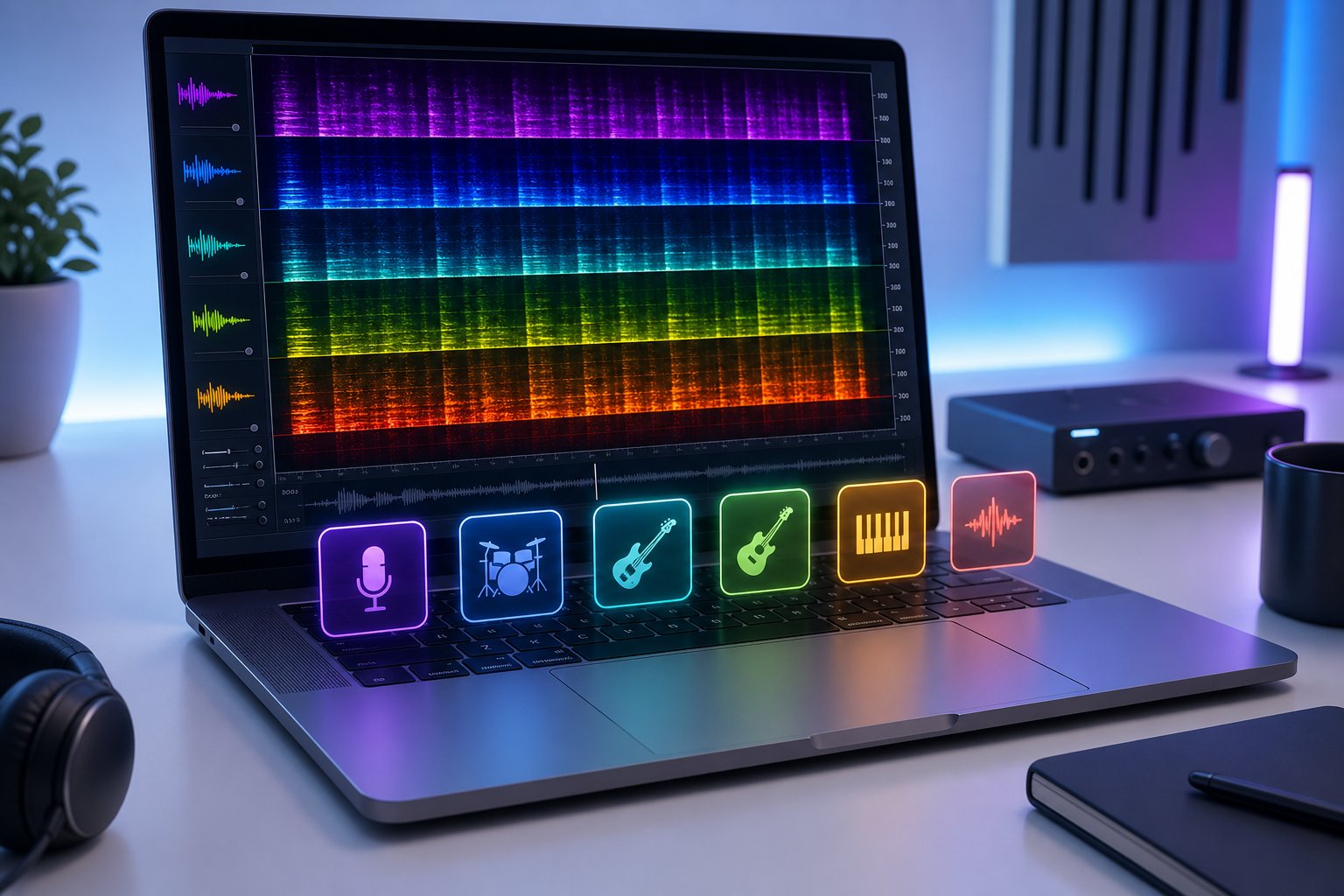
MakeBestMusic's Audio Separator lets you perform this isolation step without any technical expertise. Upload a track, and the tool splits it into individual stems: vocals, drums, bass, and other instruments. Once separated, you can apply your three-pass listening method to each layer independently. That vocal track that sounded passable in the full mix? In isolation, the absence of room tone, mechanical breath placement, and static timbral density become immediately apparent. The drum stem reveals whether each hit carries natural variation or sounds cloned from a single sample.
This stem-by-stem inspection also helps when you want to use a dedicated ai music checker on individual layers. Detection algorithms perform better on clean, isolated signals because the patterns they search for are not competing with other audio content. Running separated vocals through a voice authenticity tool, for example, eliminates instrumental frequencies that could confuse the classifier.
Free and Accessible Detection Tools Worth Trying
You do not need a research lab budget to start analyzing tracks. The landscape includes options across every price point and skill level. Some tools require audio engineering knowledge, while others are as simple as dragging a file into a browser window. Here is how they compare:
| Method | Tool | What It Reveals | Skill Level | Cost |
|---|---|---|---|---|
| Stem Separation | MakeBestMusic Audio Separator | Isolates vocals, drums, bass, instruments for individual inspection; exposes masked artifacts | Beginner | Free tier available |
| Demucs (Meta) | Research-grade separation into 4 stems; reveals residual energy patterns | Intermediate | Free (open source) | |
| Dedicated Detectors | IRCAM Amplify AI Detector | Probability score of AI generation; identifies codec fingerprints | Beginner | Commercial (API pricing) |
| ACRCloud AI Music Detector | AI probability score plus platform identification; vocal/accompaniment split analysis | Beginner | Free with Derivative Works Detection | |
| Deezer Detection Model | AI flagging for uploaded content; internal use by platform | N/A (platform-side) | Not publicly available | |
| Spectral Analyzers | Spek / iZotope RX | Visual spectrogram revealing frequency cutoffs, banding, and unnaturally clean noise floors | Advanced | Free (Spek) / $$$$ (RX) |
| Sonic Visualiser | Detailed time-frequency analysis; plugin-based feature extraction | Advanced | Free (open source) |
Spectral analyzers deserve a brief explanation. Tools like Spek generate visual spectrograms, frequency-over-time plots, that reveal things your ears cannot detect. AI-generated tracks often show a hard frequency ceiling where energy drops abruptly to zero, typically around 16-20 kHz depending on the generator's codec. Human recordings in lossless formats show a gradual, natural rolloff. You might also spot quantization banding, horizontal striations in sustained tones caused by the discrete codebook entries in AI audio codecs. These visual patterns function as a free ai music analyzer that requires only basic spectrogram reading skills.
For anyone wondering whether a reliable a.i. detector for music free of charge actually exists: yes, but with caveats. Free tools tend to lag behind the latest generator versions and may not handle edge cases like AI-human hybrid tracks. Using multiple free tools in combination, cross-referencing a stem separation check with a spectral analysis and a dedicated detector scan, compensates for any single tool's blind spots.
The combination of stem separation, dedicated detection platforms, and spectral visualization gives you a layered verification system. Each method catches different aspects of AI generation, and together they cover far more ground than ears alone. But even the best audio analysis has limits. Some of the strongest signals that a track is AI-generated have nothing to do with the audio at all. They live in the metadata, the release patterns, and the digital paper trail surrounding the artist.
Contextual Verification Beyond Audio Analysis
That digital paper trail often tells a clearer story than any spectrogram. Audio artifacts can be masked by post-processing, but the context surrounding a release is much harder to fake. An artist profile, a release schedule, a social media history: these elements either add up to a real creative life or they do not. Learning to read these signals turns you into something closer to an investigator than a listener, and dramatically improves your ability to confirm or dismiss a suspicion before you even load an online song identifier.
Artist History and Social Media Verification
Start with the artist themselves. A real musician leaves a trail that stretches back months or years: early demos, collaborations, live performance clips, studio photos, songwriting credits registered with performing rights organizations. An AI-generated persona, by contrast, tends to appear fully formed with no creative history behind it.
Consider the case of Sienna Rose, a "singer" with over 720,000 monthly Spotify listeners. She posts TikToks thanking fans and discussing writer's block. But her face shifts between videos, her hair and eye color change, and no verified human has ever been photographed with her. Everything from the name to the music was AI-generated, with a team working to convince the public she was real.
When you run an artist scanner on a suspicious profile, look for these signals:
- Linked social accounts with history: Does the Instagram or TikTok predate the music career? Are there candid posts from before the first release, or did the entire online presence spring into existence alongside the debut single?
- Collaboration credits: Real artists work with producers, session musicians, and engineers who have their own verifiable profiles. AI-generated catalogs rarely credit anyone beyond a vague "executive producer."
- Live performance footage: Concert clips, open mic videos, or even casual covers on social media. A real performer almost always has at least some unpolished live content. Its absence across an entire career is notable.
- Engagement authenticity: Comments on posts that reference specific lyrics, inside jokes from shows, or personal interactions suggest a real fan community. Generic praise like "love this vibe" repeated across posts can indicate bot-driven engagement.
- Verified by Spotify badge: Spotify introduced its Verified by Spotify program specifically to signal artist authenticity. Profiles that "primarily represent AI-generated or AI-persona artists are not eligible for verification." The absence of this badge on a popular artist is not proof of AI, but its presence is a meaningful trust signal.
Release Patterns That Signal AI Generation
Release frequency is one of the strongest contextual red flags. Sienna Rose released 45 tracks in a single month, an output that would be physically impossible for a solo artist writing, recording, and mixing original material. Even prolific human artists operating at peak productivity rarely exceed one polished track per week.
What should trigger scrutiny? An artist dropping dozens of songs across multiple genres within weeks. A catalog that spans country, EDM, lo-fi hip-hop, and classical piano without any clear artistic identity connecting them. Albums appearing faster than any reasonable mixing and mastering timeline would allow. These patterns are consistent with someone feeding prompts into a generator and uploading the results in bulk.
A useful playlist checker habit: when you encounter a new artist through algorithmic recommendations, glance at their discography. Count the releases and note the time span. If 30 tracks appeared in the last two months across five unrelated genres, you are likely looking at an AI catalog rather than a human career. The Velvet Sundown, another AI project, spent almost a year pretending to be a real band before acknowledging its AI origins, only after mounting public accusations forced transparency.
Streaming platforms are catching on. Spotify's trust framework now flags "burst-upload behavior," where artist accounts uploading 50 or more tracks in a single batch trigger account-level scrutiny. Distributors like DistroKid report rejecting tens of thousands of suspected AI-spam uploads per month based partly on these volume patterns.
Metadata and Distribution Red Flags
Metadata is the invisible backbone of every released track, and AI-generated music often carries telltale signatures in this data. You will not always have access to full metadata, but when you can inspect it, the patterns are revealing.
Look for these indicators:
- Unregistered songwriter credits: Legitimate releases list writers registered with performing rights organizations like ASCAP, BMI, or PRS. AI-generated tracks often list credits that do not appear in any PRO database.
- Generic or templated titles: Titles like "Midnight Reflections Vol. 3" or "Chill Beats for Focus" combined with bulk output suggest algorithmic naming rather than intentional artistry.
- Stock AI-generated artwork: Cover art with the telltale signs of image generators: warped text, inconsistent lighting, or anatomical oddities in depicted figures.
- ISRC patterns from bulk allocation: International Standard Recording Codes assigned in sequential batches across dozens of tracks released simultaneously can indicate automated distribution workflows.
- Distribution through platforms known for minimal vetting: Some distributors have historically had lighter screening processes, making them preferred channels for bulk AI uploads before tighter policies took effect.
If you are trying to identify song from mp3 files you have downloaded or received, metadata inspection tools like Mp3tag or MusicBrainz Picard can reveal this information. You can cross-reference songwriter names against PRO databases, check whether the distributor is reputable, and see if ISRC codes fall into suspicious sequential ranges. Even music recognition online services sometimes surface metadata discrepancies when a track's claimed origin does not match its acoustic fingerprint in existing databases.
These contextual checks are not about catching every AI track. They are about building a body of evidence. When audio artifacts align with suspicious release patterns, absent social proof, and metadata anomalies, the conclusion becomes far more defensible than any single signal alone. Used as an ai song finder methodology, this framework helps you systematically fingerprint every ai song to identify it through circumstantial evidence that generators cannot easily disguise.
Even with all these tools, though, detection is rarely a clean binary. The reality is messier: AI involvement in music exists on a spectrum, and knowing where a track sits on that spectrum matters more than a simple yes-or-no answer.

The AI-Human Spectrum and Why Detection Is Not Binary
That messiness is the central challenge for anyone trying to make a clean call. A track is rarely "100% AI" or "100% human" anymore. Modern music production blends tools, processes, and creative inputs in ways that defy a simple yes-or-no label. Understanding the spectrum of AI involvement helps you calibrate your expectations and choose the right detection approach for what you are actually hearing.
The Five Levels of AI Involvement in Music
Think of AI's role in a track as a sliding scale. The HAIM benchmark from Seoul National University formalizes this idea by breaking music production into distinct roles: composer, lyricist, vocalist, and audio engineer. AI can occupy any combination of these roles, producing a taxonomy far richer than "real or fake." For practical detection purposes, most tracks you encounter fall into one of five levels:
- Fully AI-generated (prompt to finished track): A user types a text prompt into Suno, Udio, or an ai songwriting app, and the system outputs a complete song with vocals, lyrics, arrangement, and mastering. Every creative decision was made by the model. This is the easiest category to detect because artifacts exist across all layers simultaneously.
- AI-assisted composition with human performance: A songwriter uses AI to brainstorm chord progressions, melodic ideas, or lyric fragments, then performs and records everything themselves. The final audio is entirely human-generated sound. An ai lyric detector might flag the writing patterns, but audio-based tools will find nothing synthetic because no AI touched the actual recording.
- AI-produced instrumental with human vocals: A singer records real vocals over an AI-generated backing track. The HAIM dataset calls this a "component hybrid," and it creates a split where vocal analysis comes back clean while instrumental layers carry generation artifacts. This category trips up detection tools that analyze the full mix as a single signal.
- Human composition with AI mastering or mixing: A band writes, performs, and records their own music, then runs the final mix through an AI mastering service like LANDR or iZotope's AI assistant. The creative content is entirely human, but the audio engineering layer carries AI processing signatures. Research from the HAIM benchmark shows that existing detectors struggle here: their MuQ-FST model correctly identified AI involvement in the engineer role with near-perfect accuracy while correctly attributing the composer, lyricist, and vocalist roles to humans.
- Fully human-made tracks that sound AI-generated: Heavy Auto-Tune, extreme vocal processing, quantized drums, and synthetic textures can make an entirely human production sound artificial. These are the false positives that damage real artists when listeners or algorithms incorrectly flag their work. Heavily processed pop, hyperpop, and electronic music fall into this category regularly.
This spectrum is not theoretical. Ai artists music projects and ai generated bands routinely blend these levels. A project might use AI for lyrics and arrangement but feature a real vocalist, or a human producer might splice AI-generated stems into an otherwise live recording. The combinations multiply as tools become more modular.
Why Binary Detection Is Becoming Obsolete
Most detection tools were built for a simpler world. They answer one question: "Is this AI?" But the HAIM research reveals how badly that framing fails on hybrid content. When evaluating tracks where AI handled composition but humans performed mastering, state-of-the-art binary detectors produced wildly inconsistent results. Some flagged these tracks as 100% AI. Others classified them as fully human. Neither answer was correct.
Community debates on Reddit reflect this confusion. Threads asking are ai detectors accurate reddit consistently surface cases where detection tools contradict each other on the same track. A song produced by a human singer over AI-generated instrumentation might score 30% AI on one platform and 85% on another, depending on whether the tool weights vocals or instrumentals more heavily in its analysis.
The HAIM study quantified this problem directly. They tested four leading open-source detectors across 13 categories of human-AI hybrid music. The results were stark: detectors trained on binary labels achieved near-perfect accuracy on purely human or purely AI tracks, but their performance degraded unpredictably on everything in between. Human mastering applied to AI tracks reduced detection rates by up to 48 percentage points for some systems. AI vocal covers placed over human instrumentals confused every detector tested.
Song analysis ai tools that rely purely on spectral patterns face an inherent limitation: they detect the artifacts of AI audio generation, not AI creative involvement. A track composed by AI but re-recorded by human musicians in a studio will pass every audio-based detector because the sound itself is authentically human. The AI contribution lives in the composition, not the waveform.
Which Detection Methods Stay Reliable Over Time
As generators improve with each version update, some detection strategies decay while others hold steady. Suno's progression from v2 to v5 demonstrates this clearly: early versions produced audible distortions that even casual listeners could catch. Current versions have eliminated most of those tells. Any detection method relying on version-specific artifacts has a short shelf life.
Methods that remain reliable tend to target fundamental properties of AI generation rather than surface-level glitches:
- Neural codec fingerprints: Nearly all major generators compress audio through neural codecs like EnCodec or SoundStream. These codecs leave statistical signatures in the frequency domain that persist across model updates because they are architectural rather than cosmetic. Ai music analysis tools built on this principle, like Deezer's Fourier-based detector, maintain accuracy even as generators evolve.
- Contextual verification: Release patterns, artist history, and metadata signals are immune to audio improvements. A generator can produce perfect-sounding audio, but it cannot fabricate years of social media history or live performance footage.
- Stem-level inspection: Isolating individual layers continues to expose artifacts that full-mix mastering conceals. Even as vocal quality improves, artifacts in bass frequencies and percussion transients tend to lag behind because generators optimize for perceptual quality in the vocal range first.
- Structural and lyrical analysis: Music analysis ai approaches that evaluate compositional coherence, narrative progression in lyrics, and long-range structural logic remain effective because these reflect the fundamental statistical-prediction limitation of current architectures. Generators predict locally convincing sequences but still struggle with the kind of deliberate, large-scale form that human composers build intentionally.
Methods that decay fastest are those targeting specific audible glitches: the "warble" on sustained notes, plasticky vocal textures, or quantized drum timing. Each generator update directly targets these perceptible flaws because they are what users complain about. Building your detection strategy around them alone guarantees obsolescence within months.
The practical takeaway? Layer your approach. Combine audio forensics that target deep architectural signatures with contextual checks and structural evaluation. No single method covers the full spectrum, but together they form a workflow that adapts as the technology evolves.
Putting It All Together as a Detection Workflow
Layering your approach is the principle. Now let's turn it into a workflow you can run on any track in under ten minutes. Every method covered in this guide, from ear-based listening to contextual investigation, becomes more powerful when combined into a single repeatable sequence. No individual ai detector music tool or listening technique gives you certainty on its own. Together, they build a case.
Your Complete AI Music Detection Workflow
When a track triggers your suspicion, work through these steps in order. Each one either confirms or weakens the AI hypothesis, and by the end you will have enough evidence to form a defensible judgment on how to tell if music is ai.
- First impression scan: Play the track once without analysis. Note whether the emotional delivery feels reactive or static, whether lyrics say something specific or drift through abstractions, and whether the overall production feels too uniform. Trust your instincts here. If nothing flags, the track likely is not worth further investigation.
- Focused vocal and instrumental passes: Apply the three-pass method. Listen once for vocal breath patterns, consonant clarity, and fatigue markers. Listen again isolating instruments for timbral variation, spatial depth, and timing imperfections. Document what you notice.
- Separate the stems: Upload the track to MakeBestMusic's Audio Separator to split it into vocals, drums, bass, and instruments. Listen to each layer independently. Artifacts masked in the full mix, like plasticky vocal timbre, cloned drum hits, or static bass tones, become immediately obvious once isolated. This step alone often moves you from 60% confidence to 90%.
- Run detection tools: Feed the full track and individual stems through an ai music identifier like IRCAM Amplify or ACRCloud. Compare scores across layers. If the vocal stem scores low for AI but the instrumental scores high, you may be looking at a hybrid track with real vocals over generated backing.
- Verify context: Check the artist's release history, social media presence, collaboration credits, and catalog volume. Cross-reference metadata for unregistered songwriter credits, sequential ISRC codes, or distribution through channels known for minimal vetting. A burst of 40 tracks across unrelated genres in a month tells a story no audio tool can.
- Form your judgment: Weigh the evidence across all steps. A track that flags on audio analysis, stem inspection, detection tools, and contextual checks is almost certainly AI-generated. A track that only triggers on one dimension, especially audio alone, deserves the benefit of the doubt. State your confidence level rather than making a binary claim.
This workflow functions as an ai song identifier process that scales from casual curiosity to professional verification. A playlist curator might stop at step two if nothing flags. A label vetting submissions for a competition would run all six steps before making a call. Adjust depth to match the stakes.
Developing Long-Term Listening Skills
Running this workflow once teaches you the process. Running it regularly trains your ears. Over time, you will internalize the patterns and catch AI tells faster, sometimes within the first few seconds of a track. Here is how to build that skill deliberately:
- Practice on known samples: Generate tracks on Suno and Udio, then apply the workflow to your own outputs. Knowing the ground truth sharpens your ability to hear what you are looking for.
- A/B test with human music: Compare AI outputs against human recordings in the same genre. The differences become more audible when heard back-to-back rather than in isolation.
- Follow community research: Forums and academic publications surface new tells as generators update. Detection is an ongoing practice, not a fixed skill set.
- Revisit old judgments: Tracks you flagged months ago may sound different with trained ears. Reviewing past assessments calibrates your confidence over time.
The ai music check you perform today will look different from the one you perform six months from now. Generators will improve. New tools will emerge. Some tells will vanish while others persist because they are tied to fundamental architectural constraints rather than surface-level bugs. The listeners who stay effective are those who keep updating their mental model alongside the technology.
Detection is not a destination. It is a practice. The goal is not perfect accuracy on every track but a reliable process that evolves as fast as the generators do. Trust your ears, verify with tools, confirm with context, and stay curious.
