

Step 1 - Know the Legal Rules Before You Earn a Dollar
Can you make money in AI music? Yes. People are doing it right now, across streaming platforms, stock libraries, and sync placements. But here is the part most guides gloss over: the creators who build lasting income understand the legal landscape before they upload a single track. The ones who skip this step? They get demonetized, banned, or worse.
Consider what happened to Michael Smith of North Carolina. The U.S. Department of Justice charged him with using AI to generate hundreds of thousands of songs, then deploying bots to stream them billions of times. He fraudulently collected over $10 million in royalties. The charges carry a maximum sentence of 20 years in prison. That is not a monetization strategy. That is wire fraud, money laundering, and the first criminal case of its kind involving AI-generated music streaming manipulation.
The line between legitimate income and criminal exploitation is clear when you know the rules. Let's walk through the three legal pillars every AI music creator needs to understand.
Who Actually Owns AI-Generated Music
Ownership is the first question you need to answer, and the honest answer is: it depends. The U.S. Copyright Office has ruled that purely AI-generated works lacking meaningful human authorship cannot receive copyright protection. Their Part 2 report on copyrightability, published January 2025, confirms this position. Tracks where a human contributes lyrics, melody, arrangement, or significant creative direction can receive partial copyright, but the AI-generated portions remain unprotected.
Other jurisdictions differ. The UK, EU, and China each approach AI authorship differently. If you plan to sell AI-generated music legally, you need to know which country's rules apply to your situation and how much human input qualifies your work for protection.
The practical takeaway? Purely prompt-to-output music with zero human creative contribution sits in a legal gray zone for ownership. Adding your own vocals, writing original lyrics, or arranging multiple AI stems into a new composition strengthens your ownership claim significantly.
Commercial Licensing Terms You Must Understand
Even if copyright protection is uncertain, you can still monetize AI music through the commercial licenses that AI tools grant you. Each platform handles this differently, and the details matter more than most creators realize.
- Suno - Pro ($10/mo) and Premier ($30/mo) plans grant commercial rights. Free tier explicitly restricts commercial use. Suno settled with Warner Music Group but remains in active litigation with Sony Music.
- Udio - Paid plans (Standard $10/mo, Pro $30/mo) permit commercial use. Udio settled with Universal Music Group in October 2025 and holds licensing agreements with Warner, Merlin, and Kobalt.
- AIVA - Standard plan (approximately $15/mo) allows monetization on social platforms like YouTube and TikTok. Pro plan (approximately $49/mo) grants full copyright ownership to the user.
- Stable Audio - Free tier is non-commercial only. Creator license and above allow commercial use, trained on a licensed dataset from AudioSparx.
- ElevenLabs Music - Free tier permits up to 7 songs per day. Pro plan ($9.99/mo) allows commercial use for most channels, though film, TV, and large studio games require an Enterprise plan.
Notice the pattern: free tiers almost universally block commercial rights. If you are generating tracks on a free plan and selling them, you are likely violating the tool's terms of service, regardless of what copyright law says about AI output.
The commercial right to sell AI music comes from the tool's license agreement, not from copyright ownership. Read the terms for your specific plan and pricing tier before you monetize anything.
Platform Policies That Can Kill Your Income
Distribution platforms and streaming services add another layer of rules. Spotify has removed millions of AI-generated tracks as part of its ongoing artificial streams enforcement. Apple Music now tags AI-made tracks with Transparency Labels and reports that over a third of new uploads are fully AI-generated, yet those tracks account for less than 0.5% of total listening time. Deezer says nearly half of all submissions to its platform are AI-generated.
What does this mean for you? Mass-uploading hundreds of AI tracks per week without meaningful human contribution is a fast path to account suspension. Platforms are investing heavily in detection systems, and the scrutiny is only increasing. Distributors like DistroKid and TuneCore still accept AI-generated music, but their policies evolve regularly and often require disclosure.
The difference between creators who earn sustainably and those who lose everything comes down to this: legitimate monetization means creating genuine value within the rules, not gaming systems with volume and automation. Understanding these AI music commercial license terms, ownership boundaries, and platform policies is the foundation everything else builds on.
With the legal ground covered, the next decision shapes your entire approach: whether to pursue volume-based income or quality-focused artistry.
Step 2 - Choose Your Monetization Path Based on Your Strengths
Knowing the rules keeps you safe. But knowing your direction is what actually generates income. The best way to monetize AI music for beginners and experienced creators alike starts with one strategic decision: are you building a catalog or crafting individual pieces?
Think of it like publishing versus filmmaking. A publisher releases dozens of books per year across genres, earning small amounts per title but building a compounding asset. A filmmaker pours months into a single project with higher per-unit value. Both make money. Neither is wrong. But choosing the wrong path for your skills and lifestyle leads to burnout or stalled income.
The Publisher Path vs. The Producer Path
The publisher mindset treats AI music as a volume game. You create large libraries of background music, ambient soundscapes, lo-fi beats, study playlists, and meditation tracks. Revenue comes from streaming royalties, YouTube ad income on 24/7 live streams, and stock music marketplace sales. Success here depends on consistency, metadata optimization, and understanding what listeners search for daily.
As Mubert's monetization guide puts it, publishers are not selling songs. They are building media properties powered by music. A single lo-fi channel with 200 tracks might earn modest revenue per track, but collectively the catalog works like a rental property generating monthly income with minimal ongoing effort.
The producer path is different. Here, you focus on fewer, higher-quality outputs: sync-ready cinematic tracks, brand audio identities, custom compositions for indie games, or polished singles with real vocals layered over AI foundations. Income per project is significantly higher, but so is the time investment and skill requirement. Producers sell uniqueness and sonic identity rather than sheer volume.
| Dimension | Publisher Path | Producer Path |
|---|---|---|
| Time Investment | 5-10 hours/week (batch creation) | 15-25 hours/week (per project) |
| Skill Required | Prompt engineering, metadata, basic editing | Music production, mixing, arrangement, client management |
| Income Ceiling | $500-$5,000/month (scales with catalog size) | $2,000-$20,000+/month (scales with reputation) |
| Risk Level | Low per track, spread across volume | Higher per project, dependent on client acquisition |
| Best-Fit Personality | Systematic, patient, enjoys repetition and optimization | Creative, detail-oriented, comfortable with client work |
Match Your Method to Your Skills and Time
Imagine you have no music background, ten hours a week, and you want a side hustle generating $300-$1,000 per month within six months. The publisher path is your starting point. You do not need to know music theory. You need to understand which genres people search for, how to write effective prompts, and how to tag and distribute tracks efficiently.
Have production experience? Maybe you already mix tracks, play an instrument, or write lyrics. The producer path lets you charge premium rates because you are adding human creative value that pure AI output cannot replicate. Sync licensing placements through platforms like Musicbed or APM Music pay $100 to $5,000+ per placement when production quality meets broadcast standards.
Here is a simple framework to find your tier:
- Beginner (no music background) - Start with volume-based approaches. Build lo-fi playlists, ambient channels, or stock library submissions. Focus on learning prompt craft and metadata. AI music side hustle income expectations at this level: $100-$500/month after 3-6 months of consistent output.
- Intermediate (some production skills) - Combine AI generation with your own mixing, mastering, or vocal contributions. Target stock libraries with higher acceptance standards like Artlist or Epidemic Sound. Expect $500-$3,000/month as your catalog grows past 50 well-optimized tracks.
- Advanced (production professional) - Use AI as a creative accelerator, not a replacement. Offer brand audio packages, sync-ready compositions, and custom scoring. How much money can you make with AI music at this level? Professionals report $5,000-$20,000+ monthly by combining AI speed with human artistry.
Setting Realistic Income Expectations by Tier
Most creators overestimate first-month earnings and underestimate year-two compounding. Licensing library data shows that artists typically earn $0-$500 in their first year, with income accelerating significantly once catalog size crosses 50 tracks across multiple platforms. The 80/20 rule applies hard here: roughly 5 tracks out of 50 will drive 80% of your placements.
Neither path delivers overnight results. The publisher vs producer AI music strategy you choose simply determines whether you are optimizing for many small revenue streams or fewer large payouts. Both require patience, but both compound over time if you stay consistent and adapt to platform changes.
Your chosen path also determines which AI tools make the most sense for your workflow, and not every tool fits every strategy equally well.
Step 3 - Pick the Right AI Music Tools for Your Goals
A publisher building ambient playlists needs a completely different toolset than a producer crafting sync-ready vocal tracks. The best AI music generator for commercial use is not a single answer. It depends on your monetization method, your budget, and whether you need vocals, instrumentals, or scalable background music.
Here is the problem most creators run into: they pick a tool based on a flashy demo, generate a few tracks on a free tier, upload them to a distributor, and then discover their license does not cover commercial use. That mistake can get tracks pulled, accounts flagged, or worse. So let's break down what each major tool actually offers when money is involved.
Comparing Top AI Music Tools by Monetization Fit
Each AI music platform has a sweet spot. Some excel at full vocal songs suitable for streaming distribution. Others specialize in ambient loops ideal for stock libraries. Matching your tool to your income strategy saves time and prevents licensing headaches down the road.
| Tool | Best For | Free Plan | Paid Plan Pricing | Commercial Rights | Ideal Monetization Method |
|---|---|---|---|---|---|
| MakeBestMusic Free Music Generator | Royalty-free music for content creators | Yes (commercial use included) | Free | Full commercial rights at no cost | YouTube videos, podcasts, social content, games |
| Suno | Full vocal songs and streaming releases | Yes (non-commercial) | Pro $10/mo, Premier $30/mo | Commercial on paid plans | Streaming distribution, singles, vocal tracks |
| Udio | Refined vocal tracks with precise editing | Yes (non-commercial) | Standard $10/mo, Pro $30/mo | Commercial on paid plans | Producer workflows, high-fidelity releases |
| AIVA | Cinematic instrumental composition | Yes (non-commercial) | Standard ~$11/mo, Pro ~$33/mo | Full copyright on Pro plan | Sync licensing, film scoring, game soundtracks |
| Mubert | Scalable background music generation | Yes (non-commercial) | Creator $14/mo, Pro $39/mo | Royalty-free on paid plans | Lo-fi streams, ambient channels, app integration |
| Soundraw | Customizable royalty-free instrumentals | Preview only | Creator $16.99-$19.99/mo | Commercial on paid plans | Stock libraries, content background tracks |
You'll notice a pattern immediately. If you are a content creator who needs music for your own videos, podcasts, or games rather than selling music itself, MakeBestMusic's Free Music Generator eliminates the licensing cost entirely. That zero-cost commercial license is a genuine advantage for beginners who want to test monetization through content without paying $10-$40 per month before earning a dollar.
For creators planning to sell music directly through streaming or stock platforms, the paid tiers from Suno, Udio, or AIVA become necessary investments. Think of those subscriptions as your cost of goods sold.
Free vs. Paid Plans and What You Actually Get
The gap between free and paid AI music tools is not just about output quality. It is about what you are legally allowed to do with that output.
Most free tiers across Suno, Udio, AIVA, and Mubert explicitly state "personal, non-commercial use only." That means tracks generated on a free plan cannot legally be uploaded to monetized YouTube channels, sold on stock marketplaces, or distributed through streaming services. Industry guides on commercial licensing consistently emphasize this point: if there is even a small chance the project will earn money, you need a plan that explicitly permits commercial use.
What does paid unlock beyond the legal permission?
- Higher generation limits - More credits or tracks per month, essential for the publisher path where volume matters
- Better audio quality - Some platforms reserve higher bitrate exports for paid users
- Stem exports - Separate vocal, instrumental, and drum tracks for further production (available on Suno, AIVA, and Loudly paid plans)
- Priority processing - Faster generation during peak usage times
- Rights retention after cancellation - Some platforms let you keep commercial rights on tracks created while subscribed, others revoke them. Check before you cancel.
One critical detail most creators miss: generating a track on a free tier and later upgrading does not always retroactively grant commercial rights to older tracks. You may need to regenerate on the paid plan. Assume no retroactive fixes and save yourself a licensing dispute.
Which Tool Matches Which Income Strategy
Choosing between Suno vs Udio vs AIVA for making money comes down to your specific path from Step 2.
If you chose the publisher path and want to build ambient or lo-fi catalogs for streaming and YouTube channels, Mubert's scalable generation engine handles that workflow well. It creates consistent background music without dramatic mood shifts, which is exactly what 24/7 livestream audiences expect. For creators on a tight budget who need royalty-free tracks for their own content channels, free AI music tools with commercial license options like MakeBestMusic let you start building without upfront investment.
If you chose the producer path and plan to release polished singles or pitch tracks for sync licensing, Suno and Udio are stronger starting points. Suno's Studio workflow with stem editing feels closer to a lightweight DAW, making it practical for creators who want to layer their own vocals or instruments over AI foundations. Udio's inpainting feature lets you surgically replace weak sections without regenerating an entire track, which saves hours during refinement.
If you are targeting cinematic or game audio, AIVA's 250+ style library and MIDI export make it the better fit. You can generate a foundation in AIVA, export the MIDI, and arrange it further in a full DAW like Logic Pro or Ableton. The Pro plan at roughly $33 per month grants full copyright ownership, which is critical for sync placements where buyers need clear chain-of-title documentation.
If you produce content and need background music for videos, podcasts, or social posts, Soundraw's song structure editor lets you customize track length, energy curves, and instrument balance without technical production skills. For creators who want an AI music generator with free commercial rights and no subscription overhead, MakeBestMusic covers this use case at zero cost.
The tool you pick matters less than the license it grants. A brilliant track on a free plan you cannot legally sell is worth nothing to your income. Always verify commercial rights for your specific plan tier before distributing or monetizing.
Selecting the right tool gets you the raw material. But raw material alone does not sell. The genre you target determines whether that material finds an audience willing to pay, and some niches are dramatically more profitable than others.

Step 4 - Target Profitable Genres With Proven Demand
Genre selection is not a creative preference when you are building income. It is a market decision. The most profitable genres for AI generated music share three traits: consistent listener demand, low reliance on vocals or lyrical originality, and suitability for background use where AI's current strengths shine brightest.
Think about it this way. A pop single competes against every major label release on the planet. A lo-fi study beat competes against other background tracks, and the listener is not even paying close attention. They just need something that works. That gap between active listening and functional listening is where AI music earns the most reliably.
High-Demand Genres Where AI Music Thrives
Not all genres are equally accessible or equally lucrative. Here is how the top niches rank when you factor in both income potential and how easy they are to enter as a beginner:
- Lo-fi hip hop and chill beats - The largest proven audience for AI-compatible music. Can you make money with lo-fi AI music? The numbers speak clearly. LoFi Girl's YouTube channel has over 13 million subscribers, generates roughly $9,600 per day from ads alone, and has earned its owner an estimated $6 million total. You will not replicate that scale overnight, but the demand for study and chill playlists is massive and growing. Lo-fi's imperfect, texture-heavy aesthetic actually masks AI artifacts naturally.
- Ambient and meditation - Wellness apps, sleep channels, and guided meditation platforms need a constant supply of calming soundscapes. The AI generated meditation music income potential is strong because these tracks are long (often 30-60 minutes), simple in structure, and consumed repeatedly. A single well-tagged ambient track can earn passive royalties for years across Spotify playlists and YouTube channels alike.
- Corporate and upbeat instrumental - Stock music marketplaces like AudioJungle and Pond5 have insatiable appetite for motivational, corporate-style tracks. These are the backgrounds to explainer videos, startup pitch decks, and product demos. Short, energetic, and generic works well here, and buyers care about convenience more than artistic depth.
- Cinematic and hybrid orchestral - Indie game developers, short film creators, and trailer editors pay premium rates for epic builds, tension cues, and emotional swells. Sync licensing trends show cinematic hip hop blending orchestral textures with modern beats is particularly in demand for sports programming and game marketing. AIVA and similar tools handle this style especially well.
- Electronic and techno - DJ mix content, club promotions, and fitness playlists all consume electronic music at scale. The repetitive, synthesizer-driven nature of these genres aligns naturally with what AI generators produce. Income here comes through both streaming and direct licensing to fitness apps or event promoters.
Understanding Niche Economics and Passive Income Potential
The best niche for AI music passive income is one where listeners press play and leave it running. That is why ambient, lo-fi, and meditation dominate the passive income conversation. A 24/7 YouTube livestream running lo-fi beats monetizes every hour of every day through ad revenue. A meditation playlist on Spotify accumulates streams while you sleep.
Contrast that with genres requiring active engagement, like pop or rock, where listeners skip aggressively and competition from human artists is fierce. The economics are simple: functional music earns on repeat consumption, while artistic music earns on hit potential. For AI creators, repeat consumption is the safer bet.
Corporate and cinematic tracks operate differently. They earn less through passive streaming and more through one-time licensing fees. A single corporate track sold on a stock platform might bring $20-$50 per download, but across 100 tracks, that adds up to a meaningful revenue stream with minimal ongoing effort.
Genres to Avoid Due to Oversaturation or Platform Scrutiny
Some genres have become so flooded with AI content that platforms are actively cracking down. Spotify has removed over 75 million AI-generated tracks from its catalog, and Deezer processes 60,000 uploads daily through its AI detection pipeline. The genres getting hit hardest share one characteristic: mass-produced, low-effort tracks uploaded in bulk with no human creative stamp.
Genres to approach with caution or avoid entirely:
- Generic lo-fi with no differentiator - The niche is profitable when done well, but uploading 500 near-identical chill beats per week triggers fraud detection. Quality and branding matter.
- White noise and nature sounds - Platforms have specifically targeted these for removal due to extreme oversaturation and suspected streaming manipulation.
- AI-generated pop with synthetic vocals - High scrutiny from labels, detection systems flag vocal synthesis patterns aggressively, and listeners quickly identify uncanny AI voices.
- Holiday and seasonal music - Massive upload spikes around December overwhelm platforms, and most AI holiday tracks get lost in a flood of identical-sounding content.
The pattern is clear. Genres where AI content has been weaponized for streaming fraud now face the tightest restrictions. Picking a profitable niche is only half the equation. You also need to ensure your output carries enough originality and human touch to survive platform scrutiny, which raises the next critical question: how much human contribution is actually enough?
Step 5 - Add Human Value That Platforms and Buyers Demand
Here is the uncomfortable truth most AI music creators learn too late: generating a track is not enough. Every major platform and marketplace draws a hard line between AI-assisted music and fully AI-generated music. The first category faces minimal friction. The second gets flagged, rejected, or quietly removed during routine sweeps.
How much human input does AI music need for Spotify, stock libraries, or YouTube monetization? The answer varies by channel, but the principle is universal: human contribution requirements for AI generated songs exist because platforms need to distinguish legitimate creators from spam operations flooding their catalogs with zero-effort content.
What Counts as Enough Human Contribution
There is no single legal definition of "sufficient human input," but a practical standard has emerged across platforms. Your contribution needs to reflect genuine creative decision-making rather than just clicking "generate." The types of input that satisfy most platform requirements include:
- Writing original lyrics - Composing your own words and feeding them into an AI tool counts as meaningful authorship
- Recording vocals or live instruments - Layering a real performance over AI-generated backing tracks adds undeniable human artistry
- Arranging and editing AI stems - Combining multiple generations, cutting sections, building song structure manually
- Mixing and mastering - Applying professional EQ, compression, spatial processing, and loudness optimization in a DAW
- Creative direction and curation - Generating dozens of variations, selecting the best elements, and assembling them into a cohesive piece
The more of these layers you add, the stronger your position becomes, both legally and commercially. Production experts emphasize that AI is an extraordinary idea generator, but the real value happens when you take those stems into a proper DAW and apply human production craft.
Platform-Specific Requirements for AI Music
Can you upload AI music to streaming platforms without any human touch? Technically, some distributors still accept it. But "accepted" and "safe from future removal" are not the same thing. Policies evolve, enforcement tightens, and retroactive removal is now standard practice.
| Platform / Channel | Minimum Human Contribution | Disclosure Required | Risk if Fully AI-Generated |
|---|---|---|---|
| Spotify (via distributors) | Creative direction, arrangement, or performance elements | Yes (three-tier categorization) | Retroactive removal, account flags |
| DistroKid | 100% rights ownership + meaningful creative input | Yes (AI tool usage must be indicated) | Retroactive enforcement, track pulled months later |
| TuneCore | Attribution disclosure + data licensing assurance | Yes (composition, mixing, or mastering role) | Rejection on upload or later sweep |
| CD Baby | Significant human creative input required | N/A (fully AI-generated blocked entirely) | Outright rejection |
| Stock Libraries (AudioJungle, Pond5) | Professional mixing, unique arrangement, quality curation | Varies by marketplace | Rejection during review, account suspension |
| Sync Licensing | High production quality, clear chain-of-title, originality | Yes (buyers need rights documentation) | License disputes, lost placements |
| YouTube (Content ID monetization) | Original creative elements sufficient for Content ID registration | Yes for AI vocals | Demonetization, Content ID conflicts |
Notice the DistroKid AI music policy requirements specifically: they apply changes retroactively. A track uploaded six months ago under looser rules can vanish overnight if it violates current standards. Their detection system identifies output signatures from Suno, Udio, and Stable Audio. Failing to disclose AI usage at upload time is not just a policy violation. It is a time bomb sitting in your catalog.
CD Baby takes the hardest stance. If your track lacks significant human creative input, they will not distribute it at all. Spotify's position is more nuanced: they allow AI music but categorize uploads into human-created, AI-assisted, and fully AI-generated tiers with increasing scrutiny at each level.
A Practical Workflow for Adding Your Creative Stamp
The hybrid approach produces the best results and the safest legal standing. Think of AI as your composer and session musician. You are still the producer, arranger, and creative director.
A workflow that satisfies platform requirements and genuinely improves your output:
- Generate multiple variations - Create 10-20 versions of your base track. Prompt with specific mood, genre, and instrumentation details rather than vague descriptions.
- Select and combine the best elements - Extract stems from your top generations. Take the drums from one version, the melody from another, the bass from a third.
- Add your own creative layer - Record a vocal take, play a guitar part, write and input original lyrics, or add a synth line from your own performance.
- Arrange the structure yourself - Do not accept the AI's default song form. Cut, rearrange, extend, or shorten sections to create a structure that serves your audience.
- Mix and master in a DAW - Import your assembled stems into Cubase, Logic, Ableton, or FL Studio. Apply proper EQ, compression, reverb, and loudness targeting. This step alone moves your track firmly into "AI-assisted" territory.
Suno's Studio feature and Udio's inpainting tool make steps one through four faster than ever. But step five, the professional production pass, is what separates hobbyist experiments from tracks you would be proud to release. The difference between a raw AI export and a properly mixed track is immediately audible, and platforms, stock library reviewers, and sync buyers can all tell.
AI gives you the raw clay. Your creative decisions, production skills, and artistic judgment are what shape it into something platforms will keep live and buyers will pay for.
Adding human value protects your income from policy changes and platform sweeps. It also makes your music genuinely better. With tracks that meet these standards, the question shifts from whether you can distribute them to where you should distribute them for maximum return.
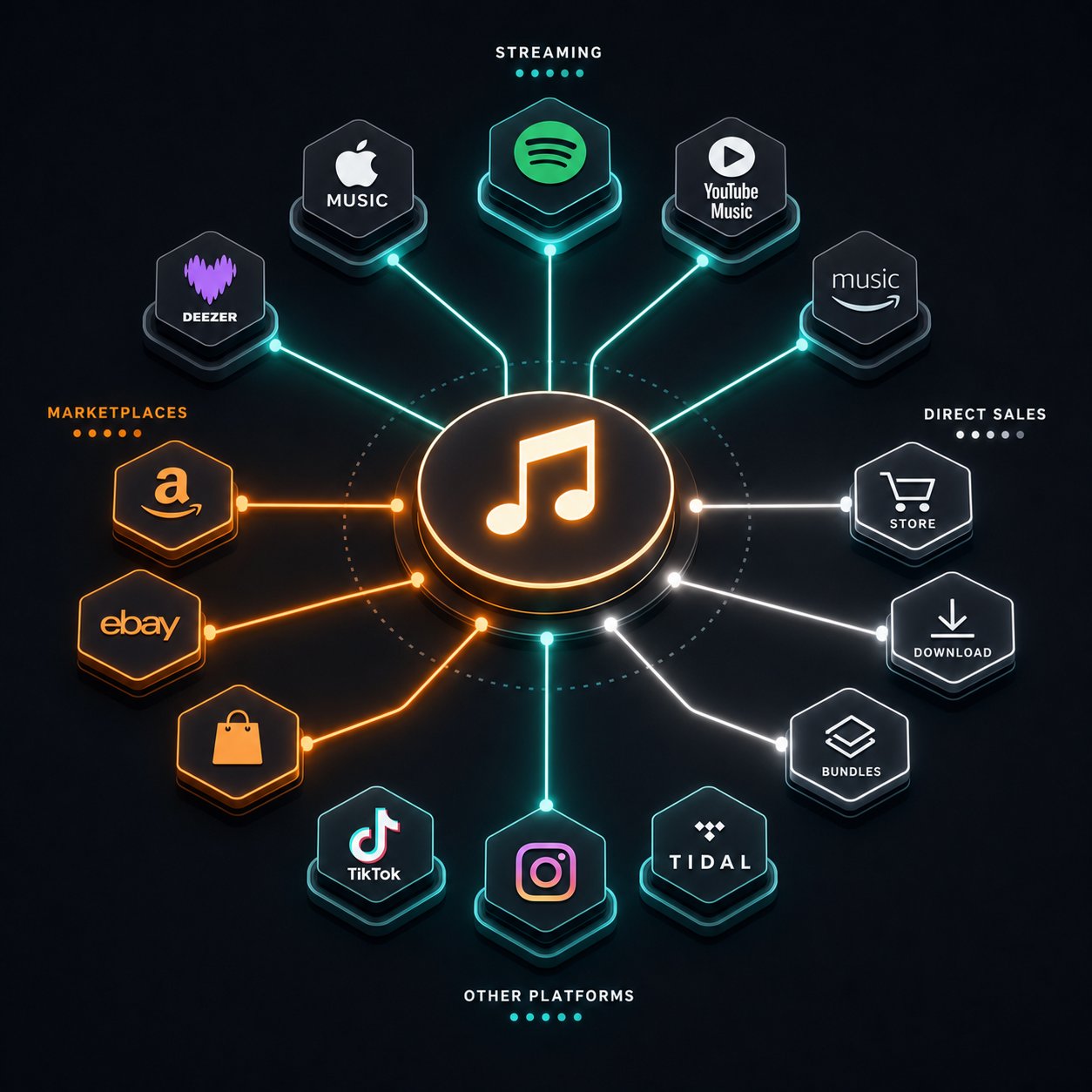
Step 6 - Distribute and Sell Your AI Music Across Multiple Channels
You have legally compliant tracks with genuine human contribution, built in a profitable genre. The next question is practical: where exactly do you put them to start earning? The answer is not one platform. It is several, stacked strategically based on how fast you need income and how much effort each channel requires.
Here is the reality: different channels pay at different speeds and different scales. Some take months before the first dollar arrives. Others can generate income within a week. Ranking them by accessibility and time to first payment gives you a clear launch sequence:
- YouTube channel with AI music - Fastest to start, monetizable once you hit 1,000 subscribers and 4,000 watch hours. Premium niches like sleep, lo-fi, and cinematic earn $3-$10 RPM in 2026.
- Stock music marketplaces - Upload, wait for review approval, earn per download or subscription payout. First sale can happen within 1-4 weeks on active platforms.
- Direct sales via Gumroad or your own site - Selling AI background music packs online lets you set your own price and keep most of the revenue. First sale depends entirely on your marketing reach.
- Streaming distribution - Upload through a distributor, wait 2-4 weeks for stores to go live, then accumulate micro-royalties over months. Slowest to meaningful income but compounds over time.
- Sync licensing - Highest per-placement pay ($100-$5,000+), but longest sales cycle. Placements can take months of pitching before a single sync lands.
Streaming Distribution Step by Step
Getting AI music onto Spotify, Apple Music, and other streaming platforms requires a distributor. You cannot upload directly. The best platform to distribute AI music for streaming depends heavily on your workflow and volume.
DistroKid is the standard recommendation for AI creators. At $24.99/year for unlimited uploads, it explicitly accepts AI music with a simple disclosure checkbox. Their policy allows music created with AI tools where you own 100% of the rights and have added meaningful creative input. TuneCore, by contrast, blocks content that is "100% created by AI" and uses detection technology claiming 99.9% accuracy. If your workflow involves Suno or Udio as the primary creative engine, TuneCore will likely reject your uploads.
Amuse offers a free tier with limited releases, making it a zero-cost entry point for testing whether your tracks gain traction before committing to a paid distributor.
What will you actually earn? Per-stream rates are identical regardless of distributor, since the streaming platforms set the payout. Current rates per 1,000 streams: Spotify pays roughly $3.02, Apple Music around $5-$7, YouTube Music about $5.28, and Tidal approximately $6.20. At Spotify's rate, you need about 8,275 streams to recover DistroKid's annual $24.99 fee. That sounds modest, but most AI tracks without promotion sit under 1,000 total streams indefinitely. Volume and playlist placement strategy matter more than the music itself at this level.
Stock Music Marketplaces and Sync Licensing
Wondering how to sell AI generated music on AudioJungle? The process is straightforward but curated. You submit tracks for review, tag them with relevant metadata (genre, mood, tempo, instrumentation), and wait for approval. Accepted tracks earn revenue each time a buyer purchases a license, typically $20-$50 per standard license on AudioJungle or Pond5.
The key platforms and what they offer:
- AudioJungle (Envato) - Large buyer base, per-download payouts, competitive review process. Accepts AI-assisted music if quality meets their standard.
- Pond5 - Non-exclusive option lets you sell the same tracks on multiple platforms simultaneously. Lower per-sale average but higher flexibility.
- Artlist - Subscription model pays contributors from a pool based on downloads. Higher production quality bar but consistent monthly income once accepted.
Sync licensing sits at the premium end. Music supervisors for TV shows, commercials, indie films, and video games pay $100 to $5,000+ for a single placement. The catch: sync buyers demand clear chain-of-title documentation, professional production quality, and tracks that feel unique enough to enhance a specific scene. This is where the producer path from Step 2 pays off most dramatically. AI-assisted tracks with strong human production elements land sync deals that purely generated tracks never will.
Direct Sales and Content Creator Licensing
Not every dollar needs to flow through a marketplace middleman. Selling directly offers higher margins and full control over pricing.
Gumroad, Payhip, and Sellfy let you package AI music into themed bundles: "50 Lo-fi Study Beats," "Cinematic Trailer Pack," or "Podcast Intro Collection." Price these at $19-$99 depending on track count and exclusivity. Content creators, small YouTubers, and podcast hosts actively search for affordable music packs they can use without recurring subscription fees.
How to make money with AI music on YouTube extends beyond uploading your own music channel. Content creators across every niche need background music, and licensing fees eat into their margins. Many smaller creators cannot afford $15-$30/month for premium music libraries. This is where a different angle emerges: instead of selling music, you can use royalty-free AI music in your own content to eliminate licensing costs entirely. Tools like MakeBestMusic's Free Music Generator give content creators commercial-use music at zero cost, turning what would be a $200-$400 annual licensing expense into pure profit margin on ad revenue, sponsorships, or course sales.
That indirect approach, using free AI music to power a monetized content channel rather than selling the music itself, is one of the most overlooked income strategies in this space. A YouTuber saving $30/month on music licensing while earning $3,000/month from ads is effectively making money from AI music, just from a different angle than most people consider.
Multiple channels working simultaneously create compounding income. A single track can earn streaming royalties on Spotify, sell as part of a bundle on Gumroad, and generate ad revenue when used in your own YouTube content. But as income diversifies across these sources, it triggers a question few creative entrepreneurs plan for: when does this stop being a hobby and start requiring business infrastructure?
Step 7 - Handle the Business and Tax Side Properly
Do you pay taxes on AI music income? Yes. Every dollar earned from streaming royalties, stock library sales, sync fees, and direct bundle purchases is taxable income in the United States, whether or not you receive a 1099 form. The IRS does not care that your instrument is an AI tool rather than a guitar. Income is income.
Most AI music creators ignore this until April, then scramble. The ones who treat their revenue stream like a real business from the start keep more of what they earn and avoid penalties that eat into already-thin margins.
When Your Side Hustle Becomes a Business
The IRS distinguishes between a hobby and a business based on profit motive and consistency. If you actively promote your music, seek profit, and earn recurring income, your activity qualifies as a business, even if it is not your full-time job. That distinction matters because a business can deduct expenses against income, while a hobby cannot create a tax loss to offset other earnings.
Practically speaking, the moment you subscribe to a paid AI music tool, upload tracks to a distributor, and receive a royalty payment, you are operating a business in the eyes of tax authorities. Tax guidance for streaming artists confirms that independent creators collecting streaming revenue are generally treated as self-employed by default unless they have formed a separate entity.
So what about AI music business structure, LLC or sole proprietor? Here is the short version:
- Sole proprietorship - Default when you start earning. No paperwork to set up. You report income and expenses on Schedule C of your Form 1040. Downside: unlimited personal liability if something goes wrong.
- Single-member LLC - Provides limited liability protection while being taxed identically to a sole proprietorship (unless you elect otherwise). Costs a small annual state fee, typically $50-$300 depending on your state. Popular choice once income becomes consistent.
- S Corporation election - Worth evaluating once net profit exceeds roughly $40,000-$50,000 annually. Can reduce self-employment tax by splitting income between salary and distributions. Adds administrative complexity and payroll requirements.
For most AI music creators earning under $3,000 per month, a sole proprietorship or single-member LLC is sufficient. Do not overcomplicate your structure before your income justifies it. As tax professionals serving musicians emphasize, consult a business lawyer since legal and tax aspects of each entity vary by state.
Tracking Expenses and Maximizing Deductions
Self-employment tax alone is 15.3% on your net profit (12.4% Social Security plus 2.9% Medicare), layered on top of your regular income tax rate. That means tax deductions for AI music creators directly reduce both obligations. Every legitimate expense you miss is money left on the table.
Common deductible expenses for AI music businesses:
- AI tool subscriptions (Suno, Udio, AIVA, Mubert paid plans)
- Distribution platform fees (DistroKid annual fee, TuneCore per-release charges)
- DAW software licenses (Logic Pro, Ableton, FL Studio)
- Audio equipment (microphones, interfaces, monitors, headphones)
- Computer hardware used for music production
- Home studio space (calculated by square footage percentage of your home)
- Marketing and promotion costs (social media ads, website hosting)
- Professional services (accounting fees, legal consultations)
- Stock marketplace commission fees
- Music education and reference materials (courses, streaming subscriptions for research)
The home studio deduction deserves special attention. If you dedicate a specific workspace exclusively to music production, the IRS allows you to deduct a proportional percentage of rent, utilities, and insurance based on square footage. A 150-square-foot production space in a 1,200-square-foot apartment means 12.5% of those housing costs become deductible. The key requirement: the space must be used exclusively and regularly for business, not a shared living area.
Separate your business and personal finances early. Open a dedicated checking account for music income and expenses. This single habit makes tax preparation dramatically simpler and provides clear documentation if you are ever audited. Accounting software like QuickBooks or even a simple spreadsheet tracking monthly income and categorized expenses is sufficient at the start.
Reporting Income From Multiple Music Revenue Streams
Here is where AI music income gets tricky: it arrives from many sources in different formats. Understanding how to report streaming royalty income on taxes requires knowing which forms to expect and what to do when no form arrives at all.
What you might receive:
- 1099-MISC - Royalty income of $10 or more (mechanical royalties, performance royalties, sync fees)
- 1099-NEC - Nonemployee compensation of $2,000 or more for services like custom production work
- 1099-K - Payment platform transactions exceeding $20,000 and 200 transactions (Gumroad, PayPal, Stripe)
- No form at all - Many distributors and platforms pay below reporting thresholds. The income is still taxable.
All of this income flows to Schedule C on your personal tax return. You total revenue from every source, subtract your legitimate business expenses, and the resulting net profit gets taxed at your income tax rate plus the 15.3% self-employment tax.
If you expect to owe $1,000 or more for the year, the IRS requires quarterly estimated tax payments due in April, June, September, and January. Missing these deadlines triggers underpayment penalties. For creators with income that fluctuates month to month, this is where many get caught. A strong Q4 from holiday playlist streams can create a tax bill you did not plan for if you have not been making quarterly payments.
One final note: the deductible half of self-employment tax is often overlooked. You can deduct 50% of your SE tax on your 1040, reducing your adjusted gross income. It is a small but meaningful benefit that compounds as your music income grows.
Getting the business side right means your earnings actually stay in your account rather than disappearing to penalties and missed deductions. But even a perfectly structured business fails if you trip the wrong wires on the platforms themselves, and the consequences go far beyond a tax bill.

Step 8 - Avoid These Pitfalls That Kill AI Music Income
Tax penalties sting. But losing your entire catalog overnight is worse. Every month, creators who built real momentum watch their accounts get suspended, their royalties clawed back, or their tracks silently removed during platform sweeps. The common thread? They crossed a line they either did not know existed or chose to ignore.
Understanding why AI music gets demonetized on Spotify and other platforms is not optional knowledge. It is the difference between compounding income and starting over from zero.
Red Flags That Get Accounts Banned or Demonetized
Platforms are investing heavily in detection systems, and the penalties are escalating. Spotify removed over 75 million spammy tracks in a single 12-month period and rolled out a dedicated music spam filter that identifies uploaders engaging in manipulative tactics, tags them, and stops recommending their content entirely. That is not a theoretical risk. It is active enforcement happening right now.
Here are the common mistakes selling AI music online that trigger account-level consequences:
- Artificial streaming (bot farms, paid plays) - The single fastest way to destroy everything you have built. Spotify now charges distributors enforcement penalty fees per track when flagrant artificial streaming is detected, and distributors pass those costs directly to the responsible account holder. Consequences escalate from stream removal and royalty clawback to complete catalog deletion and account termination. AI music streaming fraud consequences are severe: the criminal case referenced in Step 1 carried charges of up to 20 years in prison.
- Mass-uploading low-quality tracks without differentiation - Spotify's spam filter specifically targets mass uploads, duplicates, SEO hacks, and artificially short track abuse. Uploading 200 near-identical ambient tracks in a week is exactly what these systems are designed to catch. Even if each track is technically unique, pattern recognition flags bulk behavior.
- Failing to disclose AI usage where required - DistroKid, TuneCore, and Spotify all require some form of AI disclosure. Spotify is implementing industry-standard AI credits through DDEX that allow artists to indicate where AI played a role in vocals, instrumentation, or post-production. Skipping this disclosure does not make your track invisible to detection. It makes you non-compliant when they catch it.
- Uploading purely AI-generated content with zero human contribution - As covered in Step 5, platforms increasingly reject or remove tracks lacking meaningful human creative input. CD Baby blocks them outright. Spotify categorizes them under heightened scrutiny. Retroactive enforcement means tracks uploaded months ago under looser rules still get pulled.
- Using third-party promotion services that guarantee streams - Symphonic warns explicitly that even hiring a service that claims to be legitimate does not protect you if they use bot farms or playlist manipulation behind the scenes. You are responsible for streams generated on your behalf, whether you knew the methods were fraudulent or not.
- Vocal impersonation without authorization - Spotify's updated impersonation policy allows AI voice clones only when the impersonated artist has explicitly authorized the usage. Generating a track "in the style of" a famous vocalist using their cloned voice is a fast path to takedown and potential legal action.
The prevention strategy for each of these is straightforward: grow organically, disclose honestly, add genuine human value, and never pay for guaranteed streams regardless of how legitimate the service appears.
Ethical Considerations for Long-Term Success
Beyond platform rules, there is a broader question worth confronting honestly. When you flood streaming services with hundreds of AI tracks, you are not operating in a vacuum. Those tracks enter the same royalty pool as music from independent artists who spent weeks or months crafting their work. As Dr. José Valentino Ruiz argues, the use of AI must adhere to ethical business practices, and transparency is key to maintaining trust with audiences.
This is not a moral lecture. It is practical business logic. Platforms are responding to the flood by tightening policies, building detection systems, and removing content at scale. Creators who operate ethically today are building on stable ground. Those exploiting temporary loopholes are building on sand that shifts with every policy update.
What does ethical AI music creation look like in practice?
- Use AI as a creative accelerator, not a replacement for artistic intent
- Be transparent about AI's role in your creative process
- Prioritize quality over volume, even on the publisher path
- Respect other artists by not cloning their voices or closely imitating their signature sound without permission
- Treat platforms as partners rather than systems to exploit
Spotify's own framing is worth noting: they envision a future where artists are in control of how they incorporate AI into their creative processes, while the platform combats spam, impersonation, and deception. Aligning your business with that vision rather than against it is simply good strategy.
Building a Sustainable AI Music Income You Can Keep
The creators earning consistent, growing income from AI music share a specific mindset. They treat AI as one tool in a larger creative and business system. They add genuine value. They diversify across channels so no single platform policy change wipes them out. And they operate with enough integrity that algorithmic scrutiny works in their favor rather than against them.
How to avoid copyright claims on AI generated music and keep your income flowing long-term comes down to a simple checklist:
- Verify commercial rights for every tool and every plan tier - Do not assume. Read the license. Confirm it covers your specific use case.
- Add documented human contribution to every track - Keep project files showing your arrangement decisions, vocal recordings, or mixing sessions as evidence of creative input.
- Disclose AI usage honestly at upload - Comply with every platform's current disclosure requirements, even if enforcement seems lax today.
- Never purchase streams, playlist placements, or guaranteed plays - No exceptions. No "just this once." The risk-to-reward ratio is catastrophic.
- Diversify income across multiple channels - Streaming, stock libraries, direct sales, sync licensing, and content creation. If one channel tightens policy, the others sustain you.
- Monitor platform policy updates quarterly - Subscribe to distributor newsletters and platform artist blogs. Policies shift fast in this space.
- Build a recognizable brand or niche identity - Generic, interchangeable tracks are easy to flag and remove. A distinct creative identity makes your catalog defensible.
- Keep clean records for tax compliance - As Step 7 outlined, proper bookkeeping prevents a different kind of income loss.
Can you make money in AI music? The evidence is clear that you can. The real question was never about possibility. It was about durability. Creators who follow these eight steps, from understanding legal foundations through ethical long-term operation, build income that survives platform changes, policy updates, and industry evolution. Those who skip steps build income that disappears the moment enforcement catches up.
AI music is not a get-rich-quick scheme or a loophole to exploit before it closes. It is a legitimate creative and business tool that rewards the same qualities every sustainable business requires: skill development, strategic thinking, ethical operation, and patience. The technology will keep evolving. The platforms will keep adapting. The creators who treat this seriously, who add real value and respect the ecosystem they operate in, are the ones still earning five years from now.
