

The Real Answer to Monetizing AI Music on YouTube
Can you monetize AI-generated music on YouTube? Yes, but the answer comes with conditions. Your eligibility depends on YouTube's Partner Program policies, the licensing terms of the AI tool you use, and how much human creativity you bring to the table. This is not a blanket yes or no situation. It is a layered policy question that trips up creators who skip the details.
The Short Answer for Creators
AI-generated music can be monetized on YouTube when three conditions are met: your channel qualifies for the YouTube Partner Program, the AI tool grants you commercial-use rights to the output, and your content demonstrates meaningful human creative input rather than being mass-produced or formulaic. Channels that upload raw AI outputs with no curation, original visuals, or editorial direction face enforcement under YouTube's inauthentic content policy, which was renamed from "repetitious content" in July 2025 specifically to target this kind of low-effort automation.
Why This Question Matters Now
AI music tools have exploded in capability and adoption. Creators across every niche, from vloggers needing background tracks to podcasters building custom intros, are generating audio in seconds with platforms like Suno, Udio, and dozens of newer alternatives. The ai music YouTube space has grown so fast that YouTube's policy team has responded with multiple updates in 2025 and 2026, clarifying exactly how AI content fits within monetization rules. For anyone wondering whether youtube music ai workflows can actually generate revenue, the landscape has shifted dramatically from even a year ago.
This guide is built on official YouTube documentation and real policy enforcement patterns, not marketing claims from AI tool companies. Every recommendation traces back to what YouTube actually enforces, not what creators hope is true.
Whether AI-generated music can be monetized on YouTube comes down to three factors: YouTube Partner Program compliance, proper licensing rights from your AI tool, and enough content originality to pass YouTube's inauthentic and reused content policies.
The sections ahead break down each of these layers, from YPP requirements and copyright law to Content ID risks and revenue protection strategies, so you can build a workflow that earns without surprises.
YouTube Partner Program Policies on AI-Generated Content
A common misconception floating around creator communities is that using AI for music production automatically disqualifies your channel from monetization. It does not. YouTube's Partner Program evaluates your channel's metrics and compliance standing, not the specific tools you use to create your content. The distinction that matters is how you use those tools and whether you follow disclosure rules.
YPP Eligibility Requirements for AI Content Channels
YouTube's Partner Program eligibility thresholds are the same whether you record a guitar in your bedroom or generate a full track with AI. Your channel needs to hit one of two benchmarks:
- 1,000 subscribers plus 4,000 valid public watch hours in the last 12 months, or
- 1,000 subscribers plus 10 million valid public Shorts views in the last 90 days
Beyond those numbers, your channel must also meet these baseline requirements:
- No active Community Guidelines strikes
- Two-Step Verification enabled on your Google Account
- An active AdSense for YouTube account linked to your channel
- Compliance with all YouTube channel monetization policies
- Residence in a country where YPP is available
Notice what is absent from that list: any requirement about how your content is produced. A channel using Suno music on YouTube or any other AI generation platform is not flagged or penalized during the application review simply for using AI tools. Reviewers assess whether your channel follows monetization policies as a whole, not whether individual tracks were composed by a human or a model.
That said, channels publishing high volumes of AI-generated content with minimal human input may trigger scrutiny under YouTube's inauthentic content policy. The platform looks at your channel holistically. If every video is a low-effort slideshow paired with an unedited AI track, reviewers may determine the channel lacks the meaningful human contribution YouTube expects from monetized creators.
Disclosure and Labeling Obligations
Here is where understanding how AI creates music matters for your compliance. YouTube requires creators to disclose when they use generative AI tools to produce content that could appear realistic or significantly altered. This labeling system has evolved rapidly since its introduction in 2024, and a May 2026 update introduced automatic AI detection alongside the existing manual disclosure process.
When you upload a video, YouTube's upload flow asks whether you used AI tools. For content that is photorealistic or meaningfully AI-altered, the platform now places the disclosure label in a more prominent position directly visible to viewers. For content that is unrealistic, animated, or only slightly altered, the disclosure appears in the expanded description instead.
The critical update creators need to understand: YouTube now uses internal signals to detect AI-generated content automatically. If you skip the disclosure step and YouTube's systems identify significant AI use, the platform will apply a label without your input. You can dispute an incorrect detection through YouTube Studio, but deliberately avoiding disclosure when you know AI was used puts your channel at risk.
What happens if you fail to disclose? YouTube can apply labels retroactively, issue warnings, or in repeated cases, take enforcement action that affects your monetization standing. The platform draws a clear line between two categories:
- AI-assisted content - You use AI as one tool in a larger creative process. You direct the output, edit it, combine it with other elements, and make meaningful creative decisions. This faces standard scrutiny and is fully eligible for monetization with proper disclosure.
- Fully automated AI content - A system generates the output end-to-end with no meaningful human creative direction. This category faces stricter review and may not satisfy YouTube's requirements for original, human-driven content on monetized channels.
YouTube has stated clearly that a disclosure label alone does not change how a video is recommended or whether it is eligible to earn money. Labeling is about transparency, not punishment. Creators who disclose honestly and demonstrate genuine creative involvement in their workflow remain in good standing.
For anyone using AI tools as part of their production pipeline, the takeaway is straightforward: disclose, add real creative value, and keep your channel compliant with community guidelines. The YPP door stays open. The complexity begins when you look at what you actually own once that AI track is generated, and whether anyone else can claim it.
Copyright Ownership and Legal Challenges for AI Music
Monetization on YouTube is one thing. Owning the music you upload is something else entirely. Many creators assume that if they generated a track, they own it. The legal reality is more complicated, and it has direct consequences for your ability to protect your revenue, issue takedowns, or license your work elsewhere. So can you copyright AI music? The answer depends almost entirely on how much creative control you exercised during the process.
What the US Copyright Office Says About AI Authorship
The U.S. Copyright Office has been clear: copyright protection requires human authorship. A work needs human creative expression to qualify for registration. This principle was reinforced in the Office's Part 2 Report on Copyright and Artificial Intelligence, released in January 2025, which concluded that generative AI outputs can be protected by copyright "only where a human author has determined sufficient expressive elements."
What does that mean in practice? If you type a prompt into an AI music generator and accept whatever comes out, that output likely has no copyright protection. The Copyright Office's position is that prompts function as instructions conveying unprotectable ideas. They do not give you creative control over how the AI system processes those instructions into a finished piece of music.
This framework was further solidified in March 2025 when the D.C. Circuit Court of Appeals upheld the human authorship requirement in Thaler v. Perlmutter, holding that the Copyright Act requires all eligible work to be authored by a human being. The Supreme Court declined to review the case in early 2026, leaving that ruling as controlling precedent.
Here is the important nuance for creators worried about YouTube revenue: this copyright limitation does not prevent you from monetizing AI music on the platform. YouTube does not require you to hold a copyright registration to earn ad revenue. What it means is that you may lack the legal grounds to enforce exclusivity. If someone copies your AI-generated track and uploads it elsewhere, you may have no standing to file a takedown or pursue a copyright claim against them. Your revenue stays intact as long as nobody claims the track from you, but you have limited legal tools to stop others from using identical or similar output.
For anyone exploring artificial intelligence songwriting as a business model, this is the gap that matters. You can earn money, but you cannot necessarily protect what you have made from being used by others.
AI-Assisted vs Fully AI-Generated Works
The critical distinction in copyright law is not whether AI was involved. It is how much human creativity shaped the final result. The Copyright Office draws a clear line between using AI for songwriting as a creative tool and pressing a button for a fully automated output.
When a human selects, arranges, edits, layers, and makes deliberate creative decisions throughout the production process, the resulting work may qualify for copyright protection. The Office has confirmed that "the use of AI to assist in the process of creation or the inclusion of AI-generated material in a larger human-generated work does not bar copyrightability." In fact, since issuing its 2023 registration guidance, the Office has registered hundreds of works that incorporate AI-generated material, with protection covering the human author's contribution.
Imagine two producers. One enters a prompt into an AI tool, downloads the result, and uploads it directly. The other generates several AI instrumental sketches, selects the best elements from each, writes original lyrics over the top, records a vocal performance, rearranges sections, and mixes the final track with layered production choices. The first producer likely holds no copyright. The second has a much stronger claim because their creative decisions shaped what the audience ultimately hears.
This distinction carries real weight for anyone evaluating commercial AI music workflows. Whether you are exploring tools like Riffusion for sound design or considering how a record label AI strategy might scale content production, the legal defensibility of your catalog depends on demonstrating meaningful human authorship. The more creative layers you add, the stronger your position becomes, both for copyright registration and for defending against third-party claims on YouTube.
The SURYAST decision from December 2023 provides a cautionary example for musicians: even if you supply original material as an input to an AI system, your copyright claim fails if the AI transforms that input into something unrecognizable in the final output. The link between your creative contribution and what the audience hears must remain perceptible.
Here is how these two categories compare across the dimensions that matter most to YouTube creators:
| Dimension | AI-Assisted Works | Fully AI-Generated Works |
|---|---|---|
| Copyright Eligibility | Registrable for human-authored portions (lyrics, arrangement, vocal performance, creative selection) | Not registrable. Prompts alone do not establish authorship over expressive elements |
| Monetization Risk on YouTube | Low. Demonstrates human creative input that satisfies platform policies | Higher. May trigger inauthentic content review if published at scale without added value |
| Legal Defensibility | Strong. Can file takedowns, pursue infringement claims, and license the human-authored elements | Weak. No legal basis to prevent others from copying or reusing the output |
| Disclosure Requirement | Must disclaim AI-generated portions and describe human contributions in registration | Cannot register, so disclosure is moot for copyright purposes (still required by YouTube) |
| Long-Term Value | Builds a defensible catalog that can be licensed, sold, or enforced | Generates short-term revenue but creates no protectable intellectual property |
The practical takeaway is straightforward: creators who treat AI as one instrument in a larger creative process, rather than the entire process itself, position themselves with stronger ownership claims and lower platform risk. Every edit you make, every arrangement choice, every original element you layer on top strengthens your legal standing.
Copyright ownership is not just an abstract legal question. It shapes whether your content is vulnerable to the one system that can redirect your YouTube earnings overnight: Content ID.
How Content ID Handles AI-Generated Music
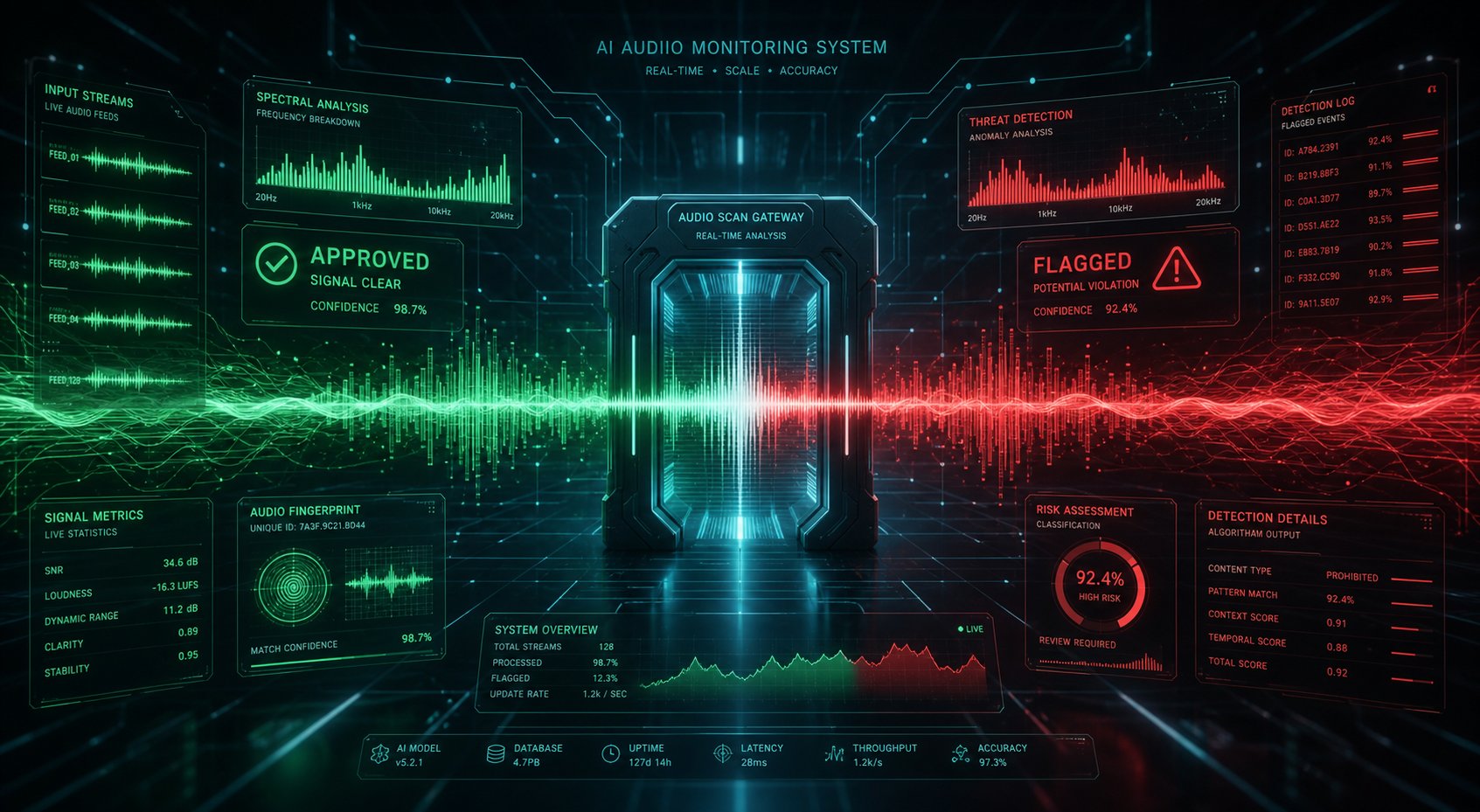
Content ID is the system that can quietly redirect every dollar your video earns to someone else. It operates around the clock, scanning every upload against a massive database of reference audio, and it does not care whether the track in question was recorded in a studio or generated by an algorithm in three seconds. For creators building channels around AI music, understanding how this automated gatekeeper works is the difference between steady revenue and frozen earnings.
How Content ID Fingerprinting Works with AI Tracks
YouTube's Content ID system is an automated copyright matching tool. Rights holders, including labels, publishers, distributors, and independent creators, submit reference audio files to YouTube. The platform creates a spectral fingerprint of each submission and stores it in the Content ID database. Every time someone uploads a video, YouTube scans the audio against this entire fingerprint library looking for matches.
The matching process works at the waveform level. Content ID analyzes the acoustic signature of your audio, comparing sequences of frequencies, rhythms, and harmonic patterns against registered references. A match can trigger even when the audio has been modified through pitch shifts, speed changes, or filters. Typically, as little as five seconds of overlapping audio is enough for the system to flag a video.
Here is where things get complicated for AI-generated music. Generative models are trained on large datasets that often include copyrighted recordings. When an AI tool produces output, it can sometimes generate audio that is statistically similar to existing tracks already registered in the Content ID database. The AI is not intentionally copying, but the melodic patterns, rhythmic structures, or timbral qualities it produces may be close enough to trigger a fingerprint match. YouTube's system cannot interpret creative intent. It simply detects similarity and applies the rights holder's chosen policy.
When a Content ID match occurs on your video, one of three outcomes follows:
- Monetization redirected - The claimant takes over ad revenue on your video. Ads still run, but the money flows to whoever owns the reference file.
- Revenue shared - In cases where multiple claims exist or agreements are in place, ad revenue is split between parties.
- Video blocked - The rights holder chooses to make your video unavailable, either globally or in specific territories.
A critical point that trips up many creators: a Content ID claim is not the same as a copyright strike. Claims are automated matches that affect monetization. Strikes are formal takedown requests that threaten your channel's existence. Three active strikes result in channel termination. Claims, while frustrating, do not carry that same existential risk. They redirect revenue or restrict availability, but your channel stays intact.
For anyone producing beats by AI songs or generating full tracks with tools like Suno or Udio, the practical risk is real. Your AI output might sound original to your ears but share enough acoustic DNA with a registered track to trigger a match. The system does not distinguish between deliberate copying and coincidental similarity.
Why Some AI Music Gets Flagged and How to Respond
Creators regularly report Content ID claims on tracks they generated themselves. How is that possible if the music was just created by an AI tool moments ago? Several scenarios explain why this happens more often than you might expect.
The most common cause is cross-registration conflicts. When one creator generates an AI track and distributes it through DistroKid, TuneCore, or CD Baby, that distributor can register the audio fingerprint with Content ID. If another creator later generates a similar track from the same AI tool, using comparable prompts or style settings, the output may be close enough to match the first creator's registered fingerprint. Two people who never interacted can end up in a Content ID dispute because the AI produced acoustically similar results for both of them.
A second scenario involves AI platforms themselves. Some tools register their output libraries or sample databases with Content ID. If you generate a track on one of these platforms and upload it to YouTube, the platform's own registered reference can claim your video. This creates an absurd situation where the tool you paid to use is effectively claiming revenue on the content it helped you create. Creators using free-tier outputs from certain ai remix music generators or archive-based tools like those found on ai music maker archive.org collections are particularly vulnerable, since those outputs may carry restrictions the creator never noticed in the terms of service.
A third cause is the training data problem. If an AI model was trained on copyrighted material that exists in the Content ID database, the model can produce outputs containing fragments that match those registered works. This is especially problematic with models trained on large catalogs of popular music. The output is not a direct copy, but Content ID's tolerance for modified audio means even a vague resemblance can trigger a match.
Platforms like SoundCloud have their own content matching systems, and creators moving tracks between soundcloud ai distribution and YouTube sometimes encounter mismatched claims when the same audio triggers different enforcement policies on different platforms. The underlying issue is the same: automated detection systems are not designed to handle the ambiguity of AI-generated content that resembles, but does not copy, existing works.
So what do you do when a claim lands on your video? YouTube provides a structured dispute process. Treat it as a formal workflow, not a casual click. Here is the step-by-step path:
- Verify your rights first. Before disputing, confirm you actually have commercial rights to the track. Free-tier AI tool output often does not include commercial licensing. Disputing a claim on content you have no commercial rights to can escalate into a copyright strike.
- Gather your evidence. Collect your AI tool subscription receipt showing the generation date, screenshots of your generation history with the prompt and output visible, the original file download confirmation, and any distribution records if the track was released through a distributor.
- File the dispute in YouTube Studio. Open the claim details on the affected video and click "Dispute." Select the appropriate reason. For AI tracks you generated under a commercial license, choose "I have a license or permission from the rights holder." Include your gathered evidence in the explanation.
- Wait the 30-day response window. The claimant has 30 days to review your dispute. During this period, revenue on the video is held rather than paid out to either party. Many false claims, particularly automated cross-matches between similar AI outputs, time out without a response. When this happens, monetization is restored and withheld earnings pay out in your next cycle.
- Escalate if the claim is upheld. If the claimant rejects your dispute, you can file a formal appeal. This step requires you to affirm under penalty of perjury that you have the rights to use the audio. Only escalate if you are fully confident in your licensing position. A failed appeal can result in the claimant requesting a takedown, which converts the situation into a copyright strike.
The entire process can take anywhere from a few days to the full 30-day window. During that time, your video stays live (unless the claimant chose a block policy), but revenue accumulates without paying out. For channels depending on consistent cash flow, even a resolved dispute means a temporary earnings gap.
The best defense against Content ID headaches is prevention. Choose AI music tools that explicitly grant commercial-use rights, do not register their outputs in the Content ID database, and provide clear documentation you can reference during a dispute. Tools that register all generated output with Content ID create an inherent conflict for their own users, and creators should treat that as a red flag when selecting a platform.
Keeping timestamped proof of every generation, saving license receipts, and maintaining organized records transforms a potential crisis into a manageable administrative step. The creators who lose revenue to Content ID claims are almost always the ones who cannot produce documentation when it matters.
Content ID risk varies dramatically depending on your use case. A vlogger dropping a 30-second AI track under narration faces a completely different exposure profile than a channel publishing full-length AI compositions as its primary content. Those risk differences shape everything from tool selection to workflow design.
Different Creator Types and Their Monetization Risk Profiles
Not every creator using AI music on YouTube faces the same set of risks. A travel vlogger layering a generated track under narration operates in a completely different policy environment than someone publishing hour-long AI compositions as the sole content of their channel. Your use case determines your exposure to Content ID disputes, inauthentic content flags, and reused content enforcement. Understanding where you fall on this spectrum is the first step toward a monetization-safe workflow.
Vloggers and Video Creators Using AI Background Music
If you produce video-first content, whether that is tutorials, vlogs, product reviews, or documentary-style storytelling, and you use AI-generated music as background audio, you sit in the lowest-risk category. Why? Because the monetizable value of your content comes from the video itself, not the music. YouTube's reviewers evaluate what makes your channel worth watching, and for video creators, that is your on-camera presence, your editing, your narrative, or your expertise.
As long as the AI tool you use grants commercial-use rights, background music usage is functionally identical to pulling a track from a royalty-free stock library. The music supports your content rather than being the content. You still need to disclose AI use per YouTube's labeling requirements, but the inauthentic content policy is unlikely to apply because your channel clearly demonstrates human creative direction in every other dimension.
The growing wave of ai for the culture music, from funk maker ai tools generating groove-heavy backing tracks to ai classical music composer platforms producing orchestral underscore, gives video creators more stylistic range than stock libraries ever offered. The risk stays low as long as the license is clean and the music remains a supporting element.
Channels Publishing AI-Generated Music as Primary Content
This is where policy risk escalates significantly. When AI music is not the background but the entire product, your channel faces YouTube's full scrutiny under both the inauthentic content policy and the reused content policy. YouTube has explicitly stated that content which is "mass-produced" or "easily replicable at scale" is ineligible for monetization, and raw AI music uploads fit that description precisely.
The enforcement pattern targets channels where upload cadence is high, audio outputs cluster tightly around the same presets, thumbnails follow formulaic templates, and no human creative layer exists beyond the generation step. According to industry analysis, an estimated 40% or more of pure AI music channels have been disqualified from YPP or seen monetization suspended since late 2025.
Does that mean music-primary channels cannot work? Not at all. It means you need to demonstrate the human contribution YouTube looks for. Channels that succeed in this space add meaningful layers: original visual storytelling, curated playlists with thematic structure, timestamped chapters, human narration or commentary, and consistent aesthetic identity. Think of it this way: YouTube rewards creators who treat AI as a production instrument, not creators who treat AI as the entire band, producer, and label rolled into one button click.
Premium niches like sleep and meditation music, cinematic scoring, and lofi study beats still earn healthy RPMs of $3 to $10 when paired with genuine curation. The key differentiator is whether a viewer can tell that a human mind shaped what they are experiencing, or whether it feels like an automated pipeline.
Podcasters and Streamers Using AI Intros and Jingles
Short-form AI music usage, things like podcast intros, stream transitions, outro stingers, and segment bumpers, carries minimal monetization risk. These clips typically run 5 to 30 seconds, serve a functional role in the production, and represent a tiny fraction of the total content runtime. From a policy standpoint, this is indistinguishable from using a stock music library or hiring a freelancer to produce a jingle.
Podcasters and streamers exploring an ai jinglemaker workflow can generate custom audio identity for their shows without licensing headaches, provided the tool's terms allow commercial use. The content value lives entirely in the spoken word, the gameplay, or the live interaction. Music is garnish. YouTube's review systems are not going to flag a 200-episode interview podcast because the 10-second intro was generated by AI.
This category also represents a natural entry point for creators curious about ai for the culture music production who want to experiment without committing their entire channel to AI-generated audio. Start with intros and transitions, learn how the tools behave, and expand from there if the workflow proves valuable.
Here is how these three creator profiles compare across the dimensions that matter most for monetization decisions:
| Creator Type | Risk Level | Primary Policy Concern | Best Practices |
|---|---|---|---|
| Vloggers and Video Creators (background music) | Low | Content ID false matches if tool license is unclear | Use tools with explicit commercial licenses, keep generation receipts, disclose AI use in upload settings |
| Music-Primary Channels (AI music as sole content) | High | Inauthentic content policy and reused content enforcement | Add original visuals, narration, or commentary; limit upload frequency; choose premium niches; demonstrate human curation in every upload |
| Podcasters and Streamers (intros, jingles, transitions) | Very Low | Virtually none beyond standard disclosure requirements | Verify commercial-use license on your AI tool; disclose per YouTube requirements; keep documentation in case of rare Content ID match |
The pattern is clear: the more your channel depends on AI music as the primary value proposition, the more work you need to invest in proving human creative involvement. Creators in the low-risk categories can focus their energy elsewhere. Those in the high-risk category need to treat every upload as a demonstration of why their channel deserves to exist beyond what the AI could produce on its own.
Regardless of where you fall on this spectrum, one factor applies equally to everyone: the licensing terms of the AI tool you choose. A clean commercial license removes the largest single variable from your monetization equation, and not all tools offer the same protections.

Choosing AI Music Tools with YouTube-Safe Licensing
A tool that generates impressive-sounding music is worthless for monetization if the licensing terms leave you exposed. The gap between "this sounds great" and "this is safe to earn money with on YouTube" lives entirely in the legal fine print. Not all AI music platforms treat commercial rights the same way, and the differences can mean the distinction between keeping 100% of your ad revenue and watching it vanish into a Content ID claim.
What to Look for in AI Music Tool Licensing
Before generating a single track for your YouTube channel, you need clear answers to a handful of questions about the tool you are using. Vague terms of service are not your friend here. If a platform cannot state plainly what you are allowed to do with its output, treat that ambiguity as a risk factor.
Here are the licensing criteria that directly affect whether you can monetize AI music on YouTube without revenue loss:
- Commercial-use rights - Does the tool explicitly grant you the right to use generated audio in monetized content? Free tiers often restrict output to personal or non-commercial use only. Suno's free plan, for example, does not include commercial rights.
- Content ID registration status - Does the platform register its outputs or reference libraries with YouTube's Content ID system? If yes, your own generated track can trigger a claim against your video. This is the single most overlooked licensing detail among creators.
- Attribution requirements - Must you credit the AI tool in your video description or on-screen? Some free tiers require visible attribution, which may be fine for some creators but unacceptable for others building a professional brand.
- Exclusivity of output - Can multiple users generate identical or near-identical tracks? If the platform produces the same output for similar prompts, another creator could release an acoustically identical track and register it before you do, creating a Content ID conflict.
- Tier-based restrictions - Many platforms split rights across subscription levels. A tool might allow YouTube uploads on its paid plan but restrict distribution or sync licensing to a higher tier. Always verify rights for your specific use case at your specific subscription level.
These five factors are more important than audio quality when evaluating whether a tool fits a monetization-safe workflow. A beautiful track with unclear licensing is a liability. A decent track with ironclad commercial rights is an asset.
Free and Paid Tools with YouTube-Safe Licenses
The market for AI music generators has expanded rapidly, and creators now have options ranging from completely free to enterprise-tier subscriptions. The tools below explicitly permit commercial use on YouTube, though specific terms vary by plan. Here is how they compare across the licensing dimensions that matter most for revenue protection:
| Tool | Licensing Clarity | Commercial Rights | Content ID Status | Pricing |
|---|---|---|---|---|
| MakeBestMusic Free Music Generator | Clear. Royalty-free for commercial projects including YouTube | Yes, included on free tier | Not registered in Content ID | Free |
| Suno | Clear per tier. Free tier excludes commercial use | Pro ($10/mo) and Premier ($30/mo) only | Not registered by Suno, but user-distributed tracks may be registered by distributors | Free / $10 / $30 per month |
| AIVA | Clear per tier. Standard allows social monetization, Pro grants full ownership | Standard (EUR 15/mo) for YouTube; Pro (EUR 49/mo) for full rights | Not registered | Free / EUR 15 / EUR 49 per month |
| ElevenLabs Music | Clear. Self-Serve plans permit most commercial use with carve-outs for film and TV | Yes on paid plans. Free tier allows up to 7 songs/day | Not registered | Free / $9.99 per month |
| Stable Audio | Clear. Creator license covers individual commercial use | Creator tier and above | Not registered | Free (non-commercial) / Creator tier varies |
A few observations from this comparison. MakeBestMusic's Free Music Generator stands out as a zero-cost entry point that removes the two biggest barriers for new creators: price and Content ID risk. Because the outputs are royalty-free and not registered in any fingerprint database, you can generate a track and upload it to a monetized video without worrying about automated claims redirecting your earnings. For creators still testing whether AI music fits their workflow, starting with a free tool that already grants commercial rights eliminates the need to commit budget before validating the approach.
Tools like the brev music generator and mytunes ai music generator have also entered the market targeting creators who want quick generation with commercial licensing, though their terms and output quality vary. Google's music fx ai experiment explored a different angle entirely, focusing on short-form audio clips rather than full-length production tracks. Each platform occupies a slightly different niche, so matching your tool to your actual use case matters more than chasing the most popular name.
For creators already using platforms like Ecrett Music for scene-based composition, or analytical tools like Sonoteller AI for tagging and metadata, the licensing question still applies. Even when the generation quality is high, your monetization safety depends on whether the terms explicitly cover YouTube commercial use at your subscription level. Soundgen AI and similar newer entrants may offer compelling features, but always verify Content ID status and commercial rights before building a workflow around any platform.
The bottom line: free tools with clear commercial licenses lower the barrier for creators who want to test AI music monetization without upfront costs. You do not need to spend $30 per month to get started. You need a tool that says, plainly and in writing, that you can use the output in monetized YouTube content without attribution requirements or Content ID registration that could create conflicts down the line.
Choosing the right tool solves the licensing variable. But licensing is only half the revenue equation. The other half is understanding exactly how YouTube's ad-revenue split works, what happens when a third-party claim lands on your video, and how to protect the income your content generates month after month.
Revenue Impact and How to Protect Your Earnings
Licensing determines whether you can earn. Revenue protection determines whether you keep what you earn. Even creators who choose the right AI music tool and follow every disclosure rule can still lose income if they do not understand how YouTube's ad-revenue mechanics interact with music claims. The good news: the platform does not penalize AI-generated audio in its payout calculations. The bad news: a single unresolved Content ID claim can drain 100% of a video's earnings before you even notice.
Ad Revenue and AI Music vs Stock Music vs Original Compositions
A question creators often ask when evaluating music ai pricing across different tools: does YouTube pay less for videos that use AI music instead of original compositions or licensed stock tracks? The short answer is no. YouTube's ad-revenue split operates the same way regardless of how the audio in your video was created.
Here is how the split works. For standard long-form content, YouTube keeps 45% of ad revenue and pays the remaining 55% to the creator. This ratio does not change based on whether you composed the track yourself, licensed it from a stock library, or generated it with the best ai song creator you could find. CPM rates, the amount advertisers pay per thousand impressions, are driven by your niche, audience demographics, geography, and seasonality. They are not driven by your music source.
What does affect your take-home revenue is whether a third party has a Content ID claim on your video. When a claim is active, the claimant's policy kicks in. In the most common scenario, the claimant monetizes your video and takes all of the ad revenue. In some cases, YouTube's Creator Music program enables revenue sharing between the creator and the rights holder, but this only applies to tracks specifically opted into that system. For everything else, a claim means someone else collects your earnings until the claim is released or disputed successfully.
The practical implication is straightforward: a free AI track with a clean commercial license and no Content ID registration nets you the same 55% revenue share as a $500 custom composition. The financial difference between tools is not in YouTube's payout formula. It is in whether the tool's licensing creates exposure to claims that redirect that payout to someone else. Creators wondering is Beatoven AI free or comparing subscription tiers across platforms should evaluate cost against claim risk, not against some imagined CPM penalty for using generated audio.
Protecting Your Revenue from Third-Party Claims
Revenue protection is not a passive exercise. It requires documentation habits built into your workflow from day one. Creators who treat license management as an afterthought find themselves scrambling for evidence when a claim appears, often weeks after the original generation when screenshots and download confirmations are harder to locate.
The creators who retain full monetization control share a common profile: they use AI tools with explicit commercial licenses that do not register outputs in Content ID, and they maintain organized proof of every generation. When a false claim does appear, they resolve it quickly because the evidence is already assembled.
Here are the revenue protection practices that keep your earnings intact:
- Save generation receipts immediately. Screenshot or export your AI tool's generation history showing the prompt, timestamp, output file name, and your account details. This is your primary evidence in any dispute.
- Download and store license documentation. Keep a copy of the tool's terms of service or license agreement that was active on the date you generated the track. Terms change over time, and having the version that applied when you created the content protects you from retroactive restrictions.
- Maintain a master log of tracks used per video. A simple spreadsheet linking each video to the AI tool used, the generation date, the license tier, and the file name makes dispute filing fast instead of frantic.
- Monitor your videos for new claims weekly. YouTube Studio shows Content ID claims in the Monetization column. Catching a claim early means disputing it before significant revenue accumulates in someone else's account.
- Respond to erroneous claims within 48 hours. While YouTube gives you 30 days to file a dispute, prompt action signals legitimacy. The longer a claim sits unchallenged, the more revenue the claimant collects and the harder it becomes to recover those earnings.
- Never distribute AI tracks through services that auto-register with Content ID unless you intend to claim other users' videos. If you upload your AI music to DistroKid or TuneCore for streaming platforms, understand that their Content ID registration can create claims against your own YouTube uploads or against other creators who generated similar output.
- Keep original project files if you edit or layer AI outputs. DAW session files showing your arrangement, mixing, and editing decisions serve as additional proof of human creative input and strengthen both your copyright position and your dispute standing.
The underlying principle is simple: your revenue is secure as long as no third party can successfully claim your audio. Clean licensing eliminates the basis for legitimate claims. Organized documentation eliminates the risk of losing disputes against illegitimate ones. Together, they form a wall around your earnings that holds up whether you are generating one track per month or scaling a full content operation.
Revenue protection is reactive by nature. You are responding to claims after they appear. A stronger position is building a workflow from the start that minimizes claim likelihood while maximizing your ownership standing, which is where best practices for the entire production pipeline come into play.

Best Practices for Monetizing AI Music Safely
Knowing the policies and understanding the risks is useful, but what actually matters is what you do with that knowledge every time you sit down to create. The creators who monetize AI music without revenue disruptions are not the ones who got lucky. They are the ones who built repeatable workflows that satisfy YouTube's policies, strengthen their copyright standing, and minimize Content ID exposure by design rather than by accident.
These are not abstract principles. They are concrete steps you can implement today, regardless of your niche or experience level.
Building a Monetization-Safe Workflow
Think of this as a production pipeline where each stage adds a layer of protection. Skip a step and you create a gap that policies or claims can exploit. Follow the sequence and you build content that is defensible at every level.
- Select a tool with verified commercial licensing. Before generating anything, confirm that your AI music platform grants explicit commercial-use rights at your subscription tier. Free tools like MakeBestMusic's Free Music Generator provide royalty-free output for commercial projects including YouTube, which means you start with a clean licensing foundation at zero cost. If you are using a paid platform, verify that your specific plan covers monetized video use, not just personal projects.
- Generate multiple outputs and make deliberate selections. Do not accept the first thing the AI produces. Generate several variations, listen critically, and choose the elements that best serve your creative vision. This selection process is itself a human creative decision that strengthens your position under both copyright law and YouTube's originality standards.
- Add human creative input through editing, arranging, or layering. Open your chosen output in a DAW or audio editor. Cut sections, rearrange the structure, adjust tempo or key, layer multiple AI outputs together, or add original elements like vocals, instruments, or sound design. Every edit you make is a creative decision that moves your content further from "automated output" and closer to "human-directed work."
- Pair the audio with original visual content. For music-primary channels, original visuals are non-negotiable. AI-generated or hand-crafted animations, filmed footage, dynamic visualizers you designed, or illustrated artwork all demonstrate human curation. A static image with an unedited AI track is exactly the pattern YouTube's inauthentic content policy targets.
- Label AI content per YouTube's disclosure requirements. In YouTube Studio, toggle the "Altered or synthetic content" setting before publishing. This takes five seconds and keeps you compliant. Skipping it risks enforcement action that could have been avoided with a single click.
- Save all license documentation and generation receipts. Screenshot your generation history, download license confirmations, and log which track appears in which video. Store this in a dedicated folder. When a Content ID dispute arises six months from now, you will need this evidence immediately, not eventually.
- Run the track through YouTube's Copyright Checker before publishing. YouTube Studio includes a built-in tool that scans your audio against the Content ID database before your video goes live. Use it every time. If a match appears at this stage, you can swap the track before it affects your published content or revenue.
- Monitor published videos for new claims weekly. Content ID claims can appear days or weeks after upload as new reference files enter the database. Check your Monetization column in YouTube Studio regularly and dispute erroneous claims promptly using the evidence you saved in step six.
This eight-step sequence is not about being paranoid. It is about building habits that make monetization problems rare and resolvable instead of common and catastrophic. Each step takes minutes. Skipping them can cost weeks of revenue.
Adding Human Value to AI-Generated Music
YouTube's policies and copyright law converge on the same principle: the more human creativity you invest, the safer your position. This is not just about checking a compliance box. It is about creating content that is genuinely yours in ways that matter legally, algorithmically, and creatively.
Here are practical strategies that strengthen both your ownership claims and your platform standing:
Mix multiple AI outputs into a single composition. Generate three or four instrumental sketches, then pull the bass line from one, the melodic hook from another, and the percussion from a third. The act of selecting, combining, and balancing these elements is arrangement work, a recognized form of human authorship. The final track is something none of the individual AI outputs produced on their own.
Add original vocals or live instruments. Record yourself singing, rapping, or playing an instrument over the AI-generated backing. This is the strongest single step you can take toward both copyright registration and YouTube compliance. Your vocal performance or instrumental contribution is unambiguously human-authored and transforms the track from pure AI output into a collaborative work. Creators exploring how to turn lyrics into a song using AI often start by generating instrumental beds and then recording their own vocal performances on top, which is exactly the kind of layered workflow that satisfies both legal and platform requirements.
Write original lyrics and use AI only for the instrumental. If you are learning how to create a song using ChatGPT or experimenting with a toolbaz song lyrics generator for initial lyric drafts, treat those outputs the same way you treat AI instrumentals: as raw material that needs your creative shaping. Edit the lines, rewrite weak phrases, restructure verses to match your cadence, and perform the final version yourself. A chatgpt music maker workflow where you prompt an LLM to draft lyrics, then heavily revise and record them over an AI instrumental, demonstrates human authorship at multiple levels.
Create unique arrangements with structural edits. Rearrange sections of AI output into non-obvious structures. Add an intro that the AI did not generate. Build a bridge by splicing elements from different generations. Change the tempo halfway through. These arrangement decisions are the kinds of creative choices that copyright law recognizes as authorship and that YouTube's review systems interpret as meaningful human contribution.
Pair music with original storytelling or commentary. For music-primary channels, adding narrative context transforms the viewer experience. Explain the creative process, discuss the genre, provide historical context, or build a visual story that gives the music emotional meaning. Channels that frame AI music within human-directed storytelling consistently pass inauthentic content reviews because the content clearly exists because of a human mind, not just an algorithm.
Creators who want to chatgpt make a song from scratch often discover that the most sustainable workflow combines multiple AI tools for different elements: one for instrumentals, another for lyric brainstorming, and their own performance and production decisions tying everything together. The chat gpt for music approach works best when you treat the AI as a brainstorming partner rather than a finished-product machine.
A practical starting point for this layered approach: generate a royalty-free base track using a tool like MakeBestMusic's Free Music Generator, then import that track into your DAW and build on top of it. Add your own elements, reshape the arrangement, and produce something that could not exist without your creative decisions. You start with zero licensing cost and zero Content ID risk, then invest your time in the human layers that make the work defensibly yours.
The pattern across all these strategies is consistent: AI provides raw material, and you provide creative direction. The top ai for lyrics for songs, the most capable instrumental generators, the most advanced production tools, none of them replace the human decisions that determine whether your content is monetization-safe and legally defensible. They accelerate the starting point. You determine the destination.
Building these habits now is not just about passing today's policies. YouTube's enforcement is tightening, copyright precedent is still being established, and the creators with deeply human workflows are the ones positioned to thrive regardless of what changes next.
Staying Ahead as YouTube AI Policies Evolve
The workflows you build today operate under rules that are still being written. YouTube's AI policies have changed multiple times since 2024, the U.S. Copyright Office is still issuing guidance, and courts are actively shaping what creators can and cannot claim as their own. Treating any current rule as permanent is a mistake. The creators who sustain monetization long-term are the ones paying attention to where the lines are moving.
Policy Changes Creators Should Monitor
YouTube's May 2026 update introducing automatic AI detection signals a clear trajectory: the platform is moving toward identifying AI content whether creators disclose it or not. That means disclosure is no longer optional in practice, even if you think your content flies under the radar. Internal detection systems will only improve from here.
Several policy areas remain in active development that could reshape monetization eligibility:
- Stricter originality thresholds for music-primary channels. YouTube may tighten what qualifies as "meaningful human contribution" as machine learning music tools become more capable and mass-generated content floods the platform.
- New Content ID integrations with AI platforms. As more AI tools grow their user bases, YouTube may partner with or require these platforms to register reference fingerprints, which would increase claim frequency across the board.
- Expanded disclosure categories. The current binary of "AI-altered" vs. "not AI-altered" may evolve into a spectrum requiring creators to specify what percentage or which elements involved generative tools.
- Algorithmic treatment changes. YouTube currently states that disclosure labels do not affect recommendations, but future updates could weight human-created content differently in discovery feeds.
Creators asking questions like "is holy groove ai generated" about tracks they encounter reflect a growing audience expectation for transparency. As listeners become more aware of AI's presence in music, YouTube has every incentive to make labeling more granular and enforcement more aggressive. The platform is responding to viewer demand, not just regulatory pressure.
The Shifting Legal Landscape
Copyright law is catching up to what the technology made possible years ago. The U.S. Copyright Office's multi-part report on AI, with Part 3 addressing generative AI training released in pre-publication form in May 2025, sets the foundation for potential legislation. Congressional interest is high, and multiple bills addressing AI-generated content ownership have been introduced since 2024.
The legal questions still being resolved include whether AI companies owe compensation to artists whose work trained their models, whether output that closely mimics a specific artist's style (think the viral debates around carti using ai or the ai slim shady deepfakes) constitutes a violation of publicity rights, and whether new federal digital replica protections will extend to musical style and vocal likeness. The Copyright Office's Part 1 report already recommended federal digital replica legislation, and several states have moved forward with their own versions.
For creators, the practical implication is this: the rules will get tighter, not looser. Every regulatory signal points toward more disclosure, more human authorship requirements, and stronger protections for original artists whose work feeds AI training datasets. Creators who built workflows around minimal human input and maximum automation are the most exposed to future policy shifts.
Policies will change, but human creativity layered on AI tools remains the safest long-term strategy. Creators who invest in genuine creative direction today are building channels that survive regardless of which rules tighten tomorrow.
The creators starting now with proper licensing, honest disclosure, and meaningful human creative input are not just complying with today's rules. They are building channels that will pass whatever standards emerge next. AI music tools will keep evolving, platform policies will keep adjusting, and copyright law will eventually catch up. Position yourself on the side of that equation where tighter rules help you rather than hurt you: the side with documented rights, transparent practices, and creative work that is unmistakably yours.
