

Yes You Can Release AI Generated Music But Here Is What You Need to Know First
Can you release AI generated music? The short answer is yes. Most distributors allow AI-generated or AI-assisted tracks to be uploaded to Spotify, Apple Music, YouTube Music, and other streaming platforms. But the honest answer is more layered than a simple green light. Whether your release stays up, earns royalties, and avoids takedowns depends on three things: the AI tool you used, the distributor you choose, and how much human creativity you actually contributed to the final product.
The Short Answer and Why It Gets Complicated
Here is the reality most platforms won't spell out clearly. U.S. copyright law generally requires a human author for copyright protection. If an AI tool created an entire song without meaningful human input, copyright protection may not exist for that work. That means you might be able to upload it, but you could face issues registering it with performing rights organizations or collecting publishing royalties. On the other hand, if you substantially contributed through prompts, editing, arrangement, or performance, you likely have a legitimate claim to authorship.
The complication grows when you consider that policies differ across DSPs and distributors, and they can change quickly. What worked six months ago might trigger a rejection or takedown today. Can ChatGPT create a song? Technically, yes. Can you publish a song written by AI and put it on Spotify without consequences? That depends entirely on the details.
Releasing AI music is technically possible on most platforms, but doing it safely requires understanding the intersection of your AI tool's terms of service, your distributor's policies, streaming platform disclosure rules, and copyright law.
Who This Guide Is For
This guide is built for three types of creators navigating AI music distribution:
- Hobbyists experimenting with AI - You have been generating tracks with tools like Suno or Udio and want to know if you can actually put them on streaming platforms without legal trouble.
- Professional musicians using AI as a creative tool - You use AI for specific parts of your workflow, whether that is generating MIDI patterns, mastering, or sketching ideas, and you need clarity on where the line is between "AI-assisted" and "AI-generated."
- Content creators who need background music - You make videos, podcasts, or games and want original music without licensing headaches. You are less concerned about streaming royalties and more concerned about avoiding copyright claims.
Each of these paths carries different risks and different rewards. A hobbyist uploading a fully AI-generated track faces scrutiny that a producer using AI mastering never will. A content creator who just needs royalty-free background music might not need a distributor at all.
The sections ahead break down distributor policies, streaming platform rules, AI tool terms of service, and practical workflows so you can make an informed decision based on your specific situation.
Major Distributor Policies on AI Generated Music Compared
Your choice of distributor is the single biggest gatekeeping decision you will make. Not all platforms treat AI-generated music the same way. Some welcome it with a simple checkbox. Others reject it outright. And the gap between their policies can mean the difference between a smooth release and an immediate rejection with no appeal.
Every major distributor now uses automated AI detection as part of their upload screening. The real difference is what each platform does with those detection results. Some use them to verify that you disclosed properly. Others use them as grounds for removal. Here is how the four most popular options stack up.
DistroKid AI Music Policy Breakdown
Does DistroKid allow AI music? Yes. DistroKid accepts music created with AI tools and has positioned itself as the most AI-friendly major distributor. Their policy is straightforward: AI music is allowed with mandatory disclosure.
During the upload process, you must check a disclosure box if any part of the track, whether composition, vocals, instrumentation, or production, was created using AI tools. That disclosure is passed through to streaming platforms as metadata. Spotify, Apple Music, and others receive this flag and may display AI attribution based on their own individual policies.
DistroKid's rules for AI uploads mirror their standard content guidelines:
- You must own 100% of the rights, including the legal right to distribute music created with any AI tools, samples, or lyrics
- No impersonation - your music cannot mimic or copy someone else's voice, likeness, or identity without permission
- No mass-generated spam - music created solely to game streaming algorithms or flood platforms with generic content violates streaming services' policies
- No infringement - your release cannot infringe on anyone else's rights
What makes DistroKid especially attractive for AI music creators is their pricing model. At $22.99/year for unlimited uploads with 0% commission on streaming revenue, high-volume creators pay the same whether they upload 5 tracks or 500. There are no per-track fees and no upload limits specifically for AI content. If you properly disclose, your AI track enters the same distribution pipeline as any human-produced release.
The enforcement side matters too. If DistroKid's detection system identifies AI-generated characteristics but the disclosure box was not checked, the track is flagged for review. Confirmed undisclosed AI content is removed, and repeat offenders risk account suspension. Disclose honestly, and the detection results serve as verification rather than a trigger for rejection.
TuneCore and CD Baby Stance on AI Releases
TuneCore takes a middle-ground approach. AI music is accepted, but the transparency requirements are more demanding than DistroKid's simple checkbox. During upload, you must specify which aspects of the track used AI (composition, lyrics, vocals, production, mastering) and which AI tools were involved. This granular attribution data is included in the track's metadata and passed to streaming platforms.
The biggest difference with TuneCore is their enforcement model. If your track gets flagged for undisclosed AI involvement, TuneCore pauses it in the pipeline and asks you to resubmit with full disclosure rather than removing it permanently. You get a second chance. This resubmission pathway makes TuneCore more forgiving for creators still learning the rules, though it adds time to your release schedule. Pricing is per-release ($9.99/year for singles, $19/year for albums) or $14.99/year on their subscription plan, making it more expensive per track than DistroKid for high-volume uploaders.
CD Baby sits at the opposite end of the spectrum. Their policy is the strictest among major distributors: fully AI-generated tracks are rejected. CD Baby draws a hard line between "AI-assisted" and "AI-generated" content. A track where you wrote the lyrics and melody but used AI for arrangement help might pass. A track generated entirely by Suno or Udio, even with extensive prompt crafting, gets classified as AI-generated and rejected with no resubmission pathway.
CD Baby's detection threshold is notably lower than other distributors. They err on the side of rejection. For AI music creators, this means CD Baby is generally not a viable option unless your workflow involves substantial human creative input beyond what the AI produced. Their one-time pricing ($9.95 for singles, $29.95 for albums) with a 9% commission on streaming revenue targets independent human artists, not AI-first workflows.
Amuse occupies a middle position with some unique restrictions. They accept AI music but exclude delivery to Meta (Facebook and Instagram) and YouTube Content ID for AI-generated content. Your AI tracks still reach Spotify, Apple Music, and Amazon Music, but you cannot monetize through Instagram Reels or claim ad revenue from YouTube videos using your music. Amuse also caps AI releases at 10 per rolling 7-day period and identifies AI content at their own discretion, meaning they may apply restrictions whether or not you self-disclose.
Key Differences That Affect Your Choice
| Feature | DistroKid | TuneCore | CD Baby | Amuse |
|---|---|---|---|---|
| AI Music Accepted | Yes, with disclosure | Yes, with detailed transparency | AI-assisted only; fully AI-generated rejected | Yes, with platform exclusions |
| Pricing | $22.99/year unlimited, 0% commission | $9.99-$19/release or $14.99/year subscription, 0% commission | $9.95-$29.95 one-time, 9% commission | Paid plans from $24.99/year |
| Disclosure Requirement | Checkbox during upload | Detailed attribution form (tools + aspects) | Must prove human authorship | Discretionary AI identification by platform |
| Consequence of Undisclosed AI | Track removal, potential account suspension | Paused for resubmission with disclosure | Rejected, no resubmission for AI-generated | Automatic restrictions applied |
| Upload Limits for AI | None (unlimited) | Per-release pricing applies | N/A (AI-generated rejected) | 10 releases per 7-day period |
| Platform Reach for AI Tracks | All 150+ platforms | All supported platforms | N/A for AI-generated | Excludes Meta and YouTube Content ID |
A few patterns stand out. If volume and cost-efficiency are your priority, DistroKid's flat-rate model with no AI upload limits is hard to beat. If you want a safety net for disclosure mistakes, TuneCore's resubmission process is more forgiving. If your music is heavily human-created with light AI assistance, CD Baby's one-time fees and artist-first positioning might suit your brand. And if social media monetization matters to your strategy, Amuse's Meta and Content ID exclusions could be a dealbreaker.
Keep in mind that these policies shift frequently. Distributors update their terms in response to platform pressure from Spotify and Apple Music, new detection technology, and evolving copyright guidance. Always verify current terms directly on each platform before uploading. What you read here reflects the landscape as it stands, but a policy update could land at any time.
Understanding which distributor accepts your content is only half the equation. The type of AI use in your track, whether it is a fully generated composition or just AI-assisted mastering, carries its own set of implications that go beyond distributor policies.
How Different Types of AI Use Affect Whether You Can Release
Not all AI use in music carries the same weight. A track that uses AI to master the final mix lives in a completely different policy universe than one built entirely from a text prompt. Distributors, streaming platforms, and copyright offices all treat these categories differently, and understanding where your workflow falls on the spectrum determines whether your release sails through or gets flagged.
Think of it this way: the more creative decision-making you hand over to AI, the more scrutiny your release will face.
AI for Composition vs AI for Vocals
AI-composed melodies and chord progressions sit in a gray area. If you use AI to generate a melodic idea but then rearrange it, change the key, layer your own instrumentation, and shape the structure, most distributors consider that AI-assisted work. The human arrangement drives the final product. But if the AI writes the melody, harmony, and structure with little meaningful editing from you, platforms like CD Baby will reject it outright, and even permissive distributors like DistroKid expect honest disclosure.
AI-generated lyrics follow a similar logic. Writing a full song with ChatGPT and recording it verbatim is different from using AI to brainstorm rhyme schemes you then rewrite. The U.S. Copyright Office has made clear that distinguishing between AI as a tool and AI standing in for human creativity is what matters for copyright eligibility.
AI-cloned and synthetic vocals face the most resistance. This is where the NO FAKES Act comes into play, protecting artists' vocal identities from unauthorized replication. Even original lyrics performed by an AI voice that mimics a real artist can trigger takedowns and legal action. Distributors universally prohibit impersonation, and streaming platforms actively flag synthetic voices that resemble known performers.
Where Mixing and Mastering AI Tools Fit In
Here is the good news for producers who use AI in post-production: AI-assisted mixing and mastering is the most widely accepted use case across every distributor and platform. Tools like LANDR, iZotope, and Ozone use machine learning to analyze frequency balance, apply EQ curves, and optimize loudness. Nobody considers this "AI-generated music." It is treated the same way auto-tune or algorithmic reverb has been treated for decades, as a production tool rather than a creative author.
You generally do not need to disclose AI mastering in your upload metadata. It falls below the threshold that distributors and DSPs care about because the creative decisions, the songwriting, performance, and arrangement, remain entirely human.
AI Sample Generation and Copyright Implications
AI sample generation occupies interesting middle ground. Tools that function as an ai sample chopper let you generate drum loops, texture layers, or melodic fragments that you then arrange, chop, and sequence into a track. The question of does DistroKid allow samples applies here: yes, as long as you hold the rights to use them. If your AI tool grants commercial rights to its outputs, those generated samples are treated like any royalty-free sample pack.
The copyright concern emerges when AI tools train on copyrighted recordings. If a generated sample closely resembles a protected work, you inherit that infringement risk. Stem separation tools that help you figure out how to separate instruments in a song are a related but distinct case. Stem splitting is considered a technical process rather than creative composition, meaning it does not create new copyrightable material, but using separated stems from someone else's track without permission still violates the original copyright.
Here is the full spectrum from most accepted to most restricted:
- AI-assisted mastering and mixing - universally accepted, no disclosure needed
- AI-generated samples used in human arrangements - generally accepted with commercial rights from the tool
- AI-composed melodies or chord progressions with substantial human editing - accepted by most distributors with disclosure
- AI-generated lyrics with minimal human revision - accepted by some distributors, rejected by stricter ones
- Fully AI-generated compositions from text prompts - rejected by CD Baby, restricted by TuneCore, allowed by DistroKid with disclosure
- AI-cloned or synthetic vocals mimicking real artists - universally prohibited and legally actionable
The practical takeaway is straightforward. The closer your AI use sits to the production and post-production end of the spectrum, the fewer barriers you face. The closer it moves toward replacing core creative authorship, especially vocals and full compositions, the more policies tighten around you.
Knowing where your workflow falls on this spectrum is only part of the picture. The AI tool itself may impose its own restrictions on what you can do commercially with its output, regardless of what distributors allow.
AI Music Tool Terms of Service and Commercial Rights Explained
Your distributor might accept AI music, and your workflow might pass every policy threshold, but none of that matters if the AI tool itself does not grant you the right to release what it generated. Every major AI music generator has its own terms of service governing what you can and cannot do with the output, and these terms vary dramatically based on which plan you are using.
Sounds straightforward? It should be, but most creators skip the ToS entirely and assume that generating a track means owning it. That assumption leads to Content ID claims, distributor rejections, and in some cases, revenue clawbacks months after release.
What AI Music Tools Actually Let You Do Commercially
The core question is not whether an AI tool can produce a releasable track. It is whether the tool's license actually permits you to distribute and monetize that track. Here is what the major platforms allow.
Suno grants full commercial use rights to Pro ($10/month) and Premier ($30/month) subscribers. This covers streaming distribution, YouTube monetization, podcasts, videos, sync licensing, and direct sales. Critically, Suno takes zero percent of your earnings. Once you hold commercial rights, all revenue from streams, downloads, and licensing stays with you. Both paid tiers offer identical commercial rights; the difference between Pro and Premier is generation volume and access to Suno Studio's production features, not broader legal permissions.
Udio follows a similar structure. Its Standard ($10/month) and Pro ($30/month) tiers grant commercial use rights for generated outputs. Free-tier content remains non-commercial. Post-settlement with major labels, Udio's terms include updated language around indemnification limits and output similarity to copyrighted works, meaning the commercial license is real but carries caveats about liability if an output too closely resembles a protected recording.
ElevenLabs Music offers what is arguably the cleanest commercial license in the market. Paid subscribers (starting at $5/month on the Starter plan) own commercial rights to generated output. Because the model was trained on licensed data rather than copyrighted recordings, the terms explicitly grant use in commercial video, advertising, and distribution without the indemnification hedging found in Suno and Udio's post-settlement terms.
Does DistroKid copyright your music? No. DistroKid is a distributor, not a rights holder. It does not claim ownership of anything you upload. But the AI tool you used might retain certain rights if you generated on its free tier. This is the critical distinction: your distributor delivers the music to platforms, but ownership and commercial licensing originate from the tool's ToS.
Free Tier vs Paid Tier Licensing Differences
This is where most creators get caught. Free tiers across nearly every AI music generator restrict output to personal, non-commercial use. The track you made on a free plan? You cannot legally distribute it to streaming platforms, monetize it on YouTube, or use it in a client project.
Here is how the free-to-paid divide looks across major tools:
| AI Tool | Free Tier Rights | Paid Tier Rights | Revenue Share |
|---|---|---|---|
| Suno | Non-commercial only. Suno retains ownership. | Full commercial use (Pro $10/mo, Premier $30/mo) | 0% |
| Udio | Non-commercial only | Full commercial use (Standard $10/mo, Pro $30/mo) | 0% |
| ElevenLabs | Non-commercial only | Full commercial use (Starter $5/mo and above) | 0% |
Notice the pattern. Free tiers exist for experimentation and demos, not for building a catalog. If you generated a track on a free plan and later upgrade to paid, retroactive rights are not guaranteed. Suno's documentation is explicit: songs created on the free tier do not automatically gain commercial status when you subscribe to Pro. You would need to regenerate the track on a paid plan to secure distribution rights.
Audio format and export quality add another layer. For direct distribution through platforms like DistroKid or TuneCore, you need high-quality audio files, typically WAV or FLAC at 16-bit/44.1kHz minimum. The Udio AI music generator supported audio formats for direct use include standard WAV exports on paid tiers, but free-tier users on some platforms may only access compressed MP3 downloads or streaming-only playback with no download option at all. Suno's upcoming changes will further restrict free-tier downloads entirely, limiting users to streaming and sharing only.
For creators exploring enterprise licensing for bulk AI-generated custom music, the standard consumer tiers may not cover your needs. High-volume commercial operations like production music libraries, advertising agencies, or game studios generating hundreds of tracks need enterprise agreements that address sublicensing, exclusivity, and indemnification at scale. These are typically negotiated directly with the AI tool provider and carry different terms than what individual subscribers receive.
Before committing to any AI music tool for commercial releases, here are the ToS provisions you should look for:
- Commercial use clause - Does the ToS explicitly state that paid subscribers can distribute, sell, and monetize generated output? Vague language like "personal and limited commercial use" is a red flag.
- Exclusivity terms - Does the platform retain any rights to your output? Can it use, showcase, or sublicense your generated tracks? Most tools retain a non-exclusive license to display user-generated content but do not claim ownership on paid plans.
- Attribution requirements - Are you required to credit the AI tool when you release? Most major generators do not require attribution on paid tiers, but some niche tools do.
- Sublicensing rights - Can you license your AI-generated music to a third party for sync, advertising, or library placement? This matters if your business model involves selling or licensing tracks rather than just streaming them.
- Rights persistence after cancellation - If you cancel your subscription, do you keep commercial rights for tracks created while you were subscribed? Suno confirms that you do. Verify this for any tool you use.
One more nuance worth noting. Rights assignment and licensing are not the same thing. Some tools assign full ownership of the generated audio to you. Others grant a broad commercial license while technically retaining ownership. For most creators releasing through distributors, the practical difference is minimal. But if you plan to register tracks with a PRO, pursue sync placements, or enforce DMCA takedowns against copiers, actual ownership matters more than a license alone.
Getting your commercial rights squared away with the AI tool is essential groundwork. But even with a legitimate license from your generator and an accepting distributor in place, streaming platforms themselves impose their own layer of requirements around disclosure and content identification that can override everything else.
Streaming Platform Rules and Disclosure Requirements for AI Music
Your distributor accepted the upload. Your AI tool's license checks out. But the streaming platforms themselves still have their own rules, and these rules operate independently of what your distributor allows. Spotify, Apple Music, YouTube Music, and Amazon Music each enforce specific disclosure requirements for AI-generated content. Fail to meet them, and your track gets pulled regardless of how clean your distributor submission was.
Can you upload AI music to Spotify? Yes, but only with proper metadata disclosure passed through your distributor. The same applies across every major DSP. The shift from outright prohibition to regulated transparency happened quickly, and creators who do not adapt face real consequences.
Streaming Platform AI Disclosure Requirements
Each platform approaches AI transparency differently, but the underlying principle is the same: listeners and rights holders deserve to know when AI created audible content in a track.
Spotify uses a "Synthetic Content" flag that must be set at the distributor level during upload. You cannot add or modify this flag through Spotify for Artists. Your distributor passes AI-related metadata, including whether the track contains AI-generated vocals, AI-generated instrumentals, or is fully AI-generated. Spotify also adopted the DDEX standard for labeling AI-assisted tracks in credits and launched a music spam filter targeting mass-produced or fraudulent content. Unauthorized AI voice clones are explicitly banned and removed on detection.
Apple Music rolled out new metadata tags that labels and distributors must use to disclose AI involvement in music, cover art, and related assets. Apple's schema is more granular than Spotify's single-flag approach. It includes fields for specifying whether AI was used in vocal generation, instrumental composition, lyrics, arrangement, or production. Apple leaves it to distribution partners to define what counts as "AI content," but the focus is on transparency and labeling rather than a blanket ban.
YouTube Music treats raw AI audio with minimal human input as low-value content. Their policy emphasizes disclosure and "transformative human input" such as commentary, performance, or storytelling. Non-disclosed or non-transformative AI music faces limited reach, demonetization, or removal. The "Altered or Synthetic Content" label in YouTube Studio must be applied to any video containing AI-generated audio, even if that audio is only background music in a vlog or tutorial.
Amazon Music does not publish a detailed public AI music policy, but it hosts AI tracks with a focus on "catalog integrity" and partners with labels against unlawful AI voice cloning and deceptive releases. Artists have reported quiet takedowns when their content raises IP flags, suggesting enforcement happens even without a clearly published framework.
When disclosing AI use, be specific. Rather than vague statements like "AI was involved," label exactly what was generated: "AI-generated instrumental," "AI-synthesized vocals," or "AI-composed melody with human arrangement and performance." Granular disclosure satisfies platform requirements and reduces the chance of a manual review flagging your release.
What Happens When You Do Not Disclose AI Use
Skipping disclosure is not a gray area. It is a policy violation that cascades across your entire catalog. Here is how the consequences escalate:
Track removal. The immediate result. On Spotify, detection systems that identify undisclosed AI content trigger removal. The track disappears from your artist profile, playlist placements are lost, and accumulated streams stop contributing to royalty calculations. Re-uploading a previously removed track without proper disclosure is itself a separate violation.
Account suspension. Repeat violations move from track-level to account-level action. Spotify can suspend your entire artist profile, pulling all releases, not just the flagged ones. DistroKid places accounts under review, pausing pending distributions and royalty payments. One undisclosed track can put an entire catalog at risk.
Distributor bans. Distributors face their own compliance obligations with platforms. If your account generates repeated violations, the distributor terminates your account to protect their relationship with DSPs. A ban from DistroKid means losing access to Spotify, Apple Music, Amazon Music, Deezer, and every other store they deliver to, all at once.
Cross-platform flagging. Spotify has begun sharing detection data with distributors. A violation on one platform can trigger a catalog-wide review at the distributor level, which then affects your standing on every platform simultaneously. The consequences are no longer isolated to a single store.
Imagine building a catalog of 50 tracks over six months, earning steady streaming revenue, and then having everything frozen because one early upload was not properly disclosed. That is the real risk. Disclosure takes seconds during upload. Recovery from a ban takes months, if it is even possible.
Content ID and Audio Fingerprinting Risks
Content ID on YouTube and audio fingerprinting systems on other platforms create a separate layer of risk for AI music that goes beyond disclosure compliance.
Here is how it works. When you distribute a track through a service like DistroKid or TuneCore with Content ID enabled, YouTube generates a spectral fingerprint of your audio and adds it to its reference database. Any future video upload containing matching audio triggers an automated claim. This protects your track from unauthorized use, but it also creates problems unique to AI-generated content.
False cross-claims between AI tracks. Two creators using similar prompts on Suno or Udio can produce tracks with enough spectral similarity for Content ID to match them against each other. One creator registers their version first. The other creator's unrelated track gets falsely flagged as containing the first creator's audio. This scenario is documented, though uncommon.
Training data overlap. AI music generators train on vast audio datasets. If a generated output carries characteristics similar enough to a copyrighted reference file already in Content ID's database, your track can trigger a legitimate-looking claim from the original rights holder. You did nothing wrong intentionally, but the AI tool produced something that resembles a protected work closely enough to trip the system.
Self-claims on your own content. If you register your AI track with Content ID via your distributor and then use that same track in your own YouTube video, Content ID can misfire and claim your own video against your own registration. This is a known quirk of the system, resolvable through the dispute process but frustrating and time-consuming.
Does DistroKid upload to SoundCloud? DistroKid does deliver to SoundCloud as part of its distribution network, but SoundCloud's own policies focus more on catalog protection than AI content bans. Their updated terms commit to not using creator uploads for generative AI training without consent, while still allowing AI-assisted music on the platform. For creators seeking example of licensing documents for SoundCloud distribution, the requirements mirror standard digital distribution: proof of commercial rights, proper metadata, and compliance with SoundCloud's content policies.
Platforms like Deezer have gone further, building dedicated AI detection tools that tag fully AI-generated songs with on-screen labels. Tagged tracks are excluded from algorithmic and editorial recommendations and filtered out of royalty calculations if flagged as fraudulent streams. Qobuz uses a proprietary detection tool as part of its "AI Charter" to identify and tag AI content, committing to 100% human-curated recommendations that exclude industrially generated AI content.
The pattern is clear. Platforms are not trying to ban AI music entirely. They are building systems to identify it, label it, and in some cases limit its algorithmic reach. Proper disclosure keeps you compliant and visible. Undisclosed content gets flagged, suppressed, or removed. And Content ID systems add an unpredictable variable where even properly disclosed tracks can generate friction if the underlying audio shares characteristics with registered copyrighted material.
With platform rules and fingerprinting systems shaping how your AI release performs after distribution, the metadata you attach to that release becomes your primary tool for staying compliant and maintaining control over your rights.
Metadata and Crediting Best Practices for AI Music Releases
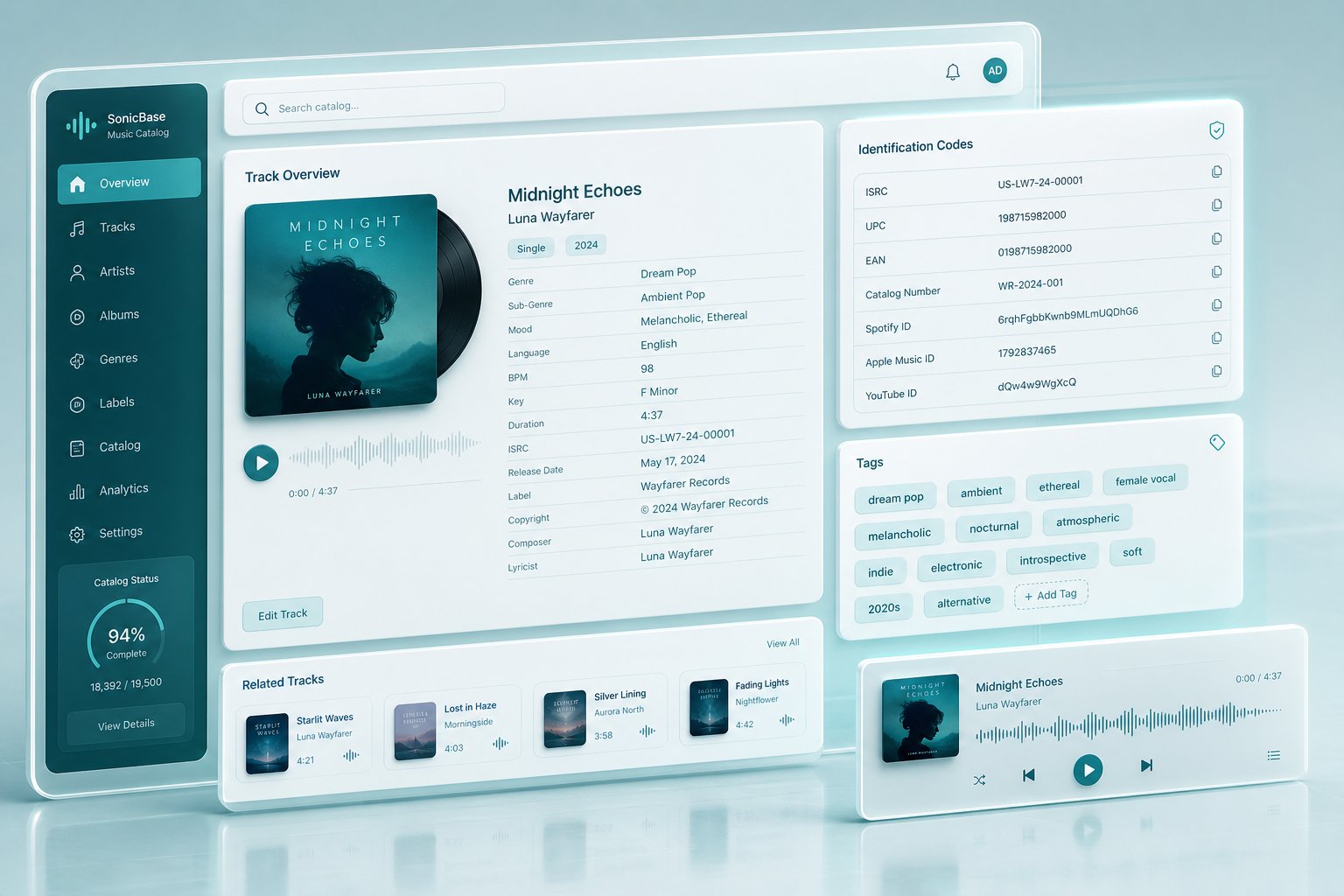
Metadata is the invisible scaffolding that determines whether you get paid, get discovered, and keep your catalog clean for years to come. For AI music releases, the stakes are even higher. A single crediting mistake or missing identifier can mean lost royalties, split artist profiles, or a compliance flag that pulls your track offline. The good news? Getting it right is not complicated once you understand what each field does and how AI changes the equation.
ISRC and UPC Codes for AI Generated Tracks
Every track you release, whether human-produced or AI-generated, needs an ISRC (International Standard Recording Code). This 12-character identifier follows the format CC-XXX-YY-NNNNN and serves as your track's unique fingerprint across every platform, store, and royalty database worldwide. Without it, streaming platforms cannot attribute plays to the correct recording or pay the right people.
For AI music specifically, the ISRC rules stay the same as any other release:
- One unique ISRC per recording, forever. If you regenerate a track with a different prompt or remix your AI output, the new version gets a new ISRC.
- Never reuse an ISRC when re-uploading through a different distributor. The same exact audio file keeps its original ISRC. A modified version gets a fresh one.
- Your distributor assigns ISRCs automatically. DistroKid, TuneCore, and most others generate these at no extra cost during upload. You do not need to register separately unless you want to manage your own codes through your country's ISRC agency.
UPC barcodes work at the release level rather than the track level. Whether your release is a single with one AI-generated track or an album with twelve, it gets one UPC that identifies the entire package. A deluxe version or re-release with different tracklisting gets a new UPC. Again, your distributor handles this automatically.
The critical point for AI creators releasing at high volume: each release configuration needs its own UPC, and each unique recording needs its own ISRC. If you are uploading 20 AI singles a month through DistroKid, that is 20 UPCs and 20 ISRCs generated automatically. No additional cost, no manual registration required.
How to Credit AI in Your Release Metadata
Crediting gets trickier when AI is part of the creative process. Distributors handle the artist name field with specific expectations that affect how your profile appears on streaming platforms.
Artist name consistency matters more than anything. Use the exact same artist name on every release, every time. If you release under "Nova Sounds" on one track and "nova sounds" on another, platforms like Spotify may create separate artist profiles that split your streams, followers, and algorithmic data. This applies whether you are a human artist, an AI music project, or a hybrid.
You cannot list an AI tool as the primary artist. DistroKid and other distributors require a human or project name in the artist field. "Suno" or "Udio" cannot be your listed artist. However, you can use a project name or alias that represents your AI-assisted creative identity. Many creators build a distinct brand for their AI catalog separate from their human-produced work.
Songwriter and composer credits require legal human names. This is where AI music gets complicated. Since AI cannot legally be a songwriter under current copyright frameworks, the human who directed the creative process, whether through prompting, editing, arranging, or curating, is typically listed as the songwriter. If you wrote the lyrics yourself and used AI for composition, credit yourself as the lyricist and note AI involvement through your distributor's disclosure mechanism rather than the songwriter field.
For producer credits, list yourself if you made production decisions like selecting takes, arranging sections, mixing, or editing AI output. The DistroKid upload form now includes AI Credits fields where you can specify whether AI generated lyrics, vocals, instrumentals, or compositions. This information feeds into Spotify's AI Credits beta, which displays AI contribution details within Song Credits on mobile.
Splits and Royalty Management for AI Collaborations
When you think about song splits for AI music, here is the simplest reality: AI tools do not claim royalties. Suno, Udio, and ElevenLabs take zero percent of your streaming revenue on paid plans. There is no automatic revenue share flowing back to the AI platform when your track gets streamed. This means you keep 100% of whatever your distributor pays out.
Where splits become relevant is in human-to-human collaborations that also involve AI. Imagine you generate an instrumental with Suno, then a vocalist records original lyrics over it. The song splits between you and the vocalist need to be agreed upon before release, just like any other collaboration. The AI tool does not factor into the split calculation because it holds no legal claim to authorship or royalties.
Tools like Splitify and similar split management services help formalize these agreements. You set percentages for each collaborator, and royalties are distributed automatically based on the split you defined. For AI music publishing administration services, the process mirrors traditional publishing: register your songs with a PRO (ASCAP, BMI, SESAC) under your name as the songwriter, define splits with any human collaborators, and let the publishing administrator collect mechanical and performance royalties on your behalf.
One nuance worth noting. If your AI-generated track has no copyrightable elements because the AI did all the creative work without meaningful human input, registering it with a PRO may be rejected. Publishing administration services require a copyrightable composition to administer. This circles back to the human authorship threshold discussed earlier: the more creative control you exercised, the stronger your claim to publishing rights and royalty collection.
Genre and mood tagging round out your metadata setup. Tag accurately rather than strategically. Labeling your ambient AI track as "Pop" because pop has more listeners hurts your algorithmic performance. Platforms like Spotify use genre and mood data to power recommendation engines. An honestly tagged "Lo-Fi Electronic" track gets served to listeners who actually engage with that sound, which builds healthy streaming signals over time.
Here is your step-by-step metadata checklist for every AI music release:
- Confirm your artist name matches your existing streaming profile exactly, including spelling and capitalization.
- Verify your track title uses proper formatting with version info in parentheses where needed: "(AI Remix)," "(Instrumental)," or "(feat. Artist Name)."
- List all human songwriters by legal name with agreed-upon percentage splits finalized before upload.
- Check that your distributor assigns a unique ISRC for each recording and a unique UPC for the release.
- Complete the AI disclosure fields honestly, specifying whether AI generated lyrics, vocals, instrumentals, or composition.
- Tag the correct genre and sub-genre based on what the music actually sounds like, not what is most popular.
- Set your release date 2-4 weeks out to allow time for Spotify editorial pitching and pre-save campaigns.
- Confirm cover art meets specifications: 3000x3000 pixels minimum, no platform logos, no restricted text.
- Mark language and explicit content flags accurately to maintain playlist eligibility across regions.
- Document your AI workflow in a private release note: tools used, human contributions, rights status, and any collaborator agreements.
That last step, the private release note, is not required by any distributor. But as AI disclosure expectations evolve, having a clear record of how each track was made protects you if a platform ever asks questions months after release. Think of it as insurance that costs nothing but five minutes of your time.
Metadata and crediting handle the technical side of releasing AI music through traditional distribution channels. But not every creator needs that path. If your goal is original music for videos, podcasts, or commercial projects rather than building a streaming catalog, there is a simpler route that skips distributor policies entirely.
The Simpler Path for Content Creators Who Need AI Music Now
Everything covered so far, distributor policies, disclosure requirements, metadata fields, ISRC codes, and Content ID risks, applies to creators who want their AI music on streaming platforms. But here is the thing: a massive segment of creators asking "can you release AI generated music" are not trying to build a Spotify catalog at all. They need original background music for a YouTube video, a podcast intro, a client presentation, or an indie game. For these use cases, the entire distributor pipeline is overkill.
When your goal is content use rather than streaming distribution, the question shifts from "which distributor accepts AI music" to "which tool gives me royalty-free music I can use commercially without worrying about takedowns or claims?" That is a fundamentally simpler problem to solve.
Using AI Music in Videos and Podcasts Without Legal Risk
Content creators face a specific pain point. You need music that fits your project's mood, does not trigger copyright strikes, and does not require ongoing royalty payments or attribution in every video description. Traditional royalty-free libraries solve part of this, but they come with limitations: other creators use the same tracks, licensing terms vary per library, and the selection might not match your vision.
AI music generation eliminates those friction points. You describe what you need, the tool creates something unique, and you use it. No split tracks to negotiate, no publishing administration to manage, and no metadata disclosure forms to fill out. The music never enters a Content ID database unless you put it there, which means it cannot generate claims against your own videos.
What is a split track in this context? In traditional distribution, split tracks refer to stems or individual instrument layers exported separately for mixing flexibility. A stems app lets producers isolate vocals, drums, bass, and melody into separate files. For content creators, this technical production concept matters less than the licensing clarity. You do not need stems, splits, or ISRC codes to drop a background track under your YouTube video. You need a clean commercial license and a WAV or MP3 file.
The legal risk for content creators comes down to two scenarios: using AI music generated from a free tier that restricts commercial use, or using a tool that trains on copyrighted material without proper licensing. Both can result in claims months after you publish your content. The solution is choosing tools that explicitly grant full commercial rights and train on properly licensed or original audio data.
Free AI Music Generators That Grant Full Commercial Rights
For creators who want to skip distribution complexity entirely, MakeBestMusic's Free Music Generator offers a practical shortcut. It generates royalty-free music you can use in commercial projects without navigating the policy layers that streaming distribution demands. No distributor account needed. No disclosure forms. No Content ID registration. You generate the track, download it, and use it in your project with full commercial rights.
This approach works especially well for creators whose primary output is not the music itself but the content that music supports. You are building a YouTube channel, producing a podcast, developing an indie game, or assembling a pitch deck. The music is a component, not the product.
Here are the use cases where generating royalty-free AI music directly makes more sense than traditional distribution:
- YouTube videos and tutorials - unique background music that will never trigger a Content ID claim against your own channel
- Social media content - original audio for Instagram Reels, TikToks, and Shorts without platform music library restrictions
- Podcast intros and transitions - branded audio that distinguishes your show without recurring license fees
- Indie games and apps - original soundtracks generated to match specific gameplay moods without per-unit royalty obligations
- Commercial presentations and corporate videos - professional background music for client deliverables without attribution requirements
The key advantage here is simplicity. You are not managing an artist profile, tracking royalty statements, or wondering whether your distributor's AI policy changed last week. You generate music, own the output, and use it. For creators whose relationship with music is "I need it for my project" rather than "I want streams and listeners," this path removes every layer of complexity discussed in the previous sections.
That said, some creators straddle both worlds. You might generate background music for your videos while also releasing polished AI-assisted tracks to streaming platforms. In that case, you need a clear framework for deciding which path each piece of music takes, and a system for staying current as the rules keep shifting.
Your Action Plan for Releasing AI Music the Right Way
Policies are shifting on a quarterly basis. Distributor terms update without notice. Streaming platforms deploy new detection systems between one release and the next. The EU AI Act GPAI obligations begin enforcement on August 2, 2026, adding mandatory disclosure and watermarking requirements for anyone distributing AI-generated audio to European listeners. Courts are still deciding whether AI training on copyrighted music constitutes fair use. And yet, creators are releasing AI music every single day without issue.
The difference between those who succeed and those who get flagged, removed, or banned is not luck. It is a repeatable decision-making process. Here is the framework that keeps you on the right side of every policy, regardless of how fast the landscape shifts.
A Decision Framework for Releasing AI Music
Every piece of AI music you create needs to pass through the same five checkpoints before it goes live. Think of this as a routing system: your answers at each step determine whether your track belongs on streaming platforms, in your content projects, or nowhere at all until you resolve an issue.
- Determine your goal: streaming distribution or content use. This single question eliminates half the complexity. If you want streams, followers, and royalty income, you need a distributor, proper metadata, platform disclosure, and copyrightable human contribution. If you just need music for videos, podcasts, games, or presentations, you can skip the entire distributor pipeline and generate royalty-free music directly with a tool like MakeBestMusic's Free Music Generator. No ISRC codes, no disclosure forms, no Content ID risks against your own content.
- Check your AI tool's commercial rights. Were you on a paid plan when you generated the track? Does the ToS explicitly grant commercial distribution rights? Are there attribution requirements or exclusivity clauses? If you generated on a free tier, stop here. You likely cannot distribute or monetize that output without upgrading and regenerating.
- Select the appropriate distributor or licensing path. For streaming releases, match your workflow to a distributor whose policy fits. DistroKid AI policies allow fully AI-generated content with disclosure. TuneCore accepts AI with detailed transparency. CD Baby rejects fully AI-generated tracks. For content use, bypass distributors entirely and work with tools that grant direct commercial licenses.
- Prepare proper metadata and disclosure. Complete every AI disclosure field your distributor offers. Credit human songwriters by legal name. Confirm your ISRC and UPC are unique to this recording and release. Tag genre accurately. Document your workflow privately in case a platform requests verification later.
- Monitor for policy changes quarterly. Set a calendar reminder every three months to check your distributor's current AI terms, review any new streaming platform requirements, and verify that your AI tool has not updated its ToS in ways that affect previously generated tracks. The EU AI Act enforcement timeline alone will reshape disclosure expectations across every global distributor by late 2026.
Most creators stall at step one because they have not clearly defined what they want from their AI music. A hobbyist experimenting with Suno who just wants friends to hear their tracks has different needs than a YouTuber who needs 30 seconds of background music for a tutorial. Clarifying your goal first saves you from over-engineering the process.
Staying Current as Policies Evolve
The best distributor for AI music today might not hold that position six months from now. DistroKid AI policies could tighten. TuneCore could simplify their disclosure process. A new platform like distribute.ai could emerge with AI-native distribution infrastructure that none of the incumbents offer. The regulatory environment is actively evolving in multiple jurisdictions simultaneously.
Here is what is concretely changing in the near term:
- EU AI Act GPAI enforcement (August 2026) - AI music tool providers like Suno and Udio must publish training data summaries. AI-generated audio must carry machine-readable watermarks. Distributors operating in EU markets must collect disclosure declarations at upload. Non-compliance carries fines up to EUR 15 million or 3% of global turnover.
- Apple Music Transparency Tags (live now) - Tracks are labeled by AI involvement level: human-authored, AI-assisted, AI-collaborated, or fully AI-generated. Tags are visible to listeners on the now-playing screen.
- Platform detection improvements - Both Apple Music and Deezer have deployed AI-detection systems in their ingestion pipelines. A track declared as human-authored that scores high on AI detection is increasingly likely to be flagged, relabeled, or removed.
- Ongoing litigation outcomes - The RIAA lawsuits against Suno and Udio, the $3 billion UMG case against Anthropic, and the UK government's reversal on AI training opt-outs all signal that the legal floor is shifting toward stricter protections for human creators.
Staying informed does not require reading legal filings. Follow your distributor's blog or changelog, check streaming platform newsrooms quarterly, and track music industry publications like Music Business Worldwide or Digital Music News. When a policy changes, revisit your catalog and update any declarations that no longer reflect reality.
For content creators whose primary goal is not streaming distribution but rather generating usable music for projects, the simplest way to future-proof your workflow is to use tools that keep you outside the distribution compliance chain entirely. MakeBestMusic's Free Music Generator gives you royalty-free output with commercial rights attached. No distributor middleman means no distributor policy to violate, no platform disclosure to miss, and no quarterly terms-of-service audit to worry about. You generate, you download, you use it. Done.
Whether you choose the streaming path or the content-use path, one principle holds across every jurisdiction, every platform, and every policy update cycle:
The more human creative contribution you bring to AI-generated music, the stronger your copyright claim, the fewer policy barriers you face, and the more sustainable your releases become as regulations tighten. AI is a tool. Your creativity is the product.
That is the through-line connecting every section of this guide. Distributor policies reward human involvement. Streaming platforms prioritize it. Copyright law requires it. And listeners, whether they know it or not, respond to the intentionality behind music that a person shaped, even when AI helped bring it to life.
You now have the full picture: which distributors accept AI music and under what conditions, how different types of AI use carry different implications, what your AI tool's ToS actually permits, what streaming platforms require for disclosure, how to handle metadata and crediting, and when to skip the entire distribution pipeline in favor of direct generation for content projects. The rules will keep changing. Your framework for navigating them does not have to.
