

The Real Answer to Copyrighting AI-Generated Music
The Direct Answer Every Creator Needs
Can you copyright AI music? If a song is fully generated by artificial intelligence with no meaningful human creative input, the answer is no. However, if you use AI as a tool while contributing substantial original authorship — writing lyrics, composing melodies, arranging instrumentation — your work can qualify for copyright protection.
That distinction might sound simple, but it carries enormous weight for anyone making music today. Whether you're a bedroom producer experimenting with AI beat generators, a songwriter using machine learning to spark lyrical ideas, or a content creator who needs background tracks for videos, the copyright status of your music determines whether you can legally prevent others from copying, distributing, or profiting from it.
Copyright protects the original expression in a work created by a human author, even if the work also includes AI-generated material.
That principle, stated directly by the U.S. Copyright Office, is the foundation everything else builds on. Is AI music copyrighted by default? No. Can AI music be copyrighted when a human shapes and transforms it? Yes — as long as those human contributions meet the threshold of "meaningful human authorship."
Why This Legal Question Affects Your Music Career
Imagine spending weeks refining an AI-assisted track, releasing it on streaming platforms, and watching it gain traction — only to discover someone else has copied it wholesale and you have no legal recourse. Without copyright protection, your music sits in the public domain. Anyone can use it, remix it, or monetize it without your permission.
This isn't a hypothetical scenario. As AI music tools become standard in production workflows, the line between protected and unprotected work grows increasingly critical. Musicians who understand where that line falls can structure their creative process to land on the right side of it. Those who don't risk building careers on a foundation they can't legally defend.
The legal landscape is still developing. The U.S. Copyright Office released Part 2 of its AI report in January 2025, specifically addressing copyrightability of AI-generated outputs. Courts are weighing in. International jurisdictions are taking divergent approaches. What remains constant is the core requirement: human creativity is the gateway to protection.
This article walks through what "meaningful human authorship" actually requires in a music context, how common AI workflows stack up against that standard, how to register AI-assisted compositions, what different countries allow, and practical steps you can take right now to protect your work — regardless of how the law continues to evolve.
What Meaningful Human Authorship Actually Means for Musicians
"Meaningful human authorship" isn't just legal jargon — it's the single test that determines whether your AI-assisted track gets copyright protection or falls into the public domain. The U.S. Copyright Office uses this standard as its threshold when evaluating works that involve artificial intelligence in music creation. If your human contributions clear the bar, you're protected. If they don't, anyone can use your music without permission or payment.
So what does this standard actually require? Think of it this way: copyright protects creative expression, not mechanical output. The question Copyright Examiners ask on a case-by-case basis is whether a human determined the expressive elements of the work — the choices that make the music sound the way it does.
What Counts as Meaningful Human Authorship in Music
The Copyright Office's January 2025 report clarifies that using AI to assist in creation does not bar copyrightability. What matters is whether human creativity drives the expressive result. In musical terms, this means the arrangement of notes, melodies, chords, lyrics, and the underlying compositional decisions that shape a song.
Imagine you're using AI to write song lyrics but then rewriting, restructuring, and adding your own verses until the final product reflects your voice and intent. That layering of human judgment — selecting what works, discarding what doesn't, shaping the emotional arc — is exactly what the Copyright Office looks for. You're not just instructing a machine; you're authoring a work.
The report draws a clear distinction between using AI as a stand-in for human creativity (not protectable) and leveraging AI to assist in the creation of works (protectable). Prompts alone don't confer copyright on the output because they function more like abstract ideas or suggestions — similar to someone who merely pitches a concept to a collaborator but does none of the actual composing.
Activities That Likely Qualify vs Those That Do Not
The gap between protectable and unprotectable ai music copyright claims comes down to creative control. Here's how common music production activities stack up against the meaningful human authorship standard:
| Likely Qualifies for Copyright | Likely Does NOT Qualify |
|---|---|
| Composing original melodies and layering them over AI-generated backing tracks | Typing a text prompt like "upbeat pop song in C major" and publishing the raw result |
| Writing and refining lyrics, even if AI generated an initial draft | Selecting an AI-generated track from multiple options without any modification |
| Arranging instrumentation, choosing voicings, and structuring song sections | Using AI to create a full composition and releasing it unedited |
| Making expressive decisions about harmony, rhythm, dynamics, and tempo | Adjusting only technical parameters like BPM or key signature in a prompt |
| Uploading your own composition into AI and directing specific alterations | Regenerating outputs until one "sounds good" without further creative input |
Notice the pattern. Every qualifying activity involves a human making creative decisions that shape the final expression. Every non-qualifying activity delegates those expressive choices to the machine.
One important nuance: these interpretations are evolving. The Copyright Office has acknowledged that as AI tools develop greater user control, the analysis may shift. But the core principle remains stable — if you want protection, you need to be the one making the musical choices that listeners actually hear. The more creative decisions you personally make throughout the production process, the stronger your claim becomes.
This naturally raises a practical question: where exactly do common AI music workflows fall on this spectrum, and how can you structure your process to land on the protectable side?
Can You Publish a Song Written by AI?
Copyright eligibility isn't binary — it exists on a sliding scale tied directly to how much creative work a human actually does. Two producers can use the exact same AI tool and end up with completely different legal outcomes depending on their workflow. One walks away with a protectable composition. The other holds a track that anyone in the world can copy freely.
Understanding where your process falls on this spectrum is the difference between owning your music and hoping nobody takes it.
Common AI Music Workflows and Their Copyright Status
Let's look at real scenarios creators face every day, ranked from strongest copyright claim to weakest. Each one reflects a different level of human creative involvement — and a different legal outcome.
- Human composition with AI-powered mixing and mastering. You write the melody, lyrics, chord progressions, and arrangement entirely yourself. You then run the finished composition through an AI mastering tool to polish the final mix. Copyright status: almost certainly protectable. The AI handled technical processing, not creative expression. Every expressive element came from you. This is comparable to using a compressor or EQ plugin — tools that execute your vision without making artistic decisions.
- Original vocals and lyrics over an AI-generated backing track. You prompt an AI tool to generate an instrumental beat or chord progression, then write and perform your own vocals, melody, and lyrics on top. Copyright status: likely protectable for your human-authored elements. Your original melody, lyrics, and vocal performance carry human authorship. The AI-generated instrumental beneath them likely does not qualify independently, but your layered contributions create a work with copyrightable expression. The more you modify or arrange the backing track, the stronger the overall claim.
- AI-generated draft substantially reworked by a human. You use AI to produce a rough song, then rewrite the lyrics, restructure verses, change the melody in key sections, and re-record portions with live instruments. Copyright status: likely protectable, depending on the extent of transformation. Your creative reworking adds the human authorship the original output lacked. Documentation of what you changed and why becomes critical here.
- Selecting and combining multiple AI outputs with creative intent. You generate dozens of AI clips, then cut, splice, layer, and arrange them into a cohesive composition — making deliberate choices about structure, pacing, and emotional arc. Copyright status: uncertain but arguable. Selection and arrangement can constitute authorship under copyright law, but you'll need to demonstrate that your curatorial choices rose above merely picking favorites. The creative decisions must be expressive, not just administrative.
- Prompting AI for a full song and publishing it unmodified. You type a detailed prompt — perhaps specifying genre, mood, tempo, and instrumentation — and release whatever the AI generates without changes. Copyright status: almost certainly not protectable. No matter how detailed or clever the prompt, the U.S. Copyright Office has made clear that prompts do not constitute authorship of the resulting output. The expressive choices were made by the machine, not you.
The Spectrum from Prompt-Only to Deeply Human-Guided
The pattern here is straightforward: every layer of genuine human creative decision-making you add pushes your work further toward protection. Selection, arrangement, modification, original expression layered on top — these are the actions that build a copyright claim. Pressing "generate" and clicking "publish" does not.
This is worth emphasizing because online communities — particularly on Reddit — frequently discuss using a music AI creator without copyright restrictions as though the absence of copyright is purely liberating. The reasoning goes: if no one owns AI-generated music, anyone can use it freely, remix it, or build on it without legal friction.
That's partially true, but the flip side is equally important. If you publish a song written entirely by AI, you can't stop anyone else from taking that exact track and monetizing it as their own. There's no infringement claim you can bring. There's no DMCA takedown you can file. As content creators have already discovered, someone else can register your AI-generated track with Content ID services, and suddenly your own videos receive copyright claims on music you thought was yours.
The "no copyright restrictions" framing only works if you genuinely don't care whether your music is exclusively yours. For hobbyists sharing tracks casually, that might be fine. For anyone building a brand, releasing commercially, or depending on music revenue — it's a serious vulnerability.
Platforms like Riffusion debut songs generated through AI diffusion models, offering creators fast production tools. But speed of creation doesn't change the legal calculus. What matters isn't how the music was made or how quickly — it's whether a human author shaped the expressive result.
So can you publish a song written by AI? Absolutely — nothing stops you from releasing it. But "publishable" and "protectable" are two very different things. You can distribute AI music on any platform that permits it. You just can't prevent the rest of the world from doing whatever they want with it unless your own creative fingerprint is genuinely embedded in the work.
For creators who want both the efficiency of AI tools and the security of legal protection, the path forward is clear: use AI as a starting point, then build something unmistakably yours on top of it. The next question becomes practical — how do you actually register that kind of hybrid work with the Copyright Office?
How to Copyright AI Music
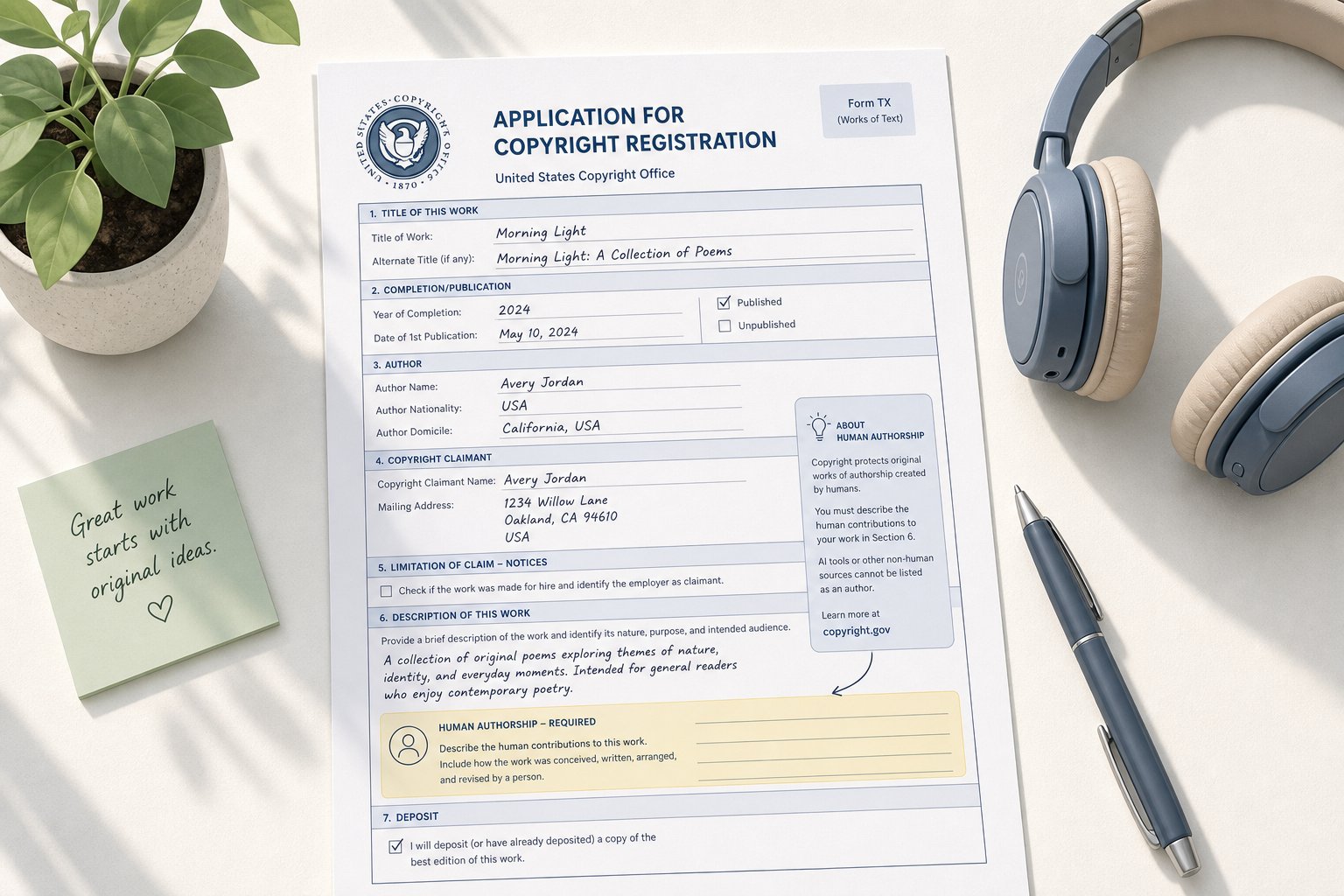
Knowing your AI-assisted composition qualifies for protection is one thing. Actually filing the registration correctly is another. The U.S. Copyright Office has specific requirements for works that incorporate AI-generated material, and getting the application wrong — or omitting key details — can undermine your protection entirely.
Here's the good news: the process isn't dramatically different from a standard copyright registration. You'll use the same online system. The key difference is a disclosure obligation that didn't exist before March 2023.
Step-by-Step Registration for AI-Assisted Compositions
If you're wondering how to copyright AI music that includes your own human authorship, follow this process:
- Confirm your work contains copyrightable human authorship. Before filing, honestly assess whether your creative contributions meet the meaningful human authorship standard. Did you compose melodies, write lyrics, arrange instrumentation, or make expressive decisions that shaped the final song? If yes, proceed.
- Access the Copyright Office's Registration Portal. Visit the online registration system and select the appropriate category — typically "Performing Arts" for musical compositions or "Sound Recordings" for recorded tracks.
- Identify yourself as the human author. In the Author section, list yourself (or your human collaborators) as the author. Do not list an AI tool as an author or co-author. AI systems cannot hold authorship under U.S. law.
- Describe your human-authored contributions in the "Author Created" field. Be specific. Rather than writing something vague like "music," describe exactly what you created: "original melody, lyrics, vocal performance, and arrangement of song sections." The more precise your description, the clearer the scope of your claim.
- Disclaim AI-generated material in the "Material Excluded" or "Limitation of Claim" field. This is the critical step unique to AI-assisted works. You must identify which elements were generated by AI — for example, "AI-generated instrumental backing track" or "AI-generated harmonic progression." This tells the Copyright Office exactly what you are not claiming.
- Upload your deposit copy. Submit the finished work — either a recording or sheet music notation, depending on what you're registering.
- Pay the filing fee and submit. The standard online registration fee is $65 for a single work by one author. Group registrations and other filing types carry different costs, so budget accordingly if you're registering an album of AI-assisted tracks.
How to Describe AI Involvement on Your Application
Accuracy matters more than length here. You don't need to write an essay about your creative process, but you do need to be truthful and specific. Think of it as drawing a clear boundary between what's yours and what the machine produced.
Strong descriptions look like this:
- "Author created: original lyrics, vocal melody, and arrangement of verse/chorus structure. Material excluded: AI-generated instrumental beat."
- "Author created: musical composition including melody, harmony, and rhythmic patterns. AI tool used for initial chord suggestions, which were substantially modified by the author."
- "Author created: sound recording including original vocal performance, guitar parts, and mixing decisions. AI-generated drum pattern excluded."
Vague descriptions like "I used AI for some parts" or "human-authored music" without specifics may trigger follow-up questions from a Copyright Examiner — or worse, leave your registration vulnerable to challenge.
What Happens If You Fail to Disclose AI Use
This is where many creators make a costly mistake. Skipping the AI disclosure — whether intentionally or through ignorance of the requirement — puts your entire registration at risk.
The consequences are real and documented. The Copyright Office has already canceled registrations where applicants failed to disclose AI-generated content. In the well-known Zarya of the Dawn case, the Office learned through social media that a registered comic book contained AI-generated images the applicant hadn't disclaimed. The original registration was canceled and replaced with a narrower one covering only the human-authored text and arrangement.
Beyond administrative cancellation, the legal exposure runs deeper. According to legal analysis from Finnegan, courts can decline to enforce a copyright if the registration contains material inaccuracies. An adverse party in litigation can challenge your registration's validity and request the court refer the matter back to the Copyright Office under 17 U.S.C. Section 411(b). And knowingly making false statements on a copyright application is punishable by a fine of up to $2,500.
The disclosure requirement is retroactive. If you've already registered a work containing AI-generated material without disclaiming it, you should file a supplementary registration to correct the record.
The cost for music copyrights on an AI-assisted album adds up when you factor in individual registrations at $65 each, though group registration options can reduce per-work costs. Weigh that against the alternative: releasing unregistered work and having no legal standing to enforce your rights if someone copies it.
One final note — this guidance reflects current Copyright Office policy as of early 2025. The Office continues publishing its multi-part AI report, and regulatory frameworks are actively developing. Registration requirements could become more detailed or shift as case law accumulates. Staying current with copyright music AI news from the Office directly is the safest way to ensure your filings remain valid as standards evolve.
Registration secures your rights domestically. But music travels across borders instantly, and not every country applies the same rules. The protections you've just filed for in the U.S. may not follow your tracks overseas.
How Different Countries Handle AI Music Copyright
Your AI-assisted track is registered with the U.S. Copyright Office. It's streaming globally within minutes. But here's the uncomfortable question: does your American copyright registration mean anything when a company in London samples your work, or a label in Tokyo redistributes it without permission?
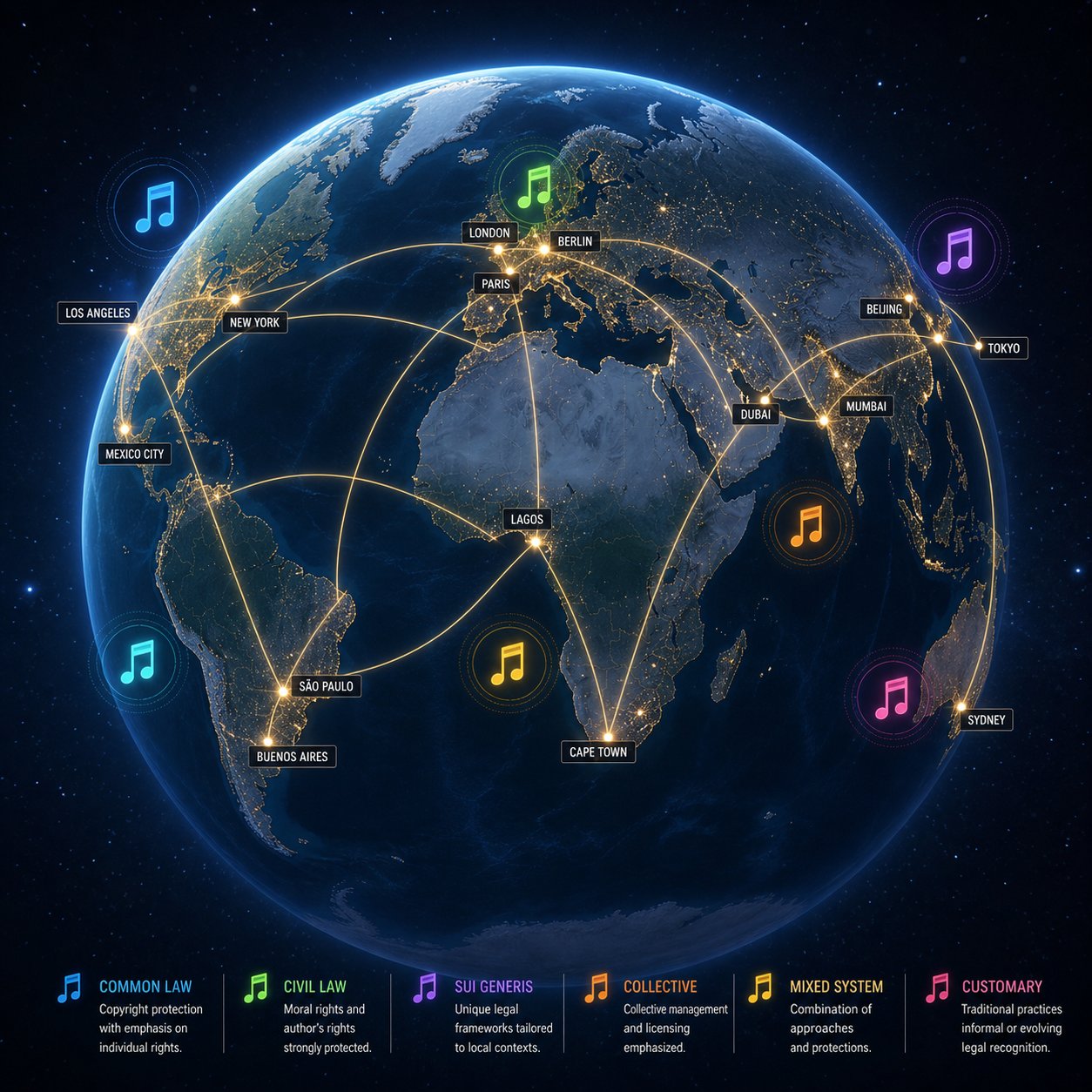
The short answer is that copyright protection is territorial. Each country applies its own rules to determine whether a work qualifies — and those rules diverge significantly when AI is involved. Staying informed on ai music copyright news today means tracking multiple legal systems simultaneously, because a single international release can fall under half a dozen different frameworks.
United States and the Human Authorship Requirement
The U.S. position is the clearest and most documented. The Copyright Office requires human authorship as a non-negotiable prerequisite for registration. Works generated entirely by AI receive no protection. Works that blend AI-generated material with substantial human creative expression can be registered — but applicants must disclose which elements are AI-generated and describe their own contributions. Court decisions in Thaler v. Perlmutter and the Zarya of the Dawn registration review have reinforced this human-authorship standard at both the administrative and judicial levels.
The UK Exception for Computer-Generated Works
The United Kingdom stands apart from nearly every other jurisdiction. Section 9(3) of the Copyright, Designs and Patents Act 1988 (CDPA) explicitly extends copyright to "computer-generated works" that have no human author. Under this provision, the person who made "the arrangements necessary" to create the work is treated as the author.
Sounds like a loophole for AI music? Not so fast. As legal analysis from IP Aware explains, the provision faces serious tension with the originality requirement that UK courts continue to apply following EU case law. The originality test demands that a work be an "intellectual creation" bearing the author's personal touch — something inherently difficult to square with fully autonomous AI output.
The UK Intellectual Property Office's 2024 consultation invited views on whether to repeal section 9(3) entirely, citing little evidence it stimulates AI innovation and noting the contradiction with human-centered originality principles. A decision on its future is expected soon. For creators, this means the UK's seemingly protective framework for AI music may not survive the current regulatory cycle.
EU AI Act and Transparency Obligations
The European Union takes a different angle. Rather than redefining copyright eligibility, the EU AI Act imposes transparency and compliance obligations on providers of general-purpose AI models. Since August 2025, these providers must publish summaries of training data and ensure compliance with EU copyright law — including respecting opt-out reservations from rights holders whose works were used in training.
The final EU AI Act Code of Practice, released in July 2025, requires signatories like Google, Microsoft, and OpenAI to mitigate risks of generating copyright-infringing outputs and only crawl lawfully accessible content. For musicians, this doesn't directly grant copyright to AI outputs, but it does create a legal environment where AI platforms face accountability for how they train on and reproduce copyrighted music.
Copyright eligibility for AI-generated works in EU member states still falls under national laws, most of which — like France and Germany — require human intellectual creation. The AI Act layers transparency on top of existing copyright frameworks rather than replacing them.
Emerging Positions in Other Jurisdictions
Japan, Canada, and Australia are each navigating this terrain with different emphases. Japan's copyright law requires "creative expression of thoughts or sentiments," which courts have traditionally interpreted as requiring human mental activity. Canada's Copyright Act protects works by "authors," a term courts have linked to human creators, though no definitive ruling on AI outputs has been issued. Australia's courts similarly tie authorship to human intellectual effort, with the Acohs v. Ucorp precedent establishing that a work needs a human author to attract copyright.
Here's how these jurisdictions compare at a glance:
| Country/Region | AI Music Copyright Eligibility | Disclosure Requirements | Who Owns the Rights |
|---|---|---|---|
| United States | Only human-authored elements protected; fully AI-generated works ineligible | Mandatory disclosure of AI-generated content on registration | Human author(s) who contributed creative expression |
| United Kingdom | Section 9(3) CDPA technically covers computer-generated works, but faces likely repeal | No formal disclosure requirement currently | Person who made "arrangements necessary" for creation |
| European Union | Generally requires human intellectual creation under national laws | AI Act mandates training data transparency from AI providers (since August 2025) | Human creator under national copyright law |
| Japan | Requires human "creative expression of thoughts or sentiments" | No specific AI disclosure regime for copyright registration | Human author; no protection for purely AI outputs |
| Canada | Likely requires human authorship; no definitive court ruling yet | No AI-specific disclosure requirement | Human author under Copyright Act |
The practical takeaway is stark: protection in one country does not guarantee protection elsewhere. A track that qualifies for U.S. copyright because you layered original vocals over AI-generated instrumentation might receive broader theoretical protection under the UK's current section 9(3) — or it might receive narrower protection in a jurisdiction that refuses to recognize any AI-involved component.
For musicians distributing internationally, this patchwork means you can't assume a single registration covers you globally. Music copyright ai news continues to shift as consultations close and new legislation passes. The safest strategy remains maximizing your demonstrable human authorship in every work — because that's the one standard virtually every jurisdiction recognizes.
Legal frameworks tell you what's protectable. But there's another layer of rights that often surprises creators: the terms of service on the AI platform you used to make the music in the first place.
AI Music Platform Terms and What They Mean for Ownership
You generated a track using an AI music tool. The platform says you "own" it. You release it, collect streaming revenue, and assume everything is settled. But what does that ownership claim actually mean — legally? And does it hold up if someone challenges you?
Platform terms of service create a contractual layer of rights that exists independently from copyright law. These two systems can say very different things about the same piece of music. Understanding where they align — and where they contradict each other — is essential for any creator planning to monetize, license, or distribute AI-generated tracks.
Platform Terms That Grant Full Ownership to Users
Some top AI platforms for lyrics and writing offer what appears to be the cleanest deal: you pay for a subscription, and the platform assigns full ownership of the output to you. Suno is a prominent example. Under its Pro and Premier plans, paid subscribers receive assignment of Suno's rights in their output, along with a commercial use license that allows monetization.
Sounds straightforward. But there's a critical distinction buried in the details. As copyright attorney Farley I. Weiss explains, "ownership under SUNO's terms is separate from federal copyright protection." The platform can transfer whatever contractual rights it holds — but it cannot grant you copyright protection that the law doesn't recognize in the first place.
If your track was generated entirely by AI without meaningful human authorship, you may "own" it under the platform's terms while simultaneously holding zero enforceable copyright. You could monetize it commercially — no one at Suno will stop you — but you couldn't file a DMCA takedown against someone who copies it. The platform gave you permission to use the output. The law didn't give you exclusive rights over it.
Free-tier users face an even more restricted situation. On Suno's Basic free plan, the platform retains ownership and limits use to non-commercial purposes only. You can't monetize tracks created under that tier regardless of how much human creativity you added.
Shared Rights and License-Only Models
Not every platform takes the full-ownership approach. Some retain shared rights or grant only usage licenses without transferring ownership at all. These models are common among platforms like Sonoteller, MusicFlow, and other AI composition tools that position themselves as creative assistants rather than production studios.
Under a shared-rights model, the platform typically reserves the right to use your output for purposes like AI training, service improvement, or promotional materials. Suno's TOS, for example, grants itself a "broad, perpetual license to use Submissions and Output for service improvement, including AI training" — even while assigning ownership to paid users. That means your track might train the next version of the model, and other users could receive outputs influenced by your work. Ownership doesn't equal exclusivity in this context.
License-only models are more restrictive still. The platform doesn't claim you own anything. Instead, it grants you permission to use the generated content under specific conditions — often limited by where you can publish, whether you can sublicense, and how the content can be modified. Think of it like renting rather than buying. You have usage rights, but the underlying asset isn't yours.
As Artlist's licensing guide puts it: "Most AI tools don't give you ownership. They give you permission to use what you create, and that permission can change depending on how and where the content is used." A track licensed for social media posts might not be licensed for advertising. A composition you can use in personal projects might require an upgraded tier for client work.
Reading the Fine Print Before You Publish
The tension here is real and often misunderstood. A platform can say "you own this" in bold text on its marketing page while its actual TOS quietly reserves training rights, limits commercial contexts, or disclaims any guarantee that the output qualifies for copyright. These aren't contradictions from the platform's perspective — they're operating within their contractual authority. But for creators, the gap between marketing language and legal reality can be expensive to discover after the fact.
Before publishing or monetizing any AI-generated music, ask these questions about the platform you're using:
- Does the platform assign ownership outright, or only grant a usage license?
- Are commercial rights included in your subscription tier, or restricted to higher plans?
- Does the platform retain rights to use your output for training, marketing, or other purposes?
- Can the platform sublicense or redistribute your output to other users?
- Does the TOS disclaim copyright vesting — meaning the platform explicitly says it can't guarantee your output is copyrightable?
- What happens to your rights if the platform changes its terms or shuts down?
- Are there restrictions on using the output in competing AI services or products?
That last point catches people off guard. Suno's terms, for instance, explicitly prohibit using output to "compete with Suno" or to "train competing AI models with service data." Your ownership has boundaries the platform defines contractually, even if copyright law isn't involved.
Here's the bottom line: platform terms determine what you're allowed to do with AI-generated music. Copyright law determines what you can prevent others from doing with it. These are two separate questions, and the answer to one doesn't determine the answer to the other. A platform granting you full commercial rights is valuable — it means you can release, stream, and profit from the track without violating the platform's rules. But it doesn't mean a competitor can't legally copy your unprotected output if it lacks human authorship.
For creators who want both commercial usage rights and legal enforceability, the strategy is the same one that runs through every layer of this discussion: add enough genuine human creativity to the work that copyright law protects it independently of whatever the platform's terms say.
That still leaves a practical gap, though. What about creators who need usable music right now — commercially, at scale — and don't necessarily need exclusive copyright ownership? The answer lies in licensing models that sidestep the ownership question entirely.
Licensing and Monetizing AI Music Without Full Copyright
Here's a reality most copyright discussions skip over: you don't need to own copyright in a piece of music to use it commercially. Copyright ownership and usage rights are two separate things. Ownership gives you the power to prevent others from using your work. Usage rights give you permission to do something specific with a work — publish it, monetize it, sync it to video — regardless of who holds the underlying copyright.
For thousands of content creators, podcasters, game developers, and video producers, the question isn't really "can you copyright music made by AI?" It's "can I use this track in my project without getting sued or demonetized?" The answer to that second question is often yes — as long as the licensing is clear.
Using AI Music Commercially Without Traditional Copyright
Think about royalty-free stock music libraries that have existed for decades. You pay a license fee (or sometimes nothing at all), and you get permission to use the music in specified commercial contexts. You never own the copyright. You don't need to. The license is what grants your usage rights.
AI-generated music works the same way when the platform's terms explicitly authorize commercial use. If a tool grants you a royalty-free commercial license on its output, you can legally embed that music in YouTube videos, podcast episodes, mobile games, advertisements, and social media content — even if the underlying track has no copyright protection at all.
The distinction matters practically. Here are legitimate ways to monetize or use AI-generated music without holding full copyright protection:
- Platform-granted commercial licenses: Many AI music tools include commercial usage rights in their terms, allowing you to publish and earn revenue from generated tracks across platforms.
- Royalty-free licensing: Some services provide AI-generated music under perpetual royalty-free licenses, meaning you pay once (or nothing) and use the track indefinitely without ongoing fees or revenue sharing.
- Creative Commons licensing: AI-generated music released under CC licenses (particularly CC0 or CC-BY) can be used freely in commercial projects, with attribution requirements varying by license type.
- Sync licensing for non-copyrighted works: You can still negotiate sync placements for AI music if you hold the master recording rights through platform terms — even without underlying composition copyright.
- White-label and background music services: Platforms like Melodia AI and others provide tracks specifically designed for commercial use in content creation, with clear licensing that removes legal ambiguity.
The key in every case is documentation. Save the license terms that applied when you generated or downloaded the music. Platforms change their TOS. If you can't prove what license governed your usage at the time of creation, you're vulnerable if a dispute arises later.
Royalty-Free AI Music for Content Creators
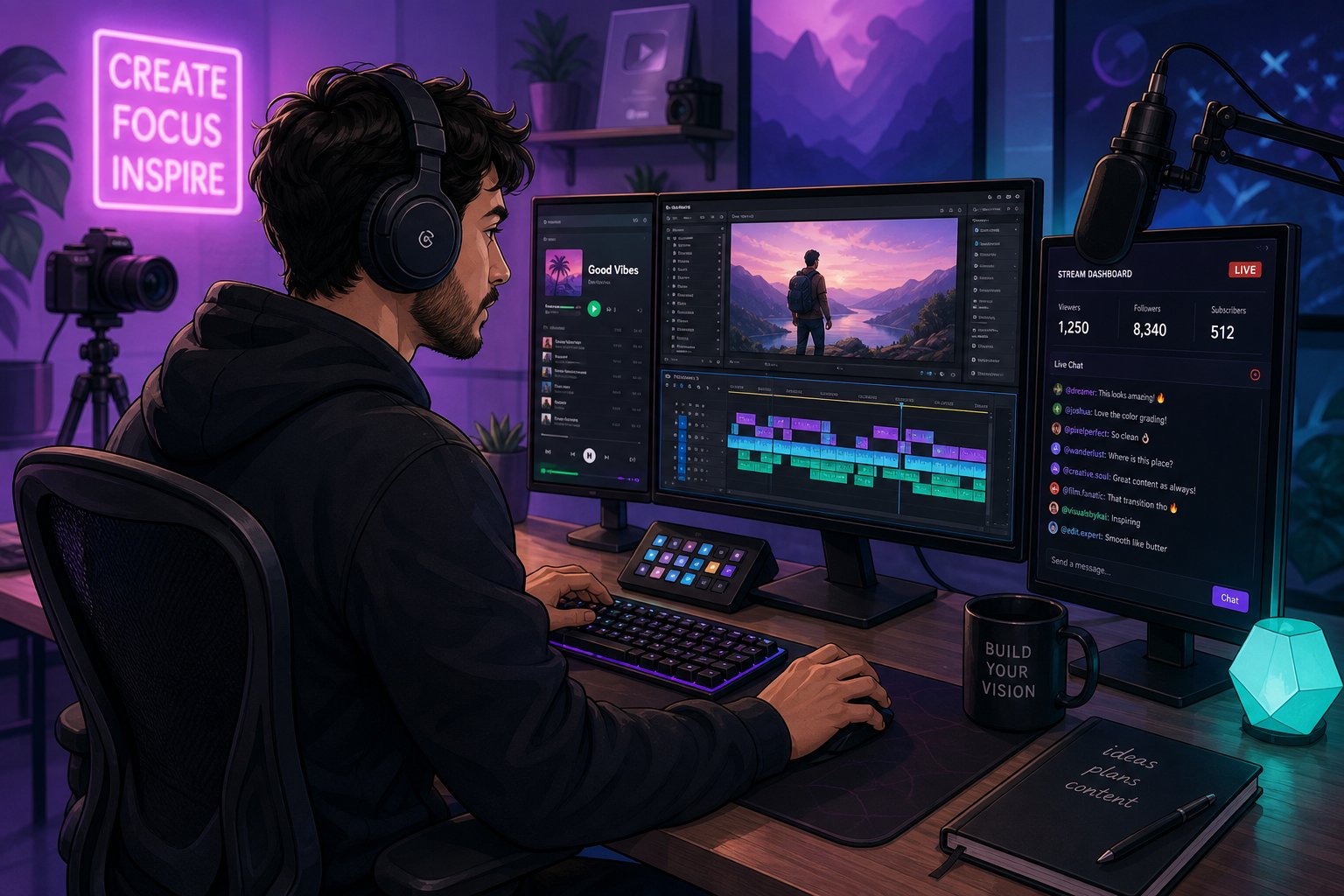
Imagine you're producing daily video content for a brand. You need fresh background music constantly, but licensing traditional tracks is expensive and time-consuming. Royalty-free AI music solves this at scale — no per-use fees, no sync clearances, no negotiations with publishers.
Tools like MakeBestMusic's Free Music Generator exemplify this approach. The platform provides royalty-free AI-generated music with clear commercial usage rights, making it particularly practical for video creators, podcasters, and game developers who need tracks they can freely use in commercial projects without navigating complex copyright questions. You generate what you need, confirm the license covers your use case, and publish.
This model works especially well for creators who don't need exclusive ownership of their background music. A YouTuber doesn't need to prevent others from using the same track — they need assurance that using it won't trigger a Content ID claim or a licensing dispute. Royalty-free AI tools provide exactly that assurance without requiring any copyright registration whatsoever.
For creators using platforms like Rightsify or LoudMe.ai, the same principle applies. What matters isn't whether the music qualifies for copyright protection — it's whether the platform's license explicitly authorizes your intended use. Commercial rights, attribution requirements, exclusivity terms, and distribution restrictions vary significantly between services. Read the terms for your specific tier and use case before building content around a track.
Streaming and Sync Licensing Considerations
Streaming platforms add another layer. As Landry PLLC explains, most distributors like DistroKid, TuneCore, and CD Baby allow AI-generated or AI-assisted tracks to be uploaded to Spotify, Apple Music, and YouTube Music. You can earn streaming revenue as the uploader of the recording even without traditional copyright registration — though some limitations apply.
The practical hiccups are worth knowing about. If your music isn't considered copyrightable because it was generated entirely by AI, you may not be able to register it with performing rights organizations (PROs) like ASCAP or BMI, which means certain publishing royalties won't flow to you. You can still earn from the recording side — the master royalties paid to whoever uploaded and controls the sound recording — but the composition royalties may be inaccessible.
Sync licensing presents a similar nuance. Brands and production companies licensing music for film, TV, or advertisements typically want clear rights chains. If you're offering AI-generated music for sync, you'll need to demonstrate that your platform terms authorize sync usage and that no third-party claims exist on the output. Some AI platforms explicitly prohibit sync licensing unless you're on a premium tier, so check before pitching tracks to music supervisors.
There's also the Content ID question. YouTube's Content ID system allows rights holders to claim revenue from videos using their music. If someone else registers an AI-generated track with Content ID — even one similar to yours — you could receive false claims on your own content. Without copyright registration backing your position, disputing these claims becomes significantly harder. This is one reason many creators prefer generating fresh tracks through royalty-free tools rather than pulling from shared AI music libraries where multiple users might access identical outputs.
The bottom line is pragmatic: you can build a sustainable creative business using AI-generated music without ever filing a copyright registration. What you can't do is prevent others from using that same music. For many creators — especially those using music as a supporting element rather than the primary product — that tradeoff is perfectly acceptable. The music serves the content. The content is what builds the brand.
But for creators who want both efficiency and exclusivity, there's a middle path: use royalty-free AI music as a foundation, then layer your own human creative expression on top. That combination gives you clear commercial usage rights from the platform and potential copyright protection from the law — covering both sides of the equation simultaneously.
Practical Steps to Protect Your AI-Assisted Music Today
Efficiency and legal security aren't mutually exclusive — but they don't happen by accident. Every strategy discussed so far converges on a single actionable principle: the more deliberately you document and demonstrate your human creative role, the stronger your position becomes, whether you're filing with the Copyright Office, defending against a Content ID dispute, or licensing your tracks for commercial use.
The legal landscape around AI music copyright is still forming. Regulations will shift. Court decisions will clarify gray areas. But the steps below protect you under current rules and position you well no matter which direction the law moves.
Document Your Creative Process Thoroughly
Think of documentation as your insurance policy. If your copyright registration is ever challenged — or if you need to prove authorship in a dispute — your creative records become your evidence. Without them, your word alone may not be enough.
What does effective documentation look like for AI music copyright training and production? Save everything that shows your creative decisions in action:
- Prompt iterations and refinements: Screenshot or export every prompt you tried, including the ones that didn't work. This shows intentional creative direction, not random generation.
- DAW project files with version history: Keep dated saves of your sessions. A project file that progresses from a raw AI stem to a fully arranged, mixed track is powerful evidence of human transformation.
- Lyric drafts and revisions: If you're wondering whether you own lyrics from a tool like Claude or another AI assistant, the answer depends on how much you reworked them. Save every draft showing your edits, rewrites, and original additions.
- MIDI files showing manual note placement: Any melody, chord voicing, or arrangement you programmed by hand — even if inspired by AI suggestions — constitutes human authorship worth documenting.
- Audio recordings of live performances layered over AI elements: Vocal takes, guitar parts, keyboard improvisations — these are unambiguous human contributions. Keep the raw recordings separate from the final mix.
- Notes explaining your creative reasoning: A simple text file noting why you chose a specific key change, why you restructured the bridge, or why you rejected an AI-generated chorus adds context that strengthens your authorship narrative.
Store these records somewhere durable. Cloud backups with timestamps, version-controlled folders, or dedicated project archives all work. The goal is creating an audit trail that any examiner, attorney, or judge could follow from initial concept to finished composition.
Strategies to Strengthen Your Copyright Claim
Documentation proves what you did. But the strength of your claim depends on what you actually contribute creatively. Here's a prioritized action list — ordered from most impactful to supplementary — for maximizing your legal protection:
- Write original lyrics and melodies yourself. These are the clearest forms of human authorship. Even if AI sparked the initial idea, composing the final melodic line and writing the words that listeners hear places you squarely in protectable territory.
- Arrange and structure the composition with deliberate creative intent. Decide how sections flow, where dynamics shift, which instruments enter or exit, and how tension builds. Arrangement choices are expressive decisions courts recognize as authorship.
- Substantially modify any AI-generated elements you use. Don't publish raw AI output. Edit chord progressions, rewrite phrases, alter rhythmic patterns, and reshape timbres until the result reflects your artistic judgment rather than the machine's default.
- Layer live performances over AI-generated foundations. Original vocal recordings, instrument performances, and even beatboxed rhythms all carry human authorship. The more live human expression in the final mix, the less the AI contribution dominates.
- Disclose AI involvement accurately on every registration. Transparent disclosure protects your registration from future invalidation. Describe what the AI produced and what you created. Honesty here is a legal safeguard, not a weakness.
- Register your work promptly. A filed registration with the U.S. Copyright Office creates a public record of your claim and is required before you can bring an infringement lawsuit. Don't wait until someone copies your track.
- Understand your platform's terms before releasing. Confirm that your subscription tier grants commercial rights, check whether the platform retains training licenses on your output, and verify sync and sublicensing permissions. Changing platforms later doesn't retroactively fix terms that applied at creation.
Smart Tools and Workflows for Protected Music Creation
The most practical workflow combines speed with legal defensibility. Use AI to accelerate the parts of production that don't require your personal creative fingerprint — initial sound design, reference track generation, rough demo creation — then invest your own artistry in the elements that make the song yours.
Tools like MakeBestMusic's Free Music Generator fit naturally into this approach. You can generate royalty-free AI music as a starting foundation — a backing track, a rhythmic bed, an atmospheric texture — then build your own original melodies, lyrics, and arrangements on top of it. The AI-generated layer gives you clear commercial usage rights from the platform. Your human-authored additions give you potential copyright protection from the law. Together, you get both the production efficiency of AI tools and the legal security of genuine authorship.
This layered method also sidesteps the uncertainty that tools like Lalai AI or fully automated generators introduce when creators rely on them for finished output. The less you depend on any single AI tool to make the final creative decisions, the less your legal position depends on how courts eventually rule on edge cases.
Stay informed as regulations develop. The U.S. Copyright Office continues releasing guidance. The EU AI Act's transparency provisions are actively being enforced. The UK may repeal its computer-generated works provision. Subscribe to Copyright Office updates, follow IP law developments, and revisit your workflow assumptions at least annually.
The creators who will be best positioned in two years are the ones building good habits now — documenting their process, layering genuine authorship into every project, and treating AI as a powerful instrument rather than a replacement for human creativity.
You can't control how fast the law evolves. You can control how much of yourself you put into the music — and how well you prove it.
