

AI Music Detection Is Not One Question but Three
How detectable is AI music? In a controlled lab, classifiers can identify AI-generated tracks with 99.8% accuracy. In the real world, simple post-processing like resampling or light mastering can drop that number close to zero. And to the average human listener? A 2025 Ipsos survey commissioned by Deezer found that 97% of people could not distinguish AI-generated music from human-made tracks. Three very different answers to what sounds like one question.
That spread is the entire story. When someone asks "is this song AI," they might mean any of three fundamentally different things, and each one has a different answer.
What Detectable Actually Means in Three Contexts
Think of detectability as three separate challenges stacked on top of each other:
- Human perception - Can your ears tell the difference? For most listeners, the answer is now no. AI generators have crossed the perceptual quality threshold where casual listening reveals nothing.
- Algorithmic classification - Can an ai music detector identify spectral artifacts, timing patterns, or frequency signatures that betray machine origin? Under ideal conditions, yes. Under real conditions, it depends entirely on what happened to the audio after generation.
- Platform metadata systems - Can streaming services and distributors flag a track using watermarks, upload behavior, account history, and embedded provenance data? This is the layer most creators never think about, yet it governs whether their music stays live.
When you try to check if a song is AI or want to know how to tell if music is ai generated, you are really asking across all three layers at once. Each layer has different strengths, different failure modes, and different implications for musicians.
The Gap Between Lab Results and Real-World Detection
Here is the tension that drives everything you will read in this article:
Lab classifiers achieve near-perfect accuracy on unprocessed AI audio, yet researchers found that common manipulations like pitch shifting or codec re-encoding can cause those same models to drop to nearly 0% detection, defaulting to labeling everything as human-made.
That gap between theoretical and practical detectability is not a minor footnote. It defines whether detection technology can actually protect human artists or whether anyone wanting to check music to see if its ai generated or not is working with fundamentally unreliable tools. The distance between what a classifier can do in a clean test environment and what it actually catches when someone applies basic audio edits is where the real conversation lives.
Understanding how each detection layer works, where it breaks down, and what that means for creators requires looking at the full technical picture.
How AI Music Detection Methods Actually Work
Detection tools do not all look for the same thing. Some analyze the raw audio signal for spectral fingerprints. Others check whether a hidden watermark was embedded at the moment of generation. Still others watch for suspicious patterns in how and when music is released. Each approach has a different philosophy, a different attack surface, and a different set of blind spots. To understand how detectable AI music really is, you need to understand how does ai music work at the generation level and what traces that process leaves behind.
The methods currently in use or development fall into four broad categories. Here is how they compare:
| Method Type | What It Analyzes | Strengths | Limitations |
|---|---|---|---|
| Watermarking and metadata fingerprinting | Hidden patterns or provenance data embedded during generation | High accuracy when intact; hard to forge without access to the model | Easily stripped by format conversion or re-recording; requires developer cooperation |
| Audio signal analysis (spectral, MIDI, embeddings) | Frequency artifacts, velocity distributions, compression signatures, learned audio embeddings | Works without any embedded data; can detect unknown generators | Sensitive to post-processing; can overfit to specific platform pipelines |
| Behavioral and contextual signals | Release cadence, artist history, account age, genre patterns | Resistant to audio manipulation; captures patterns no single track reveals | High false-positive risk for prolific human creators; easy to game with patience |
| Platform-level combined detection | Multiple signals simultaneously: watermarks + audio analysis + metadata + behavior | Most robust single approach; compensates for individual method weaknesses | Opaque to creators; inconsistent across platforms; resource-intensive to build |
Each category deserves a closer look, because the details determine whether a given ai audio detector will catch anything in practice.
Watermarking and Metadata Fingerprinting
Imagine a subtle pattern woven into the audio at the exact moment it is generated, invisible to your ears but readable by a machine. That is the core idea behind watermarking. Companies like Google with SynthID embed statistical signatures into audio outputs so that a detection algorithm can later confirm the content originated from their model. The concept is similar to how physical currency uses microprinting you cannot see without magnification.
The ambition is to fingerprint every ai song to identify it back to its source platform. In theory, if every generator embedded a unique watermark, ai song recognition would be as straightforward as scanning a barcode. In practice, several problems undermine this vision:
- Watermarks are not universal. Google's detector only identifies Google's watermark. Checking unknown content requires querying every known detection service individually.
- Simple audio transformations like resampling, re-encoding to a different codec, or even screencasting can strip or corrupt the embedded pattern.
- Open-source models can have watermarking code removed entirely, since users control the generation pipeline.
- There is no industry-wide coordination yet. Without a shared registry or standard, watermarking remains fragmented.
Content provenance frameworks like C2PA take a different angle, storing origin and modification history in file metadata secured by cryptography. This works well for cooperative actors who maintain the provenance chain but fails the moment someone screenshots, re-records, or simply strips the metadata before uploading to a distributor.
Audio Signal Analysis and Spectral Patterns
This is where music analysis ai gets technical, and where most academic research focuses. The premise: AI generators leave acoustic fingerprints in the audio itself, regardless of whether a watermark was embedded. These fingerprints show up in spectral patterns, frequency cutoffs, and the statistical distribution of musical events.
CLAP embeddings represent one of the more effective approaches. Sounds complex? Here is the simplified version. CLAP (Contrastive Language-Audio Pretraining) is a model that converts audio into a compact numerical representation, a 512-dimensional vector that captures the essential characteristics of a sound. Think of it like a musical DNA profile. Researchers at KTH Royal Institute of Technology demonstrated that feeding these embeddings into basic classifiers like support vector machines achieves detection performance comparable to far more complex systems. The reason it works: AI-generated audio from platforms like Suno and Udio clusters differently in this embedding space than human-made music from sources like the Million Song Dataset.
MIDI velocity patterns offer another revealing signal, particularly for symbolic music analysis. When a human pianist plays a piece, the velocity (how hard each key is struck) varies naturally with phrasing, emotion, and physical mechanics. No two notes land with identical force. AI generators, especially those working from text prompts or symbolic representations, tend to produce velocity distributions that are either unnaturally uniform or follow overly predictable patterns. Research published in Informatica showed that LSTM models trained on pitch, velocity, and duration features from MIDI data achieved 99% accuracy in detecting AI-generated classical music. The velocity feature was specifically highlighted as carrying meaningful variance that helps distinguish machine compositions from human ones.
Spectral artifacts round out the signal-level approach. AI platforms often generate audio at specific internal sample rates (sometimes lower, then upscaled to 48 kHz for output), and this upscaling introduces identifiable patterns in the high-frequency range. Researchers found that AI-detectable features exist primarily in the 0-4 kHz range for classification, while high-frequency artifacts above 10 kHz provide additional platform-specific signatures. Fixed bit rates (128 kbps for Suno, 256 kbps for Udio) also create compression artifacts distinct from the variable bit rates typical of commercial releases.
Behavioral and Platform-Level Detection
Not every ai music identifier looks at the audio itself. Behavioral detection examines the context surrounding a release: How many tracks did this account upload in the last week? Does the artist have a verifiable performance history? Is the release cadence humanly possible?
When a single account uploads 200 tracks in a month across 15 genres with no prior online presence, that pattern tells a story no spectrogram can. Platforms like Spotify and Deezer combine these contextual signals with technical analysis to build layered detection systems. This is why platform-level detection, the fourth category, tends to be more resilient than any single method alone. It cross-references watermark checks, audio analysis, metadata consistency, and behavioral flags to make a judgment.
The limitation? Opacity. Creators rarely know which signals triggered a flag or how to appeal. And a savvy operator who releases tracks at a human pace, builds a plausible artist profile, and applies light mastering to the audio can slip past behavioral filters entirely.
These four detection layers create a mesh rather than a wall. Each one catches a different type of AI-generated content, and each one has holes that the others partially cover. The real question is what happens when someone deliberately targets those holes, which is exactly what simple audio manipulation does to even the most confident classifiers.
Detection Accuracy in the Lab vs the Wild
The numbers from academic research look reassuring at first glance. Controlled experiments produce accuracy scores that suggest the problem of identifying AI-generated music is essentially solved. Then you deploy those same approaches against audio that has been lightly processed, resampled, or simply exported through a different codec, and the confidence collapses. The distance between these two realities is where creators, platforms, and researchers spend most of their time arguing.
What Academic Research Reports
A team at Deezer Research published the first general-purpose AI music detection study, training convolutional classifiers on real audio and autoencoded reconstructions from generators like Encodec, DAC, and MusicGen. Their amplitude-spectrogram model reached 99.8% accuracy on test data. When validated against 2,500 snippets of fully generated MusicGen tracks never seen during training, detection climbed even higher to 99.9%.
A separate study from KTH Royal Institute of Technology used CLAP embeddings with simple support vector machines on a 30,000-track dataset of Suno, Udio, and Million Song Dataset recordings. Their SVM achieved an F1 score of 0.969 for identifying AI music at the parent level. The commercial IRCAM Amplify detector reached even higher marks: perfect precision on non-AI music and 1.000 recall on AI tracks in the same sample set. These are not marginal improvements over guessing. They suggest that AI audio carries structural signatures detectable with relatively straightforward machine learning.
Why Real-World Performance Falls Short
Those impressive scores come with a critical caveat that the researchers themselves emphasize. The Deezer team found that common audio manipulations like pitch shifting, white noise addition, or codec re-encoding caused detection to plummet, in some cases dropping to nearly 0%. The model defaulted to labeling manipulated AI audio as human-made because the specific artifacts it relied on had been disrupted.
When researchers resampled audio to 22.05 kHz, the commercial IRCAM Amplify detector misclassified all Suno samples and the majority of Udio samples, despite achieving perfect accuracy on unmodified files. A single sample rate conversion broke the system.
This vulnerability is not unique to one tool. The KTH researchers showed that low-pass filtering below 4 kHz degraded all their classifiers, and high-pass filtering above a few hundred Hz impacted performance across the board. The implication is stark: many ai music detectors are not learning what makes audio "AI-generated" in any deep sense. They are learning pipeline-specific signatures like fixed bit rates, upsampling artifacts, and frequency cutoffs that disappear the moment someone runs basic processing.
Platform Deployment as a Stress Test
SubmitHub offers a useful window into how detection performs at platform scale. As a submission gateway used by playlist curators, it runs an ai song detector trained primarily on Suno and Udio outputs. Any submithub review of the tool's real-world performance reveals a familiar pattern: raw, unprocessed AI tracks get flagged reliably at 90%+ confidence, but the system struggles with edge cases. Heavily produced electronic music from human creators has been flagged at 62% AI confidence. A singer-songwriter who recorded live guitar and vocals but added AI-generated drums saw his track flagged above 80%.
The tool's creator has acknowledged it is trained on a few thousand Suno and Udio songs, which limits generalization. When tested against tracks from the platform Boomy, which uses a different generation approach, even IRCAM Amplify only identified 18% of samples as AI-generated. The detectors work well against what they have seen and poorly against anything else.
Community discussions on ai music reddit threads reflect this gap viscerally. Musicians ask are ai detectors reliable reddit and receive answers ranging from cautious optimism to outright dismissal. A recurring theme: producers who have never touched generative tools get flagged, while users who apply basic mastering to Suno outputs pass cleanly. One user summarized the situation: "AI detectors show false positives all the time," and that observation came from a curator defending the very tools he uses.
For anyone searching for an ai music detector online free or a reliable a.i. detector for music free, the practical reality is that no publicly available tool matches the performance numbers published in academic papers. LetsSubmit is one of the few tools that publishes its actual holdout accuracy: 87.67%, not the 99%+ figures others claim without methodology. That honest number better reflects what creators experience in practice.
The gap between laboratory performance and operational reliability is not a temporary shortcoming waiting to be patched. It reflects a structural problem: detectors trained on specific generation pipelines break when those pipelines evolve or when users apply the kind of basic audio manipulation that every musician already knows how to do.
Why Basic Audio Manipulation Defeats Detection
The structural weakness in pipeline-specific detection is not just an academic curiosity. It creates a practical reality where anyone with basic audio production knowledge can render current classifiers useless. Understanding how to detect ai music requires understanding why that detection breaks so easily, and the answer comes down to what these tools actually learned versus what they think they learned.
Simple Tricks That Break Current Detectors
Imagine you generate a track with Suno, export it, and run it through a basic mastering chain: a little EQ shaping, light compression, maybe a touch of room reverb for warmth. That routine post-production work, the kind every musician applies without thinking, can be enough to defeat an ai detector music tool that scored 99% accuracy in its benchmark tests.
Here is why. Most classifiers rely on specific audio signatures tied to how a particular generator exports its files. These include:
- Frequency cutoff patterns - AI platforms often generate audio at lower internal sample rates (like 32 kHz) then upsample to 48 kHz. This creates telltale spectral gaps above 16 kHz that detectors learn to spot. Resampling to a different rate like 22.05 kHz disrupts these patterns entirely.
- Compression artifacts - Suno exports at a fixed 128 kbps, Udio at 256 kbps. These fixed rates leave codec fingerprints that differ from the variable bit rates common in commercial music. Converting to WAV and back to a different MP3 bitrate scrambles this signal.
- Noise floor characteristics - AI-generated audio tends to have an artificially clean or statistically regular noise floor. Adding even subtle room ambience or analog-modeled saturation introduces enough randomness to mask this signature.
- Timing and dynamic range consistency - Light mastering with multiband compression alters the dynamic profile, and humanized timing adjustments through a DAW disrupt the machine-perfect rhythmic placement detectors flag.
Research from the University of Michigan-Flint quantified how devastating even basic manipulation can be. Under statistical anti-forensic attacks like pitch shifting, filtering, and noise addition, spectrogram-based audio deepfake detectors dropped from an average AUC of 0.86 to as low as 0.43. Raw audio detectors fared similarly, falling from 0.75 to 0.52. These are not exotic adversarial attacks requiring machine learning expertise. They are techniques any producer with a DAW can apply in minutes.
The fundamental problem? Each manipulation targets a different detection vector, and current classifiers tend to lean heavily on one or two signals rather than building holistic audio understanding. A tool that checks if song is ai generated by looking at spectral fingerprints becomes blind the moment those fingerprints are disrupted, even if the underlying music remains obviously synthetic in other dimensions.
The Arms Race Between Generation and Detection
This dynamic creates a classic cat-and-mouse game. Detectors improve to catch newly identified artifacts. Generators update to produce cleaner output with fewer telltale signs. Each cycle narrows the window of easy detection and raises the technical bar for how to tell ai music from human-made work.
The generators themselves are accelerating this race. Early Suno versions produced audio with audible phasing artifacts and limited high-frequency content. Current versions output 48 kHz audio with substantially better fidelity, reducing the low-hanging acoustic cues that made early detection straightforward. As AI models increasingly learn from higher-quality training data and refine their audio synthesis pipelines, the spectral and temporal differences between their output and human recordings shrink further.
Does this mean detection is futile? Not necessarily. Single-signal approaches are fragile, but multi-signal systems that combine watermark verification, spectral analysis, behavioral patterns, and metadata consistency are harder to defeat simultaneously. The University of Michigan-Flint study found that adversarial training improved detector resilience, pushing average AUC back up to 0.83 for spectrogram-based systems under attack. That is still below baseline performance, but it shows that detection can adapt.
The more realistic framing: anyone trying to detect music ai will need layered approaches where defeating one signal is not enough to escape the full system. No single trick will work forever, but no single detector will catch everything either. The arms race does not produce a winner. It produces a constantly shifting landscape where the difficulty of how to spot ai music depends entirely on how much effort goes into both sides of the equation.
What complicates this further is that not all AI-assisted music sits at the same point on the difficulty scale. A raw, unedited text-to-music export carries maximum detectable artifacts. A track where AI generated the initial stems but a human arranged, mixed, and mastered the final product occupies entirely different territory, territory where even multi-signal detection struggles to draw clean lines.
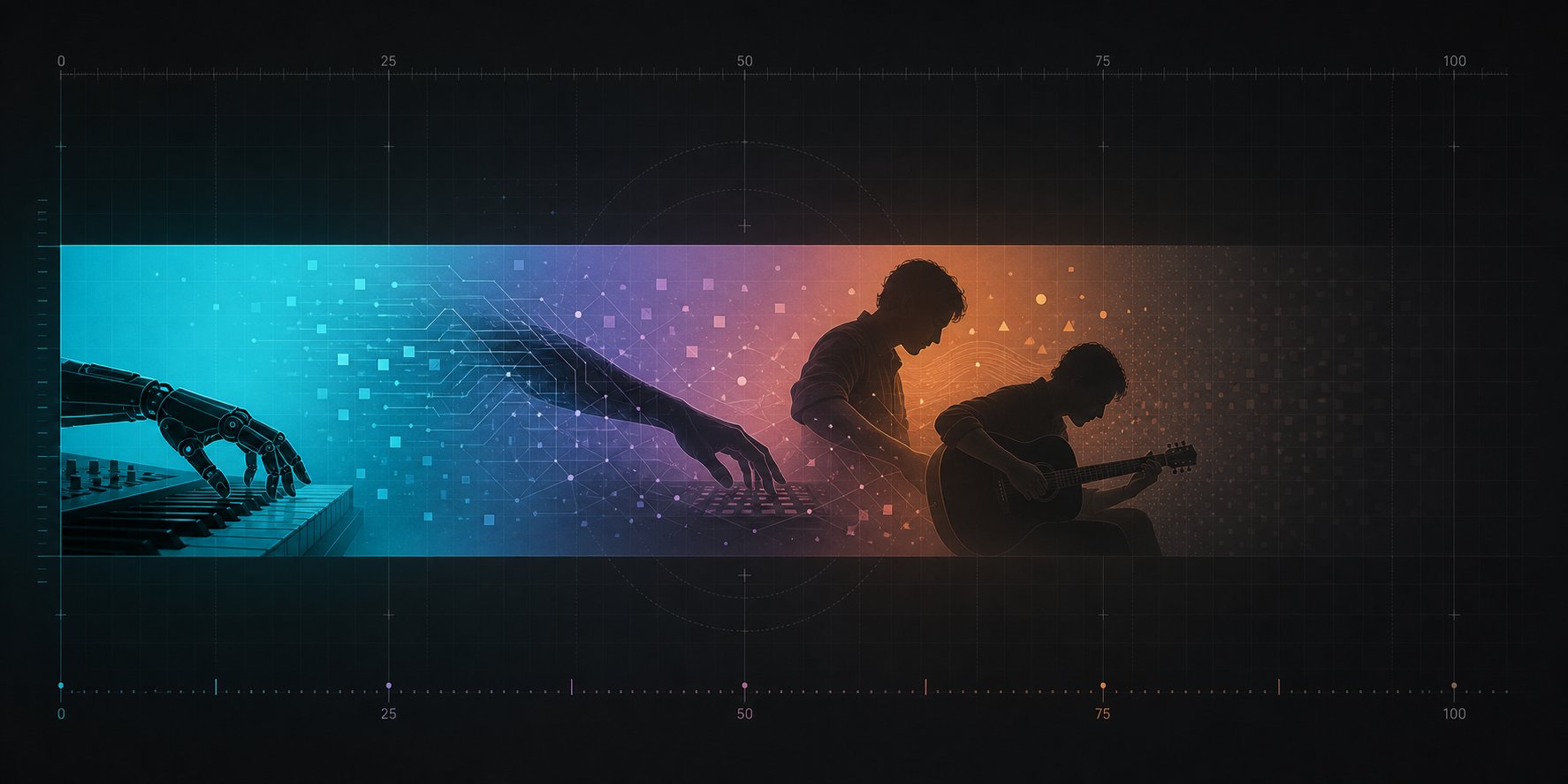
The Detectability Spectrum From Obvious to Invisible
That shift from raw AI output to human-processed AI material is not a binary jump. It is a gradient, and where a track sits on that gradient determines almost entirely whether any tool can flag it. Thinking in terms of "AI or not AI" misses the reality of how music gets made today. A more useful framework is what we call the detectability spectrum: a sliding scale from fully machine-generated tracks (easy to catch) down to human compositions that use AI for narrow production tasks (nearly impossible to distinguish from purely human work).
Fully AI-Generated Tracks and Their Telltale Patterns
At the most detectable end sit tracks generated entirely from text prompts with no human editing. You type "upbeat jazz, female vocals, brushed drums" into Suno or Udio, export the result, and upload it directly. How does ai make music in this scenario? The platform's neural codec decodes a compressed latent representation back into a waveform, and that decoding process leaves spectral artifacts, fixed bitrate signatures, and frequency cutoff patterns baked into the file. These are the tracks that classifiers trained on pipeline-specific fingerprints catch at 99%+ accuracy.
The telltale patterns include unnaturally consistent dynamics across sections, a noise floor that is either too clean or too statistically regular, and high-frequency rolloff at specific thresholds tied to the platform's internal sample rate. For anyone wondering how to tell if a song is ai generated, a raw prompt-to-export track is the easiest case. The artifacts are structural, reproducible, and well-documented in detection research.
The Blurry Middle Ground of AI-Assisted Production
Move one step along the spectrum and things get complicated fast. A growing number of producers use AI to generate initial stems, then arrange, mix, and master those stems with human judgment and standard DAW tools. This 50 stems mix edits music ai process ai powered workflow produces tracks that carry some residual generation artifacts in individual layers but overlay them with human decisions about EQ, compression, spatial placement, and arrangement structure.
Each human touch obscures a detection signal. Applying reverb masks noise floor regularity. EQ shaping disrupts spectral cutoff patterns. Arrangement decisions like cutting, rearranging, and layering sections break the temporal consistency that classifiers rely on. A 2026 study introducing the HAIM dataset specifically addressed this gap, noting that current detection research remains confined to a binary "AI-or-human" paradigm that fails to reflect real production workflows where human engineers post-process AI-generated material.
This is also where ai generated bands operate. Projects that use AI for composition or vocal synthesis but employ human producers for mixing and final arrangement sit squarely in this grey zone. How to tell if a song is ai in these cases? No single classifier gives a reliable answer because the audio carries a mix of machine and human signatures.
Why Binary Classification Fails Modern Music
At the least detectable end of the spectrum: human-composed, human-performed music that leverages AI tools for narrow production tasks. A singer-songwriter who writes and records every note but uses AI-assisted mastering from a service like LANDR. A band that composes and performs live but uses AI-driven sound design for a synth pad in one bridge section. A producer who records real instruments but applies AI-powered mixing suggestions for level balancing.
Understanding how does ai music generation work at the model level helps explain why this end of the spectrum is invisible to detectors. Generation artifacts come from the neural decoder reconstructing a waveform. If the waveform was never generated by that decoder, if a human played the notes and a microphone captured the sound, then the characteristic fingerprints simply do not exist. Using AI as a post-production tool on human audio does not introduce the same artifacts as generating audio from scratch.
Here is the full spectrum, ordered from most detectable to least:
- Raw text-to-audio exports - Full tracks generated from prompts with zero editing. Maximum pipeline artifacts intact. Detection accuracy: high with current tools.
- AI-generated tracks with basic mastering - Prompt-generated audio run through EQ, compression, or limiting. Some artifacts disrupted, others remain. Detection accuracy: inconsistent, depends on processing depth.
- AI stems with human arrangement and mixing - Individual AI-generated elements combined, edited, and mixed by a human producer. Artifacts fragmented across layers and partially masked. Detection accuracy: low for most classifiers.
- Human composition with AI-generated elements - Primarily human-made tracks incorporating one or two AI-generated stems (a drum loop, a synth texture). Detection accuracy: near zero for the overall track.
- Human music with AI production tools - Entirely human-performed recordings using AI for mastering, mixing assistance, or sound design. No generation artifacts present. Detection accuracy: effectively zero, indistinguishable from fully human production.
This spectrum reveals why the question "how are ai songs made" does not have one answer, and neither does the question of whether they can be detected. The HAIM researchers call this challenge "AI Music Tracking" rather than detection, reframing it as identifying specific AI integration points across a multifaceted production workflow rather than stamping a binary label on a finished track.
The practical consequence: any detection system that outputs only "AI" or "human" will be wrong for the majority of commercially released music that lives in the middle of this spectrum. And as AI tools become standard in every producer's workflow, that middle ground only expands, making the edges where confident classification is possible narrower with each passing month.
The spectrum also creates an uncomfortable side effect. If highly produced, quantized, or pitch-corrected human music shares acoustic characteristics with AI output, then the same tools designed to catch synthetic tracks will inevitably catch real ones too.
The False Positive Problem Hurting Real Musicians
That uncomfortable side effect is not hypothetical. It is already happening. Human musicians are getting flagged, penalized, and forced to defend work they created from scratch. The same detection pressure meant to protect artists from AI flooding is now turning against the people it was designed to help.
The demand for detection is real. A survey conducted by Cyanite, Marmoset, and Mediatracks found that 97% of music professionals want to know whether a track is AI-generated. But here is the catch: 80% of artists surveyed said they do not trust self-disclosure as a reliable signal. That distrust creates pressure for aggressive automated screening, the kind that flags first and asks questions later. And when detection tools operate at scale with high sensitivity, the false positive rate becomes a direct threat to legitimate creators working in ai artists music spaces that happen to overlap with AI output characteristics.
Why Human Music Gets Flagged as AI
False positives are not random errors. They follow a pattern rooted in how detection classifiers learn. These systems train on differences between AI-generated audio and human recordings. The problem? Certain human production techniques produce the exact same acoustic signatures that detectors associate with machine origin.
Quantized drums with zero timing variation look identical to AI-generated percussion in a classifier's analysis. Pitch-corrected vocals processed through Auto-Tune or Melodyne share the unnaturally smooth pitch transitions that characterize ai generated singers. Heavily compressed and limited masters flatten the dynamic range into the same profile that neural codec decoders produce. When someone tries to figure out how to tell if a voice is ai generated, the honest answer is that a heavily processed human voice and a synthetic one can be acoustically indistinguishable.
Certain genres and production styles sit directly in the crosshairs:
- Electronic and EDM - Programmed drums, synthesized elements, and gridlocked timing are genre conventions, not AI indicators
- Lo-fi hip-hop - Low bitrate aesthetics, simple repetitive structures, and limited frequency range mimic AI generation patterns
- Ambient and drone - Minimal harmonic movement and smooth timbral transitions overlap with text-to-audio outputs
- Hyperpop and experimental pop - Heavy vocal processing, pitch manipulation, and synthetic textures blur every boundary
- Bedroom pop with virtual instruments - Solo producers using sample libraries and MIDI programming produce audio that lacks the mic bleed, room noise, and timing imperfections detectors associate with human origin
- Vaporwave and sample-based music - Resampled, slowed, and heavily processed audio triggers pipeline-detection heuristics designed to catch format manipulation
The overlap is not a flaw in these genres. It is a flaw in detection systems that equate production cleanliness with synthetic origin. Questions like "is arthur hayes a real singer or ai" or "is solomon ray an ai artist" circulate online precisely because modern production tools let human artists achieve a level of polish previously impossible, a level that now reads as suspicious to automated classifiers.
The Real Consequences for Falsely Flagged Musicians
When a track gets flagged, the consequences are immediate and tangible. Distribution platforms can reject uploads, removing potential revenue before a single listener hears the song. Streaming services that automatically suppress flagged content pull tracks from algorithmic recommendations, effectively making them invisible. Playlist curators using detection tools pass over submissions marked with high AI-confidence scores. Each of these outcomes costs the artist money, reach, and momentum.
Reputational damage compounds the financial loss. In an industry where authenticity carries cultural currency, being publicly associated with AI generation can alienate fans and collaborators. The no ai music sentiment running through parts of the music community means that even a false accusation sticks. An artist who gets flagged may find themselves explaining their process in social media posts, uploading session files as proof, or recording video of their workflow, all to demonstrate something that should not require demonstration: that they made their own music.
This dynamic creates a chilling effect across the industry. More than 70% of artists in Cyanite's ongoing survey said they fear being wrongly labeled as AI-generated. That fear shapes creative decisions. Some producers may avoid certain processing chains. Others might leave imperfections in their masters deliberately, not for aesthetic reasons, but to signal humanity to an algorithm. When artists start making music to satisfy a detector rather than a listener, the detection system is no longer protecting creativity. It is constraining it.
The false positive problem does not exist in isolation. It intersects directly with how platforms choose to respond, what policies they enforce, and whether regulation gives artists meaningful recourse when automated systems get it wrong.
How Platforms and Regulations Are Responding
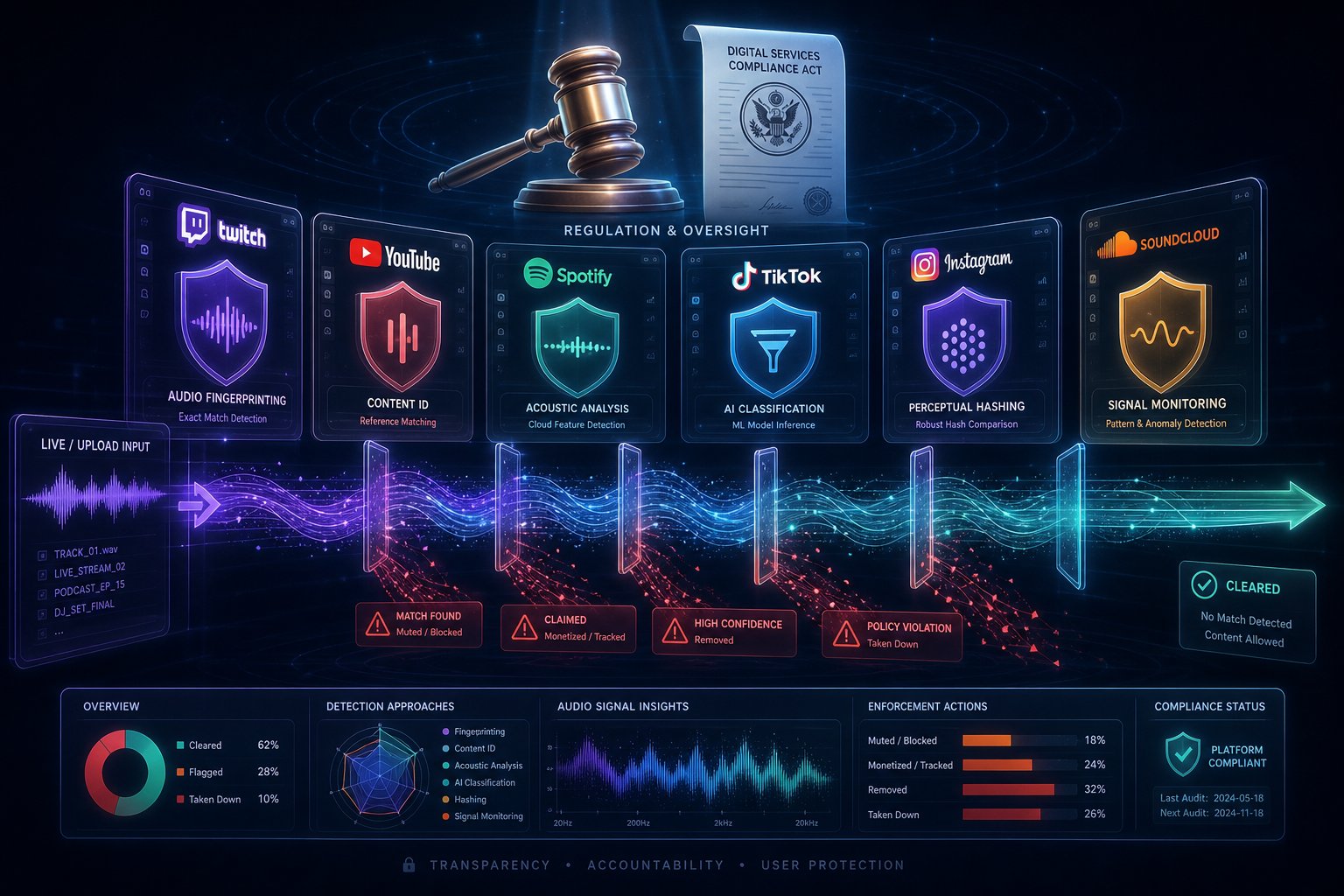
Platforms are not sitting idle while the false positive problem and the flood of synthetic content converge. Streaming services, regulators, and industry bodies are all building response frameworks, but they are choosing fundamentally different strategies. Some invest in detection technology deployed at the platform level. Others lean on disclosure requirements pushed upstream to labels and distributors. A third group is writing legislation that will force transparency regardless of what platforms choose to do. Each approach reflects a different bet on where responsibility should sit and how detectable AI music actually needs to be for the system to function.
How Streaming Platforms Handle AI Music Detection
The major platforms have split into two camps: active detection versus supply-chain disclosure.
Deezer leads the active detection approach. It launched the first platform-level AI tagging system for music streaming in mid-2025 and has since tagged over 13.4 million AI tracks using proprietary detection technology. The company claims its tool identifies 100% AI-generated music from leading generators like Suno and Udio, and it has filed two patents covering the underlying detection methods. Deezer went a step further by commercially licensing its detection tech to third parties, with French collecting society Sacem and Hungarian rights organization EJI among the early adopters.
Spotify takes a different path. Rather than building platform-level detection, it supports the new DDEX industry standard for AI disclosures in music credits, a framework developed with distributors including DistroKid, CD Baby, Believe, and EMPIRE. Through Spotify AI DDEX integration, artists and labels can now indicate where AI played a role in a track, whether that is vocals, instrumentation, or post-production. A beta feature launched in early 2026 displays these credits in Song Credits on mobile. Spotify frames this as transparency without punishment: disclosing AI use does not trigger down-ranking or removal.
Apple Music introduced its own Transparency Tags system, placing the onus on labels and distributors to declare AI-generated content at the point of delivery. YouTube has implemented disclosure labels for AI-generated content across its platform, requiring creators to flag synthetic or manipulated material. French high-resolution service Qobuz followed Deezer's lead with its own proprietary detection tool for tagging AI content.
The difference between these approaches matters. Platform-level detection catches bad actors who would never self-disclose. Supply-chain disclosure respects the spectrum of AI use without forcing binary classification. Neither alone solves the problem. Deezer's detection works against known generators but struggles with new ai songs from unfamiliar pipelines. Spotify's disclosure system depends entirely on honest reporting, and as the industry surveys show, most professionals do not trust self-disclosure alone.
Regulatory Frameworks and Disclosure Requirements
Regulation is moving faster than many in the industry expected. The EU AI Act's Article 50 establishes transparency obligations specifically targeting AI-generated content. Providers of generative AI systems must ensure their outputs are marked in a machine-readable format and detectable as artificially generated. Deployers must disclose deepfakes and AI-generated text publications. These rules take effect in August 2026, giving the industry a fixed deadline rather than an open-ended suggestion.
To help companies comply, the European AI Office kicked off a code of practice on transparency of AI-generated content. Two working groups are drafting the details: one focused on provider obligations around marking and detection, the other on deployer obligations around disclosure. The process involves eligible stakeholders including developers of marking techniques, platform associations, civil society organizations, and academic experts. The final code, expected mid-2026, will serve as a voluntary compliance tool but carries the weight of demonstrating adherence to binding law.
For music specifically, this means any AI system generating audio must embed machine-readable markers that enable downstream detection. The requirement is technology-agnostic, leaving room for watermarking, metadata, or other technical solutions, but it demands that solutions be "effective, interoperable, robust, and reliable as far as technically feasible." That qualifier acknowledges the gap between lab performance and real-world resilience discussed earlier, but it still pushes the industry toward universal marking rather than voluntary opt-in.
The regulatory landscape creates new questions for anyone doing an ai music search to understand what they are listening to. If a platform operates in the EU, it will need to surface AI provenance information to users. If a generator produces audio without machine-readable markers, it faces regulatory exposure. This does not solve the detection problem technically, but it shifts the legal burden: failing to mark AI content becomes a compliance violation rather than just a platform policy issue.
The Scale Challenge Facing Platforms
Regulation and detection infrastructure both face the same brute-force challenge: volume. The numbers from Deezer illustrate the scale. In early 2025, the platform received roughly 10,000 AI-generated tracks per day. By late 2025, that number had tripled to 30,000. By early 2026, it hit 60,000. The most recent figures show 75,000 AI-generated tracks arriving daily, representing 44% of all new music uploaded to the platform. That is over 2 million synthetic tracks per month on a single service.
How many ai musicians are there generating this content? The number is effectively uncountable because the barrier to entry is a text prompt and a free account. One person can generate hundreds of tracks per day. Content farms can produce thousands. The economics of streaming payouts incentivize exactly this behavior: even tiny per-stream royalties add up across massive catalogs of low-effort material.
Spotify addressed this volume problem by removing over 75 million spammy tracks in the twelve months preceding its September 2025 policy update. It also announced a music spam filter designed to identify uploaders engaging in mass-upload tactics, duplicate submissions, and artificially short track abuse. The system tags suspicious accounts and stops recommending their content. Critically, Spotify describes the rollout as conservative, acknowledging the risk of catching legitimate creators in the net.
The tension here is real. Under-regulation allows content farms to dilute royalty pools and push authentic artists out of algorithmic recommendations. Over-regulation risks penalizing legitimate creators, stifling experimental AI-assisted workflows, and forcing premature judgments about a technology still in rapid flux. Questions people ask, like is energy shift radio ai or is unbound music ai, reflect a growing listener anxiety that what they are hearing may not be what it claims to be. Platforms need to answer that anxiety without creating a surveillance apparatus that punishes innovation.
Deezer's data offers one reassuring signal: despite AI tracks representing 44% of uploads, they account for only 1-3% of actual streams, with 85% of those streams flagged as fraudulent and demonetized. Detection paired with demonetization can reduce the economic incentive even if it cannot stop every upload. The question for ai music updates going forward is whether this containment strategy holds as generators improve and the volume continues its exponential climb.
What platforms cannot do through policy or detection alone is help individual creators understand whether their own tracks carry detectable artifacts or how to inspect audio at the component level. That practical need, knowing what your music looks and sounds like to a classifier, requires a different set of tools entirely.
Tools for Analyzing and Inspecting Audio Tracks
Knowing that detection has limits is useful. Knowing how to analyze a track yourself is better. Whether you are a musician checking your own work before distribution, a curator screening submissions, or a listener who simply wants to understand what they are hearing, practical tools exist that let you move beyond guessing and into informed ai music analysis.
The approach splits into two categories: tools that separate audio into components for manual inspection, and dedicated classifiers that output an AI probability score. Used together, they give you the clearest picture available.
Stem Separation as an Analysis Strategy
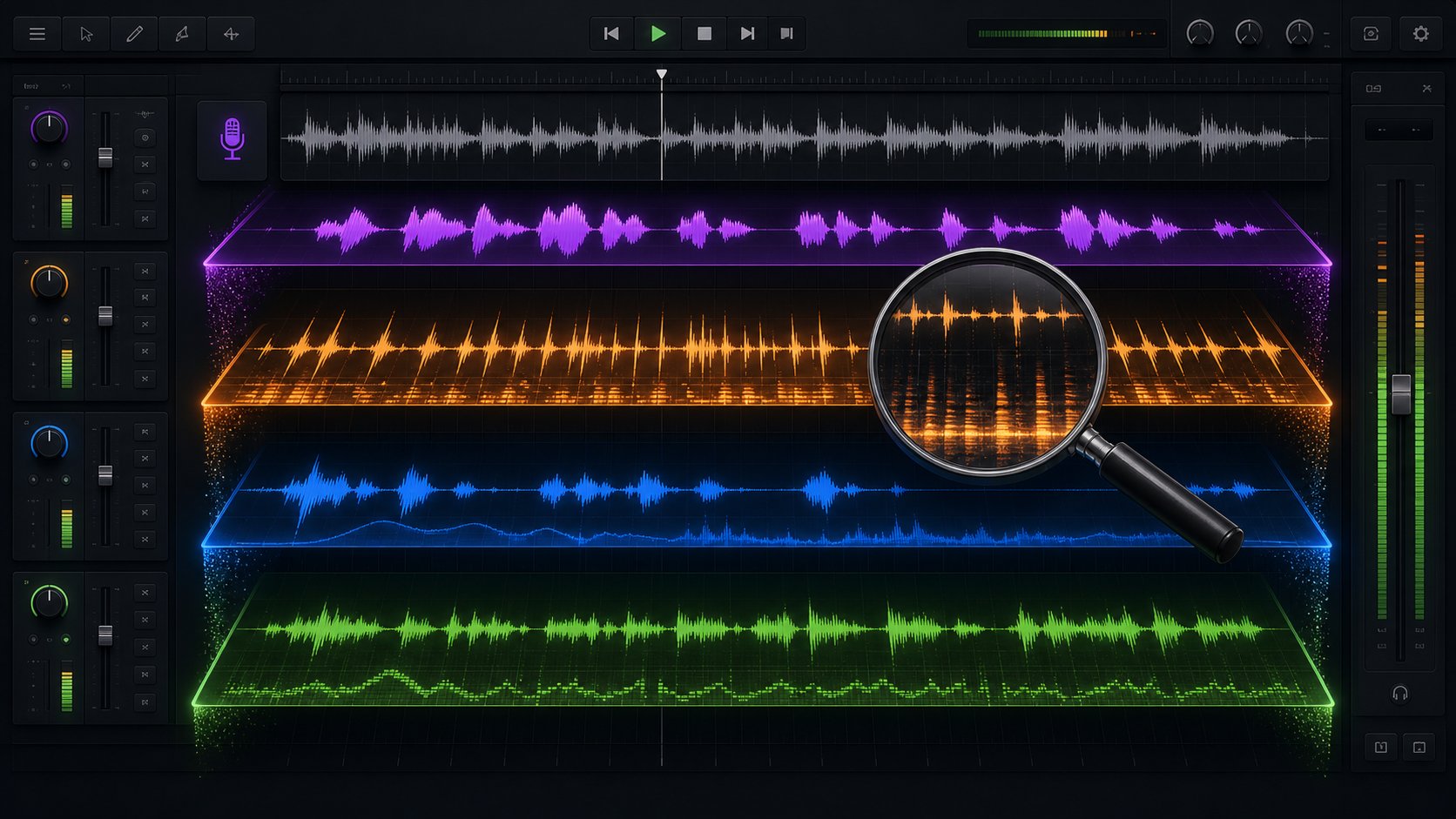
When you analyze song components in isolation, patterns hidden in the full mix become obvious. A track might sound perfectly natural at first listen, but separating it into vocals, drums, bass, and other instruments reveals telltale signs that a trained ear can catch:
- Perfectly quantized drums with zero timing variation across an entire track, no human drift or slight push-and-pull against the grid
- Identical reverb profiles across stems that should have been recorded in different spaces or at different times
- No mic bleed between instrument stems, something nearly impossible in a real recording session where room sound leaks between microphones
- Synthetic vocal textures that sound polished in context but reveal unnaturally smooth formant transitions when isolated
MakeBestMusic's Audio Separator handles this inspection workflow directly. Upload a track, split it into individual stems, and listen to each layer on its own. That isolation is where AI artifacts stop hiding behind a busy arrangement. You hear the drum stem and notice it never breathes. You hear the vocal stem and catch that the vibrato is mathematically regular rather than organically varied. These are the signals that full-mix listening masks and that automated detectors try to quantify, but your ears can evaluate in context.
Stem separation also works as a practical ai song analyzer for producers checking their own AI-assisted tracks before release. If you used a generator for initial stems but mixed and arranged them yourself, separating the final master back into components shows you whether residual artifacts survived your processing chain.
Dedicated AI Music Detection Tools
Beyond manual inspection, several dedicated tools attempt to classify tracks algorithmically. Each uses a different detection framework, which means running a track through multiple tools gives you a broader signal than relying on any single one. Here is how the available options compare:
| Tool | What It Does | Best For | Access Type |
|---|---|---|---|
| MakeBestMusic Audio Separator | Splits tracks into isolated stems (vocals, drums, bass, other) for manual inspection of individual layers | Spotting AI artifacts masked in a full mix; inspecting your own productions before submission | Free online tool |
| LetSubmit | Analyzes 72 audio features including MFCCs, micro-timing, and spectral contrast to score AI likelihood | Quick pre-screening of tracks before distribution; deepest feature analysis available publicly | Free unlimited web checks |
| SubmitHub AI Checker | Random Forest classifier using 21 features; integrated into playlist submission workflow | Curators screening submissions; low false positive rate gives high confidence when it does flag | Free, no commercialization planned |
| ACRCloud | Neural network detection across 8 AI platforms with segment-level analysis showing which parts are AI | Hybrid tracks where AI and human elements are layered; enterprise-scale screening | 14-day free trial; enterprise pricing (~$32/10K requests) |
| AHA Music | Browser extension running three-layer analysis (full track, vocals, accompaniment) via ACRCloud engine | Checking tracks playing on Spotify, YouTube, or SoundCloud without downloading | Free (5 checks/day); Chrome/Edge extension |
| Beatstorapon | Spectral haze detection from diffusion models plus phase entropy veto system; 0-10 confidence index | Second opinion alongside other detectors; catches phase-based artifacts others miss | Free web tool |
No single tool in this table is definitive. Comparative testing across all major detectors showed that no two agreed on every track, and accuracy dropped sharply on processed audio. Treat each result as one data point in a broader assessment rather than a verdict.
Building Your Own Detection Workflow
A practical workflow for anyone wanting to seriously analyze a track combines both approaches. Start with stem separation to listen for the acoustic red flags that automated tools quantify but cannot contextualize. Then run the full track through two or three free detectors to see whether their classifiers agree. If all signals point the same direction, you have reasonable confidence. If they conflict, the track likely sits in that blurry middle of the detectability spectrum where no tool gives a reliable answer.
For musicians worried about false positives on their own work, this workflow runs in reverse. Separate your finished master into stems and check whether your production choices (heavy quantization, pitch correction, synthetic sound design) overlap with the patterns detectors flag. If they do, you have advance warning before a platform's automated system reaches the same conclusion. Some creators use an ai song rater or music feedback ai service to get a second opinion on how their production reads to both algorithms and human listeners, adding another layer of awareness before submitting to distributors.
The ai music analyzer free options available today are imperfect, but they are better than nothing. An ai music rater tool can tell you how obvious your track's synthetic fingerprint is, even if it cannot guarantee how a specific platform's proprietary system will respond. The goal is not certainty. The goal is reducing surprise, understanding your own audio at the component level, and making informed decisions about post-production before your track reaches a gatekeeper you cannot see or appeal to directly.
Used as a sample finder ai workflow in reverse, stem separation also helps identify whether elements in a track were lifted from AI-generated sample packs versus recorded live. Isolating a suspicious loop and comparing its characteristics against known generator output gives you practical insight that no confidence score alone provides.
What This Means for Musicians and Creators
The core finding across every layer of this topic is consistent: AI music is highly detectable when left untouched, and dramatically harder to catch once any human processing enters the picture. That gap is not closing soon. It is widening as generators improve and as more producers integrate AI tools into workflows that also involve real performance, mixing, and mastering decisions. No ai song identifier or classifier will resolve this tension cleanly, because the problem is not purely technical. It is definitional. The industry has not agreed on what counts as "AI music" when every track sits somewhere on a spectrum from fully synthetic to barely AI-touched.
What matters now is what you do with that understanding.
Key Takeaways by Audience
If you are a musician worried about false positives:
- Know that heavily quantized, pitch-corrected, or synthetically produced music triggers the same classifier signals as AI output. This is a known limitation, not proof that your work is suspect.
- Before submitting to platforms or curators, run your track through two or three free detection tools. If they flag your work above 60% confidence, consider whether your production chain overlaps with known AI fingerprints.
- Separate your master into stems using a tool like MakeBestMusic's Audio Separator and listen for the hallmarks detectors flag: perfectly uniform timing, identical reverb across all layers, or unnaturally smooth dynamics. Hearing what a classifier hears helps you decide whether to adjust your processing or prepare documentation of your workflow.
- Keep session files, video recordings of your process, or DAW screenshots. If you are ever challenged, evidence of your creative process is the most definitive proof available.
If you are a listener asking "how ai does this sound":
- Your ears alone will not give you a reliable answer. Studies confirm that 97% of listeners cannot tell the difference in casual listening conditions.
- Use a dedicated ai music checker tool for a quantitative signal, but understand that a 50-70% confidence score means the tool genuinely does not know.
- Check contextual signals: Does the artist have a verifiable presence, live performance history, or social media trail? Behavioral indicators often tell you more than audio analysis alone.
- Accept that the binary question "is this AI or human" increasingly has no clean answer. Many tracks you encounter use AI somewhere in their production chain without being fully AI-generated.
If you are a creator using AI tools who wants to understand your obligations:
- Disclosure requirements are tightening. The EU AI Act mandates machine-readable marking of AI-generated content by August 2026. Platforms like Spotify now support DDEX-based AI credits. Transparency is shifting from optional to expected.
- Distribution policies vary. Some distributors accept AI-assisted music freely; others restrict fully AI-generated uploads. Know your distributor's specific terms before releasing.
- The more human involvement in your production, the less detectable and less legally ambiguous your output becomes. Using AI for initial ideas then arranging, performing over, and mixing the result yourself puts you in the safest territory both technically and ethically.
- An ai song checker can tell you how your track reads to automated systems before a platform's proprietary filter makes that judgment for you. Better to know in advance than to discover a rejected upload.
Where Detection Technology Is Heading
Single-signal detection is a dead end for reliable classification. The future belongs to multi-signal systems that cross-reference watermark verification, spectral analysis, behavioral patterns, metadata provenance, and disclosure records simultaneously. Defeating one layer should not be enough to escape the full stack, and the platforms investing in layered approaches are building toward that reality.
Watermarking will become more robust as the EU's regulatory deadline forces generators to embed markers by default. Attribution technology from companies like Sureel, Musical AI, and Soundverse is evolving to track influence at the model level rather than relying solely on output similarity. These systems aim to answer not just whether a track is AI-generated, but which training data influenced it and how compensation should flow. That deeper infrastructure will make detection a byproduct of a broader rights management system rather than an isolated technical challenge.
Still, perfection is not coming. The arms race dynamic means that as detection improves, generation adapts. Multi-signal approaches will raise the difficulty of evasion significantly, but determined actors will always find gaps. The realistic goal is not catching every synthetic track. It is raising the cost of deception high enough that flooding platforms with undisclosed AI content becomes economically impractical, while giving legitimate creators clear tools to understand how to identify ai music patterns in their own work and how to know if music is ai before platforms make that call for them.
For anyone searching for an ai music finder that definitively separates human from machine, the honest answer is that no such tool exists yet and may never exist in absolute terms. What does exist, and is improving, is a toolkit that makes informed judgment possible. Use it. The question of how to know if a song is ai will keep evolving alongside the technology that generates and detects it. Staying informed, inspecting your own audio, and understanding the detection landscape puts you ahead of creators who treat it as someone else's problem.
