

AI and the Music Industry Right Now
Artificial intelligence in music is no longer a futuristic concept. It is software that composes melodies, clones voices, masters tracks, and decides what millions of listeners hear next. That is the practical reality behind the headlines.
The moment this became impossible to ignore? A anonymous creator called Ghostwriter uploaded "Heart on My Sleeve" to streaming platforms, an AI-generated track mimicking Drake and The Weeknd so convincingly that it racked up hundreds of thousands of streams before Universal Music Group forced its removal. Platforms scrambled to establish policies. Artists demanded answers. The industry woke up to a problem it could no longer theorize about.
AI in the music industry is not simply a tool or a threat. It is both simultaneously, reshaping who creates, who profits, and who gets left behind.
What AI in Music Actually Means Beyond the Hype
When we talk about how AI affects the music industry, we are talking about three overlapping realities. First, generative models that produce entire songs from text prompts. Second, assistive tools that handle mixing, mastering, and arrangement tasks within a producer's workflow. Third, recommendation algorithms that determine which songs reach listeners and which disappear. Each layer touches different stakeholders differently, and this article walks through all of them.
Why This Moment Is Different From Past Technological Shifts
Music and artificial intelligence have a longer history than most people realize. The Illiac Suite in 1956 marked the first computer-composed piece of music. David Cope's Experiments in Musical Intelligence program replicated classical composers' styles in the late 1990s. These were fascinating experiments, but they stayed in labs.
Today's generative AI models are fundamentally different. They train on vast catalogs of existing recordings, learn patterns across millions of songs, and output audio that is increasingly indistinguishable from human-made music. According to WIPO patent data, over 54,000 generative AI inventions were patented between 2014 and 2023, with speech and music accounting for 13,480 of those. The scale and speed of development have no historical parallel in music technology.
This article examines the full picture, stakeholder by stakeholder. Session musicians, producers, songwriters, labels, streaming platforms, independent artists, and listeners all face different equations. Some stand to gain enormous leverage. Others face displacement. Understanding who profits and who gets cut starts with understanding how the technology actually works.
How AI Music Generation Actually Works
So how does AI create music? Not through inspiration or emotion, but through statistical pattern recognition at an enormous scale. The process is more mechanical than magical, yet the results can sound convincingly human.
At the highest level, AI music generation falls into three distinct approaches:
- Symbolic generation (MIDI/notation) — Models like Music Transformer and MuseNet generate note sequences, chord progressions, and rhythmic structures as digital instructions. Think of it as writing sheet music that still needs to be performed by a synthesizer or virtual instrument.
- Audio synthesis (waveform generation) — Models such as MusicGen and Stable Audio produce actual sound waves directly. They output finished audio rather than instructions, handling timbre, production texture, and spatial characteristics in one pass.
- Hybrid models — These combine both approaches, using symbolic generation for structural coherence and audio synthesis for realistic sound. The result captures musical logic and timbral richness simultaneously.
Neural Networks and How Machines Learn Musical Patterns
Imagine feeding a neural network hundreds of thousands of hours of recorded music. During training, the model breaks that audio into compressed representations, whether mel spectrograms, discrete audio tokens via codecs like Meta's EnCodec, or MIDI note sequences. It then learns the statistical relationships between those elements: which chord tends to follow another, how a drum pattern relates to a bass line, what frequency characteristics define a genre.
Two architectures dominate current generation. Transformer models, the same technology behind large language models, treat music as a sequence of tokens and predict what comes next. They excel at long-range coherence, connecting a melody in measure four to a callback in measure thirty-two. Diffusion models take a different path, starting from pure noise and iteratively refining it into clean audio, producing exceptionally detailed textures and realistic timbres.
From Text Prompts to Finished Audio
How does AI music generation work in practice? For text-to-music systems, you type a description like "melancholic cello solo with ambient reverb, 70 BPM." A text encoder converts that prompt into a conditioning vector, the model generates a compressed latent representation matching those characteristics, and a decoder reconstructs the final waveform. The specificity of your prompt directly shapes the output. Vague instructions produce generic results; detailed ones narrow the probability space toward something targeted.
This is where the debate around whether AI can't write songs becomes nuanced. Current models handle composition, arrangement, and production very differently. They replicate harmonic patterns convincingly. They arrange instrumentation based on learned genre conventions. They produce polished-sounding mixes. What they struggle with is narrative intentionality: the deliberate choice to place a lyrical turn at exactly the right emotional moment, or to break a structural convention for dramatic effect. Pattern replication is not the same as storytelling.
The technology is powerful at generating music that sounds right. It is far less capable of generating music that means something specific. That distinction matters enormously as these tools move into every stage of the creative pipeline.
AI Across Every Stage of Music Creation
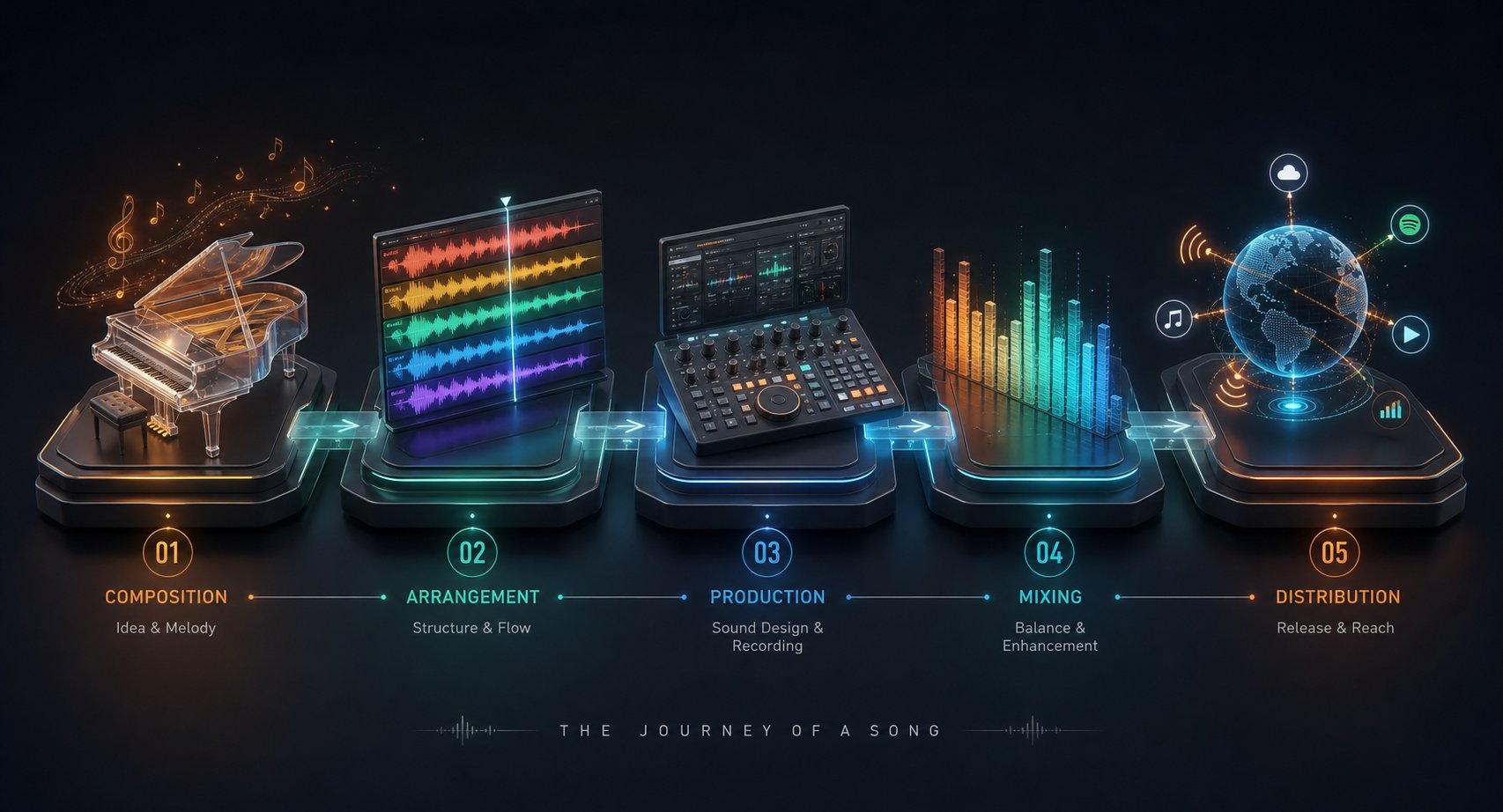
Every song moves through a lifecycle: it gets written, arranged, produced, mixed, mastered, and distributed. AI in music production now touches every single one of these stages, but its depth of involvement varies dramatically depending on where you are in the chain.
Here is a breakdown of what AI actually does at each level, what still requires a human, and how significant the impact is right now:
| Stage | What AI Does | Human Role Remaining | Impact Level |
|---|---|---|---|
| Composition | Generates chord progressions, melodies, and full song structures from text prompts or style parameters | Selecting ideas, shaping narrative intent, writing emotionally specific lyrics | High |
| Arrangement | Suggests instrumentation, builds layered parts, fills out sparse demos into full arrangements | Making taste-driven decisions about dynamics, tension, and genre-blending | Medium-High |
| Production | Generates stems, applies style transfer, creates backing tracks and beat patterns | Sound design choices, creative processing, performance nuance | High |
| Mixing | Auto-balances levels, applies EQ and compression, positions elements in stereo space | Artistic mix decisions, emotional emphasis, solving unique frequency problems | Medium |
| Mastering | Analyzes frequency content and applies loudness optimization, dynamic range control, and format-specific rendering | Critical listening for context, genre-appropriate loudness targets, artistic intent | Medium-High |
| Distribution | Algorithmic playlist curation, recommendation engine placement, metadata optimization | Marketing strategy, audience relationship building, brand identity | Very High |
Composition and Songwriting Assistance
Artificial intelligence songwriting tools operate on a spectrum. At one end, you have chord suggestion engines that propose harmonic options while a songwriter retains full creative control. At the other, platforms like Suno and Udio generate complete songs from a single text prompt, handling melody, lyrics, arrangement, and production in under a minute.
The practical sweet spot for most working musicians sits somewhere between those extremes. A producer might use AI to generate twenty chord progression variations in a key and tempo they have already chosen, then pick the one that resonates and build from there. A lyricist might feed a rough verse into an AI co-writer for rhyme alternatives, then discard ninety percent of the suggestions. AI producing at this stage functions less like a replacement and more like a brainstorming partner that never runs out of ideas.
Production, Mixing, and Mastering Automation
AI and music production intersect most visibly in stem separation and automated mastering. Consider the Beatles' "Now and Then," released in 2023. The song existed only as a degraded cassette demo John Lennon recorded in the late 1970s, with his vocal buried under piano and television noise. Producer Giles Martin used machine learning to isolate Lennon's voice from elements that were previously inseparable. As Martin explained, the AI learned to recognize the sound of Lennon's voice specifically, then extracted it cleanly from the surrounding audio. Paul McCartney and Ringo Starr could then add new parts around a vocal that would have been unusable just a few years earlier.
This same stem separation technology now ships in consumer-grade tools. Producers routinely pull apart reference tracks to study individual elements, remix existing material, or recover isolated parts from rough recordings. Meanwhile, intelligent mastering services analyze a finished mix against genre benchmarks and apply processing in seconds, a task that once required booking a specialized engineer.
AI in Distribution and Playlist Placement
Distribution is where AI's influence becomes almost invisible to artists yet profoundly shapes their careers. Streaming platforms rely on recommendation algorithms to decide which songs appear in personalized playlists, radio stations, and discovery feeds. These systems analyze listening patterns, skip rates, save behavior, and contextual signals to predict what a given user wants to hear next.
A 2024 study by Music Tomorrow and APEM found that algorithmic visibility varies dramatically based on language and geography. In their analysis, francophone artists in France received roughly twelve times more local algorithmic exposure than their Canadian francophone counterparts, revealing how recommendation systems can reinforce cultural imbalances rather than simply reflecting listener preference.
For artists, this means discoverability is no longer just about making good music. It is about how well your track fits the patterns an algorithm is trained to promote. The same AI that helps you produce a song also determines whether anyone ever hears it, creating a feedback loop where technology shapes both creation and consumption simultaneously.
Winners and Losers Among Industry Stakeholders
The impact of AI on the music industry does not land evenly. A technology that eliminates work for one person can unlock creative possibilities for another. Understanding who benefits and who faces displacement requires looking at each group's relationship to the production chain and the revenue systems surrounding it.
Here is how the major stakeholders in the ai music industry map out right now:
| Stakeholder | Primary Benefit | Primary Threat | Net Outlook |
|---|---|---|---|
| Session Musicians | AI stem tools can extend creative range in hybrid sessions | Direct replacement by AI-generated instrumental parts | Negative |
| Mixing Engineers | Faster rough-mix iterations free time for creative decisions | Automated mixing tools handling full projects end-to-end | Moderate risk |
| Producers | Rapid prototyping, unlimited arrangement options, lower session costs | Clients bypassing producers entirely with AI generators | Mixed |
| Songwriters | AI co-writing for ideation, overcoming creative blocks | Flooding of AI-generated compositions reducing sync and licensing demand | Moderate risk |
| Vocalists | Voice processing, pitch enhancement, multilingual adaptation | Voice cloning and AI vocal synthesis replacing session singers | Negative |
| Major Labels | Reduced production costs, AI-powered A&R analytics, catalog monetization through licensing deals | Catalog value erosion if AI-generated music saturates markets | Cautiously positive |
| Independent Artists | Access to professional-grade production without studio budgets | Harder to stand out as AI content floods platforms | Mixed to positive |
| Streaming Platforms | Lower content acquisition costs, improved recommendation systems | Listener trust erosion, regulatory pressure around transparency | Positive short-term |
| Listeners | More personalized discovery, unlimited niche content | Declining quality control, difficulty finding authentic human artistry | Mixed |
How Session Musicians and Engineers Face Displacement
Imagine you are a session guitarist who earns a living playing on advertising jingles, podcast intros, and indie album tracks. Those exact use cases sit squarely in AI's sweet spot: functional, genre-appropriate instrumental parts that do not require a distinctive artistic voice. When a production music library can generate a convincing guitar arrangement in seconds, the economic logic for hiring a session player shifts dramatically.
Mixing engineers face a similar but slightly slower squeeze. AI-assisted mixing tools now handle level balancing, EQ correction, and spatial placement with increasing competence. They do not replace the engineer who shapes a mix to convey emotion, but they do eliminate the entry-level work that traditionally served as a career onramp. The junior assistant engineer position, where many professionals learned their craft, is particularly vulnerable.
This displacement is not hypothetical. A report from economist Will Page highlights that AI's impact on music may be "asymmetric," potentially adding value to consumer-facing revenues while wiping out value in professional production music sectors. The B2B segment, where session musicians and engineers earn significant income through library music and sync licensing, faces the sharpest erosion.
What Labels and Streaming Platforms Stand to Gain
Major labels sit in an unusual position. They control vast catalogs of training data, which gives them leverage in licensing negotiations with AI companies. Universal Music Group, Sony Music, and Warner Music have all pursued deals that monetize their catalogs for AI training while simultaneously suing unauthorized use. This two-track strategy lets them profit from AI adoption while protecting existing revenue streams.
Streaming platforms potentially gain even more. As Forbes reported, platforms like Spotify can integrate AI-generated music to reduce content costs, shrinking royalty obligations for human artists. Why license expensive catalog tracks for mood playlists when AI generates something functionally equivalent for free?
The streaming economy context makes this especially troubling. The global value of music copyright reached $47.2 billion in 2024, yet per-stream rates continue to compress as more content enters the ecosystem. AI compounds this problem directly. Deezer reported receiving 75,000 AI-generated tracks daily, representing 44% of all new music uploaded to the platform. Over two million synthetic tracks hit the service each month. When royalty pools are divided among exponentially more tracks, every human artist's share shrinks, even if total industry revenue grows at the top line.
A study by CISAC and PMP Strategy projects that nearly 25% of music creators' revenues are at risk by 2028, an impact that could reach as much as 4 billion euros. The revenue is not disappearing from the industry; it is being redistributed upward toward platforms and entities that own or license AI infrastructure.
The Listener Experience Transformation
For listeners, issues in the music industry often remain invisible. You open a playlist, press play, and hear music. Whether a human or algorithm made it matters less in the moment than whether it fits your mood. Deezer's own research found that 97% of listeners could not tell the difference between AI-generated and human-made music. That statistic alone reveals how much the landscape has already shifted beneath the surface.
The short-term listener experience arguably improves: more music tailored to niche tastes, infinite variety, instant availability. The long-term risk is subtler. If economic incentives push platforms toward cheaper AI content over human artistry, the cultural richness of music gradually narrows. Listeners get more quantity with less genuine creative diversity, a trade-off most will never consciously notice but one that reshapes what music means as a cultural force.
The pattern is clear. Those who own infrastructure, platforms, and catalogs stand to consolidate gains. Those who sell specialized creative labor, session work, engineering, entry-level production, face the most immediate pressure. And independent artists occupy the most complex position of all, simultaneously empowered by affordable AI tools and threatened by the content flood those same tools create.
How Independent Artists Are Using AI to Compete
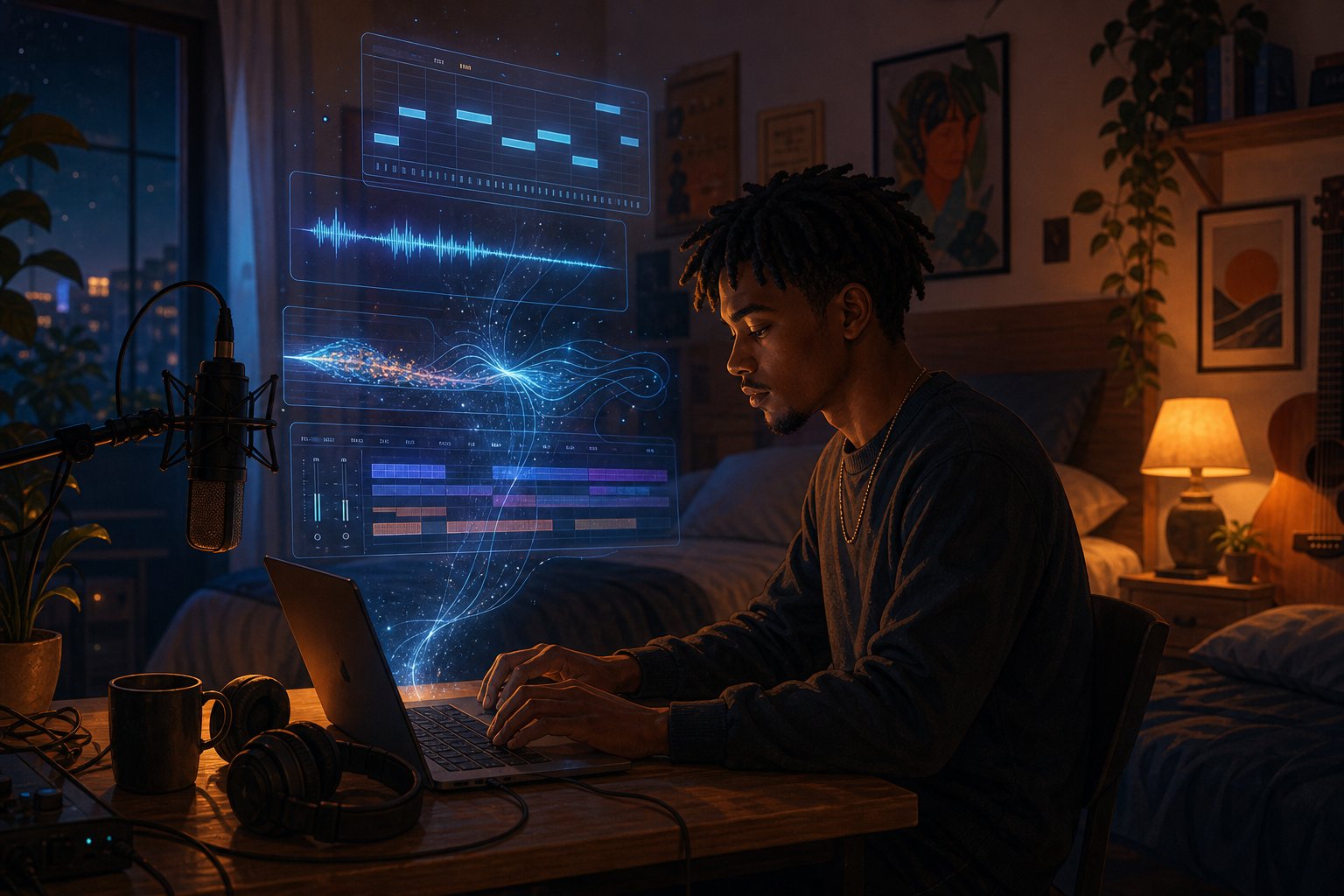
That dual reality, empowered and threatened at once, plays out most visibly among independent artists who lack label budgets but now have access to tools that mimic label resources. For a bedroom producer working alone, the benefits of AI in music are not abstract. They are the difference between a rough demo and a release-ready track.
Leveling the Playing Field Against Major Labels
Traditional studio sessions can cost hundreds of dollars per day. A professional vocal chain runs into the thousands. Hiring session musicians, booking a mastering engineer, paying for marketing campaigns: these expenses kept a hard ceiling on what indie artists could achieve without outside investment. AI removes several of these barriers simultaneously.
Here are the most impactful AI use cases for independent artists right now, ranked by how much creative and financial leverage they provide:
- Rapid prototyping of ideas — Generate full arrangements from a hummed melody or text prompt in minutes, letting you test concepts before committing hours to production. Instead of losing momentum while searching for collaborators, you sketch twenty variations and pick the strongest direction.
- Affordable mastering — AI mastering platforms analyze your tracks against genre benchmarks, applying EQ, compression, and loudness optimization that rivals professional engineers. What once cost $50 to $200 per song now runs a few dollars or comes bundled in a subscription.
- Generating backing tracks — Need a drum groove, bass line, or string arrangement you cannot perform yourself? AI generates convincing instrumental parts tailored to your tempo, key, and style, eliminating the need to hire session players for every element.
- Vocal processing — AI voice tools compensate for untreated rooms, create harmonies from a single take, and apply professional-grade processing without expensive hardware chains. A bedroom recording can sound like it came from an acoustically treated studio.
- Marketing automation — From generating social media content to optimizing release schedules based on listener data, AI handles promotional tasks that independent artists previously had to manage entirely alone or pay agencies to do.
The financial math shifts dramatically. A solo artist with a laptop, a decent microphone, and the right AI tools can produce, polish, and distribute music at a quality level that required a team of specialists and five-figure budgets just a decade ago.
From Bedroom Producer to Full Production Value
So can AI make better music than humans? That question needs reframing. AI does not make better music. It makes professional-quality production accessible to people who already have musical ideas but lacked the technical means to fully realize them. The artistic vision, the specific emotional intention behind a chord change or vocal delivery, that still comes from the person in the room.
Community discussions on platforms like Reddit reflect this nuance. Producers frequently describe AI as accelerating their workflow rather than replacing their creativity. A common thread: AI handles the tedious mechanical work (level balancing, frequency cleanup, generating starting-point arrangements) while the human makes every decision that carries emotional weight. The creative spark is not automated. The grunt work surrounding it is.
Will AI get better at helping with making music? Almost certainly. The pace of improvement is visible month to month. But the trajectory points toward more capable assistants, not autonomous replacements for artistic identity. As Berklee professor Ben Camp noted, "similarly to samplers or synthesizers before it, AI is a tool, not a genre." The artists who thrive will be those who use these tools to amplify what makes their work distinct rather than outsourcing the distinctiveness itself.
This empowerment carries an uncomfortable flip side, though. When everyone has access to professional production quality, the floor rises but so does the noise. The same democratization that helps one indie artist finish an album also enables millions of low-effort AI tracks to flood the platforms where that album needs to be discovered, creating pressures that go well beyond any individual creator's control.
Real Threats and Negative Effects on the Industry
That flood is not a hypothetical risk. It is measurable, documented, and accelerating. While the benefits of AI tools deserve honest acknowledgment, so do the negative effects of AI in the music industry, and the data behind them is increasingly hard to ignore.
Market Flooding and the Devaluation of Creative Work
The sheer volume of AI-generated content hitting streaming platforms has moved from a concern to a crisis. Deezer reported that AI-generated tracks represent 44% of all new music uploaded to the platform, with 75,000 synthetic tracks arriving daily. Spotify removed over 75 million spam tracks in just twelve months. Platforms like Suno generate an entire Spotify catalog's worth of content every two weeks.
What does that mean for working musicians? Every new track added to a streaming platform divides the royalty pool further. When millions of low-cost AI compositions enter that pool monthly, per-stream payouts compress for everyone. The music itself may cost nothing to produce, but it competes for the same finite listener attention and revenue as songs that took weeks of human labor.
A CISAC global economic study projects that music sector workers will lose nearly 25% of their income to AI within four years. Generative AI music could account for roughly 20% of traditional streaming platform revenues and about 60% of music library revenues by 2028. That revenue is not being created from thin air. It represents, as the report warns, "a transfer of economic value from creators to AI companies."
Job Displacement Across Specific Industry Roles
The ai music debate often gets framed as an all-or-nothing proposition: will AI take over music entirely, or is it just another tool? The reality is more granular. Certain roles face acute displacement while others adapt. But the roles under pressure tend to be the ones that supported middle-class careers in music, not just the glamorous top tier.
Here are documented negative effects already reshaping the industry:
- Royalty pool dilution — With AI content flooding platforms, human artists earn less per stream even as total industry revenue grows. The value gets redistributed upward toward infrastructure owners rather than creators.
- Library music collapse — Production music for ads, podcasts, games, and corporate video represents a major income source for composers. AI generates functionally equivalent tracks at near-zero cost, undercutting the entire sector.
- Session work erosion — Instrumentalists who earn a living playing on others' recordings face direct competition from AI-generated parts that cost nothing and arrive instantly.
- Discoverability crisis — Human artists compete for algorithmic visibility against a growing mass of AI content. Standing out becomes harder when the platform is saturated with cheap, competent-sounding alternatives.
- Cultural homogenization — AI models trained on popular music datasets tend to reproduce dominant patterns. Regional styles, experimental genres, and culturally specific traditions are underrepresented in training data and therefore in outputs.
- Fraudulent streaming exploitation — Deezer found that 85% of streams on AI-generated content are fraudulent, meaning bad actors use bots to artificially inflate plays on AI tracks, siphoning royalties from legitimate artists.
- Erosion of emotional authenticity — Researchers from Singapore found significant negative bias toward AI-generated music because listeners perceive it as lacking expressive intent and genuine emotional connection.
These effects do not land equally. A top-charting artist with a dedicated fanbase feels the pressure differently than a working composer who relies on sync placements. The higher up the fame ladder, the more insulated you are. The further down, the more exposed.
Is AI Music Bad? What the Debate Actually Reveals
Why is AI music bad, according to its critics? The answer depends on which critic you ask. Technical objections point to repetitive structures, generic arrangements, and a tendency to produce music that sounds competent but unremarkable. A Deezer and Ipsos survey found that 51% of respondents believe AI will lead to more "low-quality, generic-sounding music." Another poll by The Hollywood Reporter found that 66% of people never knowingly listen to AI-generated music, and 52% would not want to hear it even from their favorite artist.
Philosophical objections run deeper. Music has always been a vehicle for human experience, a way to communicate something that language alone cannot carry. When that communication comes from a statistical model rather than a lived experience, critics argue the art form loses its core function. As the Singapore researchers noted, AI-generated music "may be perceived as less capable of conveying authentic emotion or fostering meaningful connections with listeners."
Defenders counter that the tool does not determine the art. A synthesizer has no lived experience either, yet it produced some of the most emotionally resonant music of the past fifty years. What matters, they argue, is the human intention directing the tool. An artist using AI to realize a specific creative vision is fundamentally different from a bot farm churning out content for streaming fraud.
Both positions hold truth simultaneously. The technology itself is neutral. Its impact depends entirely on who deploys it, why, and within what economic structures. The problem is not that AI can generate music. The problem is that current market incentives reward volume over quality, and AI makes volume essentially free. Until platforms, regulators, and the industry collectively address that structural misalignment, the negative effects will compound regardless of how individual artists choose to use or avoid the technology.
That structural question, who sets the rules and who enforces them, leads directly into the legal battles already underway across multiple jurisdictions.
The Legal and Copyright Battleground
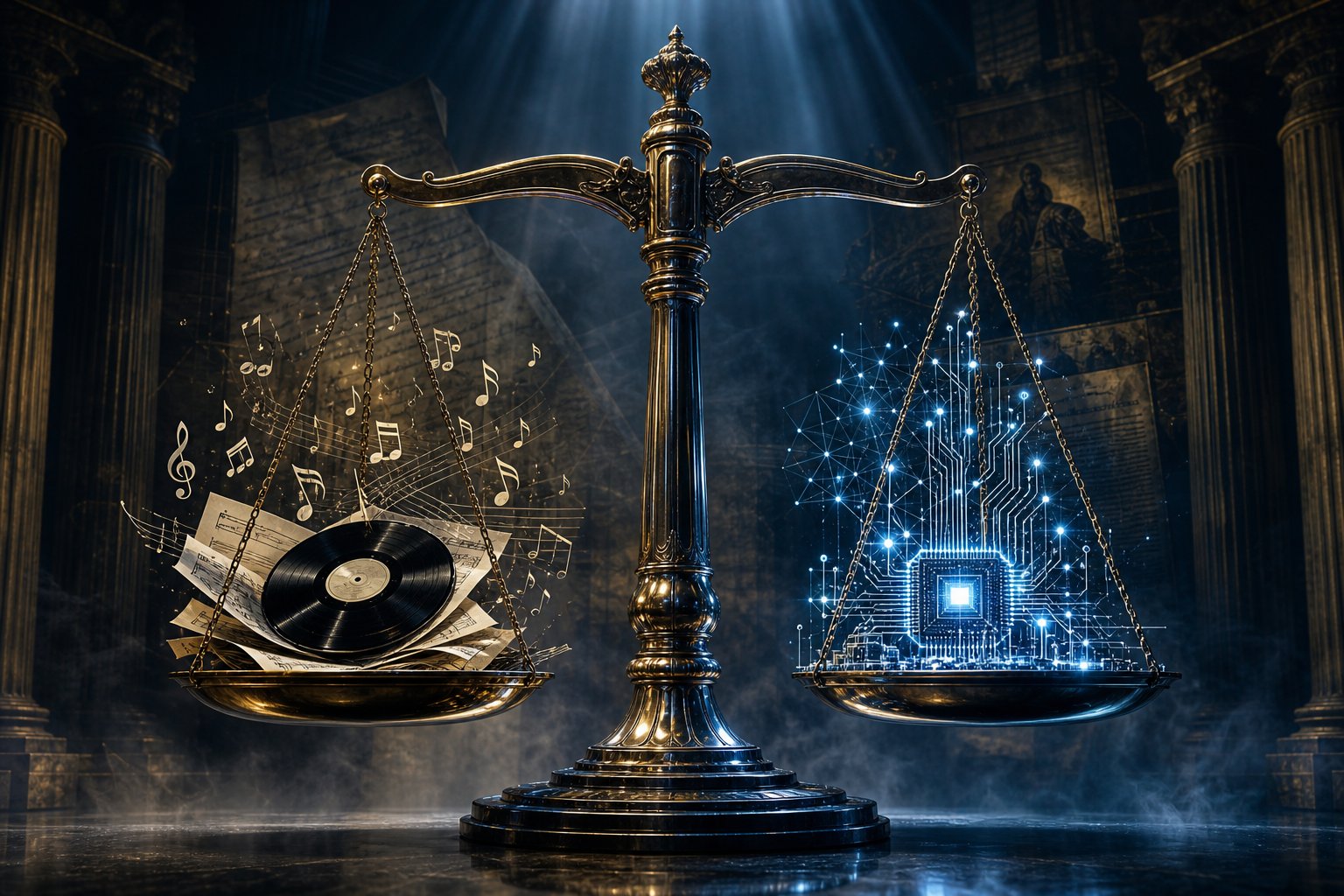
Courts and legislatures are now deciding the rules that will determine how AI music royalties flow, who owns what, and whether the entire training process was legal in the first place. These are not abstract policy debates. They are active lawsuits with billions of dollars at stake, and their outcomes will reshape the economics of every musician's career.
Active Lawsuits and Emerging Legal Precedents
The legal fight over AI training on copyrighted music intensified sharply through 2025 and into 2026. Major record labels sued AI music generators Suno and Udio over unauthorized use of recordings as training data. Authors secured a $1.5 billion class action settlement with Anthropic, the largest known copyright payout in U.S. history. Disney, The New York Times, and other major rights holders filed fresh suits against OpenAI and Meta.
The core legal question in nearly every case: does training an AI model on copyrighted material qualify as fair use? Early rulings have been contradictory. U.S. District Judge William Alsup called Anthropic's use of books for training "quintessentially transformative," siding with the company on a key fair use factor. Just two days later, Judge Vince Chhabria ruled for Meta in a similar case but warned that AI training "in many circumstances" would not qualify as fair use. He voiced concern that generative AI could "flood the market" with content, undermining the incentives copyright law exists to protect.
For music specifically, hearings involving Anthropic and music publishers, plus the Suno case against major labels, are expected to produce rulings that clarify whether AI companies need licenses or can rely on fair use protections. Warner Music took a different path entirely, settling its lawsuits against Suno and Udio and agreeing to launch joint music-creation platforms with them.
Meanwhile, the U.S. Copyright Office has issued a multi-part report on AI and copyright. Part 2, published in January 2025, addresses the copyrightability of AI-generated outputs directly. Part 3 covers generative AI training. The office's position remains clear: works generated autonomously by AI without meaningful human creative control cannot receive copyright registration. If you typed a prompt and an AI produced the song with no further human shaping, you likely do not own the copyright to that output.
Regulation Across the US, EU, and UK
The technical challenges and ethical issues in AI music generation have pushed governments toward regulation, but their approaches diverge significantly. Here is how the three major jurisdictions compare in ai music regulation news right now:
| Region | Current Stance | Key Legislation | Impact on Creators |
|---|---|---|---|
| United States | No federal AI-specific regulation; courts resolving fair use on case-by-case basis; proposed moratorium on state-level AI rules | One Big Beautiful Bill Act (proposed 10-year moratorium on state AI regulation); Copyright Office multi-part AI report | High uncertainty; outcomes depend on court rulings; no clear royalty framework for AI-generated works yet |
| European Union | Prescriptive, risk-based regulatory framework; transparency obligations for generative AI systems | EU AI Act (majority provisions apply from August 2026); sector-specific product liability directives | Strongest creator protections; generative AI providers must disclose training data summaries; potential licensing requirements |
| United Kingdom | Innovation-led, principles-based approach through existing regulators; no central AI authority yet | Artificial Intelligence (Regulation) Bill reintroduced March 2025; sector regulators extending mandates to cover AI | Less prescriptive than EU; may adopt centralized authority if Bill passes; currently fewer enforceable protections for creators |
The divergence matters practically. A musician releasing AI-assisted work globally faces overlapping and sometimes conflicting rules depending on where their listeners are. The EU AI Act requires generative AI providers to publish sufficiently detailed summaries of copyrighted training data, which could force transparency about whose music trained a given model. The U.S. has no equivalent requirement, relying instead on litigation to resolve disputes after the fact.
The proposed U.S. moratorium on state-level AI regulation adds another layer of complexity. States like California, Colorado, and Utah had begun enacting their own AI rules, but the One Big Beautiful Bill Act could freeze enforcement for up to ten years, leaving federal courts as the primary battleground.
Beyond legality, the ethical dimensions weigh heavily. Even if courts rule that training on copyrighted music is technically fair use, the question remains: is it right to build commercial products on the creative labor of millions of artists without compensation or consent? Generative ai music news today consistently surfaces this tension between what is legally permissible and what is ethically sustainable. The music industry's history with Napster, Spotify, and every major technological disruption suggests that legal frameworks eventually follow economic reality, but the gap between disruption and regulation can last years, and careers get damaged in the interim.
For working musicians, the practical takeaway is this: document your creative process, understand what rights you retain when using AI tools, and watch how these rulings develop. The legal landscape will look meaningfully different within two years, and the decisions being made now will determine whether AI music royalties flow toward creators or bypass them entirely.
AI Music Tools Reshaping How Songs Get Made
Legal frameworks are still catching up, but the tools themselves are already here and evolving fast. For musicians who want to understand how to use AI for music production rather than just debate its implications, the practical question is straightforward: which tools do what, and where do they fit in your workflow?
The current landscape breaks into distinct categories, from full song generators that turn a text prompt into a finished track, to specialized plugins that handle one stage of production with surgical precision. Here is how the major platforms compare:
| Tool | Primary Use Case | Best For | Key Strength |
|---|---|---|---|
| MakeBestMusic | Prompt-to-song and lyrics-to-song generation | Creators who want complete songs from ideas quickly | Fast, accessible workflow for turning prompts, lyrics, and style direction into finished tracks |
| Suno | Full song generation with vocals | All-around creators wanting complete tracks from text | v5 model delivers strong vocal coherence and genre versatility; Suno Studio adds light editing |
| Udio | High-fidelity audio generation with editing control | Producers wanting post-generation refinement | 48kHz output, inpainting for section fixes, stem downloads on paid tiers |
| AIVA | Classical and cinematic composition | Film scorers and orchestral composers | MIDI and sheet music export for further editing in any DAW |
| iZotope Neutron/Ozone | AI-assisted mixing and mastering | Producers working inside a DAW who need intelligent processing | Track assistant analyzes audio and suggests EQ, compression, and spatial settings |
| LANDR | Automated mastering and distribution | Independent artists needing affordable, fast mastering | Genre-aware mastering with streaming-optimized loudness targeting |
| Mubert | Real-time adaptive background music | Streamers, video creators, and app developers | Continuous generation that responds to mood and energy parameters; royalty-free licensing |
Prompt-to-Song Generators for Rapid Creation
The fastest way to experience artificial intelligence in music production is through prompt-based generators. You describe what you want, whether as a text mood description, pasted lyrics, or a combination of genre and style tags, and the platform returns a complete song within seconds.
MakeBestMusic's AI Music Generator fits this paradigm cleanly. You feed it a prompt, your own lyrics, or a style idea, and it produces a full track you can evaluate immediately. For creators who want to test whether an idea has legs before investing hours in a DAW session, that speed matters. It functions as a creative sketchpad: generate, listen, decide whether the direction is worth developing further.
Suno and Udio operate similarly but offer different trade-offs. Suno's v5 model generates complete songs with vocals in under 30 seconds, and its Studio environment adds lightweight editing. Udio rewards more patience with higher audio fidelity and inpainting tools that let you fix specific sections without regenerating the entire track. Both settled copyright lawsuits with major labels in late 2025, which strengthens their commercial licensing legitimacy but comes with subscription requirements for commercial use.
Integrating AI Tools Into Your DAW Workflow
Full song generators grab headlines, but the quieter revolution is happening inside existing production environments. Understanding how to use AI in music production at the plugin level means knowing which tools slot into your current setup without forcing you to change how you work.
For mixing, iZotope's Neutron 5 remains the industry standard DAW plugin. Its track assistant analyzes incoming audio and suggests processing chains, handling EQ, compression, and frequency masking detection. You still make the final call on every setting, but the starting point is informed rather than guesswork. Smart:EQ and Soothe2 handle more targeted tasks, removing resonances and balancing frequencies intelligently.
For mastering, services like LANDR and eMastered analyze your final mix against genre benchmarks and apply processing optimized for streaming platforms. LANDR targets specific loudness standards (Spotify at -14 LUFS, Apple Music at -16 LUFS) and delivers results in minutes. At around $9 per month, it replaces the cost of individual mastering sessions for artists releasing frequently.
Arrangement and composition plugins are catching up. Tools like Hookpad provide theory-aware chord and melody suggestions with MIDI export, letting you pull AI-generated ideas directly into Ableton, Logic, or FL Studio and manipulate them as native MIDI data. The AI proposes; you edit, rearrange, and perform.
Choosing the Right Tool for Your Creative Process
The best artificial intelligence for music production depends entirely on what stage of the process you need help with and how much control you want to retain. A useful framework:
- Need complete songs fast for demos or content? Start with a prompt-to-song generator like MakeBestMusic or Suno. Generate ideas rapidly, identify what works, then develop the strongest concepts further.
- Want AI assistance inside your existing production workflow? Look at DAW-integrated plugins: iZotope for mixing intelligence, LANDR or eMastered for mastering, and MIDI-exporting composition tools for arrangement ideas.
- Producing content that needs royalty-free background music? Mubert, Soundraw, or Beatoven provide commercially cleared output without per-track fees, ideal for video producers and podcasters on regular schedules.
- Composing for film, games, or orchestral projects? AIVA generates in classical and cinematic styles with score notation export, giving you material you can refine with traditional orchestration techniques.
The common thread across every category: AI handles the mechanical and generative heavy lifting while you retain creative direction. The most effective approach for most musicians is not choosing one tool but assembling a small stack that covers different needs. A prompt generator for ideation, a mixing assistant for polish, a mastering service for final delivery. Each tool addresses a specific friction point without demanding you surrender artistic control at any stage.
The real question is not which tool is best in isolation. It is how these capabilities translate into a sustainable creative practice, one that protects your work, maintains your identity, and adapts as the technology continues to evolve.
What Working Musicians Should Do Next
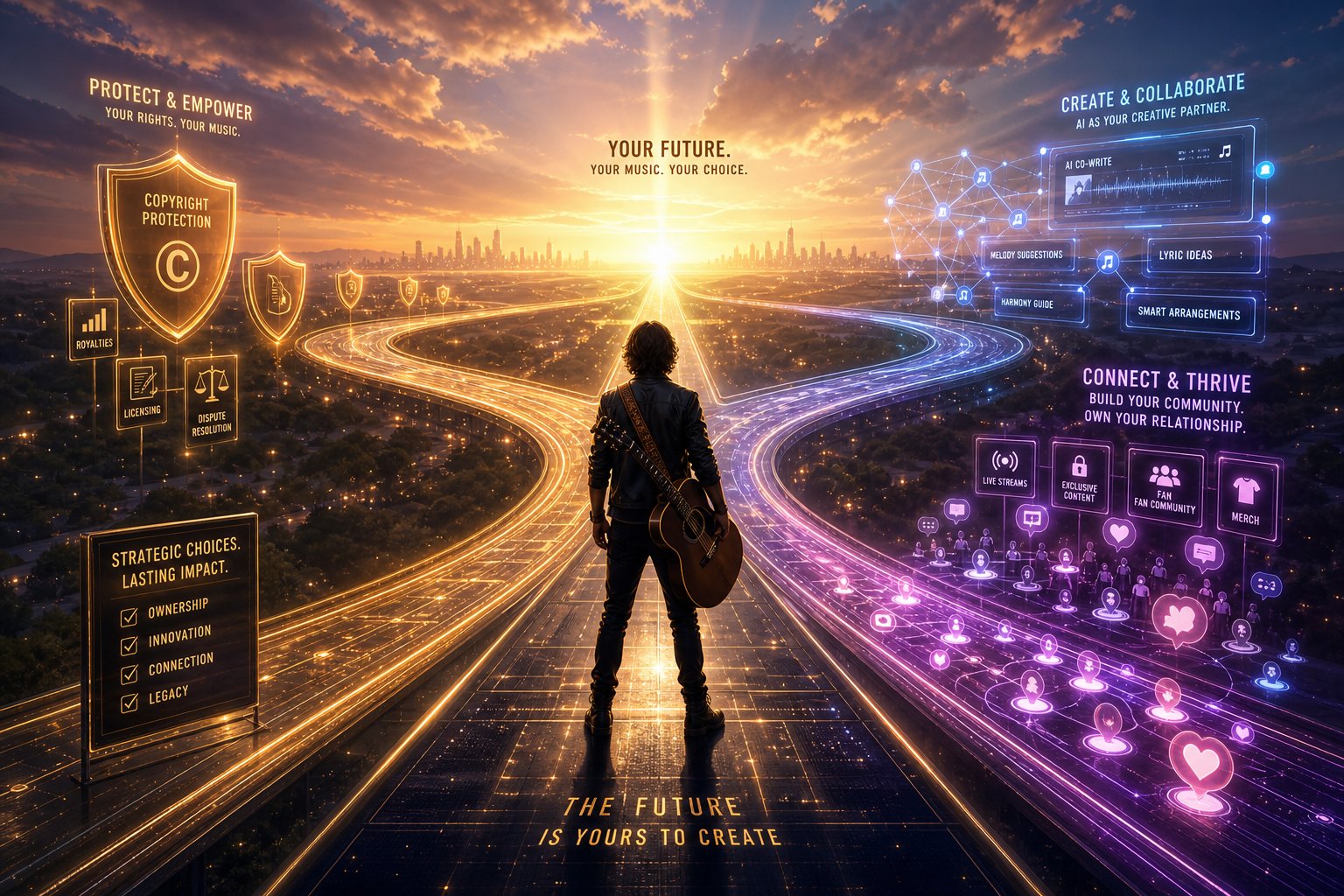
Sustainable creative practice in this environment requires more than just picking the right tools. It demands a deliberate strategy that balances AI adoption with artistic integrity, legal awareness, and long-term career thinking. Will AI take over the music industry? Not in the way doomsday headlines suggest. But it will reshape every corner of it, and musicians who act intentionally now position themselves far better than those who wait.
Building a Hybrid Creative Workflow
The artists gaining the most ground treat AI as a collaborator, not a crutch. They use generative tools for speed and exploration while keeping human decision-making at every point that carries emotional weight. That distinction, between delegating mechanical tasks and surrendering artistic identity, is what separates productive adoption from creative erosion.
Here are concrete steps you can take right now to navigate the future of music with clarity:
- Develop a hybrid workflow — Use AI for rapid ideation, arrangement sketching, and production polish, but make every final creative decision yourself. Generate ten options, then choose and refine the one that aligns with your artistic voice. The AI proposes; you curate.
- Understand your legal rights — Review the terms of service on every platform where you upload music. Watch for clauses granting AI training rights over your catalog. As the ISM advises, attach clear metadata to every release, implement robots.txt protections on your website, and explicitly reserve rights in publishing contracts to prevent unauthorized AI training use.
- Use AI for ideation while maintaining artistic identity — Let generative tools handle the blank-page problem. Prompt-based generators are excellent for sparking directions you would not have considered. But once you have that spark, develop it through your own lens. Your listeners connect with your perspective, not with statistical averages of a million other songs.
- Stay informed about regulatory changes — The legal landscape is shifting fast. EU AI Act provisions take effect in mid-2026, U.S. courts are issuing fair use rulings that will define training legality, and royalty structures may evolve significantly within two years. Follow ai music updates from industry organizations and advocacy groups so you are not caught off guard.
- Diversify revenue beyond streaming — With over 150,000 tracks uploaded to Spotify daily and AI content compounding that flood, relying on per-stream income alone is increasingly precarious. Invest in direct-to-fan channels, sync licensing, live performance, and merchandise. These revenue streams remain harder for AI to disrupt.
- Document your creative process — As copyright questions around AI-assisted work continue to develop, maintaining records of your human creative contributions strengthens your ownership claims. Save drafts, revision notes, and session files that demonstrate meaningful human authorship.
Protecting Your Work While Embracing New Capabilities
The tension between protection and adoption does not have to be paralyzing. You can use AI tools in your production process while simultaneously safeguarding your existing catalog from unauthorized AI training. These are not contradictory positions. They reflect a clear-eyed understanding that music in the future will reward artists who are both technically adaptive and legally informed.
The trends with clear momentum all point in the same direction: ethical AI frameworks built on licensed data, transparency requirements for training datasets, recurring compensation models tied to attribution, and hybrid workflows where humans direct and machines execute. Artists who build their practice around these principles are not gambling on a specific outcome. They are aligning with the structural direction the industry is already moving.
If you want to understand how AI generation actually feels in practice, the fastest path is hands-on experimentation. Tools like MakeBestMusic let you turn a prompt or a set of lyrics into a complete song in seconds, giving you a tangible sense of what these systems can and cannot do. That firsthand experience is more useful than any amount of reading when it comes to deciding where AI fits in your own creative process.
The musicians who will thrive are not those who resist every new tool or those who automate everything. They are the ones who know exactly which parts of their work carry their identity and which parts are mechanical labor that a machine can handle better and faster. Draw that line clearly, protect what matters, and let AI handle the rest.
