

The Real Question Behind AI Music Ethics
Is AI music ethical? The short answer: AI music is ethically permissible when human creative intent guides the process, artist consent is respected, and transparency exists about how the music was made. It becomes ethically problematic when it involves unauthorized voice cloning, deceptive attribution, or deliberate displacement of human creators. Context, intent, and method determine where any specific use case lands on that spectrum.
This isn't a fringe debate. A Ditto Music study of over 1,200 independent artists found that roughly 60% of musicians are already using AI within their music projects. The technology isn't approaching the industry. It's already embedded in it. Every opinion on AI music now carries real-world consequences for working artists, listeners, and the platforms connecting them.
What this article does differently is apply structured ethical reasoning rather than recycling scattered takes. Three formal moral frameworks provide the lens. Real controversies supply the evidence.
What We Mean by AI Music Ethics
AI music ethics covers the moral questions that arise when artificial intelligence intersects with music creation, distribution, and consumption. That includes authorship disputes, consent over training data, economic impact on human musicians, and whether creative integrity survives when algorithms handle composition. The relationship between music and artificial intelligence touches every link in the creative chain, from the songwriter's first idea to the listener's streaming queue.
Why This Question Demands a Structured Answer
Most discussions about artificial intelligence in music treat it as a single phenomenon. They lump AI mastering tools, full song generators, and deepfake voice clones into one moral bucket. That's like evaluating "photography" without distinguishing between photojournalism and doctored propaganda. Different use cases carry different ethical weight, and only formal frameworks can sort them clearly.
Ethics in AI music is not a verdict to deliver once and forget. It is a living practice that must evolve alongside the technology, the law, and the cultural norms shaping how we value human creativity.
The frameworks that follow won't just tell you what to think. They'll give you a repeatable method for evaluating new developments as they emerge, starting with how these AI systems actually work under the hood.
How AI Music Generation Actually Works
Before you can evaluate whether something is ethical, you need to understand what it actually does. So how does AI make music? The process isn't a single algorithm. It's a multi-stage pipeline that transforms an input, whether a text prompt, a melody reference, or a set of lyrics, into a finished audio file. Three dominant approaches exist, and each carries a different ethical footprint.
The first approach is text-to-music generation, where a user describes what they want in plain language and the model produces audio matching that description. The second is audio-to-audio style transfer, where a reference clip gets reimagined in a new arrangement. The third, and most ethically charged, is voice synthesis and cloning, where AI replicates specific vocal characteristics. Models that learn general style patterns across thousands of tracks operate very differently from those trained to replicate a single artist's voice. That distinction matters enormously when ethical questions arise.
Training Data and Pattern Recognition
Every AI music model begins by absorbing massive libraries of existing recordings. Google's MusicLM trained on 280,000 hours of music. Meta's MusicGen used over 20,000 hours of licensed tracks. Stability AI's Stable Audio drew from 800,000 audio files. During training, models extract compressed representations of this audio, learning harmonic progressions, rhythmic structures, timbral textures, and how these elements relate to text descriptions.
The role of machine learning in music generation is essentially pattern recognition at scale. Models like CLAP and MuLan create shared embedding spaces where text descriptions and audio clips with similar meanings map to nearby points. This is how a prompt like "melancholic cello solo in a cathedral" can reliably produce the right combination of instrument, mood, and reverb. The model doesn't understand music theory ai researchers might articulate in academic terms. It learns statistical associations between language and sound.
Here's the critical ethical point: this training step is where many concerns originate. The original artists whose recordings filled those datasets rarely gave explicit consent. They received no compensation for their contribution to training data. Whether that constitutes fair use or exploitation depends on which ethical framework you apply.
From Prompt to Finished Track
Understanding how do ai music generators work requires following a track from input to output. Imagine you type "upbeat jazz piano with brushed drums, 120 BPM" into a generation tool. The specificity of your prompt directly shapes what happens next, because how does ai music work at its core is about constraining probabilities. A vague prompt produces generic results. A detailed one narrows the model's output toward something targeted.
The typical generation pipeline follows this sequence:
- Input encoding: your text prompt gets converted into a conditioning vector using a language model, capturing the semantic intent of your request.
- Latent generation: the model produces a sequence of compressed audio tokens or spectrograms, conditioned on that vector. Transformer-based models predict tokens one by one, while diffusion models iteratively remove noise from a random signal until coherent audio emerges.
- Decoding: a neural vocoder or codec decoder converts the compressed representation back into a full audio waveform at CD quality.
- Post-processing: the raw output undergoes loudness normalization, filtering, and artifact cleanup to meet production standards.
The ethical weight shifts at each stage. Step one is where human creative input lives. The more specific and intentional your direction, the stronger your claim to authorship over the result. Steps two and three are where the model draws on patterns learned from training data, raising questions about whose creative labor made that generation possible. Step four is purely technical.
This pipeline reveals why blanket moral judgments about AI music fall apart. A producer who writes original lyrics, specifies exact instrumentation, iterates through dozens of variations, and arranges the final output occupies a fundamentally different creative position than someone who types "make a hit song" and publishes whatever comes out. The technology is identical. The ethical situation is not.
Applying Ethical Frameworks to AI Music
Knowing how the technology works is one thing. Deciding whether it's right to use it is another. Most conversations about the ethics of AI-generated music stall at gut reactions: enthusiasts celebrate democratized creation, skeptics mourn displaced artists, and nobody changes anyone's mind. Formal ethical frameworks break that impasse by forcing specific questions and revealing where the real tension lives.
Three established moral traditions offer distinct lenses here: utilitarianism asks about total outcomes, deontology asks about inherent rights and duties, and virtue ethics asks about the kind of creators and community we become. Each arrives at a different verdict. Together, they map the full landscape of technical challenges and ethical issues in AI music generation.
Utilitarian Analysis of AI Music
Utilitarianism evaluates actions by their consequences. The question is simple: does AI music produce more aggregate good than aggregate harm? To answer that honestly, you have to put both sides on the scale and actually weigh them.
The benefits of AI in music are real and measurable. Barriers to music creation have dropped dramatically. A bedroom producer without formal training can now generate professional-quality backing tracks, experiment with arrangements across genres, and release finished songs without expensive studio time. Platforms like Amper Music and AIVA have made composition accessible to people who previously had no entry point into music production. Independent filmmakers, game developers, and content creators gain affordable soundtracks. The sheer volume of creative output increases, and more people get to participate in musical expression.
The harms are equally measurable, though they concentrate on fewer people. AI-generated tracks flooding streaming platforms dilute per-stream royalty pools for human musicians. Background scoring jobs in advertising, television, and corporate media are already migrating to AI solutions that cost a fraction of hiring a composer. Prominent artists including Billie Eilish, Stevie Wonder, and Jon Bon Jovi have raised concerns that AI-generated works could diminish royalty pools and reduce opportunities for human musicians. There's also the subtler harm of cultural homogenization: when algorithms learn from existing hits and optimize for engagement metrics, the music they produce trends toward a narrower aesthetic range, reinforcing existing patterns rather than introducing genuinely new voices.
So which side holds more weight? Here's where utilitarian reasoning gets uncomfortable. The benefits are widely distributed but shallow: millions of people gain modest creative convenience. The negative effects of AI in the music industry are narrowly concentrated but deep: thousands of working musicians face genuine economic displacement, and the cultural ecosystem risks losing the diversity that drives artistic evolution. Classical utilitarianism would favor the larger number of beneficiaries, but more sophisticated versions, like John Stuart Mill's distinction between higher and lower pleasures, complicate that calculus. Is a world with more music but less original artistry actually better? The utilitarian framework alone cannot settle the question cleanly, which is precisely why it needs supplementing.
Rights-Based and Deontological Perspectives
Where utilitarianism focuses on outcomes, deontological ethics focuses on duties and principles. The central figure here is Immanuel Kant, whose categorical imperative provides a formal test: act only in a way that you could will to become a universal law, and never treat another person merely as a means to your own ends.
Apply that second formulation directly to AI music training. When a model ingests 280,000 hours of recordings to learn harmonic patterns, rhythmic structures, and vocal textures, it uses the creative labor of thousands of artists as raw material for a commercial product. Those artists did not consent. They were not compensated for this specific use. They had no opportunity to refuse. In Kantian terms, their creative output, which represents personal expression, cultural identity, and years of developed skill, is being treated purely as a means to someone else's end.
This isn't softened by the argument that training produces a net benefit for society. As philosopher Christine Korsgaard argues in her critique of utilitarian aggregation, the good that is "good-for" the AI company and its users is not automatically "good-for" the artist whose work was consumed without permission. You cannot aggregate away an individual's intrinsic worth by pointing to collective gains.
The deontological verdict is clearer than the utilitarian one: using an artist's work to train a commercial AI system without their consent violates a duty of respect toward them as autonomous creative agents. It treats their life's work as mere data, instrumentalizing them for purposes they never endorsed. This holds true regardless of whether the resulting AI music is commercially successful or artistically interesting. The wrongness lives in the process, not the outcome.
Does this condemn all AI music? Not necessarily. A deontological framework would permit AI music creation where training data is fully licensed, where artists have opted in rather than been scraped, and where the creative autonomy of all parties is preserved. The principle isn't "AI music is wrong." It's "using people's creative work without their consent is wrong, no matter how useful the result."
Virtue Ethics and Creative Integrity
Virtue ethics shifts the question away from outcomes and duties entirely. Instead of asking "what happened?" or "what rule was followed?", it asks: what kind of person, and what kind of creative community, are we becoming?
Shannon Vallor's concept of technomoral virtues offers a useful frame. These are "whatever virtues of character are most likely to increase our chances of flourishing together" in a technology-saturated world. Applied to music, the relevant virtues include craft (the discipline of developing skill over time), authentic expression (communicating genuine human experience), originality (contributing something that didn't exist before), and creative courage (taking artistic risks without guaranteed reception).
When AI handles the compositional work, do these virtues strengthen or atrophy? The honest answer is: it depends on the relationship between the human and the tool. A producer who uses AI to rapidly prototype ideas and then substantially reshapes them through personal judgment is still exercising craft and creative direction. Someone who generates a hundred tracks, picks the catchiest one, and publishes it under their name is not cultivating any musical virtue. They're extracting value from a system without contributing creative growth.
The deeper concern is cultural. Creativity as a human capacity is "often considered an intuition and can't be easily interpreted in a rational way," as researchers at HCII 2021 observed. If AI makes finished music as easy to produce as typing a sentence, do aspiring musicians still invest the years of deliberate practice that develop genuine artistic voice? Or does the path of least resistance erode the very discipline that produces meaningful art? Virtue ethics warns that even when an action produces good outcomes and violates no one's rights, it can still be corrosive if it undermines the character traits that sustain a creative culture over time.
The virtue ethics verdict doesn't condemn AI music outright. It condemns the lazy relationship with it. Using AI as a creative partner that expands your expressive range can be virtuous. Using it as a replacement for developing skill is not.
Framework Comparison Matrix
| Ethical Framework | Core Question | Verdict on AI Music | Argument Strength |
|---|---|---|---|
| Utilitarianism | Does AI music produce more total benefit than total harm? | Mixed. Benefits are broad but shallow; harms are narrow but deep. Depends on displacement mitigation. | Moderate. Useful for policy but cannot resolve consent-based objections. |
| Deontology (Kantian) | Does AI music creation respect the rights and autonomy of all individuals involved? | Impermissible when training uses artists' work without consent. Permissible when consent and licensing are secured. | Strong. Provides a clear, non-negotiable line around consent that no amount of benefit can override. |
| Virtue Ethics | Does AI music cultivate or erode the creative virtues that sustain a healthy musical culture? | Depends on relationship. Collaborative use can be virtuous; replacement use erodes craft, expression, and originality. | Moderate-to-strong. Captures long-term cultural effects that other frameworks miss, but harder to enforce. |
Each framework illuminates something the others miss. Utilitarianism captures the economic reality. Deontology draws a firm line on consent. Virtue ethics addresses the slow cultural erosion that neither outcomes nor rules can fully measure. A complete ethical assessment of AI music requires all three lenses working together, not picking a favorite and ignoring the rest.
These frameworks are useful in the abstract. But their real power emerges when applied to specific use cases, because not every form of AI music raises the same moral stakes.
Not All AI Music Raises the Same Ethical Questions
Imagine evaluating the ethics of "driving" without distinguishing between a daily commute and a getaway car. That's essentially what happens when commentators treat AI in music production as a monolithic activity. A songwriter using AI to suggest chord voicings occupies a completely different ethical position than someone cloning a celebrity's voice to release a fraudulent single. Collapsing these into one moral judgment helps nobody.
The ethical weight of any AI music use case depends on three variables: how much human creative direction is involved, whether any individual's identity is appropriated, and whether the output displaces or supplements human work. These variables create a spectrum, not a binary. Here's how specific use cases stack up, from least to most ethically contentious:
- AI-assisted mastering and mixing (e.g., LANDR, iZotope): minimal ethical concern, analogous to auto-tune or noise reduction
- Chord and arrangement suggestions (e.g., Scaler, Captain Plugins): human retains full authorship and decision-making
- AI-generated backing tracks or loops: low-to-moderate concern, depending on whether the human builds substantially on the output
- Full song generation from text prompts: moderate concern, raises authorship and monetization questions
- Style mimicry trained on a specific artist's catalog: high concern, even without voice cloning
- Voice cloning and artist impersonation without consent: highest ethical concern, crosses consent and identity boundaries
Each category deserves its own examination because the ethical reasoning shifts at every level.
Composition Assistance and Production Tools
When you use AI for chord suggestions, arrangement ideas, or mastering assistance, human authorship remains unambiguous. You're making every creative decision. The AI functions as an enhanced instrument, not a co-author. This is how to use ai in music production without stepping into ethically murky territory.
Think of it this way: a spell-checker doesn't make you less of a writer. An AI mastering tool like LANDR, which has processed over 20 million tracks, doesn't make you less of a producer. The creative vision, the emotional intent, the artistic choices about what stays and what gets cut: those remain entirely yours. As Berklee's Gabriel Ryfer Cohen puts it, these powerful tools "remain just that: tools."
AI and music production have coexisted in this collaborative mode for years without generating serious ethical controversy. Auto-tune, quantization, sample libraries, and algorithmic reverb all preceded today's generative models. The ethical line stays clear as long as human creative direction governs the output.
Full Song Generation from Prompts
The middle ground is where things get interesting. When a user provides a text prompt, style reference, or original lyrics and an AI generates a complete track, the authorship question becomes genuinely complicated. Who deserves creative credit: the person who wrote the prompt, the developers who built the model, or the thousands of artists whose work trained it?
Tools like MakeBestMusic's AI Music Generator represent this category. A user inputs their own lyrics, selects style preferences, and provides creative direction through prompts. The AI handles composition and production. This occupies a fundamentally different ethical position than voice cloning because the creative direction originates with the user. Nobody's identity is being appropriated. The user isn't pretending to be someone else. They're channeling their own ideas through a generative system.
Still, genuine ethical questions remain. If you generate a complete song in 30 seconds and monetize it on streaming platforms, are you claiming authorship over something you didn't meaningfully create? The U.S. Copyright Office has already signaled that purely AI-generated works lack the human authorship required for copyright protection. This legal position reflects an underlying moral intuition: creative credit should flow toward creative effort.
The ethical resolution here isn't a hard prohibition. It's a gradient. The more specific your input, the more you iterate and refine, the more you reshape the output through personal judgment, the stronger your authorship claim becomes. Someone who writes original lyrics, specifies detailed musical parameters, generates dozens of variations, and carefully selects and edits the final result has a legitimate creative claim. Someone who types "make a hit" and uploads whatever appears does not.
Voice Cloning and Artist Impersonation
Voice cloning sits at the far end of the ethical spectrum because it introduces something the other categories don't: the unauthorized use of a specific person's identity. When an AI replicates Drake's vocal timbre or Ariana Grande's phrasing without their consent, it's no longer a question of abstract creative principles. It's a question of personal autonomy and dignity.
Why is consent non-negotiable here? Because a voice is more than a sound. It's an identity marker as distinctive as a face or a fingerprint. Vocal cloning ethics intersect with personality rights, and multiple jurisdictions already recognize that using someone's distinctive vocal characteristics without permission violates their right of publicity, whether you're sampling their recordings directly or training a model on their vocal patterns.
The ethical guidelines emerging around AI-generated vocals center on three principles: obtaining explicit consent when replicating existing voices, maintaining transparency with audiences about synthetic vocal elements, and fairly compensating artists whose vocal identities are being used commercially. These aren't suggestions. They represent the ethical floor below which any use becomes indefensible.
Notice that none of these principles apply to prompt-based song generation where no specific artist's voice is replicated. That's precisely why treating "AI music" as one thing distorts the ethics. A user generating an original track from their own creative direction is engaging in a categorically different activity than someone publishing a deepfake vocal performance designed to deceive listeners into thinking a real artist created it.
The spectrum matters because ethical clarity requires precision. And precision, in turn, requires examining what happens when these theoretical distinctions collide with real-world incidents that forced the industry to confront these questions publicly.
Ethical Controversies That Changed the AI Music Industry
Ethical frameworks are powerful reasoning tools, but they gain urgency when real people are harmed and real money moves in ways nobody authorized. The AI music industry has already produced a string of incidents that forced abstract debates into concrete policy discussions. Each controversy highlights a different failure point: unauthorized identity use, systemic economic exploitation, and mass copyright infringement disguised as innovation.
These aren't hypotheticals. They're documented cases with identifiable victims, measurable damages, and lasting consequences for how the music ecosystem treats AI-generated content.
The Drake and Weeknd Deepfake Incident
In April 2023, a TikTok user called Ghostwriter977 uploaded a track titled "Heart on My Sleeve" featuring AI-generated vocals that convincingly mimicked Drake and The Weeknd. The song wasn't just a novelty experiment shared among friends. It went massively viral: 600,000 Spotify streams, 15 million TikTok views, and 275,000 YouTube views before Universal Music Group had it pulled from platforms.
Why did this particular track become a watershed moment? Because it exposed multiple ethical failures simultaneously:
- Unauthorized voice use: Neither Drake nor The Weeknd consented to having their vocal identities replicated. Their voices, the most recognizable element of their artistic brand, were synthesized and deployed for someone else's project.
- Platform distribution at scale: The track wasn't confined to a curiosity forum. It reached hundreds of thousands of listeners through the same commercial channels that distribute legitimate music, generating real streaming revenue.
- Public deception: Many listeners initially believed the track was a genuine collaboration or leak. The AI-generated nature of the vocals wasn't immediately obvious, meaning audiences were deceived about what they were consuming.
- Absence of recourse: The speed of viral distribution outpaced any takedown mechanism. By the time UMG acted, millions of people had already engaged with the content.
Drake himself responded on Instagram, calling it "the final straw AI" after multiple unauthorized uses of his synthesized voice surfaced across social media. UMG's statement went further, framing the issue as an existential choice: the industry must decide whether it stands "on the side of artists, fans and human creative expression, or on the side of deep fakes, fraud and denying artists their due compensation."
The Heart on My Sleeve incident crystallized something that ethical theorists had been arguing for months. Voice cloning without consent isn't a gray area. It sits squarely in violation of deontological principles (instrumentalizing an artist's identity), utilitarian concerns (concentrating harm on specific individuals for diffuse entertainment value), and virtue ethics (rewarding deception over genuine creative development). This single track made that convergence visible to millions of people who had never considered whether AI in the music industry posed moral risks.
Ghost Artists and Streaming Platform Manipulation
If the Drake deepfake was a highly visible case of identity theft, streaming fraud represents a quieter but potentially more damaging ethical failure. The mechanics are straightforward: threat actors use generative AI to mass-produce thousands of tracks, upload them under fake artist names to platforms like Spotify and Apple Music, then inflate play counts using bot networks to siphon royalties from shared revenue pools.
The scale is staggering. HUMAN Security's Satori Threat Intelligence team has documented operations where AI generates near-infinite supplies of passively consumed music, ambient loops, lo-fi beats, and instrumental filler designed not for artistic expression but as vehicles for royalty extraction. These tracks are uploaded under dozens of fabricated artist profiles with generic names, minimal biographies, and no verifiable presence outside the streaming platform itself.
The ethical harm here operates through dilution. Streaming platforms use pro-rata payment models where all subscription revenue goes into a shared pool, then gets distributed based on total streams. Every fraudulent stream siphons fractions of a cent away from legitimate artists. Multiply that across billions of bot-generated plays and the cumulative theft becomes substantial. Real musicians, especially independent and emerging artists who depend on streaming income, earn less because AI-generated ghost tracks are draining the same finite pool.
Two layers of ethical responsibility exist in this scheme. The uploaders bear obvious culpability: they're committing fraud by generating fake engagement and extracting revenue under false pretenses. But platforms also face moral scrutiny. When a service's recommendation algorithm pushes AI-generated "Focus Music for Studying" playlists stuffed with fraudulent tracks, and those playlists attract real listeners who don't know the content is machine-generated, the platform is complicit in a system that rewards deception and punishes genuine artistry.
This isn't a fringe problem. The first criminal case involving AI-inflated streaming resulted in charges against a North Carolina musician who used artificial intelligence and bot farms to generate fraudulent plays. The case revealed a blueprint that anyone with access to generative tools and bot services could replicate, a blueprint that threatens the economic foundation AI in music industry participants depend on.
RIAA Legal Actions Against AI Companies
While deepfakes and streaming fraud target individual artists and revenue pools, the recording industry's lawsuits against AI music generators address the foundational ethical question: is it permissible to build a commercial product by ingesting copyrighted recordings without permission?
In June 2024, the RIAA filed landmark copyright infringement cases against Suno and Udio, two multi-million-dollar AI music generation services. Plaintiffs included Sony Music Entertainment, UMG Recordings, and Warner Records. The core allegation: both services copied decades of copyrighted sound recordings to train their models without obtaining licenses, consent, or providing compensation to the artists and labels whose work made those models functional.
The complaints are blunt about the stakes. They argue that when AI companies "steal copyrighted sound recordings, the services' synthetic musical outputs could saturate the market with machine-generated content that will directly compete with, cheapen, and ultimately drown out the genuine sound recordings on which the services were built." The cases seek declarations of infringement, injunctions against future unauthorized use, and damages for infringements already committed.
The ethical arguments on both sides deserve honest examination. The industry's position rests on consent and compensation: artists created the work that makes these models possible and deserve control over how it's used. RIAA Chairman Mitch Glazier framed it directly: "Unlicensed services like Suno and Udio that claim it's 'fair' to copy an artist's life's work and exploit it for their own profit without consent or pay set back the promise of genuinely innovative AI for us all."
The AI companies' implicit defense invokes fair use doctrine: training on existing works to create something functionally new is transformative, similar to how a human musician absorbs influences from everything they hear. The RIAA complaints anticipate this argument, countering that fair use "promotes human expression by permitting the unlicensed use of copyrighted works in certain, limited circumstances," but that AI generators offer "imitative machine-generated music, not human creativity or expression."
AI companies, like all other enterprises, must abide by the laws that protect human creativity and ingenuity. There is nothing that exempts AI technology from copyright law or that excuses AI companies from playing by the rules.
What makes these cases ethically significant beyond their legal outcomes is the breadth of consensus they reveal. The Artist Rights Alliance, the American Federation of Musicians, SAG-AFTRA, the National Music Publishers' Association, and the Black Music Action Coalition all issued supporting statements. When organizations representing performers, composers, publishers, and unions agree that unconsented training constitutes theft, the ethical signal is difficult to dismiss as mere industry protectionism.
These controversies share a common thread: each represents a failure of consent, transparency, or fair compensation. The ethical principles that emerge aren't obscure philosophical positions. They're practical boundaries that the legal system is now beginning to codify into enforceable rules.
The Legal Landscape Shaping AI Music Ethics
Ethical principles matter. But principles without enforcement remain aspirational. What transforms the AI music ethics debate from philosophy into practice is law: binding rules with real consequences. Legislators, copyright offices, and regulatory bodies across multiple jurisdictions are translating those ethical principles into codified standards. These legal developments don't just mirror moral reasoning. They create an ethical floor, a minimum standard below which no creator or company can operate without facing liability.
For anyone working with artificial intelligence in music production, understanding this legal terrain isn't optional. It determines what you can copyright, what you must disclose, and what could land you in court.
Copyright Office Decisions on AI-Generated Works
The most consequential ruling came from the U.S. Copyright Office in January 2025, when it released Part 2 of its report on copyright and AI. The conclusion is unambiguous: AI-generated outputs can receive copyright protection only where a human author has determined sufficient expressive elements. The mere provision of prompts does not qualify as authorship.
What does this mean in plain terms? If you type "upbeat pop song about summer" into a generator and publish whatever comes out, that track cannot be copyrighted. It falls into the public domain. Anyone can copy it, redistribute it, or claim it as their own, and you have zero legal recourse.
Register of Copyrights Shira Perlmutter framed the reasoning directly: "Extending protection to material whose expressive elements are determined by a machine would undermine rather than further the constitutional goals of copyright." The Office confirmed that using AI to assist in the creation process does not bar copyrightability, nor does including AI-generated material in a larger human-generated work. The critical distinction is who makes the expressive choices.
This creates a practical gradient for creators. You'll notice the ethical spectrum from the previous section maps neatly onto the legal one:
- Human writes lyrics, composes melody, uses AI for production polish: fully copyrightable
- Human provides detailed creative direction, iterates on AI outputs, arranges final result: likely copyrightable
- Human provides a brief prompt, publishes unmodified AI output: not copyrightable
The ethical implication is significant. Copyright law has effectively encoded a moral principle: creative credit should follow creative effort. If you didn't make the expressive decisions, you don't own the result. That's not just a legal technicality. It's a statement about what society values in the creative process.
Legislation Targeting AI Music Specifically
Beyond copyright registration, several legislative efforts directly target the ethical failures exposed by real-world controversies. The most prominent is the NO FAKES Act (Nurture Originals, Foster Art, and Keep Entertainment Safe), introduced in both the U.S. Senate and House of Representatives. This bill aims to establish the first federal right of publicity specifically addressing AI-generated digital replicas.
The NO FAKES Act targets unauthorized digital replications of a person's voice or visual likeness. Under the proposed legislation, anyone who knowingly publicizes a digital replica of an individual without consent would be held liable for resulting harm. Online platforms would be required to remove user-uploaded content claimed to be an unauthorized replica. Exceptions exist for fair use purposes like commentary, criticism, and news reporting.
The bill's future remains uncertain. First Amendment concerns about potential restrictions on free speech in digital spaces have generated pushback, and legal analysts have flagged the vagueness of certain provisions. Cases like Lehrman v. Lovo, where voice actors sued an AI company for using their voices in a text-to-speech tool without authorization, will likely influence how courts interpret these protections. Still, the NO FAKES Act signals a clear legislative direction: the ethics of consent around digital identity are being converted into legal obligation.
Across the Atlantic, the EU AI Act classifies generative AI systems, including music generators, under transparency obligations. Providers of general-purpose AI models must disclose training data summaries and comply with copyright law. Content generated by AI must be labeled as such in contexts where the public could be misled. The UK has moved even more decisively: in March 2026, the government scrapped plans that would have allowed AI companies to train on copyrighted music without explicit permission, after over 10,000 consultation submissions overwhelmingly opposed the opt-out approach.
These legal developments shift the ethics conversation. The question is no longer "should we respect artists' consent?" It's "how do we comply with laws that require it, and how do we go beyond the minimum?" Legislation creates the floor. Ethics asks you to aim higher.
Certification and Transparency Standards
Where legislation sets enforceable minimums, industry certification standards address a different gap: how do listeners, licensors, and platforms know whether music was created by humans, assisted by AI, or generated entirely by machines?
Several initiatives are emerging to answer this. AI music production companies, stock audio libraries, and licensing platforms are beginning to adopt human-made certification programs. These function like organic food labels for creative content: a verifiable signal that a real person made the expressive decisions behind the work. For stock audio providers especially, this certification has become a competitive differentiator as buyers increasingly want assurance about what they're licensing.
Transparency requirements are also gaining traction. YouTube updated its policies to require disclosure of AI-generated content and may limit reach or monetization for music without clear human input. Streaming platforms like Deezer, which reports receiving over 30,000 fully AI-generated tracks daily, are developing detection systems and disclosure labels. Spotify removed tens of millions of tracks flagged as AI-generated spam. Even music contract software with automated royalty calculation features is beginning to incorporate metadata fields that distinguish between human-composed and AI-assisted works, ensuring royalty splits reflect actual creative contributions.
These standards matter ethically because transparency is the precondition for informed choice. A listener can't exercise moral judgment about what they stream if they don't know what they're listening to. A sync licensing buyer can't make an ethical procurement decision if the provenance of a track is hidden. Certification and disclosure don't resolve the deeper ethical questions, but they make genuine resolution possible by ensuring everyone operates with accurate information.
| Legal Framework | Scope | Key Requirements | Ethical Implication for AI Music Creators |
|---|---|---|---|
| U.S. Copyright Office Guidance (2025) | Copyrightability of AI-generated outputs | Human author must determine sufficient expressive elements; prompts alone don't qualify | Creative effort determines ownership. No effort, no rights. Encourages meaningful human involvement. |
| NO FAKES Act (proposed) | Unauthorized digital replicas of voice/likeness | Consent required for digital replicas; platforms must remove unauthorized content; fair use exceptions apply | Consent is non-negotiable for identity use. Voice cloning without permission becomes legally actionable. |
| EU AI Act | Generative AI systems including music tools | Training data transparency; AI-generated content labeling; copyright compliance | Transparency obligations mean creators can no longer obscure AI involvement. Disclosure becomes default. |
| UK Copyright Policy (2026) | AI training on copyrighted works | Explicit permission required before using copyrighted material for AI training | Opt-in replaces opt-out. Artists regain control over whether their work trains commercial models. |
| Platform Policies (YouTube, Spotify, Deezer) | AI content on streaming/video platforms | Disclosure of AI generation; potential monetization limits; spam removal | Undisclosed AI music faces economic penalties. Honesty about process becomes financially incentivized. |
Together, these frameworks form an increasingly coherent legal architecture. Copyright law rewards human creative involvement. Publicity rights protect individual identity. Transparency regulations ensure honest disclosure. Platform policies enforce compliance through economic incentives. None of these systems are complete yet, and jurisdictions differ in pace and specifics. But the direction is clear: the ethical principles of consent, transparency, and human creative primacy are being written into enforceable rules.
What these laws don't address, however, is the ethical responsibility of everyone else in the ecosystem. Creators face legal obligations. But what about the people who listen to, stream, and commission AI music? Their choices shape the market too, and their ethical responsibilities deserve examination.
Ethical Responsibilities Beyond the Creator
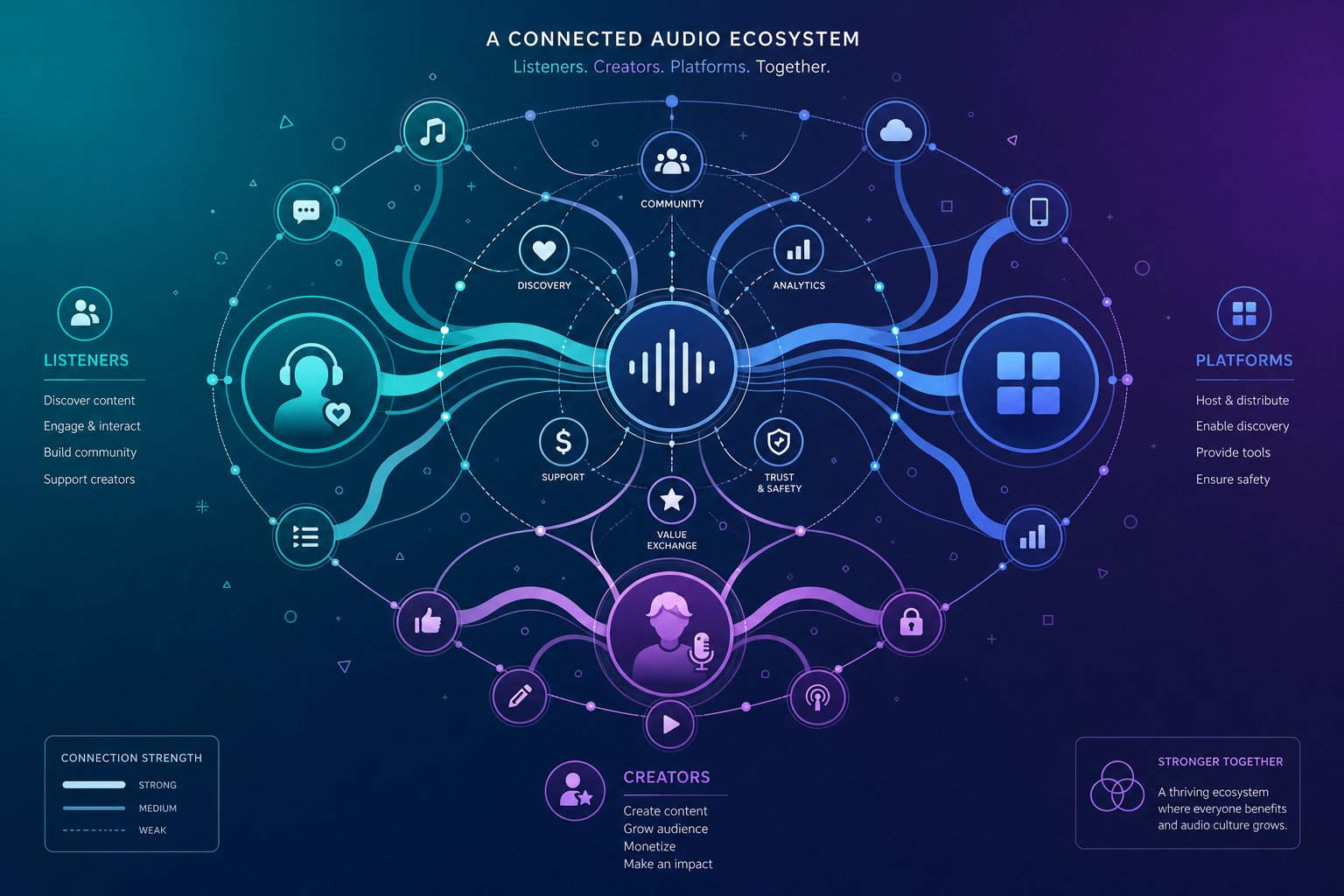
Laws target the people who build AI models and the people who upload AI-generated tracks. Ethical frameworks, as applied earlier in this article, focus on the act of creation. But the ecosystem doesn't end with creators. Every stream, every playlist addition, every algorithmic recommendation feeds the same economic machine. Listeners and platforms aren't passive bystanders in this equation. Their choices carry moral weight too, and the ai impact on music industry economics only makes that weight heavier.
When you press play on a track, you cast a tiny economic vote. In a pro-rata system, that vote directs fractions of a cent toward whoever uploaded it. If the track is AI-generated filler uploaded under a fake artist name, your stream funds fraud and diverts payment from human musicians. You didn't intend that outcome. But does ignorance eliminate responsibility?
Listener Ethics in the Streaming Era
Do listeners have an ethical obligation to know whether music is AI-generated? The intuitive answer is no. People stream music for enjoyment, not investigation. Nobody checks the production credits before hitting shuffle on a study playlist. Yet that intuition breaks down once you understand the economic consequences.
Here's the reality: Deezer reported that approximately 44% of daily uploads to its platform are now AI-generated tracks, yet those tracks account for less than 3% of total streams, with a majority of even those streams driven by bots rather than human listeners. The supply is exploding. Real demand isn't keeping pace. But the economic harm still occurs because every fraudulent or AI-generated stream that slips through dilutes the shared royalty pool that pays real artists.
A Luminate study covered by NPR found that listener comfort with AI music dropped from -13% to -20% between May and November 2025. Consumers are net negative: more people feel uncomfortable with AI use in music than feel comfortable with it. The decline is sharpest among Gen Z and Gen Alpha listeners, the very demographics streaming platforms depend on for growth. Artists speaking out, from SZA calling herself "at war" with AI to the 200-plus musicians who signed open letters demanding protection, appear to be shifting public sentiment.
This growing discomfort suggests that listeners do care about the origin of what they hear, once they're made aware. The ethical question isn't whether people should become music detectives. It's whether they have a responsibility to support systems that provide transparency, to choose platforms that label AI content clearly, and to be intentional about where their streaming dollars flow.
Consumer demand also shapes production incentives. When audiences accept an endless supply of cheap background music without questioning its origin, they create market conditions that reward the mass production of AI-generated filler. That demand signal tells the industry: quality and human craft don't matter as much as volume and availability. Whether individual listeners bear direct blame is debatable. That their aggregate behavior shapes the ecosystem is not.
Platform Responsibilities and Algorithmic Curation
Platforms occupy a more clearly culpable position than individual listeners. They design the algorithms. They control what gets recommended. They set the rules for what gets uploaded, labeled, and monetized. When a recommendation engine pushes an AI-generated "Lo-fi Beats for Focus" playlist to millions of users without disclosing that none of the tracks were made by human musicians, the platform is making an ethical choice, even if it frames the decision as mere optimization.
NRG research found that 54% of streaming listeners believe AI will have a net negative impact on musicians and songwriters. Meanwhile, 38% of users say fair artist compensation is "very important" to them, making it the second most important feature driving platform loyalty after audio quality. Listeners already expect platforms to protect the artists they love. When platforms fail to distinguish human-made music from machine-generated content in their recommendations, they betray that expectation.
The impact of ai on music industry revenue models makes this betrayal concrete. Streaming services use pro-rata payment: all subscription revenue enters a shared pool, and each track's payout depends on its share of total plays. When AI-generated tracks accumulate streams, whether through bot manipulation or legitimate passive listening, they shrink the per-stream value for everyone else. An independent artist who earned $0.004 per stream now earns $0.003 because thousands of AI-generated ambient tracks absorbed part of the pool. The platform's algorithm recommended those tracks. The platform bears responsibility for the outcome.
Algorithmic curation that favors cheaper AI content over human work isn't a neutral technical decision. It's a systemic ethical failure with identifiable victims. Platforms optimize for engagement and retention, not for the welfare of the creators whose content drives that engagement. When those optimization targets can be served more cheaply by AI-generated material, the algorithm has an economic incentive to recommend it, regardless of the downstream harm to human artists.
Deezer's own research found that 80% of listeners believe fully AI-generated music should be clearly labeled, and 52% believe it doesn't belong in main charts alongside human-made music. The audience has already reached a conclusion. The platforms are still catching up.
Based on these realities, specific ethical principles emerge for both listeners and platforms operating within ai and the music industry:
- For listeners: Support platforms that implement transparent AI labeling policies rather than those that obscure content origins.
- For listeners: When possible, seek out and stream music from verified human artists, especially independent creators most vulnerable to royalty dilution.
- For listeners: Recognize that passive acceptance of undisclosed AI content normalizes the economic displacement of working musicians.
- For platforms: Label all AI-generated or AI-assisted content clearly, at the point of recommendation and on the track page itself.
- For platforms: Separate AI-generated content from human-made music in royalty calculations, or implement user-centric payment models that direct each listener's subscription toward the artists they actually chose to hear.
- For platforms: Audit recommendation algorithms for bias toward cheaper AI content, and weight human-made music proportionally in discovery features.
- For platforms: Remove fraudulent AI-generated tracks and demonetize bot-inflated streams proactively, not only after complaints surface.
None of these principles require rejecting AI music entirely. They require honesty about what it is, accountability for the economic systems it operates within, and a conscious decision not to let algorithmic efficiency quietly override the livelihoods of human creators. The ethical burden doesn't rest on any single actor. It distributes across the entire chain, from the developer who builds the model, to the platform that hosts the output, to the listener whose stream becomes a micro-transaction in a system they may not fully understand.
Understanding shared responsibility is one thing. Translating it into daily creative practice is another. The final challenge is giving creators, listeners, and platforms a concrete set of guidelines they can apply right now, while the legal and cultural landscape continues to shift beneath them.
Practical Guidelines for Ethical AI Music Creation
Ethical standards in AI music aren't static. A practice that seemed harmless in 2023, like training on publicly available recordings without explicit consent, now faces legal challenge and public backlash. What's considered acceptable shifts as legislation tightens, cultural attitudes evolve, and the technology itself changes what's possible. That means ethical awareness isn't a box you check once. It's an ongoing discipline, more like maintaining physical fitness than passing a single exam.
For creators working with artificial intelligence for music production, this temporal dimension makes practical guidelines essential. You need principles sturdy enough to hold today but flexible enough to adapt as the ground moves beneath them.
Building an Ethical Practice Around AI Music
Think of ethical AI music creation as a practice in the same way meditation or musicianship is a practice: something you return to deliberately, refine over time, and hold yourself accountable to even when nobody's watching. The Water & Music ethical framework captures this well, cautioning that ethics must be treated "as a verb, not a noun" and that reducing real-world harms into a quick checklist without serious reflection leads to moral blindness.
With that spirit in mind, five foundational principles anchor responsible AI music practice:
- Always disclose AI involvement. Whether you're releasing a fully generated track or using AI to add a background of a music performance on AI-assisted production tools, transparency with your audience builds trust and respects their right to know what they're consuming.
- Never clone voices without explicit consent. This principle has no exceptions. A person's voice is their identity. Using it without permission violates their autonomy regardless of your creative intent or how impressive the result sounds.
- Ensure human creative direction guides the output. The more specific your input, the stronger your ethical and legal position. Write your own lyrics, define your style parameters, iterate on results, and make deliberate artistic choices rather than publishing raw, unmodified AI output.
- Compensate artists whose work informs training data when possible. Support platforms and tools that license their training data or operate royalty-sharing frameworks. When you can choose between a model trained ethically and one built on scraped recordings, choose the former.
- Support platforms with transparent AI policies. Your tool choices are ethical choices. Favor services that disclose their data sources, respect opt-out requests, and clearly communicate what rights you retain over generated content.
These aren't aspirational ideals reserved for saints. They're minimum standards that any creator using AI can implement immediately. The Sonarworks responsible integration guide reinforces this point: responsible use means understanding what data your AI tools use, how they process your audio, and what rights you retain over the final output. Ignorance isn't a defense when the information is available.
The Spectrum of Ethical AI Music Creation
Principles are essential, but situations are specific. You need a decision framework you can run through before publishing any AI-assisted work. Imagine you've just generated a track using a prompt-based tool, maybe something like ChatGPT for music composition or a dedicated generator like MakeBestMusic's AI Music Generator, where you supplied your own lyrics, chose a genre, and directed the style. Before you release it, run through these questions:
- Does human creative intent drive this work? Did you make meaningful expressive decisions, or did you outsource all creative judgment to the algorithm? The more specific your direction, the stronger your ethical standing.
- Is any individual's likeness used without consent? If the output replicates a recognizable voice, style so specific it constitutes identity appropriation, or uses a named artist's persona, stop. Consent is required.
- Will this output displace or supplement human work? There's a difference between using AI to prototype ideas you'll develop further and flooding a platform with generated content designed to extract royalties from a shared pool. One supplements creativity. The other undermines it.
- Would you be comfortable with full transparency about the process? If you'd feel embarrassed or defensive explaining exactly how the track was made, that discomfort is a moral signal worth heeding. Ethical creation survives daylight.
- Are you contributing to or extracting from the creative ecosystem? Does your use of AI help you grow as an artist, serve a genuine creative vision, or give back to your community? Or are you purely extracting economic value from a system without adding anything meaningful?
Tools that position the user as creative director rather than passive consumer align naturally with these principles. When you input original lyrics, select instrumentation, specify mood and tempo, and iterate until the result matches your vision, you're maintaining the human authorship intent that both ethics and copyright law reward. That's categorically different from typing a single generic prompt and monetizing whatever emerges.
The Water & Music framework puts it well: ethical AI use requires approaching decisions through lenses of rights, justice, utility, common good, virtue, and care, then evaluating your choices, testing them against how others would perceive them, and reflecting afterward. It's a cycle, not a finish line.
Revisit these guidelines regularly. The tools will evolve. New legal requirements will emerge. Cultural expectations will shift. What remains constant is the underlying commitment: use AI for creativity, with integrity, and in solidarity with the broader community of musicians whose work makes the entire ecosystem possible.
A Clear Answer to the Ethics Question
Three ethical frameworks. Multiple real-world controversies. An evolving legal architecture. All of it converges on a position more specific than "it depends" and more honest than a blanket yes or no.
Where AI Music Stands Ethically
The relationship between music and ai is ethically permissible when four conditions hold simultaneously: human creative direction is present, consent over voice and likeness is respected, transparency about AI involvement is maintained, and economic displacement of human artists is actively mitigated rather than ignored. Strip away any one of those conditions, and the ethical ground collapses.
AI music is ethically impermissible when it involves unauthorized voice cloning, deceptive attribution designed to mislead listeners, deliberate flooding of royalty pools with bot-inflated content, or training on copyrighted works without license or consent. These aren't edge cases. They're the documented harms that prompted lawsuits, legislation, and public backlash.
The question of how does ai create music matters here because method determines morality. Machine learning music systems that train on licensed datasets and produce outputs shaped by genuine human creative choices occupy a fundamentally different ethical position than systems built on scraped recordings and deployed to impersonate real people. Same underlying technology. Completely different moral standing.
Ethics as an Evolving Standard
These conclusions apply now. They won't remain static. As machine learning and music continue to intertwine, new capabilities will introduce new ethical questions nobody has anticipated yet. Legislation will tighten in some jurisdictions and lag in others. Cultural norms around AI disclosure will shift as audiences become more literate about how these tools function.
The frameworks outlined in this article aren't a final verdict. They're a repeatable method. When the next controversy surfaces or the next generation of tools arrives, apply the same lenses: weigh aggregate outcomes, check whether consent and autonomy are respected, and ask what kind of creative culture your choices are building.
AI music is ethical when humans lead, consent is secured, transparency is default, and the ecosystem sustains rather than displaces the artists who made it possible. Anything less is a shortcut dressed as innovation.
Revisit your position as the landscape changes. The commitment to asking the question honestly matters more than any single answer you arrive at today.
