

What Would It Take for AI to Truly Understand Music
Imagine a machine that composes a melody so moving it brings you to tears. It followed every rule of harmony, nailed the emotional arc, and even surprised you with a chord change that sent chills down your spine. Here's the uncomfortable question: did the machine understand the music it made, or did it simply arrange numbers in a pattern that happened to move you?
This is the core tension behind asking whether artificial intelligence in music can ever cross the line from processing sound into genuinely comprehending it. The distinction matters more than it might seem at first glance. Processing means converting audio into data, detecting patterns, and generating statistically plausible outputs. Understanding, on the other hand, implies something far richer, something that touches the very nature of mind itself.
Defining What Musical Understanding Actually Means
Before we can answer whether AI grasps music, we need to define what grasping music actually involves for those who already do it: us. Musical understanding is not a single skill. It is a layered phenomenon that draws on perception, emotion, memory, cultural knowledge, and lived experience all at once.
Musical understanding is the integrated capacity to perceive sonic structure, generate emotional and physical responses, interpret cultural and historical meaning, and relate those elements to subjective personal experience.
That definition matters because it exposes the gap between what current AI systems do and what human listeners do without thinking. When you hear a song from your teenage years, you are not just recognizing frequencies. Your brain activates reward circuits, pulls autobiographical memories forward, and situates the sound within a web of personal identity. As cognitive neuroscientist Robert Zatorre of McGill University has shown, music engages ancient reward structures that respond to stimuli like food and social bonding, yet it also recruits higher-order regions tied to internal goals, values, and sense of agency. A machine performing statistical pattern matching on audio tokens does none of this.
Why This Question Matters Beyond Academic Debate
You might wonder: does it really matter whether AI understands music, as long as it produces something people enjoy? The answer reaches into copyright law, artistic identity, listener trust, and the future shape of the music industry. If machines can make better music than humans, at least by some measurable standard, the philosophical question becomes an economic and ethical one too.
Institutions at the intersection of music and artificial intelligence are already grappling with this. At Berklee College of Music's AI and Music Innovation event, professor Lori Landay put it directly: "An AI simulation is never going to have what everyone in this room has, which is experiences over time in a body." Carnegie Mellon University researchers have similarly found that humans still lead in creativity even as AI output advances technically. These are not abstract debates confined to philosophy departments. They shape how artists define their craft and how audiences decide what deserves their attention.
What follows is an interdisciplinary exploration, one that bridges philosophy of mind, music cognition, and AI architecture, to examine whether the question "can AI truly understand music" even has a clean answer, or whether the reality is something more layered and more interesting than a simple yes or no.
The Neuroscience Behind How Humans Experience Music
That layered definition of musical understanding from the previous section raises an immediate follow-up: what does the biology look like? If understanding music requires perception, emotion, memory, and embodied response working together, then the brain must be doing something remarkably complex every time you press play on a favorite track. And it is.
Music perception is not a single process happening in one region. It is a whole-brain event. As Harvard Medical School's Patrick Whelan explains, music "lights up nearly all of the brain," engaging structures responsible for memory, emotion, motor coordination, and reward simultaneously. This is why music creativity in humans feels so different from mere pattern recognition. Your brain is not just identifying sounds. It is predicting, feeling, remembering, and moving all at once.
Here are the key neurological components involved in music perception:
- Auditory cortex pattern recognition — parses the soundscape, identifies tonal relationships, and separates instruments from noise
- Limbic system emotional engagement — governs pleasure, motivation, and reward responses to musical stimuli
- Motor cortex rhythmic entrainment — drives the urge to tap your feet, nod your head, or dance
- Prefrontal cortex structural analysis — tracks larger musical forms like tension, resolution, and narrative arc
- Hippocampal memory association — links sounds to autobiographical memories and personal meaning
Each of these systems contributes something distinct, but none of them operates in isolation. The result is an integrated experience that feels effortless to the listener but is anything but simple under the hood.
How the Brain Predicts and Rewards Musical Patterns
Imagine listening to a song you have never heard before. Within seconds, your brain is already generating predictions about what comes next. Will the melody rise or fall? Will the chord resolve or surprise? This process, known as predictive coding, is one of the brain's most fundamental operations, and it sits at the heart of why music creativity exists in the first place.
The predictive coding framework proposes that the brain continuously generates models of incoming sensory input, then compares those predictions against what actually arrives. When a musical passage confirms your expectation, it feels satisfying. When it deviates in a skillful way, it generates surprise, and that surprise is where the magic happens.
Research from the Center for Music in the Brain distinguishes between two types of prediction at play: prediction error about the music's structure ("What is the next chord?") and reward prediction error about its emotional value ("How much will I enjoy the next chord?"). These are distinct processes, potentially mediated by different neural circuits, yet they work in tandem to create the sense that music is unfolding meaningfully over time.
This is not passive reception. Your brain is actively constructing the musical experience moment by moment, weighing each new sound against a lifetime of accumulated listening. The interplay between prior learning and dynamic changes in stimulus structure is what gives music its emotional weight. More music does not automatically mean more pleasure. Rather, the pleasure potential depends on how well the composition plays with your expectations.
The Dopamine Response and Why Machines Cannot Replicate It
When those predictions pay off, or when a piece of music surprises you in just the right way, something physical happens. Your skin prickles. A shiver runs down your spine. You might even feel tears forming. These are not metaphors. They are measurable physiological events driven by dopamine release in the brain's striatal regions, particularly the nucleus accumbens.
A landmark pharmacological study published in the Proceedings of the National Academy of Sciences demonstrated this causal link directly. Researchers administered a dopamine precursor (levodopa), a dopamine antagonist (risperidone), and a placebo to 27 participants while they listened to music. The results were striking: levodopa increased the time participants spent reporting chills by 65% compared to placebo, while risperidone decreased it by 43%. Participants under dopamine enhancement also spent more money to acquire music they enjoyed, confirming that the neurotransmitter drives both the pleasure and the motivation to seek musical experiences again.
This tells us something crucial about why music creativity matters at a biological level. Musical pleasure is not simply an opinion or a cultural preference. It is a neurochemical event that engages the same reward circuitry activated by food, social bonding, and other survival-relevant stimuli. The difference is that music provides no direct survival advantage. It rewards the brain through abstract cognitive processes: anticipation, surprise, pattern completion, and memory retrieval.
The bodily dimension makes this even harder to replicate computationally. As Andrew Budson of the Veterans Affairs Boston Healthcare System notes, music "ends up being encoded as a rich experience" precisely because so many systems fire simultaneously. Your autonomic nervous system adjusts your heart rate. Your motor cortex primes your muscles for movement. Your emotional circuits tag the moment with personal significance. The chills you feel are not decoration. They are evidence that understanding music is partly a bodily phenomenon, rooted in flesh and chemistry.
This biological benchmark sets a high bar. Any claim that a machine truly understands music must contend with the fact that human musical experience is inseparable from a living body that predicts, feels, and remembers. The question then becomes: what exactly is happening inside an AI model when it processes the same audio signal? The answer, as we will see, involves a very different kind of architecture.
How AI Music Models Actually Process Sound
The human brain predicts, rewards, and feels its way through a piece of music. An AI model does none of that. So how does AI create music, and what is actually happening inside these systems when they encounter an audio signal? The answer involves converting everything you hear into math, then finding patterns in that math at a scale no human could manage manually.
Modern AI music generation relies on three core technologies working in concert: transformer architectures that model sequences, diffusion models that generate audio from noise, and neural audio codecs that compress sound into compact token representations. Each of these plays a distinct role, and none of them involves anything resembling listening.
Transformers and Diffusion Models Explained Simply
You have likely encountered the word "transformer" in the context of ChatGPT or similar language models. The same architecture drives much of AI in music production. A transformer is a deep learning model designed to handle sequential data, whether that sequence is a string of words, a time series, or a stream of musical events.
Imagine you are reading a sentence and trying to predict the next word. A transformer does something similar with music: it takes a sequence of musical tokens and predicts what should come next based on everything it has seen before. The key innovation is something called an attention mechanism. Instead of processing notes one by one from left to right and gradually forgetting earlier material, the transformer can look back at any point in the sequence and weigh how relevant each past element is to the current prediction. As AWS explains in their DeepComposer documentation, this attention mechanism overcomes the memory limitations of older models like RNNs and LSTMs, which struggle with the long-term dependencies that make music coherent over time.
The training process works like this: musical scores are converted into sequences of tokens, where each token represents a distinct musical event such as a note's pitch, its timing, or its duration. The transformer then learns a probability distribution across these tokens. During generation, it samples from that distribution to produce new sequences. The result sounds like music because it statistically resembles music, not because the model hears or feels anything.
Diffusion models take a fundamentally different approach. Instead of predicting the next token in a sequence, they learn to generate audio by reversing a noise-adding process. As audio ML researcher Christopher Landschoot explains, the core idea is surprisingly intuitive: take a clean audio signal, gradually add random noise until it becomes pure static, then train a model to reverse each step. Once trained, the model can start from random noise and progressively denoise it into recognizable sound.
The architecture at the heart of most audio diffusion systems is the U-Net, a neural network shaped like the letter U. The left side compresses the audio into increasingly abstract representations, capturing features at multiple scales. The bottom holds a highly condensed version of the signal. The right side reconstructs the audio back to full resolution. Skip connections between matching layers preserve fine-grained details that would otherwise be lost during compression. Each layer has millions of adjustable parameters, tiny numerical knobs that the training process tunes so the model can accurately predict how to remove noise at each step.
The creative implications are significant. Because diffusion models learn probability distributions over sounds rather than memorizing specific examples, they can generate audio that resembles their training data without copying it directly. A model trained on thousands of piano recordings will produce piano sounds that exist in the statistical neighborhood of real performances but match none of them exactly. This is how AI music generation works at the waveform level: not through inspiration or intent, but through guided noise removal shaped by learned probability.
From Sound Waves to Number Arrays
Before either transformers or diffusion models can operate, raw audio must be converted into a numerical format the machine can process. This is where neural audio codecs enter the picture.
A neural audio codec is an encoder-quantizer-decoder pipeline that transforms a continuous audio waveform into a discrete sequence of tokens. According to research compiled by Emergent Mind, these systems use techniques like Residual Vector Quantization (RVQ) to compress audio into extremely compact representations, sometimes operating at frame rates as low as 12 to 100 frames per second, while preserving perceptual quality. The encoder downsamples the waveform into a continuous latent representation, the quantizer snaps those continuous values to the nearest entries in a learned codebook, and the decoder reverses the process to reconstruct the audio.
Think of it this way. When you hear a guitar chord, your auditory system processes vibrating air molecules, routes them through the cochlea, and distributes the signal across neural populations tuned to different frequencies. A neural audio codec takes a digital recording of that same chord, slices it into tiny frames, and maps each frame to the closest matching entry in a table of learned numerical patterns. The guitar chord becomes a string of code indices, nothing more. The model never encounters a guitar. It encounters arrays of floating-point numbers.
These tokenized representations serve as the vocabulary for audio language models in much the same way that word tokens serve as vocabulary for text models. Systems like Meta's MusicGen, AudioLM, and Stable Audio all rely on some form of this encode-quantize-decode pipeline to translate between the continuous world of sound and the discrete world of machine computation.
The following table draws out the key parallels and differences between how humans and machines process music:
| Dimension | Human Music Cognition | AI Music Processing |
|---|---|---|
| Input type | Continuous sound waves via air pressure on the eardrum | Digitized signals converted to spectrograms, tokens, or embeddings |
| Processing method | Biological neural networks across multiple brain regions simultaneously | Artificial neural networks (transformers, U-Nets, codecs) processing numerical arrays |
| Learning approach | Embodied experience over a lifetime: listening, moving, feeling, remembering | Statistical training on large datasets of tokenized audio examples |
| Prediction mechanism | Predictive coding shaped by personal history, culture, and emotional state | Attention-weighted probability distributions over token sequences |
| Output | Integrated emotional, physical, and cognitive response (chills, tears, movement) | Probability distributions sampled into new token sequences or denoised waveforms |
| Feedback loop | Dopamine-driven reward that reshapes future listening preferences | Loss function optimization that adjusts model weights during training |
The parallels are real. Both systems detect patterns, both improve with exposure to more data, and both generate predictions about what comes next in a sequence. But the differences are equally stark. The human system is grounded in a body that feels the consequences of what it hears. The AI system processes numbers and outputs numbers. It has no stakes in the outcome.
This technical reality is what makes the question of machine comprehension so difficult to answer with a simple yes or no. These models are astonishingly capable at producing musically coherent output. They capture harmonic relationships, rhythmic structures, and timbral nuances that sound right to human ears. Yet their internal process involves no sensation, no memory of a first dance, no goosebumps. The output resembles understanding. The mechanism does not.
That gap between sophisticated output and absent inner experience is precisely what philosophers have been arguing about for decades, and the music domain gives the debate a uniquely vivid test case.

The Chinese Room Problem Applied to Music
That gap between output quality and inner experience has a name in philosophy, or at least a vivid illustration. In 1980, philosopher John Searle published a thought experiment that remains one of the sharpest tools for thinking about what machines actually do when they appear to comprehend something. His Chinese Room argument was originally aimed at language processing, but it maps onto music and AI with unsettling precision.
The Chinese Room Rearranged for Audio
Picture this scenario. You are locked in a room. Through a slot in the wall, someone feeds you audio spectrograms, numerical arrays representing musical input. You have no musical training. You cannot hear the sounds these numbers represent. But you have an enormous rulebook that tells you exactly which output arrays to produce in response to each input pattern. You follow the rules flawlessly. The person outside the room receives your output, converts it back to audio, and hears a breathtaking orchestral response that perfectly mirrors the emotional arc of the original piece.
From the outside, it looks like the room understands music. From the inside, you are shuffling numbers without the faintest idea what a melody sounds like.
A system can produce musically meaningful output by manipulating formal symbols according to syntactic rules, without ever accessing the semantic content of the music, without hearing, feeling, or understanding a single note.
This is Searle's core claim rearranged for the domain of sound. The original experiment targeted text comprehension. Searle argued that manipulating Chinese characters according to a program does not constitute understanding Chinese, no matter how convincing the output appears to a native speaker. The same logic applies here: manipulating audio tokens according to learned statistical weights does not constitute understanding music, no matter how moving the result sounds to a human listener.
Searle's argument rests on a clean distinction. Programs are formal and syntactic. They shuffle symbols according to rules. Human minds have mental contents, what philosophers call semantics. Syntax alone, Searle insisted, "is neither constitutive of nor sufficient for semantics." In musical terms: processing structure (identifying chord progressions, beat patterns, harmonic intervals) is syntax. Grasping what that structure means, feeling the tension in a minor seventh, sensing the defiance in a punk tempo, mourning in a slow cello line, that is semantics.
Does Scale of Pattern Matching Equal Comprehension
The most common pushback against Searle, then and now, is the systems reply: maybe the person in the room does not understand, but the whole system (person plus rulebook plus procedures) does. Critics have argued that separating syntax from semantics is too radical, that sufficiently complex syntactic operations can generate meaning through relationships between symbols. As philosopher David Chalmers noted, a symbol may not represent internal properties of an object on its own, but it can transmit them through a system of relationships with other symbols.
Scale is the modern version of this objection. When generative AI music systems train on millions of tracks, learning billions of statistical relationships between audio patterns, does the sheer density of those connections cross a threshold? Does pattern matching at planetary scale become something qualitatively different from pattern matching at small scale?
The functionalist position says yes. If a system replicates all the causal relationships that constitute musical understanding in a human brain, it is musical understanding, regardless of what it is made of. Substrate does not matter. Silicon or neurons, the argument goes, are equally valid carriers of mind as long as the functional organization matches.
The phenomenological counter says no. Understanding music requires something it is like to hear it. There must be subjective experience, what philosophers call qualia: the felt redness of red, the heard sadness of a minor key. A Google DeepMind research publication frames this precisely, arguing that symbolic computation is not an intrinsic physical process but a "mapmaker-dependent description" that requires an experiencing cognitive agent to interpret continuous physics into meaningful states. On this view, simulation (behavioral mimicry) and instantiation (actually having the experience) are structurally different things. No amount of syntactic scaling bridges that divide.
Searle himself offered a telling extension in his later work. Even if you placed a billion people in that room, each following instructions without understanding Chinese, none of them would ever comprehend the meaning of their work. The number of processors does not generate comprehension. What matters is whether the system has what Searle called intentionality: consciousness directed toward an object, rooted in a body with a history.
For the music and AI debate, this lands as follows. An AI model can produce output that sounds emotionally intelligent. It can surprise listeners, resolve tension beautifully, and mirror the structural logic of human compositions with eerie accuracy. But if the Chinese Room argument holds, all of that output is sophisticated symbol manipulation. The room never hears the music. It never feels the chill. And no matter how many parameters you add to the model, you remain on the syntax side of the line.
The question, then, is whether that line is real or whether it dissolves at sufficient complexity. This is not merely an abstract puzzle for philosophers. It determines how we interpret every piece of generative AI music news today, every claim that a model "understands" style or "captures" emotion. If the line holds, those claims are metaphors. If it dissolves, we need an entirely new vocabulary for what machines are becoming.
Either way, the binary framing, either AI understands music or it does not, starts to feel inadequate. The reality may be that understanding comes in degrees, and the interesting question is not whether machines cross a single threshold but where exactly they sit on a much longer spectrum.

A Spectrum of Understanding Rather Than a Binary Answer
A binary question demands a binary answer. But the Chinese Room thought experiment reveals something more nuanced: the gap between syntax and semantics is not a clean wall. It is a gradient. Some operations sit closer to genuine comprehension than others. Instead of asking whether AI understands music, a more productive question is this: how much does it understand, and at what layers does that understanding break down?
Most discussions of artificial intelligence in music fall into a trap. They frame the issue as all-or-nothing: either the machine gets it, or it does not. Real musical cognition is not structured that way. A toddler bouncing to a beat understands something about music. A jazz improviser navigating chord substitutions in real time understands something different and deeper. Understanding is not a switch. It is a staircase.
Five Levels of Musical Understanding
To move past the binary, consider a taxonomy that maps what it means to grasp music at increasing levels of depth. Each level builds on the previous one, requiring capabilities the earlier levels do not demand.
- Pattern Recognition — Detecting fundamental acoustic features: beat positions, tempo, key signatures, time signatures, pitch intervals. This is the floor of musical perception, the equivalent of recognizing individual words in a language without understanding the sentence.
- Structural Analysis — Identifying higher-order musical organization: verse and chorus boundaries, tension and resolution arcs, repetition schemes, modulations, cadences. At this level, the system grasps how elements relate to each other over time, not just what they are in isolation.
- Emotional Correlation — Mapping audio features to human-reported emotional states. A system operating here can predict that a slow tempo in a minor key with soft dynamics will likely be perceived as sad, or that a driving rhythm with distorted guitars signals aggression. It knows what humans feel in response to certain patterns, even if it does not share those feelings.
- Cultural Contextual Interpretation — Understanding what music means within its social, historical, and cultural framework. This includes recognizing that a blues progression carries the weight of a specific American history, that a raga is tied to a time of day and a spiritual tradition, or that a punk song's three chords are a deliberate aesthetic statement against virtuosity. Meaning at this level cannot be extracted from audio waveforms alone. It requires knowledge of the world outside the signal.
- Subjective Experience — Qualia, personal meaning, embodied response. This is the level where music becomes inseparable from being a conscious creature with a body, a history, and a sense of self. The chill down your spine. The song that reminds you of a person you lost. The way a particular chord voicing makes your chest tighten for reasons you cannot articulate.
This framework is not arbitrary. It tracks the progression from signal processing to cognition to consciousness, the same trajectory that makes the philosophy of mind so difficult. Each step requires something the previous step does not: structure requires memory across time, emotion requires mapping to human reports, culture requires world knowledge, and experience requires a mind.
Where Current AI Systems Actually Sit on the Spectrum
Where do today's tools land? The honest answer is that they cluster in the first three levels with uneven competence, struggle meaningfully at Level 4, and have no access whatsoever to Level 5.
At Level 1, AI excels. Beat tracking, key detection, tempo estimation, and pitch identification are well-solved problems in music information retrieval. The MARBLE benchmark, presented at NeurIPS 2023, evaluates pre-trained music models across precisely these acoustic-level tasks and finds that large-scale musical language models perform strongly, with clear room for improvement at higher task levels. Pattern recognition is where the benefits of AI in music are most unambiguous: machines handle these tasks faster and more consistently than human annotators.
At Level 2, performance is strong but imperfect. Systems like AIVA can compose music that follows classical structural conventions, building tension across sections and resolving themes in ways that sound compositionally coherent. Autoregressive models with attention mechanisms track long-range dependencies, something earlier architectures could not manage. They recognize that a verse leads to a chorus, that a bridge introduces contrast, and that a coda signals closure. Yet as recent analysis in the Transactions of the International Society for Music Information Retrieval demonstrates, these models still operate through "reductionist processes" that fragment music into discrete elements, potentially missing holistic structural qualities that emerge only from the relationships between those elements.
Level 3 is where things get interesting and contested. Music emotion recognition is an active research area, and models can now map audio features to emotional labels with moderate accuracy. Tools like Musico generate music that adapts to mood parameters, producing output that listeners rate as emotionally appropriate for given contexts. But these systems work by correlating acoustic features with human-annotated emotional tags. They know that certain spectral patterns statistically co-occur with the label "melancholic" in training data. They do not feel melancholy. The correlation is real. The comprehension is debatable.
Level 4 is where current AI struggles most visibly. Researchers at the MIT Media Lab's Opera of the Future group have argued that meaningful AI music tools require what they call "musical common sense," comprising structural, emotional, and sociocultural factors. Their framework explicitly identifies cultural sensitivity as a grand challenge: understanding music as a socially embedded practice shaped by community, ritual, and historical context. This is knowledge that cannot be learned from audio signals alone. A model trained on millions of tracks may detect that certain harmonic patterns recur in gospel music, but it cannot know why those patterns matter to a specific community, what they signify about faith, resilience, or collective identity. AI for the culture in music remains largely aspirational because culture is not encoded in waveforms.
Level 5 remains entirely out of reach. No current architecture, regardless of scale, has subjective experience. There is nothing it is like to be a transformer model processing audio tokens. This is not a limitation that more data or bigger parameters can solve. It is a category difference between computation and consciousness.
The spectrum framework clarifies something that ai music updates and headlines routinely obscure: progress is real but uneven. Each new model announcement represents incremental gains at Levels 1 through 3, not a leap toward the deeper layers. And the distance between Level 3 and Level 5 is not a gap that better engineering can close. It may require something we do not yet know how to build, or something that is not buildable at all.
The practical value of this taxonomy is that it replaces vague claims with testable propositions. Instead of debating whether AI "gets" music in some undefined sense, we can ask specific questions: Can this system identify a Picardy third? (Level 1.) Can it predict where a listener will expect a chorus to return? (Level 2.) Can it generate music that humans rate as emotionally congruent with a given scene? (Level 3.) Can it explain why a particular sample carries political meaning in a specific subculture? (Level 4.) These questions have answers. The last one, consistently, is no.
This graduated view also reframes what we should expect from AI-generated music. A system operating competently at Levels 1 through 3 can produce technically impressive, emotionally resonant output. But that output reflects statistical patterns in human-created music, not comprehension of what those patterns mean. The music sounds like it was made by someone who understands. The mechanism behind it suggests otherwise. And the difference between sounding like understanding and actually understanding is precisely what becomes visible when we look at what AI-generated tracks reveal about the machines that made them.
What AI-Generated Music Reveals About Comprehension
The spectrum framework exposes a clean prediction: if current AI operates at Levels 1 through 3, then its output should look technically polished and emotionally resonant while revealing cracks at the cultural and experiential layers. That is exactly what the most popular AI songs confirm when you listen closely.
What Popular AI Songs Tell Us About Machine Limitations
AI-generated music has already charted, earned millions of streams, and appeared in advertising. An AI-generated R&B avatar debuted on a Billboard radio chart. AI-produced country acts topped digital sales charts. Platforms like Suno and Udio now serve hundreds of thousands of users who generate tracks from simple text prompts. A large-scale data-driven analysis of songs created on these platforms between May and October 2024 revealed prominent themes in lyrics, consistent prompting strategies, and a clear language preference, showing that real creative use is happening at scale across the ai music industry.
These outputs follow genre conventions with startling accuracy. Type a few words describing an 80s-style rock anthem and out comes something radio-ready, complete with appropriate harmonic movement, expected song structures, and timbral choices that match listener expectations. The ai and music production pipeline works. What it produces, however, tells us something about what the system does not know.
Carnegie Mellon University researchers tested this directly. An interdisciplinary team found that AI-assisted music was slower, used fewer notes, and was judged by listeners as less creative than human-composed work. As doctoral researcher Jose Oros explained, "These tools are being developed with the promise of improving creativity or having a social benefit, so if these tools are not helping, then that has important implications." Rich Randall, who leads CMU's Music Experience Lab, put it more bluntly: AI-generated music is "always going to be derivative in some way, it's always going to be playing it safe. Humans are not constrained by that."
Playing it safe is exactly what a system without understanding would do. It has learned what statistically works. It has not learned when to break rules, because breaking rules requires knowing why those rules exist in the first place.
The Cultural Knowledge Gap No Dataset Can Fill
The deeper limitation surfaces when you ask what music means beyond its acoustic properties. Music meaning is socially constructed through shared history, ritual, and identity. A blues progression carries the weight of generations of Black American experience. A protest song functions not because of its chord structure but because of the political moment it inhabits. A hymn's power derives from congregational memory, not from harmonic analysis.
This is what evolutionary musicologists call a "symbolic inheritance system": music as a form of culturally transmitted meaning that requires cooperation between people and is shaped by the contingencies of specific sociocultural communities. The meaning of a song depends on who sings it, to whom, in what context, and with what shared history. These dimensions are not encoded in spectrograms or audio tokens. They exist in the relationships between people, not in the waveform itself.
An AI trained on millions of tracks can detect that certain harmonic patterns recur in gospel music. It cannot know that those patterns signify faith tested by oppression. It can replicate the sound of a protest anthem. It cannot grasp that the sound is inseparable from what people were marching toward when they sang it. As CMU's Randall observed, "Humans create music out of their own personal experiences and inspirations, and that resonates with some people, creating a relationship between the music, the artist and the listener."
Generating emotionally compelling music and understanding the emotion that makes it compelling are fundamentally different capabilities, one statistical, the other rooted in lived experience within a community.
This distinction matters practically. The most popular ai songs succeed because listeners bring their own meaning to the output. A human hears an AI-generated ballad and fills it with personal significance, projecting memories, associations, and cultural context onto sound that was produced without any of those things in mind. The emotional resonance is real, but it lives entirely in the listener. The generator contributes structure. The audience contributes meaning.
That asymmetry raises an uncomfortable follow-up. If the listener's experience is genuine regardless of what made the sound, does the creator's lack of understanding actually matter? Or does something important collapse when nobody is on the other side of the communication?
Does It Matter If AI Does Not Understand What It Creates
Something does collapse. Or does it? The listener who weeps at an AI-generated ballad is not faking their tears. The dopamine fires. The chills arrive. The emotional response is physiologically identical whether the source is a human composer pouring personal grief into a melody or a diffusion model denoising a latent vector into a waveform. If the experience is real for the person hearing it, why should the internal state of the creator carry any weight at all?
This is the pragmatic argument, and it is harder to dismiss than it first appears. Think about it this way: you have probably been moved by a sunset, and no one designed that. You have felt tension watching clouds gather before a storm. Nature produces emotionally resonant experiences constantly without understanding, intention, or consciousness behind them. If we grant emotional validity to those experiences, why not extend the same generosity to AI-generated sound?
When the Output Moves You But Nothing Created It
Research from the MIT Media Lab complicates the picture in a revealing way. In a mixed-methods study, participants were exposed to both AI-generated and human-composed music under various labeling conditions: correctly labeled, incorrectly labeled, and unlabeled. The quantitative results showed no significant differences in emotional response between AI and human music. Listeners felt the same things regardless of origin. Yet participants were significantly more likely to rate human-composed music as more effective at eliciting target emotional states. The perception of a human behind the sound changed how people evaluated it, even when their measured emotional reactions were identical.
Even more striking: participants were significantly more likely to indicate preference for AI-generated music in certain conditions. The qualitative data revealed why this gap exists. Listeners associated humanness with qualities like imperfection, flow, and "soul." They wanted to believe a person was on the other end of the signal, not because the music sounded different, but because the relationship felt different.
This suggests that the pragmatic argument works at the level of raw sensation but fails at the level of meaning-making. Your nervous system does not care who composed the track. Your sense of connection does. And music, for most of human history, has been as much about connection as about sound.
Music as Communication Between Minds
Here is the counter-argument in its strongest form: music is not just an acoustic phenomenon that triggers neurological responses. It is a communicative act. A composer encodes something of their inner life into sound. A listener decodes it, imperfectly, through the filter of their own experience. The magic is not just in the sound itself but in the sense that another consciousness is reaching toward you through the medium of organized vibration.
Philosopher Milena Ivanova at Cambridge's Leverhulme Centre for the Future of Intelligence touches on this tension in her work on AI, art, and morality. She argues that our opposition to AI-generated creative works is not purely aesthetic or ontological. It is partly moral. We value knowing that a creative work emerged from a lived context, that the artist risked something, processed something, offered something of themselves. When that origin disappears, what Ivanova calls "contextual distance" sets in, depriving us of a crucial part of how we value the artifact. We lose the sense that someone is communicating with us.
If music is fundamentally a bridge between minds, then a bridge with no one on the other side is just a plank extending into empty air. Functional? Technically, yes. Meaningful in the same way? That depends on what you think meaning requires.
The implications ripple outward through ai and the music industry in ways that are already reshaping legal and economic realities. Copyright law, for instance, is built on the concept of human authorship. The US Copyright Office has reaffirmed that AI-generated music without substantial human involvement does not qualify for copyright protection. This is not a technicality. It reflects a deeper principle: intellectual property law protects the expression of a mind, not the output of a process. If the machine does not understand what it created, the law says it has not authored anything protectable. Fully AI-generated tracks may default into the public domain, meaning others can freely use, remix, or commercialize them.
The ai copyright music news cycle makes this tangible. Artists face a landscape where a machine can produce something that sounds indistinguishable from a copyrighted work, yet the legal frameworks were built for an era when creation implied a creator with intentions, experiences, and a claim to their own expression. The understanding question is not just philosophy. It determines who owns what, who gets paid, and whose creative labor retains economic value.
Listener trust operates on a parallel track. The MIT study's finding is telling: people want human authorship even when they cannot detect it in the audio. Trust in music is partly trust that someone meant what they expressed. When that trust erodes, the relationship between artist and audience changes. You might still enjoy the sound. But you lose the sense that you are being spoken to, and that loss reshapes how deeply you invest in the music, how loyal you remain to an artist, and whether you feel the work deserves your attention over time.
So does it matter if AI does not understand what it creates? At the level of a single listening moment, perhaps not. Your chills are your chills. But at the level of culture, law, economics, and human connection, the answer tilts firmly toward yes. The question of understanding is not abstract. It is the foundation on which the entire music ecosystem decides what counts as art, what deserves protection, and what kind of relationship listeners can have with the sounds that move them.
That still leaves the practical dimension unaddressed. If the philosophical line between understanding and simulation matters this much, is there a way to investigate it concretely, to get your hands on the question rather than just your head around it?
Practical Ways to Explore How AI Hears Music
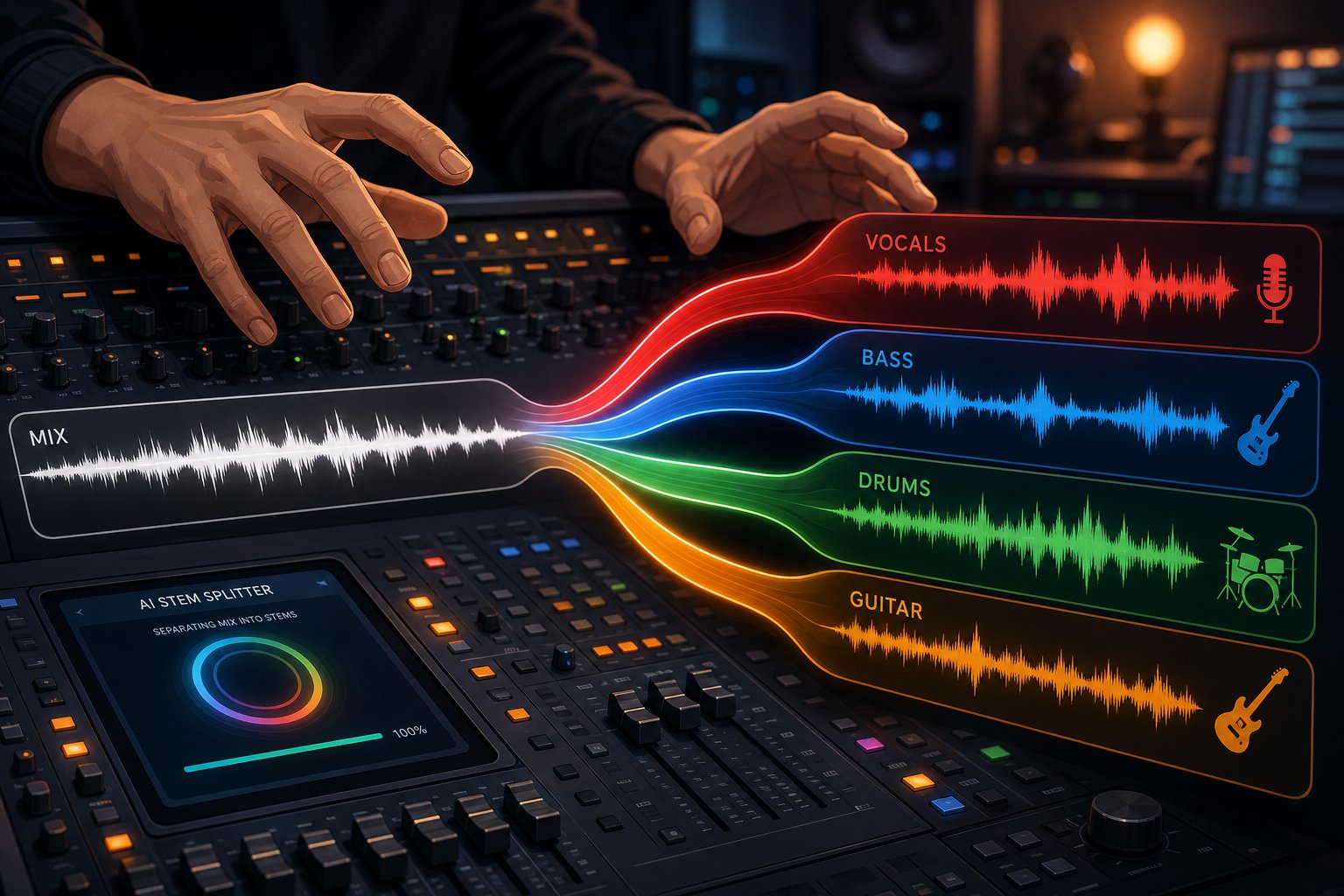
There is a way to get your hands on this question. Instead of debating whether machines truly comprehend sound, you can watch them work, observe what they detect, where they succeed, and where they lose the thread. One of the most revealing entry points is stem separation: the process of breaking a mixed audio track into its individual components, isolating vocals from drums, bass from guitar, melody from accompaniment.
This is not a random starting point. It mirrors exactly how music students learn. A composition teacher does not hand you a finished symphony and say "understand this." They have you pull it apart. Listen to the bass line alone. Follow just the vocal melody. Track the harmonic rhythm underneath everything else. Understanding music, for humans, has always involved decomposition. You learn the whole by studying the parts and grasping how they relate.
AI stem separation tools operate on the same principle, but from the computational side. They convert a mixed signal into a spectrogram, apply trained neural networks to classify frequency patterns by source, and reconstruct individual stems as separate audio files. The result lets you hear what the model "hears" when it listens to a track. Where does it draw the line between a vocal and a guitar? How cleanly can it isolate a bass line buried under distortion? These are testable questions, and the answers reveal something concrete about the current state of machine audio perception.
Exploring AI Listening Through Stem Separation
Modern AI stem separation relies on deep learning architectures, often U-Net models or attention-based transformers, trained on labeled datasets of isolated instrument recordings. According to Soundverse's technical breakdown, the process follows a clear pipeline: the mixed track is converted to a spectrogram, machine learning models analyze spectral patterns to identify each component's sonic fingerprint, the model predicts which frequencies belong to which stem, and the system reconstructs clean separate audio files for each predicted source.
What makes this relevant to the understanding question is what it exposes about AI's perceptual limits. A human musician separating parts by ear brings contextual knowledge: they know that the bass is likely doubling the root of the chord, that the vocal phrasing follows the lyric's natural speech rhythm, that the drum fill signals a section change. The AI has none of that context. It works purely from spectral patterns, frequency signatures learned across thousands of examples. When it succeeds, it demonstrates Level 1 and Level 2 competence on the spectrum outlined earlier. When it fails, smearing a vocal into a guitar because their harmonics overlap, it shows precisely where statistical pattern matching runs out of road.
This makes stem separation a uniquely hands-on way to explore the impact of AI on the music industry at a granular, audible level. You do not need to read a research paper to grasp the difference between machine processing and human understanding. You just need to listen to what the AI got right and what it missed.
Turning the Abstract Question Into Hands-On Discovery
If you want to test this yourself, MakeBestMusic's Audio Separator offers a practical starting point. It lets musicians, students, remixers, and creators upload a track and receive separated stems, giving you a direct window into how AI decomposes music at the component level. Feed it a dense mix and examine the results. Where does the model excel? Where does it struggle? The answers tell you something real about how far machine perception currently reaches.
Here are concrete ways to use stem separation as an investigative tool:
- Separate stems to study arrangement choices — isolate individual layers to hear how a producer balanced competing elements, revealing structural decisions invisible in the full mix
- Isolate vocals to examine melodic structure — strip away instrumentation to focus on melody, phrasing, and rhythmic delivery without harmonic distraction
- Extract instrumental layers for remix and study — pull out bass lines, drum patterns, or guitar parts to analyze technique, loop them for practice, or repurpose them in new creative contexts
- Compare AI separation accuracy against human ear training — test whether you can hear distinctions the model misses, or whether the model catches subtleties your ear overlooked, calibrating both machine and human perception simultaneously
Each of these exercises does something philosophy alone cannot: it makes the abstract question tangible. You stop debating whether AI understands music in theory and start observing what it perceives in practice. Will AI get better at helping with making music? Almost certainly. These tools improve with each generation of model architecture and training data. But improvement at decomposition is not the same as improvement at comprehension. A system that perfectly separates every stem in a gospel recording still does not know why the congregation sings.
That gap, between increasingly precise perception and persistently absent understanding, is where the question lives. And it is a gap you can explore yourself, not by waiting for philosophers to reach consensus, but by feeding a song into a separator, listening to what comes back, and asking: is this understanding, or is this something else entirely? The answer you arrive at may depend less on what the machine does and more on what you believe understanding requires. Either way, the exploration starts with a single track pulled apart into its elements, waiting for someone, human or otherwise, to hear what it means.
