


Inside Deezer's Automated AI Music Detection System
Imagine scrolling through a streaming platform and having no idea whether the song playing was crafted by a human artist or generated entirely by a machine in seconds. That scenario is already reality. Deezer, the Paris-based streaming service, now receives nearly 75,000 fully AI-generated tracks every single day, accounting for roughly 44% of all daily uploads. Over 13.4 million AI-generated tracks have been detected and tagged on the platform to date. The sheer volume makes one thing clear: the flood of synthetic music is not a future problem. It is happening right now.
So how does Deezer detect AI music at this scale? The answer lies in a patented, automated classification system — a tool built specifically to identify fully AI-generated tracks and label them transparently for listeners. Rather than silently removing synthetic content, Deezer tags it and excludes it from algorithmic recommendations and editorial playlists. The goal is not censorship. It is transparency and financial integrity for every artist in the royalty pool.
What Is Deezer's AI Music Detection System
At a high level, the Deezer AI music detection system is an automated pipeline that analyzes incoming tracks for signatures unique to synthetic audio. Launched in January 2025, it uses patent-pending methods to distinguish content produced by generative models like Suno and Udio from music recorded and performed by humans. When a track is classified as fully AI-generated, a visible label is applied so listeners can make informed choices about what they hear.
In December 2024, Deezer filed two patents focused on different methods of detecting unique signatures that separate synthetic content from authentic recordings. The company has not disclosed the full technical details of its approach, which means some elements remain proprietary. This article breaks down what is publicly known, what can be reasonably inferred from patents and official statements, and where the boundaries of public knowledge end.
The Scale of AI Music on Streaming Platforms
The numbers tell a striking story. When Deezer first launched its detection tool in early 2025, about 10,000 AI tracks arrived daily. By September, that figure hit 30,000. By November, it reached 50,000. The latest data shows nearly 75,000 per day — a growth rate that shows no sign of slowing.
97% of listeners could not tell the difference between fully AI-generated music and human-made music in a blind test — according to a Deezer-commissioned study conducted by Ipsos across 9,000 people in 8 countries.
That single statistic reveals why automated AI music detectors are essential. When human ears fail at the task, only algorithmic systems can operate at the speed and accuracy required to keep pace with tens of thousands of daily uploads. Manual review is simply not viable when nearly half of all incoming content is synthetic and virtually indistinguishable from the real thing.
The detection technology is not just an internal safeguard. Deezer now licenses its AI detection tech to the broader music industry, signaling confidence that this system works at scale. Understanding how it works — the mechanics behind classification, the signals it reads, the pipeline from upload to label — is the focus of everything that follows.
Why Algorithmic Detection Became Essential
Could you pick out an AI-generated song in a lineup? Chances are, you could not. A Deezer-commissioned study conducted by Ipsos across 9,000 respondents in eight countries found that 97% of people failed to distinguish fully AI-generated music from human-made tracks in a blind listening test. That is not a minor gap in perception — it is a near-total inability. And it explains precisely why relying on human review to identify synthetic content was never going to work.
Why Human Ears Cannot Reliably Spot AI Music
Think about what that 97% figure means in practice. If you hired a team of trained listeners and asked them to review every track uploaded to a streaming platform, they would miss nearly all of the AI-generated content. Even music professionals struggle to hear the telltale artifacts that once made synthetic audio obvious — the slightly mechanical timing, the unnatural vocal transitions, the sterile frequency response. Modern generative models like Suno and Udio have closed that quality gap dramatically.
When you combine this perception problem with the volume of uploads — 75,000 AI-generated tracks hitting Deezer alone every day — manual detection becomes mathematically impossible. A human reviewer listening to each track in full would need over 3,000 hours of continuous listening daily just to keep up. Even spot-checking a fraction of uploads would produce results no better than random guessing. This is why algorithmic detection matters: machines can analyze audio signatures, metadata patterns, and behavioral signals at a speed and consistency that human ears simply cannot match.
The Streaming Fraud Problem AI Detection Solves
The inability to tell if music is AI generated is not just an academic curiosity. It has real financial consequences. Deezer's data reveals that up to 85% of streams on fully AI-generated tracks are fraudulent — driven by bots that artificially inflate play counts on cheap synthetic content. The playbook is straightforward: generate thousands of low-effort filler tracks using AI, upload them to streaming platforms, then use bot farms to stream each track just enough times to collect royalties without triggering obvious red flags.
The Michael Smith case illustrates this pattern clearly. The North Carolina musician allegedly extracted more than $10 million in royalty payments by uploading hundreds of thousands of AI-generated songs and using bots to play each one a modest number of times. Enough to generate revenue, not enough to arouse suspicion — at least initially.
Every fraudulent dollar pulled from the royalty pool is a dollar that does not reach legitimate artists. As Morgan Hayduk, Co-CEO of fraud detection service Beatdapp, puts it: each point of market share in streaming is worth hundreds of millions of dollars. Streaming fraud siphons at least a billion dollars annually from the finite pool meant for real creators. AI music streaming fraud detection is not about policing creativity. It is about protecting the financial ecosystem that supports working musicians.
Deezer's automated detection system addresses several interconnected problems simultaneously:
- Royalty fraud prevention — Identifying and demonetizing bot-driven streams on synthetic content so fraudulent actors cannot extract payments from the shared royalty pool
- Catalog pollution control — Keeping millions of low-effort filler tracks from burying genuine releases in an ocean of noise, which distorts recommendation algorithms and reduces discoverability for real artists
- Listener trust — Giving fans transparency about what they are hearing, since 80% of surveyed listeners agree that fully AI-generated music should be clearly labeled
- Artist protection — Ensuring that investment in discovering, signing, and developing human artists is not undermined by synthetic content flooding the same marketplace
With over 13.4 million AI tracks detected and tagged on Deezer in 2025 alone, the scale of this challenge demands automation. No team of human moderators could review that volume of content with any meaningful accuracy. The detection system is not a philosophical statement about whether AI music should exist — it is an infrastructure response to a financial integrity crisis that only machines can solve at the required speed.
The real question, then, is not whether automated detection is necessary. It is how the technology actually works — what signals it reads, what models it runs, and what happens inside the pipeline between the moment a track arrives and the moment it receives a classification.
The Technical Methods Behind AI Music Detection
Every AI music generator leaves traces — microscopic fingerprints embedded in the audio itself. The challenge is reading them at scale. Think of it like this: Shazam identifies a song by converting audio into a unique fingerprint and matching it against a known database. YouTube's Content ID does something similar for copyright enforcement. Deezer's ai detector music system operates on a related principle, but instead of asking "which song is this?" it asks "was this song made by a machine?" The answer comes from analyzing multiple layers of evidence simultaneously.
Deezer has not published the full technical specifications behind its two patents, but between public statements, academic research in deepfake audio detection, and known methods in the field, we can map out how ai music detection algorithms work in practice.
Spectral Analysis and Audio Fingerprinting Methods
Spectral analysis is the foundation of nearly every system designed to detect music ai generators produce. The core idea is straightforward: convert raw audio into a visual representation called a spectrogram, then look for patterns that differ between synthetic and organic recordings.
A spectrogram shows how the frequencies in an audio signal change over time. The horizontal axis represents time, the vertical axis represents frequency, and color intensity shows how loud each frequency is at a given moment. When a neural network analyzes this image, it can detect visual patterns that correlate with specific musical attributes — or, in this case, with synthetic generation artifacts.
Research presented at ISMIR 2025 demonstrated that the deconvolution layers inside neural audio generators produce systematic spectral peaks at predictable frequency intervals. These peaks are architecture-dependent, meaning they exist regardless of what training data the generator used. A simple logistic regression model with just 10,000 parameters achieved over 99% accuracy detecting these artifacts in both open-source and commercial generators like Suno and Udio. In practical terms, spectral analysis ai music detection catches a kind of metallic high-frequency shimmer that marks audio as synthetically generated.
Beyond basic spectrograms, detection systems examine Mel-Frequency Cepstral Coefficients (MFCCs), which represent the spectral envelope of sound in a way that mirrors human perception of timbre and pitch. AI-generated audio typically shows different MFCC distributions than human recordings, particularly in the higher coefficients that capture fine spectral detail. Phase coherence is another signal — human recordings have naturally chaotic phase relationships between frequency components, while AI generators often produce audio with anomalously low phase entropy, creating impossibly perfect relationships that do not occur in real acoustic environments.
Understanding audio at the component level — isolating vocals from instruments, separating beats from harmonic content — is central to how these detection methods work. If you want hands-on insight into this kind of audio decomposition, MakeBestMusic's Audio Separator lets you split any track into its individual stems. It is a practical way for musicians and curious listeners to see how a piece of music breaks down into its constituent parts, which is exactly the type of analysis that underlies spectral detection technology.
Neural Network Classifiers for AI Pattern Recognition
Spectral analysis provides the raw features. Neural network classifiers do the actual decision-making. The process follows a supervised learning approach: train a model on a large labeled dataset of known AI-generated and known human-made tracks, then deploy that model to classify new uploads.
Research in deepfake audio detection shows that Convolutional Neural Networks (CNNs) are particularly effective for this task because they excel at recognizing spatial patterns in spectrogram images. The training process works like this: the model receives a labeled spectrogram, produces a classification guess, compares that guess against the correct answer, and adjusts its internal weights. Repeat this across hundreds of thousands of examples, and the network learns which visual patterns correspond to synthetic generation.
State-of-the-art systems go further by using ensemble approaches — combining multiple models trained on different spectrogram types (Short-time Fourier Transform, Constant-Q Transform, Wavelet Transform) and fusing their predictions. Research demonstrates that ensembling multiple spectrograms with multiple model architectures significantly outperforms any single detector. One ensemble system achieved an Equal Error Rate of just 0.03 on the ASVspoof 2019 benchmark, meaning it misclassified only 3% of samples in either direction.
Transfer learning also plays a role. Models pre-trained on massive image or audio datasets — architectures like ConvNeXt, Swin Transformers, and even OpenAI's Whisper — can be fine-tuned for AI music detection. These models arrive with a deep understanding of audio patterns and need relatively little additional training to distinguish synthetic from organic content.
Metadata Heuristics and Behavioral Signals
Audio analysis alone does not tell the full story. Detection systems also examine metadata and behavioral patterns surrounding a track's upload. Imagine an account that uploads 500 tracks in a single day, each exactly 90 seconds long, distributed through a service known for bulk AI content. None of those metadata signals prove a track is AI-generated on their own, but stacked together they dramatically increase the confidence score.
Behavioral heuristics might include upload frequency and volume, distributor reputation scores, account history patterns, track length uniformity, and even naming conventions. These signals act as a pre-filter — flagging suspicious content for deeper audio analysis while allowing obviously legitimate uploads to pass through with minimal friction.
A fourth detection layer is emerging through watermark detection. Standards like C2PA and Google's SynthID embed imperceptible watermarks directly into AI-generated audio at the point of creation. These watermarks survive compression, format conversion, and basic post-processing. As the EU AI Act mandates machine-readable watermarks in AI-generated content by August 2026, this layer will become increasingly important alongside spectral and behavioral methods.
| Detection Method | What It Examines | Strengths | Limitations |
|---|---|---|---|
| Spectral Analysis | Frequency patterns in mel-spectrograms, MFCCs, phase coherence | Catches architecture-dependent artifacts with high accuracy; works on raw audio without metadata | Can be evaded by resampling or post-processing through analog hardware; performance varies across generators |
| Neural Network Classifiers | Learned patterns across large labeled datasets of AI vs. human audio | Adapts to new generators through retraining; ensemble approaches achieve very low error rates | Requires continuous retraining as generators improve; risk of overfitting to specific platforms |
| Metadata Heuristics | Upload patterns, distributor flags, account behavior, track uniformity | Fast pre-screening at scale; catches bulk upload fraud patterns before audio analysis | Cannot confirm AI generation alone; legitimate artists with high output may trigger false positives |
| Watermark Detection | Embedded identifiers from C2PA, SynthID, or generator-specific markers | Definitive proof of AI origin when present; survives compression and format changes | Only works if the generator embeds watermarks; easily stripped by non-compliant tools; not yet universal |
In practice, robust detection requires combining all four approaches into a multi-signal fusion system. No single method is foolproof — research shows that detectors trained on one platform can collapse in accuracy when tested against a different generator. But by layering spectral evidence, neural network confidence scores, behavioral signals, and watermark checks, the system builds a composite picture that is far more resilient than any individual technique.
That composite picture produces a number — a confidence score — that determines what happens next. The question shifts from "can we detect it?" to "what does the system do with that detection?" And that answer depends entirely on how the pipeline processes each track from the moment it arrives.
The Detection Pipeline From Upload to Label
A track enters Deezer through a distributor, and within seconds it either passes clean or gets flagged. But what actually happens in those seconds? The ai content detection pipeline is not a single algorithm making a binary yes-or-no call. It is a multi-stage process where each layer adds information, narrows uncertainty, and builds toward a final classification. Here is how the deezer ai track classification process unfolds step by step.
From Upload to Classification in Seconds
Picture the journey a track takes from the moment it lands on Deezer's servers. Each upload passes through a sequence of checkpoints — some lightning-fast metadata scans, others computationally intensive audio analyses. According to Deezer's creator documentation, AI detection happens during the upload process itself, meaning tagging is immediate rather than retroactive.
The full pipeline looks like this:
- Ingestion — The track arrives via a distributor (DistroKid, TuneCore, CD Baby, etc.) and enters Deezer's processing queue along with its associated metadata, including artist name, distributor ID, upload history, and track specifications.
- Initial Screening — Automated metadata and behavioral checks run first. The system examines upload frequency, account patterns, distributor reputation, track length uniformity, and any known flags associated with the source. This stage acts as a fast pre-filter — a quick ai music check that sorts obviously legitimate uploads from suspicious ones before committing heavier computational resources.
- Deep Audio Analysis — The track's raw audio is processed through classifier models. Spectral features are extracted, neural network classifiers evaluate the audio against trained patterns, and watermark detection scans for embedded identifiers like C2PA or SynthID markers. Multiple models may run in parallel, each producing its own prediction.
- Confidence Scoring — Each classifier outputs a probability score between 0 and 1, representing its confidence that the track is fully AI-generated. These individual scores are fused into a composite confidence value. If that value exceeds a predetermined threshold, the track is classified as AI-generated.
- Human Review Layer — Edge cases that fall near the decision boundary get flagged for manual assessment. Tracks where the system is uncertain — perhaps scoring between 0.4 and 0.7 — may receive additional scrutiny from a human reviewer before final classification.
- Tagging — Once classified, a visible AI label is applied to the track's metadata. This label is what listeners see on the platform, providing transparency without removing the content entirely.
- Policy Action — Separate from detection, policy systems determine consequences. AI-tagged tracks are excluded from algorithmic recommendations and editorial playlists, though they remain fully available through direct search. Royalty payments continue, but fraudulent streaming patterns on tagged content may trigger demonetization.
Deezer processes this pipeline at enormous scale. With roughly 75,000 AI-generated tracks arriving daily — approximately 44% of all uploads — every stage must execute in near real-time. That is how ai music gets flagged on streaming platforms operating at this volume: not through leisurely review, but through automated systems that compress what would take a human hours into a matter of seconds.
Confidence Scoring and the Human Review Layer
The confidence score is where nuance lives. A track generated entirely by Suno from a text prompt might score 0.98 — near certainty. A human-produced track with no AI involvement might score 0.02. But what about the tracks in between? A song where a musician used AI-assisted mastering, or one where a small AI-generated loop sits underneath live instrumentation?
The threshold matters enormously. Set it too low and you flood listeners with false positives — legitimate human artists tagged incorrectly. Set it too high and synthetic content slips through undetected. The sweet spot involves balancing precision (how many tagged tracks are actually AI) against recall (how many actual AI tracks get caught). Deezer's system has been "extensively tested" against content from major AI generation tools, according to their official documentation, suggesting the threshold is calibrated for high precision on fully AI-generated content rather than casting an overly wide net.
For tracks that land in the uncertain middle zone, a human review process exists. Artists who believe their content has been incorrectly tagged can appeal through their distributor, who escalates the concern to Deezer's team. A manual review follows, and if the tagging was incorrect, it gets corrected. This safety valve is critical — no classifier is perfect, and giving creators a path to contest errors maintains trust in the system.
One crucial distinction worth emphasizing: detection and policy are separate systems operating independently. A track can be identified as AI-generated without being removed from the platform. Deezer's deliberate approach is transparency, not censorship. The AI label informs listeners. The policy layer determines visibility and monetization rules. These are distinct decisions made by distinct parts of the infrastructure.
That separation raises a deeper question. If the system can detect fully synthetic tracks with high confidence, how does it handle the spectrum of AI involvement? Not every AI music tool works the same way, and not every generator leaves the same fingerprints.

Which AI Generators Can Deezer Actually Detect
Not all AI music generators are created equal, and they are not equally detectable either. Each platform uses a different architecture, a different audio synthesis pipeline, and a different approach to turning prompts into finished tracks. Those differences matter enormously for ai music generator detection accuracy — a system trained to catch one generator's fingerprints may completely miss another's.
So can Deezer detect Suno AI music? What about Udio, Boomy, or AIVA? The answer is more nuanced than a simple yes or no.
Detection Across Different AI Music Generators
Deezer has publicly confirmed that its detection tool identifies 100% AI-generated music from the most prolific generative models, specifically Suno and Udio, with the capability to add detection for other tools as relevant training data becomes available. These two platforms dominate the synthetic music landscape on streaming services, so targeting them first makes strategic sense.
Academic research confirms why some generators are easier to catch than others. A 2025 study published in TISMIR found that Suno is consistently the easiest AI platform to identify — its audio exhibits lower spectral centroid values, reduced high-frequency content, and a distinctive acoustic phasing that detection systems pick up reliably. Udio, by contrast, produces audio that more closely resembles the characteristics of human-made recordings from commercial catalogs. Classifiers still catch Udio at high rates (over 96% in controlled tests), but it generates more confusion with the non-AI class than Suno does.
Boomy presents a completely different challenge. The same research tested multiple detection systems against Boomy-generated tracks and found alarming results: the commercial IRCAM Amplify detector identified only 37% of Boomy tracks as AI-generated. Simpler classifiers trained on Suno and Udio data performed even worse — some catching as few as 11% of Boomy samples. The likely reason? Boomy appears to use symbolic generation followed by sample-based sequencing, producing audio that passes through a fundamentally different synthesis pipeline than the waveform-based generators that most detectors are trained against.
This cross-platform generalization gap is the central technical challenge in deezer ai music detection. Here is how the major generators stack up along the detection spectrum:
- Suno — Fully synthetic, text-to-audio waveform generation. Leaves strong spectral artifacts including acoustic phasing and reduced pitch salience. Highest detection confidence across all tested systems.
- Udio — Fully synthetic, text-to-audio generation with higher fidelity output. Audio characteristics overlap more with commercial recordings, making detection slightly harder, though still achievable at high accuracy.
- Boomy — Appears to use symbolic/MIDI-based generation with sample sequencing rather than direct waveform synthesis. This different pipeline leaves fewer of the spectral fingerprints that detectors are typically trained to spot. Significantly harder to detect with systems not specifically trained on its output.
- AIVA — Composition-focused tool that generates scores often rendered through high-quality virtual instruments or live performance. Because the final audio may pass through standard production chains, detection relies more on compositional patterns than synthesis artifacts.
- Soundraw — Generates royalty-free background music using a combination of AI composition and pre-recorded audio elements. The hybrid approach blurs the line between fully synthetic and AI-assisted.
The pattern is clear: generators that produce fully synthetic audio from text prompts (Suno, Udio) leave the most detectable signatures. Tools that generate music symbolically and then render it through conventional audio pipelines are considerably harder to catch. Deezer acknowledges this spectrum by stating it has made "significant progress in creating a system with increased generalizability, to detect AI-generated content without a specific dataset to train on" — suggesting active work on closing the cross-platform gap.
The Arms Race Between Generation and Detection
Every improvement in generation quality puts pressure on detection systems. When Suno releases a new model version that reduces its characteristic phasing artifacts, detectors trained on the old version lose accuracy overnight. When Udio upgrades its neural codec to produce higher-fidelity output, the spectral differences between its tracks and human recordings shrink further. This is a textbook arms race — and both sides are evolving rapidly.
The TISMIR research demonstrated this vulnerability concretely. Simply resampling AI-generated audio from 44.1 kHz to 22.05 kHz caused a commercial detection system to misclassify Suno tracks entirely. Basic audio transformations like pitch shifting or codec re-encoding also degraded detector performance dramatically. These are not sophisticated adversarial attacks — they are common post-processing steps that any user could apply. If simple manipulations fool detectors, determined bad actors with more advanced techniques pose an even greater challenge.
Deezer's response to this arms race comes through patent-protected innovation. In December 2024, the company filed two patents for its AI detection technology, each focused on a different method of identifying unique signatures that distinguish synthetic content from authentic recordings. While the full patent claims are not publicly detailed, the filing structure — two separate patents covering two distinct detection methods — strongly suggests a multi-signal fusion approach. Rather than relying on a single detection technique that any one generator improvement could defeat, the system likely combines independent evidence streams that would need to be evaded simultaneously.
Deezer's own published research, authored by Gabriel Meseguer-Brocal and Romain Hennequin from Deezer Research, frames this challenge honestly. Their paper acknowledges that detection is "a cat-and-mouse game, where it is illusory to anticipate all cases in advance" and recommends treating AI music detection like antivirus software — requiring continual updates as new threats emerge rather than a one-time deployment. The fact that Deezer now licenses its detection technology commercially suggests the system has matured beyond a static model into something closer to an evolving service, with ongoing model updates as new generators appear.
The philosophical question underneath all of this: how much AI involvement makes a track "AI music"? A song generated entirely from a text prompt is unambiguous. But what about a track where a human wrote the melody, an AI generated the backing instrumentation, and a human performed the vocals? Or a piece where every note was composed by a human but mastered by an AI tool? The boundary between fully AI-generated and AI-assisted is not a bright line — it is a gradient. And where detection systems draw that line determines which ai music tools get flagged and which pass through as legitimate human creation.
Deezer currently targets the unambiguous end of that spectrum: fully AI-generated content where no meaningful human creative contribution exists. But as AI tools become more deeply integrated into ordinary music production workflows, the classification challenge will only grow more complex — and the industry's response will need to evolve alongside it.

How Other Streaming Platforms Compare to Deezer
Deezer built its own automated detection engine. But what are other platforms doing about AI-generated music? The answer varies wildly — and the streaming platforms ai music detection comparison reveals fundamentally different philosophies about who should be responsible for identifying synthetic content.
Deezer vs Spotify Approach to AI Content
The spotify vs deezer ai music policy gap comes down to one core difference: who does the detecting. Deezer runs its own classifier against every incoming track — no reliance on honesty from uploaders or distributors. Spotify takes the opposite approach. Its system depends on voluntary disclosure through the DDEX metadata standard, where labels and distributors tag AI involvement in credits. If no one discloses, Spotify has no automated way to identify the content independently.
How does Spotify handle AI generated music in practice? It launched a music spam filter targeting mass-produced or fraudulent uploads, and it explicitly bans unauthorized AI voice clones. But these are enforcement tools aimed at bad behavior, not detection tools that analyze audio. Spotify removed over 75 million spammy tracks in a 12-month period, yet the company has no publicly confirmed equivalent to Deezer's spectral-analysis-based classifier. The gap is philosophical: Spotify treats AI disclosure as a shared responsibility across the industry, while deezer ai detection treats it as an internal engineering problem to solve.
How Apple Music and YouTube Music Handle AI Tracks
Apple Music rolled out AI transparency metadata tags requiring labels and distributors to disclose when AI was used in artwork, audio, composition, or video. The policy centers on labeling rather than banning — but like Spotify, it depends entirely on the supply chain being honest. Apple does not scan audio for synthetic signatures. If a distributor delivers an AI-generated track without the proper metadata, Apple has no automated backstop to catch it.
YouTube Music takes a different angle. Its policy treats "raw" AI audio with minimal human input as low-value content, making it ineligible for monetization or subject to removal. The emphasis falls on "transformative human input" — commentary, performance, or storytelling layered on top. Non-disclosed or non-transformative AI music faces limited reach or demonetization. YouTube has the infrastructure for content analysis through Content ID, but its AI policy still relies heavily on creator disclosure and manual enforcement rather than a purpose-built synthetic audio classifier.
Among newer entrants, Qobuz stands closest to Deezer, having released an "AI Charter" with a proprietary detection tool and a commitment to 100% human-curated recommendations. Bandcamp went furthest by explicitly banning music "produced entirely or mainly by AI." Every other major platform falls somewhere on the spectrum between trust-based disclosure and active enforcement.
| Platform | Detection Method | Transparency Approach | Policy Stance | Scale of AI Content Identified |
|---|---|---|---|---|
| Deezer | Automated audio classifier (patented) | Visible AI label on tracks | Allowed with label; excluded from recommendations; fraudulent streams demonetized | 13.4M+ tracks tagged; ~75,000 AI uploads daily |
| Spotify | Distributor disclosure via DDEX standard | AI credits in Song Credits (beta) | Allowed with disclosure; voice clones banned; spam filter removes mass-produced content | 75M spammy tracks removed in 12 months (not all AI-specific) |
| Apple Music | Metadata tags from labels/distributors | Required AI transparency tags | Transparency-focused; no hard ban; relies on partners to define "AI content" | Not publicly disclosed |
| YouTube Music | Disclosure-based with Content ID infrastructure | Disclosure required; non-compliance penalized | Raw AI ineligible for monetization; transformative human input required | Not publicly disclosed |
| Qobuz | Proprietary detection tool (AI Charter) | Tags AI content; 100% human-curated playlists | Excludes "industrially generated AI content" from editorial features | Not publicly disclosed |
| Bandcamp | Manual review and user reports | Removal of flagged content | Explicit ban on music produced entirely or mainly by AI | Not publicly disclosed |
The table reveals a striking pattern. Most platforms delegate the identification problem to someone else — distributors, labels, or uploaders themselves. Deezer is the only major streamer that has publicly deployed and patented an automated audio-level detection system capable of classifying tracks without relying on anyone in the supply chain to be truthful. That distinction matters enormously when you consider that bad actors uploading synthetic content for royalty fraud have zero incentive to self-disclose.
These different approaches reflect different bets about the future. Spotify and Apple are betting that industry-wide standards and good-faith disclosure will scale. Deezer is betting that trust alone is insufficient and that only technology can verify what technology creates. Both philosophies have merit, but only one produces a classification the moment a track arrives — before any damage to the royalty pool occurs.
Detection, though, is only half the story. What a platform does after identifying AI content — whether it removes, labels, demonetizes, or simply ignores — is an entirely separate decision with its own set of consequences for creators and listeners alike.
What Happens After a Track Gets Flagged as AI
Identifying a track as AI-generated and deciding what to do about it are two completely different actions. Many discussions — and many competitor articles — blur these into a single event, as if detection automatically means removal. It does not. On Deezer, detection is a technical process. Policy is a philosophical choice. Understanding the gap between them is essential to grasping how the platform actually treats synthetic content once the classifier has done its work.
Detection vs Policy Are Two Separate Systems
Think of it this way: a smoke detector identifies smoke. What happens next — whether you evacuate, open a window, or check if someone just burned toast — is a separate decision made by a separate system (you). Deezer's architecture works on the same principle. The detection engine outputs a classification: this track is fully AI-generated. A completely independent policy layer then determines the consequences.
This separation is deliberate. It means Deezer can update its detection models without changing platform rules, and it can adjust policy without retraining classifiers. The two systems evolve independently based on different inputs — detection improves as new generators emerge, while policy adapts based on industry norms, user feedback, and legal developments.
In practice, the Deezer AI content policy operates along a spectrum of actions once a track receives the AI-generated classification:
- Visible labeling — A clear AI-generated tag appears on the track, visible to any listener browsing the platform. This is mandatory and cannot be opted out of.
- Algorithmic exclusion — AI-tagged tracks are automatically removed from algorithmic recommendations and editorial playlists. Fans can still find the music through direct search or the artist's page, but the platform will not actively push it to new listeners.
- Continued availability — The track is not removed. It remains fully playable, shareable, and accessible on the platform.
- Royalty continuity — Normal streaming royalties continue for AI-tagged content. The label itself does not affect payment eligibility.
- Fraud-based demonetization — When streams on AI-tagged tracks are detected as fraudulent (bot-driven plays), those specific streams are excluded from royalty payouts. This is a fraud response, not an AI penalty.
- Storage optimization — Deezer has stopped storing high-resolution versions of AI-generated tracks, reducing infrastructure costs without affecting playback availability at standard quality.
Notice the layered approach. Detection triggers labeling. Labeling triggers recommendation exclusion. Fraud detection — a separate system entirely — triggers demonetization. No single event cascades automatically into removal. Each policy action sits at a different level of intervention, and together they form a graduated response rather than a binary accept-or-reject decision.
Why Deezer Labels AI Music Instead of Removing It
Why not just delete synthetic tracks entirely? Deezer has made a conscious philosophical choice here, and the reasoning is worth examining.
Deezer's CEO Alexis Lanternier stated the platform's position clearly: "transparency for fans and protecting the rights of artists and songwriters" — not prohibition of AI content altogether.
Removal would be censorship. Some AI-generated music is uploaded legitimately — experimental artists exploring synthetic tools, hobbyists sharing creative projects, producers testing ideas. Blanket deletion punishes legitimate use alongside fraud. Labeling preserves listener choice without making value judgments about artistic merit.
The market data supports this approach. Despite AI-generated tracks representing 44% of daily uploads, they account for only 1-3% of total streams on the platform. Listeners, when given transparency through visible labels, naturally gravitate toward human-made music. The market self-corrects once information asymmetry is removed. You do not need to ban content that audiences already choose to skip — you just need to make sure they know what they are hearing.
This tiny consumption share also reveals something about intent. If 44% of uploads generate only 1-3% of streams, and 85% of those streams are fraudulent, the math paints a clear picture: most AI-generated uploads exist to game the system, not to reach real listeners. When Deezer removes fraudulent streams from the royalty pool, the financial incentive collapses without any need to remove the tracks themselves.
For listeners, the practical experience is straightforward. You browse the platform, find a track, and if it was generated entirely by AI, you see a label telling you so. No guessing required. No need to develop your own ear for how to spot AI music — the system handles that identification for you and presents the result transparently. You then decide whether to press play or move on.
For artists, the implications depend on how they use AI. Fully synthetic tracks get tagged and excluded from recommendations but remain available and continue earning standard royalties on legitimate streams. AI-assisted production — using AI for mastering, mixing, or as a creative tool within a human-driven workflow — is explicitly not the target. Deezer's system focuses on fully AI-generated content, not production tools used in traditional music-making.
This distinction between what the system detects and what the platform does about it matters enormously for independent musicians navigating AI tools in their own creative process. The detection engine draws a line. The policy layer determines which side of that line carries consequences — and for whom.
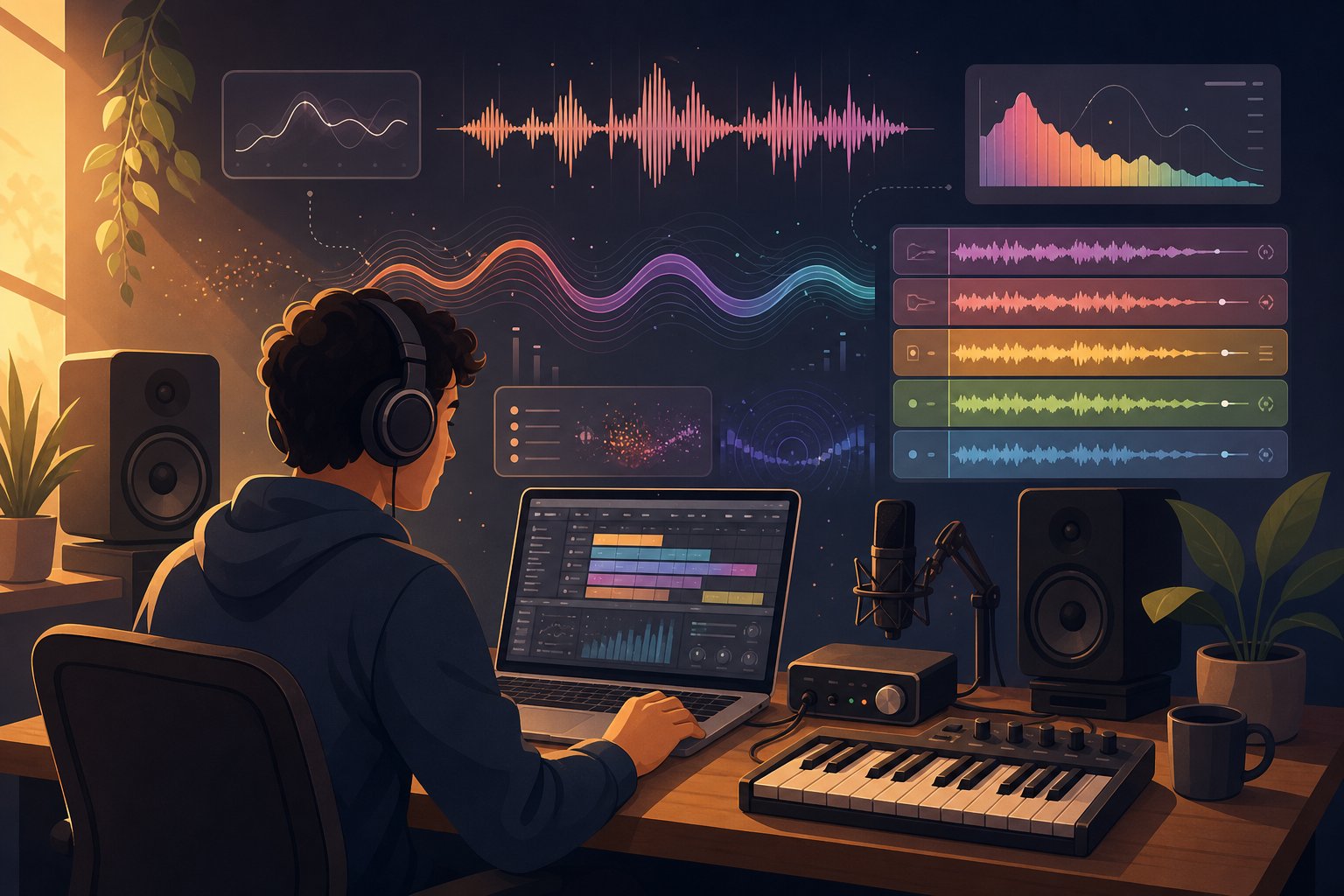
What AI Detection Means for Independent Musicians
You produce your own music. Maybe you use AI to master your final mix, or you run a reference track through a stem separator to study the arrangement. Perhaps you lean on an AI tool for chord suggestions when you hit a creative wall. Does any of that put your releases at risk of being flagged?
This is the question keeping independent creators up at night — and the answer requires understanding a distinction that detection systems themselves are built around. The line between fully AI-generated content and AI-assisted production is not just a philosophical debate. It is the boundary that determines whether your music gets tagged or passes through untouched.
AI-Assisted vs Fully AI-Generated Music
Deezer's detection system targets one specific category: tracks created entirely by AI from a text prompt with no meaningful human creative contribution. Type a sentence into Suno, receive a finished song, upload it to a distributor — that is the workflow the classifier is designed to catch. The audio itself carries the spectral fingerprints of synthetic generation because every element was produced by a neural network rather than captured from a physical performance or deliberate human composition.
AI-assisted music is fundamentally different. When a human writes lyrics, performs vocals, arranges instruments, and makes creative decisions throughout the process — using AI only for specific production tasks — the resulting audio carries the signatures of human recording. Real microphones capture real room reflections. Human timing introduces natural micro-variations. Live performance creates the kind of phase complexity and spectral diversity that synthetic generators struggle to replicate. These are exactly the signals that classifiers read as "human-made."
The distinction matters technically, not just philosophically. AI-assisted music with significant human input produces audio that looks and sounds like human-produced music to a classifier because it fundamentally is human-produced music — augmented by tools, but driven by a person. Detection systems trained on fully synthetic output from Suno and Udio are looking for architecture-dependent artifacts that simply do not exist when AI plays a supporting role in an otherwise human workflow.
So will ai tools get my music flagged? If you are writing, performing, and producing your own tracks while using AI for specific production tasks, the answer is almost certainly no. Here are legitimate AI-assisted workflows that are unlikely to trigger detection:
- Stem separation for remixing or study — Using AI-powered tools to isolate vocals, drums, bass, or instruments from a reference track or your own mix. This is an analysis and production technique, not content generation.
- AI mastering — Services like LANDR or iZotope's AI-assisted mastering apply EQ, compression, and loudness optimization to your finished mix. The audio content remains yours; the AI only processes its final presentation.
- AI-suggested chord progressions with human performance — Getting harmonic ideas from an AI tool, then actually playing those chords yourself on a real instrument. The performance is human. The suggestion is just a starting point.
- Vocal tuning and pitch correction — Auto-Tune and Melodyne have used algorithmic pitch correction for decades. Newer AI-enhanced versions improve accuracy but do not change the fundamental nature of the recorded vocal.
- AI-assisted mixing suggestions — Tools that recommend EQ curves, compression settings, or panning positions based on analysis of your tracks. You make the final decisions. The AI offers guidance.
- Beat and loop generation as compositional seeds — Using AI to generate a drum pattern or melodic fragment that you then modify, layer with live performance, and integrate into a larger human-directed arrangement.
The common thread across all of these: a human remains the creative driver. AI handles specific technical tasks within a larger human-directed process. The final audio retains the acoustic characteristics of human production — real recordings, natural timing, physical space — rather than exhibiting the telltale spectral uniformity of fully synthetic generation.
Tools That Help Creators Understand Audio Analysis
If you want to understand how your own music looks to a detection system, the best approach is to inspect it at the component level. Breaking a track into its individual stems reveals what each layer contributes sonically — and gives you practical insight into whether your production carries the characteristics of organic audio or synthetic generation.
MakeBestMusic's Audio Separator is built for exactly this kind of exploration. It lets musicians, students, remixers, and producers separate any track into its component parts — vocals, drums, bass, and other instruments — giving you a hands-on way to inspect how each element sounds in isolation. For independent artists wondering how their production reads at the signal level, this kind of decomposition is genuinely educational. You can hear whether your vocal stem sounds like a captured human performance or whether an instrument layer carries the spatial flatness associated with synthetic audio.
Beyond self-inspection, stem separation serves practical creative purposes that sit firmly in the AI-assisted category. Remixers use it to extract elements for reinterpretation. Producers study arrangements by isolating individual parts. Students learn mixing by examining how professional tracks are balanced. Cover artists pull instrumental stems to practice against. None of these workflows generate new synthetic content — they analyze and repurpose existing audio, which is a fundamentally different activity from text-to-music generation.
Other ai music tools for independent artists that fall into the legitimate production-assistance category include DAW-integrated stem splitters like Logic Pro's Stem Splitter and Steinberg SpectraLayers, AI-powered mixing assistants, intelligent EQ tools that adapt to source material, and composition aids that suggest harmonic or rhythmic ideas without generating finished audio.
The key distinction that ties everything together: tools that help you make better music are categorically different from tools that make music instead of you. Deezer's detection system is calibrated to identify the latter. If your creative process involves human decision-making, human performance, and human direction — regardless of which AI tools assist along the way — your music occupies a fundamentally different classification space than a track generated from a text prompt in seconds.
That said, the boundary is not static. As AI tools grow more sophisticated and more deeply embedded in production workflows, the question of how to identify ai music will keep evolving. Musicians who understand what detection systems actually look for — spectral signatures, synthesis artifacts, behavioral patterns — are better positioned to use AI tools confidently, knowing their human-driven work sits clearly on the right side of the line.
